Case Report

Bone Turnover Alterations after Completing a Multistage Ultra-Trail: A Case Study

by
Carlos Castellar-Otín
1,
Miguel Lecina
2,* and
Francisco Pradas
1
1
ENFYRED Research Group, Faculty of Health and Sports, University of Zaragoza, 22002 Huesca, Spain
2
Faculty of Health and Sports, University of Zaragoza, 22002 Huesca, Spain
*
Author to whom correspondence should be addressed.
Healthcare 2022, 10(5), 798; https://doi.org/10.3390/healthcare10050798

Submission received: 7 March 2022 / Revised: 13 April 2022 / Accepted: 23 April 2022 / Published: 25 April 2022
(This article belongs to the Special Issue Improving Athletes’ Performance and Avoiding Health Issues)

Abstract

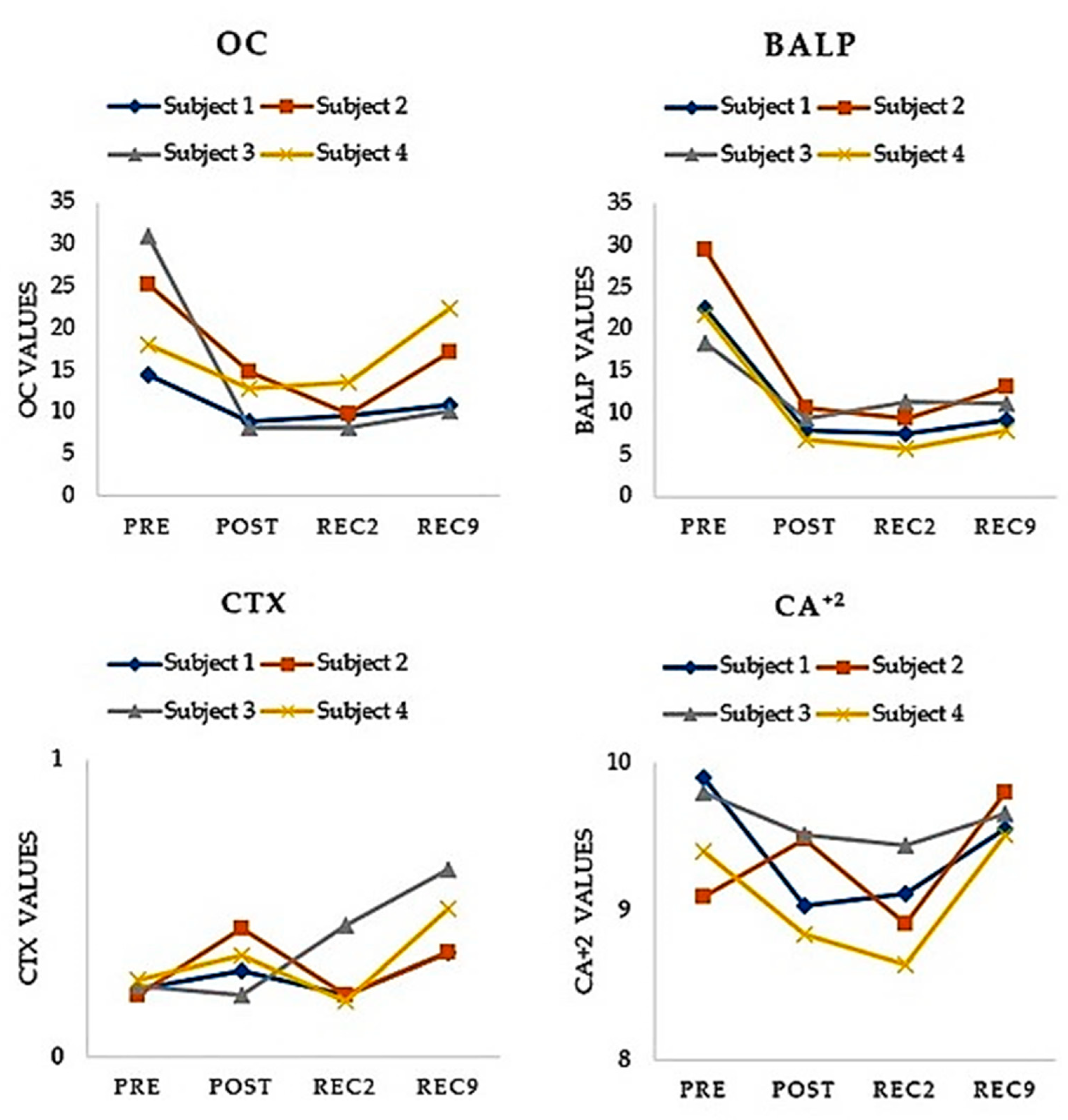
A series of case studies aimed to assess bone and stress fractures in a 768-km ultra-trail race for 11 days. Four nonprofessional male athletes completed the event without diagnosing any stress fracture. Bone turnover markers (osteocalcin (OC), serum C-terminal cross-linking telopeptide of type I collagen (CTX), bone-specific alkaline phosphatase (BALP), and serum turnover calcium (Ca2+)) were assessed before (pre) and after the race (post) and on days two and nine during the recovery period (rec2 and rec9), respectively. Results showed: post-pre-OC = −45.78%, BALP = −61.74%, CTX = +37.28% and Ca2+ = −3.60%. At rec2 and rec9, the four parameters did not return to their pre-run levels: OC, −48.31%; BALP, −61.66%; CTX, +11.93% and Ca2+, −3.38%; and OC = −25.12%, BALP = −54.65%, CTX = +93.41% and Ca2+ = +3.15%), respectively. Our results indicated that the ultra-trail race induced several changes in bone turnover markers, uncoupling of bone metabolism, increased bone resorption: OC and BALP and suppressed bone formation: CTX and Ca2+. Bone turnover markers can help determine the response of bone to extreme effort and might also help predict the risk of stress fractures.
Keywords: ultra-endurance; bone mass density; bone remodelling markers; bone formation; bone resorption ultra-endurance; bone mass density; bone remodelling markers; bone formation; bone resorption