Abstract
Given a graph G without isolated vertices, a total Roman dominating function for G is a function such that every vertex u with is adjacent to a vertex v with , and the set of vertices with positive labels induces a graph of minimum degree at least one. The total Roman domination number of G is the smallest possible value of among all total Roman dominating functions f. The total Roman domination number of the direct product of the graphs G and H is studied in this work. Specifically, several relationships, in the shape of upper and lower bounds, between and some classical domination parameters for the factors are given. Characterizations of the direct product graphs achieving small values () for are presented, and exact values for are deduced, while considering various specific direct product classes.
MSC:
05C69; 05C76
1. Introduction
The present investigation is devoted to describe several contributions to the theory of total Roman dominating functions while dealing with the direct (or tensor or Kronecker) product of two graphs. Studies concerning parameters in relation to domination in graphs are very frequently present in recent years. This might probably be caused by the popularity of some classical problems, like for instance Vizing’s conjecture [1,2] for domination in Cartesian products. The conjecture claims that the cardinality of the smallest dominating set of the Cartesian product of two graphs is at least equal to the product of the domination numbers of the factor graphs involved in the product. See [3], for a survey and recent results concerning this conjecture. Several other problems concerning domination parameters in product graphs have occupied the mind of a significant number of investigators. Works of that type concerning direct product graphs are [4,5,6,7].
The (total) Roman domination variants are among the most popular topics of domination in graphs. Both versions have had their birth in connection with some defense strategies related to the ancient Roman Empire (see [8,9]). Studies on (total) Roman domination in product graphs have not escaped from the researcher’s attention. For instance, [10,11,12,13] are aimed to these goals, although no works appear that considers the Roman domination parameters for the case of direct products. We hence continue with giving new contributions to the theory of parameters related to domination in graph products, specifically we center our attention on the total Roman domination version for the case of the direct product of graphs.
In this work, we consider simple graphs without isolated vertices. For a function and a set of vertices , the weight of S under f is . Moreover, the weight of f is . Since the function f generates three sets such that , , we shall write .
A function is known to be a Roman dominating function on G whenever all vertices have at least one neighbor . In connection with this, the parameter of G called Roman domination number stands for the least weight among all functions that are proved to be Roman dominating on G. This parameter is usually represented as . Such concepts in the theory of graphs were formally introduced in [14], motivated in part by some domination strategies which arose from the antique Roman Empire (see for instance [8,9]). A Roman dominating function is called a total Roman dominating function if induces a graph without isolated vertices. The total Roman domination number of G stands for the minimum possible weight among all total Roman dominating functions on G. This parameter is denoted . By a -function we mean a total Roman dominating function whose weight equals precisely . These concepts of total Roman domination were first introduced in [15] by using some more general settings. The concepts were further specifically introduced and first well studied in [16]. Some other recent studies on total Roman domination in graphs are for example [17,18,19].
A set is called a packing set of G, if for every two different integers . The packing number of G is the cardinality of a largest possible packing set of G. We represent such cardinality as . A packing set induces a subgraph of maximum degree 0, i.e., a graph without edges. If we substitute the closed neighborhoods with open neighborhood in the definition above, then the concept of open packing sets arises. Hence, D is considered to be an open packing set whenever for any two distinct . Similarly, the parameter called open packing number of G is the cardinality of the largest possible open packing set of G. We write this cardinality by using the notation . We recall that any open packing set represents a set of vertices of the graph which induces a graph with the maximum degree equal to one, and clearly, it could have some vertices whose degree equals zero.
A set is total dominating if all the vertices of the whole graph G have at least a neighbor in the set D. The cardinality of the smallest total dominating set of G is known as the total domination number of G. This cardinality is then represented as . A set being total dominating and with cardinality is said to be a -set. The graph G is called an efficient open domination graph, if there is a total dominating set of G which is simultaneously also an open packing.
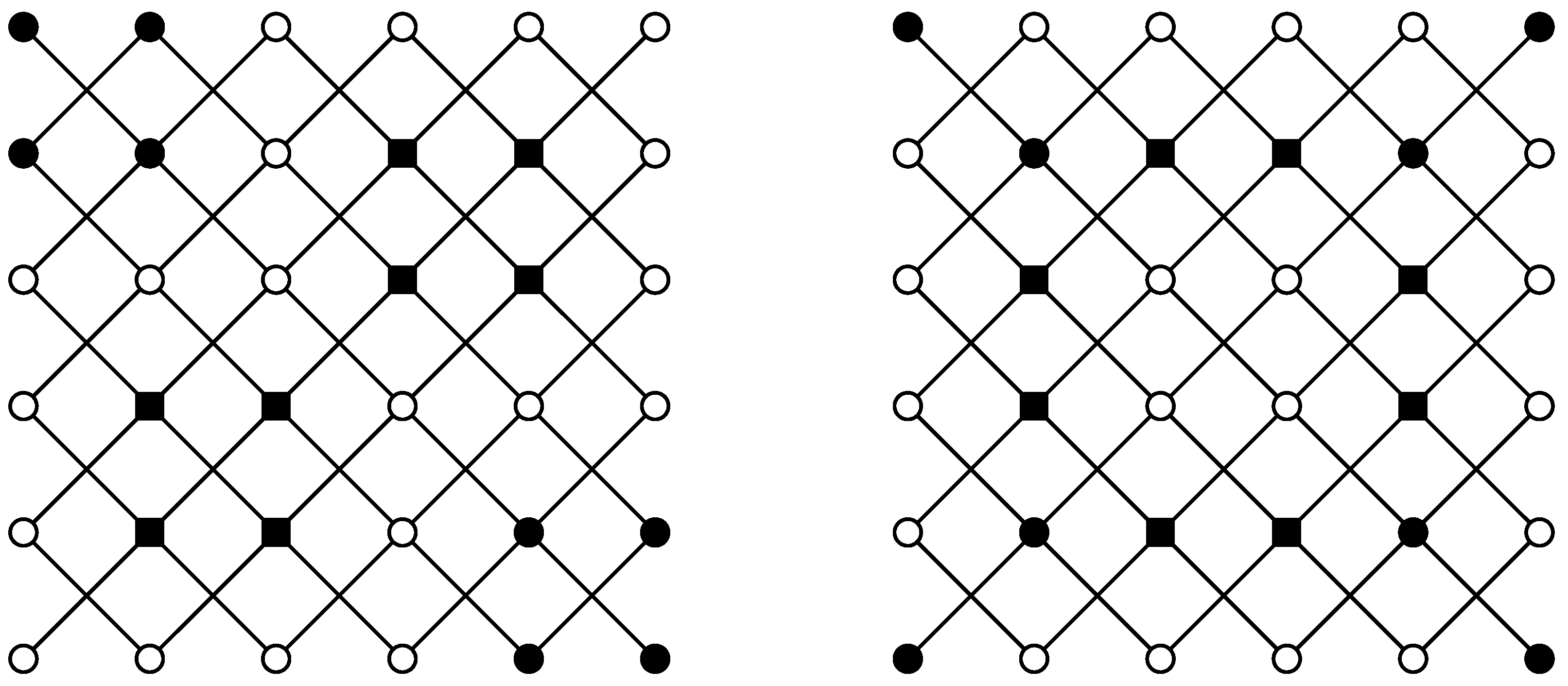
The direct product (also known as tensor product or Kronecker product) of two graphs G and H is the graph denoted by whose vertex set is given by and the edge set is the Cartesian product of the vertex sets of the factors, i.e., . The example is shown in Figure 1. As usual, we call the map a projection of onto G and the map a projection of onto H. The set is called a G-layer through and contains all vertices that project to h. An H-layer through is similarly defined. Please note that vertices from a G-layer and from an -layer form an independent set of .
Figure 1.
Two total Roman dominating functions on where vertices in are white circles, vertices in are black circles and black squares represent vertices in .
The direct product is a graph product (see the exhausting monograph on graph products [20]) in categorical sense, as the end vertices of every edge from project to end vertices of edges in both factors. Consequently, one of the most natural products among all graph products is precisely the direct product, but on the other hand, this also makes this product the most elusive one in many perspectives. Therefore, the connectedness of both factors G and H does not imply the connectedness of the product . (Notice that from Figure 1 is not connected.) To achieve this, one of the factors must also be non-bipartite, see Theorem 5.9 in [20]. One reason for this is that layers form independent sets in . On the other side, the open neighborhoods behave “nicely”, with respect to the factors, while making a direct product based on the fact
Two different total Roman dominating functions on are presented in Figure 1.
The degree of the vertex v in G is represented as the cardinality of the open neighborhood of v, i.e., . The maximum degree of a vertex in a graph G is denoted by . Clearly, as we consider only simple graphs with no isolated vertices. A leaf of G is a vertex with degree and in contrast, if , then the vertex v is called a universal vertex. For the specific case of the direct product of two graphs G and H, we recall that and by (1).
2. General Bounds
We start our exposition with some lower and upper bounds for which are mainly depending on , , and .
Theorem 1.
If is a -function (with maximum cardinality of ) and is a -function (with maximum cardinality of ), then
Proof.
We consider a function f on defined as follows. If , then ; if , then ; and otherwise. If , then since and , there exist two vertices and such that and . Thus, it follows and . Now, consider a vertex such that . If , then there exist two vertices and such that and . Thus, it follows and . Finally, if with , then a symmetrical argument to the above one produce a similar conclusion.
Consequently, we deduce f is a total Roman dominating function on the direct product , which leads to
Now, in order we deduce the lower bound, a -function f and a -set are considered. Hence, for any integer , we construct a function on H as follows: for any vertex , we set .
If , then there is a vertex for which . If , then there exists a vertex such that and . Moreover, note that in this case and that . Now, if , then there exists a vertex such that . In such situation, we similarly get and .
On the other hand, if , then for every vertex we have . In particular, for the vertex , there exists a vertex with and . Hence, for the vertex it is satisfied and .
As a consequence of these arguments, we deduce that is a total Roman dominating function on H whose weight is less than or equal to , i.e., . Hence, we have the following.
By the symmetry of the product, we also deduce that , and this ends the proof for the case of the lower bound. ☐
Since every graph of order at least three contains at least one total Roman dominating function whose weight equals the total Roman domination number and at least one vertex labeled two, the following result is directly deduced from the result above.
Corollary 1.
For all graphs G and H of orders at least three,
Notice that we can avoid the remarks about maximum cardinality of and in Theorem 1. However, the bound is better if we take a -function and a -function with maximum cardinality of and , respectively. The proof of the upper bound from Theorem 1 remains valid for any total Roman dominating functions g and h of graphs G and H without isolated vertices, respectively, as long as we exchange and by and , respectively, in the last step of the proof. Therefore, we can improve the upper bound of Theorem 1, as we next show.
Remark 1.
For every two graphs G and H,
where such minimum value is understood for every pair of total Roman dominating functions and on G and H, respectively.
Despite the fact that the bound above represents an advance with respect to the upper bound of Theorem 1, we have no knowledge of one pair of graphs G and H where the bound given in Remark 1 is better than the upper bound of Theorem 1.
Let be a -set. Clearly, the function total Roman dominating for G and the weight of g is . Remark 1 yields the following connection.
Corollary 2.
For any graphs G and H,
If the graphs G and H represent efficient open domination graphs, then and (see [21], Observation 1.1), and Corollary 2 implies the following.
Corollary 3.
If the graphs G and H represent efficient open domination graphs, then .
A graph G is known to be a total Roman graph if it satisfies that . In the case of two total Roman graphs we can develop the upper bound of Corollary 2 to the following result.
Corollary 4.
If G and H are two total Roman graphs, then
Another consequence of Theorem 1 can be deduced by using open packings instead of packings, since for any graph G.
Corollary 5.
For any graphs G and H of orders at least three,
The bound given in Theorem 1 can be enhanced by a factor of 2, whenever one factor is bipartite and the other without triangles as shown next.
Theorem 2.
If G is a triangle free graph and H is a bipartite graph of order at least two without isolated vertices, then
Proof.
Let f and S be defined in a similar manner to that of the proof of Theorem 1 for the lower bound. Clearly, for any vertex , induces a non-connected graph with at least two components. In this sense, for every and for every component of the subgraph induced by , we can construct a total Roman dominating function in the same style as in the proof of Theorem 1. This means that . A similar argument as the one used to prove Theorem 1 gives the stated bound. ☐
The bound of Corollary 5 can also be improved if we consider one bipartite factor and the other without triangles as next stated.
Theorem 3.
If G is a graph with no triangles and with a -set which induces a graph with all components isomorphic to , and H is a bipartite graph of order at least two, then
Proof.
Let f be a -function, and assume is a -set such that for every . Since H is bipartite and G is triangle free, the set induces a non-connected graph with at least two components. In concordance with this fact, by using similar arguments as those ones in the proof for the lower bound of Theorem 1, we deduce that for every , we can construct two total Roman dominating functions on H satisfying that . Therefore, we obtain that
and the proof is completed. ☐
3. Direct Product Graphs with Small
We concentrate our attention in this section on the case when is small. We shall characterize all the direct product graphs for which . For this we need the following class of graphs.
A graph G is called triangle centered if there exists a triangle in G such that every vertex of G is adjacent to at least two vertices of . We call such the central triangle of a triangle centered graph. Notice that any two vertices of a central triangle form a total dominating set of a triangle centered graph G and we have .
Theorem 4.
The following assertions holds for any two graphs G and H.
- (i)
- There are no graphs G and H for which .
- (ii)
- if and only if G and H are both isomorphic to .
- (iii)
- if and only if (G and H have at least two universal vertices each and at least one of them is of order at least three), or (one factor is and the other one is of order at least three and contains a universal vertex), or (the graphs G and H are triangle centered).
- (iv)
- if and only if both G and H have a universal vertex, one of the graph G and H has exactly one universal vertex, and the other one is different from , and only one of G and H can be triangle centered.
- (v)
- If at most one of the graphs G and H has a universal vertex, , and G and H are not both triangle centered, then .
Proof.
For notice that there must be at least two adjacent vertices and in for a -function . If , then and have label 0 and no neighbor with label 2, a contradiction. This already shows that . If , then either , which is not possible, or . In later case there are three vertices of label 1 and no vertex of label 2, a contradiction as we have . Hence .
To end with suppose that . Let first where . If and , then only one vertex from and can have label 1 and the other has label 0 and is not adjacent to a vertex of label 2, a contradiction. Therefore, either or , say . In is only one vertex, say , and it must be adjacent to both vertices of . This means that and . But then possess label 0 and is not adjacent to a vertex of label 2, a contradiction.
So let where and is adjacent to . There are only two more vertices in and these vertices must be and because they are not adjacent to . If there exists any other vertex from the mentioned four, then such a vertex implies the existence of a vertex of label 0 in , a contradiction. Hence we have only four vertices and . But in this case we have as there exists a total Roman dominating function with . This is the final contradiction and .
The implication of item follows from and the total Roman dominating function with . For of suppose that at least one of G and H contains more than three vertices. Hence and if all vertices have label 1, then . Otherwise, if , then also . Let and let be a neighbor of . If also , then we have . On the other hand, if at least one of and has label 0, then there exists a vertex of label 2 different than and , meaning that again and is done.
For we start with . We know from and that whenever at least one of G and H contains more than two vertices, which is true in all three cases. Suppose first that each G and H have at least two universal vertices and , respectively, and are of order at least three. If we set , and , then is a total Roman dominating function with . Assume now that one factor, say H, is and that G contains at least three vertices together with a universal vertex g. For we define by making , and for an arbitrary neighbor of g in G. It is easy to check that is a total Roman dominating function with . The third possibility is that both G and H are triangle centered graphs with central triangles and , respectively. We define , and . We will show that is a total Roman dominating function. First notice that induces a triangle in . Let . By the definition of the central triangle, g and h are adjacent to at least two vertices of and , respectively. Hence, there exists such that and , and is adjacent to . Therefore, f is a total Roman dominating function on with . In all three cases we have and by and the equality follows.
For the opposite implication of we have and analyze the different possibilities for the cardinalities of and for a -function . We start with and and let . As induces a graph without isolated vertices one vertex of these mentioned three, say , must be adjacent to the other two. Hence and . If , then is a vertex of label 0 not adjacent to a vertex from . Similar, if , then is a vertex of label 0 not adjacent to a vertex from . Hence and form a triangle in G and H, respectively. Suppose that there exists that is either adjacent to exactly one vertex of , say to , or to no vertex of . In both cases we obtain must has label 0, and is not adjacent to any vertex of , which is not possible for a total Roman dominating function f. Thus, every vertex must be adjacent to at least two vertices from and G is triangle centered. Similarly, one shows that H is triangle centered and the third option follows.
We continue with and . Let and be vertices of label 2. Assume first that and are adjacent. Hence, the vertices and are not adjacent to nor to and must have label 1. All the other vertices are in . Moreover, as the converse leads to a contradiction with f being a -function. Every vertex , has label 0 and is not adjacent to . Therefore, they must be adjacent to , which means that is a universal vertex of H. Similarly, every vertex , has label 0 and is not adjacent to . So, they are adjacent to , and h is a universal vertex of H. By symmetric arguments, also g and are universal vertices of G. Thus, both G and H have at least two universal vertices. If both have only two vertices, then we have a contradiction with . Therefore, we obtained the first possibility.
Let now and be nonadjacent. If they are not in the same (G- or H-) layer, then and are not adjacent to nor to and must have label 1. All the other vertices must be in . However, this is a contradiction because induces four isolated vertices. Hence, and are in the same G- or H-layer, say in . Therefore, . If there exists different , then , since there are no edges between vertices of . A contradiction again, due to no existing edges between vertices of . If , say , then and the other vertex from must be adjacent to all three vertices from . This is not possible as is contained in one of the layers , or . Again, we have a vertex from that is not adjacent to any other vertex of , a contradiction. Therefore, H contains only two vertices h and , which are adjacent and therefore both universal vertices. If both vertices from belong to the same G-layer, say , then is not adjacent to any vertex from , which is not possible. Therefore, we may assume that . Clearly , so that induces a subgraph without isolated vertices. Also every vertex must be adjacent to , which means that and g is an universal vertex of G. (Notice also that in the case when , there always exists , because otherwise we have a contradiction with .) This yields the middle case of .
To end with let and , where . Let be a neighbor of . Clearly all vertices from must be in , meaning that one of the factors is and the other contains three vertices, say . Moreover, g must be a universal vertex of G. Therefore, either or , which is the middle case of and the proof of is completed.
We continue with of . We may assume that G has exactly one universal vertex g, and that H is different from with a universal vertex h, and that at most one of G and H is triangle centered. Furthermore, let and be arbitrary neighbors of g in G and of h in H, respectively. By and we know that . If we set , and , then is a total Roman dominating function with . Hence, and the equality follows.
For of , suppose that and that is a -function. First assume that and , where and . We may also assume that as f is a -function. Vertices and are not adjacent to nor to . If , then is adjacent to both and (even if one of them equals to ). As a consequence, we have and . In other words, and form a triangle in G and H, respectively. Let g be an arbitrary vertex from and let h be an arbitrary vertex from . The vertex is adjacent to at least one vertex from (even if ). Let be a neighbor of for some . Clearly, and are not adjacent to . Hence they must be adjacent to for some , meaning that and . We see that both G and H are triangle centered graphs, and by we have , a contradiction with .
So, we can assume that either or , say that . Moreover, also as otherwise has no neighbor of label 2. If is not adjacent to some vertex , then is not adjacent to a vertex of label 2, meaning that is a universal vertex of H. Similarly, we see that is a universal vertex of G. We have by when both G and H have (at least) two universal vertices, or one is and the other contains a universal vertex, a contradiction. Hence, one of G or H has at most one universal vertex and the other is not and we are done in this case.
The second possibility is that and , where and . If and are adjacent, then , say and . Suppose that and . All the vertices of must be in and adjacent to , meaning that is a universal vertex of G. Similarly, all the vertices of must be in and adjacent to , meaning that is a universal vertex of G. This means that G is triangle centered with central triangle . By symmetric arguments H is triangle centered with central triangle . By we have , a contradiction. Therefore, either or , say . By the same arguments as above, we see that is a universal vertex of G, and that and are universal vertices of H. (Notice that is not adjacent to , otherwise also is universal vertex, a contradiction with .) If , then we have by , a contradiction. Otherwise and we are done.
Now we can assume that and are not adjacent. If and , then, as in the previous paragraph, we can choose the notation such that and that . Moreover, must be adjacent to all other vertices from to avoid isolated vertices of positive label. Vertices and are from and must have a neighbor in . The only possibility is that is adjacent to and is adjacent to . The mentioned edges imply that and , a contradiction with the not adjacency of and . It remains that and belong to the same layer, say , i.e., . Every vertex from is not adjacent to a vertex of label 2 and must poses label 1. We need also at least two vertices of label 1 outside of to assure non-isolated vertices in . This means that . Every vertex from must be adjacent to and is a universal vertex of G. If , then we have a contradiction with . So, either or , meaning that also H has a universal vertex and the second possibility is done.
The last option is that and , where . Clearly all vertices from must be in and g and h must be universal vertices of G and H, respectively. We either obtain a contradiction with (when one factor is ) or obtain that which yields the desired situation and the proof of is completed.
We conclude this proof with . We have from assertions . Let be a -set and be a -set. We set , and and claim that is a total Roman dominating function on . Let . Clearly, is neighbor of g or of , say of g, and is neighbor of h or , say h. Therefore is neighbor of and f satisfies the conditions to be total Roman dominating for . Hence, the inequality is obtained, which leads to the claimed equality. ☐
A wheel graph , , is a join of and and a fan graph , , is a join of and . Clearly and have exactly one universal vertex when . In particular, and are triangle centered whenever . For a complete graph and a maximum matching M of it, the graph , , is a triangle centered graph with a universal vertex whenever n is an odd number. By using Theorem 4 we directly obtain the next results (among others).
Corollary 6.
For integers , , , and maximum matchings M and we have
- (i)
- ;
- (ii)
- ;
- (iii)
- ;
- (iv)
- ;
- (v)
- ;
- (vi)
- ;
- (vii)
- ;
- (viii)
- ;
- (ix)
- ;
- (x)
- .
With the help from Corollary 6, we can comment the sharpness for most of the bounds from Section 2. The upper bounds of Theorem 1, of Corollary 1 and of Remark 1 are sharp by of Corollary 6. For instance that is, since the total Roman domination number of any star on at least two leaves is 3, with total Roman dominating functions of minimum weight assigning 2 to the center of the star, 1 to one of its leaves and 0 otherwise, we obtain that , by using the notations of Theorem 1. For the remaining cases, similar computations can be easily made, as well as, for the next remarked tightness situations. The upper bound from Corollary 2 is sharp by and of Corollary 6. For we have by of Corollary 6, and so for Corollary 4, its upper bound is sharp. The lower bound from Theorem 1 follows from which holds by of Theorem 4. By of Corollary 6, we show the sharpness of the bounds from Theorems 2 and 3 and Corollary 3. In conclusion, only the tightness of the bound presented in Corollary 5 remains open.
We end this section with an alternative presentation with respect to Theorem 4, where we consider the number of vertices in of a total Roman dominating function. For the minimum cardinality of , we need an additional condition that the cardinality of must be maximum to be able to characterize them.
Theorem 5.
Given two graphs G and H of orders at least three, the next items are equivalent.
- (i)
- Graphs G and H are triangle centered.
- (ii)
- .
- (iii)
- For any -function with the largest possible cardinality for , it follows .
Proof.
The direction follows from of Theorem 4.
For the direction , let where is a -function with maximum cardinality of . There exist vertices from in as there are at least nine vertices in . Consequently . Let and let be a neighbor of with . There exists at least one vertex from of label 0, because . Suppose that is a neighbor of of label 2. Assume first that . The vertices and are not adjacent to nor to . If they have label equal to 1, then all the other vertices have label 0 and every vertex is adjacent to or to . Let and be a third vertex of G and H, respectively. Clearly, and are adjacent to and with this, we have and . Similarly, and are adjacent to , and with this we get and . Let us define where , and . Clearly, is a total Roman dominating function with , a contradiction with the choice of f. Therefore, the label of and must be 0 and there exists a third vertex of label 2 that is adjacent to and . From it follows that .
Next we assume that . If also , then and and we are done. So, let . Because there exists a fourth vertex in with and all other vertices are in . Vertex is not from , because contains only and and we have at least three vertices in every G- or H-layer. Hence, and . Vertices and are not adjacent to nor to , and must therefore have label 1. This leads to , and this is not possible since is adjacent to . Hence, in all cases and this implication is done.
Let and let . As induces a graph without isolated vertices, one vertex of these mentioned three, say , must be adjacent to the other two. Thus, and . If , then is a vertex that is labeled with 0 being not neighbor of a vertex belonging to . Similarly, if , then is a vertex whose label is equal to 0 being not neighbor of one vertex from . Hence and form a triangle in G and H, respectively. Suppose there is a vertex which is either neighbor of exactly one vertex of , say to , or to no vertex of . In both cases the vertex has label 0 and is not adjacent to any vertex of , which is not possible since f is a function which is total Roman dominating. Hence, every vertex is adjacent to two or more vertices from and G is triangle centered. Similarly, one shows that H is triangle centered. ☐

4. A General Lower Bound and Its Consequences on the Direct Product
The following lower bound for depends on the order of G and its maximum degree as well as on a -function.
Theorem 6.
If is a -function of a graph G, then and . Moreover, if in addition , then the equality holds.
Proof.
Assume is a -function. Every vertex from must have one neighbor in . This means that every vertex from has no more than adjacent vertices in . With this we have
From (2) we extract and obtain the second inequality
Notice that from (2), it follows is maximum when . Now we return to (2), and add on the right side to get
that yields the first inequality. Notice that from the additional condition we get
and consequently . This connection gives the equality in the lines (2) and (3) and the proof is completed. ☐
With respect to the condition in the theorem above, we see that there are several graphs satisfying it. For instance, consider a graph , with , obtained as follows. We begin with a set of k disjoint stars on k leaves. Next, we add some edges between pairs of leaves belonging to different stars such that every leaf from all the stars will have at most one new neighbor. Observe that has maximum degree and that . Also, we observe that a function that assigns 2 to the centers of the stars (), 1 to exactly one neighbor of each center of the stars (), and 0 otherwise, is a -function. Thus, .
If we rewrite the Theorem 6 for the direct product , then we have the following.
Corollary 7.
Let G and H be any two graphs. If is a -function, then and . Moreover, if in addition , then the equality holds.
The lower bound from Theorem 6 is better when is small as possible. Also, one cannot expect that the mentioned bound behave well when there exists a small quantity of vertices with maximum number of neighbors in G. From this point of view, one can expect that Theorem 6 works at its best for regular graphs. To see this, the following known remark is necessary.
Remark 2.
([21]) If S is an efficient open dominating set of an efficient open domination graph G, then S is a -set.
Theorem 7.
If G is a regular efficient open domination graph, then .
Proof.
Let D be an efficient open dominating set of an r-regular graph G. By Remark 2 we have that D is a -set. Hence, is a total Roman dominating function on G of weight that clearly fulfills the condition . By Theorem 6 the result follows. ☐
For two graphs G and H, its direct product represents an efficient open domination graph whenever both G and H contain efficient open dominating sets. This was proved in [22]. Moreover, for the two efficient open dominating sets and of G and H, respectively, the set is an efficient open dominating set of . Hence we have the following result.
Corollary 8.
If G and H are regular graphs and they are also efficient open domination graphs, then = .
The relaxation of Corollary 8 and Theorem 7 without the condition of regular graphs is not true anymore as shown by of Corollary 6. Clearly and are efficient open domination graphs that are not regular and we have .
A prism over a graph G is a graph obtained from two disjoint copies of the graph G by adding a perfect matching between analogous vertices of each copy (or the Cartesian product ). All the prisms that are efficient open domination graphs are described in Theorem 4.3 from [21]. One 3-regular example is and for them we have .
It is well known that a cycle contains an efficient open dominating set whenever n is congruent with 0 modulo 4. Thus, the next result is clear by Corollary 8.
Corollary 9.
If m and n are positive integers divisible by 4 and and are any integers, then
- (i)
- ;
- (ii)
- ;
- (iii)
- ;
- (iv)
- .
Author Contributions
All authors contributed equally to this work. Investigation, A.C.M., D.K., I.P. and I.G.Y.; writing–review & editing, A.C.M., D.K., I.P. and I.G.Y. All authors have read and agreed to the published version of the manuscript.
Funding
This research received no external funding.
Conflicts of Interest
The authors declare no conflict of interest.
References
- Vizing, V.G. The cartesian product of graphs. Vycisl Sist. 1963, 9, 30–43. [Google Scholar]
- Vizing, V.G. Some unsolved problems in graph theory. Usp. Mat Nauk. 1968, 23, 117–134. [Google Scholar] [CrossRef]
- Brešar, B.; Dorbec, P.; Goddard, W.; Hartnell, B.L.; Henning, M.A.; Klavžar, S.; Rall, D.F. Vizing’s conjecture: A survey and recent results. J. Graph Theory 2012, 69, 46–76. [Google Scholar] [CrossRef]
- Brešar, B.; Klavžar, S.; Rall, D.F. Dominating direct products of graphs. Discret. Math. 2007, 307, 1636–1642. [Google Scholar] [CrossRef][Green Version]
- Defant, C.; Iyer, S. Domination and upper domination of direct product graphs. Discret. Math. 2018, 341, 2742–2752. [Google Scholar] [CrossRef]
- Mekiš, G. Lower bounds for the domination number and the total domination number of direct product graphs. Discret. Math. 2010, 310, 3310–3317. [Google Scholar] [CrossRef]
- Shiu, W.C.; Chen, H.-Y.; Chen, X.-G.; Sun, P.K. On the total restrained domination number of direct products of graphs. Discuss. Math. Graph Theory 2012, 32, 629–641. [Google Scholar]
- Revelle, C.S.; Rosing, K.E. Defendens imperium romanum: A classical problem in military strategy. Am. Math. Mon. 2000, 107, 585–594. [Google Scholar] [CrossRef]
- Stewart, I. Defend the Roman Empire. Sci. Am. 1999, 28, 136–139. [Google Scholar] [CrossRef]
- Martínez, A.C.; Rodríguez-Velázquez, J.A. Closed formulas for the total Roman domination number of lexicographic product graphs, manuscript. 2020; unpublished. [Google Scholar]
- Campanelli, N.; Kuziak, D. Total Roman domination in the lexicographic product of graphs. Discret. Appl. Math. 2019, 263, 88–95. [Google Scholar] [CrossRef]
- Šumenjak, T.K.; Pavlič, P.; Tepeh, A. On the Roman domination in the lexicographic product of graphs. Discret. Appl. Math. 2012, 160, 2030–2036. [Google Scholar] [CrossRef]
- Yero, I.G.; Rodríguez-Velázquez, J.A. Roman domination in Cartesian product graphs and strong product graphs. Appl. Anal. Discret. Math. 2013, 7, 262–274. [Google Scholar]
- Cockayne, E.J.; Dreyer, P.A., Jr.; Hedetniemi, S.M.; Hedetniemi, S.T. On Roman domination in graphs. Discret. Math. 2004, 278, 11–22. [Google Scholar] [CrossRef]
- Liu, C.-H.; Chang, G.J. Roman domination on strongly chordal graphs. J. Comb. Optim. 2013, 26, 608–619. [Google Scholar] [CrossRef]
- Ahangar, H.A.; Henning, M.A.; Samodivkin, V.; Yero, I.G. Total Roman domination in graphs. Appl. Anal. Discret. Math. 2016, 10, 501–517. [Google Scholar]
- Amjadi, J.; Sheikholeslami, S.M.; Soroudi, M. On the total Roman domination in trees. Discuss. Math. Graph Theory 2019, 39, 519–532. [Google Scholar] [CrossRef]
- García, S.C.; Martínez, A.C.; Yero, I.G. Quasi-total Roman domination in graphs. Results Math. 2019, 74, 173. [Google Scholar] [CrossRef]
- Martínez, A.C.; García, S.C.; García, A.C. Further results on the total Roman domination in graphs. Mathematics 2020, 8, 349. [Google Scholar] [CrossRef]
- Hammack, R.; Imrich, W.; Klavžar, S. Handbook of Product Graphs, 2nd ed.; CRC Press: Boca Raton, FL, USA, 2011. [Google Scholar]
- Kuziak, D.; Peterin, I.; Yero, I.G. Efficient open domination in graph products. Discret. Math. Theor. Comput. Sci. 2014, 16, 105–120. [Google Scholar]
- Abay-Asmerom, G.; Hammack, R.H.; Taylor, D.T. Total perfect codes in tensor products of graphs. Ars Comb. 2008, 88, 129–134. [Google Scholar]
© 2020 by the authors. Licensee MDPI, Basel, Switzerland. This article is an open access article distributed under the terms and conditions of the Creative Commons Attribution (CC BY) license (http://creativecommons.org/licenses/by/4.0/).