


Abstract
The order of appearance is an arithmetic function related to the Fibonacci sequence . This function is defined as the smallest positive integer solution of the congruence . In this paper, we shall provide lower and upper bounds for the functions , and .
Keywords:
asymptotic; arithmetic functions; inequalities; Fibonacci sequence; order of appearance; Landau symbols MSC:
primary 111B39; secondary 11N37
1. Introduction
Perhaps the most important of the binary recurrences is the Fibonacci sequence . This sequence starts with and and it satisfies the 2nd order recurrence relation (for ). A well-known, explicit, formula for the nth Fibonacci number is called the Binet-formula
where and . It follows from this formula that the estimates , hold for all .
The study of the divisibility properties of Fibonacci numbers has always been a popular area of research. For example, it is still an open problem to decide if there are infinitely many primes in that sequence. In order to study such kind of Diophantine problems, the arithmetic function was defined by setting . This function is called the order of appearance in the Fibonacci sequence. For more results on , see [1] and references therein.
In 1878, Lucas ([2], p. 300) established that is well defined and, in 1975, J. Sallé [3] proved that , for all positive integers n. This is the sharpest upper bound for , since for example
However, apart from these cases this upper bound is very weak. For instance, . In fact, Marques [4] gave sharper upper bounds for for all positive integers . These upper bounds depend on the number of distinct prime factors of n, denoted by .
In the main stream of the Analytic Number Theory, we have the three following functions
where is the well-known von Mangoldt function defined as if , for some prime number p and , and 0 otherwise (see, e.g., [5,6]). The functions and are called the first and the second Chebyshev functions, respectively. Note that can be rewritten as . Here (and in all what follows) , and mean that the sum is taken over all positive integers, all prime numbers and all prime powers belonging to the interval , respectively.
Probably, the main importance of the functions and relies in the proof of the celebrated Prime Number Theorem which states that
where is the prime counting function. Indeed, the prime number theorem and the statements and are all equivalent. Here (asymptotic equivalence) means that tends to 1 as (in another way, where means a function with ). Actually, one has the following stronger fact
Here we shall use the Landau symbols in their usual meaning, i.e., we say that (or ), if there exists a positive constant M such that , for all sufficiently large x. Also, means that and .
Another function of great interest is the harmonic function whose image for is called the xth harmonic number and denoted by . These numbers gained much attention with their relation to the Riemann hypothesis. In fact, the Riemann hypothesis is equivalent to prove that
for all , where is the sum of the positive divisors of n (see [7]). We observe that the harmonic series, i.e., is a well-studied example of divergent series. In fact, it holds that
which agrees with its very slow divergence.
In this paper, we are interested in studying the growth of the following Fibonacci versions of , and , thus, the functions , and (see Figure 1), for a positive real x, which are defined as
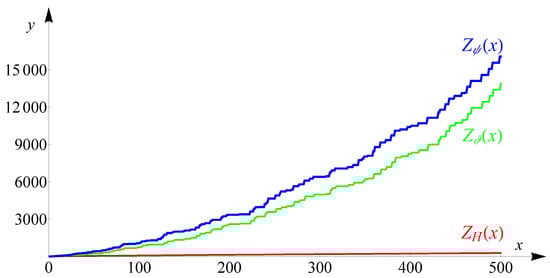
Figure 1.
The graphs of the functions , and for .
First, observe that since , then the following trivial estimates hold
However, we found the previous bounds by neglecting the contribution of (which is much bigger than 1 and much smaller than , in almost all cases). In fact, by taking into account, we obtain
Theorem 1.
We have that
For the function , if we use that , we get
Again, with an extra effort, we can improve this by proving that
Theorem 2.
We have that
Since the number of prime powers in is bigger than , a similar direct inequality (that one for ) could be derived for . However, by using the behavior of , we can obtain better estimates such as
Theorem 3.
We have that
Note that even with a larger number of possibilities in the sum of , its bounds are the same (in order) than the ones for (Theorem 2). The explanation for this, follows from the fact that the contribution, i.e., the number of powers of p (for example) belonging to is which is . In other words, this amount is almost negligible (compared with x, in terms of order).
In a few words, the proof of the results combine some new (sharper upper bounds for due to Marques) and classical results (such as results due Abel, Sathé, Selberg) in Number Theory.
2. Auxiliary Results
In this section, we shall present some tools which will be very useful in the proofs. We start with some results due to Marques [4], which will be very helpful in our proof. Thus, we shall state his results as lemmas (in what follows, the 2-adic valuation of n is ).
Lemma 1.
We have
- (i)
- (for ), (for ) and (for ).
- (ii)
- If is a prime, thenwhere, as usual, denotes the Legendre symbol of a with respect to a prime .
Lemma 2.
Let n be an odd integer number with , then
where
Lemma 3.
Let n be an even integer number with , it holds that
- (i)
- If , then
- (ii)
- If , then
- (iii)
- If , then
The next lemma is a powerful result in analytic number theory which is related to positive integers with fixed number of distinct prime factors.
Lemma 4
(Sathé–Selberg Formula). For any positive constant A, we have
for and , where
In the previous statement (for ) is the well-known Gamma function.
The proof of Lemma 4 can be found in [8,9].
Our last tool is a very useful formula due to Abel which makes an interplay between a discrete sum and an integral (continuous sum). More precisely,
Lemma 5
(Abel’s Summation Formula). Let be a sequence of real numbers and define its partial sum . For a real number , let f be a continuously differentiable function on . Then
Remark 1.
We remark that, throughout what follows, the implied constants in ≪ and ≫ can be made explicit. Here, we decided to use asymptotic bounds in order to leave the text more readable. However, we shall provide the explicit inequalities for convenience of the reader (they can be found in [10], for example).
- (i)
- ;
- (ii)
- , for and , for ;
- (iii)
- , for ;
- (iv)
- , for .
As usual, from now on we use the well-known notation , for integers .
Now we are ready to deal with the proof of our results.
3. The Proofs
3.1. The Proof of Theorem 1
Since, by definition, , then and so . Thus
Now, we shall use Lemma 5 for and . Then
Since and , then
and so .
For the second part, we use Lemmas 1, 2 and 3 to derive that
for all . First, let us write as
where . By using that , we have
which can be written as
Now, we shall use Lemma 4 to deal with the first sum in the right hand side above. Since converges uniformly and absolutely in any bounded set, we have , for some positive constant C. Now, by Lemma 4 for , we get (for ) and
Therefore,
For the second sum in the right hand side of (6), we use that to obtain
where we used that . Since , then
Thus
3.2. The Proof of Theorem 2
By the Prime Number Theorem, we have that . In particular, it holds that . Since , then
where we used that .
For the second part, since , then
as desired.
3.3. The Proof of Theorem 3
Note that, by Theorem 2, we have
For the second part, since there exist exactly powers of p in the interval , we can write as
By using Lemma 1 (ii), we get
Note that . Then,
which completes the proof.
4. Conclusions
In this paper, we study some problems related to the order (of appearance) in the Fibonacci sequence, denoted by . This arithmetic function plays an important role in the comprehension of some Diophantine problems involving Fibonacci numbers (the most important one is the open problem about the existence of infinitely many Fibonacci prime numbers). The problems are related to the growth of Fibonacci versions of well-known number-theoretic functions (related to the Prime Number Theorem) like the first and second Chebyshev functions, and and the harmonic function . These Fibonacci-like functions are defined as and . In particular, we shall find effective bounds for these three functions. The proofs combine elementary facts related to (such as Marques’ upper bounds) together with some deep tools from Analytic Number Theory (such as Abel’s summation formula and Sathé–Selberg formula).
Funding
The author was supported by Project of Excelence PrF UHK No. 2213/2020, University of Hradec Králové, Czech Republic.
Acknowledgments
The author thanks the anonymous referees for their careful corrections and very helpful and detailed comments, which have significantly improved the presentation of this paper.
Conflicts of Interest
The author declares no conflict of interest.
References
- Trojovský, P. On Diophantine equations related to order of appearance in Fibonacci sequence. Mathematics 2019, 7, 1073. [Google Scholar] [CrossRef]
- Lucas, E. Théorie des fonctions numériques simplement périodiques. Am. J. Math. 1878, 1, 289–321. [Google Scholar] [CrossRef]
- Sallé, H.J.A. Maximum value for the rank of apparition of integers in recursive sequences. Fibonacci Quart. 1975, 13, 159–161. [Google Scholar]
- Marques, D. Sharper upper bounds for the order of appearance in the Fibonacci sequence. Fibonacci Quart. 2013, 51, 233–238. [Google Scholar]
- Hast, D.R.; Matei, V. Higher Moments of Arithmetic Functions in Short Intervals: A Geometric Perspective. Int. Math. Res. Not. 2019, 21, 6554–6584. [Google Scholar] [CrossRef]
- Visser, M. Primes and the Lambert W function. Mathematics 2018, 6, 56. [Google Scholar] [CrossRef]
- Lagarias, J. An elementary problem equivalent to the Riemann hypothesis. Am. Math. Monthly 2002, 109, 534–543. [Google Scholar] [CrossRef]
- Sathé, L.G. On a problem of Hardy on the distribution of integers having a given number of prime factors. J. Indian Math. Soc. 1953, 17, 63–141. [Google Scholar]
- Selberg, A.A. Note on a Paper by L.G. Sathe. J. Indian Math. Soc. 1954, 18, 83–87. [Google Scholar]
- De Koninck, J.-M.; Luca, F. Analytic Number Theory—Exploring the Anatomy of Integers; American Mathematical Society: Providence, RI, USA, 2012. [Google Scholar]
© 2020 by the author. Licensee MDPI, Basel, Switzerland. This article is an open access article distributed under the terms and conditions of the Creative Commons Attribution (CC BY) license (http://creativecommons.org/licenses/by/4.0/).