

Abstract
In this paper, we study Hyers–Ulam and Hyers–Ulam–Rassias stability of nonlinear Caputo–Fabrizio fractional differential equations on a noncompact interval. We extend the corresponding uniqueness and stability results on a compact interval. Two examples are given to illustrate our main results.
Keywords:
Caputo–Fabrizio fractional differential equations; fixed-point theory; Hyers–Ulam stability MSC:
26A33; 34D10; 45N05
1. Introduction
In 1940, Ulam posed a question concerning the stability of homomorphisms into metric groups, a question which is regarded as the origin of the problem of stability in the theory of functional equations. In 1941, Hyers [1] answered the problem for a linear functional equation on the Banach space and established a new concept on the stability of functional equation, now called Hyers–Ulam stability. In 1978, Rassias [2] introduced a new definition of generalized Hyers–Ulam stability by the constant by a variable, and obtained the stability of Hyers–Ulam–Rassias for functional equation. There is a rich literature on this topic for standard integer-order equations (see [3,4,5,6,7,8,9,10,11,12,13,14,15,16,17]). In addition, the same stability concepts are introduced to find approximate solutions to fractional differential equations, see [18,19] and the references therein.
In 2015, Caputo and Fabrizio [20] gave a new definition of fractional derivative with a smooth kernel. Losada and Nieto [21] introduced Caputo–Fabrizio fractional differential equation the newly developed Caputo–Fabrizio fractional derivative and obtained the existence and uniqueness results under some strong restriction. Baleanu et al. [22] obtained the approximate solution for some infinite coefficient-symmetric Caputo–Fabrizio fractional integro-differential equations. Goufo [23] used the fractional derivative of the newly developed Caputo–Fabrizio without singular kernel to establish the Korteweg–de Vries–Burgers equation with two perturbation levels. Atangana and Nieto [24] studied the numerical approximation of this new fractional derivative and established an improved RLC circuit model. Moore et al. [25] developed and analyzed a Caputo–Fabrizio fractional derivative model for the HIV epidemic which includes an antiretroviral treatment compartment. Dokuyucu et al. [26] applied the fractional derivative of Caputo–Fabrizio to model the cancer treatment by radiotherapy.
Recently, Başcı et al. [27] applied the Laplace transform method to study the Hyers–Ulam stability of the following linear differential equations with Caputo–Fabrizio fractional derivative (see Definition 1):
and
Meanwhile, Liu et al. [4] presented the Hyers–Ulam stability of linear differential equations with two term Caputo–Fabrizio derivatives as follows
and applied fixed-point theorems to derive the existence and uniqueness of solution to nonlinear equations as follows
and obtained the generalized Hyers–Ulam–Rassias stability via the Gronwall’s inequality.
Observing that ([4], Theorem 3) adopted the generalized Banach fixed-point theorem instead of the standard Banach contraction mapping and weakened the condition in ([21], Theorem 1) to where denoted by the Lipschtiz constant of g, T denoted by the step of the interval and
and denotes a normalization constant depending on ·.
Based on the above observation, we apply a new fixed-point approach to show the existence and uniqueness and stability for (1) on a compact interval to a noncompact interval .
2. Preliminaries
Definition 1
(see [20]). Let , the Caputo–Fabrizio fractional derivative of order γ for a function f can be written as
where is a normalization constant depending on γ. Please note that if and only if f is a constant function.
Definition 2
(see [21] or ([4], Definition 2)). Let . The Caputo–Fabrizio fractional integral of order γ for a function f is defined as
Let be a nonempty set, we present the following definition of generalized metric on .
Definition 3
(see [3]). A function is called a generalized metric on Ω if and only if ρ satisfies
- (i)
- if and only if ;
- (ii)
- for all ;
- (iii)
- for all ;
Theorem 1
(see [28]). Let is a generalized complete metric space. Suppose is a strictly contractive operator with the Lipschitz constant . If there exists a nonnegative integer l such that for some , then the followings are true:
- (i)
- The sequence converges to a fixed point of P;
- (ii)
- is the unique fixed point of P in
- (iii)
- If , then
Definition 4
(see [4]). Let be a continuous function. Equation (7) is Hyers–Ulam stable if there exists a real number , such that for each and for any solution of
there exists a solution of (1) with
Definition 5
(see [4]). Let and be continuous functions. Equation (7) is generalized Hyers–Ulam–Rassias stable with respect to , if there exists a constant such that for any solution of
there exists a solution of (1) with
3. Main Results
Throughout this section, we denote the set Y of all continuous functions on J by
Lemma 1
(see ([3], Theorem 3.1)). Define the function with
where is a given continuous function. Then is a generalized complete metric space.
We give the following conditions:
- The function is continuous and locally Lipschitz in .
- There exists a constant such that
Now, we prove the Hyers–Ulam stability of (7).
Theorem 2.
Assume that and and hold. If the function is continuously differentiable and satisfies
for all and for some , then there exists a unique solution of
satisfying
for all , where and are defined in (2).
Proof.
Let in Lemma 1, we obtain is a generalized complete metric space.
Next, we consider the operator as follows:
for any , where . Please note that any fixed point of P solves (7). Indeed, the function in (10) is invertible, it is increasing. We denote its inverse , and G is globally Lipschitz in v and locally Lipschitz in by our assumptions. So, any fixed point of (10) satisfies
Now clearly the function is locally Lipschitz in , we see that the composition function is also locally Lipschitz in . So, any fixed point of (10) is a locally Lipschitz function, and thus it is locally absolute continuous on J. So really (10) gives solutions of (7). As a matter of fact, we need just that is invertible, i.e., is strictly monotonic in u, and we can extend our results for more general case. We shall consider (11) instead of (10).
We prove that is continuous. Let , and , we have
Then, for all , as , the right-hand side of the above inequality tends to zero (due to and ). Thus, is continuous, i.e., for all .
Then, we have
for all and . Therefore, by (9), we obtain
Similarly, we have
for all and , which implies that
that is
Next, we show that P is strictly contractive on Y. For any , we get
for all . Thus, for any and all , we have
Hence, we obtain
Therefore, P is strictly contractive on Y.
When and , the operator P satisfies all the conditions of Theorem 1.
On the other hand, by (6), we have
Remark 1.
Now we will prove the Hyers–Ulam–Rassias stability of (7).
Theorem 3.
Assume that and and hold. If a continuously differentiable function satisfies
for all and for some is a nondecreasing continuous function satisfying
for all , then there exists a unique solution of (7) satisfying
for all .
Proof.
Let in the Lemma 1, is a generalized complete metric space.
Consider defined in (10). Similar to the method of Theorem 2, we can conclude that for each and .
Next, we prove that P is strictly contractive on Y. Note
for all
For any , let be an arbitrary constant with , by (17), we obtain
Then, for each , we have
for all . Thus, for any and all , we have
that is, Hence, we obtain
Therefore, P is strictly contractive on Y. When and , the operator P satisfies all the conditions of Theorem 1.
On the other hand, by (14), we have
By simple computation, we can obtain
This yields that
By Theorem 1, there exists a unique solution of (7) satisfying
Remark 2.
Remark 3.
Compared to ([4], Theorems 3 and 5), we extend the existence and uniqueness result and the generalized Hyers–Ulam–Rassias stability result for (1) on the noncompact interval and also remove the condition from the assumptions.
4. Examples
Assume that in Definition 1 is the solution of the following equation:
Then one can derive an explicit formula (see ([21], p. 89)).
Example 1.
We consider the following equation:
and let . Obviously, and the Lipschitz condition holds with the Lipschitz constant . Then, (19) is Hyers–Ulam stable on J, for all and .
Now, let , and . We consider the following equation:
Let , for by simple calculation, we have
then
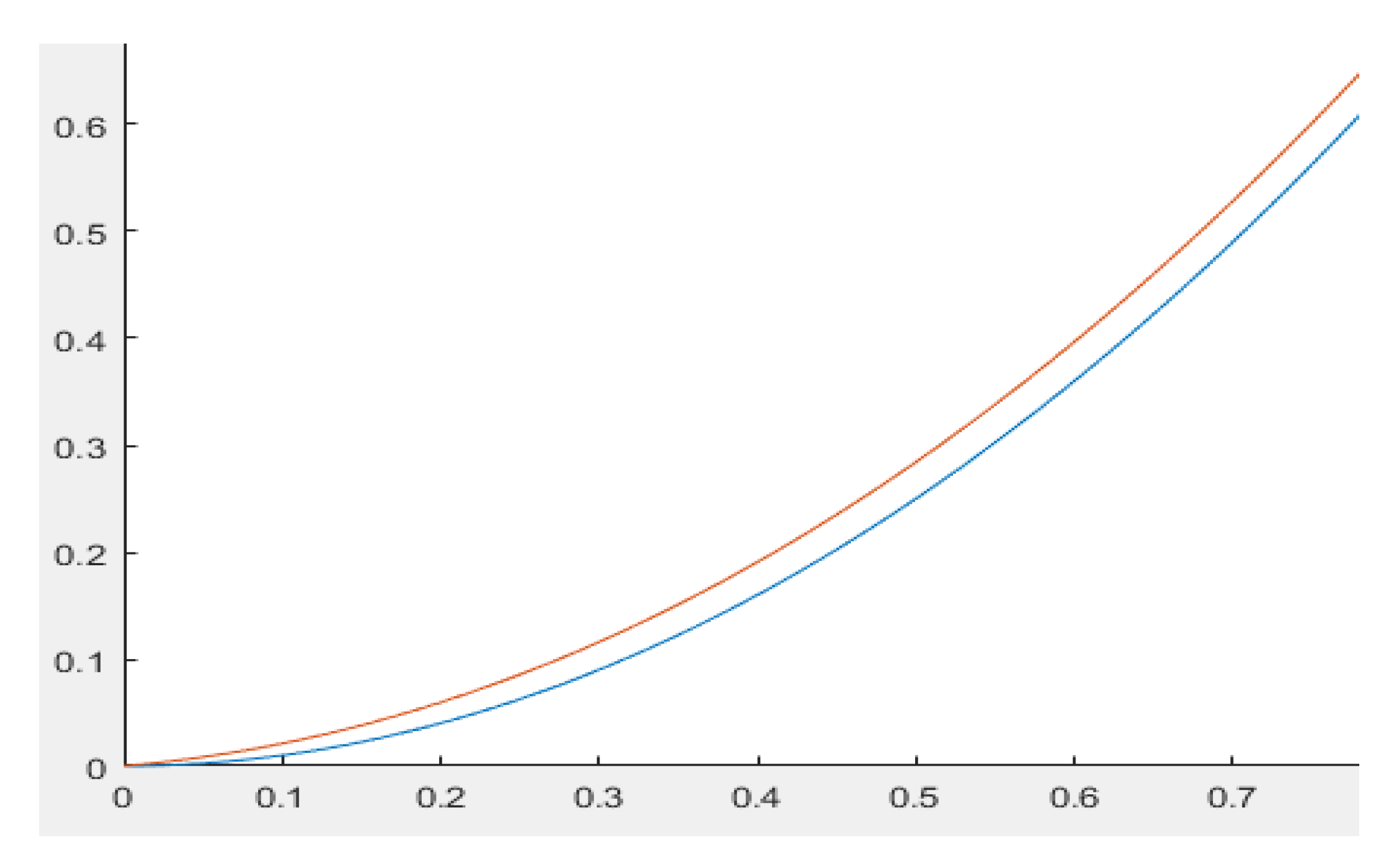
So (20) is Hyers–Ulam stable (see Figure 1). Please note that the condition in ([27], Theorem 2.6) is not required here, and moreover, (20) is Hyers–Ulam stable, too.
Figure 1.
The exact and approximated solutions of the differential equation (20) are shown by the red and blue lines, respectively.
Example 2.
We consider the following fractional problem
and the inequality
Let . Obviously holds. For any and , we have
Then the condition hold and and in ([4], Theorem 5).
Let and . (15) holds for . Therefore, in view of Theorem 3, (22) is generalized Hyers–Ulam–Rassias stable.
Here , by calculation, we have , . Then . Thus condition of Theorem 5 in [4] does not hold in this problem. Thus, ([4], Theorem 5) does not work even on .
Author Contributions
M.F. and J.W. contributed to the supervision and project administration, K.L., M.F. and J.W. contributed to the conceptualization and methodology. All authors have read and approved the final manuscript.
Funding
This work is partially supported by the National Natural Science Foundation of China (11661016), Guizhou Provincial Science and Technology Foundation ([2020]1Y002), the Slovak Research and Development Agency under the Contract No.APVV-18-0308, and the Slovak Grant Agency VEGA No.1/0358/20 and No.2/0127/20.
Acknowledgments
The authors thank the referees for their careful reading of the article and insightful comments.
Conflicts of Interest
The authors declare no conflict of interest.
References
- Hyers, D.H. On the stability of the linear functional equation. Proc. Natl. Acad. Sci. USA 1941, 27, 222–224. [Google Scholar] [CrossRef] [PubMed]
- Rassias, T. On the stability of linear mappings in Banach spaces. Proc. Am. Math. Soc. 1978, 72, 297–300. [Google Scholar] [CrossRef]
- Jung, S.-M. A fixed point approach to the stability of differential equations y′ = F(x,y). Bull. Malays. Math. Sci. Soc. 2010, 33, 47–56. [Google Scholar]
- Liu, K.; Fečkan, M.; O’Regan, D.; Wang, J. Hyers-Ulam stability and existence of solutions for differential equations with Caputo-Fabrizio fractional derivative. Mathematics 2019, 7, 333. [Google Scholar] [CrossRef]
- Başcı, Y.; Mısır, A.; Öğrekçi, S. On the stability problem of differential equations in the sense of Ulam. Results Math. 2020, 75, 6. [Google Scholar] [CrossRef]
- Liu, K.; Wang, J.; Zhou, Y.; O’Regan, D. Hyers-Ulam stability and existence of solutions for fractional differential equations with Mittag-Leffler kernel. Chaos Solitons Fractals 2020, 132, 109534. [Google Scholar] [CrossRef]
- Wang, J.; Lv, L.; Zhou, Y. Ulam stability and data dependence for fractional differential equations with caputo derivative. Elect. J. Qual. Theory Diff. Equ. 2011, 63, 1–10. [Google Scholar] [CrossRef]
- Rezaei, H.; Jung, S.; Rassias, T. Laplace transform and Hyers-Ulam stability of linear differential equations. J. Math. Anal. Appl. 2013, 403, 244–251. [Google Scholar] [CrossRef]
- Alqifiary, Q.; Jung, S. Laplace transform and generalized Hyers-Ulam stability of linear differential equations. Electron. J. Differ. Equat. 2014, 2014, 1–11. [Google Scholar]
- Wang, J.; Li, X. A uniform method to Ulam-Hyers stability for some linear fractional equations. Mediterr. J. Math. 2016, 13, 625–635. [Google Scholar] [CrossRef]
- da C. Sousa, J.; Capelas de Oliveira, E. Ulam-Hyers stability of a nonlinear fractional Volterra integro-differential equation. Appl. Math. Lett. 2018, 81, 50–56. [Google Scholar]
- Wang, J.; Zhou, Y.; Fečkan, M. Nonlinear impulsive problems for fractional differential equations and Ulam stability. Comput. Math. Appl. 2012, 64, 3389–3405. [Google Scholar] [CrossRef]
- Capelas de Oliveira, E.; Vanterler da C. Sousa, J. Ulam-Hyers-Rassias stability for a class of fractional integro-differential equations. Result Math. 2018, 73, 111. [Google Scholar] [CrossRef]
- da C. Sousa, J.; Kucche, K.; Capelas de Oliveira, E. Stability of ψ-Hilfer impulsive fractional differential equations. Appl. Math. Lett. 2018, 88, 73–80. [Google Scholar]
- da C. Sousa, J.; Capelas de Oliveira, E. On the Ulam-Hyers-Rassias stability for nonlinear fractional differential equations using the ψ-Hilfer operator. J. Fixed Point Theory Appl. 2018, 20, 5–21. [Google Scholar]
- Shah, K.; Ali, A.; Bushnaq, S. Hyers-Ulam stability analysis to implicit Cauchy problem of fractional differential equations with impulsive conditions. Math. Meth. Appl. Sci. 2018, 41, 8329–8343. [Google Scholar] [CrossRef]
- Ali, Z.; Zada, A.; Shah, K. Ulam stability to a toppled systems of nonlinear implicit fractional order boundary value problem. Bound. Value Prob. 2018, 2018, 175. [Google Scholar] [CrossRef]
- Wang, J.; Zhang, Y. Ulam-Hyers-Mittag-Leffler stability of fractional-order delay differential equations. Optimization 2014, 63, 1181–1190. [Google Scholar] [CrossRef]
- Liu, K.; Wang, J.; O’Regan, D. Ulam-Hyers-Mittag-Leffler stability for ψ-Hilfer fractional-order delay differential equations. Adv. Differ. Equal. 2019, 50, 1–12. [Google Scholar] [CrossRef]
- Caputo, M.; Fabrizio, M. A new definition of fractional derivative without singular kernel. Prog. Fract. Differ. Appl. 2015, 1, 73–85. [Google Scholar]
- Losada, J.; Nieto, J. Properties of a new fractional derivative without singular kernel. Prog. Fract. Differ. Appl. 2015, 1, 87–92. [Google Scholar]
- Baleanu, D.; Mousalou, A.; Rezapour, S. On the existence of solutions for some infinite coefficient-symmetric Caputo-Fabrizio fractional integro-differential equations. Bound. Value Prob. 2017, 145, 1–9. [Google Scholar] [CrossRef]
- Goufo, F.E.D. Application of the Caputo-Fabrizio fractional derivative without singular kernel to Korteweg-de Vries-Burgers equations. Math. Model. Anal. 2016, 21, 188–198. [Google Scholar] [CrossRef]
- Atangana, A.; Nieto, J. Numerical solution for the model of RLC circuit via the fractional derivative without singular kernel. Adv. Mech. Eng. 2015, 7, 1–7. [Google Scholar] [CrossRef]
- Moore, E.; Sirisubtawee, S.; Koonparasert, S. A Caputo-Fabrizio fractional differential equation model for HIV/AIDS with treatment compartment. Adv. Differ. Equat. 2019, 2019, 200. [Google Scholar] [CrossRef]
- Dokuyucu, M.; Celik, E.; Bulut, H.; Baskonus, H. Cancer treatment model with the Caputo-Fabrizio fractional derivative. Eur. Phys. J. Plus 2018, 133, 92. [Google Scholar] [CrossRef]
- Başcı, Y.; Öğrekçi, S.; Mısır, A. On Hyers-Ulam stability for fractional differential equations including the new Caputo-Fabrizio fractional derivative. Mediterr. J. Math. 2019, 16, 131. [Google Scholar] [CrossRef]
- Diaz, J.; Margolis, B. A fixed point theorem of the alternative, for contractions on a generalized complete metric space. Bull. Am. Math. Soc. 1968, 74, 305–309. [Google Scholar] [CrossRef]
© 2020 by the authors. Licensee MDPI, Basel, Switzerland. This article is an open access article distributed under the terms and conditions of the Creative Commons Attribution (CC BY) license (http://creativecommons.org/licenses/by/4.0/).


