1. Introduction
Multiple attribute decision making (MADM) is one of the important branches of decision science for which the principle goal is to find the best alternatives under the set of the different attributes. In it, each alternative is accessed by an expert or group of experts under the different attributes and their ratings are expressed either as a crisp number or as a linguistic number. However, in today’s challenging world, it is very common that the uncertainty plays a vital role in almost every decision-making process. Thus there is a need to handle the uncertainties in the analysis. To address this, Zadeh [
1] stated the theory of fuzzy set (FS) by defining the membership degree to each element. After their appearance, several researchers have extended their theory to its more generalized ones namely, intuitionistic fuzzy set (IFS) [
2], interval-valued IFS (IVIFS) [
3], linguistic IVIFS [
4], cubic IFS [
5], Pythagorean fuzzy set (PFS) [
6,
7], q-rung orthopair fuzzy set [
8,
9]. In the existing IFS, each element is rated by an expert in terms of membership degree
and non-membership degree
such that
, while in PFS, these conditions are extended over the unit circle as
. Since their existence, several researchers have presented the different kinds of algorithms for solving the MADM problems by using aggregation operators (AOs), similarity or distance measures, hybrid operators and so forth. The several existing approaches under the IFS or PFS environments are classified into three aspects as below:
- (1)
Approaches based on operators: Under it, several AOs are defined by the researchers to aggregate the intuitionistic fuzzy numbers (IFNs) and Pythagorean fuzzy numbers (PFNs). For instance, Xu and Yager [
10] defined the geometric operators while Garg [
11,
12] defined the interactive AOs based on the hesitance degree for the pairs of intuitionistic fuzzy numbers (IFNs). He et al. [
13] presented some interactive geometric AOs. In terms of PFSs, Yager [
7] defined the weighted averaging AOs for Pythagorean fuzzy numbers (PFNs). Garg [
14,
15] extended their AOs with Einstein t-norm operations and hence presented some generalized AOs to solve the MADM problems. Zhang [
16] presented ordered weighted while Zeng et al. [
17] defined the hybrid AOs for PFSs. Garg [
18] presented neutrality aggregation operators for PFNs to solve the MADM problems.
- (2)
Approaches based on measures: The information measure such as similarity or distance measures, correlation coefficients and so forth also play a vital role in the process of MADM problems. In the IFS environment, Li and Cheng [
19] defined the similarity measures for IFNs. Garg and Kumar [
20] defined the similarity measures for IFNs by using connection numbers of IFNs. Ye [
21] defined the cosine similarity measures for IFNs. However, under the PFS environment, Peng and Yang [
22] defined the subtraction and division operations between the two or more PFNs. Yager and Abbasov [
23] studied the relationship between the Pythagorean and complex numbers. Peng [
24] defined some new operations between the PFSs. Wei and Wei [
25] defined the similarity measure for PFS to solve the decision-making problems. Garg [
26] defined the correlation coefficient between the pairs of PFNs to solve the MADM problems.
- (3)
Approaches based on hybrid operators: Some researchers have utilized the extended operators to solve the MADM or MADM problems such as applications of the problems by using TOPSIS (“Technique for Order Preference with respect to the Similarity to the Ideal Solution”) [
27], Bonferroni mean [
28], Maclaurin symmetric mean [
29] and so forth. However, for PFSs, Nie et al. [
30] presented partitioned Bonferroni mean AOs to solve the DMPs with Shapley fuzzy measure. Wei and Lu [
31] presented a power AOs for PFS to solve MADM problems. Gao [
32] presented Hamacher Prioritized weighted AOs for PFNs. Apart from them, some interactive AOs for PFNs have been proposed by researchers in References [
33,
34,
35].
From the above extensive literature, it has been noted that IFS and PFS are widely applied in various decision making problems. However, it is observed that their approaches are limited in nature. For example, when an expert provides their information in terms of membership degree as 0.8 and non-membership degree as 0.7 then it is clearly seen that neither
nor holds. Hence, IFSs and PFSs cannot describe the information effectively. To manage such a situation, a concept of q-ROFS was introduced by Yager [
9] in which each element is characterized as a membership degree
such that
, with
interger. The q-ROFS is more effective and more general than the existing methods for handling uncertain and unpredictable information in real-decision problems with an independent degree parameter
. Clearly, when
and
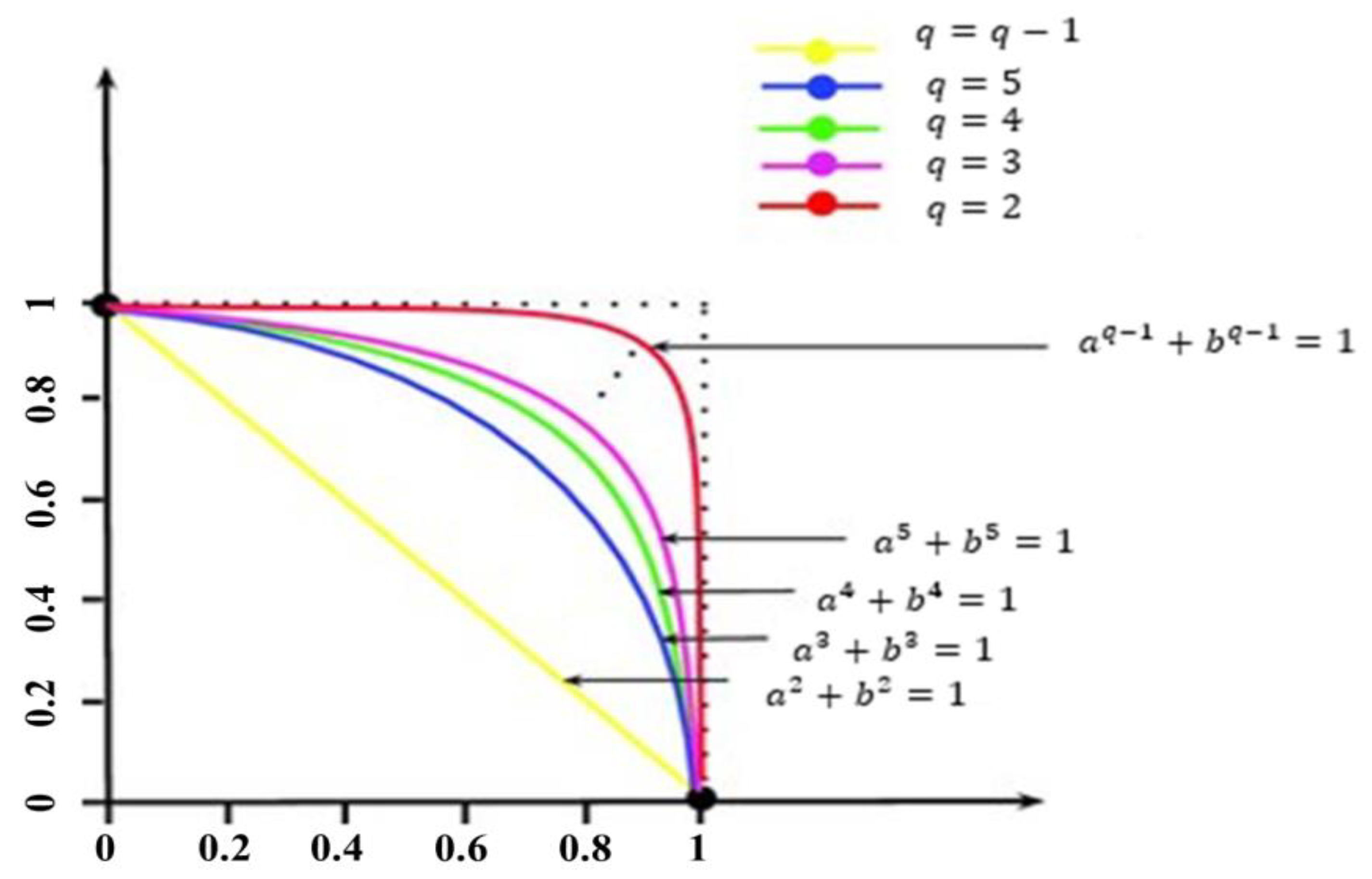
, the q-ROFS reduces to IFS and PFS respectively. Thus, the IFS and PFS are the special cases of the q-ROFS. The geometrical interpretation of q-ROFS is shown in
Figure 1. Under the q-ROFS environment, scholars have utilized it to solve the MADM problems. Liu and Wang [
36] explored the q-rung fuzzy weighted average and geometric operators. Wei et al. [
37] proposed the Heronian mean operator based on the q-ROFS to solve the MADM problems. Peng et al. [
38] proposed an exponential operation and aggregation operators for the q-ROFS. Liu and Wang [
39] presented the q-rung orthopair fuzzy Archimedean Bonferroni mean operators for decision-making problems. Liu and Liu [
40] proposed q-rung orthopair fuzzy Bonferroni mean operators and Wei et al. [
41] proposed q-rung orthopair fuzzy Maclaurin symmetric mean operators. Xing et al. [
42] impersonated the point operators for q-ROFSs. Garg and Chen [
43] developed the neutrality aggregation operators for q-ROFS to solve the MADM problems. Peng and Dai [
44] acted the multi-parametric similarity measures and its based method to solve the MADM problem under q-ROFS environment.
With the growing technologies these days, it is perceived that the above stated and similar approaches are limited in nature and are unable to handle the information which are vary with the phase of time such as “medical diagnosis”, “biometric recognition” and so forth. To deal with this, Alkouri and Salleh [
45] presented the concept of the complex IFS (CIFS) in which each element is characterized by complex-valued membership and complex-valued non-membership grades represented in polar coordinates over the unit disc. Later on, Kumar and Bajaj [
46] initiated the concept of the distance measures and entropy for complex intuitionistic soft sets. Rani and Garg [
47] presented the distance measures to compute the degree of separation between two CIFSs. In terms of AOs, Garg and Rani [
48] and Rani and Garg [
49] presented weighted and power AOs for solving the MADM problems. Alkouri and Salleh [
50] defined the complex intuitionistic fuzzy relations. Recently, Garg and Rani [
51] presented the generalized Bonferonni mean AOs for decision-making problems. Garg and Rani [
52] presented various measures for CIFS. Ullah et al. [
53] extended the concept of CIFS to a complex Pythagorean fuzzy set (CPFS). However, to study the several approaches to solve the MADM under the CIFS environment, we refer to References [
54,
55,
56].
Considering the flexibility of the complex fuzzy sets and q-ROFS to describe the uncertain information in the data, this paper presents a new concept named thecomplex q-rung orthopair fuzzy set (Cq-ROFS). To address it completely, in this paper, we extend the concept of CIFS to Cq-ROFS by taking the advantages of q-ROFS. The properties of the stated sets are also investigated. The proposed Cq-ROFS is defined under the constraint that the sum of q-powers of the real parts (imaginary parts) of the membership and non-membership grades is less than or equal to one. Further, in contrast to the standard VIKOR strategy, we have defined the VIKOR method for solving decision-making problems. Holding all the above points in mind, the primary objectives of the work are:
- (1)
To establish the concept of Cq-ROFS and its fundamental properties to handle uncertain information in the data.
- (2)
To define several powers weighted AOs to aggregate the different Cq-ROFS. Several properties and their special cases are also discussed in detail.
- (3)
In view of the merits of the VIKOR model in considering the compromise between group utility maximization and individual regret minimization, this paper introduced the novel VIKOR method for Cq-ROFS.
- (4)
Two new MADM methods, based on power operators and VIKOR methods are presented to solve the decision making problems.
- (5)
The presented approaches have been demonstrated with several numerical examples to show their superiority and advantages.
The rest of the manuscript is organized as follows: in
Section 2, some basic concepts of the existing sets are reviewed. In
Section 3, we present a new concept of Cq-ROFS and its fundamental properties. In
Section 4, we define the various power aggregation operators for Cq-ROFS and discuss their properties. In
Section 5, two new MADM methods are presented to solve the problems. In
Section 6, we illuminate the stated methods with several examples and compare their methods with the existing ones. Finally,
Section 7 concludes the paper.
3. Proposed Cq-ROFS
In this section, we present the new concept of Complex q-rung orthopair fuzzy set (Cq-ROFS) and state their properties.
Definition 9. A Cq-ROFSon finite universal set is given by:whereand,
represents the complex-valued truth and complex-valued falsity degrees, with a conditions:
.
The complex q-rung orthopair fuzzy number (Cq-ROFN) is denoted by:.
Remark 1. The hesitancy degree is denoted and defined by.
Definition 10. For a two Cq-ROFNsand, then
- (1)
iffand.
- (2)
ifand.
- (3)
.
To compare two or more Cq-ROFNs, we define the score and accuracy functions for them as
Definition 11. For Cq-ROFN,
a score function for it is defined aswhile an accuracy function H is stated as Definition 12. For two Cq-ROFNsand and by using Definition 11, we define an order relation between them as follows
- (1)
Ifthen, similarly ifthen.
- (2)
Ifandthen.
Definition 13. For a two Cq-ROFNsandand be any real number. Then
- (1)
;
- (2)
;
- (3)
;
- (4)
.
Theorem 1. For two Cq-ROFNsandwith real number, thenand as defined in Definition 13, are Cq-ROFNs.
Proof. For two Cq-ROFNs
and
and by definition of Cq-ROFN, we have
Consider
and by Definition 13, we consider
, where
and
. Since,
, then
and hence for
we have
. On the other hand,
, than
. Moreover,
, then
And we have , so similaily, . Hence proves. Similarly it can be proving that and are also Cq-ROFNs. □
Theorem 2. For any three Cq-ROFNsand, the following axioms are hold true
- (1)
;
- (2)
;
- (3)
;
- (4)
Proof. Straightforward. □
Theorem 3. For any two Cq-ROFNsandwithandare a positive real numbers, the following axioms are hold true
- (1)
;
- (2)
;
- (3)
;
- (4)
Proof. We examine part (1) and part (3), the others are straightforward.
- (1)
Let
and
be two Cq-ROFNs. Then
- (3)
Let
and
be two Cq-ROFNs. Then
Hence . □
4. Proposed Power Aggregation Operators for Cq-ROFS
In this section, we define the power weighted averaging and geometric AOs for a collection of Cq-ROFNs. Several of their properties are also investigated.
4.1. The Cq-ROFPA Operator
Let be the collections of Cq-ROFNs. Here, we introduce the concept of Complex q-rung orthopair power averaging (Cq-ROFPA) and Complex q-rung orthopair power weighted averaging (Cq-ROFPWA) operators as follows:
Definition 14. The Cq-ROFPA operator is a mapping given by:whereandrepresents is the support forfrom,
with the conditions:
;
;
and,
if,
where is distance measure.
By using the operational laws of Cq-ROFNs and by Definition 14, we examined the following result.
Theorem 4. For the collections of “
”
Cq-ROFNs ,
the aggregated value obtained through Definition 14 is again a Cq-ROFN and given bywhere is defined in Equation (10).
Proof. For two Cq-ROFNs
and
. For simplicity, we consider
and hence by applying the operational laws of Cq-ROFNs, we get
Using the additive law in Definition 13, we have
so the result is true for
. Next, we assume that the result is holds for
.
Then for
, we have
Hence, the result is true for , so the Equation (11) holds true for all natural numbers. □
The established operators based on Cq-ROFSs is more powerful due to its constraint, that is, the sum of q-powers of the real parts (imaginary parts) of the membership and non-membership grades is less than or equal to one.
To further explain its working for different numbers, we verified with the help of an example discussed below.
Example 1. Letandare four Cq-ROFNs for,
then we examinefor all.
Using the distance measure as defined in below equationand hence we compute the measurement values of each numbers and get Similarly,
and
.
Subsequently, we can obtain the support degree, such that Similarly,
and.
Furthermore, we use Equation (10) and get Similarly,
and.
Then,
Similarlyand.
Moreover,
and Then, by using operator, we get It is clear that the aggregated value is again q-ROFNs.
The proposedoperator satisfies certain properties, which are stated as below. Here, we have taken.
Property 1. When allare equal, that isfor all , then Proof. When
for all
, then, we have
,
and hence by definition of Cq-ROFPA operator, we get
□
Property 2. Letbe the family of Cq-ROFNs and letThen Proof. By Theorem 4, we considered
, then
For Cq-ROFN
, we first verify the real part of the complex-valued membership grade:
which implies that
Similarly, we can obtain
and
Then, by using the Equation (7), we have
and
Hence, □
Property 3. Letbe the permutation of.
Then Proof. Let
be the permutation of
. Then
Hence, holds. □
Remark 2. The monotonicity properties cannot be held for the Cq-ROFPA operator.
In the above definition of the Cq- ROFPA operator, it is considered that all the values are equally important; however, in reality, different attributes/numbers play different roles during the aggregation. Hence, we have defined the complex q-rung orthopair power weighted average (Cq-ROFPWA) operator for a collection of Cq-ROFNs.
Definition 15. For a collection of “
”
Cq-ROFNs , the Cq-ROFPWA operator is defined aswhererepresent the support of the numbers. Example 2. Consider the information given in Example 1 and by taking the their weights are. By utilizing the information, we getand. Similarly, and, we get, , and . Thus by using Equation (16), we get .
Similar to Cq-ROFPA operator, the Cq-ROFPWA operator also satisfies certain properties which are stated (without proof) as follows.
- (1)
(Idempotency) When
for all
, then
- (2)
(Boundedness) Let
Then,
- (3)
(Commutativity) Let
be the permutation of
. Then,
Next, we provide a complex q-rung orthopair fuzzy power ordered weighted averaging (Cq-ROFPOWA) operator as:
Definition 16. The Cq-ROFPOWA operator is given bywhereis a permutation ofsuch thatfor all.
Furthermore,
is the collection of weights such thatwhererepresents the support of the jth largest Cq-ROFNs, that isdenotes the support of the jth largest Cq-ROFNs andis a basic unit-interval monotonic (BUM) function exhibiting the following properties:
andif.
The Cq-ROFPOWA operator satisfies certain properties as follows.
- (1)
(Idempotency) When
for all
, then
- (2)
(Boundedness). Let
Then,
- (3)
(Commutativity). Let
be the permutation of
. Then,
Next, we provide a complex q-rung orthopair fuzzy power hybrid averaging (Cq-ROFPHA) operator below:
Definition 17. The Cq-ROFPHA operator is given bywhere,
is a permutation ofsuch thatfor all.
Furthermore,
andis the collection of weights such thatwhererepresents the support of the jth largest Cq-ROFNs, that isdenotes the support of the j-
th largest Cq-ROFNs andis a BUM function exhibiting the following properties:
and if
.
Remark 3. If, then the Cq-ROFHA operator is converted to the Cq-ROFWA operator; if, then the Cq-ROFHA operator is converted to the Cq-ROFOWA operator.
4.2. The Cq-ROFPG Operators
In this section, we define the weighted power aggregation operators for the collections of Cq-ROFNs named as Complex q-rung orthopair fuzzy Power geometric (Cq-ROFPG) and Complex q-rung orthopair fuzzy Power weighted geometric (Cq-ROFPWG) operators. The presented operators are also discussed with help of some remarks.
Definition 18. For a collection of Cq-ROFNsthe Cq-ROFPG operator is given by:where Theorem 5. The aggregated value by considering Cq-ROFPG operators is also a Cq-ROFN, wherewhere Proof. As similar to the above. □
Remark 4. Theoperator satisfies the similar properties as those ofoperator.
Definition 19. The Cq-ROFPWG operator is given by:where Next, we examined the properties of the Cq-ROFPWG operator.
- (1)
(Idempotency) When
for all
, then
- (2)
(Boundedness) Let
Then
- (3)
(Commutativity). Let
be the permutation of
. Then
Moreover, we provide a complex q-rung orthopair fuzzy power ordered weighted geometric (Cq-ROFPOWG) operator below:
Definition 20. The Cq-ROFPOWG operator is given by:whereis a permutation ofsuch thatfor all.
Further,
is the collection of weights such thatwhererepresents the support of the jth largest Cq-ROFNs, that isdenotes the support of jth largest Cq-ROFNs andis a basic unit-interval monotonic (BUM) function having properties:
andif.
Next, we examined the properties of Cq-ROFPWG operator.
- (1)
(Idempotency) When
for all
, then
- (2)
(Boundedness) Let
Then
- (3)
(Commutativity). Let
be the permutation of
. Then
Moreover, we provide a complex q-rung orthopair fuzzy power hybrid geometric (Cq-ROFPHG) operator below:
Definition 21. The Cq-ROFPHG operator is given by:where,
is a permutation ofsuch thatfor all.
Further,
andis the collection of weights such thatwhererepresents the support of the jth largest Cq-ROFNs, that isdenotes the support of jth largest Cq-ROFNs andis a basic unit-interval monotonic (BUM) function having properties:
andif.
Remark 5. If, then the Cq-ROFHG operator is converted to the Cq-ROFWG operator and if, then the Cq-ROFHG operator is converted to the Cq-ROFOWG operator.
5. Proposed MADM Methods
In this section, we offer a novel MADM method based on the proposed AOs and VIKOR method under the Cq-ROFS environment.
Consider alternatives and attributes and with respect to weight vectors such that . Suppose that is the complex q-rung orthopair fuzzy matrix, which consists of Cq-ROFNs and each pair contains complex-valued membership and complex-valued non-membership grades, where represents the degree that the alternative satisfies the attributes given by the decision maker represents the degree that the alternative does not satisfy the attributes given by the decision makers.
5.1. Algorithm 1: Method Based on AOs
The steps of the algorithm based on proposed Cq-ROFPWA and Cq-ROFPWG operators are summarized as follows:
Step 1: Computing the supports:
which holds the support conditions; without loss of generality, we calculated
using the new proposed approach:
Step 2: Computing the weighted support
Furthermore, we compute the weighted
associated with the Cq-ROFNs
:
where
and
,
.
Step 3: Aggregate the Cq-ROFNs by using either Cq-ROFPWA or Cq-ROFPWG operator into the collective value
as
or
Step 4: Compute the score values of aggregated Cq-ROFNs
by using the Equation
If for any two indices
the value of
and
are equal then compute the degree of accuracy values for such indices as
Step 5: Ranking the alternatives based on the computed score values and choose the best one.
5.2. Algorithm 2: Method Based on VIKOR
The following are the steps of the proposed method summarized to find the best alternative by using the proposed VIKOR method.
Step 1: Normalize the decision matrix, there are two types of attribute such as benefits
and cost
types attributes, the normalized can be done by the following formula;
Step 2: Computing the virtual positive ideal
and the virtual negative ideal
values under the attributes
, we have
Step 3: Computing the values of group utility
and
, we have
where
represents the distance between two Cq-ROFNs defined as:
Step 4: Computing the values of
, we have
where
and
, the symbol
is the balance parameter which can balance the group of utility and individual regret. There are three possibility:
- (a)
If represents the maximum group utility being more than minimum individual regret.
- (b)
If represents the minimum individual regret being more than maximum group utility.
- (c)
If represents the maximum group utility and minimum individual regret are of the same importance.
Step 4: Using the values of and and ranking the alternatives, then we will obtain the compromise solution.
Step 5: When we get the compromise solution in steps 4, then it satisfied the following two conditions.
Condition 1:Acceptable advantages: , where is the value in the second position of all ranking alternatives produced by the value of and number of alternatives.
Condition 2:Acceptable stability: Alternative must also be in the first position of all ranking alternatives produced by the values of or .
6. Illustrative Examples
In this section, the above defined algorithms have been demonstrated through several numerical examples.
Example 3. In this numerical example, we consider the potential evaluation of emerging technology commercialization with complex intuitionistic fuzzy information. For it, consider a five possible emerging technology enterprisesand their attributes whichare represented by,
defined as (
Technical Advancement),
(
Potential and Risk Market),
(
Financial Conditions) and
(
Employment Creation).
The weight vector for the attributes is taken as The normalized rating values of the alternatives under each attributes are summarized in Table 1. Then, the steps of the Algorithm 1 are implemented as follows:
Step 1: Using the similarity measures between the given numbers, we compute the support degrees as
as
Step 2: Collect the valued of weighted
as
Step 3: Utilize the Cq-ROFPWA operator to obtain the collective values for each alternative and get
while by Cq-ROFPWG operator, these values are obtained as
Step 4: The score values corresponding to the aggregated numbers by Cq-ROFPWA operator are S() = 0.2595, S() = 0.2233, S() = 0.2597, S() = 0.3382 and S() = 0.1506. On the other hand, these score values for the values by Cq-ROFPWG operators are 0.3821, 0.2399, 0.3892, 0.4544 and 0.2132 respectively.
Step 5: The ranking order of the given numbers are by Cq-ROFPWA operator while by Cq-ROFPWG operator and hence conclude that is the best alternative.
To compare the performance of the proposed algorithm with the existing studies [
48,
49,
55] based on the weighted averaging and geometric operators, we summarized their results in
Table 2. From this table, we conclude that the optimal alternative remains the same as that of the proposed ones.
Example 4. Consider a decision making problem with four alternatives denoted byand measured by four attributes(Anti-risk ability), (Growth ability), (Social impact) and (Environment impact), with weight vectors . The following steps of the Algorithm 2, based on VIKOR method, are implemented here to find the best alternative.
Step 1: The normalized decision matrix is summarized in
Table 3 in terms of Cq-ROFNs.
Step 2: The positive ideal
and the negative ideal
values under the attributes
are computed as
and
Step 3: Compute the values of group utility
and
and their results are listed in
Table 4.
Step 4: We compute the values of
and their results are given in
Table 5.
Step 5: Using the values of and and ranking the alternatives, then we will obtain the compromise solution as .
Step 6: We obtain the compromise results using the condition 1 and condition 2, such that and the second position is , then , so which holds the conditions but the alternative is the best ranked by and , which holds the condition 1. By calculating, we get ; and . So, the condition 1 holds accurately, therefore by condition 1, are the compromise solutions.
The comparison between proposed methods and existing methods for the numerical Example 4, are discussed in
Table 6. Based on the VIKOR methods for the existing and proposed approaches, the best alternative is
. It is clearly seen from this table that the VIKOR method under the CIFS and CPFS environments failed to rank the alternatives due to the violation of the constraint condition and hence these approaches are limited in nature. The VIKOR methods for the CIFS and CPFS are the special cases of the VIKOR methods for Cq-ROFS. When
, the VIKOR methods for the Cq-ROFS reduce to the VIKOR methods for the CIFS. When
, the VIKOR methods for the Cq-ROFS reduce to the VIKOR methods for the CPFS. Additionally, our approach is more flexible and decision makers can select different values of parameter
according to the risk attitude. According to the comparisons and analysis above, the VIKOR methods based on the Cq-ROFS proposed herein are better than the existing methods for aggregating complex intuitionistic fuzzy information and complex Pythagorean fuzzy information. Therefore, they are more suitable for solving difficult and complicated problems.
6.1. Advantages and Comparative Analysis
In the following, we provide some examples to confirm the utility as well as the effectiveness of the proposed MADM method and perform a comparison with the current studies [
48,
49,
55]. In Reference [
48], authors have presented the generalized complex aggregation operators based on the CIFS while power weighted aggregation operators are defined in Reference [
49]. In Reference [
55], the authors have presented the averaging and geometric operators for CIFS.
Example 5. Consider the five possible emerging technology enterprisesto be examined under the four attributes, whose weight vector is.
The expert has assessed the information by using the complex Pythagorean fuzzy information and the rating values are summarized in Table 7. By implementing the steps of the proposed Algorithm 1 for this considered information, then the final score values of the given alternatives are obtained by using Cq-ROFPWA operator as S( 0.8102, S( 0.5949, S( 0.7955, S( 0.7447, S( 0.8954, while by Cq-ROFPWG operator as S( 0.7930, S( 0.8922. From these computed score values, we can obtain the ranking order of the given alternatives as through Cq-ROFPWA operator and by Cq-ROFPWG operator. From both these ranking, we can conclude that the best alternative for the desired task is .
To compare the reliability of the proposed Algorithm 1 with the existing methods [
48,
49,
55], we implemented their approaches on the considered information and their corresponding results are summarized in
Table 8. Clearly, as seen from this table, the existing approaches [
48,
49,
55] under the CIFS environment fail to classify the objects while the proposed method and the others can classify them. Also, we can see that the best alternative is
.
Example 6. Consider the five possible emerging technology enterprises.
are be examined under the four given attributes whose weight vector isThe expert utilize the complex PFS environment during assessing the information and hence we summarized their normalized rating values in Table 9. By implementing the steps of the proposed Algorithm 1 on this considered information, then the final score values of the given alternatives are obtained by using the Cq-ROFPWA operator as S( 0.89, S( 0.63, S( 0.76, S( 0.79, S( 0.85, while by the Cq-ROFPWG operator as S( 0.76, S( 0.73. From these computed score values, we can obtain the ranking order of the given alternatives as through the Cq-ROFPWA operator and by the Cq-ROFPWG operator. From both these ranking, we can conclude that the best alternative for the desired task is .
The performance of this considered example with the existing studies [
48,
49,
55] are executed and the results are tabulated in
Table 10. Again, it is clearly seen from the table that the existing studies [
48,
49,
55] under the CIFS environment fail to classify the objects while the presented approach and under CPFS, the best alternatives coincides with each other.
Example 7. Consider a MADM problem consists of the selection of the best contractor(s) from the given five builderswhich are evaluated under the four attributeswhose weight vector is 0.3, 0.4, 0.1 and 0.2. The decision matrix given by an expert to evaluate them is given in Table 11. By utilizing the proposed Cq-ROFPWA and Cq-ROFPWG operators to aggregate the given information and hence the score values of the aggregated numbers are obtained as 0.2837, 0.0255, 0.3542, 0.3378 and 0.3571 of each alternatives through the Cq-ROFPWA operators. On the other hand, if we aggregate the given information by the Cq-ROFPWG operator, then the final score values of the aggregated numbers corresponding to each alternative are computed as 0.0869, −0.0847, 0.1364, 0.2025 and 0.1419, respectively. Based on these score values, the ranking order of the given numbers are obtained as and through the Cq-ROFPWA and Cq-ROFPWG operators, respectively. Hence, the best alternative by both the operators is .
To check the validity of the proposed method over the existing methods [
48,
49,
55], the results are summarized in
Table 12. It is seen from this table that all the existing approaches under the CIFS and CPFS environments fail to handle the decision making problems, while the proposed approach successfully overcomes the drawbacks of it. Thus, the applicability range of the considered method is wider than the existing approaches under the CIFS and CPFS environments.
6.2. Characteristic Comparison
From the above stated Examples 3–7, we conclude that the proposed VIKOR and Aggregation operators are successfully applied to solve the decision making problems while the existing methods fail. In order to compare the proposed concept Cq-ROFS with the various existing sets, we investigate their comparison through their characteristics. The results computed through their characteristic comparison are summarized in
Table 13. From this investigation, we conclude that the proposed set performed better than the existing sets. Therefore, our method is superior and more effective for solving MADM problems.
Apart from this, we also concluded that the several existing VIKOR methods and the aggregation operators are special cases of the proposed ones. The following are summarily obtained through the presented approach:
- (1)
In the VIKOR method, if we consider , then it reduces to the VIKOR method for CIFS.
- (2)
In the VIKOR method, if we consider the imaginary part is zero and the value of , then it reduces to the VIKOR method for IFS.
- (3)
In the VIKOR method, if we set , it reduces to the VIKOR method for CPFS.
- (4)
In the VIKOR method, if we set the imaginary part is zero and the value of , then it reduces to the VIKOR method for PFS.
- (5)
In power aggregation operators, if we set , then proposed operator reduces to CIFS. On the other hand, if we set , then it becomes CPFS.
- (6)
In power aggregation operators, if the imaginary part is considered to be zero and the value of , , the proposed methods are converted to IFS and PFS, respectively.