1. Introduction
From the very beginning of the invention of fuzzy sets by Zadeh [
1], many authors have contributed towards fuzzifying the topological concept. Fuzzy topology was first introduced by Chang [
2] in 1968. Since then, fuzzy topology had drawn the attention of many mathematicians and a foundation of systematic research began. Fuzzy topology, L-fuzzy topology, interval-valued fuzzy topology, and intuitionistic fuzzy topology ([
3,
4,
5,
6]) laid the foundation of new topological structures on some non-crisp sets. The lack of fuzziness in fuzzy topology was still a drawback to some extent. The Chang fuzzy topology is a crisp family of fuzzy subsets satisfying the properties of topology over some domain. However, a crisp collection never looked good for a proper justification for fuzzifying the topological concept. This absence of fuzziness in Chang fuzzy topology was pointed out by Sostak [
7], Ying [
8], Chattopadhyay et al. [
9], Gregoroi [
10], and Mondal [
11]. Chattopadhyay et al. [
12] introduced a notion of gradation, where every fuzzy set was associated with some grade of openness or closedness. With the concept of gradation of openness, they further studied fuzzy closure operator, gradation preserving maps, fuzzy compactness, and fuzzy connectedness ([
9,
12,
13]). This concept of gradation has been used widely instead of direct fuzzification of some mathematical structures mainly in the field of topology by many researchers. Samanta [
14] and Ghanim et al. [
15] introduced gradation of uniformity and gradation of proximity, Thakur et al. [
16] studied gradation of continuity, and Mondal et al. ([
11,
17,
18,
19]) introduced intuitionistic gradation and L-fuzzy gradation.
Bipolar fuzzy set (
), a generalized concept of fuzzy set, has already found its way in the field of research as bipolarity in decisions often occurs in many practical problems. Unlike fuzzy set, the range of membership lies in [−1,1], where the range of membership (0,1] for some element is an indication of the satisfaction of the property, whereas the range of membership [−1,0) is an indication of the satisfaction of the counter-property. Some basic operations on bipolar fuzzy sets can be found in ([
20,
21]). Applications of bipolar fuzzy sets can be found in ([
22,
23,
24]). Bipolar fuzzy topology (
studied by Azhagappan et al. [
25] and Kim et al. [
26] are of Chang type. For a universal set
X,
is the collection of all bipolar fuzzy sets of
X and a bipolar fuzzy topology
on
X is a collection from
containing the null bipolar fuzzy set, absolute bipolar fuzzy set, finite intersection, and arbitrary union. Thus, for a bipolar fuzzy topological space (
)
,
and
are fuzzy topologies of Chang type. In addition,
is a fuzzy bitopological space deduced from the bipolar fuzzy topology
. Therefore, the study on bipolar fuzzy topology looks quite logical in the context of fuzzy topology as fuzzy topology can be considered as a special case of
and a
induces a special type of fuzzy bitopology. However the definition of a
introduced in [
25] looks similar to the definition of Chang fuzzy topological space where the bipolar fuzzy open sets are considered as a crisp collection over some universe. This looks to be a drawback in proper bifuzzification of the topological concept. Fuzzy set is a particular case of bipolar fuzzy set where the counter-property is absent i.e., counter-property takes the value 0 only—for example, “sweet and sour”, “good and bad”, “beauty and ugly”, “matter and anti-matter”, etc. By incorporating a bipolar gradation in the openness and closedness, we tried to rectify the previous drawbacks in bifuzzification of topological concept and thus introduce a modified definition of bipolar fuzzy topological space.
In this paper, we introduce a definition of bipolar gradation of openness of bipolar fuzzy subsets of X and give a new definition of bipolar fuzzy topological spaces. In our definition of bipolar fuzzy topology, each bipolar fuzzy subset is associated with a definite bipolar gradation of openness and non-openness. We have shown that the set of all bipolar fuzzy topologies in our sense form a complete lattice with an order relation defined in Definition 9. We also introduce bipolar gradation preserving maps and a decomposition theorem involving bipolar fuzzy topology in our sense and the same in Chang’s sense is proved. Bipolar fuzzy closure operator is introduced and some of their characteristic properties are dealt with. Lastly, it is shown that the bipolar fuzzy topologies in our sense and the bipolar gradation preserving mapping is a topological category.
3. Bipolar Gradation of Openness
In this section, we define bipolar gradation of openness (bipolar ), bipolar gradation of closedness (bipolar ) and prove some subsequent results.
Definition 9. For any , and for , define
- (1)
if and ,
- (2)
if and ,
- (3)
if and ,
- (4)
,
- (5)
Definition 10. Let X be a non-empty set. Then, a mapping is said to be a bipolar on X, if it satisfies the following properties:
- (1)
,
- (2)
,
- (3)
.
Example 1. Let be the set of all real numbers. Let T be the usual topology on and be the topology generated by . For let denote the characteristic function of A. Define . Define a mapping by for each Then, τ is a bipolar on X.
Definition 11. A mapping is said to be a bipolar , if it satisfies the following properties:
- (1)
,
- (2)
,
- (3)
.
Proposition 1. Let τ be a bipolar on X. Then, a mapping defined by , for all , is a bipolar on X.
Proof. We have
. Similarly,
.
Consequently, the proof completes.
For a mapping , let and . Then, f is a bipolar , () iff are , () on X. □
Proposition 2. Let be a bipolar on X. Then, a mapping defined by , for all , is a bipolar on X.
Definition 12. Let be a family of bipolar on X. Then, is defined as, .
Proposition 3. Arbitrary intersection of a family of bipolar is a bipolar .
Proof. Suppose that
is a family of
bipolar on
X and
. Clearly, we have
:
and
Hence, is a bipolar on X. □
Remark 2. Let X be a non-empty set. Define by , for all and . Then, are bipolar on X such that, for any bipolar τ on i.e for any .
Proposition 4. Let denote the collection of all bipolar on X. Then, is a complete lattice.
The proof follows from Proposition 3 and Remark 2.
Proposition 5. Let be a , where τ is a bipolar on X. Then, for each is a is a Chang type on X.
Proof. We have
, for all
. Therefore, we get
. Let
. Then, we have
Hence, we obtain . Similarly, it can be shown that is closed under arbitrary union. Therefore, for each is a Chang type on X. □
Definition 13. For each is called the --th level on X with respect to the bipolar τ.
Definition 14. The family is said to be a descending family if any implies .
Proposition 6. Let be a , where τ is a bipolar on X and be the family of all --th level on X with respect to the bipolar τ. Then, this family is descending family and and for each , Proof. Clearly, if , then . Hence, is a descending family of s on X.
Obviously, .
Next, let . Then, . Then, . Therefore, . Hence, . □
Proposition 7. Let be a non-empty descending family of Chang type s on X. Let be a mapping defined by . Then, τ is a bipolar on X. Furthermore, if, for any then holds for all . Proof. From the definition of
, it is clear that
. Let
and let
. If
for some
i, then
. Without loss of generality, suppose
and
. Let
and
. Then, for any
with
, there exist
and
such that
and
and
and
for
. Now, let
Then, implies that . Since is arbitrary, it follows that .
Let , for all . Suppose that , for all . Let . W.l.o.g, suppose and . Let be any number such that and . Then, and for all . Therefore, we have , for all . Then, . Since is arbitrary, it follows that . This implies that is a bipolar on X.
In order to show the next part, assume that satisfies the condition . Let . Then, , so and, consequently, . Next, suppose that . Then, . Let and . If , then, for with . Since is arbitrary, . Similarly, other cases can be dealt with. Thus, . □
Remark 3. The family of Proposition 7 is called the family of s associated with the bipolar , τ.
Remark 4. Two bipolar τ and on X is equal iff , for all .
Proposition 8. Let be a Chang type . For each , define a mapping by the rule Then, is a bipolar on X such that
Definition 15. Let T be a Chang type on X; then, is called an --th bipolar on X and is called the --th graded .
4. Bipolar Gradation Preserving Mapping
In a bipolar fuzzy setting, the continuity concept of a mapping is formulated in this section by introducing bipolar gradation preserving maps. Some of its properties are also studied.
Definition 16. Let and be two s, where τ and are bipolar on X and Y, respectively, and be a mapping. Then, f is called a bipolar gradation preserving map (bipolar map ) if, for each .
In the following Proposition, a relation between bipolar gradation preserving property with the continuity for a mapping over bipolar fuzzy topological spaces is established.
Proposition 9. Let and be two s, where τ and are bipolar on X and Y, respectively. Then, a mapping is a bipolar map iff is continuous for all .
Proof. Suppose that f is a bipolar map and . Then, . Since f is a bipolar map, it follows that . Hence, we get . Thus, is continuous for all .
Conversely, suppose that f is continuous for all . Let . If , then . Let , where . Then, . Since f is continuous, it follows that . This implies that . Consequently, f is a bipolar map. □
Proposition 10. Let and be two Chang type s and be a mapping. Then, f is continuous iff is a bipolar map for all
Proof. Suppose that is continuous. Take . Then, we have the following possibilities:
Case (1) If or , then and and hence .
Case (2) If , then . By continuity of . Therefore, we get . Thus, .
Case (3) If , then and so . Hence, is a bipolar map.
The converse follows from Propositions 8 and 9. □
Proposition 11. Let be three s, where are bipolar on and Z respectively. If and are bipolar map, then is a bipolar map.
Proposition 12. Let be a and be a mapping. Let be a descending family of Chang type s on Y. Let be the bipolar generated by this family. Suppose that, for each be the base and be the subbase of . Then,
- (1)
is a bipolar map iff , for all and .
- (2)
is a bipolar map iff , for all and .
- (3)
is a bipolar map iff , for all and .
5. Bipolar Fuzzy Closure Operator
A concept of bipolar fuzzy closure operator is introduced in this section and its characteristic properties are studied. As in the classical case of Kuratowski’s closure operator, here it is shown that the bipolar fuzzy topology and the bipolar map are completely characterized by a bipolar fuzzy closure operator.
Let
be a
, where
is a bipolar
on
X. For each
and for
, the
-
-th graded bipolar fuzzy closure (
) of
is defined by
Proposition 13. Let be a , where is a bipolar on X and let be a operator on . Then,
- (1)
, for all .
- (2)
, for all .
- (3)
if .
- (4)
, for all .
- (5)
, for all .
- (6)
If , then .
Proposition 14. Let be a mapping satisfying of Proposition 13. Let be a mapping defined by then is a bipolar on X. Again, iff the conditions and of Proposition 13 are satisfied by .
Proof. Clearly, by .
Let and . For such that and . Let . Then, and hence By . Hence, . Thus, . Since is arbitrary, .
Let and for all for all . Without loss of generality, assume that . For with such that and . Let . Then, since . Thus, by and hence . Thus, , since is arbitrary .
In order to prove the next part, first suppose that
satisfies the conditions (1)–(6) of Proposition 13. Then,
Again, by
and
(by
, and
. Again,
, for all
, implies, by
. Thus,
Therefore, we conclude that .
Next, suppose that holds . Since is the operator generated by the bipolar , it follows that satisfies conditions (1)–(6) of Proposition 13. Thus, by assumption, also satisfies conditions (1)–(6) of Proposition 13. This completes the proof. □
Remark 5. It can be easily verified that, if is a operator on X, then, for each defined by is a operator of Chang type.
Proposition 15. Let be a Chang type . Then, is a operator iff is a Chang type operator for the Chang type for all .
Proof. Clearly, if is a operator for the , then is a Chang type operator for all .
Conversely, suppose that
is a Chang type
operator for the Chang type
for all
. Thus, the conditions (1), (2), (4), and (5) of Proposition 13 are satisfied. If
, then,
. Therefore, condition
of Proposition 13 is satisfied. In order to prove condition
, suppose that
Then, for all . Thus, we have , i.e., . Therefore, we have and hence we conclude that . This completes the proof. □
Proposition 16. Let be a mapping between two s. Then, f is a bipolar map iff .
Proof. By Proposition 9, is a bipolar map iff is continuous for all iff . □
6. Category of Bipolar Fuzzy Topology
In this section, categorical behavior of bipolar fuzzy topological spaces is studied.
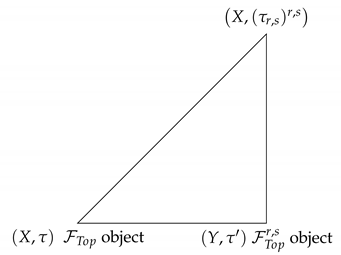
Let denote the category of all Chang type s and continuous functions; denotes the category of all s and bipolar maps in our sense; for each denotes the category of --th graded s and bipolar maps.
Proposition 17. - (1)
is a full subcategory of .
- (2)
For each , and are isometric.
- (3)
is a bireflective full subcategory of .
Proof. The first two results follow from the facts: if is a --th bipolar ; if T is a Chang type and is continuous w.r.t the Chang type iff is a bipolar map, for all . To prove , let us take a member of . Then, for each is a member and also is a bipolar map. Let be a member of and be a bipolar map. Now, we only need to check whether is a bipolar map. If , then . Then, . Similarly, . If , then, obviously . Let . Then, . Then, . Thus, is a bipolar map. □
Remark 6. From (2), (3) in Proposition 17 may be called a bireflective full subcategory of .
Proposition 18. Let be a family of s and X be a set such that is a map for each . Then, there exists a bipolar on X such that the following condition holds:
- (1)
for each is a bipolar map.
- (2)
If is a , then is a bipolar map iff is a bipolar map for each .
Proof. For each
and for each
, we define
where
is the
-s)-th level
on
w.r.t
. It can be shown that
is a
on
X. Clearly,
is a descending family. For each
, we define
Let be the on X generated by as a subbase. Then, is a descending family. Then, there exists a bipolar on X associated with the family , where . First, we show that for each is a bipolar map. Let and , where . Then, . Thus, . Consequently, is a bipolar map.
If is a bipolar map and since, for each is a bipolar map, by Proposition 11, the composition of two bipolar map is a bipolar map for each .
Conversely, we have to show that
is a
bipolar map. Let
and
. Then,
for some
. Then, there exists
such that
. Since
is a
bipolar map for each
, it follows that
Hence, the result follows from Proposition 12. □



 ,
,