Abstract
A non-autonomous allelopathic phytoplankton model with nonlinear inter-inhibition terms and feedback controls is studied in this paper. Based on the comparison theorem of differential equation, some sufficient conditions for the permanence of the system are obtained. We study the extinction of one of the species by using some suitable Lyapunov type extinction function. Our analyses extend those of Xie et al. (Extinction of a two species competitive system with nonlinear inter-inhibition terms and one toxin producing phytoplankton. Advances in Difference Equations, 2016, 2016, 258) and show that the feedback controls and toxic substances have no effect on the permanence of the system but play a crucial role on the extinction of the system. Some known results are extended.
1. Introduction
Recently, competition models with nonlinear inter-inhibition terms have been considered by many scholars [1,2,3,4,5,6,7]. Wang, Liu and Li [1] considered the following competition system:
where indicate the species and densities at time t, respectively; denote the net rates of production of two species; are the rates of intraspecific competition of the species and , respectively; represent the interspecific competing rates. The nonlinear inter-inhibition terms and implie that for large phytoplankton density, the interspecific competing rate tends to a certain value. In other words, the interspecific competing rate will not increase infinitely with the increase of phytoplankton density, which could make us understand the real ecosystems deeper. For more information about the nonlinear inter-inhibition terms, see [8]. Based on differential inequality, the module containment theorem and constructing the Lyapunov function, Wang et al. [1] gave the sufficient conditions for the global asymptotic stability of system.
As we all know, phytoplankton is the primary producer in ocean and plays an important role in energy flow and nutrient cycling of marine ecosystems. In addition, phytoplankton can absorb carbon dioxide for photosynthesis, which has a significant impact on the climate regulation. The importance of phytoplankton to marine ecosystem has been widely recognized. Besides, many authors attempted to explain the bloom phenomenon by different approaches, and find that toxic phytoplankton certainly play an important role in the bloom phenomenon. Therefore, in recent years, many scholars have stuied the allelopathic toxic phytoplankton model [4,5,7,9,10,11,12,13,14,15,16,17,18,19,20]. Rashi Gupta [9] considered Holling type-II and Holling type-IV functional responses in a model of non-toxic phytoplankton-toxic phytoplankton-zooplankton. He gave the the condition for diffusive instability of a locally stable equilibrium of spatial and non-spatial model for one dimensional system. Based on the work of Yue [4], recently, Xie et al. [5] further considered the effect of toxin on a non-autonomous competitive phytoplankton system, written in the form as
where denotes the rate of toxic inhibition for the species released by the second species. The authors obtained the sufficient conditions for the extinction of a species and the global attractivity of the other one. On the other hand, through experimental data of a experimental study on two phytoplankton species, namely C. polylepis and H. triquetra, Sole et al. [10] found that the allelopathic interaction using is more suitable. M. Bandyopadhyay [11] proposed and studied the following mathematical model of two competing phytoplankton species with allelopathic interaction term:
Since the influence of human behavior on the ecosystems is more and more great, a large number of precious species are facing extinction. It is important to know how to protect endangered species and maintain the diversity of ecosystems. In ecology, we want to know that whether or not an ecosystem can withstand those unpredictable disturbances. In the language of control variables, we use feedback control variables to represent these unpredictable disturbances. In order to describe the effect of people’s behavior, many researchers focused on the research of the systems with feedback control variables [7,15,21,22,23,24,25,26]. Muroya Y. [21] studied a Lotka-Volterra systems with infinite delays and feedback controls, the authors applied a Lyapunov functional and established that the feedback controls have no effect on the attractivity of a saturated equilibrium. Recently, Liu et al. [22] proposed the following system with feedback controls:
where are the forward difference operators; denote the feedback control variables. and are bounded positive almost periodic sequences. Liu et al. [22] studied the existence and uniformly asymptotic stability of unique positive almost periodic solution of system (4). Furthermore, based on a suitable Lyapunov function, Yu [7] obtained the sufficient conditions for the extinction of one species.
As is well known, if the amount of the species is enough large, the continuous model is more appropriate. But, to this day, still no scholar propose and study the continuous form of system (4) with toxin and feedback controls. Motivated by the above work, in this paper, we consider the following nonautonomous allelopathic phytoplankton model with nonlinear-inhibition terms and feedback control variables:
Recently, a few studies about the effect of feedback controls on allelopathic phytoplankton model have been carried out, it is worth noting that in this paper. Besides, the allelopathic interaction term is replaced by instead of . Our main objective is to study the effects of toxicity and feedback controls on the dynamics of the system.
The paper is organized as follows. In Section 2, we will state some necessary Lemmas and prove the permanence of the system (5). In Section 3, we will discuss the extinction of one species. Four examples together with their numeric simulations are present in Section 4, as we will show the feasibility of the main results. We give a a briefly discussion in the end of this paper.
2. Permanence
Given a continuous and bounded function , let and denote and , respectively. From the point of view of biology, we assume that . We can easily obtain the solution passing through is positive.
Definition 1
([27]).
- (1)
- Population x(t) is said to be permanent if there exist two constant M and m such that .
- (2)
- Population x(t) is said to be extinct if almost surely.
Lemma 1.
- (1)
- If and , when and , we have
- (2)
- If and , when and , we have
Lemma 2.
- (1)
- If and , when and , we have
- (2)
- If and , when and , we have
Lemma 3.
Every positive solution of system (5) satisfies
Proof.
It follows from the first and second equation of system (5) yields
According to Lemma 2 and differential inequality (7), we have
From (8), there exists a , such that for and any small positive constant ,
From the third and fourth equation of system (5) it follows that
By applying Lemma 1 to differential inequality (10), we have
Setting in above inequalities leads to
□
Theorem 1.
Assume that
holds. Then, for any positive solution of the system (5), we have
i.e., system (5) is permanent.
Remark 1.
Theorem 1 shows that two kinds of phytoplankton can coexist under certain conditions. Besides, the conditions of Theorem 1 show that the feedback control variables and toxic substances do not effect on the permanence of the system.
Proof.
From (5), for any small positive constant , we may choose small enough such that
For above, from Lemma 3 it follows that there exists such that for ,
From the first equation of system (5), we have
Integrating the above differential inequality from s to t, we have
By the third equation of system (5), it follows
According to Lemma 2.3 of [24] and inequality (15), integrateing the above differential inequality from () to t, we have
There exists a such that , we have
where
By the first equation of system (5), we have
By applying Lemma 2 to the above differential inequality, it follows that
Setting in this inequality leads to
where
From the second equation of system (5) it follows that
Integrating this inequality from s to t, we get
By the fourth equation of system (5), we have
Integrating this inequality from to t, it follows
From Lemma 3, we have
There exists a such that , we have
where
From the second equation of system (5), we have
Similarly to the analysis of (19), we can obtain
where
For any small positive constant , from (20) and (26) it follows that there exists a . such that for , we have
From the third and fourth equation of system (5) it follows that
From Lemma 1, we obtain
Setting in this inequality leads to
□
3. Extinction
Theorem 2.
Assume that
and
hold, then the species is permanent and the species will be extinct, that is, for any positve solution of system (5),
Remark 2.
Theorem 2 gives the conditions for the permanence of nontoxic phytoplankton and the extionction of toxic phytoplankton. From Theorem 2, we known that lower rate of toxic production could not avoid the extinction of the second species.
Proof.
Condition (31) is equivalent to
From (32) and (33), there exist positive constants and enough small positive such that
That is
Let be a positive solution of system (5). For above , from Lemma 2, there exists a enough large , such that
Let
Calculating the derivative of , from (35), for , we can otain
From inequalities (34), we obtain
Integrating the above inequality from to , we have
It follows from (35) that
Combining inequalities (38) and (39), we have
where
Hence we obtain that
And so, , , such that for all . From the fourth equation of system (5), we have
From Lemma 1, we obtain
Setting leads to
thus
By using the analysis technique of [24], one could show that under the conditions of Theorem 2, the first species of system (5) is permanent. We omit the detail here. This ends the proof of Theorem 2. □
Theorem 3.
Assumes that
hold, then the species will be extinct and the species is permanent, that is, for any positve solution of system (5),
Proof.
The proof of Theorem 3 is similar to Theorem 2, which we omit here. □
Remark 3.
Theorem 3 gives the conditions for the permanence of toxic phytoplanktonand the extionction of nontoxic phytoplankton. Besides, when , Theorem 1 obtained by Xie and Xue et al. [5] are the corollary of Theorem 3, which extends the results of Xie and Xue et al. [5] and reveal that by choosing suitable feedback control variables, the extinction property of system still contains.
4. Example
Example 1.
Consider the following equations
Corresponding to system (44), one has
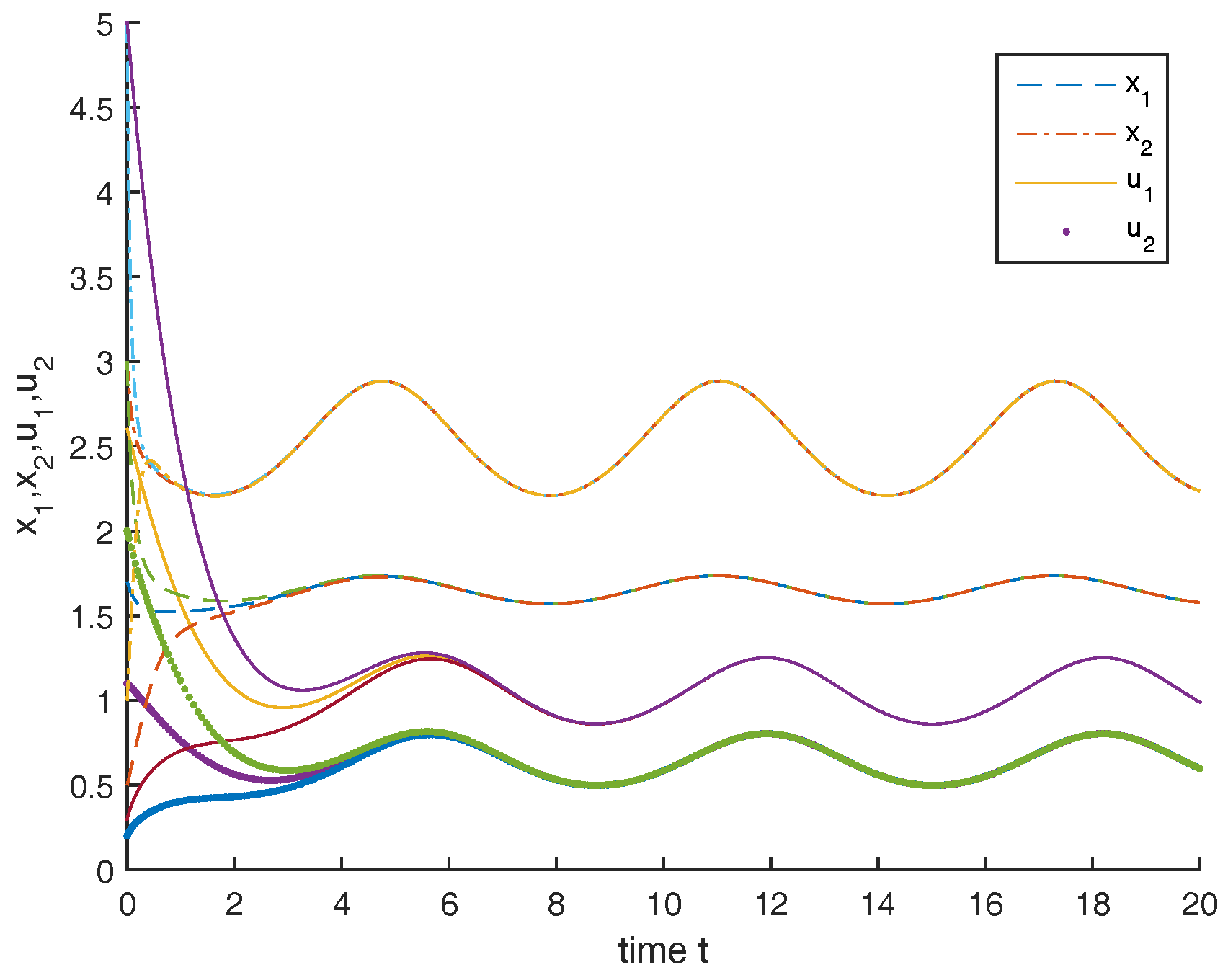
Clearly, condition (11) are satisfied, from Theorem 1, we know that the system (44) is permanent. Figure 1 shows the dynamic behaviors of system (44) which is consistent with the conclusion obtained above.
Figure 1.
Dynamic behaviors of the solution of system (44) with the initial conditions = , and , respectively.
Example 2.
Consider the following equations
By calculation, one has
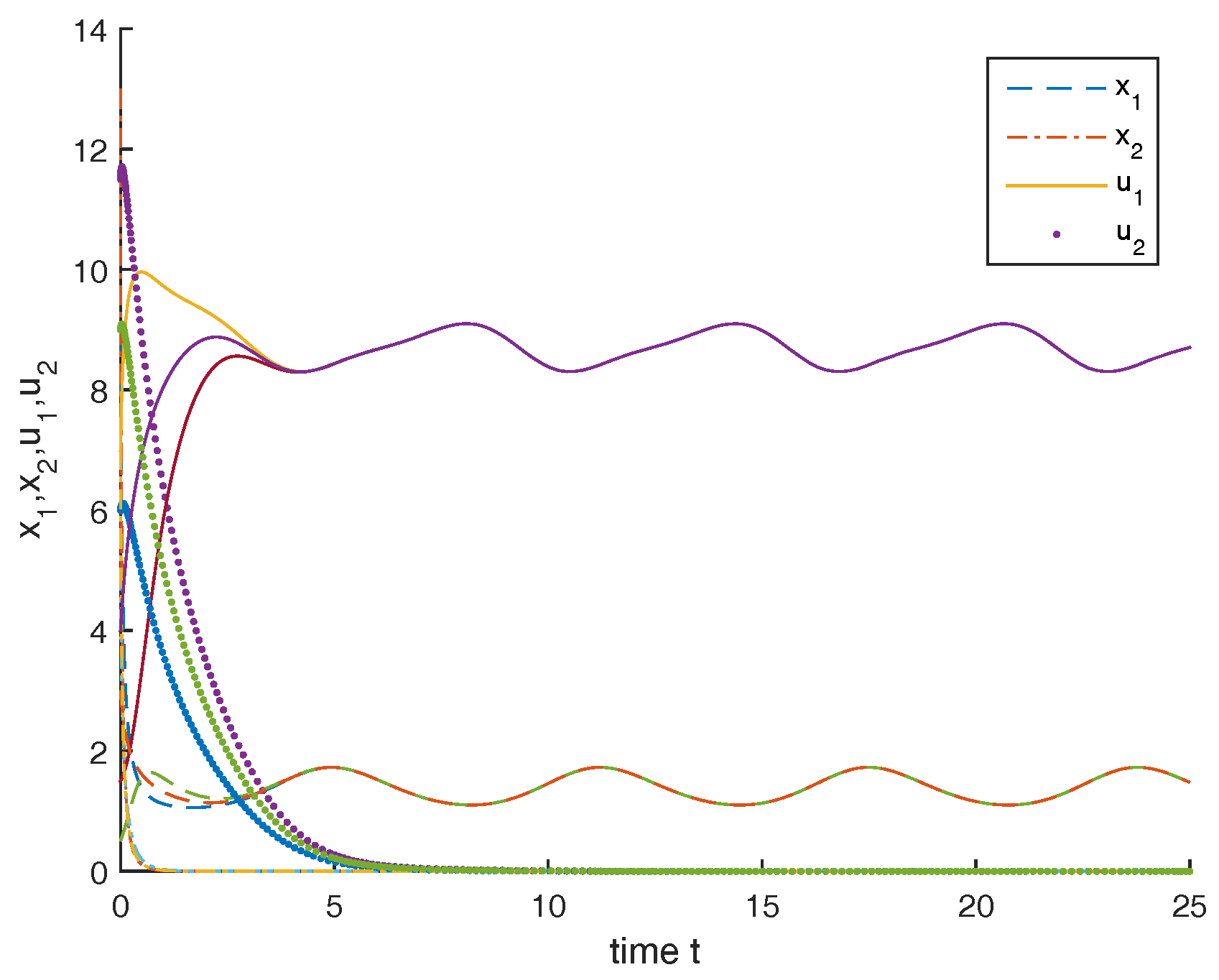
We assume that , clearly, conditions (31) and (32) are satisfied, from Theorem 2, we know that the first species is permanent and the rest of species is driven to extinction. Figure 2 shows the dynamic behaviors of system (45) which is consistent with the conclusion obtained above.
Figure 2.
Dynamic behaviors of the solution of system (45) with the initial conditions = , and , respectively.
Example 3.
Consider the following equations
By calculation, one has
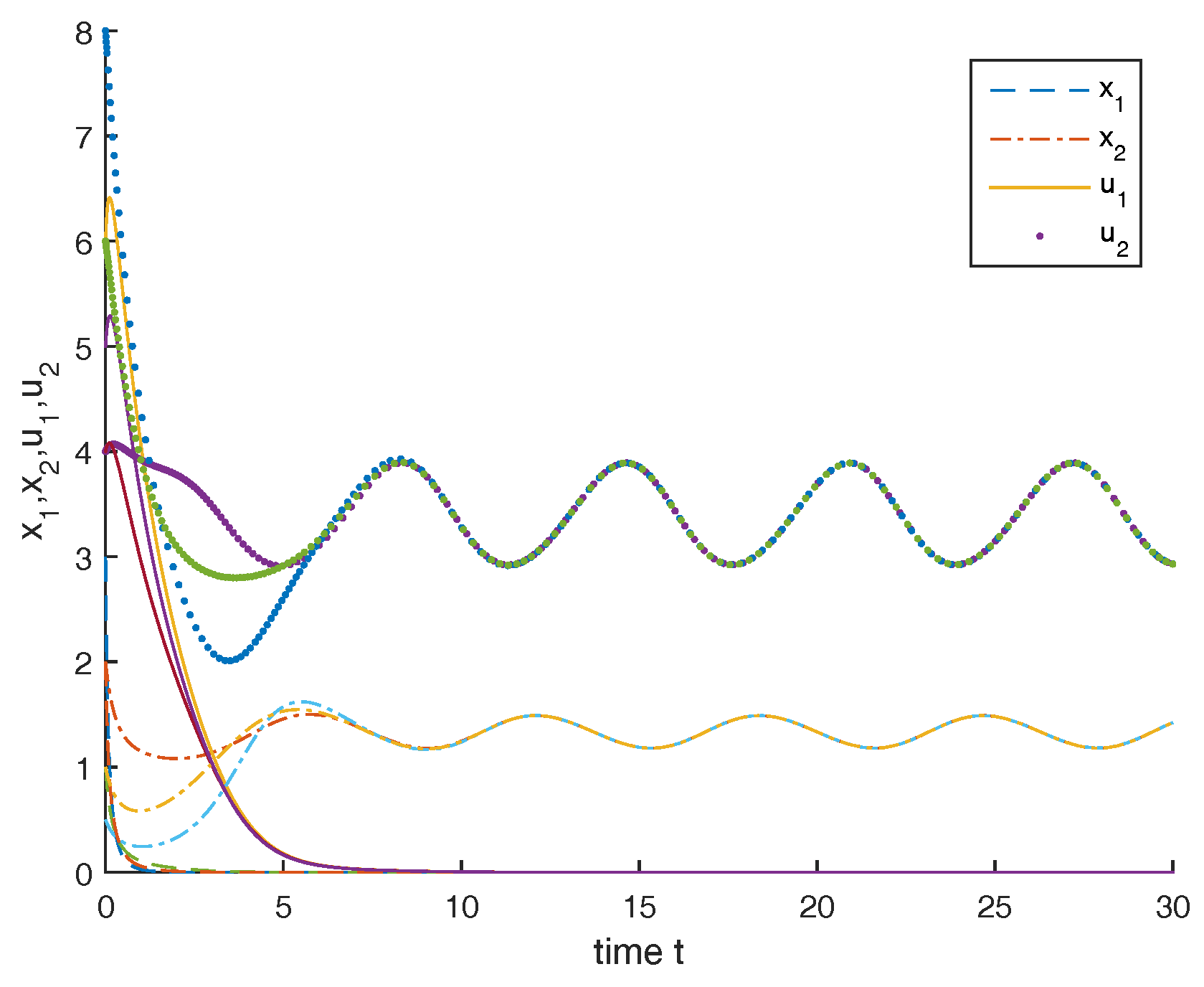
Clearly, , condition (43) are satisfied, from Theorem 3, we know that the second species is permanent and the rest of species is driven to extinction.
Figure 3 shows the dynamic behaviors of system (46) is consistent with the conclusion obtained above.
Figure 3.
Dynamic behaviors of the solution of system (4.3) with the initial conditions = , and , respectively.
5. Conclusions
(1) In this paper, we consider a non-autonomous allelopathic phytoplankton model with nonlinear inter-inhibition terms and feedback controls, i.e., Equation (5), The difference from the model in [5] is that we consider two feedback control variables and the allelopathic interaction term is replaced by instead of . We further investigate the influence of feedback control variables and toxic substances on the dynamic behaviors of system (5).
(2) Theorem 2 and 3 show that the feedback control variables and toxic substances play an important role on the extinction of system (5). Despite the second species could produce toxic, but lower rate of toxic production could not avoid the extinction of the second species. The conditions of Theorem 1 show that the feedback control variables and toxic substances do not effect on the permanence of the system.
(3) Moreover, when , moldel (5) becomes (2), we can easily find that Theorems 2.1 and 2.5 obtained by Xie and Xue et al. [5] are the corollary of Theorem 2 and 3, which extends the results of Xie and Xue et al. [5]. When , moldel (5) becomes (1), we can easily find that Theorem 1 and 2 obtained by Yu [18] are the corollary of Theorem 2 and 3, which extends the results of Yu [18].
Author Contributions
Writing–original draft, L.Z.; Writing–review & editing, F.C., S.S. and G.X. All authors equally contributed to this manuscript and approved of the final version. All authors have read and agreed to the published version of the manuscript.
Funding
This work was supported by the Natural Science Foundations of China (NO. 11771082) and the Scientific Research Development Fund of Young Researchers of Guangxi University of Finance and Economics(2019QNB09).
Acknowledgments
The authors would like to thank the referees for their useful suggestions which have significantly improved the paper. The authors thank for the help from the editor.
Conflicts of Interest
The authors declare no conflict of interest.
References
- Wang, Q.L.; Liu, Z.J.; Li, Z.X. Existence and global asymptotic stability of positive almost periodic solutions of a two-species competitive system. Int. J. Biomath. 2014, 7, 1450040. [Google Scholar] [CrossRef]
- Wang, Q.; Liu, Z. Uniformly asymptotic stability of positive almost periodic solutions for a discrete competitive system. J. Appl. Math. 2013, 2013, 182158. [Google Scholar] [CrossRef]
- Yu, S. Permanence for a discrete competitive system with feedback controls. Commun. Math. Biol. Neurosci. 2015, 2015, 16. [Google Scholar]
- Yue, Q. Extinction for a discrete competition system with the effect of toxic substances. Adv. Differ. Equ. 2016, 2016. [Google Scholar] [CrossRef]
- Xie, X.; Xue, Y.; Wu, R.; Zhao, L. Extinction of a two species competitive system with nonlinear inter-inhibition terms and one toxin producing phytoplankton. Adv. Differ. Equ. 2016, 2016, 258. [Google Scholar] [CrossRef][Green Version]
- Chen, J.H.; Xie, X.D. Stability analysis of a discrete competitive system with nonlinear interinhibition terms. Adv. Differ. Equ. 2017, 2017, 294. [Google Scholar] [CrossRef]
- Yu, S.B. Extinction for a discrete competition system with feedback controls. Adv. Differ. Equ. 2017, 2017, 9. [Google Scholar] [CrossRef]
- Gopalsamy, K. Stability and Oscillations in Delay Differential Equations of Population Dynamics; Springer: Berlin, Germany, 1992. [Google Scholar]
- Gupta, R. Dynamics of three species plankton model with Holling type-IV functional responses and control of toxic phytoplankton. Comput. Ecol. Softw. 2019, 9, 89. [Google Scholar]
- Sole, J.; Garca-Ladona, E.; Ruardij, P.; Estrada, M. Modelling allelopathy among marine algae. Ecol. Model. 2005, 183, 373–384. [Google Scholar] [CrossRef]
- Bandyopadhyay, M. Dynamical analysis of a allelopathic phytoplankton model. J. Biol. Syst. 2006, 14, 205–217. [Google Scholar] [CrossRef]
- Li, Z.; Chen, F.D.; He, M.X. Global stability of a delay differential equations model of plankton allelopathy. Appl. Math. Comput. 2012, 13, 7155–7163. [Google Scholar] [CrossRef]
- Li, Z.; Chen, F.D.; He, M.X. Asymptotic behavior of the reaction-diffusion model of plankton allelopathy with nonlocal delays. Nonlinear Anal. Real World Appl. 2011, 12, 1748–1758. [Google Scholar] [CrossRef]
- Chen, F.D.; Gong, X.J.; Chen, W.L. Extinction in two dimensional discrete Lotka-Volterra competitive system with the effect of toxic substances (II). Dyn. Contin. Discrete Impuls. Syst. Ser. B Appl. Algorithms 2013, 20, 449–461. [Google Scholar]
- Chen, L.J.; Chen, F.D. Extinction in a discrete Lotka-Volterra competitive system with the effect of toxic substances and feedback controls. Int. J. Biomath. 2015, 8, 1550012. [Google Scholar] [CrossRef]
- Chen, L.J.; Sun, J.T.; Chen, F.D.; Zhao, L. Extinction in a Lotka-Volterra competitive system with impulse and the effect of toxic substances. Appl. Math. Model. 2016, 40, 2015–2024. [Google Scholar] [CrossRef]
- He, H.X.; Chen, F.D.; Li, Z. Almost periodic solution of an impulsive differential equation model of plankton allelopathy. Nonlinear Anal. Real World Appl. 2010, 11, 2296–2301. [Google Scholar] [CrossRef]
- Yu, S.B. Extinction and stability in a continuous competitive system. J. Ningxia Univ. 2016, 37, 400–404. [Google Scholar]
- Chen, F.D.; Li, Z.; Chen, X.X.; Laitochova, J. Dynamic behaviors of a delay differential equation model of plankton allelopathy. J. Comput. Appl. Math. 2007, 206, 733–754. [Google Scholar] [CrossRef][Green Version]
- Li, Z.; Chen, F.D. Extinction in two dimensional nonautonomous Lotka-Volterra systems with the effect of toxic substances. Appl. Math. Comput. 2006, 182, 684–690. [Google Scholar] [CrossRef]
- Muroya, Y.; Faria, T. Attractivity of saturated equilibria for Lotka-Volterra systems with infinite delays and feedback controls. arXiv 2018, arXiv:1807.02825. [Google Scholar] [CrossRef]
- Liu, Z.; Li, Z.; Wang, Q. Positive Almost Periodic Solutions for a Discrete Competitive System Subject to Feedback Controls. J. Appl. Math. 2013, 8, 1–14. [Google Scholar]
- Li, Z.; Han, M.A.; Chen, F.D. Influence of feedback controls on an autonomous Lotka-Volterra competitive system with infinite delays. Nonlinear Anal. Real World Appl. 2013, 14, 402–413. [Google Scholar] [CrossRef]
- Chen, F.D.; Yang, J.H.; Chen, L.J. Note on the persistent property of a feedback control system with delays. Nonlinear Anal. Real World Appl. 2010, 11, 1061–1066. [Google Scholar] [CrossRef]
- Yang, K.; Miao, Z.S.; Chen, F.D.; Xie, X.D. Influence of single feedback control variable on an autonomous Holling-II type cooperative system. J. Math. Anal. Appl. 2016, 435, 874–888. [Google Scholar] [CrossRef]
- Chen, F.D.; Li, Z.; Huang, Y. Note on the permanence of a competitive system with infinite delay and feedback controls. Nonlinear Anal. Real World Appl. 2007, 8, 680–687. [Google Scholar] [CrossRef]
- Wang, W.; Ma, Z. Permanence of populations in a polluted environment. Math. Biosci. 1994, 122, 235–248. [Google Scholar] [CrossRef]
© 2020 by the authors. Licensee MDPI, Basel, Switzerland. This article is an open access article distributed under the terms and conditions of the Creative Commons Attribution (CC BY) license (http://creativecommons.org/licenses/by/4.0/).