


Abstract
In this paper, we obtained several recurrence relations for the single and product moments under progressively Type-II right censored order statistics and then use these results to compute the means and variances of two parameter reduced Kies distribution. Besides, these moments are then utilized to derived best linear unbiased estimators of the scale and location parameters of two parameter reduced Kies distribution. The parameters of the two parameter reduced Kies distribution are estimated under progressive type-II censoring scheme. The model parameters are estimated using the maximum likelihood estimation method. Further, we explore the asymptotic confidence intervals for the model parameters. Monte Carlo simulations are performed to compare between the proposed estimation methods under progressive type-II censoring scheme. Based on our study, we can conclude that maximum likelihood estimators is decreasing with respect to an increase of the schemes and comparing the three censoring schemes, it is clear that the mean sum of squares, confidence interval lengths are smaller for scheme 1 than schemes 2 and 3.
1. Introduction
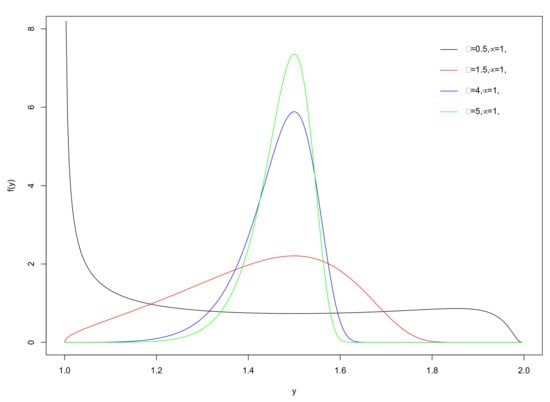
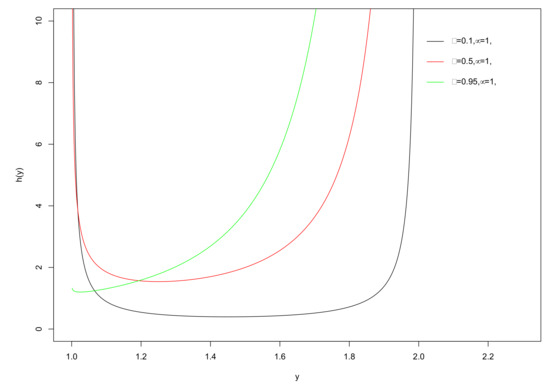
The one parameter reduced Kies (RK) distribution was introduced by Kumar and Dharmaja [1] for modeling data and a generalization of Kies distribution. The two parameter RK distribution is a flexible model which provides left-skewed, symmetrical, right-skewed, and reversed-J shaped densities (see Figure 1). Its hazard rate function (HRF) can provide decreasing, increasing, upside-down bathtub, bathtub, and reversed-J shaped hazard rates (see Figure 2). It is noted that the bathtub and modified bathtub hazard rates are very important in the reliability engineering context. John et al. [2] investigated modified-bathtub hazard rate shape is widely used in industrial and medical applications. For example, thermal stress screening is an assembly-level electronics manufacturing process that evolved from the burn-in processes used in NASA and DoD programs. While burn-in subjects the product to expected field extremes to expose infant mortalities (patent failures), thermal stress screening briefly exposes a product to fast temperature rate-of-change and out-of-spec temperatures to trigger failures that would otherwise occur during the useful life of the product. Also Xie and Lai [3], Lai et al. [4], Chakherloo et al. [5] and Al abbasi et al. [6] pointed out bathtub hazard rate shape is widely used in reliability engineering. The motivation for using this distribution here is that it has many applications in several areas of life such as accelerated life testing, survival analysis, reliability, biology, material science, engineering, physics, chemistry, economics, business administration, meteorology, hydrology, medicine, psychology and pharmacy. For a detailed account in this regard see Murthy et al. [7] or Rinne [8] and references therein. RK distribution can be viewed as a functional form of the Weibull distribution with shape parameter and it can be useful for modeling data sets with increasing and bathtub shaped hazard rate functions. Simple probability distributions generally do not exhibit bathtub-shaped failure rate, including Weibull, gamma, and log-normal. In most cases, bathtub shaped hazard functions have at least two parameters, whereas reduced Kies distribution has two parameter which exhibit both increasing and bathtub shaped hazard rate. In Engineering and Medical situations, Kumar and Dharmaja [1] observed that RK distribution is a better model compared to the Weibull as well as its extended models such as beta Weibull distribution, beta generalised Weibull distribution etc. in terms of hazard function is decreasing, increasing and bathtub shaped where Weibull models are inappropriate. Kumar and Dharmaja [1] studied the estimation of the parameters by using maximum likelihood estimation method of the reduced Kies distribution. Kumar and Dharmaja [9] considered the estimation of the Kies parameters under maximum likelihood estimation method. Dey et al. [10] studied the estimation of the reduced Kies parameter under progressive type-II censoring. They compared the performance of these estimators, for small and large samples, using extensive simulations. The only paper we were able to find on progressive type-II censoring of the one parameter RK distribution is Dey et al. [10]. This paper gives recurrence relations for single moments and product moments of progressive type-II censoring order statistics based on one parameter RK distribution. It did not consider two parameter RK distribution.
Figure 1.
The pdfs of two parameter RK distribution for various parameter values.
Figure 2.
The hazard rate functions of two parameter RK distribution for various parameter values.
Let be a random variable come from a two parameter RK distribution, then its non negative probability density function (pdf) and cumulative distribution function (cdf) are given as follows:
and
Here is a shape parameter and is a location parameter. From Equations (1) and (2), we obtain
where , ⋯, denotes the ascending factorial.
In Figure 1 and Figure 2, various graphs of the pdf and the hazard rate function for the two parameter RK distribution for different parameters values. These plots show that the pdf is uni-modal, positively skewed and approximately symmetric. The plots in Figure 2 indicate that the hazard rate function for the two parameter RK distribution is very flexible. It can have increasing (IFR), decreasing (DFR), upside down bathtub (UBT) or bathtub (BT) failure rate functions.
Let the experimenter decides to carry out the life-test for a pre-fixed length of time, say T. Then the data arising from such a time-constrained life-test would be of the form with the remaining lifetimes being more than T; here, r is random and has a binomial distribution with parameters . This situation is referred to as Type-I censoring. Suppose the experimenter decides to carry out the life-test until the time of the failure, then the data arising from such a life-test would be of the form with the remaining lifetimes being more than . This situation is referred to as Type-II censoring see Balakrishnan [11].
In life testing experiments, it is common to come across incomplete or censored data. This happens particularly when the experimenter does not observe the failure times of all units placed on the life test and this may be intentional or unintentional or may be due to time constraints or owing to the structure of a technical system. Obviously, in such a situation, the probabilistic structure of the resulting incomplete data affects the censoring mechanism and therefore suitable inferential procedures become necessary. In literature, there are various censoring schemes which include right, left and interval censoring, single or multiple censoring and type-I or type-II censoring. However, classical Type-I and Type-II censoring schemes are not flexibile as they do not allow removal of units at point other than the terminal point of the experiment. A mixture of type-I and type-II schemes is known as the hybrid censoring scheme. For this reason, we consider here a more general censoring scheme called progressive type-II censoring scheme.
If the failure times are based continuous cdf with pdf , the joint pdf of the progressively censored failure times , ⋯, , is given by Balakrishnan and Aggarwala [12].
where
with . Here T is the progressive censoring scheme, are numbers which are prefixed, s is the number of units we put on the life testing experiment and r is the predetermined number of failures at which experiment will be terminated.
Let , ⋯, be a random sample of size s from the two parameter RK distribution with pdf and cdf given in (1) and (2) respectively. The corresponding progressive Type-II right censored order statistics with censoring scheme will be
Let us define the single moments of the progressive Type-II right censored order statistics
In the last few decades, researchers have focused their attention to recurrence relation for moments of progressive type-II censoring. Many researchers considered moments of progressive type-II censoring in their studies. For example, Aggarwala and Balakrishnan [13] studied censored order statistics of a exponential and truncated exponential distribution. Balakrishnan et al. [14] discussed the inference under progressive type-II censoring of extreme value distribution. Fernandez [15] discussed the information of estimate the parameter of exponential distribution. With regard to progressive type-II censoring order statistics, readers may refer to the works of Cohen [16] discussed in progressively censored samples in life testing experiments. Viveros and Balakrishnan [17] obtained the interval estimation of life characteristics under progressively censored data. Balakrishnan and Aggarwala [18] discussed in details the progressive Censoring including theory, method and applications. Mahmoud et al. [19] studied the parameters estimation of linear exponential distribution under Progressively censored data. Sultan et al. [20] discussed the moments and estimation of parameters of the half logistic distribution based on progressively censored data, Balakrishnan et al. [21] obtained relations for moments of progressively censored order statistics from logistic distribution. Balakrishnan and Saleh [22] discussed relations for single and product moments of progressively Type-II censored order statistics from a generalized half logistic distribution. Dey et al. [23] discussed the estimation of parameters of Rayleigh distribution under progressively Type-II censored data. Kumar et al. [24] obtained the moments of extended exponential distribution under order statistics. Malik and Kumar [25] studied moments of progressively type-II Right censored order statistics from Erlang-truncated exponential distribution. Hu and Gui [26] discussed Bayesian and Non-Bayesian inference for the generalized Pareto distribution based on Progressive Type II Censored Sample. Malik and Kumar [27] obtained the moments of exponential-Weibull distribution based on progressively censored data. Singh and Khan [28] discussed the moments of progressively type-II right censored order statistics from additive Weibull distribution. Kumar et al. [29] studied the moments and estimation of parameters of extended exponential distribution based on progressive type-II right censored order statistics and Kumar et al. [30] considered estimation of the location and scale parameters of generalized Pareto distribution based on progressively type-II censored order statistics.
The key role of this article is two fold: first, we derive recurrence relations for the single and product moments of the RK distribution based on progressive type-II right censored order statistics. The so-obtained relationships enable us to compute all these moments for all sample sizes and all possible censoring schemes, using some mathematical softwares (Mathematica, Maple), second, we discuss the maximum likelihood estimators (MLEs) and BLUEs of the scale and location-scale parameters and compare them on the basis of bias and mean squared errors.
The rest of the paper is organized as follows. Relations for single moments is presented in Section 2. The relations for double (product) moments are given in Section 3. Parameter estimation along with approximate confidence intervals are computed in Section 4. In Section 5, the potentiality of the estimation approaches is assessed via simulation results. Finally, some remarks are offered in Section 7.
2. Relations for Single Moments
Here, we obtain some relations for the moments of progressive type-II right censored order statistics from the two parameters reduced Kies distribution.
Theorem 1.
For and ,
Proof.
Integrating (9) by parts, we obtain
Theorem 2.
For and ,
Proof.
Similar to the proof of Theorem 1. □
Theorem 3.
For , and ,
Proof.
Similar to the proof of Theorem 1. □
Theorem 4.
For , and ,
Proof.
Similar to the proof of Theorem 1. □
Special cases For this implies that then the progressive censored order statistics reduced to the order statistics , then
3. Relations for Product Moments
Here, we present the relations for product moments of the progressive type-II right censored order statistics from the two parameters reduced Kies distribution. The th product moment of the progressive type-II right censored order statistics can be written as
Theorem 5.
For and ,
Proof.
Theorem 6.
For and ,
Proof.
Similar to the proof of Theorem 5. □
In Table 1, Table 2, Table 3 and Table 4, we have presented the values of means and variances of the progressive Type-II right censored order statistics for , , and different values of r and s.
Table 1.
Means of two parameter RK distribution for different values of parameters, e.g., and .
Table 2.
Means of two parameter RK distribution for different values of parameters, e.g., and .
Table 3.
Variances of two parameter RK distribution for different values of parameters, e.g., and .
Table 4.
Variances of two parameter RK distribution for different values of parameters, e.g., and .
4. Estimation of the Parameters
In this section, we obtain the best linear unbiased estimators (BLUEs) of the location and scale parameters and the maximum likelihood estimators (MLEs) of the two parameter RK distribution using progressive type-II censored samples.
4.1. BLUEs of Location and Scale Parameters
Let be a progressively type-II right censored samples from the location-scale two parameter RK distribution with the following probability density function
where is the location parameter and is the scale parameter. We use the single and product moments obtained in the previous section to derive the BLUEs of the location and scale parameters and . Let
and
where , and . Then the BLUEs of and can be obtained as
where
and
The coefficients and given by (20) and (21), respectively, satisfy the conditions and , which are used to check the computations accuracy. Table 5 and Table 6 display the coefficients and for and, respectively. These coefficients are obtained for various sample sizes, some selected progressive censoring , and different number of failures r.
Table 5.
Coefficients of the BLUEs for some selected progressive censoring schemes of and for .
Table 6.
Coefficients of the BLUEs for some selected progressive censoring schemes of and for .
4.2. Maximum Likelihood Method
Let be a progressively Type-II censored sample from two parameter RK distribution with being the progressive censoring scheme. The likelihood function is given by
where and are given respectively by Equations (1) and (2). Substituting Equations (1) and (2) into Equation (23), the likelihood function is
The log of likelihood function is
It is noted that the maximum likelihood estimates (MLEs) of the parameter and cannot be obtained in closed form, therefore, a numerical techniques can be used to solve (25) to obtain the MLEs of and .
To construct the two-sided asymptotic confidence intervals for the unknown parameters and , the Fisher’s information matrix must be obtained. Asymptotic variance-covariance (V-C) matrix of the MLEs can be obtained by inverting Fisher information matrix, in the form
ractically, by dropping the expectation operator E and replacing by their MLEs , we get the approximate asymptotic V-C matrix for the MLEs, see Cohen [31], as
Fisher’s elements are given by the following
and
Under some regularity conditions, the asymptotic normality of MLEs is approximately bivariate normal as . Hence, using the large sample theory, the two-sided ACIs for and can be obtained, respectively, by
where and are the main diagonal elements of (25), respectively, and is the percentile of the standard normal distribution with upper probability .
5. Simulation Study
In this section, a simulation study is conducted to study the behaviour of the MLEs by considering and and different values of the parameter and in all the cases. We have obtained the MLEs by using the following progressive censoring schemes
- Scheme 1: .
- Scheme 2: .
- Scheme 3: .
We use the algorithm introduced by Balakrishnan and Sandhu [32] to generate progressively censored two parameter RK samples. The average values of the estimates of and the corresponding MSEs, Average confidence interval and coverage probabilities are displayed in Table 7 for and . The average values of the estimates of and the corresponding mean sum of squares (MSEs), Average confidence interval and coverage probabilities are displayed in Table 8 for and .
Table 7.
Average values of estimate of with their respective mean sum of squares (MSEs), Average confidence interval and coverage percentages.
Table 8.
Average values of estimate of with their respective MSEs, Average confidence interval and coverage percentages.
6. Discussion
This study examined the recurrence relations for single and product moments of progressively type-II censored samples from two parameter RK distribution. We have presented the values of means and variances of the progressive Type-II right censored order statistics for , , and different values of r and s. We observe that the means and variances are decreasing with respect to r, s, and . From our study it is to be noted that the MLEs is decreasing with respect to increase the schemes. For fixed s, when the number of observed failure r increases, the MSEs and the confidence interval lengths decreases in all cases. Comparing the three censoring schemes, it is clear that the MSEs, confidence interval lengths are smaller for scheme 1 than schemes 2 and 3.
7. Conclusions
Based on our study, we can conclude that the the MLEs is decreasing with respect to increase the schemes. For fixed s, when the number of observed failure r increases, the MSEs and the confidence interval lengths decreases in all cases. Comparing the three censoring schemes, it is clear that the MSEs, confidence interval lengths are smaller for scheme 1 than schemes 2 and 3. A future work may be to derive estimation procedures for the two parameter RK distribution based on order statistics, generalized order statistics and dual generalized order statistics. Another future work may be to characterize the two parameter RK distribution based on order statistics, generalized order statistics and dual generalized order statistics.
Author Contributions
Conceptualization, D.K.; methodology, N.A.; software, N.A.; validation, M.S. and S.A.A.; formal analysis, N.A.; investigation, M.S.; resources, D.K.; data curation, N.A.; writing—original draft preparation, D.K.; writing—review and editing, N.A.; visualization, M.S.; supervision, N.A.; project administration, M.S.; funding acquisition, M.S. All authors have read and agreed to the published version of the manuscript.
Funding
The first and second authors extends their appreciation to the Deanship of Scientific Research at King Saud University for funding this work through research group No (RG-1438-086).
Acknowledgments
The authors would like to thank the editor and reviewers for their valuable and very constructive comments, which have greatly improved the contents of the paper.
Conflicts of Interest
The authors declare no conflict of interest.
References
- Kumar, C.S.; Dharmaja, S.H.S. On Reduced Kies Distribution. Collection of Recent Statistical Methods and Applications; Kumar, C.S., Chacko, M., Sathar, E.I.A., Eds.; Department of Statistics, University of Kerala Publishers: Trivandrum, India, 2013; pp. 111–123. [Google Scholar]
- John, R.; English, L.Y.; Thomas, L.L. Modified bathtub curve with latent failures. In Proceedings of the Annual Reliability and Maintainability Symposium 1995 Proceedings, Washington, DC, USA, 16–19 January 1995; IEEE: Piscataway, NJ, USA, 1995. [Google Scholar] [CrossRef] [Scilit]
- Xie, M.; Lai, C. Reliability analysis using an additive Weibull model with bathtub-shaped failure rate function. Reliab. Eng. Syst. Saf. 1996, 52, 87–93. [Google Scholar] [CrossRef] [Scilit]
- Lai, C.D.; Xie, M.; Murthy, D.N.P. A modified Weibull distribution. IEEE Trans. Reliab. 2003, 52, 33–37. [Google Scholar] [CrossRef] [Scilit]
- Chakherloo, R.A.; Pourgol-Mohammad, M.; Sepanloo, K. Change points estimations of bathtub-shaped hazard functions. Int. J. Syst. Assur. Eng. Manag. 2017, 8, 553–559. [Google Scholar] [CrossRef] [Scilit]
- Alabbasi, J.N.; Mundher, A.K.; Moudher, K.; Abdal-Hammed, L.Y.F.; Ozel, G. A new uniform distribution with bathtub shaped failure rate with simulation and application. Int. J. Syst. Assur Eng. Manag. 2019, 13, 105–114. [Google Scholar]
- Murthy, D.N.P.; Xie, M.; Jiang, R. Weibull Models; Wiley: New York, NY, USA, 2004. [Google Scholar]
- Rinne, H. The Weibull Distribution a Handbook; Taylor and Francis Group: London, UK, 2009. [Google Scholar]
- Kumar, C.S.; Dharmaja, S.H.S. On some properties of Kies distribution. Metron 2014, 72, 97–122. [Google Scholar] [CrossRef] [Scilit]
- Dey, S.; Nassar, M.; Kumar, D. Moments and estimation of reduced Kies distribution based on progressive type-II right censored order statistics. Hacet. J. Math. Stat. 2019, 48, 332–350. [Google Scholar] [CrossRef] [Scilit]
- Balakrishnan, N. Progressive Censoring Methodology: An Appraisal. Test 2007, 16, 211–296. [Google Scholar] [CrossRef] [Scilit]
- Balakrishnan, N.; Aggarwala, R. Recurrence relations for single and product moments of order statistics from a generalized logistic distribution with applications to inference and generalizations to double truncation. Handb. Stat. 1998, 17, 85–126. [Google Scholar]
- Aggarwala, R.; Balakrishnan, N. Recurrence relations for single and product moments of progressively Type-II censored order statistics from a exponential and truncated exponential distribution. Ann. Inst. Statist. Math. 1996, 48, 757–771. [Google Scholar] [CrossRef] [Scilit]
- Balakrishnan, N.; Kannan, N.; Lin, C.T.; Wu, S.J.S. Inference for the extreme value distribution under progressive type-II censoring. J. Stat. Comput. Simul. 2004, 74, 25–45. [Google Scholar] [CrossRef] [Scilit]
- Fernandez, A.J. On estimating exponential parameters with general type II progressive censoring. J. Stat. Plan. Inference 2004, 121, 135–147. [Google Scholar] [CrossRef] [Scilit]
- Cohen, A.C. Progressively censored samples in life testing. Technometrics 1963, 5, 327–329. [Google Scholar] [CrossRef]
- Viveros, R.; Balakrishnan, N. Interval estimation of life characteristics from progressively censored data. Technometrics 1994, 36, 84–91. [Google Scholar] [CrossRef]
- Balakrishnan, N.; Aggarwala, R. Progressive Censoring: Theory, Method and Applications; Birkhauser, Bosto.: Basel, Switzerland, 2000. [Google Scholar]
- Mahmoud, R.M.; Sultan, K.S.; Saleh, H.M. Progressively censored data from the linear exponential distribution, moments and estimation. Metron 2006, 64, 199–215. [Google Scholar]
- Sultan, K.S.; Mahmoud, M.R.; Saleh, H.M. Moments of estimation from progressively censored data of the half logistic distribution. Int. J. Reliab. Appl. 2006, 7, 187–201. [Google Scholar]
- Balakrishnan, N.; AL-Hussaini, E.K.; Saleh, H.M. Recurrence relations for moments of progressively censored order statistics from logistic distribution with applications to inference. J. Stat. Plan. Inference 2011, 141, 17–30. [Google Scholar] [CrossRef] [Scilit]
- Balakrishnan, N.; Saleh, H.M. Recurrence relations for single and product moments of progressively Type-II censored order statistics from a generalized halflogistic distribution with application to inference. J. Stat. Comput. Simul. 2013, 83, 1704–1721. [Google Scholar] [CrossRef] [Scilit]
- Dey, T.; Dey, S.; Kundu, D. On progressively type-II censored two-parameter Rayleigh distribution. Commun. Stat. Simul. Comput. 2016, 45, 438–455. [Google Scholar] [CrossRef] [Scilit]
- Kumar, D.; Dey, S.; Nadarajah, S. Extended exponential distribution based on order statistics. Commun. Stat. Theory Methods 2017, 46, 9166–9184. [Google Scholar] [CrossRef] [Scilit]
- Malik, M.R.; Kumar, D. Relations for moments of progressively type-II Right censored order statistics from Erlang-truncated exponential distribution. Stat. Transit. New Ser. 2017, 18, 651–668. [Google Scholar] [CrossRef] [Scilit]
- Hu, X.; Gui, W. Bayesian and Non-Bayesian Inference for the Generalized Pareto Distribution Based on Progressive Type II Censored Sample. Mathematics 2018, 6, 319. [Google Scholar] [CrossRef] [Scilit]
- Malik, M.R.; Kumar, D. Relations for single and product moments of exponential-Weibull distribution based on progressively censored data. Int. J. Agric. Stat. Sci. 2020, 16, 465–477. [Google Scholar]
- Singh, B.; Khan, R.U. Moments of progressively type-II right censored order statistics from additive Weibull distribution. Probstat Forum 2019, 12, 36–46. [Google Scholar]
- Kumar, D.; Mansoor, M.Q.S.; Dey, S.; Malik, M.R. Recurrence relations for moments and estimation of parameters of extended exponential distribution based on progressive type-II right censored order statistics. J. Stat. Theory Appl. 2019, 18, 171–181. [Google Scholar] [CrossRef] [Scilit]
- Kumar, D.; Nassar, M.; Malik, M.R.; Dey, S. Estimation of the location and scale parameters of generalized Pareto distribution based on progressively type-II censored order statistics. Ann. Data Sci. 2020. [Google Scholar] [CrossRef] [Scilit]
- Cohen, A.C. Maximum likelihood estimation in the Weibull distribution based on complete and censored samples. Technometrics 1963, 5, 579–588. [Google Scholar] [CrossRef]
- Balakrishnan, N.; Sandhu, R.A. A simple simulational algorithm for generating progressive Type-II censored samples. Am. Stat. 1995, 49, 229–230. [Google Scholar]

Publisher’s Note: MDPI stays neutral with regard to jurisdictional claims in published maps and institutional affiliations. |
© 2020 by the authors. Licensee MDPI, Basel, Switzerland. This article is an open access article distributed under the terms and conditions of the Creative Commons Attribution (CC BY) license (http://creativecommons.org/licenses/by/4.0/).