Abstract
The purpose of this work is to extend Leech cohomology for monoids (and so Eilenberg-Mac Lane cohomology of groups) to presheaves of monoids on an arbitrary small category. The main result states and proves a cohomological classification of monoidal prestacks on a category with values in groupoids with abelian isotropy groups. The paper also includes a cohomological classification for extensions of presheaves of monoids, which is useful to the study of -extensions of presheaves of regular monoids. The results apply directly in several settings such as presheaves of monoids on a topological space, simplicial monoids, presheaves of simplicial monoids on a topological space, monoids or simplicial monoids on which a fixed monoid or group acts, and so forth.
MSC:
18D30; 20M50; 55N91
1. Introduction and Summary
This work grew out of the problem of stating a precise classification theorem for prestacks [1] on a small category with values in the 2-category of monoidal abelian groupoids, that is, of tensor groupoids whose isotropy groups are abelian. The non-fibered case, that is, when is the final category, was treated recently in [2], where it is shown how monoidal abelian groupoids are classified by elements of Leech third cohomology groups of monoids [3,4]. In that classification process, for each monoidal abelian groupoid, M is its monoid of connected components, with multiplication induced by the tensor product, the coefficients A are provided by its automorphism groups, and the classifying datum is the cohomology class of a certain 3-cocycle canonically constructed from its structure associativity constraint. For categorical groups (also known as Gr-categories), that is, monoidal groupoids where the objects are quasi-invertible, that cohomological classification goes back to that given by Sinh in [5], where she proved that categorical groups are classified by the elements of the third Eilenberg-Mac Lane cohomology groups. When is an arbitrary small category, every prestack on valued in monoidal abelian groupoids produces, by taking connected components, not a monoid as in the punctual case but rather a presheaf on with values in the category of monoids. Then, we were naturally led to a research for an adequate cohomology theory for presheaves of monoids . Here, we provide a proposal for such a cohomology theory, which enjoys desirable properties whose study the paper is dedicated to.
Presheaves on small categories are rather familiar objects and arise in many situations. The cohomology of presheaves of several algebraic structures (groups, rings, etc.) has been object of study with interest along the last decades. Particularly, we should refer here to the seminal work by Gerstenhaber-Shack (in deformation theory) on cohomology of presheaves of algebras (e.g., associative or Lie) [6,7,8], which greatly inspires part of this paper on cohomology of presheaves of monoids. Also, our exposition is strongly influenced by several papers on cohomology of diagrams of simplicial sets (in equivariant homotopy theory). Particularly we should refer those by Dwayer-Kan [9,10], Moerdijk-Svensson [11,12], and Blanc-Johnson-Turner [13]. Notice that, when each monoid is replaced by its nerve (i.e., its simplicial classifying space), every presheaf of monoids on a small category produces a presheaf of simplicial sets, , whose homotopy type is represented by its homotopy colimit [14]. Thus, Gabriel-Zisman cohomology groups [15] of the simplicial set naturally arise from a presheaf of monoids . In this setting, it is worth to recall that every path-connected CW-complex has the same homotopy type as the classifying space of a monoid [16].
1.1. Outline of Results
In this paper we actually present two cohomology theories for presheaves of monoids. For both theories, we start by associating to each presheaf of monoids a small category, denoted by , whose left modules, that is, the abelian group valued functors on it, provide the coefficients. This is justified because of the existence of an equivalence
between the category of abelian group objects in the slice category of presheaves of monoids on over and the category of abelian group valued functors on . The first cohomology theory of a presheaf of monoids is then defined as the cohomology of the category , that is, by the right derived functors
where is the constant -module given by the abelian group of integers. For the second one, which following to Gerstenhaber and Shack [7] we call the simple cohomology theory, we previously introduce the left exact functor of derivations, -Mod → Ab, and prove its representability by showing that it is naturally isomorphic to the hom functor provided by the (suitably defined) ideal augmentation of the presheaf . Then, we define the simple cohomology theory of by the right derived functors
When is the final category, then a presheaf of monoids on is simply a monoid and the above are just the cohomology functors of the monoid by Leech [3,4]. Furthermore, in this case, there are natural isomorphisms for all , so that both cohomology theories are essentially the same. However, in general the are different of the simples ones . For instance, when is a group (regarded as an one-object category) and is a right G-group, then , the semidirect product group, and the cohomology functors agree with the ordinary Eilenberg-Mac Lane cohomology functors , whereas the functors agree with the vector cohomology groups by Whitehead [17]. A main result in this paper states that, for any presheaf of monoids on a small category , there is a natural long exact sequence
for any -module A, connecting the cohomology groups of in both theories with those of the category with coefficients in the right module obtained by restricting the coefficients A to through its natural inclusion into .
Following general methods by Gerstenhaber-Schack and Gabriel-Zisman, we define, for every presheaf and any -module A, cochain complexes of abelian groups and such that there are natural isomorphisms
When the category is cohomologically trivial, for instance whenever has a final object, we deduce the existence of natural isomorphisms
These isomorphisms hold then in several relevant cases we have in mind, as for example when
- (a)
- , the category defined by the partially ordered set of open subsets of a topological space X. That is, in the cohomology of presheaves of monoids (and presheaves of groups, then) on a topological space.
- (b)
- , the category defined by the ordered set . That is, in the cohomology of pairs of monoids.
- (c)
- , the simplicial category of finite ordered sets , with non-decreasing maps between them as its morphisms. That is, in the cohomology of simplicial monoids.
- (d)
- , where X is a topological space. That is, in the cohomology of presheaves of simplicial monoids on a topological space (or, equivalently, of simplicial presheaves of monoids on a topological space).
- (e)
- , where is the orbit category of a group G, whose objects are the transitive left G-sets , for any subgroup , and whose morphisms are the G-equivariant maps between them. That is, in the (Borel) equivariant cohomology of simplicial monoids endowed with a left G-action by automorphisms. Here, one regards such a simplicial monoid as the presheaf of monoids on such that .
We dedicate much of the paper to show natural realizations for the cohomology classes in and . For any presheaf of monoids on a small category and any -module A, we prove the existence of a natural bijection
between the set of equivalence classes of extensions (aka coextensions) of by A and the second simple cohomology group of with coefficients in A. This classification result is showed to be useful in the study of the structure of -extensions of with abelian kernel, that is, locally surjective morphisms of presheaves of monoids such that, for any objet U of , the congruence kernel of is contained in the Green’s relation of and the Shützenberger groups of the kernel classes are abelian. Following to Grillet [18] and Leech [3], we introduce a certain full subcategory of -Mod, which we call the category of -modules, and we prove that when the presheaf of monoids is locally regular then equivalence classes of -extensions of with abelian kernel correspond bijectively to the elements of .
Our results on the classification of prestacks on a small category , that is, of contravariant pseudo-functors from to the 2-category of monoidal abelian groupoids, by the third simple cohomology groups of presheaves of monoids on , can be summarized as follows:
- (i)
- If is a presheaf of monoids on and A is -module, every simple 3-cocycle gives rise to a prestack .
- (ii)
- For any prestack on , there exist a presheaf of monoids , a -module A, a simple 3-cocycle , and an equivalence .
- (iii)
- If and are simple 3-cocycles, where and are presheaves of monoids, A is a -module, and is a -module, then there is an equivalence if and only if there are isomorphisms and such that in .
Thus, prestacks on are classified by triples where is a presheaf of monoids on , A is a -module, and .
1.2. Organization of The Paper
The plan of the paper is, briefly, as follows. After the first introductory and summary section, the rest is organized in nine sections. Section 2 is preparatory and comprises some notations and a review on cohomology of small categories. In Section 3 we analyze the coefficients we use for the cohomology of presheaves of monoids. Section 4 is dedicated to the notion of derivation of presheaves of monoids. The main Section 5 includes the definition of the cohomology groups and and a first study of their properties. In particular, we state here the above mentioned linking long exact sequences. The following Section 6 and Section 7 are dedicated to cochains, cocycles, and coboundaries. We provide in Section 6 of suitable cochain complexes and for computing the cohomology groups and , and in the brief Section 7 we specify, for future reference, what low dimensional simple cochains, cocycles, and coboundaries are. Section 8 is mainly devoted to state the classification of extensions of presheaves of monoids by means of the groups , while the long Section 9 is entirely dedicated to show the classification of prestacks by means of the cohomology groups . In the last Section 10, we analyze how our previous results specialize when we focus on presheaves of groups.
2. Preliminaries on the Cohomology of Small Categories
Let be a small category. A (left) -module is a functor . The category of -modules, with morphisms the natural transformations, is denoted by -Mod. We make reference to [19] (Chapter VIII, §3) for formalities but point out that this is an abelian category with sufficiently many projective and injective objects. For any two -modules A and , the abelian group structure of is given by pointwise addition. The zero -module is the constant functor given by the abelian group 0, and a sequence is exact if and only if it is locally exact, that is, every sequence of abelian groups , , is exact. There is a free -module functor,
from the slice category of sets over the set of objects of to the category of -modules. For every , the free -module assigns to each the free abelian group on the pairs where and . The homomorphism , induced by a morphism in , is defined on generators by .
Proposition 1.
For any set over and any -module A, there is a natural isomorphism of abelian groups
Proof.
This is a straightforward consequence of Yoneda Lemma. □
From the above, it is plainly seen that every free -module is projective.
The cohomology groups of with coefficients in a -module A [20,21], denoted , are defined by
Above denotes the constant functor defined by the group of integers.
To exhibit an explicit cochain complex that computes the cohomology groups , let be the nerve of . That is, the simplicial set whose p-simplices are sequences
of p composable morphisms in (objects of if ), and whose face and degeneracy operators
are defined by , , and if , and for by
There is a canonical “last object” functor from the category of simplices of to K, , . Then, by composing with it, every -module A defines a system of coefficients on [15]) and produces a cosimplicial abelian group, denoted , in which each is the abelian group of those maps that assign to each p-simplex an element . The coface homomorphisms
are given by
The so-called standard cochain complex of with coefficients in A, also written as , is its alternating sum faces cochain complex, whose coboundaries are
We have the following (well-known) relevant fact.
Proposition 2.
There are natural isomorphisms
Proof.
For each integer , let be the map given by , and let be the free -module on . Thus, for each , is the free abelian group with generators those such that , and for each arrow in , the induced is given on generators by . These define an augmented chain complex of projective -modules,
whose differential, at any object U of , is given on generators by the usual boundary formula , and whose augmentation by . Indeed, (16) is a projective resolution of since, at any object U of , the augmented chain complex
has a contracting homotopy , which is given on generators by , and .
Therefore, for any -module A, the cohomology groups can be computed as those of the cochain complex . As the isomorphisms (10) provide an isomorphism of cochain complexes , the result follows. □
We will use later the following (also well-known) consequence.
Proposition 3.
Assume has an initial object ∅. Then, for any -module A,
Proof.
Let denote the arrow from ∅ to an object U of . For any -module A, the augmented cochain complex
where the coaugmentation is defined by , has a contracting homotopy , which is defined by and, for , . □
3. Coefficients for the Cohomology of Presheaves of Monoids

Let be a fixed small category. A presheaf of monoids on is a contravariant functor
from into the category of monoids. Thus, provides a monoid to each object U of , and a homomorphism
to each arrow in . If and are presheaves of monoids on , a morphism is a natural transformation, so it consists of homomorphisms of monoids , one for each object U of , such that
for any in and . This defines the category of presheaves of monoids on .
The Leech category of factorizations of a monoid M, denoted by , has objects the elements and morphisms pairs of elements satisfying . Composition of morphisms in is given by the formula , and the identity of an object x is the morphism , where e is the identity of the monoid. The construction defines a functor
from the category of monoids to the category of small categories, which acts on monoid homomorphisms in the natural way. By composing with , every presheaf of monoids defines a presheaf of categories . Let
be the category obtained by applying the Grothendieck construction on . Its objects are then pairs where and , and an arrow , between two such objects of , consists of an arrow in together with a pair of elements such that . The composition in of two morphisms and is defined in the evident way
and the identities are , where 1 is the identity arrow of U in and e is the identity of the monoid .
Notation 1.
Let be a -module. For any and , the effect of the homomorphism
and the effect of the homomorphism
For any morphism in and any , the effect of the homomorphism
Thus, for any morphism in , the image of an by writes , so that we can omit the parenthesis and write
In these terms, we can say that a -module A consists of the family of abelian groups , , , together with maps (26), (27) and (28) satisfying the equalities below, whenever they make sense.
Furthermore, a morphism of -modules is a family of homomorphisms , , , such that
The following proposition justifies why the -modules naturally arise as coefficients for the cohomology of a presheaf of monoids on .
Proposition 4.
There is an equivalence
between the category of abelian group objects in the slice category of presheaves of monoids on over and the category of -modules.
Proof.
This can be given paralleling the proof of Theorem 6 in [22] and we omit the details here but briefly let us stress that the abelian group object corresponding to a -module A can be written as , where
- -
- for each , with multiplication ,
- -
- for each arrow in , the homomorphism is given by ,
- -
- for any , the homomorphism is the projection ,
- -
- for any object , the internal group operation is defined by .
□
4. Derivations of Presheaves of Monoids
Let be a presheaf of monoids on . If A is a -module, a derivation of in A, , is a function that assigns to each pair , where and , an element satisfying
Under pointwise addition, the set of all derivations may be given an abelian group structure. We denote this abelian group by . Note that for a -module morphism and a derivation the “composition” , , again is a derivation. With this
becomes a functor. Next we prove that this functor is representable. Let
be the -module which assigns to each object of the abelian group which is free on the set of pairs of elements such that , and, for each arrow and ,
There is an augmentation morphism over the constant -module
which, at each object of , is the homomorphism given on generators by . We call the kernel of , denoted by , the augmentation ideal of . Thus, we have the short exact sequence of -modules
Notice that each is the free abelian group on the set of generators
and for each arrow and ,
Proposition 5.
Let be a presheaf of monoids on . For any -module A, there is a natural isomorphism
Proof.
There is a derivation given, at each and , by
and then a homomorphism , . In the other direction, if is any derivation, there is a morphism of -modules defined by the homomorphisms
which act on generators by
So defined, is actually a morphism of -modules. In effect, for any arrow in , , and , we have
A quite straightforward verification shows that both maps and are mutually inverse. For instance, since, for any and ,
□
5. Cohomologies for Presheaves of Monoids
Let be a presheaf of monoids on . For any -module A and each integer , we define the n-th cohomology group of with coefficients in A by , that is,
Also, for each , we define the n-th simple cohomology group of with coefficients in a A by
where is the -th right derived functor of the left-exact functor of derivations (35) or, equivalently, by Proposition 5, as
(we refer the reader to Section 6, to justify the above terminology of “simple,” which is taken from Gersterhaber and Schack [7]).
Example 1.
Let Γ be a monoid, regarded as a small category with only one object, say ∗, in which the arrows are the elements of Γ and the composition of two of them is given by the monoid multiplication , and the identity is . Then, a presheaf of monoids on Γ is the same thing as a monoid enriched with a left Γ-action by endomorphisms, and the corresponding simple cohomology groups above are just the equivariant cohomology groups of the Γ-monoid introduced and studied recently in [23]. When both Γ and are groups, the cohomology groups agree with those introduced by Whitehead in [17] on the cohomology of groups with operators, while the cohomology groups above agree with the ordinary Eilenberg-Mac Lane cohomology groups of the semidirect product group.
Example 2.
If , the final category, then a presheaf of monoids on is simply a monoid and the above are just the cohomology groups of the monoid by Leech [3,4]. Furthermore, in this case, is a projective -module, as it is free on the inclusion map , whence there are natural isomorphisms
for all .
But notice that in general the cohomology groups are different of the simple ones , as the following example shows.
Example 3.
let e be the constant presheaf on a small category defined by the trivial monoid. Then, and, for any -module A, we have , whereas as . Let, for instance, be the finite cyclic group of order k (regarded as a category with only one object). Then and, for the trivial -module , we have , while .
The following property is naturally expected for the simple cohomology groups but it is not satisfied by the cohomology groups . Recall that the free presheaf of monoids on a set S endowed with a map is defined to be
where, for any set X, denotes the free monoid on X. For instance, the free presheaf on the empty set is e, the constant presheaf on defined by the trivial monoid e. As we showed in Example 3 above, the cohomology groups of the free presheaf e are the same as the cohomology groups of the category which, obviously, do not vanish in general. However, for the simple cohomology groups, we have the following.
Proposition 6.
If is a free presheaf of monoids on , then for .
Proof.
If is free on , for every -module A, we have an isomorphism
From this observation, it is easy to see that the functor -Mod → Ab is right exact, whence its right derived functors vanish for all . □
If is a presheaf of monoids on , for any -module A let
denote the presheaf of abelian groups on (= -module) which assigns to any the abelian group , and to any morphism of the homomorphism (28)
As we shall establish below, in Theorem 1, there is a natural long exact sequence linking the cohomology groups , , and . The proof is based on the following auxiliary result. Recall the -module constructed in Section 4.
Lemma 1.
Let be a presheaf of monoids on . For any -module A, there are natural isomorphisms
Proof.
Below, we represent the p-simplices of as sequences of p composable arrows in .
For each integer , let the set of p-simplices of the nerve of the category be endowed with the map given by , and let denote the free -module on . Then, for each , is the free abelian group with generators the triples where and satisfy that and . If is an arrow in , the induced homomorphism acts on generators by (recall notation (29))
These form an augmented complex of -modules
whose differential operators, at an object of , , are defined on generators by , and the augmentation by .
Every is free, and therefore projective. Furthermore, is exact owing to, at any object of , the augmented chain complex has a contracting homotopy , which is given by the homomorphisms defined on generators by and, for , . It follows that, for any -module A, there are natural isomorphisms . Now, we have the isomorphisms of abelian groups
which provide an isomorphism , whence the result follows from Proposition 2. □
Theorem 1
(The linking long exact sequences). Let be a presheaf of monoids on . For any -module A, there is a natural long exact sequence
Proof.
Corollary 1.
If has a final object, then for any a presheaf of monoids on and any -module A there are natural isomorphisms
Proof.
This follows from the long exact sequence in Theorem 1 and Proposition 3. □
6. Cochains, Cocycles, Coboundaries
In this section we provide suitable cochain complexes for computing the cohomologies of presheaves of monoids.
Below we regard each monoid as a small category with only one object, as in Example 1. Then, the simplicial set is just its classifying space, that is, the reduced simplicial set whose p-simplices are the elements of .
Let be a presheaf of monoids on . By composing with the nerve functor, it gives rise to a presheaf of simplicial sets . Let denote the simplicial replacement construction by Bousfield-Kan [14] on ; that is, the bisimplicial set whose set of -bisimplices is
Here, we represent the p-simplices of as sequences
of p composable arrows in (objects of if ). The vertical face and degeneracy operators are defined by those of the simplicial sets , and the horizontal face operators by those of , except that is defined by .
There is a canonical functor , from the category of bisimplices of to , . Then, by composition with it, every -module A defines a system of coefficients on and gives rise to a bicosimplicial abelian group, denoted
in which each is the abelian group of all functions that assign to each -bisimplex an element
The horizontal and vertical coface homomorphisms
are respectively given by
Let also write for its alternating faces sum cochain bicomplex, whose horizontal and vertical coboundaries are
Definition 1.
Let be a presheaf of monoids on . We define the complex of cochains of with coefficients in a -module A as , the total cochain complex of the bicomplex . That is, is given by
Notice that the homotopy colimit of is the simplicial set diagonal of :
Then, every -module A defines a coefficient system on and the corresponding cohomology groups are justly calculated as
where is the alternating faces sum cochain complex of the diagonal cosimplicial abelian group ; that is,
Proposition 7.
Let be a presheaf of monoids on . For any -module A, there are natural isomorphisms
Proof.
This is a direct application of the generalized Eilenberg-Zilber theorem of Dold-Puppe (see, e.g., Reference [24] (Chapter IV, Theorem 2.4), which shows that both cochain complexes and are cohomology equivalent in a natural way. □
A subcomplex of plays an important role in our development. Following Gerstenhaber-Schack [7], we establish the following
Definition 2.
Let be a presheaf of monoids. If A is a -module, we say that a n-cochain is simple if for every , that is, if . We denote the subcomplex of simple cochains of by
so that and, for ,
Theorem 2.
Let be a presheaf of monoids on . For any -module A there are natural isomorphisms
Proof.
To start, we construct a bisimplicial -module and a simplicial -module , as follows.
In , each is the free -module on the set , endowed with the map given by
Thus, for each object of , is the free abelian group with generators the quadruplets with , , and , such that and
If is an arrow in , the induced homomorphism acts on generators by (recall notation (29))
The horizontal and vertical face morphisms at an object of ,
are defined on generators by
In , each -module assigns to an object of the free abelian group whose generators are those such that . If is an arrow in , then
At any , the face homomorphisms , , are induced by the face maps ; that is, on generators,
Let us point out that, regarding as a constant in the horizontal direction bisimplicial -module, a bisimplicial augmentation
is determined by the morphisms which, at each object of , consist of the homomorphisms defined on generators by
Now, let also write for its associated alternating faces sum chain bicomplex, in which the horizontal and vertical boundaries are
and let be its total complex. Thus,
Hence, if we denote also by to its associated alternating faces sum chain complex, in which the boundaries are , we have an augmented morphism of chain bicomplexes of -modules , were is here view as bicomplex concentrated in degree zero in the horizontal direction, which, we claim, induces a homology equivalence between the associated total complexes , and therefore natural isomorphisms
In effect, it suffices to prove that, for any , the augmented chain complex of -modules is exact. But this holds since, at any object of , the augmented chain complex of abelian groups
admits a contraction Φ, which is given by the homomorphisms defined on generators by
Let us now compute the homology of the complex : There is an augmentation over the constant -module , , given by the morphism of -modules which, at any object of , consists of the homomorphism defined on generators by . The resulting augmented complex is exact due to, for any object , the augmented chain complex
has a contracting homotopy defined by the homomorphisms , which act on generators by
Therefore, and for all .
It follows that and for all . Since, at every degree , is a projective -module, we conclude that is actually a projective resolution of the constant -module . Therefore, for any -module A, there are natural isomorphisms
Now, there are isomorphisms
which, as a direct and straightforward verification shows, provide a natural isomorphism of cochain complexes . Thus, we conclude the claimed isomorphisms (76), namely
To show the remaining isomorphisms (75), let be the chain bicomplex of -modules obtained from by taking , with coboundaries and , let also be the chain complex constructed from by taking and coboundary , and let be the augmentation obtained from by taking . Then, as every augmented chain complex is exact, there are induced natural isomorphisms . Now, for , we have . To compute , notice that and that the morphism above is just the augmentation in (38). Then, as is exact,
the augmentation ideal of . It follows that and, for , , whence we can conclude that is a projective resolution of . Therefore, for any -module A and , there are natural isomorphisms
Finally, as we have the isomorphisms
which are compatible with the coboundaries (recall that ), we conclude the claimed isomorphisms . □
Corollary 2.
If has a final object, for any presheaf of monoids on and any -module A, there are natural isomorphisms
7. Low Dimensional Simple Cochains, Cocycles and Coboundaries
In the rest of the paper we will only use the simple cohomology groups for . Therefore, for future reference we specify below the relevant truncated subcomplex of the complex , namely
where:
- ⧫
- A 1-cochain is a map assigning an element
- ⧫
- A 2-cochain is a function assigning elements
- ⧫
- The coboundary acts on an 1-cochain f by
- ⧫
- A 3-cochain is a function assigning elements
- ⧫
- The coboundary acts on a 2-cochain g by
- ⧫
- A 4-cochain is a function assigning elements
- ⧫
- The coboundary acts on a 3-cochain h by
As usually, we write and for the respective groups of n-cocycles and n-coboundaries of the cochain complex , and refer to them as the abelian groups of simple n-cocycles and simple n-coboundaries of the presheaf of monoids with coefficients in the -module A, respectively.
A direct comparison shows that simple 1-cocycles are the same as derivations, that is
In the next sections we give natural interpretations to simple 2- and 3-cocycles.
8. Extensions of Presheaves of Monoids
If is a presheaf of monoids on , by an extension (or coextension) of we shall mean a morphism of presheaves of monoids which is locally surjective, that is, for any , the homomorphism is surjective. If A is a -module, an extension of by A is an extension of endowed, for each and , with a simply-transitive action
of the group on the fibre of at x, such that the following two conditions hold:
- (i)
- for any object U of , , , , and ,
- (ii)
- for any arrow of , , and ,
Two such extensions of by A, say and , are equivalent if there is an isomorphism of presheaves of monoids such that and , for any , and . Let
denote the set of equivalence classes [] of extensions of by A.
The classification result we show in Theorem 3 below, for extensions of a presheaf of monoids by -modules, is useful to analyze the structure of -extensions of with abelian kernel, that is, extensions such that, for every object U of , the congruence kernel of the surjective homomorphism is included in the Green’s relation of and, for any element , the (left) Schützenberger group of the kernel class is abelian. The results by Grillet in [18] and, mainly, by Leech in References [3,4] on group extensions of monoids lie behind the content of the next proposition, where by a -module we mean a -module A which restricts to a -module [3] for every object U of , that is, such that for any with and , the equality holds for all .
Proposition 8.
Let be a presheaf of monoids on .
- (i)
- Any -extension of with abelian kernel is an extension of by a -module.
- (ii)
- If, for any object U of , the monoid is regular, then every extension of by a -module is an -extension of with abelian kernel.
Proof.
(i) Suppose is an -extension of with abelian kernel. Let us recall that, for each and , the kernel group of at x, is the quotient of the submonoid by the congruence in which if for some (then, for any) . By [3] (Lemma 2.4) or [4] (Chapter V, Lemma 1.7), there is a canonical simply-transitive left action
By [3] (Lemma 2.28) or [4] (Chapter V, Theorem 1.15), the assignment , for each and , is the correspondence on objects of a -module (the kernel of ), which applies a morphism in to the homomorphism that carries each to the element satisfying
for some (and then by any) , , and .
The extension is recognized to be an extension of by the its -module kernel Σ thanks to the simply-transitive actions (118).
(ii) At any object U of , every extension of by a -module is an extension of the regular monoid by an -module. Hence, the result follows from Leech’s Theorems 3.9 and 5.18 in Reference [3]. □
Theorem 3.
Let be a presheaf of monoids on . For any -module A there is a natural bijection
Proof.
This falls naturally into three parts.
1. The natural a map . Let be an extension of by A. For each object U of , the homomorphism is surjective, so we can choose a family of section maps , one for each , such that . Then, a 2-cocycle
is defined as follows:
- -
- for any object U of and , let be the element of determined by the equation
- -
- for each arrow of and , let be the element of determined by the equation
To verify the cocycle condition , see (105), we see that
and by comparison the result follows. Analogously, the cocycle condition , see (106), follows from the equality , since
while the cocycle condition , see (107), follows from the equality :
The cohomology class does not depend on the choice of the sections maps : Suppose maps , one for each , with . Then, let be the 1-cochain where, for any and any , the element is determined by the equation . For any , if we compute in the following two ways
it follows, by comparison, that , see (102). Similarly, for any arrow in and any , we can compute in two ways
whence it follows that , see (103). Thus, and .
Furthermore, for an equivalence of extensions and of by A we easily see that , and therefore we have a map
2. The map F is surjective: For every , an extension of by A can be constructed as follows. For each object U of , we define
with multiplication
A straightforward verification shows that this multiplication (126) is associative thanks to the cocycle condition in (105). Moreover, from equations and we get and , whence it is easy to see that the multiplication (126) is unitary, with identity . Hence, is actually a monoid. For any arrow of , the homomorphism is given by
This is actually a homomorphism of monoids, since, for any , the equality follows from the 2-cocycle condition in (106); while the requirement holds owing to the 2-cocycle condition . If are any two composable arrows in , the equality , for any , follows from the 2-cocycle condition in (107), whereas the condition gives the equality . Thus, is a presheaf of monoids on .
The locally surjective morphism is defined, at each , by the projection homomorphism , . For any , the simply transitive action is given by . Conditions (115) and (116) are easily verified, so that is actually an extension of by A.
Now, for each , let be the obvious section map with . Then, the equalities, for any and ,
show that , and therefore .
3. The map F is injective: For any extension of by A and any family of section maps , there is an isomorphism of extensions which is locally defined by the isomorphisms of monoids
Furthermore, if are cohomologous, say for some , then there is an isomorphism of extensions which is defined by the isomorphisms of monoids
Hence, the injectivity of F follows. □
9. Prestacks of Monoidal Abelian Monoids
To start, we fix some notation. Recall that a groupoid is termed abelian whenever its automorphism groups , , are abelian. We shall use additive notation for them. Thus, if , are morphisms an abelian groupoid , their composite is written as , the identity morphism of an object x is denoted by , and the inverse of is .
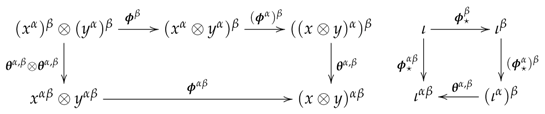
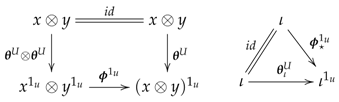
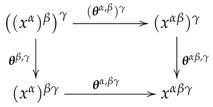
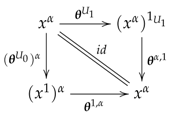
If is any fixed small category, by a prestack of monoidal abelian groupoids on we mean a contravariant pseudo-functor from to the 2-category of monoidal abelian groupoids, see Reference [1] for instance. Thus, such a prestack consists of the data (PDi) and axioms (PAj) that follow.
- (PD1)
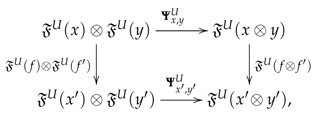
- a monoidal abelian groupoid , for each object U of ; that is, an abelian groupoid enriched with a tensor product , a unit object , and natural morphismssatisfying the commutativity of the diagrams
- (PD2)
- a monoidal functor , for each arrow of ; that is, a functor between the underlying groupoids endowed with natural morphisms and a morphism , satisfying the commutativities
- (PD3)
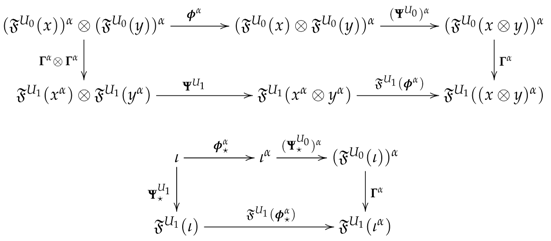
- a monoidal transformation , for each two arrows of ; that is, a family of natural morphisms , making commutative the diagrams
- (PD4)
- a monoidal transformation , for each object U of ; that is, a family of natural morphisms making commutative the diagrams
All these data are subject to the following two coherence conditions:
- (PA1)
- for any three composable arrows of and , the squarecommutes, that is,
- (PA2)
- for each in and , both inner triangles in the squarecommute, that is,
If and are two such prestacks on , then an equivalence is a pseudo-natural equivalence, in other words it consists of the following data
- (EPD1)
- a monoidal equivalence , for each object U of ; that is, an equivalence between the underlying groupoids enriched with natural morphisms and a morphism , satisfying
- (EPD2)
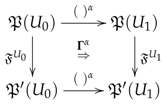
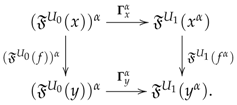
- a monoidal transformationfor each morphism of ; that is, a family of natural morphisms
making commutative the diagrams

All subject to the following two axioms:
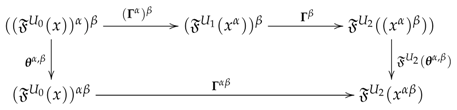
- (EPA1)
- for any two composable arrows of and , the diagramcommutes, that is,
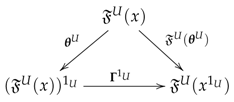
- (EPA2)
- for any objects U of and x of , the triangle below commutes.
The following is an useful result about transporting prestack structure.
Lemma 2.
Suppose is a prestack of monoidal abelian groupoids on , and is a -indexed family of equivalences of groupoids. Then, there is a prestack of monoidal abelian groupoids and an equivalence which agrees on the underlying groupoids with the given functors .
Proof.
Notice that to provide the datum (PD1) in the construction of our prestack , we can simultaneously provide the datum (EPD1) for the construction of , since and are equivalences: For each object U of , let us select objects and in together with morphisms and in . Then, there is a unique monoidal structure on such that together with the morphisms and turns to be a monoidal equivalence. The tensor product of morphisms and in is determined by the commutativity of the diagram
the unit object is , and the structure constraints , and are uniquely determined by Equations (142) and (143). Similarly, (EPD2) tell us how to satisfy (PD2): For each arrow in , let us choose objects in together with morphisms . Then, the assignment is the function on objects of the functor , whose effect on a morphism of is the morphism determined by the commutative square
This functor becomes a monoidal functor in a unique way such that turns to be a monoidal transformation, since its structure constraints and are uniquely determined by the Equations (145) and (146). Finally, axiom (EPA1) uniquely determines the datum (PD3) for , while (EPA2) do the same with the datum (PD4). All the requirements (132)–(141) for are consequence of the corresponding ones for since the are faithful. In getting we have also got the equivalence . □
Theorem 4 below shows a classification for equivalence classes of prestacks of monoidal abelian groupoids on by means of triads , where is a presheaf of monoids on , A is a -module, and c is a cohomology class . Previously, we show how every 3-cocycle gives rise to a prestack of monoidal abelian groupoids on
which, for abbreviation, we also denote by . Its data are as follows:
(PD1) For each object U of , the underlying groupoid has as set of objects the elements of the monoid . If are different elements of , then , whereas its isotropy group at an x is , the abelian group that A attaches to the object of . Its tensor product is given by
The identity of the monoid provides the unit object, that is, , and the associativity and unit constraints are
which are easily seen to be natural since the are abelian groups. Equation (132) hold thanks to the 3-cocycle condition in (109). Besides, if we take and replace t with y in (109), we get
which just is (133).
(PD2) For each arrow of , the functor acts by
and its monoidal structure constraints are defined by
The 3-cocycle condition in (110) directly provides the verification of (134). If, firstly, we take in (110) and, secondly, we take and then we replace z with x also in (110), we get the equalities
which tell us that the requirements in (135) hold.
(PD3) For each in , the monoidal transformation is defined, at each object x of , by
The coherence condition (136) holds owing to the cocycle condition in (111). Furthermore, taking in (111) we obtain
which just reads the requirement (137).
(PD4) For each object U of , the monoidal transformation is given, at each object x, by
Taking in (111) we obtain
which, taking opposites, says that (138) holds. Even more, taking in the above equation, we obtain
that is, (139) is satisfied.
Finally, we verify axioms (PA1) and (PA2) for : Here (140) reads
which follows directly from the cocycle condition in (112). But we have even more, since if we take in the above equality we get
while taking and then replacing by we obtain
and these last two equalities just mean that (141) holds.
In the theorem below, we will use that the cohomology groups of presheaves of monoids are functorial in the usual way, contravariant in and covariant in A.
Theorem 4.
For any prestack of monoidal abelian groupoids , there exist presheaf of monoids , a -module A, a 3-cocycle , and an equivalence
Let and be 3-cocycles, where and are presheaves of monoids, A is a -module, and is a -module. There is an equivalence
if and only if there are isomorphisms and such that
in .
Proof.
(i) Let be a prestack of monoidal abelian groupoids on . By Lemma 2, we can assume that for any object U of the groupoid is skeletal, that is, there is no morphisms between different objects. Then, we can construct a presheaf of monoids , a -module A, a 3-cocycle , and an equivalence as follows:
- ⧫
- The presheaf of monoids : For any object U of , let be the set of objects of the monoidal abelian groupoid . The effect on objects of tensor functor gives a multiplication on , simply by putting , which is associative and unitary, with identity , the unit object of , since being skeletal the existence of the structure constraints , , and forces the equalities and . Thus, is a monoid. For each arrow of , the function on objects of the monoidal functor in (PD2) gives a homomorphism of monoids , . The equalities and follow from the presence of the structure morphisms and , since is skeletal. Furthermore, if is any other arrow , the equality , that is for any , holds due to is skeletal and we have the structure morphisms in (PD3). Similarly, we see that because we have the morphisms as data in (PD4). Thus, is a presheaf of monoids.
- ⧫
- The -module A: For any object U of and each , let the abelian group of automorphisms of x in . For any other , the homomorphisms (26), , and (27), , are respectively defined by the functors and ; that is, for every , and . If is an arrow in , the homomorphism (28), , , is defined by the monoidal functor . For and , the equality holds since the naturality of associativity constraint of tell us that, in the abelian group , we have . Similarly, the equality follows from the naturality of the unit constraints and , which imply the equalities and , and the abelianity of the group . If is an arrow in , the naturality of the structure morphisms and , in (PD2), gives the equalities and . Then, as the group is abelian, we conclude that and . If is any other arrow , the equalities are consequence of being the group abelian and the naturality of the structure morphisms in (PD3), which tell us that . Similarly, the equality follows from the naturality of the morphisms , which says that , and the abelianity of the group . Thus, all the requirements in (30) are verified and we conclude that A is actually a -module.
- ⧫
- ⧫
- The equivalence : Previously to show such an equivalence, it is worth analyzing in relation to :
Concerning the data in (PD1), a direct comparison shows that, for each object U of , both monoidal groupoids and have the same underlying groupoid and the same tensor product, as for any and , and
as well as the same associativity constraint and the same unit object . However, they have different left and right unit constraints, since in the original they are and , whereas in they are respectively defined as
With regards to the data in (PDA2), a direct comparison shows that, for any arrow in , both monoidal functors and coincide on objects and on morphisms, as well as they have the same structure morphisms . But they have different unit structure morphism since, while in the original it is , in it is . Similarly, we see that the data in (PDA3) and in (PDA4) for both and are given by the same monoidal transformations and the same morphisms (for these last, note that the equalities follow from (141) by taking therein).
Then, an equivalence is defined by the following data:
(EPD1) For each object U of , the monoidal functor acts between the underlying groupoids as the identity, that is, . Its structure morphisms are all identities, that is, , and the structure morphism is defined by (, see Proposition 1.1 in Reference [25]), the unit constraint of at the unit object .
(EPD2) For any arrow , the monoidal transformation is the identity transformation on the functor , that is, for any object x of .
Notice that, for any object U of , the naturality of the morphisms simply means that the tensor product ⊗ is the same in both and , which is true as we commented before, and the coherence condition (142) is obviously satisfied, since the associativity constraints also agree in both monoidal groupoids. Here, the requirements in (143) read
To verify them, first observe that, by naturality, we have the equalities and , whence and . Then, taking in (133) we obtain the equality , while taking and replacing y with x in (133) we obtain . Hence, Equation (170) hold since the group is abelian.
Checking the remaining requirements, we see that Equations (145), (147) and (148) obviously hold, while (146) reads . To its verification, note that, by naturality, we have the equality . Hence, since the group is abelian. Then, taking in (135), we obtain the required equality in the equivalent form .
(ii) Notice that and are equivalent if and only if they are isomorphic since, for any object U of , both groupoids and are skeletal.
Suppose first that an isomorphism of presheaves and an isomorphism of -modules such that . This means that there is a 2-cochain such that the equations below hold.
Then, we can define an isomorphism by the following data:
(EPD1) For each object U of , the monoidal isomorphism acts, at the level of the underlying groupoids, by , and its structure constrains are respectively defined by and .
(EPD2) For each arrow of , the monoidal transformation is given by
So defined, it is plain to see that every is an isomorphism of groupoids. The naturality of the isomorphisms holds since F is a morphism of -modules and the groups are abelian. Equation (171) directly provides the verification of the coherence condition (142), as well as that of (143) just by taking therein. Similarly, the naturality of the morphisms follows from being F a morphism of -modules and the groups abelian, whereas Equation (172) implies conditions (145) and (146), taking for the last one. Finally, say that (147) holds thanks to (173), from which one verifies also (148) by taking therein.
Finally, we can prove the converse simply by retracting our above steps: Suppose we have an isomorphism . Then, for each U of , let be the function on objects of the monoidal isomorphism . Since is skeletal, the existence of the morphisms data and in (EPD1) forces the equalities and . Similarly, for each in , the presence of the morphisms in the data (EPD2) implies the equalities . Thus is an isomorphism of presheaves of monoids. Now, if for each object U of and , we define the isomorphism by , the naturality of the morphisms and just tell us that is an isomorphism of -modules. Finally, if we take the 2-cochain defined by and , we easily see that that the coherence conditions (142), (145) and (147) imply the equalities in (171), (172), and (173), respectively. Thus, we have , whence in , and therefore in . □
10. The Particular Case Where the Monoids Are Groups
In this section, we review how our results above specialize when we limit our attention to presheaves of groups .
10.1. the Coefficients for the Cohomology of a Presheaf of Groups
The coefficients for the cohomology of a presheaf of groups admit an easier description than that given in Section 3 for the coefficients for the cohomology of a presheaf of monoids. This is as follows.
Definition 3.
Let be a presheaf of groups on . A-module is a presheaf of abelian groups on (= -module) A such that for each object U of the abelian group is a left -module and for each arrow of the induced homomorphism is compatible with the modules structures via the group homomorphism ; that is, for and
In other words, such that the action maps , , define a natural transformation . A morphism of -modules is a morphism of presheaves of abelian groups such that, for each object U of , the homomorphism is of -modules.
Let -Mod denote the category of -modules. There is a full and faithful embedding
which identifies each -module A to the -module, equally denoted by A, such that for each object U of and , and , for each in and .
Proposition 9.
For any presheaf of groups , the embedding (176) above is an equivalence of categories.
Proof.
Let A be a -module. Define to be the -module whose underlying presheaf assigns to each the abelian group and to each morphism of the homomorphism . For each object U of , the -action on is given by . Then, an isomorphism of -modules is given by the isomorphisms defined by , for any and . □
It follows that there is no loss of generality in assuming that the coefficients for the cohomology groups of a presheaf of groups are -modules. For these, all our constructions and results rewrite more simply and revisit those established in Reference [26]. Notice that, when we plug an -module A into the complex of cochains of Section 6, we just obtain (up to normalization) the cochain complex shown in Reference [26] to compute the cohomology groups of with coefficients in A.
10.2. Derivations of Presheaves of Groups
Let be a presheaf of groups on . By definition,
Here, a derivation of in a -module A, say , simply consists of a natural family of ordinary derivations , one for each . That is, the maps satisfy and, for any in , the equalities hold.
The -module in (36) assigns to each object U of the underlying group of the ordinary integral group ring turned into an -module in the obvious way and, if is a morphism of , the corresponding homomorphism is just the induced by . Then, the isomorphism in Proposition 5 reads
where is the -module assigning to each object U of the ordinary ideal augmentation of the group .
10.3. Singular Extensions of Presheaves of Groups
The main result in Section 8 particularizes here by giving the cohomological classification of short exact sequences of presheaves of groups on
in which A is of abelian groups. Such a short exact sequence determines a -module structure on A in which, for each object U of , the action of the group on the abelian group is determined by the formula , where is an (any) element of the fibre of the epimorphism at x. If A is a -module, we define a singular extension of by A as a short exact sequence (179) such that the induced -module structure on A is the given one.
Proposition 10.
A singular extension of a presheaf of groups by a -module A is the same thing as an extension of by A (as defined in Section 8).
Proof.
Suppose first that is an extension of by A. Then, we claim, every monoid , , is a group. In effect, let and suppose that . Let us choose any . Since , we can write for some . Then,
so that is an inverse of w in . Now, the bijections , , define an isomorphism of presheaves of groups since, for any ,
and, for any in ,
Thus, is an extension, which is singular since, for any , and ,
Conversely, any singular extension can be regarded as an extension, where the simply-transitive actions are given by . The requirements in (115) and (116) are satisfied, since
□
When two singular extensions and are viewed as extensions, they are isomorphic if and only if there is an isomorphism of presheaves of groups such that and . Then, Theorem 3 rewrites as follows (cf. Theorem 7.2 in Reference [26]).
Theorem 5.
The isomorphism classes of singular extensions of a presheaf of groups by a -module A correspond bijectively to the elements of .
10.4. Prestacks of Categorical Groups
The results in Section 9 specialize here by giving the cohomological classification of prestacks of categorical groups. Let us recall that a categorical group (aka Gr-category or 2-group) is a monoidal groupoid such that, for any object x, the endofunctor is an autoequivalence [5,25,27,28].
Lemma 3.
In any categorical group, the underlaying groupoid is abelian.
Proof.
Let be a categorical group. The group is abelian since the multiplication
is a group homomorphisms [29]. For any object x, the group is also abelian, since we have the group isomorphism . □
The 2-category of categorical groups is then a full 2-subcategory of the 2-category of monoidal abelian groupoids and therefore, for any small category , the 2-category of prestacks of categorical groups on is a full 2-subcategory of the 2-category of prestacks of monoidal abelian groupoids on . In particular, two prestacks of categorical groups are equivalent if and only if they are equivalent as prestacks of monoidal abelian groupoids. In order to their classification, recall that a monoidal groupoid is a categorical group if and only if every object x has a quasi-inverse with respect to the tensor product, that is, there is an object with an arrow . Then, for any presheaf of groups , any -module A and any 3-cocycle , the prestack of monoidal abelian groupoids built as in (149) is easily recognized to be a prestack of categorical groups. Then, Theorem 4 particularizes as follows (cf. Theorem 8.5 in Reference [26]).
Theorem 5.
For any prestack of categorical groups , there exist presheaf of groups , a -module A, a 3-cocycle and an equivalence
Let and be 3-cocycles, where and are presheaves of groups, A is a -module and is a -module. There is an equivalence
if and only if there is an isomorphism of presheaves of groups and a isomorphism of -modules such that the equality of cohomology classes in below holds.
Proof.
(i) Let be a prestack of categorical groups on . By Theorem 4(i), there are a presheaf of monoids , a -module A, a 3-cocycle and an equivalence . Then, is a prestack of categorical groups as is; that is, is a categorical group, for every object U of . Therefore, for any it must exist another with a morphism in . As the groupoid is skeletal, necessarily in , which means that is an inverse of x in the monoid . Therefore, every is a group and is actually a presheaf of groups.
Now, by Proposition 9, there is a -module with an isomorphism of -modules . Then, Theorem 4 gives the existence of an equivalence , whence an equivalence follows.
(ii) This follows directly from Theorem 4(ii). □
Author Contributions
Both authors have contributed equally in the conceptualization, methodology, validation, investigation and writing original draft preparation. Both authors have read and agreed to the published version of the manuscript.
Funding
This research received external funding from FQM-379: Algebra y Teoría de la Información.
Conflicts of Interest
The authors declare no conflict of interest.
References
- Kashiwara, M.; Schapira, P. Categories and Sheaves; Grundlehren der Mathematischen Wissenschaften, 332; Springer: Berlin, Germany, 2006; 497p. [Google Scholar]
- Calvo, M.; Cegarra, A.M.; Heredia, B.A. Structure and classification of monoidal groupoids. Semigroup Forum 2008, 87, 35–79. [Google Scholar] [CrossRef]
- Leech, J. -coextensions of monoids. Mem. Am. Math. Soc. 1975, 1, 1–66. [Google Scholar]
- Leech, J. The cohomology of monoids. Unpublished lecture notes. 1976. [Google Scholar]
- Sinh, H.K. Gr-catégories. Ph.D. Thesis, Université Paris VII, Paris, France, 1975. [Google Scholar]
- Gerstenhaber, M.; Schack, S.D. On the deformation of algebra morphisms and diagrams. Trans. Am. Math. Soc. 1983, 279, 1–50. [Google Scholar] [CrossRef]
- Gerstenhaber, M.; Schack, S.D. The cohomology of presheaves of algebras. I. Presheaves over a partially ordered set. Trans. Am. Math. Soc. 1988, 310, 135–165. [Google Scholar]
- Gerstenhaber, M.; Giaquinto, A.; Schack, S.D. Diagrams of Lie algebras. J. Pure Appl. Algebra 2005, 196, 169–184. [Google Scholar] [CrossRef][Green Version]
- Dwyer, W.G.; Kan, D.M. An obstruction theory for diagrams of simplicial sets. Ned. Akad. Wet. Indag. Math. 1984, 46, 139–146. [Google Scholar] [CrossRef]
- Dwyer, W.G.; Kan, D.M. Hochschild-Mitchell cohomology of simplicial categories and the cohomology of simplicial diagrams of simplicial sets. Ned. Akad. Wet. Indag. Math. 1988, 50, 111–120. [Google Scholar]
- Moerdijk, I.; Svensson, J.-A. The equivariant Serre spectral sequence. Proc. Am. Math. Soc. 1993, 118, 263–278. [Google Scholar] [CrossRef]
- Moerdijk, I.; Svensson, J.-A. A Shapiro lemma for diagrams of spaces with applications to equivariant topology. Compositio Math. 1995, 96, 249–282. [Google Scholar]
- Blanc, D.; Johnson, M.W.; Turner, J.M. Local-to-global spectral sequences for the cohomology of diagrams. J. Pure Appl. Algebra 2009, 213, 34–53. [Google Scholar] [CrossRef][Green Version]
- Bousfield, A.K.; Kan, D.M. Homotopy Limits, Completions and Localizations; Lecture Notes in Mathematics; Springer: Berlin/Heidelberg, Germany, 1972; Volume 304, 348p. [Google Scholar]
- Gabriel, P.; Zisman, M. Calculus of Fractions and Homotopy Theory; Ergebnisse der Mathematik und ihrer Grenzgebiete, Band 35; Springer: New York, NY, UYA, 1967; 168p. [Google Scholar]
- McDuff, D. On the classifying spaces of discrete monoids. Topology 1979, 18, 313–320. [Google Scholar] [CrossRef][Green Version]
- Whitehead, J.H.C. On group extensions with operators. Q. J. Math. Oxf. Ser. 1950, 1, 219–228. [Google Scholar] [CrossRef]
- Grillet, P.-A. Left coset extensions. Semigrpup Forum 1974, 7, 200–263. [Google Scholar] [CrossRef]
- Mac Lane, S. Categories for the Working Mathematician, 2nd ed.; Graduate Texts in Mathematics, 5; Springer: New York, NY, USA, 1998; 314p. [Google Scholar]
- Roos, J.-E. Sur les foncteurs dérivś de . Applications. C. R. Acad. Sci. Paris 1961, 252, 3702–3704. [Google Scholar]
- Watts, C.E. A homology theory for small categories. In Proc. Conf. Categorical Algebra (La Jolla, Calif., 1965); Springer: New York, NY, USA, 1966; pp. 331–335. [Google Scholar]
- Wells, C. Extension theories for monoids. Semigroup Forum 1978, 16, 13–35. [Google Scholar] [CrossRef]
- Cegarra, A.M. Cohomology of monoids with operators. Semigroup Forum 2019, 99, 67–105. [Google Scholar] [CrossRef]
- Goerss, P.G.; Jardine, J.F. Simplicial Homotopy Theory; Modern Birkhäuser Classics; Birkhäuser Verlag: Basel, Switzerland, 2009; 510p. [Google Scholar]
- Joyal, A.; Street, R. Braided tensor categories. Adv. Math. 1993, 102, 20–78. [Google Scholar] [CrossRef]
- Cegarra, A.M. Cohomology of diagrams of groups. The classification of (co)fibred categorical groups. Int. Math. J. 2003, 3, 643–680. [Google Scholar]
- Breen, L. Théorie de Schreier supŕieure. Ann. Sci. Éc. Norm. Super. 1992, 25, 465–514. [Google Scholar] [CrossRef]
- Saavedra, R.N. Catégories Tannakiennes; Lecture Notes in Mathematics; Springer: New York, NY, USA, 1972; Volume 265, 418p. [Google Scholar]
- Eckmann, B.; Hilton, P.J. Group-like structures in general categories. I. Multiplications and comultiplications. Math. Ann. 1961, 145, 227–255. [Google Scholar] [CrossRef]
© 2020 by the authors. Licensee MDPI, Basel, Switzerland. This article is an open access article distributed under the terms and conditions of the Creative Commons Attribution (CC BY) license (http://creativecommons.org/licenses/by/4.0/).