


Abstract
In this paper, we propose a generalized viscosity implicit iterative method for asymptotically non-expansive mappings in Banach spaces. The strong convergence theorem of this algorithm is proved, which solves the variational inequality problem. Moreover, we provide some applications to zero-point problems and equilibrium problems. Further, a numerical example is given to illustrate our convergence analysis. The results generalize and improve corresponding results in the literature.
Keywords:
fixed point; variational inequality; generalized viscosity implicit rule; asymptotically nonexpansive mapping; Banach spaces MSC:
47H10; 49H09; 47J25
1. Introduction
Variational inequality theory and fixed point theory are two important fields in non-linear analysis and optimization. Much attention has been given to developing implementable viscosity iterative methods for solving variational inequality problems, due to their applications in many real world problems, such as signal processing, saddle point problems, equilibrium problems, and game theory, in the frameworks of Hilbert spaces or Banach spaces; see [1,2,3,4,5,6,7,8,9] and the references therein.
The implicit midpoint rule is one of the most important numerical methods for solving certain differential algebraic equations. Convergence analysis for viscosity iterative algorithms using the implicit midpoint rule have been introduced by many authors; see [10,11,12,13,14,15,16] and the references therein. More precisely, in 2015, Xu et al. [17] introduced the viscosity implicit midpoint rule for non-expansive mappings in Hilbert spaces, wherein they showed that the sequence generated by
converges strongly to a fixed point of T, which was also the solution of the following variational inequality (VI):
where is the set of fixed points of T. In 2017, Luo et al. [14] extended the work of Xu et al. [17] to uniformly smooth Banach spaces, which contains Hilbert spaces as a special case. They proved a strong convergence theorem for the iterative scheme. In 2015, Ke et al. [18] studied the following generalized viscosity implicit rule for nonexpansive mappings in Hilbert spaces:
which converges strongly to a fixed point of T under certain assumptions, and is also solved by the variational inequality (VI). In 2017, He et al. [19] considered the generalized viscosity implicit rule of asymptotically non-expansive mappings in Hilbert spaces. They proved that the iterative algorithm, defined by
converges strongly to a fixed point of T, which was also the solution of the variational inequality (VI).
Motivated and inspired by the above works, we present a generalized viscosity implicit iterative method for an asymptotically non-expansive mapping in a Banach space. Then, we prove a strong convergence theorem of this algorithm, which solves the variational inequality problem. Applications to zero-point problems and equilibrium problems are presented. Finally, a numerical example is given, to illustrate our convergence analysis. Therefore, the results in this paper generalize and improve the corresponding results found in [13,14,15,17,18,19].
2. Preliminaries
Throughout this paper, let K be a subset of a real Banach space E and let be the dual space of E. Let be a mapping, and denote by the set of fixed points of T. Recall that the duality mapping is defined by
A mapping T is said to be contractive on K if there exists a constant such that for all . Further, T is said to be nonexpansive if for all , and T is said to be asymptotically nonexpansive if there exists a sequence : such that for all , and is called an asymptotic coefficient sequence of T.
We need some Lemmas for the proof of our main results.
Lemma 1
([20]). Let be a sequence of non-negative real numbers satisfying the condition
where and satisfy
- (i)
- and and
- (ii)
- either or
Then, converges to zero.
Lemma 2
([15]). Let and be bounded sequences in a Banach space E and be a sequence in with . Suppose that for all and . Then, .
Lemma 3
([21]). Let K be a non-empty closed convex subset of a Banach space E, and let be an asymptotically non-expansive mapping with a fixed point. Suppose that E admits a weakly sequentially continuous duality mapping. Then, the mapping is demiclosed at zero (i.e., where I is the identity mapping, if and , then ).
Lemma 4
([22]). Let E be a uniformly smooth Banach space, K be a nonempty closed convex subset of E, and be a nonexpansive mapping with . Let be a contractive mapping. Then, the sequence defined by converges strongly to a point in . If we define a mapping by , then solves the variational inequality
Lemma 5
([23]). Let E be strictly convex, and and be an attracting non-expansive and a non-expansive mapping, respectively, which have a common fixed point. Then, .
3. Main Results
Theorem 1.
Let K be a non-empty closed convex subset of a uniformly smooth Banach space E, which has a weakly continuous duality mapping. Let be an asymptotically nonexpansive mapping with its asymptotic coefficient sequence : . Assume that and is a contraction with coefficient . For a given , let be a sequence generated in the following manner:
where satisfy the following conditions:
Then, converges strongly to a fixed point of the asymptotically nonexpansive mapping T, which solves the variational inequality:
Proof.
We divide the proof into five steps.
Step 1: We show that is bounded. Indeed, if we let , then we have
It follows that
As , we can get
We deduce that
By induction, we get
Then, we obtain that is bounded, and so are , .
Step 2: Show that . Setting , we have
which implies that
where is a constant that satisfies:
By (1), we can get
This implies that
Then,
Substituting (4) into (3), we have
By conditions (i), (ii), and (iv), we have
Applying Lemma 2, we can get
Note that
and so we have
Step 3: We show that .
Moreover, we know that
That is,
From conditions (i) and (ii), and Step 2, we obtain
Then,
By (5) and Step 2, we have
We know that T is an asymptotically non-expansive mapping, and so we have
By Step 2 and (6), we can get
Step 4: We prove that .
As K is a uniformly smooth Banach space and is bounded, then there exists a subsequence of which converges weakly to y. Further,
It follows from Step 3 and Lemma 3, we can get . Then, satisfies
by the weakly sequential continuous duality mapping and Lemma 4, we have
Step 5: Finally, we prove that converges strongly to .
which implies taht
That is,
we note that
By Step 4, we have . Thus, by condition (i) and applying Lemma 1 to (7), we conclude that . This completes the proof. □
Theorem 2.
Let K be a nonempty closed convex subset of a uniformly smooth Banach space E, which has a weakly continuous duality mapping. Let be a non-expansive mapping. Assume that and is a contraction. For a given , let be a sequence generated in the following manner:
where , satisfy the following conditions:
Then, converges strongly to a fixed point of the nonexpansive mapping T, which solves the variational inequality:
Remark 1.
The aim of this paper is to study the general viscosity implicit midpoint rule for asymptotically non-expansive mappings in Banach spaces. In Theorem 1, if in a Hilbert space, this is the main result of Yan et al. [24]. We know that every non-expansive mapping is an asymptotically non-expansive mapping. In Theorem 1, if , then T is a non-expansive mapping. Thus, we extend and generalize the Hilbert space results to Banach spaces, the non-expansive mapping to asymptotically non-expansive mapping, and the implicit midpoint rule to the generalized viscosity implicit midpoint rule, which includes some corresponding recent results (see, for example, [13,14,17,18,19]) as special cases.
4. Applications
4.1. Application to Zero-Point Problems
Consider the zero-point problem: Find , such that
where is an accretive operator: An operator is accretive if, for , there exists such that . Further, is called the resolvent of A, which we define by . It is well-known that is a non-expansive mapping and that , where is the set of zeros of A and is the fixed point set of . Thus, we can apply the our results by taking .
Corollary 1.
Let K be a nonempty closed convex subset of a uniformly smooth Banach space E, which has a weakly continuous duality mapping. Let A be a m-accretive operator in E, such that and is a contraction. For a given , let be a sequence generated in the following manner:
where , satisfy the following conditions:
Then, converges strongly to , which solves the variational inequality:
4.2. Application to Equilibrium Problems
Let B be a non-empty, closed, and convex subset of a Hilbert space H. Consider the equilibrium problem: Find , such that
where is a bi-function satisfying the following conditions:
- (H1)
- for all ;
- (H2)
- , for all ;
- (H3)
- for each ,; and
- (H4)
- for all , is convex and weakly lower semi-continuous.
Assume that G satisfies –. For and , we define by , and the set of solutions of the equilibrium problem is denoted by . It is well-known that the single-valued mapping is firmly non-expansive and that , where is a closed and convex set. Thus, we can apply our results by Lemma 5.
Corollary 2.
Let B be a non-empty, closed, and convex subset of a real Hilbert space H and be a bi-function satisfying the conditions –. Let be a non-expansive mapping such that and is a contraction. For a given , let be a sequence generated in the following manner:
where , satisfy the following conditions:
Then, converges strongly to , which solves the variational inequality:
5. Numerical Examples
Example 1.
Let the inner product be . We set and , where . We take , , , and , for all . It is easy to see that , , and satisfy the conditions (i)–(iv) in Theorem 1. Then, we get
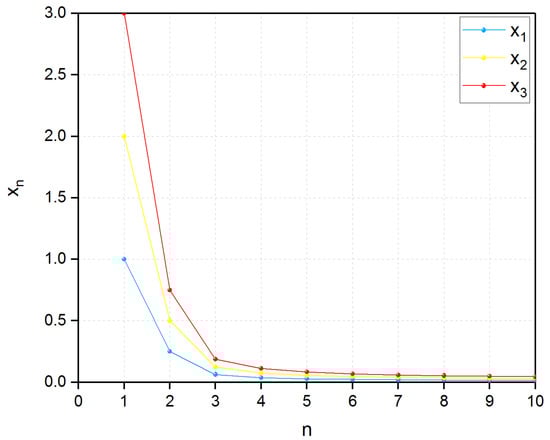
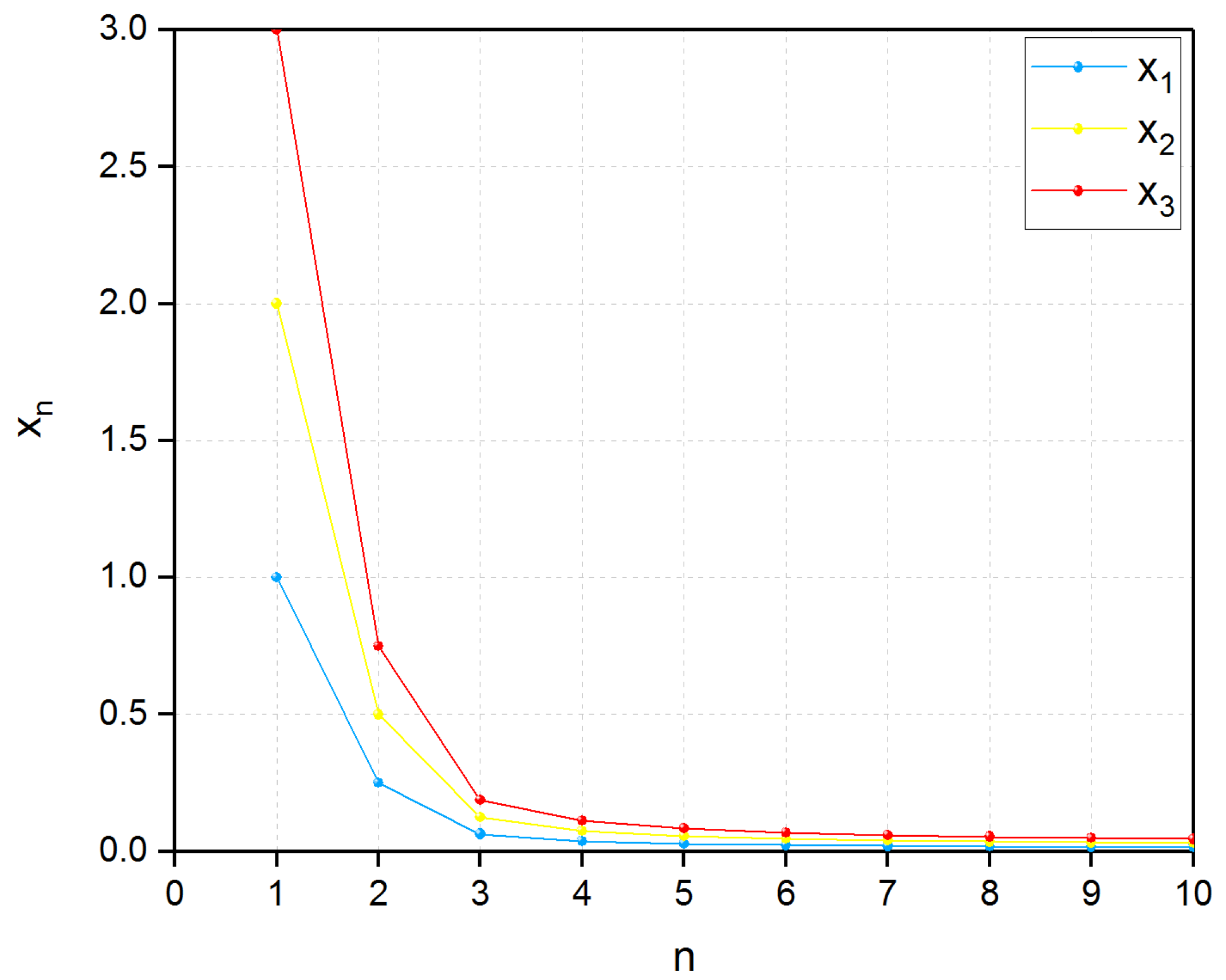
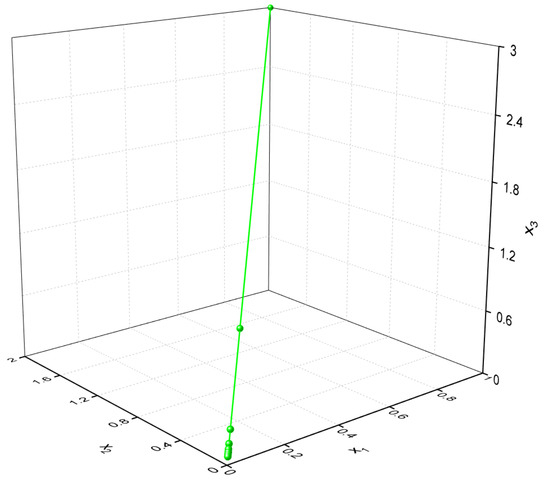
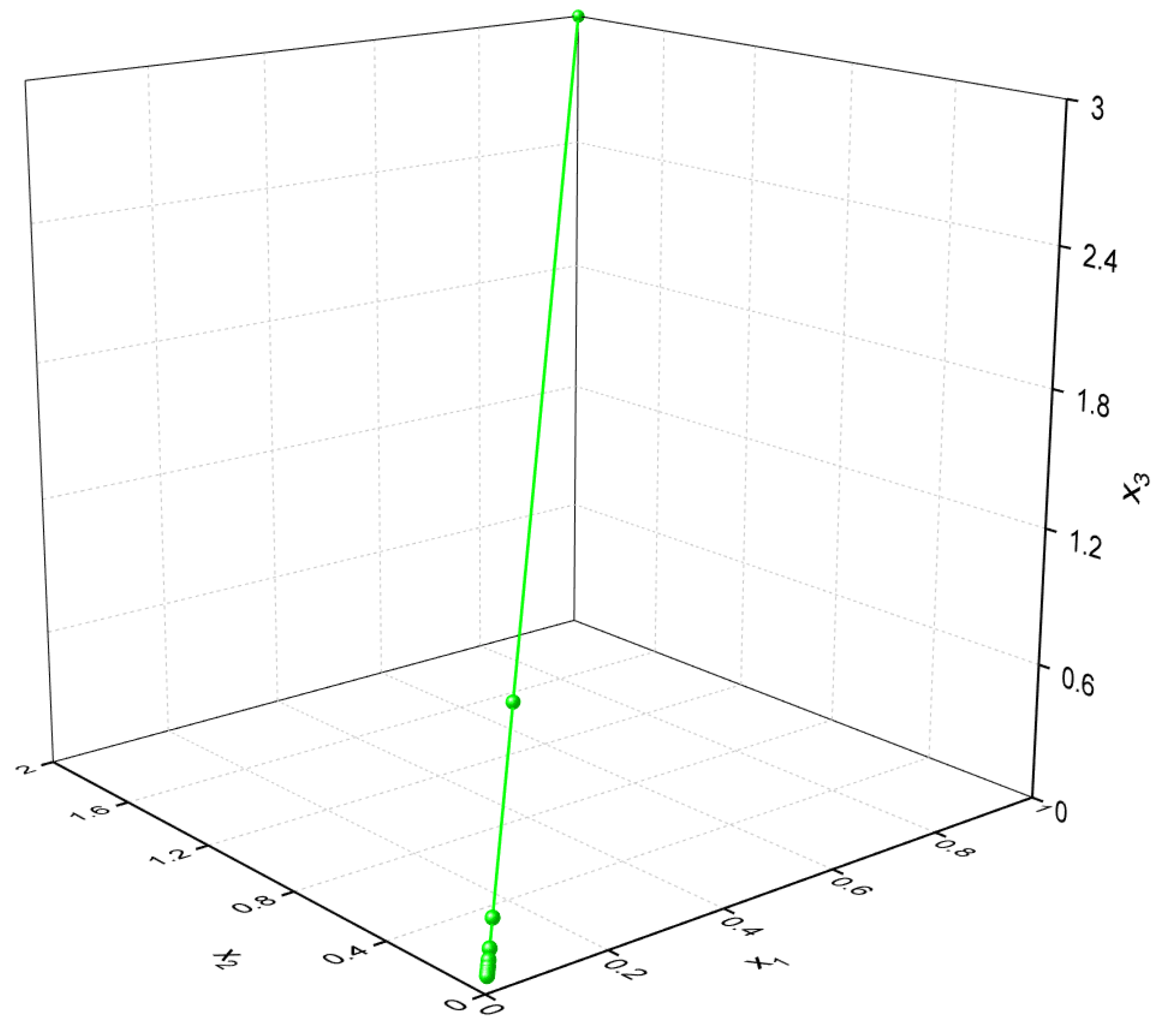
Starting with and using the algorithm in Theorem 1, we get the following numerical results, as shown in Figure 1 and Figure 2.
Figure 1.
Two dimensions.
Figure 2.
Three dimensions.
Author Contributions
Conceptualization, C.P. and Y.W.; methodology, C.P. and Y.W.; software, C.P. and Y.W.; validation, C.P. and Y.W.; formal analysis, C.P. and Y.W.; investigation, C.P. and Y.W.; resources, C.P. and Y.W.; data curation, C.P.; writing—original draft preparation, C.P. and Y.W.; writing—review and editing, C.P. and Y.W.; visualization, C.P. and Y.W.; supervision, Y.W.; project administration, Y.W.
Funding
This research received no external funding.
Acknowledgments
This work was supported by the National Natural Science Foundation of China (Grant no. 11671365) and the Natural Science Foundation of Zhejiang Province (Grant no. LY14A010011).
Conflicts of Interest
The authors declare that they have no competing interests.
References
- Iiduka, H.; Takahashi, W.; Toyoda, M.; Toyoda, M. Approximation of solutions of variational inequalities for monotone mappings. Pan. Math. J. 2004, 14, 49–61. [Google Scholar]
- La Sen, M.D. Stability and convergence results based on fixed point theory for a generalized viscosity iterative scheme. Fixed Point Theory Appl. 2009, 19, 314581. [Google Scholar] [CrossRef] [Scilit]
- Yao, Y.; Leng, L.; Postolache, M.; Zheng, X. Mann type iteration method for solving the split common fixed point problem. J. Nonlinear Convex Anal. 2017, 18, 875–882. [Google Scholar]
- Song, Y.; Chen, R.; Zho, H. Viscosity approximation methods for nonexpansive mapping sequences in Banach spaces. Nonlinear Anal. 2007, 66, 1016–1024. [Google Scholar] [CrossRef] [Scilit]
- Yao, Y.; Maruster, S. Strong convergence of an iterative algorithm for variational inequalities in Banach spaces. Math. Comput. Model. 2011, 54, 325–329. [Google Scholar] [CrossRef] [Scilit]
- Wu, X.; Zhao, L. Viscosity Approximation Methods for Multivalued Nonexpansive Mappings. Mediterr. J. Math. 2016, 13, 2645–2657. [Google Scholar] [CrossRef] [Scilit]
- Yao, Y.; Yao, J.C.; Liou, Y.C.; Postolache, M. Iterative algorithms for split common fixed points of demicontractive operators without priori knowledge of operator norms. Carpathian J. Math. 2018, 34, 459–466. [Google Scholar]
- Sunthrayuth, P.; Kumam, P. Viscosity approximation methods base on generalized contraction mappings for a countable family of strict pseudo-contractions, a general system of variational inequalities and a generalized mixed equilibrium problem in Banach spaces. Math. Comput. Model. 2013, 58, 1814–1828. [Google Scholar] [CrossRef] [Scilit]
- Yao, Y.; Postolache, M.; Yao, J.C. An iterative algorithm for solving the generalized variational inequalities and fixed points problems. Mathematics 2019, 7, 61. [Google Scholar] [CrossRef] [Scilit]
- Bader, G.; Deuflhard, P. A semi-implicit mid-point rule for stiff systems of ordinary differential equations. Numer. Math. 1983, 41, 373–398. [Google Scholar] [CrossRef] [Scilit]
- Somalia, S. Implicit midpoint rule to the nonlinear degenerate boundary value problems. Int. J. Comput. Math. 2002, 79, 327–332. [Google Scholar] [CrossRef] [Scilit]
- Zhang, H.C.; Qu, Y.H.; Su, Y.F. Strong convergence theorems for fixed point problems for nonexpansive mappings and zero point problems for accretive operators using viscosity implicit midpoint rules in Banach Spaces. Mathematics 2018, 6, 257. [Google Scholar] [CrossRef] [Scilit]
- Cai, G.; Shehu, Y.; Iyiola, O.S. Modified viscosity implicit rules for nonexpansive mappings in hilbert spaces. Fixed Point Theory Appl. 2017. [Google Scholar] [CrossRef] [Scilit]
- Luo, P.; Cai, G.; Shehu, Y. The viscosity iterative algorithms for the implicit midpoint rule of nonexpansive mappings in uniformly smooth banach spaces. J. Inequal. Appl. 2017, 2017, 154. [Google Scholar] [CrossRef] [Scilit] [PubMed]
- Yao, Y.H.; Shahzad, N.; Liou, Y.C. Modified semi-implicit midpoint rule for nonexpansive mappings. Fixed Point Theory Appl. 2015, 2015, 166. [Google Scholar] [CrossRef] [Scilit]
- Xu, H.K.; Alghamdi, M.; Shahzad, N. The implicit midpoint rule of nonexpansive mappings in Banach spaces. Fixed Point Theory 2016, 17, 509–518. [Google Scholar]
- Xu, H.K.; Alghamdi, M.; Shahzad, N. The viscosity technique for the implicit midpoint rule of nonexpansive mappings in hilbert spaces. Fixed Point Theory Appl. 2015, 2015, 41. [Google Scholar] [CrossRef] [Scilit]
- Ke, Y.F.; Ma, C.F. The generalized viscosity implicit rules of nonexpansive mappings in Hilbert spaces. Fixed Point Theory Appl. 2015, 2015, 190. [Google Scholar] [CrossRef] [Scilit]
- He, S.J.; Mao, Y.D.; Zhou, Z.; Zhang, J.Q. The generalized viscosity implicit rules of asymptotically nonexpansive mappings in Hilbert spaces. Appl. Math. Sci. 2017, 12, 549–560. [Google Scholar] [CrossRef] [Scilit]
- Liu, L.S. Iterative processes with errors for nonlinear strongly accretive mappings in Banach spaces. J. Math. Anal. Appl. 1995, 194, 114–125. [Google Scholar] [CrossRef] [Scilit]
- Lim, T.C.; Xu, H.K. Fixed point theorems for asymptotically nonexpansive mappings. Nonlinear Anal. 1994, 22, 1345–1355. [Google Scholar] [CrossRef] [Scilit]
- Xu, H.K. Viscosity approximation methods for nonexpansive mappings. J. Math. Anal. Appl. 2004, 298, 279–291. [Google Scholar] [CrossRef] [Scilit]
- Chancelier, J.P. Iterative schemes for computing fixed points of nonexpansive mappings in Banach spaces. J. Math. Anal. Appl. 2009, 353, 141–153. [Google Scholar] [CrossRef] [Scilit]
- Yan, Q.; Cai, G. Convergence analysis of modified viscosity implicit rules of asymptotically nonexpansive mappings in Hilbert spaces. Revista de la Real Academia de Ciencias Exactas, Físicas y Naturales. Serie A Matemáticas 2018, 112, 1125–1140. [Google Scholar] [CrossRef] [Scilit]
© 2019 by the authors. Licensee MDPI, Basel, Switzerland. This article is an open access article distributed under the terms and conditions of the Creative Commons Attribution (CC BY) license (http://creativecommons.org/licenses/by/4.0/).