


Abstract
In this work, we study an impulsive sub-diffusion equation as a fractional diffusion equation of order . Existence, uniqueness and regularity of solution of the problem is established via eigenfunction expansion. Moreover, we establish the approximate controllability of the problem by applying a unique continuation property via internal control which acts on a sub-domain.
Keywords:
fractional diffusion equation; controllability; impulsive system; unique continuation property MSC:
93B05; 34A08; 47H10; 49J15; 26A33; 45K05
1. Introduction
1.1. Fractional Diffusion Equations
A fractional diffusion equation of order is obtained by rewriting a normal diffusion equation in integral form as
Then, replacing the first of right-hand side (RHS) integral of Equation (1) by a Riemann-Liouville fractional integral, of order we get
Now, differentiating the above equation on both sides with respect to t, we get the following fractional diffusion equation:
If , then Equation (2) is a classical diffusion equation. Equation (2) with is called the fractional diffusion equation. These equations appear in the model of anomalous diffusion in heterogeneous media. Anomalous diffusion is one of the most ubiquitous phenomena in nature; it has been observed in various fields of physical sciences, for example, surface growth, transport of fluid in porous media, two-dimensional rotating flow and diffusion of plasma. Because of such anomalies, the classical diffusion models can not be used to study the dynamics of such systems. In this situation, fractional derivatives extend the help and play a crucial role in characterizing such diffusion. The model corresponding to such derivative is called a fractional partial differential equation. From the continuous time random walk (CTRW) model, Metzler and Klafter [1] derived Equation (3) with as a macroscopic model.
1.2. Impulsive Partial Differential Equations
Impulsive partial differential equations are a very important class of differential equations. These equations arise from the modelling of various real world processes having memory and are subject to short time fluctuations. The theory of impulsive differential equation is very rich and wide. It is mainly due to the fact that the it inherit intrinsic difficulties of the problems. These kinds of equations have lots of applications in different branches of Science and Engineering. These kinds of equations arise naturally from several physical and natural processes like earthquakes and pulse vaccination strategy. For more information, we refer to [2,3,4] and references therein. For more theoretical work, one can see the interesting book by Bainov and Simeonov [5]. The authors Shun et al. in [6] consider second-order impulsive Hamiltonian systems and established the existence of infinitely many solutions.
1.3. Controllability
In mathematical control theory, controllability and optimal control are two important concepts. In controllability, one studies the steering of a dynamical system from a given initial state to any other state or in the neighborhood of the state under some admissible control input. The cases where target states are defined in a given subregion are particularly very important; this situation arises in many real world applications. The last few decades have seen tremendous work in the controllability problems for integer order systems. Several techniques have been developed for solving such problems [7,8]. It has been seen that mostly authors worked on the problems with hard constraints on the state or control. This is mainly due to its applicability and importance in various applications in optimal control. Moreover, many authors have studied controllability of the semilinear, partial evolution equations, we refer to [9,10,11,12,13,14,15,16,17] and references therein. In a very interesting paper [14], Kenichi Fujishiro and Masahiro Yamamoto consider a partial differential equations with fractional order time derivatives and established approximate controllability by interior control.
1.4. The Problem under Consideration
Let be a bounded domain of with boundary . We consider the following initial value/boundary value problem of an impulsive sub-diffusion equation of order :
In Equation (3), is the state to be controlled and is the control which is localized in a subdomain of . We will act by f to drive the initial state to some target function . The operator A is a symmetric and uniformly elliptic operator. The details will be specified later; is also a constant. Several problems in applications can be modeled by the above equation. Some of them are: thermal diffusion in media with fractional geometry, underground environmental problems, highly heterogeneous aquifer, etc. [18]. In this paper, we study approximate controllability for fractional partial differential equations with impulses. We say that Equation (3) is approximately controllable if, for any and , there exists a control f such that the solution u of (3) satisfies
This paper is divided into four sections. In Section 2, we study requisite function spaces and some important basic results. In Section 3, we analyse the mild solutions of the Equation (3) by eigenfunction expansion. Section 4 is devoted to the study of a dual system of (3) and to establish a unique continuation property. In the last section, we establish the proof of approximate controllability.
2. Preliminaries
In this section, we state a few function spaces, notations and results in order to establish our main results. For the smooth reading of the manuscript, we first define the following class of spaces (for more details, we refer to Adams [19], Mahto [12]):
The functions and operators defined below are very standard in the fractional calculus. For more details, we refer to [20]:
- Mittag-Leffler function bywhere and are arbitrary constants. We can directly verify that is an entire function of . As for the Mittag–Leffler functions, we have the following lemma.Lemma 1.Let and be arbitrary and μ satisfy . Then, there exists a constant such that
- Reimann-Liouville integrals: For and , we define -th order forward and backward integrals of f byIn other words, the forward integral operators of -th order is the convolution with and consequently also belongs to . The same argument is also valid for the backward integrals.
- The Riemann-Liouvill fractional derivatives: For , we define the forward and backward fractional derivatives of by
We also have the following lemmas for fractional integration by parts.
Lemma 2.
Let . If , then
Proof.
□
Lemma 3.
Let . Then, we have the following identity:
Proof.
By substituing the value of R-L fractional derivative, we obtain
□
3. Solution of Primal System
3.1. Representation of the Solution
To derive the representation, we first focus on We can rewrite (3) as
where and is a symmetric, self-adjoint, uniformly elliptic operator with domain , the spectrum of A is entirely composed of a countable number of eigenvalues and we can set with finite multiplicities:
By , we denote the orthonormal eigenfunction corresponding to :
Then, the sequence is an orthonormal basis in . Since we have
where is the jth Fourier coefficient. Taking an inner product between (9) and we have an infinite number of linear integro-differential equations:
where and
Taking Laplace Transform both sides of (10), we get
where is the Laplace Transform of Simplifying, we get
By taking the inverse Laplace Transform, we get
Now, the representation for of (10) is given by
3.2. Weak Formulation
Rewriting the (3) in unified form, we get
A weak formulation of (16) is to find a such that
- is bounded or continuous
- is coercive
- l is continuous.
Definition 1.
A function is called a weak solution of (3) if:
- (1)
- and
- (2)
- For every satisfies (18),
- (3)
Based on the above analysis, we can now formulate the following two theorems.
Theorem 1.
For every and there exists a unique weak solution of (3).
Proof.
Existence and uniqueness of weak solution is followed by the Lax-Milgram theorem. □
4. Dual System
In order to establish approximate controllability, we also need to consider the dual system for (3), a similar strategy for partial differential equations of integer order (see Section 8 in [21] or Chapters 2 and 3 in [22] for example). The dual system for (3), which runs backward in time, is given by;
4.1. Solution of Dual System
Proposition 1.
Let Then, there exists a unique solution of (19) and the solution is given by
and has the following estimate:
where
Moreover, the mapping is analytically extended to .
Proof.
Here, we establish existence and uniqueness of solution of (19) for .
Multiplying (19) with and setting we get
Since
we have
From existence and uniqueness of the solution of the fractional differential equation (see [12]), we get
As is a complete orthonormal system, we have
Thus, Equation (19) has a unique solution.
Now, we show the estimate (21).
By (20), we have
Therefore,
Next, we show the analyticity of in .
We note that is an entire function (see [20] for example) and consequently each is analytic in . Therefore, in
If we fix arbitrarily, then, for with , we have
That is, (20) is uniformly convergent in . Hence, is also analytic in . □
4.2. Unique Continuation Property
Proposition 2.
Let ω be open in Ω and If a solution be the solution of (19) vanishing in then in .
Proof.
Since in and can be analytically extended to , we have
Let be all spectra of L without multiplicities and we denote by an orthonormal basis of . By using these notations, we can rewrite (24) by
Then, for any with and , we have
and
where
Therefore,
and
The right-hand sides of the two inequalities above are integrable on :
and
Hence, the Lebesgue theorem yields that
where we have used the Laplace transform formula;
(see (1.80) in p. 21 of [20]). By (25) and (26), we have
that is,
By using analytic continuation in , we have
Then, we can take a suitable disk which includes and does not include . By integrating (27) in the disk, we have
By setting , we have
Therefore, the unique continuation result for eigenvalue problem of elliptic operator (see [23,24]) implies
for each . Since is linearly independent in , we see that
This implies in . □
5. Approximate Controllability
In this section, we complete the proof of our main theorems.
Theorem 3.
We start the proof with a lemma.
Lemma 4.
If the conclusion of Theorem (3) is true for , then it is true for any .
Proof.
Let and . Let . Let us introduce the (mild) solution of
Then, . Therefore, using the assumption of Lemma 4, there exists such that the solution w of
satisfies
One can easily see that , so that the proof of Lemma 4 is achieved. □
We now assume that .
In order to complete the proof of Theorem 3, we will see that the unique continuation property for (19) is equivalent to the approximate controllability for (3) stated in Theorem 3.
Proof.
In the above equation, the first term is calculated as follows:
In terms of and , we apply the Green formula to the second term, we have
Therefore, we have
Since and and taking we get
In order to prove density of in we have to show that, if satisfies
for any then This can be shown as follows: we have
for any Then, by the fundamental theorem of the calculus of variations. we have
By proposition (2), we have
By uniqueness of the solution of (1),
which gives Hence, is dense in
Thus, the proof of Theorem (3) is completed. □
6. Example
Example 1.
Consider the following relaxations’ oscillation equation with fractional order given by
Now, consider the corresponding system Let and assume to be a continuous function with respect to t that satisfies the Lipschitz condition in Define the operator with domain
It is well known that for generates an analytic semigroup and for generates a cosine family of operators.
Using the above notation, now consider the following system
The above problem can be posed as an abstract problem on and hence it has a unique solution. Hence under the assumption of Theorem, the problem is approximately controllable.
Example 2.
By choosing the function we get the following relaxations oscillation equation with fractional order given by
where A is the operator mentioned above.
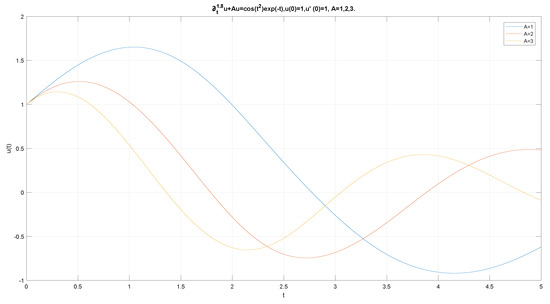
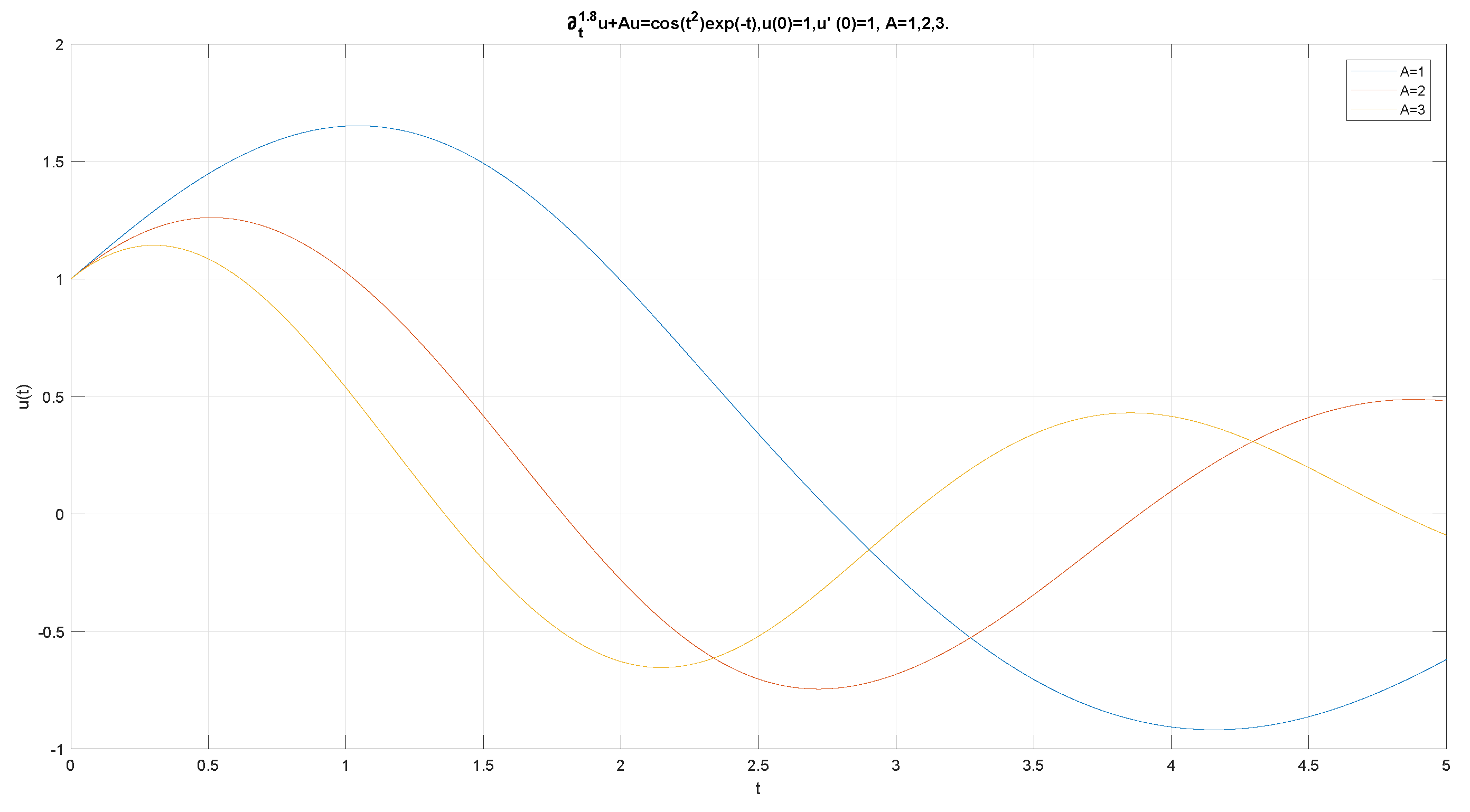
The graphical illustration of Example 2 is depicted in the Figure 1.
Figure 1.
Comparison of solution of (33) with varied relaxation coefficients, and
7. Discussion
This paper presents a fractional sub-diffusion equation of an impulsive system (3) and its dual (19). The unique continuation Property 2 of the dual system plays a crucial role in the proof of our main result, approximate controllability Theorem 3 of the primal system with an interior control acts on a sub-domain. As an example, the approximate controllability of a fractional relaxation-oscillation equation is discussed and simulated for different relaxation coefficients.
Author Contributions
Conceptualization, L.M. and S.A.; methodology, S.A. and M.H.; software, M.H.; validation, S.A. and H.M.S.; formal analysis, L.M. and H.M.S.; writing—original draft preparation, S.A. and M.H.; writing—review and editing, S.A. and H.M.S.; supervision, S.A. and H.M.S.
Funding
This research received no external funding.
Acknowledgments
The authors are thankful to the anonymous reviewers for their careful reading of the manuscript and constructive comments and suggestions. Lakshman Mahto would like to thank The Institute of Mathematical Sciences, Chennai, for support and hospitality during the postdoctoral work, where this work was initiated.
Conflicts of Interest
The authors declare no conflict of interest.
References
- Metzler, R.; Klafter, J. The random walk’s guide to anomalous diffusion: A fractional dynamics approach. Phys. Rep. 2000, 339, 1–77. [Google Scholar] [CrossRef] [Scilit]
- Abada, N.; Benchohra, M.; Hammouche, H. Existence and controllability results for nondensely defined impulsive semilinear functional differential inclusions. J. Differ. Equ. 2009, 246, 3834–3863. [Google Scholar] [CrossRef] [Scilit]
- Chu, J.; Nieto, J.J. Impulsive periodic solutions of first-order singular differential equations. Bull. Lond. Math. Soc. 2009, 40, 143–150. [Google Scholar] [CrossRef] [Scilit]
- Fan, Z.; Li, G. Existence results for semilinear differential equations with nonlocal and impulsive conditions. J. Funct. Anal. 2010, 258, 1709–1727. [Google Scholar] [CrossRef] [Scilit]
- Bainov, D.; Simeonov, P. Impulsive Differential Equations: Periodic Solutions and Applications; CRC Press: Boca Raton, FL, USA, 1993; Volume 66. [Google Scholar]
- Sun, J.; Chen, H.; Nieto, J.J. Infinitely many solutions for second-order Hamiltonian system with impulsive effects. Math. Comput. Model. 2011, 54, 544–555. [Google Scholar] [CrossRef] [Scilit]
- Lions, J.L. Optimal Control of Systems Governed Partial Differential Equations; Springer: New York, NY, USA, 1971. [Google Scholar]
- Bergounioux, M.; Penalization, A. Method for Optimal Control of Elliptic Problems with State Constraints. SIAM J. Control Optim. 1992, 30, 305–323. [Google Scholar] [CrossRef] [Scilit]
- Debbouche, A.; Torres, D.F.M. Approximate Controllability of Fractional Nonlocal Delay Semilinear Systems in Hilbert Spaces. Int. J. Control 2013, 86, 1577–1585. [Google Scholar] [CrossRef] [Scilit]
- Debbouche, A.; Torres, D.F.M. Approximate Controllability of Fractional Delay Dynamic Inclusions with Nonlocal Control Conditions. Appl. Math. Comput. 2014, 243, 161–175. [Google Scholar] [CrossRef] [Scilit]
- Khalida, A.; Benchohra, M.; Meghnafi, M. Controllability for impulsive fractional evolution equations with state-dependent delay. Mem. Differ. Equ. Math. Phys. 2018, 73, 1–20. [Google Scholar]
- Mahto, L.; Abbas, S. Approximate controllability and existence of optimal control of impulsive fractional semilinear functional differential equations with non-local condition. J. Abstr. Differ. Equ. Appl. 2013, 4, 44–59. [Google Scholar]
- Mahmudov, N.I. Partial-approximate controllability of nonlocal fractional evolution equations via approximating method. Appl. Math. Comput. 2018, 334, 227–238. [Google Scholar] [CrossRef] [Scilit]
- Fujishiro, K.; Yamamoto, M. Approximate controllability for fractional diffusion equations by interior control. Appl. Anal. 2014, 93, 1793–1810. [Google Scholar] [CrossRef] [Scilit]
- Love, E.R.; Young, M.L.C. On fractional integration by parts. Proc. Lond. Math. Soc. 1937. [Google Scholar] [CrossRef] [Scilit]
- Sakamoto, K.; Yamamoto, M. Initial value/boundary value problems for fractional diffusion-wave equations and applications to some inverse problems. J. Math. Anal. Appl. 2011, 382, 426–447. [Google Scholar] [CrossRef] [Scilit]
- Samko, S.G.; Kilbas, A.A.; Marichev, O.I. Fractional Integrals and Derivatives; Gordon and Breach Science Publishers: Philadelphia, PA, USA, 1993. [Google Scholar]
- Nigmatulin, R. The realization of the generalized transfer equation in a medium with fractal geometry. Phys. Status Solidi B 1986, 133, 425–430. [Google Scholar] [CrossRef] [Scilit]
- Adams, R.A. Sobolev Spaces; Academic Press: New York, NY, USA, 1975. [Google Scholar]
- Podlubny, I. Fractional Differential Equations; Academic Press: San Diego, CA, USA, 1999. [Google Scholar]
- Russell, D.L. Controllability and stabilizability theory for linear partial differential equations: Recent progress and open questions. SIAM Rev. 1978, 20, 639–739. [Google Scholar] [CrossRef] [Scilit]
- Micu, S.; Zuazua, E. An Introduction to the Controllability of Partial Differential Equations, Quelques Questions de Théorie du Contrôle. In Collection Travaux en Cour; Sari, T., Ed.; 2004; pp. 69–157. Available online: https://cel.archives-ouvertes.fr/cel-00392196/document (accessed on 7 January 2019).
- Protter, M.H. Unique Continuation for Elliptic Equations. Trans. Am. Math. Soc. 1960, 95, 81–90. [Google Scholar] [CrossRef]
- Kilbas, A.A.; Srivastava, H.M.; Trujillo, J.J. Theory and Applications of Fractional Differential Equations; North-Holland Mathematical Studies; Elsevier (North-Holland) Science Publishers: Amsterdam, The Netherlands; London, UK; New York, NY, USA, 2006; Volume 204. [Google Scholar]
© 2019 by the authors. Licensee MDPI, Basel, Switzerland. This article is an open access article distributed under the terms and conditions of the Creative Commons Attribution (CC BY) license (http://creativecommons.org/licenses/by/4.0/).