1. Introduction
All graphs considered in this paper are undirected and simple. Let be a graph with and , where and . We denote by the degree of in G, and define and to be the adjacency matrix and the degree diagonal matrix, respectively.
A graph matrix is a symmetric matrix with respect to adjacency matrix of G. As usual, M is separately called the adjacency matrix, the Laplacian matrix, the signless Laplacian matrix and the normalized Laplacian matrix of G if M equals , , and . The M-characteristic polynomial of G is defined as . Since M is real symmetric, its eigenvalues are real number. The M-spectrum, denoted by , of G is a multiset consisting of the M-eigenvalues. The A-eigenvalues, L-eigenvalues, Q-eigenvalues and -eigenvalues are respectively arranged as , , and . Graphs G and H are said to be M-cospectral if they share the same M-spectrum. An M-cospectral mate of G is a graph cospectral with but not isomorphic to G, and G is said to be determined by its M-spectrum if any graph H that is M-cospectral with G is also isomorphic to G. Furthermore, the line graph of graph G is a graph whose vertices corresponding the edges of G, and where two vertices are adjacent iff the corresponding edges of G are adjacent. Let , and denote the complete graph, the complete bipartite graph and the path, respectively.
The spectra of a graph provide information on its structural properties and also on some relevant dynamical aspects [
1,
2]. Calculating the spectra of graphs as well as formulating the characteristic polynomials of graphs is a fundamental and very meaningful work in spectral graph theory. Moreover, those allow the calculation of some interesting graph invariants such as the number of
spanning trees [
3,
4,
5,
6], the (
degree-)
Kirchhoff index [
7] and the
Kemeny’s constant [
8] and so on. Up till now, many graph operations such as the
disjoint union, the
corona [
9], the
edge corona [
10,
11], the
neighborhood corona [
12] and the
subdivision vertex (edge) neighborhood corona [
13] have been introduced, and their spectra are computed respectively. Recently, many researchers have concerned the
subdivision-join of two graphs. Indulal [
14] introduced two new joins
subdivision vertex-join and
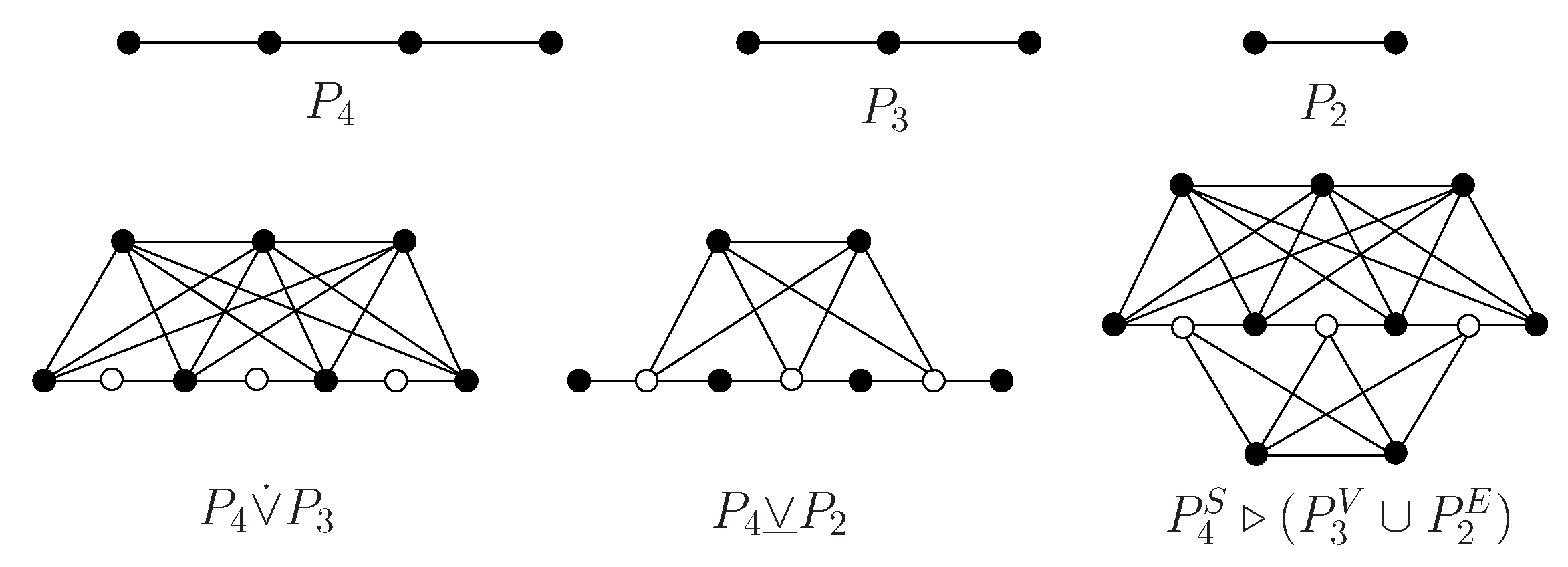
subdivision edge-join (for example, we depict
and
in
Figure 1 if
and
, or
), and their
A-spectra are investigated when
and
are both regular graphs. In [
15], Liu and Zhang have determined the adjacency, the Laplacian and the signless Laplacian spectra of
and
for a regular graph
and an arbitrary graph
.
Inspired by above, we introduce a new graph operation based on subdivision and join. For a graph , let be the subdividing graph of whose vertex set has two parts: one the origin vertices , another, denoted by , the inserting vertices corresponding to the edges of . Let and be other two disjoint graphs. Then we have the following definition.
Definition 1. The subdivision vertex-edge join (short for SVE-join) of with and , denoted by , is the graph consisting of , and , all vertex-disjoint, and joining the i-th vertex of to every vertex in the and i-th vertex of to each vertex in the .
For instance, we depict
in the following
Figure 1 if
and
.
It is easy to see that
has
vertices and
edges, where
and
are the number of vertices and edges of
for
. Also, we see that
is
(see [
14]) if
is the null graph, and is
(see [
14]) if
is the null graph.
In this paper, we respectively determine the adjacency, the Laplacian and the signless Laplacian spectrum of
for a regular graph
and two arbitrary graph
and
in terms of the corresponding spectra for a regular graph
and two arbitrary graphs
and
. All the above can be viewed as the generalizations of the main results in [
15]. In addition, we also determine the normalized Laplacian spectrum of
whenever
,
and
are regular graphs.
“
Which graph is determined by its spectrum?” [
16] is a long-standing open problem in the theory of graph spectra. The problem was first raised in 1956 by Günthard and Primas [
17], which relates the theory of graph spectra to Hückel’s theory from chemistry. Showing graphs to be
determined by their spectra or constructing as many as
cospectral non-isomorphic graphs (i.e., cospectral mates) are two sides of one coin, and both providing valuable insights to understanding the above open question. As an application of our main results (See Theorems 1–4), we focus the later and construct infinitely many pairs of
M-cospectral mates (
) since
M-cospectral mates have the same
M-characteristic polynomials, and
SVE-join whose corresponding
M-characteristic polynomials are known. Subsequently, we give the number of spanning trees, the (degree-)Kirchhoff index and the Kemeny’s constant of
, respectively.
The paper is organized as follows. In
Section 2, we give some preliminary results that will be needed in later in the paper. In
Section 3, we present
-characteristic polynomials and their corresponding spectra of
. Some applications are given in
Section 4.
2. Elementary
In this section, we give some useful established results which are required in the proof of the main result.
Lemma 1 ([
18])
. For a graph G with n vertices and m edges, let and be the incidence matrix of G and the line graph of G, respectively. Then Corollary 1 ([
18])
. If G is an r-regular graph. Then- (a)
;
- (b)
;
- (c)
;
- (d)
where , , and are the eigenvalues of , , and , respectively.
Corollary 2. Let G be an r-regular graph with n vertices and m edges. For a constant a, we have
- (i)
;
- (ii)
where is identity matrix and is matrix of size with all entries equal to one.
Proof. Please note that
G is an
r-regular graph. Then by Lemma 1 we have
. Therefore,
Similarly, (ii) can be verified. □
Lemma 2 ([
19])
. Let , , , be respectively , , , matrices with and invertible. Thenwhere and are called the Schur complements of and . For two matrices
and
, the
Hadamard product is a matrix of size
with entries
, which is given by [
20].
For a matrix
M of order
n, we respectively denote by
and
the column vector of size
n and the matrix of size
with all the entries equal one.
M-coronal is defined, in [
21], to be the sum of the entries of the matrix
, i.e.,
If
M has constant row sum
t, it is easy to verify that
Lemma 3 ([
15])
. Let A ba an real matrix, and adj(A) denote the adjugated matrix of A. Then 3. Spectra of SVE-join
Let
be a graph with
vertices and
edges for each index
. For the graph
, we first label its vertices in the following:
,
,
and
. Then the vertices of
G is partitioned by
From Definition 1, the degrees of the vertices of
G are:
Those above will be persisted in what follows.
3.1. A-spectrum, L-spectrum and Q-spectrum of SVE-join
In this section, we focus on determining the A-spectrum, L-spectrum and Q-spectrum of subdivision vertex-edge join whenever is -regular graph.
Theorem 1. Let be an -regular graph with vertices and edges, and be arbitrary graphs on vertices for each index . Then has A-characteristic polynomial Proof. Let
be the adjacency matrix of
. The adjacency matrix of
G can be represented in the form of block-matrix according to the partition (
1) as follows:
Then the characteristic polynomial of
G is obtained from Equation (
3) as follows
where
By Corollary 2, Lemmas 2 and 3, we have
Moreover, the sum of all entries on every row of matrix
is
, thus
Since
is an
-regular graph,
. From Corollary 1 (a), we know that the eigenvalues of
are the eigenvalues of
and
repeated
times. Combining Equations (
4)–(
6), we have
Here, the last step uses the fact that since is an -regular graph.
Thus, the
A-characteristic polynomial of
G is
The proof here follows. □
We notice that
if
is the null graph, where
and
. Similarly,
if
is the null graph. Then we can obtain the following results in [
14,
15] immediately.
Corollary 3 ([
14,
15])
. Let be an –regular graph with vertices and edges, and be arbitrary graphs on vertices for each index . Then- (a)
;
- (b)
.
By Theorem 1, the A-spectrum of can be obtained in the following.
Corollary 4. Let be an -regular graph with vertices and edges, and be arbitrary graphs on vertices for each index . The A-spectrum of consists of:
- (a)
each eigenvalue of , ;
- (b)
each eigenvalue of , ;
- (c)
0 repeats times, and for each , ;
- (d)
two roots of the equation
Theorem 2. Let be an -regular graph with vertices and edges, and be arbitrary graphs on vertices for each index . Then has Laplacian characteristic polynomial Proof. Let
be the adjacency matrix of
. By Equations (
2) and (
3), the Laplacian matrix of
G can be written as
Thus, the Laplacian characteristic polynomial of
G is given below
where
Denote by
X the elementary block matrices as follows:
Please note that
. Thus
For the matrix
B, we have
where
For the sake of brevity, we write
and
as
and
, respectively. By Corollary 2, Lemmas 2 and 3, we get
Moreover, the sum of all entries on every row of matrix
is
, so
Since
is an
-regular graph, we have
,
and
. Combining Equations (
7)–(
9), one can obtain
For a non-empty graph
H, the sum of all entries on every row of matrix
is 0. So
Consequently, the Laplacian characteristic polynomial of
G is
The proof is completed. □
For the null graph
H, we have
and
. We know that
if
is the null graph, where
. Similarly,
if
is the null graph, where
. Hence, our Theorem 2 includes the results in [
15].
Corollary 5 ([
15])
. Let be an –regular graph with vertices and edges, and be arbitrary graphs on vertices for each index . Then- (a)
- (b)
Now, we give the L-spectrum of in terms of the corresponding spectra of for .
Corollary 6. Let be an -regular graph with vertices and edges, and be arbitrary graphs on vertices for each index . The L-spectrum of consists of:
- (a)
for each of , ;
- (b)
for each of , ;
- (c)
repeats times, and two roots of the equation for each of , ;
- (d)
four roots of the equation
Theorem 3. Let be an -regular graph with vertices and edges, and be arbitrary graphs on vertices for each index . Then has Q-characteristic polynomial Proof. Let
be the adjacency matrix of
. By Equations
2 and
3, the Laplacian matrix of
G can be written as
What needs to be stressed here is that . The rest of the proof is similar to that of Theorem 2. □
From Theorem 3, the following Corollaries can be deduced.
Corollary 7 ([
15])
. Let be an -regular graph with vertices and edges, and be arbitrary graphs on vertices for each index . Then- (a)
- (b)
Corollary 8. Let be an -regular graph with vertices and edges, and be arbitrary graphs on vertices for each index . The Q-spectrum of consists of:
- (a)
for each of , ;
- (b)
for each of , ;
- (c)
repeats times, and two roots of the equationwhere are the eigenvalues of for ; - (d)
two roots of the equation
Example 1. Let (see Figure 2). By simple computation, one can get the following. - (i)
, and . From Corollary 4, the A-spectrum of G consists of: 0 (multiplicity 5), (multiplicity 3), (multiplicity 4), (multiplicity 4), four roots of the equation .
- (ii)
, and . From Corollary 6, the L-spectrum of G consists of: 4 (multiplicity 3), 9 (multiplicity 2), 11, each root of the equation with multiplicity 4 (that is, 3 (multiplicity 4) and 7 (multiplicity 4)), two roots of the equation (that is, 4 and 6), four roots of the equation .
- (iii)
, and . From Corollary 8, the Q-spectrum of G consists of: 4 (multiplicity 3), 7 (multiplicity 2), 9, each root of the equation with multiplicity 4 (that is, 3 (multiplicity 4) and 7 (multiplicity 4)), two roots of the equation , four roots of the equation .
3.2. The Normalized Laplacian Spectrum of SVE-Join
In this section, we will give the -spectrum of subdivision vertex-edge join whenever is -regular graph, .
Theorem 4. Let . If is an -regular graph with vertices and edges , then G has the -characteristic polynomial Proof. Let
be the adjacency matrix of
. By Equations (
2), (
3) and
, the normalized Laplacian matrix of
G can be written as
where
a,
b and
c are the constant whose value are
,
and
, respectively.
is the
matrix whose all diagonal entries are 1 and off-diagonal entries are
.
is the
matrix whose all diagonal entries are 1 and off-diagonal entries are
.
The Laplacian characteristic polynomial of
G is thus given below
where
and
are simply written as
and
, and
By Corollary 2, Lemmas 2 and 3, we have
From Lemma 1, we have
. Please note that
. Then
As
, we get
Similarly, we have
. Since
that is, the sum of all entries on every row of matrix
is
. Also, because
, so we have
The value of
is similar to that of
, so
Moreover, the sum of all entries on every row of matrix
is
, so
Combining Equations (
10)–(
13), we can obtain that
Therefore, the normalized Laplacian characteristic polynomial of
G is
The proof completes. □
Remark 1. For the null graph H, . We notice that if is the null graph, and if is the null graph. Hence, Theorem 4 can immediately deduce the normalized Laplacian characteristic polynomials of and .
Corollary 9. Let . If is an -regular graph with vertices and edges , the -spectrum of G consists of:
- (a)
for each eigenvalue of , ;
- (b)
for each eigenvalue of , ;
- (c)
1 repeats times; two roots of the equationwhere each eigenvalue of , ; - (d)
four roots of the equation
Example 2. Let (see Figure 2). By simple computation, , and . By Corollary 9, the normalized Laplacian spectrum of G consists of: , 1 (multiplicity 5), two roots of the equation (that is, with multiplicity 4), four roots of the equation .