


Abstract
In this paper, the Lax pair of the modified nonlinear Schrödinger equation (mNLS) is derived by means of the prolongation structure theory. Based on the obtained Lax pair, the mNLS equation on the half line is analyzed with the assistance of Fokas method. A Riemann-Hilbert problem is formulated in the complex plane with respect to the spectral parameter. According to the initial-boundary values, the spectral function can be defined. Furthermore, the jump matrices and the global relations can be obtained. Finally, the potential can be represented by the solution of this Riemann-Hilbert problem.
1. Introduction
In mathematics and physics, nonlinear partial differential equations play an important role due to their abundant mathematical structure and properties. Many works on nonlinear evolution equations have been studied, such as the Hamiltonian structure [1,2], the infinite conservation laws [3,4], the Bäcklund transformation [5,6] and so on [7,8,9]. Besides, the exact solution of these equations, which can be expressed in various forms by different methods, is also a significant subject of soliton research [10,11,12,13,14,15,16,17,18,19,20,21,22]. In recent years, with the development of soliton theory, more and more researchers pay attention to the Riemann-Hilbert approach. The Riemann-Hilbert approach was introduced by Fokas to analyze the initial-boundary values problem for linear and nonlinear partial differential equations [23,24]. In the past 20 years, many researchers have discussed a lot of nonlinear integrable equations for the initial-boundary values problem [25,26,27,28,29,30,31,32,33,34,35,36,37,38,39,40,41,41]. They have all made a great contribution to the development of this method. The core idea of this method is to construct the associated Riemann-Hilbert problem by the Lax pair of the integrable equation, and then in addition to the initial-boundary values problem, the long-time asymptotic behavior of the solution can be analyzed [42,43,44,45,46]. However, as we all know, it is difficult to determine whether a nonlinear evolution equation possesses a Lax pair or not. As far as we are concerned, the prolongation structure method is an efficient way to obtain the Lax pair, which was firstly proposed in 1975 by Wahlquist and Estabrook [47]. In recent years, a large number of scholars have improved this method, for example, Hermann deduced the prolongation structure method connection in 1976 [48], Deconinck applied the prolongation structure method to semi-discrete systems firstly [49], Wang used this approach to get the integrability of many nonlinear wave equation [50] and so on [51,52]. In this way, we can get the Lax pair of the nonlinear evolution equation easily as long as it is integrable.
In this paper, we mainly talk about the modified nonlinear Schrödinger(mNLS) equation
which is very important in plasma physics. Recently, many properties of this equation have been studied, such as the Hamiltonian structure [53], the Darboux transformation [54], the numerical solutions [55,56] and so on [57,58]. Actually, it can become the derivative NLS equation by certain gauge transformation [59]. In this paper, we mainly discuss the mNLS equation on the half line. For simplicity, we let . Supposing that the solution of the mNLS equation exists, and the initial-boundary values are defined as follows,
Initial values:
Boundary values:
In order to formulate a Riemann-Hilbert problem, we need to reconstruct the Lax pair of Equation (1). Based on the initial-boundary values, the corresponding spectral functions can be defined. Eventually, the potential function can be expressed in terms of the solution of this Riemann-Hilbert problem.
This paper is divided into four sections. The construction of the prolongation structure for the mNLS equation is in Section 2 and then in Section 3, we reconstruct the Lax pair to formulate the Riemann-Hilbert problem and some conditions and relations are derived. In the last section, we define the spectral functions according to the initial-boundary values and the Riemann-Hilbert problem is investigated.
2. The Prolongation Structures of the mNLS Equation
In order to obtain the Lax pair of the mNLS equation, we analyze the prolongation structure of this equation. This process mainly involves a fundamental theorem in Lie algebra [51].
Theorem 1.
Suppose X and Y are two elements of Lie algebra with , and ad Y, it means that there exist such that , so we obtain and , where are the nilpotent and h is the neutral elements of g.
In the beginning, we introduce these variables
Then Equation (1) is equivalent to this set of equations as follows
We define the set of two-forms , where
It is easy to find that I is a closed ideal, actually, . After that, we define the differential one-forms
At the same time, we suppose . According to the general theory of exterior differential systems, if is a closed ideal, it must satisfy
Combining (5)–(8), we obtain
where the bracket denotes the Lie bracket, namely .
After a lengthy calculation, one solution of this set of equations can be derived
with the integrability conditions
where all , are pending matrices. Here depend on an incomplete Lie algebra, called prolongation algebra.
The next step is to embed the prolongation algebra in . According to (11) and Theorem 1, we deduce that and is nilpotent and is neutral element. So we have
Bringing the above results into (11), we obtain
where is spectral parameter. Hence, the expressions of F and G can be presented eventually
So, the mNLS equation admits Lax pair
where .
3. Spectral Analysis
From the previous paragraph, we know the Lax pair of the mNLS equation. By introducing
where the denotes the conjugation of q, the Lax pair (15) can be rewritten in this form
In our analysis, we assume that q decays to zero sufficiently fast as . So, it is correct to extend the column vector to a matrix. For simplicity, we substitute for . Letting , then the Lax pair (17) becomes
We can write (18) in full derivative form
where
and denotes the operator to matrix by , hence it is easy to prove , where M is a matrix.
3.1. The Reconstruction of Lax Pair
Expanding the solution of (19) in this way
where are independent of . Bringing this equation into the first equation of (18), and comparing the same order of ’s frequency, we obtain the following equations
Using the same method, taking (21) into another equation of (18), we have
For (22), We find that D is a diagonal matrix from . Without loss of generality, we suppose
From we have
where denotes the off-diagonal part of . So, we can get from easily
For (23), after a lengthy calculation, we get
The mNLS equation admits the conservation law
From the above results, we find (26) and (27) admit the conservation law. Define
where is the differential one-form, and it is given by
It is not difficult to find that the integral is path independent. So, we introduce
Then the form of the Lax pair (18) can be replaced with
where
Considering the definitions of U and , we have
where
Thus, (32) changes into
3.2. The Riemann-Hilbert Problem And Some Relations
Supposing that is smooth function in the domain . Then we define the eigenfunctions of (34) as follows
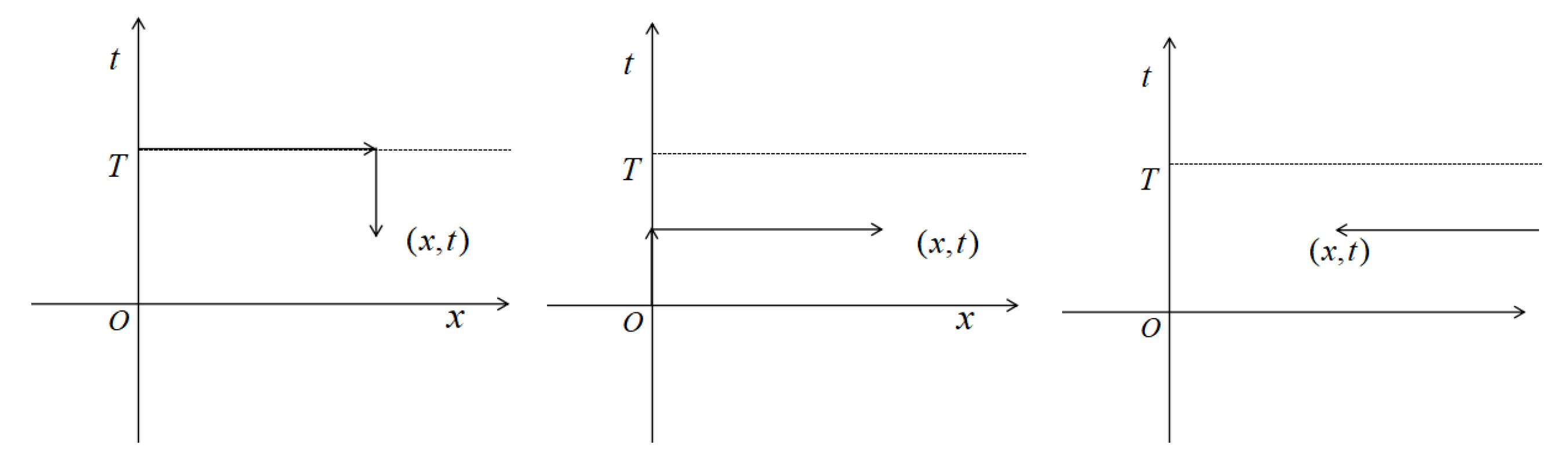
The integral curve is from to , where and . Furthermore, the point is an arbitrary point in the domain D. We know that the integral of (36) is independent of the path of integration. Without loss of generality, we will consider the particular integral paths as follows, see Figure 1.
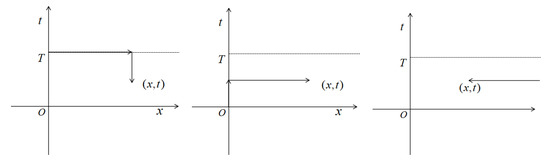
Figure 1.
Integral paths.
By this method, we get
Noting that the first column of includes . So, in different integral paths, we have the following inequalities
Due to the exponential function decaying sufficiently, these inequalities imply that the first of the functions are analytic if
At the same time, the second column of the functions are analytic if
Hence, we get
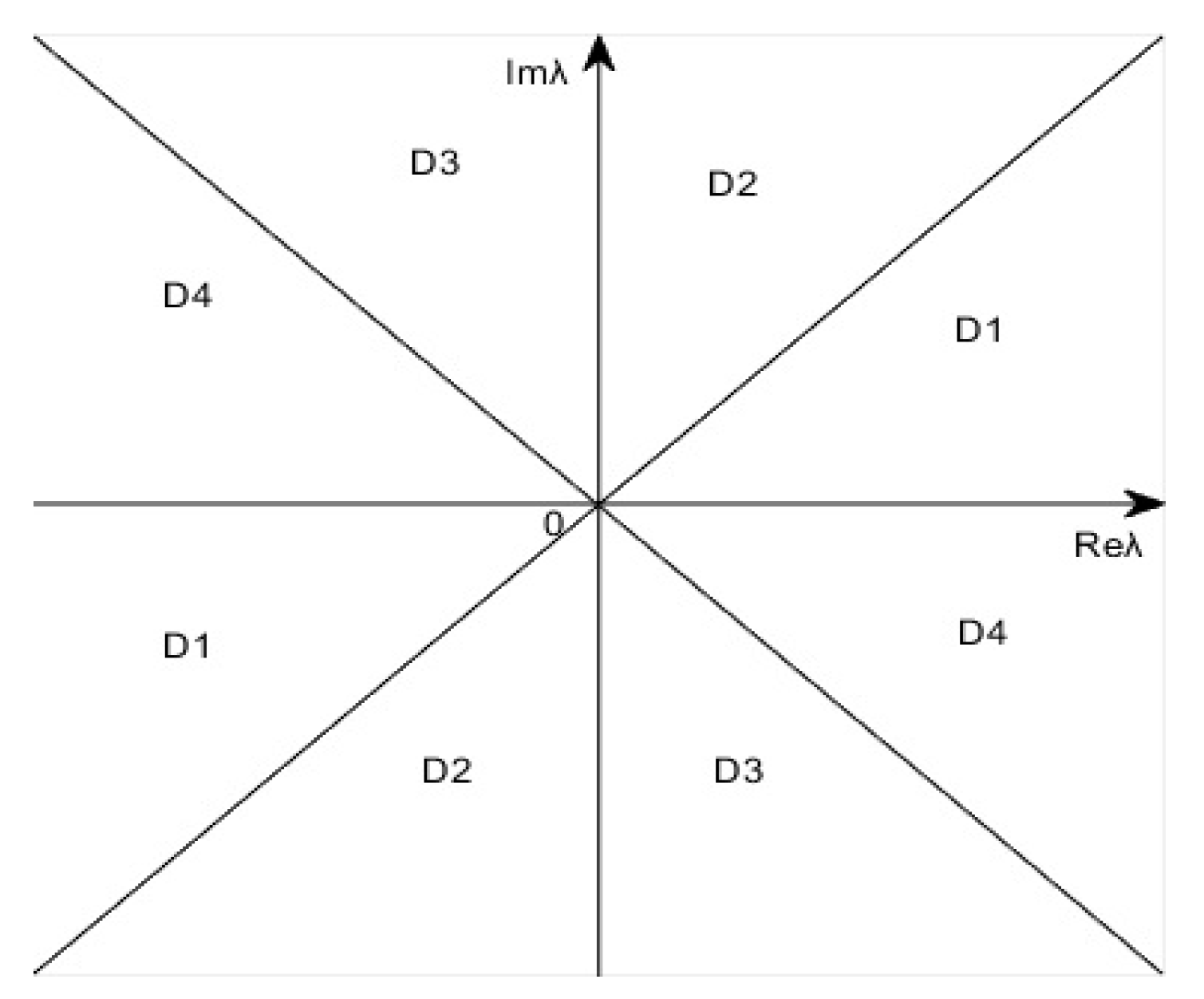
where stands for is analytic if , where , see Figure 2.
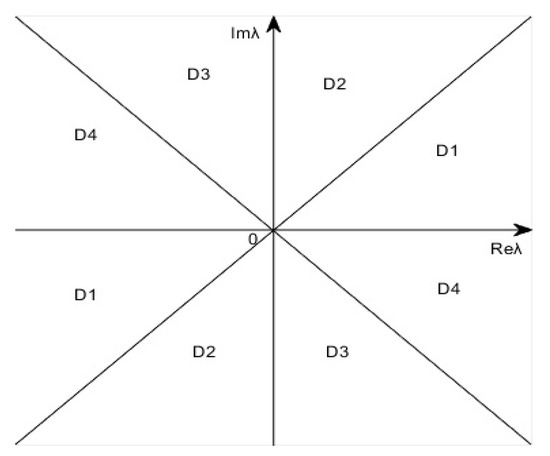
Figure 2.
.
The eigenfunctions possess these properties.
- ;
- ;
where the eigenfunctions
For the purpose of formulating a Riemann-Hilbert problem, our main task is to find the jump matrices for every to any other regions. Then we define the spectral functions and
According to the above definition, we have
Combining (37) with (42), we acquire
Owing to (37), it is clear to see that
Considering the initial values , , boundary values and . For convenience, the initial-boundary values of can be written in this form, namely , and . Then and can be expressed with
where
with
Due to have symmetry, the and also have symmetry
Without loss of generality, we assume
According to (42) and (44), we have
The spectral functions have the following properties
These spectral functions do not exist independently, but depend on each other and satisfy certain relationships, we call it global relation
where
For simplicity, we define
where
Synthesizing the above definitions, we can get
and
Theorem 2.
Given a smooth function . Define as (50), and define like (37). Then the jump matrices can be derived through
where
and
with
According to definition, we have to consider the residue conditions of . By analyzing, we can know that both and have an even zero. Hence, we suppose that
- has simple zeros , . Furthermore, lie in , lie in .
- has simple zeros , . In addition, lie in , lie in .
- and do not have any of the same zeros.
Theorem 3.
For convenience, the mark denotes the first column of . Similarly, denotes the second column. At the same time, we let . Then, we get the residue condition as follows:
Proof.
Just prove , and the other proof can be proved in the same way. Firstly, we take account of , the simple zeros of are the simple poles of . Then we get
Then taking into the equation
we obtain
Finally,
□
Now, we discuss how to derive the potential from the spectral functions . Reviewing what we did before, when (21) is a solution of (19), we have . Suppose
is a solution of (32).
As , letting , namely
By direct calculation, we have
After that, it is clear to find that
and
Eventually, we can get the final form of the potential .
4. The Spectral Map and the Regular Riemann-Hilbert Problem
4.1. The Spectral Map
Definition 1.
For initial values , the map can be defined by
with
where is the unique solution of the Volterra linear integral equation
and is given by Equation (46).
Proposition 1.
and possess these properties.
- (i)
- and are analytic for and continuous for ,
- (ii)
- ,
- (iii)
- ,
- (iv)
- ,
- (v)
- We define , as the inverse of map , withwhere is the unique solution of the following Riemann-Hilbert problem.
- is a meromorphic function.
- where
- .
- has simple zeros , , such that lie in , and lie in .
- The first column of has simple poles at . Furthermore, the second column of has simple poles at . The relevant residues are given by
Definition 2.
For boundary values , the map can be defined by
with
where is the unique solution of the Volterra linear integral equation
and is given by (46).
Proposition 2.
and possess these properties.
- (i)
- and are analytic for and continuous ,
- (ii)
- ,
- (iii)
- ,
- (iv)
- ,
- (v)
- We define , as the inverse of map , withwherewith the functions are depend onwhere is the unique solution of the following Riemann-Hilbert problem
- is a meromorphic function.
- where
- .
- has simple zeros , , such that lie in , and lie in .
- The first column of has simple poles at . And the second column of has simple poles at . The relevant residues are given by
4.2. The Regular Riemann-Hilbert Problem
Theorem 4.
Given the smooth function , which is compatible with and . The spectral functions ,, , and are defined according to the previous definitions. Furthermore, they satisfy the global relation (49). Clearly, it becomes when . Define the as the solution of this following Riemann-Hilbert problem.
- is a sectionally meromorphic function in .
- The residue condition of satisfies Theorem 3
- satisfies the jump conditionwhere the jump matrices are defined by (55)–(57).
Then, not only exists but is unique. In this way, the solution of the mNLS equation can be derived, which can be defined by
Besides, also satisfies the initial-boundary values condition
Proof.
Actually, if there are no zeros of and , then the function satisfies a non-singular Riemann-Hilbert problem. Due to the jump matrices possessing symmetry, we can find that this problem has a unique solution. On the other hand, when and have a certain number of zeros, by specific mapping, the singular Riemann-Hilbert problem can become no zeros with a system of algebraic equations; the unique solvability can be proved by the following theorem. □
Theorem 5.
The Riemann-Hilbert problem in Theorem 4 with the vanishing boundary condition
has only the zero solution.
Proof.
Firstly, we suppose that the matrix function is a solution of the Riemann-Hilbert problem in Theorem 4. At the same time, means the complex conjugate transpose of A, where A is a matrix. We define
where the x and t are dependent with each other. and are analytic in and , respectively. Due to the symmetry, we can obtain from (54) and (55)
Then
From the above two equations, it is easy to find that . This means that and define an entire function decaying at infinity, hence the and . Finding is a unit Hermitian matrix for any . It is not difficult to see that is a positive definite matrix. Now that for , we have
After simple calculation, we have for . Therefore, , . □
Remark 1.
satisfies the mNLS equation.
In fact, if is the solution of the Riemann-Hilbert problem defined by Theorem 4 and is defined as the previous definition, with the help of the dressing method [45], we can find that satisfies the Lax pair (18). Hence, satisfies the mNLS equation.
Remark 2.
Using the same proof method in Reference [32] can we prove that satisfies the initial values and boundary values , so in this paper, we leave this proof out.
5. Conclusions
In this paper, we mainly studied the initial-boundary values problem for the mNLS equation on the half line. Before we did this, with the help of prolongation structure theory, the Lax pair of this equation was derived. Then we reconstructed the Lax pair to obtain a Riemann-Hilbert problem, and therefore, the potential function has been represented by its solution. In future work, the long time asymptotic behavior for the solutions will be analyzed.
Author Contributions
All authors contributed equally to the writing of this paper. All authors read and approved the final manuscript.
Funding
This work was supported by Nature Science Foundation of Shandong Province of China (No.ZR2018MA017), China Postdoctoral Science Foundation funded project (No.2017M610436), Open Fund of the Key Laboratory of Meteorological Disaster of Ministry of Education (Nanjing University of Information Science and Technology) (No.KLME201801).
Conflicts of Interest
The authors declare no conflict of interest.
References
- Xu, X.X.; Sun, Y.P. Two symmetry constraints for a generalized Dirac integrable hierarchy. J. Math. Anal. Appl. 2018, 458, 1073–1090. [Google Scholar] [CrossRef]
- Mcanally, M.; Ma, W.X. An integrable generalization of the D-Kaup-Newell soliton hierarchy and its bi-Hamiltonian reduced hierarchy. Appl. Math. Comput. 2018, 323, 220–227. [Google Scholar] [CrossRef]
- Ma, W.X. Conservation laws by symmetries and adjoint symmetries. Discret. Contin. Dynam. Syst. Ser. S 2017, 11, 707–721. [Google Scholar] [CrossRef]
- Xu, X.X. A deformed reduced semi-discrete Kaup-Newell equation, the related integrable family and Darboux transformation. Appl. Math. Comput. 2015, 251, 275–283. [Google Scholar] [CrossRef]
- Hirota, R. A new form of Bäcklund transformations and its relation to the inverse scattering problem. Progr. Theor. Phys. 1974, 52, 1498–1512. [Google Scholar] [CrossRef]
- Xu, X.X.; Sun, Y.P. An integrable coupling hierarchy of Dirac integrable hierarchy, its Liouville integrability and Darboux transformation. J. Nonlinear Sci. Appl. 2017, 10, 3328–3343. [Google Scholar] [CrossRef]
- Zhang, L.J.; Khalique, M. Classification and bifurcation of a class of second-order ODEs and its application to nonlinear PDEs. Discret. Contin. Dynam. Syst. Ser. S 2017, 11, 777–790. [Google Scholar] [CrossRef]
- Lou, S.Y.; Ruan, H.Y.; Chen, D.F.; Chen, W.Z. Similarity reductions of the KP equation by a direct method. J. Phys. A Gen. Phys. 1999, 24, 1455. [Google Scholar] [CrossRef]
- Ablowitz, M.J.; Segur, H. Solitons and the Inverse Scattering Transform; Siam: Philadelphia, PA, USA, 1981. [Google Scholar]
- Gu, J.Y.; Zhang, Y.; Dong, H.H. Dynamic behaviors of interaction solutions of (3+1)-dimensional Shallow Water wave equation. Comput. Math. Appl. 2018, 76, 1408–1419. [Google Scholar] [CrossRef]
- Liu, Y.; Dong, H.H.; Zhang, Y. Solutions of a discrete integrable hierarchy by straightening out of its continuous and discrete constrained flows. Anal. Math. Phys. 2018. [Google Scholar] [CrossRef]
- Ma, W.X.; Zhou, Y. Lump solutions to nonlinear partial differential equations via Hirota bilinear forms. J. Differ. Eq. 2018, 264, 2633–2659. [Google Scholar] [CrossRef]
- Zhang, Y.; Dong, H.H.; Zhang, X.E.; Yang, H.W. Rational solutions and lump solutions to the generalized (3+1)-dimensional Shallow Water-like equation. Comput. Math. Appl. 2016, 73, 246–252. [Google Scholar] [CrossRef]
- Wang, H.; Wang, Y.H.; Dong, H.H. Interaction solutions of a (2+1)-dimensional dispersive long wave system. Comput. Math. Appl. 2018, 75, 2625–2628. [Google Scholar] [CrossRef]
- Dong, H.Y.; Lu, C.N.; Yang, H.W. The finite volume WENO with Lax-Wendroff scheme for nonlinear system of Euler equations. Mathematics 2018, 6, 211. [Google Scholar] [CrossRef]
- Lu, C.N.; Gao, Q.Q.; Fu, C.; Yang, H.W. Finite element method of BBM-Burgers equation with dissipative term based on Adaptive Moving Mesh. Discret. Dynam. Nat. Soc. 2017, 2017, 3427376. [Google Scholar] [CrossRef]
- Tao, M.S.; Dong, H.H. Algebro-Geometric solutions for a discrete integrable equation. Discret. Dynam. Nat. Soc. 2017, 2017, 5258375. [Google Scholar] [CrossRef]
- Hirota, R. Exact N-soliton solutions of the wave equation of long waves in Shallow-Water and in nonlinear lattices. J. Math. Phys. 1973, 14, 180–184. [Google Scholar] [CrossRef]
- Feng, B.F.; Maruno, K.; Ohta, Y. A two-component generalization of the reduced Ostrovsky equation and its integrable semi-discrete analogue. J. Phys. A Math. Theor. 2016, 50, 055201. [Google Scholar] [CrossRef]
- Feng, B.F.; Kawahara, T. Stationary travelling-wave solutions of an unstable KdV-Burgers equation. Phys. D Nonlinear Phenom. 2000, 137, 228–236. [Google Scholar] [CrossRef]
- Tao, M.S.; Zhang, N.; Gao, D.Z.; Yang, H.W. Symmetry analysis for three-dimensional dissipation Rossby waves. Adv. Differ. Eq. 2018, 2018, 300. [Google Scholar] [CrossRef]
- Ma, W.X.; Li, J.; Khalique, C.M. A Study on Lump Solutions to a Generalized Hirota-Satsuma-Ito Equation in (2+1)-Dimensions. Complexity 2018, 2018, 9059858. [Google Scholar] [CrossRef]
- Fokas, A.S. A unified transform method for solving linear and certain nonlinear PDEs. Proc. R. Soc. Math. Phys. Eng. Sci. 1997, 453, 1411–1443. [Google Scholar] [CrossRef]
- Fokas, A.S. On a class of physically important integrable equations. Phys. D Nonlinear Phenom. 1995, 87, 145–150. [Google Scholar] [CrossRef]
- Fokas, A.S. A Unified Approach to Boundary Value Problems; Society for Industrial and Applied Mathematics: Philadelphia, PA, USA, 2008. [Google Scholar]
- Fokas, A.S. Integrable nonlinear evolution equations on the half-Line. Commun. Math. Phys. 2002, 230, 1–39. [Google Scholar] [CrossRef]
- Lenells, J. The derivative nonlinear Schrödinger equation on the half-line. Phys. D Nonlinear Phenom. 2009, 237, 3008–3019. [Google Scholar] [CrossRef]
- Lenells, J. Initial-boundary value problems for integrable evolution equations with 3 × 3 Lax pairs. Phys. D Nonlinear Phenom. 2012, 241, 857–875. [Google Scholar] [CrossRef]
- Lenells, J. The Degasperis-Procesi equation on the half-line. Nonlinear Anal. Theory Methods Appl. 2013, 76, 122–139. [Google Scholar] [CrossRef]
- Lenells, J.; Fokas, A. Boundary-value problems for the stationary axisymmetric Einstein equations: A rotating disc. Nonlinearity 2009, 24, 177–206. [Google Scholar] [CrossRef]
- Lenells, J. An integrable generalization of the sine-Gordon equation on the half-line. Ima J. Appl. Math. 2012, 76, 554–572. [Google Scholar] [CrossRef]
- Xu, J.; Fan, E.G. A Riemann-Hilbert approach to the initial-boundary problem for derivative nonlinear Schröingder equation. Acta Math. Sci. 2014, 34, 973–994. [Google Scholar] [CrossRef]
- Xu, J.; Fan, E.G. The initial-boundary value problem for the Ostrovsky-Vakhnenko equation on the half-line. Math. Phys. Anal. Geom. 2016, 19, 20. [Google Scholar] [CrossRef]
- Xu, J.; Fan, E.G. Initial-boundary value problem for integrable nonlinear evolution equation with 3 × 3 Lax pairs on the interval. Stud. Appl. Math. 2016, 136, 321–354. [Google Scholar] [CrossRef]
- Xu, J.; Fan, E.G. The three-wave equation on the half-line. Phys. Lett. A 2014, 378, 26–33. [Google Scholar] [CrossRef]
- Geng, X.G.; Liu, H.; Zhu, J.Y. Initial-boundary value problems for the coupled nonlinear Schrödinger equation on the half-Line. Stud. Appl. Math. 2015, 135, 310–346. [Google Scholar] [CrossRef]
- Tian, S.F. Initial-boundary value problems for the general coupled nonlinear Schrödinger equation on the interval via the Fokas method. J. Differ. Eq. 2017, 262, 506–558. [Google Scholar] [CrossRef]
- Xu, J.; Fan, E.G. The unified transform method for the Sasa-Satsuma equation on the half-line. Physics 2013, 17, 445–452. [Google Scholar] [CrossRef] [PubMed]
- Zhang, N.; Xia, T.C.; Fan, E.G. A Riemann-Hilbert approach to the Chen-Lee-Liu equation on the half line. Acta Math. Appl. Sin. Engl. Ser. 2018, 34, 493–515. [Google Scholar] [CrossRef]
- Ma, W.X. Application of the Riemann-Hilbert approach to the multicomponent AKNS integrable hierarchies. Nonlinear Anal. Real World Appl. 2019, 47, 1–17. [Google Scholar] [CrossRef]
- Hu, B.B.; Xia, T.C.; Ma, W.X. Riemann-Hilbert approach for an initial-boundary value problem of the two-component modified Korteweg-de Vries equation on the half-line. Appl. Math. Comput. 2018, 332, 148–159. [Google Scholar] [CrossRef]
- Deift, P.; Zhou, X. A steepest descent method for oscillatory Riemann-Hilbert problems. Asymptotics for the mKdV equation. Ann. Math. 1993, 137, 295–368. [Google Scholar] [CrossRef]
- Lenells, J. The nonlinear steepest descent method: Asymptotics for initial-boundary value problems. SIAM J. Math. Anal. 2015, 48, 273–311. [Google Scholar] [CrossRef]
- Xu, J.; Fan, E.G. Long-time asymptotic for the derivative nonlinear Schrödinger equation with step-like initial value. Math. Phys. Anal. Geom. 2013, 16, 253–288. [Google Scholar] [CrossRef]
- Lenells, J. Dressing for a novel integrable generalization of the nonlinear Schrödinger equation. J. Nonlinear Sci. 2009, 20, 709–722. [Google Scholar] [CrossRef]
- Deift, P.; Zhou, X. Long-time asymptotics for solutions of the NLS equation with initial data in a weighted Sobolev space. Commun. Pure Appl. Math. 2010, 56, 1029–1077. [Google Scholar] [CrossRef]
- Wahlquist, H.D.; Estabrook, F.B. Prolongation structures of nonlinear evolution equations. J. Math. Phys. 2008, 16, 1293–1297. [Google Scholar] [CrossRef]
- Hermann, R. Pseudopotentials of Estabrook and Wahlquist, the Geometry of Solitons, and the Theory of Connections. Phys. Rev. Lett. 1976, 36, 791–795. [Google Scholar] [CrossRef]
- Deconinck, B. A Constructive Test for Integrability of Semi-Discrete Systems. Phys. Lett. A 1996, 223, 45–54. [Google Scholar] [CrossRef]
- Wang, D.S. Integrability of the coupled KdV equations derived from two-layer fluids: Prolongation structures and Miura transformations. Nonlinear Anal. 2010, 73, 270–281. [Google Scholar] [CrossRef]
- Humphreys, J.E. Introduction to Lie Algebras and Representation Theory; Springer: New York, NY, USA, 1972. [Google Scholar]
- Morris, H.C. Prolongation structures and nonlinear evolution equations in two spatial dimensions. II. A generalized nonlinear Schrödinger equation. J. Math. Phys. 1977, 18, 285–288. [Google Scholar] [CrossRef]
- Karsten, T. Hamiltonian form of the modified nonlinear Schrödinger equation for gravity waves on arbitrary depth. J. Fluid Mech. 2011, 670, 404–426. [Google Scholar]
- Wen, X.Y.; Yang, Y.Q.; Yan, Z.Y. Generalized perturbation (n,M)-fold Darboux transformations and multi-rogue-wave structures for the modified self-steepening nonlinear Schrödinger equation. Phys. Rev. E Stat. Nonlinear Soft Matter Phys. 2015, 92, 012917. [Google Scholar] [CrossRef] [PubMed]
- Brizhik, L.; Eremko, A.; Piette, B.; Zakrzewski, W. Static solutions of a D-dimensional modified nonlinear Schrödinger equation. Nonlinearity 2003, 16, 1481–1497. [Google Scholar] [CrossRef]
- Liu, J.Q.; Wang, Z.Q. Symmetric solutions to a modified nonlinear Schrödinger equation. Nonlinearity 2007, 21, 121. [Google Scholar] [CrossRef]
- Strampp, W. Lax-pairs, spectral problems, and recursion operators. J. Math. Phys. 1984, 25, 2905–2909. [Google Scholar] [CrossRef]
- Maimistov, A.I. Evolution of solitary waves which are approximately solitons of a nonlinear Schrödinger equation. Soviet J. Exp. Theor. Phys. 1993, 77, 727–731. [Google Scholar]
- Mihalache, D.; Truta, N.; Panoiu, N.; Baboiu, D. Analytic method for solving the modified nonlinear Schrödinger equation describing soliton propagation along optical fibers. Phys. Rev. A 1993, 47, 3190–3194. [Google Scholar] [CrossRef] [PubMed]
© 2019 by the authors. Licensee MDPI, Basel, Switzerland. This article is an open access article distributed under the terms and conditions of the Creative Commons Attribution (CC BY) license (http://creativecommons.org/licenses/by/4.0/).