1. Introduction
All graphs in this paper are finite and undirected with no loops or multiple edges. Let G be a graph with n vertices. The vertex set and the edge set of G are denoted by and , respectively. The Laplacian matrix of G is , where is the diagonal matrix and denotes the degree of the vertex v in G and is the adjacency matrix of G. Denoting its eigenvalues by , we shall use the notation to denote the kth Laplacian eigenvalue of the graph G. Also, the multiplicity of the eigenvalue of is denoted by . For any , let be the set of all vertices adjacent to v. A vertex of degree one is called a leaf vertex. A matching of G is a set of pairwise disjoint edges of G. The matching number of G, denoted , is the maximum possible cardinality for a matching in G. Clearly, . In particular, if , then G has a perfect matching.
Connected graphs in which the number of edges equals the number of vertices are called unicyclic graphs. Therefore, a unicyclic graph is either a cycle or a cycle with some attached trees. Let be the set of all unicyclic graphs of order n with girth g. Throughout this paper, we suppose that the vertices of the cycle are labeled by , ordered in a natural way around , say in the clockwise direction. A rooted tree is a tree in which one vertex has been designated as the root. Furthermore, assume that is a rooted tree of order attached to , where . This unicyclic graph is denoted by . The sun graph of order is a cycle with an edge terminating in a leaf vertex attached to each vertex. A broken sun graph is a unicyclic subgraph of a sun graph.
A
one-edge connection of two graphs
and
is a graph
G with
and
, where
and
. We denote it by
. In this manuscript, we would like to study the eigenvalue 2 in bicyclic graphs with just 2 cycles. We provide a necessary and sufficient condition under which a bicyclic graph with a perfect matching has 2 as its Laplacian eigenvalue, for more see [
1]. For more about Laplacians of some parameters of graphs we refer to [
2,
3,
4,
5]. In the last couple of years there has been a renewed interest toward the Laplacian spectral properties of bicyclic graphs (see [
6,
7]), and it is very likely that many techniques employed in this paper could be also helpful to solve the correspondent problems in the context of signed graphs.
2. Preliminary Results
By [
8] (Theorem 13) due to Kelmans and Chelnokov, the Laplacian coefficient,
, can be expressed in terms of subtree structures of
G, for
. Suppose that
F is a spanning forest of
G with components
of order
, and
. The
Laplacian characteristic polynomial of
G turns out to be
.
Theorem 1 ([
9], Theorem 7.5)
. The Laplacian coefficient of a graph G of order n is given by , where is the set of all spanning forest of G with exactly k components. In particular, we have , , , and , in which denotes the number of spanning trees of G.
Let
G be a graph with
n vertices. It is convenient to adopt the following terminology from [
10]: for a vector
, we say that
X gives a valuation of the vertex of
V, and to each vertex
of
V, we associate the number
, which is the value of the vertex
; that is,
. Then
is an eigenvalue of
with the corresponding eigenvector
if and only if
and
It has been shown that if
T is a tree containing a perfect matching, then
T has 2 among its Laplacian eigenvalues and
, [
11] (Theorem 2). In [
12] (Theorem 2) the author proved that, if
T is a tree with a perfect matching,
M, a vector
is an eigenvector of
corresponding to the eigenvalue 2 if and only if
X has exactly two distinct entries
and 1. Moreover,
for each
, and
for each
.
3. The Eigenvector of the Laplacian Eigenvalue 2
In what follows, we study some results on broken sun graphs and unicyclic graphs. Furthermore, we establish the eigenvector of these types of graphs that have two among their Laplacian eigenvalues. First, we cite a theorem from [
13].
Theorem 2 ([
13], Theorem 3.2)
. Let G be a graph on n vertices and e be an edge of G. Let be the eigenvalues of . Then the following holds: Remark 1. Let T be a tree of order with a perfect matching, and let X be a Laplacian eigenvector of T corresponding to the eigenvalue 2
. Then, by [12] (Theorem 2), T has vertices with value 1 and vertices with value given by X. Let and be the sets of the former and the latter vertices, respectively. By [14] (Theorem 3.1), if we add edges between any two non-incident vertices in or , then 2
is also an eigenvalue of the result graph. Hence, if u and v belong to (or ), then has 2
among its Laplacian eigenvalues and is an eigenvector of corresponding to the eigenvalue 2
where . Let be the number of vertices of degree i in G. Now we have the following Theorem.
Theorem 3. Let G be a broken sun graph containing a perfect matching which has 2 among its Laplacian eigenvalues. Thus, there exists an eigenvector corresponding to the eigenvalue 2, like such that .
Proof. By induction on
g and using Remark 1, we prove that
for
, where
X is an eigenvector of
corresponding to the eigenvalue 2. Assume that
M is a perfect matching in
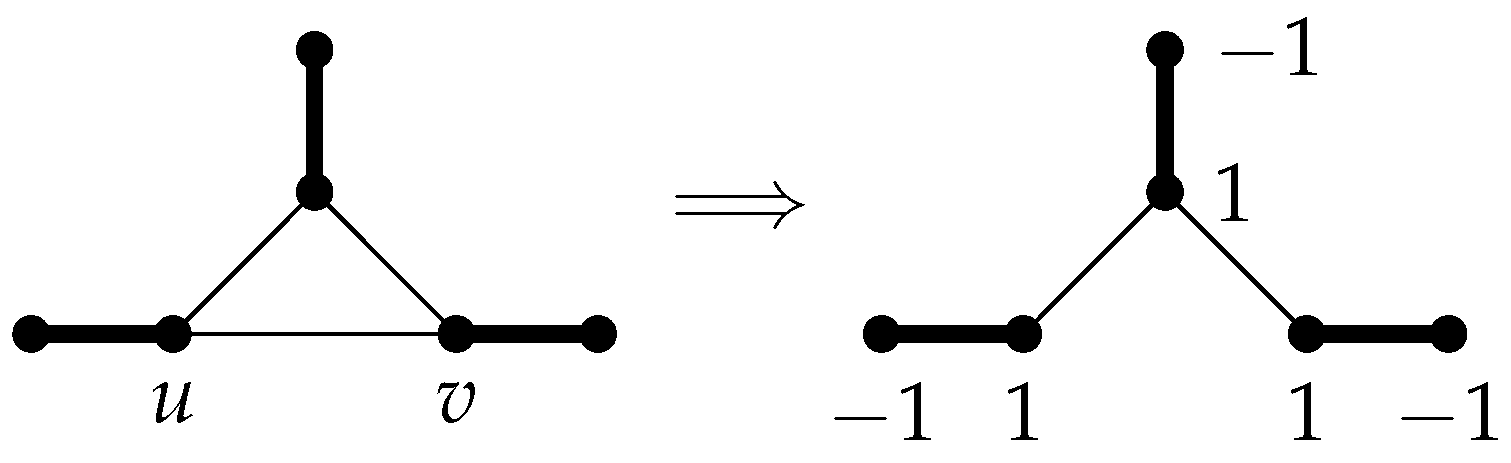
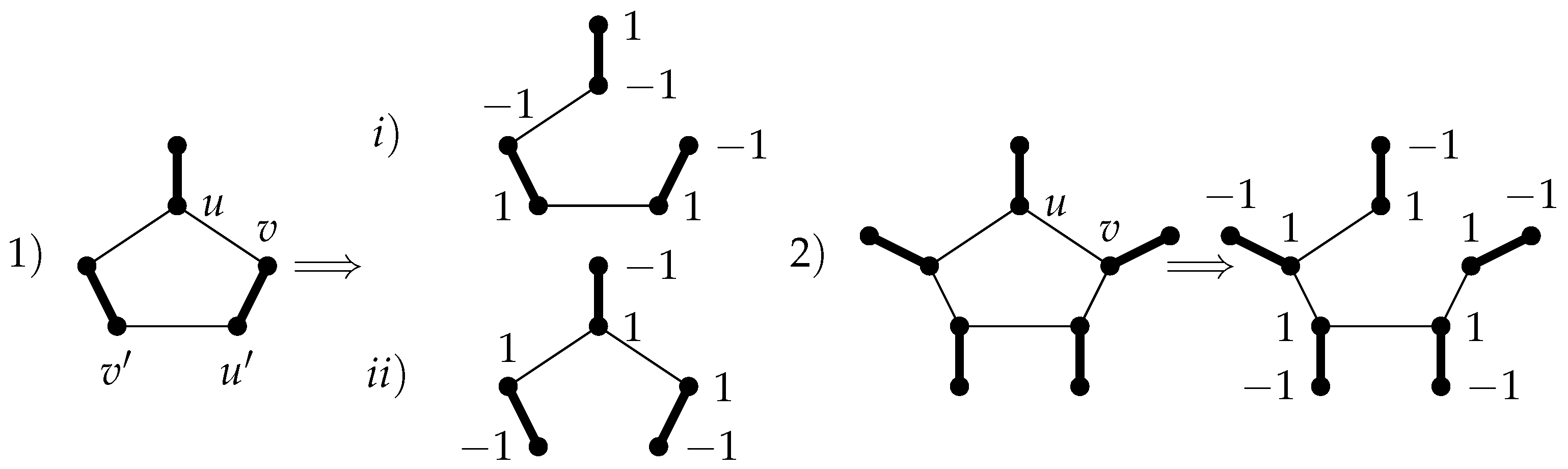
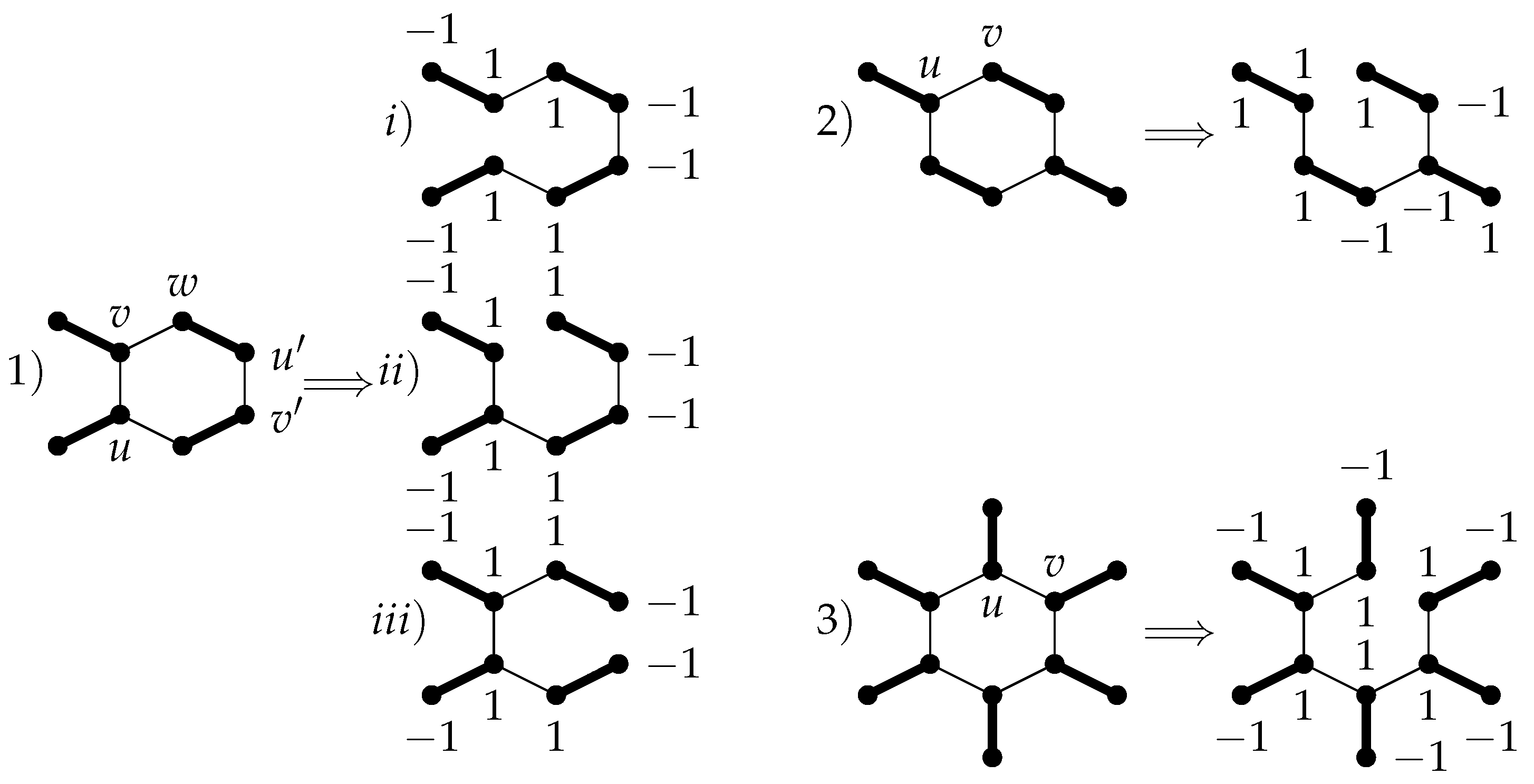
G. The following
Figure 1,
Figure 2,
Figure 3 and
Figure 4 show that for all broken sun graphs with
, that contain a perfect matching and have 2 among their Laplacian eigenvalues, for each arbitrary edge
, by removing
e, we have a tree
with a perfect matching. Thus, assume that
be an eigenvector of
corresponding to the eigenvalue 2 such that
, by [
12] (Theorem 2) and
. Also
X is an eigenvector of
corresponding to the eigenvalue 2, by Remark 1.
Now assume that
. We can find two pairs of adjacent vertices of degree 2 in
G, because of
G has a perfect matching. Also
, by [
2] (Theorem 8). We suppose that
and
are these vertices. Suppose that
obtained from
G by identifying three vertices
as one vertex
and also by identifying three vertices
as one vertex
, where
. Obviously,
is a broken sun graph with a perfect matching
whose girth is
and
. Thus, using induction hypothesis in
by removing
,
. So
has 2 among its Lapalcian eigenvalues with the eigenvector
such that
. If
, then we define the vector
as
also assign to each
leaf vertex the negative value of its neighbor. If
, then we define the vector
as
also assign to each
leaf vertex the negative value of its neighbor. One may check that in both cases, the vector
Y satisfies in Equation (
1). Therefore,
Y is an eigenvector of
corresponding to the eigenvalue 2 such that
and the proof is complete. □
In what follows, we wish to prove the correspondence of Theorem 3 to any unicyclic graphs containing a perfect match for which the Theorem 3 plays as an induction basis.
Theorem 4. Let be a unicyclic graph containing a perfect matching which has 2 among its Laplacian eigenvalues. It holds that there exists the eigenvector corresponding to the eigenvalue 2 like , such that .
Proof. First note that, for broken sun graphs, the proof is clear by Theorem 3. So, let
, for some
i,
. We prove the theorem by induction on
. Let
, where
is the root of
. Since
G has a perfect matching,
u is a
leaf vertex and its neighbor, say
v, has degree 2. Thus
, where
is a star on 2 vertices.
has 2 among its Laplacian eigenvalues because
, by [
15] (Theorem 2.5). So, by the induction hypothesis,
is the eigenvector of
corresponding to the eigenvalue 2 such that
for all
. Let
be a neighbor of
v.
is an eigenvector of
corresponding to the eigenvalue 2, where
for all
. This is because
and for vertex
vAdditionally, for the vertex
uBy noting the fact that
for the other vertices of
G, we have
and the proof is complete. □
4. The Laplacian Eigenvalue 2 of Bicyclic Graphs
In this section, we study the multiplicity of the Laplacian eigenvalue 2 of a bicyclic graphs G with just two cycles and . Let be the girth of ().
Lemma 2. Let G be a bicyclic graph and be an integral eigenvalue of . It holds that .
Proof. On the contrary, if
, then using Theorem 2, for every unicyclic subgraph
of
G we have
. This contradicts [
2] (Lemma 4) and the result follows. □
Theorem 5. Let G be a bicyclic graph of odd order n. It holds that . In particular, if and are odd, then .
Proof. On the contrary, suppose that
. Let
and
be two cycles of
G. Let
, where
. Then,
is a unicyclic graph. So
, by Theorem 2. If
, this contradicts [
2] (Lamma 4). Thus,
. Let
T be a spanning tree of
. Therefore
T has 2 among its Laplacian eigenvalues, by Theorem 2. By applying [
15] (Theorem 2.1), we conclude that
is a contradiction. Therefore,
. Moreover, Theorem 1 implies that
. Since
n is odd, for each
, the value of
is even. So,
is an even number. Thus, if
G has 2 among its Laplacian eigenvalues, then
, and hence,
. Therefore,
, a contradiction, and the proof is complete. □
Remark 3. Let be a bicyclic graph such that and contain a perfect matching. It is obvious that G has a perfect matching.
Theorem 6. Let and be unicyclic graphs containing a perfect matching. Let M be the perfect matching of a one-edge connected graph that has 2 as Laplacian eigenvalue. It holds that has 2 among its Laplacian eigenvalues such that or and .
Proof. Let
and
. Without loss of generality, we can assume that
and
. So, by Theorem 2, we have,
Now, let
. Therefore, by Theorem 2, we have,
Assume that
. Since
has a perfect matching,
, and hence,
and
by Theorem 2. If
, then
so
and the proof is complete. On the other hand, if
, then
. So we have,
and therefore,
. This is a contradiction, by [
15] (Theorem 2.1) and the result holds. □
As an immediate result we have the following corollary.
Corollary 4. Let and be unicyclic graphs containing a perfect matching. Let and . Thus , where and and .
In what follows, we state the condition under which the bicyclic graphs have 2 among their Laplacian eigenvalues.
Theorem 7. Let and be unicyclic graphs containing a perfect matching which have 2 among their Laplacian eigenvalues and be a bicyclic graph. Let and be the number of and of odd orders of and , respectively. It holds that if and only if G has 2 among its Laplacian eigenvalues.
Proof. Assume
X and
Y are eigenvectors of
and
corresponding to the eigenvalue 2, respectively. So vectors
X and
Y satisfy Equation (
1). Let
u and
v be two vertices of
and
with
. Now let
. We show that
satisfies Equation (
1) for
. First, note that
for all
and
for all
. So Equation (
1) holds for all vertices
. Also,
and
Thus, the proof of the “only if” part of the theorem is complete.
Conversely, assume that
G has 2 among its Laplacian eigenvalues. Suppose
is a joining edge of
G with
and
. The unicyclic graph
has 2 among its Laplacian eigenvalues, where
or
and
is not in the perfect matching
M of
G, by Theorem 6. Without loss of generality, let
. Then
, where
s is the number of trees of odd orders in
, by [
2] (Theorem 9). If
is an even number, then
is an even number. So the trees of odd orders in
are the same as the trees of odd orders in
, and hence,
. If
is an odd number, then
is an odd number. So the trees of odd orders in
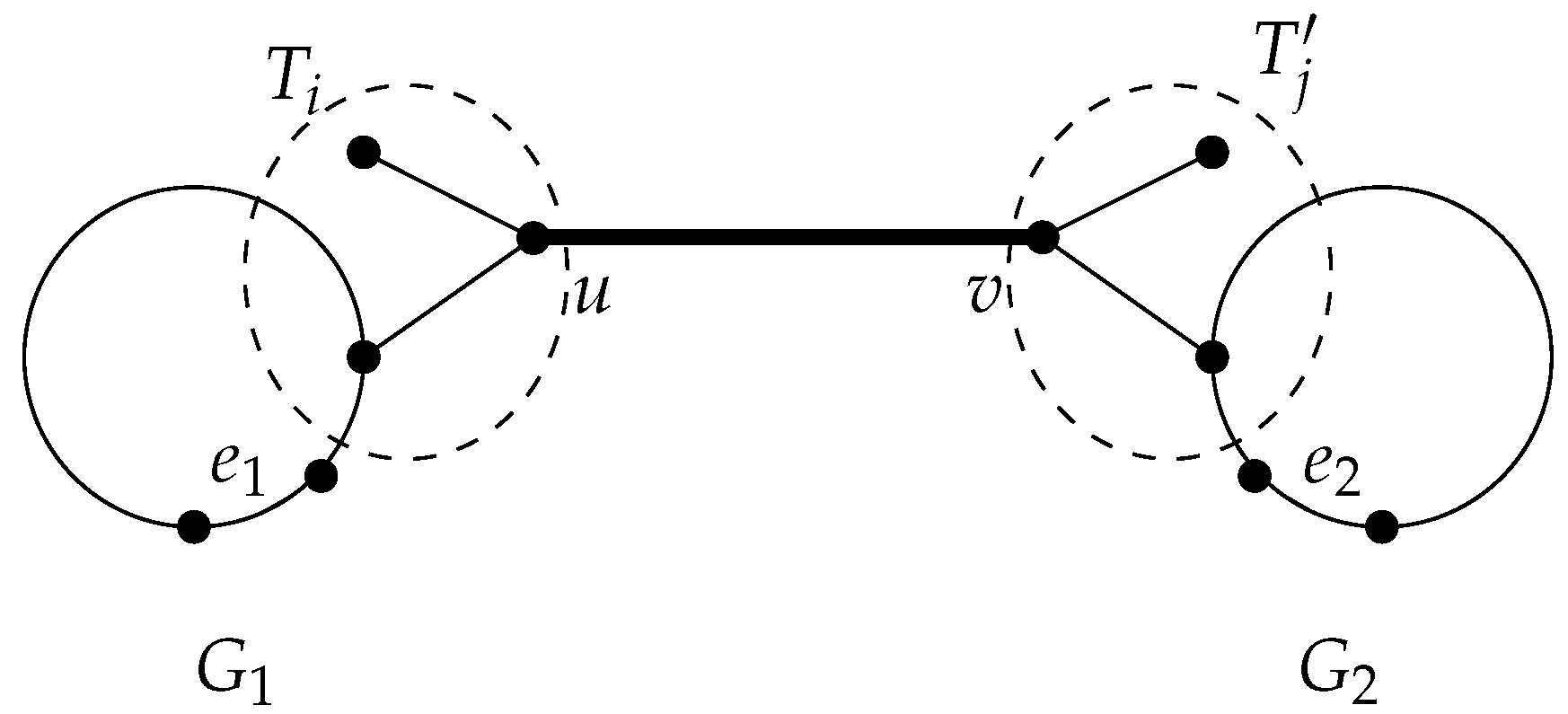
are
and all trees of odd orders in
except
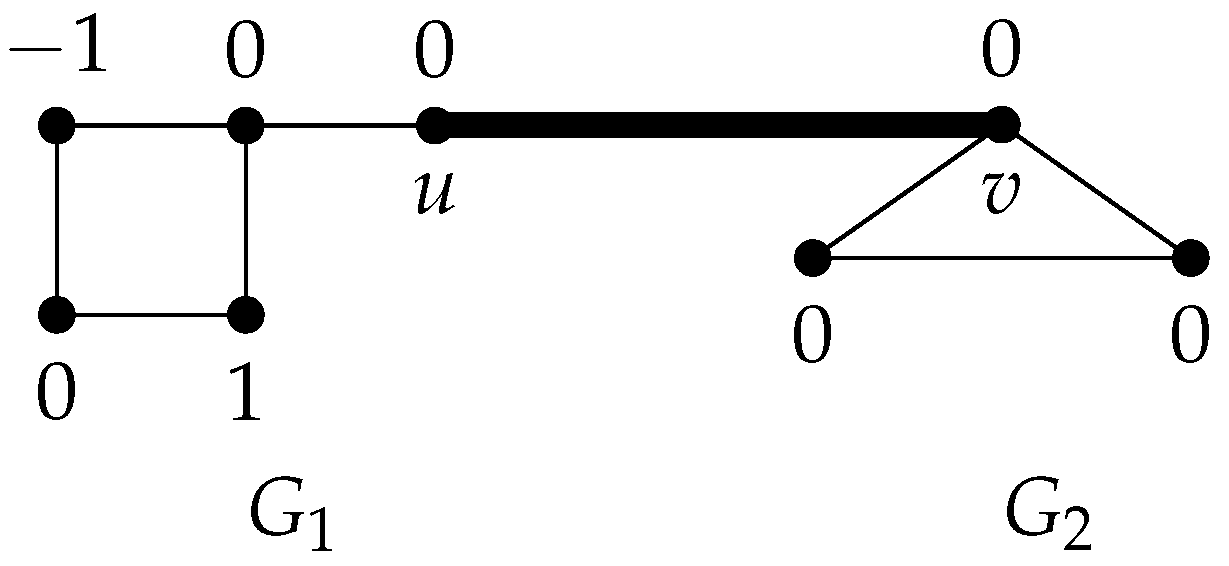
(see
Figure 5). Therefore,
and this completes the proof. □
As an immediate result from Theorems 3 and 7, we have the following corollary.
Corollary 5. Let and be broken sun graphs containing perfect matchings and be a bicyclic graph. Then, if and only if G has 2 among its Laplacian eigenvalues.
Let and be two unicyclic graphs. Assume () has 2 among its eigenvalues and . Even if has 2 as eigenvalue, the same thing does not necessarily happen for ().
Example 6. Let and be the unicyclic graphs in Figure 6. Then and G have 2
among their Laplacian eigenvalues, but has not 2
as a Laplacian eigenvalue. Here we establish some conditions on the degree of vertices of some bicyclic graphs having 2 as Laplacian eigenvalues.
Theorem 8. Let and be broken sun graphs of orders and with no perfect matching. If and there are odd numbers of vertices of degree 2 between any pair of consecutive vertices of degree 3, then has 2 among its Laplacian eigenvalues.
Proof. Assume that
and there are odd numbers of vertices of degree 2 between any pair of consecutive vertices of degree 3 in
and
; therefore,
and
have 2 among their Laplacian eigenvalues, by [
2] (Theorem 10). Let the edge of
G joining
and
be
, where
and
. We can assign
to the vertices of
and
, by the pattern
consecutively, starting with a vertex of degree 3, and assign to each
leaf vertex the negative of value of its neighbor to obtain eigenvectors
X and
Y of
and
corresponding to the eigenvalues 2, respectively. If
u and
v are two
leaf vertices or two vertices of degree 3 or 1 of them is a
leaf vertex and the other is of degree 3, then
is an eigenvector of
corresponding to the eigenvalue 2 (note that Equation (
1) is satisfied). If
u is a vertex of degree 1 or degree 3 and
v is a vertex of degree 2,
is an eigenvector of
corresponding to the eigenvalue 2 (note that Equation (
1) is satisfied). If
u and
v are two vertices of degree 2, and consequently, if
, then
. If
and
,
. If
and both of them are other than 0,
. Therefore,
Z satisfies Equation (
1) for
and
G has 2 among its Laplacian eigenvalues. Therefore, the result follows. □
Theorem 9. Let be a broken sun graph of orders with no perfect matching and be a unicyclic graph of order with a perfect matching. If and have 2 among their Laplacian eigenvalues, then has 2 as a Laplacian eigenvalue.
Proof. It is proven like Theorem 8, by a similar method. □