You are currently viewing a new version of our website. To view the old version click .
Mathematics
  • Article
  • Open Access

2 December 2019

Homotopy Analysis Method for a Fractional Order Equation with Dirichlet and Non-Local Integral Conditions


and
Mathematics Department, College of Science, King Saud University, P.O. Box 2455, Riyadh 11451, Saudi Arabia
*
Author to whom correspondence should be addressed.
This article belongs to the Special Issue Numerical Modeling and Analysis

Abstract

The main purpose of this paper is to obtain some numerical results via the homotopy analysis method for an initial-boundary value problem for a fractional order diffusion equation with a non-local constraint of integral type. Some examples are provided to illustrate the efficiency of the homotopy analysis method (HAM) in solving non-local time-fractional order initial-boundary value problems. We also give some improvements for the proof of the existence and uniqueness of the solution in a fractional Sobolev space.

1. Introduction

In this paper, we use a theoretical method to prove that the non-local initial-boundary value problem for a singular fractional order parabolic equation is well posed, and use a numerical method to investigate approximate solutions for the given problem, namely the homotopy analysis method. For theoretical purpose, we apply the energy inequality method based mainly on some a priori estimates, and on the density of the range of the operator generated by the considered problem. This method is an important component of linear and nonlinear functional analysis theory. It is one of the crucial tools to build the existence and uniqueness of solutions for a large variety of local and non-local initial-boundary value problems in partial differential equations. The model we study is a one-dimensional fractional order diffusion heat equation, associated with a classical and a non-local condition of integral type (see [1,2,3]). The fractional order derivative in the equation can be viewed as the degree of memory in the diffusing substance [4]. Many results concerning the existence and uniqueness of fractional order initial-boundary value problems have been studied by many researchers during the last few decades. These fractional order problems arise in many scientific and engineering areas, for example in control theory, blood flow, aerodynamics, biology, in the description of stochastic transport, viscoelasticity, in quantum mechanics, nuclear physics, and many other physical and biological processes, etc., see [5,6,7,8,9,10,11,12,13,14,15] and the references therein. For the proof of the existence and the uniqueness of the solution of the posed problem, we use the energy inequality method based mainly on some a priori estimates and on the density of the range of the operator generated by the considered problem. In the literature, there are few articles using the method of energy inequalities for the proof of existence and uniqueness of fractional initial-boundary value problems in the fractional case (see [16,17,18,19]).
For numerical purposes, we use the homotopy analysis method (HAM), which was firstly introduced by Liao [20] to efficiently handle nonlinear problems. It provides the solution in the form of a rapid convergent series, which in most cases gives a very accurate solution, after only a few iterations. The method has been widely used by many authors to successfully solve a wide range of mathematical problems in different disciplines. Recently, it is employed to generate reliable approximate solutions for fractional partial differential equations. For example, it is utilized to investigate approximate solutions of linear and nonlinear fractional diffusion wave equations in [21], for a system of nonlinear fractional partial differential equations in [22], a time fractional wave-like equation in [23], and a nonlinear type problems in [24]. Many authors have analytically and numerically studied many models of time-fractional differential equations, especially for the existence and uniqueness of solutions; see, for example, [6,19,25,26,27,28,29,30].
This article is organized as follows: In Section 2, we pose and set the problem to be solved, and write it in its operator form. In Section 3, we give some notations, introduce the functional frame and state some important inequalities that will be used in the sequel. In Section 4, we establish the uniqueness of the solution and its dependence on the given data of the posed problem. Section 5 is devoted to the solvability of the stated problem. In the last section, we use the homotopt analysis method to solve the posed problem, and provide some examples to test the efficiency of the method.

2. Problem Setting

We consider a fractional order parabolic equation with a Caputo derivative associated with Dirichlet and non-local conditions of integral type
L u = g ( x , t ) , ( x , t ) Q = Ω × [ 0 , T ] , l 1 u = u ( x , 0 ) = ω ( x ) , x Ω = ( 0 , 1 ) , 0 1 x u ( x , t ) d x = 0 , u ( 1 , t ) = 0 , t ( 0 , T ) ,
where L = t α 1 x x 2 x 2 + f and the functions f and g are in L ρ 2 ( Q ) , which is defined below.
The time fractional Caputo derivative of order 0 < α < 1 for a differential function is defined by
t α H ( x , t ) = 1 Γ ( 1 α ) 0 t ( t τ ) α τ H ( x , τ ) d τ , t > 0 ,
where Γ ( 1 α ) denotes the Gamma function.
For more details about the Caputo fractional derivative, we refer the reader to the references [5,31].
In order to establish the existence and uniqueness of the solution of problem (1), we write it in an equivalent operator form.
The solution of problem (1) can be regarded as the solution of the operator equation K u = ( L u , 1 u ) = F , where K is an unbounded operator which acts from S to H , with the domain of definition being the set of functions u L ρ 2 ( Q ) : u x , u x x , t α u L ρ 2 ( Q ) satisfying the boundary conditions, where S is a Banach space of functions u associated with the finite norm
u S 2 = u L 2 ( 0 ; T , H ρ α , t ( 0 , 1 ) ) 2 = 0 T u L ρ 2 ( 0 , 1 ) 2 + t α u L ρ 2 ( 0 , 1 ) 2 d t ,
and H is the weighted Hilbert space L ρ 2 ( Q ) × H ρ 1 ( 0 , 1 ) consisting of vector valued functions F = ( g , ω ) for which the norm
F H 2 = ω H ρ 1 ( 0 , 1 ) 2 + g L ρ 2 ( Q ) 2 .
is finite.
We will not outline here the basic ideas of the homotopy analysis method, but rather we refer the reader to [32].

3. Preliminaries

In this section we recall some function spaces and some basic tools.
We denote by L ρ 2 ( 0 , 1 ) the Hilbert space of weighted square integrable functions with inner product ( U , V ) ρ = 0 1 x U V d x , and by H ρ 1 ( 0 , 1 ) the weighted Sobolev space with the norm u H ρ 1 ( 0 , 1 ) 2 = u L ρ 2 ( 0 , 1 ) 2 + u x L ρ 2 ( 0 , 1 ) 2 . We also introduce the Hilbert space L 2 0 , T ; H ρ α , t ( 0 , 1 ) consisting of all abstract strongly measurable functions u on 0 , T into H ρ α , t ( 0 , 1 ) such that
u L 2 0 , T ; H ρ α , t ( 0 , 1 ) 2 = 0 T u ( . , t ) H ρ α , t ( 0 , 1 ) 2 d t = 0 T u L ρ 2 ( 0 , 1 ) 2 + t α u L ρ 2 ( 0 , 1 ) 2 d t < .
H ρ α , t ( 0 , 1 ) denotes the weighted Sobolev space whose norm is defined by
u H ρ α , t ( 0 , 1 ) = u L ρ 2 ( 0 , 1 ) 2 + t α u L ρ 2 ( 0 , 1 ) 2 .
Lemma 1
([18]). For any absolutely continuous function Z ( t ) on the interval [ 0 , T ] , the following inequality holds
Z ( t ) t α Z ( t ) 1 2 t α Z 2 ( t ) , 0 < α < 1 .
Lemma 2
([18]). Let a nonnegative absolutely continuous function J ( s ) satisfy the inequality
t α J ( t ) r 1 J ( t ) + r 2 ( t ) , 0 < α < 1 ,
for almost all t [ 0 , T ] , where r 1 is a positive constant and r 2 ( t ) is an integrable nonnegative function on [ 0 , T ] . Then
J ( t ) J ( 0 ) E α ( r 1 t α ) + Γ ( α ) E α , α ( r 1 t α ) D t α r 2 ( t ) ,
where
E α ( x ) = n = 0 x n Γ ( α n + 1 ) a n d E α , μ ( x ) = n = 0 x n Γ ( α n + μ ) ,
are Mittag–Leffler functions.
Young’s inequality with ε : For any ε > 0 , we have the inequality
a W 1 p ε a p + p 1 p W ε p p 1 , a , W R , p > 1 ,
which is the generalization of the Cauchy inequality with ε :
a W ε 2 a 2 + 1 2 ε W 2 , ε > 0 ,
where a and W are nonnegative numbers.
A Poincaré type inequality [33]
P x ξ U L ρ 2 ( 0 , l ) 2 l 3 2 U L ρ 2 ( 0 , l ) 2 ,
where
P x V = 0 x V ( ξ , t ) d ξ .
We also need the Riemann–Liouville integral of order 0 < α < 1 , which is defined by
D t α H ( t ) = 1 Γ ( α ) 0 t H ( τ ) ( t τ ) 1 α d τ .

4. Uniqueness of Solution

In this section, on the basis of an a priori estimate, we establish a uniqueness result for the solution of the given problem and its dependence on the given data of the posed problem.
Theorem 1.
Suppose that the function f satisfies
i ) f ( x , t ) A 0 , i i ) f x ( x , t ) A 1 , f ( x , t ) A 2 , ( x , t ) Q
where A 0 , A 1 and A 2 are positive constants and g L ρ 2 ( Q ) . Then we have the a priori estimate
u S 2 = u L 2 ( 0 , T ; H ρ α , t ( 0 , 1 ) ) 2 C * * ω H ρ 1 ( 0 , 1 ) 2 + g L ρ 2 ( Q ) 2 ,
for all u D ( K ) , where C * and C * * are positive constants given by
C * * = max C * , T 1 α ( 1 α ) Γ ( 1 α ) , C * = 1 2 A 1 + 4 min A 0 , 1 / 4 .
Proof. 
Consider the inner product in L 2 ( 0 , 1 ) of the integro-differential operator M u = x u x P x ξ u + x t α u and L u
L u , M u L 2 ( 0 , 1 ) = t α u 1 x x x u x + f ( x , t ) u , x u x P x ξ u + x t α u L 2 ( 0 , 1 ) = g , x u x P x ξ u + x t α u L 2 ( 0 , 1 ) .
where
P x ξ u = 0 x ξ u ( ξ , t ) d ξ .
 □
Boundary and initial conditions in Equation (1), give
t α u , x P x ξ u L 2 ( 0 , 1 ) = 0 1 x t α u P x ξ u d x ,
x x u x , P x ξ u L 2 ( 0 , 1 ) = u L ρ 2 ( 0 , 1 ) 2 ,
f u , x P x ξ u L 2 ( 0 , 1 ) = 1 2 f x P x ξ u L 2 ( 0 , 1 ) 2 ,
t α u , x u L 2 ( 0 , 1 ) = 0 1 x u t α u d x ,
x x u x , u L 2 ( 0 , 1 ) = u x L ρ 2 ( 0 , 1 ) 2 ,
f u , x u L 2 ( 0 , 1 ) = f u L ρ 2 ( 0 , 1 ) 2 ,
t α u , x t α u L 2 ( 0 , 1 ) = t α u L ρ 2 ( 0 , 1 ) 2 ,
t α u , x x u x L 2 ( 0 , 1 ) = t α u x , u x L ρ ( 0 , 1 ) ,
x t α u , f u L 2 ( 0 , 1 ) = 0 1 x f u t α u d x .
Substitution of Equalities (20)–(28) into (19),gives
u x L ρ 2 ( 0 , 1 ) 2 + f u L ρ 2 ( 0 , 1 ) 2 + t α u , u L ρ ( 0 , 1 ) + t α u x , u x L ρ ( 0 , 1 ) + t α u L ρ ( 0 , 1 ) 2 + t α u , f u L ρ ( 0 , 1 ) + u L ρ ( 0 , 1 ) 2 + 1 2 f x P x ξ u L 2 ( 0 , 1 ) 2 = P x ξ u , x g L 2 ( 0 , 1 ) + x u , g L 2 ( 0 , 1 ) + x t α u , g L 2 ( 0 , 1 ) + t α u , x P x ξ u L 2 ( 0 , 1 ) .
By using Cauchy inequality, Inequality (12), Conditions (16) and Lemma 1, we infer from Equation (29) that
u x L ρ 2 ( 0 , 1 ) 2 + ( 1 + A 0 ) u L ρ 2 ( 0 , 1 ) 2 + ( A 0 + 1 2 ) t α u L ρ 2 ( 0 , 1 ) 2 + 1 2 t α u x L ρ 2 ( 0 , 1 ) 2 + A 1 2 P x ξ u L 2 ( 0 , 1 ) 2 + t α u L ρ 2 ( 0 , 1 ) 2 ε 1 2 P x ξ u L 2 ( 0 , 1 ) 2 + 1 2 ε 1 g L ρ 2 ( 0 , 1 ) 2 + ε 2 2 t α u L ρ 2 ( 0 , 1 ) 2 + 1 2 ε 2 P x ξ u L 2 ( 0 , 1 ) 2 + ε 3 u L ρ 2 ( 0 , 1 ) 2 + 1 ε 3 g L ρ 2 ( 0 , 1 ) 2 + ε 4 t α u L ρ 2 ( 0 , 1 ) 2 + 1 ε 4 g L ρ 2 ( 0 , 1 ) 2
By dropping the first term on the left-hand side of Equation (30), taking ε 1 = A 1 , ε 2 = 1 / 2 , ε 3 = 1 / 2 and ε 4 = 1 / 2 , and applying the Poincaré inequality for the fourth term on the right-hand side of Equation (30), we obtain
u H ρ α , t ( 0 , 1 ) 2 + t α u H ρ 1 ( 0 , 1 ) 2 C * g L ρ 2 ( 0 , 1 ) 2 ,
where
C * = 1 2 A 1 + 4 min A 0 , 1 / 4 .
Integrating both sides of Equation (31) over ( 0 , t ) gives
0 t u ( x , ν H ρ α , t ( 0 , 1 ) 2 d ν + D α 1 u H ρ 1 ( 0 , 1 ) 2 C * 0 t g ( x , ν ) L ρ 2 ( 0 , 1 ) 2 d ν + T 1 α ( 1 α ) Γ ( 1 α ) ω H ρ 1 ( 0 , 1 2 C * * 0 t g ( x , ν ) L ρ 2 ( 0 , 1 ) 2 d ν + ω H ρ 1 ( 0 , 1 2 ,
where
C * * = max C * , T 1 α ( 1 α ) Γ ( 1 α ) .
If we discard the second term on the left hand side of Equation (33) and replace t by T, we obtain the desired inequality:
u L 2 ( 0 , T ; H ρ α , t ( 0 , 1 ) ) 2 C * * ω H ρ 1 ( 0 , 1 ) 2 + g L ρ 2 ( Q ) 2 .

5. Solvability of the Posed Problem

In this section, we prove a result concerning the existence of the solution of the given problem. It follows from Inequality (17) that the operator K admits an inverse K 1 : I m ( K ) S . Since I m ( K ) H, we then can construct its closure K ¯ such that Inequality (17) holds for K ¯ and I m ( K ¯ ) = H .
Corollary 1.
The operator K : S H has a closure.
A priori bound Inequality (17) can be then extended to
u S 2 μ ω H ρ 1 ( 0 , 1 ) 2 + g L ρ 2 ( Q ) 2 ,
for all u D ( K ¯ ) .
It follows from Equation (36) that K ¯ u = H and I m ( K ¯ ) = H is a closed subset in H and I m ( K ) = I m ( K ¯ ) and K ¯ 1 = K 1 ¯ . Hence the solvability result.
Theorem 2.
Assume that conditions of Theorem 4.1 hold. Then for all F = ( g , ω ) H , there exists a unique strong solution u = K ¯ 1 F = K 1 ¯ F of Problem (1).
Proof. 
Corollary 5.2 asserts that in order to show that Problem (1) has a strong solution for any F = ( g , ω ) H , it is sufficient to show that I m ( K ) ¯ = H for every u S .  □
Proposition 1. 
(Special case of density). Assume that the conditions of Theorem 4.1 hold. If for all u D ( K ) such that 1 u = 0 , and for some function Φ L 2 ( Q ) , we have
0 T L u , Φ L ρ 2 ( 0 , 1 ) d t = 0 ,
then Φ is zero a . e in Q .
Proof. 
Identity (37) can be expressed as
0 T t α u 1 x x x u x + f ( x , t ) u , Φ L ρ 2 ( 0 , 1 ) d t = 0 .
 □
Suppose that a function Γ ( x , t ) satisfies boundary and initial conditions in Equation (1) and such that Γ , Γ x , x x I t ( Γ ( x , s ) , and t α I t ( Γ ( x , s ) ) L 2 ( Q t ) ; we then let
u ( x , t ) = I t ( Γ ( x , s ) ) = 0 t Γ ( x , s ) d s .
Equation (38) then takes the form
0 T t α I t ( Γ ( x , s ) ) 1 x x x I t ( Γ x ( x , s ) ) + f ( x , t ) I t ( Γ ( x , s ) ) , Φ L ρ 2 ( 0 , 1 ) d t = 0 .
We now consider the function
Φ ( x , t ) = I t ( Γ ( x , s ) ) + P x ξ I t ( Γ ( x , s ) ) + t α I t ( Γ ( x , s ) )
Consequently, Equation (40) becomes
0 T t α I t ( Γ ( x , s ) ) , x I t ( Γ ( x , s ) ) + x P x ξ I t ( Γ ( x , s ) ) + x t α I t ( Γ ( x , s ) ) L 2 ( 0 , 1 ) d t + 0 T x x I t ( Γ x ( x , s ) ) , I t ( Γ ( x , s ) ) P x ξ I t ( Γ ( x , s ) ) t α I t ( Γ ( x , s ) ) L 2 ( 0 , 1 ) d t + 0 T f ( x , t ) I t ( Γ ( x , s ) ) , x I t ( Γ ( x , s ) ) + x P x ξ I t ( Γ ( x , s ) ) + x t α I t ( Γ ( x , s ) ) L 2 ( 0 , 1 ) d t = 0 .
Since Γ satisfies boundary conditions in Equation (1), then we have
t α I t ( Γ ( x , s ) ) , x I t ( Γ ( x , s ) ) L 2 ( 0 , 1 ) t α I t ( Γ ( x , s ) ) L ρ 2 ( 0 , 1 ) 2 ,
t α I t ( Γ ( x , s ) ) , x t α I t ( Γ ( x , s ) ) L 2 ( 0 , 1 ) = t α I t ( Γ ( x , s ) ) L ρ 2 ( 0 , 1 ) 2 ,
x x I t ( Γ x ( x , s ) ) , I t ( Γ ( x , s ) ) L 2 ( 0 , 1 ) = I t ( Γ x ( x , s ) ) L ρ 2 ( 0 , 1 ) 2 ,
x x I t ( Γ x ( x , s ) ) , P x ξ I t ( Γ ( x , s ) ) L 2 ( 0 , 1 ) = 1 2 I t ( Γ ( 1 , s ) ) 2 1 2 I t ( Γ ( x , s ) ) L ρ 2 ( 0 , 1 ) 2 ,
x x I t ( Γ x ( x , s ) ) , t α I t ( Γ ( x , s ) ) L 2 ( 0 , 1 ) = x I t ( Γ x ( x , s ) ) , t α I t ( Γ ( x , s ) ) L 2 ( 0 , 1 ) 1 2 t α I t ( Γ ( x , s ) ) L ρ 2 ( 0 , 1 ) 2 ,
f ( x , t ) I t ( Γ ( x , s ) ) , x I t ( Γ ( x , s ) ) L 2 ( 0 , 1 ) = f I t ( Γ ( x , s ) ) L ρ 2 ( 0 , 1 ) 2 A 0 I t ( Γ ( x , s ) ) L ρ 2 ( 0 , 1 ) 2 ,
f ( x , t ) I t ( Γ ( x , s ) ) , x t α I t ( Γ ( x , s ) ) L 2 ( 0 , 1 ) A 0 t α I t ( Γ ( x , s ) ) L ρ 2 ( 0 , 1 ) 2 ,
A combination of Equations (42)–(49) gives the inequality
I t ( Γ ( 1 , s ) ) 2 + t α I t ( Γ x ( x , s ) ) L ρ 2 ( 0 , 1 ) 2 + 2 I t ( Γ x ( x , s ) ) L ρ 2 ( 0 , 1 ) 2 + 2 t α I t ( Γ ( x , s ) ) L ρ 2 ( 0 , 1 ) 2 ( 2 + 2 A 0 ) t α I t ( Γ ( x , s ) ) L ρ 2 ( 0 , 1 ) 2 + 2 A 0 I t ( Γ ( x , s ) ) L ρ 2 ( 0 , 1 ) 2 I t ( Γ ( x , s ) ) L ρ 2 ( 0 , 1 ) 2 2 f ( x , t ) I t ( Γ ( x , s ) ) , x P x ξ I t ( Γ ( x , s ) ) L 2 ( 0 , 1 ) 2 t α I t ( Γ ( x , s ) ) , x P x ξ I t ( Γ ( x , s ) ) L 2 ( 0 , 1 ) .
Poincaré type Inequality (11), the Cauchy-inequality and Condition (16) reduce Equation (50) to
I t ( Γ ( 1 , s ) ) 2 + t α I t ( Γ x ( x , s ) ) L ρ 2 ( 0 , 1 ) 2 + 2 I t ( Γ x ( x , s ) ) L ρ 2 ( 0 , 1 ) 2 + 2 t α I t ( Γ ( x , s ) ) L ρ 2 ( 0 , 1 ) 2 + ( 2 + 2 A 0 ) t α I t ( Γ ( x , s ) ) L ρ 2 ( 0 , 1 ) 2 + 2 A 0 I t ( Γ ( x , s ) ) L ρ 2 ( 0 , 1 ) 2 I t ( Γ ( x , s ) ) L ρ 2 ( 0 , 1 ) 2 + ε 1 A 2 I t ( Γ ( x , s ) ) L ρ 2 ( 0 , 1 ) 2 + 1 4 ε 1 I t ( Γ ( x , s ) ) L ρ 2 ( 0 , 1 ) 2 + ε 2 t α I t ( Γ ( x , s ) ) L ρ 2 ( 0 , 1 ) 2 + 1 ε 2 I t ( Γ ( x , s ) ) L ρ 2 ( 0 , 1 ) 2 .
Put ε 1 = 1 8 A 0 , ε 2 = 2 into Equation (51) and ignore the first three terms on the left-hand side of Equation (51), it follows that
t α I t ( Γ ( x , s ) ) L ρ 2 ( 0 , 1 ) 2 10 A 0 + A 2 16 A 0 ( 1 + A 0 ) I t ( Γ ( x , s ) ) L ρ 2 ( 0 , 1 ) 2 .
Integration over ( 0 , t ) in Equation (52), leads to
D t α 1 I t ( Γ ( x , s ) ) L ρ 2 ( 0 , 1 ) 2 * 0 t I τ ( Γ ( x , s ) ) L ρ 2 ( 0 , 1 ) 2 d τ .
where
* = 10 A 0 + A 2 16 A 0 ( 1 + A 0 ) .
Applying Lemma 3.2 to Equation (53), after putting
Y ( t ) = 0 t I τ ( Γ ( x , s ) ) L ρ 2 ( 0 , 1 ) 2 d τ Y ( 0 ) = 0 ,
and
t α Y ( t ) = D t α 1 I t ( Γ ( x , s ) ) L ρ 2 ( 0 , 1 ) 2 ,
then
0 t I τ ( Γ ( x , s ) ) L ρ 2 ( 0 , 1 ) 2 d τ Y ( 0 ) E α ( * t α ) + Γ ( α ) E α , α ( * t α ) D t α ( 0 ) = 0 .
Replacing t by T , It follows then from Equation (56) that
0 T I τ ( Γ ( x , s ) ) L ρ 2 ( 0 , 1 ) 2 d τ 0 .
Hence Φ = 0 a . e in Q .
We now complete the proof of Theorem 5.3, We suppose that for ( ψ , ζ 1 ) I m ( K ) , we have
0 T L u , ψ L ρ 2 ( 0 , 1 ) d t + 1 u , ζ 1 H ρ 1 ( 0 , 1 ) = 0 ,
then we should show that ψ = 0 , ζ 1 = 0 . Take u D ( K ) such that 1 u = 0 in (58), then we have
0 T L u , ψ L ρ 2 ( 0 , 1 ) d t = 0 , u D ( K ) .
It follows from Theorem 5.4, and Equation (59), that ψ = 0 a . e in Q . Hence Equation (58) takes the forms
1 u , ζ 1 H ρ 1 ( 0 , 1 ) = 0 u D ( K ) .
Since I m 1 is dense in H ρ 1 ( 0 , 1 ) , we deduce from Equation (60) that ζ 1 = 0 .

6. Application of the Method

To test the efficiency of the HAM for solving the fractional non-local mixed problem with the Bessel operator, we consider the equivalent initial-boundary value problem
t α u 1 x u x 2 u x 2 + f ( x , t ) u ( x , t ) = g ( x , t ) , 0 < x , α < 1 , 0 < t < T ,
u ( x , 0 ) = ω ( x ) , x ( 0 , 1 ) ,
u x ( 1 , t ) = 0 , u ( 1 , t ) = d ( t ) ,
for some given functions f, g, d and ω .
To apply the HAM to Equation (61) with the initial Condition (62), we consider the initial approximation
u 0 ( x , t ) = u ( x , 0 ) ,
and the linear operator with the non-integer order
L [ ϕ ( x , t ; q ) ] = t α ϕ ( x , t ; q ) , 0 < α < 1 ,
which satisfies the property L ( c ) = 0 , where c represents an integral constant. Thus, in view of Equation (61), we consider the fractional partial differential operator
F [ ϕ ( x , t ; q ) ] = t α ϕ ( x , t ; q ) 1 x ϕ x 2 ϕ x 2 + f ( x , t ) ϕ ( ( x , t ) g ( x , t ) ,
hence the zeroth-order deformation equation is given by
( 1 q ) L [ ϕ ( x , t ; q ) u 0 ( x , t ) ] = q F [ ϕ ( x , t ; q ) ] ,
then, at q = 0 and q = 1 , we have
ϕ ( x , t ; 0 ) = u 0 ( x , t ) = u ( x , 0 ) , a n d   ϕ ( x , t ; 1 ) = u ( x , t ) ,
respectively.
On the other hand, the mth-order deformation equation is given by
L [ u m ( x , t ) χ m u m 1 ( x , t ) ] = R m ( u m 1 ) ,
where
R m ( u m 1 ( x , t ) ) = t α u m 1 1 x u m 1 x 2 u m 1 x 2 + f ( x , t ) u m 1 ( 1 χ m ) g ( x , t ) ,
and
χ m = 0 , m 1 , 1 , m > 1 .
Now, for m 1 , the solution of the mth-order deformation Equation (66) can be obtained recessively through the iterative scheme:
u m ( x , t ) = χ m u m 1 ( x , t ) + L 1 R m ( u m 1 ( x , t ) ) ,
or
u m ( x , t ) = χ m u m 1 ( x , t ) + t α R m ( u m 1 ( x , t ) ) .
To illustrate the efficiency of the HAM in solving fractional partial differential equations in the form of Equation (61), we apply this method to the following test examples:
Example 1.
Consider the fractional homogeneous initial/boundary value problem
t α u 1 x u x 2 u x 2 = 0 , 0 < x < 1 , 0 < t < T , 0 < α < 1 , u ( x , 0 ) = 1 4 1 + x 2 2 l n ( x ) , x ( 0 , 1 ) , u ( 1 , t ) = t α Γ ( α + 1 ) , u x ( 1 , t ) = 0 , t ( 0 , T ) .
Taking f ( x , t ) = g ( x , t ) = 0 , d ( t ) = t α Γ ( α + 1 ) and u 0 ( x , t ) = u ( x , 0 ) = 1 4 x 2 4 + ln x 2 , then in view of Equation (68) we have
u 1 ( x , t ) = t α R 1 ( u 0 ( x , t ) ) , = t α t α u 0 1 x u 0 x 2 u 0 x 2 , = t α 1 .
u 2 ( x , t ) = χ 2 u 1 + t α R 2 ( u 1 ( x , t ) ) , = u 1 + t α t α u 1 1 x u 1 x 2 u 1 x 2 , = t α 1 + t α t α t α 1 , = t α 1 + 2 t α 1 , = ( 1 + ) t α 1 .
u 3 ( x , t ) = χ 3 u 2 + t α R 2 ( u 2 ( x , t ) ) , = u 2 + t α t α u 2 1 x u 2 x 2 u 2 x 2 , = t α 1 + 2 t α 1 + t α t α t α 1 + 2 t α 1 , = t α 1 + 2 2 t α 1 + 3 t α 1 . = ( 1 + ) 2 t α 1 .
u 4 ( x , t ) = χ 4 u 3 + t α R 2 ( u 3 ( x , t ) ) , = u 3 + t α t α u 3 1 x u 3 x 2 u 3 x 2 , = t α 1 + 2 2 t α 1 + 3 t α 1 + t α t α t α 1 + 2 2 t α 1 + 3 t α 1 , = t α 1 + 2 2 t α 1 + 3 t α 1 + 2 t α 1 + 2 3 t α 1 + 4 t α 1 , = t α 1 + 3 2 t α 1 + 3 3 t α 1 + 4 t α 1 , = ( 1 + ) 3 t α 1 .
and so on. Thus, the series solution is
u ( x , t ) = u 0 ( x , t ) + u 1 ( x , t ) + u 2 ( x , t ) + u 3 ( x , t ) + , = 1 4 x 2 4 + ln x 2 + t α 1 + ( 1 + ) t α 1 + ( 1 + ) 2 t α 1 + , = 1 4 x 2 4 + ln x 2 + t α 1 1 + ( 1 + ) + ( 1 + ) 2 + , = 1 4 x 2 4 + ln x 2 + t α 1 j = 0 ( 1 + ) j .
If the auxiliary parameter ℏ is selected so that | 1 + | < 1 , then the last power series converges, and gives
u ( x , t ) = 1 4 x 2 4 + ln x 2 t α 1 , = 1 4 x 2 4 + ln x 2 + t α Γ ( α + 1 ) .
which is the exact solution for 0 < α < 1 .
Moreover, for α = 1 , setting u 0 ( x , t ) = 1 4 x 2 4 + ln x 2 , then successive applications of Equation (68) implies
u 1 ( x , t ) = t , u 2 ( x , t ) = ( 1 + ) t , u 3 ( x , t ) = ( 1 + ) 2 t , u 4 ( x , t ) = ( 1 + ) 3 t ,
Hence, the series solution becomes
u ( x , t ) = u 0 ( x , t ) + u 1 ( x , t ) + u 2 ( x , t ) + u 3 ( x , t ) + , = 1 4 x 2 4 + ln x 2 + t + ( 1 + ) t + ( 1 + ) 2 t + , = 1 4 x 2 4 + ln x 2 + t 1 + ( 1 + ) + ( 1 + ) 2 + , = 1 4 x 2 4 + ln x 2 + t j = 0 ( 1 + ) j , = 1 4 x 2 4 + ln x 2 t , p r o v i d e d   t h a t | 1 + | < 1 ,
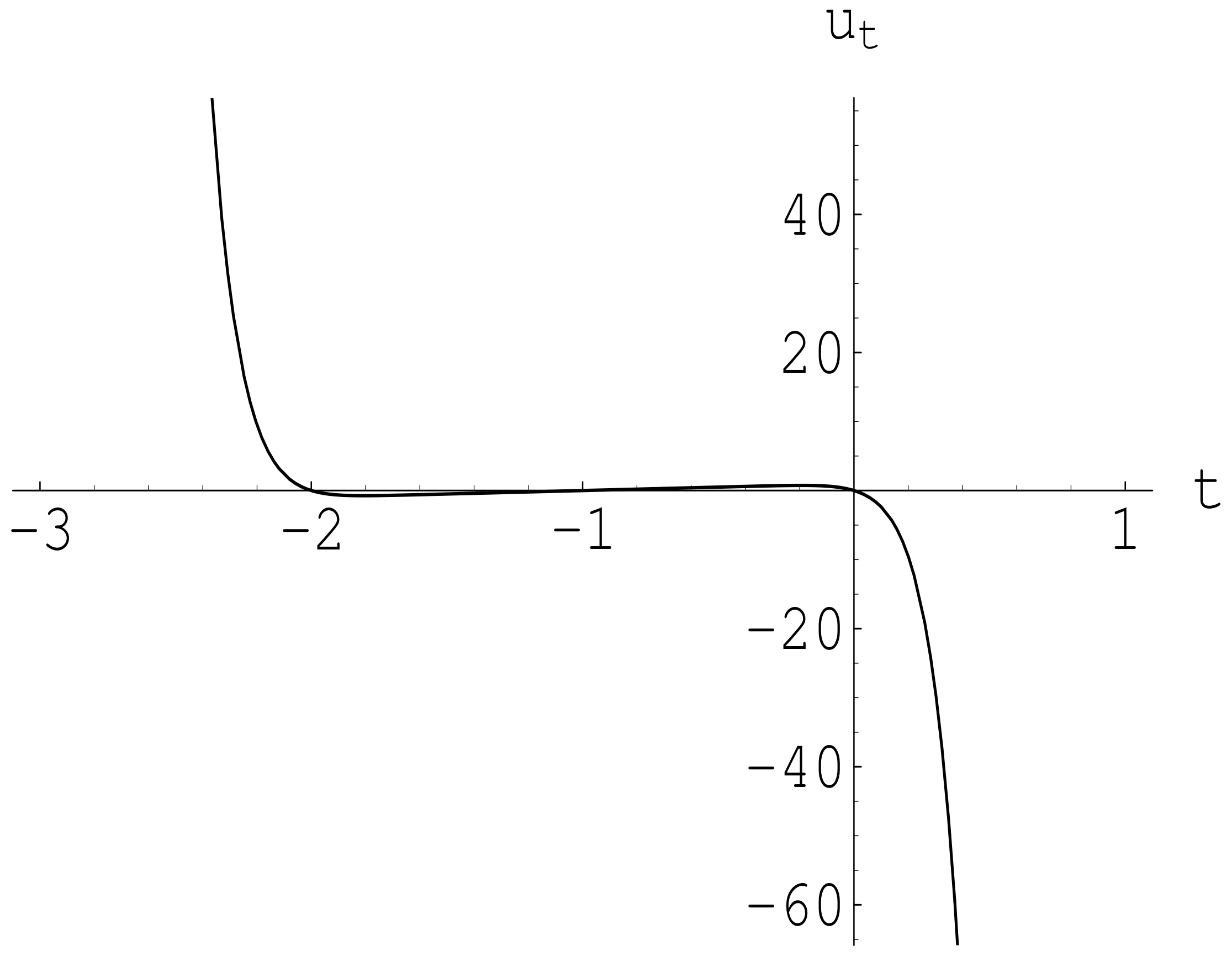
which is the exact solution in this case. Figure 1 shows the ℏ-curve corresponding to the truncated series solution of order 8, which indicates that the permissible values of ℏ should satisfy 2 < < 0 .
Figure 1. The h-curve based on the 8th order approximation and α = 1 .
Example 2.
Consider the fractional nonhomogeneous initial/boundary value problem
t α u 1 x u x 2 u x 2 = 4 e t , 0 < x < 1 , 0 < t < T , , 0 < α < 1 , u ( x , 0 ) = 1 x 2 + 2 l n ( x ) , x ( 0 , 1 ) , u ( 1 , t ) = t α e t , u x ( 1 , t ) = 0 , t ( 0 , T ) .
Taking f ( x , t ) = 0 , g ( x , t ) = 4 e t , d ( t ) = t α e t and u 0 ( x , t ) = u ( x , 0 ) = 1 x 2 + 2 l n ( x ) , then in view of Equation (68) we have
u 1 ( x , t ) = t α R 1 ( u 0 ( x , t ) ) , = t α t α u 0 1 x u 0 x 2 u 0 x 2 ( 1 χ 1 ) g ( x , t ) , = t α e t .
u 2 ( x , t ) = χ 2 u 1 + t α R 2 ( u 1 ( x , t ) ) , = u 1 + t α t α u 1 1 x u 1 x 2 u 1 x 2 ( 1 χ 2 ) g ( x , t ) , = t α e t + t α t α t α e t , = t α e t + 2 t α e t , = ( 1 + ) t α e t .
u 3 ( x , t ) = χ 3 u 2 + t α R 2 ( u 2 ( x , t ) ) , = u 2 + t α t α u 2 1 x u 2 x 2 u 2 x 2 ( 1 χ 3 ) g ( x , t ) , = ( 1 + ) t α e t + t α t α ( 1 + ) t α e t , = ( 1 + ) t α e t + 2 ( 1 + ) t α e t , = ( 1 + ) 2 t α e t .
u 4 ( x , t ) = χ 4 u 3 + t α R 2 ( u 3 ( x , t ) ) , = u 3 + t α t α u 3 1 x u 3 x 2 u 3 x 2 ( 1 χ 4 ) g ( x , t ) , = ( 1 + ) 2 t α e t + t α t α ( 1 + ) 2 t α e t , = ( 1 + ) 3 t α e t .
and so on. Thus, the series solution is given by
u ( x , t ) = u 0 ( x , t ) + u 1 ( x , t ) + u 2 ( x , t ) + u 3 ( x , t ) + , = 1 x 2 + 2 l n ( x ) + t α e t + ( 1 + ) t α e t + ( 1 + ) 2 t α e t + , = 1 x 2 + 2 l n ( x ) + t α e t 1 + ( 1 + ) + ( 1 + ) 2 + , = 1 x 2 + 2 l n ( x ) + t α e t i = 0 ( 1 + ) j .
Again, if we select the auxiliary parameter ℏ so that | 1 + | < 1 , then the power series in the last term converges, and we obtain
u ( x , t ) = 1 x 2 + 2 l n ( x ) t α e t , f o r   0 < α < 1 .
For α = 1 and u 0 ( x , t ) = 1 x 2 + 2 l n ( x ) , successive applications of Equation (68) imply
u 1 ( x , t ) = ( 1 e t ) , u 2 ( x , t ) = ( 1 + ) ( 1 e t ) , u 3 ( x , t ) = ( 1 + ) 2 ( 1 e t ) , u 4 ( x , t ) = ( 1 + ) 3 ( 1 e t ) ,
Thus, the series solution is
u ( x , t ) = u 0 ( x , t ) + u 1 ( x , t ) + u 2 ( x , t ) + u 3 ( x , t ) + u 4 ( x , t ) + , = 1 x 2 + 2 l n ( x ) + ( 1 e t ) + ( 1 + ) ( 1 e t ) + ( 1 + ) 2 ( 1 e t ) + , = 1 x 2 + 2 l n ( x ) + ( 1 e t ) 1 + ( 1 + ) + ( 1 + ) 2 + , = 1 x 2 + 2 l n ( x ) + ( 1 e t ) i = 0 ( 1 + ) i , = e t x 2 + 2 l n ( x ) , p r o v i d e d   t h a t | 1 + | < 1 ,
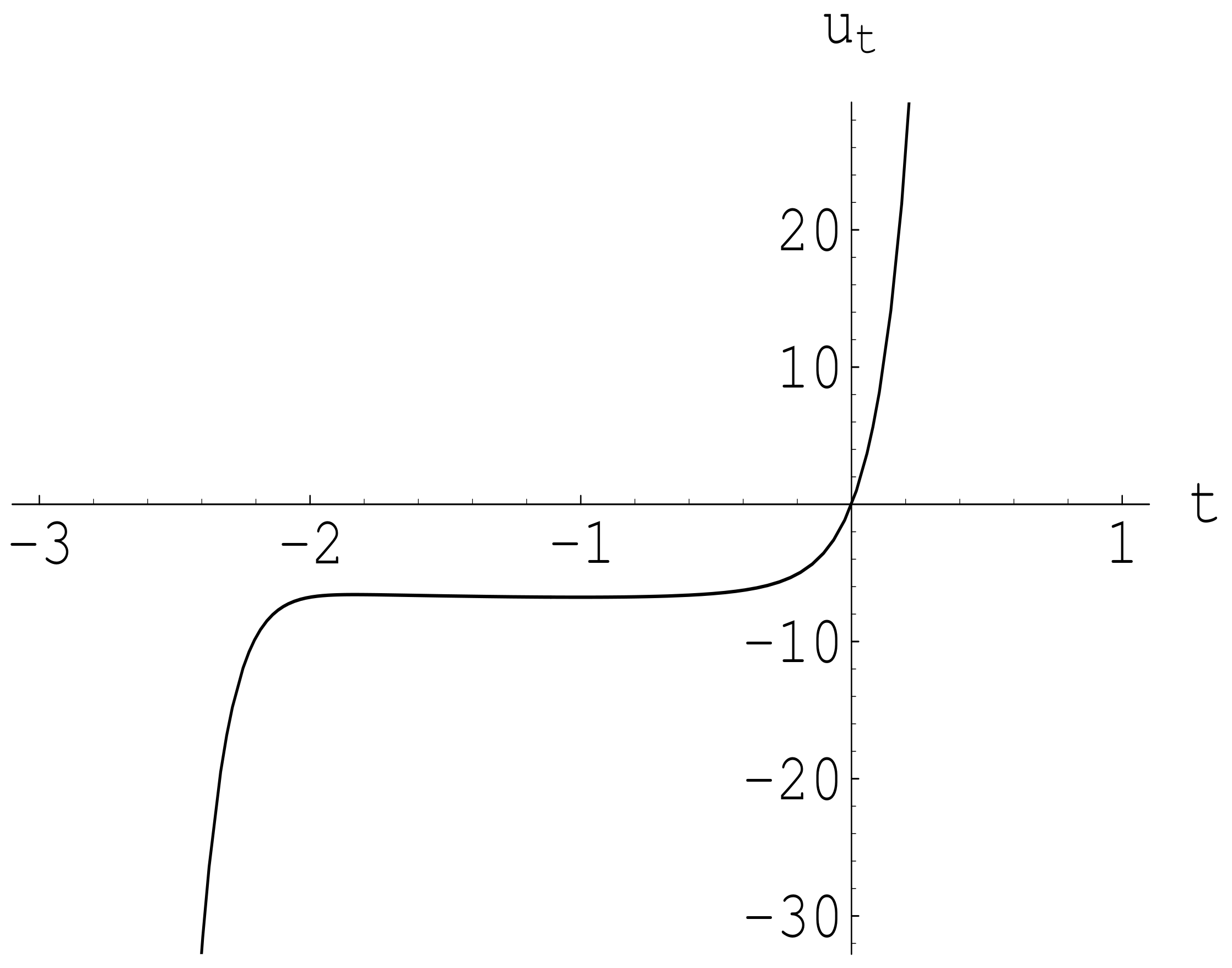
which is the exact solution in this case. Figure 2, shows the ℏ-curve corresponding to the truncated series solution of order 12, which indicates that the parameter ℏ should satisfy 2 < < 0 .
Figure 2. The h-curve based on the 12th order approximation and α = 1 .
Example 3.
Consider the fractional nonhomogeneous initial/boundary value problem
t α u 1 x u x 2 u x 2 + u = g ( x , t ) , 0 < x < 1 , 0 < t < T , 0 < α < 1 , u ( x , 0 ) = 1 + x 2 2 l n ( x ) , x ( 0 , 1 ) , u ( 1 , t ) = 2 + n = 1 ( 1 ) n t n α 1 2 e t , u x ( 1 , t ) = 0 , t ( 0 , T ) ,
Taking f ( x , t ) = 1 , g ( x , t ) = 2 e t 4 + x 2 2 l n ( x ) and u 0 ( x , t ) = u ( x , 0 ) = 1 + x 2 2 l n ( x ) , then in view of Equation (68) we have
u 1 ( x , t ) = t α R 1 ( u 0 ( x , t ) ) , = t α t α u 0 1 x u 0 x 2 u 0 x 2 + u 0 ( 1 χ 1 ) g ( x , t ) , = t α 1 2 e t .
u 2 ( x , t ) = χ 2 u 1 + t α R 2 ( u 1 ( x , t ) ) , = u 1 + t α t α u 1 1 x u 1 x 2 u 1 x 2 + u 1 ( 1 χ 2 ) g ( x , t ) , = t α 1 2 e t + t α t α t α 1 2 e t + t α 1 2 e t , = t α 1 2 e t + 2 t α 1 2 e t + 2 t 2 α 1 2 e t , = ( 1 + ) t α 1 2 e t + 2 t 2 α 1 2 e t .
u 3 ( x , t ) = χ 3 u 2 + t α R 2 ( u 2 ( x , t ) ) , = u 2 + t α t α u 2 1 x u 2 x 2 u 2 x 2 + u 2 ( 1 χ 3 ) g ( x , t ) , = ( 1 + ) 2 t α 1 2 e t + 2 2 ( 1 + ) t 2 α 1 2 e t + 3 t 3 α 1 2 e t .
u 4 ( x , t ) = χ 4 u 3 + t α R 2 ( u 3 ( x , t ) ) , = u 3 + t α t α u 3 1 x u 3 x 2 u 3 x 2 + u 3 ( 1 χ 4 ) g ( x , t ) , = ( 1 + ) 3 t α 1 2 e t + 3 2 ( 1 + ) 2 t 2 α 1 2 e t + 3 3 ( 1 + ) t 3 α 1 2 e t + 4 t 4 α 1 2 e t , = t α ( 1 + ) + t α 3 1 2 e t ,
continuing in this manner we obtain
u n ( x , t ) = t α ( 1 + ) + t α n 1 1 2 e t n 1 .
Hence, the series solution is given by
u ( x , t ) = u 0 ( x , t ) + u 1 ( x , t ) + u 2 ( x , t ) + u 3 ( x , t ) + , = 1 + x 2 2 l n ( x ) + n = 1 t α ( 1 + ) + t α n 1 1 2 e t .
If we take = 1 , then all terms involving the factor ( 1 + ) will vanish, and we are left with the dominant terms involving the operator t α . Thus, the series solution takes the form
u ( x , t ) = 1 + x 2 2 l n ( x ) + n = 1 ( 1 ) n t n α 1 2 e t .
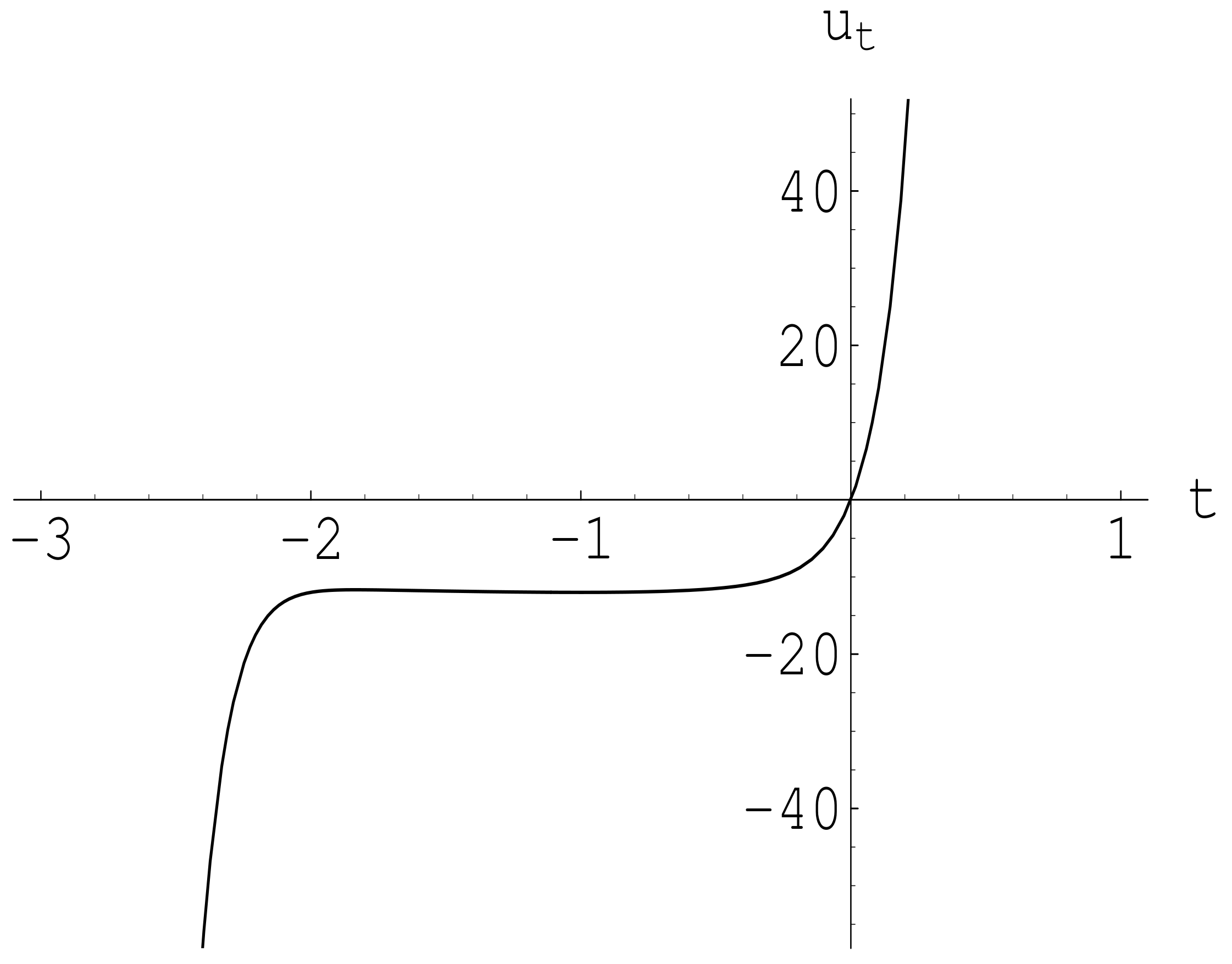
Figure 3, shows the -curve corresponding to the truncated series solution of order 12, which indicates that the values of should lie in the range 2 < < 0 .
Figure 3. The h-curve based on the 12th order approximation and α = 1 .
Table 1 shows the absolute error in approximating the solution of the fractional equation in example 3, generated by the truncated series solution u ( 10 ) = i = 0 9 u i ( x , t ) , using = 1 and α = 1 , for different values of x and t, where the exact solution in this case is
u ( x , t ) = e t + x 2 2 l n ( x ) .
Table 1. Absolute error | u u ( 10 ) | corresponding to the values of the approximate solution u ( 10 ) of example 3 with = 1 , α = 1 .
Let us mention that the accuracy in these results can be improved by increasing the order of the truncated series solution. On the other hand Table 2, Table 3, Table 4, Table 5, Table 6 and Table 7 show the approximate solutions generated by an mth order truncated series, u ( m ) , for several values of m, with = 1 , using different values of α = 0.5 , t = 0.2 and x.
Table 2. Approximate solutions of Problem (71) generated by u ( m ) , at α = 0.5 and t = 0.2 , with different values of x and m.
Table 3. Approximate solutions of Problem (71) generated by u ( m ) , at α = 0.75 and t = 0.2 , with different values of x and m.
Table 4. Approximate solutions of Problem (71) generated by u ( m ) , at α = 0.35 and t = 0.2 , with different values of x and m.
Table 5. Approximate solutions of Problem (71) generated by u ( m ) , at α = 0.5 and x = 0.2 , with different values of t and m.
Table 6. Approximate solutions of Problem (71) generated by u ( m ) , at α = 0.75 and x = 0.2 , with different values of t and m.
Table 7. Approximate solutions of Problem (71) generated by u ( m ) , at α = 0.35 and x = 0.2 , with different values of t and m.
In view of the numerical results presented in Table 2, Table 3, Table 4, Table 5, Table 6 and Table 7, it is noticed that when the value of α is decreased and the value of t is increased, higher order truncated series solutions are required to obtain the desired accuracy.

7. Conclusions

Some results concerning whether the non-local initial-boundary value problem for a fractional order parabolic equation is well posed are obtained. The homotopy analysis method is applied to obtain some numerical results. A set of examples is provided to illustrate the efficiency of the HAM in solving some non-local time-fractional order initial-boundary value problems.

Author Contributions

Investigation, S.M.; Methodology, S.O.; Software, S.O.; Supervision, S.M.; Writing—original draft, S.M.; Writing—review and editing, S.O. Both authors have contributed equally to this paper.

Funding

This research was funded by the Deanship of Scientific Research at King Saud University grant number RGP-117.

Acknowledgments

The authors would like to extend their sincere appreciation to the Deanship of Scientific Research at King Saud University for its funding of this research through the Research Group Project number RGP-117.

Conflicts of Interest

The authors declare no conflict of interest.

References

  1. Tuan, N.H.; Ngoc, T.B.; Tatar, S.; Long, L.D. Recovery of the solute concentration and dispersion flux in an inhomogeneous time fractional diffusion equation. J. Comput. Appl. Math. 2018, 342, 96–118. [Google Scholar] [CrossRef]
  2. Wei, T.; Li, Y.S. Identifying a diffusion coefficient in a time-fractional diffusion equation. Math. Comput. Simul. 2018, 151, 77–95. [Google Scholar] [CrossRef]
  3. Widder, D.V. The Heat Equation; Academic Press: New York, NY, USA, 1975. [Google Scholar]
  4. Gorenflo, R.; Mainardi, F.; Moretti, D.; Paradisi, P. Time fractional diffusion: A discrete random walk approach. Nonlinear Dyn. 2002, 29, 129–143. [Google Scholar] [CrossRef]
  5. Kilbas, A.A.; Srivastava, H.; Trujillo, J.J. Theory and Applications of Fractional Differential Equations; Elsevier: Amsterdam, The Netherlands, 2006. [Google Scholar]
  6. Bagley, R.L.; Torvik, P.J. A theoretical basis for the application of fractional calculus toviscoelasticity. J. Rheol. 1983, 27, 201–210. [Google Scholar] [CrossRef]
  7. Sorrentinos, G. Fractional derivative linear models for describing the viscoelastic dynamic behaviorof polymeric beams. In Proceedings of the IMAS, Saint Louis, MO, USA, 30 January–2 February 2006. [Google Scholar]
  8. Mainardi, F. Fractional Calculus and Waves in linear Viscoelasticity: An Introduction to Mathematical Models; World Scientific: Singapore, 2010. [Google Scholar]
  9. Goloviznin, V.M.; Kisilev, V.P.; Korotkin, I.A.; Yurkov, Y.I. Direct Problems of Nonclassical Radionuclide Transfer in Geological Formations. Izv. Ross. Akad. Nauk Energ. 2004, 4, 121–130. [Google Scholar]
  10. Chukbar, K.V. The Stochastic Transfer and Fractional Derivatives. Zh. Eksp. Teor. Fiz. 1995, 108, 1875–1884. [Google Scholar]
  11. Advances in Fractional Calculus: Theoretical Developments and Applications in Physics and Engineering; Sabatier, J., Agrawal, O.P., Machado, J.A.T., Eds.; Springer: Dordrecht, The Netherlands, 2007. [Google Scholar]
  12. Benchohra, M.; Hamani, S.; Ntouyas, S.K. Boundary value problems for differential equations with fractional order and nonlocal conditions. Nonlinear Anal. 2009, 71, 2391–2396. [Google Scholar] [CrossRef]
  13. Lazarević, M.P.; Spasić, A.M. Finite-time stability analysis of fractional order time-delay systems: Gronwall’s approach. Math. Comput. Model. 2009, 49, 475–481. [Google Scholar] [CrossRef]
  14. Nieto, J.J. Maximum principles for fractional differential equations derived from Mittag–Leffler functions. Appl. Math. Lett. 2010, 23, 1248–1251. [Google Scholar] [CrossRef]
  15. Zhang, S.Q. Positive solutions to singular boundary value problem for nonlinear fractional differential equation. Comput. Math. Appl. 2010, 59, 1300–1309. [Google Scholar] [CrossRef]
  16. Mesloub, S.; Aldosari, F. Even Higher Order Fractional Initial Boundary Value Problem with Nonlocal Constraints of Purely Integral Type. Symmetry 2019, 11, 305. [Google Scholar] [CrossRef]
  17. Akilandeeswari, A.; Balachandran, K.; Annapoorani, N. Solvability of hyperbolic fractional partial differential equations. J. Appl. Anal. Comput. 2017, 7, 1570–1585. [Google Scholar]
  18. Alikhanov, A.A. A Priori Estimates for Solutions of Boundary Value Problems for Fractional-Order Equations. arXiv 2011, arXiv:1105.4592v1. [Google Scholar] [CrossRef]
  19. Mesloub, S. Existence and uniqueness results for a fractional two-times evolution problem with constraints of purely integral type. Math. Methods Appl. Sci. 2016, 39, 1558–1567. [Google Scholar] [CrossRef]
  20. Liao, S.J. The Proposed Homotopy Analysis Techniques for the Solution of Nonlinear Problems. Ph.D. Thesis, Shanghai Jiao Tong University, Shanghai, China, 1992. (In English). [Google Scholar]
  21. Jafari, H.; Seifi, S. Homotopy Analysis Method for solving Linear and Nonlinear Fractional Diffusion-Wave Eequation. Commun. Nonlinear Sci. Numer. Simul. 2009, 14, 2006–2012. [Google Scholar] [CrossRef]
  22. Chowdhury, M.S.H.; Hashim, I.; Abdulaziz, O. Comparison of homotopy analysis method and homotopy-petrubation method for purely nonlinear fin-type problems. Commun. Nonlinear Sci. Numer. Simul. 2009, 14, 371–378. [Google Scholar] [CrossRef]
  23. Liao, S.J. Beyond Perturbation, Introduction to the Homotopy Analysis Method; Chapman and Hall CRC: Boca Raton, FL, USA, 2004. [Google Scholar]
  24. Liao, S.J. On the homotopy analysis method for nonlinear problems. Appl. Math. Comput. 2004, 147, 499–513. [Google Scholar] [CrossRef]
  25. Li, X.; Xu, C. A Space-Time Spectral Method for the Time Fractional Diffusion Equation. SIAM J. Numer. Anal. 2009, 47, 2108–2131. [Google Scholar] [CrossRef]
  26. Liu, F.; Anh, V.; Turner, I.; Zhuang, P. Time fractional advection dispersion equation. J. Appl. Math. Comput. 2003, 13, 233–245. [Google Scholar] [CrossRef]
  27. Baleanu, D.; Mustafa, O.G. On the global existence of solutions to a class of fractional di erential equations. Comput. Math. Appl. 2010, 59, 1835–1841. [Google Scholar] [CrossRef]
  28. Baleanu, D.; Mustafa, O.G.; Agarwal, R.P. An existence result for a superlinear fractional di erential equation. Appl. Math. Lett. 2010, 23, 1129–1132. [Google Scholar] [CrossRef]
  29. Zhu, T. Existence and uniqueness of positive solutions for fractional differential equations. Bound. Value Probl. 2019, 2019, 22. [Google Scholar] [CrossRef]
  30. Peiguo, Z.; Xinan, H.; Lishan, L. Existence and uniqueness of the global solution for a class of nonlinear fractional integro-differential equations in a Banach space. Adv. Differ. Equ. 2019, 2019, 135. [Google Scholar]
  31. Podlubny, I. Fractional Differential Equations; Academic Press: Cambridge, MA, USA, 1999. [Google Scholar]
  32. Liao, S.J. Notes on the homotopy analysis method: Some definitions and theorems. Commun. Nonlinear Sci. Num. Simul. 2009, 14, 983–997. [Google Scholar] [CrossRef]
  33. Mesloub, S. A nonlinear non-local mixed problem for a second order parabolic equation. J. Math. Anal. Appl. 2006, 316, 189–209. [Google Scholar] [CrossRef]
Article Metrics

Citations

Article Access Statistics

Multiple requests from the same IP address are counted as one view.