


Abstract
Given a graph G and a set of k colors, assign an arbitrary subset of these colors to each vertex of G. If each vertex to which the empty set is assigned has all k colors in its neighborhood, then the assignment is called a k-rainbow dominating function (kRDF) of G. The minimum sum of numbers of assigned colors over all vertices of G is called the k-rainbow domination number of graph G, denoted by . In this paper, we focus on the study of the k-rainbow domination number of the Cartesian product of cycles, . For , based on the results of J. Amjadi et al. (2017), . For , we give a proof for the new lower bound of . We construct some novel and recursive kRDFs which are good enough and upon these functions we get sharp upper bounds of . Therefore, we obtain the following results: (1) ; (2) for ; (3) for or , and for . We also discuss Vizing’s conjecture on the k-rainbow domination number of .
1. Introduction
Let be an undirected graph with vertex set V and edge set E. The open neighborhood of a vertex v consists of the vertices adjacent to v. The degree of a vertex is . The minimum and maximum degree of a graph G are denoted by and respectively.
The k-rainbow domination problem is to determine the k-rainbow domination number of G. This problem can be described as the following: k-rainbow domination represents a situation in which there are k types of guards, and it is required that each location (vertex) which is not occupied by a guard has all types of guards in its neighborhood. The k-rainbow domination has many practical applications, such as in information transfer or people allocation between company departments, network security, channel assignment, logistics scheduling, storage hierarchy optimization, and so on. Therefore, it has been extensively studied [1,2].
Let G be a graph, and f be a mapping from to the power set of , i.e., . If for each vertex with , then f is called a k-rainbow dominating function (kRDF) of G. The weight of f is , denotes the number of elements in . The minimum weight of a kRDF of G is called the k-rainbow domination number of G, denoted by .
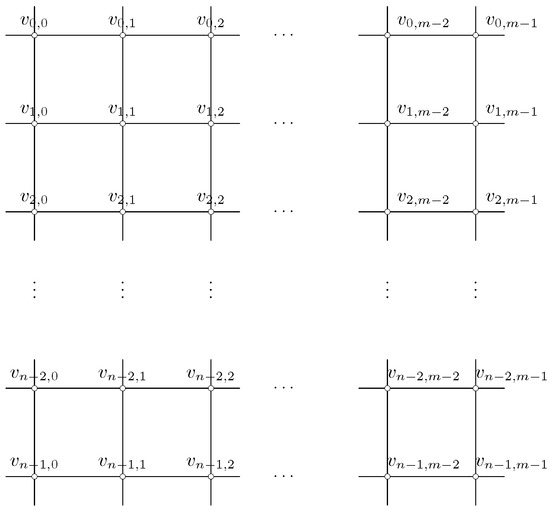
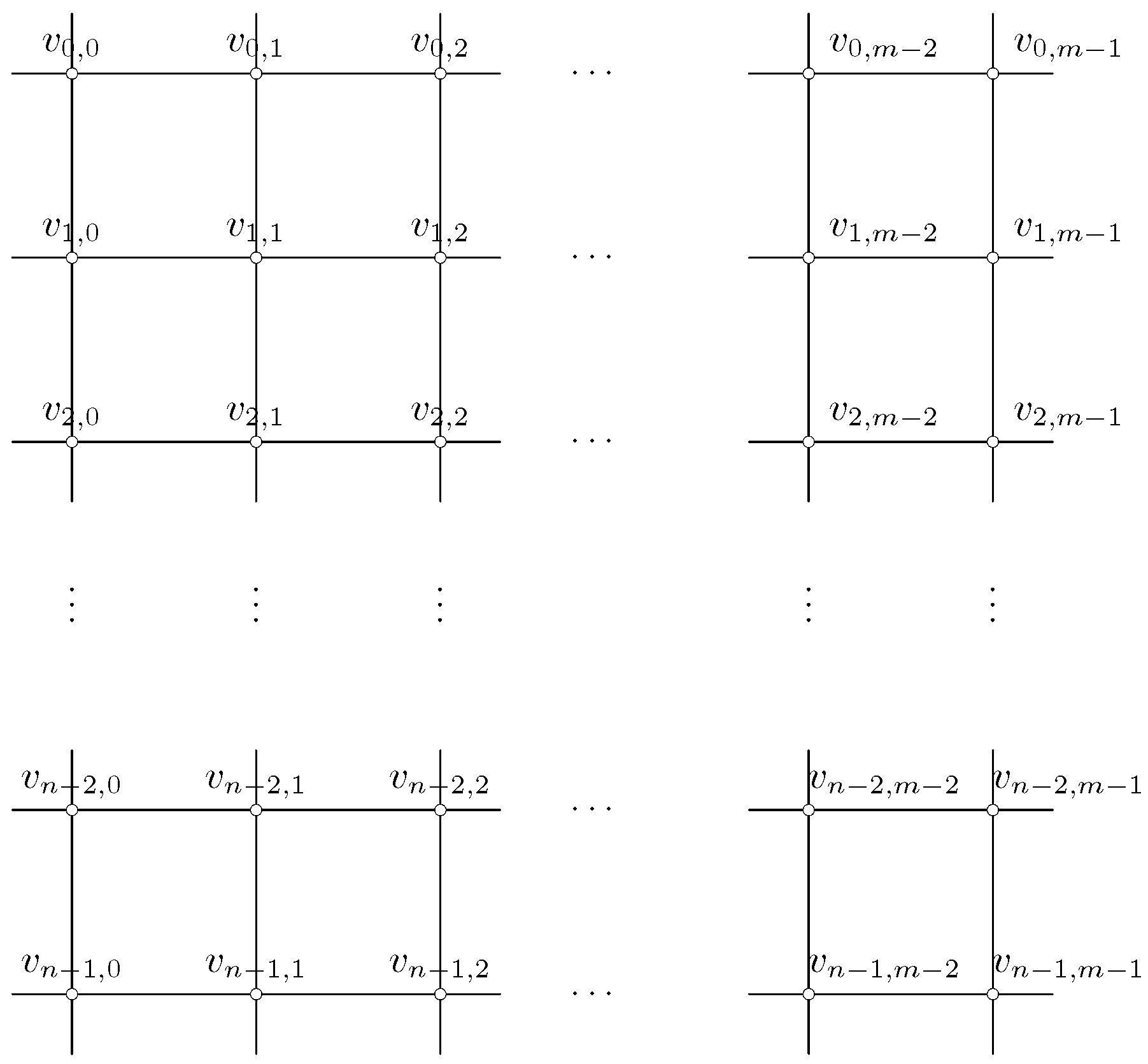
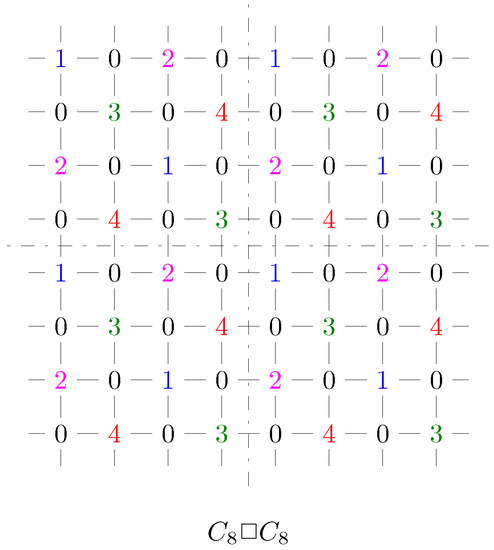
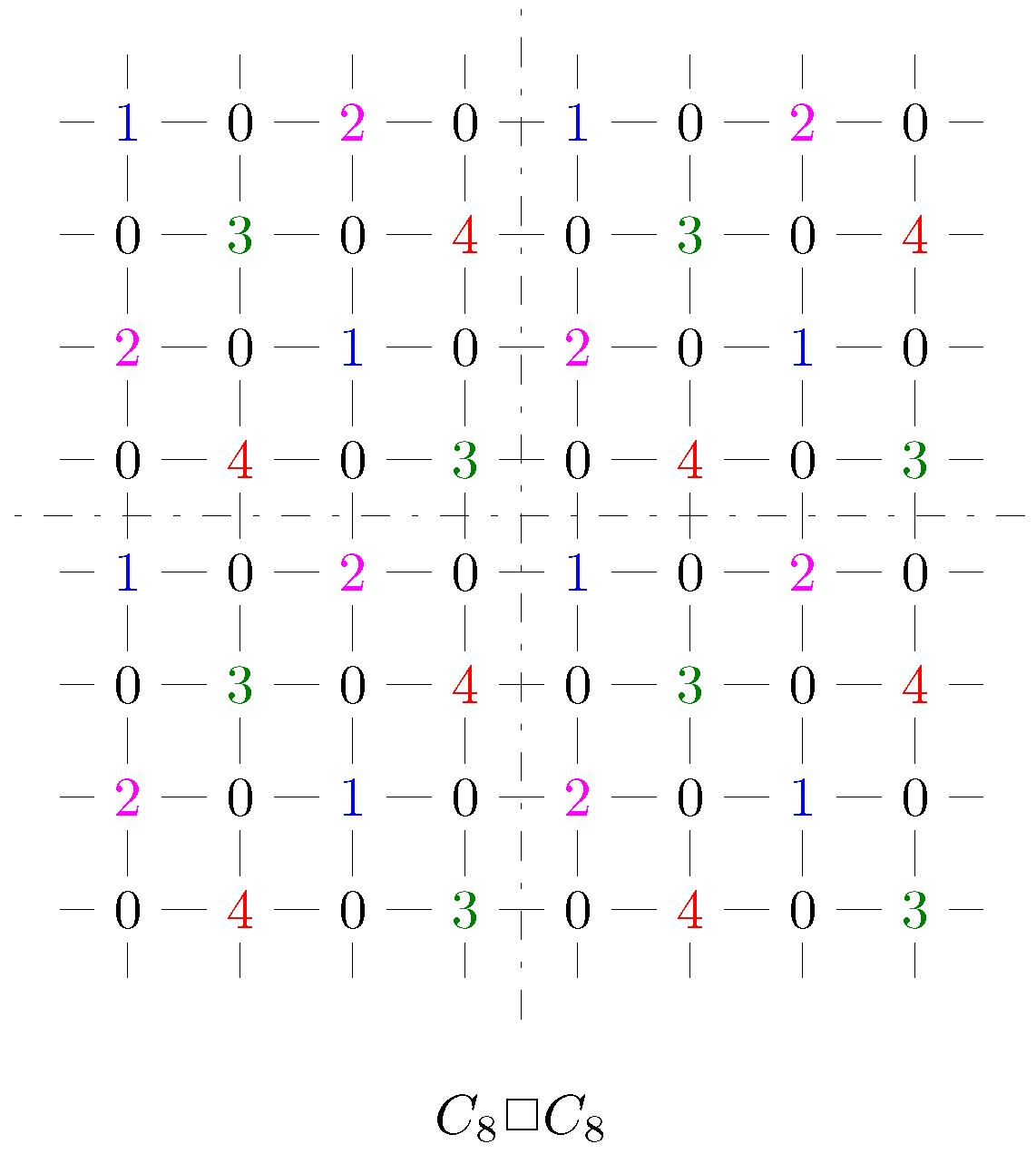
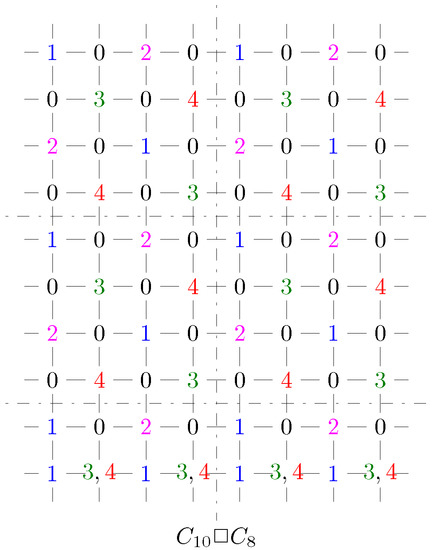
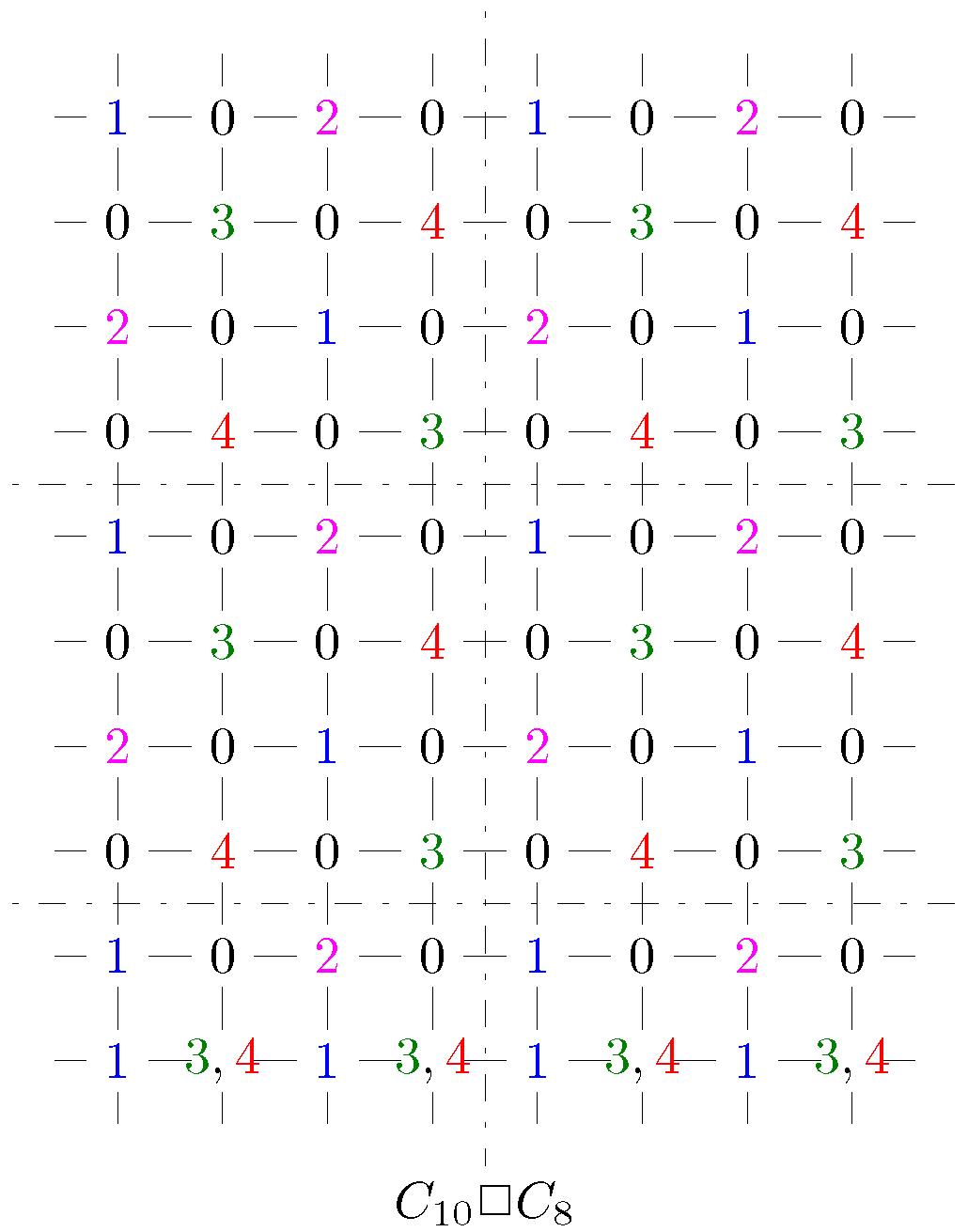
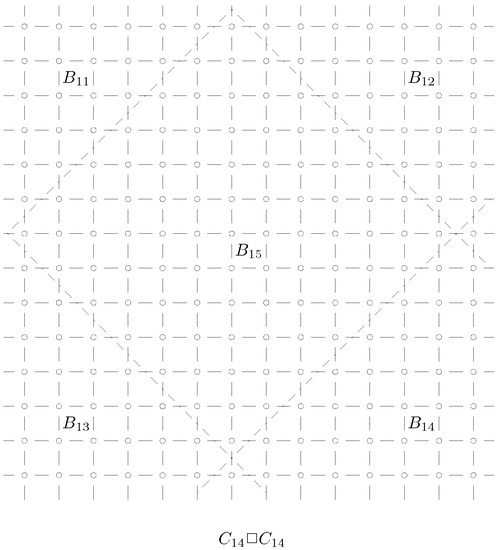
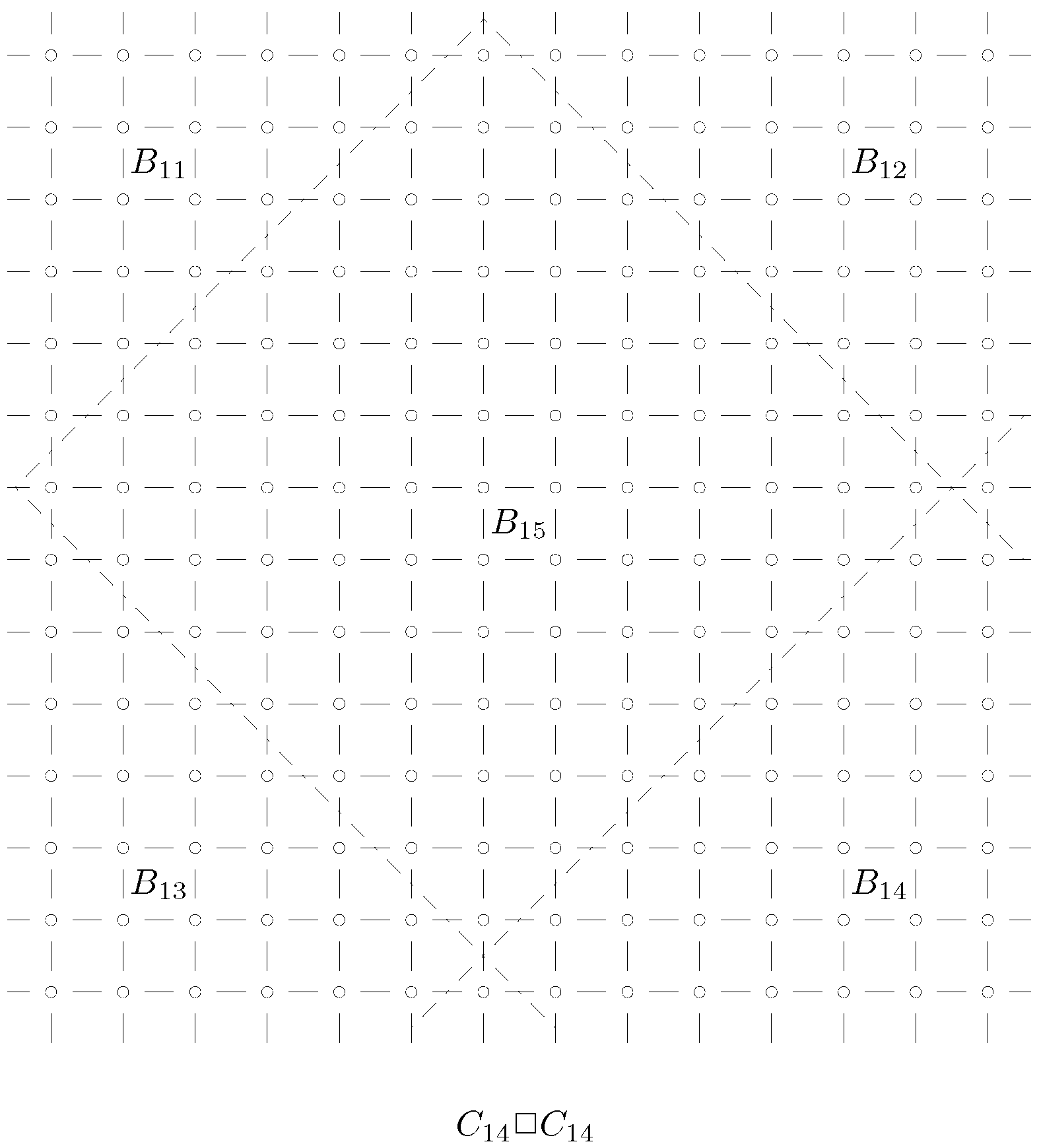
, the Cartesian product of graphs G and H, is the graph with vertex set , where two vertices are adjacent if and only if they are equal in one coordinate and adjacent in the other. Let with and , where indices i and j are read modulo n and m respectively. Figure 1 shows the graph of . The problem of domination on Cartesian product graphs was first initiated by Vizing [3]. Since then, various domination numbers of are extensively studied [4,5,6].
Figure 1.
Graph .
The concept of k-rainbow domination is introduced by Brešar et al. [1], and they determine the exact values of 2-rainbow domination numbers of paths, cycles, Suns, etc. [7]. Since then, many scholars have begun to pay attention to and studied this parameter. There are many results on 2-rainbow domination. Stepień et al. present the exact values of [8], [9], and [10] for , . Shao Zehui et al. [11] determined the exact values of and . Shao Zehui et al. [12] studied the 2-rainbow domination number of the generalized Petersen graphs and prove for , for , and for . Wang Yueli et al. [13] propose a tight upper bound for when . Liu Jiajie et al. [14] determine , , and , where , , and are Sierpiński graphs and extended Sierpiński graphs.
The problem of k-rainbow domination will be more complex with k becoming bigger. The relative studies on k-rainbow domination for are not as numerous as 2-rainbow domination. Michitaka Furuya et al. [15] prove that for every connected graph G with and . Shao Zehui et al. [16] investigate the 3-rainbow domination number of cycles, paths and the generalized Petersen graphs. They determine the exact values of , and present the upper bounds of , . Gerard J. Chang et al. [17] prove the k-rainbow domination problem is NP-complete, and for a given tree T, they determine the smallest k such that . Hao Guoliang et al. [18] study the k-rainbow domination number of directed graphs and determine the exact value of in the Cartesian product of directed cycles for . Kang Qiong et al. [19] initiate the study of outer-independent k-rainbow domination and they present some bounds for the outer-independent 2-rainbow domination number. Simon Brezovnik et al. [20] present some bounds on the k-rainbow independent domination number of the lexicographic product and give the exact values of the 2-rainbow independent domination number of the lexicographic product. J. Amjadi et al. [21] show the lower bounds on the k-rainbow domination number for any graphs and they present for .
In this paper, we focus on the study of the k-rainbow domination number of . Thank to J. Amjadi et al. [21] giving the lower bounds on the k-rainbow domination number for any graphs, we get the lower bounds of and the exact values of for .
Theorem 1.
([21]) Let k be a positive integer, and let G be a graph of order n, then
Corollary 1.
([21]) Let k be a positive integer, and let G be a graph of order n. If , then .
Since , by Corollary 1, it has
Corollary 2.
For ,
In this paper, we provide a proof for the new lower bound on the 4-rainbow domination number of . We construct some recursive kRDFs and upon these functions we obtain sharp upper bounds on the 4-rainbow domination number of . We determine the exact values and for . We present some bounds of for or . At last, we discuss Vizing’s conjecture on the k-rainbow domination number of .
2. 4-Rainbow Domination Number of Graph
2.1. Lower Bounds on the 4-Rainbow Domination Number of Graph
Lemma 1.
For a graph ,
Proof.
In , the order is , . Since , then . By Theorem 1, we can obtain the lower bound of is . □
For some special graphs, the lower bound of can be higher than . Next, we will prove the lower bound of can be improved to instead of .
Let f be a 4RDF on , we denote , and .
Lemma 2.
For , if there exists i such that , then or , where indices are read modulo n.
Proof.
If , i.e., , then by the definition of 4RDF, it follows
So, or . □
Lemma 3.
For , if there exists i such that , then or , where indices are read modulo n.
Proof.
If , without loss of generality, we let , then by the definition of 4RDF, it follows
So, or . □
Lemma 4.
Let , then .
Proof.
For we divide into by the following steps.
Step 0. Let and let for up to .
Step 1. For every i with do:
- ; ; ;
- if , then ; ;
- if , then ; ;
- if , then ; ;
- if , then ; ;
- It follows . Let .
By Lemma 2, by now, for every row with , , and , .
Step 2. For every i with do:
- ; ; ;
- if , then ; ;
- if , then ; .
- It has . Let .
Step 3. For every i with do:
- ; ; ;
- if , then ; .
- It follows . Let .
By Lemma 2 and 3, by now, for all .
Step 4. For every i with do:
- ; ; .
- It has .
Thus, , that is . □
2.2. Upper Bounds on the 4-Rainbow Domination Number of Graph
Lemma 5.
For , ,
Proof.
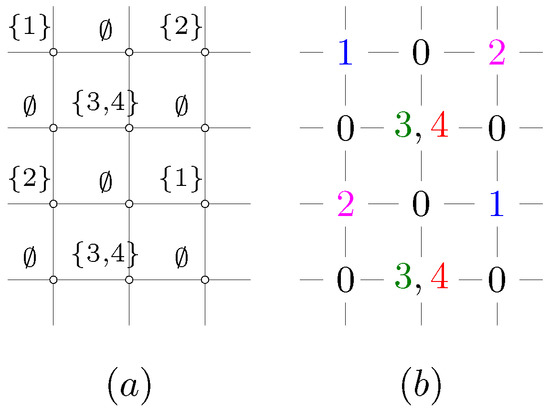
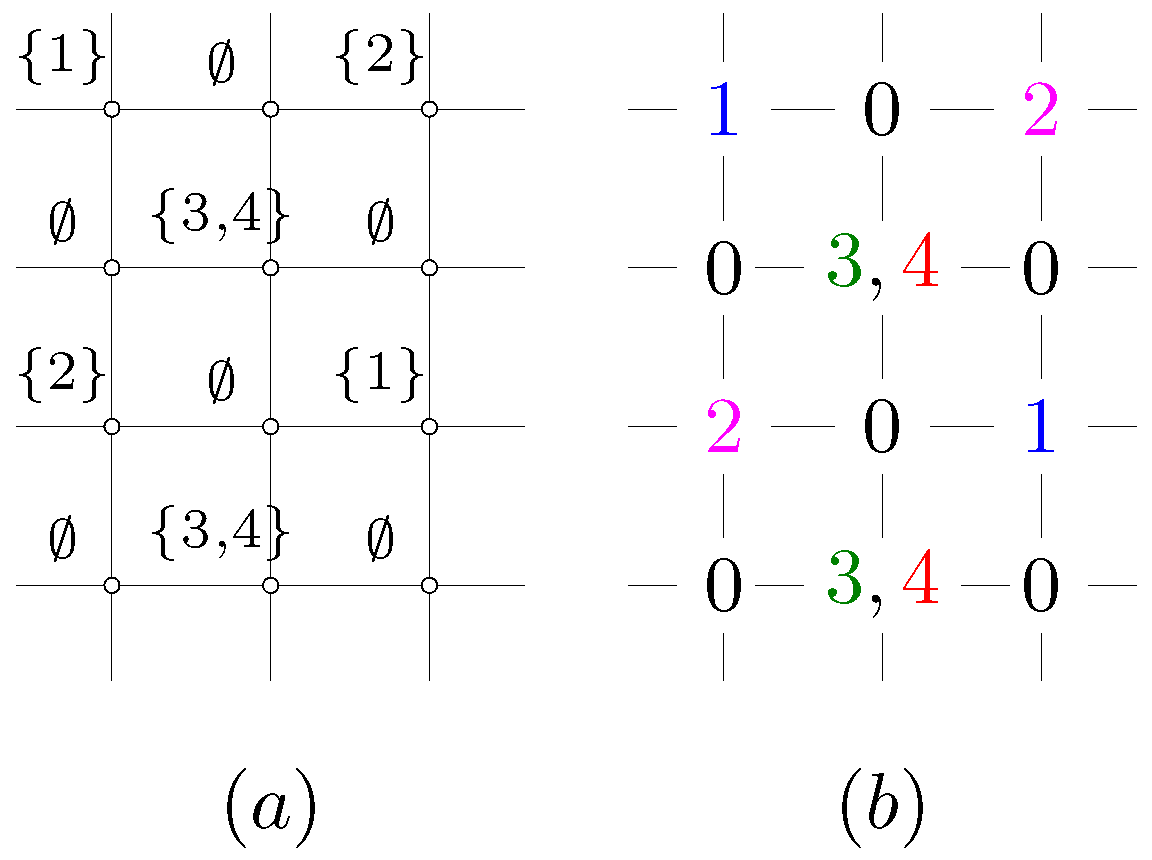
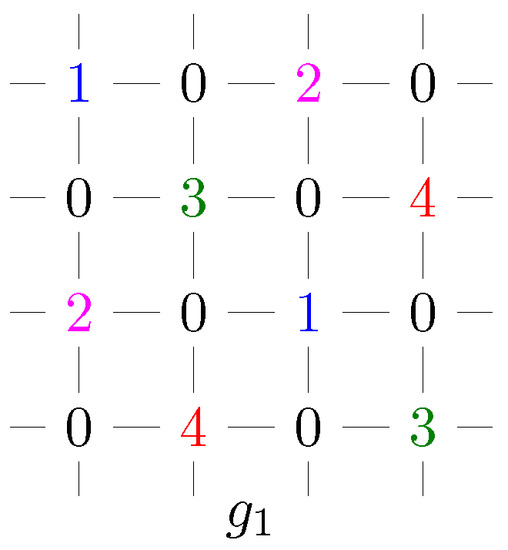
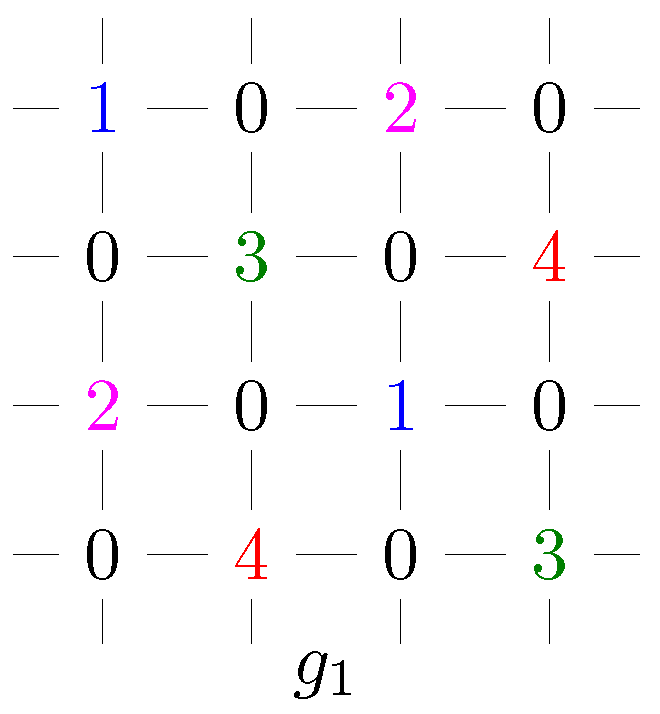
First, we define a function g on as follows.
Figure 2a shows g on . For convenience, we use to encode the color sets , and use to encode the color sets , , ⋯, . We use Figure 2b to show a function on a graph in the rest of this paper.
Figure 2.
The g for . (a) Vertex labelled with color sets. (b) Vertex labelled with codes.
Then, we construct a function f as follows.
Figure 3.
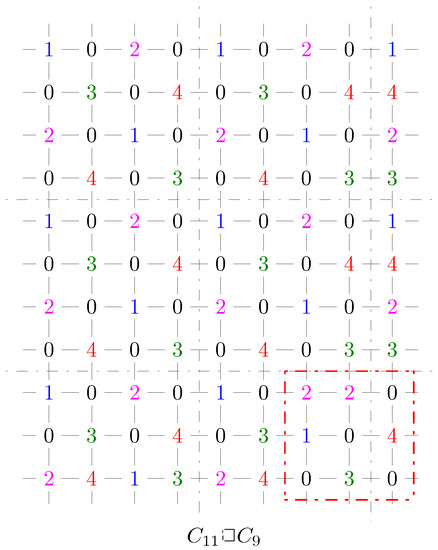
f on , , , .
For , by symmetry of , we construct 4RDFs in the following cases:
- (1)
- m, n are evens and , (Lemma 6).
- (2)
- m, n are evens and , (Lemma 7).
- (3)
- m, n are evens and , (Lemma 8).
- (4)
- m, n are odds and , (Lemma 9).
- (5)
- m, n are odds and , (Lemma 10).
- (6)
- m, n are odds and , (Lemma 9).
- (7)
- m is odd, n is even and , (Lemma 11).
- (8)
- m is odd, n is even and , (Lemma 12).
Lemma 6.
For , , .
Proof.
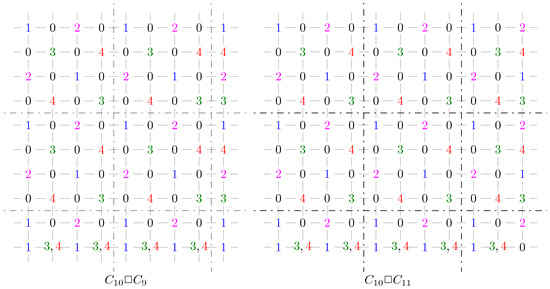
We first define a 4RDF on , and Figure 4 shows the function.
Figure 4.
The for .
Then, we construct a recursive 4RDF f on ,
Figure 5 shows f on . The weight . Thus, . □
Figure 5.
f on .
Lemma 7.
For , , .
Proof.
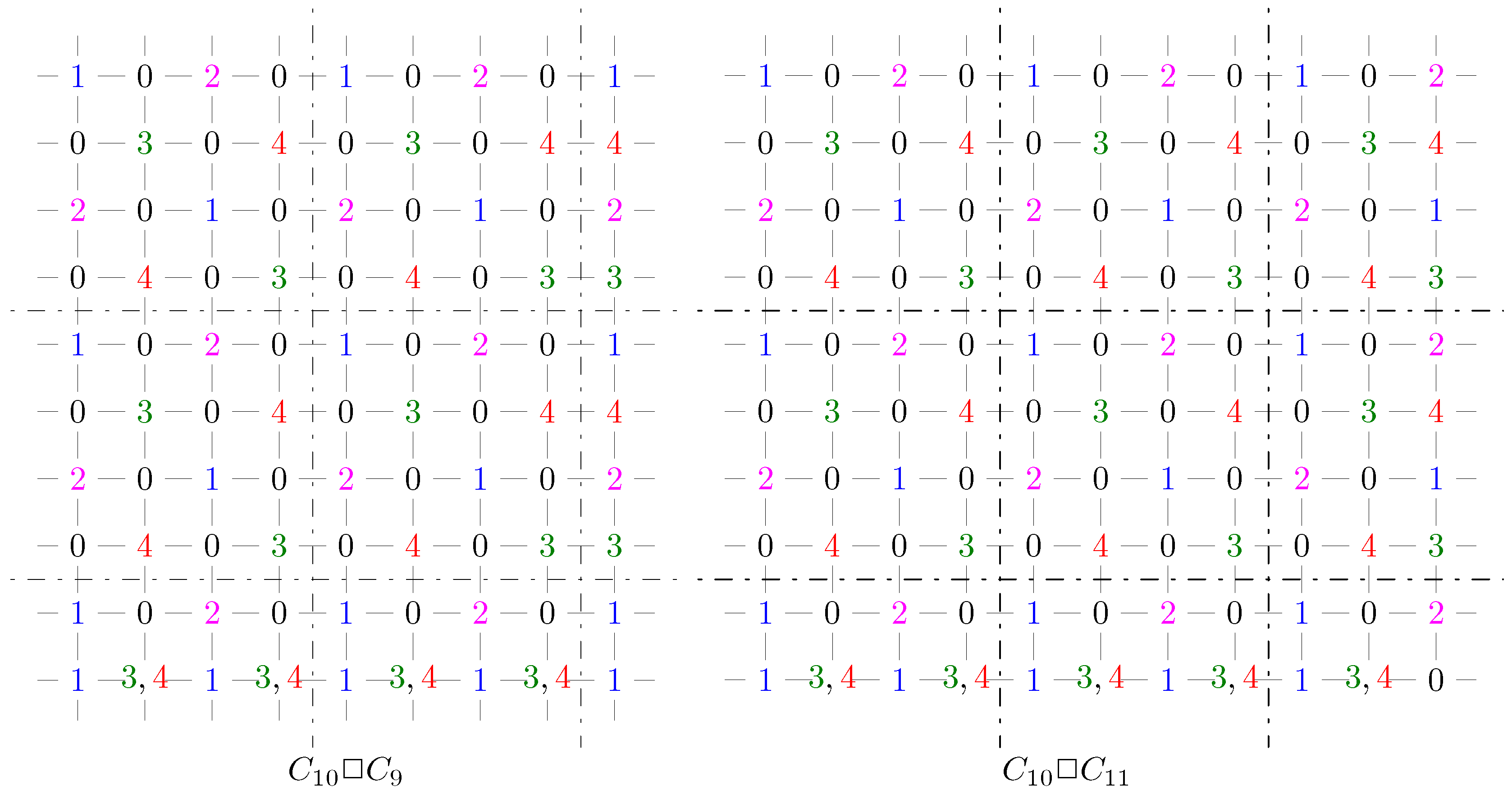
Figure 6 shows f on . The weight . Hence, . □
Figure 6.
f on .
Lemma 8.
For , ,
Proof.
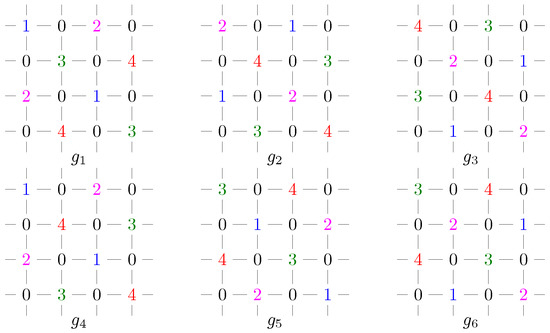
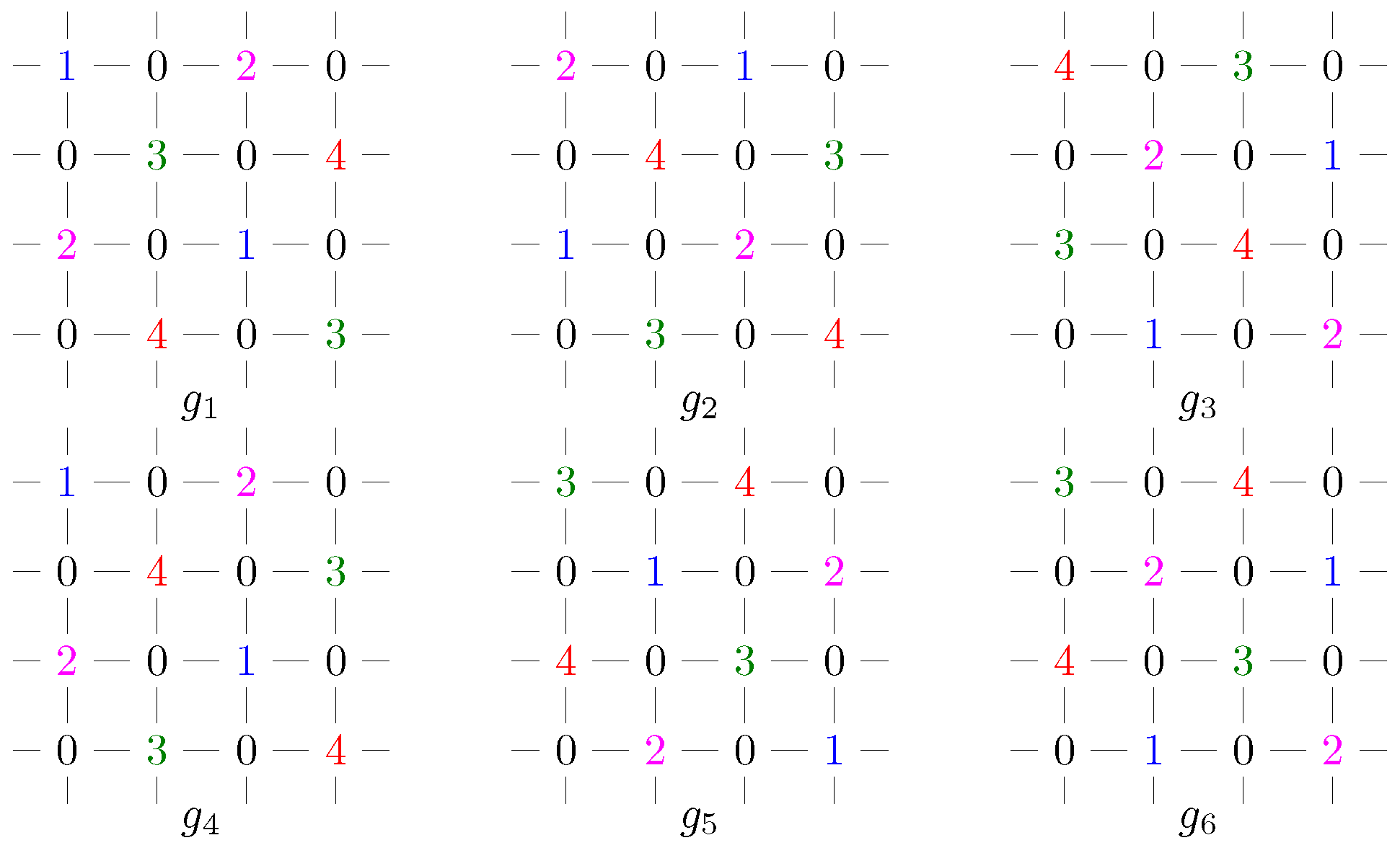
Figure 7.
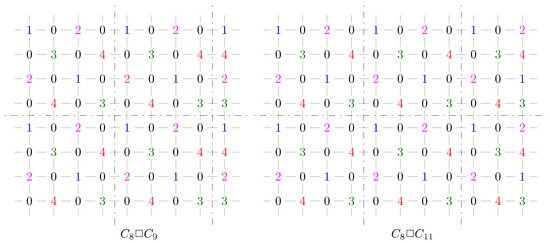
Six different functions on .
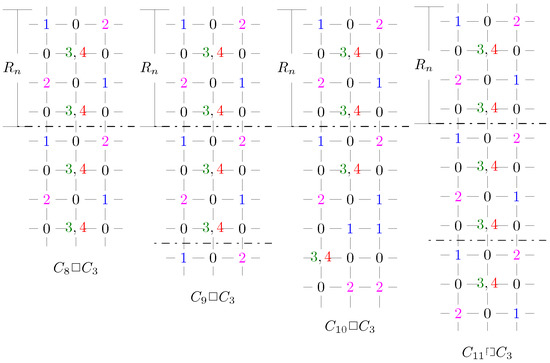
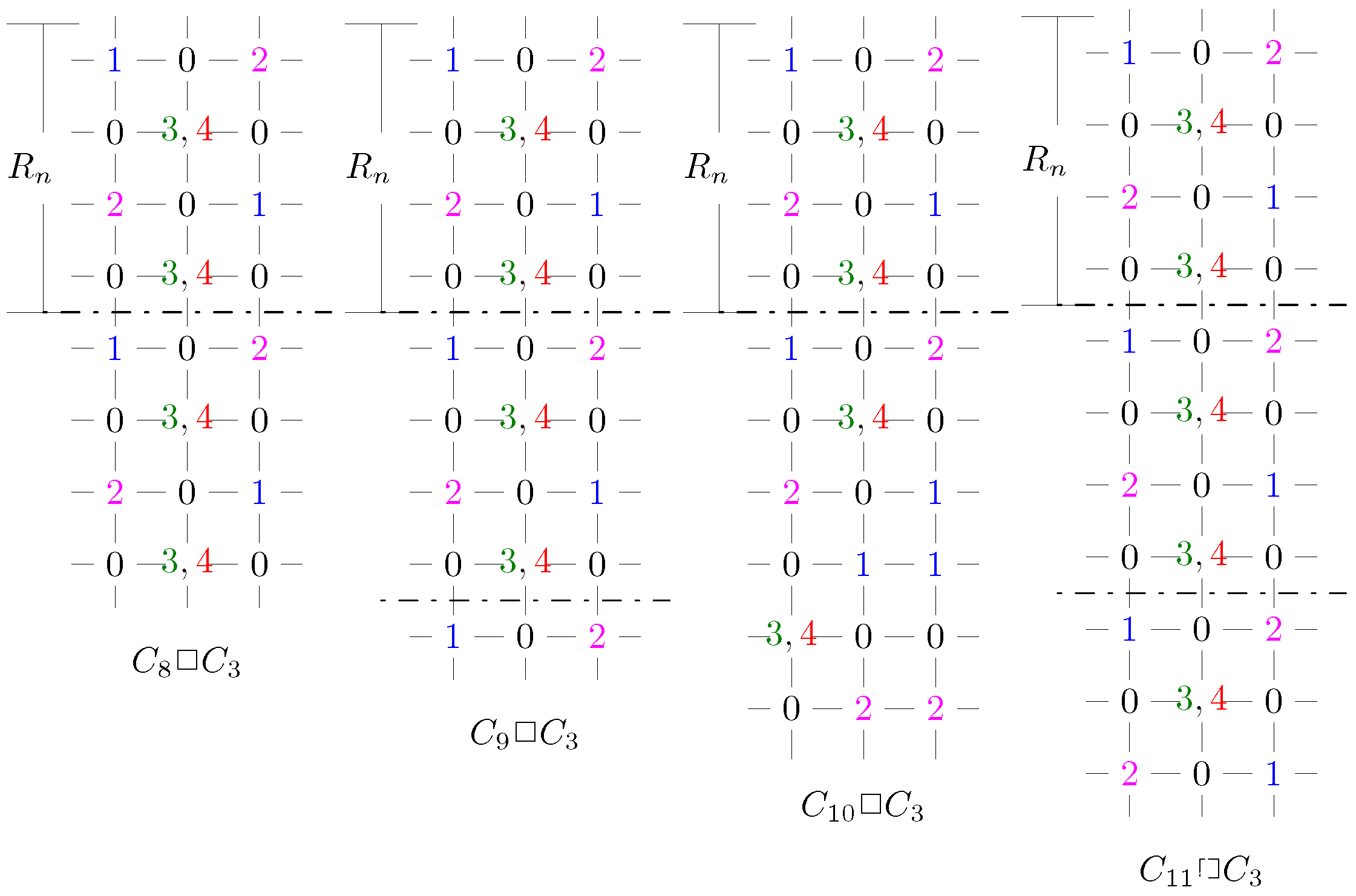
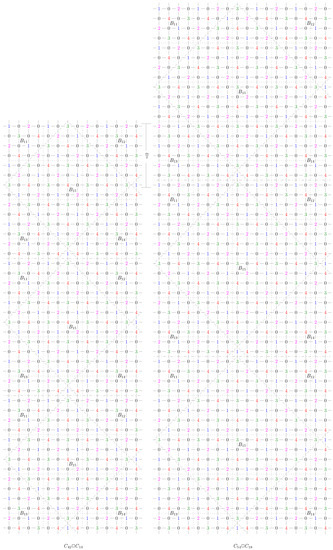
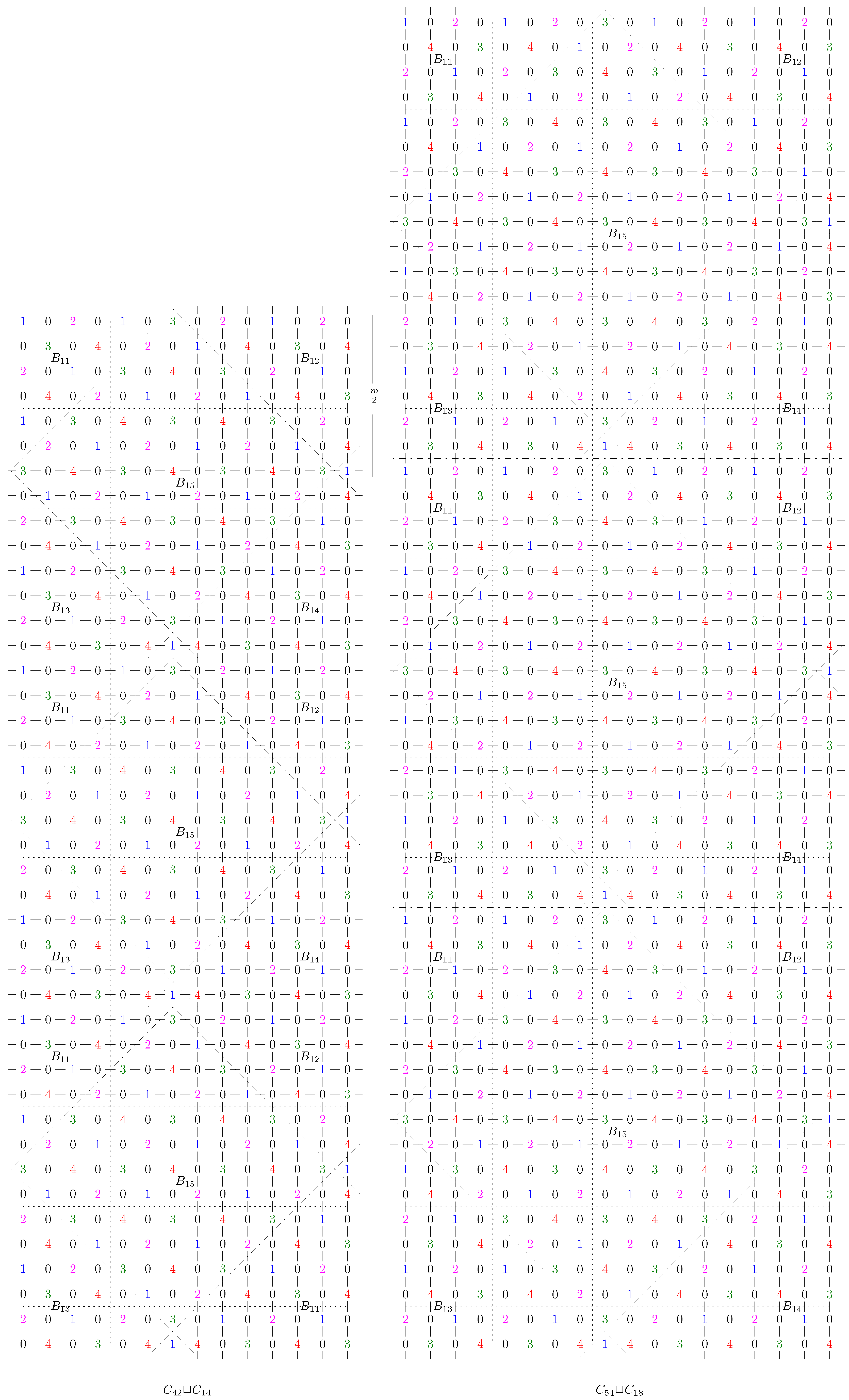
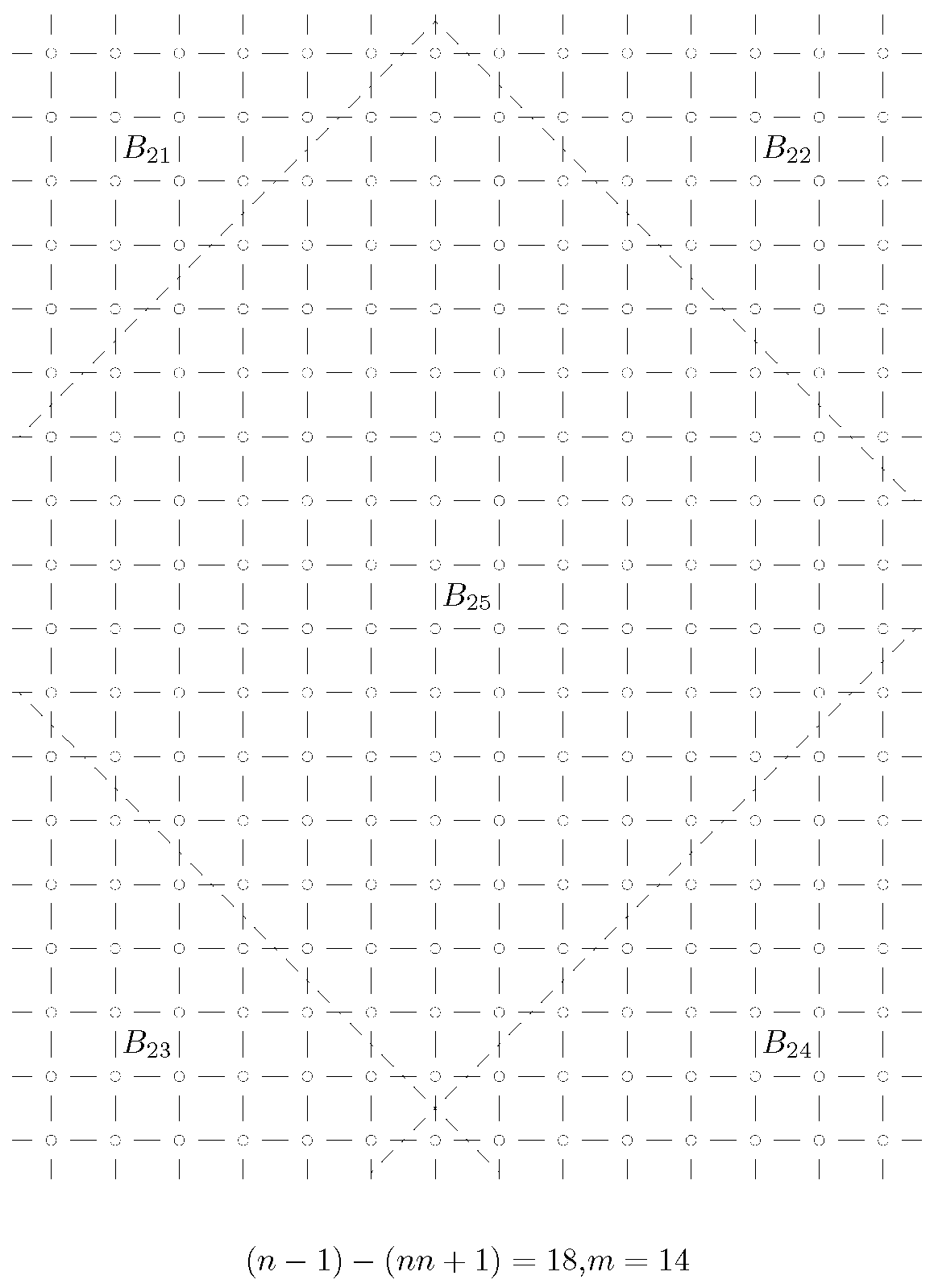
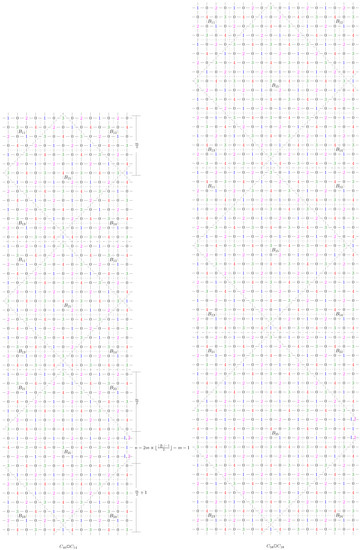
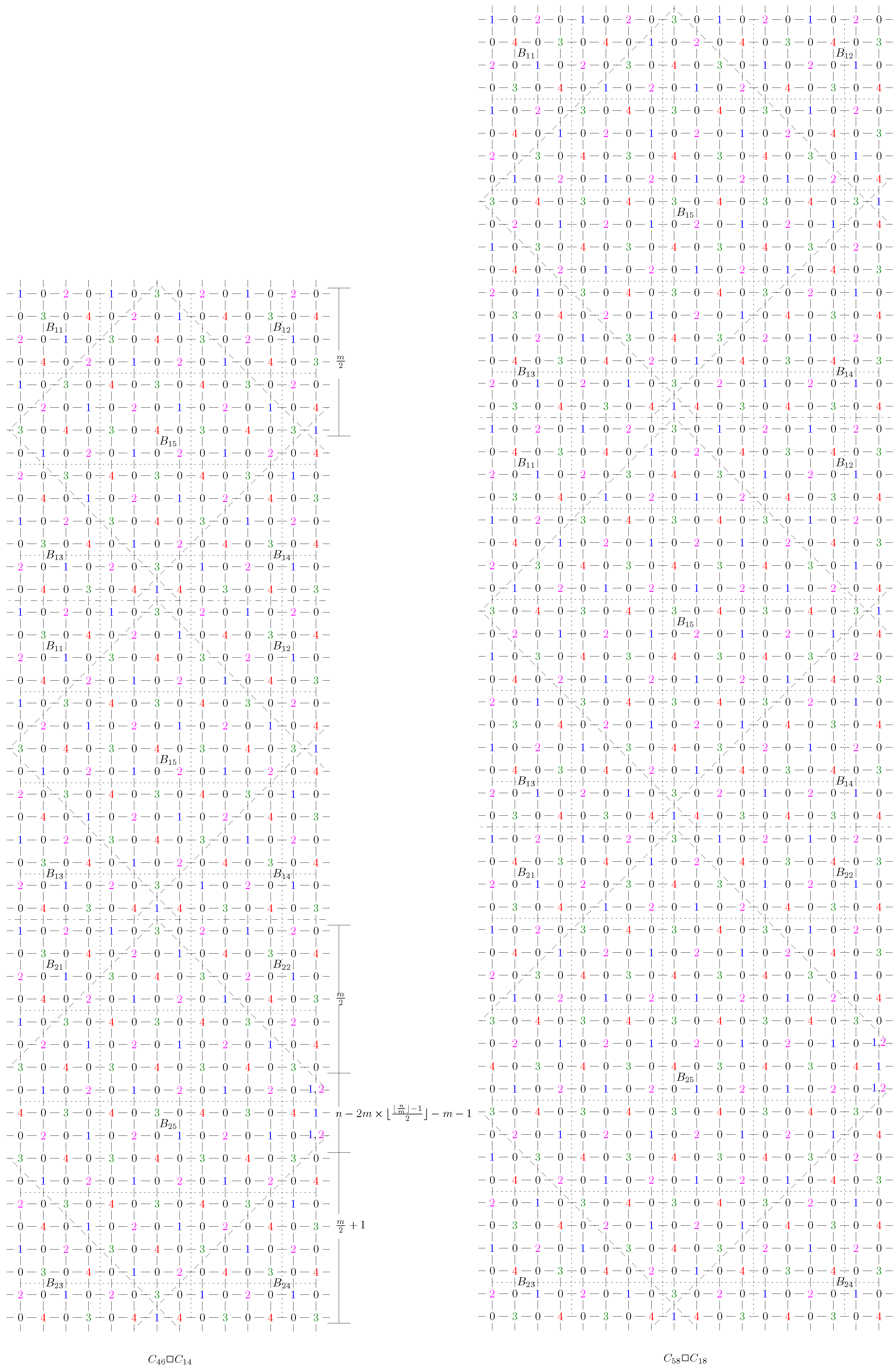
Then, we design a novel partition, , on . The blocks are defined as the following (shown in Figure 8).
Figure 8.
Partition on .
Now, we construct and on .
For ,
For ,
Case 1. For , we construct f on as follows.
Figure 9.
Function f on and .
Case 2. For , we design two kinds of partition, and . The former is defined as shown in Figure 8, and the later is defined on the lines from to as shown in Figure 10, where .
Figure 10.
Partition on the last lines.
We construct functions h and on the lines from to .
For ,
For ,
Now, we construct f on .
,
,
Figure 11.
Function f on and .
Hence, for . □
Lemma 9.
For , .
Proof.
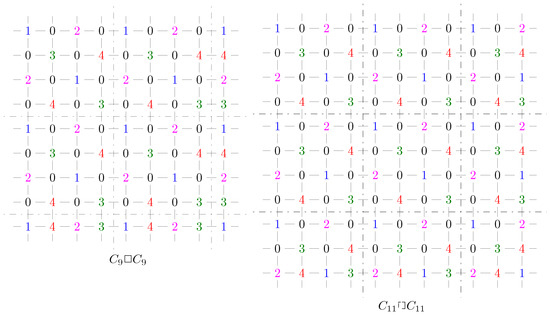
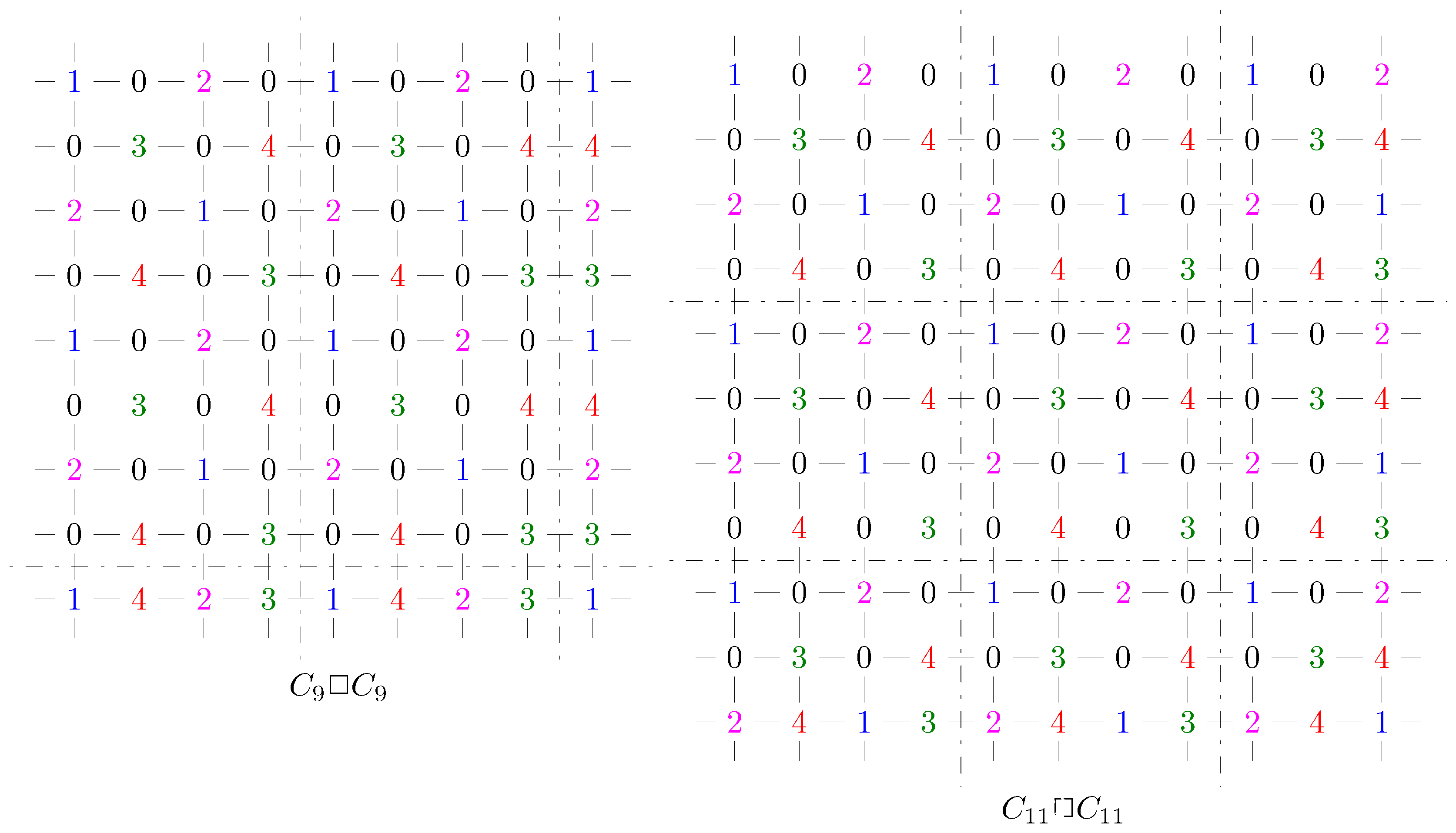
Figure 12 shows f on and . The weight . Hence, . □
Figure 12.
f on and .
Lemma 10.
For , , .
Proof.
Figure 13.
Function f on .
Lemma 11.
For , , .
Proof.
Figure 14.
f on , .
Lemma 12.
For , ,
2.3. The Values and Bounds of
By Lemma 4 and Lemma 5, we can get the exact values of .
Theorem 2.
For any integer , .
By Lemma 1 and Lemma 6, we have
Theorem 3.
For , and , , .
By Lemmas 1 and 7–12, we have
Theorem 4.
For , and or ,
3. The k-Rainbow Domination Number of Graph
Lemma 13.
For ,
Proof.
Since , then , by Theorem 1, . □
Next, we will present upper bounds on the k-rainbow domination number of graph . Let denotes the number of vertex containing color t . Based on 4RDFs, we can construct kRDFs for . The main idea is: (1) Find , where , , , . (2) Replace color with colors . Then, we can get upper bounds of .
Lemma 14.
For , ,
Proof.
By the 4RDF f we construct for in Lemma 5 (see Figure 3), we can count:
, ,
, , ,
, , ,
, , .
Then,
Thus,
□
Lemma 15.
For , , and , .
Proof.
By the 4RDF f in Lemma 6 (see Figure 5), . Thus, . □
Lemma 16.
For , or and , .
Proof.
(1) For , , by f in Lemma 7 (see Figure 6), , thus .
For , . Thus
.
For , . Thus
(3) For , by f in Lemma 9 (see Figure 12).
For , , .
Thus,
For , , .
Thus,
(4) For , , by f in Lemma 10 (see Figure 13), , thus .
(5) For , , by f in Lemma 11 (see Figure 14), , .
To sum up, for or and , . □
By Lemma 13 and Lemma 15, we have the following Theorem.
Theorem 5.
For , , and ,
By Lemma 13 and Lemma 14, we have
Theorem 6.
For , ,
By Lemma 13 and Lemma 16, we can get
Theorem 7.
For , or , and ,
4. Discussion on Vizing’s Conjecture
Vizing’s conjecture [3] concerns a relation between the domination number and the cartesian product of graphs. It states , where denotes the domination number of G. In this section, we check Vizing’s generalized conjecture for the k-rainbow domination number of (shown in Table 1). From Table 1, one can see is not always true.
Table 1.
Known results of k-rainbow domination number of and .
5. Conclusions
In this paper, we study the k-rainbow domination number of . We provide a proof for the new lower bound on the 4-rainbow domination number of . We construct some novel and recursive 4RDFs, and upon these functions we obtain some sharp upper bounds on the 4-rainbow domination number of . Therefore, for , we determine ; for , we determine for , ; we present the bounds of for or . Finally, we discuss Vizing’s generalized conjecture for the k-rainbow domination number of .
Author Contributions
H.G. contributes for supervision, methodology, validation, project administration and formal analysing. K.L. contributes for resource, some computations and wrote the initial draft of the paper. Y.Y. wrote the final draft.
Funding
This work is supported by the Fundamental Research Funds for the Central University, Grand No. is 3132019323.
Acknowledgments
Authors gratefully acknowledge the helpful comments and suggestions of the reviewers, which have improved the presentation. This work is supported by the Fundamental Research Funds for the Central University, Grand No. is 3132019323.
Conflicts of Interest
The authors declare no conflict of interest.
References
- Brešar, B.; Henning, M.A.; Rall, D.F. Rainbow domination in graphs. Taiwan J. Math. 2008, 12, 213–225. [Google Scholar] [CrossRef] [Scilit]
- Dehgardi, N.; Sheikholeslami, S.M.; Volkmann, L. The k-rainbow bondage number of a graph. Discret. Appl. Math. 2014, 174, 133–139. [Google Scholar]
- Vizing, V.G. Some unsolved problems in graph theory. Uspehi Mater. Nauk. 1968, 23, 117–134. [Google Scholar]
- Chen, Q.; Zhao, C.Y.; Zhao, M. Dominator colorings of certain cartesian products of paths and cycles. Graph Combinator. 2017, 33, 73–83. [Google Scholar]
- Li, Z.P.; Shao, Z.H.; Xu, J. Weak {2}-domination number of Cartesian products of cycles. J. Comb. Optim. 2018, 35, 75–85. [Google Scholar]
- Ye, A.S.; Miao, F.; Shao, Z.H.; Liu, J.B.; Žerovnik, J.; Repolusk, P. More Results on the Domination Number of Cartesian Product of Two Directed Cycles. Mathematics 2019, 7, 210. [Google Scholar] [CrossRef] [Scilit]
- Brešar, B.; Šumenjak, T.K. On the 2-rainbow domination in graphs. Discret. Appl. Math. 2007, 155, 2397–2400. [Google Scholar]
- Stepień, Z.; Zwierzchowski, M. 2-rainbow domination number of cartesian products: Cn□C3 and Cn□C5. J. Comb. Optim. 2014, 28, 748–755. [Google Scholar] [CrossRef] [Scilit]
- Stepień, Z.; Szymaszkiewicz, A.; Szymaszkiewicz, L.; Zwierzchowski, M. 2-Rainbow domination number of Cn□C5. Discret. Appl. Math. 2014, 170, 113–116. [Google Scholar] [CrossRef] [Scilit]
- Stepień, Z.; Szymaszkiewicz, L.; Zwierzchowski, M. The Cartesian product of cycles with small 2-rainbow domination number. J. Comb. Optim. 2015, 30, 668–674. [Google Scholar] [CrossRef] [Scilit]
- Shao, Z.H.; Li, Z.P.; Erveš, R.; Žerovnik, J. The 2-Rainbow domination numbers of C4□Cn and C8□Cn. Natl. Acad. Sci. Lett. 2019, 2, 1–8. [Google Scholar]
- Shao, Z.H.; Jiang, H.Q.; Wu, P.; Wang, S.H.; Žerovnik, J.; Zhang, X.S.; Liu, J.B. On 2-rainbow domination of generalized Petersen graphs. Discret. Appl. Math. 2019, 257, 370–384. [Google Scholar] [CrossRef] [Scilit]
- Wang, Y.L.; Wu, K.H. A tight upper bound for 2-rainbow domination in generalized Petersen graphs. Discret. Appl. Math. 2013, 161, 2178–2188. [Google Scholar] [CrossRef] [Scilit]
- Liu, J.J.; Chang, S.C.; Lin, C.J. The 2-rainbow domination of Sierpiński graphs and extended Sierpiński graphs. Theor. Comput. Syst. 2017, 61, 893–906. [Google Scholar] [CrossRef] [Scilit]
- Furuya, M.; Koyanagi, M.; Yokota, M. Upper bound on 3-rainbow domination in graphs with minimum degree 2. Discret. Optim. 2018, 29, 45–76. [Google Scholar] [CrossRef] [Scilit]
- Shao, Z.H.; Liang, M.L.; Yin, C.; Xu, X.D.; Pavlič, P.; Žerovnik, J. On rainbow domination numbers of graphs. Inform. Sci. 2014, 254, 225–234. [Google Scholar] [CrossRef] [Scilit]
- Chang, G.J.; Wu, J.J.; Zhu, X.D. Rainbow domination on trees. Discret. Appl. Math. 2010, 158, 8–12. [Google Scholar] [CrossRef] [Scilit]
- Hao, G.L.; Qian, J.G. On the rainbow domination number of digraphs. Graph Combinator. 2016, 32, 1903–1913. [Google Scholar] [CrossRef] [Scilit]
- Kang, Q.; Samodivkin, V.; Shao, Z.H.; Sheikholeslami, S.M.; Soroudi, M. Outer-independent k-rainbow domination. J. Taibah Univ. Sci. 2019, 1, 883–891. [Google Scholar] [CrossRef] [Scilit]
- Brezovnik, S.; Šumenjak, T.K. Complexity of k-rainbow independent domination and some results on the lexicographic product of graphs. Appl. Math. Comput. 2019, 349, 214–220. [Google Scholar] [CrossRef] [Scilit]
- Amjadi, J.; Dehgardi, N.; Furuya, M.; Sheikholeslam, S.M. A sufficient condition for large rainbow domination number. Int. J. Comput. Math. Comput. Syst. Theory 2017, 2, 53–65. [Google Scholar] [CrossRef] [Scilit]

© 2019 by the authors. Licensee MDPI, Basel, Switzerland. This article is an open access article distributed under the terms and conditions of the Creative Commons Attribution (CC BY) license (http://creativecommons.org/licenses/by/4.0/).