


Abstract
This paper provides a geometric description for Lie–Hamilton systems on with locally transitive Vessiot–Guldberg Lie algebras through two types of geometric models. The first one is the restriction of a class of Lie–Hamilton systems on the dual of a Lie algebra to even-dimensional symplectic leaves relative to the Kirillov-Kostant-Souriau bracket. The second is a projection onto a quotient space of an automorphic Lie–Hamilton system relative to a naturally defined Poisson structure or, more generally, an automorphic Lie system with a compatible bivector field. These models give a natural framework for the analysis of Lie–Hamilton systems on while retrieving known results in a natural manner. Our methods may be extended to study Lie–Hamilton systems on higher-dimensional manifolds and provide new approaches to Lie systems admitting compatible geometric structures.
1. Introduction
A Lie system is a first-order system of ordinary differential equations (ODEs)whose general solution can be written as a function, a so-called superposition rule, of a generic family of particular solutions and some constants to be related to initial conditions [1,2,3,4,5,6,7]. Lie systems can be characterised by the Lie–Scheffers theorem [1,2,3,4,7,8], which states that a Lie system is equivalent to a t-dependent vector field taking values in a finite-dimensional Lie algebra of vector fields, called a Vessiot–Guldberg (VG) Lie algebra of the Lie system [3,8].
Every Lie system on can be endowed with a VG Lie algebra that is, around a genericpoint, locally diffeomorphic to one of the twenty-eight possible classes of VG Lie algebras on described in References [4,8,9]. In particular, only twelve classes can be considered, again locally around a generic point, as VG Lie algebras of Hamiltonian vector fields relative to a symplectic form (see References [8,10] and Table 1). Lie systems admitting a VG Lie algebra of Hamiltonian vector fields relative to a Poisson bivector are called Lie–Hamilton systems [8,10,11]. In the case of Lie–Hamilton systems on , the role played by the Poisson bivector is accomplished, at a generic point on the plane, by a symplectic form [12].
Table 1.
Classes of VG Lie algebras of Hamiltonian vector fields on (see References [9,10,20]). In particular, every Lie algebra consists of Hamiltonian vector fields on the submanifold of where the given symplectic form is well defined. The functions and 1 are any set of linearly independent functions, while form a basis of fundamental solutions for an r-order homogeneous differential equation with constant coefficients ([20] pp. 470–471). Finally, stands for the semi-direct product of the Lie algebras and , where becomes an ideal of . We assume that and . Locally transitive VG Lie algebras are written in bold.
Although Lie–Hamilton systems on are the exception rather than the rule among general differential equations (cf. References [8,10]), they admit a plethora of geometric properties and relevant applications [8,10,13,14,15], which motivates their analysis. For instance, Smorodinsky–Winternitz oscillators [16] or certain diffusion equations can be analysed via Lie–Hamilton systems on (see References [8,10,15] and references therein).
Among Lie systems, a relevant role is played by automorphic Lie systems, that is, a class of Lie systems described by a t-dependent vector field on a Lie group G taking values in its Lie algebra of right-invariant vector fields (or in its Lie algebra of left-invariant vector fields either) [1,3,8]. All Lie systems can be described via automorphic Lie systems (see References [1,3,8,17,18]). Nevertheless, there exists no prototypical geometric model to describe Lie–Hamilton systems. Moreover, many works on Lie–Hamilton systems try to derive or to explain the existence of a Poisson bivector or symplectic form turning the elements of a VG Lie algebra into Hamiltonian vector fields [10,19]. This has been done by solving systems of partial differential equations (PDEs) [12] or using other algebraic and geometric techniques [10,14,19].
The aim of this work is to provide prototypical geometric models for Lie–Hamilton systems on admitting locally transitive VG Lie algebras, that is, Lie algebras of vector fields whose elements span, at every point, the tangent space to the manifold where they are defined on. More specifically, we focus on the classes P, P, P, P, I, I, I, I, I and I given in Table 1. We use two types of geometric models for studying Lie–Hamilton systems on and we propose methods to derive geometrically their associated symplectic structures.
Our first model describes Lie–Hamilton systems on as the restriction of a Lie–Hamilton system on the dual, , of a Lie algebra to an even-dimensional symplectic leaf on relative to the Poisson structure given by the Kirillov-Kostant-Souriau (KKS) bracket [21]. Our methods significantly extend and clarify the procedure briefly sketched in Reference [14] Theorem 2, which was focused on studying only a particular simple example and it did not consider several difficulties for the application of the technique. Moreover, we now obtain as a byproduct that certain Lie–Hamilton systems on are endowed with a pseudo–Riemannian metric that is invariant relative to the Lie derivative with respect to the vector fields of the VG Lie algebra of the Lie–Hamilton system. This explains previous results relative to the existence of Lie systems on admitting a VG Lie algebra of Killing vector fields relative to a pseudo-Riemannian metric given in Reference [19].
Our second model is a projection onto a quotient space of an automorphic Lie system whose VG Lie algebra leaves invariant a Poisson bracket, or a general bivector field that it is also projectable. This model extends the methods in Reference [22], where invariant tensor fields relative to VG Lie algebras for Lie systems were constructed via -invariant elements of tensor algebras on the elements of a Lie algebra.
It is remarkable that all presented geometric models can be immediately extended to describe Lie–Hamilton systems on higher-dimensional manifolds. Moreover, our results also provide additional information on the existence of symplectic leaves for KKS brackets related to general Lie algebras, for example, the existence of two-dimensional symplectic leaves relative to the KKS bracket on . Finally, our techniques give rise to the conjecture that the compatible structures for Lie systems can be obtained very generally via the projections onto quotient spaces of automorphic Lie systems admitting VG Lie algebras of right-invariant vector fields and associated left-invariant tensor fields.
2. Fundamentals
Let us provide a brief account of the theory of Lie–Hamilton systems needed to understand our work and to make our exposition almost self-contained. To highlight our main ideas and to avoid minor technical details, we assume, if not otherwise stated, that mathematical objects are smooth and well defined globally (see References [1,3,8,21,23] for further details). Hereafter, N stands for a connected n-dimensional manifold and denotes an abstract finite-dimensional Lie algebra.
We call a t-dependent vector field on N a map satisfying that , where is the canonical tangent bundle projection and we define . An integral curve of X is a solution to
Then, becomes an integral curve of the autonomisation (also called suspension) of X, that is, the vector field on of the form [3,23]. Conversely, a section of the bundle that is additionally an integral curve of leads to a solution to (1). This one-to-one correspondence enables us to identify system (1) with its associated t-dependent vector field X. This also allows us to shorten the terminology of the paper.
Each t-dependent vector field X on N amounts to a t-parametric family of standard vector fields on N of the form . We call smallest Lie algebra of X (also called minimal Lie algebra or irreducible Lie algebra in the literature [8]) the smallest Lie algebra (in the sense of inclusion) of vector fields, , containing . Let us denote by the generalised distribution on N spanned by the elements of a Lie algebra of vector fields V. Then, is regular in the connected components of an open and dense subset of N (see References [21,24] for details). Special attention will be hereafter paid to finite-dimensional Lie algebras of vector fields, the so-called Vessiot–Guldberg (VG) Lie algebras.
A superposition rule [2,3,7,8] for a system X on N is a map satisfying that the general solution, , to X can be expressed as
for a fixed family of particular solutions to X and a parameter to be related to the initial conditions of . We call Lie system a system of ODEs admitting a superposition rule. Although the term superposition rule has been used in the literature with different meanings and there exist different approaches to each notion, our definition in this paper is the predominant in the literature on nonlinear differential equations (cf. References [1,3,8,25,26] and references therein).
Theorem 1.
(The Lie–Scheffers theorem [1,2,3,4,7]) A system X on N admits a superposition rule if and only if for a set of vector fields on N generating an r-dimensional Lie algebra of vector fields, called a VG Lie algebra of X and a family of t-dependent functions.
A prototypical type of Lie system (see References [1,3,8]) is given by the system of differential equations on a Lie group G associated with a t-dependent vector field
where stand for a basis of right-invariant vector fields on G and are arbitrary t-dependent functions. Indeed, span an r-dimensional VG Lie algebra on G [23]. The Lie–Scheffers theorem yields then that (2) admits a superposition rule, which turns into a Lie system. In fact, the right-invariance of (2) relative to the action of G on itself from the right ensures that if is any particular solution to (2) and , then is another particular solution to (2). Since initial conditions to (2) are in one-to-one correspondence with its particular solutions, the general solution to (2), let us say , can be written as
where h is an arbitrary element of G. Then, possesses a superposition rule . Lie systems taking the form (2) are called automorphic Lie systems [3,22]. Every Lie system can be solved through one particular solution to a related automorphic Lie system [1,3,8]. Automorphic Lie systems play a relevant role in the determination of superposition rules for special classes of Lie systems [17,18].
Let us turn to studying Lie systems with compatible Poisson structures (see Reference [8] for details). We recall that a Poisson structure on N is a map that is antisymmetric, bilinear and it satisfies the Leibniz property and the Jacobi identity. The pair is called a Poisson manifold. We just say that N is a Poisson manifold if is understood by context. Since is a derivation on each entry, it amounts to a bivector field on N satisfying , where stands for the Schouten-Nijenhuis bracket. Conversely, a bivector field on N satisfying leads to a Poisson structure for every . Hence, and its associated can be considered as equivalent.
A vector field X on a Poisson manifold N is Hamiltonian if there exists a certain such that for every . A Casimir function of is a function satisfying that for every .
The use of Poisson structures in the study of Lie systems appeared very succinctly in Reference [1] but its usefulness, for instance so as to obtain superposition rules and constants of motion for Lie–Hamilton systems, was shown posteriorly in Reference [11]. In particular, the use of Poisson geometry in the study of Lie systems is based on the definition below [8,11].
Definition 1.
A system X on N is called a Lie–Hamilton system if is a VG Lie algebra of Hamiltonian vector fields relative to a Poisson bivector on N.
Reference [12] showed that every VG Lie algebra V of Hamiltonian vector fields on a two-dimensional Poisson manifold N is, around each point where , locally diffeomorphic to a VG Lie algebra detailed in just one of the twelve classes of Table 1. Note that I, I, I and I are additionally subdivided into subclasses depending on the index r, which fixes the dimension of the VG Lie algebras of each subclass.
VG Lie algebras may be isomorphic as Lie algebras without being locally diffeomorphic, for example, this concerns the VG Lie algebras of the classes P, I and I (see Table 1). Meanwhile, VG Lie algebras belonging to one of the classes I, I, I and I, may not be isomorphic between themselves as Lie algebras. For instance, and belong to I (for ) but they are not isomorphic as Lie algebras because the first one is isomorphic to while the second is isomorphic to for a different, not equivalent to , semi-direct product .
If a Poisson bivector satisfies that the map is an isomorphism, then becomes a symplectic form on N. Every Poisson manifold is such that N can be decomposed into the sum of non-intersecting submanifolds (generally of different dimension), a so-called stratification [23], in such a way that is tangent to each submanifold and its restriction induces a symplectic structure on it. Moreover, the tangent space to each submanifold of the stratification is spanned by the restriction to it of the Hamiltonian vector fields relative to (see Reference [21] for details).
Let us now define a new structure for the study of Lie systems. Let G be a Lie group and let be the space of left-invariant contravariant tensor fields on G. It is clear that if is a basis of left-invariant vector fields on G, then every element of can be considered as a linear combination of tensor products of . Moreover, if stands for the space of left-invariant vector fields on G, then one can define a Lie algebra morphism , where denotes the Lie derivative relative to X.
Let us briefly analyse the space of invariants,
relative to . Let us show how Casimir elements of a Lie algebra and the -invariant elements of the Grassmann algebra, , of can be considered as elements in (see Reference [27] for details). A Lie algebra admits a so-called universal enveloping algebra, , which is linearly isomorphic to the space of symmetric tensor products of elements of . The adjoint representation , can be extended to a Lie algebra morphism by considering that the extension of each with to , namely , is a derivation relative to the tensor product. Then, a Casimir element of is a satisfying that for every . Similarly, is linearly isomorphic to the space of skew-symmetric tensor products of elements of . Likewise, can be extended to a new Lie algebra morphism by extending each , with , to a derivation in relative to the tensor product. A -invariant element is an such that for every .
Since every abstract Lie algebra is isomorphic to the Lie algebra of left-invariant vector fields of a connected and simply connected Lie group G, Casimir elements and -invariant elements amount to elements of . A similar construction to the above one can be accomplished by considering right-invariant objects on G. We denote then by the space of right-invariant tensor fields on G.
Our previous construction is similar to the tensor algebra structure given in Reference [22]. In this paper, we will use such an approach to study Lie–Hamilton systems on the plane or higher-dimensional manifolds.
There exist other kinds of Lie systems admitting compatible geometric structures, for example, a Lie system X on N is called a pseudo-Riemannian Lie system when it possesses a VG Lie algebra of Killing vectors relative to a pseudo-Riemannian metric on N (see Reference [8] and references therein).
Finally, we detail a lemma that, although being rather immediate, it seems to be absent in the literature. It will be useful to study the description of Lie–Hamilton systems through automorphic Lie systems with a compatible geometric structure.
Lemma 1.
A k-vector field on a Lie group G, that is, an antisymmetric k-contravariant tensor field on G, can be projected onto the quotient space of left cosets of a connected Lie subgroup if and only if , where is the canonical projection onto the quotient space, for every left-invariant vector field tangent to H.
Proof.
The projection of to exists if and only if is the same for every projecting onto the same coset in . This implies that every integral curve with of a vector field tangent to H satisfies that
Hence, for every and , we have
Then, . Hence, for every tangent to H. This shows that the latter condition is necessary. Since the vector fields, , tangent to H span the whole tangent space to H and H is connected, the previous reasoning can be reversed to get that the given condition is sufficient. □
3. Lie–Hamilton Systems on Related to Simple VG Lie Algebras
Let us show how a Lie–Hamilton system on admitting a simple VG Lie algebra can be considered as the restriction of a certain type of Lie–Hamilton system on the dual to a Lie algebra to even-dimensional symplectic leaves of the KKS bracket on such a dual [21]. Our approach extends the results and applications given in Reference [14] Theorem 2.
Let be a Lie algebra with a Lie bracket . If , where is the dual space to , the canonical isomorphisms and , for any , allow us to consider as a vector in . This leads to a Poisson bracket on , called the KKS bracket [21], given by
where stands for the value of the linear form at .
Let us consider a basis of . The isomorphism enables us to understand the elements of this basis as a coordinate system on . Let us now define a differential equation on given by
where for and are arbitrary t-dependent functions. The vector fields for every and , span a finite-dimensional Lie algebra, , since
where , with , are the structure constants of in the chosen basis. Hence, is a Lie algebra and is a Lie algebra morphism. Moreover, , namely , where denotes the centre of .
In view of the above comments, (4) is the system of differential equations associated with
which is a Lie system admitting a VG Lie algebra . Moreover, since due to the assumption on the simplicity of , one obtains that . By construction, are Hamiltonian relative to the KKS bracket (3) on . Hence, (4) becomes a Lie–Hamilton system.
Recall that a Poisson structure on N gives rise to a stratification of N into symplectic submanifolds [21]. In particular, admits a stratification, , induced by the KKS bracket. The tangent space to each leaf of the stratification is spanned by the Hamiltonian vector fields of the KKS bracket [21]. Consequently, are tangent to each leaf of and system (4) can be restricted to each . We write for the restriction of to . We also denote by the restrictions of to , respectively.
Since the elements of can be restricted to each , such restrictions give rise to a VG Lie algebra for the system . It may happen that is not isomorphic to , since some restrictions of the vector fields of to may vanish. Nevertheless, the restriction mapping is a surjective Lie algebra morphism. Using the above facts and since is simple by assumption, we obtain that the kernel of must be equal to zero or , because these are the only ideals of . Let us prove that . Every Hamiltonian vector field on is of the form for a certain . Since are coordinates on , one obtains that h is a function of , that is, and, using the properties of Poisson brackets, one gets that
Hence, the vector fields span the tangent space to the symplectic leaves of . In other words, the elements of span the tangent space to each . If we assume that , then the elements of span the tangent space to and . Hence, and . Thus, (4) can be restricted to each leaf, , giving rise to a Lie–Hamilton system with a VG Lie algebra of Hamiltonian vector fields .
Summarising, we have proved the following result.
Theorem 2.
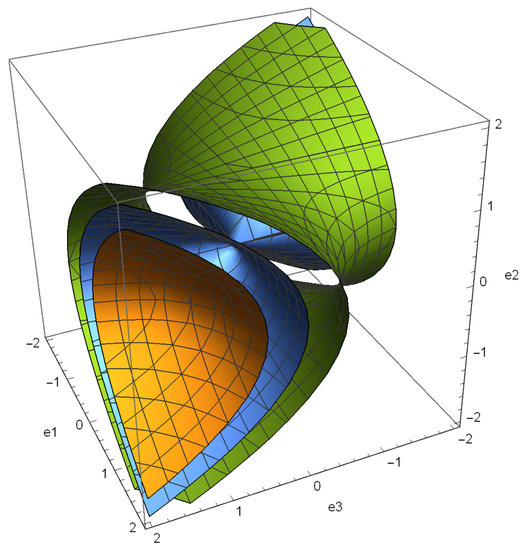
In particular, if , then is locally diffeomorphic to one of the classes of Lie–Hamilton systems on admitting a VG Lie algebra isomorphic to . In view of Table 1 and since and have two-dimensional symplectic leaves (cf. Reference [28,29]), Theorem 2 potentially allows one to obtain the Lie–Hamilton systems on related to the VG Lie algebras isomorphic to and , that is, P, P, I and I. According to Table 1, there exist three classes of VG Lie algebras of Hamiltonian vector fields on isomorphic to : P, I and I. To check that Theorem 2 allows us to recover all of them, we have to verify all the restrictions of (4) on to each symplectic leaf relative to the KKS bracket in detail (see Figure 1). On the other hand, it is immediate that Theorem 2 gives rise to a Lie–Hamilton system on admitting a VG Lie algebra locally diffeomorphic to P, since it is the only class of Hamiltonian VG Lie algebras on isomorphic to (see Table 1).
Figure 1.
Representative symplectic leaves of the KKS bracket on .
Although Lie–Hamilton systems on related to VG Lie algebras isomorphic to and were very briefly studied in Reference [14], our analysis here is much more detailed and it additionally shows, as a bonus, the existence of additional features of such Lie–Hamilton systems, which retrieves in a more natural and general manner results given in References [19,22].
• VG Lie algebras isomorphic to (classes P, I and I):
Let be a basis of satisfying the commutation relations
In the given basis, system (4) takes the form
Hence, admits a Casimir function given by (see References [28,29]). The symplectic leaves of the KKS bracket on are therefore given by the submanifolds where the function takes a constant value. Then, Hamiltonian vector fields are tangent to such submanifolds. This implies that we have three main types of two-dimensional symplectic leaves where is positive (two-sheeted hyperboloids), negative (one-sheeted hyperboloids) or zero (a two-sided cone without vertex). Three types of symplectic leaves are illustrated in the diagram aside in orange, green and blue colour, respectively.
In the coordinate system one obtains that the restriction of (5) to each leaf of the KKS bracket, reads
To determine to which class of the Table 1 systems (6) belong to, one can use the so-called Casimir tensor field (see Reference [10])
This tensor field appears naturally as the restriction to each of on . In fact, since the previous tensor field is constructed as a linear combination of tensor products of Hamiltonian vector fields, it is then tangent to each and it gives rise to .
Recall that the two-dimensional symplectic leaves in relative to the KKS bracket are given by its symplectic leaves in . Hence, one can use ([10], Theorem 4.4), which claims that the sign, , of the matrix of the coefficients of at a single point of classifies to which class of Table 1, the Lie algebra is locally diffeomorphic to. In particular, if , then is locally diffeomorphic to P; while gives that is locally diffeomorphic to I; and finally indicates that is locally diffeomorphic to I.
To check which class of Lie algebras on the plane is diffeomorphic to, it is enough to see that are local coordinates at a certain open subset of each two-dimensional leaf . Hence, for . Then,
Thus, each one of the main three types of symplectic leaves leads to a VG Lie algebra of a different type. In particular, yields a VG Lie algebra locally diffeomorphic to P on a two-sheeted hyperboloid; leads to a VG Lie algebra locally diffeomorphic to I on a one-sheeted hyperboloid; and induces a VG Lie algebra locally diffeomorphic to I on a two-sided cone without vertex. In turn, this makes the Lie system
into a Lie–Hamilton system possessing a VG Lie algebra locally diffeomorphic to P, I and I, when , or , respectively. Recall that the symplectic form related to (9) is the one associated with the restriction to of the Poisson bivector on .
For the sake of completeness, we provide the coordinate expression for (9). In particular the system can be mapped, for , onto the system
through the change of variables and . In the case , system (6) can be mapped, via the change of variables and , onto the system
Finally, the change of variables maps (6) into
It is worth noting that our approach also explains other aspects of the Lie–Hamilton systems (9). In fact, the Casimir tensor field (7) can also be understood as a symmetric contravariant tensor field on each leaf that is invariant relative to the Lie derivative with the elements of . When , the matrix of the coefficients of (7) becomes non-degenerate by (8) and admits an inverse that is a metric invariant relative to the Lie derivaties with the elements of . Then, the Lie–Hamilton systems on the leaves with become pseudo-Riemannian Lie systems as proved in Reference ([19], Table 1). In particular, the metric is positive definite for , that is, Riemannian, while it is pseudo-Riemannian for .
• VG Lie algebra isomorphic to (class P):
Consider the basis of of the form admitting the structure constants (We recall that these commutation relations are not the same as the ones of the basis of P given in Table 1).
Then, system (4) takes in this case the form
In this case, the Casimir function of the KKS Poisson structure on reads [28,29]
The two-dimensional submanifolds where becomes a constant , that is, the symplectic surfaces associated with the KKS bracket, are therefore spheres, , with different radius . As previously explained in the general theory of this section, the Lie algebra defined on each sphere becomes a VG Lie algebra isomorphic to . In view of Table 1, the Lie algebra is locally diffeomorphic to P.
For the sake of completeness, we can describe the restriction process in detail. If one consider the set of variables
the restriction of (10) to a symplectic leaf reads
As stated previously, there must exist a change of variables mapping this system of differential equations into a Lie system with the VG Lie algebra P. In fact, the change of variables
maps (11), that is, the restriction of (10) to , onto
where .
It is worth noting that the Casimir tensor field relative to , namely
is tangent to . The coefficients of in the local coordinates , which are well defined on a point with of every leaf for , read
and becomes a non-degenerate tensor field. Its inverse, , becomes a Riemmanian metric since the determinant of its coefficients is positive. As a similar result can be obtained in any local coordinate system around points of each , the leaf becomes a Riemmanian manifold. Since (12) satisfies that for , then consists of Killing vector fields with respect to , as proved in Reference [19] and the Lie–Hamilton systems on are also Riemannian–Lie systems.
To finish this section, we stress that Theorem 2 implies that the Lie algebra or other simple Lie algebras have no two-dimensional symplectic leaves. Otherwise, such Lie algebras of vector fields would give rise to Lie algebras of Hamiltonian vector fields on , which are absent in Table 1. Moreover, the method exposed here can be employed to obtain Lie–Hamilton systems on higher-dimensional manifolds.
4. Non-Simple VG Lie Algebras and Symplectic Foliations
It is immediate that the method showed in the last section can be slightly modified to give rise to Lie–Hamilton systems on the non-zero-dimensional symplectic leaves of the symplectic stratifications of the KKS bracket of general, not necessarily simple, Lie algebras . Nevertheless, the induced VG Lie algebras on each leaf, , do not need to be isomorphic neither to nor to . The difficulties due to the lack of an isomorphism between and were not addressed in Reference [14]. Despite above mentioned problems, we prove in this section that the method given in Section 3 can be extended to the Lie algebras and to obtain Lie–Hamilton systems on their symplectic leaves related to VG Lie algebras locally diffeomorphic to elements of the class I for .
• VG Lie algebra isomorphic to (class I for ):
Let be a basis of the Lie algebra , that is, the abstract Lie algebra isomorphic to a VG Lie algebra of the class I, with commutation relations
The Poisson structure on given by the KKS bracket admits a Casimir function [28,29] given by
Consequently, the symplectic stratification on is given by the cylinders , with and the set of points with . We focus on the two-dimensional symplectic leaves, with , of this stratification. Using (14), we obtain that the vector fields for read
on the coordinates of . The restrictions of to the two-dimensional symplectic leaves can be expressed on each leaf by restricting the cylindrical coordinates on to each leaf, that is, via . Then,
Therefore, one obtains that are Hamiltonian and span a three-dimensional Lie algebra . Since , and the Lie brackets of with elements of belong also to the latter linear space, must be locally diffeomorphic to a Lie algebra of the class I for .
• VG Lie algebras isomorphic to (class I for ):
Let be a basis of with the structure constants given by
Then, a Casimir function is given by
Hence, the two-dimensional symplectic leaves associated with the KKS Poisson bracket on are given by surfaces or the four semiplanes with or . We now write for the symplectic leaf for a certain .
Let us derive the restrictions of the vector fields on , that is,
to the symplectic leaves by defining the coordinates and , when they will have sense. This gives rise to the expressions
Therefore, the restriction to a leaf with is a Lie system with a VG Lie algebra belonging to the class I for .
It is immediate that for gives rise to a VG Lie algebra on a semi-plane isomorphic to , that is, a non-Abelian two-dimensional Lie algebra and locally diffeomorphic to I for .
5. An Approach through Automorphic Lie Systems and Left-Invariant Bivector Fields
The method established in Section 3 and Section 4 cannot be easily applied to all Lie–Hamilton systems on . On the one hand, this is due to the fact that the abstract Lie algebras isomorphic to the VG Lie algebras in Table 1 may not posses a sufficient number of Casimir functions or invariants to reduce the system to a two-dimensional submanifold with a compatible symplectic structure, for example, the Lie algebra I for has no Casimir function (cf. References [28,29]). On the other hand, one could consider other Lie algebras not given in Table 1 and expect that the restriction of the vector fields on onto certain two-dimensional symplectic leaves (relative to the KKS bracket) will give rise to Lie–Hamilton systems with the remaining VG Lie algebras in Table 1. But there is no hint about the form of the general Lie algebras to be used.
Above problems motivate our following alternative model for Lie–Hamilton systems on (and other possible ones on higher-dimensional manifolds). Our approach suggests that Lie–Hamilton systems on can be recovered as projections of automorphic Lie systems with appropriate projectable invariants in or, more generally, elements of .
Let us provide our new approach. Consider a Lie system on a two-dimensional connected manifold N with a VG Lie algebra . The integration of V allows us to obtain a Lie group action whose Lie algebra of fundamental vector fields is equal to V and . Assume that , which yields that V is a locally transitive VG Lie algebra. Then,
is surjective for every . If is the isotropy group of , then one gets the commutative diagram
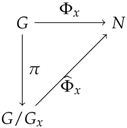 where is a diffeomorphism. Moreover, if is the right-invariant vector field on G with for and is the fundamental vector field (We choose the fundamental vector field to be defined as for every ) of associated with v, then
In particular, , with , for a certain basis of . Due to the commutativity of the diagram (15), one obtains that where , as usually, stands for the Lie algebra of right-invariant vector fields on G.
Our aim now is to obtain a Poisson bivector on G that can be projected onto , for example, is a left-invariant bivector field that is invariant relative to the left-invariant vector fields tangent to . This shows that exists. Then, induces a Poisson bivector on that is invariant relative to . Hence, this allows us to define a Lie–Hamilton system on given by , which is diffeomorphic to the one, X, on N via . If does not vanish, then X is a Lie–Hamilton system relative to a symplectic structure.
To illustrate the above method, let us analyse Lie–Hamilton systems related to P, I, P, and I.
• VG Lie algebra isomorphic (class P):
We consider the Lie group as the direct product of the matrix Lie group of unimodular matrices with relative to the multiplication
Let us analyse now the automorphic Lie system on given by
for a certain basis of right-invariant vector fields on . Let us use a local coordinate system defined close to the neutral element of and related to the description of elements of in the form
In this coordinate system, a basis of left-invariant vector fields on reads
They span indeed a VG Lie algebra isomorphic to the VG Lie algebra of the class P. Meanwhile,
Since is a exterior product of left-invariant vector fields, it is then invariant relative to the Lie derivatives with respect to the elements of .
If we consider the quotient space of left-cosets of , we obtain the projection which satisfies that . Since and all the elements of are invariant with respect to the Lie derivatives relative to the elements of , one obtains that and are projectable onto . The projections of the elements of onto are spanned by linear combination over the reals of the elements of the basis
Therefore, the projection of the vector fields (16) onto span, as proved in our general theory, a VG Lie algebra isomorphic to . Moreover, the projection of onto takes the form
and admits a VG Lie algebra . Moreover, one has that the projection, , of onto reads
which becomes equivalent to a symplectic form. Since is invariant relative to the elements of , it follows that is invariant with respect to the elements of , and (17) becomes a Lie–Hamilton system relative to . Recall that the integration of the VG Lie algebra P gives rise to a Lie group action . In view of the basis of P in Table 1, one sees that can be considered as the isotropy Lie group of . Then, the mapping gives rise to a diffeomorphism that maps (17) onto a Lie–Hamilton system on of the form
where is a basis of P.
• VG Lie algebra isomorphic to (class I):
The Lie algebra, , which is isomorphic to the VG Lie algebra I for the fixed r, has an associated Lie group given by . This Lie group acts on having a set of fundamental vector fields given in the class I of Table 1. The Lie algebra of vector fields vanishing at is given by . Then, the isotropy group at is , and its corresponding Lie algebra is isomorphic to .
Let us choose a basis of of the form obeying the same commutation relations as the basis of I in Table 1. In other words, the chosen basis has non-vanishing commutation relations
for . If is a basis of left-invariant vector fields on such that for , one can consider the bivector field on of the form
This bivector field is invariant relative to the Lie derivatives with right-invariant vector fields. Moreover, can be projected onto together with the automorphic Lie system on of the form
If is the quotient map, is a Poisson bivector that is invariant relative to , for , and this leads to a Lie–Hamilton system on given by
In view of our previous general comments, the VG Lie algebra of the projection is locally diffeomorphic to I, and it represents geometrically this class of Lie–Hamilton systems on .
• VG Lie algebras P and I:
These cases follow exactly the same ideas given in previous examples, hence we will just sketch the procedure. In the case of the VG Lie algebra P, its vector fields can be integrated to define an action of the Lie group on admitting a set of fundamental vector fields given by P. One then considers an automorphic Lie system on the Lie group , where are assumed to admit the same commutation relations as the basis of P given in Table 1. The isotropy group of the point is given by a Lie subgroup whose Lie algebra is spanned by .
Then, is a Poisson bivector on the Lie group that is also invariant relative to the Lie derivatives with respect to the VG Lie algebra . Thus, and are invariant relative to and they can be therefore projected simultaneously onto via , giving rise to a Lie–Hamilton system on the plane relative to with a VG Lie algebra locally diffeomorphic to P. In the case of I, the procedure is absolutely analogous.
Let us provide a slight generalisation of the above procedure that will allow us to retrieve the Lie–Hamilton systems on the plane admitting a VG Lie algebra locally diffeomorphic to any of the VG Lie algebras of the classes I and I.
• VG Lie algebras isomorphic to (classes I and I):
Any VG Lie algebra V of the classes I or I can be integrated to give rise to a Lie group action of a Lie group on whose fundamental vector fields are given by V. The Lie algebra of the isotropy group of 0 is given by an -dimensional Lie subalgebra of , where we can assume without loss of generality that does not vanish at 0 and therefore . Thus, is isomorphic to the Abelian Lie algebra with a Lie subgroup H. Then, is diffeomorphic to the quotient space with the Abelian Lie group . We write for the Lie algebra of the left-invariant vector fields of the isotropy group of 0, which is isomorphic to .
We define the automorphic Lie system on of the form
where are assumed to close the opposite structure constants than the basis of the VG Lie algebra on under inspection. Let us also define , which is not necessarily a Poisson bivector as (See Reference [21] for our convention on the Schouten-Nijenhuis bracket). and , which may different for the VG Lie algebras of the classes I and I.
Let us try to project and J onto the two dimensional quotient space . Since is invariant relative to left-invariant vector fields, it will be projectable onto via the canonical projection . Meanwhile, for every , one gets that . Since for a certain constant c and an element , one obtains that , which projects onto zero in . By Lemma 1, the J is projectable onto . Moreover, is such that and is a Poisson bivector. Hence, one obtains that the projection of onto is a Lie–Hamilton system relative to that is locally diffeomorphic to a Lie–Hamilton system on the plane with a VG Lie algebra locally diffeomorphic to V.
It is now very simple to prove that the above generalisation allows us to recover the Lie–Hamilton systems on the plane related to the VG Lie algebras P, P, I, and I.
It seems to us that the previous procedure could be extended to study Lie–Hamilton systems on higher-dimensional manifolds. The idea is to construct from a Lie–Hamilton system X on a manifold N with a locally transitive VG Lie algebra V of Hamiltonian vector fields an automorphic Lie system on a certain Lie group G with a VG Lie algebra of right-invariant vector fields isomorphic to V. Then, a left-invariant bivector field must become projectable onto the quotient space with an isotropy group, which can be tested by using the algebraic properties of and/or using as previously.
6. Conclusions and Outlook
We have developed two natural geometric models for the study of Lie–Hamilton systems on the plane that, quite surely, can also be used to study higher-dimensional Lie–Hamilton systems. We plan to study such an extension in the future.
On the other hand, it is natural to wonder whether the given approaches to Lie–Hamilton systems are useful to study their superposition rules. Recall that superposition rules for certain Lie–Hamilton systems were obtained through Casimir functions (see Reference [8] and references therein), while Winternitz and coworkers derived superposition rules for classes of Lie systems by considering them as projections of automorphic Lie systems (see References [3,8,17,18]). Hence, it seems to us that our techniques, where such structures appear naturally, can be useful to study the existence and derivation of superposition rules. We aim to study this topic in further works.
Author Contributions
Conceptualization and methodology, J.d.L.; Investigation, J.d.L. and J.L.; writing—original draft preparation and writing—review and editing, J.d.L. and J.L.
Funding
J.d.L. acknowledges support from the contract 623 of the Faculty of Physics of the University of Warsaw.
Acknowledgments
This work is circumscribed within the research topics of the project HARMONIA 2016/22/M/ST1/00542 financed by the Polish National Science Center (POLAND). We would like to thank the anonymous referees for the careful reading of the work, raising interesting questions that led to improving the paper, proposing interesting further research tasks, and pointing out relevant references on the topic under research.
Conflicts of Interest
The authors declare no conflict of interest. The founders had no role in the design of the study; in the collection, analyses, or interpretation of data; in the writing of the manuscript, or in the decision to publish the results.
References
- Cariñena, J.F.; Grabowski, J.; Marmo, G. Lie–Scheffers Systems: A Geometric Approach; Bibliopolis: Naples, Italy, 2000. [Google Scholar]
- Cariñena, J.F.; Grabowski, J.; Marmo, G. Superposition Rules, Lie Theorem and Partial Differential Equations. Rep. Math. Phys. 2007, 60, 237–258. [Google Scholar] [CrossRef] [Scilit]
- Cariñena, J.F.; de Lucas, J. Lie systems: Theory, generalizations, and applications. Diss. Math. 2011, 479, 1–162. [Google Scholar] [CrossRef] [Scilit]
- Lie, S.; Scheffers, G. Vorlesungen über Continuierliche Gruppen mit Geometrischen und Anderen Anwendungen; Teubner: Leipzig, Germany, 1893. [Google Scholar]
- Vessiot, M.E. Sur une classe de d’équations différentielles. Ann. Sci. École Norm. Sup. 1893, 10, 53–64. [Google Scholar] [CrossRef] [Scilit]
- Vessiot, M.E. Sur les équations différentielles ordinaires du premier ordre qui ont des systèmes fondamentaux d’intégrales. Ann. Fac. Sci. Toulousse 1899, 1, 1–33. [Google Scholar]
- Winternitz, P. Lie groups and solutions of nonlinear differential equations. Lect. Not. Phys. 1983, 189, 263–305. [Google Scholar]
- de Lucas, J.; Sardón, C. A Guide to Lie Systems with Compatible Structures; World Scientific: Singapore, 2019. [Google Scholar]
- González-López, A.; Kamran, N.; Olver, P.J. Lie algebras of vector fields in the real plane. Proc. London Math. Soc. 1992, 64, 339–368. [Google Scholar] [CrossRef] [Scilit]
- Blasco, A.; Herranz, F.J.; de Lucas, J.; Sardón, C. Lie-Hamilton systems on the plane: Applications and superposition rules. J. Phys. A 2015, 48, 345202. [Google Scholar] [CrossRef] [Scilit]
- Cariñena, J.F.; de Lucas, J.; Sardón, C. Lie–Hamilton systems: Theory and applications. Int. J. Geom. Methods Mod. Phys. 2013, 10, 1350047. [Google Scholar] [CrossRef] [Scilit]
- Ballesteros, A.; Blasco, A.; Herranz, F.J.; de Lucas, J.; Sardón, C. Lie–Hamilton systems on the plane: Properties, classification and applications. J. Differ. Equ. 2015, 258, 2873–2907. [Google Scholar] [CrossRef] [Scilit]
- Ballesteros, A.; Campoamor-Stursberg, R.; Fernández-Saiz, E.; Herranz, F.J.; de Lucas, J. Poisson–Hopf algebra deformations of Lie–Hamilton systems. J. Phys. A 2017, 51, 065202. [Google Scholar] [CrossRef] [Scilit]
- Ballesteros, A.; Campoamor-Stursberg, R.; Fernández-Saiz, E.; Herranz, F.J.; de Lucas, J. A unified approach to Poisson–Hopf deformations of Lie–Hamilton systems based on (2). In Quantum Theory and Symmetries with Lie Theory and Its Applications in Physics; Springer: Singapore, 2018; Volume 1, pp. 347–366. [Google Scholar]
- Ballesteros, A.; Cariñena, J.F.; Herranz, F.; de Lucas, J.; Sardón, C. From constants of motion to superposition rules for Lie–Hamilton systems. J. Phys. A 2013, 46, 285203. [Google Scholar] [CrossRef] [Scilit]
- Friš, J.; Mandrosov, V.; Smorodinsky, Y.A.; Uhlir, M.; Winternitz, P. On higher order symmetries in quantum mechanics. Phys. Lett. 1965, 16, 354–356. [Google Scholar] [CrossRef] [Scilit]
- Shnider, S.; Winternitz, P. Classification of systems of nonlinear ordinary differential equations with superposition principles. J. Math. Phys. 1984, 25, 3155–3165. [Google Scholar] [CrossRef] [Scilit]
- Shnider, S.; Winternitz, P. Nonlinear equations with superposition principles and the theory of transitive primitive Lie algebras. Lett. Math. Phys. 1984, 8, 69–78. [Google Scholar] [CrossRef] [Scilit]
- de Lucas, J.; Lewandowski, M.M. Geometric Features of Vessiot–Guldberg Lie Algebras of Conformal and Killing Vector Fields on ℝ2; Banach Center Publications: Warsaw, Poland, 2018; Volume 113, pp. 243–262. [Google Scholar]
- Hermann, R.; Ackerman, M. Sophus Lie’s 1880 Transformation Group Paper; Math. Sci. Press: Brookline, MA, USA, 1975. [Google Scholar]
- Vaisman, I. Lectures on the Geometry of Poisson Manifolds; Progress in Mathematics 118; Birkhäuser Verlag: Basel, Switzerland, 1994. [Google Scholar]
- Gràcia, X.; de Lucas, J.; Muñoz Lecanda, M.C.; Vilariño, S. Multisymplectic structures and invariant tensors for Lie systems. J. Phys. A 2019, 52, 215201. [Google Scholar] [CrossRef] [Scilit]
- Abraham, R.; Marsden, J.E. Foundations of Mechanics; Addison-Wesley Publishing Company Inc.: Redwood City, CA, USA, 1987. [Google Scholar]
- Palais, R.S. Global formulation of the Lie theory of transformation groups. Mem. Am. Math. Soc. 1957, 22, 1–123. [Google Scholar] [CrossRef] [Scilit]
- Umemura, H. On the irreducibility of Painlevé differential equations. Sugaku Expo. 1989, 2, 231–252. [Google Scholar]
- Malgrange, B. The Galois groupoid of a foliation. In Essays on Geometry and Related Topics; Monogr. Enseign. Math. 38; Enseignement Math.: Geneva, Switzerland, 2001; pp. 465–501. [Google Scholar]
- Varadarajan, V.S. Lie Groups, Lie Algebras, and Their Representations; Graduate Texts in Mathematics 102; Springer: New York, NY, USA, 1984. [Google Scholar]
- Patera, J.; Sharp, R.T.; Winternitz, P.; Zassenhaus, H. Invariance of real low-dimensional Lie algebras. J. Math. Phys. 1976, 17, 986–994. [Google Scholar] [CrossRef] [Scilit]
- Šnobl, L.; Winternitz, P. Classification and Identification of Lie Algebras; CRM Monograph Series 33; AMS: Providence, RI, USA, 2014. [Google Scholar]

© 2019 by the authors. Licensee MDPI, Basel, Switzerland. This article is an open access article distributed under the terms and conditions of the Creative Commons Attribution (CC BY) license (http://creativecommons.org/licenses/by/4.0/).