


Abstract
In this paper, we introduce the iterative scheme for finding a common fixed point of a countable family of G-nonexpansive mappings by the shrinking projection method which generalizes Takahashi Takeuchi and Kubota’s theorem in a Hilbert space with a directed graph. Simultaneously, we give examples and numerical results for supporting our main theorems and compare the rate of convergence of some examples under the same conditions.
1. Introduction
In this paper, we assume that H is a real Hilbert space with inner product and norm . Let C be a nonempty subset of H. Then, mapping is called
1. contraction if there exists such that for all ;
2. nonexpansive if for all .
An element is called a fixed point of T if . The fixed point set of T is denoted by . There are many iterative methods for approximating fixed points of nonexpansive mapping in a Hilbert space (see [1,2,3]) and references therein.
In 1953, Mann [2] introduced the iteration procedure as follows:
where and are the set of all positive integers. Recently, many mathematicians (see [4,5,6]) have used Mann’s iteration for obtaining a weak convergence theorem.
Let H be a Hilbert space and let C be a subset of H. Let and be two families of mappings of C into itself with , where is the set of all fixed points of , is the set of all common fixed points of . is said to satisfy the -condition [7] with respect to if for each bounded sequence in C,
To obtain a strong convergence theorem, Takahashi et al. [8] introduced the following modification of the Mann’s iteration method (1), which just involved one closed convex set for a countable family of nonexpansive mappings , which is called the shrinking projection method:
Theorem 1.
Let H be a Hilbert space and C be a nonempty closed convex subset of H [8]. Let and τ be a family of nonexpansive mappings of C into H such that and let . Suppose that satisfies the -condition with τ. For and , define a sequence in C as follows:
where for all . Then, the sequence converges strongly to a point .
This iteration is used to obtain strong convergence theorem (see, for example, [9,10]).
Let X be a Banach space and C be a nonempty subset of X. Let G be a directed graph with the set of vertices and the set of edges that contains the diagonal of , where an edge is the related pairs of vertices x and y. We suppose that G has no parallel edge.
Thus, we can identify the graph G with the pair . A mapping is said to be
- G-contraction if T satisfies the conditions:
- (i)
- T preserves edges of G, i.e.,
- (ii)
- T decreases weights of edges of G in the following way: there exists such that
- G-nonexpansive if T satisfies the conditions:
- (i)
- T preserves edges of G, i.e.,
- (ii)
- T non-increases weights of edges of G in the following way:
In 2008, Jachymski [11] proved some generalizations of the Banach’s contraction principle in complete metric spaces endowed with a graph. To be more precise, Jachymski proved the following result.
Theorem 2.
Let be a complete metric space, and a triple have the following property: for any sequence if and for and there is a subsequence of with for all .
Let be a G-contraction, and . Then, if and only if [11].
In 2008, Tiammee et al. [12] and Alfuraidan [13] employed the above theorem to establish the existence and the convergence results for G-nonexpansive mappings with graphs. Recently, many mathematicians (see [14,15]) have introduced the iterative method for finding a fixed point of G-nonexpansive mappings in the framework of Hilbert spaces and Banach spaces.
Inspired by all aforementioned references, we introduce the iterative scheme for solving the fixed point problem of a countable family of G-nonexpansive mappings. We also obtain strong convergence theorems in a Hilbert space with a directed graph under suitable conditions. Furthermore, we demonstrate examples and numerical results for supporting our main results and compare the rate of convergence of some examples under the same conditions.
2. Preliminaries and Lemmas
We now provide some basic results for the proof. In a Hilbert space H, let C be a nonempty closed and convex subset of H. Letting be a sequence in H, we denote the weak convergence of to a point by and the strong convergence, that is, relative to a norm of to a point by . For every point , there exists a unique nearest point of C, denoted by , such that for all . Such a is called the metric projection from H onto C.
Lemma 1.
Let H be a real Hilbert space [16]. Then, for each ∈H and each
- (a)
- ,
- (b)
- ,
- (c)
- If is a sequence in H weakly convergent to z, then
Lemma 2.
Let C be a nonempty closed and convex subset of a real Hilbert space H [17]. For each x, y∈H and , the set
is closed and convex.
Lemma 3.
Let C be a nonempty closed and convex subset of a real Hilbert space H and be the metric projection from H onto C. Then, , for all and [18].
Lemma 4.
Let H be a real Hilbert space and let [19]. For such that , the following identity holds:
Lemma 5.
[20] Let X be a Banach space. Then, X is strictly convex, if
for all and , which implies .
Definition 1.
A directed graph G is transitive if, for any in which and are in , then we have .
Definition 2.
Let and A be a subset of We say that
- (i)
- A is dominated by if for all
- (ii)
- A dominates if, for each ,
Definition 3.
Let be a directed graph. The set of edges is said to be convex if for all and such that , then .
Lemma 6.
Let C be a nonempty, closed and convex subset of a Hilbert space H and a directed graph such that [14]. Let be a G-nonexpansive mapping and be a sequence in C such that for some . If there exists a subsequence of such that for all and for some . Then, .
3. Main Results
In this section, we prove a strong convergence theorem by hybrid methods for families of G-nonexpansive mappings
Theorem 3.
Let H be a real Hilbert space and C be a nonempty, closed and convex subset of H. Let be a directed graph with and be also convex. Suppose that and τ are two families of G-nonexpansive mappings on C such that and is closed. Assume that for all , satisfies the -condition with respect to τ and for all . For , and , define a sequence of C as follows:
If satisfies the following conditions:
- (i)
- dominates p for all ;
- (ii)
- if there exist a subsequence of such that , then .
Then, converges strongly to .
Proof.
We split the proof into five steps.
Step 1: Show that is well-defined for every . We know that is convex, if for all ; see Theorem 3.2 of Tiammee et al. [12]. This implies that is convex. It follows now from the assumption that is closed. This implies that is well-defined. We first show, by induction, that for all . It is obvious that . Assume that for some . Then, by the fact that dominates p for all , for ,
and hence . This implies that for all . Next, we show that is closed and convex for all . By the condition of , is closed and convex. Assume that is closed and convex for some . For , from Equation (6), we know that is equivalent to . Thus, is closed and convex. Then, for any , is closed and convex. This implies that is well-defined.
Step 2: Show that exists. From , we have for all . As , we also have
Thus, for , we have
This implies that
for all and From and , we also have
From (5), we have, for ,
Thus,
Since is bounded, exists.
Step 3: Show that as . For , by the definition of C, we see that . Thus, we have
Since is a Cauchy sequence, there exists such that as . This implies that by condition (ii).
We next give some examples of a family of G-nonexpansive mappings , which satisfies the -condition.
Example 1.
Let . Define , where for all . Then, is a family of G-nonexpansive mappings and satisfies the -condition.
Proof.
We first prove that is G-nonexpansive for all .
Since is convex and for all , then
Furthermore, we have
Hence, is G-nonexpansive for all .
Next, we show that satisfies the -condition with respect to T. First, we show that . It is obvious that . On the other hand, let . Then, we have
Then, , which implies that . Hence, that is . This shows that . Let be a sequence in C such that ; we have Since , then
From (11) and (12), we get that satisfies the -condition with respect to . □
Example 2.
Let . Define , where , and for all . If and for all and , then is a family of G-nonexpansive mappings and satisfies the -condition.
Proof.
We first prove that is G-nonexpansive for all . Since is convex and for all , then
Furthermore, we have
From (13) and (14), we have that is G-nonexpansive for all . Next, we show that satisfies the -condition with respect to . It is clear that . On the other hand, we let .
Consider
By our assumption, we obtain . Hence, . Therefore, . Next, we let be a sequence in C such that and . We shall show that Since for all , we have
Thus,
ince as , by our assumptions, we have and as . Hence, satisfies the -condition with respect to . □
Example 3.
Let . Define , where and . If for all , and for all and , then is a family of G-nonexpansive mappings and satisfies the -condition.
Proof.
We first prove that is G-nonexpansive for all . Let , and we see that . Setting , by the convexity of , we have . This implies that . Again by the convexity of , we have
Then, we have
and hence
Hence, is G-nonexpansive for all . Next, we show that satisfies the -condition with respect to . It is obvious that Thus, it is enough to show that . Let , and . Then, we have . It follows that
This implies that . Then, we have
From Lemma 5, . Consider
This implies that . This shows that .
Let be a sequence in C such that Since dominates p, then . It follows that
This implies that
By our assumptions, we obtain
It follows that
as . Since , it follows from (16) that
This implies that
By our assumptions and (20), we have
It follows from (21) and (24) that
as . This implies that as Hence, satisfies the -condition with respect to . □
4. Examples and Numerical Results
In this section, we provide some numerical examples to support our obtained result.
Example 4.
Let and . Assume that if and only if or , where . Define mappings by
for all . It is easy to check that T and S are G-nonexpansive such that . We have that T is not nonexpansive since for and , then . We also have that S is not nonexpansive since, for and , then .
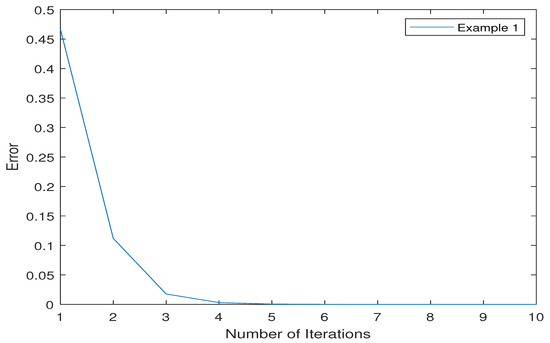
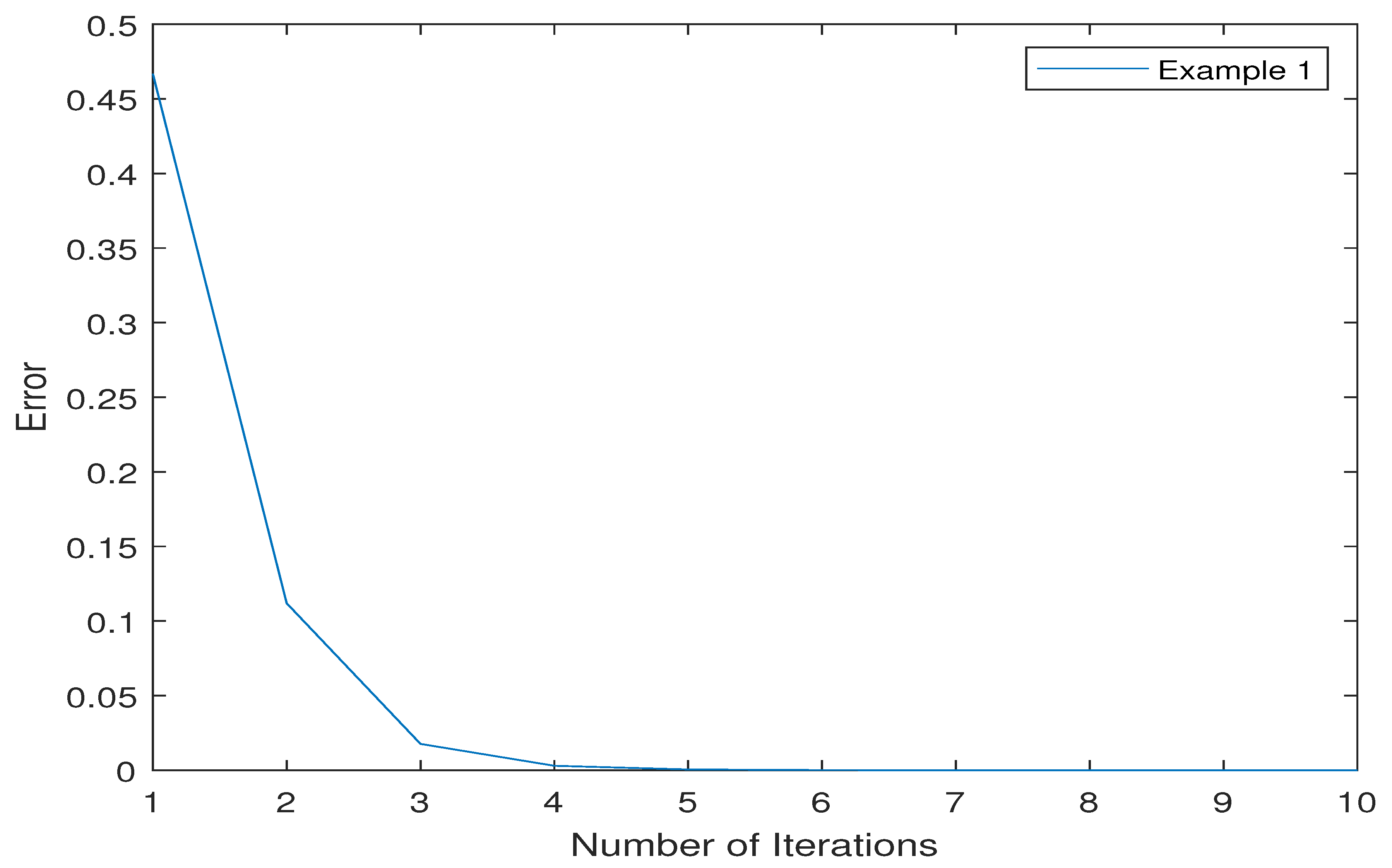
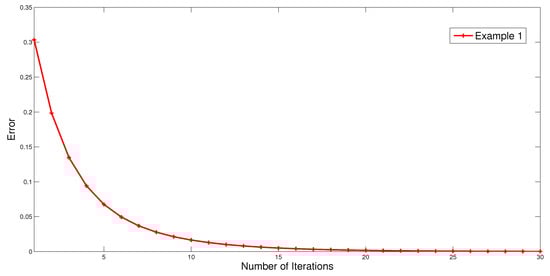
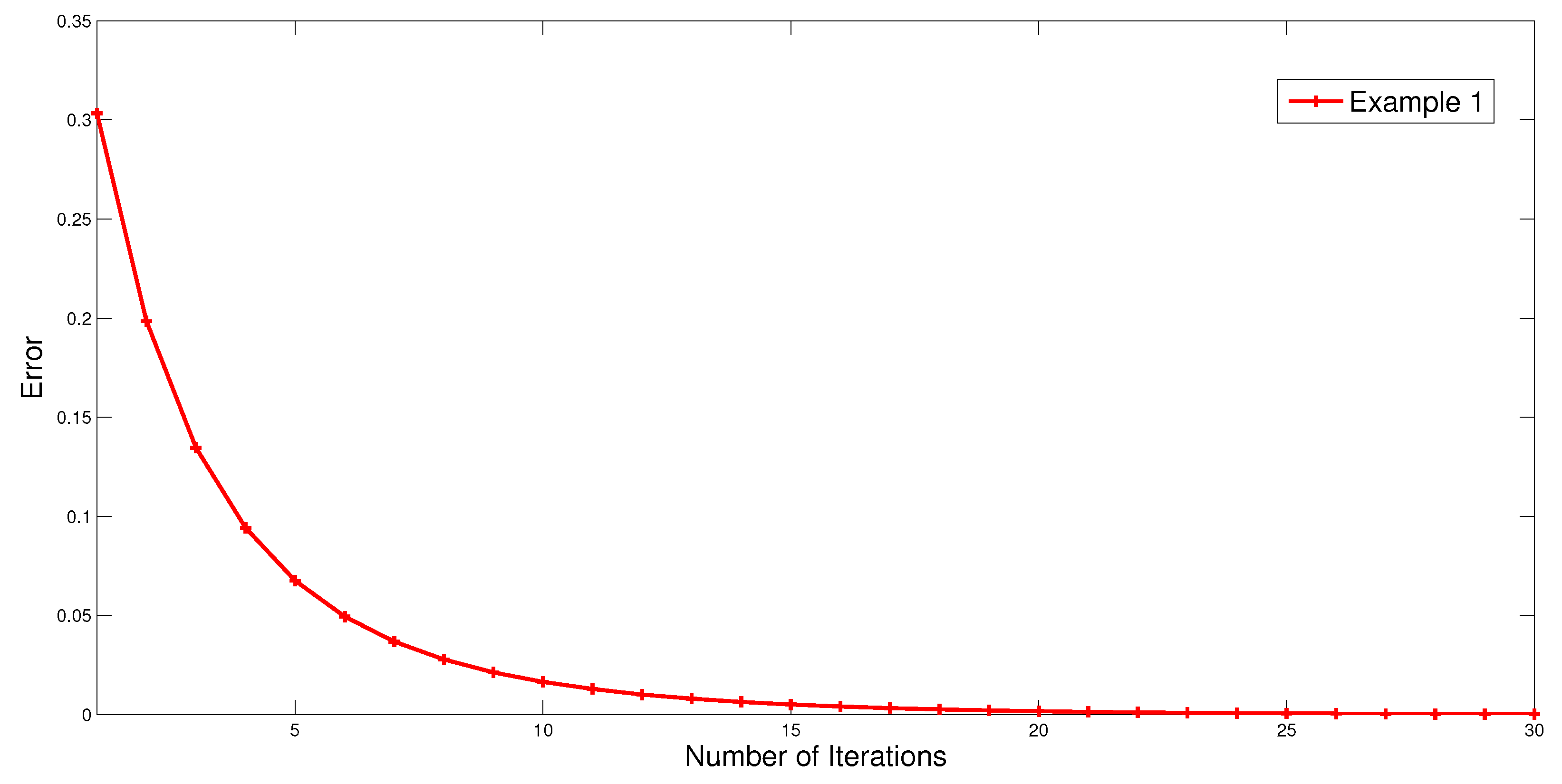
We use the mappings in Example 4 and choose . By computing, we obtain the sequences generated in Theorem 3 by using the mapping which, generated from Examples 1–3, converges to 1. We next show the following error plots of :
(1) Choose and ; then, the sequences and satisfy the conditions in Theorem 3 and Example 1.
(2) Choose , and ; then, the sequences , and satisfy the conditions in Theorem 3 and Examples 2 and 3.
Example 5.
Let and . Assume that if and only if or for all , where , . Define mappings by
for any It is easy to check that T and S are G-nonexpansive such that . On the other hand, T is not nonexpansive since, for and , then . We also have that S is not nonexpansive since, for and , then .
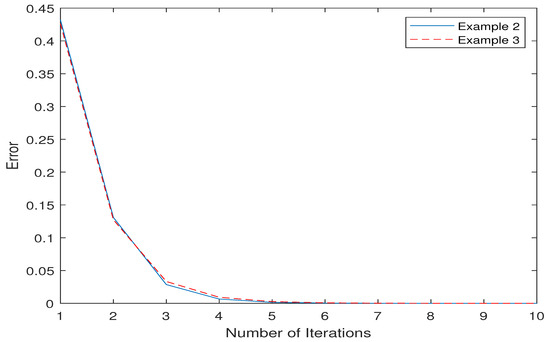
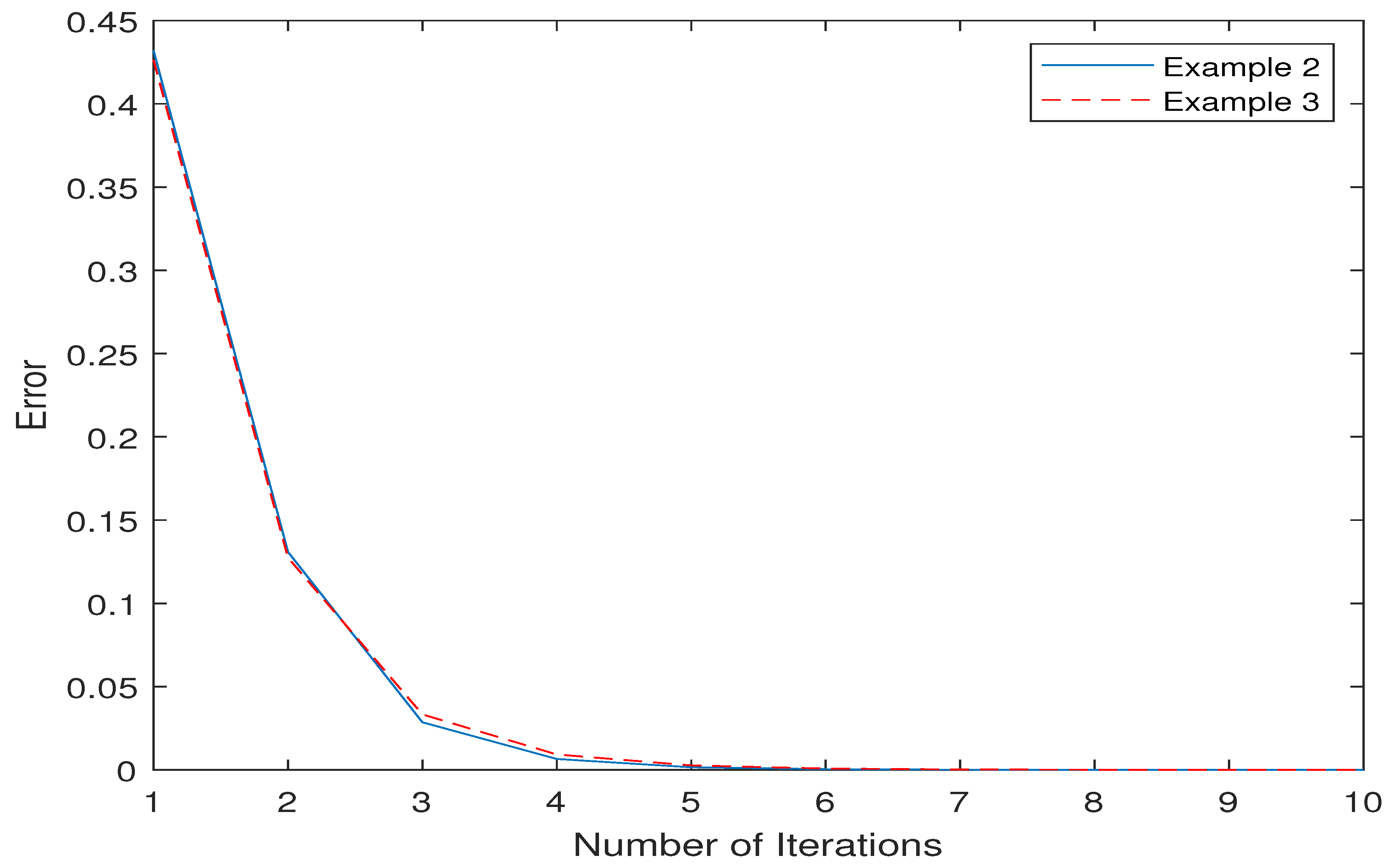
We use the mappings in Example 5 and choose . By computing, we obtain the sequences generated in Theorem 3 by using the mapping , which generated from Examples 1–3, converge to . We next show the following error plots of .
(1) Choose and ; then, the sequences and satisfy the conditions in Theorem 3 and Example 1.
(2) Choose , and ; then, the sequences , and satisfy the conditions in Theorem 3 and Examples 2 and 3.
Remark 1.
According to the investigation of our numerical results under the same conditions, we see that the sequence in Theorem 3, which generated by using the mapping in Example 2, converges faster than the sequence of Example 3.
5. Conclusions
In this paper, we introduce the iterative scheme for approximating a common fixed point of a countable family of G-nonexpansive mappings by modifying the shrinking projection method. We then prove strong convergence theorems in a Hilbert space with a directed graph under some suitable conditions. We give some examples of some families of G-nonexpansive mappings that satisfy the -condition with respect to its (see in Examples 1–3). Finally, we give some numerical experiments for supporting our main results and compare the rate of convergence of some examples under the same conditions (see in Examples 4 and 5 and Figure 1, Figure 2, Figure 3 and Figure 4).
Figure 1.
Error plots of the sequence in Theorem 3 by using the mapping in Example 1.
Figure 2.
Error plots of the sequence in Theorem 3 by using the mapping in Examples 2 and 3.
Figure 3.
Error plots of the sequence in Theorem 3 by using the mapping in Example 1.
Figure 4.
Error plots of the sequence in Theorem 3 by using the mapping in Examples 2 and 3.
Author Contributions
Funding acquisition and Supervision, S.S.; Writing—review & editing and Software, M.D. and W.C.
Funding
This research was funded by Chiang Mai University.
Acknowledgments
The first author thanks Chiang Mai University for financial support.
Conflicts of Interest
The authors declare no conflict of interest.
References
- Halpern, B. Fixed points of nonexpanding maps. Bull. Am. Math. Soc. 1967, 73, 957–961. [Google Scholar] [CrossRef] [Scilit]
- Mann, W.R. Mean value methods in iteration. Proc. Am. Math. Soc. 1953, 4, 506–510. [Google Scholar] [CrossRef]
- Wittmann, R. Approximation of fixed points of nonexpansive mappings. Arch. Math. 1992, 58, 486–491. [Google Scholar] [CrossRef] [Scilit]
- Emmanuele, G. Convergence of the Mann-Ishikawa iterative process for nonexpansive mappings. Nonlinear Anal. Theory Methods Appl. 1982, 6, 1135–1141. [Google Scholar] [CrossRef] [Scilit]
- Hicks, T.L.; Kubicek, J.D. On the Mann iteration process in a Hilbert space. J. Math. Anal. Appl. 1977, 59, 498–504. [Google Scholar] [CrossRef] [Scilit]
- Song, Y.; Promluang, K.; Kumam, P.; Cho, Y.J. Some convergence theorems o fthe Mann iteration for monotone α-nonexpansive mappings. Appl. Math. Comp. 2016, 287, 74–82. [Google Scholar] [CrossRef] [Scilit]
- Nakajo, K.; Shimoji, K.; Takahashi, W. Strong convergence theorems by the hybrid method for families of mappings in Hilbert spaces. Taiwan. J. Math. 2006, 10, 339–360. [Google Scholar] [CrossRef] [Scilit]
- Takahashi, W.; Takeuchi, Y.; Kubota, R. Strong convergence theorems by hybrid methods for families of nonexpansive mappings in Hilbert spaces. J. Math. Anal. Appl. 2008, 341, 276–286. [Google Scholar] [CrossRef] [Scilit]
- Boung, N.; Lang, N.D. Shrinking hybrid descent-like methods for noexpansive mappings and semigroups. Nonlinear Funct. Anal. Appl. 2011, 16, 331–339. [Google Scholar]
- Kimura, Y. Shrinking projection methods for a family of maximal monotone operators. Nonlinear Funct. Anal. Appl. 2011, 16, 61. [Google Scholar]
- Jachymski, J. The contraction principle for mappings on a metric space with a graph. Proc. Am. Math. Soc. 2008, 136, 1359–1373. [Google Scholar] [CrossRef] [Scilit]
- Tiammee, J.; Kaewkhao, A.; Suantai, S. On Browder’s convergence theorem and Halpern iteration process for G-nonexpansive mappings in Hilbert spaces endowed with graphs. Fixed Point Theory Appl. 2015, 2015, 187. [Google Scholar] [CrossRef] [Scilit]
- Alfuraidan, M.R. Fixed points of monotone nonexpansive mappings with a graph. Fixed Point Theory Appl. 2015, 2015, 49. [Google Scholar] [CrossRef] [Scilit]
- Suparatulatorn, R.; Cholamjiak, W.; Suantai, S. Hybrid methods for a finite family of G-nonexpansive mappings in Hilbert spaces endowed with graphs. AKCE Int. J. Graphs Comb. 2017, 14, 101–111. [Google Scholar] [CrossRef] [Scilit]
- Tripak, O. Common fixed points of G-nonexpansive mappings on Banach spaces with a graph. Fixed Point Theory Appl. 2016. [Google Scholar] [CrossRef] [Scilit]
- Marino, G.; Xu, H.K. Weak and strong convergence theorems for strict pseudo-contractions in Hilbert spaces. J. Math. Anal. Appl. 2007, 329, 336–346. [Google Scholar] [CrossRef] [Scilit]
- Martinez-Yanes, C.; Xu, H.-K. Strong convergence of CQ method for fixed point iteration processes. Nonlinear Anal. 2006, 64, 2400–2411. [Google Scholar] [CrossRef] [Scilit]
- Nakajo, K.; Takahasi, W. Strongly convergence theorems for nonexpansive mappings and nonexpansive semigroups. J. Math. Anal. Appl. 2003, 279, 372–379. [Google Scholar] [CrossRef] [Scilit]
- Chidume, C.E.; Ezeora, J.N. Krasnoselkii-type algorithm for family of multi-valued strictly pseudo-contractive mappings. Fixed Point Theory Appl. 2014, 2014, 111. [Google Scholar] [CrossRef] [Scilit]
- Takahashi, W. Nonlinear Function Analysis, Fixed Point Theory and Its Applications; Yokohama Publishers: Yokohama, Japan, 2000. [Google Scholar]
© 2019 by the authors. Licensee MDPI, Basel, Switzerland. This article is an open access article distributed under the terms and conditions of the Creative Commons Attribution (CC BY) license (http://creativecommons.org/licenses/by/4.0/).