1. Introduction
Graph theory has advanced greatly in the field of mathematical chemistry. Chemical graph theory has become very popular among researchers because of its wide application in mathematical chemistry. The molecular topological descriptors are the numerical invariants of a molecular graph and are very useful for predicting their bioactivity. A great variety of such indices have been studied and used in theoretical chemistry, by pharmaceutical researchers, in drugs, and in other different fields. There is considerable usage of graph theory in chemistry. Chemical graph theory is the topology branch of mathematical chemistry which applies graph theory to the mathematical modeling of chemical occurrence. A lot of research has been done in this area in the last few decades. This theory has a major role in the field of chemical sciences.
In reference [
1,
2], W. Gao et al. computed the electron energy of molecular structures through the forgotten topological index. Also, they computed the generalized atom bond connectivity index of several chemical molecular graphs. In reference [
3,
4,
5], the authors studied topological indices of networks and nanotubes. The topological index of aztec diamonds was discussed in reference [
6] by M. Imran et al. Some degree-based and eccentricity-based topological indices of oxide networks and tetra sheets were described in reference [
7,
8,
9] by A. Q. Baig et al., respectively.
Recently the eccentric atom bond connectivity index of linear polycene parallelogram benzenoid was introduced by reference [
10]. Sierpinski graphs constitute an extensively studied family of graphs of fractal nature and have been applied in topology, the mathematics of the Tower of Hanoi, computer science, and elsewhere [
11]. The Sierpinski graphs were introduced in reference [
12] by Klavzar and Milutinovic. The average eccentricity and standard deviation for all Sierpiński graphs (
) was established by reference [
13]. The extremal properties of the average eccentricity as well as the conjectures and autographics were obtained by reference [
14], in which the AutoGraphiX(AGX) computer system was developed by the GERAD group from Montreal [
15,
16,
17]. AGX is an interactive software designed to help find conjectures in graph theory. The bounds on the mean eccentricity of graph and also the change in mean eccentricity when a graph is replaced by a subgraph was established by reference [
18]. For trees with a fixed diameter, fixed matching number and fixed number of pendent vertices, the lower and upper bounds of average eccentricity were found by reference [
19].
An undirected graph is a pair (), where V is the set of vertices, and is a set of edges. In molecular graph theory, the vertices represent atoms, and the edges represent bonds between the atoms.
If
, then the distance (
) between
u and
v is defined as the length of any shortest path in
G connecting
u and
v. We denote
as the number of edges incident to vertex
v in
G. The eccentricity of
u is the distance of vertex
u from the farthest vertex in
G. In mathematical form, this is shown as
Table 1 describes the eccentricity-based indices and polynomials which have been introduced over the years.
The aim of this paper is to compute and compare the above described eccentric-based topological indices for a cyclic octahedron structure of dimension n.
2. Main Results and Discussion
In this section, we discuss the cyclic octahedron structure and give closed formulae of certain topological indices for this network. Here, we find the analytically closed results of the eccentric connectivity polynomial, the eccentric connectivity index, the total eccentricity index, the average eccentricity index, and the eccentricity-based geometric-arithmetic and atom bond connectivity indices for the cyclic octahedron structure.
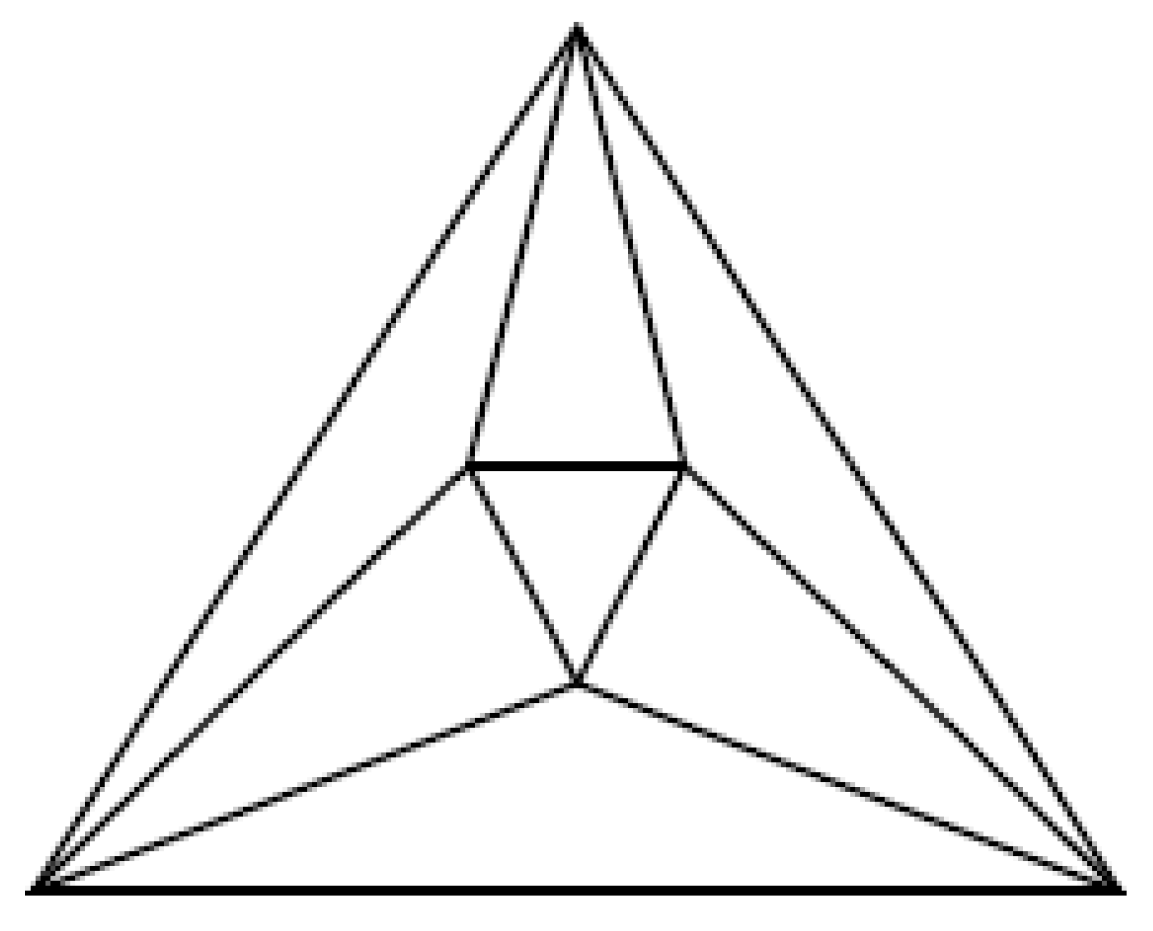
An octahedron graph, as shown in
Figure 1, is a polyhedral graph corresponding to the skeleton of the octahedron, one of the five Platonic solids. This Platonic graph consists of six vertices and 12 edges. The analogs of this structure play vital roles in the field of reticular chemistry, which deals with the synthesis and properties of metal-organic frameworks [
11,
29].
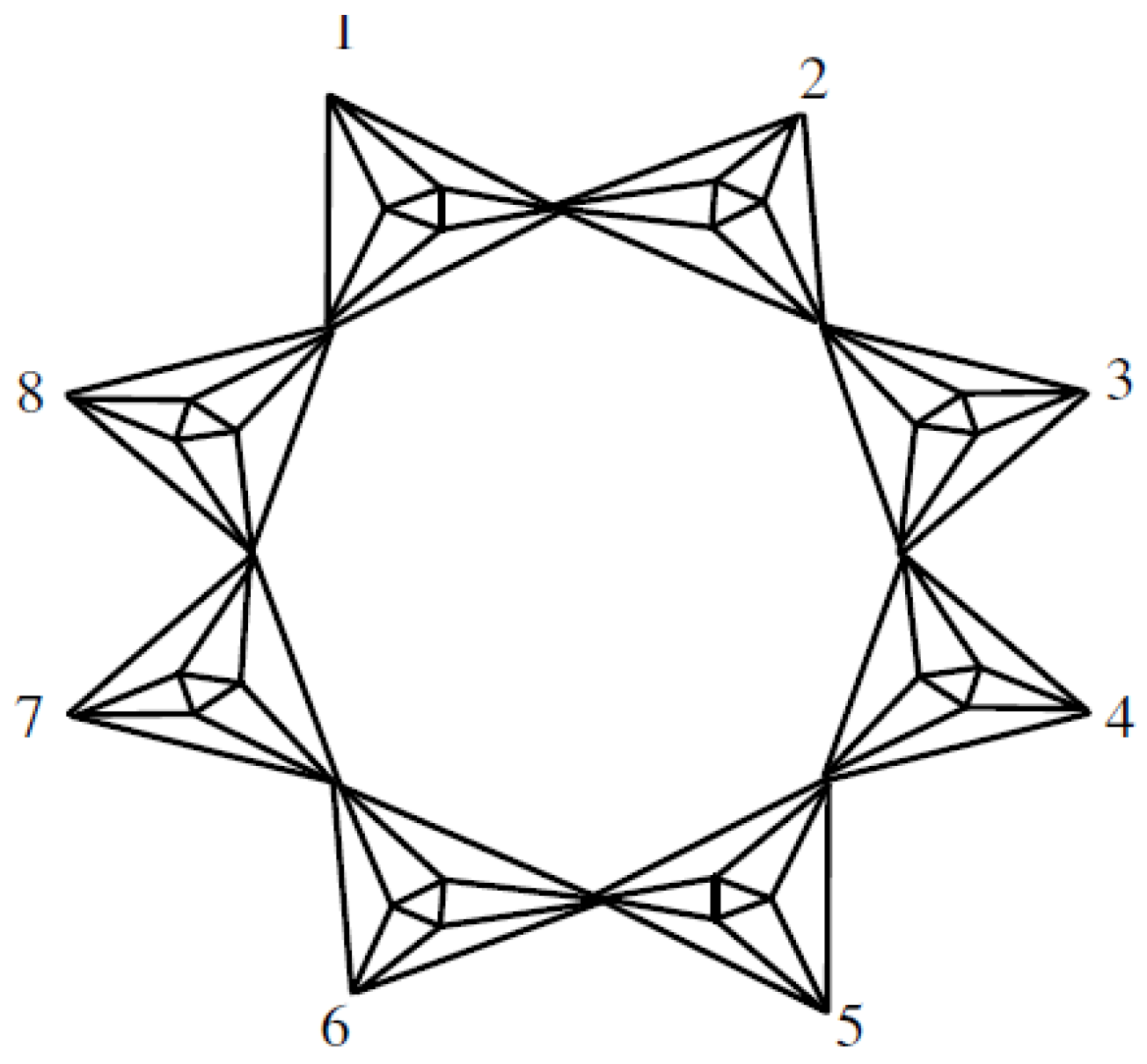
The different types of octahedral structures arise from the ways that these octahedra can be connected. The cyclic octahedral structure of dimension
n is denoted by
, and it is obtained by arranging
n octahedra in cyclic order, as shown in
Figure 2. For
,
consists of
vertices and
edges. To compute the said indices and polynomials, we partitioned the vertices and edges of
in certain ways in
Table 2,
Table 3,
Table 4,
Table 5,
Table 6 and
Table 7. To understand the tables and the partitions that they describe, we give detailed captions of each table. We computed the exact formulas for the above mentioned topological indices of the cyclic octahedral structure as follows.
2.1. Eccentric Connectivity Polynomial
Then, using the following theorems, we computed the eccentric polynomial of the cyclic octahedron structure ().
Theorem 1. Let , for all , where n is odd, be the cyclic octahedron structure. Then, the eccentric polynomial of is Proof. Let , where n is odd, be the cyclic octahedron structure containing vertices and edges.
The formula of the eccentric polynomial is
Using the vertex partition from
Table 1, we obtained the following computations:
☐
Theorem 2. Let , for all where n is even, be the cyclic octahedron structure. Then, the eccentric polynomial of is Proof. Let , where n is even, be the cyclic octahedron structure containing vertices and edges.
The formula of the eccentric polynomial is
Using the vertex partition from
Table 2, we obtained the following computations:
☐
2.2. Eccentric Connectivity Index
Then, using the following theorems, we computed the eccentric connectivity index of the cyclic octahedron structure ().
Theorem 3. Let , for all , where n is odd, be the cyclic octahedron structure. Then, the eccentric connectivity index of is Proof. Let , where n is even, be the cyclic octahedron structure containing vertices and edges.
The formula of the eccentric connectivity index is:
Using the vertex partition from
Table 1, we obtained the following computations:
☐
Theorem 4. Let , for all , where n is even, be the cyclic octahedron structure. Then, the eccentric connectivity index of is Proof. Let , where n is even, be the cyclic octahedron structure containing vertices and edges.
The formula of the eccentric connectivity index is
Using the vertex partition from
Table 2, we obtained the following computations:
☐
2.3. Total Eccentricity Index
Then, using the following theorems, we computed the total eccentricity index of the cyclic octahedron structure ().
Theorem 5. Let , for all , where n is odd, be the cyclic octahedron structure. Then, the total eccentricity index (ζ) of is Proof. Let , where n is odd, be the cyclic octahedron structure containing vertices and edges.
The formula of the total eccentricity index is
Using the vertex partitioned from
Table 3, we obtained the following computations:
☐
Theorem 6. Let , for all , where n is even, be the cyclic octahedron structure, then the total eccentricity index (ζ) of is Proof. Let , where n is even, be the cyclic octahedron structure containing vertices and edges.
The formula of the total eccentricity index is
Using the vertex partitioned from
Table 4, we obtained the following computations
☐
2.4. Average Eccentricity Index
In this section, we describe how the average eccentricity index of the cyclic octahedron structure () was determined.
Theorem 7. Let , for all , where n is odd, be the cyclic octahedron structure. Then, the average eccentricity index () is Proof. Let , where n is odd, be the cyclic octahedron structure containing vertices and edges.
The formula of the average eccentricity index is
Using the vertex partitioned from
Table 3, we obtained the following computations:
☐
Theorem 8. Let , for all , where n is even, be the cyclic octahedron structure. Then, the average eccentricity index () is Proof. Let , where n is even, be the cyclic octahedron structure containing vertices and edges.
The formula of the average eccentricity index is
Using the vertex partitioned from
Table 4, we obtained the following computations:
☐
2.5. First Zagreb Eccentricity Index
In this section, we describe how we found the first Zagreb eccentricity index of the cyclic octahedron structure ().
Theorem 9. Let for all , where n is odd, be the cyclic octahedron structure. Then, the first Zagreb eccentricity index is Proof. Let , where n is odd, be the cyclic octahedron structure containing vertices and edges.
The general formula of the first Zagreb eccentricity index is
By using the values from
Table 5, we obtained
☐
Theorem 10. Let for all , where n is even, be the cyclic octahedron structure. Then, the first Zagreb eccentricity index () is Proof. Let , where n is even, be the cyclic octahedron structure containing vertices and edges.
The general formula of the first Zagreb eccentricity index is
By using the values from
Table 6, we obtained
☐
2.6. Second Zagreb Eccentricity Index
In this section, we describe how we found the second Zagreb eccentricity index of the cyclic octahedron structure ().
Theorem 11. Let for all , where n is odd, be the cyclic octahedron structure. Then, the second Zagreb eccentricity index () is Proof. Let , where n is odd, be the cyclic octahedron structure containing vertices and edges.
The general formula of the second Zagreb eccentricity index is
By using the values from
Table 3, we obtained
☐
Theorem 12. Let for all , where n is even, be the cyclic octahedron structure. Then, the second Zagreb eccentricity index () is Proof. Let , where n is even, be the cyclic octahedron structure containing vertices and edges.
The general formula of the second Zagreb eccentricity index is
By using the values from
Table 4, we obtained
☐
2.7. Third Zagreb Eccentricity Index
In this section we describe how we found the third Zagreb eccentricity index of the cyclic octahedron structure ().
Theorem 13. Let for all , where n is odd, be the cyclic octahedron structure. Then, the third Zagreb eccentricity index () is Proof. Let , where n is odd, be the cyclic octahedron structure containing vertices and edges.
The general formula of the third Zagreb eccentricity index is
By using the values from
Table 5, we obtained
☐
Theorem 14. Let for all , where n is even, be the cyclic octahedron structure. Then, the third Zagreb eccentricity index is Proof. Let , where n is even, be the cyclic octahedron structure contains vertices and edges.
The general formula of the third Zagreb eccentricity index is
By using the values from
Table 6, we obtained
☐
2.8. Geometric-Arithmetic Index
In this section, we describe how we found the eccentricity-based geometric-arithmetic index of the cyclic octahedron structure .
Theorem 15. Let for all , where n is odd, be the cyclic octahedron structure. Then the geometric-arithmetic index () is Proof. Let , where n is odd, be the cyclic octahedron structure containing vertices and edges.
The general formula of the eccentricity-based geometric-arithmetic index is
Using the edge partitioned from
Table 5, we obtained the following computations:
☐
Theorem 16. Let for all , where n is even, be the cyclic octahedron structure. Then the geometric-arithmetic index () is Proof. Let , where n is even, be the cyclic octahedron structure containing vertices and edges.
The general formula of the eccentricity-based geometric-arithmetic index is
Using the edge partitioned from
Table 6, we obtained the following computations:
☐
2.9. Atom Bond Connectivity Index
In this section, we desscribe how we found the eccentricity-based atom bond connectivity index of the cyclic octahedron structure ().
Theorem 17. Let for all , where n is odd, be the cyclic octahedron structure. Then, the atom bond connectivity index () is Proof. Let , where n is odd, be the cyclic octahedron structure containing vertices and edges.
The general formula of the eccentricity-based atom bond connectivity index is
Using the edge partitioned from
Table 5, we obtained the following computations:
☐
Theorem 18. Let for all , where n is even, be the cyclic octahedron structure. Then the atom bond connectivity index () is Proof. Let , where n is even, be the cyclic octahedron structure containing vertices and edges.
The general formula of the eccentricity-based atom bond connectivity index is
Using the edge partitioned from
Table 6, we obtained the following computations:
☐