


Abstract
Finding a repeated zero for a nonlinear equation , has always been of much interest and attention due to its wide applications in many fields of science and engineering. Modified Newton’s method is usually applied to solve this kind of problems. Keeping in view that very few optimal higher-order convergent methods exist for multiple roots, we present a new family of optimal eighth-order convergent iterative methods for multiple roots with known multiplicity involving a multivariate weight function. The numerical performance of the proposed methods is analyzed extensively along with the basins of attractions. Real life models from life science, engineering, and physics are considered for the sake of comparison. The numerical experiments and dynamical analysis show that our proposed methods are efficient for determining multiple roots of nonlinear equations.
1. Introduction
It is well-known that Newton’s method converges linearly for non-simple roots of a nonlinear equation. For obtaining multiple roots of a univariate nonlinear equation with a quadratic order of convergence, Schröder [1] modified Newton’s method with prior knowledge of the multiplicity of the root as follows:
Scheme (1) can determine the desired multiple root with quadratic convergence and is optimal in the sense of Kung-Traub’s conjecture [2] that any multipoint method without memory can reach its convergence order of at most for p functional evaluations.
In the last few decades, many researchers have worked to develop iterative methods for finding multiple roots with greater efficiency and higher order of convergence. Among them, Li et al. [3] in 2009, Sharma and Sharma [4] and Li et al. [5] in 2010, Zhou et al. [6] in 2011, Sharifi et al. [7] in 2012, Soleymani et al. [8], Soleymani and Babajee [9], Liu and Zhou [10] and Zhou et al. [11] in 2013, Thukral [12] in 2014, Behl et al. [13] and Hueso et al. [14] in 2015, and Behl et al. [15] in 2016 presented optimal fourth-order methods for multiple zeros. Additionally, Li et al. [5] (among other optimal methods) and Neta [16] presented non-optimal fourth-order iterative methods. In recent years, efforts have been made to obtain an optimal scheme with a convergence order greater than four for multiple zeros with multiplicity of univariate function. Some of them only succeeded in developing iterative schemes of a maximum of sixth-order convergence, in the case of multiple zeros; for example, see [17,18]. However, there are only few multipoint iterative schemes with optimal eighth-order convergence for multiple zeros which have been proposed very recently.
Behl et al. [19] proposed a family of optimal eighth-order iterative methods for multiple roots involving univariate and bivariate weight functions given as:
where weight functions and are analytical in neighborhoods of and respectively, with and being and complex nonzero free parameters.
A second optimal eighth-order scheme involving parameters has been proposed by Zafar et al. [20], which is given as follows:
where , are free parameters and the weight functions and are analytic in the neighborhood of 0 with and
Recently, Geum et al. [21] presented another optimal eighth-order method for multiple roots:
where is analytic in the neighborhood of 0 and is holomorphic in the neighborhood of with
Behl et al. [22] also developed another optimal eighth-order method involving free parameters and a univariate weight function as follows:
where are two free disposable parameters and the weight function is an analytic function in a neighborhood of 0 with
Most recently, Behl at al. [23] presented an optimal eighth-order method involving univariate weight functions given as:
where , are free parameters and the weight functions are analytic in the neighborhood of 0 with and
Motivated by the research going on in this direction and with a need to give more stable optimal higher-order methods, we propose a new family of optimal eighth-order iterative methods for finding simple as well as multiple zeros of a univariate nonlinear function with multiplicity . The derivation of the proposed class is based on a univariate and trivariate weight function approach. In addition, our proposed methods not only give the faster convergence but also have smaller residual error. We have demonstrated the efficiency and robustness of the proposed methods by performing several applied science problems for numerical tests and observed that our methods have better numerical results than those obtained by the existing methods. Further, the dynamical performance of these methods on the above mentioned problems supports the theoretical aspects, showing a good behavior in terms of dependence on initial estimations.
The rest of the paper is organized as follows: Section 2 provides the construction of the new family of iterative methods and the analysis of convergence to prove the eighth order of convergence. In Section 3, some special cases of the new family are defined. In Section 4, the numerical performance and comparison of some special cases of the new family with the existing ones are given. The numerical comparisons is carried out using the nonlinear equations that appear in the modeling of the predator–prey model, beam designing model, electric circuit modeling, and eigenvalue problem. Additionally, some dynamical planes are provided to compare their stability with that of known methods. Finally, some conclusions are stated in Section 5.
2. Construction of the Family
This section is devoted to the main contribution of this study, the design and convergence analysis of the proposed scheme. We consider the following optimal eighth-order class for finding multiple zeros with multiplicity :
where and are analytical functions in a neighborhood of and respectively being and .
In the next result, we demonstrate that the order of convergence of the proposed family reaches optimal order eight.
Theorem 1.
Let us consider (say) is a zero with multiplicity of the involved function f. In addition, we assume that is an analytical function in the region enclosing the multiple zero ξ. The proposed class defined by Equation (7) has an optimal eighth order of convergence, when the following conditions are satisfied:
where for .
Proof.
Let us assume that is the error at nth step. By expanding and about using Taylor series expansion, we have:
and:
respectively, where .
By inserting the above Equations (9) and (10), in the first substep of Equation (7), we obtain:
where are given in terms of with two explicitly written coefficients and etc.
With the help of Taylor series expansion and Equation (11), we get:
It is clear from Equation (13) that is of order one. Therefore, we can expand the weight function in the neighborhood of origin by Taylor series expansion up to third-order terms for eighth-order convergence as follows:
Now, by inserting Equations (11)–(14) in the second substep of the proposed class (Equation (7)), we obtain:
where , .
In order to obtain fourth-order convergence, the coefficients of and must be simultaneously equal to zero. Thus, from Equation (15), we obtain the following values of and
Using Equation (16), we have:
where ,
Hence, it is clear from Equation (13) that and are of order 2 and 3, respectively. Therefore, we can expand weight function in the neighborhood of by Taylor series expansion up to second-order terms as follows:
where for .
From Equation (22), it is clear that we can easily obtain at least cubic order of convergence, for:
Moreover, for , we also have:
Thus, we take:
Thus, by inserting Equation (24), it results that and:
Therefore, by taking:
we have at least a sixth-order convergence. Additionally, for :
which further yields:
Finally, we take:
where
3. Some Special Cases of Weight Function
In this section, we discuss some special cases of our proposed class (7) by assigning different kinds of weight functions. In this regard, please see the following cases, where we have mentioned some different members of the proposed family.
Case 1: Let us describe the following polynomial weight functions directly from the hypothesis of Theorem 1:
where and are free parameters.
Case 1A: When we obtain the corresponding optimal eighth-order iterative method as follows:
Case 2: Now, we suggest a mixture of rational and polynomial weight functions satisfying condition Equation (8) as follows:
where and , and are free parameters.
Case 2A: When , the corresponding optimal eighth-order iterative scheme is given by:
Case 3: Now, we suggest another rational and polynomial weight function satisfying Equation (8) as follows:
where and , and are free.
Case 3A: By choosing , , , , the corresponding optimal eighth-order iterative scheme is given by:
In a similar way, we can develop several new and interesting optimal schemes with eighth-order convergence for multiple zeros by considering new weight functions which satisfy the conditions of Theorem 1.
4. Numerical Experiments
This section is devoted to demonstrating the efficiency, effectiveness, and convergence behavior of the presented family. In this regard, we consider some of the special cases of the proposed class, namely, Equations (31), (33) and (35), denoted by , , and , respectively. In addition, we choose a total number of four test problems for comparison: The first is a predator–prey model, the second is a beam designing problem, the third is an electric circuit modeling for simple zeros, and the last is an eigenvalue problem.
Now, we want to compare our methods with other existing robust schemes of the same order on the basis of the difference between two consecutive iterations, the residual errors in the function, the computational order of convergence , and asymptotic error constant . We have chosen eighth-order iterative methods for multiple zeros given by Behl et al. [19,23]. We take the following particular case (Equation (27)) for (, , ) of the family by Behl et al. [19] and denote it by as follows:
From the eighth-order family of Behl et al. [23], we consider the following special case denoted by :
Table 1, Table 2, Table 3 and Table 4 display the number of iteration indices , the error in the consecutive iterations , the computational order of convergence (the formula by Jay [24]), the absolute residual error of the corresponding function , and the asymptotical error constant . We did our calculations with 1000 significant digits to minimize the round-off error. We display all the numerical values in Table 1, Table 2, Table 3 and Table 4 up to 7 significant digits with exponent. Finally, we display the values of approximated zeros up to 30 significant digits in Examples 1–4, although a minimum of 1000 significant digits are available with us.
Table 1.
Comparison of different multiple root finding methods for .
Table 2.
Comparison of different multiple root finding methods for .
Table 3.
Comparison of different multiple root finding methods for .
Table 4.
Comparison of different multiple root finding methods for .
For computer programming, all computations have been performed using the programming package 16 with multiple precision arithmetics. Further, the meaning of is in Table 1, Table 2, Table 3 and Table 4.
Now, we explain the real life problems chosen for the sake of comparing the schemes as follows:
Example 1 (Predator-Prey Model).
Let us consider a predator-prey model with ladybugs as predators and aphids as preys [25]. Let x be the number of aphids eaten by a ladybug per unit time per unit area, called the predation rate, denoted by . The predation rate usually depends on prey density and is given as:
Let the growth of aphids obey the Malthusian model; therefore, the growth rate of aphids G per hour is:
The problem is to find the aphid density x for which:
This gives:
Let aphids eaten per hour, aphids and per hour. Thus, we are required to find the zero of:
The desired zero of is with . We choose
Example 2 (Beam Designing Model).
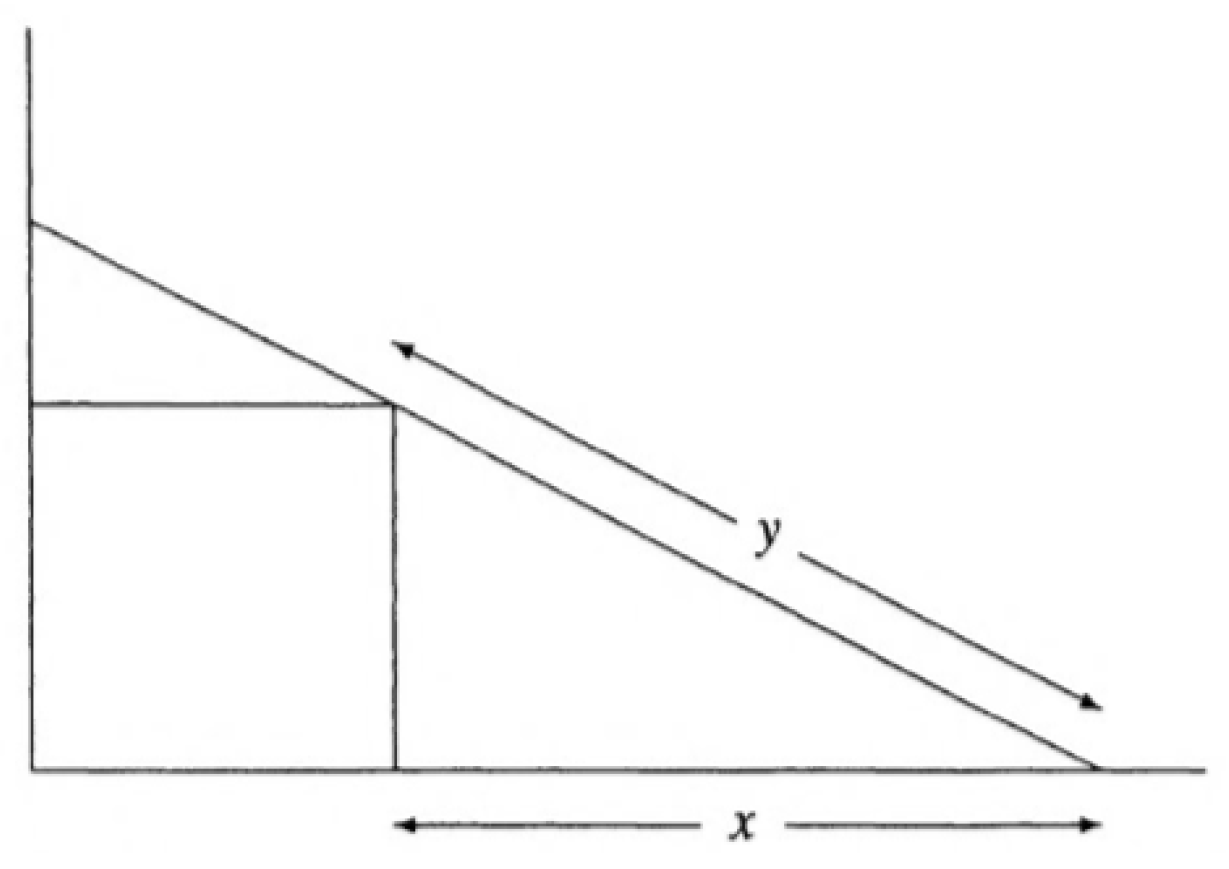
We consider a beam positioning problem (see [26]) where an r meter long beam is leaning against the edge of the cubical box with sides of length 1 m each, such that one of its ends touches the wall and the other touches the floor, as shown in Figure 1.
Figure 1.
Beam positioning problem.
What should be the distance along the floor from the base of the wall to the bottom of the beam? Let y be the distance in meters along the beam from the floor to the edge of the box and let x be the distance in meters from the bottom of the box to the bottom of the beam. Then, for a given value of r, we have:
The positive solution of the equation is a double root . We consider the initial guess
Example 3 (The Shockley Diode Equation and Electric Circuit).
Let us consider an electric circuit consisting of a diode and a resistor. By Kirchoff’s voltage law, the source voltage drop is equal to the sum of the voltage drops across the diode and resistor
Let the source voltage be V and from Ohm’s law:
Additionally, the voltage drop across the diode is given by the Shockley diode equation as follows:
where I is the diode current in amperes, is saturation current (amperes), n is the emission or ideality constant ( for silicon diode), and is the voltage applied across the diode. Solving Equation (40) for and using all the values in Equation (38), we obtain:
Now, for the given values of n, , R and , we have the following equation [27]:
Replacing I with x, we have
The true root of the equation is . We take
Example 4 (Eigenvalue Problem).
One of the challenging task of linear algebra is to calculate the eigenvalues of a large square matrix, especially when the required eigenvalues are the zeros of the characteristic polynomial obtained from the determinant of a square matrix of order greater than 4. Let us consider the following 9 × 9 matrix:
The corresponding characteristic polynomial of matrix A is given as follows:
The above function has one multiple zero at of multiplicity 4 with initial approximation .
In Table 1, Table 2, Table 3 and Table 4, we show the numerical results obtained by applying the different methods for approximating the multiple roots of . The obtained values confirm the theoretical results. From the tables, it can be observed that our proposed schemes , , and exhibit a better performance in approximating the multiple root of and among other similar methods. Only in the case of the example for simple zeros Behl’s scheme BM1 is performing slightly better than the other methods.
Dynamical Planes
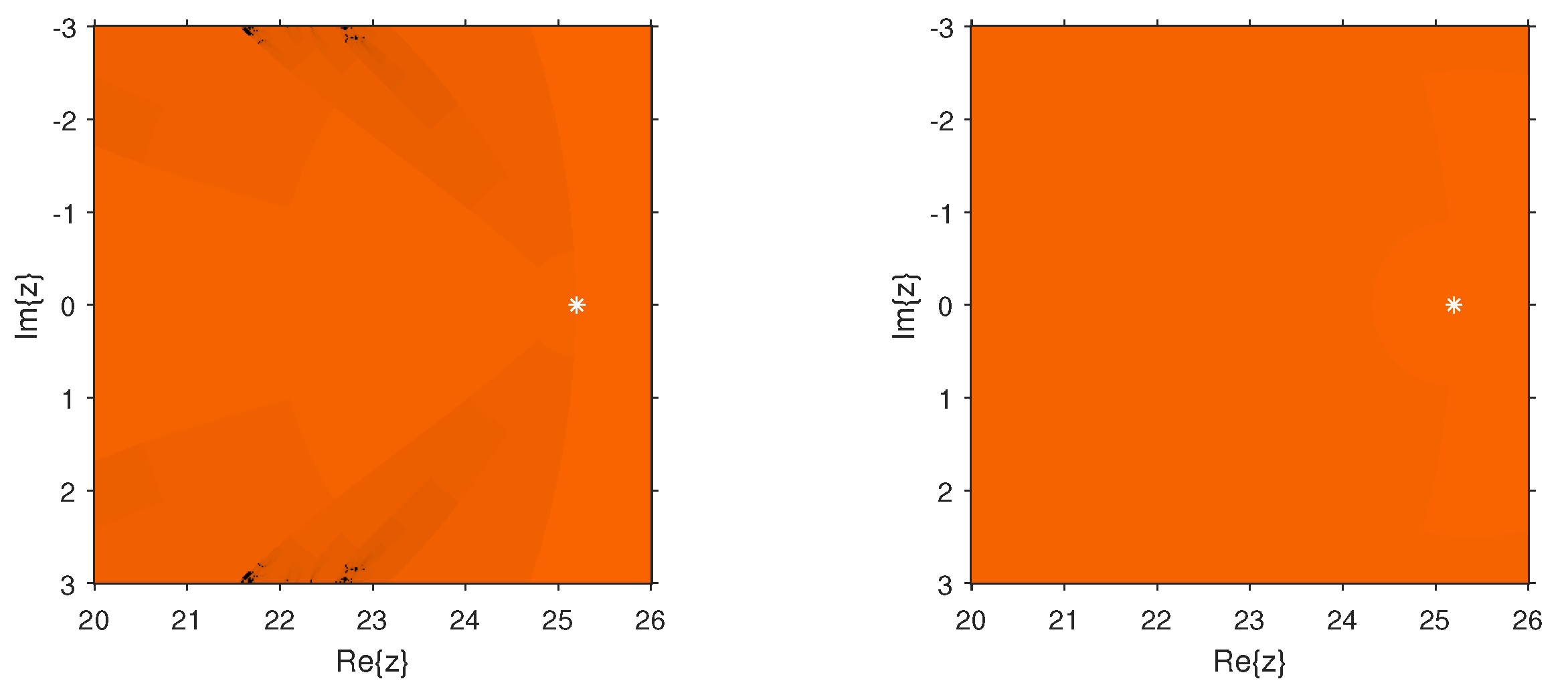
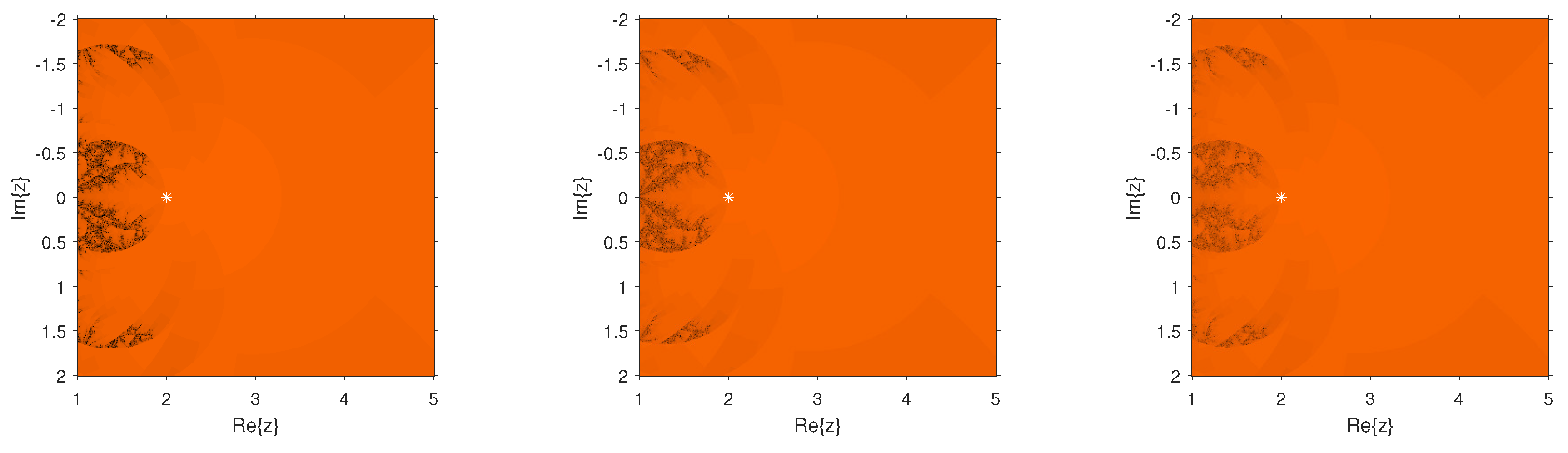
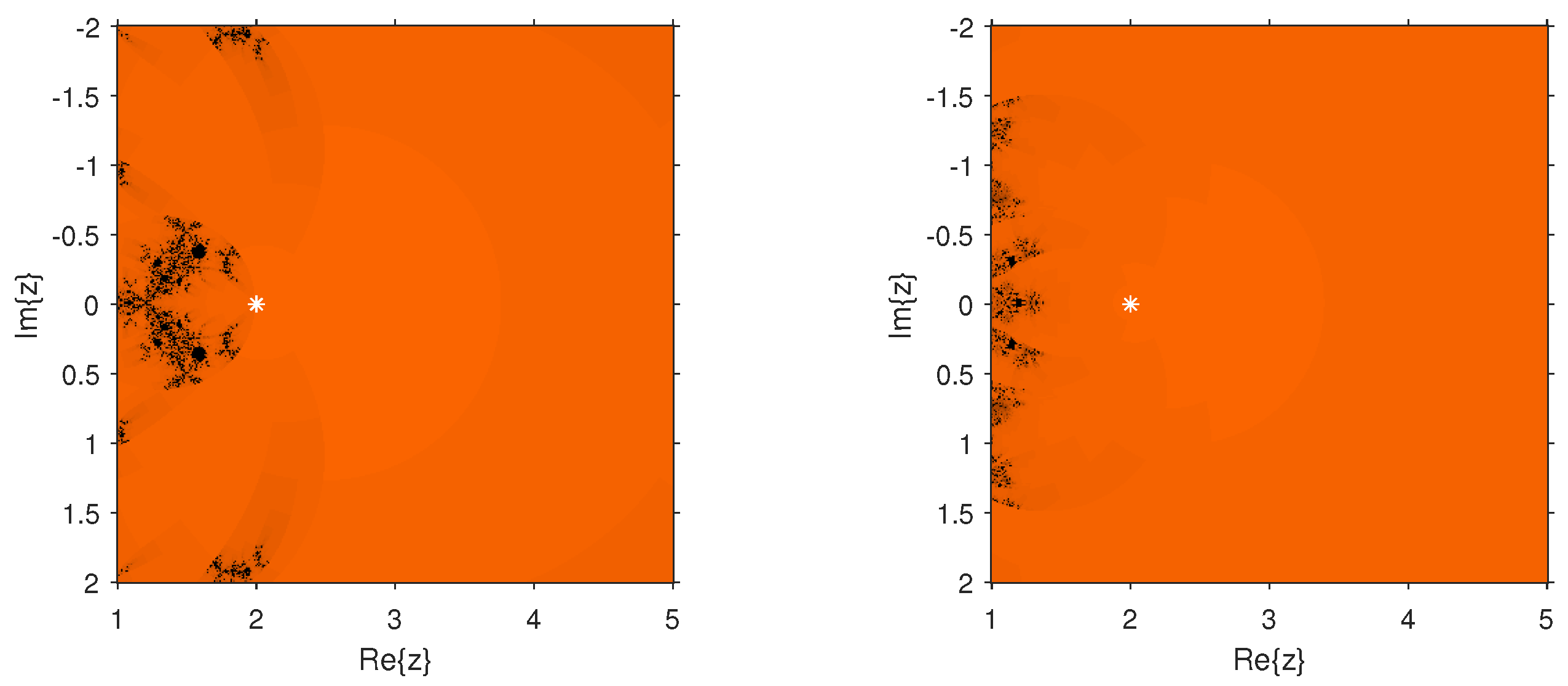
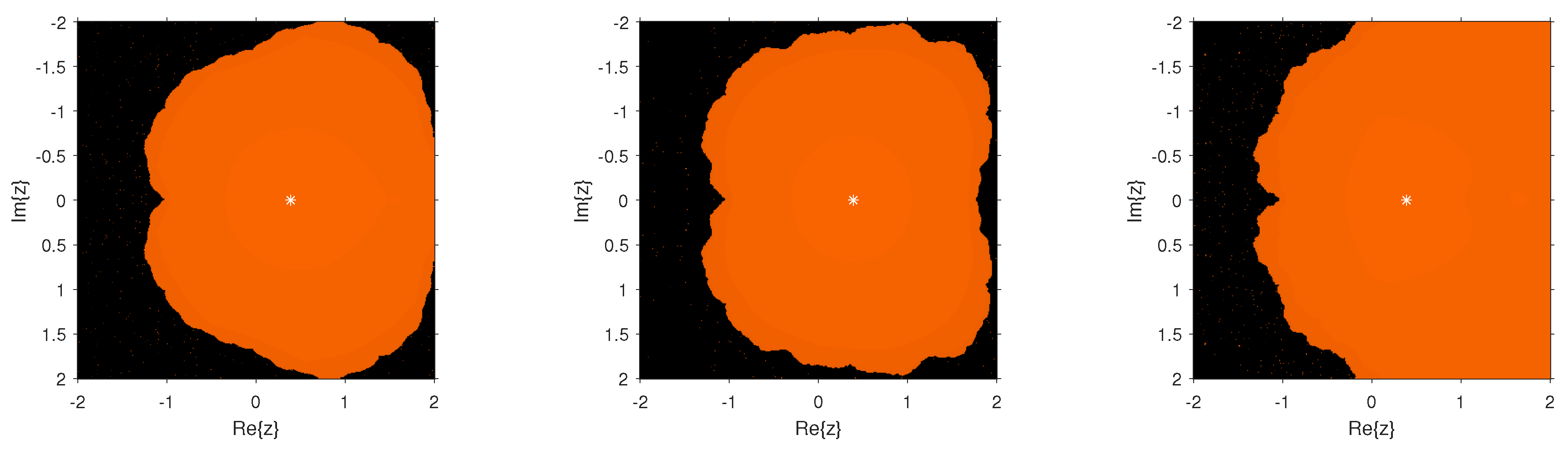
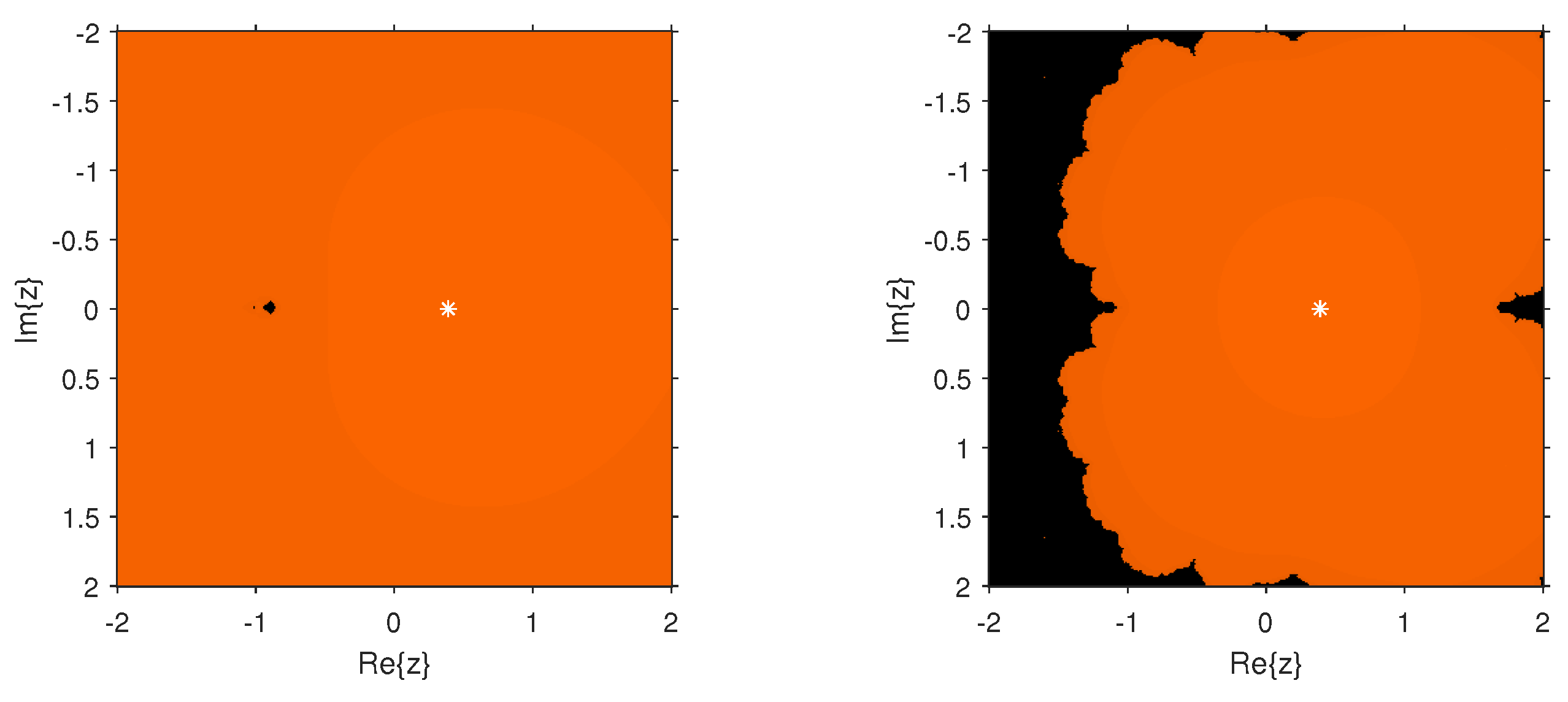
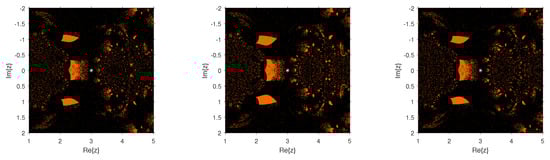
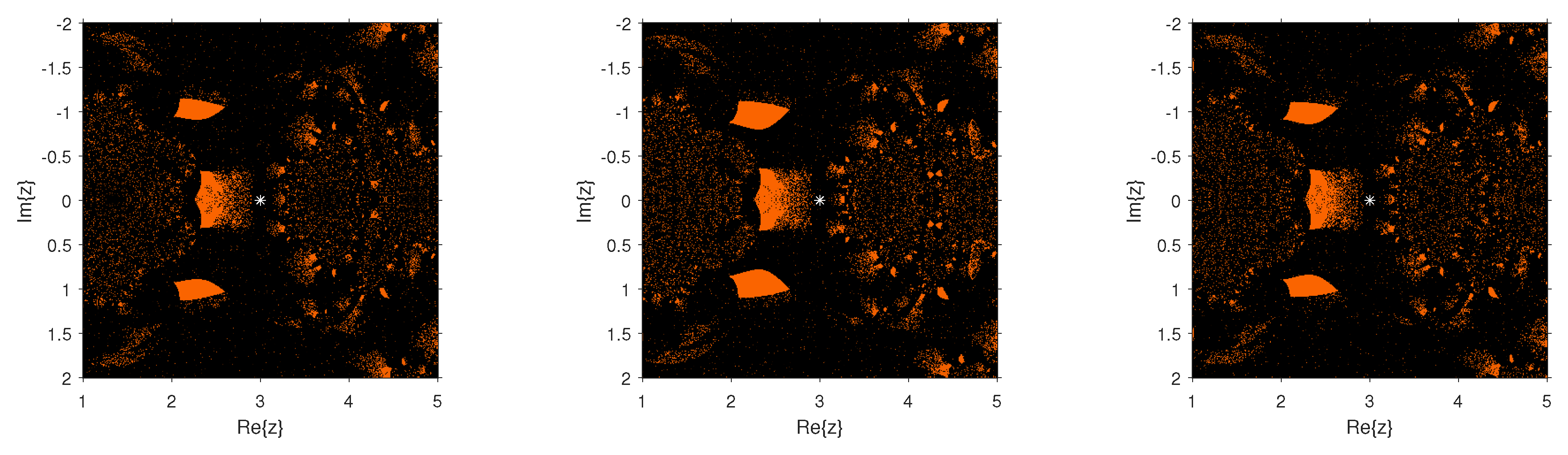
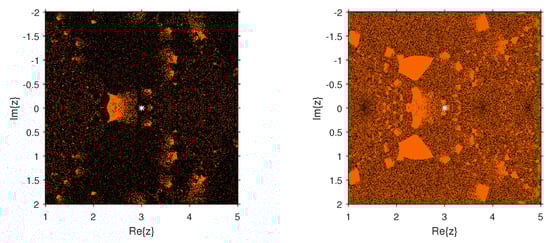
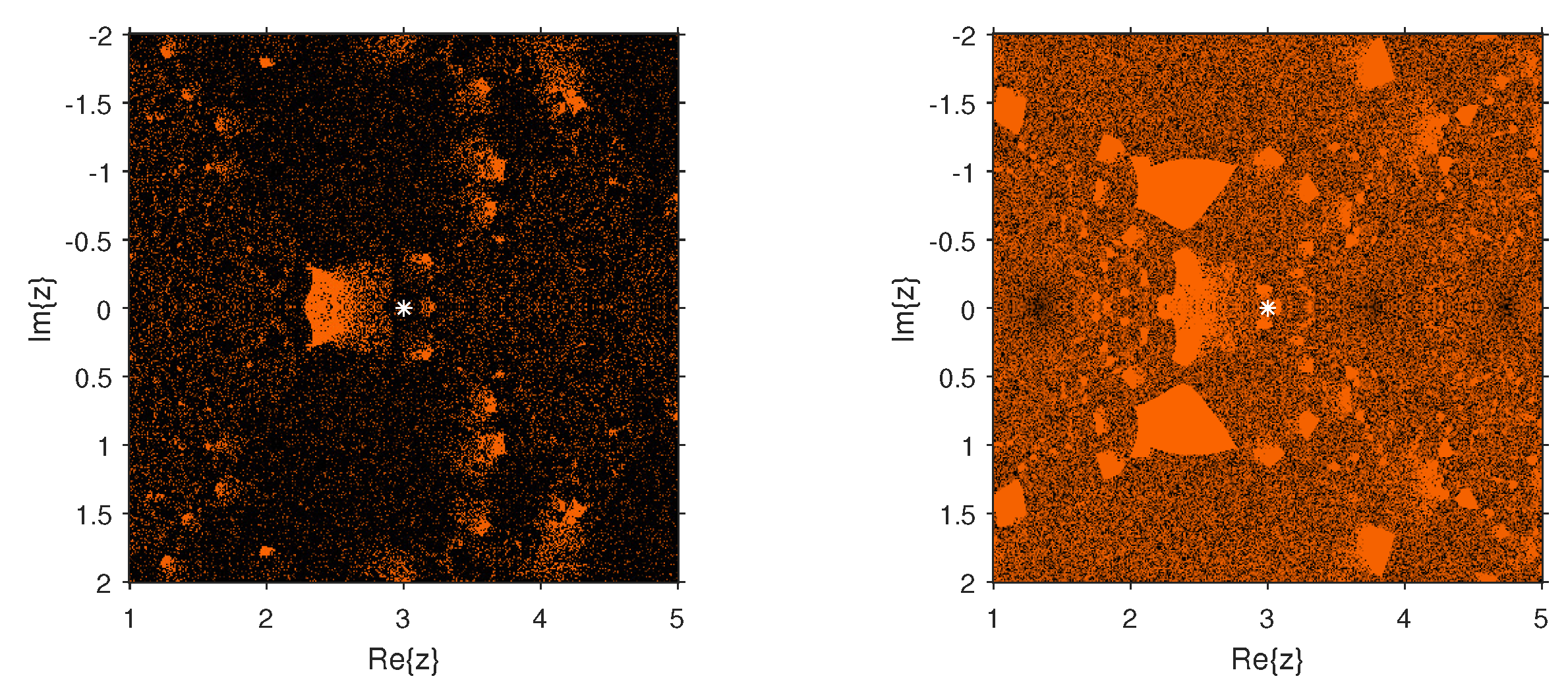
The dynamical behavior of the test functions is presented in Figure 2, Figure 3, Figure 4, Figure 5, Figure 6, Figure 7, Figure 8 and Figure 9. The dynamical planes have been generated using the routines published in Reference [28]. We used a mesh of points in the region of the complex plane . We painted in orange the points whose orbit converged to the multiple root and in black those points whose orbit either diverged or converged to a strange fixed point or a cycle. We worked out with a tolerance of and a maximum number of 80 iterations. The multiple root is represented in the different figures by a white star.
Figure 2.
Dynamical planes of the methods (Left), (Center), and (Right) for .
Figure 3.
Dynamical planes of the methods (Left) and (Right) for .
Figure 4.
Dynamical planes of the methods (Left), (Center), and (Right) for .
Figure 5.
Dynamical planes of the methods (Left) and (Right) on .
Figure 6.
Dynamical planes of the methods (Left), (Center), and (Right) for .
Figure 7.
Dynamical planes of the methods (Left) and (Right) for .
Figure 8.
Dynamical planes of the methods (Left), (Center), and (Right) on .
Figure 9.
Dynamical planes of the methods (Left) and (Right) for .
Figure 2, Figure 3, Figure 4, Figure 5, Figure 6, Figure 7, Figure 8 and Figure 9 study the convergence and divergence regions of the new schemes , , and in comparison with the other schemes of the same order. In the case of and , we observed that the new schemes are more stable than and as they are almost divergence-free and also converge faster than and in their common regions of convergence. In the case of performs better; however, , , and have an edge over for the region in spite of the analogous behavior to , as the new schemes show more robustness. Similarly, in the case of it can be clearly observed that the divergence region for is bigger than that for , , and . Additionally, these schemes perform better than where they are convergent. The same behavior can be observed through the numerical comparison of these methods in Table 1, Table 2, Table 3 and Table 4. As a future extension, we shall be trying to construct a new optimal eighth-order method whose stability analysis can allow to choose the optimal weight function for the best possible results.
5. Conclusions
In this manuscript, a new general class of optimal eighth-order methods for solving nonlinear equations with multiple roots was presented. This family was obtained using the procedure of weight functions with two functions: One univariate and another depending on three variables. To reach this optimal order, some conditions on the functions and their derivatives must be imposed. Several special cases were selected and applied to different real problems, comparing their performance with that of other known methods of the same order of convergence. Finally, their dependence on initial estimations was analyzed from their basins of attraction.
Author Contributions
Methodology, F.Z.; writing original draft preparation, F.Z.; writing review and editing, J.R.T.; visualization, A.C.; supervision, J.R.T.
Funding
This research was partially supported byMinisterio de Economía y Competitividad MTM2014-52016-C2-2-P, by Generalitat Valenciana PROMETEO/2016/089 and Schlumberger Foundation-Faculty for Future Program.
Conflicts of Interest
The authors declare no conflict of interest.
References
- Schroder, E. Uber unendlich viele Algorithmen zur Auflosung der Gleichungen. Math. Ann. 1870, 2, 317–365. [Google Scholar] [CrossRef] [Scilit]
- Kung, H.T.; Traub, J.F. Optimal order of one-point and multipoint iteration. J. Assoc. Comput. Mach. 1974, 21, 643–651. [Google Scholar] [CrossRef] [Scilit]
- Li, S.; Liao, X.; Cheng, L. A new fourth-order iterative method for finding multiple roots of nonlinear equations. Appl. Math. Comput. 2009, 215, 1288–1292. [Google Scholar]
- Sharma, J.R.; Sharma, R. Modified Jarratt method for computing multiple roots. Appl. Math. Comput. 2010, 217, 878–881. [Google Scholar] [CrossRef] [Scilit]
- Li, S.G.; Cheng, L.Z.; Neta, B. Some fourth-order nonlinear solvers with closed formulae for multiple roots. Comput. Math. Appl. 2010, 59, 126–135. [Google Scholar] [CrossRef] [Scilit]
- Zhou, X.; Chen, X.; Song, Y. Constructing higher-order methods for obtaining the muliplte roots of nonlinear equations. J. Comput. Math. Appl. 2011, 235, 4199–4206. [Google Scholar] [CrossRef] [Scilit]
- Sharifi, M.; Babajee, D.K.R.; Soleymani, F. Finding the solution of nonlinear equations by a class of optimal methods. Comput. Math. Appl. 2012, 63, 764–774. [Google Scholar] [CrossRef] [Scilit]
- Soleymani, F.; Babajee, D.K.R.; Lofti, T. On a numerical technique forfinding multiple zeros and its dynamic. J. Egypt. Math. Soc. 2013, 21, 346–353. [Google Scholar] [CrossRef] [Scilit]
- Soleymani, F.; Babajee, D.K.R. Computing multiple zeros using a class of quartically convergent methods. Alex. Eng. J. 2013, 52, 531–541. [Google Scholar] [CrossRef] [Scilit]
- Liu, B.; Zhou, X. A new family of fourth-order methods for multiple roots of nonlinear equations. Non. Anal. Model. Cont. 2013, 18, 143–152. [Google Scholar]
- Zhou, X.; Chen, X.; Song, Y. Families of third and fourth order methods for multiple roots of nonlinear equations. Appl. Math. Comput. 2013, 219, 6030–6038. [Google Scholar] [CrossRef] [Scilit]
- Thukral, R. A new family of fourth-order iterative methods for solving nonlinear equations with multiple roots. J. Numer. Math. Stoch. 2014, 6, 37–44. [Google Scholar]
- Behl, R.; Cordero, A.; Motsa, S.S.; Torregrosa, J.R. On developing fourth-order optimal families of methods for multiple roots and their dynamics. Appl. Math. Comput. 2015, 265, 520–532. [Google Scholar] [CrossRef] [Scilit]
- Hueso, J.L.; Martínez, E.; Teruel, C. Determination of multiple roots of nonlinear equations and applications. J. Math. Chem. 2015, 53, 880–892. [Google Scholar] [CrossRef] [Scilit]
- Behl, R.; Cordero, A.; Motsa, S.S.; Torregrosa, J.R.; Kanwar, V. An optimal fourth-order family of methods for multiple roots and its dynamics. Numer. Algor. 2016, 71, 775–796. [Google Scholar] [CrossRef] [Scilit]
- Neta, B. Extension of Murakami’s high-order non-linear solver to multiple roots. Int. J. Comput. Math. 2010, 87, 1023–1031. [Google Scholar] [CrossRef] [Scilit]
- Geum, Y.H.; Kim, Y.I.; Neta, B. A class of two-point sixth-order multiple-zero finders of modified double-Newton type and their dynamics. Appl. Math. Comput. 2015, 270, 387–400. [Google Scholar] [CrossRef] [Scilit]
- Geum, Y.H.; Kim, Y.I.; Neta, B. A sixth-order family of three-point modified Newton-like multiple-root finders and the dynamics behind their extraneous fixed points. Appl. Math. Comput. 2016, 283, 120–140. [Google Scholar] [CrossRef] [Scilit]
- Behl, R.; Cordero, A.; Motsa, S.S.; Torregrosa, J.R. An eighth-order family of optimal multiple root finders and its dynamics. Numer. Algor. 2017. [Google Scholar] [CrossRef] [Scilit]
- Zafar, F.; Cordero, A.; Rana, Q.; Torregrosa, J.R. Optimal iterative methods for finding multiple roots of nonlinear equations using free parameters. J. Math. Chem. 2017. [Google Scholar] [CrossRef] [Scilit]
- Geum, Y.H.; Kim, Y.I.; Neta, B. Constructing a family of optimal eighth-order modified Newton-type multiple-zero finders along with the dynamics behind their purely imaginary extraneous fixed points. J. Comput. Appl. Math. 2018, 333, 131–156. [Google Scholar] [CrossRef] [Scilit]
- Behl, R.; Zafar, F.; Alshomrani, A.S.; Junjua, M.; Yasmin, N. An optimal eighth-order scheme for multiple zeros of univariate function. Int. J. Comput. Math. 2018, 15. [Google Scholar] [CrossRef] [Scilit]
- Behl, R.; Alshomrani, A.S.; Motsa, S.S. An optimal scheme for multiple roots of nonlinear equations with eighth-order convergence. J. Math. Chem. 2018. [Google Scholar] [CrossRef] [Scilit]
- Jay, L.O. A note on Q-order of convergence. BIT Numer. Math. 2001, 41, 422–429. [Google Scholar] [CrossRef] [Scilit]
- Edelstein-Keshet, L. Differential Calculus for the Life Sciences; Univeristy of British Columbia: Vancouver, BC, Canada, 2017. [Google Scholar]
- Zachary, J.L. Introduction to Scientific Programming: Computational Problem Solving Using Maple and C; Springer: New York, NY, USA, 2012. [Google Scholar]
- Khoury, R. Douglas Wilhelm Harder, Numerical Methods and Modelling for Engineering; Springer International Publishing: Berlin, Germany, 2017. [Google Scholar]
- Chicharro, F.I.; Cordero, A.; Torregrosa, J.R. Drawing dynamical and parameters planes of iterative families and methods. Sci. World J. 2013, 2013, 780153. [Google Scholar] [CrossRef] [Scilit] [PubMed]



© 2018 by the authors. Licensee MDPI, Basel, Switzerland. This article is an open access article distributed under the terms and conditions of the Creative Commons Attribution (CC BY) license (http://creativecommons.org/licenses/by/4.0/).