


Abstract
Graph theory plays a substantial role in structuring and designing many problems. A number of structural designs with crossings can be found in real world scenarios. To model the vagueness and uncertainty in graphical network problems, many extensions of graph theoretical ideas are introduced. To deal with such uncertain situations, the present paper proposes the concept of Pythagorean fuzzy multigraphs and Pythagorean fuzzy planar graphs with some of their eminent characteristics by investigating Pythagorean fuzzy planarity value with strong, weak and considerable edges. A close association is developed between Pythagorean fuzzy planar and dual graphs. This paper also includes a brief discussion on non-planar Pythagorean fuzzy graphs and explores the concepts of isomorphism, weak isomorphism and co-weak isomorphism for Pythagorean fuzzy planar graphs. Moreover, it presents a problem that shows applicability of the proposed concept.
1. Introduction
Graph theory is rapidly moving into the core of mathematics due to its applications in various fields, including physics, biochemistry, biology, electrical engineering, astronomy, operations research and computer science. The theory of planar graphs is based on Euler’s polyhedral formula, which is related to the polyhedron edges, vertices and faces. In modern era, the applications of planar graphs occur naturally such as designing and structuring complex radio electronic circuits, railway maps, planetary gearbox and chemical molecules. While modeling an urban city, pipelines, railway lines, subway tunnels, electric transmission lines and metro lines are extremely important. Crossing is beneficial as it helps in utilizing less space and is inexpensive, but there are some drawbacks too. As the crossing of such lines is quite dangerous for human lives, but, by taking certain amount of security measures, it can be made. The crossing between the uncrowded route and crowded route is less risky as compared to the crossing between two crowded routes. In fuzzy graphs, the terms’ uncrowded route and crowded route referred to as weak edge and strong edge. The allowance of such crossings leads to fuzzy planar graph theory [1,2,3].
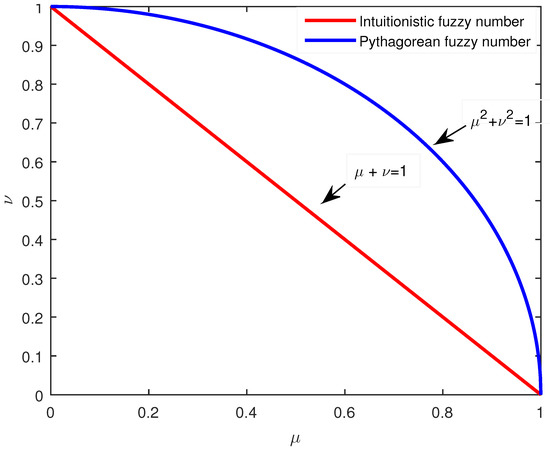
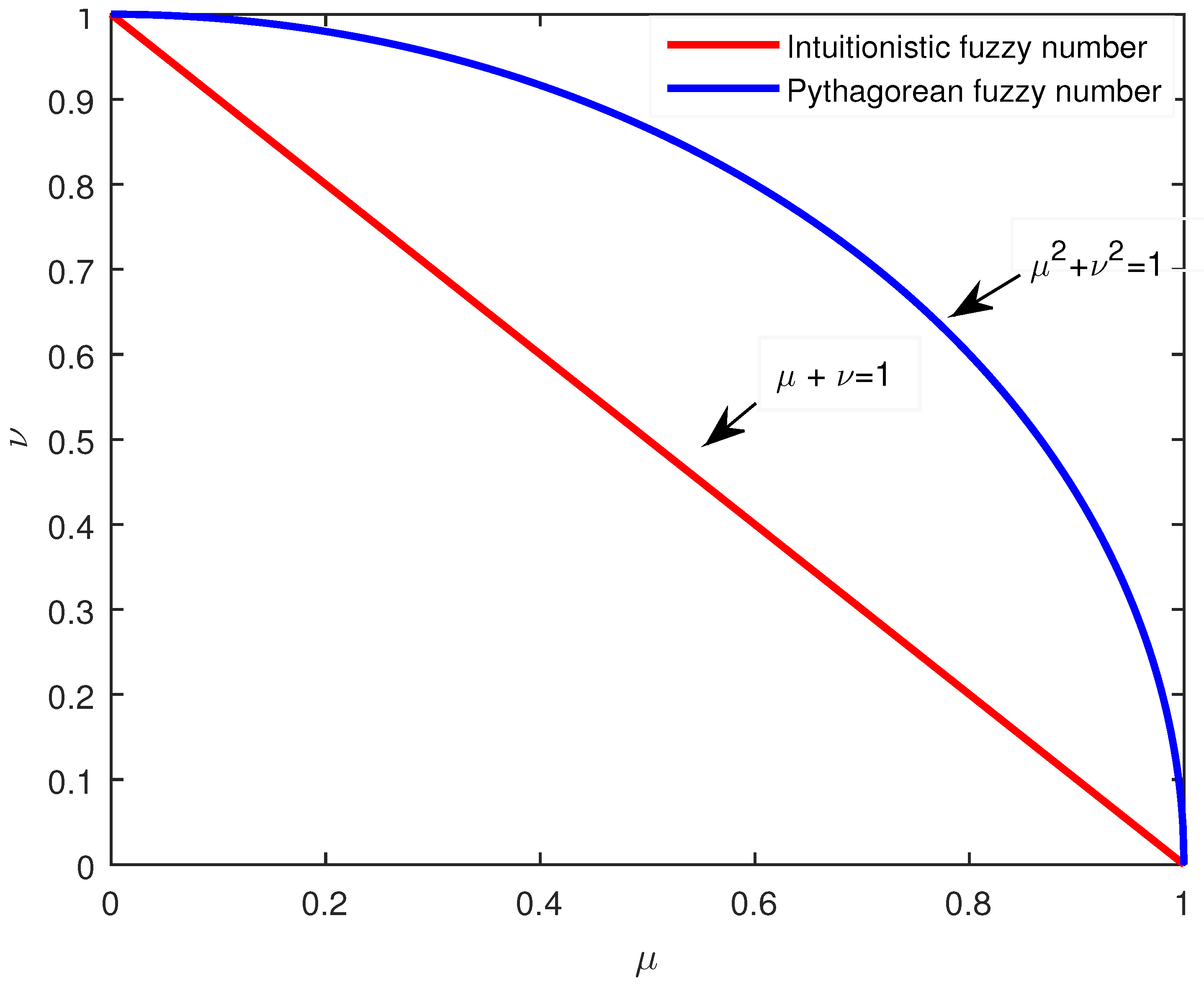
In the long-established mathematical models, the information about the complex phenomena is very precise. However, it is an impractical supposition that the exact information is sufficient to model the real world problems that involve inherent haziness. Fuzzy set theory, originally proposed by Zadeh [4], is the most efficient tool having the capability to deal with imprecise and incomplete information. To cope with imprecise and incomplete information, consisting of doubts in human judgement, the fuzzy set shows some restrictions. Hence, for characterizing the hesitancy more explicitly, fuzzy sets were extended to intuitionistic fuzzy sets (IFSs) by Atanassov [5], which assigns a membership grade and a nonmembership grade to the objects, satisfying the condition and the hesitancy part . The IFSs have gained extensive attention and have been broadly applied in different areas of real life. The limitation confines the choice of the membership and nonmembership grades in IFS. To evade this situation, Yager [6,7,8] initiated the idea of Pythagorean fuzzy set (PFS), depicted by a membership grade and a nonmembership grade with the condition . Zhang and Xu [9] introduced the concept of Pythagorean fuzzy number (PFN) for interpreting the dual aspects of an element. The motivation of PFSs can be described as, in a decision-making environment, a specialist gives the preference information about an alternative with the membership grade and the non-membership grade . It is noted that the IFN fails to address this situation, as . However, Thus, PFSs comprise more uncertainties than IFSs and are usually capable of accommodating greater degrees of uncertainty. The comparison between intuitionistic fuzzy number space and Pythagorean fuzzy number space is shown in Figure 1.
Figure 1.
Comparison of spaces of the IFN and the PFN.
Graphs are the pictorial representation that bond the objects and highlight their information. To emphasis a real-world problem, the bondedness between the objects occurs due to some relations. However, when there exists uncertainty and haziness in the bonding, then the corresponding graph model can be taken as a fuzzy graph model. In 1973, Kaufmann [10] presented the idea of fuzzy graphs, based on Zadeh’s fuzzy relation in 1971. Afterwards, Rosenfeld [11] discussed several basic graphs’ theoretical concepts in fuzzy graphs. Some remarks on fuzzy graphs were explored by Bhattacharya [12]. Mordeson and Peng [13] discussed fuzzy graphs’ operations and their properties. The concept of intuitionistic fuzzy relations and intuitionistic fuzzy graphs was initiated by Shannon and Atanassov [14] and some of their eminent properties were explored in [15]. Parvathi et al. [16] described operations on intuitionistic fuzzy graphs. Many new concepts involving intuitionistic fuzzy hypergraphs and strong intuitionistic fuzzy graphs were given by Akram et al. [17,18]. On the basis of Akram and Davvaz’s IFGs [17], Naz et al. [19] gave the idea of PFGs along with applications. Some results related to PFGs have been discussed in [20]. Pythagorean fuzzy graph energy was studied by Naz and Akram [21]. Dhavudh and Srinivasan [22,23] coped with IFGs2k. Verma et al. and Akram et al. [24] proposed some operations of PFGs. Recently, Akram et al. [25] introduced certain graphs under Pythagorean fuzzy environment. Abdul-Jabbar et al. [26] put forward the idea of a fuzzy dual graph and investigated some of its crucial properties. Yager [27] used the notation of fuzzy bags to define fuzzy multiset. Pal et al. [1] and Samanta et al. [2] developed the notion of fuzzy planar graphs and studied its properties. Pramanik et al. [3] discussed special planar fuzzy graphs. Furthermore, some extensions of planar fuzzy graph were studied [28,29,30]. For other terminologies and applications, one can see [31,32,33,34,35,36,37]. Under the Pythagorean fuzzy environment, the graph theoretical results have been extended in this paper. The structure and applicability of planar graphs are full of surprises. For example, in the designing of complex radioelectronic circuits, elements can be arranged in such a manner that the conductors connecting each other do not intersect. This problem can be solved by using the concept of planar graphs. This research paper describes the concept of Pythagorean fuzzy multigraphs (PFMGs), Pythagorean fuzzy planar graphs (PFPGs) and Pythagorean fuzzy dual graphs (PFDGs) that allow the mathematical structuring of a road or communication network. By using these graphs, several real world problems can be analyzed and designed. The work explores a significant property known as planarity. Meanwhile, a critical analysis is done on nonplanar PFGs. A close association is developed between Pythagorean fuzzy planar graphs and Pythagorean fuzzy dual graphs. Furthermore, the concept of isomorphism, co-weak isomorphism and weak isomorphism are established between PFPGs. Some substantial results are investigated. In the end, an application of PFPG is discussed.
2. Pythagorean Fuzzy Multigraph
Definition 1.
A Pythagorean fuzzy multiset (PFMS) taken from nonempty set is classified by two functions, ‘count membership’ and ‘count non-membership’ of denoted by and and given as and , where is the set of all crisp multisets taken from the unit interval such that, for each the degree of membership sequence is described as a decreasingly ordered sequence of objects in represented as where and the corresponding degree of non-membership sequence will be represented as such that for all and A PFMS is denoted by
Multigraphs play a crucial role for any kind of network design where multiedges are involved. Likewise, in Pythagorean fuzzy graph theory, Pythagorean fuzzy multigraphs have vast usage. As Pythagorean fuzzy planar graph can not be defined without Pythagorean fuzzy multigraph, hence, on the basis of Pythagorean fuzzy multiset, we propose the idea of Pythagorean fuzzy multigraph.
Definition 2.
Let be a PFS on and let be a PFMS on such that
Then, is known as Pythagorean fuzzy multigraph.
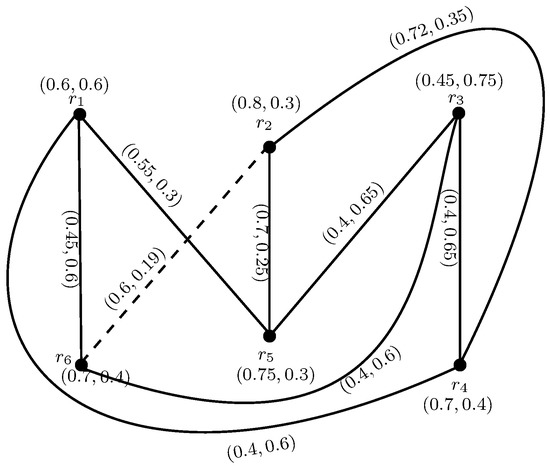
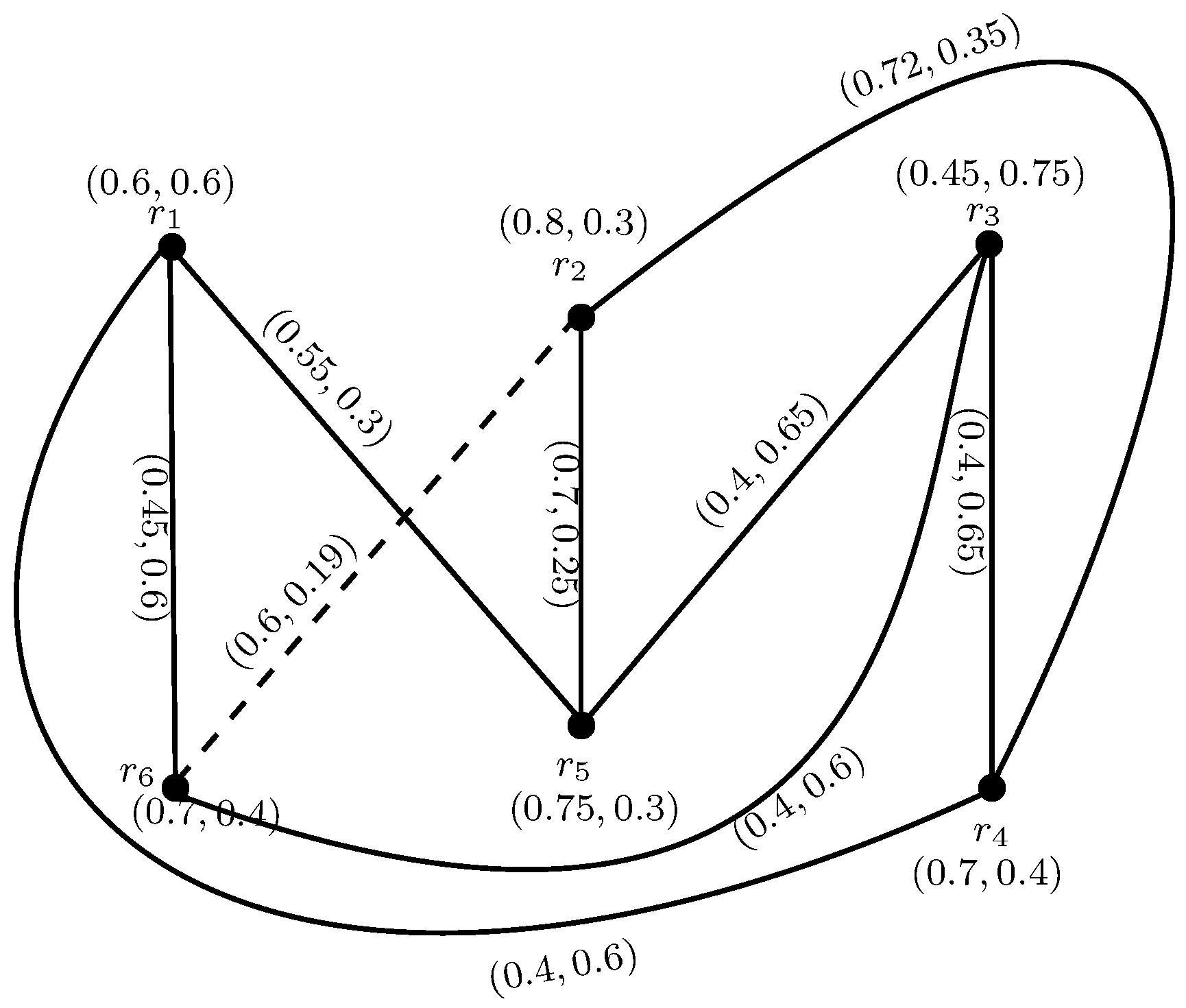
Example 1.
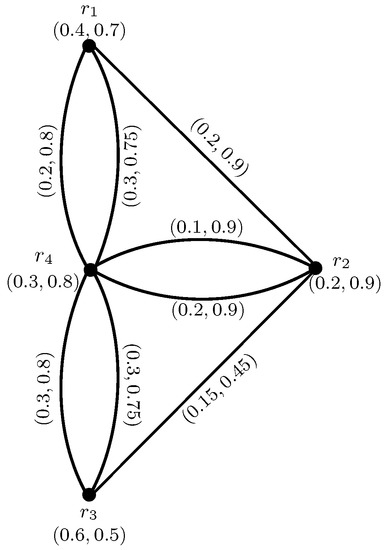
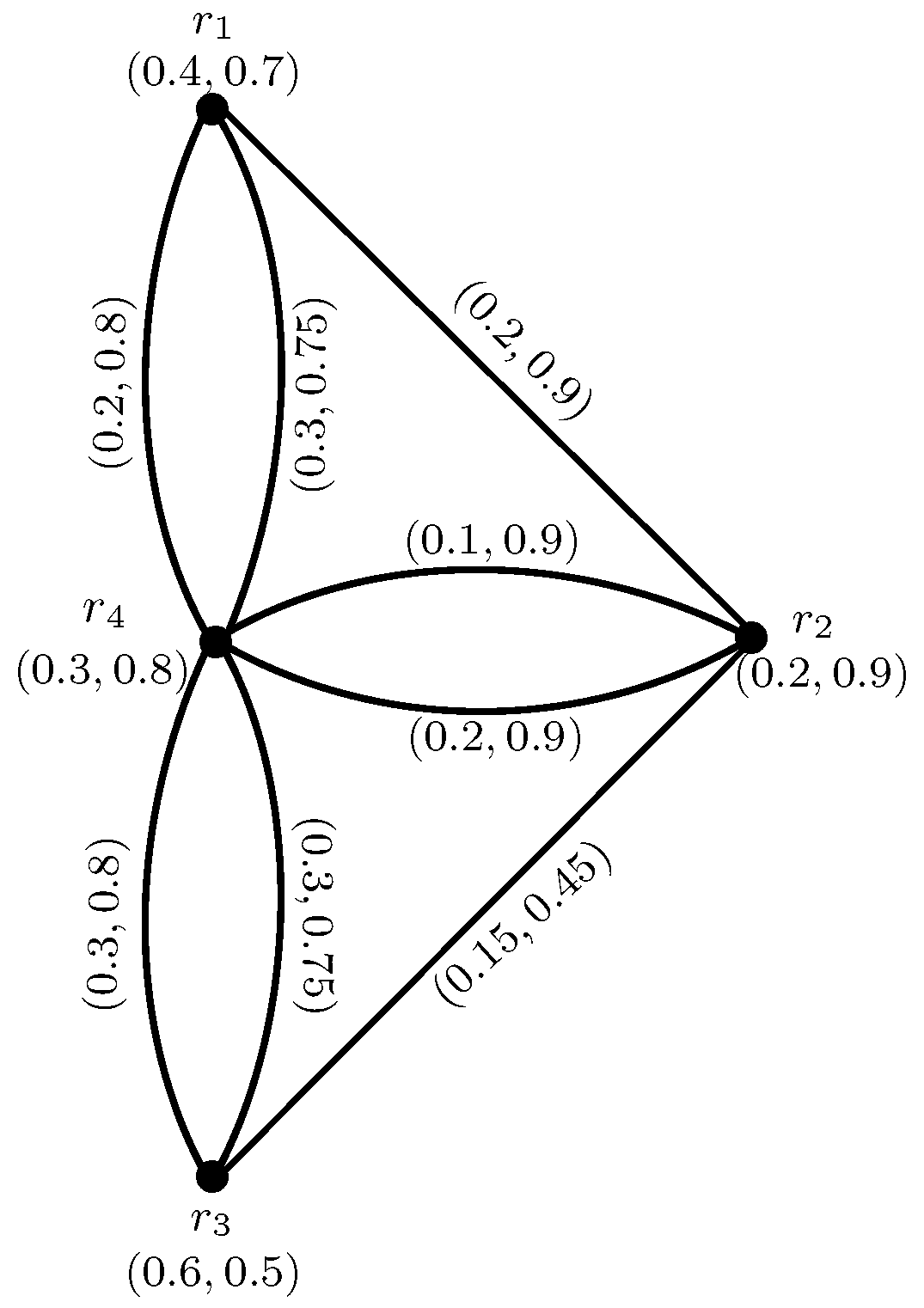
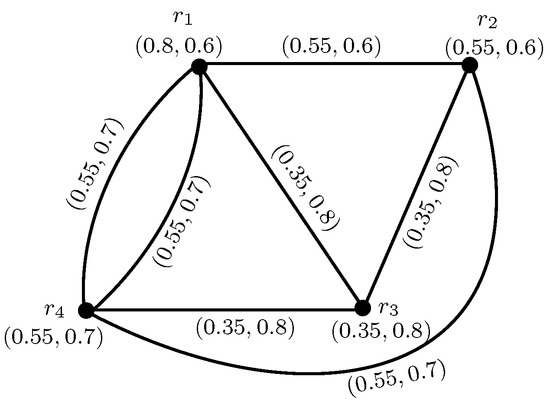
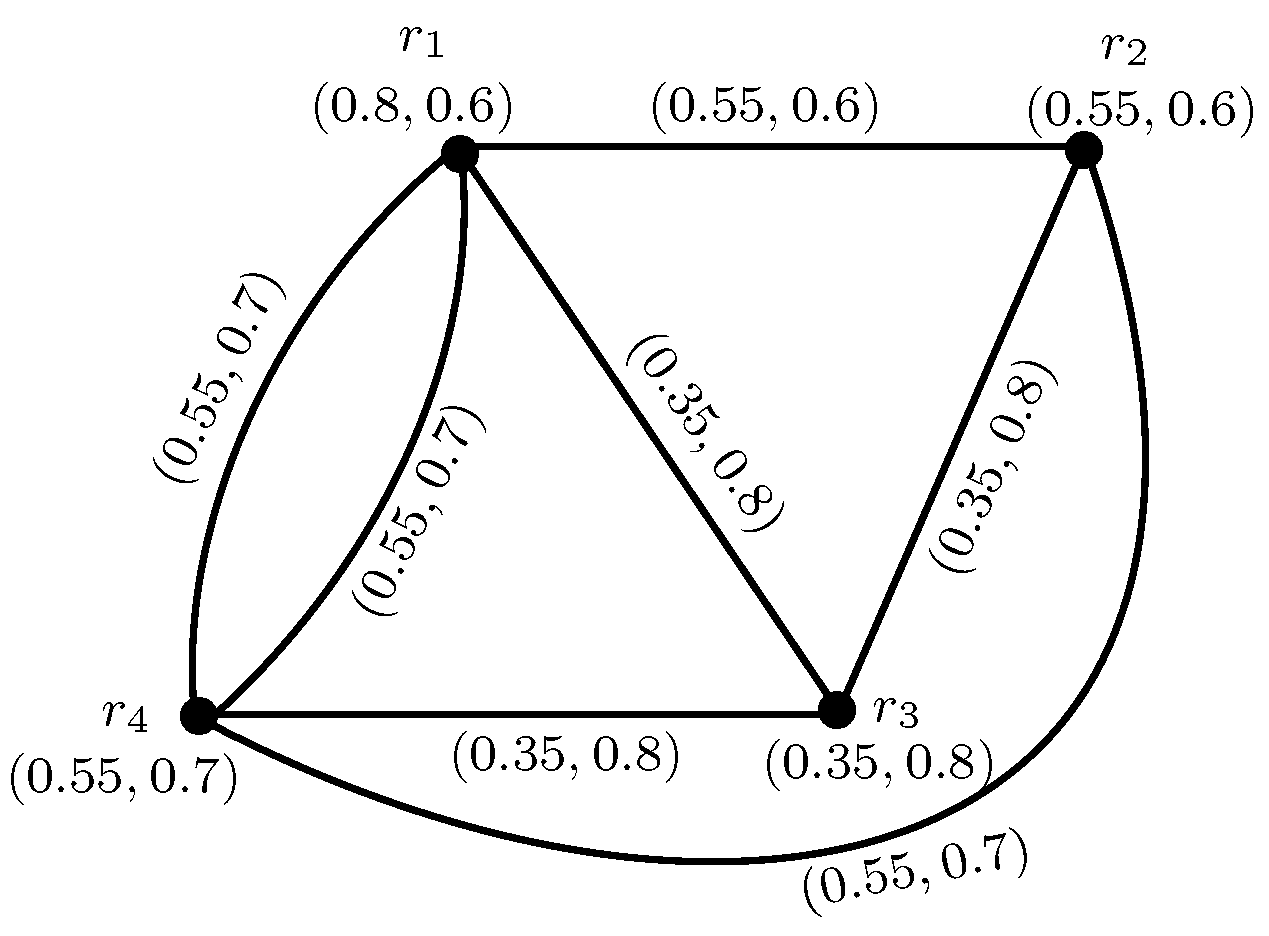
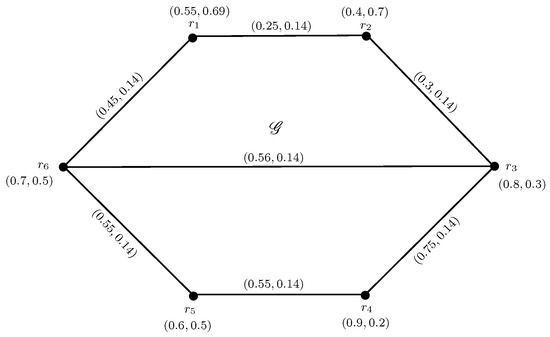
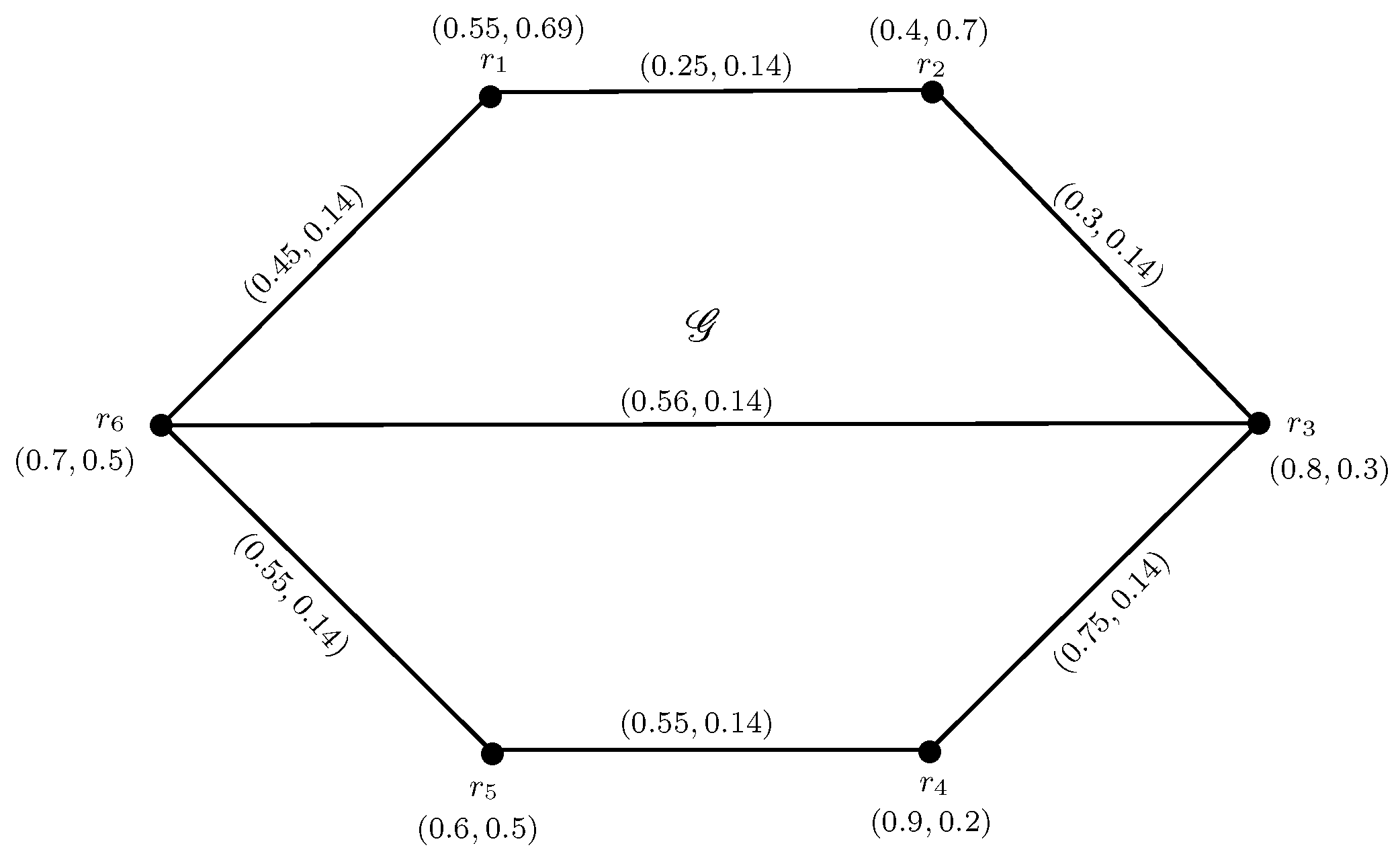
Consider a multigraph where and Let and be PF vertex set and PF multiedge set defined on and , respectively,
By direct calculation, one can look from Figure 2 that it is a PFMG.
Figure 2.
Pythagorean fuzzy multigraph.
Definition 3.
Let be a PF multiedge set in PFMG then,
- 1.
- The order of is represented by and defined as
- 2.
- The size of is represented by and defined asfor all
- 3.
- The degree of vertex is represented by and defined asfor all
- 4.
- The total degree of vertex is represented by and defined asfor all
Definition 4.
Let be a Pythagorean fuzzy multigraph on . If each vertex has the same degree of membership and nonmembership values in , then is known as a regular Pythagorean fuzzy multigraph.
Example 2.
In Example 1, by direct calculation, one can see
- 1.
- The order of
- 2.
- The size of
- 3.
- The degree of the vertices are
- 4.
- The total degree of the vertices are
In addition, is not regular as degree of membership and nonmembership values of the vertices are not equal.
Definition 5.
Let be a PFMG such that Then,
- 1.
- The degree of an edge is represented by and defined as
- 2.
- The total degree of an edge is represented by and defined as
where is the jth edge between r and s.
Definition 6.
A Pythagorean fuzzy multigraph is known as edge regular, if the degree of membership and nonmembership values of all edges in are equal.
Example 3.
In Example 1, the degree of edges are
whereas the total degree of edges are
In addition, is not an edge regular Pythagorean multigraph as degree of the membership and nonmembership values are not the same.
Theorem 1.
Let be a Pythagorean fuzzy multigraph. If is regular and edge regular Pythagorean fuzzy multigraph, then the membership values and nonmembership values for each edge are constant.
Proof.
Let be a Pythagorean fuzzy multigraph. Assume that is regular and edge regular Pythagorean fuzzy multigraph, then there exist constants , and , , respectively, such that, for each vertex,
For each edge ,
Hence, for the membership and nonmembership values,
Thus, we conclude that the membership and nonmembership values of a regular Pythagorean fuzzy multigraph with edge regular are constant. □
Theorem 2.
Let be a Pythagorean fuzzy multigraph on a crisp graph If is p-regular multigraph, and are constant for each edge then is regular and edge regular Pythagorean fuzzy multigraph.
Proof.
Assume that is a p - regular multigraph. Let and Then, for each vertex
For each edge ,
Hence, is regular and edge regular Pythagorean fuzzy multigraph. □
Definition 7.
Let be a PF multiedge set in PFMG . A multiedge of is said to be strong if
Example 4.
In Example 1, is a strong edge as
Definition 8.
Let be a PF multiedge set in PFMG . A multiedge of is said to be effective if
where j is fixed integer.
Example 5.
In Example 1, is an effective edge as
Definition 9.
Let be a Pythagorean fuzzy multigraph and , be a Pythagorean fuzzy multiedge set. A PFMG is said to be complete if
and
Example 6.
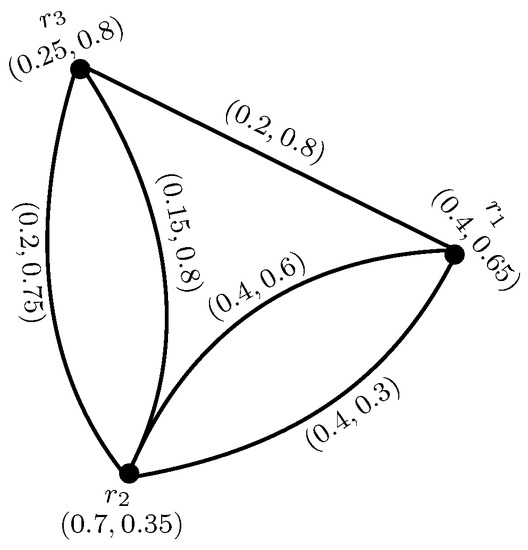
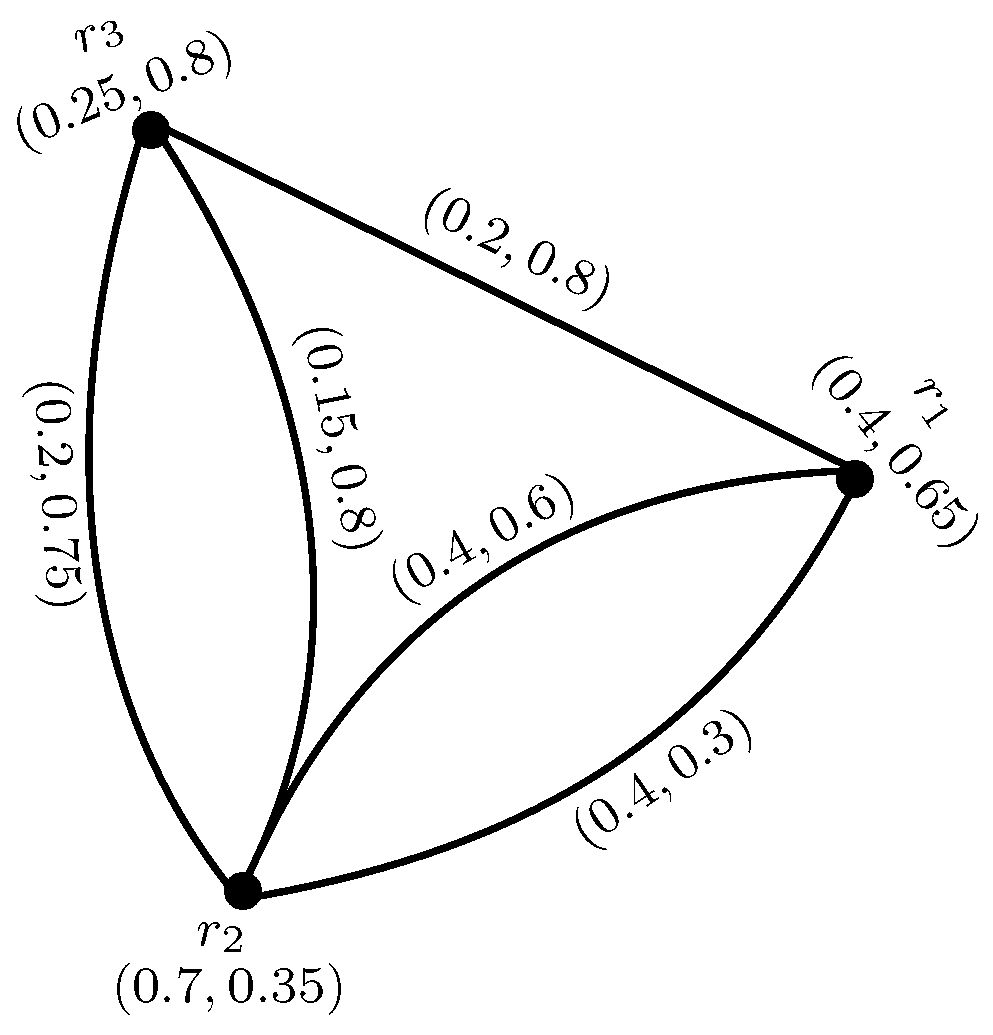
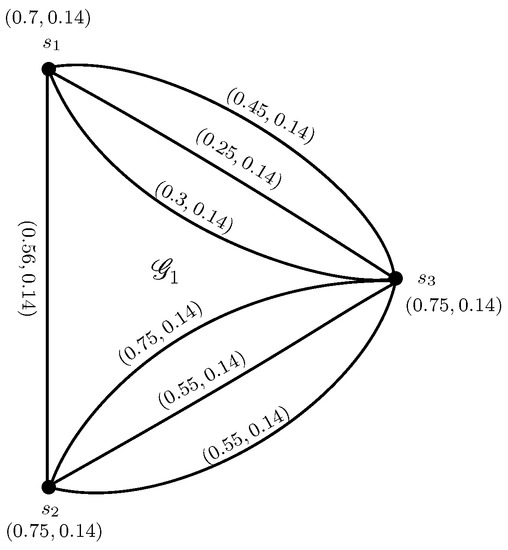
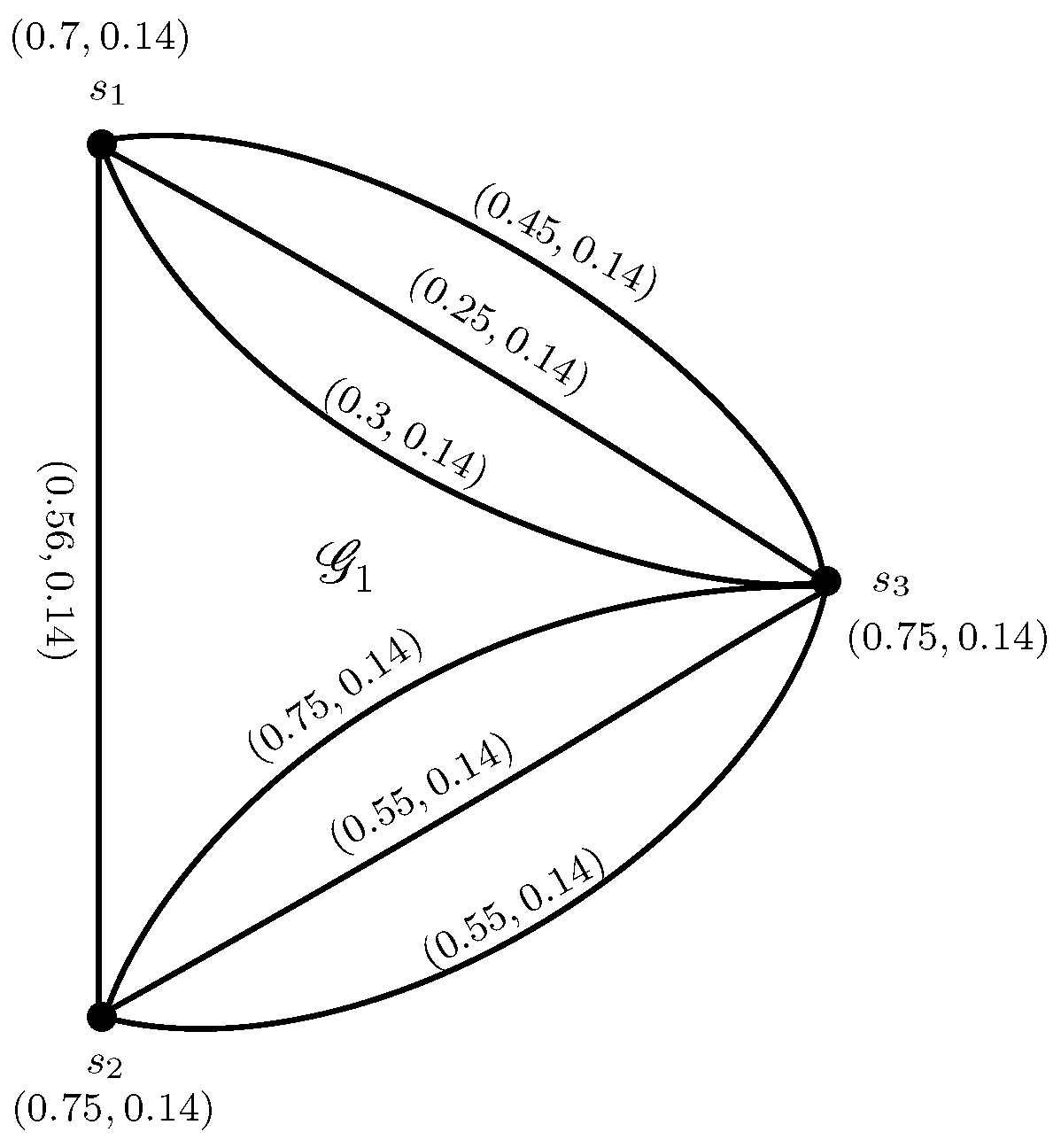
Consider a multigraph where and Let and be Pythagorean fuzzy vertex set and Pythagorean fuzzy multiedge set defined on and , respectively.
Directly, one can see from Figure 3 that it is a complete Pythagorean fuzzy multigraph.
Figure 3.
Complete Pythagorean fuzzy multigraph.
3. Pythagorean Fuzzy Planar Graphs
In planar graph, the intersection between edges is not acceptable. However, in this section, we determine a Pythagorean fuzzy planar graph in an interesting manner with a parameter called ‘Pythagorean fuzzy Planarity’. Planarity is an amount that measures how much a graph is planar. It is very useful in connecting different networking models, structuring websites containing many pages, designing electronic chip, etc. Sometimes, crossing between edges can not be avoided so for this purpose we only consider minimum number of crossing. Hence, Pythagorean fuzzy planar graphs are important for these kinds of connections.
Some correlated terms are discussed below before going to the main definition.
Definition 10.
The strength of the Pythagorean fuzzy edge is defined as
An edge of PFMG is known as strong if and otherwise, known as weak.
Example 7.
Consider a multigraph where and Let and be PF vertex set and PF multiedge set defined on and , respectively.
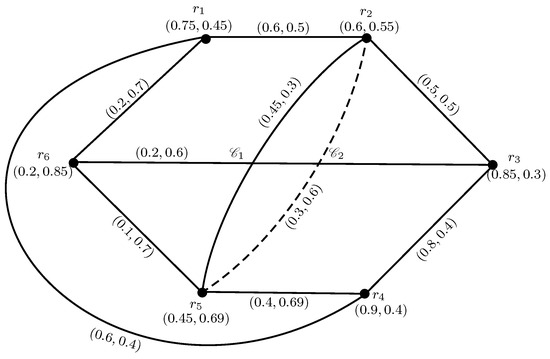
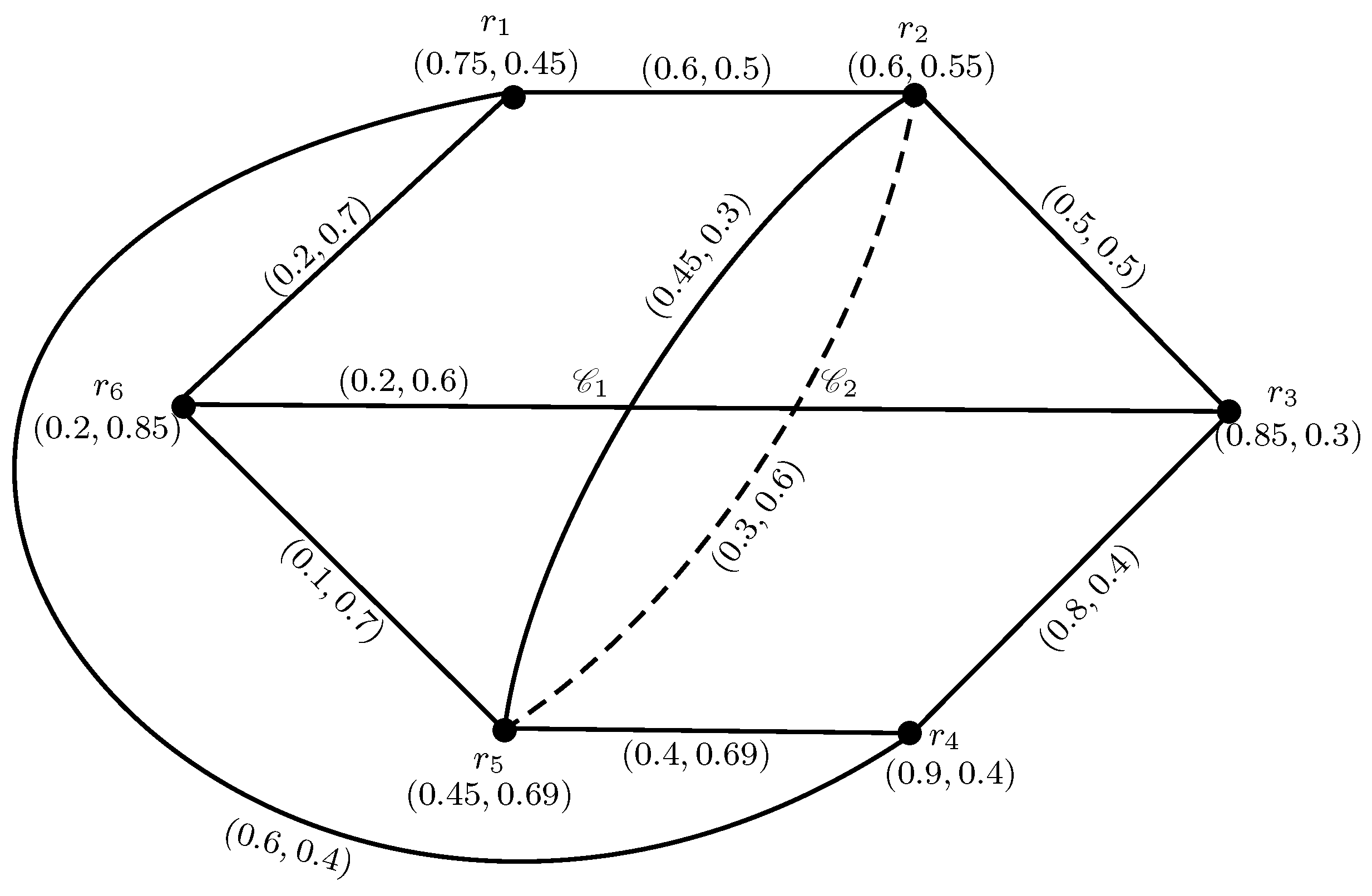
The PFMG as shown in Figure 4 have edges , , , and with strength , , , and , respectively. Since , hence edge is strong and the others are weak.
Figure 4.
Pythagorean fuzzy multigraph.
Definition 11.
Let be a Pythagorean fuzzy multigraph, where contain two edges and intersecting at a point (j and k are fixed integers). The intersecting value at the point (or cut point) can be obtained as
In Pythagorean fuzzy multigraph, is inversely proportional to planarity i.e., if the number of points of intersections increases, planarity decreases.
Definition 12.
Let be a Pythagorean fuzzy multigraph. Let ,,…, be the crossing points between the edges for geometric insight. Then, is known as Pythagorean fuzzy planar graph with Pythagorean fuzzy planarity value defined as
It is clear that is bounded and , If geometric representation of a PFPG has no intersecting point, then its Pythagorean fuzzy planarity value is considered as with the underlying crisp graph as a crisp planar graph.
Remark 1.
Every Pythagorean fuzzy graph is a PFPG with some definite planarity value.
Example 8.
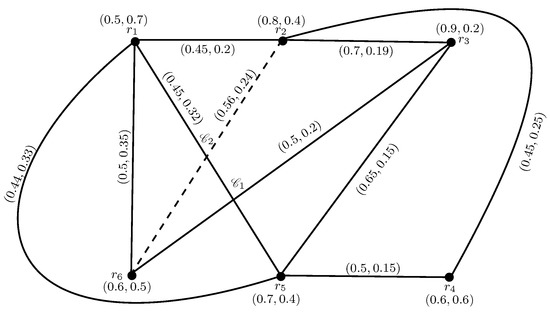
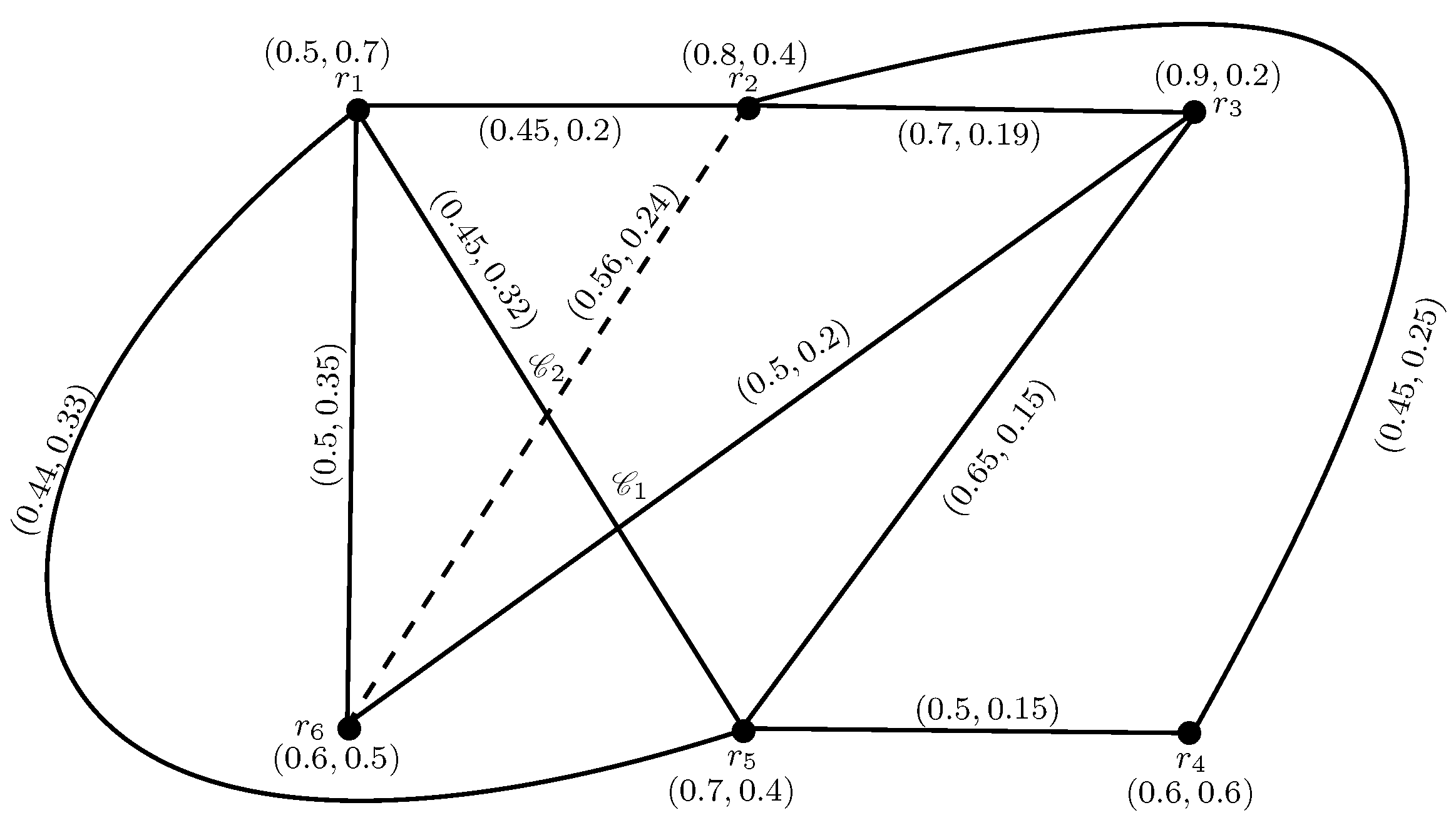
Consider a multigraph where and Let and be the PF vertex set and PF multiedge set defined on and , respectively.
There are two crossings and in PFMG as shown in Figure 5. is the crossing between the edges and and is the crossing between the edges and For the edges , and , the strength is , and , respectively.
Figure 5.
Pythagorean fuzzy planar graph.
The intersecting value of the first crossing is and for the second crossing is Hence, the Pythagorean fuzzy planarity value for PFMG is
Theorem 3.
Let be a Pythagorean fuzzy multigraph with an effective intersecting edge. Then, Pythagorean fuzzy planarity value of is stated as
where and is the quantity of crossing between the edges in .
Proof.
Assume that is a PFMG with an effective intersecting edge that is
Let ,,…, be the crossings between the edges in where k is an integer. For each crossing edge in ,
Therefore, the point of intersection between the edges and
Hence, for . Now, Planarity value of PFMG is
such that and is the quantity of crossings between the edges in . □
Definition 13.
A Pythagorean fuzzy planar graph is said to be strong if Pythagorean fuzzy planarity value of the graph is such that and
Example 9.
In Example 8, the PFPG has PF planarity value Hence, is not strong.
Theorem 4.
If is a strong Pythagorean fuzzy planar graph, then there is at most one crossing between strong edges.
Proof.
Assume that is a strong Pythagorean fuzzy planar graph. Suppose, on the contrary, contains at least two crossings and between the strong edges. Then, for any strong edge ,
As is strong PFPG, thus and Thus, if two strong edges and intersect, then
That is, and Similarly, and This implies that and Therefore, and —a contradiction because is strong PFPG such that and Thus, the crossings between two strong edges can not be two. Likewise, if the number of crossings between strong edges is one, then and Therefore, and . Since is strong, thus Pythagorean fuzzy planarity value for one point of intersection ranges from and . Hence, any PFPG without crossing is a strong PFPG. Therefore, we deduce that the maximum number of crossings between strong edges is one. □
Furthermore, the validity of the above theorem is checked in the example given below.
Example 10.
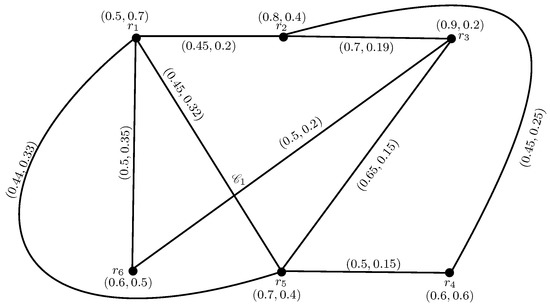
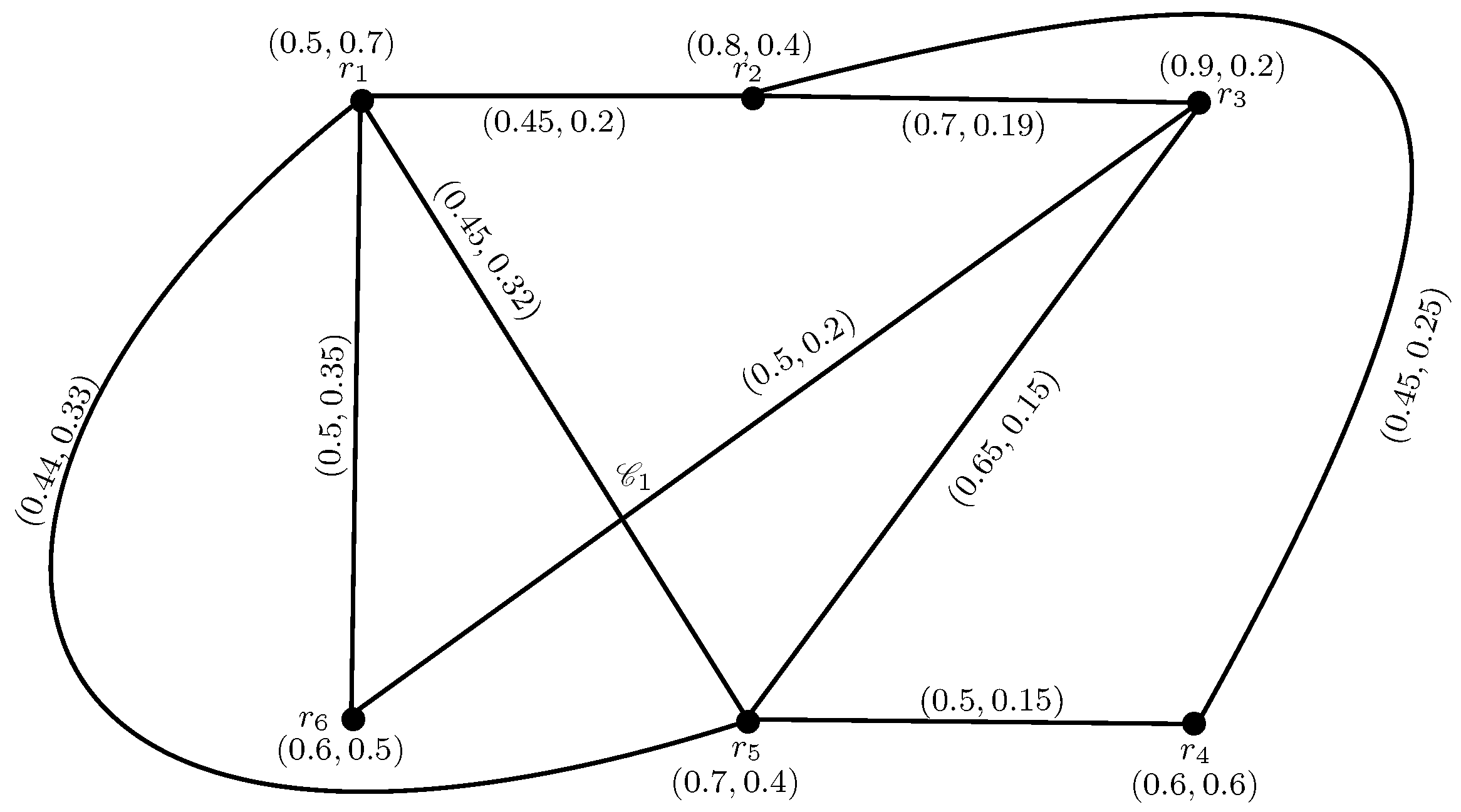
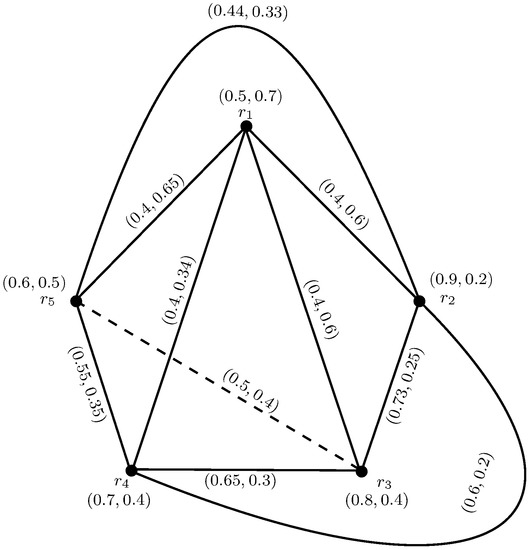
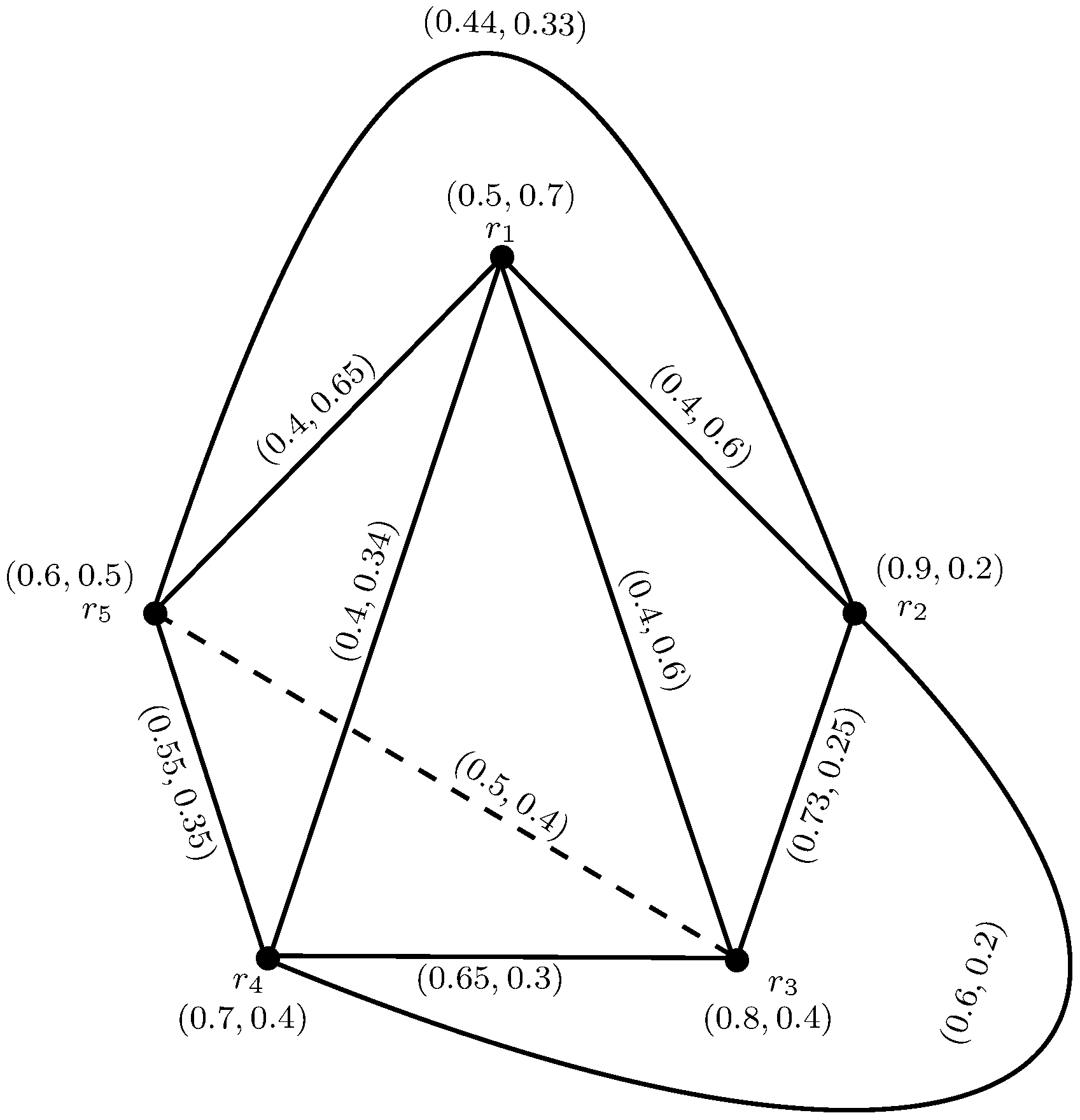
Consider two strong Pythagorean fuzzy planar graphs and . Let and be PF vertex set and PF multiedge set defined on and , respectively, as shown in Figure 6
Figure 6.
PFPG with one crossing.
In addition, let and be PF vertex set and PF multiedge set defined on and , respectively, as shown in Figure 7
Figure 7.
PFPG with two crossings.
A Pythagorean fuzzy planar graph and with one and two crossing between strong edges and have Pythagorean fuzzy planarity value and that satisfies , and , respectively. Moreover, it is easy to see that, between strong edges, if there is no intersection, then PF planarity value and Hence, this analysis and the two examples above justify the statement of Theorem 4.
A fundamental theorem of PFPG is as follows.
Theorem 5.
If has Pythagorean fuzzy planarity value such that and , then, between the strong edges of PFPG , there is no crossing.
Proof.
Assume that is a PFPG with PF planarity value and Suppose, on the contrary, has crossing between two strong edges and . For any strong edge,
That means, Likewise, Furthermore, for the minimum value of and maximum value of ,
Therefore, —a contradiction; thus, between the strong edges of , there is no crossing. □
To design any type of networking model, the strength of a Pythagorean fuzzy edge plays a vital role. For such networking designs, the edge with minimum strength is not as useful as the edge with maximum strength. Hence, the edge with maximum strength is called the considerable edge. The standard definition is stated below.
Definition 14.
Let be a Pythagorean fuzzy graph. An edge in is known as considerable if
whereas is a rational number. If an edge is not considerable, then it is known as a nonconsiderable edge. Furthermore, an edge in Pythagorean fuzzy multigraph is considerable if and , for each edge in
Remark 2.
The rational number is a pre-assigned value that may not be unique, as, for a distinct value of one can acquire distinct sets of considerable edges, but it is countable. This rational number is called a considerable number of a Pythagorean fuzzy graph.
Theorem 6.
If is a strong PFPG with considerable number , then, between considerable edges in there is at most crossings.
Proof.
Assume that is a strong PFPG and Let be considerable number and be the PF planarity value. Then, for any considerable edge ,
That is, and Let ,,…, be crossings between considerable edges. Therefore, if two considerable edges and intersect, then
Thus, and . Hence, and As is strong PFPG, and . Therefore, which implies that This inequality will be justified for some integral values n, obtained from following expression:
□
4. Kuratowski’s Graphs and Pythagorean Fuzzy Planar Graphs
Kuratowski presented ‘Kuratowski’s Theorem’ in by using the concept of graph homomorphism to characterize planar graphs. According to this theorem, a graph is planar if and only if it does not contain kuratowski graph as a subgraph. A kuratowski graph is basically, a subdivision of either a complete bipartite graph or a complete graph with five vertices where and are nonplanar as they cannot be drawn without intersection between edges. However, in this section, we will see that nonplanar Pythagorean fuzzy graphs are Pythagorean fuzzy planar graphs with some definite Pythagorean fuzzy planarity value.
Theorem 7.
A Pythagorean fuzzy complete graph or is not a strong Pythagorean fuzzy planar graph.
Proof.
Assume that is a Pythagorean fuzzy complete graph with five vertices and Since is complete, then, for all
The Pythagorean fuzzy planarity value of Pythagorean fuzzy complete graph is where is the number of crossings between edges in .
Since the geometric insight of an underlying crisp graph of is non planar and, for any representation, one crossing can not be excluded. Therefore, As so is not a strong Pythagorean fuzzy planar graph. Likewise, has only one crossing that cannot be avoided, so it is not a strong Pythagorean fuzzy planar graph. □
Remark 3.
A Pythagorean fuzzy planar graph with five vertices and each pair of vertices connected by an edge may or may not be a strong Pythagorean fuzzy planar graph.
Example 11.
Considering a PFPG as displayed in Figure 8, there is one crossing between two edges and Then, the Pythagorean fuzzy planarity value Hence, it is a strong PFPG.
Figure 8.
Pythagorean fuzzy planar graph with PF planarity (0.54,0.61).
Remark 4.
A Pythagorean fuzzy bipartite planar graph with six vertices, partitioned into two subsets containing three vertices each, is a strong Pythagorean fuzzy planar graph.
Example 12.
Considering a PFPG as displayed in Figure 9, there is one crossing between two edges and Then, the Pythagorean fuzzy planarity value Hence, it is a strong PFPG.
Figure 9.
Pythagorean fuzzy planar graph with PF planarity (0.53,0.65).
From Theorem 7, Remarks 3 and 4, it is concluded that a complete PFG is not a strong Pythagorean fuzzy planar graph, whereas a complete PFPG may or may not be a strong Pythagorean fuzzy planar graph as justified in Examples 11 and 12.
5. Pythagorean Fuzzy Face and Pythagorean Fuzzy Dual Graphs
In Pythagorean fuzzy sense, the face of a PFPG has a significant role. It is a flat surface, enclosed by Pythagorean fuzzy edges. If all the edges in the surrounding of a Pythagorean fuzzy face have degree of membership and nonmembership , then it is known as crisp face. The Pythagorean fuzzy face does not exist, if one of such edge is removed with degree of membership and nonmembership . Hence, the occurrence of Pythagorean fuzzy face based on the minimum strength of Pythagorean fuzzy edge.
We consider Pythagorean fuzzy planar graph that do not carry any pair of intersecting edge. That is, its planarity value is to define Pythagorean fuzzy face.
Definition 15.
Let be a PFPG with planarity and A region enclosed by the Pythagorean fuzzy edge set of the geometrical representation of is known as Pythagorean fuzzy face of The membership and nonmembership value of Pythagorean fuzzy face are defined as
Definition 16.
A Pythagorean fuzzy face is called strong if its membership value is greater than or equal to and nonmembership is less than or equal to otherwise weak. Moreover, an infinite region of PFPG is known as outer Pythagorean fuzzy face, while others are known as inner Pythagorean fuzzy face.
Remark 5.
Every Pythagorean strong fuzzy face has a membership value greater than or equal to and nonmembership less than or equal to Thus, a strong Pythagorean fuzzy face has a strong Pythagorean fuzzy edge.
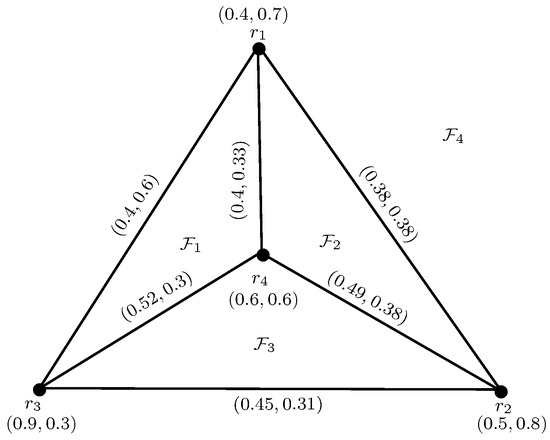
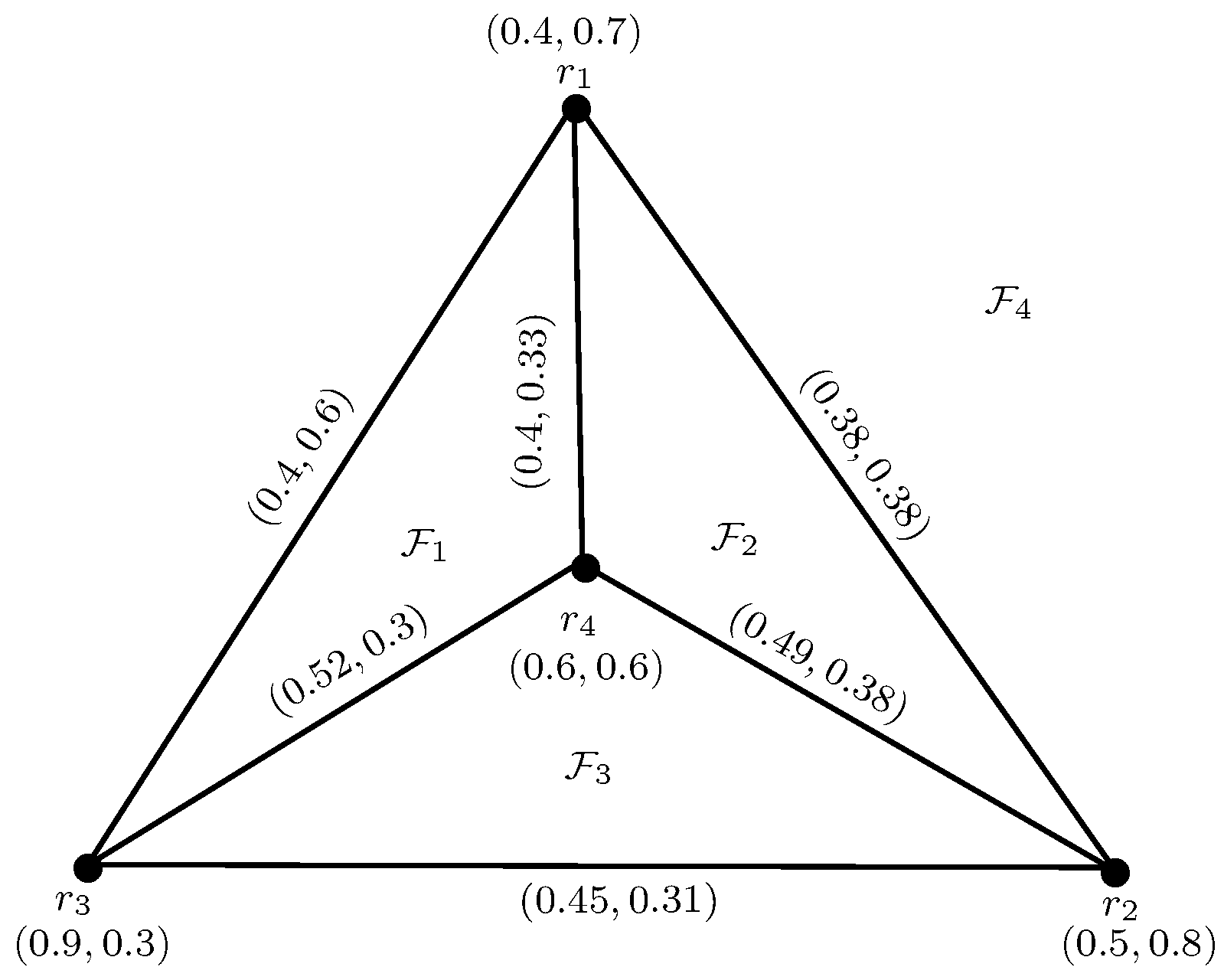
Example 13.
Consider a PFPG as displayed in Figure 10. Let , , and be the Pythagorean fuzzy faces:
Figure 10.
Faces in Pythagorean fuzzy planar graph.
- Pythagorean fuzzy inner face is enclosed by the edges
- Pythagorean fuzzy inner face is bounded by the strong edges
- Pythagorean fuzzy inner face is surrounded by the strong edges , ,
- Pythagorean fuzzy outer face is enclosed by the edges ,,
The membership and nonmembership value of Pythagorean fuzzy faces , , and are , , and , respectively. Here, and are weak faces and and are strong Pythagorean fuzzy faces.
In graph theory, duality is very helpful in explaining various structures like drainage system of basins, etc. It has been widely applied in computational geometry, design of integrated circuits and mesh generation. A mathematician Whitney described planarity in terms of occurrence of dual graph i.e., a graph is planar if and only it has a dual graph. This concept is very effective in solving many critical problems. Motivated from this concept, we introduce a Pythagorean fuzzy dual graph of a Pythagorean fuzzy planar graph.
Definition 17.
Let be a PFPG where
Let ,,…, be strong Pythagorean fuzzy faces of Then, the Pythagorean fuzzy dual graph of is a PFPG where and the vertex of is taken for of Furthermore, the membership grades and nonmembership grades of vertices are given by mapping such that
Meanwhile, between two faces and of there may occur more than one common edge. Thus, between two vertices, there may exist more than one edge and in PFDG The membership and nonmembership values of Pythagorean fuzzy edges of PFDG are where is an edge in the surrounding between strong PF faces and and , is the number of common edges in the surrounding of and
The Pythagorean fuzzy dual graph of PFPG has no crossing between edges for some definite geometric representation; thus, it is PFPG of PF planarity
Example 14.
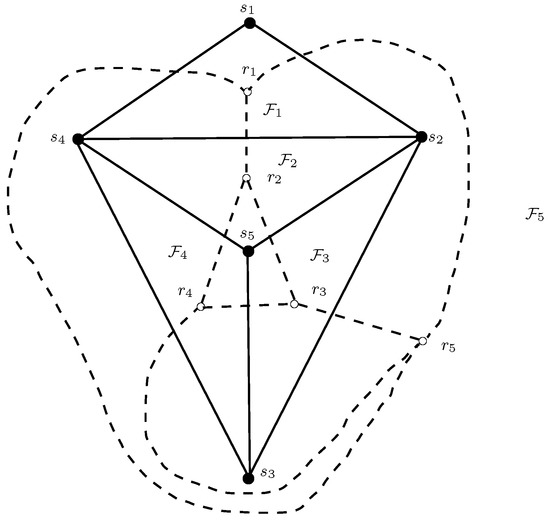
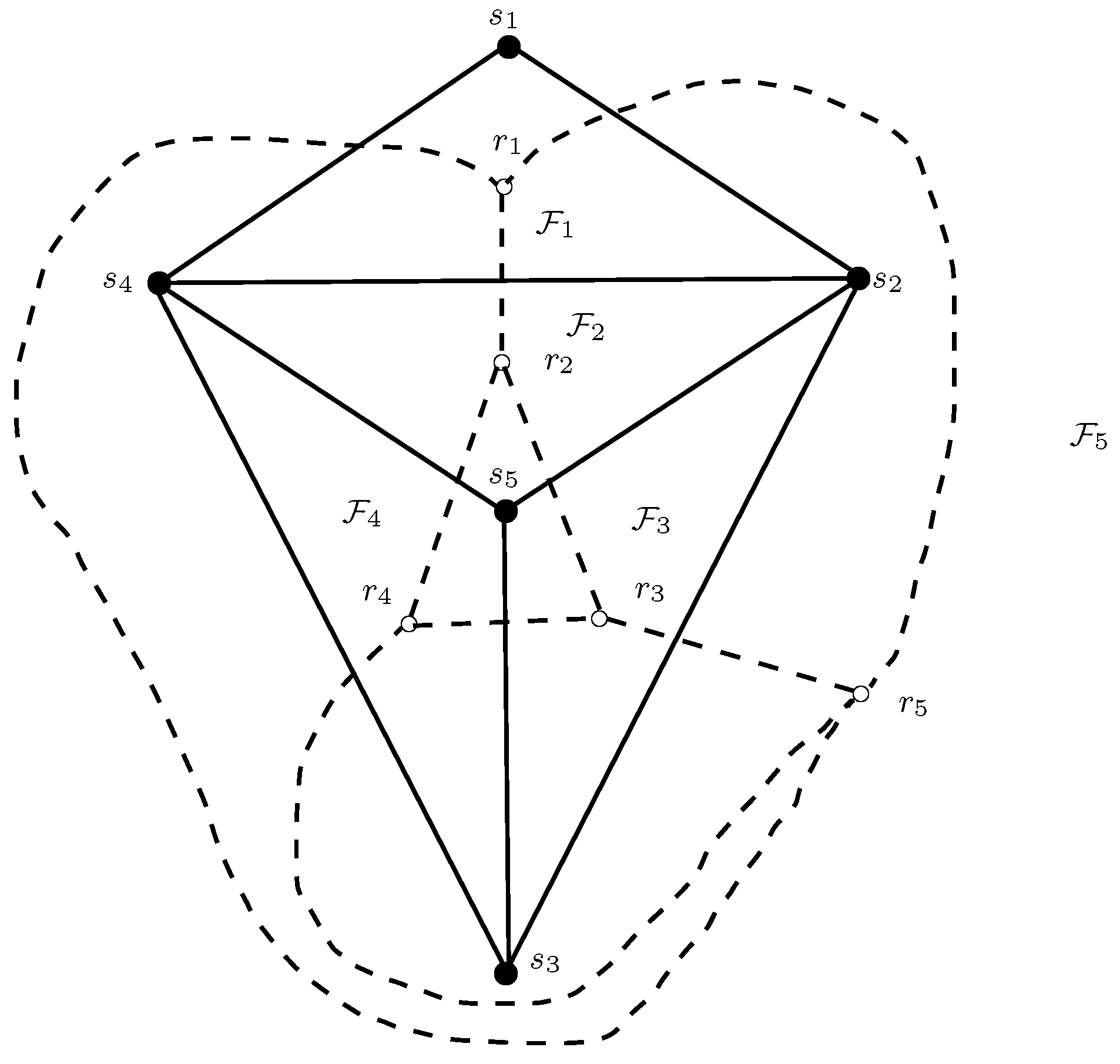
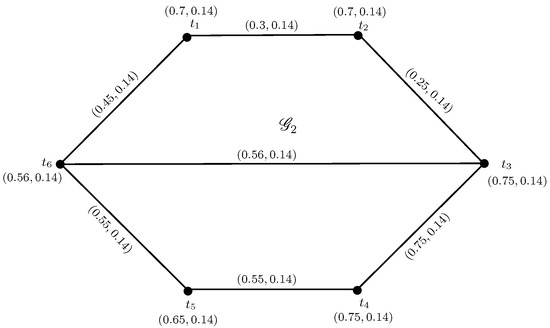
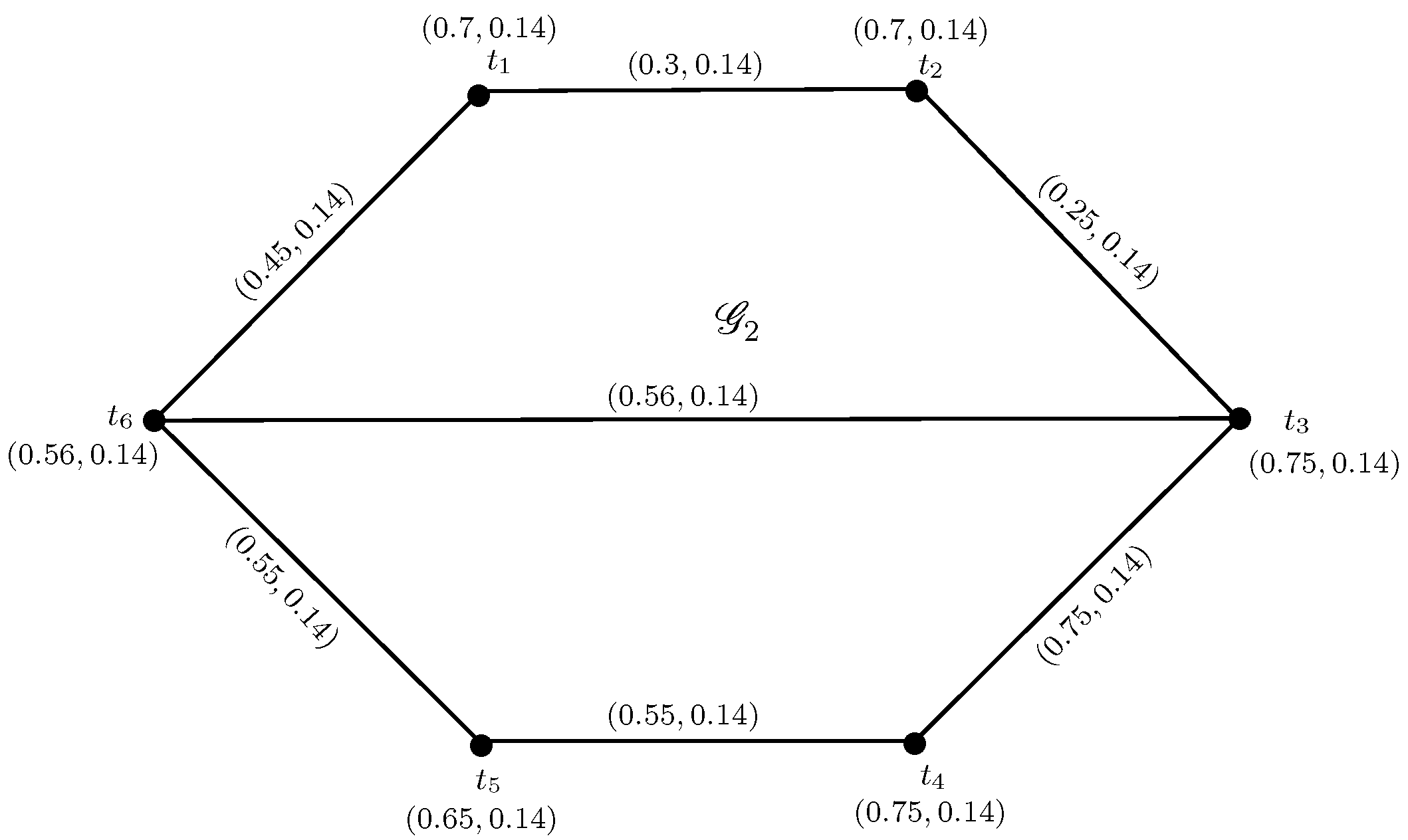
Consider a PFPG as displayed in Figure 11 such that Let and be a PF vertex set and PF edge set defined on and , respectively.
Figure 11.
Pythagorean fuzzy dual graph.
The Pythagorean fuzzy faces of a Pythagorean fuzzy planar graph are given below:
- Pythagorean fuzzy face is enclosed by the edges ,,
- Pythagorean fuzzy face is bounded by the edges ,,
- Pythagorean fuzzy face is surrounded by the edges ,,
- Pythagorean fuzzy face is bounded by the edges ,,
- Pythagorean fuzzy face is enclosed by the edges ,,,
By direct calculation, one can see that these five faces are strong Pythagorean fuzzy faces. We represent the vertices of Pythagorean fuzzy dual graph (PFDG) by small white circles and the edges by dashed lines. For each strong Pythagorean fuzzy face (SPFF), we take a vertex for the PFDG. Therefore, the vertex set , where the vertex is extracted parallel to the SPFF , Hence,
There is one common edge between the faces and in Hence, there exists one edge between the vertices and in PFDG of The membership grade and nonmembership grade of the edges of PFDG are obtained as
Thus, the Pythagorean fuzzy dual graph edge set is
Hence, is a PFDG of
In the Pythagorean fuzzy dual graph, we will not consider weak edges. The following theorems are given below.
Theorem 8.
Let be a Pythagorean fuzzy planar graph without weak edges, r strong faces, q Pythagorean fuzzy edges and p vertices. Let be a Pythagorean fuzzy dual graph of with faces, Pythagorean fuzzy edges and vertices, then , and
Proof.
The proof is easily perceived by the definition of the Pythagorean fuzzy dual graph. □
Theorem 9.
Let be a Pythagorean fuzzy dual graph of PFPG . The number of strong PF faces in is less than or equal to the number of vertices of
Proof.
Assume that is a PFDG of PFPG with strong PF faces and has p vertices. Since has both weak and strong PF edges, and, to develop PFDG, weak PF edges are eliminated. Hence, if has some weak PF edges, then some vertices may have all its adjoining PF edges as weak PF edges. Suppose that such vertices are in number l. These vertices are not enclosed by any strong PF faces. By eliminating these vertices and adjoining edges, the number of vertices become . Moreover, from Theorem 8, . Hence, This concludes that the number of strong PF faces in is less than or equal to the number of vertices of □
Example 15.
The above statement is justified from Example 14, as one can see that the number of strong PF faces in is which is less than 5
Theorem 10.
If be a Pythagorean fuzzy dual graph of a PFPG without weak edges. Then, the membership grade and nonmembership grade of Pythagorean fuzzy edge of are equivalent to the membership grade and nonmembership grade of Pythagorean fuzzy edge of
Proof.
Let be a PFPG without weak edges. The PFDG of is in which there is no crossing between any edges. Let ,,…, be SPFF of By the definition of PF dual graph, the membership grade and nonmembership grade of Pythagorean fuzzy edges of Pythagorean fuzzy dual graph are
where is an edge in the surrounding between strong PF faces and The common edges in the surrounding between and are s in number, where The number of PF edges of two PFGs and are similar as has no weak edges. Hence, for every Pythagorean fuzzy edge of , there is a Pythagorean fuzzy edge in with similar membership grade and nonmembership grade. □
6. Isomorphism between Pythagorean Fuzzy Planar Graphs
Isomorphism is a formal mapping that propagates knowledge and better understanding between different graphs. It can be defined between complex models where the two models have equal division. If there is isomorphism between two models such that the property of one is known and the other is unknown. Then, due to isomorphism, we are able to know the property of an unknown model. By using this concept, we define isomorphism between two Pythagorean fuzzy planar graphs.
Definition 18.
An isomorphism of two Pythagorean fuzzy planar graphs and is a bijective mapping that satisfies
- 1.
- 2.
for all
Example 16.
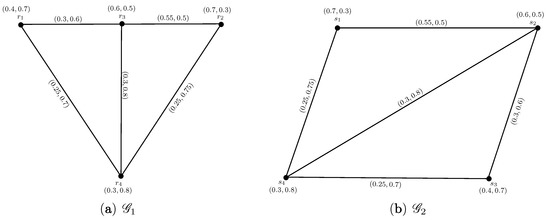
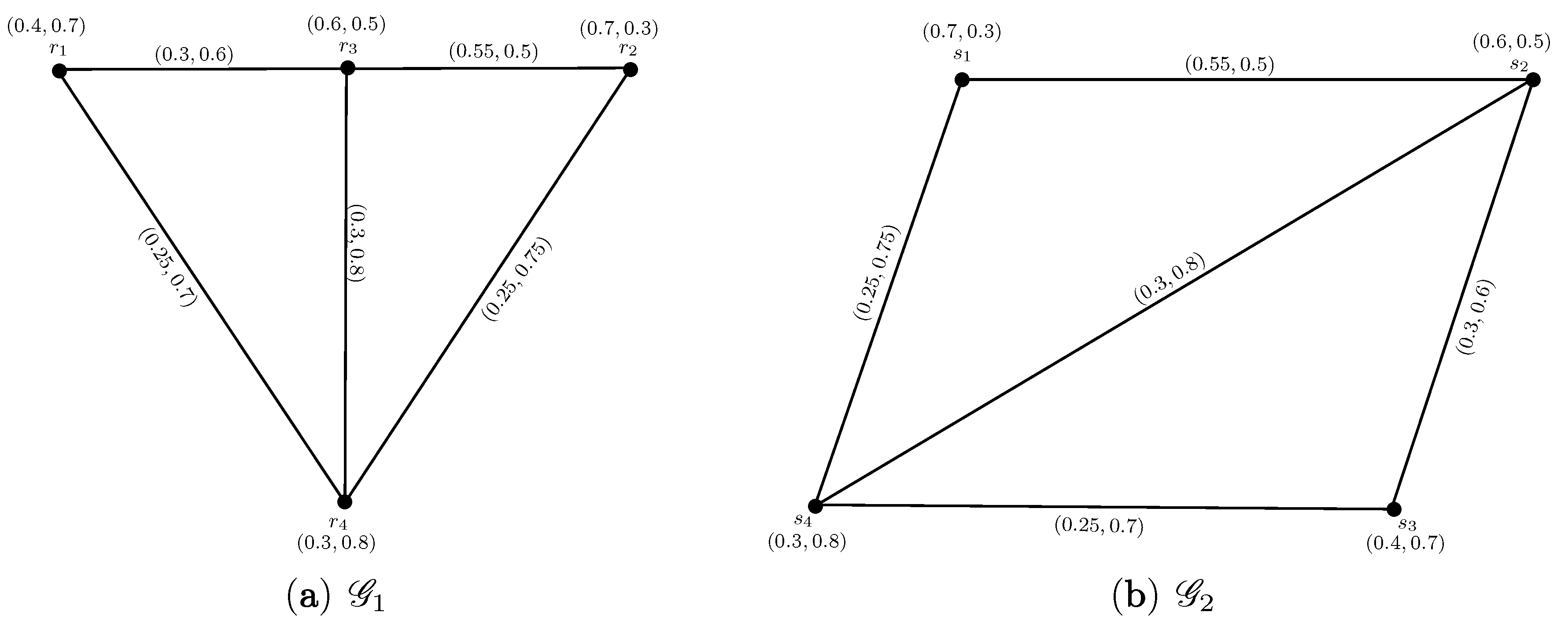
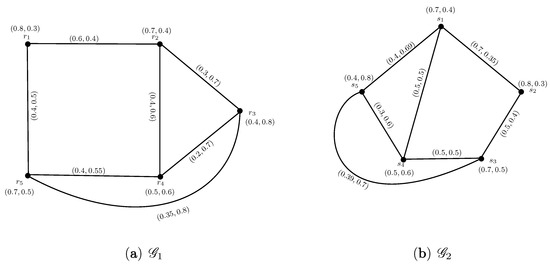
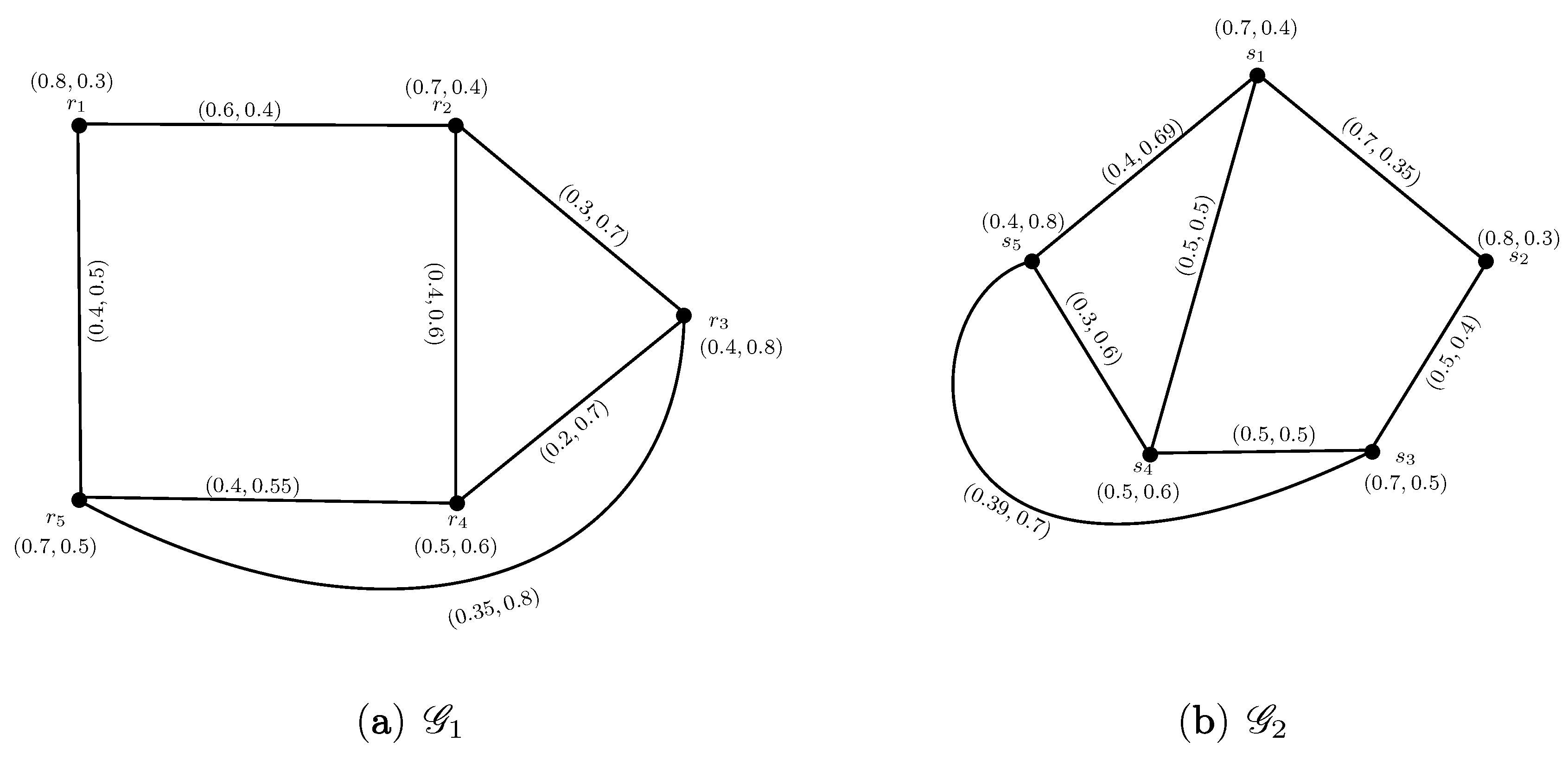
Consider two Pythagorean fuzzy planar graph and as shown in Figure 12 such that
Since a mapping defined by satisfies for all where . Therefore, is isomorphic to
Figure 12.
Pythagorean fuzzy planar graphs.
Definition 19.
A weak isomorphism of two Pythagorean fuzzy planar graphs and is a bijective mapping that satisfies
- 1.
- F is homomorphism,
- 2.
for all
Example 17.
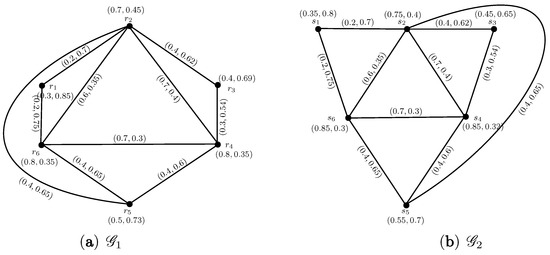
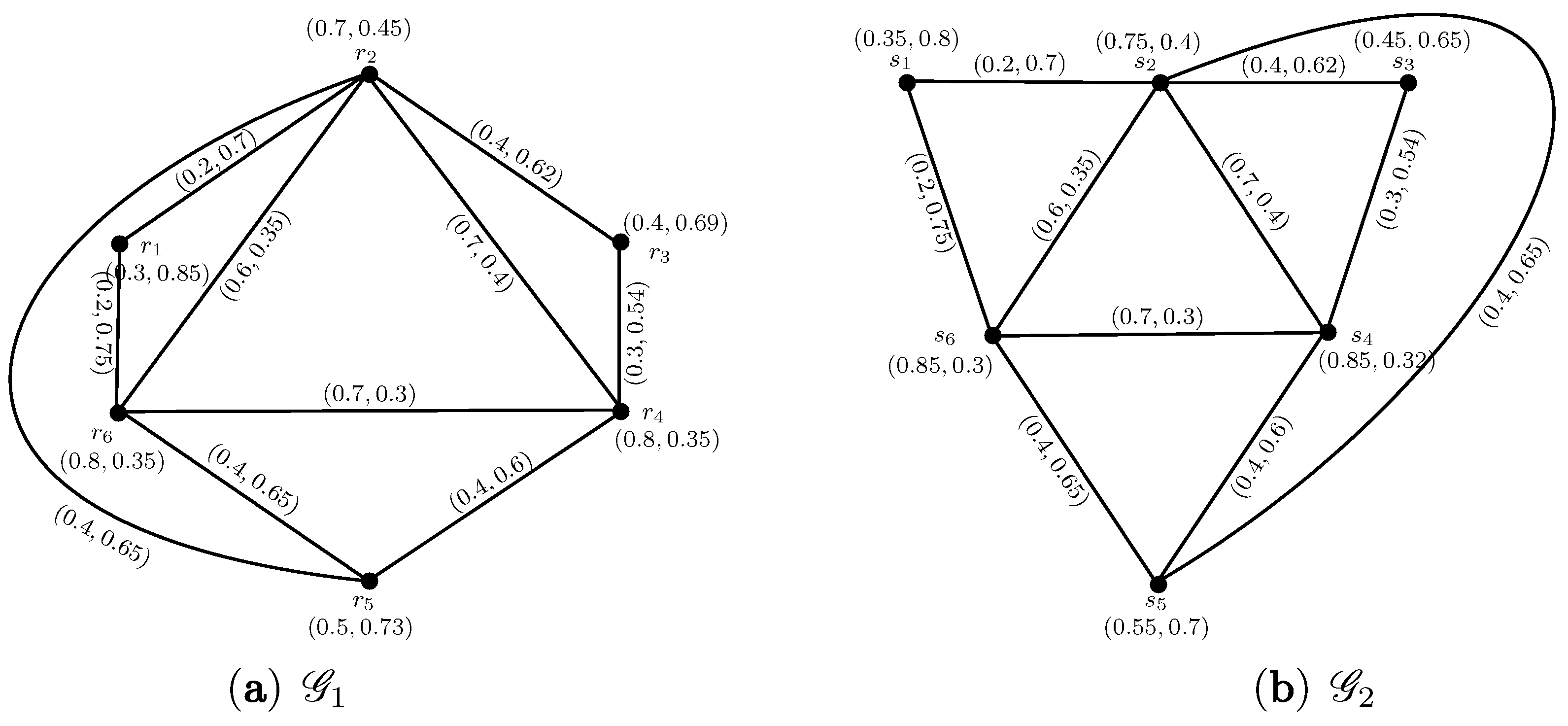
Figure 13.
Pythagorean fuzzy planar graphs.
Since a mapping defined by , satisfies for all where but Therefore, is a weak isomorphic to
Definition 20.
A co-weak isomorphism of two Pythagorean fuzzy planar graphs and is a bijective mapping that satisfies
- 1.
- F is homomorphism,
- 2.
for all
Example 18.
Figure 14.
Pythagorean fuzzy planar graphs.
Since a mapping defined by ,, satisfies for all , where but Therefore, is a co-weak isomorphic to
Some correlated results have been discussed below.
Theorem 11.
If is an isomorphism from PFPG to Pythagorean fuzzy graph Then, can be considered as PFPG with equivalent PF planarity value of
Proof.
Suppose is an isomorphism. As an isomorphism retains the membership and nonmembership value of vertex and edge of Pythagorean fuzzy graphs. Thus, membership and nonmembership value of will be equivalent to the membership and nonmembership value of Drawing and structure of and are similar. Hence, the crossings number between edges and Pythagorean fuzzy planarity value of will be similar to Thus, can be considered as PFPG with equivalent Pythagorean fuzzy planarity value as that of the Pythagorean fuzzy graph □
Theorem 12.
Two isomorphism Pythagorean fuzzy graphs and have equivalent planarity value.
Theorem 13.
Let and be two Pythagorean fuzzy graphs with Pythagorean fuzzy planarity and respectively. If is weak isomorphic to , then and
Proof.
Let is weak isomorphic to Then, for any edge there exists The strength of an edge is given as
The intersecting value between two edges and is
where is the intersection point between two edges and in Since is weak isomorphic to the number of the intersecting points in the certain geometric representation in and are equal which are n. Hence,
Thus, we conclude that, if is weak isomorphic to , then and □
Theorem 14.
Let and be two Pythagorean fuzzy graphs with Pythagorean fuzzy planarity and respectively. If is co-weak isomorphic to , then and
Proof.
Assume that is co-weak isomorphic to satisfying the conditions
Then, the strength of an edge is given as
The intersecting value between two edges and is
where is the intersection point between two edges and in Since is co-weak isomorphic to the number of the intersecting points in the certain geometric representation in and are equal, which are n. Hence,
Thus, we conclude that, if is co-weak isomorphic to , then and □
Theorem 15.
Let and be two weak isomorphic PFGs with PF planarity values and respectively. If the edge membership and nonmembership grades of the parallel crossing edges are equivalent, then
Proof.
Let and be two weak isomorphic PFGs with PF planarity values and respectively. Since two PFGs are weak isomorphic, for all and Let the Pythagorean fuzzy graphs have one crossing. Let two crossing edges in and are bc, de and vw, rs, respectively. Then, the cut point in is defined by
Likewise, the cut point in is defined by
Now, , if and The number of intersecting points increases. However, if the sum of crossing values of are equivalent to that of then Pythagorean fuzzy planarity values must be equal. Hence, for the edge membership and nonmembership grades of crossing edges of are equivalent to the edge membership and nonmembership grades of the parallel crossing edges in . □
Theorem 16.
Let and be two co-weak isomorphic PFGs with PF planarity values and respectively. If the minimum membership and maximum nonmembership grade of end vertices of the parallel crossing edges are equivalent, then
Proof.
Let and be two co-weak isomorphic PFGs with PF planarity values and respectively. Since two PFGs are co-weak isomorphic, so for all and Let the Pythagorean fuzzy graphs have one crossing. Let two crossing edges in and are cd, ef and wx, yz, respectively. Then, the cut point in is defined by
Likewise, the cut point in is defined by
Now, , if and The number of intersecting points increase. However, if the sum of crossing value of is equivalent to that of then Pythagorean fuzzy planarity values must be equal. Hence, for the minimum membership and maximum nonmembership grades of end vertices of an edge in is equivalent to the minimum membership and maximum nonmembership grades of parallel edge in □
In a crisp sense, we know that double dual of planar graph is also planar. We call it self-duality of planar graph. However, this concept does not hold in a Pythagorean fuzzy planar graph as the vertex membership and nonmembership grade of Pythagorean fuzzy planar graph are not preserved in its dual graph. However, the edge membership and nonmembership grade of Pythagorean fuzzy planar graph are preserved. The following theorem illustrates this fact.
Theorem 17.
If is the PFDG of PFDG of a PFPG without weak edges, then a co-weak isomorphism occurs between and
Proof.
Suppose that is a PFPG without weak edges. Suppose that is a PFDG of and is the PFDG of For establishing co-weak isomorphism between and We know that the number of vertices of is equivalent to the strong Pythagorean fuzzy faces of Similarly, the number of strong Pythagorean fuzzy faces of is equivalent to the number of vertices of Hence, the number of vertices of and are similar. Furthermore, by definition of PFDG, the membership and nonmembership grade of an edge in PFDG is equivalent to the membership and nonmembership grade of an edge in PFPG. Thus, it is concluded that a co-weak isomorphism occurs between and □
The following example justifies the above theorem.
Example 19.
Figure 15.
Pythagorean fuzzy planar graph.
The Pythagorean fuzzy dual graph of is displayed in Figure 16,
Figure 16.
Pythagorean fuzzy dual graph.
where
Again, constructing the dual of as displayed in Figure 17,
Figure 17.
Pythagorean fuzzy dual graph.
where
It is easy to see that the edge membership and nonmembership grades of are equal to the edge membership and nonmembership grades of , but the vertex membership and nonmembership grades of are not equal to the vertex membership and nonmembership grades of which shows that the self-duality of Pythagorean fuzzy planar graph is not satisfied. Hence, we conclude that there is co-weak isomorphism between and
7. Application
From the power plants to our houses, the potent power lines that are zigzagging our countryside or city streets carry numerously high voltage electricity. For reducing such high voltage electricity to lower voltage, an equipment is used, called a transformer. A transformer works in a very simple way, consisting of different units in which electric current flows through tiny wires. While connecting the units with each other, crossing between tiny wires may occur. Sometimes, crossing between wires is beneficial as it helps in utilizing less space and makes it inexpensive, but, on the other hand, due to crossing, the transformer heats up and there is a chance of an explosion that is quite dangerous for human life. To overcome this problem, a crossing between such wires needs to be minimized or good quality wires are needed for installation. The practical approach of Pythagorean fuzzy planar graphs can be utilized to structure this kind of situation for reducing the rate of destruction.
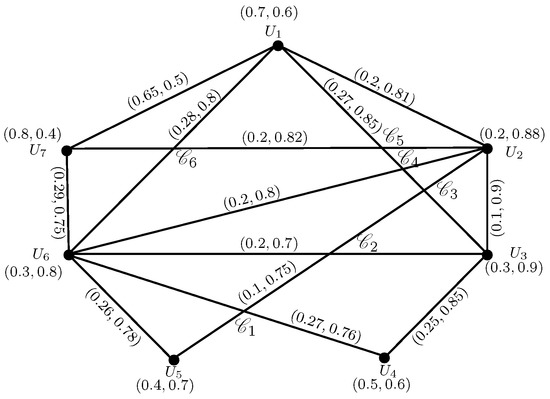
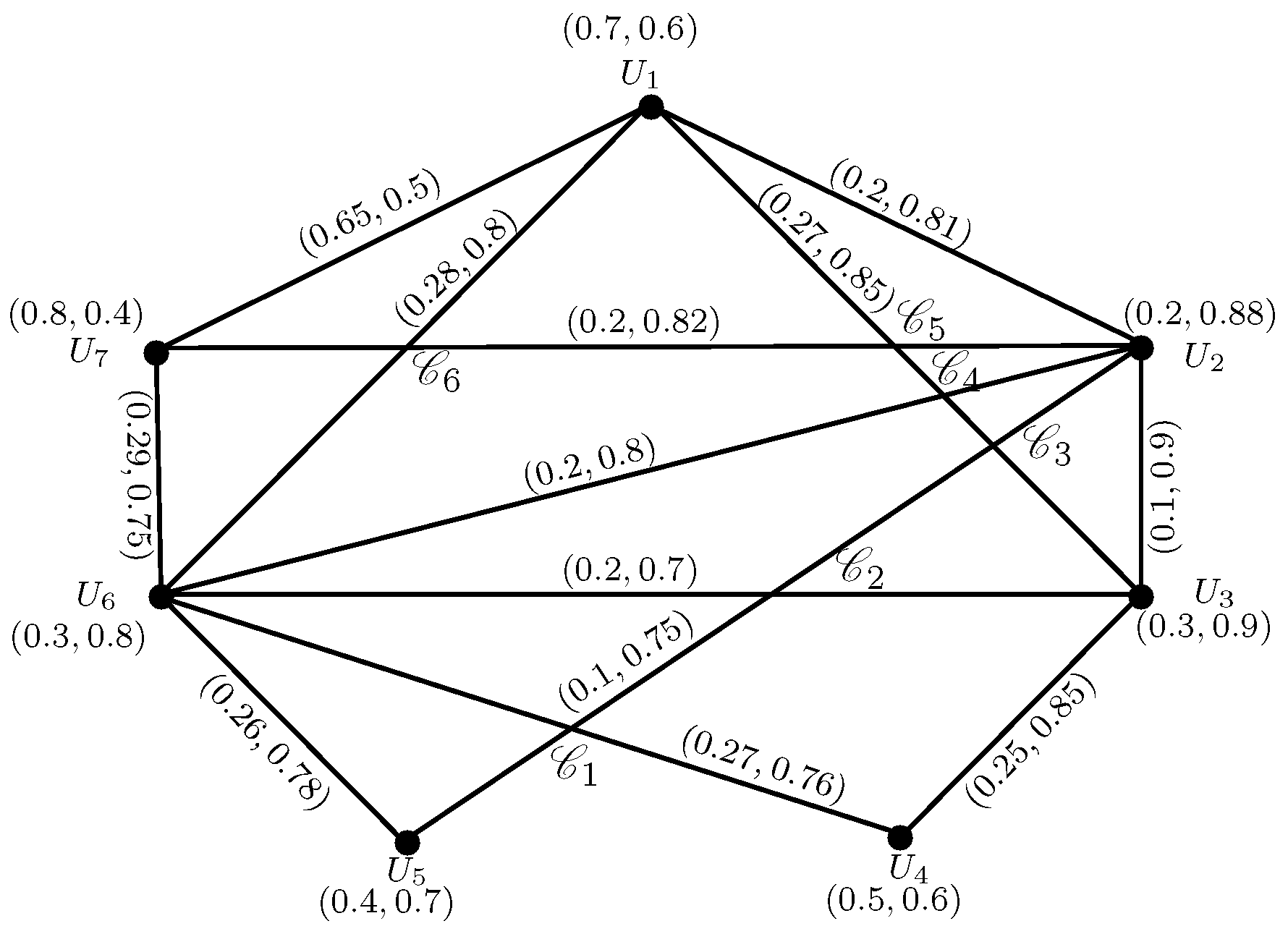
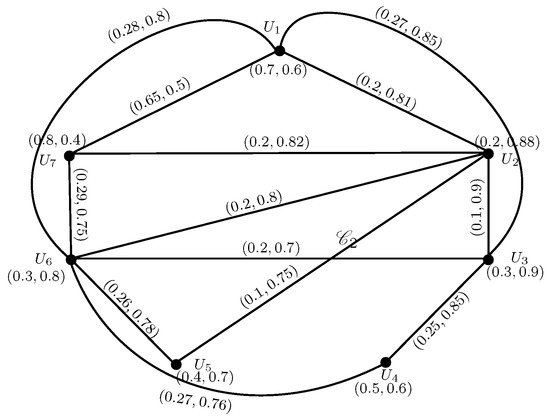
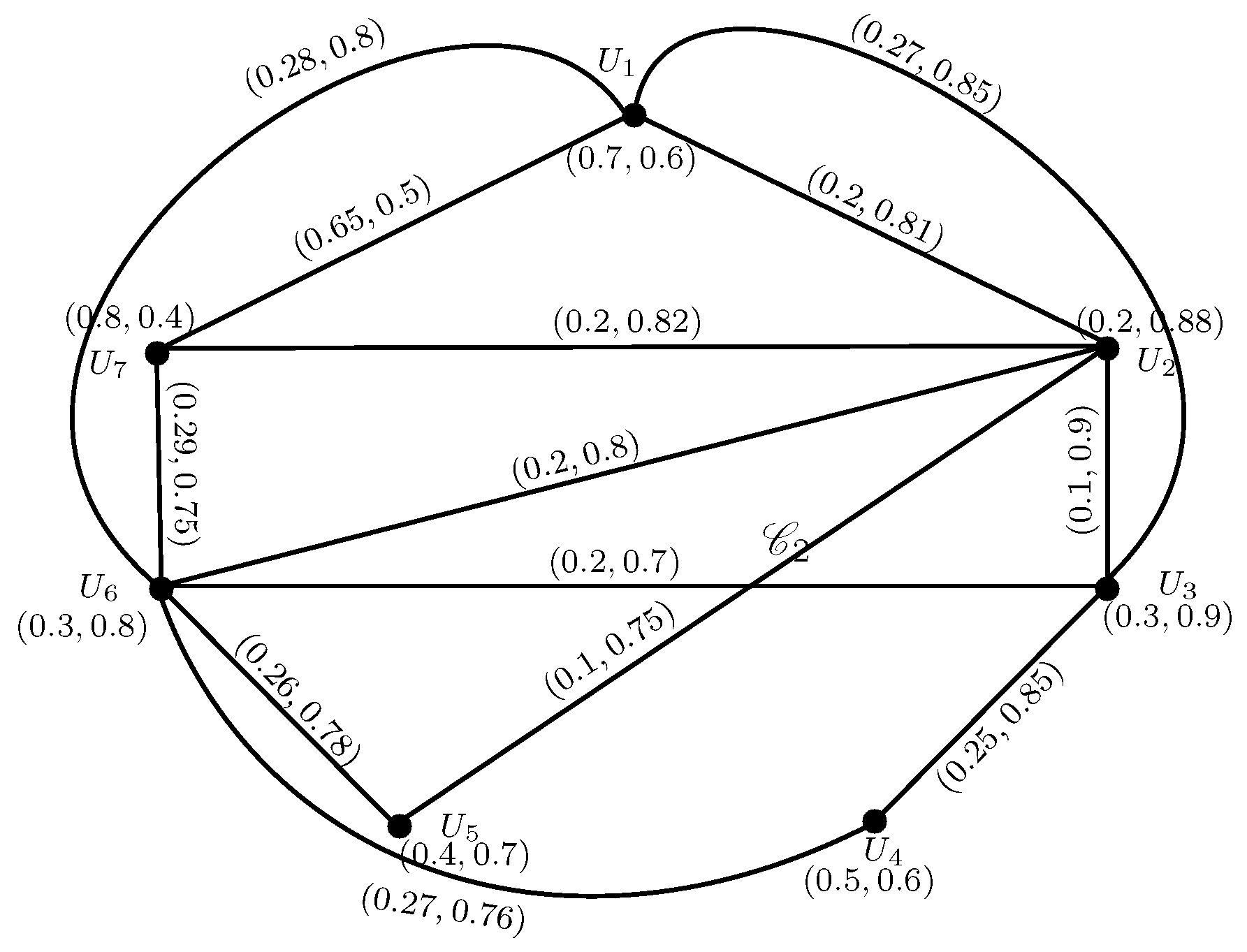
Consider an electric transformer in which units are connected as shown in Figure 18. Each unit is represented by a vertex and each electric connection between units through tiny wire is represented by an edge. The membership grade of the vertex depicted the chances of electric spark, whereas the nonmembership grade interpreted the chances of no electric spark in the unit. The membership grade of the edge depicted the intensity of electrical hazard between two units, whereas the nonmembership grade interpreted no intensity of electrical hazard.
Figure 18.
Transformer units connection.
As the number of crossings increase, the rate of destruction increases. Hence, the measurement of the planarity value is necessary. There are six crossings , , , , and between the pair of wires , , , , and , respectively. The strength of the wire , , , , , and For crossings, the point of intersections are , , , , and Thus, Pythagorean fuzzy planarity value Since the planarity value is at a minimum, it indicates the possibility of high destruction. To reduce crossing, we can change the graphical representation as shown in Figure 19.
Figure 19.
Pythagorean fuzzy electric connection model.
We know that the number of intersecting points is inversely proportional to planarity. Since the number of intersecting points decrease, the Pythagorean fuzzy planarity value increases and rate of destruction decreases. Moreover, from the representation shown in Figure 19, it is noted that is the only crossing left that can not be reduced, but the chance of electric hazard and rate of destruction through it can be minimized by using good quality electrical wires between and , and Thus, this crossing will become less harmful. Hence, we conclude that the Pythagorean fuzzy electric connection model can be used for tracking and detecting the rate of destruction. By examining and taking extra special security measures, the percentage of destruction can be reduced and many human lives can be saved.
We present our proposed method for checking planarity and minimizing crossings between electric connections in the following Algorithm 1.
| Algorithm 1: Planarity and minimizing crossings between electric connections. |
INPUT: A discrete set of units , a set of electric connections between the units and a set of point of intersections OUTPUT: Minimized crossing and increased planarity value.
|
8. Conclusions
Graph theory has a vast range of applications in designing various networking problems encountered in different fields such as image capturing, transportation and data mining. To model uncertainties in graphical networking problems, numerous generalization of graph theoretical concepts have established. Pythagorean fuzzy graphs, as an extension of fuzzy graphs and intuitionistic fuzzy graphs, have better ability due to the increment of spaces in membership and nonmembership grades, for modeling the obscurity in practical world problems. This paper has utilized the idea of Pythagorean fuzzy graphs and initiated the concept of Pythagorean fuzzy multigraphs and Pythagorean fuzzy planar graphs. It has investigated the Pythagorean fuzzy planarity value by considering strong, weak and considerable edges. Moreover, a critical analysis has been done on a nonplanar Pythagorean fuzzy graph. A close association has been developed between Pythagorean fuzzy planar graphs and Pythagorean fuzzy dual graphs. Furthermore, the concept of isomorphism, weak isomorphism and co-weak isomorphism have been elaborated between Pythagorean fuzzy planar graphs and some substantial results have been investigated. In the end, it has explored an important result that there exists a co-weak isomorphism between the Pythagorean fuzzy planar graph and dual of a dual Pythagorean fuzzy planar graph. The purpose of this research work is the applicability of Pythagorean fuzzy planar graphs in the field of neural networks and geographical information systems. With the help of these graphs, many problems related to crossing including designing golf holes in a golf club, linking different houses with each other and structuring road or communication networks can be easily solved. Further studies can focus on (1) Interval-valued Pythagorean fuzzy graphs; (2) Hesitant Pythagorean fuzzy graphs and; (3) Simplified interval-valued Pythagorean fuzzy graphs.
Author Contributions
M.A., J.M.D. and A.F. conceived of the presented idea. J.M.D. and A.F. developed the theory and performed the computations. M.A. and J.M.D. verified the analytical methods.
Funding
This research received no external funding.
Conflicts of Interest
The authors declare that they have no conflict of interest regarding the publication of the research article.
References
- Pal, A.; Samanta, S.; Pal, M. Concept of Fuzzy Planar Graphs. In Proceedings of the Science and Information Conference, London, UK, 14 November 2013; pp. 557–563. [Google Scholar]
- Pal, A.; Samanta, S.; Pal, M. New concept of fuzzy planar graphs. Int. J. Adv. Res. Artif. Intell. 2014, 3, 52–59. [Google Scholar]
- Pramanik, T.; Samanta, S.; Pal, M. Special planar fuzzy graph configurations. Int. J. Sci. Res. Publ. 2012, 2, 1–4. [Google Scholar]
- Zadeh, L.A. Fuzzy sets. Inf. Control 1965, 8, 338–353. [Google Scholar] [CrossRef] [Scilit]
- Atanassov, K.T. Intuitionistic fuzzy sets. Fuzzy Sets Syst. 1986, 20, 87–96. [Google Scholar] [CrossRef] [Scilit]
- Yager, R.R. Pythagorean fuzzy subsets. In Proceedings of the Joint IFSA World Congress and NAFIPS Annual Meeting, Edmonton, AB, Canada, 24–28 June 2013; pp. 57–61. [Google Scholar]
- Yager, R.R.; Abbasov, A.M. Pythagorean membership grades, complex numbers, and decision making. Int. J. Intell. Syst. 2013, 28, 436–452. [Google Scholar] [CrossRef] [Scilit]
- Yager, R.R. Pythagorean membership grades in multi-criteria decision making. IEEE Trans. Fuzzy Syst. 2014, 22, 958–965. [Google Scholar] [CrossRef] [Scilit]
- Zhang, X.; Xu, Z. Extension of TOPSIS to multiple criteria decision making with Pythagorean fuzzy sets. Int. J. Intell. Syst. 2014, 29, 1061–1078. [Google Scholar] [CrossRef] [Scilit]
- Kaufmann, A. Introduction a la Theorie des Sour-Ensembles Flous; Masson et Cie 1: Paris, France, 1973. [Google Scholar]
- Rosenfeld, A. Fuzzy graphs. In Fuzzy Sets and Their Applications to Cognitive and Decision Processes; Zadeh, L.A., Fu, K.S., Shimura, M., Eds.; Academic Press: Cambridge, MA, USA, 1975; pp. 77–95. [Google Scholar]
- Bhattacharya, P. Some remarks on fuzzy graphs. Pattern Recognit. Lett. 1987, 5, 297–302. [Google Scholar] [CrossRef] [Scilit]
- Mordeson, J.N.; Peng, C.S. Operations on fuzzy graphs. Inf. Sci. 1994, 79, 159–170. [Google Scholar] [CrossRef] [Scilit]
- Shannon, A.; Atanassov, K.T. A first step to a theory of intuitioistic fuzzy graphs. In Proceedings of the Fuzzy Based Expert Systems, Sofia, Bulgaria, 26–29 June 1994; Lakov, D., Ed.; pp. 59–61. [Google Scholar]
- Shannon, A.; Atanassov, K.T. Intuitioistic fuzzy graphs from α-, β-, (α,β)-levels. Notes Intuit. Fuzzy Sets 1995, 1, 32–35. [Google Scholar]
- Parvathi, R.; Karunambigai, M.G.; Atanassov, K.T. Operations on intuitioistic fuzzy graphs. In Proceedings of the IEEE International Conference on Fuzzy Systems, Jeju Island, Korea, 20–24 August 2009; pp. 1396–1401. [Google Scholar]
- Akram, M.; Davvaz, B. Strong intuitionistic fuzzy graphs. Filomat 2012, 26, 177–196. [Google Scholar] [CrossRef] [Scilit]
- Akram, M.; Dudek, W.A. Intuitionistic fuzzy hypergraphs with applications. Inf. Sci. 2013, 218, 182–193. [Google Scholar] [CrossRef] [Scilit]
- Naz, S.; Ashraf, S.; Akram, M. A novel approach to decision-making with Pythagorean fuzzy information. Mathematics 2018, 6, 95. [Google Scholar] [CrossRef] [Scilit]
- Verma, R.; Merigo, J.M.; Sahni, M. Pythagorean fuzzy graphs: Some results. arXiv, 2018; arXiv:1806.06721v1.
- Akram, M.; Naz, S. Energy of Pythagorean fuzzy graphs with applications. Mathematics 2018, 6, 136. [Google Scholar] [CrossRef] [Scilit]
- Dhavudh, S.S.; Srinivasan, R. Intuitionistic fuzzy graphs of second type. Adv. Fuzzy Math. 2017, 12, 197–204. [Google Scholar]
- Dhavudh, S.S.; Srinivasan, R. Properties of intuitionistic fuzzy graphs of second type. Int. J. Comput. Appl. Math. 2017, 12, 815–823. [Google Scholar]
- Akram, M.; Habib, A.; Ilyas, F.; Dar, J.M. Specific types of Pythagorean fyzzy graphs and application to decision-making. Math. Comput. Appl. 2018, 23, 42. [Google Scholar] [CrossRef] [Scilit]
- Akram, M.; Dar, J.M.; Naz, S. Certain Graphs under Pythagorean Fuzzy Environment. Complex Intell. Syst. in press.
- Abdul-Jabbar, N.; Naoom, J.H.; Ouda, E.H. Fuzzy dual graphs. J. Al-Nahrain Univ. 2009, 12, 168–171. [Google Scholar]
- Yager, R.R. On the theory of bags. Int. J. Gen. Syst. 1986, 13, 23–37. [Google Scholar] [CrossRef] [Scilit]
- Nirmala, G.; Dhanabal, K. Interval-valued fuzzy planar graphs. Int. J. Mach. Learn. Cybern. 2016, 7, 653–664. [Google Scholar]
- Alshehri, N.; Akram, M. Intuitionistic fuzzy Planar Graphs. Discret. Dyn. Nat. Soc. 2014, 2014, 397823. [Google Scholar] [CrossRef] [Scilit]
- Akram, M.; Samanata, S.; Pal, M. Application of bipolar fuzzy sets in planar graph. Int. J. Appl. Comput. Math. 2017, 3, 773–785. [Google Scholar] [CrossRef] [Scilit]
- Peng, X.; Yang, Y. Some results for Pythagorean fuzzy sets. Int. J. Intell. Syst. 2015, 30, 1133–1160. [Google Scholar] [CrossRef] [Scilit]
- Ren, P.; Xu, Z.; Gou, X. Pythagorean fuzzy TODIM approach to multi-criteria decision making. Appl. Soft Comput. 2016, 42, 246–259. [Google Scholar] [CrossRef] [Scilit]
- Rangasamy, P.; Palaniappan, N. Some operations on intuitionistic fuzzy sets of second type. Notes Intuit. Fuzzy Sets 2003, 10, 1–19. [Google Scholar]
- Peng, X.; Selvachandran, G. Pythagorean fuzzy set: state of the art and future directions. Artif. Intell. Rev. 2017, 1–55. [Google Scholar] [CrossRef] [Scilit]
- Garg, H. Some methods for strategic decision-making problems with immediate probabilities in Pythagorean fuzzy environment. Int. J. Intell. Syst. 2018, 33, 687–712. [Google Scholar] [CrossRef] [Scilit]
- Garg, H. Linguistic Pythagorean fuzzy sets and its applications in multi attribute decision making process. Int. J. Intell. Syst. 2018, 33, 1234–1263. [Google Scholar] [CrossRef] [Scilit]
- Zadeh, L.A. Similarity relations and fuzzy orderings. Inf. Sci. 1971, 3, 177–200. [Google Scholar] [CrossRef] [Scilit]
© 2018 by the authors. Licensee MDPI, Basel, Switzerland. This article is an open access article distributed under the terms and conditions of the Creative Commons Attribution (CC BY) license (http://creativecommons.org/licenses/by/4.0/).