3.1. Constant Returns to Scale
Let
and
. According to Map (
1), the equilibrium equations are
Since
, we have
from which we derive the closed form of the Nash equilibrium as follows:
Therefore, the following theorem can be derived.
Theorem 1. Let and . The Nash equilibrium is locally stable ifandFurthermore, a Neimark–Sacker bifurcation and a period-doubling bifurcation may occur whenandrespectively. There are no fold bifurcations. Proof. The local stability of the Nash equilibrium can be determined by the eigenvalues of the Jacobian matrix of Map (
1):
where
The eigenvalues of
J can be written as
It is well known that the Nash equilibrium is locally stable if .
If
, then
are real numbers. Thus, the stability condition becomes
. One can see that
which implies that
always holds. In addition,
If
, then
are a pair of conjugate complex numbers. Accordingly, we have
Therefore, the Nash equilibrium is locally stable if
and
According to the classical bifurcation theory, a Neimark–Sacker bifurcation and a period-doubling bifurcation may occur when
and
respectively. The proof is completed. □
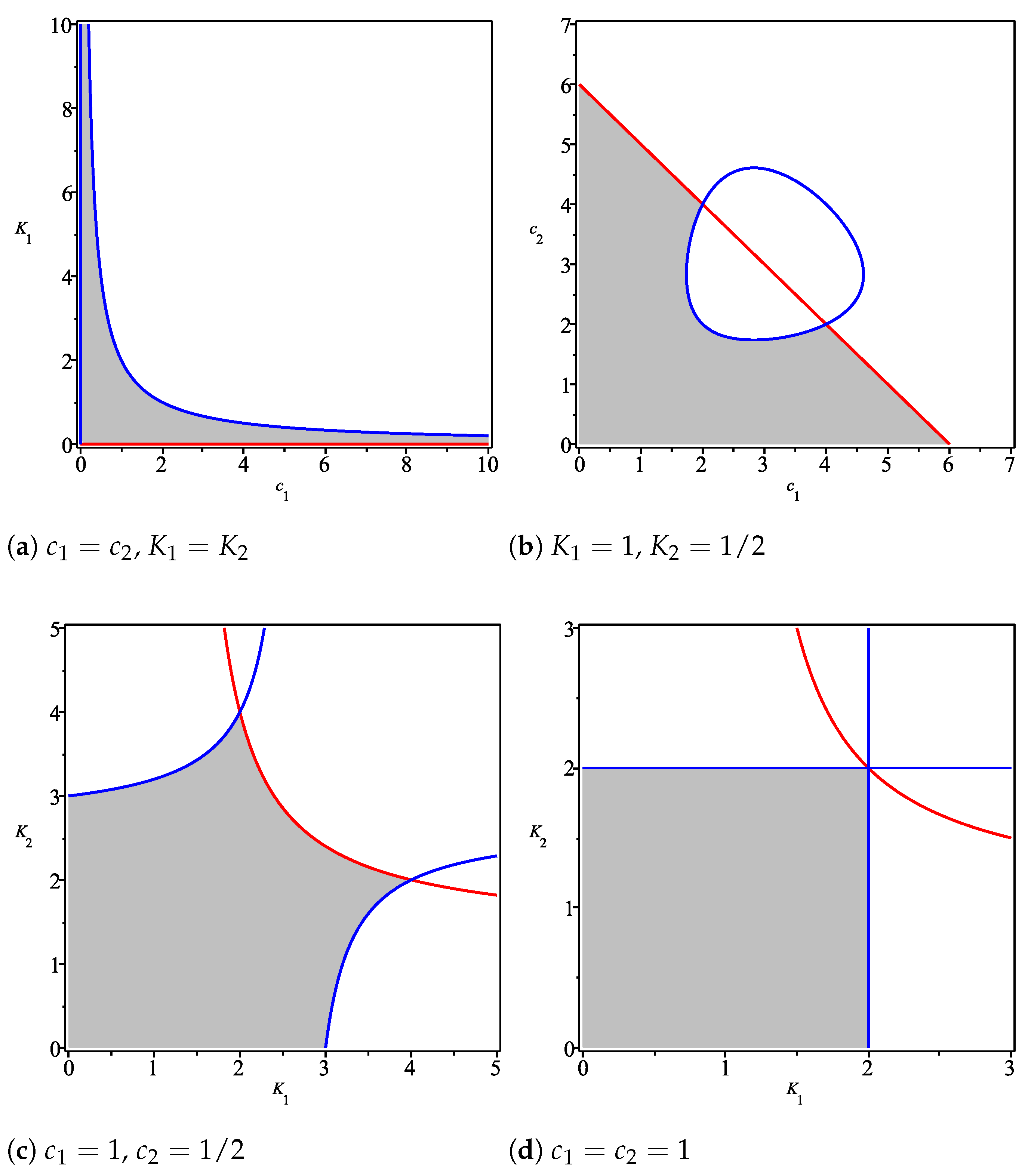
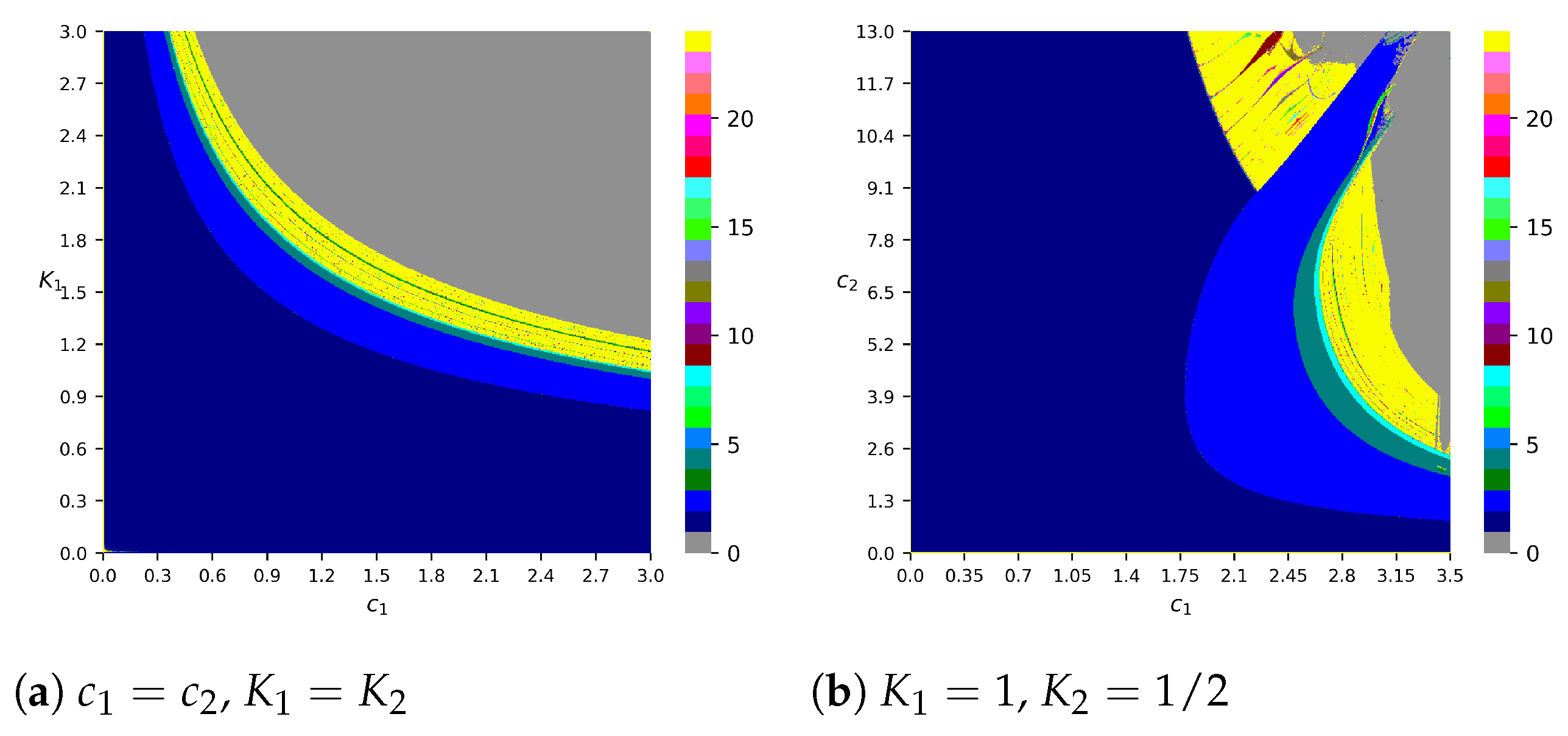
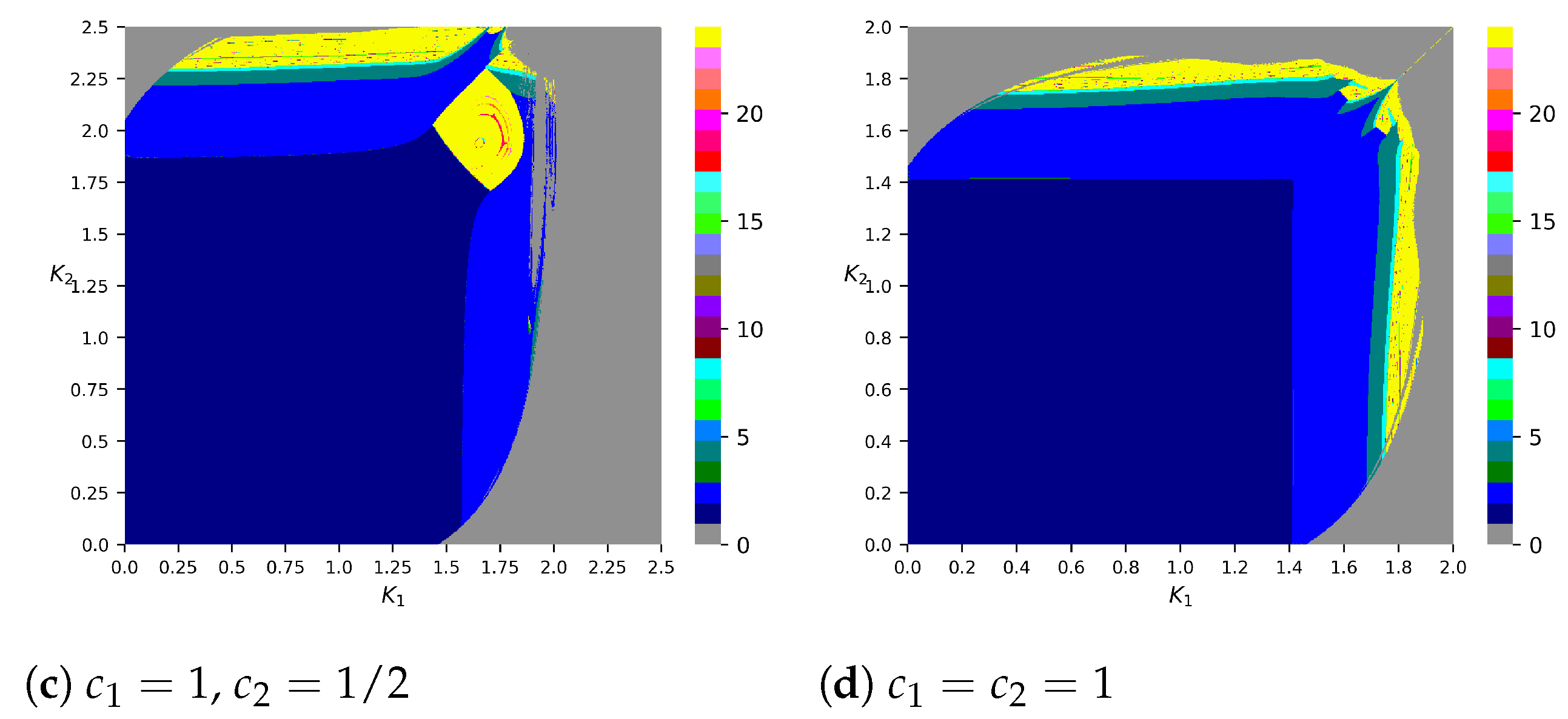
Figure 1 depicts the two-dimensional cross-sections of the four-dimensional stability region, wherein the algebraic varieties (bifurcation curves)
and
are colored in blue and red, respectively. As shown in
Figure 1a, it can be observed that when the cost parameters and adjustment speed parameters are identical for both players, i.e.,
and
, raising these variables may result in the destabilization of the Nash equilibrium. It is noteworthy that the blue and red curves are in alignment, indicating the necessity for further analysis to ascertain the type of bifurcation. As illustrated in
Figure 1b, when
and
, two potential routes also exist for the destabilization of the Nash equilibrium, i.e., through a Neimark–Sacker bifurcation or through a period-doubling bifurcation. To be precise, if the values of
and
are in close proximity to one another, then only a period-doubling bifurcation may occur. Conversely, if the values of
and
are sufficiently distinct, then a Neimark–Sacker bifurcation may ensue. Similarly,
Figure 1c illustrates that when
and
, two potential routes exist for the destabilization of the Nash equilibrium. When the discrepancy between
and
is sufficiently pronounced, the model may undergo a period-doubling bifurcation. In contrast, when the discrepancy between
and
is relatively minor, the model may undergo a Neimark–Sacker bifurcation.
Figure 1d clearly shows that when the costs of the two firms are identical (but
), the Nash equilibrium is only likely to lose its local stability through a period-doubling bifurcation, which is formally proven in Corollary 1.
Corollary 1. Let for . The Nash equilibrium is locally stable if and . Furthermore, provided that , a period-doubling bifurcation may occur when or , and there are no other bifurcations.
Proof. Recall Theorem 1. Plugging
into
yields
which is equivalent to
Moreover, plugging
into
yields
which can be transformed into
or
However, if
and
, then we have
which means that
and
are in conflict with (
2). On the other hand, it can be easily verified that
and
implies (
2). Accordingly, we can conclude that the Nash equilibrium is locally stable if
and
. Furthermore, provided that
, a period-doubling bifurcation may occur when
or
, and there are no other bifurcations. □
3.2. Decreasing Returns to Scale
Let
and
. According to Map (
1), the equilibrium equations are
Since
, we obtain the equations as follows:
The closed-form solutions of the above equations are intricate and challenging to analyze further (for example, see [
9,
21]). Accordingly, the triangular decomposition method is employed below to describe the Nash equilibrium. For further details regarding the triangular decomposition, the reader is referred to [
22,
23,
24,
25]. In essence, the triangular decomposition method can decompose a system of polynomial equations into some systems of polynomial equations in the triangular form (i.e., triangular sets) without altering the solutions.
We use
to denote the numerator. Then the solutions of the equilibrium equations are the same as those of
The triangular decomposition method allows us to decompose
into two triangular sets,
and
, where
It is evident that the zero of , that is, , is not defined in the equilibrium equations. Consequently, our attention is limited to the triangular set , which corresponds to the Nash equilibrium.
It can be observed that the polynomial
has two variables, namely
and
, yet is linear with respect to
. Therefore, we can conclude that
The solution for
can be derived from
, but they are complex and therefore difficult to analyze in terms of local stability. In a previous study [
26], the first author of this paper and his coauthor proposed a symbolic computation approach (for a comparable approach, the reader is directed to [
27]) to analyze the equilibrium of static models without solving its closed form. In what follows, we will borrow the main idea of this approach to derive the conditions for the local stability and bifurcations of the Nash equilibrium.
The
Sylvester resultant (or, for brevity, called the
resultant) plays an important role in our approach. Let us consider two univariate polynomials in the variable
x, designated by the symbols
and
. In this context, the notation res
is used to denote the resultant of polynomials
and
with respect to
x. As demonstrated in [
28], there exist two polynomials,
and
, such that res
can be expressed as
. This implies that res
if and only if
and
have a common zero in the field of complex numbers.
Remark 1. Let us consider a triangular set and a polynomial . DenoteIf we have and (or simply denoted as ), then it can be shown that implies that . That is to say, is a necessary condition for . In order to investigate the local stability of the Nash equilibrium, we calculate the Jacobian matrix associated with (
1) as follows:
where
The characteristic polynomial of
H is denoted as
where
and
are the trace and the determinant of
H, respectively. In accordance with the Jury criterion [
29], the conditions for the local stability of the Nash equilibrium are as follows:
Remark 2. In accordance with the classical bifurcation theory, it is established that a discrete dynamic system may exhibit a fold, period-doubling, or Neimark–Sacker bifurcation when the equilibrium point loses its stability when , , or , respectively.
Following Remark 2, we conduct a bifurcation analysis first. It is necessary to ascertain the parameter conditions for , and at the Nash equilibrium. Note that , and are rational functions. Thus, the problem of identifying bifurcations is transformed into finding the conditions for , and when and (or simply if we denote ).
By computing the resultants, we acquire that
where
and
It is a known fact that and . In accordance with Remarks 1 and 2, it can be deduced that is a necessary condition for the existence of fold bifurcations provided that . It can also be seen that if period-doubling bifurcations occur, then either or , while if Neimark–Sacker bifurcations take place, then either or . However, further analysis is required to determine whether these bifurcations are indeed taking place, and this will involve an examination of the local stability.
To analyze the local stability, it is necessary to determine the signs of
,
and
at the equilibrium. We use
to denote the denominator. If
, then
and
have the same signs. It can be computed that
The feasible parameter set consists of all tuples of the form
where
and
. The algebraic varieties
,
, divide the feasible parameter set into several regions. In each region, the signs of
(equivalently, the signs of
),
, remain constant. Therefore, it is sufficient to select at least one sample point from each region and identify the signs of
,
, at the selected sample point. The selection of sample points may be a challenging process in general and can be automated using, for example, the partial cylindrical algebraic decomposition (PCAD) method [
30].
As demonstrated by our implementation, the PCAD method generates a total of 2869 sample points. Due to space limitations, it is not feasible to report all of the sample points here. (These sample points are available from the corresponding author upon request. Also, the reader can compute the sample points by directly using the
SamplePoints function in the
RegularChains package of Maple 2022.) However, a selection of these points is presented in
Table 1, which also provides information regarding the signs of
and the local stability (this is equivalent to the simultaneous fulfillment of the conditions
,
, and
) of the Nash equilibrium.
Upon verification of all 2869 sample points, it can be observed that , , and if and only if and . This leads to the conclusion of the following theorem.
Theorem 2. Let and . The Nash equilibrium is locally stable if and . Furthermore, a period-doubling bifurcation may occur when , while a Neimark–Sacker bifurcation may occur when . There are no fold bifurcations.
The computational procedure is summarized as follows:
Step 1. Compute the triangular sets , , of the equilibrium equations using the triangular decomposition method.
Step 2. Evaluate the Jacobian matrix H at the Nash equilibrium point. The corresponding stability conditions are denoted for .
Step 3. For and , compute . This yields the parameter conditions under which the Nash equilibrium may undergo bifurcations.
Step 4. For and , compute . Using the PCAD method, sample points can be selected within the parameter regions divided by the algebraic varieties . This provides the parameter conditions under which the Nash equilibrium is locally stable.
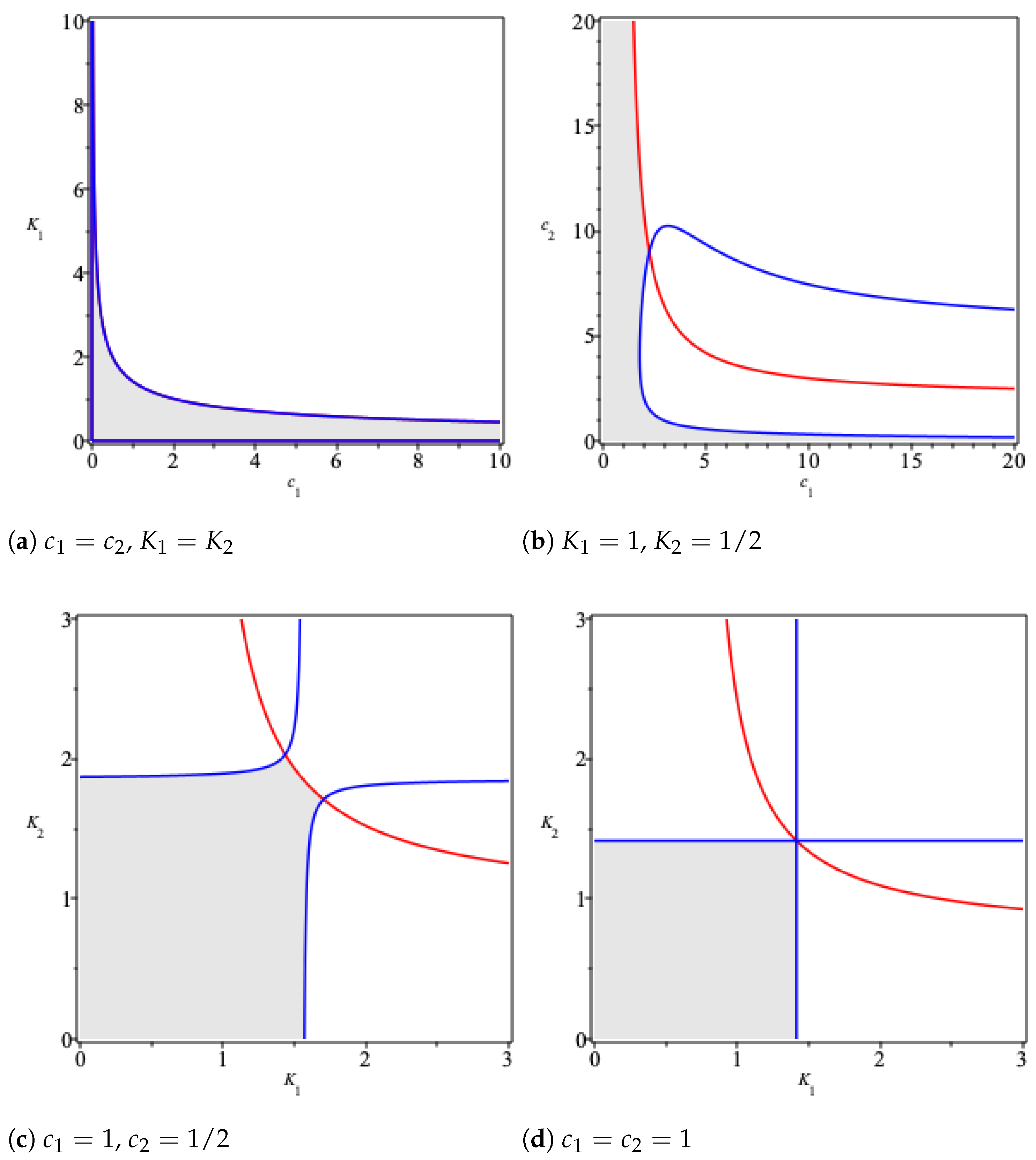
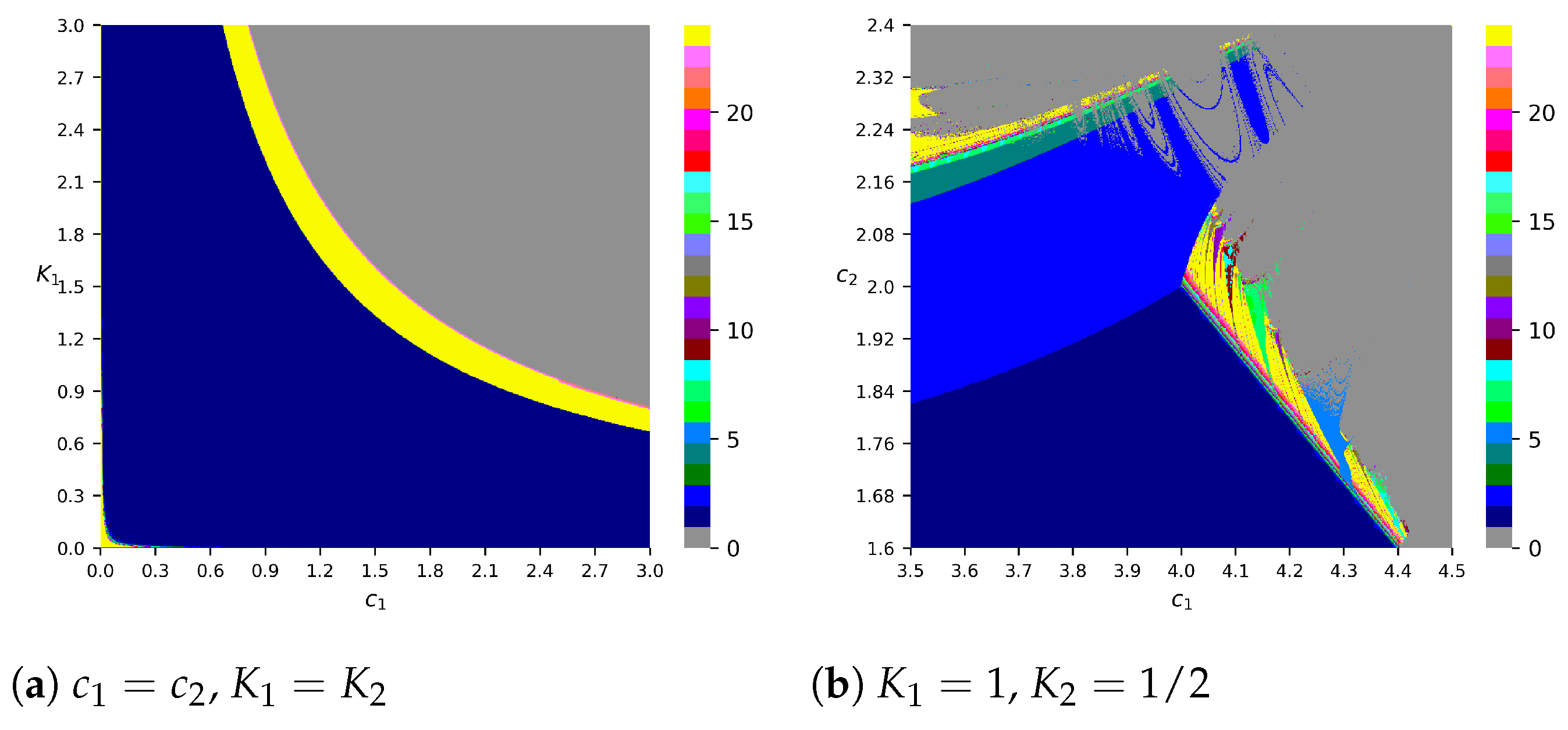
Figure 2 depicts the two-dimensional cross-sections of the four-dimensional stability region, wherein the algebraic varieties
and
are represented by blue and red, respectively. As illustrated in
Figure 2a, it can be observed that when the cost parameters and adjustment speed parameters are identical for both players, an increase in these variables may result in the destabilization of the Nash equilibrium. It is worth noting that the blue and red curves coincide with each other, meaning that the type of bifurcation needs to be identified by further analysis. As illustrated in
Figure 2b, when
and
, if the value of
is sufficiently large, an increase in
will result in the loss of stability through a Neimark–Sacker bifurcation. Nevertheless, if the value of
is sufficiently small, an increase in
will result in the model losing its stability through a period-doubling bifurcation. We should mention that the effects of
and
revealed by
Figure 2b are starkly divergent from those observed in
Figure 1b.
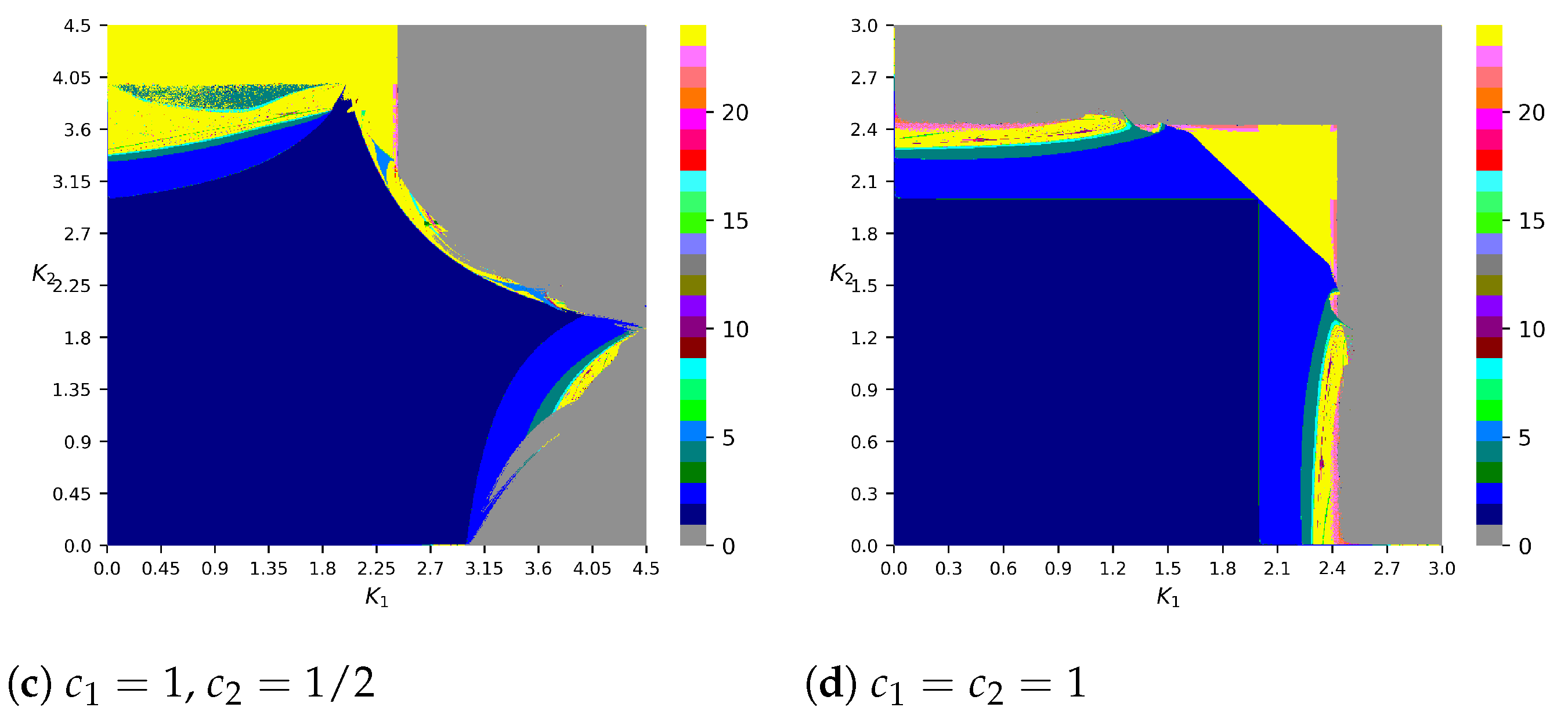
Figure 2c demonstrates that when
and
, two potential routes exist for the destabilization of the Nash equilibrium, i.e., through a Neimark–Sacker bifurcation or through a period-doubling bifurcation. In particular, when the discrepancy between
and
is sufficiently pronounced, the model may exhibit a period-doubling bifurcation. In contrast, when the discrepancy between
and
is relatively minor, the model may undergo a Neimark–Sacker bifurcation.
Figure 2d indicates that when the costs of the two firms are identical, the Nash equilibrium is only likely to lose stability through a period-doubling bifurcation. This observation is formally proven in Corollary 2.
Corollary 2. Let for . The Nash equilibrium is locally stable if and . Furthermore, provided that , a period-doubling bifurcation may occur when or , and there are no other bifurcations.
Proof. Recall Theorem 2. Plugging
into
yields
which is equivalent to
Moreover, plugging
into
yields
which can be transformed into
or
However, if
and
, then we have
which means that
and
are in conflict with (
3). On the other hand, it can be verified that
and
implies (
3).
First, assume that
. We have
Thus,
implies
Furthermore, in the case where
, we can similarly prove that
implies
Accordingly, we can conclude that the Nash equilibrium is locally stable if and . Furthermore, provided that , a period-doubling bifurcation may occur when or , and there are no other bifurcations. □