1. Introduction
Offset surfaces play a fundamental role in geometric modeling and computer-aided design (CAD), where they are used to generate surfaces at a prescribed distance from a given reference geometry. They are widely applied in tool path generation, tolerance analysis, and shape optimization. However, the construction of offset surfaces for complex geometries often leads to significant analytical and numerical difficulties, including singularities and self-intersections [
1,
2]. A detailed discussion of these challenges can be found in [
3].
In addition to these traditional CAD applications, scattered data approximation has become increasingly important in contemporary research and industry. In particular, surface reconstruction from 3D point clouds, obtained from scanners or imaging devices, is a fundamental problem in reverse engineering, medical imaging, and industrial inspection. These data sets are often irregularly distributed and corrupted by noise, making classical mesh-based or globally supported methods less effective. This highlights the necessity for efficient, robust, and meshfree approaches capable of handling scattered data in realistic scenarios.
Classical approaches for offset surface approximation are mainly based on spline techniques. Hoschek and Schneider investigated spline approximation of offset curves and surfaces, while Akhrif et al. [
1] proposed bicubic splines for generalized offset surfaces. Although effective, these methods rely on mesh-based representations and may lack flexibility when dealing with scattered or irregular data.
Radial basis functions (RBFs) offer an alternative framework for surface approximation. In particular, compactly supported RBFs introduced by Wendland [
4] provide computational efficiency due to sparsity. The extension of these functions to even-dimensional spaces was addressed by Schaback [
5], ensuring their applicability in a broader setting.
Several works highlight the flexibility and robustness of RBFs in various applications beyond offset surfaces. Narkawich et al. [
6] established Sobolev bounds for scattered zeros, Bilal et al. [
7] proposed meshless collocation for discontinuous coefficients, Fortes et al. [
8] applied RBFs to 3D data sets with volume constraints, and González-Rodelas et al. [
9] addressed fuzzy data approximation, other references following the same line can be consulted such as [
10,
11]. Although these works do not directly focus on offset surfaces, they demonstrate the adaptability and stability of RBF-based approaches in handling irregular or noisy data.
In this context, the choice of the basis functions plays a crucial role. Generalized Wendland combine compact support, locality, and strong approximation properties. Their use leads to sparse systems, improved numerical stability, and efficient handling of scattered data. Moreover, their well-defined construction in even dimensions ensures the theoretical consistency of the approximation framework.
The present work proposes a smoothing approach for the approximation of generalized offset surfaces using compactly supported generalized Wendland
. The method combines meshfree flexibility with improved computational efficiency. A convergence analysis is provided, and numerical experiments illustrate the effectiveness of the approach. Furthermore, the estimated approximation errors are compared with those obtained in [
1], allowing a quantitative evaluation of the proposed method.
To position the proposed approach within the context of existing research, we next review relevant contributions on offset surface approximation using both spline-based and radial basis function methods.
2. Related Work
The approximation of offset surfaces has been extensively studied in geometric modeling and computer-aided design. Early contributions focused on spline-based techniques. Hoschek and Schneider [
12] investigated the approximation of offset curves and surfaces using classical spline methods, highlighting both their effectiveness and limitations in the presence of singularities and complex geometries. Akhrif et al. [
1] proposed bicubic spline techniques for generalized offset surfaces, while Kouibia and Pasadas [
2] developed biquadratic spline methods to reconstruct offset surfaces with holes.
Radial basis functions (RBFs) provide a meshfree alternative for surface approximation. Iske [
13] studied scattered data approximation using positive definite kernels, emphasizing stability and convergence properties. Wendland [
4] introduced compactly supported RBFs, which improve computational efficiency by generating sparse system matrices. Schaback [
5] extended these constructions to even-dimensional spaces, and Wendland [
14] provided error estimates supporting their theoretical reliability.
Recent work explored generalized Wendland functions for surface approximation. Kouibia et al. [
15] proposed bivariate generalized Wendland RBFs with strong convergence properties. Kosari et al. [
16] developed hybrid RBF and B-spline methods to improve stability, while Paulo et al. [
17] introduced Hermitian RBF techniques incorporating geometric constraints. Kouibia and Pasadas [
18] emphasized smoothing variational approaches for handling noisy data.
Other studies demonstrate the flexibility of
beyond offset surfaces. Narkawich et al. [
6], Bilal et al. [
7], Fortes et al. [
8], and González-Rodelas et al. [
9] illustrate their effectiveness in multidimensional approximation, discontinuous problems, and noisy data sets. These contributions support the use of RBFs as a robust and adaptable framework.
Despite these advances, several challenges remain. Spline-based methods depend on mesh generation, while globally supported may lead to dense and computationally expensive systems. Efficient and stable approximation of generalized offset surfaces, particularly in the presence of noise and complex geometries, remains an open problem. The approach proposed in this work addresses these issues by combining smoothing techniques with compactly supported generalized Wendland radial basis functions, leading to a meshfree, efficient, and stable framework.
The rest of this work is organized as follows.
Section 2 presents the notation and preliminary necessary for the problem formulation.
Section 3 is devoted to the analysis of generalized compactly supported Wendland radial basis functions. In
Section 4, we formulate and study the smoothing variational spline problem using generalized Wendland functions. In
Section 5, we compute the explicit form of the resulting function, whereas a convergence theorem is proved in
Section 6. The final section provides numerical and graphical examples illustrating the effectiveness of the proposed approach, together with a comparison with an existing method in the literature.
3. Notations and Formulation of the Global Problem
Given an open, convex, and bounded set
, let
denote the usual Sobolev space of order 3. This space is equipped with the inner semi-products
the semi-norms
, for
, and the norm
.
Let
be the space of real matrices with
n rows and 3 columns, equipped with the inner product
and the corresponding norm
.
For a regular parametric surface
, its two unit tangent vectors in the directions of
u and
v and its normal vector are given by
respectively.
In this situation, the generalized offset surface
with the variable offset distance and direction determined by
,
and
is defined by
Let be a surface defined by a parametrization . For each , let be a finite subset of n distinct points of .
Now, let , and be some given offset variable distances and directions.
For any
, let
4. Generalized Wendland Compactly Supported Radial Basis Functions
Definition 1.
Let ϕ be a continuous function , a set , and a finite set of points of Ω.
The linear space generated by the functions setis called the radial basis functions space relative to the function ϕ and the centers set . Definition 2.
We consider a function . The interpolant associated with u is defined by:where are determined by the interpolating conditions Remark 1.
The radial basis function interpolating exists and is unique if and only if the interpolation matrix is invertible: The algorithm for constructing the generalized Wendland functions in even dimensions
is developed in [
5].
for integers
, with
and
,
are polynomials of degree
and
, respectively.
Remark 2.
The function is not defined at . However, the overall remains well-defined at this point by continuity, and the value at is obtained by taking the limit as , which yields a finite value. Therefore, the function is extended at by continuity.
For the Wendland function
in dimension
d pair with parameter
k, the native Sobolev space is:
Theorem 1.
Let be an open set, a set of centers, and let with . Let denote the RBF interpolating of relative to using .
Define the fill distance of in Ω
by Then, for all , we havewhere C is independent of f. Proof. Analogously to the proof of Theorem 1 in [
15]. □
Remark 3.
By applying the preceding theorem to the case , we obtain the following estimate, for all Let us consider with
The RBF interpolating of f is defined component-wise aswhere denotes the scalar RBF interpolating of with respect to the same centers set . Vector Sobolev semi-norm
By definition of the vector-valued Sobolev space , the associated semi-norm satisfies Component-wise application of the scalar estimate
Applying inequality to each component , Squaring and summing over we obtain Taking the square root, and for yields the desired estimate 5. Smoothing Variational Splines by Generalized Wendland Functions
Given a function
and a set of finite points
, we consider the functional
given by
and let
be the functional defined on
by
We consider the following minimization problem: Find
such that
Suppose that
A is a
-unisolvent set, that is,
and suppose that
Theorem 2.
Problem (6) has a unique solution, called the smoothing variational spline in relative to A, β, , , and ε, which is also the unique solution of the following variational problem: Find such that Proof.
Let us define the following application by
By the reasoning of Proposition 1.1 in [
19], we obtain that the linear form
is a norm in
, which is equivalent to the norm
.
Since
the operator
is linear and continuous.
We define the bilinear form
Continuity:
For all
, we have
Coercivity:
For all
, it holds that
The linear form defined from
into
by
is continuous on
.
Therefore, by the Lax–Milgram theorem (see [
20]), there exists a unique solution
to Problem (
10).
Furthermore,
is the minimizer of the functional
As a result,
is the unique solution of Problem (
6). □
6. Computing the Solution
In this section, we describe how to compute the generalized offset surfaces’ RBF spline in
. The solution
can be expressed by:
such that
.
Change of Basis
Let
denote the canonical basis of
. Starting from the vector-valued
approximation
we introduce the vector basis functions
defined, for
, by
where the indices
i and
j are given by
With this change of basis, the approximation can be rewritten as
where these coefficients are given as the solution of the linear system:
such as:
Now, by adapting the notations and reasoning as the proof of ([
3], Proposition 7), we obtain the following result.
Remark 4.
The coercivity of the bilinear form implies that the system matrix is symmetric positive definite and therefore invertible.
7. Convergence
The aim of this section is to prove that the offset RBF spline in relative to and converge to as n tends to .
Theorem 3.
Suppose hypotheses (7) and (8) hold and thatandThen Proof. Step 1. First, we have
with
being the interpolation RBFs function of
relative to
from
. Then:
which implies that:
Hence
It follows from (
5) that
and again applying (
5) for
, there exists
such that, for each
, we have
Thus, from (
13) and (
14), we obtain:
and, from (
11), we conclude that there exists
and
such that
In addition, from (
12)–(
14), we have that
and, from (
10) and (
11), there exists
and
such that
It follows that:
Hence, from (
15)–(
17), it follows that there exist a constant
and an integer
such that
Since the family
is bounded in
, it follows that there exists a sub-sequence
, with
,
, and an element
such that
Step 2. We suppose that
From the continuous injection of
into
, it follows that there exist
and a non-empty open
such that
As this injection is compact, from (
18),
Hence, for all
and all
, we have
For sufficiently large
m and using the density (
8), we deduce that there exists a point
such that
which is a contradiction with (
19). Consequently
Step 3. As
is compactly injected in
, using (
18) and taking into account that
, we have
Then,
Thus, for any
, we have
Therefore
Step 4. We suppose now that
does not tend to 0 as
n tends to infinity. In this case, there will exist
and a sequence
, such that
The sequence
is bounded in
. Hence, by following the same way of steps (1), (2) and (3), we deduce that from such a sequence, we can extract a sub-sequence that converges towards
, which produces a contradiction with (
23). □
8. Numerical and Graphical Examples
To illustrate the proposed method, we consider the following example. Let
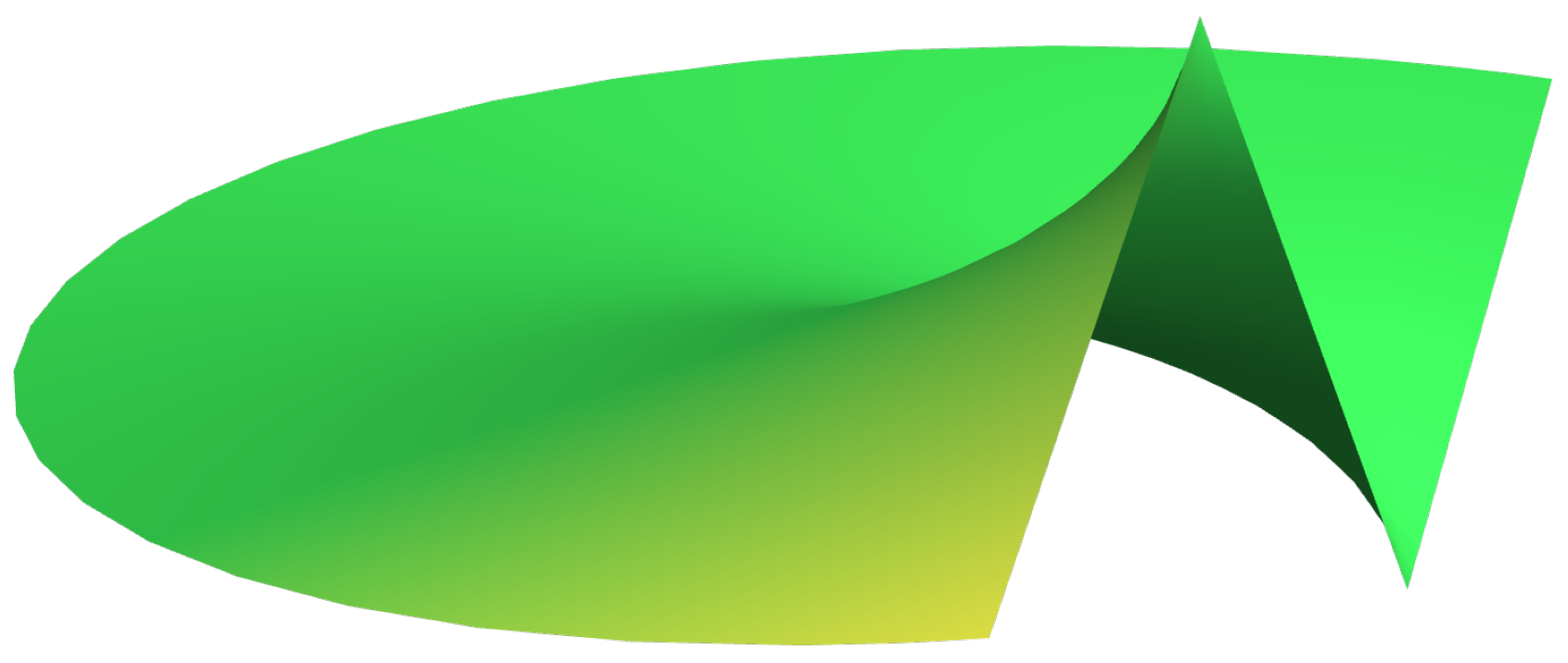
be a regular surface, its graph appears in
Figure 1, parameterized by
, with
and
In order to evaluate the performance of the method using Spline RBF, two relative error estimates were computed as follows:
with
being one thousand distinct random points used to estimate the relative errors of
and
with respect to
s in the
norm.
By Theorems 1 and 3, the error estimates and converge to zero as under suitable conditions.
The discrete space employed to compute the approximated solution
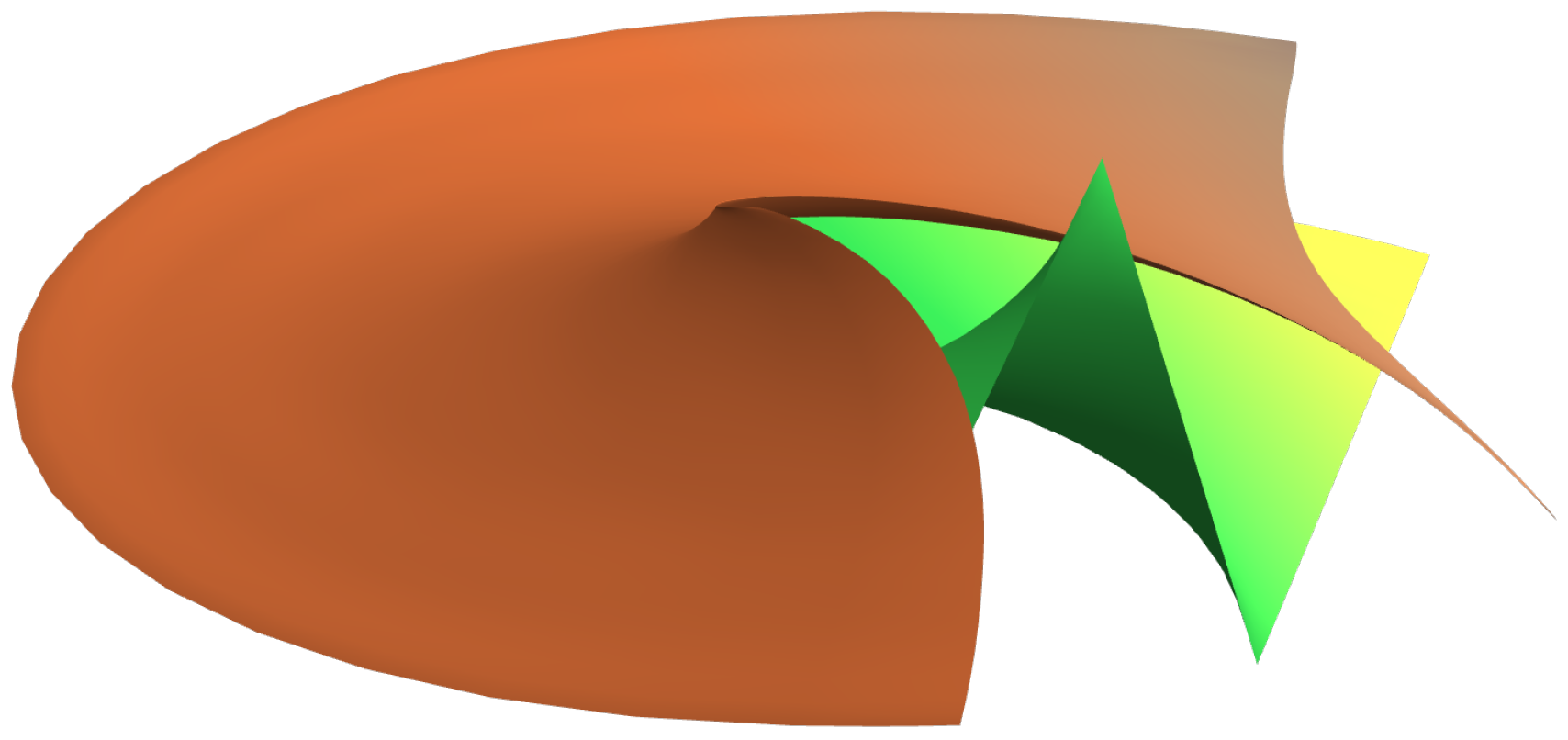
, its corresponding graph appears on the top part of the
Figure 2, is the
space generated by the generalized Wendland function
associated with the chosen set of centers:
The total number of centers is therefore .
Table 2 presents the relative error estimate
obtained with
centers and
approximation points for different values of
. As observed, when the parameter
decreases, the relative error progressively decreases and stabilizes at the order of
.
Table 3 Presents the relative error estimates
, for
and
, for various values of
n. The results show that
decreases as
n increases.
Table 4 Presents
and
for
and
, for various values of
N. It can be observed that
decreases monotonically as
N increases. In contrast,
initially decreases but increases for larger values of
N, likely due to ill-conditioning of the interpolation matrix. Furthermore,
remains consistently lower than
for all considered values of
N.
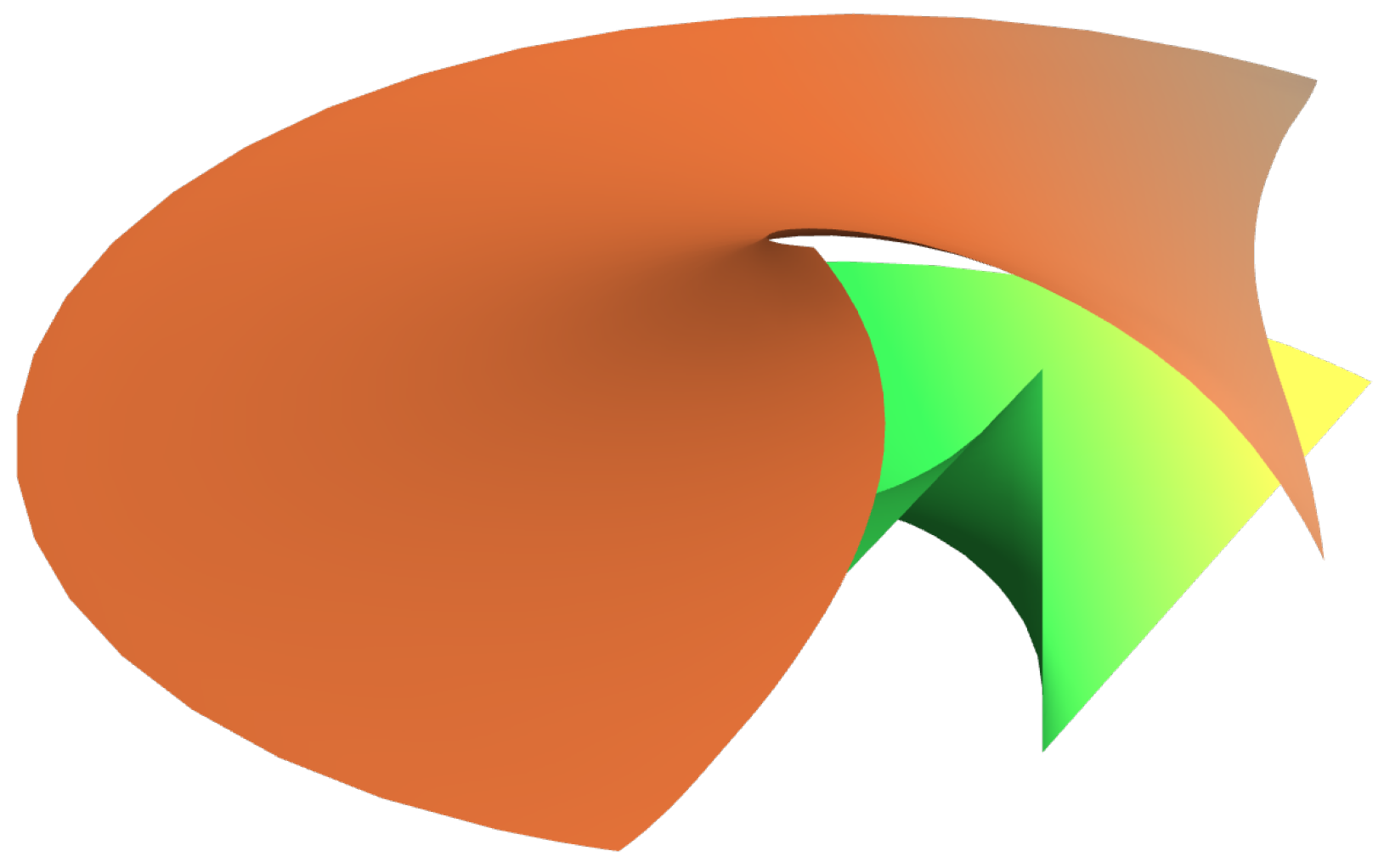
Figure 3 shows the original surface (the bottom part) and its
approximation of the generalized offset surface for
,
and
, its graph is shown on the top part, with the variable offset direction and offset distance
. In this case the computation of the relative error is
.
8.1. Normal Perturbation
Let denote the exact unit normal to the surface at a point .
8.1.1. Addition of Gaussian Noise
A perturbed normal is defined as:
where
is an isotropic Gaussian noise in dimension 3.
Here, the list of
values,
listeSigmaNormal in the code, corresponds to the different standard deviations used for the Gaussian noise in the experiments:
The parameter controls the intensity of the perturbation applied to the normals.
8.1.2. Renormalization
The perturbed normal is then normalized to preserve unit length:
This operation introduces a directional (angular) perturbation of the normal.
8.1.3. Perturbed Surface
After perturbing the normals, the surface becomes:
Thus, only the normal component is affected by the noise, leading to a geometric deformation of the surface mainly in the normal direction.
Numerical experiments are conducted for different values of the parameter
, allowing us to assess the robustness of the method with respect to noise on the normals (see
Table 5).
8.2. Example Torus
Let
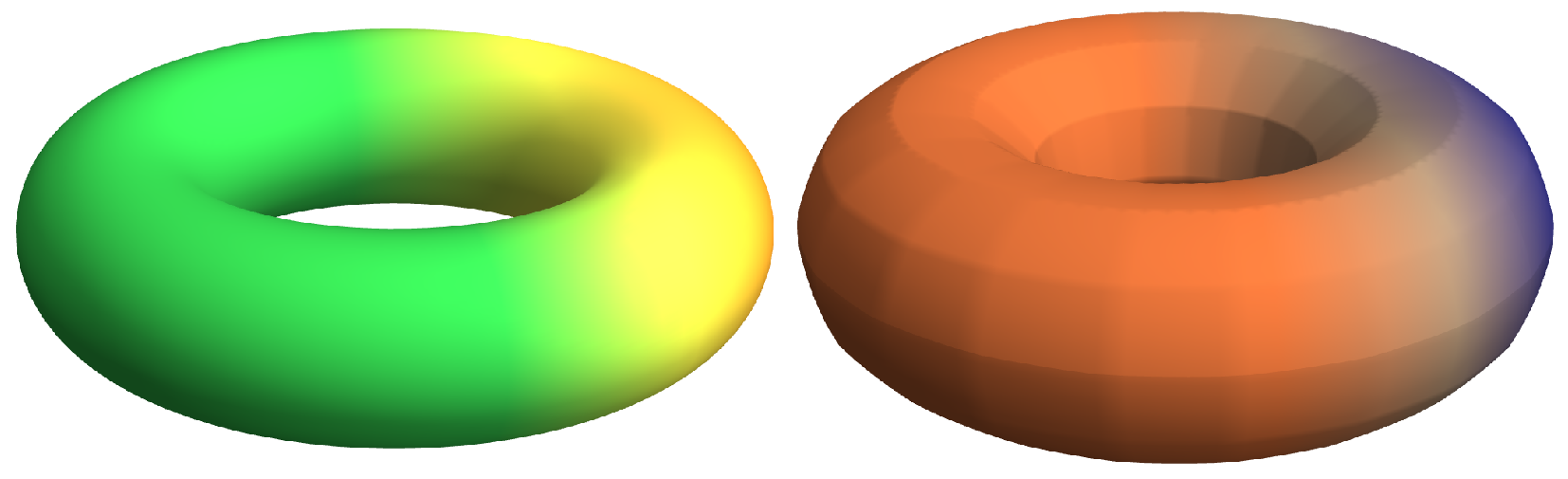
. We consider the regular surface, which parameterizes a torus (its graph appears on the left side of
Figure 4), defined by:
The generalized offset surface is defined by:
Its graph is shown in
Figure 4 right side.
8.3. Comparison with Other Method
The work we can compare to ours is the one [
1] where the authors there consider using the same approximation tool as ours for the example given by
but in the space of bicubic splines. As is known, they are piecewise polynomials, which makes studying the theory easy in one way or another, and especially reduces the time cost of computing the approximation results. In this context, we can compare the following results. In [
1], the estimation of the relative error, given by
is of the order
obtained with the bicubic spline method, for
approximation points and
, variable offset direction and offset distance
, while for a constant offset direction
, the computation of such an estimation is
obtained with the bicubic spline method for
approximation points and
. In this manuscript, we have obtained that the estimation of the degree of approximation, given by
, is
for
and
and
. We can conclude that the order of the estimation of the relative error is the same in both manuscripts; we can even observe that ours is slightly better, although our method uses
approximation, so it is assumed that the study in this case is more complicated.
8.4. Conclusions and Perspectives
In this manuscript, we have presented firstly some analysis of the generalized compactly supported Wendland radial basis functions. After this, we have formulated and studied the smoothing variational spline problem by generalized Wendland functions. We have described how to compute the generalized offset surfaces’ RBF spline in the space . Furthermore, the convergence theorem is proved, which shows that the offset RBF spline in relative to and converges to as n tends to . The end of this manuscript provided numerical and graphical examples illustrating the effectiveness of the proposed approach, together with a comparison with an existing method in the literature.
From the study of the
Table 2,
Table 3,
Table 4 and
Table 5, we can observe that as the value of the parameter
(its introduction is so important in any approximation, since this parameter avoids any oscillation in the approximation method) decreases, the estimation of the error decreases; furthermore, as the data points increase, the estimation of the error decreases. Hence, we can conclude the compatibility between the theory of the convergence results and the numerical ones.
In short, from the analysis presented in the
Figure 2,
Figure 3 and
Figure 4, the studies of the
Table 2,
Table 3,
Table 4 and
Table 5, and the last paragraph comparing with other methods that exist in the literature, we can conclude the effectiveness and the validity of our approach as an approximation method.
As future research work, we propose conducting the same study with other alternative approaches to filling and detecting the holes.
Author Contributions
Conceptualization, L.O. and A.K.; software, L.O. and H.E.B.; validation, L.O., A.K., H.O.Y. and H.E.B.; formal analysis, L.O. and A.K.; investigation, L.O., A.K., H.O.Y. and H.E.B.; resources, A.K.; data curation, L.O. and A.K.; writing—original draft, L.O.; writing—review & editing, A.K.; visualization, L.O., A.K., H.O.Y. and H.E.B.; and supervision, A.K. and H.O.Y. It should be noted that part of A. Kouibia’s research has been carried out in the “2EANIA” laboratory of FSJES of Tetouan, Abdelmalek Essaidi University. All authors have read and agreed to the published version of the manuscript.
Funding
This research received no external funding.
Data Availability Statement
The original contributions presented in this study are included in the article. Further inquiries can be directed to the corresponding author.
Conflicts of Interest
The authors declare no conflicts of interest.
References
- Akhrif, R.; Kouibia, A.; Pasadas, M. Approximation of generalized offset surfaces by bicubic splines. J. Math. Chem. 2020, 58, 647–662. [Google Scholar] [CrossRef]
- Kouibia, A.; Pasadas, M. Reconstruction approximating method by biquadratic splines of offset surfaces holes. J. Math. Chem. 2022, 60, 423–439. [Google Scholar] [CrossRef]
- Kouibia, A.; Pasadas, M. Optimization of the parameters of surfaces by interpolating variational bicubic splines. Math. Comput. Simul. 2014, 102, 76–89. [Google Scholar] [CrossRef]
- Wendland, H. Piecewise polynomial, positive definite and compactly supported radial functions of minimal degree. Adv. Comput. Math. 1995, 4, 389–396. [Google Scholar] [CrossRef]
- Schaback, R. The missing Wendland functions. Adv. Comput. Math. 2011, 34, 67–81. [Google Scholar] [CrossRef]
- Narkawich, F.J.; Ward, J.D.; Wendland, H. Sobolev bounds on functions with scattered zeros, with applications to radial basis function surface fitting. Math. Comput. 2005, 74, 743–763. [Google Scholar] [CrossRef]
- Bilal, F.; Asif, M.; Shakeel, M.; Popa, I. RBF-based meshless collocation method for time-fractional interface problems with highly discontinuous coefficients. Math. Comput. Appl. 2025, 30, 133. [Google Scholar] [CrossRef]
- Fortes, M.A.; González, P.; Palomares, P.; Pasadas, M. Fitting and filling of 3D datasets with volume constraints using radial basis functions under tension. J. Comput. Appl. Math. 2023, 420, 114841. [Google Scholar] [CrossRef]
- González-Rodelas, P.; Idais, H.; Pasadas, M.; Yasin, M. Approximation of 3D trapezoidal fuzzy data using radial basis functions. Fuzzy Sets Syst. 2023, 453, 82–94. [Google Scholar] [CrossRef]
- González, P.; Pasadas, M.; Kouibia, A.; Basim, M. Numerical solution of linear Volterra integral equation systems of second kind by radial basis functions. Mathematics 2022, 10, 223. [Google Scholar] [CrossRef]
- Arrazaki, M.; Zougari, T. L’utilisation de fonction radiale de base á support compact pour accélérer le temps de décomposition BEMD. Adv. Comput. Math. 2014, 4, 24–29. [Google Scholar] [CrossRef]
- Hoschek, J.; Schneider, F.J. Spline Approximation of Offset Curves and Offset Surfaces; Springer: Dordrecht, The Netherlands, 1990; pp. 383–389. [Google Scholar]
- Iske, A. Scattered data approximation by positive definite kernel functions. Rend. Sem. Mat. Univ. Politec. Torino 2011, 69, 217–246. [Google Scholar]
- Wendland, H. Error estimates for interpolation by compactly supported radial basis functions of minimal degree. J. Approx. Theory 1998, 93, 258–272. [Google Scholar] [CrossRef]
- Kouibia, A.; González, P.; Pasadas, M.; Mustafa, B.; Oulad Yakhlef, H.; Omri, L. Approximation of bivariate functions by generalized Wendland radial basis functions. Mathematics 2024, 12, 2597. [Google Scholar] [CrossRef]
- Kosari, S.; Hao, G.; Derakhshan, M. An efficient hybrid meshless RBF and B-spline approach for solving distributed-order time-fractional advection-diffusion equations. Comput. Appl. Math. 2026, 45, 92. [Google Scholar] [CrossRef]
- Paulo, J.; Trevisan, D.; Batagelo, H.; Macedo, I. Generalized Hermitian radial basis functions implicits from polygonal mesh constraints. Vis. Comput. 2013, 29, 651–661. [Google Scholar] [CrossRef]
- Kouibia, A.; Pasadas, M. Approximation by smoothing variational vector splines for noisy data. J. Comput. Appl. Math. 2008, 211, 213–222. [Google Scholar] [CrossRef]
- Arcangéli, R.; López de Silanes, M.C.; Torrens, J.J. Multidimensional Minimizing Splines, Theory and Applications; Kluwer Academic Publishers: Boston, MA, USA, 2004. [Google Scholar]
- Atkinson, K.; Han, W. Theoretical Numerical Analysis, A Functional Analysis Framework, 2nd ed.; Springer: New York, NY, USA, 2005. [Google Scholar]
| Disclaimer/Publisher’s Note: The statements, opinions and data contained in all publications are solely those of the individual author(s) and contributor(s) and not of MDPI and/or the editor(s). MDPI and/or the editor(s) disclaim responsibility for any injury to people or property resulting from any ideas, methods, instructions or products referred to in the content. |