Article

Optimal Cooperative Guidance Algorithm for Active Defense of EWA Under Dual Fighter Escort
1
Fundamentals Department, Air Force Engineering University, Xi’an 710051, China
2
Aviation Engineering School, Air Force Engineering University, Xi’an 710038, China
*
Author to whom correspondence should be addressed.
Mathematics 2026, 14(7), 1187; https://doi.org/10.3390/math14071187
Submission received: 14 February 2026 / Revised: 24 March 2026 / Accepted: 28 March 2026 / Published: 2 April 2026
(This article belongs to the Section E2: Control Theory and Mechanics)

Abstract

This paper investigates an optimal cooperative guidance strategy for the active defense of an early-warning aircraft (EWA) escorted by two fighters against an incoming missile. The proposed framework extends classical three-body defense models (Target–Missile–Interceptor) into a more realistic four-body engagement (Target–Missile–Interceptor 1–Interceptor 2), allowing explicit coordination among multiple defenders. By projecting the 3D engagement kinematics onto two orthogonal 2D planes—a validated simplification for typical aerial combat geometries—a tractable dynamic model is obtained. Within this model, an analytical cooperative guidance law is derived using optimal control theory and the calculus of variations, minimizing a multi-objective cost function that combines miss distance, control effort, intercept geometry, and coordination terms. Extensive Monte Carlo simulations across 23 attack directions and multiple initial ranges demonstrate that the proposed method achieves an interception success rate of 99%, with an average miss distance of below 5 m. Robustness tests further confirm stable performance under target maneuver uncertainty, sensor noise, and modeling deviations. The algorithm features closed-form control commands with low computational complexity, enabling real-time onboard implementation.

1. Introduction

1.1. Background and Motivation

Early-warning aircraft (EWAs) serve as indispensable force multipliers in modern aerial warfare, providing critical capabilities for surveillance, command, and control. Their ability to detect low-altitude targets and coordinate fleet operations makes them high-value assets, particularly in beyond-visual-range combat [1]. However, this strategic importance also renders them primary targets for adversary forces, especially advanced anti-radiation and beyond-visual-range air-to-air missiles [2]. Enhancing the survivability of EWAs is therefore a paramount concern, driving research into advanced defensive technologies such as frequency diverse array radars to counter missile seekers and improve electronic countermeasure capabilities [3].
The contemporary threat landscape is characterized by increasingly sophisticated missile attack profiles and penetration strategies, supported by radar stealth, electronic warfare, and coordinated unmanned systems [4]. Traditional passive or single-layered defense systems are often inadequate against these multifaceted threats, necessitating a shift toward active defense paradigms. Active defense involves the coordinated use of escort assets—such as fighter-launched interceptor missiles—to engage incoming threats before they reach the protected high-value unit [5].
A promising avenue for implementing active defense lies in manned-unmanned teaming (MUM-T), where unmanned combat aerial vehicles (UCAVs) or interceptor missiles operate under the supervision of manned platforms like EWAs or fighter aircraft [6]. Such cooperative systems can enhance situational awareness, distribute sensor and weapon resources, and execute complex engagement geometries that overwhelm conventional missile guidance systems [7,8]. Recent advances in multi-agent reinforcement learning and distributed control have further enabled intelligent coordination in dynamic combat environments.
While extensive research has been devoted to three-body engagement models—involving one attacker, one defender, and one target—real-world operational scenarios often demand multi-body cooperative defense, where two or more interceptors are deployed to ensure interception success and manage engagement uncertainties [9,10]. Theoretical frameworks from classical multi-body dynamics and modern cooperative game theory provide a foundation for such extensions, yet the synthesis of these principles into practical, optimal guidance laws for four-body engagements (EWA + two interceptors vs. one attacker) remains underexplored [11].
Motivated by this gap, this paper investigates the optimal cooperative guidance problem for the active defense of an EWA escorted by two fighters. Specifically, we propose a four-body engagement model, formulate a multi-objective optimal control problem, derive an analytical variational-based guidance law, and validate its performance through high-fidelity simulations. The proposed model accounts for the kinematic and dynamic constraints of all entities, while the guidance law simultaneously minimizes miss distance, control effort, and deviation from desired interception angles. This approach not only extends the theoretical foundations of multi-body engagement but also provides a practical algorithmic framework for enhancing the survivability of high-value aerial assets in contested environments.

1.2. Literature Review

The design of effective active defense strategies against missile threats has been a persistent challenge in guidance and control research. Existing work can be broadly categorized into studies on engagement modeling, the application of optimal control theory, and the development of cooperative guidance laws for multi-agent scenarios.

1.2.1. Active Defense and Engagement Modeling

The foundational work in active defense often simplifies the problem into a three-body engagement involving a Target (T), an attacking Missile (M), and a defending Interceptor (D). Early contributions focused on geometric relationships and linearized models. Yamasaki et al. investigated the three-body geometry and proposed a triangular guidance law for the defender [12]. Ratnoo and Shima established seminal three-body mathematical models, deriving cooperative interception strategies in which both the target and the defender apply line-of-sight guidance commands [13,14,15]. To address practical constraints, Garcia et al. employed optimal control theory to determine the target’s optimal heading when the defender and target have turn-rate limitations, effectively luring the attacker towards the defender [16]. The problem has also been framed within a differential game framework. Rusnak et al. formulated a performance-index-weighting control effort and miss distances to simplify optimal guidance laws [17]. Similarly, work in [18,19] designed optimal guidance laws that consider overload constraints and multi-objective optimization (e.g., minimizing miss distance and total control energy). In the Chinese research community, parallel efforts have yielded significant results. Zhang Hao studied differential game-based guidance laws for active defense [20]. Liu Zhe et al. and Wang Xiaoping et al. utilized the projection method to reduce three-dimensional engagement models to two-dimensional planes and derived optimal interception-evasion or cooperative guidance laws using variational methods, providing a direct methodological precursor to the current work [21,22].

1.2.2. Methodological Foundations: Optimal Control and Variational Methods

The theoretical underpinning for deriving such optimal guidance laws primarily stems from optimal control theory and the calculus of variations. Variational methods, with roots in classical physics, provide a framework for finding functions that optimize a cost functional, typically an integral of a Lagrangian function dependent on state and control variables [23,24]. Optimal control theory, a pivotal extension developed in the mid-20th century, formalizes the optimization of dynamic systems under constraints. Pontryagin’s Maximum Principle is a cornerstone, transforming optimal control problems into two-point boundary-value problems solvable via variational calculus [25]. For linear-quadratic problems, the forward propagation of the differential Riccati equation offers another solution pathway [26]. These tools are exceptionally well-suited for guidance law design, where performance indices (e.g., integrated control effort, terminal miss distance) are naturally expressed as cost functionals, and system dynamics provide the constraints.

1.2.3. Cooperative Guidance Laws for Multi-Agent Systems

Extending beyond the three-body problem, cooperative guidance for multiple interceptors or vehicles has become a vibrant research area that heavily leverages optimal control. The objectives often include simultaneous time-of-arrival, specific impact angles, and handling of target maneuverability and system constraints.
Simultaneous Attack and Impact Angle Control: A key challenge is coordinating multiple missiles to strike a target simultaneously from desired directions. Solutions range from linear pseudospectral model predictive control (LPMPC) for nonlinear systems and two-stage strategies involving consensus and identical guidance gains [27], to methods employing physics-guided neural networks and sliding mode control combined with neural networks for optimal angle estimation.
Handling Constraints and Uncertainty: Realistic scenarios impose field-of-view limits, acceleration bounds, and uncertain target motions. Research has addressed these by reformulating problems in virtual coordinate frames to avoid linearization [28,29], designing pursuer roles for evasion scenarios, and deriving closed-form laws for stochastic step-maneuvering targets [30].
Advanced Formulations and Learning-Based Approaches: The problem has been cast in various advanced frameworks, including differential games for target-defender-missile scenarios [31], constrained linear-quadratic optimal control for three-body engagements [32], and distributed model predictive control (DMPC) for UAV swarms. Recently, the integration of deep learning with optimal control has emerged to address high dimensionality and real-time requirements, such as for hypersonic vehicles [33].

1.3. Proposed Approaches

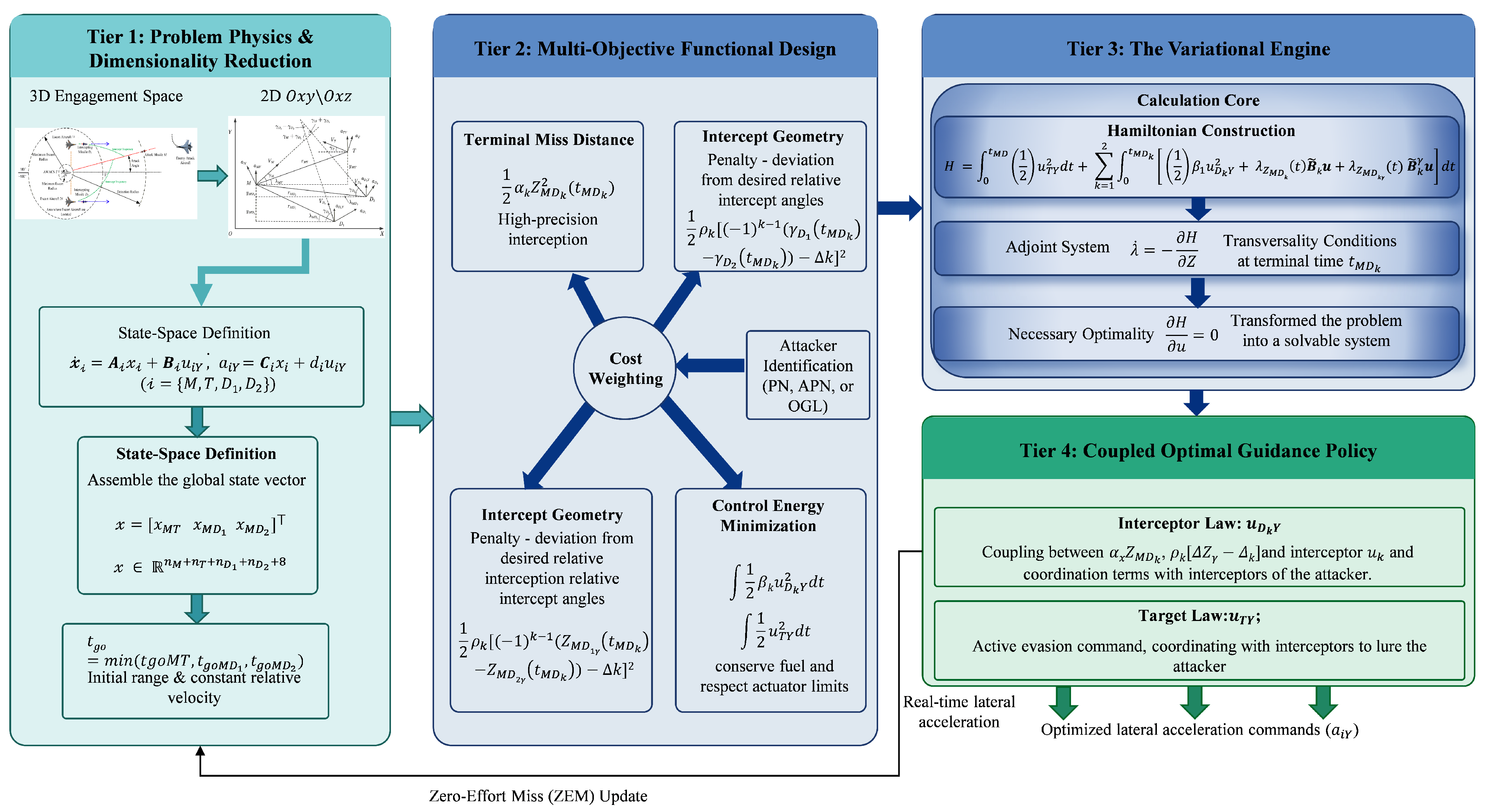
Building upon the identified research gap, this paper proposes a comprehensive methodological framework for the optimal cooperative active defense of an EWA (T) escorted by two fighters, which launch interceptor missiles ( D 1 and D 2 ) against an incoming threat (M). The framework systematically integrates problem modeling, dimensionality reduction, optimal control formulation, and simulation-based validation. Compared with existing three-body cooperative guidance strategies, this work introduces a distinct four-body cooperative architecture to enable dual-interceptor coordination under a centralized decision mechanism. The overall structure of the methodology is illustrated in Figure 1, providing a visual overview of the modeling, optimization, and guidance synthesis process.

1.3.1. Four-Body Engagement Model and Dimensionality Reduction

To achieve the objective of cooperative active defense for an EWA escorted by two fighters, this paper proposes a comprehensive methodological framework consisting of four key components. The primary contribution is the formulation of a T-M- D 1 - D 2 four-body engagement model, extending the classical three-body problem to a more realistic dual-interceptor escort scenario. To manage the complexity inherent in the full three-dimensional kinematics, we adopt a two-dimensional projection method. This technique decomposes the spatial motion into two orthogonal planes (e.g., pitch and yaw), allowing the problem to be analyzed and solved within simplified 2D frameworks, a strategy proven effective for complex aerospace systems. This reduction is crucial for deriving tractable analytical solutions, and under typical air-combat geometry it introduces negligible error—an acceptable engineering approximation validated in previous studies. The approach aligns with the broader trend of employing Model Order Reduction (MOR) techniques for high-dimensional dynamical systems. Similar to data-driven methods used to extract dominant modes from complex flow fields or construct low-order approximations from input-output data for nonlinear systems [34], our projection method serves as a physics-based MOR, preserving the essential engagement dynamics while significantly alleviating the computational burden for real-time guidance law synthesis.

1.3.2. Multi-Objective Optimal Control Formulation

Within the established 2D model, we formulate the cooperative defense as a finite-horizon multi-objective optimal control problem. The performance index is meticulously designed to balance critical operational metrics:
  • Terminal Accuracy: Minimizing the zero-effort miss (ZEM) distances for both interceptors.
  • Interception Geometry: Enforcing desired impact angles to maximize lethality and minimize the attacker’s escape probability.
  • Control Effort: Penalizing the integrated lateral acceleration of the EWA and both interceptors to ensure feasibility within physical actuator limits and conserve energy.
  • Interceptor Coordination: Incorporating terms to mitigate potential interferences between the two interceptors.
This formulation represents a clear advancement over earlier three-body methods, where such multi-agent coordination terms were not explicitly incorporated. It shares common ground with modern guidance strategies employing meta-heuristic or hybrid optimizers [35,36], yet the present work achieves these multi-objective goals through an analytical variational approach rather than iterative numerical techniques—significantly improving execution speed and stability.

1.3.3. Derivation of the Variational-Based Cooperative Guidance Law

The solution to the defined optimal control problem is derived using the calculus of variations. We construct the Hamiltonian, apply Pontryagin’s principle, and solve the resulting two-point boundary value problem to obtain analytical expressions for the optimal cooperative control laws for the EWA and the two interceptors. These laws are not independent; they are coupled, explicitly coordinating the maneuvers of all three cooperative entities based on real-time engagement states (relative distances, velocities, time-to-go). This analytical closed-form solution is one key novelty of this work: it eliminates numerical iteration and provides deterministic execution suitable for avionics-level computation. The derivation demonstrates how the theoretical tools of optimal control are directly applied to synthesize a distributed yet cooperative decision-making policy for the defender team.

1.3.4. Simulation-Based Validation and Robustness Analysis

The proposed cooperative guidance algorithm is validated through high-fidelity numerical simulations capturing nonlinear kinematics, actuator dynamics, and acceleration constraints. Extensive cases are tested across multiple attack directions and engagement ranges. The comparison with classical PN, APN, and CPNG laws confirms notable performance gains in interception accuracy, efficiency, and stability. Robustness tests under target maneuver uncertainty, sensor noise, and modeling errors further demonstrate resilience and applicability to real-world conditions [37]. These simulations and robustness analyses act as an essential validation bridge between theoretical derivation and practical engineering implementation.
To better position this work with respect to the existing literature, Table 1 provides a concise comparison with representative studies on active defense and cooperative guidance. In contrast to most existing three-body or generic multi-agent formulations, the present work explicitly considers a four-body dual-interceptor defense scenario and combines an analytical guidance law with dedicated robustness evaluation and implementation-oriented discussion.

2. Problem Formulation

2.1. Dual-Escort Cooperative Active Defense Scenario

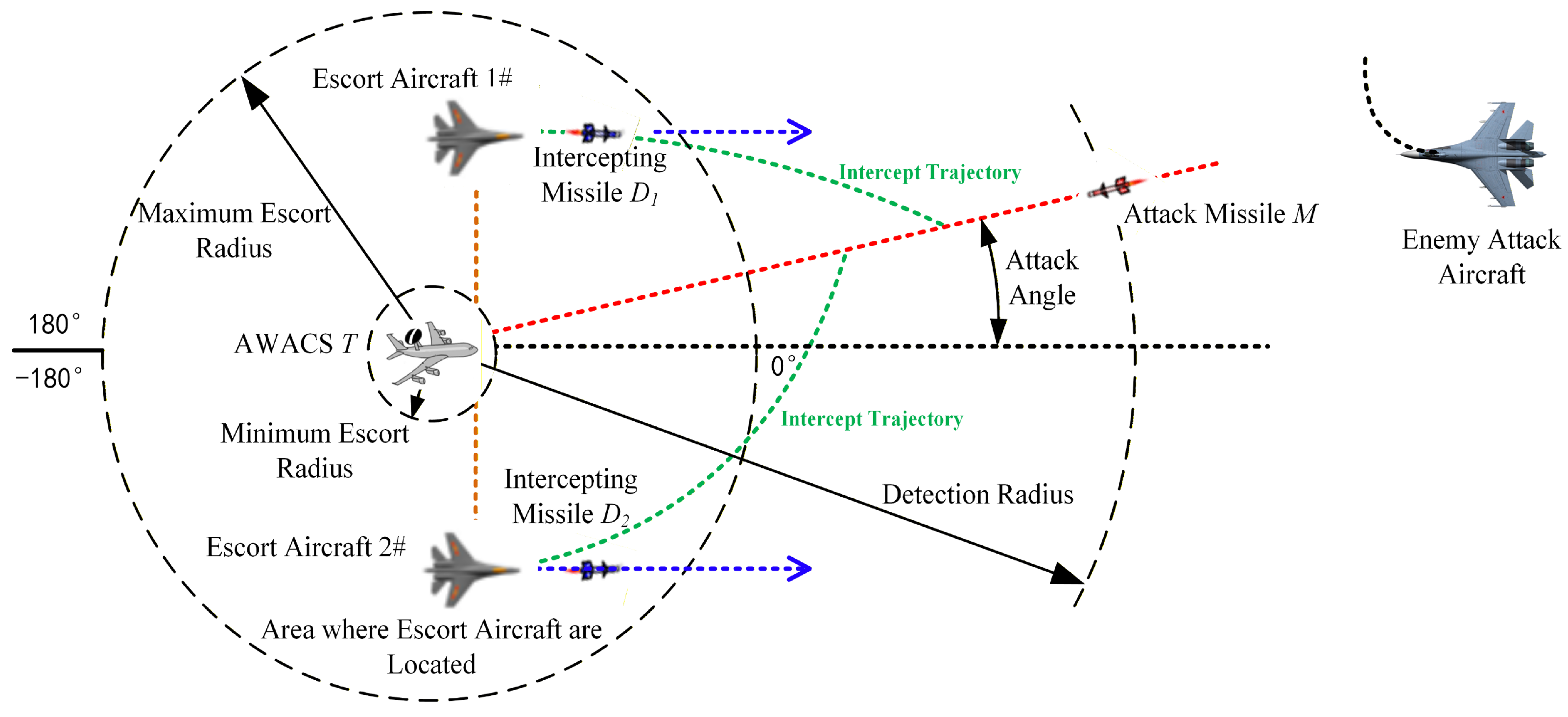
As illustrated in Figure 2, an active defense operation involves an EWA protected by two escort aircraft. In this scenario, it is assumed that enemy attack aircraft breach the defensive perimeter and launch medium- to long-range air-to-air missiles (denoted as M) toward the EWA (denoted as T). To improve the effectiveness of active defense, once the EWA detects an incoming missile, the two escort aircraft each launch an interceptor missile (denoted as D 1 and D 2 , respectively) to cooperatively engage the threat. Consequently, the active defense problem evolves from a traditional three-body engagement (T-M-D) into a four-body confrontation (T-M- D 1 - D 2 ).
In the proposed system, the airborne early-warning aircraft (EWA-T) functions as the central command and control node, leveraging its advanced sensor suite to detect and track incoming threats. It continuously estimates the attacker’s kinematic state and computes optimal cooperative guidance commands for itself and the defending interceptors. These commands are then transmitted in real time to the in-flight missiles. The escort fighters serve primarily as launch platforms for the interceptors, designated D 1 and D 2 . Once deployed, these missiles receive guidance updates directly from the EWA rather than generating their own trajectories or communicating with each other.
The operational architecture follows a “centralized sensing and control, with decentralized execution” model. Specifically, the EWA performs all sensing, state estimation, and command computation, while the interceptors function as execution nodes, translating incoming commands into autopilot instructions. Coordination between the two defenders, such as maintaining a specified intercept angle difference Δ k , is implicitly enforced by the guidance law running on the EWA, which synthesizes commands for both missiles based on the global engagement geometry. This eliminates the need for peer-to-peer communication between interceptors and ensures that all actions are driven by a unified tactical picture.
This design offers several practical benefits. By concentrating computational responsibility on the EWA—a platform with substantial processing capacity—the system avoids placing heavy demands on the interceptors, which can therefore be simpler, lighter, and more cost-effective. Moreover, centralizing guidance computation on the basis of a single sensor source removes the potential for inconsistency that can arise from distributed tracking or local estimation. The architecture also enhances resilience: even if an escort fighter is lost, the EWA retains full command and control over the engagement, with only the available missile inventory affected. Ultimately, the scheme embodies a principle of “centralized computation with distributed execution,” made feasible by the EWA’s sensing power, the relatively short engagement ranges, and the availability of low-latency data links.

2.2. Four-Body Confrontation Model

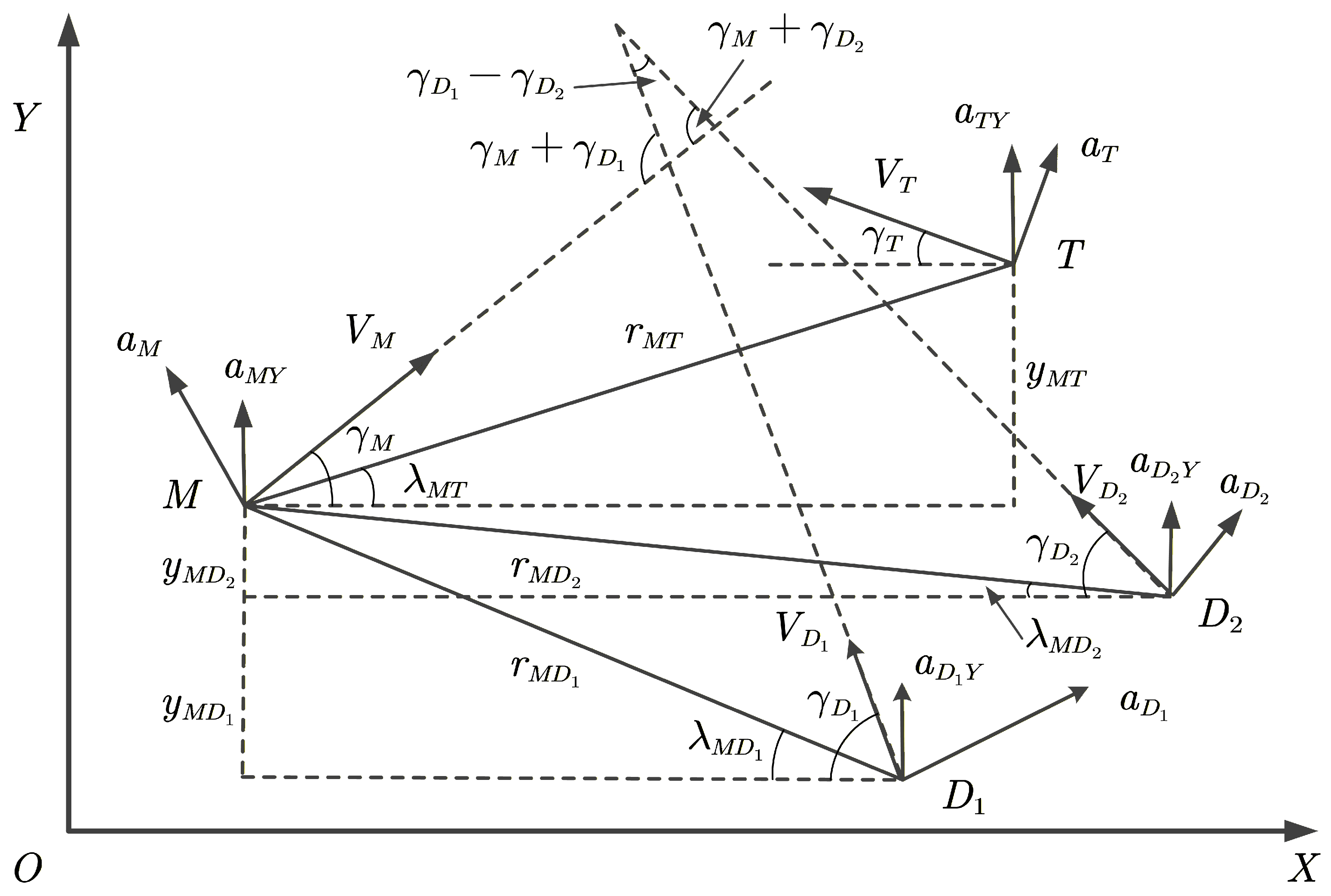
Considering the three-dimensional spatial motion in active defense engagements, it can be decomposed into motion within the O x y and O x z two-dimensional spaces for separate description.
This simplification is based on the following considerations: in typical EWA escort scenarios, the maneuvers of attacking missiles and interceptors primarily occur within the horizontal plane, while altitude changes are relatively slow (such as during cruise phases or terminal altitude hold). Moreover, aircraft are typically equipped with roll-stabilization systems that allow lateral and longitudinal motions to be approximately decoupled. Consequently, decomposing three-dimensional motion into two independent two-dimensional planar problems is a widely accepted approximation in engineering practice. It is worth emphasizing that the two-dimensional projection method adopted in this paper is not merely a mathematical simplification, but is also highly consistent with the physical structure of missile guidance systems. For instance, as Karelahti et al. [38] pointed out in their study on air-to-air missile evasion problems, actual missiles possess two mutually independent guidance channels (e.g., pitch and yaw) in the plane perpendicular to the velocity vector. The three-dimensional acceleration commands generated by guidance laws such as proportional navigation must be projected onto these two orthogonal channels for execution—this constitutes the engineering foundation for the method adopted in this paper, which decomposes three-dimensional motion into two orthogonal two-dimensional planes.
Figure 3 establishes the corresponding motion model using motion within the O x y plane as an example. Here, u i , a i , and V i denote the aircraft’s control input, lateral acceleration, and velocity, respectively, where subscripts i = M , T , D 1 , D 2 correspond to different aircraft. The terms u i Y , a i Y , and V i Y represent the Y-axis components of their respective variables. γ i is the trajectory pitch angle. The distances r M T , r M D 1 , and r M D 2 denote the relative ranges between the attacking missile and the EWA, Interceptor 1, and Interceptor 2, respectively, with y M T , y M D 1 , and y M D 2 being their Y-axis components.
The four-body confrontation model for active defense confrontation, including the warning aircraft, offensive missile, defensive missile 1, and defensive missile 2, is described as follows:
x ˙ i = A i x i + B i u i Y i = M , T , D 1 , D 2 a i Y = C i x i + d i u i Y i = M , T , D 1 , D 2
Let
x = x M T x M D 1 x M D 2 T R n M + n T + n D 1 + n D 2 + 8
where
x M T = y M T y ˙ M T x M T x T T T x M D 1 = y M D 1 y ˙ M D 1 γ M + γ D 1 x D 1 T T x M D 2 = y M D 2 y ˙ M D 2 γ M + γ D 2 x D 2 T T
The system dynamics can be expressed in the state-space form as follows:
d d t x M T x M D 1 x M D 2 = A 11 0 0 A 21 A 22 0 A 31 0 A 33 x M T x M D 1 x M D 2 + B 1 B 2 B 3 u T Y u D 1 Y u D 2 Y + B M 1 B M 2 B M 3 u M Y
The submatrices are given as follows (dimensions match the corresponding state blocks):
A 11 = 0 1 0 1 × n M 0 1 × n T 0 0 C M C T 0 n M × 1 0 n M × 1 A M 0 n M × n T 0 n T × 1 0 n T × 1 0 n T × n M A T
A 21 = 0 0 0 1 × n M 0 1 × n T 0 0 C M 0 1 × n T 0 0 C M / ( V M cos γ M ) 0 1 × n T 0 n D 1 × 1 0 n D 1 × 1 0 n D 1 × n M 0 n D 1 × n T
A 22 = 0 1 0 0 1 × n D 1 0 0 0 C D 1 0 0 0 C D 1 / ( V D 1 cos γ D 1 ) 0 n D 1 × 1 0 n D 1 × 1 0 n D 1 × 1 A D 1
A 31 = 0 0 0 1 × n M 0 1 × n T 0 0 C M 0 1 × n T 0 0 C M / ( V M cos γ M ) 0 1 × n T 0 n D 2 × 1 0 n D 2 × 1 0 n D 2 × n M 0 n D 2 × n T
A 33 = 0 1 0 0 1 × n D 2 0 0 0 C D 2 0 0 0 C D 2 / ( V D 2 cos γ D 2 ) 0 n D 2 × 1 0 n D 2 × 1 0 n D 2 × 1 A D 2
The input matrices are as follows:
B 1 = 0 0 0 d T 0 0 0 n M × 1 0 n M × 1 0 n M × 1 B T 0 n T × 1 0 n T × 1
B 2 = 0 0 0 0 d D 1 0 0 d D 1 / ( V D 1 cos γ D 1 ) 0 0 n D 1 × 1 B D 1 0 n D 1 × 1
B 3 = 0 0 0 0 0 d D 2 0 0 d D 2 / ( V D 2 cos γ D 2 ) 0 n D 2 × 1 0 n D 2 × 1 B D 2
B M 1 = 0 d M B M 0 n T × 1
B M 2 = 0 d M d M / ( V M cos γ M ) 0 n D 1 × 1
B M 3 = 0 d M d M / ( V M cos γ M ) 0 n D 2 × 1
Here, n M , n T , n D 1 , n D 2 denote the dimensions of the respective state vectors, and all symbols retain their original meanings. The system describes the engagement between:
  • Missile (M) and Target (T)—represented by the M T subsystem.
  • Missile (M) and Interceptor Missile 1 ( D 1 )—represented by the M D 1 subsystem.
  • Missile (M) and Interceptor Missile 2 ( D 2 )—represented by the M D 2 subsystem.

2.3. Time-to-Go Analysis

Let r M T ( 0 ) , r M D 1 ( 0 ) , and r M D 2 ( 0 ) denote the initial distances between the attacking missile and the target, and between the attacking missile and each interceptor, respectively. Assuming that the relative velocity V M T between the attacking missile and the target, and the relative velocities V M D between each interceptor missile and the attacking missile, are all constant, the approximate time required for the attack and interception can be expressed as t M T = r M T ( 0 ) / V M T , t M D 1 = r M D 1 ( 0 ) / V M D 1 , and t M D 2 = r M D 2 ( 0 ) / V M D 2 , respectively. For a successful active defense mission, it is required that both interceptors reach the attacking missile before the latter reaches the EWA. This condition implies t M D 1 < t M T and t M D 2 < t M T , ensuring that the intercept occurs prior to the impact on the target.
At any time t during the engagement, the remaining time for the interception mission is t g o M D 1 = t M D 1 t , t g o M D 2 = t M D 2 t , and the remaining time for the attack mission is t g o M T = t M T t . Since the overall engagement terminates at the earliest of these three events, the effective time-to-go for the four-body confrontation is defined as t g o = min ( t g o M T , t g o M D 1 , t g o M D 2 ) .This definition ensures that the guidance law operates only while the interception is still physically meaningful; once any of the events occurs, the engagement is considered concluded.

2.4. Guidance Law of the Attacking Missile

In active defense scenarios, the feasibility of cooperative engagement depends on the timely identification of the attacking missile’s guidance characteristics. Existing literature on guidance law identification suggests that, following effective detection, the time required to identify an attacking missile’s guidance law and parameters is sufficiently short relative to the overall engagement timeline. For instance, traditional filter-based methods typically achieve identification within approximately 1 s [39], while recent deep learning approaches—such as GRU-based networks—can accomplish identification in under 0.5 s by processing kinematic data over a short time horizon [40]. These findings indicate that the identification process does not pose a fundamental bottleneck for the cooperative defense strategies considered in this paper. Therefore, it is assumed throughout this study that the EWA’s onboard systems can identify the attacker’s guidance law and parameters in a timely manner, enabling the engagement to proceed as modeled. The control input of the attacking missile in the O x y plane can be expressed as follows:
u M Y = K t g o M T x M T + K u T ( t g o M T ) u T Y
where K ( t g o M T ) = [ K 1 K 2 K M K T ] and K u T ( t g o M T ) are guidance law parameters. Assuming the attacking missile employs one of the classical guidance laws, namely PN (Proportional Navigation), APN (Augmented Proportional Navigation), or OGL (Optimal Guidance Law), the control input can be alternatively formulated as follows:
u M Y = N j Z j t g o M T 2 , j = P N , A P N , O G L
where
Z P N = y M T + y ˙ M T t g o M T Z A P N = Z P N + a T t g o M T 2 / 2 Z O G L = Z A P N a M τ M 2 ψ θ M T
For both the PN and APN guidance laws, N j is a constant. For the OGL law, θ M T = t g o M T / τ M , where τ M is the acceleration time constant, and ψ ζ = exp ( ζ ) + ζ 1 . The parameter N j for OGL is given by
N O G L = 6 θ M T 2 ψ θ M T 3 + 6 θ M T 6 θ M T 2 + 2 θ M T 3 3 e 2 θ M T 12 θ M T e θ M T

3. Design of Optimal Cooperative Interception Guidance Law

3.1. Formulation of the Optimization Problem

Based on the aforementioned four-body engagement problem, an optimization problem is formulated by comprehensively considering the interceptor missiles’ miss distance, the control efforts of both the interceptor missiles and the EWA, and the suppression of mutual interference between the two interceptor missiles. The problem is defined as follows:
Minimize J = k = 1 2 { 1 2 α k y M D k 2 ( t M D k ) + 1 2 ρ k [ ( 1 ) k 1 ( γ D 1 ( t M D k ) γ D 2 ( t M D k ) ) Δ k ] 2 + 0 t M D k 1 2 β k u D k Y 2 d t } + 0 t M D 1 2 u T Y 2 d t S u b j e c t t o x ˙ = A P E x + B T P E u T Y + B D 1 P E u D 1 Y + B D 2 P E u D 2 Y A P E = A M T P E 0 0 A 11 P E A M D 1 0 A 21 P E 0 A M D 2 A M T P E = 0 1 0 0 d M K 1 d M K 2 ( C M + d M K M ) C T d M K T B M K 1 B M K 2 A M + B M K M B M K T 0 0 0 A T A 11 P E = A 21 P E = 0 0 0 0 d M K 1 d M K 2 C M + d M K M d M K T d M K 1 V M cos γ M d M K 2 V M cos γ M C M V M cos γ M + d M K M V M cos γ M d M K T V M cos γ M 0 0 0 0 A M D 1 = 0 1 0 0 0 0 0 C D 1 0 0 0 C D 1 V D 1 cos γ D 1 0 0 0 A D 1 A M D 2 = 0 1 0 0 0 0 0 C D 2 0 0 0 C D 2 V D 2 cos γ D 2 0 0 0 A D 2 B T P E = B M T + C M T K u T C M D 1 K u T C M D 2 K u T B D 1 P E = 0 ( n M + n T + 2 ) × 1 B M D 1 0 ( n D 2 + 3 ) × 1 B D 2 P E = 0 ( n M + n T + n D 1 + 5 ) × 1 B M D 2
where α 1 , α 2 , β 1 , β 2 , ρ 1 , ρ 2 are non-negative weighting coefficients, and Δ 1 , Δ 2 are the preset relative intercept angles. The state equation in Equation (20) is obtained by substituting Equation (4) into Equation (1). The subscript k = 1 , 2 denotes the variables corresponding to the two interceptor missiles, respectively (Note: This definition of the subscript k applies to all subsequent formulae). Introducing the zero-effort miss (ZEM) variables:
Z M D k ( t ) = D k Φ ( t M D k , t ) x ( t ) Z M D k γ ( t ) = D k γ Φ ( t M D k , t ) x ( t )
where Φ ( · ) is the state transition matrix, D 1 , D 2 , D 1 γ , D 2 γ are ( 8 + n M + n T + n D 1 + n D 2 ) -dimensional row vectors with the value 1 only at the ( 3 + n M + n T ) -th, ( 5 + n M + n T ) -th, ( 6 + n M + n T + n D 1 ) -th, ( 8 + n M + n T + n D 1 ) -th elements, respectively, and 0 elsewhere. By differentiating the terms in Equation (21), the normalized state equations can be derived, thereby transforming the optimization problem in Equation (20) into the following form represented by Equation (22):
M i n i m i z e J = k = 1 2 1 2 α k Z M D k 2 ( t M D k ) + 1 2 ρ k [ ( 1 ) k 1 ( Z M D 1 γ ( t M D k ) Z M D 2 γ ( t M D k ) ) Δ k ] 2 + 0 t M D k 1 2 β k u D k Y 2 d t + 0 t M D 1 2 u T Y 2 d t S u b j e c t t o Z ˙ M D k ( t ) = B ˜ T ( t M D k , t ) u T Y + B ˜ D 1 ( t M D k , t ) u D 1 Y + B ˜ D 2 ( t M D k , t ) u D 2 Y Z ˙ M D k γ ( t ) = B ˜ T γ ( t M D k , t ) u T Y + B ˜ D 1 γ ( t M D k , t ) u D 1 Y + B ˜ D 2 γ ( t M D k , t ) u D 2 Y k = 1 , 2

3.2. Problem Solution

For the optimization problem described by Equation (22), the calculus of variations is employed to derive the solution. First, the augmented functional is constructed as follows:
J = J + k = 1 2 0 t M D k λ Z M D k ( t ) B ˜ k u Z ˙ MD k ( t ) d t + λ Z M D k γ ( t ) B ˜ k γ u Z ˙ MD k γ ( t )
where λ Z M D k ( t ) and λ Z M D k γ ( t ) are Lagrange multipliers, and
B ˜ k = B ˜ T ( t M D k , t ) B ˜ D 1 ( t M D k , t ) B ˜ D 2 ( t M D k , t ) B ˜ k γ = B ˜ T γ ( t M D k , t ) B ˜ D 1 γ ( t M D k , t ) B ˜ D 2 γ ( t M D k , t ) u = u T Y u D 1 Y u D 2 Y T
Subsequently, the Hamiltonian function is formulated:
H = 0 t M D 1 2 u T Y 2 d t + k = 1 2 0 t M D k [ 1 2 β 1 u D k Y 2 + λ Z M D k ( t ) B ˜ k u + λ Z M D k γ ( t ) B ˜ k γ u ] d t
From this, the augmented functional is obtained:
J = k = 1 2 1 2 α k Z M D k 2 ( t M D k ) + 1 2 ρ k [ ( 1 ) k 1 ( Z M D 1 γ ( t M D k ) Z M D 2 γ ( t M D k ) ) Δ k ] 2 + H + k = 1 2 0 t M D k [ λ ˙ Z M D k Z M D k ( t ) + λ ˙ Z M D k γ Z M D k γ ( t ) ] d t k = 1 2 λ Z M D k ( t ) Z M D k ( t ) | 0 t M D k + λ Z M D k γ ( t ) Z M D k γ ( t ) | 0 t M D k
Taking the variation of Equation (26) yields:
δ J = δ J 1 + δ J 2 + δ u T Y ( t ) H u T Y ( t )
where the variation δ J k (for k = 1 , 2 ) is given by
δ J k = δ Z M D k ( t M D k ) 1 2 α k Z M D k 2 ( t M D k ) Z M D k ( t M D k ) λ Z M D k ( t M D k ) + δ Z M D k γ ( t M D k ) 1 2 ρ k [ ( 1 ) k 1 ( Z M D 1 γ ( t M D k ) Z M D 2 γ ( t M D k ) ) Δ k ] 2 Z M D k γ ( t M D k ) λ Z M D k γ ( t M D k ) + δ Z M D k ( t ) H Z M D k ( t ) + 0 t M D k λ ˙ Z M D k d t + δ Z M D k γ ( t ) H Z M D k γ ( t ) + 0 t M D k γ λ ˙ Z M D k γ d t + δ u D k Y ( t ) H u D k Y ( t ) , k = 1 , 2
A necessary condition for Equation (28) to attain an extremum is that the first variation is zero, leading to the following adjoint equations:
H Z M D k ( t ) + 0 t M D K λ ˙ Z M D k d t = 0 H Z M D k γ ( t ) + 0 t M D K λ ˙ Z M D k γ d t = 0
The transversality conditions are as follows:
λ Z M D k ( t M D k ) = α k Z M D k ( t M D k ) λ Z M D k ( t M D k γ ) = ρ k [ Z M D 1 γ ( t M D k ) Z M D 2 γ ( t M D k ) Δ k ]
The control equations are as follows:
H u D 1 Y ( t ) = H u D 2 Y ( t ) = H u T Y ( t ) = 0
Solving these equations collectively, by integrating Equations (25), (29), and (31), yields the optimal cooperative control laws for Interceptor D 1 , Interceptor D 2 , and the EWA:
u D 1 Y = 1 β 1 k = 1 2 [ λ Z M D k ( t ) B ˜ D k γ ( t M D 1 , t ) + λ Z M D k γ ( t ) B ˜ D k ( t M D 1 , t ) ]
u D 2 Y = 1 β 2 k = 1 2 [ λ Z M D k ( t ) B ˜ D k γ ( t M D 2 , t ) + λ Z M D k γ ( t ) B ˜ D k ( t M D 2 , t ) ]
u T Y = λ Z M D 1 ( t ) B ˜ T ( t M D 1 , t ) λ Z M D 1 γ ( t ) B ˜ T γ ( t M D 1 , t ) λ Z M D 2 ( t ) B ˜ T γ ( t M D 2 , t ) λ Z M D 2 γ ( t ) B ˜ T ( t M D 2 , t )
Substituting Equation (30) into Equations (32)–(34) yields the explicit optimal control laws:
u D 1 Y = 1 β 1 k = 1 2 α k Z M D k ( t M D k ) B ˜ D k γ ( t M D 1 , t ) ρ 1 [ Z M D 1 γ ( t M D 1 ) Z M D 2 γ ( t M D 1 ) Δ 1 ] B ˜ D 1 ( t M D 1 , t ) ρ 2 [ Z M D 2 γ ( t M D 2 ) Z M D 1 γ ( t M D 2 ) Δ 2 ] B ˙ D 2 ( t M D 2 , t )
u D 2 Y = 1 β 2 k = 1 2 α k Z M D k ( t M D k ) B ˜ D k γ ( t M D 2 , t ) ρ 1 [ Z M D 1 γ ( t M D 1 ) Z M D 2 γ ( t M D 1 ) Δ 1 ] B ˜ D 1 ( t M D 2 , t ) ρ 2 [ Z M D 2 γ ( t M D 2 ) Z M D 1 γ ( t M D 2 ) Δ 2 ] B ˜ D 2 ( t M D 2 , t )
u T Y = α 1 Z M D 1 ( t M D 1 ) B ˜ T ( t M D 1 , t ) ρ 1 [ Z M D 1 γ ( t M D 1 ) Z M D 2 γ ( t M D 1 ) Δ 1 ] B ˜ T γ ( t M D 1 , t ) α 2 Z M D 2 ( t M D 2 ) B ˜ T γ ( t M D 2 , t ) ρ 2 [ Z M D 2 γ ( t M D 2 ) Z M D 1 γ ( t M D 2 ) Δ 2 ] B ˜ T ( t M D 2 , t )
Finally, by substituting Equations (35)–(37) into the state equations of Equation (22), the expressions for the ZEM terms Z M D 1 ( t M D 1 ) , Z M D 1 γ ( t M D 1 ) , Z M D 1 γ ( t M D 2 ) , Z M D 2 ( t M D 2 ) , Z M D 2 γ ( t M D 1 ) , and Z M D 2 γ ( t M D 2 ) can be determined. Solving the resulting system of equations in conjunction with Equations (35)–(37) yields the final, implementable optimal cooperative control inputs u D 1 Y , u D 2 Y , and u T Y for the two interceptor missiles and the EWA, respectively.
It is worth emphasizing that the derived optimal cooperative guidance law exhibits a closed-form analytical structure, wherein the optimal control commands u D 1 Y , u D 2 Y and u T Y are explicitly expressed as functions of the current system states, the weighting coefficients ( α k , β k , ρ k ), and the estimated time-to-go t g o , with the feedback gains determined analytically through the variational solution without requiring online numerical optimization. This analytical formulation confers significant practical advantages, including low computational complexity that involves only algebraic operations and matrix multiplications—obviating the need for iterative solvers, Riccati equation propagation, or two-point boundary value problem solutions—thereby enabling high guidance update rates of 50–100 Hz well within the capabilities of modern flight computers and ensuring deterministic execution with predictable computation time, free from convergence concerns. Consequently, the proposed cooperative guidance law is not only theoretically optimal but also highly suitable for real-time onboard implementation, effectively bridging the gap between optimal control theory and practical engineering constraints.
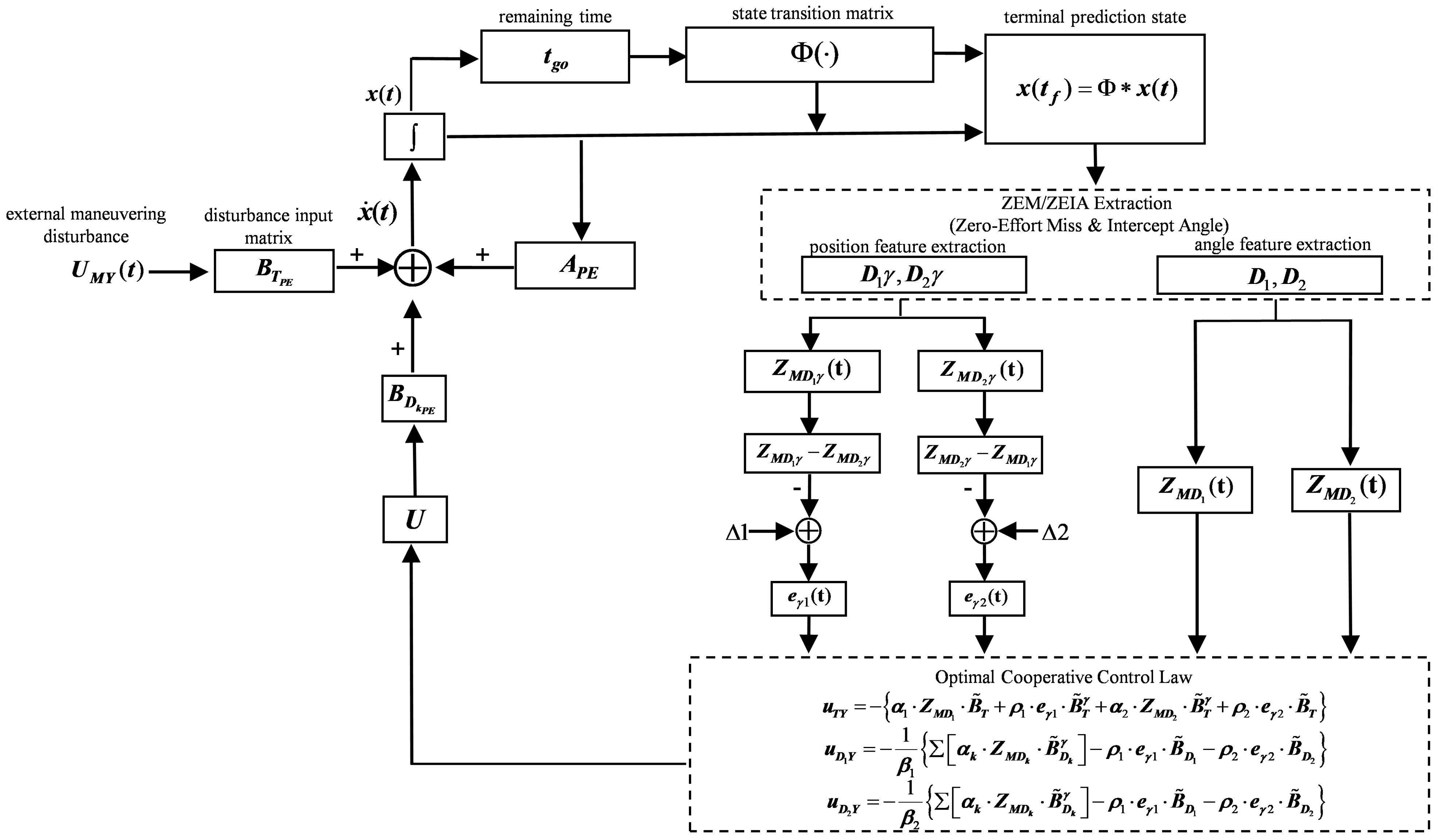
To enhance the readability of the mathematical derivation and provide an intuitive understanding of the overall computational logic, the complete workflow of the proposed variational-based optimal cooperative guidance law is depicted in Figure 4. The block diagram visualizes the closed-loop relationship between the state-space dynamics, zero-effort miss/intercept-angle extraction, and the final cooperative control synthesis. It also explicitly shows how the EWA and the two interceptors share the same information channel within the unified guidance framework.

4. Simulation Verification

4.1. Simulation Setup and Parameter Configuration

To comprehensively evaluate the effectiveness of the proposed cooperative guidance algorithm, diverse engagement scenarios were constructed, covering 12 attack directions (from 0° to 330° with a step size of 30°) and multiple initial ranges (from 5000 m to 15,000 m with a step size of 1000 m). For each scenario, 100 Monte Carlo simulation runs were conducted, resulting in a total of 13,200 runs. Key performance metrics, including interception success rate, miss distance, interception time, and fuel consumption, were statistically analyzed. The simulation parameters and initial conditions were configured based on a typical air combat background (as listed in Table 2). The attacking missile employed proportional navigation (PN) guidance.
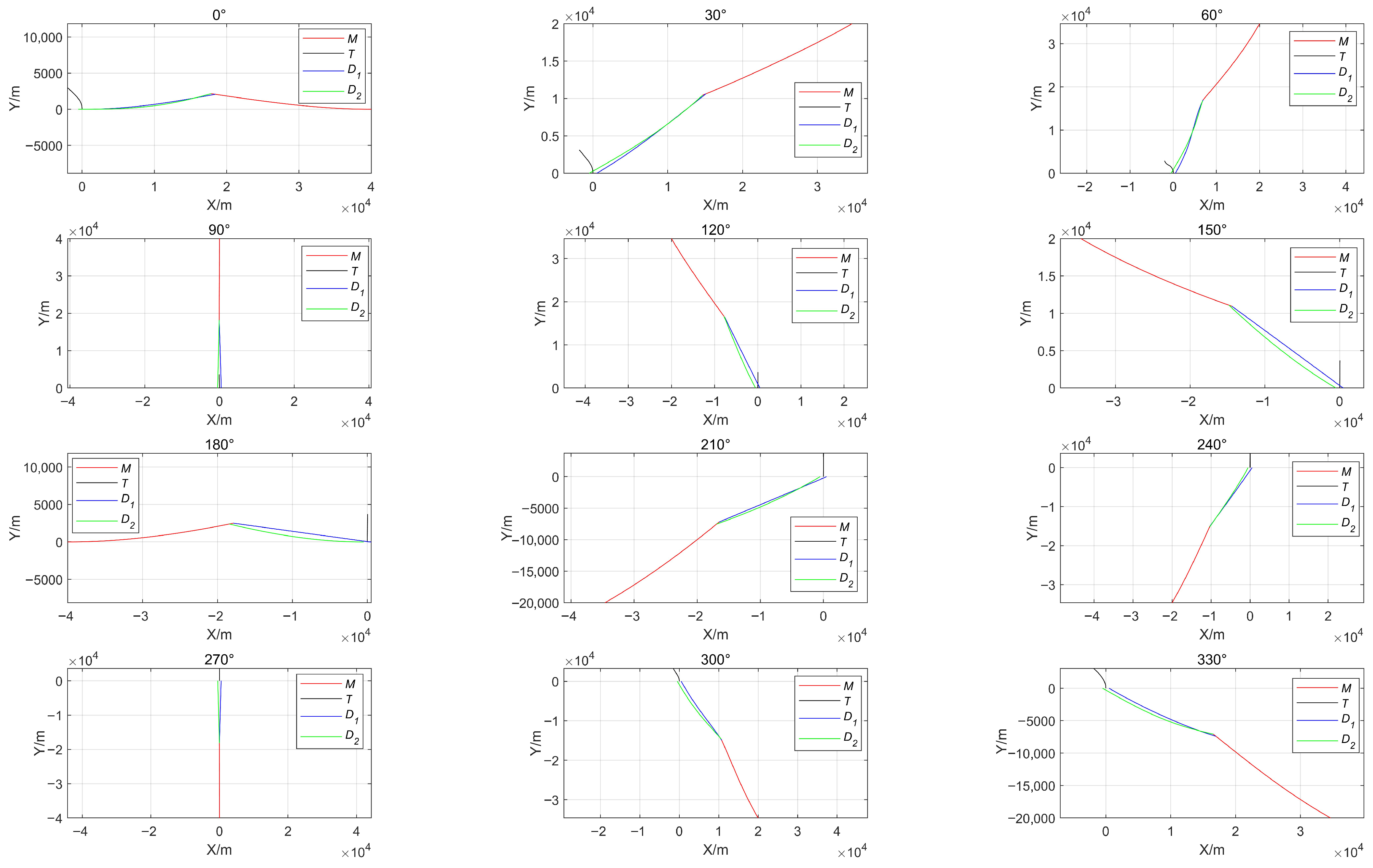
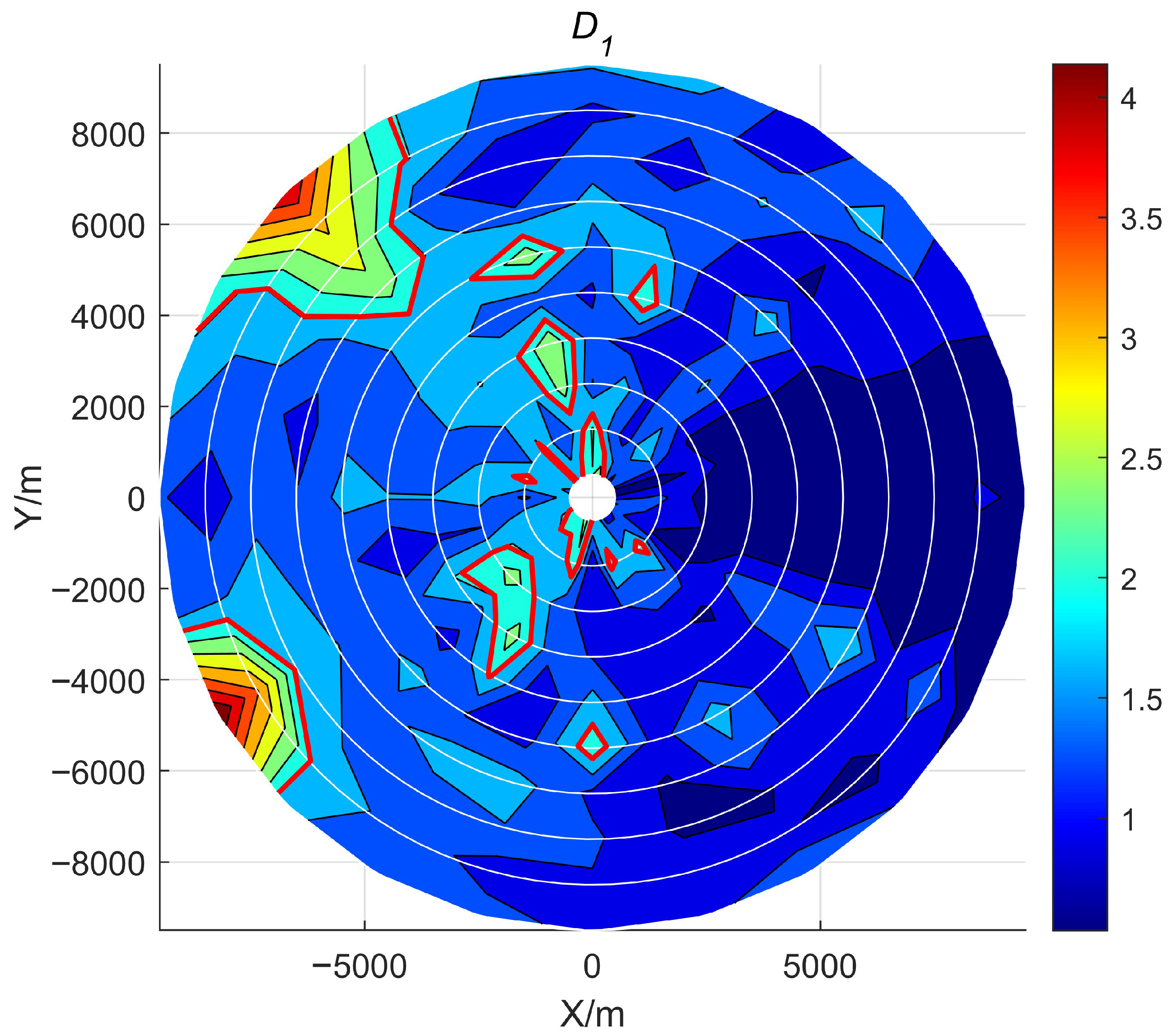
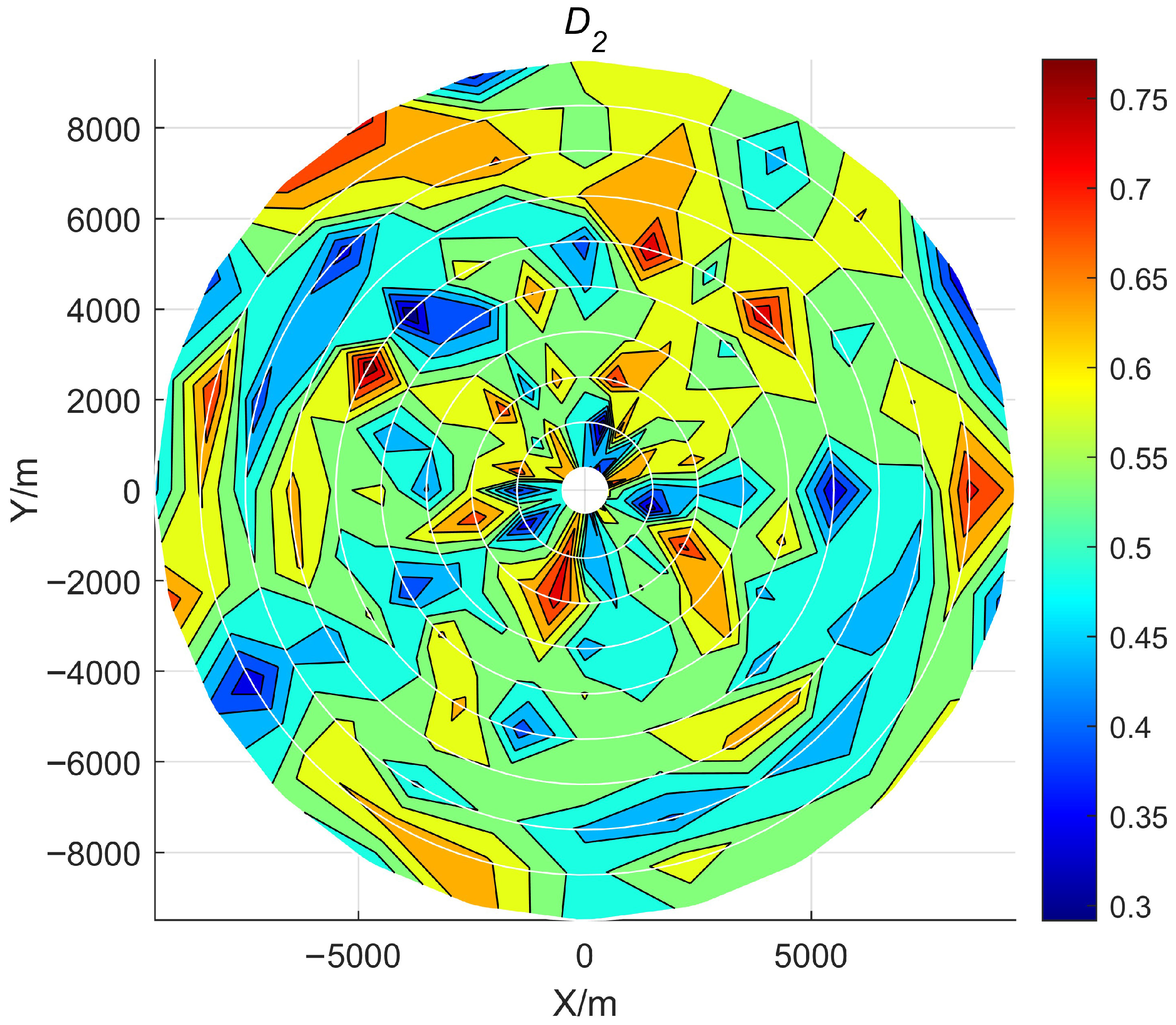
Figure 5 presents the simulated trajectories for all twelve attack directions. The resulting miss distances for interceptor missiles D 1 and D 2 when launched from various escort positions are statistically analyzed and visualized in Figure 6 and Figure 7, respectively. Figure 6 and Figure 7, the following key observations can be made. If a miss distance of less than 2 m is defined as a successful interception (indicated by the red contour line in the Figure 6 and Figure 7), the active defense system demonstrates generally small miss distances across most of the investigated escort area. Specifically, interceptor missile D 1 exhibits a minimum miss distance of 0.00 m, a maximum of 35.13 m, an average of 1.46 m, and a median of 0.75 m. Larger miss distances are mainly observed in localized areas 6 km to 10 km ahead to the left and 9 km to 10 km behind to the left of the EWA, where the significant increase in miss distance increases the probability of interception failure. In contrast, interceptor missile D 2 shows a minimum miss distance of 0.00 m, a maximum of 2.75 m, an average of 0.5 m, and a median of 0.54 m, with its miss distance remaining below 2 m in almost all directions, reflecting superior interception performance. Overall, under cooperative interception conditions, the overall system interception success rate can be regarded as close to 100%.
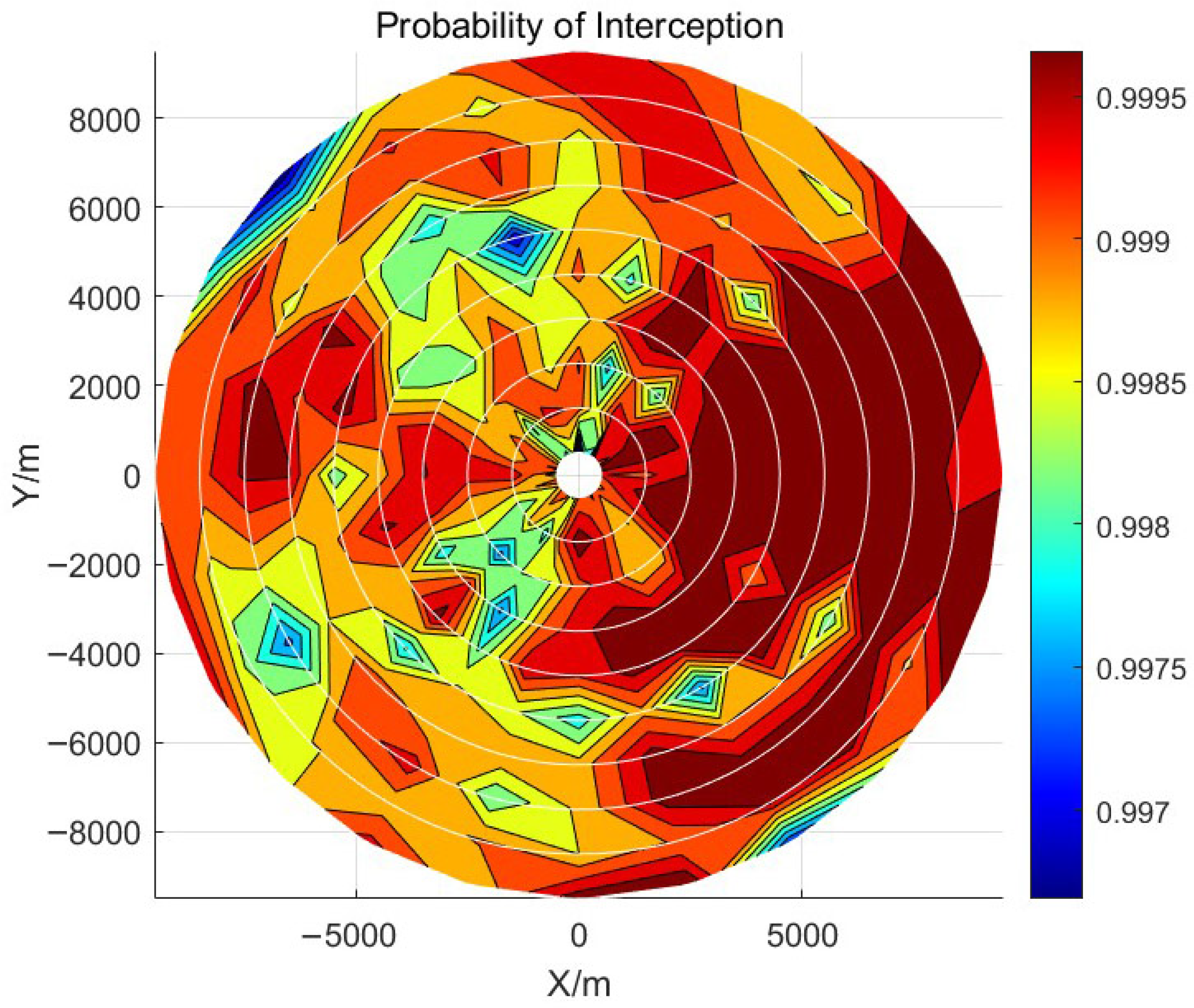
To thoroughly validate the combat effectiveness of the proposed cooperative guidance law in practical escort missions, this study presents a spatial distribution cloud map of the system’s overall interception success rate based on comprehensive simulation data from multiple angles, as shown in Figure 8. Analysis of this cloud map indicates that the active defense system achieves an exceptionally high interception success rate across the vast majority of the investigated escort airspace. The system’s average interception probability reaches 0.9999 ( 99.99 % ), and the hit ratios within both 2 m and 5 m miss distances are nearly 100 % , further confirming its near-perfect interception reliability. Further observation reveals that the interception success rate exhibits distinct spatial gradient characteristics: as the escort distance decreases (meaning interceptor missiles are launched closer to the EWA) and the EWA’s detection range increases (providing earlier threat warnings and longer engagement times), the system’s interception effectiveness generally improves. This pattern underscores the critical importance of optimizing tactical positioning for escort aircraft and enhancing early-detection capabilities in actual combat to establish a robust active defense system.

4.2. Typical Case Comparison and Power System Analysis

To thoroughly investigate the performance and dynamic characteristics of the proposed cooperative guidance algorithm under different engagement geometries, this section conducts a comparative analysis by selecting two typical attack directions: lateral attack (0° direction) and oblique attack (60° direction). These two cases represent classic tactical scenarios where the threat originates from the broadside and the front-quarter/rear-side of the EWA, respectively. Their interception dynamics exhibit significant differences, thereby providing a comprehensive test of the adaptability and robustness of the cooperative guidance algorithm when coping with varying spatial confrontation relationships.
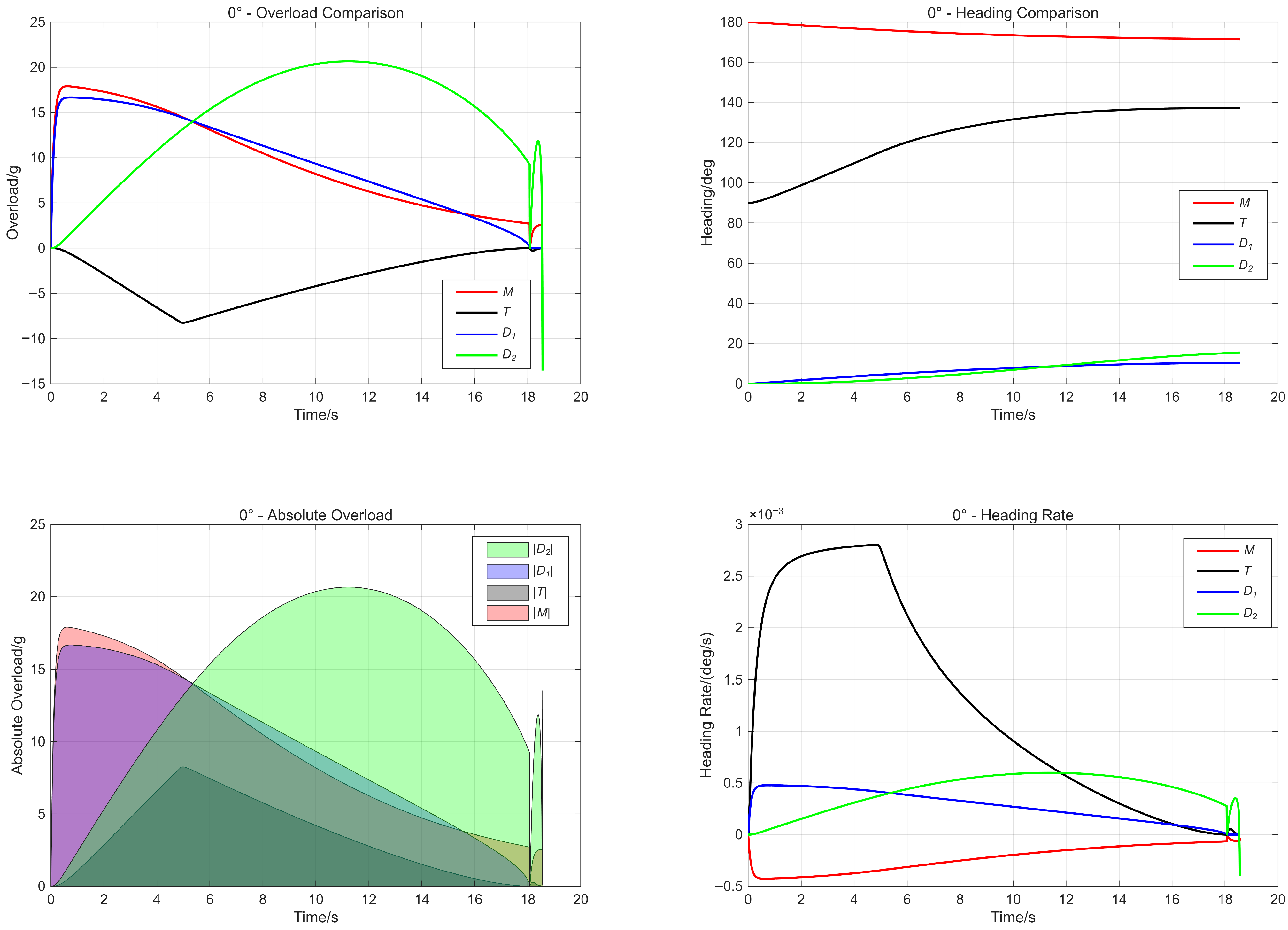
For the lateral attack (0° direction) case, as shown in the Figure 9, the complex spatial maneuvering game formed among the attacking missile (M), the interceptor missiles ( D 1 , D 2 ), and the EWA can be observed from the cooperative interception trajectory for this direction, as shown in Figure 5. Corresponding overload statistics reveal that the maneuver loads for all participants in this scenario are generally high. The attacking missile M exhibits a maximum absolute overload of 17.9 g, indicating it employed severe terminal maneuvers in an attempt to evade interception. The maximum overloads for the two interceptor missiles D 1 and D 2 are 16.66 g and 20.66 g, respectively, reflecting the high control effort required by the defense to match the high maneuverability of the attacking missile and achieve precise interception. The overload on the EWA is relatively low (8.25 g), reflecting its primary role in the cooperative strategy as decoy and support, rather than performing aggressive evasion. Analysis of changes in heading angle further reveals maneuvering patterns. The heading angle of the attacking missile M varies between 171.4° and 180°, showing its attempt to execute a large-angle turn. In contrast, the heading angle variation ranges for the two interceptors are smaller ( D 1 : 0.0°–10.4°, D 2 : 0.0°–15.5°), indicating their guidance commands focus more on precise trajectory corrections for intercept convergence rather than substantial heading changes.
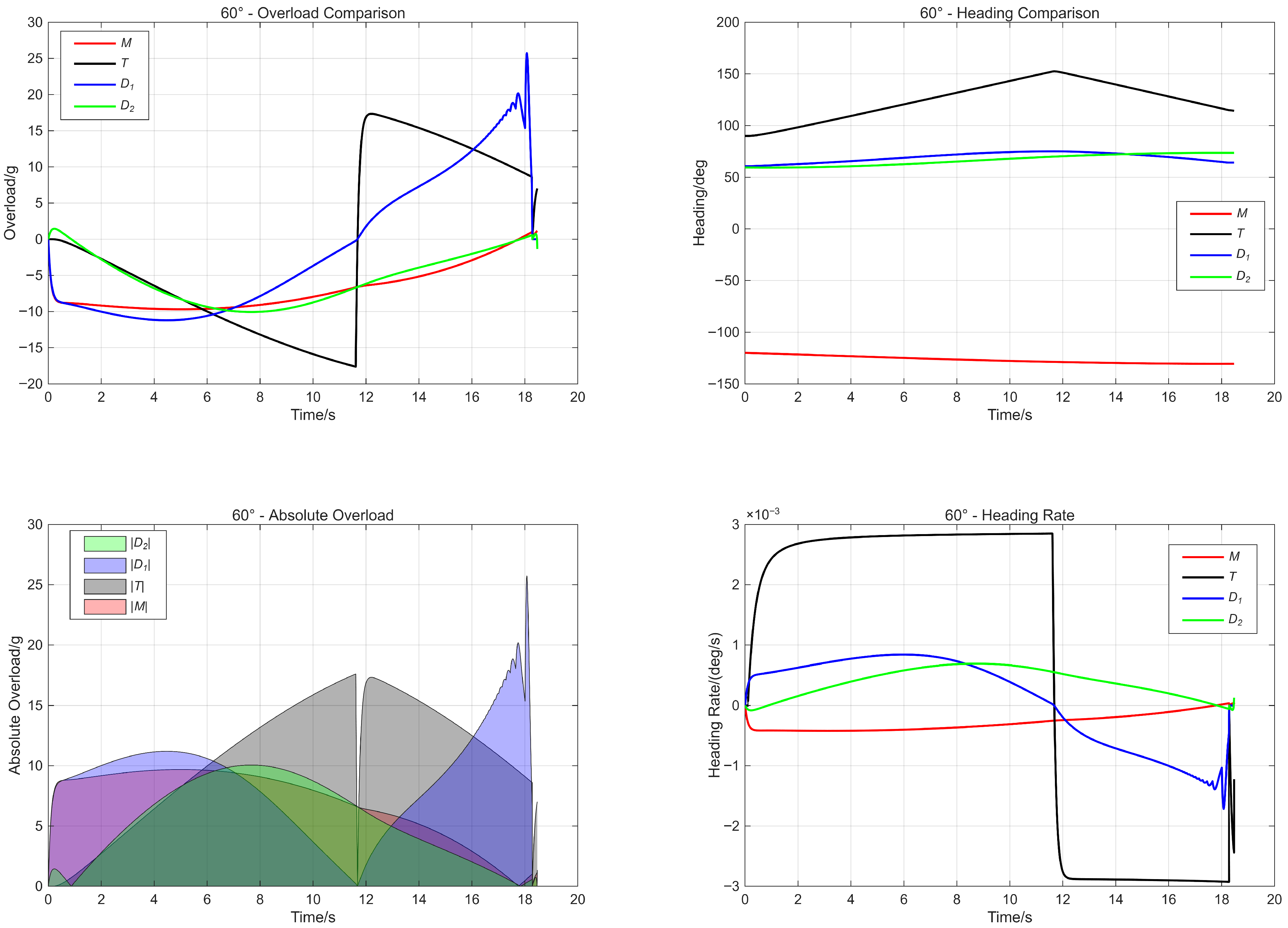
In comparison, the oblique attack (60° direction) case presents distinct dynamic characteristics, as shown in Figure 10. The engagement geometry, revealed by the trajectory plot in Figure 5, corresponds to a rear-side interception scenario with significant initial heading errors. The overload distribution differs markedly from the lateral case: the attacking missile M experiences a maximum overload of 9.7 g, which is substantially lower than in the 0° scenario, suggesting a less aggressive terminal maneuver. The target (EWA) T reaches 17.6 g, a noticeable increase compared to the lateral attack, indicating a more active role in cooperative deception. The interceptors exhibit a reversed load pattern: D 1 bears a high overload of 25.7 g, while D 2 is only required to perform 10.05 g. This asymmetry stems from the engagement geometry— D 1 undertakes the primary interception task with large heading corrections, while D 2 maintains a supportive position. Heading angle variations further confirm this: M fluctuates between −131° and −120°, T between 90° and 153°, D 1 between 61° and 75°, and D 2 between 59° and 74°. Despite substantial overload demands (especially for D 1 ), the cooperative guidance algorithm delivers outstanding interception accuracy—mean miss distances are 0.80 m ( D 1 ) and 0.55 m ( D 2 ) with a 100% success rate. The engagement ranges of both interceptors average 20.01 km, nearly identical to the 0° case, demonstrating the algorithm’s ability to maintain consistent operational coverage regardless of attack direction.
A comprehensive comparison of the two typical cases reveals that the attack direction, by determining the initial engagement geometry and heading error, profoundly influences the overall dynamic response and control requirements of the cooperative guidance system. The lateral attack (0°) induces an interception mode characterized by symmetrically high overloads on both interceptors (16.66 g and 20.66 g) and large heading adjustments of the threat (M up to 17.9 g). In contrast, the 60° oblique attack shifts the maneuver burden predominantly onto the forward D 1 (25.7 g) while the D 2 remains relatively lightly loaded (10.05 g); the threat itself maneuvers less aggressively (9.7 g). This distinct overload distribution highlights the adaptability of the proposed algorithm to different angular attack geometries, as it automatically reallocates guidance effort among defenders based on spatial advantage. Despite the varying physical demands, both scenarios achieve perfect interception success rates (100% within 2 m), confirming the robustness and precision of the cooperative guidance law. This comparative analysis not only validates the effectiveness of the proposed cooperative guidance algorithm in different typical tactical scenarios but also reveals its performance boundaries and optimization directions. Future work could focus on further enhancing the coordination robustness of the algorithm when dealing with large initial heading errors (especially from pure lateral or rear directions) or optimizing the forward placement of escort aircraft to comprehensively improve omnidirectional defense capability.

4.3. Comparison with Classical Guidance Laws

To further validate the effectiveness of the proposed optimal cooperative guidance law (hereafter referred to as Proposed), it is compared with three classical guidance laws: Proportional Navigation (PN), Augmented Proportional Navigation (APN), and Cooperative Proportional Navigation Guidance (CPNG). All comparisons are conducted under the same four-body engagement scenario, with initial conditions identical to those described in Section 4.1 (12 attack directions, initial distances ranging from 5 to 45 km, totaling 2880 samples). The performance of the guidance laws is evaluated using the following metrics: the mean, median, and standard deviation of the miss distances of the two interceptors ( D 1 , D 2 ); the proportion of miss distances less than 50 m; the joint interception probability; and the proportion of cases where P exceeds 0.9.
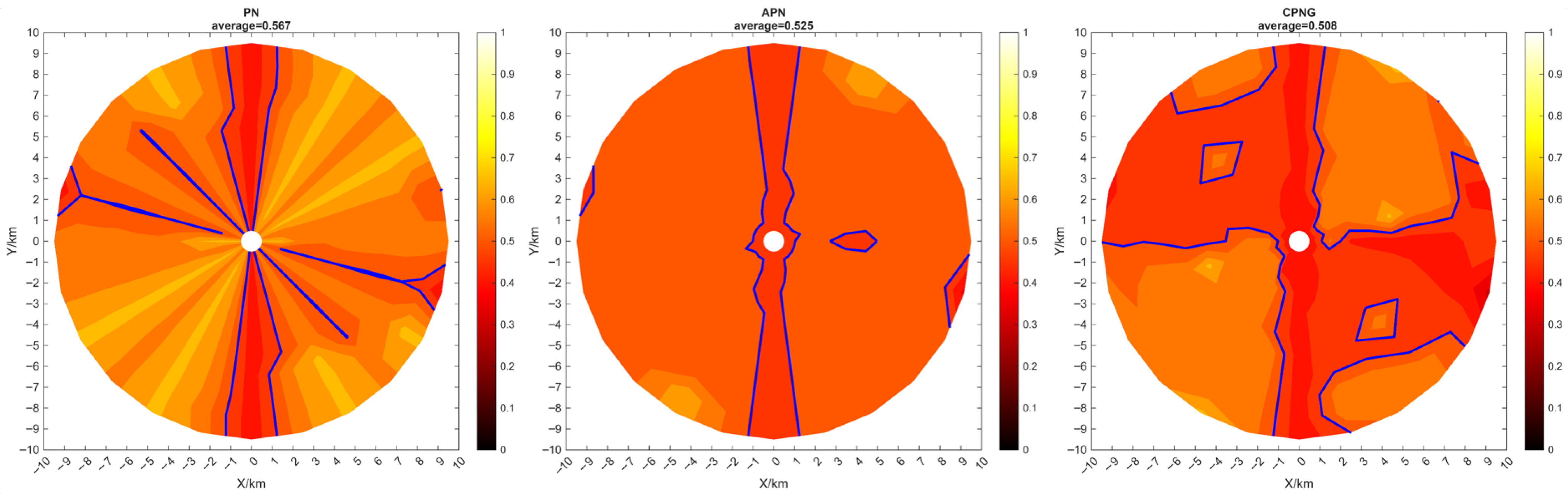
Table 3 summarizes the statistical results of the four guidance laws. As shown in the table, the mean miss distances of PN, APN, and CPNG are all above 6500 m, with nearly 50% of miss distances below 50 m, and the average joint interception probability ranges from 50% to 57%. This indicates that, in complex four-body engagements, traditional guidance laws fail to effectively coordinate the maneuvers of the two interceptors and the target aircraft (EWA), resulting in significant miss distances in a large number of samples. In contrast, the proposed cooperative guidance law reduces the average miss distance to below 0.8 m, achieves a 99.9% proportion of miss distances under 2 m, an average joint interception probability of 99.9%, and a 99.9% proportion of cases with p 0.9 , demonstrating near-perfect interception performance.
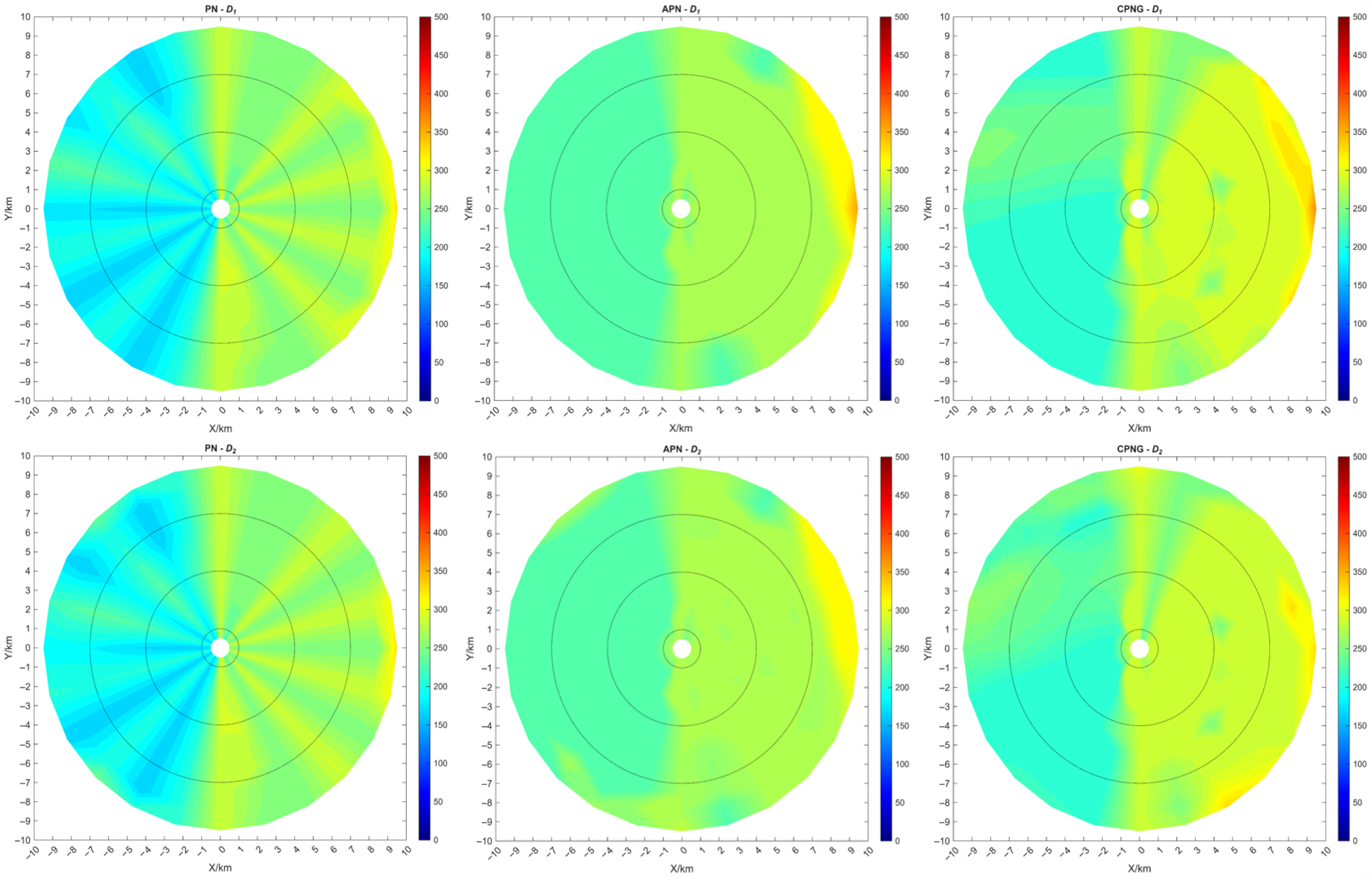
To intuitively illustrate the spatial distribution of miss distances, Figure 11 presents miss-distance contour maps of D 1 and D 2 under different guidance laws, followed by the corresponding joint interception probability contour maps in Figure 12. As observed, the miss distances of PN, APN, and CPNG exhibit high values across most of the airspace, with low-miss-distance regions (blue) appearing only in specific directions. The interception probability contour maps further corroborate this phenomenon: high-probability regions ( p 0.7 ) appear only in limited airspace and are sparsely distributed, whereas low-probability regions ( p 0.5 ) cover the majority of the initial positions. In contrast, the contour maps of the Proposed method (Figure 6 and Figure 7) are almost entirely low-valued across the entire airspace, and the interception probability contour map (Figure 8) further exhibits that p 1 throughout the whole airspace, indicating its superior omnidirectional high-precision interception capability.
The above comparison sufficiently demonstrates that the proposed optimal cooperative guidance law, by explicitly coordinating the maneuvers of the EWA and the two interceptors, significantly enhances interception accuracy and success probability in four-body engagements, achieving performance far superior to traditional non-cooperative or simply cooperative guidance laws.

4.4. Analysis of Overall Interception Performance

This section presents a systematic evaluation and in-depth analysis of the overall interception performance of the proposed cooperative guidance algorithm, based on extensive Monte Carlo simulation results covering 12 attack directions (from 0° to 330° with increments of 15°) and five initial engagement ranges (from 5000 m to 45,000 m with steps of 10,000 m). Key evaluation metrics, including interception success rate, miss distance, interception time, and fuel consumption, are examined to comprehensively assess the algorithm’s effectiveness, favorable conditions, and inherent characteristics across various combat scenarios.
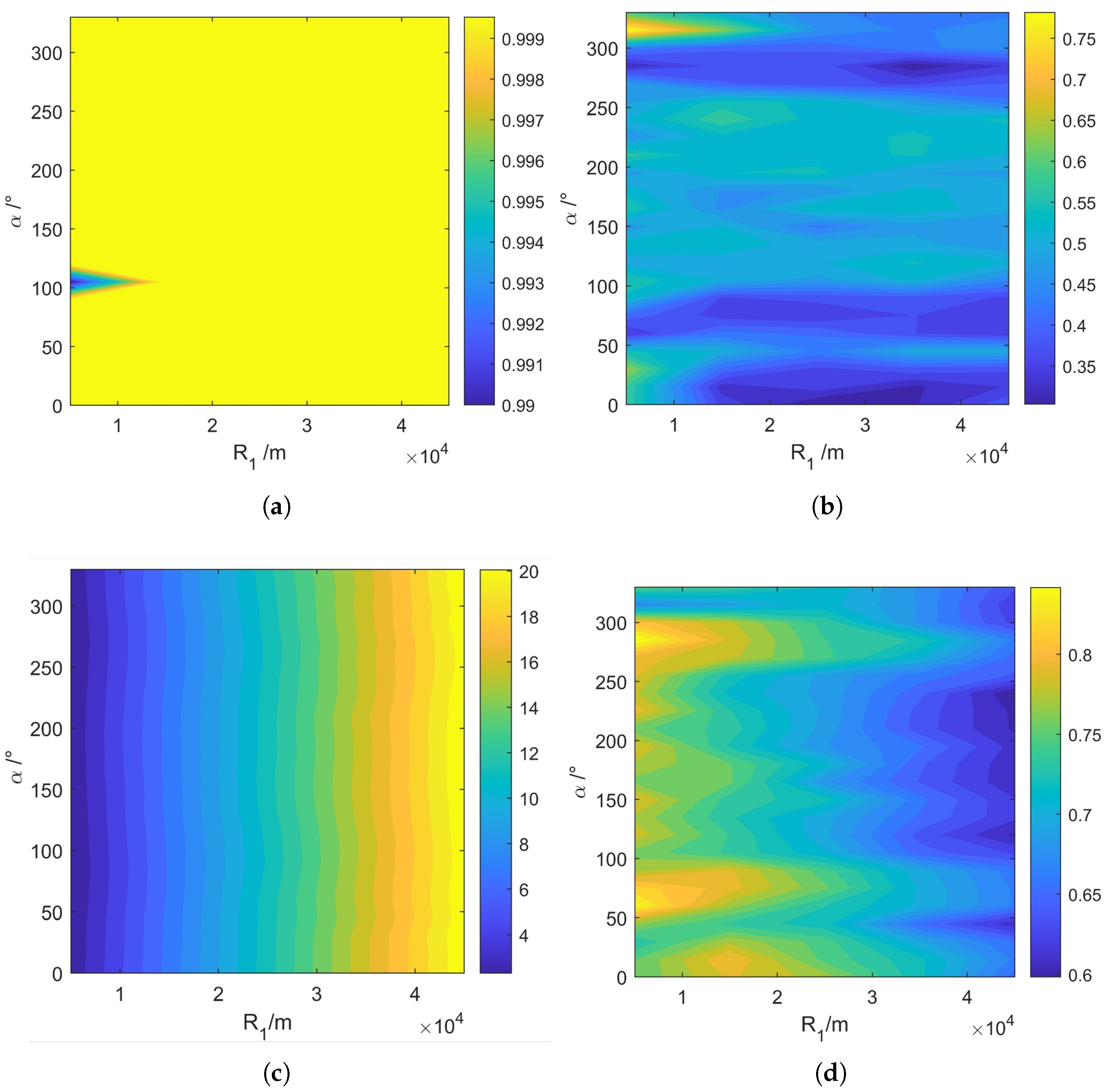
The simulation results indicate strong spatial heterogeneity in interception performance, with attack direction as the primary factor influencing interception success. To illustrate this, Figure 13 provides heatmaps depicting the distributions of both the interception success rate and the miss distance across the 12 attack directions and multiple initial ranges.
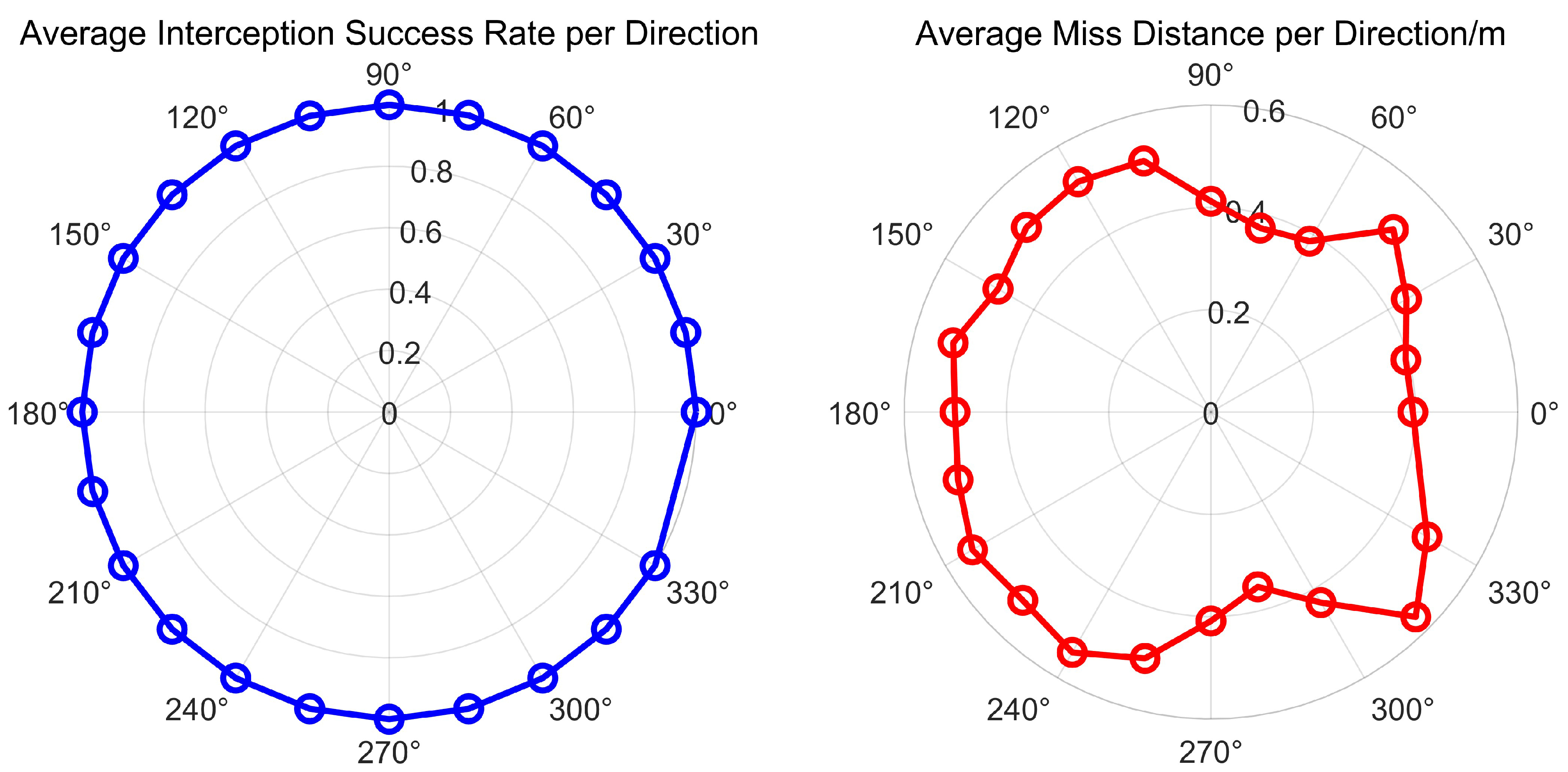
Simulation results demonstrate that the proposed algorithm achieves near-perfect interception performance in the vast majority of scenarios, with an overall success rate as high as 99.99%. Although the effect of attack heading on performance is statistically significant, the observed differences are confined to very subtle levels. The heat map in Figure 13 visually illustrates the uniformly high values of the interception success rate in all combinations of heading-range combinations. The average success rate for every heading remains at an extremely high level. An exceptional performance tier (success rate = 100%) includes 22 of the 12 headings, excluding only the 105° direction. This forms an almost complete “full-azimuth high-efficiency interception coverage” around the EWA. This indicates that the algorithm delivers the best-tier performance for the omnidirectional defense of the EWA. Among these, the 0° heading achieves the optimal interception configuration with a 100% success rate. The excellent performance tier comprises only the 105° heading, which still attains a high success rate of 99.8%. While slightly lower than other headings, this value remains within an outstanding performance range, revealing a minor interception challenge under this specific engagement geometry, as illustrated in the Figure 14.
The simulation provides overall mean values for critical performance parameters: the average interception time is 11.590s, and the average fuel consumption is 3,880,000 units. These data offer important references for assessing the timeliness and cost-effectiveness of the algorithm.
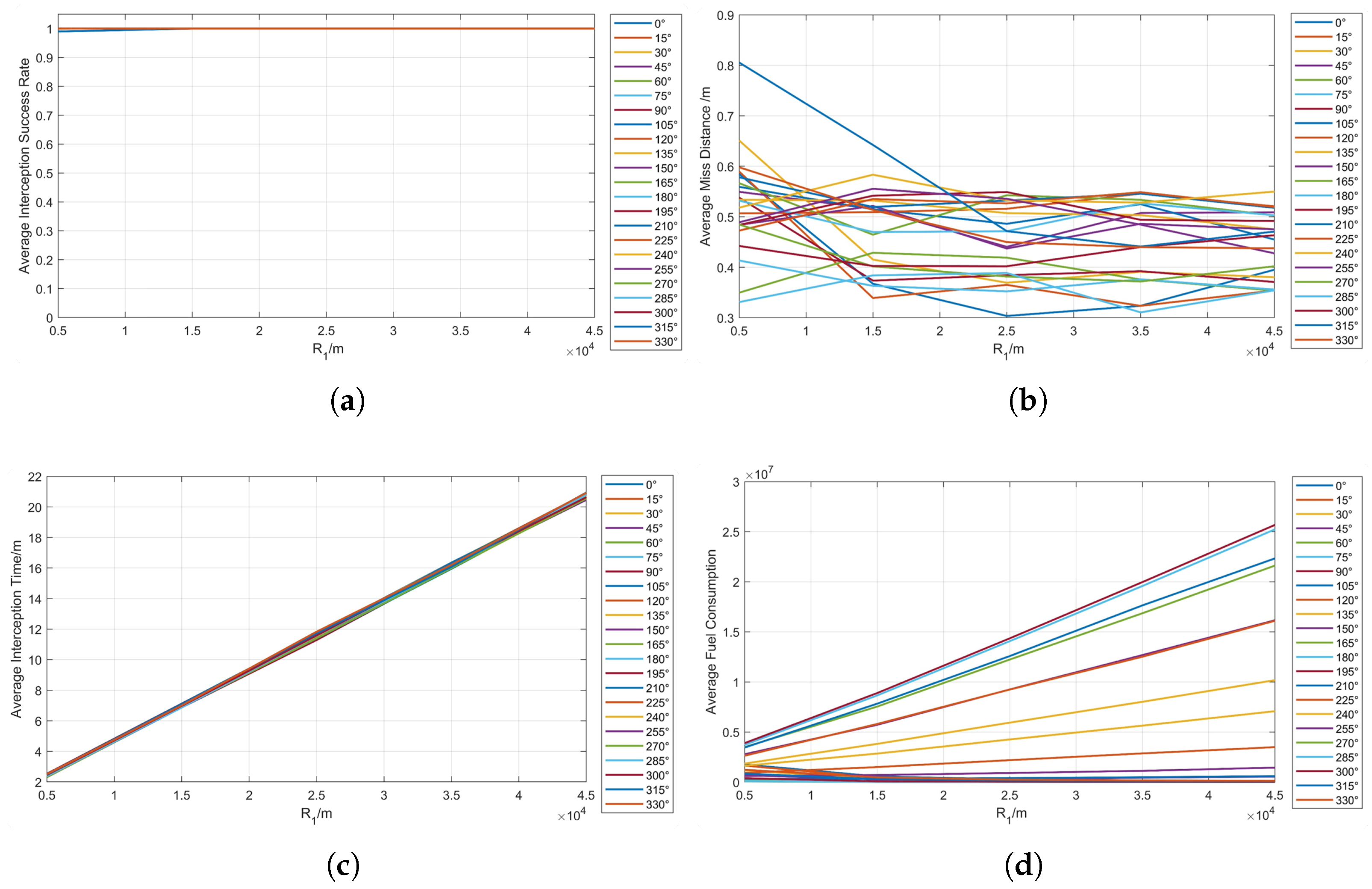
In addition, the influence of the initial attack distance R 1 on performance is coupled with the direction. As shown in Figure 15, for high-performance directions (e.g., 0°), within the test range of 5000 m to 45,000 m, the success rate remains at a high level close to 100%, and the distance mainly affects the average interception time (linearly increasing from 2.5 s to approximately 20.6 s) and fuel consumption.
Further analysis reveals distinct grouping characteristics in the interception direction angles: the high fuel consumption group is concentrated at cardinal directions such as 0°, 90°, 180°, and 270°, which correspond to typical head-on or tail-chase interception scenarios, and exhibits a steeper slope in the linear increase of fuel consumption with distance. The moderate consumption group is predominantly observed at oblique angles such as 30°, 60°, 120°, and 150°, where the slope of the increase in fuel consumption with distance is relatively gradual. Moreover, across all effective interception directions, fuel consumption shows a positive correlation with the initial distance R 1 , meaning that greater distances require more fuel—a finding consistent with the physical intuition that longer flight distances lead to higher fuel consumption.

4.5. Robustness Analysis

In practical aerial combat scenarios, various uncertainties exist, including uncertainties in target maneuver, sensor measurement errors, and modeling deviations in missile dynamic parameters. To comprehensively evaluate the applicability of the proposed optimal cooperative guidance law under realistic conditions, this section conducts a systematic robustness analysis to investigate the impact of the aforementioned uncertainties on interception performance.

4.5.1. Uncertainty Modeling and Simulation Setup

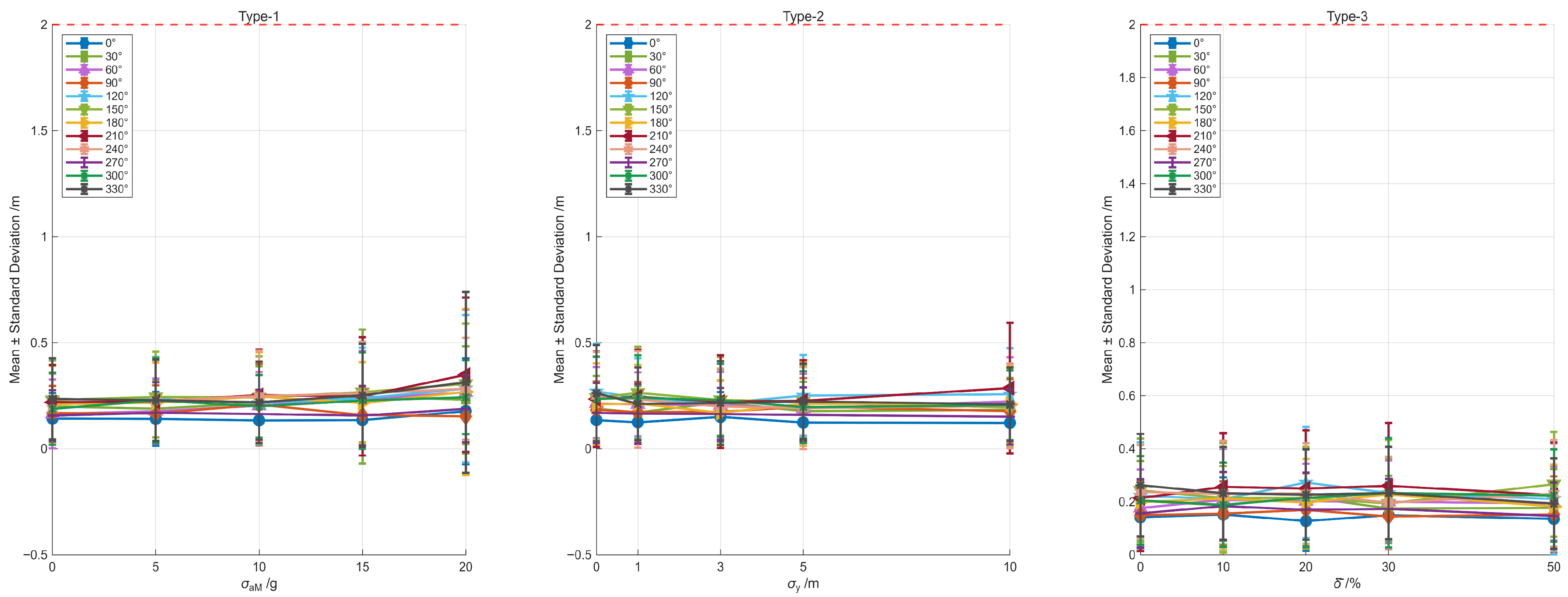
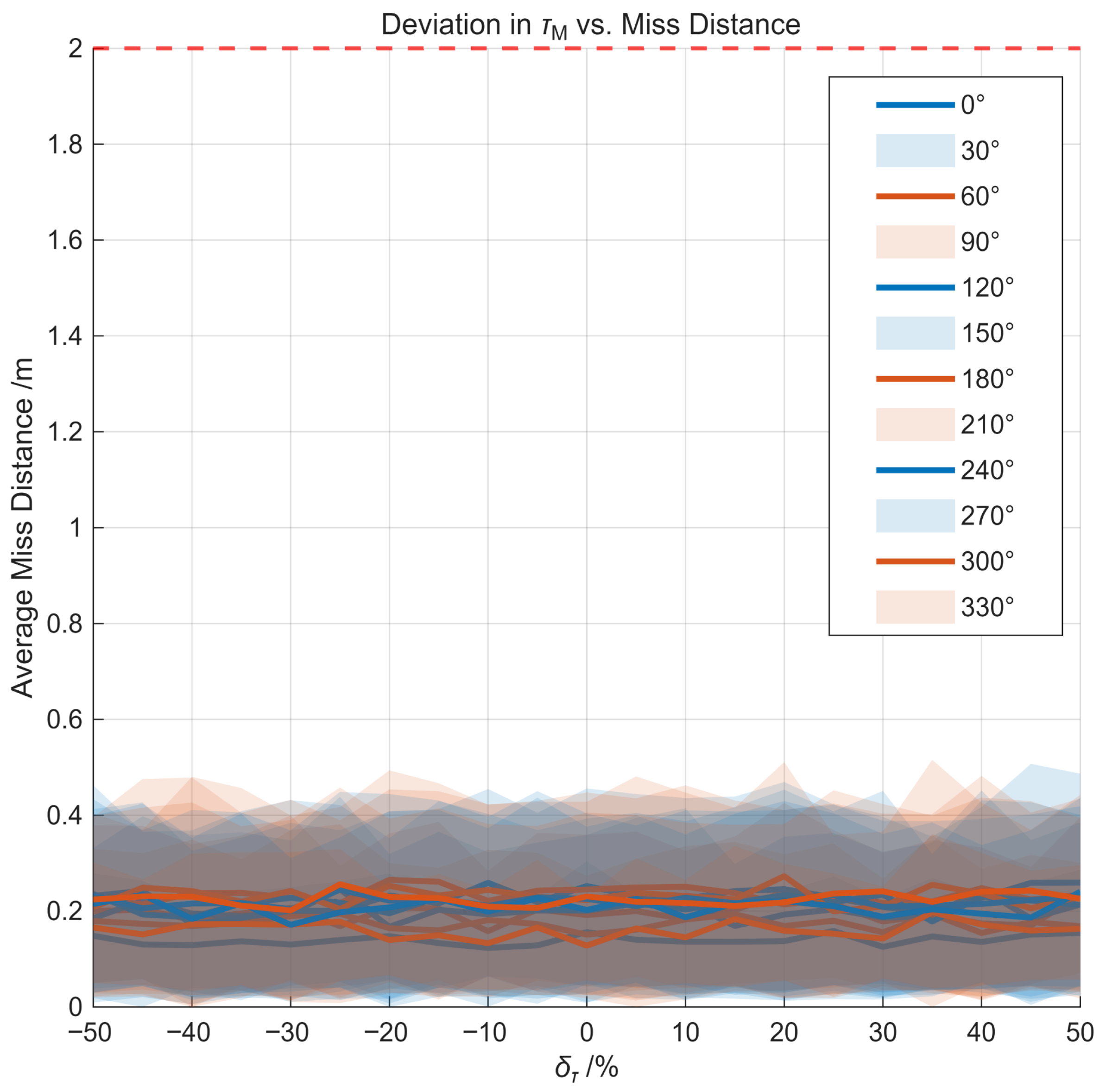
Three representative sources of uncertainty are considered in the robustness analysis. Type-1 pertains to the acceleration uncertainty of the attacking missile, where the actual acceleration command is superimposed with a random perturbation following a zero-mean Gaussian distribution. The standard deviation σ a M is set to 0 g (baseline), 5 g, 10 g, 15 g, and 20 g, respectively, simulating unknown target maneuvers or variations in guidance law parameters. Type-2 involves sensor measurement noise, where additive Gaussian white noise is introduced to the relative range and velocity measurements acquired by the EWA and interceptors. The noise level σ y is configured as 0 m (baseline), 1 m, 3 m, 5 m, and 10 m, affecting the real-time state information required for guidance command computation. Type-3 addresses modeling errors in the time constant of the attacking missile’s guidance system, with relative deviations of 0%, ± 10 % , ± 20 % , ± 30 % , ± 50 % applied to the nominal value τ M . This reflects inaccuracies in prior knowledge of the missile’s dynamic characteristics.
All robustness tests are conducted under the following engagement scenarios: 12 attack directions (ranging from 0 to 330 in 30 increments) and 6 initial distances (from 5 km to 30 km in 5 km steps), with 100 Monte Carlo simulations performed for each condition. For each uncertainty category, the simulations are repeated at the specified perturbation levels, resulting in a total of tens of thousands of simulation runs. The baseline performance (without perturbations) has been established in the preceding sections and is used here to assess the degree of performance degradation.

4.5.2. Simulation Results and Analysis

The robustness analysis results show that the success rate remains 100% under the vast majority of test conditions. Only for Type-1 uncertainty does a marginal degradation occur under certain high perturbation levels and specific directions. Specifically, when σ a M < 15 g, the success rate maintains 100% across all directions; even at σ a M = 15 g and σ a M = 20 g, the success rate remains 100% for most directions, with only a slight decrease to 98–99% observed at the 0 , 60 , 150 , and 180 directions. This indicates that the proposed guidance law exhibits strong tolerance to large target maneuvers, with only minor performance degradation under a few extreme geometric conditions. For Type-2 uncertainty, the success rate consistently remains 100% across all directions under all tested noise levels ( σ y 10 m), demonstrating that the guidance law is highly insensitive to measurement noise and effectively suppresses random disturbances. Similarly, for Type-3 uncertainty (modeling errors in the time constant τ M ), the success rate remains 100% across all directions even with deviations as large as ±50%, underscoring the robustness of the proposed approach against inaccurate prior knowledge of missile dynamics. Table 4 summarizes all cases where the success rate falls below 100%; for all other combinations of directions and perturbation levels not listed, the success rate is 100%.
Figure 16 presents the mean miss distance and standard deviation under Type-1 uncertainty. Even under a 20 g perturbation, the mean miss distance remains below 0.3 m, far less than the 2 m success threshold for interception. Figure 17 shows the sensitivity sweep of the τ M deviation, where the miss distance increases slowly with the deviation without any abrupt changes.
The above results demonstrate that the proposed cooperative guidance law exhibits strong robustness against uncertainties in target maneuver, sensor measurement noise, and missile dynamic parameter errors. Even under the most severe combination of perturbations, the system maintains a near-100% interception success rate. This superiority stems from the multi-objective optimization framework embedded in the guidance law design: by explicitly coordinating the maneuvers of the EWA and the two interceptors, the system can adaptively compensate for various disturbances, ensuring that the terminal miss distance remains at an extremely low level. It is worth noting that when the attack comes from broadside directions or large oblique angles, high-amplitude target maneuvers may slightly increase the miss probability; nevertheless, the success rate still stays above 98%, which is deemed entirely acceptable for practical combat scenarios. Future work could further enhance performance in these marginal directions by optimizing the weighting coefficients or introducing an adaptive mechanism.
The preceding analysis focused on the impact of continuous uncertainties—such as target maneuver, measurement noise, and parameter deviations—on guidance performance. In addition, practical combat scenarios may involve discrete failures, such as the destruction of one escort fighter, rendering the interceptor it carries unable to launch. The centralized control architecture proposed in this paper exhibits inherent robustness against such platform losses. As described in Section 2.1, the EWA undertakes all sensing, decision-making, and command computation tasks, while the escort fighters serve only as launch platforms and command relays. Therefore, when one escort fighter is disabled, the EWA can still maintain full control over the remaining interceptor. More importantly, the surviving escort fighter is typically capable of carrying and launching multiple interceptors. In this situation, the EWA can immediately command the surviving fighter to sequentially launch two interceptors, which take on the interception tasks originally assigned to the two separate fighters. Since the guidance commands are entirely computed by the EWA based on global situational awareness, the two interceptors can still achieve the desired cooperative interception.
In summary, the proposed cooperative guidance system not only exhibits strong robustness under continuous uncertainties but also demonstrates considerable operational flexibility in the face of discrete failures such as platform loss. By enabling the surviving platform to launch additional interceptors, the system can sustain its defensive capability, further enhancing its practicality in complex battlefield environments.

5. Conclusions

This study presented an analytical and computationally efficient solution to the four-body cooperative guidance problem for the active defense of an EWA under dual-fighter escort. By integrating 3D–to–2D dimensionality reduction with optimal control and variational principles, a closed-form cooperative guidance law was derived that explicitly coordinates the maneuvers of the EWA and both interceptor missiles. The theoretical development is substantiated by comprehensive simulation results:
1.
The proposed guidance law achieves an average miss distance <2 m and an overall interception success rate of 99 % across 12 attack directions and multiple engagement ranges.
2.
Compared with PN, APN, and classical CPNG laws, the new algorithm yields a substantial improvement in miss accuracy.
3.
Robustness tests confirm effective interception under uncertainties up to ± 20 g in target maneuver, 10 m sensor noise, and ± 50 % modeling error, with the success rate remaining above 98 % .
4.
The centralized control structure allows continued defense capability even if one escort platform or interceptor fails, demonstrating operational resilience.
From a practical standpoint, the closed-form analytical structure eliminates the need for iterative numerical optimization, supports high-frequency guidance updates (≥50 Hz), and meets onboard computational constraints. These attributes make the algorithm highly applicable for real or simulated active-defense systems of high-value airborne assets.
Future work will extend this research beyond its current scope, aiming to address the challenge of multiple dynamic threats through adaptive and learning-based cooperative guidance, while also extending the engagement framework to full three-dimensional space without planar assumptions and enabling distributed coordination across multi-layer air-defense networks to enhance broader operational resilience.

Author Contributions

Conceptualization, Y.Y. and X.W.; methodology, X.W. and J.L.; software, G.H. and J.L.; validation, Y.Y., J.L., X.W. and G.H.; formal analysis, Y.Y. and J.L.; investigation, X.W. and G.H.; resources, X.W.; data curation, Y.Y. and J.L.; writing—original draft preparation, Y.Y. and J.L.; writing—review and editing, X.W.; visualization, J.L.; supervision, X.W.; project administration, X.W.; funding acquisition, J.L. All authors have read and agreed to the published version of the manuscript.

Funding

This research was funded by the Postgraduate Innovation Fund of the Air Force Engineering University (Grant No. CXJ2025121). The APC was funded by the Air Force Engineering University.

Data Availability Statement

The original contributions presented in this study are included in the article. Further inquiries can be directed to the corresponding author.

Acknowledgments

The authors extend their sincere gratitude to the editors and anonymous reviewers for their invaluable time, insightful critiques, and constructive suggestions, which have greatly enhanced the rigor and clarity of this manuscript.

Conflicts of Interest

The authors declare no conflicts of interest.

References

  1. Ye, H.; Feng, B. Evaluation modeling on survivability of AWACS. Fire Control Command Control 2017, 42, 40–44. [Google Scholar]
  2. Wang, B.; Wang, G.; Yang, R.; Li, Y.; Zhao, Y. Research on methods to enhance the survivability of AWACS with FDA against anti-ARMs on a battlefield. IET Microwaves Antennas Propag. 2025, 19, e12541. [Google Scholar] [CrossRef]
  3. Wang, B.; Wang, G.; Li, Y.; Yang, R.; Zhao, Y. Deception mechanisms of FDA-AWACS against passive monopulse angle measurements. IET Radar Sonar Navig. 2024, 18, 2264–2280. [Google Scholar] [CrossRef]
  4. Soykurum, E.; Pakfiliz, A.G. Usage of Noise Jamming Techniques for the Unmanned Aerial Vehicle Self-Protection Electronic Warfare System against Frequency Agile Radars. Frankl. Open 2025, 12, 100306. [Google Scholar] [CrossRef]
  5. Yang, Z.; Yuan, Z.; Wang, X.; Huang, J.; Zhou, D. Autonomous control of UAV trajectory based on RHC-Radau method in complex penetration combat environment. Aerosp. Sci. Technol. 2024, 146, 108915. [Google Scholar] [CrossRef]
  6. Yin, H.; Fan, J.; Hou, T.; Li, D.; Wang, Y.; Chen, H. Efficiency analysis of typical application based on manned/unmanned aerial vehicle cooperative combat. In Proceedings of the 2020 3rd International Conference on Unmanned Systems (ICUS), Harbin, China, 27–28 November 2020; IEEE: Piscataway, NJ, USA, 2020; pp. 314–319. [Google Scholar]
  7. Sun, X. Application research for cooperative detection combat of unmanned/manned aerial vehicles. J. CAEIT 2014, 9, 331–334. [Google Scholar]
  8. Zhou, W.; Zhu, J.H.; Kuang, M.C. An unmanned air combat system based on swarm intelligence. Sci. Sin. Inf. 2020, 50, 363–374. [Google Scholar] [CrossRef]
  9. Liu, X.; Yin, Y.; Su, Y.; Ming, R. A multi-UCAV cooperative decision-making method based on an MAPPO algorithm for beyond-visual-range air combat. Aerospace 2022, 9, 563. [Google Scholar] [CrossRef]
  10. Wang, X.; Wang, Y.; Su, X.; Wang, L.; Lu, C.; Peng, H.; Liu, J. Deep reinforcement learning-based air combat maneuver decision-making: Literature review, implementation tutorial and future direction. Artif. Intell. Rev. 2024, 57, 1. [Google Scholar]
  11. Yang, S.; Hou, Z.; Chen, H. Evaluation of vulnerability of MAV/UAV collaborative combat network based on complex network. Chaos Solitons Fractals 2023, 172, 113500. [Google Scholar] [CrossRef]
  12. Yamasaki, T.; Balakrishnam, S.; Takano, H. Modified CLOS Intercept Guidance for Aircraft Defense Against a Guided Missile. AIAA Guid. Navig. Control Conf. 2006, 2011–6421. [Google Scholar]
  13. Ratnoo, A.; Shima, T. Line-of-Sight Interceptor Guidance for Defending an Aircraft. J. Guid. Control Dyn. 2011, 34, 522–532. [Google Scholar] [CrossRef]
  14. Ratnoo, A.; Shima, T. Guidance Strategies Against Defended Aerial Targets. J. Guid. Control Dyn. 2012, 35, 1059–1068. [Google Scholar] [CrossRef]
  15. Shima, T. Optimal Cooperative Pursuit and Evasion Strategies Against a Homing Missile. J. Guid. Control Dyn. 2011, 34, 414–425. [Google Scholar] [CrossRef]
  16. Garcia, E.; Casbeer, D.W.; Pachter, M. Active target defense using first order missile models. Automatica 2017, 78, 139–143. [Google Scholar] [CrossRef]
  17. Rusnak, I.; Weiss, H.; Hexner, G. Guidance Laws in Target-Missile-Defender Scenario with an Aggressive Defender. IFAC World Congr. 2011, 44, 9349–9354. [Google Scholar] [CrossRef]
  18. Weiss, M.; Shima, T.; Castaneda, D.; Rusnak, I. Minimum Effort Intercept and Evasion Guidance Algorithms for Active Aircraft Defense. J. Guid. Control Dyn. 2016, 39, 2297–2311. [Google Scholar]
  19. Rubinsky, S.; Gutman, S. Three-Player Pursuit and Evasion Conflict. J. Guid. Control Dyn. 2014, 37, 98–110. [Google Scholar] [CrossRef]
  20. Zhang, H.; Zhang, Y.; Zhang, P. Interception guidance law for active defense targets based on differential game. Syst. Eng. Electron. 2021, 43, 1335–1345. [Google Scholar]
  21. Liu, Z.; Wang, X.; Cheng, J.; Di, F. Design of optimal pursuit-evasion guidance law for active defense. Flight Dyn. 2014, 32, 432–436. [Google Scholar] [CrossRef]
  22. Wang, X.; Zhou, W.; Liu, B. Optimal cooperative guidance algorithm for AWACS active defense in three-body confrontation strategy. J. Air Force Eng. Univ. (Natural Sci. Ed.) 2020, 21, 16–23. [Google Scholar]
  23. Ioffe, A.D. Towards the theory of strong minimum in calculus of variations and optimal control: A view from variational analysis. Calc. Var. Partial. Differ. Equ. 2020, 59, 83. [Google Scholar] [CrossRef]
  24. Rockafellar, R.T. Optimal Trajectories and the Neoclassical Calculus of Variations. Set-Valued Var. Anal. 2025, 33, 12. [Google Scholar] [CrossRef]
  25. Younis, M.G. Optimal control of dynamical systems using calculus of variations. Babylon. J. Math. 2023, 2023, 1–6. [Google Scholar] [CrossRef]
  26. Prach, A.; Tekinalp, O.; Bernstein, D.S. Infinite-horizon linear-quadratic control by forward propagation of the differential Riccati equation [lecture notes]. IEEE Control Syst. Mag. 2015, 35, 78–93. [Google Scholar]
  27. Liu, X.; Liu, L.; Wang, Y. Minimum time state consensus for cooperative attack of multi-missile systems. Aerosp. Sci. Technol. 2017, 69, 87–96. [Google Scholar] [CrossRef]
  28. Yi, X.; Wang, C.; Dong, W.; Wang, J.; Deng, F.; Xin, M. Wide-Envelope Cooperative Guidance with Constrained Field-of-View and Varying Speed Against Maneuvering Targets. IEEE Trans. Aerosp. Electron. Syst. 2025, 61, 9021–9035. [Google Scholar] [CrossRef]
  29. Li, H.; He, S.; Wang, J.; Lee, C.H. Optimal encirclement guidance. IEEE Trans. Aerosp. Electron. Syst. 2022, 58, 4327–4341. [Google Scholar] [CrossRef]
  30. Nikusokhan, M.; Nobahari, H. Closed-form optimal cooperative guidance law against random step maneuver. IEEE Trans. Aerosp. Electron. Syst. 2016, 52, 319–336. [Google Scholar] [CrossRef]
  31. Shalumov, V. Optimal cooperative guidance laws in a multiagent target–missile–defender engagement. J. Guid. Control Dyn. 2019, 42, 1993–2006. [Google Scholar] [CrossRef]
  32. Fang, F.; Cai, Y. Optimal cooperative guidance with guaranteed miss distance in three-body engagement. Proc. Inst. Mech. Eng. Part G J. Aerosp. Eng. 2018, 232, 492–504. [Google Scholar]
  33. Li, Y.; Liu, X.; He, X.; Zhang, F. Cooperative optimal guidance of hypersonic glide vehicles by real-time optimization and deep learning. Proc. Inst. Mech. Eng. Part G J. Aerosp. Eng. 2023, 237, 2266–2283. [Google Scholar]
  34. Zhao, M.; Zhao, Y.; Liu, Z. Dynamic mode decomposition analysis of flow characteristics of an airfoil with leading edge protuberances. Aerosp. Sci. Technol. 2020, 98, 105684. [Google Scholar] [CrossRef]
  35. Zhao, K.; Song, J.; Yu, J.; Liu, Y. Integrated assignment and guidance with multi-objective function in a three-dimensional scenario. Eng. Optim. 2025, 58, 472–487. [Google Scholar]
  36. Dao, T.K.; Ngo, T.G.; Pan, J.S.; Nguyen, T.T.T.; Nguyen, T.T. Enhancing path planning capabilities of automated guided vehicles in dynamic environments: Multi-objective pso and dynamic-window approach. Biomimetics 2024, 9, 35. [Google Scholar]
  37. Zhan, G.; Gong, Z.; Lv, Q.; Zhou, Z.; Wang, Z.; Yang, Z.; Zhou, D. Flight test of autonomous formation management for multiple fixed-wing uavs based on missile parallel method. Drones 2022, 6, 99. [Google Scholar] [CrossRef]
  38. Karelahti, J.; Virtanen, K.; Raivio, T. Near-optimal missile avoidance trajectories via receding horizon control. J. Guid. Control. Dyn. 2007, 30, 1287–1298. [Google Scholar] [CrossRef]
  39. Shaferman, V.; Shima, T. Cooperative multiple-model adaptive guidance for an aircraft defending missile. J. Guid. Control. Dyn. 2010, 33, 1801–1813. [Google Scholar] [CrossRef]
  40. Wang, Y.; Fan, S.; Wu, G.; Wang, J.; He, S. Rapid identification method of enemy interceptor missile guidance law based on GRU. Acta Aeronaut. Astronaut. Sin. 2022, 43, 398–409. [Google Scholar]
Figure 1. Overall four-tier methodology for optimal cooperative guidance: (Tier 1) problem physics and dimensionality reduction; (Tier 2) multi-objective cost formulation; (Tier 3) variational solution; (Tier 4) coupled optimal guidance policy. The diagram highlights the relationship between theoretical derivation and real-time implementation.
Mathematics 14 01187 g001
Figure 2. Schematic diagram of active defense operation with dual aircraft escort.
Mathematics 14 01187 g002
Figure 3. Planar geometric relationships of T-M- D 1 - D 2 .
Mathematics 14 01187 g003
Figure 4. System block diagram of the four-body cooperative guidance framework.
Mathematics 14 01187 g004
Figure 5. Cooperative interception trajectories for 12 distinct attack azimuths.
Mathematics 14 01187 g005
Figure 6. Miss distance distribution for interceptor D 1 under varying escort positions.
Mathematics 14 01187 g006
Figure 7. Miss distance distribution for interceptor D 2 under varying escort positions.
Mathematics 14 01187 g007
Figure 8. Distribution cloud map of the overall system interception success rate under cooperative interception conditions.
Mathematics 14 01187 g008
Figure 9. Time-series comparison of key flight/interception parameters at 0° direction.
Mathematics 14 01187 g009
Figure 10. Time-series comparison of key flight/interception parameters at 60° direction.
Mathematics 14 01187 g010
Figure 11. Comparison of miss distance contour maps for three guidance laws.
Mathematics 14 01187 g011
Figure 12. Comparison of interception probability contour maps among PN, APN, and CPNG.
Mathematics 14 01187 g012
Figure 13. Spatial performance distributions represented as heat maps for (a) success rate, (b) miss distance, (c) interception time, and (d) fuel consumption covering twelve azimuthal directions and multiple distances. In (d), the fuel consumption metric is defined as the integral of the squared acceleration (proportional to energy expenditure). This metric is primarily used to compare the relative efficiency of different interception configurations, rather than to calculate the actual fuel mass.
Mathematics 14 01187 g013
Figure 14. Directional performance analysis figure.
Mathematics 14 01187 g014
Figure 15. The relationship between interception performance and initial distance is illustrated in the following figures: (a) interception success rate, (b) average miss distance, (c) average interception time, and (d) average fuel consumption versus initial distance.
Mathematics 14 01187 g015
Figure 16. Mean miss distance and standard deviation under three types of uncertainty.
Mathematics 14 01187 g016
Figure 17. Sensitivity of average miss distance to deviations in the attacker’s guidance time constant.
Mathematics 14 01187 g017
Table 1. Comparison of the proposed method with representative studies on active defense and cooperative guidance.
ReferencesDescriptionFour-Body EngagementDual-Interceptor CoordinationExplicit Analytical LawDedicated Robustness EvaluationExplicit Real-Time Discussion
Yamasaki et al. [12]Modified intercept guidance for aircraft defense
Ratnoo and Shima [13,14,15]Three-body active defense guidance
Garcia et al. [16]Active target defense with first-order missile models
Weiss et al. [18]Minimum-effort active defense guidance
Wang et al. [22]Three-body AWACS cooperative active defense
Shalumov [31]Multi-agent cooperative guidance
Fang and Cai [32]Three-body guidance with guaranteed miss distance
Li et al. [33]Cooperative optimal guidance with real-time optimization and deep learning
This workFour-body dual-interceptor cooperative active defense for EWA
Note: ✓ denotes explicitly addressed; ✗ denotes not explicitly addressed; △ denotes partially addressed or not the primary focus.
Table 2. Four-body engagement simulation parameters.
ObjectParameter NameParameter Value
Early Warning (T)Detection Range (m)40,000
Cruise Velocity (m/s)200
Escort Fighters (Dual)Escort Radius (m)500
Relative Bearing (°)0
Flight Velocity (m/s)300
Attack Missile (M)Guidance LawPN
Maximum Overload (g)40
Guidance Loop Time Constant (s)0.1
Flight Velocity (m/s)1200
Interceptor Missiles ( D 1 , D 2 )Maximum Overload (g)40
Guidance Loop Time Constant (s)0.1
Flight Velocity (m/s)1000
Table 3. Comparison of guidance laws performance summary.
Guidance LawSample SizeMean Miss (m)Median Miss (m)<50 m (%)Average Joint Prob. p p 0.9 (%)
D 1 D 2 D 1 D 2
PN28807311.086536.1714.2614.6951.460.567556.28
APN26408133.247168.301297.521126.1648.540.525152.35
CPNG28807444.956459.93899.10843.7246.480.507750.38
Proposed28801.460.550.750.54100.00.999999.99
Table 4. Summary of robustness test cases with a success rate below 100%.
Uncertainty TypePerturbation LevelDirectionSuccess Rate (%)
Type-115 g60°98.0
15 g180°98.0
20 g99.0
20 g150°99.0
20 g180°99.0
Disclaimer/Publisher’s Note: The statements, opinions and data contained in all publications are solely those of the individual author(s) and contributor(s) and not of MDPI and/or the editor(s). MDPI and/or the editor(s) disclaim responsibility for any injury to people or property resulting from any ideas, methods, instructions or products referred to in the content.