1. Introduction
Remanufacturing has become a core topic in closed-loop supply chain management within the global context of dual carbon goals and circular economy strategies. It serves as a key path to achieve efficient resource circulation and emission reduction [
1]. Remanufacturing extends product life cycles and significantly reduces raw material consumption and carbon emissions [
2]. Original Equipment Manufacturers (OEMs) possess technical and brand advantages. However, they often lack the motivation to conduct remanufacturing in-house due to financial pressure and technical barriers [
3,
4]. They also fear the cannibalization effect on new products. The outsourcing remanufacturing mode has subsequently emerged as a mainstream solution [
5]. The OEM retains brand control and sales channels in this mode. The OEM then outsources the remanufacturing production to a Third-Party Remanufacturer (TPR) with professional capabilities [
6]. However, product remanufacturability largely depends on the design decisions made by the OEM in the initial stage [
7]. Examples include ease of disassembly and material reuse rates. The cost savings and efficiency improvements from these designs mainly benefit the production process of the TPR. Outsourcing remanufacturing improves operational efficiency. However, the separation of design and manufacturing causes a misalignment between benefits and costs. The OEM controls the design but cannot directly obtain the cost reduction benefits at the remanufacturing stage. Conversely, the TPR is responsible for production but cannot influence upstream design schemes. This situation may lead to a dual dilemma involving insufficient motivation for remanufacturing design and a limited market scale.
Government financial subsidies are commonly used as external interventions to address market failures and cost barriers in outsourcing remanufacturing. These subsidies aim to guide the development of the remanufacturing industry. China launched the “Trade-in for Remanufactured Products” program as early as 2013. This program provided subsidies for core components such as automobile engines and gearboxes. The National Development and Reform Commission issued a document to include the remanufacturing of retired equipment in the scope of support in 2024. The policy further included remanufactured home appliances in the subsidy system in 2025. The maximum subsidy for a single item reached 2000 yuan. France also received a special subsidy of 500 million euros from the European Union in 2025. This fund supports the research and development of remanufacturing technologies, such as chemical recycling of plastic waste. These policy practices indicate that financial incentives have become a core engine for promoting the large-scale development of the remanufacturing industry.
Government subsidies in remanufacturing practices are typically designed to intervene at key stages of the industrial value chain. Based on policy observations across various countries, subsidy instruments can be broadly categorized into three major types: innovation subsidies, production subsidies, and consumption subsidies. This classification reflects the three core stages of value creation in the remanufacturing lifecycle: design, manufacturing, and market realization. Innovation subsidies operate at the upstream stage and primarily focus on the source design of remanufacturing. In particular, they support investments in Design for Remanufacturing (DfR), encouraging OEMs to incorporate disassembly-friendly and recyclable features at the early stage of product development [
8]. Production subsidies intervene at the manufacturing stage by alleviating cost pressures and promoting remanufacturing output expansion [
9]. Consumption subsidies act at the downstream market stage, reducing consumers’ effective purchase prices and mitigating quality perception concerns regarding remanufactured products [
10]. Importantly, these three subsidy types correspond to three distinct decision-making agents in an outsourcing remanufacturing context. The OEM controls product design and DfR investment, the TPR undertakes remanufacturing production, and consumers determine market demand. Therefore, each subsidy type targets a different agent and influences a different decision margin. This structural alignment between policy instruments and decision nodes provides a systematic framework for analyzing how government intervention affects strategic interactions, market entry regimes, and environmental outcomes in outsourcing remanufacturing.
However, subsidy policies are often temporary and transitional [
11]. Governments use high subsidies to stimulate the market in the early stages of an industry. Subsidies inevitably face a phase-out as technology matures and market patterns stabilize. The New Energy Vehicle industry in China provides a clear example. The government rapidly activated the market through substantial production and consumption subsidies in the early stages. However, subsidy standards declined annually starting in 2017. The national purchase subsidy policy was completely ended by the end of 2022 [
12,
13]. The policy focus simultaneously shifted toward charging infrastructure construction and core technology breakthroughs. The phase-out of subsidies is necessary to relieve financial burdens. It is also an inevitable path to push enterprises away from policy dependence. This transition helps firms achieve independent innovation and market-oriented development. The remanufacturing industry faces similar challenges regarding subsidy phase-outs. Adapting to this trend is a significant problem for decision-makers in the context of outsourcing remanufacturing.
Extensive research has explored outsourcing remanufacturing and subsidy policies. In the outsourcing remanufacturing context, prior studies have compared outsourcing with authorization remanufacturing modes [
14,
15], highlighting their differences in channel structure and strategic interactions between OEMs and TPRs. Some studies further demonstrate that outsourcing remanufacturing can be an efficient operational mode under certain market conditions [
16,
17]. Meanwhile, a separate stream of literature investigates subsidy policies in remanufacturing. For example, innovation subsidies have been analyzed in studies [
7,
8,
18], production subsidies in studies [
19,
20,
21], and consumption subsidies in studies [
22,
23]. Most of these studies examine a single subsidy instrument independently, evaluating its economic and environmental impacts under specific structural assumptions. Although some research compares two subsidy targets under particular conditions [
9,
24], a systematic comparison of innovation, production, and consumption subsidies within the specific context of outsourcing remanufacturing remains limited. In particular, the differentiated strategic impacts of these subsidy instruments under subsidy phase-out have not been systematically examined in the outsourcing remanufacturing.
Current research on subsidy phase-outs mainly concentrates on specific industries. For example, studies have examined the gradual reduction in subsidies in the photovoltaic industry [
11], and new energy vehicles [
12]. Although these investigations provide valuable industry-specific insights, subsidy phase-out has increasingly become a broader trend in public policy evolution [
13]. Persistent industrial subsidies may impose substantial fiscal burdens and foster subsidy dependence, potentially hindering the transition toward market-driven and high-quality development. This mechanism is crucial for guiding enterprises away from policy dependence. It enables them to achieve market-oriented development. Therefore, this paper adopts outsourcing remanufacturing as the research setting, incorporating the logic of subsidy phase-outs. The study systematically analyzes and compares the policy performance of the three types of subsidies. These findings offer significant practical value for optimizing policy design and promoting the sustainable development of the remanufacturing industry.
This paper addresses two research questions. (1) How do innovation subsidies, production subsidies, and consumption subsidies, respectively, influence remanufactured product design and supply chain operations? What impact does the subsidy phase-out have? (2) Do significant differences exist between the three types of subsidies regarding economic and environmental benefits?
To answer these questions, this paper develops a Stackelberg game framework that integrates innovation, production, and consumption subsidies into the outsourcing remanufacturing. Unlike most existing studies that focus on a single subsidy type or compare only two subsidy targets under static policy assumptions, we incorporate the logic of subsidy phase-outs into the analytical structure and examine firms’ strategic responses across different subsidy intervals. In particular, the model captures the interaction between OEM-led DfR decisions and TPR’s market entry strategies, revealing a piecewise equilibrium structure that reflects firms’ entry and production adjustments during phased subsidy reduction. By systematically comparing the three subsidy instruments within the same theoretical framework and evaluation criteria, this study identifies their differentiated impacts on design incentives, market structure, and environmental performance. These findings provide new theoretical insights into subsidy mechanism design and offer policy guidance for optimizing subsidy transition strategies toward sustainable and market-oriented industry development.
The remainder of the paper is organized as follows.
Section 2 reviews the relevant literature.
Section 3 provides the model description and assumptions.
Section 4 presents the construction and solution of the models.
Section 5 explores the impacts of the subsidies.
Section 6 compares the three subsidy types.
Section 7 presents the conclusions and suggestions.
2. Literature Review
This paper reviews relevant literature focusing on three main aspects. These areas include the outsourced remanufacturing mode, remanufacturing subsidy policies, and remanufactured product design. We then clarify the research positioning of this study based on this foundation.
2.1. Outsourcing Remanufacturing
Third-party remanufacturing has gradually replaced in-house remanufacturing by OEMs. It has become the mainstream mode as industrial specialization deepens. Early research primarily focused on in-house remanufacturing by OEMs. However, many OEMs face constraints regarding technology and funding [
4,
25]. They also worry about the cannibalization effect on new products [
26]. Consequently, they prefer leveraging third-party resources. Agrawal et al. [
27] indicated that third-party remanufactured products can actually enhance the consumer perceived value of new products. Wu and Zhou [
28] confirmed that OEMs without remanufacturing capabilities often benefit from market entry by a TPR. This finding provides a theoretical basis for the rise in third-party remanufacturing. Two dominant modes exist in third-party remanufacturing practice. These are authorizing remanufacturing [
29] and outsourced remanufacturing [
25]. Zou et al. [
14] systematically compared these two modes. They pointed out that the OEM retains sales rights for remanufactured products under the outsourcing mode. This arrangement effectively avoids intense price competition between new and old products compared to the authorizing mode. Studies show that the outsourcing mode becomes more attractive to the OEM when consumer acceptance of remanufactured products is high. Zhang et al. [
15] conducted research within a blockchain context. They found that information transparency enhances consumer trust and increases preference for remanufactured products. This prompts the OEM to shift from authorization to outsourcing. The OEM outsources the remanufacturing production stage to the TPR under the outsourcing remanufacturing mode. However, the OEM retains sales rights for the remanufactured products. The TPR acts as a contract manufacturer responsible for production [
30]. For instance, Dell entrusts the remanufacturing of equipment such as computer servers to the professional contract manufacturer Wistron. However, Dell sells all remanufactured products uniformly [
15]. Therefore, the outsourcing mode enables the TPR to focus on the remanufacturing process. This allows them to handle waste products efficiently and ensure quality [
31]. Extensive research confirms that outsourcing remanufacturing is indeed an efficient mode [
16,
17].
2.2. Remanufacturing Subsidy Policies
Government subsidies are regarded as a core tool for promoting the early development of the remanufacturing industry. A policy system has formed that covers the entire chain, including innovation, production, and consumption. Innovation subsidies mainly target remanufactured product design and technology research and development. These subsidies aim to incentivize manufacturers to engage in eco-design, green material development, and remanufacturability improvements. This approach reduces costs and environmental burdens at the source. Wang et al. [
8] pointed out that eco-design subsidies effectively alleviate financial pressure on manufacturers during the R&D stage. Wang et al. [
7] found that these subsidies improve recovery rates and lower remanufacturing thresholds. However, the final environmental benefit depends on the cost variations between new and old products. A comparative study by Xiao et al. [
18] showed that the effectiveness of eco-design subsidies is significantly influenced by the altruistic preferences and specific design tendencies of manufacturers. Production subsidies mainly act on the supply side. They expand the scale by reducing the costs of the TPR. Wang et al. [
7] found that the TPR enters the remanufacturing market only under certain conditions. Production subsidies effectively lower the entry barrier for remanufacturing. Zhang et al. [
19] argued that production subsidies can achieve a win–win outcome for profits, social welfare, and environmental benefits within a suitable range. However, their effectiveness relies heavily on the specific context. Qiao et al. [
20] noted that subsidies might not improve the environment in certain competitive settings. Tsao and Ai [
32] discovered in the electric vehicle battery supply chain that production subsidies could increase the battery return rate and reduce material costs. Zhang and Zhang [
21] even suggested that excessively high remanufacturing efficiency might inhibit new product updates. They recommended adopting linear subsidy rules to balance this conflict. Consumption subsidies directly stimulate market demand on the consumption side. Wei [
10] examined how subsidies for “trade old for new” and “trade old for remanufactured” affect consumers’ acceptance of remanufactured products. Han et al. [
22] found that consumption subsidies enhance the motivation of enterprises to launch remanufacturing programs. This effect is particularly strong when combined with designs that have high remanufacturability. However, Zhang et al. [
23] found that excessive consumption subsidies may increase environmental burdens due to scale expansion even though they improve economic benefits. Li et al. [
33] further incorporated social welfare, economic, and environmental performance to determine the optimal consumption subsidy level.
Some scholars have compared the effects of different subsidy targets. For instance, Hong et al. [
24] found that subsidizing manufacturers is equivalent to subsidizing consumers under specific conditions. Liu et al. [
9] also yielded similar results. Mitra and Webster [
34] explored the allocation mechanism of subsidies among supply chain members. However, few studies have integrated all three types of subsidies into a single framework for a systematic comparison. Furthermore, most literature relies on static subsidy assumptions. This approach ignores the impact of the real-world constraint of subsidy phase-outs on the long-term strategies of enterprises.
2.3. Remanufactured Products Design
DfR determines the economic and environmental performance of remanufacturing. The complexity and cost of remanufacturing increase significantly if the design stage does not fully consider disassembly, reuse, and material processing needs [
17]. Shi et al. [
35] noted that optimizing remanufacturing design strategies is key to obtaining benefits. This is especially true for high-value-added products. However, the third-party remanufacturing separates design decisions controlled by the OEM from production benefits controlled by the TPR. This separation leads to complex strategic interactions. Subramanian et al. [
36] found that the OEM might strategically reduce component interchangeability to limit the TPR due to competitive concerns. However, a win–win outcome is possible under specific revenue-sharing or cooperation mechanisms. Zheng et al. [
37] revealed a potential environmental rebound effect. High-level design reduces the environmental impact of individual remanufactured products. However, it may increase total carbon emissions by stimulating a large increase in sales volume [
7]. Government policy plays an important role in resolving this design incentive mismatch. Wang et al. [
8] showed that government subsidies can reduce the burden on manufacturing enterprises regarding remanufactured product design. Xiao et al. [
18] explored the impacts of recycling subsidies and eco-design subsidies. They found that recycling subsidies always promote eco-design. In contrast, eco-design subsidies only produce significant effects when the manufacturer conducts eco-design biased toward recovery.
Literature on outsourcing remanufacturing and government subsidies is extensive. However, several important gaps remain. First, existing studies predominantly focus on a single subsidy or, at most, compare two subsidy types (e.g., production versus consumption subsidies). A unified analytical framework that simultaneously incorporates innovation, production, and consumption subsidies within an outsourcing remanufacturing setting remains limited. By integrating the three subsidy instruments into a consistent framework, this study enables a systematic comparison of their strategic and environmental implications. Second, while existing literature on outsourcing remanufacturing predominantly assumes static subsidies, real-world evidence from the photovoltaic and new energy vehicle industries reveals a clear trend toward subsidy phase-outs. This study explicitly incorporates the subsidy phase-out logic into the analytical framework, investigating how the declining intensity of subsidy reshapes equilibrium entry strategies, pricing mechanisms, and product design decisions. Third, limited attention has been paid to how different subsidy instruments influence the design incentive mechanism under outsourcing structures. By incorporating DfR into the research and examining heterogeneous policy effects, this study reveals differentiated incentive transmission paths across subsidy types. In summary, the factors considered in the related literature and those incorporated in this study are summarized in
Table 1.
3. Problem Description and Assumptions
In an outsourcing remanufacturing setting involving an OEM and a TPR, new and remanufactured products coexist in the market. The OEM implements DfR for new products and is responsible for their sales. The OEM pays an outsourcing fee to the TPR to delegate the production of remanufactured goods. Upon completion, the remanufactured products are delivered to the OEM.
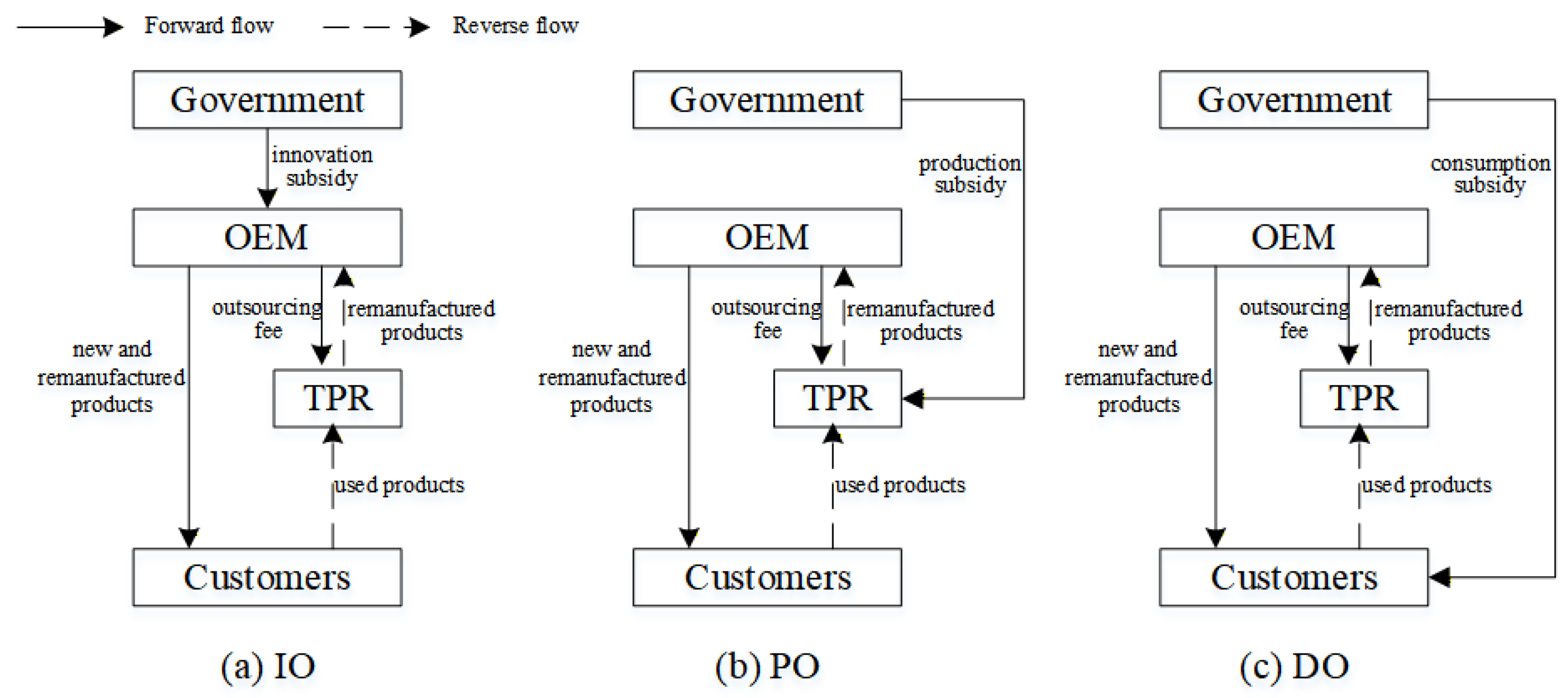
To foster remanufacturing development, the government provides three types of subsidies. Specifically, (i) an innovation subsidy, which is directed to the OEM to support its DfR investment; (ii) a production subsidy, which is granted to the TPR based on remanufacturing output; and (iii) a consumption subsidy, which is provided to consumers purchasing remanufactured products. For clarity and consistency throughout the paper, we refer to these three subsidy scenarios as follows: the innovation subsidy scenario (IO), the production subsidy scenario (PO), and the consumption subsidy scenario (DO). The corresponding structural framework is illustrated in
Figure 1.
Since the design of new products is typically led by the OEM, the innovation subsidy is granted to the OEM to incentivize DfR efforts. Let
denote the OEM’s DfR level. To capture the diminishing marginal returns of innovation investment, the DfR cost is defined as
[
38], where
k represents the design innovation cost parameter. This specification is widely adopted in green innovation and remanufacturing literature, as it reflects increasing marginal investment costs and ensures interior equilibrium solutions. Assuming the innovation subsidy ratio is
(
) [
39], the total innovation subsidy received by the OEM is
, which effectively reduces the OEM’s innovation burden while preserving incentive compatibility. Considering that the production of remanufactured goods is consistently performed by the TPR, the production subsidy is allocated to the TPR. Consistent with policy practice and prior literature [
7], production subsidies are assumed to be output-based rather than lump-sum transfers. This approach better adapts to the diverse production capacities of TPRs and directly lowers the marginal cost of remanufactured units. Furthermore, it avoids the inefficiency of fixed subsidies, which may offer excessive incentives to small-scale TPRs while providing insufficient support to large-scale TPRs. Let
denote the unit production subsidy and
the quantity of remanufactured products; the total production subsidy received by the TPR is
. Consumption subsidies are generally implemented on a per-unit basis, ensuring that consumers tangibly perceive the welfare benefits of price reductions [
10]. Assuming the price of the remanufactured product is
, and the unit consumption subsidy is
, the effective price paid by the consumer is
.
Let
and
denote the unit costs of new and remanufactured products, respectively. Since remanufacturing conserves resources compared to new production, it is assumed that
[
40]. DfR enhances the remanufacturability of new products, thereby reducing the remanufacturing cost. Consequently, the unit cost of remanufacturing decreases to
[
41]. This linear cost reduction structure captures the idea that higher design effort improves remanufacturing efficiency while preserving analytical tractability. To focus on how subsidy mechanisms influence production decisions, pricing strategies, and DfR investment incentives rather than on technological feasibility constraints, it is assumed that all used products are recyclable and meet the criteria for remanufacturing [
41,
42]. Consistent with common industry practice and prior literature [
43], each product can be remanufactured only once. The collection cost is modeled as a convex function, implying that the cost increases as the quantity of collected products rises [
44]. As more units are collected, the logistics and coordination costs become higher. Let
be the collection cost parameter,
the collection rate, and
the production quantity of new products; the total collection cost is given by
[
44].
The market size is normalized to 1. Following the related research [
42,
45], we assume that consumer willingness to pay (WTP) for a new product, denoted by
v, is uniformly distributed in [0, 1]. This assumption is widely adopted as it provides a robust benchmark for analyzing supply chain interactions and policy effectiveness while ensuring analytical tractability. Implementing DfR improves the environmental performance of new products, thereby increasing consumer WTP to
[
46]. However, consumers differentiate between the two product types [
9]. Letting
represents the valuation discount factor for remanufactured goods, the consumer WTP for a remanufactured product is expressed as
. Consumers purchase at most one unit of either product. Let
denotes the price of new products, respectively. Under the innovation and production subsidy scenarios, the utility derived from purchasing a new product is
, and for a remanufactured product is
[
45]. A consumer purchases a new product if
and
, and a remanufactured product if
and
. Otherwise, no purchase is made. According to the inverse demand function, we can obtain
and
[
47]. In the consumption subsidy scenario, consumers receive the subsidy when purchasing remanufactured products. Consequently, the utility function for the remanufactured product is modified to
, leading to
and
.
Regarding environmental impact, the unit impact of a new product is normalized to 1, while that of a remanufactured product is denoted by
. This normalization facilitates analytical comparison and reflects the widely documented environmental advantage of remanufacturing relative to new production. DfR efforts by the OEM further reduce the unit environmental impact of the remanufactured product to
. Thus, the total environmental impact of production is formulated as
. The decision-making process is modeled within a single period to exclude initial and terminal horizon effects, assuming decision stability within this period [
26,
45]. The interaction is modeled as a Stackelberg game. Considering the OEM’s first-mover advantage and its control over product remanufacturability, the OEM acts as the leader. In contrast, the TPR serves as the follower. Following the common practice in remanufacturing literature [
41], we assume that the OEM and TPR operate under complete information. This assumption allows us to focus on the fundamental strategic interactions and the comparative efficiency of different subsidy schemes without the confounding effects of information asymmetry.
The relevant parameters and variables are presented in
Table 2.
4. Model Formulation
This section formulates and solves decision models for outsourcing remanufacturing under different subsidy scenarios. First, the OEM determines the new product quantity and the unit outsourcing fee. Subsequently, the TPR decides the collection rate. Backward induction is employed to derive the optimal solutions. The proofs of relevant propositions and corollaries are provided in
Appendix A.
4.1. IO Scenario
In the innovation subsidy scenario, the OEM receives the subsidy .
The OEM’s profit function in scenario IO is defined as:
where the first part represents the revenue from new product sales, the second part is the selling income from remanufactured products, the third part accounts for the cost of new product design, net of subsidies, and the final part indicates the outsourcing fee revenue.
The TPR’s profit function in scenario IO is determined by:
where the initial part represents the outsourcing revenue, the next part accounts for the production cost of remanufactured products, and the third part corresponds to the collection cost of used products.
By solving the model, Proposition 1 is obtained.
Proposition 1. In the IO scenario, there exist two thresholds of and such that the TPR’s market entry strategy satisfies the following conditions:
- (1)
Full remanufacturing when ;
- (2)
Partial remanufacturing when ;
- (3)
No remanufacturing when .
The size of the innovation subsidy does not influence the TPR’s market entry strategy. This is fundamentally because the innovation subsidy targets the OEM’s investment in DfR. It does not directly reduce the TPR’s operational costs. Consequently, the TPR’s entry decision remains primarily dependent on its own cost structure. Specifically, when remanufacturing costs are low, the TPR secures higher profits and adopts full remanufacturing. At moderate cost levels, the TPR engages in partial remanufacturing to balance costs and revenue. Conversely, when costs are high, remanufacturing becomes unprofitable, and the TPR chooses not to enter the market.
Innovation subsidies are driven by the long-term need for technological breakthroughs. The focus and intensity of these subsidies do not simply decline with market maturity. Instead, they evolve alongside technological iterations to continuously incentivize firms to overcome technical bottlenecks. This implies that while the short-term impact on the TPR’s entry decision may be limited, innovation subsidies provide lasting benefits. By sustaining the OEM’s investment in product design and R&D, these subsidies enhance product remanufacturability over the long term. This provides a foundational guarantee for the sustainable development of the entire remanufacturing supply chain.
Under the no remanufacturing strategy, only new products exist, and no remanufacturable cores are available. Consequently, the case where the TPR does not enter the remanufacturing market is excluded. In the IO scenario, the optimal decisions for the OEM and the TPR are presented in
Table 3. In
Section 5, the impact of innovation subsidy phase-out will be analyzed by taking the derivatives of the equilibrium results with respect to the innovation subsidy.
4.2. PO Scenario
In the production scenario, the TPR receives the subsidy based on the production quantity of remanufactured products.
The OEM’s profit function in scenario PO is defined as:
where the first part represents the revenue from new product sales, the second part accounts for denotes the revenue from remanufactured product sales, the third part accounts for the cost of DfR, and the final part corresponds to the outsourcing fee.
The TPR’s profit function in scenario PO is determined by:
where the initial part represents the outsourcing revenue, the next part accounts for the production cost of remanufactured products, the third part corresponds to the collection cost of used products, and the final part is the production subsidy.
By solving the model, Proposition 2 is obtained.
Proposition 2. In the PO scenario, there exist two thresholds of and such that the TPR’s market entry strategy satisfies the following conditions:
- (1)
Full remanufacturing when ;
- (2)
Partial remanufacturing when ;
- (3)
No remanufacturing when .
In the PO scenario, the TPR’s market entry behavior is significantly influenced by the subsidy level. This behavior exhibits characteristics across three distinct intervals. When the subsidy is below a certain threshold, the financial incentive is insufficient to offset remanufacturing costs. Consequently, the TPR cannot achieve positive returns and chooses not to enter the market. When the subsidy falls between the lower and upper thresholds, the TPR’s profitability improves partially. In this range, the TPR adopts a partial remanufacturing strategy. When the subsidy exceeds the upper threshold, the revenue from remanufacturing fully outweighs cost pressures. Thus, the TPR implements a full remanufacturing strategy.
Unlike the result of most existing studies [
20,
32], our result reveals that the TPR adopts different market entry strategies across distinct subsidy intervals during the gradual reduction in subsidy intensity. The piecewise equilibrium structure across subsidy thresholds can be interpreted as capturing the strategic adjustment process induced by phased subsidy reduction. This structure reflects how firms reconfigure their remanufacturing decisions when subsidy levels move from high-support to low-support regimes. The high-subsidy interval corresponds to the initial stage of remanufacturing development. Here, the government employs strong subsidies to incentivize full TPR entry and rapidly cultivate the market. The medium-subsidy interval represents a transitional stage. In this phase, some TPRs maintain operations despite limited subsidies. This marks a shift in the industry from being policy-driven to market-driven. The low-subsidy interval corresponds to the mature stage. As subsidies are gradually reduced or eliminated, TPRs lacking cost advantages are forced out. Consequently, the market becomes dominated by a few competitive enterprises. The variations across production subsidy intervals delineate the TPR’s market entry logic. Furthermore, they reveal the phasic characteristics of industry development during the subsidy phase-out process. As the unit cost of remanufactured products increases, both thresholds for the production subsidy rise (
,
). This indicates that industries or technological contexts with higher remanufacturing costs require more substantial government subsidies. Such support is necessary to incentivize TPR entry and expand the third-party remanufacturing market. Overall, production subsidies directly impact the TPR’s marginal production revenue. Consequently, these subsidies effectively alter the market entry barrier and the scale of remanufacturing operations.
In the PO scenario, the optimal decisions for the OEM and the TPR are presented in
Table 4.
4.3. DO Scenario
In the consumption scenario, the consumers purchasing remanufactured products receive a subsidy .
The OEM’s profit function in scenario DO is defined as:
where the first part represents the revenue from new product sales, the second part accounts for denotes the revenue from remanufactured product sales, the third part accounts for the cost of DfR, and the final part corresponds to the outsourcing fee.
The TPR’s profit function in scenario DO is determined by:
where the initial part represents the outsourcing revenue, the next part accounts for the production cost of remanufactured products, and the final part corresponds to the collection cost of used products.
By solving the model, Proposition 3 is obtained.
Proposition 3. In the DO scenario, there exist two thresholds of and such that the TPR’s market entry strategy satisfies the following conditions:
- (1)
Full remanufacturing when ;
- (2)
Partial remanufacturing when ;
- (3)
No remanufacturing when .
In the DO scenario, the subsidy level influences consumer willingness to pay. It also affects the TPR’s market entry strategy via the demand side. The TPR’s strategy exhibits characteristics across three distinct subsidy intervals. When the subsidy is high, consumer interest in remanufactured products is significantly stimulated. This leads to substantial growth in demand. Driven by this demand expansion, the TPR opts for full remanufacturing. As the subsidy phases out to a medium level, consumer willingness to pay decreases. Consequently, the growth of demand for remanufactured products slows down. The TPR then engages in partial remanufacturing on a limited scale to maintain profitability. When the subsidy declines further to a low level or is eliminated, the demand stimulus is insufficient. The market attractiveness of remanufactured products drops further. TPRs lacking competitive advantages are subsequently eliminated from the market.
Similar to the results of the innovation subsidies, the piecewise equilibrium structure across subsidy intervals can reflect the effect of phase-out of consumption subsidies. This process moves from rapid demand cultivation under high subsidies, through a market transition under medium subsidies, to a rational normalization of demand under low subsidies. Consumer purchasing behavior serves as the core mechanism driving these shifts in TPR decisions. As the unit cost of remanufactured products rises, both subsidy thresholds increase (, ). This observation implies that in industries or technological contexts characterized by high remanufacturing costs, higher consumption subsidies achieve effects comparable to those of production subsidies. Specifically, they effectively promote TPR market entry and drive the expansion of the remanufacturing market.
A comparison of PO and DO scenarios reveals that the two thresholds are identical (, ). The fundamental reason is that both subsidies influence market entry decisions by impacting the TPR’s profit structure. Specifically, production subsidies directly reduce the unit remanufacturing cost. This increases the unit yield from remanufacturing. In contrast, consumption subsidies enhance consumer willingness to pay. This drives sales volume and indirectly boosts the TPR’s sales revenue and overall profit. At the critical points, the profit improvement from cost savings on the supply side is equivalent to that from demand increments on the demand side. Consequently, the subsidy thresholds remain consistent. This result demonstrates the equivalence of supply-side and demand-side incentives in altering the TPR’s market entry strategy.
The three types of subsidies exhibit distinct characteristics in influencing the TPR’s market entry strategy. Innovation subsidies are best suited as long-term, stable incentive tools for front-end R&D and product design improvements. They facilitate the OEM’s adoption of design concepts conducive to remanufacturing early in the product life cycle. However, if the policy objective is to enhance the TPR’s enthusiasm for remanufacturing, relying solely on innovation subsidies is insufficient to alter its market entry logic. Such policies must be combined with production or consumption subsidies that directly improve the TPR’s profitability. Production and consumption subsidies should be structured with a phase-out mechanism, transitioning from high to low intensity. Adjusting subsidy levels according to different remanufacturing modes facilitates a smooth transition from a policy-driven to a market-driven market. This approach ensures the sustainable development of both government finance and the industry. Consequently, innovation subsidies are more appropriate as complementary measures for source improvement within the policy framework, whereas production and consumption subsidies are better suited as core instruments for driving the expansion of the remanufacturing market.
In the DO scenario, the optimal decisions for the OEM and the TPR are presented in
Table 5.
5. The Impact of Government Subsidy
To further capture the marginal effect of subsidy phase-out within each equilibrium region, we conduct the analysis by differentiating equilibrium outcomes with respect to subsidy intensity. This approach allows us to evaluate how gradual subsidy reduction affects production decisions, profits, and environmental performance within both full and partial remanufacturing strategies. Subsequently, incorporating a real-world case of new energy vehicle power battery, we conduct the numerical simulations. The parameter settings are grounded in empirical industry data, official policy documents, and established research, ensuring realistic magnitudes. By analyzing equilibrium outcomes across different strategic regimes, we provide both magnitude illustrations and sensitivity insights, further revealing the evolution of production levels, supply chain profits, and environmental impacts under the subsidy phase-out mechanism.
Proposition 4. In the IO scenario, when the TPR adopts full or partial remanufacturing, the impacts of the innovation subsidy on the optimal decisions, economic performance, and environmental performance are as follows: , , , , , , .
Innovation subsidies specifically target the OEM’s investment in DfR. Consequently, they directly enhance the OEM’s profit. However, these subsidies primarily reduce the OEM’s R&D costs without altering the revenue structures or decision boundaries of other market entities, such as the TPR or consumers. As a result, innovation subsidies exert no direct influence on production scales or product pricing. Similarly, they produce no significant impact on environmental performance. This result indicates that if the policy objective is to steer market behavior or environmental performance across the entire remanufacturing supply chain, relying solely on innovation subsidies may prove insufficient to achieve the expected outcomes.
As a core component of new energy vehicles, power batteries possess both high recovery value and potential environmental risks, making their recycling and remanufacturing a focal point of global circular economy policies. Therefore, this paper selects the BYD Song PLUS EV (BYD Auto Co., Ltd., Shenzhen, China), released in April 2025 and equipped with lithium iron phosphate (LFP) blade batteries, as a representative case to put the numerical analysis in a realistic industrial context. The parameter settings are determined based on publicly available industry data and relevant research. Specifically, Liu et al. [
48] analyzed data from 26 battery electric vehicles (BEVs), including those powered by LFP batteries, and reported that the industry average eco-design level for power batteries typically ranges from 0.5 to 0.7. According to environmental performance data released by the BMW Group, remanufactured batteries can reduce carbon emissions by approximately 70% compared to newly produced batteries (
https://news.yiche.com/hao/wenzhang/67736533/, accessed on 15 February 2026), which informs the environmental impact parameter in our model. Regarding policy intensity, we refer to the 2024 subsidy framework in Shanghai (Pudong New Area), where the “Notice on Organizing the Application for 2024 Special Funds for Circular Economy Development and Comprehensive Resource Utilization” explicitly stipulates a 20% capital subsidy for eligible projects (
https://www.shanghai.gov.cn/zxsj-gqwj1/20241202/345e787429e3457ea09c4caf3948f63e.html, accessed on 15 February 2026). This regional policy serves as a realistic and empirical benchmark for the parameterization of innovation subsidies in our study. Other parameters are determined based on relevant literature and standard modeling conventions to ensure consistency with typical cost and demand structures in remanufacturing studies. Combining these data with relevant research [
41,
42,
45], it is assumed that
,
,
,
,
,
, and
.
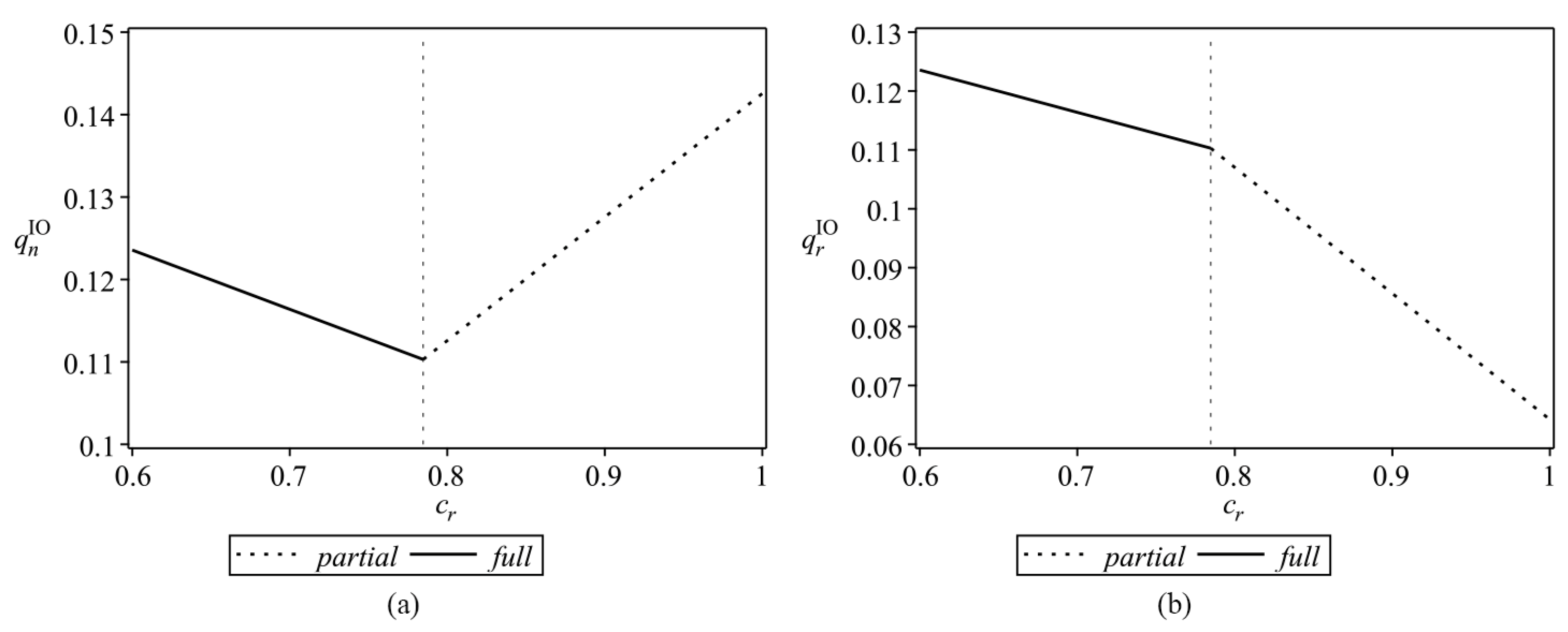
Figure 2,
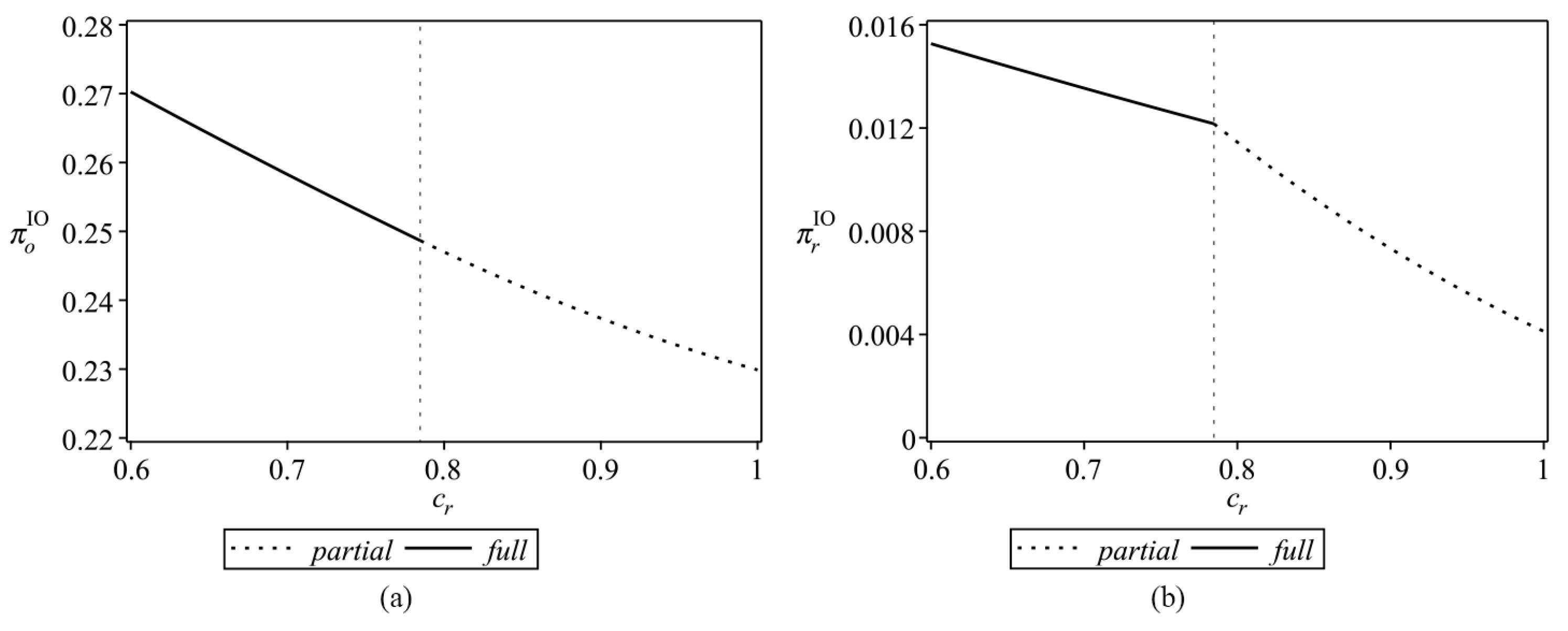
Figure 3 and
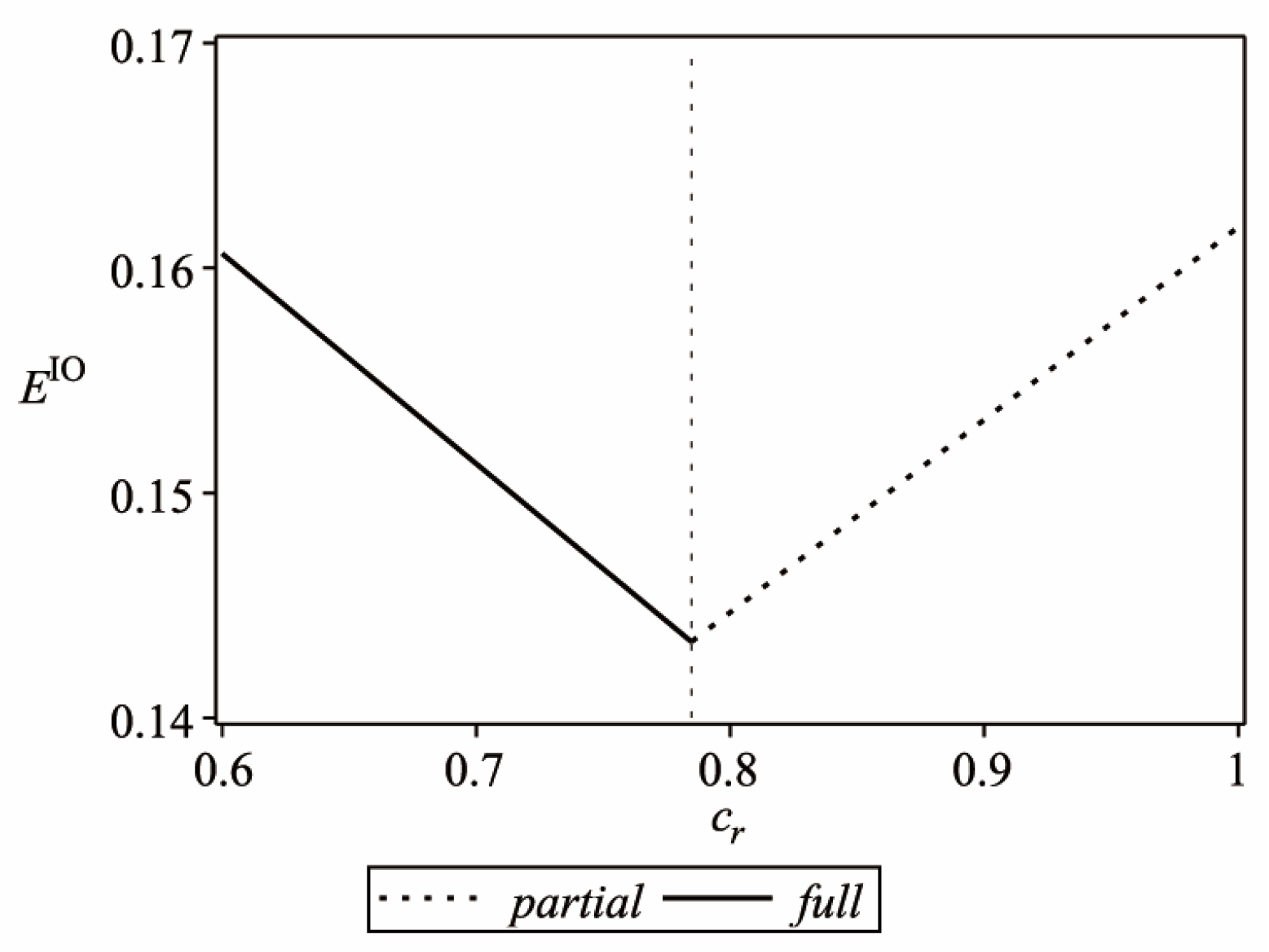
Figure 4 illustrate the impact of remanufacturing costs on production, profits, and environmental performance under the IO scenario. Regarding production, the full remanufacturing stage exhibits perfect substitution, where the quantities of new and remanufactured products are identical and decline simultaneously as costs rise. Upon entering the partial remanufacturing stage, new products regain dominance; while remanufactured quantities decline sharply, leading to a widening gap and a contraction in overall market scale. Regarding economic benefits, due to the compression of TPR’s marginal revenue and the reduction in OEM’s outsourcing income, profits for both parties decrease across two stages. Regarding environmental impact, driven by the dynamic interaction between total production structure and unit emission differences, environmental performance demonstrates distinct characteristics under the two strategies.
Proposition 5. In the PO scenario, the impacts of the production subsidy on the optimal decisions, economic performance, and environmental performance are as follows:
- (1)
When the TPR adopts partial remanufacturing (high subsidy stage): , , , , , , .
- (2)
When the TPR adopts full remanufacturing (low subsidy stage):
- (i)
, , , , , .
- (ii)
if , ; otherwise, .
In the high-subsidy stage, production subsidies significantly reduce remanufacturing costs, enabling the TPR to engage in full remanufacturing. This drives a simultaneous increase in the production quantities of both new and remanufactured products, leading to price reductions and significantly boosting corporate profits. However, this effect, driven by market scale expansion, also increases in total production volume, thereby causing environmental damage. In the subsidy phase-out stage, the TPR engages only in partial remanufacturing. Here, production subsidies primarily enhance the competitiveness of remanufactured products by lowering prices. This attracts some consumers to switch from new products to remanufactured ones, resulting in increased remanufactured production and decreased new product production. The OEM reduces production volume to maintain prices and protect profits. Overall, however, profits still increase.
When the TPR adopts full remanufacturing, the direction of change in the environmental impact with respect to the subsidy depends on the sign of
. Carbon emissions constitute the most measurable, standardized, and policy-relevant component of lifecycle environmental burdens in manufacturing systems. Compared with other environmental indicators, such as water pollution or toxicity, carbon emissions are more consistently quantified and widely adopted in remanufacturing and sustainability research [
25]. Therefore, the environmental impact can be proxied by carbon emissions. The environmental impact of new and remanufactured products can also be represented by their carbon emissions. For normalization and analytical clarity, the unit carbon emission of a new product is set to 1. The unit carbon emission of a remanufactured product is
. Carbon efficiency is defined as the level of carbon emissions per unit of market value, measured as the ratio of unit emissions to consumers’ willingness to pay. Accordingly, the carbon efficiency of new products is
, while that of remanufactured products is
. When
, remanufactured products generate lower carbon emissions per unit of market value, indicating superior carbon efficiency. Conversely, if
, new products are more carbon-efficient. As subsidy intensity increases, the output of remanufactured products expands, while the output of new products declines. Therefore, subsidies alter the production composition of the market. The resulting change in total environmental impact depends on the relative carbon efficiency of remanufactured products. When remanufactured products exhibit superior carbon efficiency, the substitution effect, where remanufactured products replace new products, dominates. In this case, total environmental impact decreases as subsidy intensity increases. Conversely, when the carbon efficiency advantage of remanufactured products is insufficient, the scale expansion effect induced by subsidies may outweigh the per-unit emission advantage, leading to an increase in total carbon emissions.
Proposition 6. In the DO scenario, the impacts of the consumption subsidy on the optimal decisions, economic performance, and environmental performance are as follows:
- (1)
When the TPR adopts partial remanufacturing (high subsidy stage): , , , , , , .
- (2)
When the TPR adopts full remanufacturing (low subsidy stage):
- (i)
, , , , , .
- (ii)
if , ; otherwise, .
In the high-subsidy stage, consumption subsidies enhance consumer willingness to pay for remanufactured products, enabling the TPR to achieve sales at higher prices. Consequently, the price of remanufactured products rises as the subsidy increases. Production quantities, profits, and environmental impact also increase with the magnitude of the production subsidy. In the subsidy phase-out stage, consumption subsidies similarly drive up the price of remanufactured products. This incentivizes an increase in remanufactured production while causing a decline in new product output. Accordingly, the profits of both the OEM and the TPR increase. The environmental impact of consumption subsidies continues to depend on the comparison of carbon efficiency between the two products. When remanufactured products possess a significant emission reduction advantage, consumption subsidies facilitate emission reductions; otherwise, they may lead to an increase in emissions.
A comparison of the results under the PO and DO scenarios reveals significant similarities. The differences lie only in the absolute magnitude of the subsidies. Assuming that
. Consequently,
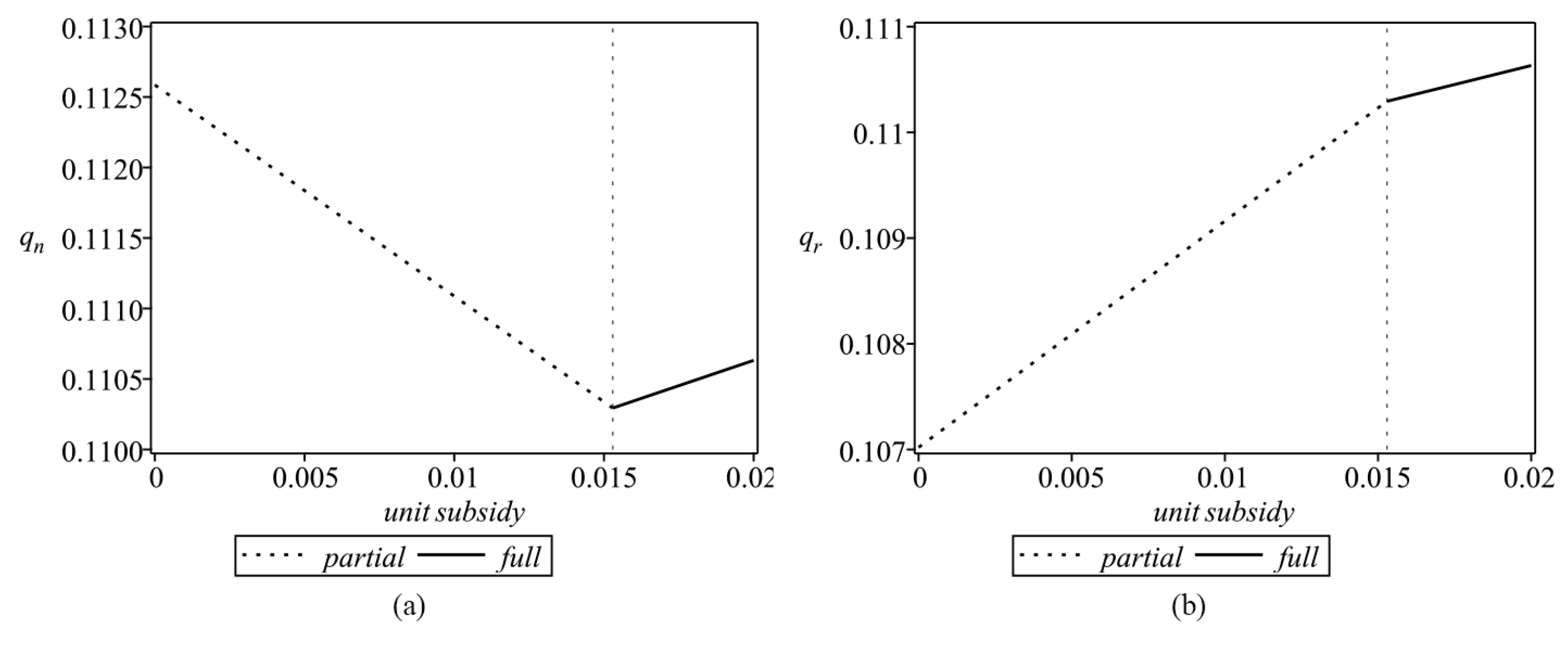
Figure 5,
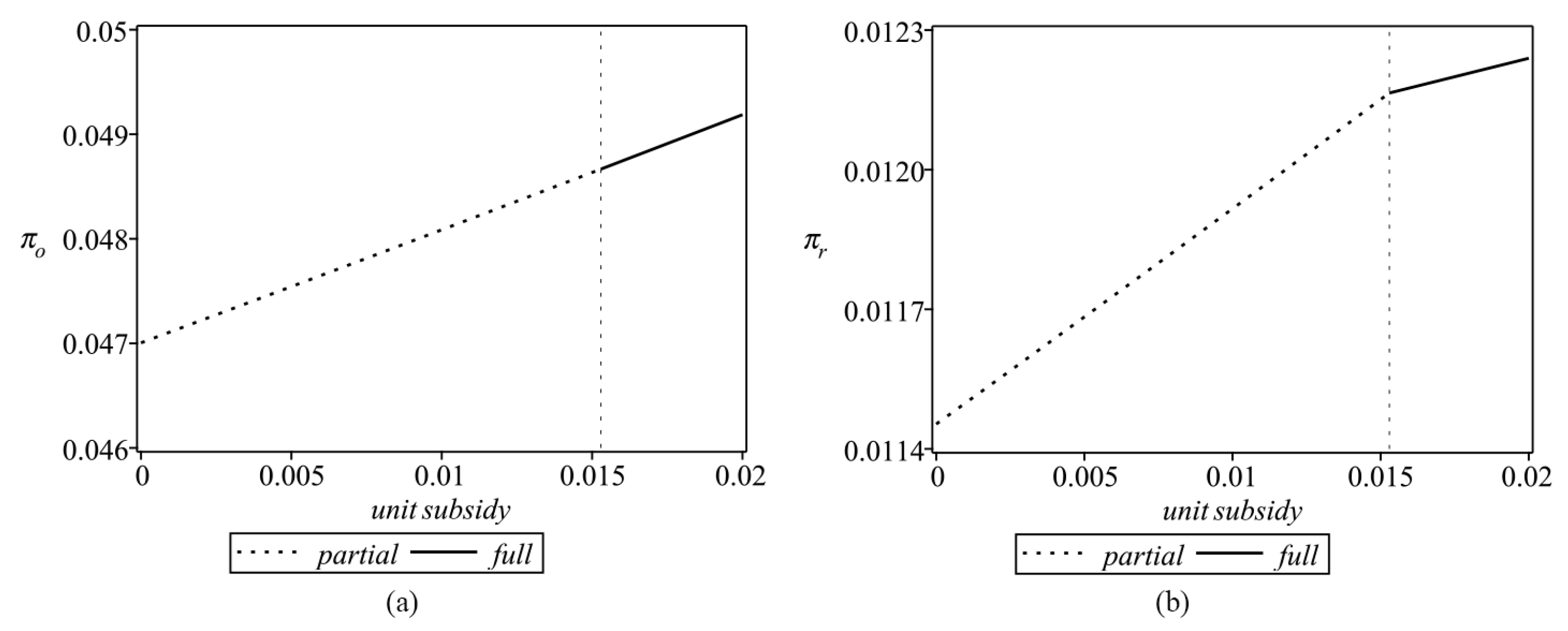
Figure 6 and
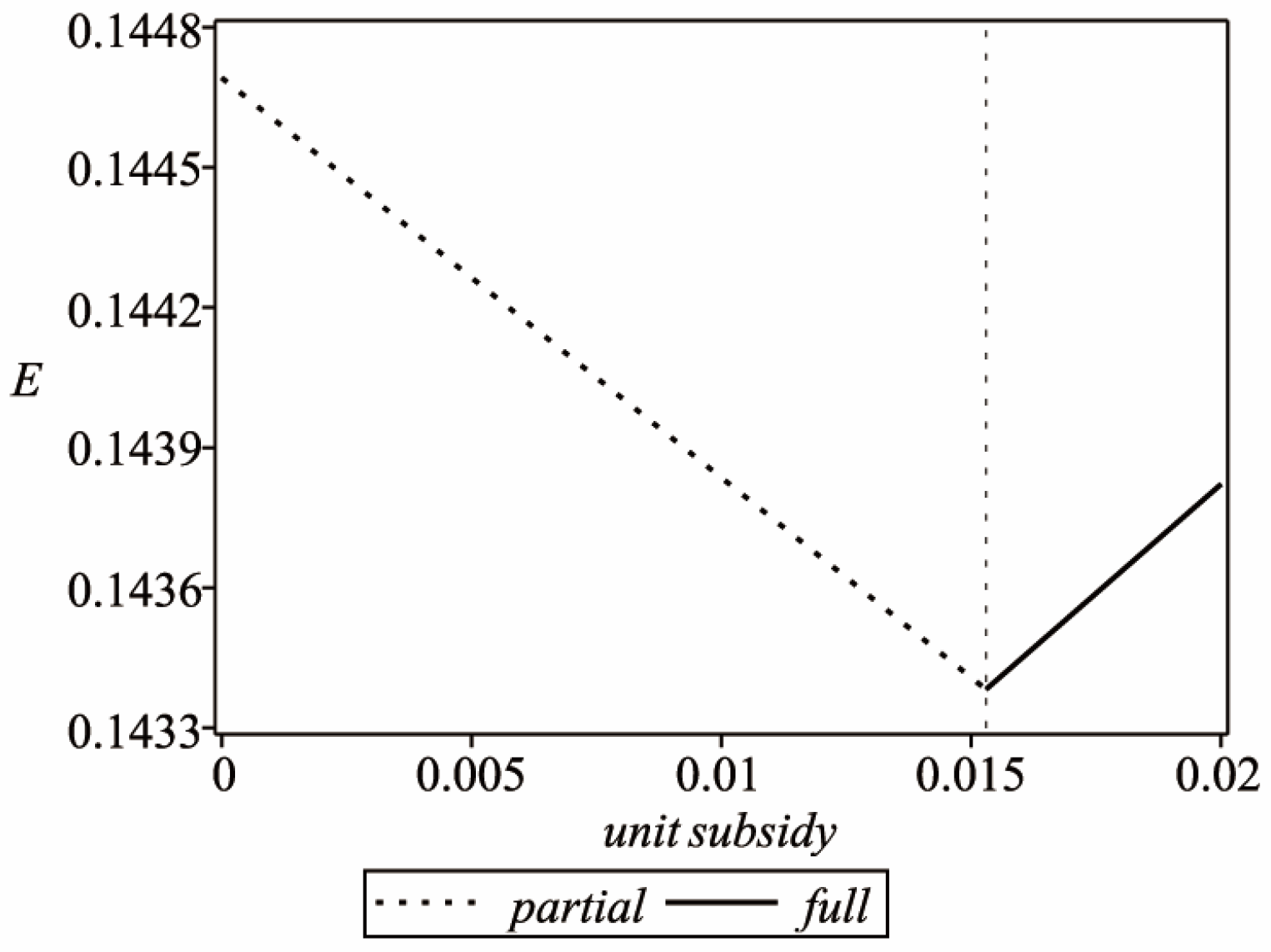
Figure 7 illustrate the dynamic impacts of the subsidy phase-out mechanism on production quantities, profits, and environmental performance, with the horizontal axis representing the intensity of both types of subsidies. In the high-subsidy stage, the TPR adopts a full remanufacturing strategy. Strong policy incentives stimulate the expansion of total market demand, causing the production quantities of both new and remanufactured products to increase with the subsidy. The resulting scale effect significantly enhances the TPR’s remanufacturing revenue and the OEM’s outsourcing revenue but simultaneously hurts the total environmental burden. As the subsidy phases out and enters the low-subsidy stage, the cost advantage of remanufactured products disappears gradually. The output of remanufactured products decreases, while the production of new products increases, leading to a worsening in environmental performance. Simultaneously, constrained by the decrease in remanufacturing profit, the profits of both the OEM and the TPR exhibit a downward trend.
The main qualitative insights of the model are structurally derived from the analytical equilibrium conditions rather than being driven by a specific numerical configuration. Additional numerical checks under alternative parameter ranges yield qualitatively consistent patterns. Therefore, the conclusions are robust to moderate variations in key parameters.
Having analyzed the impact of various subsidies on market equilibrium outcomes, this section further explores how subsidies alter the OEM’s intrinsic incentive to engage in product design for remanufacturing. By differentiating the OEM’s profit function with respect to the DfR, we find that the OEM’s design decision depends on the design cost coefficient. Specifically, there exists a threshold (denoted as ). When the design cost coefficient falls within this threshold (i.e., ), the OEM is motivated to undertake product design. Conversely, when , the marginal benefit derived from design innovation is insufficient to offset its marginal cost, prompting the OEM to give up. Denoting the no-subsidy scenario as Model O, a comparison of the thresholds under the no-subsidy case and the three subsidy scenarios yields Proposition 7.
Proposition 7. The comparison results between the no-subsidy scenario and the three subsidy scenarios are as follows: , , .
It can be seen from Proposition 7 that all three subsidies can expand the parameter range of the OEM’s product design investment. Moreover, the greater the subsidy intensity, the higher the cost threshold for engaging in remanufacturing product design (, , ). However, their underlying mechanisms differ. Production and consumption subsidies induce the scale effect by driving demand expansion. This improved market scale amplifies the marginal benefit derived from design optimization, enabling the OEM to amortize R&D costs over a greater sales volume and sustain the incentive to design even at higher cost levels. In contrast, innovation subsidies operate through a direct cost-sharing mechanism. By reducing the effective R&D burden borne by the OEM, innovation subsidies relax the design cost constraint and raise the profitability of engaging in DfR activities. Therefore, although innovation subsidies do not primarily rely on demand expansion, they also enlarge the feasible design investment region by increasing the OEM’s net return from remanufacturing design.
6. Comparative Analysis of the Three Subsidies
To provide a systematic and unified comparison of the policy effectiveness of innovation, production, and consumption subsidies in promoting remanufacturing development, this section evaluates the three subsidies within the same outsourcing remanufacturing framework. Specifically, we compare their impacts across four dimensions: market outcomes (measured by the share of remanufactured products), environmental performance, economic performance, and subsidy efficiency (the incremental volume of remanufactured products per unit of subsidy).
After excluding the invalid case where the TPR does not enter the market, the analysis focuses on comparing four typical conditions. (1) Condition 1: High remanufacturing cost–High subsidy. This case corresponds to the initial stage of remanufacturing development. Immature technology results in high costs, and the government implements high-intensity subsidies to improve the market. Under the IO scenario, the TPR engages in partial remanufacturing. In contrast, under the PO and DO scenarios, the TPR implements full remanufacturing. (2) Condition 2: High remanufacturing cost–Low subsidy. This case represents a mismatch stage where subsidies are phased out too quickly or are insufficient in intensity. Specifically, costs remain high, but policy support has prematurely declined. The TPR selects a partial remanufacturing strategy across all three subsidy scenarios. (3) Condition 3: Low remanufacturing cost–High subsidy. This case corresponds to a transitional stage where industry technology has matured and lowered costs, but policies have not yet been phased out promptly. The TPR adopts full remanufacturing under all three subsidy scenarios. (4) Condition 4: Low remanufacturing cost–Low subsidy. This case corresponds to the mature stage of the industry. Technological progress has reduced costs, and government subsidies have completed their phase-out by reaching low levels or exiting the market. Under the IO scenario, the TPR engages in full remanufacturing. In contrast, under the PO and DO scenarios, the TPR conducts partial remanufacturing.
Proposition 8. The comparison results of the share of remanufactured products under the three subsidy scenarios are shown in Table 6.
Significant differences exist among the different subsidy types regarding the share of remanufactured products. Overall, production subsidies and consumption subsidies significantly increase the market share of remanufactured products in most conditions, whereas the effect of innovation subsidies is relatively limited. Specifically, in Condition 1, both production subsidies and consumption subsidies drive the TPR to adopt a full remanufacturing strategy. Consequently, the share of remanufactured products under these subsidies is significantly higher than under the IO scenario. In Conditions 2 and 4, while the comparison between PO and DO depends on the relative size of subsidies, both consistently outperform IO. It is only in Condition 3 that the results for the three subsidy types tend to converge, driven by the maturity of remanufacturing technology and increased subsidy intensity. This indicates that increasing the share of remanufactured products largely depends on subsidies that directly act on the supply and demand sides of the market. It is suggested that if the government’s objective is to expand the market share of remanufactured products, particularly during the early stages of development or when fiscal funds are ample, priority should be given to production or consumption subsidies.
Proposition 9. The comparison results of the environmental impact under the three subsidy scenarios are shown in Table 7.
When remanufactured products possess superior carbon efficiency, increasing their market share facilitates emission reduction. In this context, production subsidies and consumption subsidies typically reduce environmental impact significantly by lowering remanufacturing costs or boosting demand, respectively. However, if these subsidies trigger excessive market expansion, the scale effect may outweigh the substitution effect, thereby damaging the environment. Conversely, if new products possess superior carbon efficiency, relying solely on production subsidies or consumption subsidies to drive the expansion of remanufactured products may increase total emissions. In such cases, the innovation subsidy becomes crucial due to its long-term role in improving design standards and reducing unit carbon emissions.
Under Condition 1, if the carbon efficiency of remanufactured products is inferior to that of new ones, PO and DO lead to higher emissions due to market scale expansion, whereas IO results in the lowest emissions. However, if remanufactured products possess superior carbon efficiency, the outcome depends on whether subsidies exceed entry thresholds. In Condition 2, if remanufactured products hold an emission advantage, subsidies are insufficient to expand the market, meaning PO and DO effectively reduce emissions. Otherwise, IO proves more effective. In Condition 3, all three subsidies promote development. PO and DO tend to result in higher emissions due to strong supply and demand expansion, leaving IO with the lowest emission levels. Finally, in Condition 4, limited PO or DO can still yield certain emission reductions, whereas IO fails to significantly drive substitution, resulting in the highest emissions in this specific scenario.
Overall, the variations in environmental impact under different subsidy policies depend on the relative carbon efficiency of remanufactured products, the extent of market expansion induced by the subsidy, and whether critical thresholds are crossed. Specifically, in the high-subsidy stage, the scale effect often dominates, potentially causing market-oriented subsidies to push up emissions. Conversely, in the low-subsidy stage, relying solely on IO may lead to the highest emissions if there is a lack of sufficient market substitution. Therefore, if the policy objective is emission reduction, the design of subsidies and their phase-out paths must balance the scale effect against carbon efficiency improvement.
Proposition 10. The comparison results of the OEM profits under the three subsidy scenarios are shown in Table 8. Proposition 11. In all four conditions, the comparative results for TPR profits are consistently: if , ; otherwise .
Combining Propositions 10 and 11, it is revealed that production and consumption subsidies generally bolster OEM and TPR profits more effectively than innovation subsidies. For the OEM, the profit ranking depends on whether the innovation subsidy crosses a critical threshold. Unless the subsidy is substantial, production and consumption subsidies yield better financial returns. In contrast, the outcome for the TPR is static, with innovation subsidies consistently performing behind the other two options. Determining whether production or consumption subsidies yield higher profits hinges on the relative magnitude of the two.
Proposition 12. In all four conditions, the comparative results for TPR profits are consistently: .
Production and consumption subsidies directly reduce supply costs or boost demand, quickly driving up remanufacturing output. As a result, they are the most effective tools for expanding production, with both showing similar results, while innovation subsidies remain at a disadvantage. Consequently, if the government aims to maximize remanufacturing growth under a limited budget, production and consumption subsidies represent the optimal choices. Innovation subsidies are more appropriate as long-term supplementary tools rather than primary interventions.
Combining Propositions 8–12 reveal that each subsidy type offers distinct advantages depending on the specific conditions. In most scenarios, production and consumption subsidies yield superior results regarding the market share of remanufactured products, subsidy efficiency, and profits for both the OEM and TPR. Their impact is most significant during the early stages characterized by high costs and market immaturity, where they directly lower marginal costs, significantly driving market and expansion. However, as costs decline and market acceptance grows, the marginal efficiency of these subsidies diminishes; the incremental output generated per unit of subsidy weakens. Under certain conditions, these incentives may even risk driving up carbon emissions. Conversely, while innovation subsidies have a limited immediate impact on production volume, they provide a more sustained boost to OEM profits. By driving design improvements and indirectly lowering carbon emissions, innovation subsidies lay the essential groundwork for the long-term development of the remanufacturing industry.
7. Conclusions and Managerial Implications
Incorporating a subsidy phase-out mechanism into the context of outsourced remanufacturing, this paper constructs game-theoretic models involving an OEM and a TPR under three distinct scenarios: innovation, production, and consumption subsidies. The study examines the differential impacts of these subsidies and systematically evaluates their comparative policy effectiveness. The findings contribute theoretical insights to the literature on outsourced remanufacturing and offer valuable references for the advancement of the remanufacturing industry. The main research results are as follows.
(1) The three subsidy instruments operate through distinct strategic channels within the outsourcing remanufacturing framework. Innovation subsidies primarily affect the OEM’s DfR investment decision. The production and consumption subsidies directly alter the profitability conditions and entry thresholds of the TPR. Under subsidy phase-out, the equilibrium exhibits a piecewise structure across subsidy intervals, leading the TPR to shift endogenously among full remanufacturing, partial remanufacturing, and market exit regimes. This threshold-based adjustment mechanism highlights the structural impact of phased subsidy reduction on market participation.
(2) The policy performance of different subsidies varies significantly across economic and environmental dimensions. Production and consumption subsidies expand remanufacturing scale by relaxing entry constraints and increasing market demand. However, their environmental effect depends critically on the relative carbon efficiency of remanufactured products. When remanufactured products possess a sufficient emissions advantage, scale expansion reduces total environmental impact; otherwise, expansion effects may offset per-unit emissions savings. In contrast, innovation subsidies primarily improve carbon efficiency through enhanced DfR, yielding more stable environmental performance during subsidy phase-out and market maturity.
(3) No single subsidy instrument dominates across all parameter regions. The relative effectiveness of innovation, production, and consumption subsidies depends on remanufacturing cost levels, carbon efficiency conditions, and subsidy intensity. In early-stage industries with high entry barriers, scale-oriented subsidies are more effective in stimulating participation. As technology matures and remanufacturing costs decline, innovation subsidies play a more critical role in sustaining design incentives under reduced policy support.
The findings provide the following implications for governments and enterprises in the outsourcing remanufacturing. For the government, subsidy policies should be stage-specific and dynamically adjusted. In the early stage, production and consumption subsidies help lower entry barriers and expand remanufacturing scale. As the industry matures and subsidies are phased out, greater emphasis should be placed on innovation subsidies to sustain DfR incentives and improve carbon efficiency. For enterprises, OEMs should use innovation subsidies to strengthen long-term design capabilities, while TPRs should enhance operational efficiency to remain competitive under declining subsidy support.
Despite obtaining valuable insights, this study has limitations that merit further exploration in future research. First, this study captures subsidy phase-out effects through threshold analysis and comparative statics. Future studies could introduce multi-period or dynamic models to capture the long-term industry development and firm behavior under phased subsidy reductions. Second, while this study provides a clear benchmark under complete information, we recognize that information asymmetry is prevalent in outsourcing. Future research may introduce asymmetric information structures, such as private remanufacturing costs or hidden design effort, to examine how subsidy policies interact with incentive compatibility and contract design under incomplete information. Third, future research may incorporate richer consumer heterogeneity structures, such as segmented environmental preferences or alternative WTP distributions, to examine how heterogeneous demand responses influence subsidy efficiency and environmental outcomes. Finally, future research could extend the numerical analysis by incorporating multi-industry datasets to further validate the robustness of the findings across different remanufacturing contexts.