A Constraint-Tightening Feasible-Trajectory-Guided Two-Stage Evolutionary Algorithm

Abstract
1. Introduction
- (1)
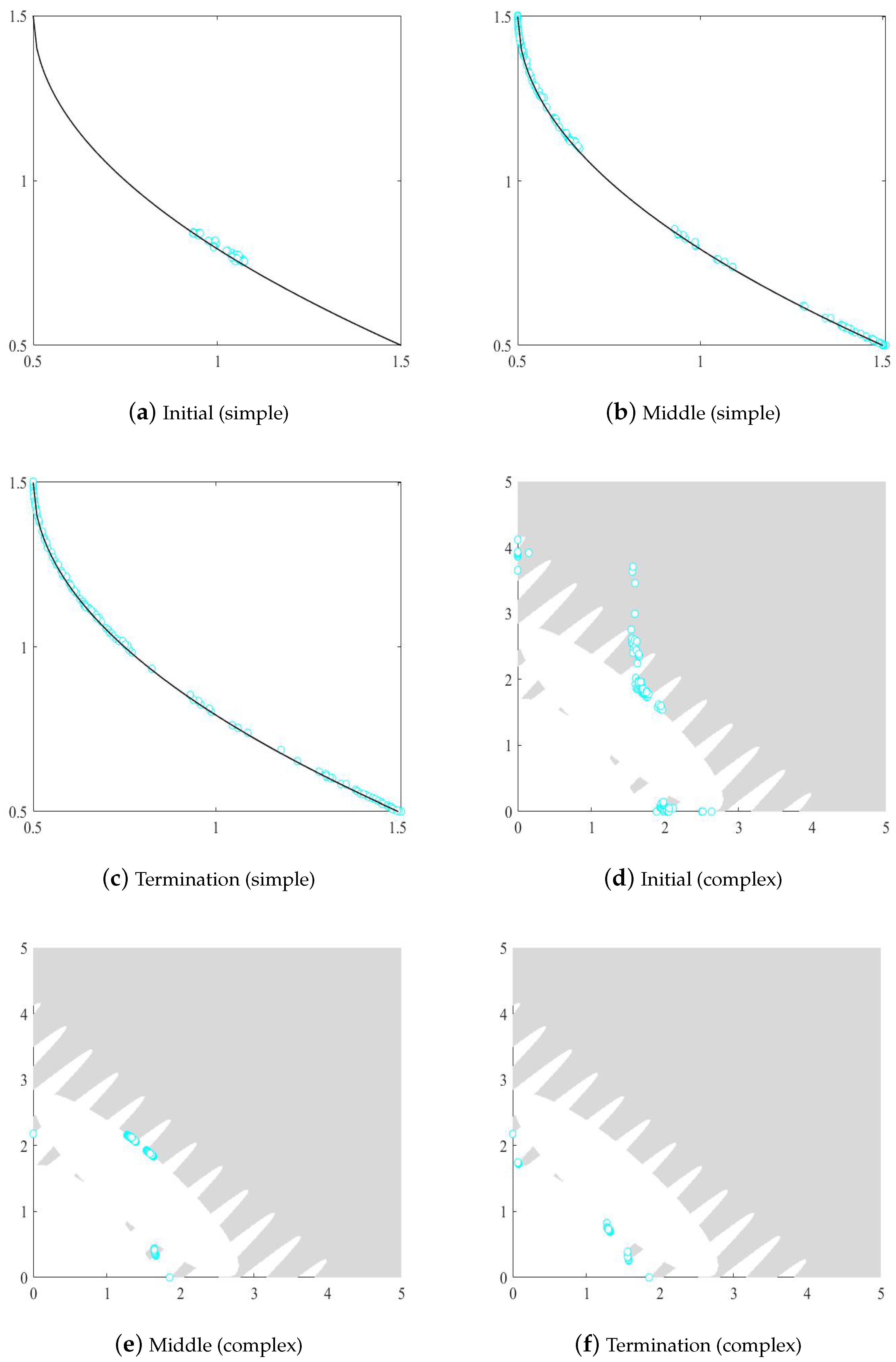
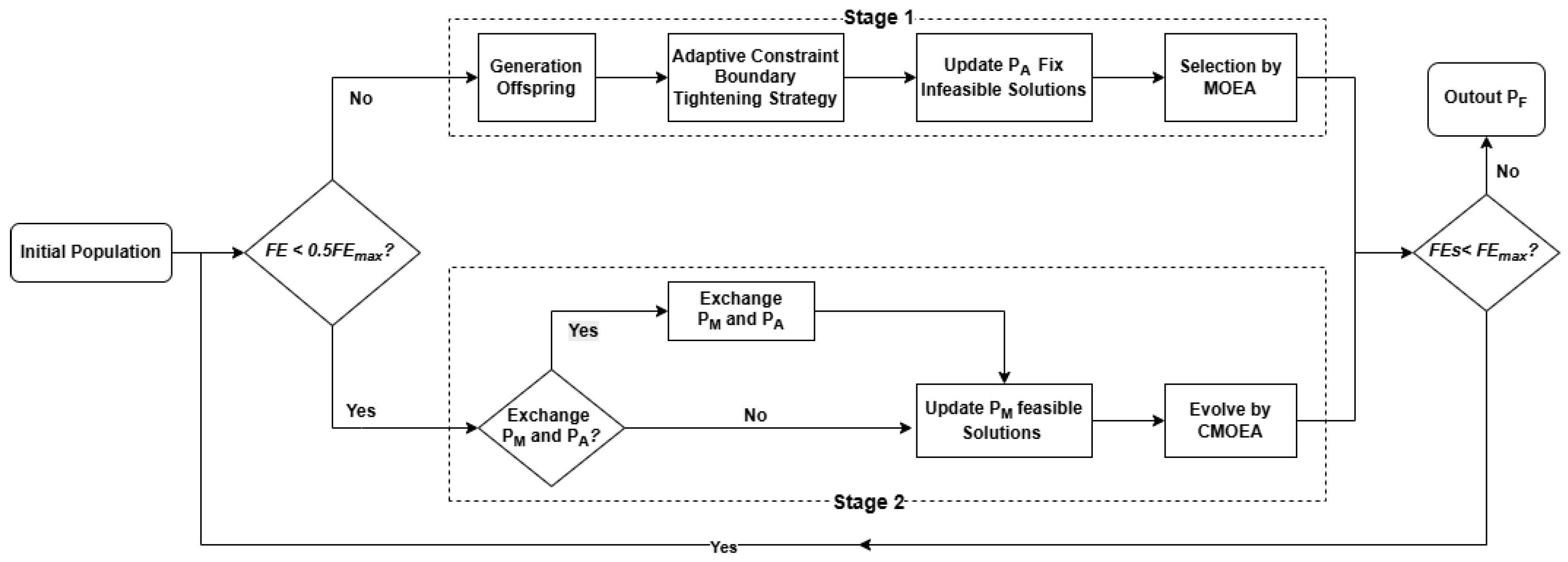
- This paper proposes a novel Constraint-Tightening Feasible-Trajectory-Guided Two-Stage Evolutionary Algorithm (CT-FTREA) for constrained multi-objective optimization problems. The proposed framework decomposes the optimization process into a feasible-region-guided exploration stage and a CPF-oriented refinement stage. In the first stage, an adaptive -constraint boundary tightening strategy is designed to progressively guide the population from relaxed infeasible regions toward the feasible region by dynamically shrinking the constraint boundary according to the number of function evaluations. This mechanism effectively exploits feasible search trajectories and enhances convergence efficiency and robustness under complex constraint environments.
- (2)
- A role-exchanging archive–population collaboration mechanism is introduced in the second stage, where the archive and population exchange their roles to actively guide offspring generation. Combined with an improved elite selection strategy and a differential evolution operator, this mechanism enables fine-grained approximation of the CPF by adaptively balancing exploration and exploitation.
- (3)
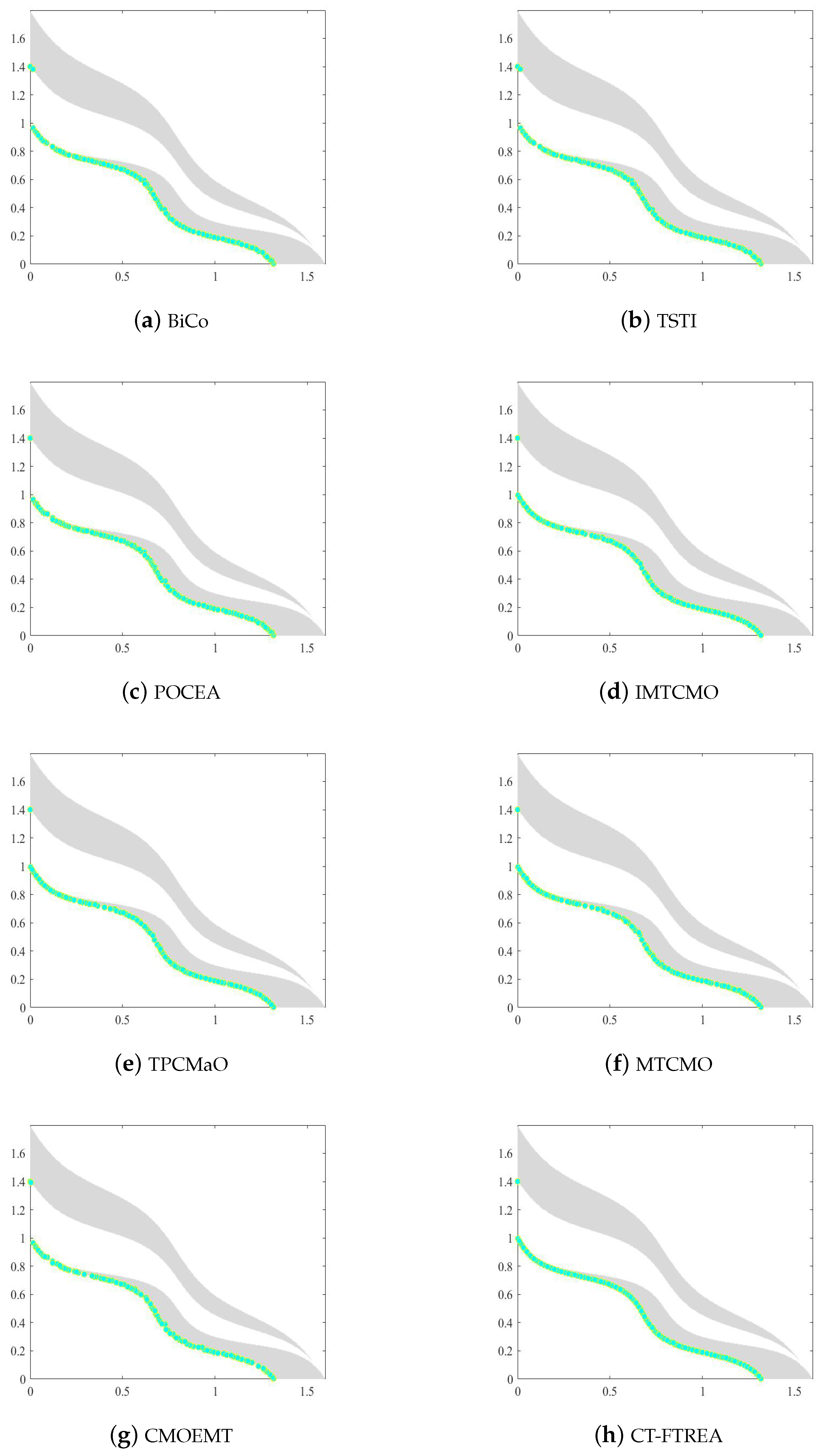
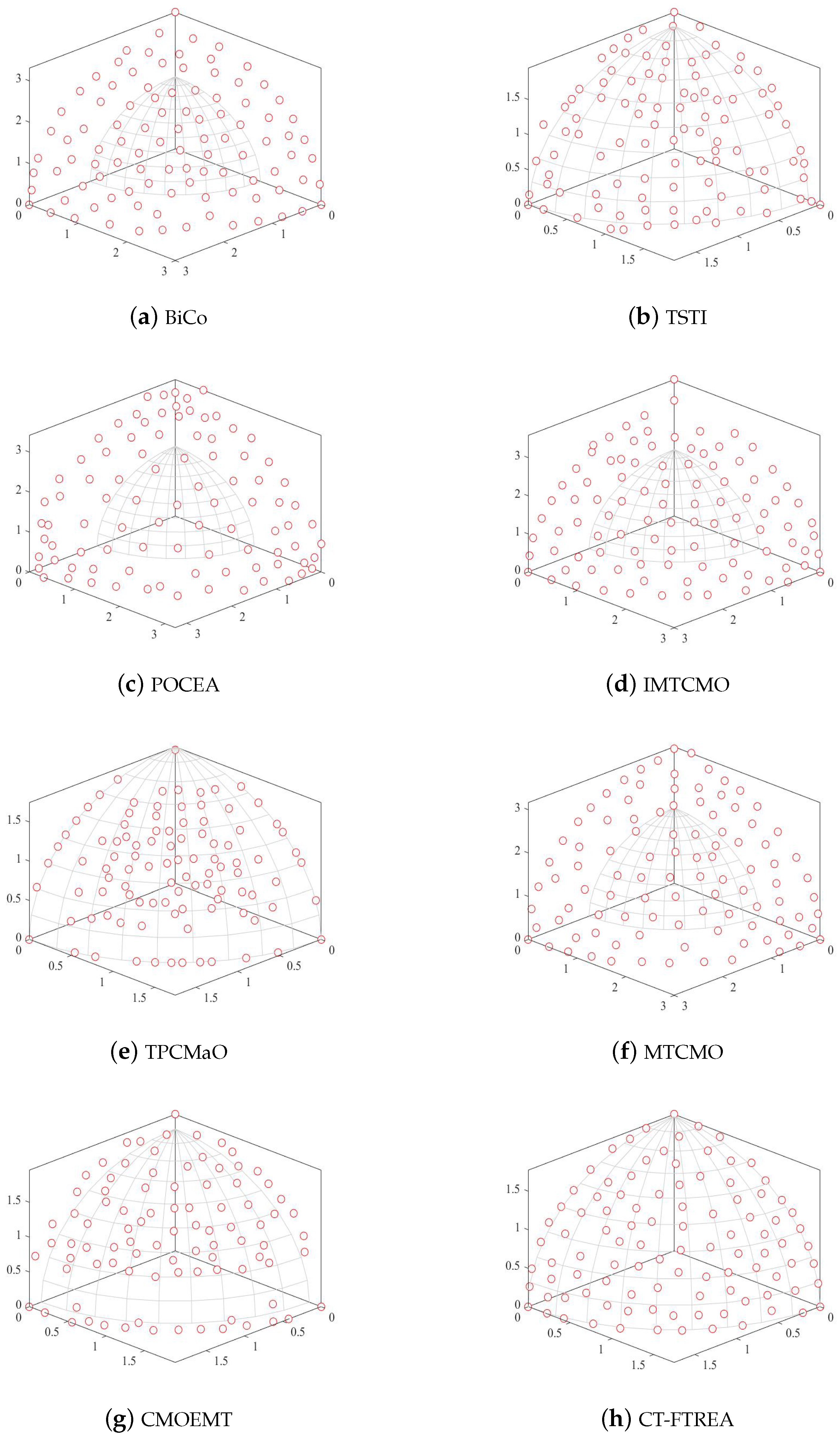
- Extensive comparative experiments conducted on 28 benchmark test instances and four real-world engineering problems demonstrate that the proposed CT-FTREA achieves competitive and robust performance compared with seven state-of-the-art algorithms.
2. Related Work and Motivation
2.1. Related Work
2.1.1. Constraint-Handling Techniques for CMOPs
2.1.2. Multi-Stage and Adaptive Evolutionary Frameworks
2.1.3. Archive-Assisted and DE-Based Approaches
2.2. Motivation
3. Proposed CT-FTREA
3.1. The Framework of CT-FTREA
| Algorithm 1 Framework of CT-FTREA |
|
3.2. Adaptive Constraint Boundary Tightening Strategy
3.3. Elite Environmental Selection Strategy
| Algorithm 2 Elite environmental selection strategy |
|
3.4. Time Complexity Analysis
4. Experimental Study
4.1. Experimental Setup
4.2. Competing Algorithms
- (1)
- BiCO: Handling Constrained Multi-objective Optimization Problems Via Bidirectional Coevolution.
- (2)
- TSTI: A Two-stage Evolutionary Algorithm Based on Three Indicators for Constrained Multi-objective Optimization.
- (3)
- POCEA: Paired Offspring Generation for Constrained Large-scale Multi-objective Optimization.
- (4)
- IMTCMO: Evolutionary Constrained Multi-objective Optimization: Scalable High-dimensional Constraint Benchmarks and Algorithm.
- (5)
- TPCMaO: Solving Optimal Power Flow Problems Via a Constrained Many-objective Co-evolutionary Algorithm.
- (6)
- MTCMO: Dynamic Auxiliary Task-based Evolutionary Multitasking for Constrained Multi-objective Optimization.
- (7)
- CMOEMT: Constrained Multi-objective Optimization Via Multitasking and Knowledge Transfer.
4.3. Performance Metrics
4.4. Experimental Results and Analysis
4.4.1. Comparative Analysis of MW Problems
4.4.2. Comparative Analysis of LIRCMOP Problems
4.4.3. Comparative Analysis of Real-World CMOP
4.4.4. Ablation Study on CT-FTREA
- (1)
- CT-FTREA1: The two-stage optimization framework (feasible-region-guided stage + CPF-focused refinement stage) is removed, and the entire optimization process is simplified into a single-stage search. This experiment aims to verify the effect of the two-stage design on convergence and the quality of the solution set distribution.
- (2)
- CT-FTREA2: The adaptive constraint boundary tightening strategy is removed and replaced with a fixed constraint boundary. This experiment examines the contribution of the strategy in guiding the population into the feasible region, increasing the proportion of feasible solutions, and improving the approximation of the CPF.
- (3)
- CT-FTREA3: The elite environmental selection strategy is removed, retaining only the basic selection operator. This experiment analyzes the impact of elite environmental selection on the stability of the solution set, convergence, and the approximation ability of the Pareto front.
5. Conclusions
Author Contributions
Funding
Data Availability Statement
Conflicts of Interest
References
- Lv, Y.; Li, K.; Zhao, H.; Lei, H. A Multi-Stage Constraint-Handling Multi-Objective Optimization Method for Resilient Microgrid Energy Management. Appl. Sci. 2024, 14, 3253. [Google Scholar] [CrossRef]
- Maneengam, A. Multi-Objective Optimization of the Multimodal Routing Problem Using the Adaptive ε-Constraint Method and Modified TOPSIS with the D-CRITIC Method. Sustainability 2023, 15, 12066. [Google Scholar] [CrossRef]
- Cerda-Flores, S.C.; Rojas-Punzo, A.A.; Nápoles-Rivera, F. Applications of Multi-Objective Optimization to Industrial Processes: A Literature Review. Processes 2022, 10, 133. [Google Scholar] [CrossRef]
- Zhao, K.; Wang, P.; Tong, X. An Adaptive Two-Population Evolutionary Algorithm for Constrained Multi-Objective Optimization Problems. IEEE Access 2023, 11, 82118–82131. [Google Scholar] [CrossRef]
- Hao, Y.; Zhao, C.; Zhang, Y.; Cao, Y.; Li, Z. Constrained multi-objective optimization problems: Methodologies, algorithms and applications. Knowl.-Based Syst. 2024, 299, 111998. [Google Scholar] [CrossRef]
- Vodopija, A.; Tušar, T.; Filipič, B. Characterization of Constrained Continuous Multiobjective Optimization Problems: A Performance Space Perspective. IEEE Trans. Evol. Comput. 2025, 29, 275–285. [Google Scholar] [CrossRef]
- Wang, C.; Huang, H.; Zhang, X. Growing Neural Gas Network for Offspring Generation in Evolutionary Constrained Multi-Objective Optimization. IEEE Trans. Emerg. Top. Comput. Intell. 2024, 8, 576–590. [Google Scholar] [CrossRef]
- Zhou, J.; Zhang, Y.; Wang, J.; Suganthan, P.N. Localized Constrained-Domination Principle for Constrained Multiobjective Optimization. IEEE Trans. Syst. Man Cybern. Syst. 2024, 54, 1376–1387. [Google Scholar] [CrossRef]
- Gong, Q.; Xia, Y.; Zou, J.; Hou, Z.; Liu, Y. Enhancing Dynamic Constrained Multiobjective Optimization with Multicenters-Based Prediction. IEEE Trans. Evol. Comput. 2025, 29, 1604–1618. [Google Scholar] [CrossRef]
- Cao, J.; Yan, Z.; Chen, Z.; Zhang, J. A Pareto front estimation-based constrained multi-objective evolutionary algorithm. Appl. Intell. 2023, 53, 10380–10416. [Google Scholar] [CrossRef]
- Yang, Y.; Liu, J.; Tan, S. A constrained multi-objective evolutionary algorithm based on decomposition and dynamic constraint-handling mechanism. Appl. Soft Comput. 2020, 89, 106104. [Google Scholar] [CrossRef]
- Liang, J.; Ban, X.; Yu, K.; Qu, B.; Qiao, K.; Yue, C.; Chen, K.; Tan, K.C. A survey on evolutionary constrained multiobjective optimization. IEEE Trans. Evol. Comput. 2022, 27, 201–221. [Google Scholar] [CrossRef]
- Liu, Z.Z.; Qin, Y.; Song, W.; Zhang, J.; Li, K. Multiobjective-based constraint-handling technique for evolutionary constrained multiobjective optimization: A new perspective. IEEE Trans. Evol. Comput. 2022, 27, 1370–1384. [Google Scholar] [CrossRef]
- Tang, H.; Yu, F.; Zou, J.; Yang, S.; Zheng, J. A constrained multi-objective evolutionary strategy based on population state detection. Swarm Evol. Comput. 2022, 68, 100978. [Google Scholar] [CrossRef]
- Khodadadi, N.; Abualigah, L.; El-Kenawy, E.S.M.; Snasel, V.; Mirjalili, S. An Archive-Based Multi-Objective Arithmetic Optimization Algorithm for Solving Industrial Engineering Problems. IEEE Access 2022, 10, 106673–106698. [Google Scholar] [CrossRef]
- Wu, H.; Chen, Q.; Jin, Y.; Ding, J.; Chai, T. A Surrogate-Assisted Expensive Constrained Multi-Objective Optimization Algorithm Based on Adaptive Switching of Acquisition Functions. IEEE Trans. Emerg. Top. Comput. Intell. 2024, 8, 2050–2064. [Google Scholar] [CrossRef]
- Xia, M.; Chong, Q.; Dong, M. A constrained multi-objective evolutionary algorithm with two-stage resources allocation. Swarm Evol. Comput. 2023, 79, 101313. [Google Scholar] [CrossRef]
- Ban, X.; Liang, J.; Qiao, K.; Yu, K.; Wang, Y.; Peng, J.; Qu, B. A Decision Variables Classification-Based Evolutionary Algorithm for Constrained Multi-Objective Optimization Problems. IEEE/CAA J. Autom. Sin. 2025, 12, 1830–1849. [Google Scholar] [CrossRef]
- Hou, Y.; Qin, X.; Han, H.; Wang, J. Multiobjective Ant Colony Optimization Algorithm Based on Dynamic Constraint Evaluation Strategy for Highly Constrained Optimization. IEEE Trans. Cybern. 2025, 55, 4570–4582. [Google Scholar] [CrossRef] [PubMed]
- Wang, R.; Huang, W.; Li, W.; Tang, X.; Zhang, T.; Wang, L. An Adaptive Constraint Relaxation Strategy Based Coevolutionary Algorithm for Constrained Multi-Objective Optimization. IEEE Trans. Emerg. Top. Comput. Intell. 2026, 10, 632–646. [Google Scholar] [CrossRef]
- Sun, R.; Zou, J.; Liu, Y.; Yang, S.; Zheng, J. A multistage algorithm for solving multiobjective optimization problems with multiconstraints. IEEE Trans. Evol. Comput. 2023, 27, 1207–1219. [Google Scholar] [CrossRef]
- Bao, Q.; Wang, M.; Dai, G.; Chen, X.; Song, Z.; Li, S. An archive-based two-stage evolutionary algorithm for constrained multi-objective optimization problems. Swarm Evol. Comput. 2022, 75, 101161. [Google Scholar] [CrossRef]
- Yang, K.; Zheng, J.; Zou, J.; Yu, F.; Yang, S. A dual-population evolutionary algorithm based on adaptive constraint strength for constrained multi-objective optimization. Swarm Evol. Comput. 2023, 77, 101247. [Google Scholar] [CrossRef]
- Wang, P.; Ma, Y.; Wang, M. A dynamic multi-objective optimization evolutionary algorithm based on particle swarm prediction strategy and prediction adjustment strategy. Swarm Evol. Comput. 2022, 75, 101164. [Google Scholar] [CrossRef]
- Ming, M.; Wang, R.; Ishibuchi, H.; Zhang, T. A Novel Dual-Stage Dual-Population Evolutionary Algorithm for Constrained Multiobjective Optimization. IEEE Trans. Evol. Comput. 2021, 26, 1129–1143. [Google Scholar] [CrossRef]
- Wang, P.; Xiao, H.; Han, X.; Yang, F.; Li, L. A coevolutionary algorithm based on reference line guided archive for constrained multiobjective optimization. Appl. Soft Comput. 2023, 142, 110169. [Google Scholar] [CrossRef]
- Qin, C.; Ming, F.; Gong, W.; Gu, Q. Constrained multi-objective optimization via two archives assisted push–pull evolutionary algorithm. Swarm Evol. Comput. 2022, 75, 101178. [Google Scholar] [CrossRef]
- Hao, L.; Peng, W.; Liu, J.; Zhang, W.; Li, Y.; Qin, K. Competition-based two-stage evolutionary algorithm for constrained multi-objective optimization. Math. Comput. Simul. 2025, 230, 207–226. [Google Scholar] [CrossRef]
- Zhao, S.; Shao, Z.; Chen, Y.; Zheng, L.; Chen, J. A self-organizing decomposition based evolutionary algorithm with cooperative diversity measure for many-objective optimization. AIMS Math. 2025, 10, 13880–13907. [Google Scholar] [CrossRef]
- Chen, J.; Zhang, K.; Zeng, H.; Yan, J.; Dai, J.; Dai, Z. Adaptive Constraint Relaxation-Based Evolutionary Algorithm for Constrained Multi-Objective Optimization. Mathematics 2024, 12, 3075. [Google Scholar] [CrossRef]
- Zhang, K.; Zhao, S.; Zeng, H.; Chen, J. Two-Stage Archive Evolutionary Algorithm for Constrained Multi-Objective Optimization. Mathematics 2025, 13, 470. [Google Scholar] [CrossRef]
- Chen, J.; Wang, Y.; Shao, Z.; Zeng, H.; Zhao, S. Dual-Population Cooperative Correlation Evolutionary Algorithm for Constrained Multi-Objective Optimization. Mathematics 2025, 13, 1441. [Google Scholar] [CrossRef]
- Ming, F.; Gong, W.; Wang, L.; Gao, L. Constrained multiobjective optimization via multitasking and knowledge transfer. IEEE Trans. Evol. Comput. 2024, 28, 77–89. [Google Scholar] [CrossRef]
- Wang, X.; Wang, H.; Tian, Z.; Wang, W.; Chen, J. Angle-Based Dual-Association Evolutionary Algorithm for Many-Objective Optimization. Mathematics 2025, 13, 1757. [Google Scholar] [CrossRef]
- Fan, C.; Wang, J.; Xiao, L.; Cheng, F.; Ai, Z.; Zeng, Z. A coevolution algorithm based on two-staged strategy for constrained multi-objective problems. Appl. Intell. 2022, 52, 17954–17973. [Google Scholar] [CrossRef]
- Qiao, K.; Liang, J.; Yu, K.; Yue, C.; Lin, H.; Zhang, D.; Qu, B. Evolutionary Constrained Multiobjective Optimization: Scalable High-Dimensional Constraint Benchmarks and Algorithm. IEEE Trans. Evol. Comput. 2024, 28, 965–979. [Google Scholar] [CrossRef]
- Li, K.; Chen, R.; Fu, G.; Yao, X. Two-archive evolutionary algorithm for constrained multiobjective optimization. IEEE Trans. Evol. Comput. 2018, 23, 303–315. [Google Scholar] [CrossRef]
- Gu, Q.; Liu, R.; Hui, Z.; Wang, D. A constrained multi-objective optimization algorithm based on coordinated strategy of archive and weight vectors. Expert Syst. Appl. 2024, 244, 122961. [Google Scholar] [CrossRef]
- Liang, J.; Lin, H.; Yue, C.; Yu, K.; Guo, Y.; Qiao, K. Multiobjective differential evolution with speciation for constrained multimodal multiobjective optimization. IEEE Trans. Evol. Comput. 2022, 27, 1115–1129. [Google Scholar] [CrossRef]
- Zhou, T.; He, P.; Niu, B.; Yue, G.; Wang, H. A novel competitive constrained dual-archive dual-stage evolutionary algorithm for constrained multiobjective optimization. Swarm Evol. Comput. 2023, 83, 101417. [Google Scholar] [CrossRef]
- Lai, Y.; Chen, J.; Chen, Y.; Zeng, H.; Cai, J. Feedback Tracking Constraint Relaxation Algorithm for Constrained Multi-Objective Optimization. Mathematics 2025, 13, 629. [Google Scholar] [CrossRef]
- Liu, B.J.; Bi, X.J. Adaptive ε-Constraint Multi-Objective Evolutionary Algorithm Based on Decomposition and Differential Evolution. IEEE Access 2021, 9, 17596–17609. [Google Scholar] [CrossRef]
- Zhou, X.; Zhu, Y.; Wang, Y.; Sun, R.; Zou, J. Constrained Multi-Objective Optimization With Constraint Priority. IEEE Trans. Emerg. Top. Comput. Intell. 2025, 9, 4037–4050. [Google Scholar] [CrossRef]
- Wang, F.; Huang, M.; Yang, S.; Wang, X. A constrained multimodal multi-objective evolutionary algorithm based on adaptive epsilon method and two-level environmental selection. Swarm Evol. Comput. 2025, 93, 101845. [Google Scholar] [CrossRef]
- Zuo, M.; Xue, Y. Population Feasibility State Guided Autonomous Constrained Multi-Objective Evolutionary Optimization. Mathematics 2024, 12, 913. [Google Scholar] [CrossRef]
- Tian, Y.; Cheng, R.; Zhang, X.; Jin, Y. PlatEMO: A MATLAB platform for evolutionary multi-objective optimization [educational forum]. IEEE Comput. Intell. Mag. 2017, 12, 73–87. [Google Scholar] [CrossRef]
- Liu, Z.Z.; Wang, B.C.; Tang, K. Handling Constrained Multiobjective Optimization Problems via Bidirectional Coevolution. IEEE Trans. Cybern. 2022, 52, 10163–10176. [Google Scholar] [CrossRef]
- Ming, F.; Gong, W.; Wang, L. A Two-Stage Evolutionary Algorithm with Balanced Convergence and Diversity for Many-Objective Optimization. IEEE Trans. Syst. Man Cybern. Syst. 2022, 52, 6222–6234. [Google Scholar] [CrossRef]
- He, C.; Li, L.; Tian, Y.; Zhang, X.; Cheng, R.; Jin, Y.; Yao, X. Accelerating Large-Scale Multiobjective Optimization via Problem Reformulation. IEEE Trans. Evol. Comput. 2019, 23, 949–961. [Google Scholar] [CrossRef]
- Tian, Y.; Shi, Z.; Zhang, Y.; Zhang, L.; Zhang, H.F.; Zhang, X. Solving optimal power flow problems via a constrained many-objective co-evolutionary algorithm. Front. Energy Res. 2023, 11, 1293193. [Google Scholar] [CrossRef]
- Qiao, K.; Yu, K.; Qu, B.; Liang, J.; Song, H.; Yue, C.; Lin, H.; Tan, K.C. Dynamic Auxiliary Task-Based Evolutionary Multitasking for Constrained Multiobjective Optimization. IEEE Trans. Evol. Comput. 2023, 27, 642–656. [Google Scholar] [CrossRef]
- Dong, J.; Gong, W.; Ming, F.; Wang, L. A two-stage evolutionary algorithm based on three indicators for constrained multi-objective optimization. Expert Syst. Appl. 2022, 195, 116499. [Google Scholar] [CrossRef]
- Bader, J.; Zitzler, E. HypE: An algorithm for fast hypervolume-based many-objective optimization. Evol. Comput. 2011, 19, 45–76. [Google Scholar] [CrossRef] [PubMed]



| Problem | M | D | BiCo | TSTI | POCEA | IMTCMO | TPCMaO | MTCMO | CMOEMT | CT-FTREA |
|---|---|---|---|---|---|---|---|---|---|---|
| MW1 | 2 | 15 | 1.3523 × 10⁻¹ (1.08 × 10⁻¹) − | 7.9445 × 10⁻³ (1.84 × 10⁻²) ≈ | 1.1889 × 10⁻² (3.98 × 10⁻³) − | 1.4623 × 10⁻³ (1.77 × 10⁻⁴) − | 3.1440 × 10⁻³ (6.65 × 10⁻³) − | 8.6376 × 10⁻² (7.61 × 10⁻²) − | 1.4508 × 10⁻³ (3.22 × 10⁻⁴) − | 1.2127 × 10⁻³ (3.16 × 10⁻⁵) |
| MW2 | 2 | 15 | 1.6101 × 10⁻² (7.75 × 10⁻³) − | 1.5813 × 10⁻² (6.94 × 10⁻³) − | 1.6754 × 10⁻¹ (1.03 × 10⁻¹) − | 7.5661 × 10⁻² (3.11 × 10⁻²) − | 1.9732 × 10⁻² (7.18 × 10⁻³) − | 2.0014 × 10⁻² (1.08 × 10⁻²) − | 2.8534 × 10⁻² (2.03 × 10⁻²) − | 4.0504 × 10⁻³ (3.00 × 10⁻³) |
| MW3 | 2 | 15 | 1.8488 × 10⁻² (7.66 × 10⁻³) − | 1.1099 × 10⁻² (2.09 × 10⁻²) ≈ | 3.1400 × 10⁻² (1.16 × 10⁻²) − | 1.6089 × 10⁻² (6.32 × 10⁻³) − | 2.6235 × 10⁻³ (3.49 × 10⁻⁴) + | 7.4876 × 10⁻³ (1.83 × 10⁻³) − | 3.1868 × 10⁻³ (4.80 × 10⁻⁴) + | 3.3120 × 10⁻³ (1.42 × 10⁻⁴) |
| MW4 | 3 | 15 | 6.0657 × 10⁻² (1.77 × 10⁻²) − | 2.9555 × 10⁻² (8.07 × 10⁻⁴) + | 4.7361 × 10⁻² (7.77 × 10⁻³) − | 1.7512 × 10⁻¹ (6.07 × 10⁻²) − | 3.9490 × 10⁻² (3.68 × 10⁻²) − | 6.2938 × 10⁻² (2.07 × 10⁻²) − | 4.8973 × 10⁻² (3.44 × 10⁻²) − | 3.1380 × 10⁻² (6.87 × 10⁻⁴) |
| MW5 | 2 | 15 | 1.2184 × 10⁻³ (1.44 × 10⁻³) − | 3.6906 × 10⁻² (7.46 × 10⁻²) − | 1.0843 × 10⁻¹ (7.38 × 10⁻²) − | 1.4524 × 10⁻¹ (8.43 × 10⁻²) − | 1.6408 × 10⁻³ (1.88 × 10⁻³) − | 3.8904 × 10⁻² (7.42 × 10⁻²) − | 3.7416 × 10⁻³ (5.76 × 10⁻³) − | 4.6762 × 10⁻⁴ (1.43 × 10⁻⁴) |
| MW6 | 2 | 15 | 1.1606 × 10⁻² (9.29 × 10⁻³) − | 7.7872 × 10⁻² (1.36 × 10⁻¹) − | 5.9216 × 10⁻¹ (2.46 × 10⁻¹) − | 2.9330 × 10⁻¹ (2.48 × 10⁻¹) − | 1.3406 × 10⁻² (7.58 × 10⁻³) − | 2.8856 × 10⁻² (1.76 × 10⁻²) − | 4.6464 × 10⁻² (3.84 × 10⁻²) − | 2.6789 × 10⁻³ (6.77 × 10⁻³) |
| MW7 | 2 | 15 | 2.4660 × 10⁻³ (5.13 × 10⁻⁴) ≈ | 2.4950 × 10⁻³ (1.35 × 10⁻³) − | 6.4848 × 10⁻² (5.32 × 10⁻²) − | 8.7930 × 10⁻³ (3.04 × 10⁻³) − | 2.3380 × 10⁻³ (5.50 × 10⁻⁴) + | 5.9013 × 10⁻³ (1.52 × 10⁻³) − | 2.5787 × 10⁻³ (3.56 × 10⁻⁴) ≈ | 2.3957 × 10⁻³ (1.75 × 10⁻⁴) |
| MW8 | 3 | 15 | 2.5003 × 10⁻² (5.68 × 10⁻³) − | 3.5904 × 10⁻² (1.35 × 10⁻²) − | 2.1834 × 10⁻¹ (1.61 × 10⁻¹) − | 9.9667 × 10⁻² (3.74 × 10⁻²) − | 2.6727 × 10⁻² (5.88 × 10⁻³) − | 3.2696 × 10⁻² (1.12 × 10⁻²) − | 4.7679 × 10⁻² (3.46 × 10⁻²) − | 1.9549 × 10⁻² (6.24 × 10⁻⁴) |
| MW9 | 2 | 15 | 4.2963 × 10⁻³ (9.92 × 10⁻⁴) − | 9.2075 × 10⁻² (2.03 × 10⁻¹) − | 1.8386 × 10⁻¹ (3.12 × 10⁻¹) − | 9.8257 × 10⁻² (1.78 × 10⁻¹) − | 6.0612 × 10⁻³ (1.01 × 10⁻²) − | 7.8598 × 10⁻² (1.62 × 10⁻¹) − | 2.0270 × 10⁻² (7.13 × 10⁻²) − | 3.1416 × 10⁻³ (3.32 × 10⁻⁴) |
| MW10 | 2 | 15 | 8.9651 × 10⁻² (8.19 × 10⁻²) − | 8.5892 × 10⁻² (1.07 × 10⁻¹) − | 2.8026 × 10⁻¹ (1.89 × 10⁻¹) − | 1.8764 × 10⁻¹ (8.54 × 10⁻²) − | 2.6201 × 10⁻² (1.59 × 10⁻²) − | 5.3440 × 10⁻² (4.83 × 10⁻²) − | 5.9470 × 10⁻² (5.67 × 10⁻²) − | 2.5048 × 10⁻³ (1.36 × 10⁻³) |
| MW11 | 2 | 15 | 1.5416 × 10⁻¹ (2.37 × 10⁻¹) − | 2.7071 × 10⁻³ (1.67 × 10⁻⁴) ≈ | 9.4743 × 10⁻² (1.33 × 10⁻¹) − | 2.5273 × 10⁻³ (1.47 × 10⁻⁴) + | 1.9413 × 10⁻² (1.13 × 10⁻²) − | 6.1188 × 10⁻³ (1.99 × 10⁻³) − | 3.2063 × 10⁻³ (1.92 × 10⁻⁴) − | 2.6732 × 10⁻³ (9.73 × 10⁻⁵) |
| MW12 | 2 | 15 | 2.8967 × 10⁻¹ (2.39 × 10⁻¹) − | 3.0585 × 10⁻³ (2.99 × 10⁻⁴) − | 1.4341 × 10⁻² (1.49 × 10⁻³) − | 2.9910 × 10⁻³ (2.07 × 10⁻⁴) − | 3.6519 × 10⁻³ (3.03 × 10⁻⁴) − | 1.5711 × 10⁻¹ (2.88 × 10⁻¹) − | 3.6537 × 10⁻³ (3.25 × 10⁻⁴) − | 2.8454 × 10⁻³ (1.04 × 10⁻⁴) |
| MW13 | 2 | 15 | 8.7971 × 10⁻² (6.91 × 10⁻²) − | 8.0434 × 10⁻² (5.40 × 10⁻²) − | 7.3176 × 10⁻¹ (5.86 × 10⁻¹) − | 1.2047 × 10⁻¹ (7.05 × 10⁻²) − | 2.7934 × 10⁻² (1.30 × 10⁻²) − | 6.3528 × 10⁻² (4.36 × 10⁻²) − | 5.4390 × 10⁻² (6.64 × 10⁻²) − | 1.7004 × 10⁻² (4.63 × 10⁻²) |
| MW14 | 3 | 15 | 6.7516 × 10⁻¹ (2.91 × 10⁻¹) − | 6.5065 × 10⁻² (2.94 × 10⁻³) ≈ | 5.8381 × 10⁻¹ (3.23 × 10⁻¹) − | 1.0256 × 100 (1.71 × 10⁻¹) − | 9.1428 × 10⁻² (1.28 × 10⁻¹) − | 5.6201 × 10⁻¹ (2.34 × 10⁻¹) − | 1.5499 × 10⁻¹ (2.03 × 10⁻¹) − | 6.3681 × 10⁻² (1.68 × 10⁻³) |
| +/−/≈ | 0/13/1 | 1/9/4 | 0/14/0 | 1/13/0 | 2/12/0 | 0/14/0 | 1/12/1 | |||
| Problem | M | D | BiCo | TSTI | POCEA | IMTCMO | TPCMaO | MTCMO | CMOEMT | CT-FTREA |
|---|---|---|---|---|---|---|---|---|---|---|
| MW1 | 2 | 15 | 3.1698 × 10⁻¹ (1.16 × 10⁻¹) − | 4.7786 × 10⁻¹ (2.70 × 10⁻²) ≈ | 4.6755 × 10⁻¹ (7.91 × 10⁻³) − | 4.8936 × 10⁻¹ (4.63 × 10⁻⁴) − | 4.8506 × 10⁻¹ (1.21 × 10⁻²) − | 3.7576 × 10⁻¹ (9.36 × 10⁻²) − | 4.8937 × 10⁻¹ (7.55 × 10⁻⁴) − | 4.8997 × 10⁻¹ (4.42 × 10⁻⁵) |
| MW2 | 2 | 15 | 5.5857 × 10⁻¹ (1.19 × 10⁻²) − | 5.5993 × 10⁻¹ (1.14 × 10⁻²) − | 3.7057 × 10⁻¹ (1.09 × 10⁻¹) − | 4.7248 × 10⁻¹ (3.86 × 10⁻²) − | 5.5321 × 10⁻¹ (1.10 × 10⁻²) − | 5.5334 × 10⁻¹ (1.59 × 10⁻²) − | 5.4138 × 10⁻¹ (2.83 × 10⁻²) − | 5.7995 × 10⁻¹ (5.38 × 10⁻³) |
| MW3 | 2 | 15 | 5.1675 × 10⁻¹ (1.39 × 10⁻²) − | 5.3499 × 10⁻¹ (2.28 × 10⁻²) ≈ | 4.9914 × 10⁻¹ (1.64 × 10⁻²) − | 5.2129 × 10⁻¹ (1.15 × 10⁻²) − | 5.4466 × 10⁻¹ (5.87 × 10⁻⁴) + | 5.3711 × 10⁻¹ (2.82 × 10⁻³) − | 5.4393 × 10⁻¹ (7.39 × 10⁻⁴) + | 5.4382 × 10⁻¹ (2.27 × 10⁻⁴) |
| MW4 | 3 | 15 | 8.0085 × 10⁻¹ (2.42 × 10⁻²) − | 8.4104 × 10⁻¹ (9.51 × 10⁻⁴) + | 8.1488 × 10⁻¹ (1.47 × 10⁻²) − | 6.0023 × 10⁻¹ (8.73 × 10⁻²) − | 8.1537 × 10⁻¹ (6.84 × 10⁻²) − | 7.8824 × 10⁻¹ (4.75 × 10⁻²) − | 8.1598 × 10⁻¹ (4.73 × 10⁻²) − | 8.3936 × 10⁻¹ (7.82 × 10⁻⁴) |
| MW5 | 2 | 15 | 3.2390 × 10⁻¹ (9.41 × 10⁻⁴) − | 2.9707 × 10⁻¹ (5.45 × 10⁻²) − | 2.2110 × 10⁻¹ (5.50 × 10⁻²) − | 1.5910 × 10⁻¹ (7.52 × 10⁻²) − | 3.2368 × 10⁻¹ (1.18 × 10⁻³) − | 2.8875 × 10⁻¹ (5.11 × 10⁻²) − | 3.2236 × 10⁻¹ (3.99 × 10⁻³) − | 3.2441 × 10⁻¹ (9.38 × 10⁻⁵) |
| MW6 | 2 | 15 | 3.1407 × 10⁻¹ (1.27 × 10⁻²) − | 2.8392 × 10⁻¹ (4.31 × 10⁻²) − | 7.7752 × 10⁻² (7.24 × 10⁻²) − | 1.7663 × 10⁻¹ (6.78 × 10⁻²) − | 3.1070 × 10⁻¹ (1.02 × 10⁻²) − | 2.8848 × 10⁻¹ (2.69 × 10⁻²) − | 2.7597 × 10⁻¹ (3.52 × 10⁻²) − | 3.2645 × 10⁻¹ (9.25 × 10⁻³) |
| MW7 | 2 | 15 | 4.1120 × 10⁻¹ (1.18 × 10⁻³) ≈ | 4.1150 × 10⁻¹ (2.06 × 10⁻³) + | 3.4950 × 10⁻¹ (3.43 × 10⁻²) − | 3.9881 × 10⁻¹ (5.82 × 10⁻³) − | 4.1160 × 10⁻¹ (8.39 × 10⁻⁴) + | 4.0452 × 10⁻¹ (3.01 × 10⁻³) − | 4.1153 × 10⁻¹ (7.63 × 10⁻⁴) + | 4.1106 × 10⁻¹ (4.73 × 10⁻⁴) |
| MW8 | 3 | 15 | 5.4198 × 10⁻¹ (1.06 × 10⁻²) − | 5.2150 × 10⁻¹ (2.43 × 10⁻²) − | 2.7958 × 10⁻¹ (1.41 × 10⁻¹) − | 4.0302 × 10⁻¹ (6.12 × 10⁻²) − | 5.3131 × 10⁻¹ (1.06 × 10⁻²) − | 5.2628 × 10⁻¹ (1.92 × 10⁻²) − | 5.0076 × 10⁻¹ (6.10 × 10⁻²) − | 5.5122 × 10⁻¹ (1.06 × 10⁻³) |
| MW9 | 2 | 15 | 3.9386 × 10⁻¹ (2.75 × 10⁻³) − | 3.3494 × 10⁻¹ (1.30 × 10⁻¹) − | 2.6745 × 10⁻¹ (1.51 × 10⁻¹) − | 3.1337 × 10⁻¹ (8.16 × 10⁻²) − | 3.9335 × 10⁻¹ (1.71 × 10⁻²) ≈ | 3.2907 × 10⁻¹ (1.06 × 10⁻¹) − | 3.7890 × 10⁻¹ (7.32 × 10⁻²) ≈ | 3.9722 × 10⁻¹ (2.09 × 10⁻³) |
| MW10 | 2 | 15 | 3.8009 × 10⁻¹ (5.25 × 10⁻²) − | 3.8393 × 10⁻¹ (6.56 × 10⁻²) − | 2.6164 × 10⁻¹ (1.09 × 10⁻¹) − | 3.1779 × 10⁻¹ (5.30 × 10⁻²) − | 4.2520 × 10⁻¹ (1.47 × 10⁻²) − | 4.0572 × 10⁻¹ (3.65 × 10⁻²) − | 4.0262 × 10⁻¹ (4.18 × 10⁻²) − | 4.5422 × 10⁻¹ (2.49 × 10⁻³) |
| MW11 | 2 | 15 | 3.8859 × 10⁻¹ (7.55 × 10⁻²) − | 4.4752 × 10⁻¹ (3.99 × 10⁻⁴) ≈ | 4.0484 × 10⁻¹ (4.21 × 10⁻²) − | 4.4768 × 10⁻¹ (3.17 × 10⁻⁴) + | 4.3419 × 10⁻¹ (7.17 × 10⁻³) − | 4.4250 × 10⁻¹ (2.55 × 10⁻³) − | 4.4739 × 10⁻¹ (2.31 × 10⁻⁴) ≈ | 4.4745 × 10⁻¹ (2.12 × 10⁻⁴) |
| MW12 | 2 | 15 | 3.0440 × 10⁻¹ (1.92 × 10⁻¹) − | 6.0470 × 10⁻¹ (4.59 × 10⁻⁴) ≈ | 5.8680 × 10⁻¹ (3.15 × 10⁻³) − | 6.0450 × 10⁻¹ (4.51 × 10⁻⁴) − | 6.0364 × 10⁻¹ (5.77 × 10⁻⁴) − | 4.6646 × 10⁻¹ (2.38 × 10⁻¹) − | 6.0361 × 10⁻¹ (4.22 × 10⁻⁴) − | 6.0487 × 10⁻¹ (2.41 × 10⁻⁴) |
| MW13 | 2 | 15 | 4.1870 × 10⁻¹ (3.24 × 10⁻²) − | 4.2176 × 10⁻¹ (3.06 × 10⁻²) − | 1.9934 × 10⁻¹ (1.23 × 10⁻¹) − | 3.9714 × 10⁻¹ (3.91 × 10⁻²) − | 4.5431 × 10⁻¹ (1.04 × 10⁻²) − | 4.3019 × 10⁻¹ (2.52 × 10⁻²) − | 4.3970 × 10⁻¹ (3.89 × 10⁻²) − | 4.6850 × 10⁻¹ (2.85 × 10⁻²) |
| MW14 | 3 | 15 | 1.7742 × 10⁻¹ (1.31 × 10⁻¹) − | 4.7297 × 10⁻¹ (1.88 × 10⁻³) + | 2.0625 × 10⁻¹ (1.40 × 10⁻¹) − | 7.1427 × 10⁻² (4.03 × 10⁻²) − | 4.5049 × 10⁻¹ (6.55 × 10⁻²) − | 2.1964 × 10⁻¹ (9.78 × 10⁻²) − | 4.2558 × 10⁻¹ (1.04 × 10⁻¹) − | 4.7040 × 10⁻¹ (1.42 × 10⁻³) |
| +/−/≈ | 0/13/1 | 3/7/4 | 0/14/0 | 1/13/0 | 2/11/1 | 0/14/0 | 2/10/2 | |||
| Problem | M | D | BiCo | TSTI | POCEA | IMTCMO | TPCMaO | MTCMO | CMOEMT | CT-FTREA |
|---|---|---|---|---|---|---|---|---|---|---|
| LIRCMOP1 | 2 | 30 | 1.8670 × 10⁻¹ (2.11 × 10⁻²) − | 1.7957 × 10⁻¹ (1.28 × 10⁻²) − | 2.3881 × 10⁻¹ (3.86 × 10⁻²) − | 6.0818 × 10⁻² (6.48 × 10⁻²) + | 1.5749 × 10⁻¹ (3.84 × 10⁻²) ≈ | 2.3169 × 10⁻¹ (2.20 × 10⁻²) − | 2.7753 × 10⁻¹ (9.38 × 10⁻³) − | 1.4620 × 10⁻¹ (6.80 × 10⁻²) |
| LIRCMOP2 | 2 | 30 | 1.1600 × 10⁻¹ (1.49 × 10⁻²) − | 1.1746 × 10⁻¹ (1.43 × 10⁻²) − | 1.6806 × 10⁻¹ (3.73 × 10⁻²) − | 3.9469 × 10⁻² (4.64 × 10⁻²) + | 1.9903 × 10⁻¹ (2.76 × 10⁻³) − | 1.4958 × 10⁻¹ (2.18 × 10⁻²) − | 1.7226 × 10⁻² (6.01 × 10⁻³) + | 8.6656 × 10⁻² (4.79 × 10⁻²) |
| LIRCMOP3 | 2 | 30 | 1.8846 × 10⁻¹ (1.94 × 10⁻²) ≈ | 1.9087 × 10⁻¹ (1.82 × 10⁻²) ≈ | 2.7158 × 10⁻¹ (3.88 × 10⁻²) − | 4.4862 × 10⁻² (6.88 × 10⁻²) + | 2.7809 × 10⁻¹ (3.02 × 10⁻³) − | 2.2604 × 10⁻¹ (1.88 × 10⁻²) − | 2.3588 × 10⁻² (1.05 × 10⁻²) + | 1.6310 × 10⁻¹ (6.50 × 10⁻²) |
| LIRCMOP4 | 2 | 30 | 1.3100 × 10⁻¹ (9.35 × 10⁻³) ≈ | 1.3492 × 10⁻¹ (1.82 × 10⁻²) ≈ | 2.0929 × 10⁻¹ (2.21 × 10⁻²) − | 9.6419 × 10⁻² (9.45 × 10⁻²) ≈ | 1.5103 × 10⁻¹ (4.99 × 10⁻²) ≈ | 1.5866 × 10⁻¹ (2.40 × 10⁻²) ≈ | 1.3176 × 10⁻¹ (7.91 × 10⁻²) ≈ | 1.3963 × 10⁻¹ (6.99 × 10⁻²) |
| LIRCMOP5 | 2 | 30 | 1.2219 × 100 (6.21 × 10⁻³) − | 9.2591 × 10⁻¹ (4.54 × 10⁻¹) ≈ | 1.1148 × 100 (7.81 × 10⁻¹) − | 4.3083 × 100 (6.17 × 100) − | 1.9187 × 10⁻¹ (5.29 × 10⁻²) + | 1.5826 × 100 (5.87 × 10⁻¹) − | 1.2602 × 100 (4.47 × 10⁻²) − | 9.6892 × 10⁻¹ (4.82 × 10⁻¹) |
| LIRCMOP6 | 2 | 30 | 1.3453 × 100 (1.65 × 10⁻⁴) − | 1.0426 × 100 (4.75 × 10⁻¹) + | 1.0917 × 100 (7.54 × 10⁻¹) ≈ | 6.6141 × 100 (8.10 × 100) − | 1.0423e+1 (8.45 × 100) − | 1.4557 × 100 (3.39 × 10⁻¹) − | 1.3559 × 100 (9.48 × 10⁻³) − | 1.1952 × 100 (3.68 × 10⁻¹) |
| LIRCMOP7 | 2 | 30 | 5.0929 × 10⁻¹ (6.95 × 10⁻¹) − | 1.1277 × 10⁻¹ (2.25 × 10⁻²) − | 1.4846 × 100 (9.50 × 10⁻¹) − | 2.8973 × 10⁻¹ (6.05 × 10⁻¹) ≈ | 7.4561 × 10⁻² (1.83 × 10⁻²) ≈ | 1.5316 × 100 (4.67 × 10⁻¹) − | 9.7343 × 10⁻¹ (7.41 × 10⁻¹) − | 6.5865 × 10⁻² (3.80 × 10⁻²) |
| LIRCMOP8 | 2 | 30 | 1.0137 × 100 (7.58 × 10⁻¹) − | 3.4531 × 10⁻¹ (4.58 × 10⁻¹) − | 9.7828 × 10⁻¹ (7.39 × 10⁻¹) − | 4.3119 × 10⁻¹ (7.43 × 10⁻¹) − | 1.1363 × 10⁻¹ (3.53 × 10⁻²) − | 1.6829 × 100 (7.54 × 10⁻⁴) − | 9.5425 × 10⁻¹ (6.95 × 10⁻¹) − | 7.6235 × 10⁻² (6.91 × 10⁻²) |
| LIRCMOP9 | 2 | 30 | 9.3201 × 10⁻¹ (1.08 × 10⁻¹) − | 3.0290 × 10⁻¹ (7.93 × 10⁻²) − | 1.1508 × 100 (1.65 × 10⁻¹) − | 3.0179 × 10⁻¹ (1.41 × 10⁻¹) − | 3.8550 × 10⁻¹ (1.06 × 10⁻¹) − | 1.0578 × 100 (5.06 × 10⁻²) − | 4.3332 × 10⁻¹ (4.04 × 10⁻¹) − | 2.5030 × 10⁻¹ (1.27 × 10⁻¹) |
| LIRCMOP10 | 2 | 30 | 9.2397 × 10⁻¹ (8.68 × 10⁻²) − | 5.2893 × 10⁻¹ (2.54 × 10⁻¹) − | 1.0726 × 100 (1.47 × 10⁻¹) − | 2.1358 × 10⁻¹ (3.17 × 10⁻¹) ≈ | 1.6524 × 10⁻¹ (5.28 × 10⁻²) ≈ | 1.0835 × 100 (4.96 × 10⁻²) − | 1.0103 × 100 (9.56 × 10⁻²) − | 1.8192 × 10⁻¹ (1.39 × 10⁻¹) |
| LIRCMOP11 | 2 | 30 | 6.7200 × 10⁻¹ (2.28 × 10⁻¹) − | 5.5805 × 10⁻¹ (1.76 × 10⁻¹) − | 1.1024 × 100 (1.41 × 10⁻¹) − | 5.3270 × 100 (4.05 × 100) − | 6.5651 × 10⁻² (4.39 × 10⁻²) ≈ | 9.9642 × 10⁻¹ (8.04 × 10⁻²) − | 9.8627 × 10⁻¹ (1.34 × 10⁻¹) − | 1.1680 × 10⁻¹ (1.29 × 10⁻¹) |
| LIRCMOP12 | 2 | 30 | 5.9029 × 10⁻¹ (2.49 × 10⁻¹) − | 2.6771 × 10⁻¹ (8.08 × 10⁻²) − | 9.7984 × 10⁻¹ (2.52 × 10⁻¹) − | 2.2443 × 10⁻¹ (1.32 × 10⁻¹) ≈ | 3.5272 × 100 (6.19 × 100) − | 9.5200 × 10⁻¹ (1.20 × 10⁻¹) − | 9.6728 × 10⁻¹ (1.81 × 10⁻¹) − | 1.3645 × 10⁻¹ (7.62 × 10⁻²) |
| LIRCMOP13 | 3 | 30 | 1.3171 × 100 (1.83 × 10⁻³) − | 1.1897 × 100 (3.89 × 10⁻¹) − | 1.3080 × 100 (2.39 × 10⁻¹) − | 1.3137 × 100 (7.73 × 10⁻³) − | 4.1369 × 10⁻² (1.13 × 10⁻³) + | 1.3186 × 100 (2.76 × 10⁻³) − | 6.0718 × 10⁻¹ (2.19 × 100) ≈ | 6.6042 × 10⁻² (2.32 × 10⁻³) |
| LIRCMOP14 | 3 | 30 | 1.2738 × 100 (2.05 × 10⁻³) − | 1.2704 × 100 (1.76 × 10⁻³) − | 1.3289 × 100 (1.93 × 10⁻¹) − | 1.2696 × 100 (6.13 × 10⁻³) − | 6.4957 × 10⁻² (6.47 × 10⁻³) − | 1.2753 × 100 (2.19 × 10⁻³) − | 5.1385 × 10⁻² (1.94 × 10⁻³) − | 4.9940 × 10⁻² (8.75 × 10⁻⁴) |
| +/−/≈ | 0/12/2 | 1/10/3 | 0/13/1 | 3/7/4 | 2/7/5 | 0/13/1 | 2/10/2 | |||
| Problem | M | D | BiCo | TSTI | POCEA | IMTCMO | TPCMaO | MTCMO | CMOEMT | CT-FTREA |
|---|---|---|---|---|---|---|---|---|---|---|
| LIRCMOP1 | 2 | 30 | 1.3937 × 10⁻¹ (9.00 × 10⁻³) − | 1.4021 × 10⁻¹ (7.42 × 10⁻³) − | 1.1605 × 10⁻¹ (1.65 × 10⁻²) − | 2.0341 × 10⁻¹ (3.63 × 10⁻²) + | 1.5025 × 10⁻¹ (2.06 × 10⁻²) ≈ | 1.2036 × 10⁻¹ (9.81 × 10⁻³) − | 1.0125 × 10⁻¹ (3.78 × 10⁻³) − | 1.5373 × 10⁻¹ (3.20 × 10⁻²) |
| LIRCMOP2 | 2 | 30 | 2.5706 × 10⁻¹ (1.25 × 10⁻²) − | 2.5862 × 10⁻¹ (8.97 × 10⁻³) − | 2.2766 × 10⁻¹ (2.32 × 10⁻²) − | 3.3015 × 10⁻¹ (4.12 × 10⁻²) + | 2.0796 × 10⁻¹ (3.83 × 10⁻³) − | 2.3658 × 10⁻¹ (1.45 × 10⁻²) − | 3.5182 × 10⁻¹ (4.11 × 10⁻³) + | 2.9336 × 10⁻¹ (3.33 × 10⁻²) |
| LIRCMOP3 | 2 | 30 | 1.2596 × 10⁻¹ (8.39 × 10⁻³) − | 1.2362 × 10⁻¹ (9.82 × 10⁻³) − | 9.8029 × 10⁻² (1.06 × 10⁻²) − | 1.8524 × 10⁻¹ (3.01 × 10⁻²) + | 8.7805 × 10⁻² (3.63 × 10⁻³) − | 1.0866 × 10⁻¹ (8.85 × 10⁻³) − | 1.9249 × 10⁻¹ (7.67 × 10⁻³) + | 1.3734 × 10⁻¹ (1.93 × 10⁻²) |
| LIRCMOP4 | 2 | 30 | 2.2302 × 10⁻¹ (7.89 × 10⁻³) ≈ | 2.2253 × 10⁻¹ (1.24 × 10⁻²) ≈ | 1.8040 × 10⁻¹ (1.30 × 10⁻²) − | 2.5354 × 10⁻¹ (5.99 × 10⁻²) ≈ | 2.1821 × 10⁻¹ (3.39 × 10⁻²) ≈ | 2.0745 × 10⁻¹ (1.44 × 10⁻²) ≈ | 2.2766 × 10⁻¹ (5.18 × 10⁻²) ≈ | 2.2501 × 10⁻¹ (3.94 × 10⁻²) |
| LIRCMOP5 | 2 | 30 | 0.0000 × 100 (0.00 × 100) − | 4.3254 × 10⁻² (6.83 × 10⁻²) ≈ | 4.6659 × 10⁻² (6.66 × 10⁻²) ≈ | 0.0000 × 100 (0.00 × 100) − | 1.7028 × 10⁻¹ (2.32 × 10⁻²) + | 0.0000 × 100 (0.00 × 100) − | 0.0000 × 100 (0.00 × 100) − | 5.5532 × 10⁻² (1.14 × 10⁻¹) |
| LIRCMOP6 | 2 | 30 | 0.0000 × 100 (0.00 × 100) ≈ | 2.7718 × 10⁻² (4.35 × 10⁻²) ≈ | 3.4132 × 10⁻² (4.29 × 10⁻²) ≈ | 2.8501 × 10⁻² (6.55 × 10⁻²) ≈ | 4.0440 × 10⁻² (6.38 × 10⁻²) ≈ | 0.0000 × 100 (0.00 × 100) ≈ | 0.0000 × 100 (0.00 × 100) ≈ | 1.2569 × 10⁻² (3.17 × 10⁻²) |
| LIRCMOP7 | 2 | 30 | 1.8117 × 10⁻¹ (1.08 × 10⁻¹) − | 2.4395 × 10⁻¹ (9.12 × 10⁻³) − | 5.7636 × 10⁻² (1.02 × 10⁻¹) − | 2.3539 × 10⁻¹ (1.05 × 10⁻¹) ≈ | 2.5829 × 10⁻¹ (7.43 × 10⁻³) ≈ | 2.2437 × 10⁻² (6.91 × 10⁻²) − | 1.0283 × 10⁻¹ (1.07 × 10⁻¹) − | 2.6394 × 10⁻¹ (1.78 × 10⁻²) |
| LIRCMOP8 | 2 | 30 | 9.9586 × 10⁻² (1.13 × 10⁻¹) − | 2.0098 × 10⁻¹ (6.89 × 10⁻²) − | 1.0167 × 10⁻¹ (1.05 × 10⁻¹) − | 2.1819 × 10⁻¹ (1.30 × 10⁻¹) − | 2.4695 × 10⁻¹ (1.02 × 10⁻²) ≈ | 0.0000 × 100 (0.00 × 100) − | 9.9297 × 10⁻² (9.45 × 10⁻²) − | 2.6393 × 10⁻¹ (2.61 × 10⁻²) |
| LIRCMOP9 | 2 | 30 | 1.3088 × 10⁻¹ (4.68 × 10⁻²) − | 3.5465 × 10⁻¹ (4.14 × 10⁻²) − | 7.2623 × 10⁻² (5.35 × 10⁻²) − | 3.6292 × 10⁻¹ (9.08 × 10⁻²) − | 3.5668 × 10⁻¹ (5.50 × 10⁻²) − | 8.8436 × 10⁻² (2.02 × 10⁻²) − | 3.4249 × 10⁻¹ (1.53 × 10⁻¹) − | 4.2192 × 10⁻¹ (7.23 × 10⁻²) |
| LIRCMOP10 | 2 | 30 | 7.8375 × 10⁻² (3.60 × 10⁻²) − | 3.3427 × 10⁻¹ (1.78 × 10⁻¹) − | 5.9589 × 10⁻² (2.73 × 10⁻²) − | 5.4951 × 10⁻¹ (2.39 × 10⁻¹) ≈ | 5.9071 × 10⁻¹ (3.71 × 10⁻²) ≈ | 5.0698 × 10⁻² (2.29 × 10⁻³) − | 6.7502 × 10⁻² (3.80 × 10⁻²) − | 5.8383 × 10⁻¹ (1.14 × 10⁻¹) |
| LIRCMOP11 | 2 | 30 | 2.7374 × 10⁻¹ (1.05 × 10⁻¹) − | 3.3182 × 10⁻¹ (8.74 × 10⁻²) − | 1.1805 × 10⁻¹ (5.18 × 10⁻²) − | 2.0567 × 10⁻¹ (2.97 × 10⁻¹) − | 6.5200 × 10⁻¹ (3.60 × 10⁻²) ≈ | 1.5729 × 10⁻¹ (2.57 × 10⁻²) − | 1.5574 × 10⁻¹ (5.05 × 10⁻²) − | 6.0145 × 10⁻¹ (1.07 × 10⁻¹) |
| LIRCMOP12 | 2 | 30 | 3.4543 × 10⁻¹ (1.26 × 10⁻¹) − | 4.4345 × 10⁻¹ (5.44 × 10⁻²) − | 2.4214 × 10⁻¹ (9.50 × 10⁻²) − | 4.7479 × 10⁻¹ (9.20 × 10⁻²) ≈ | 3.0848 × 10⁻¹ (2.33 × 10⁻¹) − | 2.0156 × 10⁻¹ (6.12 × 10⁻²) − | 2.0031 × 10⁻¹ (7.50 × 10⁻²) − | 5.3686 × 10⁻¹ (5.02 × 10⁻²) |
| LIRCMOP13 | 3 | 30 | 1.0027 × 10⁻⁴ (9.83 × 10⁻⁵) − | 5.4642 × 10⁻² (1.68 × 10⁻¹) − | 1.7652 × 10⁻² (4.66 × 10⁻²) − | 1.0481 × 10⁻⁴ (1.39 × 10⁻⁴) − | 5.6108 × 10⁻¹ (9.74 × 10⁻⁴) + | 1.6081 × 10⁻⁴ (1.45 × 10⁻⁴) − | 4.5839 × 10⁻¹ (1.35 × 10⁻¹) ≈ | 5.3281 × 10⁻¹ (2.48 × 10⁻³) |
| LIRCMOP14 | 3 | 30 | 4.3442 × 10⁻⁴ (2.88 × 10⁻⁴) − | 5.1083 × 10⁻⁴ (3.49 × 10⁻⁴) − | 1.0184 × 10⁻² (4.54 × 10⁻²) − | 4.6347 × 10⁻⁴ (3.35 × 10⁻⁴) − | 5.4987 × 10⁻¹ (1.81 × 10⁻³) ≈ | 5.1252 × 10⁻⁴ (3.14 × 10⁻⁴) − | 5.4830 × 10⁻¹ (2.20 × 10⁻³) − | 5.5028 × 10⁻¹ (8.02 × 10⁻⁴) |
| +/−/≈ | 0/12/2 | 0/11/3 | 0/12/2 | 3/6/5 | 2/4/8 | 0/12/2 | 2/9/3 | |||
| Problem | M | D | BiCo | TSTI | POCEA | IMTCMO | TPCMaO | MTCMO | CMOEMT | CT-FTREA |
|---|---|---|---|---|---|---|---|---|---|---|
| VBP | 2 | 5 | 3.7500 × 10⁻¹ (2.80 × 10⁻²) − | 2.7506 × 10⁻¹ (1.52 × 10⁻¹) − | 1.4469 × 10⁻¹ (9.11 × 10⁻²) − | 3.9292 × 10⁻¹ (1.49 × 10⁻⁵) − | 3.3757 × 10⁻¹ (7.23 × 10⁻²) − | 3.9286 × 10⁻¹ (1.28 × 10⁻⁴) − | 3.9290 × 10⁻¹ (3.93 × 10⁻⁵) − | 3.9300 × 10⁻¹ (6.63 × 10⁻⁶) |
| TBTD | 2 | 3 | 8.9978 × 10⁻¹ (5.37 × 10⁻⁴) − | 8.9927 × 10⁻¹ (4.62 × 10⁻⁴) − | 2.3729 × 10⁻¹ (2.09 × 10⁻¹) − | 8.9936 × 10⁻¹ (5.87 × 10⁻⁴) − | 8.9847 × 10⁻¹ (6.84 × 10⁻⁴) − | 8.9953 × 10⁻¹ (4.52 × 10⁻⁴) − | 8.9840 × 10⁻¹ (9.34 × 10⁻⁴) − | 9.0245 × 10⁻¹ (7.98 × 10⁻⁵) |
| WBDP | 2 | 4 | 8.5888 × 10⁻¹ (2.40 × 10⁻³) − | 8.5795 × 10⁻¹ (4.49 × 10⁻³) − | 4.8728 × 10⁻³ (2.12 × 10⁻²) − | 8.6005 × 10⁻¹ (6.19 × 10⁻⁴) − | 8.6037 × 10⁻¹ (1.68 × 10⁻³) − | 8.5990 × 10⁻¹ (1.33 × 10⁻³) − | 8.5666 × 10⁻¹ (9.96 × 10⁻⁴) − | 8.6268 × 10⁻¹ (7.48 × 10⁻⁴) |
| DBDP | 2 | 4 | 4.3496 × 10⁻¹ (1.11 × 10⁻⁴) − | 4.3446 × 10⁻¹ (5.16 × 10⁻⁴) − | 4.2345 × 10⁻¹ (1.96 × 10⁻³) − | 4.3493 × 10⁻¹ (1.41 × 10⁻⁴) − | 3.9561 × 10⁻¹ (1.54 × 10⁻²) − | 4.3493 × 10⁻¹ (9.68 × 10⁻⁵) − | 4.3449 × 10⁻¹ (1.07 × 10⁻⁴) − | 4.3519 × 10⁻¹ (6.73 × 10⁻⁵) |
| GTDP | 2 | 4 | 4.8459 × 10⁻¹ (4.08 × 10⁻⁵) − | 4.8456 × 10⁻¹ (6.52 × 10⁻⁵) − | 4.8076 × 10⁻¹ (1.03 × 10⁻³) − | 4.8458 × 10⁻¹ (4.67 × 10⁻⁵) − | 4.8298 × 10⁻¹ (1.04 × 10⁻³) − | 4.8455 × 10⁻¹ (3.53 × 10⁻⁵) − | 4.8462 × 10⁻¹ (3.50 × 10⁻⁵) − | 4.8468 × 10⁻¹ (3.97 × 10⁻⁵) |
| +/−/≈ | 0/5/0 | 0/5/0 | 0/5/0 | 0/5/0 | 0/5/0 | 0/5/0 | 0/5/0 | |||
| Problem | M | D | CT-FTREA1 | CT-FTREA2 | CT-FTREA3 | CT-FTREA |
|---|---|---|---|---|---|---|
| MW1 | 2 | 15 | 9.1918 × 10⁻³ (8.53 × 10⁻³) − | 2.3776 × 10⁻² (9.59 × 10⁻²) − | 5.2980 × 10⁻³ (9.99 × 10⁻³) ≈ | 1.2127 × 10⁻³ (3.16 × 10⁻⁵) |
| MW2 | 2 | 15 | 3.6269 × 10⁻² (7.90 × 10⁻²) ≈ | 1.1090 × 10⁻¹ (9.06 × 10⁻²) − | 6.2182 × 10⁻³ (7.84 × 10⁻³) − | 4.0504 × 10⁻³ (3.00 × 10⁻³) |
| MW3 | 2 | 15 | 3.8785 × 10⁻² (1.10 × 10⁻¹) − | 4.9154 × 10⁻³ (4.66 × 10⁻³) ≈ | 5.0577 × 10⁻³ (4.63 × 10⁻³) ≈ | 3.3120 × 10⁻³ (1.42 × 10⁻⁴) |
| MW4 | 3 | 15 | 3.8892 × 10⁻² (3.14 × 10⁻³) − | 3.0213 × 10⁻² (6.91 × 10⁻⁴) + | 3.8245 × 10⁻² (1.66 × 10⁻²) ≈ | 3.1380 × 10⁻² (6.87 × 10⁻⁴) |
| MW5 | 2 | 15 | 5.3332 × 10⁻³ (2.40 × 10⁻³) − | 1.7375 × 10⁻¹ (2.32 × 10⁻¹) − | 4.5009 × 10⁻³ (1.12 × 10⁻²) − | 4.6762 × 10⁻⁴ (1.43 × 10⁻⁴) |
| MW6 | 2 | 15 | 4.7823 × 10⁻² (1.43 × 10⁻¹) ≈ | 4.0772 × 10⁻¹ (3.89 × 10⁻¹) − | 6.3827 × 10⁻³ (1.12 × 10⁻²) ≈ | 2.6789 × 10⁻³ (6.77 × 10⁻³) |
| MW7 | 2 | 15 | 2.8950 × 10⁻² (8.05 × 10⁻²) − | 4.3766 × 10⁻² (1.24 × 10⁻¹) − | 9.0960 × 10⁻³ (3.97 × 10⁻³) − | 2.3957 × 10⁻³ (1.75 × 10⁻⁴) |
| MW8 | 3 | 15 | 3.1581 × 10⁻² (3.56 × 10⁻²) ≈ | 1.3311 × 10⁻¹ (1.41 × 10⁻¹) − | 4.6422 × 10⁻² (8.20 × 10⁻³) − | 1.9549 × 10⁻² (6.24 × 10⁻⁴) |
| MW9 | 2 | 15 | 1.7458 × 10⁻² (5.04 × 10⁻³) − | 2.0056 × 10⁻² (4.48 × 10⁻²) − | 1.2036 × 10⁻² (1.14 × 10⁻²) − | 3.1416 × 10⁻³ (3.32 × 10⁻⁴) |
| MW10 | 2 | 15 | 4.4760 × 10⁻³ (4.43 × 10⁻³) ≈ | 2.1799 × 10⁻¹ (1.64 × 10⁻¹) − | 1.8803 × 10⁻² (4.15 × 10⁻²) ≈ | 2.5048 × 10⁻³ (1.36 × 10⁻³) |
| MW11 | 2 | 15 | 8.0518 × 10⁻² (1.89 × 10⁻¹) − | 4.7571 × 10⁻³ (3.43 × 10⁻³) − | 4.2464 × 10⁻³ (2.42 × 10⁻³) − | 2.6732 × 10⁻³ (9.73 × 10⁻⁵) |
| MW12 | 2 | 15 | 4.1439 × 10⁻³ (1.71 × 10⁻³) − | 3.1721 × 10⁻³ (1.36 × 10⁻⁴) − | 6.4323 × 10⁻³ (6.76 × 10⁻³) − | 2.8454 × 10⁻³ (1.04 × 10⁻⁴) |
| MW13 | 2 | 15 | 1.0107 × 10⁻¹ (2.20 × 10⁻¹) − | 3.5643 × 10⁻¹ (3.32 × 10⁻¹) − | 3.6372 × 10⁻² (7.06 × 10⁻²) ≈ | 1.7004 × 10⁻² (4.63 × 10⁻²) |
| MW14 | 3 | 15 | 2.1182 × 10⁻¹ (3.31 × 10⁻¹) − | 1.4217 × 10⁻¹ (2.06 × 10⁻¹) ≈ | 1.5545 × 10⁻¹ (2.83 × 10⁻¹) ≈ | 6.3681 × 10⁻² (1.68 × 10⁻³) |
| +/−/≈ | 0/10/4 | 1/11/2 | 0/7/7 | |||
| Problem | M | D | CT-FTREA1 | CT-FTREA2 | CT-FTREA3 | CT-FTREA |
|---|---|---|---|---|---|---|
| MW1 | 2 | 15 | 4.7435 × 10⁻¹ (1.38 × 10⁻²) − | 4.6538 × 10⁻¹ (1.05 × 10⁻¹) − | 4.8234 × 10⁻¹ (1.87 × 10⁻²) ≈ | 4.8997 × 10⁻¹ (4.42 × 10⁻⁵) |
| MW2 | 2 | 15 | 5.3441 × 10⁻¹ (1.12 × 10⁻¹) ≈ | 4.3879 × 10⁻¹ (1.02 × 10⁻¹) − | 5.7617 × 10⁻¹ (1.37 × 10⁻²) − | 5.7995 × 10⁻¹ (5.38 × 10⁻³) |
| MW3 | 2 | 15 | 5.0448 × 10⁻¹ (1.16 × 10⁻¹) − | 5.4134 × 10⁻¹ (7.35 × 10⁻³) ≈ | 5.4054 × 10⁻¹ (8.66 × 10⁻³) ≈ | 5.4382 × 10⁻¹ (2.27 × 10⁻⁴) |
| MW4 | 3 | 15 | 8.3126 × 10⁻¹ (3.45 × 10⁻³) − | 8.4068 × 10⁻¹ (7.18 × 10⁻⁴) + | 8.3115 × 10⁻¹ (1.98 × 10⁻²) ≈ | 8.3936 × 10⁻¹ (7.82 × 10⁻⁴) |
| MW5 | 2 | 15 | 3.2088 × 10⁻¹ (1.72 × 10⁻³) − | 2.1580 × 10⁻¹ (1.20 × 10⁻¹) − | 3.2073 × 10⁻¹ (1.05 × 10⁻²) − | 3.2441 × 10⁻¹ (9.38 × 10⁻⁵) |
| MW6 | 2 | 15 | 3.0792 × 10⁻¹ (6.16 × 10⁻²) − | 1.4942 × 10⁻¹ (1.06 × 10⁻¹) − | 3.1986 × 10⁻¹ (1.88 × 10⁻²) ≈ | 3.2645 × 10⁻¹ (9.25 × 10⁻³) |
| MW7 | 2 | 15 | 3.8201 × 10⁻¹ (8.85 × 10⁻²) ≈ | 3.8291 × 10⁻¹ (7.80 × 10⁻²) − | 3.9925 × 10⁻¹ (7.24 × 10⁻³) − | 4.1106 × 10⁻¹ (4.73 × 10⁻⁴) |
| MW8 | 3 | 15 | 5.2701 × 10⁻¹ (7.29 × 10⁻²) ≈ | 3.9600 × 10⁻¹ (1.34 × 10⁻¹) − | 4.9382 × 10⁻¹ (1.63 × 10⁻²) − | 5.5122 × 10⁻¹ (1.06 × 10⁻³) |
| MW9 | 2 | 15 | 3.7393 × 10⁻¹ (5.35 × 10⁻³) − | 3.7459 × 10⁻¹ (3.92 × 10⁻²) − | 3.8086 × 10⁻¹ (1.40 × 10⁻²) − | 3.9722 × 10⁻¹ (2.09 × 10⁻³) |
| MW10 | 2 | 15 | 4.5085 × 10⁻¹ (6.75 × 10⁻³) ≈ | 3.0416 × 10⁻¹ (9.36 × 10⁻²) − | 4.4002 × 10⁻¹ (3.47 × 10⁻²) − | 4.5422 × 10⁻¹ (2.49 × 10⁻³) |
| MW11 | 2 | 15 | 4.1593 × 10⁻¹ (7.58 × 10⁻²) − | 4.4560 × 10⁻¹ (2.48 × 10⁻³) − | 4.4586 × 10⁻¹ (2.32 × 10⁻³) − | 4.4745 × 10⁻¹ (2.12 × 10⁻⁴) |
| MW12 | 2 | 15 | 6.0203 × 10⁻¹ (3.65 × 10⁻³) − | 6.0404 × 10⁻¹ (4.48 × 10⁻⁴) − | 5.9793 × 10⁻¹ (1.20 × 10⁻²) − | 6.0487 × 10⁻¹ (2.41 × 10⁻⁴) |
| MW13 | 2 | 15 | 4.1820 × 10⁻¹ (1.17 × 10⁻¹) − | 2.8161 × 10⁻¹ (1.29 × 10⁻¹) − | 4.5381 × 10⁻¹ (4.50 × 10⁻²) − | 4.6850 × 10⁻¹ (2.85 × 10⁻²) |
| MW14 | 3 | 15 | 4.0631 × 10⁻¹ (1.34 × 10⁻¹) − | 4.2976 × 10⁻¹ (1.03 × 10⁻¹) ≈ | 4.3050 × 10⁻¹ (1.23 × 10⁻¹) ≈ | 4.7040 × 10⁻¹ (1.42 × 10⁻³) |
| +/−/≈ | 0/10/4 | 1/11/2 | 0/9/5 | |||
Disclaimer/Publisher’s Note: The statements, opinions and data contained in all publications are solely those of the individual author(s) and contributor(s) and not of MDPI and/or the editor(s). MDPI and/or the editor(s) disclaim responsibility for any injury to people or property resulting from any ideas, methods, instructions or products referred to in the content. |
© 2026 by the authors. Licensee MDPI, Basel, Switzerland. This article is an open access article distributed under the terms and conditions of the Creative Commons Attribution (CC BY) license.
Share and Cite
Wei, D.; Song, K.; Shan, Y.; Jin, G. A Constraint-Tightening Feasible-Trajectory-Guided Two-Stage Evolutionary Algorithm. Mathematics 2026, 14, 859. https://doi.org/10.3390/math14050859
Wei D, Song K, Shan Y, Jin G. A Constraint-Tightening Feasible-Trajectory-Guided Two-Stage Evolutionary Algorithm. Mathematics. 2026; 14(5):859. https://doi.org/10.3390/math14050859
Chicago/Turabian StyleWei, Dapeng, Kai Song, Yahui Shan, and Guangyin Jin. 2026. "A Constraint-Tightening Feasible-Trajectory-Guided Two-Stage Evolutionary Algorithm" Mathematics 14, no. 5: 859. https://doi.org/10.3390/math14050859
APA StyleWei, D., Song, K., Shan, Y., & Jin, G. (2026). A Constraint-Tightening Feasible-Trajectory-Guided Two-Stage Evolutionary Algorithm. Mathematics, 14(5), 859. https://doi.org/10.3390/math14050859