1. Introduction
The study of second-order curves, commonly known as conics, has attracted considerable interest from ancient Greek times to the present day. Conics play a significant role in numerous disciplines, from astronomy to architecture. The properties of conics in the Euclidean plane are well-known and described in numerous books and papers. An extensive treatment of the geometric properties of conics can be found, e.g., in [
1]. The geometric nature of conics, their broad range of applications, and their historical development are thoroughly examined in [
2], where the authors investigate the properties of conics in the Euclidean plane as well as in the framework of projective geometry, leading to a much deeper understanding of their properties. In [
3], the author considered statements about very interesting properties of conics that can be considered for solving the problem of determining the axes of these conics when their center and an inscribed, conjugate, or circumscribed triangle are known. In [
4], the same problem is tackled, substituting a focus for the center. In [
5,
6,
7,
8,
9,
10,
11,
12,
13,
14,
15,
16], the authors investigated the properties of conics inscribed in a triangle in the Euclidean plane.
Previous studies in isotropic geometry have examined basic geometric objects such as lines, circles, triangle centers, and certain classes of conics associated with a triangle. However, a systematic study of conics inscribed in a triangle in the isotropic plane has not yet been conducted. The aim of this paper is to provide such a treatment for conics inscribed in a standard triangle in the isotropic plane. Our research is centered on deriving the tangential equation of conics inscribed in a standard triangle in the isotropic plane, and we obtain and prove conditions under which these conics can be classified. We derive explicit formulae for the axes, foci, and directrices and determine the loci of centers under geometric conditions.
In
Section 2, we present some fundamental facts about the isotropic plane and the standard triangle. In the main part of the paper,
Section 3, we derive the tangential equation of a conic inscribed in a standard triangle in the isotropic plane and determine the condition under which this conic is a parabola. We obtain the coordinates of the centers of the inscribed ellipse and hyperbola, defined by their tangential equations, and present the tangential equation in terms of the coordinates of the center
. We show that, besides the three sides of the triangle, the inscribed conic shares a fourth common tangent with the incircle, and we determine its equation explicitly. Furthermore, we prove that the centers of special inscribed hyperbolas lie on the polar circle of the triangle, a result analogous to the corresponding property in Euclidean geometry. The quantity K, which distinguishes ellipses from hyperbolas, is expressed geometrically by
, where
,
, and
denote the spans of the center of a conic from the triangle’s midlines. This leads to a characterization of when an inscribed conic is an ellipse or a hyperbola in terms of the position of its center relative to the complementary triangle. We derive formulae for the minor semi-axis
, and the major semi-axis
, as well as for the pair of directrices. The fundamental relationship
is proved. In addition, we prove that the power of the center of an ellipse or a hyperbola inscribed in an allowable triangle, with respect to the polar circle of that triangle, is equal to the square of the major semi-axis of that conic, in contrast to the Euclidean case, where it equals
. We obtain the equation of the axis and the coordinates of the foci. Finally, we establish locus characterizations of the centers: the centers of conics whose axes have a fixed slope lying on a special hyperbola, while the centers of the conics whose axes are parallel to the orthic line lie on the Jeřabek hyperbola of the tangential triangle.
2. Preliminaries
The isotropic (or Galilean) plane is a projective-metric plane, where the absolute consists of one line—the absolute line , and one point on that line—the absolute point .
Using homogeneous coordinates in the projective plane, , , we choose the absolute point and the absolute line given by the equation . Points incident to the absolute line are called isotropic points and lines incident to the absolute point are called isotropic lines.
We begin by recalling a few well-known metric quantities in the isotropic plane, taking and .
Two lines are called parallel if they have the same isotropic point. Points that lie on the same isotropic line are said to be parallel.
For two non-parallel points and , their isotropic distance is defined as . For parallel points and , their isotropic span is defined as . The angle formed by two non-isotropic lines and given by and , is defined as . The bisector of the lines and is given by the equation . The normal line to a non-isotropic line at a point P is the isotropic line passing through P.
The metric quantities and all the facts related to the geometry of the isotropic plane can be found in [
17,
18].
A triangle is called
allowable if none of its sides is isotropic [
17]. As is explained in [
19], according to [
17], for any allowable triangle in the isotropic plane there is exactly one circumscribed circle. The equation of this circle is of the form
,
. Choosing a suitable coordinate system and applying the group of similarities, we may assume that the equation of this circle is
, and that the vertices of the allowable triangle
are
,
, and
, where
a,
b, and
c are mutually different numbers. We will frequently use the abbreviations
and
.
Assuming, without loss of generality, that , the circle circumscribed to the triangle has the equation , and its diameter, passing through the triangle’s centroid , lies on the y-axis, while the x-axis is tangent to this circle at the endpoint of that diameter.
We shall say that such a triangle is in the standard position, or shorter, that is a standard triangle. To prove geometric facts for an allowable triangle, it is sufficient to give a proof for a standard triangle. Its sides , , and have the equations , , and .
3. Conics Inscribed in a Standard Triangle in the Isotropic Plane
In this section, we determine conditions under which a conic touches the sides of a standard triangle. We derive the equation of a conic inscribed in the standard triangle, and the coordinates of the center of such a conic.
Theorem 1. Conic whose tangents satisfy the equationhas its center at Proof. Consider the tangents of conic
which have the slope
, i.e., those that are parallel to the line
. For
Equation (
1) becomes
and its two solutions
and
satisfy the equality
The angle bisector between these two tangents, given by the equations
and
, has, due to (
4), the equation
and it is a diameter of the conic
. Therefore, point
S, defined by (
2), satisfies (
5) and lies on the diameter of the conic parallel to line
. The same holds for the diameters parallel to
and
. Consequently, point
S is the center of the conic
. □
Any equation of the form (
1) will be called the
tangential equation of a conic. If
, the conic is an ellipse or a hyperbola, and for
, it is a parabola or a circle.
Theorem 2. The conic with tangential Equation (1) touches the lines , , and if and only if the following equalities hold Proof. Line
has the equation
, and it is tangent to the conic with tangential Equation (
1) provided that
satisfies (
3), i.e., that
Since
and
, this equality can be rewritten as
Introducing
we obtain the first of three analogous equalities
where the latter two are obtained by analogous considerations for the tangents
and
.
The determinant of the system of Equation (
7) in variables
U,
V, and
W is not zero. Thus,
, which are precisely the conditions (
6). □
From (
6) we get
,
, and
, and hence we have proven the following theorem.
Theorem 3. Every conic inscribed in the standard triangle has the tangential equationIf this conic is a parabola, then its tangential equation is of the form From Theorems 1 and 2 we obtain the following result:
Corollary 1. The center of an ellipse or a hyperbola inscribed in the standard triangle that is given by its tangential Equation (8), is the point We will apply Corollary 1 under the assumption that
, i.e., that the conic is an ellipse or a hyperbola. If we set
and denote the coordinates of point
S from (
10) by
u and
v, then
and
. This implies that
and
, and Equation (
8) takes the form
Thus, we have proven the following result:
Theorem 4. In the standard triangle , an inscribed ellipse or a hyperbola with the center has tangential Equation (11). According to [
20], the equation of the inscribed circle of the standard triangle
is
, and this circle can be parametrized as
. The polar of point
with respect to this circle, is the line given by
. For
and
, this equation becomes
, i.e.,
with
,
. Thus, the tangents of the inscribed circle satisfy the equation
. If we substitute this into Equation (
11), we obtain a new equation which, after rearrangement, takes the form
, or equivalently,
. The solutions
,
, and
for
k correspond to the lines
,
, and
, respectively. Here,
represents the slope of the fourth tangent common to the conic with tangential Equation (
11) and the inscribed circle. For this tangent, we have
, which results in Theorem 5.
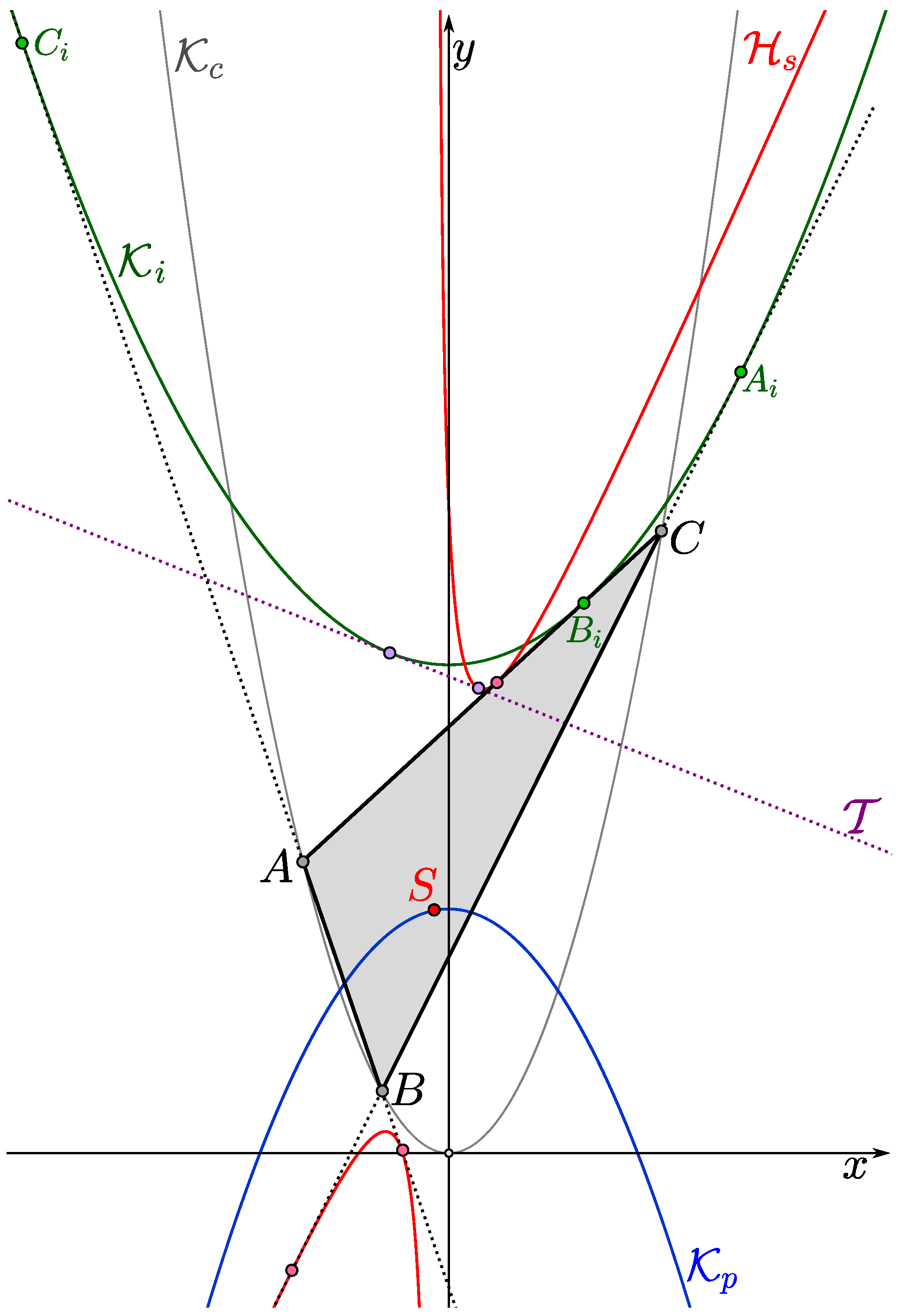
Theorem 5. The inscribed conic in the standard triangle given by the tangential Equation (8), and the inscribed circle of the corresponding triangle, share, in addition to lines , , and , a fourth common tangent (see Figure 1), whose equation is Corollary 2. The inscribed circle of the standard triangle is given by the tangential equation .
Let us find the type of equations representing ellipses and hyperbolas inscribed in the standard triangle
. Given a line
through some point
in the isotropic plane, the coordinates
x and
y satisfy
, i.e.,
, for some
k and
l. Substituting
l into (
11) and rearranging, one gets the following equation for
kA necessary condition for the line
to be tangent to an ellipse at point
T or a hyperbola inscribed in the triangle
, is that this equation has a double solution. And this happens if and only if
which, after rearrangement, takes the form
Thus, we get Theorem 6.
Theorem 6. The ellipse or hyperbola with center that is inscribed in the standard triangle , is represented by Equation (13). The conic given by (
13) is a
special hyperbola when the coefficient of
is equal to zero. However, the equality
implies that the point
lies on the polar circle of the triangle
, which, according to [
20], has the equation
. Therefore,
Corollary 3. The set of centers of inscribed special hyperbolas of an allowable triangle is the polar circle of that triangle (see Figure 1). This statement for the Euclidean case can be found in [
6,
8].
Now we ask under which conditions does Equation (
13) represent an ellipse, and under which a hyperbola? Consider the equation
as an equation in
, i.e., with respect to the slope of isotropic points of the considered conic. Its discriminant equals
where
Therefore, the following holds:
Theorem 7. The conic with Equation (13) and tangential Equation (11) is an ellipse if , and a hyperbola if , where K is given by (14). What is the geometric interpretation of the expression K?
Theorem 8. Spans , , and of a point from the midlines of the standard triangle satisfy .
Proof. The midpoint of
and
is the point
. The midline
, where
is the midpoint between
A and
C, runs through the point
and is parallel to the line
with the slope
, hence its equation is
, i.e,
. Thus, for the span
of the point
from this midline, we have
, i.e.,
. Similar relations hold for spans
and
of the point T from the other two midlines. Therefore
But since
,
and
we get
Theorem 8 implies that the center of the considered conic cannot lie on any of the midlines of the triangle , and that each time point T crosses one of these midlines the conic transforms from ellipse to hyperbola or vice versa.
For the centroid
that lies inside the complementary triangle
of the triangle
, we have
,
and consequently
where
is the Brocard angle and, according to [
19],
. The corresponding conic is an ellipse. So we have Theorem 9.
Theorem 9. The inscribed conic of an allowable triangle is an ellipse if its center lies within its complementary triangle or in a region outside the triangle at a vertex angle of one of its angles; it is a hyperbola if its center lies outside the complementary triangle in one of the four regions adjacent to its sides.
An isotropic line passing through the center of a conic is the conic’s secondary axis. The intersection points of this line with the conic are the vertices of the conic, and the span of these two vertices is the minor axis, and half of its length represents the minor semi-axis.
Next, we compute the square of the minor semi-axis, whose value is positive for a hyperbola and negative for an ellipse.
Theorem 10. The minor semi-axis β of the inscribed ellipse or hyperbola of the standard triangle with the center is given by the formula Proof. Substituting
into (
13) gives the following equation in
y
whose solutions
and
are the (real or imaginary) vertices of the conic. Therefore
and
and hence
Isotropic tangents of a conic are its directrices; the distance between directrices is the major semi-axis; and , half of this distance, is the major semi-axis. We will calculate the square of the major semi-axis that will be positive for an ellipse and a hyperbola of the first kind that has foci, and negative for a hyperbola of the second kind that has no foci, but has vertices.
Dividing the equation
by
k, Equation (
1) by
, and taking the limit for
, gives
and
. Therefore,
is the equation of the pair of directrices of the conic (
1). Equation (
11) is obtained for
,
, and
. Under the same assumptions, the equation for the pair of directrices becomes
This proves the following theorem.
Theorem 11. The pair of directrices of a conic, inscribed in the standard triangle with center , is given by Equation (16). Theorem 12. The major semi-axis α of the ellipse or hyperbola, inscribed in the standard triangle with the center , is given by Proof. If
and
are the solutions of Equation (
16), then
and
. Therefore,
Formulas (
15) and (
17) imply
Corollary 4. The major semi-axis α and minor semi-axis β of a conic with the center inscribed in the standard triangle satisfy , where K is given by (14). Using Theorem 8, we get the following result.
Corollary 5. Major and minor semi-axes α and β of a conic with the center T, that is inscribed in an allowable triangle, satisfy , where , , and are spans of the point T from the midlines of that triangle.
Since the circumscribed circle of the standard triangle
has the radius
, the previous equality can be written in the form
. This equality, in the same form, is presented in [
7,
14] in the context of Euclidean geometry, and is cited without proof in [
5].
According to [
20], the polar circle of the standard triangle
has the equation
. Let
be the equation of a line
through the center
of the considered ellipse or hyperbola, i.e.,
. Eliminating the ordinate
y from equations of the polar circle and the line
, for the abscissas
and
of their intersections
and
, we obtain the equation
. Therefore,
and
, and because of (
17) and
, we get
The constant product , independent of the choice of the line through the point S, is the of S with respect to the polar circle. Thus, we have proven Theorem 13.
Theorem 13. The power of the center of an ellipse or a hyperbola, inscribed into an allowable triangle, with respect to the polar circle of that triangle, is equal to the square of the major semi-axis of that conic.
In the Euclidean plane, the power of the center of an ellipse or a hyperbola, inscribed in a triangle, with respect to the triangle’s polar circle, is equal to the sum of squares of the major and minor semi-axes of that conic [
3,
9].
Writing (
13) in homogeneous coordinates, the equation of the polar of a point
takes the form
The axis of this conic is the polar of the absolute point
, so for
and
, the above equation becomes
and in nonhomogeneous coordinates, it has the form
Therefore Theorem 14 holds.
Theorem 14. The equation of the axis of the conic with center at and inscribed in the standard triangle , is (18). Due to (
17), the coefficient of
y in (
18) equals
. The abscissas of foci
and
are
, and their ordinates
and
follow from (
18):
and therefore
Putting all this together, we have the following theorem.
Theorem 15. The foci of a conic with the center , inscribed in the standard triangle , are Theorem 16. Let and be foci of the inscribed conic of the triangle ; , , and spans of the center of this conic from the midlines , ; and , and R the radius of the circumscribed circle of the triangle . Then the following holds The corresponding result in the Euclidean plane can be found in [
11,
12,
13].
Proof. It follows from Theorem 11 that abscissas of the foci
and
are the solutions
and
of Equation (
16), and hence
Now, we have
where the last equality was obtained in the proof of Theorem 8. This proves the first Equation (
19) for
. The other two are proved similarly. □
Multiplying the equality in the above proof by
, gives
and one obtains two more analogous equalities in a similar way. Adding these three equalities shows that
and then
In the Euclidean plane, one can find this equality in [
15,
16] for ellipses inscribed in a triangle.
The power
of
with respect to the circumscribed circle of the triangle
is
On the other hand, the last line occurs also in the following sequence of equalities
Therefore,
. The analogous equality is also valid for the focus
. In the Euclidean plane, these equalities can be found in [
4].
The slope of the axis, defined by Equation (
18), of an inscribed conic with center at
, is
Consider all inscribed conics having axes with the same slope
k, i.e., for which
. The centers of these conics lie on the special hyperbola given by the equation
This gives the following result:
Theorem 17. The centers of inscribed conics of the standard triangle all having axes with the same slope k, lie on the special hyperbola given by (20). The polar line of the point
with respect to the conic (
20), has the equation
. In particular, the polar line of the vertex
has the equation
. For
, this becomes
, i.e.,
, which is precisely the line
. Analogously, the polars of vertices
B an
C are lines
and
. In this special case (
20) becomes
. It is the equation of the special hyperbola for which the triangle
is autopolar, having the
y-axis as the isotropic and the
x-axis as the non-isotropic asymptote. According to [
21] (Thm. 15), this is the Jeřabek hyperbola of the tangential triangle of the triangle
. This consideration can be summarized as Theorem 18.
Theorem 18. The set of centers of inscribed conics of an allowable triangle having axes parallel to the orthic line of that triangle, is the Jeřabek hyperbola of the tangential triangle of the given triangle.
The analogous result in [
10] for the Euclidean plane states that the rectangular hyperbola is the set of centers of inscribed conics to one fixed autopolar triangle of this hyperbola, whose axes are parallel to the asymptotes of this hyperbola.