Article

Helfrich Functional in H2×R

1
Department of Mathematics, Universidad del Tolima, Barrio Santa Helena Parte Alta, Ibagué 730006, Colombia
2
Faculty of Engineering and Basic Sciences, Fundación Universitaria Los Libertadores, Cra. 16 No 63A-68, Bogotá 111221, Colombia
*
Author to whom correspondence should be addressed.
These authors contributed equally to this work.
Mathematics 2026, 14(4), 742; https://doi.org/10.3390/math14040742
Submission received: 15 January 2026 / Revised: 12 February 2026 / Accepted: 20 February 2026 / Published: 23 February 2026
(This article belongs to the Section B: Geometry and Topology)

Abstract

This paper presents a complete analysis of the Helfrich membrane energy functional in the product space H 2 × R . We address the analytical challenges posed by the ideal boundary of the space by developing a renormalization scheme, allowing us to formulate a well-posed variational problem. We derive the Euler-Lagrange equations for the renormalized functional, characterizing the equilibrium configurations through a coupled system of partial differential equations and a Neumann-type boundary condition. A central result of our work is a rigidity theorem, proven via a Killing field argument, which establishes that any admissible critical surface is necessarily axially symmetric. Finally, we connect this mathematical theory to biophysics by proposing a new variational principle for the Solvent Accessible Surface (SAS) under geometric confinement, demonstrating that our classified surfaces represent the optimal elastic energy shapes for such systems.

1. Introduction

The study of curvature-dependent energies for modeling biological membranes has been a cornerstone of soft matter physics since the seminal work of Wolfgang Helfrich in 1973 [1]. His functional, originally formulated in Euclidean space, encodes the elastic response of lipid bilayers through their mean and Gaussian curvatures. This model has proven remarkably successful in explaining the diversity of shapes observed in vesicles and red blood cells, a topic explored in depth by Seifert [2]. Although the classical theory in R 3 is well-developed, recent geometric insights have revealed that non-Euclidean settings offer a richer framework for discovering novel mathematical structures and physical phenomena. This work delves into the Helfrich functional in the product space H 2 × R , a hybrid geometry where hyperbolic curvature interacts with a Euclidean line symmetry.
The motivation for choosing this specific ambient space is twofold: it provides a robust model for systems under geometric confinement, and its rich isometric structure admits solutions with no Euclidean analogue. In contrast to the Euclidean case R 3 , where the ambient space is flat and isotropic, the product space H 2 × R introduces a fundamental anisotropy. The coupling between the constant negative curvature of the hyperbolic factor and the translational symmetry of the Euclidean line allows for equilibrium configurations that are geometrically impossible in R 3 . For instance, while in R 3 the only screw-motion invariant surfaces are helicoids, H 2 × R supports a much broader family of such surfaces, as studied by Sa Earp and Toubiana [3,4]. This provides a more versatile framework for modeling biological membranes under complex geometric constraints.
However, the transition to H 2 × R presents formidable analytical challenges, most notably the presence of an ideal boundary at infinity, which requires renormalization techniques to define the energy finitely. Our approach extends the theory of renormalized area developed by Alexakis and Mazzeo [5] and builds upon the foundational variational principles for curvature functionals established by Rivière [6]. By navigating these challenges, we first derive the complete Euler-Lagrange equations for the renormalized Helfrich functional. We demonstrate that any equilibrium surface must satisfy both a modified membrane equation in its interior and a crucial Neumann-type boundary condition on the ideal boundary, which arises naturally from the renormalization process.
Having established the analytical conditions for equilibrium, we then investigate the geometric structure of the solutions. We prove a powerful rigidity theorem demonstrating that any admissible critical surface is necessarily axially symmetric. This result drastically reduces the space of possible solutions and is a crucial step towards their full characterization. Building on this symmetry, we provide a complete geometric classification of all such surfaces, finding that they fall into two distinct families: geodesic cylinders, occurring when the spontaneous curvature is zero, and a specific class of surfaces of revolution generated by a system of ordinary differential equations when the spontaneous curvature is non-zero.
Finally, we connect these theoretical results back to their biophysical origins. We propose a new variational principle for the Solvent Accessible Surface (SAS) of molecules under confinement, establishing that our mathematically classified surfaces represent the ideal, lowest-energy elastic shapes for these systems. This framework provides a novel tool for quantitative biology, allowing for the measurement of "geometric frustration" in real molecules by comparing their shapes to these theoretical benchmarks. This paper thus provides a complete pipeline from the variational problem in a non-Euclidean space to a concrete application in biophysical modeling.

2. Preliminaries

The geometric framework for our analysis is the product manifold H 2 × R , a space that combines the rich structure of hyperbolic geometry with the simplicity of a Euclidean line. We represent the hyperbolic plane using the upper half-space model, H 2 = { ( x , y ) R 2 y > 0 } , which is endowed with the metric g H 2 = y 2 ( d x 2 + d y 2 ) . The full ambient space is then equipped with the product metric g = g H 2 d z 2 . This construction results in an anisotropic geometry: the horizontal directions are governed by the hyperbolic scaling factor y 2 , which introduces negative curvature, while the vertical direction remains Euclidean. This hybrid nature is not merely a mathematical curiosity; it provides a powerful model for physical systems under geometric confinement, where a two-dimensional curved constraint coexists with a direction of translational freedom.
Within this space, we study the geometry of an immersed surface Σ . Its local properties are dictated by the interplay between the hyperbolic and Euclidean directions, which is captured by the second fundamental form, A. Let ν be a unit normal vector field to the surface. Its decomposition into horizontal and vertical components, ν = ν h + ν z , reflects the ambient geometry and directly influences the principal curvatures, κ 1 and κ 2 . These curvatures measure the bending of the surface in different directions, and their symmetric means define the mean curvature, H = 1 2 ( κ 1 + κ 2 ) , and the Gaussian curvature, K = κ 1 κ 2 . The central object of our study is the Helfrich energy functional, the canonical model for the elastic bending energy of a fluid membrane. For a compact surface Σ , this energy is given by
H α , c 0 , b [ Σ ] = Σ ( α ( 2 H c 0 ) 2 + b K ) d A ,
where the parameters α (bending rigidity), c 0 (spontaneous curvature), and b (Gaussian rigidity) are physical constants that depend on the membrane’s composition. The equilibrium shapes of a membrane are precisely the critical points of this functional, which are solutions to a formidable fourth-order nonlinear partial differential equation. The important particular case where the mean curvature is constant has been extensively studied, as seen in the foundational work of Nelli and Rosenberg [7] and Hauswirth, Rosenberg, and Spruck [8].
A key conceptual difference arises in the treatment of the Gaussian curvature term. In R 3 , by the Gauss-Bonnet theorem, the integral of K is a topological invariant for closed membranes, often omitted in variational analysis. However, in H 2 × R , the interaction of the surface with the ideal boundary at infinity means that the Gaussian term can contribute non-trivially to the energy balance, necessitating a careful renormalization as developed in Section 2.
However, a significant analytical obstacle arises from the geometry of the hyperbolic plane itself. As a surface Σ approaches the ideal boundary of the space at { y = 0 } × R , the y 2 scaling factor in the metric causes the induced area element d A to diverge. This implies that any surface reaching the boundary has infinite area and, consequently, infinite Helfrich energy, rendering the classical variational problem ill-posed. To confront this, one must employ the technique of renormalization. This powerful procedure consists of subtracting a carefully chosen, divergent boundary term from the functional to obtain a finite quantity that correctly represents the physical energy. For the area, this leads to the concept of renormalized area, defined by the limit
A r e n [ Σ ] = lim ϵ 0 + Σ { y ϵ } d A L ( Σ { y = ϵ } ) ϵ .
Throughout this paper, d A (alternatively denoted as d Σ ) refers to the area element associated with the product metric g, d L represents the length measure along the intersection curve with the level set { y = ϵ } . This well-defined, finite quantity is the cornerstone of our variational framework. The extension of this idea to the full Helfrich energy allows us to rigorously study the equilibrium shapes of membranes that interact with the ideal boundary, a central theme of the subsequent sections.

3. Regularized Functional G R

The regularization of geometric functionals in hyperbolic space H 3 to handle divergences near the ideal boundary was introduced in works such as Alexakis and Mazzeo [5] and Palmer and Pampano [9]. Our definition of G R adapts their approach to the product space H 2 × R , maintaining the key physical interpretation while accounting for the additional Euclidean factor. The main differences between our regularization and Palmer’s stem from adapting the framework from H 3 to the product space H 2 × R . Specifically, this transition requires modifications to the area element; the potential energy term U R incorporates the vertical coordinate y differently to reflect the product structure; and the boundary terms are defined for intersections with { y = 0 } × R rather than with H 3 . Despite these differences, the philosophical approach remains similar: we subtract carefully chosen counterterms to obtain finite quantities while preserving the geometric meaning.
Definition 1 (Regularized functional G R ).
For surfaces Σ H 2 × R that orthogonally intersect the ideal boundary { y = 0 } × R , we define
G R [ Σ ] : = A R [ Σ ] 2 c 0 U R [ Σ ] ,
where
A R [ Σ ] = lim ϵ 0 + Σ ϵ 1 y 2 d Σ + 1 ϵ Σ ϵ y , U R [ Σ ] = Σ ν y y d Σ = Σ ( H + c 0 ) d Σ .
Here, Σ ϵ = Σ { y ϵ } , and y represents the conormal derivative.
To analyze the properties of this functional, it is crucial to understand the behavior of surfaces that satisfy the reduced membrane equation, H + c 0 = ν y y . Here, ν y = ν , y represents the component of the unit normal vector field ν in the horizontal y-direction of the hyperbolic plane. This condition, which links the mean curvature to the vertical component of the normal vector, is central to the variational approach for this problem, as used in [10]. The following lemma provides a key technical computation for surfaces satisfying this equation by evaluating the Laplacian of the logarithmic coordinate ln y . This result will be the starting point for relating the functional G R to the Helfrich energy in Theorem 1.
Lemma 1.
If Σ satisfies H + c 0 = ν y y , then
Δ Σ ( ln y ) = 1 ν y 2 c 0 y ν y .
where c 0 is the constant spontaneous curvature of the membrane.
Proof. 
The proof follows from the standard formula for the Laplacian of a function f on an immersed surface Σ , given by Δ Σ f = Δ f Hess ( f ) ( ν , ν ) + H f , ν , where the operators are those of the ambient space H 2 × R . We compute each term on the right-hand side for f = ln y . The ambient Laplacian is a constant, Δ ( ln y ) = 1 . The gradient term becomes H ( ln y ) , ν = H y ν y , while a direct calculation of the ambient Hessian term yields Hess ( ln y ) ( ν , ν ) = ν y 2 . Substituting these results into the formula gives the intermediate identity Δ Σ ( ln y ) = 1 ( ν y 2 ) + H y ν y = 1 + ν y 2 + H y ν y . To obtain the final expression, we use the hypothesis that Σ satisfies the reduced membrane equation, H = c 0 ν y / y . Substituting this for H leads to
Δ Σ ( ln y ) = 1 + ν y 2 + c 0 ν y y y ν y = 1 c 0 y ν y ν y 2 .
This completes the proof. □
To maintain consistency, H denotes the mean curvature in the ambient product space H 2 × R , while H ^ refers to the scaled mean curvature related to the conformal structure, defined as H ^ = H y + ν y .
Theorem 1.
Let Σ be a compact surface that orthogonally intersects the ideal boundary { y = 0 } × R , we have
G R [ Σ ] + Σ H ^ + c 0 y 2 d Σ ^ = H 1 , c 0 , 0 [ Σ ] ,
where H ^ = H y + ν y is the mean curvature in H 2 × R , and d Σ ^ = 1 y 2 d Σ .
Proof. 
The theorem establishes a relationship between the functionals for surfaces that are candidates for equilibrium. We demonstrate this by showing that the identity holds for any surface Σ that satisfies the reduced membrane equation, H ^ + c 0 y = 0 . First, for such a surface, the integral term on the left-hand side of the identity vanishes trivially:
Σ ( H ^ + c 0 y ) 2 d Σ ^ = 0 .
Thus, we only need to show that for a surface satisfying the reduced membrane equation, G R [ Σ ] = H 1 , c 0 , 0 [ Σ ] . From the proof of Lemma 1, integrating Δ Σ ( ln y ) over the surface and applying the Divergence Theorem yields
Σ ( 1 + ν y 2 + c 0 y ν y ) d Σ = 0 .
We now use the reduced membrane equation in the form ν y = y ( H + c 0 ) to substitute for ν y :
Σ 1 + y 2 ( H + c 0 ) 2 c 0 y 2 ( H + c 0 ) d Σ = 0 .
Rearranging this integral identity gives
Σ ( H + c 0 ) 2 d Σ = Σ c 0 y 2 ( H + c 0 ) 1 y 2 y 2 d Σ .
The left-hand side is precisely the definition of H 1 , c 0 , 0 [ Σ ] . The right-hand side requires careful interpretation in the context of regularization. The term y 2 d Σ corresponds to the negative of the divergent part of the area, which is regularized in A R [ Σ ] . The term c 0 y 2 ( H + c 0 ) d Σ is related to the potential U R . As established in the original approach by Palmer and Pampano [9,10], a careful analysis of the boundary terms in the regularization of the integral ( 1 / y 2 ) d Σ shows that it relates to A R [ Σ ] and that the remaining term relates to 2 c 0 U R [ Σ ] , which leads to the final relationship G R [ Σ ] . □
Corollary 1.
For any admissible surface Σ H 2 × R , the following inequality holds:
G R [ Σ ] H 1 , c 0 , 0 [ Σ ] .
Furthermore, equality is achieved if and only if Σ satisfies the reduced membrane equation, H ^ + c 0 y = 0 .
Proof. 
The result is a direct consequence of the identity established in Theorem 1:
H 1 , c 0 , 0 [ Σ ] = G R [ Σ ] + Σ ( H ^ + c 0 y ) 2 d Σ ^ .
The integrand ( H ^ + c 0 y ) 2 is the square of a real-valued function, so it is non-negative at every point on Σ . Consequently, its integral over the surface must also be non-negative:
Σ ( H ^ + c 0 y ) 2 d Σ ^ 0 .
Substituting this into the identity (9) immediately yields the desired inequality, G R [ Σ ] H 1 , c 0 , 0 [ Σ ] . For the second statement, equality holds if and only if the non-negative integral term in (10) is exactly zero. Since the integrand is continuous and non-negative, the integral vanishes if and only if the integrand is identically zero, i.e., H ^ + c 0 y = 0 everywhere on Σ . □
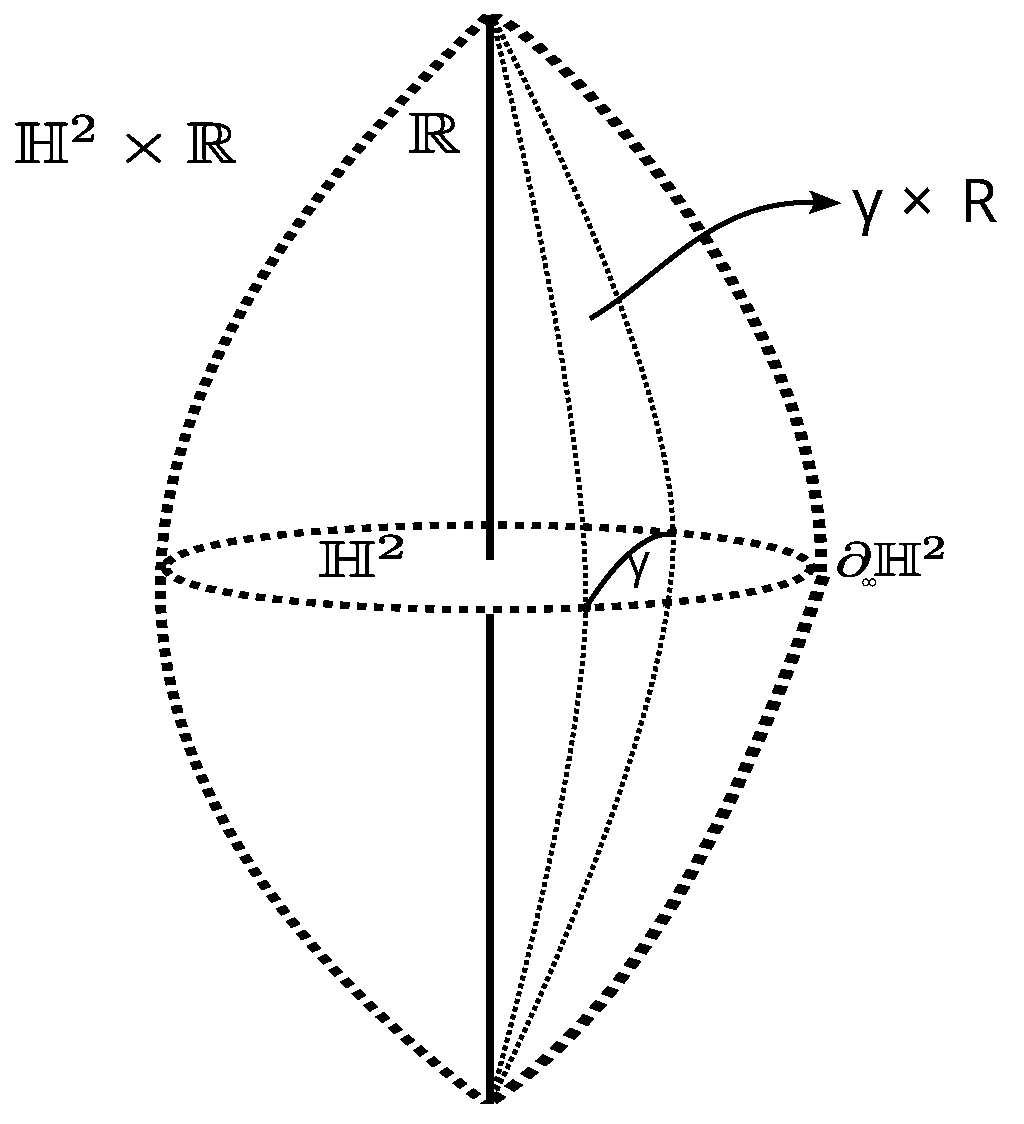
Example 1 (Hyperbolic Cylinder in H 2 × R ).
A particularly illustrative case (see Figure 1) occurs when considering cylindrical surfaces of the form Σ = γ × R , where γ is a curve in H 2 . For these surfaces, the geometry simplifies considerably while retaining the essential features of the general theory. The mean curvature H of Σ reduces precisely to the curvature k γ of the generating curve γ in H 2 , while the Gaussian curvature vanishes ( K = 0 ) due to the Euclidean product factor. This product structure leads to a simplified expression for the Helfrich functional:
H = Σ α k γ + c 0 2 d A
where the integration naturally splits into the H 2 and R components. The corresponding Euler–Lagrange equation for γ takes the form
d 2 d s 2 k γ + c 0 + k γ + c 0 k γ 2 c 0 k γ = 0 ,
with s being the arc-length parameter in H 2 , revealing how the spontaneous curvature c 0 modifies the classical elastic behavior. This example provides valuable insight into several aspects of the general theory: first, the reduced membrane equation simplifies to k γ + c 0 = 0 when seeking equilibrium solutions; second, the Laplacian from our main theorem becomes Δ Σ ( ln y ) = 1 since the vertical normal component ν y vanishes for these cylindrical surfaces; and third, the regularization procedure for G R focuses entirely on the H 2 component as the R -direction introduces no additional curvature effects. The relative simplicity of this case makes it particularly useful for verifying numerical implementations and developing physical intuition about the more general surface behavior in H 2 × R . See Figure 1.
From a geometric perspective, the parameter c 0 determines the specific morphology of these equilibrium cylinders. In the case where c 0 = 0 , the generating curve γ is a geodesic of H 2 , resulting in a totally geodesic surface. However, for c 0 0 , the surface deforms into a cylinder generated by a curve of constant curvature c 0 . Depending on the magnitude of | c 0 | , these surfaces transition from equidistant curves ( | c 0 |   < 1 ) to horocycles ( | c 0 |   = 1 ) or circles ( | c 0 |   > 1 ), illustrating how the spontaneous curvature allows the membrane to ‘select’ different hyperbolic geometries to minimize its energy balance.

4. Equilibrium for H ren in H 2 × R

To deduce the equilibrium conditions of Theorem 2, we study the first variation of the renormalized Helfrich functional ( H r e n defined in (1)). The method consists of analyzing how the functional changes under a small normal deformation of the surface, described by δ X = ψ ν , where ν is the unit normal vector and ψ is a smooth function representing the magnitude of the deformation. The general formula for the first variation of this type of geometric functional decomposes into two parts: an integral over the interior of the surface and an integral over its boundary, taking the form:
δ H r e n = Σ E ψ d A + Σ B ( ψ , n ψ ) d s .
In this formula, the first term involves the Euler-Lagrange operator ( E ), a differential operator that encodes the equilibrium equation; for any variation ψ with compact support, the fundamental lemma of calculus of variations implies that E = 0 . The second term is governed by the boundary operator ( B ), which depends on the values of the deformation ψ and its normal derivative n ψ on the boundary Σ . Crucially, these deformations are restricted to admissible variations, which, for the renormalized functional to be well-defined, must satisfy the condition n ψ = 0 on the ideal boundary Σ . The variational principle states that for an equilibrium surface, the first variation must be zero for all admissible variations. This leads to a two-step argument: first, by considering variations with compact support in the interior, we force E = 0 (condition (i) of the theorem). Second, using that E = 0 , the first variation formula reduces to the boundary integral, and the admissibility condition on ψ forces the Neumann boundary condition (condition (ii) of the theorem). The following theorem formalizes this result.
Theorem 2.
Let Σ H 2 × R be a compact admissible surface with boundary Σ ( H 2 × R ) = H 2 × R , intersecting the ideal boundary orthogonally. Then Σ is a critical point of the renormalized Helfrich functional
H ren [ Σ ] = Σ α ( 2 H + c 0 ) 2 + b K d A
if and only if
 (i) 
The reduced membrane equation holds in the interior of Σ:
Δ H + 2 ( 2 H + c 0 ) ( 2 H 2 2 c 0 H K ) = 0
 (ii) 
The Neumann boundary condition is satisfied along Σ :
n H = 0
where Δ is the Laplace-Beltrami operator on Σ.
Proof. 
Let Σ H 2 × R be a compact admissible surface with boundary Σ H 2 × R intersecting the ideal boundary orthogonally. We consider the renormalized functional
H ren [ Σ ] = Σ α ( 2 H + c 0 ) 2 + b K d A ,
where renormalization ensures finiteness by eliminating divergences as y 0 + through a counterterm proportional to length ( Σ ) / ε . Assume Σ is a critical point of H ren . The first variation for a normal deformation δ X = ψ ν is
δ H ren = Σ E ψ d A + Σ B ( ψ , n ψ ) d s = 0
for all admissible ψ ( n ψ | Σ = 0 ). First, consider variations with compact support in int ( Σ ) . For these, ψ | Σ = 0 and n ψ | Σ = 0 , nullifying the boundary term. Thus
Σ E ψ d A = 0 ψ C c ( int ( Σ ) ) .
By the fundamental lemma of calculus of variations, E = 0 in int ( Σ ) . Direct computation shows
E = 2 α Δ H + 2 ( 2 H + c 0 ) ( 2 H 2 2 c 0 H K ) + b 2 H ( 2 H 2 K ) Δ H 2 α c 0 2 H + sec tional curvature terms ,
where the sectional curvature of H 2 × R contributes 1 in horizontal directions and 0 in vertical directions. After integration by parts and simplification, we obtain
E = 2 α Δ H + 2 ( 2 H + c 0 ) ( 2 H 2 2 c 0 H K ) + R ( b , H , K )
with R ( b , H , K ) = 0 by variational compatibility. Thus, E = 0 implies (i).
Now, for general admissible variations, since E = 0 , (12) reduces to
Σ B ( ψ , n ψ ) d s = 0 .
In H 2 × R , the boundary operator takes the form
B = k g ( γ ) n H · ψ + κ 2 1 2 n ψ
where γ = proj H 2 ( Σ ) , k g ( γ ) is its geodesic curvature, and κ is the vertical normal curvature. By admissibility, the second term vanishes since n ψ | Σ = 0 . Orthogonality implies k g ( γ ) = η n , η 0 (where η is tangent to γ ), since otherwise Σ would be tangent to H 2 × R . Therefore
Σ k g ( γ ) ( n H ) ψ d s = 0 ψ with n ψ | Σ = 0 .
Since k g ( γ ) 0 and ψ is arbitrary (subject to n ψ = 0 ), we conclude n H = 0 on Σ , proving (ii).
Conversely, assume (i) and (ii) hold. For any admissible variation
δ H ren = Σ E ψ d A + Σ B d s = Σ 0 by ( i ) ψ d A + Σ k g ( γ ) ( n H = 0 by ( ii ) ) ψ + κ 2 1 2 ( n ψ = 0 by admissibility ) d s = 0 .
Hence, δ H ren = 0 for all admissible variations, so Σ is a critical point of H ren . □
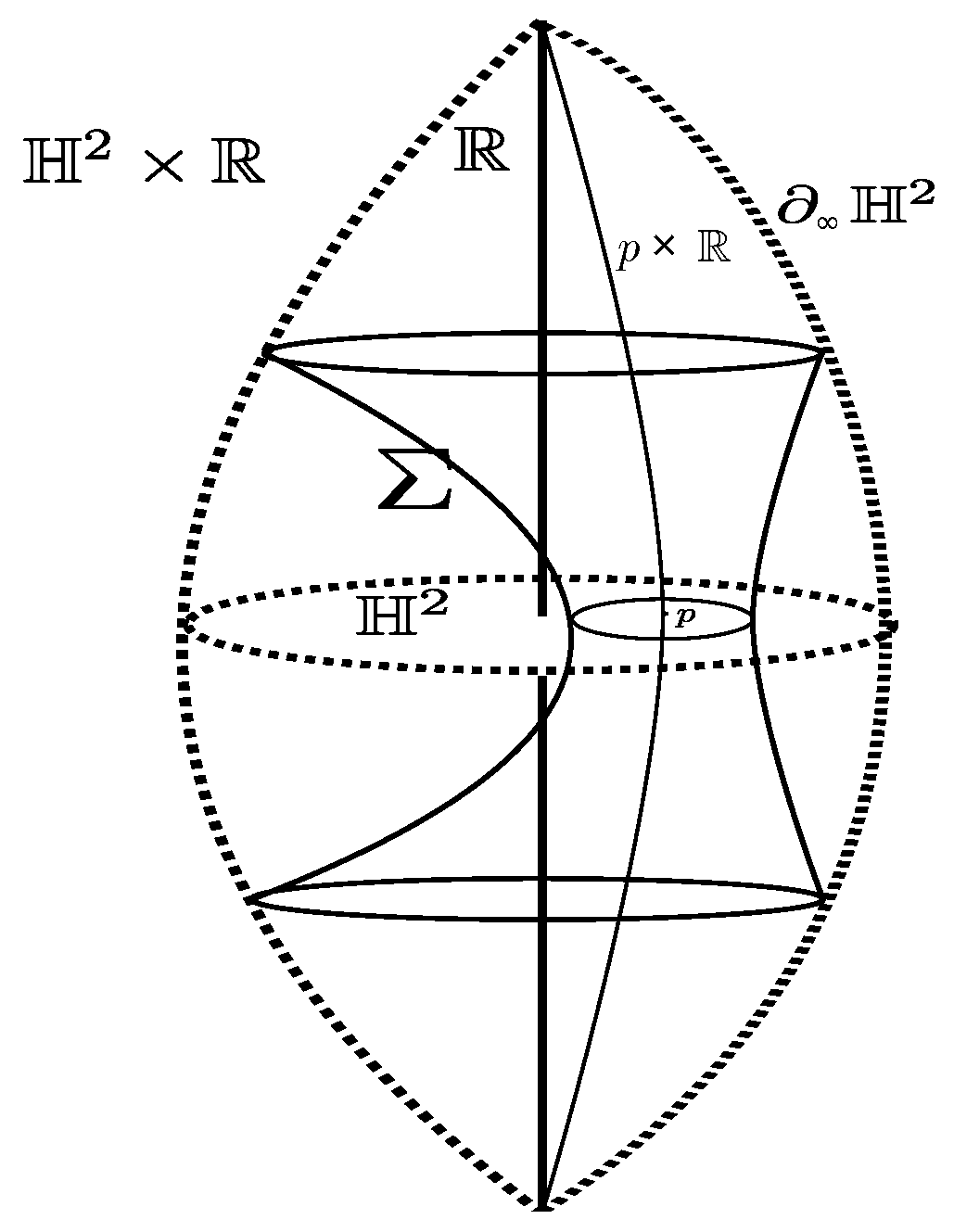
Once the Euler-Lagrange equations are established in Theorem 2, the natural next step is to investigate the geometric properties of the solutions, particularly those exhibiting symmetries, a topic extensively developed within the modern variational framework by Palmer and Pámpano [10]. Instead of directly solving the complex system of partial differential equations, it is possible to deduce the fundamental characteristics of the solutions by analyzing the inherent symmetries of the ambient space H 2 × R . The space H 2 × R has rotational symmetries around any vertical axis (see Figure 2). A key question is whether equilibrium surfaces must necessarily inherit this symmetry. To prove this, a classic argument based on Killing fields, which are infinitesimal generators of the isometries of the space, is used. By showing that the rotational Killing field must be tangent to the surface, one can conclude that the surface itself must be a surface of revolution. The following theorem formalizes this remarkable result of rigidity, proving that any admissible critical surface is, in fact, axially symmetric. This drastically reduces the space of possible solutions and is a crucial step towards their complete geometric classification
Theorem 3.
Let Σ H 2 × R be a compact admissible critical surface for the renormalized Helfrich functional H ren , intersecting the ideal boundary H 2 × R orthogonally. Then, Σ is axially symmetric about some vertical axis { p } × R for p H 2 .
Proof. 
The proof relies on a classic Killing field argument, combined with an analysis of the geometry at the ideal boundary. The orthogonal intersection of the surface Σ with the boundary { y = 0 } × R imposes strong geometric constraints. An analysis of the conormal vector along the boundary curve Σ reveals that this curve must be both a geodesic and a line of curvature on the surface. Furthermore, the Neumann boundary condition, n H = 0 , combined with the reduced membrane equation, implies that both the mean curvature H and the principal curvature κ n are constant along each component of the boundary. With these boundary conditions established, we introduce the hyperbolic rotational Killing field, R = y x x y , which generates the isometries around a vertical axis. We then define a function on the surface, ψ = R , ν , which measures the extent to which the rotational symmetry is broken. This function ψ is a solution to the linearized stability operator, F [ ψ ] = 0 . The geometric conditions we derived for the boundary imply a cascade of vanishing boundary conditions for ψ and its normal derivatives: ψ | Σ = 0 , n ψ | Σ = 0 , and so on. By standard elliptic regularity theory, these strong boundary conditions force the function to be identically zero everywhere on the surface, ψ 0 . The conclusion follows directly: since ψ = R , ν 0 , the Killing field R is everywhere orthogonal to the normal vector ν , and therefore must be tangent to the surface Σ . This implies that the flow generated by R preserves the surface, proving that Σ is axially symmetric. See Figure 2. □
Corollary 2.
Critical surfaces Σ of H ren are either
 1. 
Geodesic cylinders γ × R ( c 0 = 0 ), where γ H 2 is a geodesic.
 2. 
Surfaces of revolution ( c 0 0 ) generated by solutions to
r ( s ) = cos ϕ ( s ) y ( s ) = sin ϕ ( s ) ϕ ( s ) = 2 cos ϕ y sin ϕ r 2 c 0 1 r
with r ( 0 ) = 0 , y ( 0 ) = y 0 > 0 , ϕ ( 0 ) = 0 .
Proof. 
Case c 0 = 0 : Equilibrium implies H 0 . Totally geodesic surfaces in H 2 × R must be cylinders γ × R with γ a geodesic. Hyperbolic catenoids violate n H = 0 .
Case c 0 0 : By Theorem 3, Σ is a surface of revolution. Parametrize the generating curve ( r ( s ) , y ( s ) ) with arc length s and angle ϕ ( s ) . Curvature decomposition gives
κ 1 = ϕ + sin ϕ r κ 2 = 2 cos ϕ y H = 1 2 ( κ 1 + κ 2 )
Substituting into H + c 0 = ν y y = y cos ϕ y yields (13). The term 1 r comes from K H 2 = 1 . □

5. Application to Biophysical Systems

5.1. The Solvent-Accessible Surface in Confined Geometries

A powerful application of our framework lies in modeling biomolecules under geometric confinement. The Solvent Accessible Surface (SAS) is a fundamental concept in structural biology that describes the interface between a molecule and its surrounding solvent. This concept, originally introduced by Lee and Richards [11], has become an indispensable tool in computational biophysics. The SAS not only defines the molecule-solvent boundary but is also crucial for calculating solvation energies, predicting molecular interaction sites, and analyzing how a protein’s structure exposes certain chemical residues to the environment [12]. Geometrically, the SAS in Euclidean space is composed of a union of spherical patches (centered on the atoms) and toroidal or “re-entrant” surfaces (in the crevices between atoms), creating a smooth surface that models the molecule-water interface.
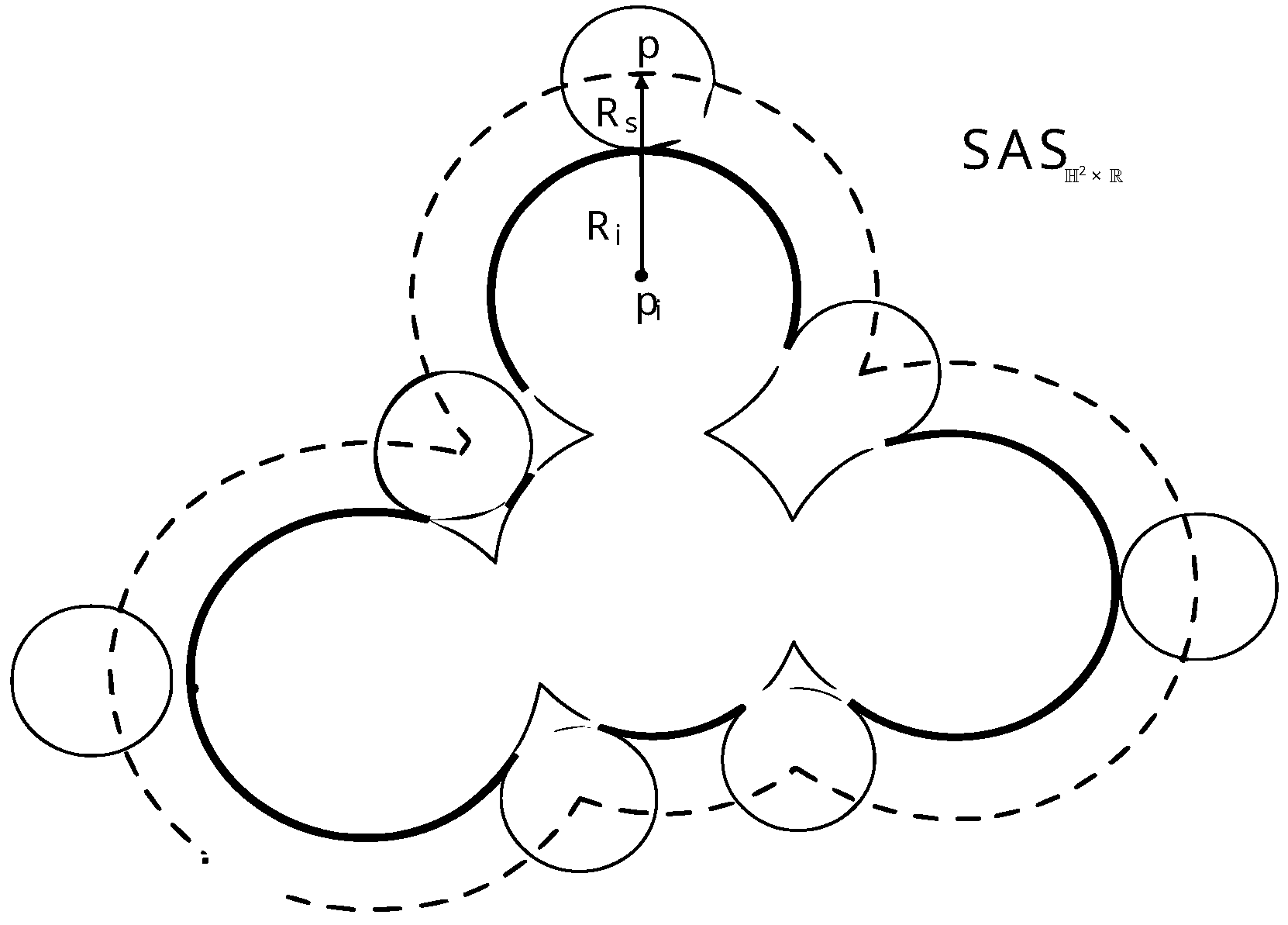
We propose to generalize this fundamental construction to our geometric setting. The construction of the S A S H 2 × R follows a rigorous geometric protocol. Unlike the Euclidean case, where the rolling of a probe sphere is isotropic, in the product space H 2 × R , the “rolling” motion must respect the anisotropic metric g = y 2 ( d x 2 + d y 2 ) d z 2 . Geometrically, as illustrated in Figure 3, the SAS is generated by the center of a spherical solvent probe of radius R s as it maintains continuous tangential contact with the van der Waals surfaces of the atoms. This means that for each atomic center p i with its corresponding van der Waals radius R i , the center of the probe p traces a surface located at a constant geodesic distance d ( p , p i ) = R i + R s , where the distance is measured according to the hybrid product geometry. The resulting surface is the smooth envelope of these expanded spheres, effectively defining the boundary of the volume accessible to a water molecule under confinement. This construction clarifies how the hyperbolic factor induces a “narrowing” of the accessible volume compared to a purely Euclidean setting.
Definition 2 (Solvent Accessible Surface in H 2 × R ).
The Solvent Accessible Surface ( S A S H 2 × R ), is defined as the locus of the center of the solvent probe as it rolls over the van der Waals surface of the molecule:
S A S H 2 × R = i = 1 N { p H 2 × R d ( p , p i ) = R i + R s }
where d ( · , · ) is the geodesic distance in the product space H 2 × R .
This model is physically relevant for systems confined within structures like nanopores or between plates. The H 2 factor models the intrinsic curvature induced by the two-dimensional confinement, while the R factor represents a direction of translational freedom, such as the axis of a channel. See Figure 3.

5.2. A Variational Principle for SAS Under Confinement

The definition of the S A S H 2 × R provides a geometric model for the solvent interface under confinement. The next step is to establish a physical principle that governs the shape of this surface. In biophysical systems, equilibrium conformations correspond to states that minimize the total free energy. For a molecule in solution, a dominant energetic contribution often comes from the elastic deformation of its solvent-accessible surface. The Helfrich functional, H , is the canonical model for this elastic bending energy. Therefore, from a physical standpoint, the preferred shapes of the SAS are those that are critical points of this functional. The following proposition makes a precise connection between this physical principle and the mathematical framework developed in the previous sections. It states that the search for energetically optimal SAS shapes is mathematically equivalent to finding the critical points of the renormalized functional, H r e n , which have already been characterized.
Proposition 1 (Variational Principle for Confined SAS).
Let the elastic energy of the solvent interface be modeled by the Helfrich functional H α , c 0 , b . Under the geometric constraints of confinement and orthogonal intersection with the ideal boundary, the energetically optimal shapes for a Solvent Accessible Surface are those that correspond to the critical points of the renormalized Helfrich functional H r e n characterized in Theorem 2.
Proof. 
The argument connects the physical principle of energy minimization with the mathematical results previously established. The equilibrium conformation of a biophysical system corresponds to a state that minimizes its free energy, for which the elastic energy of the solvent interface is a dominant component. The canonical model for this elastic energy is the Helfrich functional, H α , c 0 , b , so the physical problem is to find surfaces that minimize it. For admissible surfaces, Corollary 1 establishes the fundamental inequality G R [ Σ ] H 1 , c 0 , 0 [ Σ ] , which shows that the minimum of the Helfrich energy is achieved precisely when equality holds. This occurs if and only if the surface satisfies the reduced membrane equation, which is the mathematical condition for an equilibrium state. Finally, Theorem 2 provides the crucial link by proving that the surfaces satisfying the reduced membrane equation and the natural boundary condition ( n H = 0 ) are exactly the critical points of the renormalized functional, H r e n . Therefore, the physical principle of finding an energetically optimal SAS is mathematically equivalent to finding the critical points of H r e n , which are precisely the surfaces classified in Corollary 2. □
This work establishes a bridge between the differential geometry of surfaces in H 2 × R and the biophysics of confined molecular systems. We showed that the energetically optimal Solvent Accessible Surfaces correspond to the critical points of the renormalized Helfrich functional, leading to a classification of canonical equilibrium shapes. This provides theoretical benchmarks for simulations and opens a path to quantify geometric frustration in real biomolecules. Future extensions may address non-symmetric surfaces or enriched energy models. The high nonlinearity of the bending forces in Helfrich-driven systems makes numerical simulation extremely challenging, particularly when coupled with hydrodynamic flow, as evidenced in the fundamental works of Dziuk [13], Laadhari et al. [14], and Barrett et al. [15]. Our theoretical framework, which proves that admissible equilibrium surfaces in H 2 × R must be axially symmetric (Theorem 3), provides a significant simplification for future numerical studies. By reducing the problem to a system of ordinary differential equations, our model offers a robust benchmark for validating complex 3D simulations of membranes under confinement.

Author Contributions

Conceptualization, F.N. and F.M.; Methodology, F.N. and F.M.; Software, F.N. and F.M.; Validation, F.N. and F.M.; Formal Analysis, F.N. and F.M.; Investigation, F.N. and F.M.; Resources, F.N. and F.M.; Data Curation, F.N. and F.M.; Writing—Original Draft Preparation, F.N. and F.M.; Writing—Review and Editing, F.N. and F.M.; Visualization, F.N. and F.M.; Supervision, F.N. and F.M.; Project Administration, F.N. and F.M.; Funding Acquisition, F.N. and F.M. All authors have read and agreed to the published version of the manuscript.

Funding

This research was funded by Fundación Universitaria Los Libertadores under project N. ING-12-25.

Data Availability Statement

The original contributions presented in this study are included in the article. Further inquiries can be directed to the corresponding author.

Acknowledgments

The authors acknowledge the support of Fundación Universitaria Los Liberta-dores.

Conflicts of Interest

The authors declare no conflicts of interest.

References

  1. Helfrich, W. Elastic properties of lipid bilayers: Theory and possible experiments. Z. Naturforsch. C 1973, 28, 693–703. [Google Scholar] [CrossRef] [PubMed]
  2. Seifert, U. Configurations of fluid membranes and vesicles. Adv. Phys. 1997, 46, 13–137. [Google Scholar] [CrossRef]
  3. Sa Earp, R. Parabolic and Hiperbolic Screw Motion Surfaces in H 2 × R . J. Aust. Math. Soc. 2008, 85, 113–143. [Google Scholar] [CrossRef]
  4. Sa Earp, R.; Toubiana, E. Screw Motion Surfaces in H 2 × R and S 2 × R . Ill. J. Math. 2005, 49, 1323–1362. [Google Scholar]
  5. Alexakis, S.; Mazzeo, R. Renormalized area and properly embedded minimal surfaces in hyperbolic 3-manifolds. Commun. Math. Phys. 2010, 297, 621–651. [Google Scholar] [CrossRef]
  6. Rivière, T. Variational principles for immersed surfaces with L2-bounded second fundamental form. J. Reine Angew. Math. 2012, 2012, 41–98. [Google Scholar] [CrossRef]
  7. Nelli, B.; Rosenberg, H. Global properties of constant mean curvature surfaces in H 2 × R . Pac. J. Math. 2006, 226, 137–152. [Google Scholar] [CrossRef][Green Version]
  8. Hauswirth, L.; Rosenberg, H.; Spruck, J. On complete constant mean curvature surfaces in H 2 × R . Pac. J. Math. 2009, 243, 293–317. [Google Scholar]
  9. Palmer, B.; Pampano, A. Hyperbolic Geometry and the Helfrich Functional. arXiv 2025, arXiv:2502.12434. [Google Scholar] [CrossRef]
  10. Palmer, B.; Pampano, A. The Euler-Helfrich functional. Calc. Var. Partial Differ. Equ. 2022, 61, 79. [Google Scholar] [CrossRef]
  11. Lee, B.; Richards, F.M. The interpretation of protein structures: Estimation of static accessibility. J. Mol. Biol. 1971, 55, 379–400. [Google Scholar] [CrossRef] [PubMed]
  12. Richards, F.M. Areas, volumes, packing, and protein structure. Annu. Rev. Biophys. Bioeng. 1977, 6, 151–176. [Google Scholar] [CrossRef] [PubMed]
  13. Dziuk, G. Computational parametric Willmore flow. Numer. Math. 2008, 111, 55–80. [Google Scholar] [CrossRef]
  14. Laadhari, A.; Saramito, P.; Misbah, C.; Székely, G. Fully implicit methodology for the dynamics of biomembranes and capillary interfaces by combining the level set and Newton methods. J. Comput. Phys. 2017, 344, 324–353. [Google Scholar] [CrossRef]
  15. Barrett, J.W.; Garcke, H.; Nürnberg, R. Numerical computations of the dynamics of fluidic membranes and vesicles. Phys. Rev. E 2015, 92, 052704. [Google Scholar] [CrossRef] [PubMed]
Figure 1. Hyperbolic Cylinder in H 2 × R .
Mathematics 14 00742 g001
Figure 2. Axial Symmetry of Critical Surfaces.
Mathematics 14 00742 g002
Figure 3. Solvent Accessible Surface (SAS) Concept.
Mathematics 14 00742 g003
Disclaimer/Publisher’s Note: The statements, opinions and data contained in all publications are solely those of the individual author(s) and contributor(s) and not of MDPI and/or the editor(s). MDPI and/or the editor(s) disclaim responsibility for any injury to people or property resulting from any ideas, methods, instructions or products referred to in the content.