1. Introduction
The modeling and numerical simulation of gas–particle multiphase flows in compressible media have long been an important topic in computational fluid dynamics. Such problems arise in a wide range of engineering and natural applications, including internal flows in solid rocket motors (nozzle problems), combustion in engine chambers, plume dynamics of ballistic weapons, and volcanic eruptions. In these scenarios, particles are entrained by the background flow and may also act as reactive constituents, leading to complex two-way interactions with the surrounding gas.
A common modeling strategy employs the compressible Euler equations for the carrier gas, augmented by interphase momentum and energy exchange terms that represent drag and heat transfer between the gas and particles. These interphase couplings typically enter the Euler system as source terms, while the particle phase is described by additional equations whose specific form depends on the particle loading regime (e.g., dilute versus dense). The resulting coupled system provides a unified framework for the evolution of both phases. Furthermore, particles may undergo chemical reactions during transport and generate new species. Such reactions are highly sensitive to local thermodynamic conditions (e.g., high temperature, high pressure, and gas reactivity), which increases model complexity and requires careful formulation of the reactive source mechanisms.
From the numerical viewpoint, solutions of the compressible Euler equations generally contain shock waves and contact discontinuities, whose accurate and stable resolution remains a central challenge in computational mathematics. The presence of a particle phase further complicates the problem: stiff or strongly varying source terms associated with interphase exchange may destabilize the flow solver and amplify spurious oscillations near discontinuities. Consequently, numerical methods for gas–particle systems must balance physical fidelity, conservation, and robustness, particularly in the presence of strong nonlinearities and discontinuous solutions.
The nomenclature “two-phase flow” was first introduced in the literature [
1]. During the formative period of this topic, systematic research predominantly centered on experimental investigations and phenomenological characterization. Guided by these experimental findings, researchers progressively formulated physical frameworks and governing equations for two-phase flow problems [
2,
3,
4,
5,
6], including the work of Campbell et al. [
7], who conducted a series of studies on particle dynamics.
Through various experimental configurations, researchers have carried out systematic observations and analyses of transport dynamics and interphase interactions in shock-induced ejecta and gas–particle mixing flows. Buttler et al. [
8] employed photonic Doppler velocimetry (PDV) to quantify the velocity evolution of metal ejecta, and subsequent developments in PDV-based diagnostics have enabled improved recovery of ejecta velocity and size distributions [
9]. Chemical reactions between phases in reactive gases constitute another important aspect of these flows. Buttler et al. [
10] investigated the transport and breakup of reactive cerium ejecta in reactive gases, and more recent numerical studies have further examined solid cerium ejecta transporting in vacuum as well as in non-reactive and reactive gas environments [
11].
However, due to the intrinsic complexity of gas–particle systems and the high cost of experimental investigations, the development of physical models and numerical methods has increasingly become a primary research focus, both as predictive tools and as complementary approaches for interpreting and validating experimental observations. Recent reviews have emphasized the multi-scale challenges in high-speed compressible particle-laden flows, including shock–particle interactions and interphase coupling mechanisms [
12]. As representative numerical approaches, smoothed particle hydrodynamics (SPH) has been used to simulate shock-induced ejecta formation and microjetting from shocked metal surfaces under extreme loading [
13]. A particle model, referred to as multiphase particle-in-cell (MP-PIC), was introduced in [
14,
15,
16] and has continued to be extended toward broader compressible regimes; for example, compressible MP-PIC (CMP-PIC) formulations have been proposed to improve applicability across flow patterns [
17], and related developments have been reported in recent studies [
18]. MP-PIC has also been applied to shock interaction with particle curtains [
19]. In addition, ejecta source and transport modeling capabilities have been developed in the FLAG hydrocode framework [
20]. Chertock et al. [
21] introduced a low-dissipative hybrid finite-volume–particle method for dusty gas flows. In [
22], we investigated a discontinuous Galerkin (DG) scheme on moving meshes for the ejecta-mixing equations.
While the aforementioned studies have significantly advanced the understanding of gas–particle interactions, several limitations remain and motivate further refinement. Two issues are particularly relevant to coupled, shock-dominated regimes. First, in many particle-trajectory-focused studies, comparatively less emphasis is placed on accurately resolving the background compressible flow; consequently, the fluid solvers adopted in practice may exhibit insufficient resolution and nonphysical oscillations in the presence of shock waves, and quantitative validation against reference solutions or experiments is often limited. Second, energy exchange associated with temperature variation and chemical reactions is sometimes neglected or treated in a simplified manner, and numerical tests frequently provide insufficient diagnostics on temperature evolution, which restricts the reliable computation and assessment of the gas internal energy budget.
Building upon previous research, we develop a coupled gas–particle trajectory transport model for particle motion in compressible gas, with explicit attention to interphase interactions and energy exchange. The model accounts for three primary physical processes: (i) drag induced by viscosity and relative velocity, which governs interphase momentum exchange; (ii) heat transfer driven by temperature differences; and (iii) reaction-induced energy variation modeled through a diffusion-based framework, without imposing temporal consistency between reactions and fluid motion. By emphasizing gas–particle coupling, the model further investigates how these effects modify the background compressible flow. Notably, particle loading introduces additional complexity in shock dynamics and yields nontrivial variations in both flow motion and energy distribution, which places stringent demands on the accuracy and stability of the numerical discretization.
To address these challenges, we propose a cell-centered Arbitrary Lagrangian–Eulerian (ALE) finite-volume framework for reactive gas–particle flows, combining a coupled particle-trajectory transport model with interphase drag/heat exchange and a diffusion-based reaction treatment. The gas-phase equations are discretized on moving meshes using an HLLC-2D nodal Riemann solver, and the time step is further constrained by a particle-search-based CFL-like condition to ensure consistent particle transport and coupling. The main novelty is a genuinely two-dimensional, node-compatible flux construction: a nodal contact velocity is determined from local conservation and used to build discontinuous edge fluxes, which improves robustness on moving meshes and mitigates shock instabilities observed in ALE schemes based on one-dimensional Riemann solvers. Numerical tests are presented to assess accuracy and stability and to quantify particle-induced modifications of the carrier-gas dynamics.
The rest of the paper is organized as follows. In
Section 2, we introduce the coupled gas–particle trajectory transport model with chemical reactions between phases. A cell-centered ALE scheme and a two-dimensional nodal solver are presented in
Section 3. In
Section 4, we describe the time discretization and a particle-searching strategy that provides a CFL-like condition to restrict the time step. In
Section 5, we present numerical tests, analyze the results, and draw conclusions.
2. Particle Trajectory Model with Enthalpy
2.1. Problem Statement, Notation and Assumptions
Consider the following problem in a region of two-dimensional space that multiple particles are mixed in the fluid (the total volume is less than a certain percentage). Regard each particle as an individual, interacting with the fluid separately and research the motion of each particle independently. Since our particle concentration is less than a certain ratio, the particle flow is considered to be dilute particle flow, so it is assumed that particles do not affect each other. And the fluid has initial density, velocity, pressure and interacts with particles to exchange momentum and energy at the same time.
In the following, the subscript p denotes particle-phase quantities, while the subscript g denotes gas-phase quantities. Let , , , , , denote the gas density, velocity, energy, viscosity, thermal conductivity, respectively; P denotes the pressure of the fluid. , , , , , denote the coordinate, density, velocity, temperature, specific heat capacity and radius of particle, respectively. In particular, if there are multiple particles in the region with different physical quantities, we can additionally use a subscript m to identify them. Namely , , , , denote the variable of the different particles, in which , is the total number of particles in the region .
To investigate the interactions between two phases, the force analysis of the particles in the system is essential. During the motion, particles are subject to gravity, drag, differential pressure, Basset force, Magnus force, Saffman force, etc. In general, not all of these forces are equally important. It is necessary to compare the magnitude of the above forces in order to estimate the relative importance of the various forces. Under normal conditions, other forces are several orders of magnitude smaller than the drag. So for the convenience of analysis, above forces except drag are not considered in the following model.
In addition to the force analysis, the exchange of heat between the particles and the fluid is also significant. In general, interphase heat transfer may involve conduction, convection, radiation, and reaction-induced energy exchange. In this work, the interphase heat exchange is modeled by the convective heat-transfer law ; the interfacial conductive contribution is effectively embedded in the coefficient h, and radiative transfer is neglected since it remains much smaller than convection over the temperature range considered.
Throughout, give the following assumptions:
- (1)
Consider ideal compressible gas with ideal gas equation of state , where is the adiabatic index.
- (2)
Viscosity and heat transfer are only considered in interactions.
- (3)
The particles are ideal round or spherical, uniform in diameter.
- (4)
There are no collisions and interactions among particles.
- (5)
The reaction between the ejecta and fluid is homogeneous which only depends on the diffusion efficiency K.
2.2. Governing Equations
According to the above assumptions, we introduce the equation of the system.
For the fluid phase, the equations for two-dimensional compressible particle trajectory model with enthalpy are as follows:
where the state vector and flux vectors are
For the particle phase, each particle has:
where the
and
indicate the interactions between the particle phase and fluid phase.
And
is the source term between the flow and particles.
In the above model, the motion of every particles with index m will be calculated respectively; actually, we have
where
is the force source item coming from the drag
between phases and momentum term
carried away by the gas in chemical reactions.
is the exchange of energy including the heat
and the kinetic energy
from drag work.
is the change ratio of mass because of the reaction between phases.
Then give the specific definition of drag source item . The force comes from the drag due to friction. There are two drag models usually used during computing which are the Stoke’s model and Crowe’s model.
For the Stoke’s model [
23], the following formulation is applied:
where
is the radius of the particles and
is the gas viscosity.
For the Crowe’s model [
24], we have
where
is the drag coefficient and
is the upwind area. Drag coefficient
is related to the Reynolds number
, the following definition is applied [
25,
26]:
In formulation (
4),
depends on the Reynolds number
:
and
The calculation method of
is not same in different research. The above definition is given by Wang et al. in [
26].
2.3. Reactions and Energy
The heat source item
comes from the convection heat transfer [
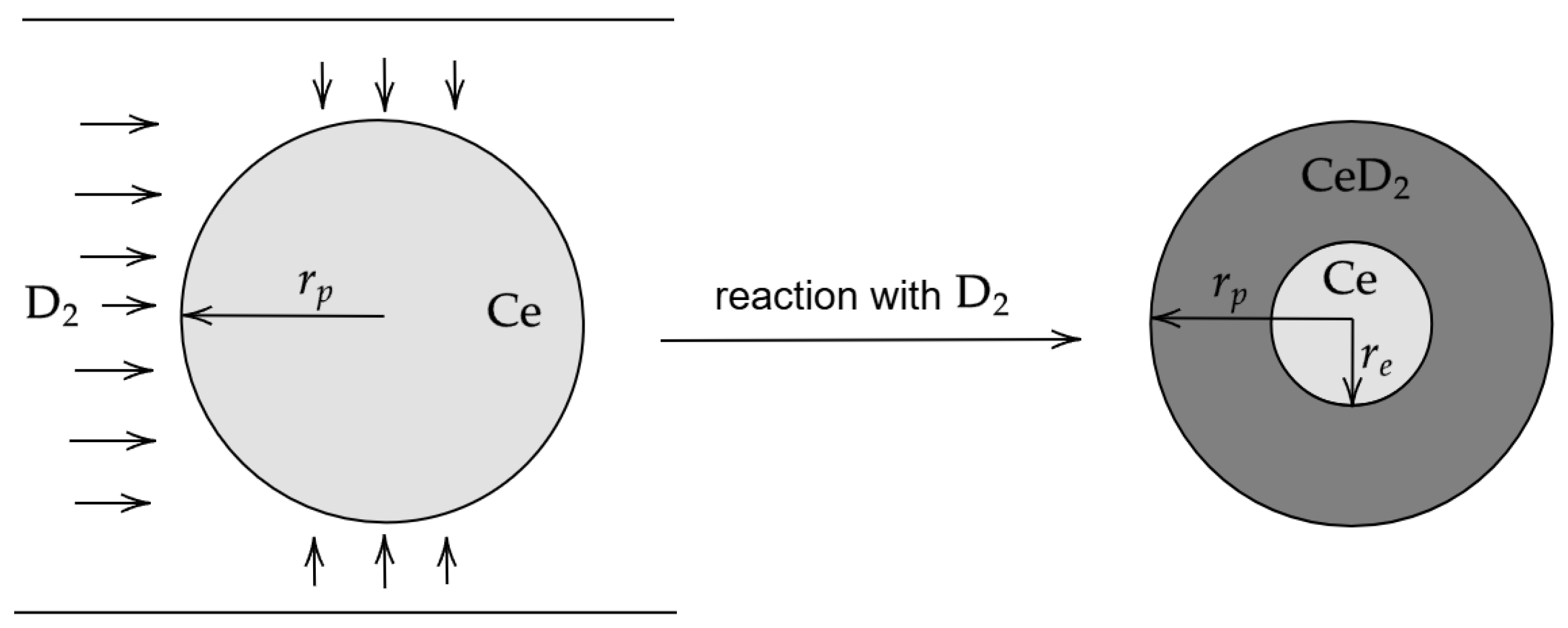
27] and reaction between phases, respectively. First analyze the procedure of reaction and suppose there is an ejecta with radius
. Typically, the reaction proceeds uniformly from the surface of the particles towards the interior, and the reaction rate depends on the diffusion efficiency
. Reactions are usually accompanied by heat absorption and release, and this exchange of heat can affect the physical state of the phases. For convenience, we assume that the particles remain in the solid state. Take the reaction between
and
as an example to illustrate this. The chemical reaction equation is:
, where
. The following
Figure 1 gives the details:
We employ a diffusion model to characterize the spread of the reaction procedure. We have:
so the reaction rate has:
The reason of using the time index there but not the index t is that the reaction is not always with the motion of fluid except under the certain conditions of pressure and temperature.
According to the heat
, we have the energy release:
Because of the difference of temperature between a particle and surrounding fluid, there is a convection heat transfer
, the total energy exchange is:
And
is:
where
is constant-pressure specific heat capacity,
is Nusselt numbers,
is Prandtl numbers of flow, of which specific definitions are as follows:
and
Based on Equations (
1) and (
3), we need to prove that the above gas–particle two phase system satisfies conservation law. It is obvious that the conservation of momentum because the drag between the particle and the fluid is a pair of interacting forces, namely the right items of the second Equations (
1) and (
3). The item
is the energy of the fluid, which is converted into the kinetic energy of the particle, and the convection heat transfer energy
is generated by the temperature difference.
5. Numerical Tests and Results
In the following section, we present several examples to validate the above numerical scheme. We begin by several classical one-dimensional particle transport tests in quiescent fluid, in fluid under constant acceleration and in fluid under sinusoidal acceleration. The relationship between particle size and particle motion path is further explored in this part. Next we explore the motion of fluid in gas–particle Sod test. Finally, we give a two-dimensional practical test case about Pb plate ejecta motion under the high speed shock. For generality, we calculate these numerical tests on unstructured mesh.
5.1. Particle Transport Tests
In this test, we investigate the dynamics of particles immersed in a fluid across different flow conditions, a problem of fundamental importance in both engineering and natural applications.
5.1.1. Transport in a Quiescent Fluid
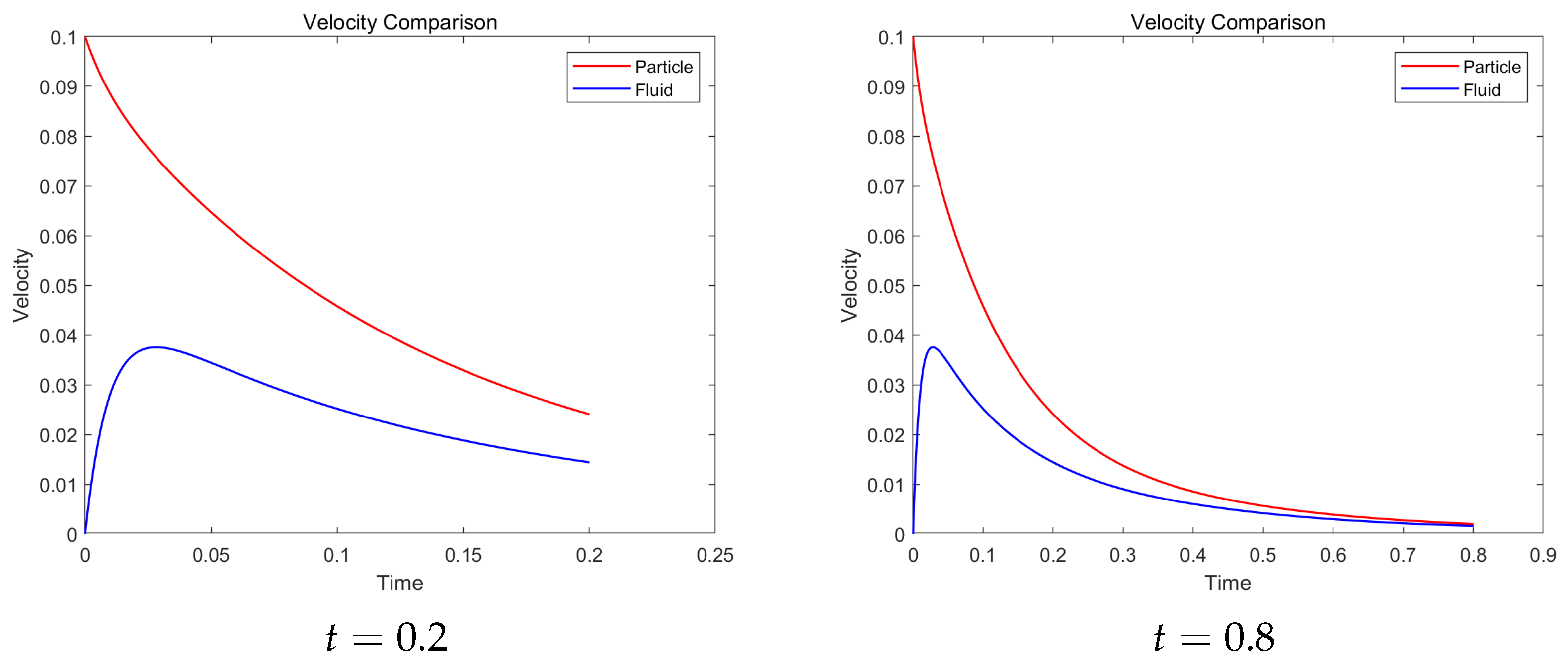
Consider the basic case of a particle subject only to drag. Initialized with a nonzero velocity at the fluid center, the particle exhibits a monotonically decreasing velocity, with deceleration gradually diminishing, as shown in
Figure 4. At the same time, the velocity of the fluid reaches the peak rapidly within a short period and then decreases. The velocity difference between the particle and fluid ultimately converges, contrary to the intuition that the fluid velocity keeps increasing until they become consistent.
5.1.2. Motion Under Constant Acceleration
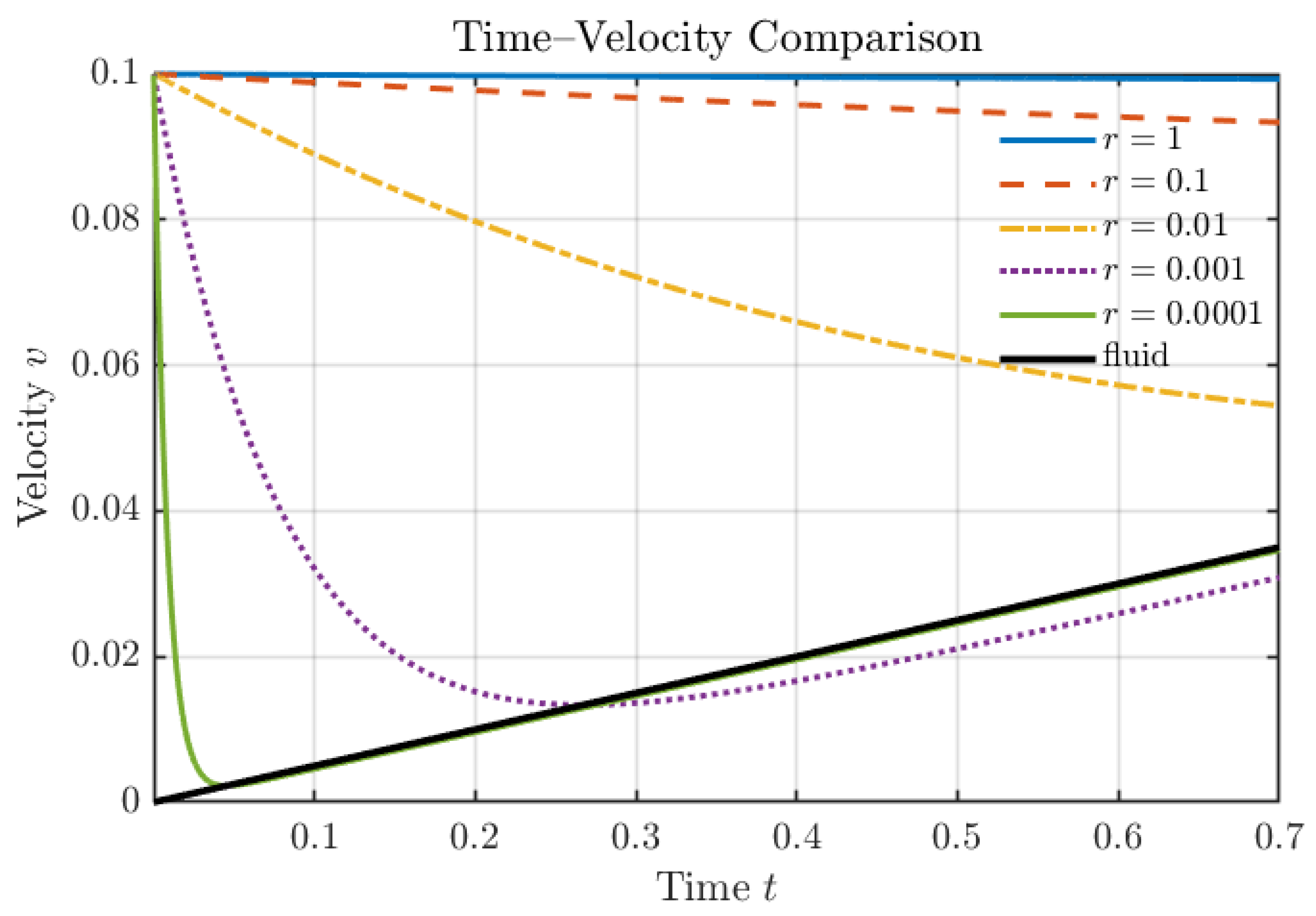
In the second series of tests, according to the
Figure 5, the different-size particles are given a nonzero initial velocity into a quiescent fluid with a constant acceleration. At the start of the motion, the fluid velocity is less than all the particles when the particles are enforced to decelerate, and then accelerate when the fluid velocity exceeds the particle velocity. Analyzing the curves of
and
, it can be observed that once the particle velocity is lower than that of the fluid, the particle accelerates with the same acceleration as the fluid, consistently lagging behind it. Similarly, when the particle becomes sufficiently large,
for instance, it is scarcely affected.
In addition, it is obvious that the particles eventually move with the different velocity differences from the fluid. Suppose that the acceleration of fluid is , the velocity difference is . There is the equation that when the motion reaches the balance. In a general physical computation, drag force is positive correlation with the , we have in which is a variable positive coefficient related to radius, density and viscosity when we used the different drag force model affecting the final velocity difference. For instance, in Stoke’s drag model, there are and which is consistent with the numerical results.
5.2. Multiphase Sod Test
We consider a shock tube problem in the domain
following the classical setup proposed in [
29]. The solution consists of a left rarefaction, a contact discontinuity and a right-moving shock. The length of the shock tube is normalized to unity. To investigate the influence of particle–fluid interaction, we conduct a series of numerical experiments under varying particle sizes. In all cases, particles are uniformly distributed across the computational domain and the flow phase is modeled as an ideal gas. The initial flow field is piecewise constant, with a high-pressure state on the left and a low-pressure state on the right of
. Specifically, the left state is given by
, while the right state is
, as reported in [
17]. We employ a uniform mesh in the domain with the mesh resolution
and
.
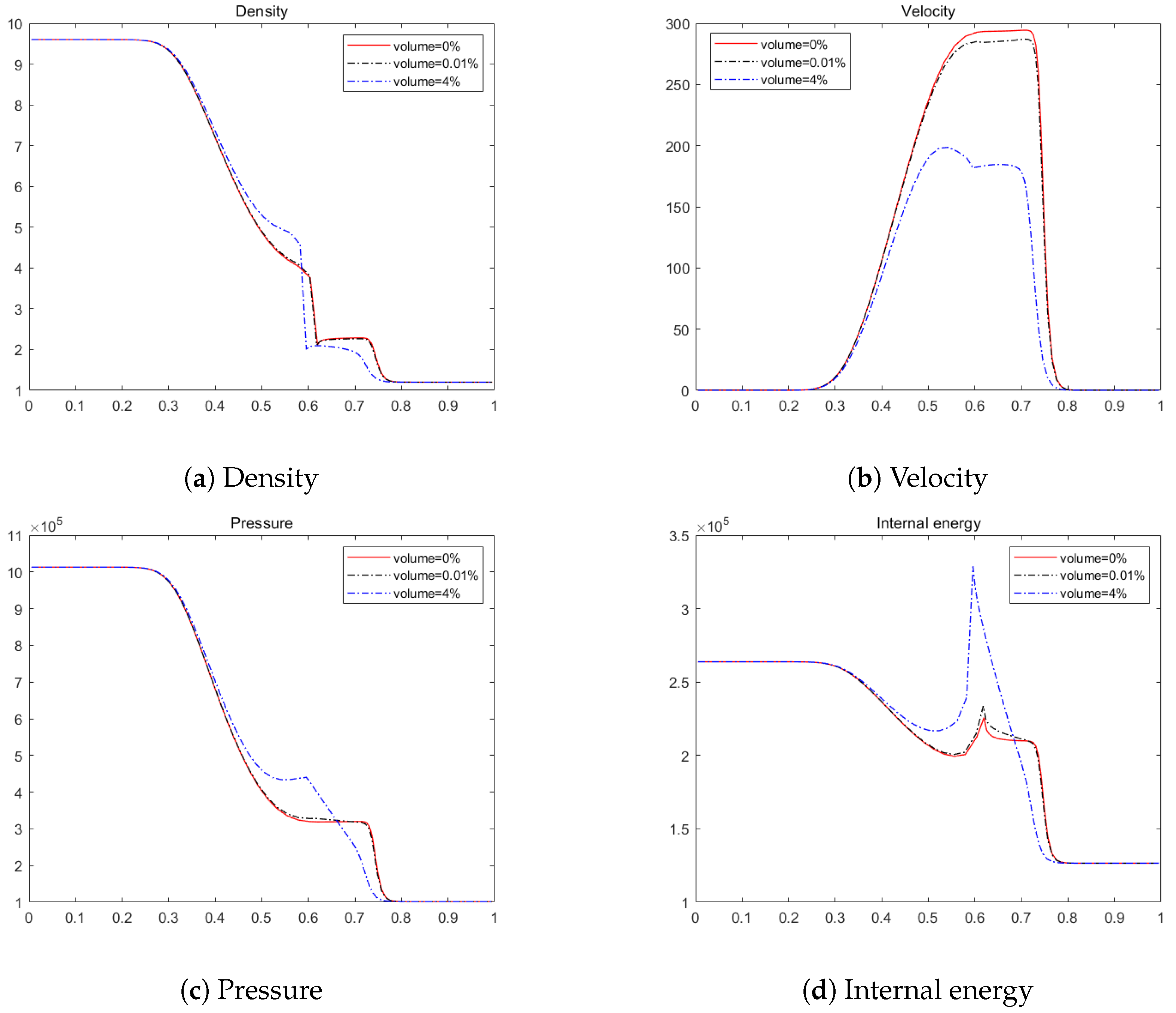
The physical interactions and resulting flow behaviors are analyzed based on high-resolution numerical simulations. In the numerical tests, we investigate the influence of gas–particle coupling by varying the particle radius to obtain different particle volume fractions:
,
, and
. The corresponding initial conditions are summarized in
Table 1. The final average CPU times for the three cases are about 5.5 s, 6.1 s, and 6.3 s on the same workstation, respectively.
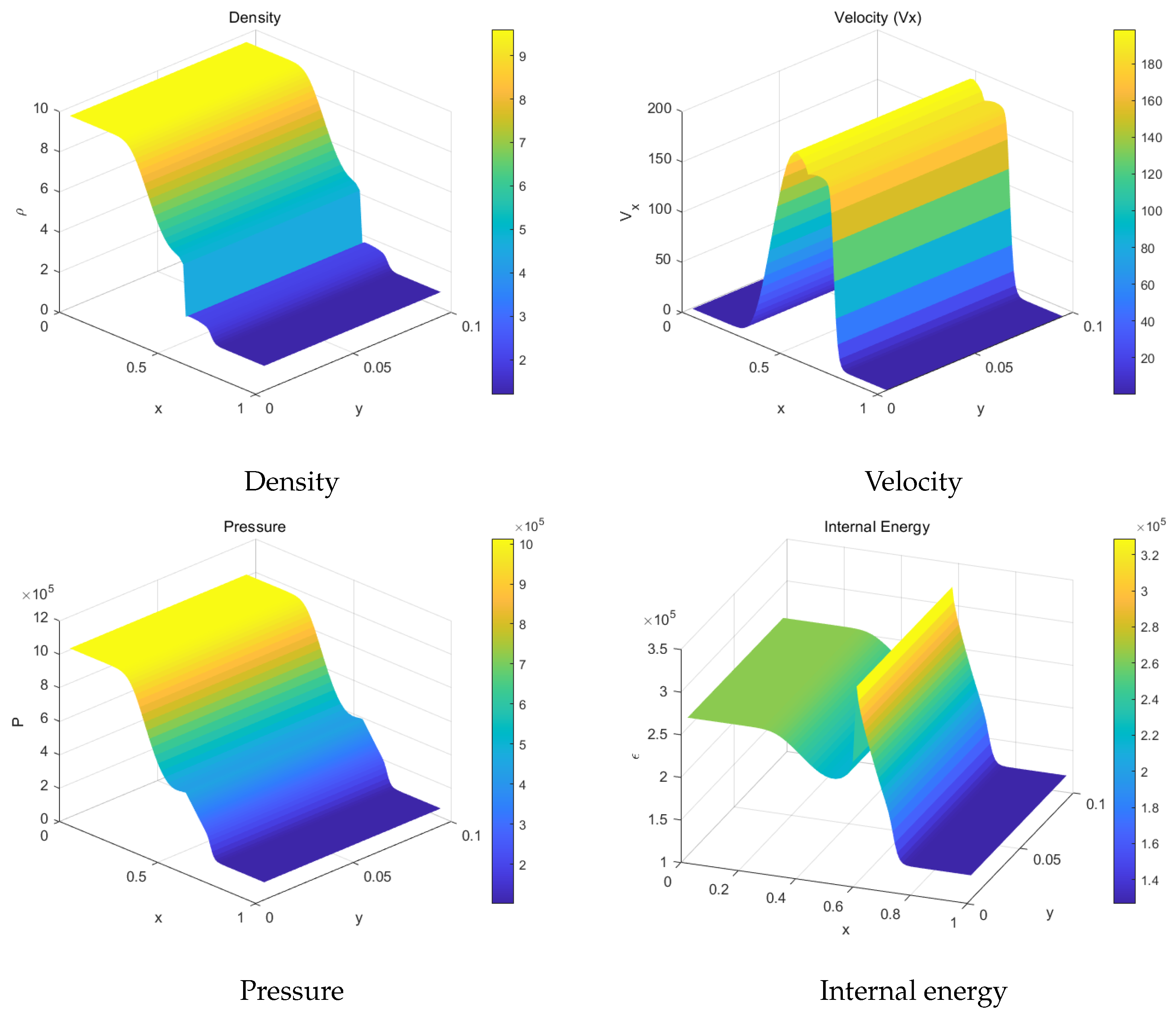
The simulations are conducted in a two-dimensional domain to assess the stability of the proposed algorithm. For clarity, both one- and two-dimensional results are presented. Although the Sod shock tube is essentially one-dimensional, we also compute it on a 2D mesh because the proposed HLLC-2D solver is constructed in a two-dimensional manner, with flux and nodal velocity evaluations involving coupled contributions from cells around a vertex. The 2D setup, therefore, serves as a consistency and robustness check of the 2D construction. In particular, the 2D results confirm that the algorithm effectively eliminates spurious oscillations near discontinuities, even in the presence of particles, and coincide with the corresponding 1D results.
Figure 6 show the flow field (density, velocity, energy and pressure) at time
under the condition of different volume fractions. Different colors denote different particle volume fractions. The results show that, when the particle loading is sufficiently small, its influence on the carrier flow remains negligible. As the volume fraction increases, the drag effect becomes more pronounced, leading to a reduction in wave propagation speed and a decrease in the overall flow velocity, while the internal energy in the central region rises. Although discontinuities are still present in the flow field, the presence of particles acts in a manner analogous to a weak viscous term, smoothing the variations across contact discontinuity and shock. This behavior is consistent with the findings reported in [
17].
To further verify the stability of the proposed scheme, simulations were conducted in a two-dimensional domain. We give the results in
Figure 7. The results show that no spurious oscillations arise near discontinuities, and the flow field remains consistent along the
y-direction. Even with particle–fluid interactions, the scheme demonstrates strong robustness.
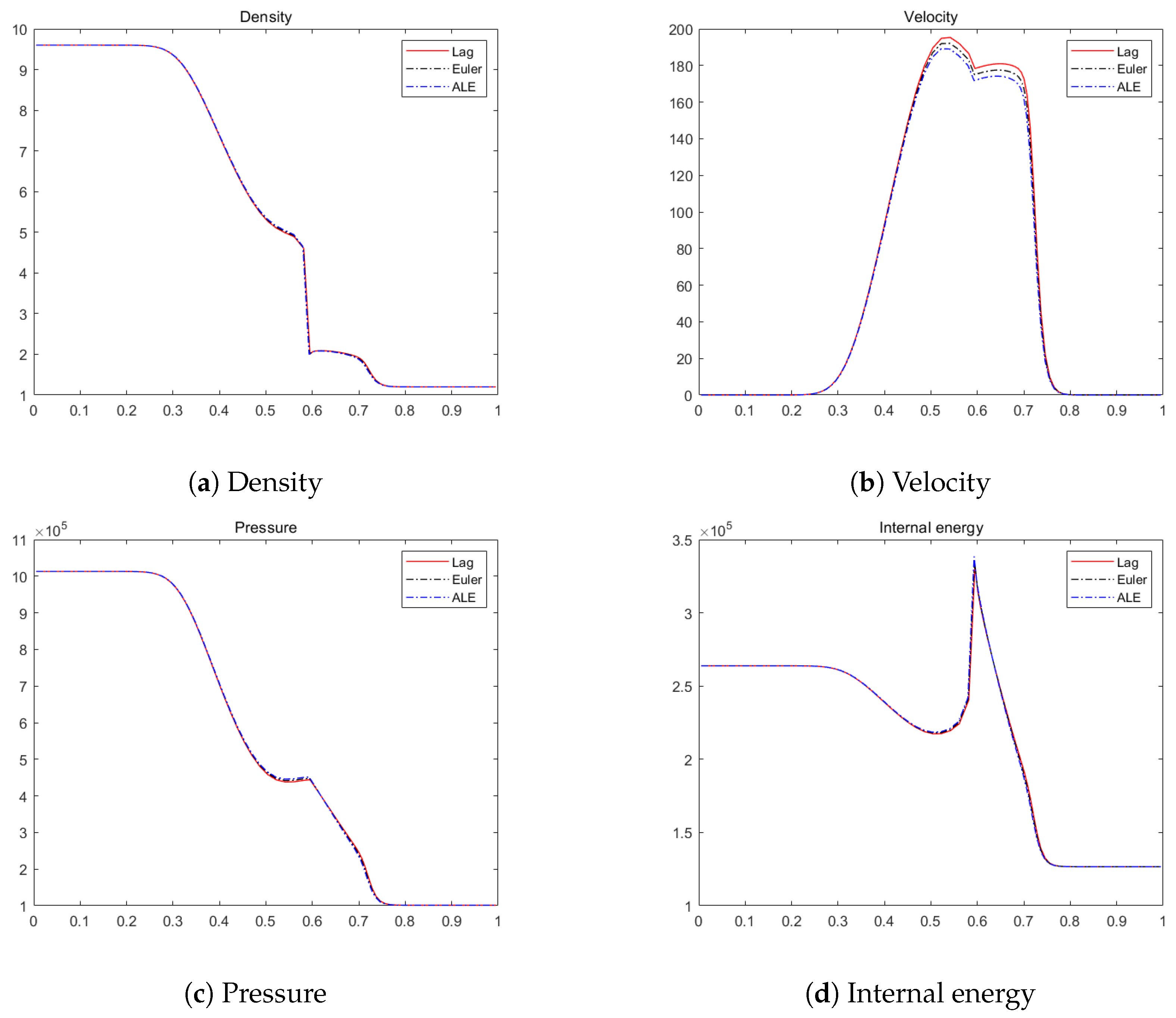
To compare the effects of Eulerian, Lagrangian, and ALE mesh strategies, we consider the case with a particle volume fraction of
and perform simulations under three settings: a fixed mesh (Eulerian), a Lagrangian mesh, and a moving-mesh ALE formulation. The corresponding results are shown in
Figure 8. For this test regime and the present mesh resolution, the three strategies yield very similar profiles for density, pressure, and internal energy; only a modest discrepancy is observed in the fluid velocity in localized regions, while the overall trends remain consistent. We emphasize that this observation does not imply that the three approaches necessarily achieve comparable accuracy for more general two-phase flow problems. In an ALE framework, moving mesh strategies can significantly affect numerical dissipation and the resolution of discontinuities. The mesh-moving strategy adopted in this work follows [
30], and formulating our scheme within an ALE framework is motivated by the need for greater geometric flexibility across different two-phase problems. For instance, highly skewed or excessively flattened cells may hinder particle search, whereas an adaptive ALE mesh can help maintain cell quality and thereby improve the robustness and applicability of the coupled particle-flow computation.
Specifically when the particle volume fraction is set to 0%, the coupled system degenerates to the classical compressible Euler equations; the slight smearing of the shock and contact discontinuity on coarse meshes is mainly attributable to the numerical viscosity of shock-capturing schemes, and a detailed accuracy and convergence study of the HLLC-2D Riemann solver for the Sod test is available in our previous work [
28].
5.3. The Motion of Cerium in Reactive Gas
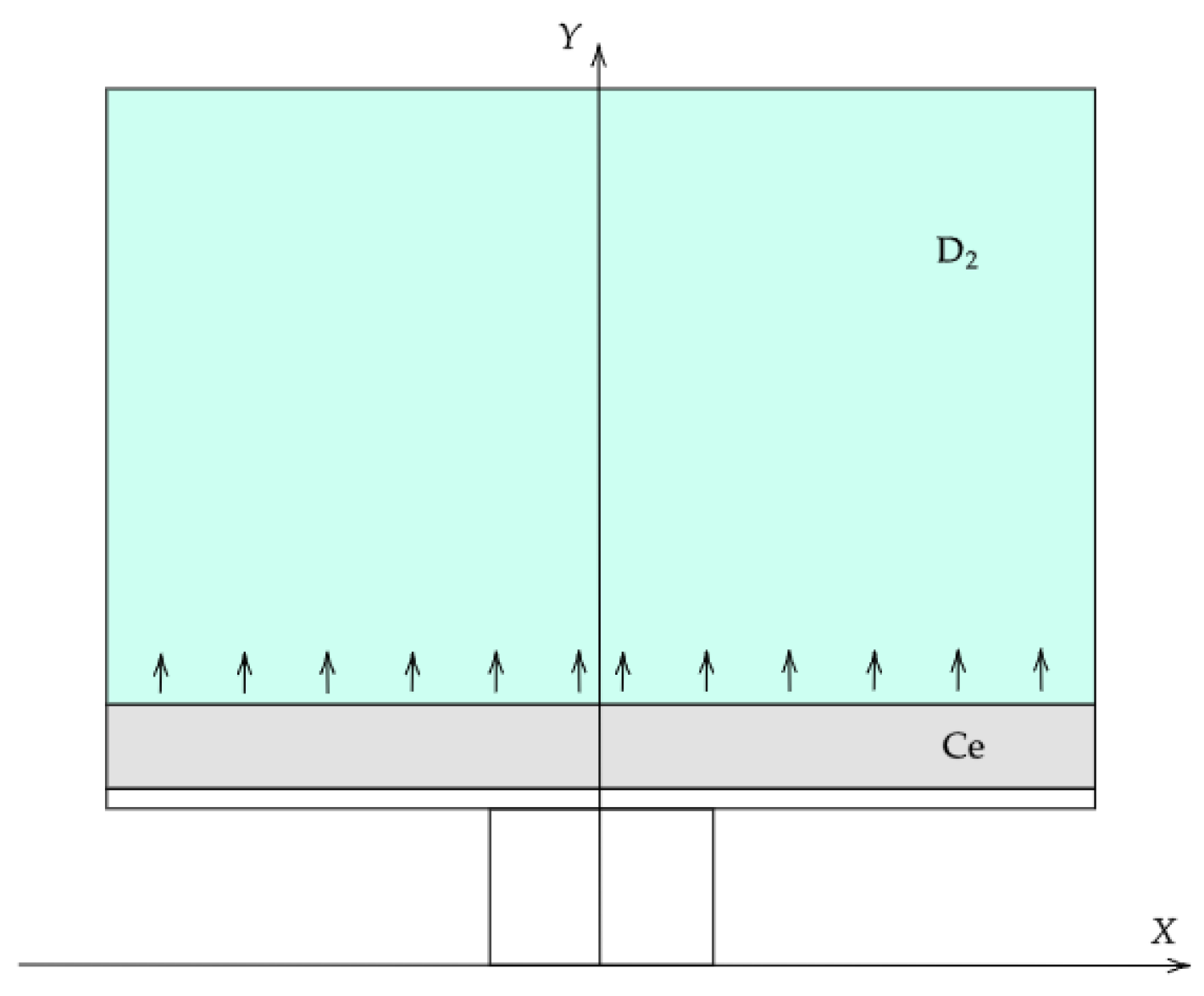
Detonation simulations are widely used as benchmark problems for coupled particle transport and interphase heat exchange. We consider a sealed square container (
Figure 9) with a cerium plate placed at the bottom, which generates ejecta under shock loading. When the carrier gas is helium (He), interphase chemical reactions are absent, whereas reactions occur in a deuterium (
) environment as described in
Section 2.3. We therefore compare particle heating and transport in He and
under otherwise identical conditions.
The parameters used in the numerical experiments were taken from [
11]. The cerium plate is approximately 0.6 cm in length, and the ejecta mass is about 35 mg/cm. The initial particle speed ranges from roughly 1.1 km/s to 1.4 km/s, with a small transverse component whose magnitude depends on the mass ratio. To better represent realistic conditions, the particle radius is not prescribed as a uniform value but varies from 1 μm to 10 μm. The total number of simulated particles is up to
. In what follows, we compare particle motion and heat-transfer effects under different background gases.
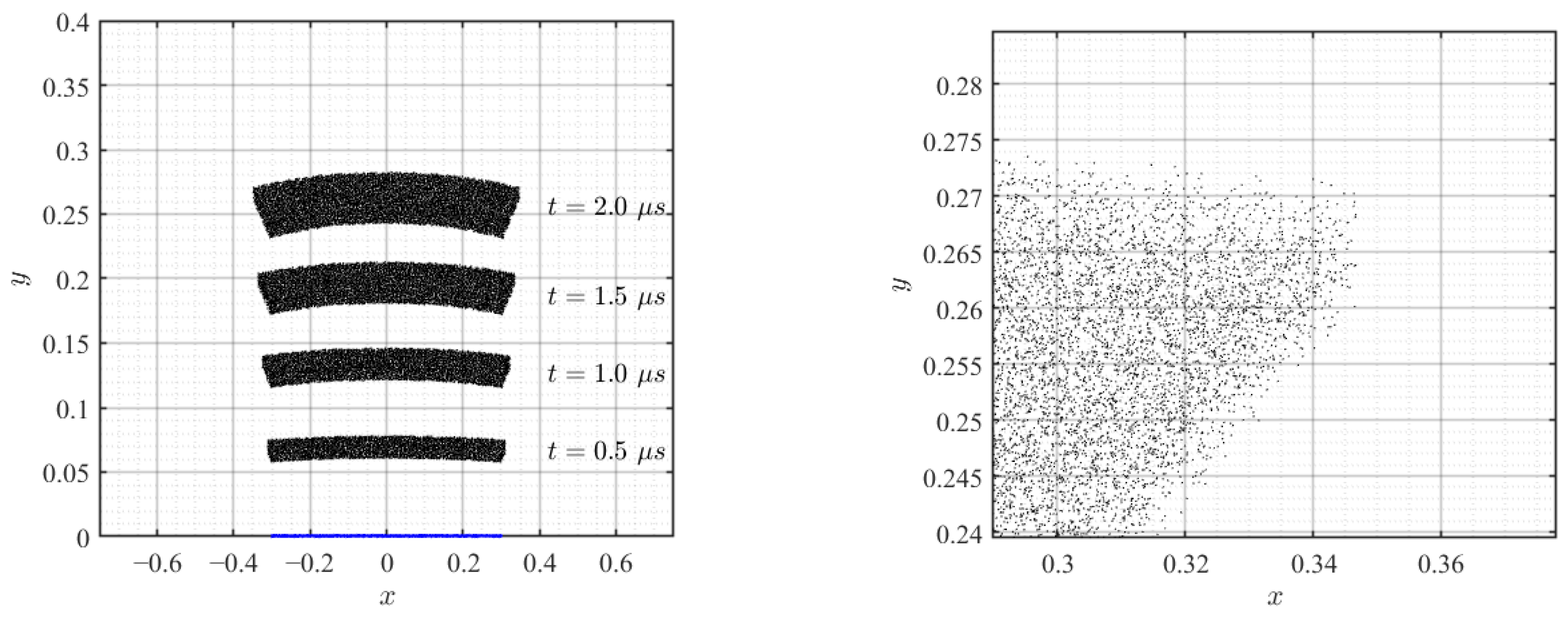
We first investigate the particle motion in He, where no reaction occurs during the process. Neglecting the initial stage in which the cerium plate is impacted by the shock wave, we analyze the particle dynamics over 2 μs; the numerical results are shown in
Figure 10. At
, the particles start to move. As the particles evolve, they gradually spread outward and form layered structures due to differences in their initial velocities and radii. A key feature of the enthalpy-based particle-trajectory model is that it resolves the trajectory of each individual particle; this is also illustrated by the second panel of
Figure 10, where the boundary of the particle cloud is captured clearly. Although the particle phase exhibits a coherent overall trend, each particle follows its own distinct trajectory.
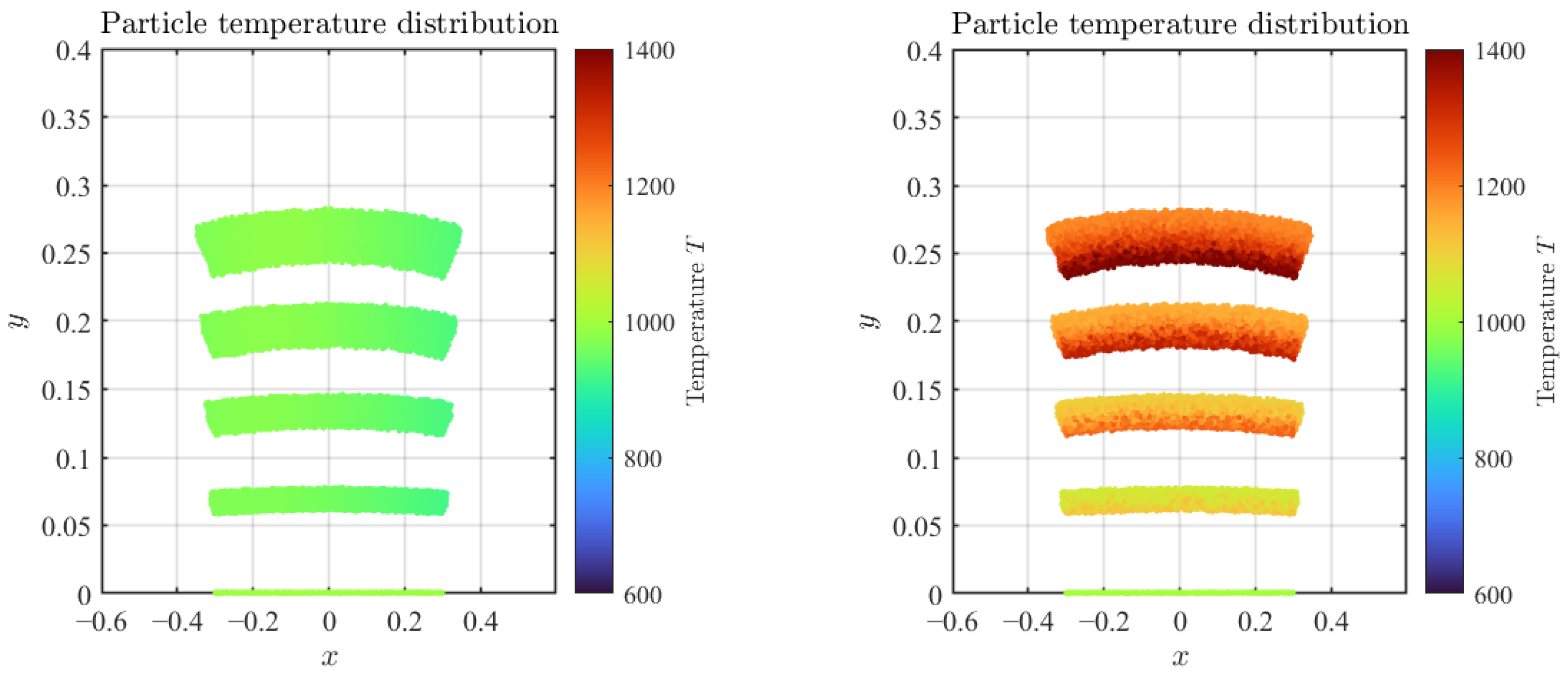
We then perform numerical tests in
with reactions taken into account. By comparing the results in
Figure 11, it is evident that the presence of reactions has a pronounced impact on the temperature evolution. In He, we assume that the particles and the gas share the same initial temperature, which weakens the interphase heat exchange; consequently, only a slight temperature decrease is observed for particles near the boundary. In contrast, in
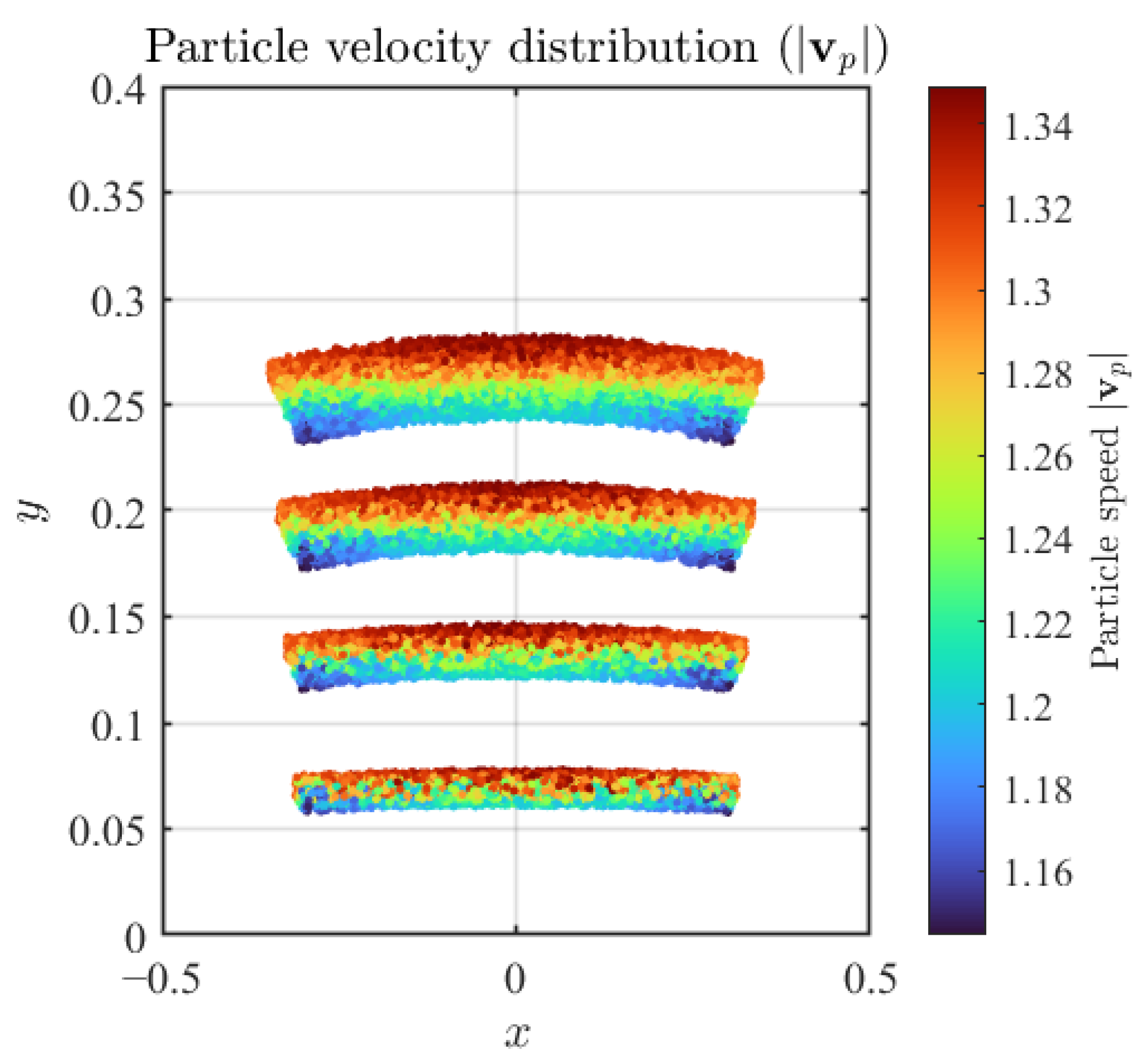
the temperature rises markedly due to chemical reactions and shows clear spatial variations. Particles with larger radii and lower speeds exhibit more pronounced heating, indicating a higher extent of reaction. Regarding the velocity distribution in
Figure 12, the overall speed field becomes progressively stratified in time as the particles are transported, with the highest speeds located in the central region.
5.4. Conclusions
Due to strong interphase coupling, the gas flow and particle motion are tightly linked. In regimes where either the carrier-gas velocity or particle velocity becomes large, a purely Lagrangian description may suffer from severe mesh distortion and loss of robustness. To improve applicability across a wider range of flow conditions, we formulated the proposed HLLC-type Riemann solver within an Arbitrary Lagrangian–Eulerian (ALE) moving-mesh finite-volume framework, which allows mesh motion to be decoupled from the material motion while retaining conservative updates for the coupled system.
The numerical results indicate that particle–fluid interactions have a pronounced impact on the flow evolution. In particular, interphase drag acts as an effective dissipative mechanism that attenuates wave structures and can modify propagation characteristics when the coupling is sufficiently strong; therefore, in particle-laden high-speed regimes, the feedback of particles on the carrier gas should be included for predictive simulations. The tests also show that the computed dynamics are sensitive to the choice of the gas viscosity coefficient. When the temperature difference between the gas and particles remains small, the thermal exchange term plays a secondary role relative to momentum exchange; however, in reactive settings the reaction-induced energy transfer leads to appreciable temperature variations and must be incorporated. Finally, our results suggest that a common-pressure approximation is reasonable at low particle volume fractions, whereas at higher loadings noticeable gas–particle pressure differences may arise and should be accounted for in the coupled modeling.