1. Introduction and Preliminaries
Let
be Banach spaces and
denote the set of all bounded linear operators from
X into
We write
as
For
let
and
be the adjoint, range and null space of
respectively. An operator
is said to be idempotent if
The identity operator will be denoted by
I. An operator
is said to be a generalized inverse of
if
satisfies the following two operator equations:
However, the generalized inverse may not exist, and it is not unique even if it exists. We denote the set of all generalized inverses of T by
It is well known that some unique generalized inverses, such as the Moore–Penrose inverse and group inverse, play an important role in least squares problems, numerical analysis, statistics and approximate equations; see [
1,
2,
3,
4,
5]. Let us recall the definitions of the Moore–Penrose inverse and group inverse.
Definition 1. Let X and Y be Hilbert spaces. An operator is called the Moore–Penrose inverse of if satisfies the Penrose equations: Definition 2. Let X be a Banach space. An operator is called the group inverse of if satisfies As is well known, the Moore–Penrose invertibility and generalized invertibility are equivalent in Hilbert space. Furthermore,
T is Moore–Penrose invertible if and only if
is closed. However, in Banach space, the group invertibility imposes stricter conditions than the generalized invertibility. Some characterizations of the group invertibility are contained in [
6,
7].
Theorem 1 ([
6])
. Let X be a Banach space and . Then the following statements are equivalent: is closed, and
T has a generalized inverse with and
T has the group inverse;
T has a regular factorization such that is invertible.
Lemma 1 ([
7])
. Let X be a Banach space and be generalized invertible. Then the following statements are equivalent: T is group invertible;
is invertible, for all or some
is invertible, for all or some
In this case, for any For a given operator , let be a multiplicative perturbation of where , and We call an upper bound of or a multiplicative perturbation bound for the Moore–Penrose inverse (or group inverse). If or holds, then the multiplicative perturbation for the Moore–Penrose inverse (or group inverse) is continuous.
The multiplicative perturbation, together with the additive perturbation, namely
A is perturbed to
is often used to estimate the perturbation bound for the Moore–Penrose inverse [
8,
9,
10,
11]. For example, in [
8], Meng and Zheng presented a multiplicative perturbation bound for the Moore–Penrose inverse under the Frobenius norm. Under the condition that
D and
S are invertible, some expressions for the Moore–Penrose inverse of the multiplicative perturbation were given in [
12,
13]. In fact, when
D and
S are invertible, the multiplicative perturbation of matrices must be rank-preserving and continuous for the Moore–Penrose inverse. A natural problem is whether the multiplicative perturbation for the group inverse is continuous and whether we can find representations of the group inverse, as well as the multiplicative perturbation bound for the group inverse.
This paper is organized as follows. In
Section 2, we first give an example to illustrate that the multiplicative perturbation for the group inverse may not be group invertible. Further, we characterize the group invertibility for the multiplicative perturbation of group invertible operators and obtain some expressions of the group inverse. Based on these results, we prove the continuity of the multiplicative perturbation for the group inverse under the condition that
D and
S converge to
I and derive some multiplicative perturbation bounds for the group inverse. In
Section 3, we consider the group invertibility for the linear combination of operators.
2. Multiplicative Perturbation
First, we present an example to show that even if A is a group invertible matrix, the multiplicative perturbation of A is not necessarily group invertible.
Example 1. LetThen A is group invertible, whileis not group invertible since To characterize the group invertibility and provide the expressions of the multiplicative perturbation, we need the following lemma.
Lemma 2. Let X be a Banach space and be group invertible. Then for any Proof. The proofs of (
1) and (
2) are similar; we only prove (
1) and directly calculate that
Thus, the proof is complete. □
Theorem 2. Let X be a Banach space and be group invertible. Assume that and are invertible. Then the following statements are equivalent:
is group invertible;
is invertible;
is invertible.
Proof. Noting that
is a generalized inverse of
by Lemma 1, we know that
is group invertible ⇔
is invertible ⇔
is invertible. In this case,
Similarly, we can find that is group invertible ⇔ is invertible ⇔ is invertible. Furthermore, the corresponding expressions can be obtained. Therefore, we complete the proof. □
Example 2. In Example 1, we can check thatThen is not invertible, and so by Theorem 2, is not group invertible. It is well known that the group inverse is not continuous, i.e., A has the group inverse , but the convergent sequence of A is not necessarily group invertible, and even if it is group invertible, may not hold. However, we can use Theorem 2 to prove that when the multiplicative perturbation for the group inverse is continuous.
Corollary 1. Let X be a Banach space and be group invertible. If satisfy then for all sufficiently large n, is group invertible andwith Proof. By Banach’s lemma, for all sufficiently large
n,
and
are invertible. By Theorem 2,
is group invertible ⇔
is invertible. Since
and
is invertible, we see that
is invertible for all sufficiently large
n. Hence,
is group invertible and
□
Now, we provide an example in Banach space to illustrate the above continuity result.
Example 3. Let be defined byThen for Obviously, , with From Corollary 1, for all sufficiently large n, is group invertible, and In fact,and consequently, In Hilbert space, for a bounded linear operator A with the closed range, is always group invertible with An interesting result is that for an idempotent operator using Theorem 2 and setting special invertible operators D and we can get the expressions of
Proposition 1. Let X be a Hilbert space and be idempotent. Then and are invertible and Proof. From
we know that
is invertible. In Theorem 2, if
then
is group invertible ⇔
(or
) is invertible. Since
is group invertible, we can obtain what we desire. □
Next, we construct a continuous additive perturbation for which is different from the method of Corollary 1.
Corollary 2. Let X be a Hilbert space and be idempotent. If sequence then for all sufficiently large , is group invertible andwith Proof. Without loss of generality, we assume that for all sufficiently large
,
In Theorem 2, if
then
S is invertible with
and so
is group invertible
is invertible. By Proposition 1,
is invertible, and then for all sufficiently large
is invertible. Hence,
is group invertible and
Thus, the proof is complete. □
In the following, we give some multiplicative perturbation bounds for the group inverse.
Theorem 3. Let X be a Banach space and be group invertible. Assume that and are invertible. If is invertible, then is group invertible andwhere Proof. From Theorem 2, if
is invertible, then
M is group invertible and
Noting that
we can get
□
Theorem 4. Let the conditions and be the same as those in Theorem 3. Then is group invertible andwhere Theorem 5. Let the conditions and be the same as those in Theorem 3. Then is group invertible andwhere Next, we will compare the perturbation bounds , and .
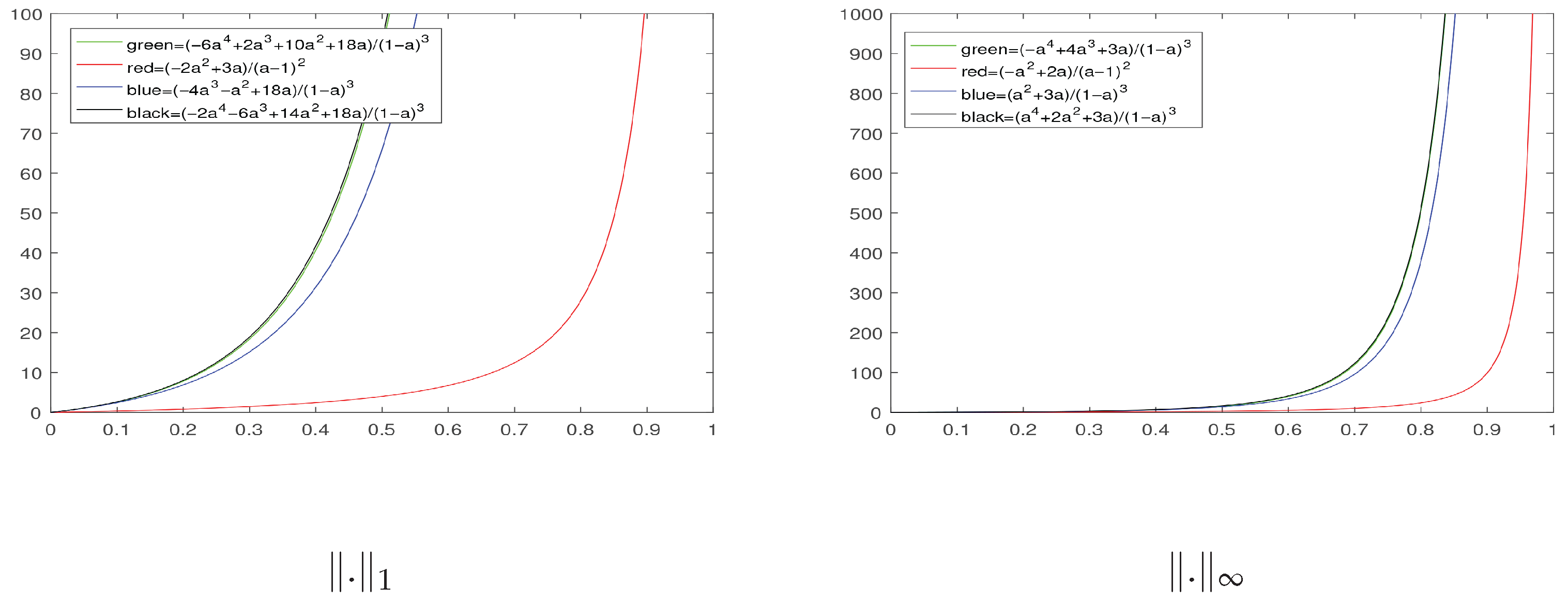
Example 4. Let Then , and is group invertible with In the following,
Table 1 presents the differences among the perturbation bounds under the
and
, while
Figure 1 provides a visual comparison of these bounds.
3. Linear Combination of Operators
Linear combination techniques of matrices or operators are often used in differential and difference equations, Markov chains, and cybernetics. Some sufficient conditions for the generalized invertibility and idempotency of
have been widely studied [
14,
15,
16,
17,
18,
19,
20]. In this section, we shall characterize the group invertibility of
, which can be considered a multiplicative perturbation of
Theorem 6. Let X be a Banach space. Assume that is group invertible and is idempotent. Then the following statements are equivalent:
is group invertible;
is invertible;
is invertible.
Proof. It is noted that
Considering that
and
are invertible with
in Theorem 2, we set
and
Thus we can get what we desire. □
Remark 1. We remark that the main difficulty is in finding the existence conditions and expressions of the group inverse. In addition, we can also characterize the idempotency of
Proposition 2. Let the conditions be the same as those in Theorem 6. Then the following statements are equivalent:
is idempotent;
In particular, when A is idempotent and is equivalent to Proof. If
is idempotent, then
Since
and
are invertible, we find that
i.e.,
When
A is idempotent and
Therefore, the proof is complete. □
Using Theorem 6, we can obtain the following corollaries.
Corollary 3. Let X be a Banach space and be idempotent. Then the following statements are equivalent:
is group invertible;
is invertible;
is invertible.
In particular, if then is group invertible is invertible. And Proof. In Theorem 6, if A is idempotent, then A is group invertible with In particular, when the proof is obvious. □
Corollary 4. Let X be a Banach space. Assume that is group invertible and is idempotent. If there is a complex number μ such that is invertible, then the following statements hold:
is group invertible;
is group invertible;
is group invertible;
is group invertible;
is group invertible.
Proof. We first prove
and the expression of
When
it follows from
being invertible that
So the conclusion holds. When
in Theorem 6, we assume that
Noting that for all sufficiently large
,
and
are invertible, we know that
is group invertible and
In addition, considering that
is uniformly bounded and
[
21], we find that
is group invertible and
Hence
Similarly, to prove (2)–(5) and the corresponding expression of the group inverse, in Theorem 6, we set
respectively. Thus, we can get what we want. □
Now we consider the group invertibility of , in the case of and
Theorem 7. Let X be a Banach space. Assume that is group invertible and is idempotent. If there is a complex number μ such that is invertible, then the following statements hold:
is group invertible;
is group invertible;
is group invertible.
Proof. We first prove
When
with
Since
B is idempotent,
is also idempotent. By the condition and
in Corollary 4,
holds and
Similarly, when
with
By the condition and
in Corollary 4,
holds, and we can acquire the expressions of the group inverse. When
By Corollary 4,
holds, and representations of the group inverse can be obtained. Therefore, we complete the proof. □