Article

Pulse Waves in the Viscoelastic Kelvin–Voigt Model: A Revisited Approach

by
Juan Luis González-Santander
1,*,
Francesco Mainardi
2,3 and
Andrea Mentrelli
3,4
1
Department of Mathematics, University of Oviedo, C/Leopoldo Calvo Sotelo 18, 33007 Oviedo, Spain
2
Department of Physics and Astronomy, University of Bologna, Via Irnerio 46, 40126 Bologna, Italy
3
Italian National Institute for Nuclear Physics, Section of Bologna, I.S. FLAG, Viale Berti Pichat 6/2, 40127 Bologna, Italy
4
Department of Mathematics, Alma Mater Research Center on Applied Mathematics, University of Bologna Via Saragozza 8, 40123 Bologna, Italy
*
Author to whom correspondence should be addressed.
Mathematics 2026, 14(3), 528; https://doi.org/10.3390/math14030528
Submission received: 12 January 2026 / Revised: 26 January 2026 / Accepted: 29 January 2026 / Published: 2 February 2026
(This article belongs to the Section C: Mathematical Analysis)

Abstract

We calculate the mechanical response r x , t of an initially quiescent semi-infinite homogeneous medium to a pulse applied at the origin, and this is achieved within the framework of the Kelvin–Voigt model. Although this problem has been extensively studied in the literature because of its wide range of applications—particularly in seismology—here, we present a solution in a novel integral form. This integral solution avoids the numerical computation of the solution in terms of the inverse Laplace transform; that is, numerical integration in the complex plane. In particular, we derive integral form expressions for both delta-pulse and step-pulse excitations which are simpler and more computationally efficient than those previously reported in the literature. Furthermore, the obtained expressions allow us to obtain simple asymptotic formulas for r x , t as x , t 0 , for both step- and delta-type pulses.

1. Introduction

The problem of determining the response of uniaxial waves in an initially quiescent semi-infinite medium is fundamental in linear viscoelasticity and is discussed in most standard textbooks on rheology. Indeed, it constitutes a preliminary step for the analysis of wave propagation in linear dispersive media subject to dissipation, including seismic waves in the Earth. Following the notation used in Mainardi’s book [1], we consider the mechanical response r x , t at time t 0 of an initially quiescent, semi-infinite homogeneous medium extending over x 0 (with density ρ ) to a pulse applied at the origin; that is, r 0 t = r 0 , t . As pointed out in Hunter’s review paper [2], the quantity r ( x , t ) may represent the stress σ ( x , t ) , strain ε ( x , t ) , displacement u ( x , t ) , or particle velocity v ( x , t ) . According to the classical theory described in [1] (Sect. 4.2.1) (see also [2]), the response is obtained through the inversion of Laplace transform of the form
r x , t = 1 2 π i γ i γ + i r ˜ 0 s exp s t μ s x d s ,
where γ > 0 , s is the Laplace parameter, r ˜ 0 s is the Laplace transform of the applied pulse r 0 t , and μ s is a characteristic complex function depending on the Laplace transform of the material functions; that is, the creep compliance J ( t ) (the strain to a step input of stress) and the relaxation modulus G ( t ) (the stress to a step input of strain), according to the equation:
μ ( s ) = s ρ s J ˜ ( s ) = s ρ s G ˜ ( s ) .
Here, we have used the notation given in [1] where J ˜ ( s ) and G ˜ ( s ) represent the Laplace transforms of the creep compliance and relaxation modulus, respectively.
At this point, we would distinguish the case of the existence—or lack thereof—of a finite wave front velocity c > 0 according to
lim | s | μ ( s ) s = 0 if 1 / J ( 0 ) = G ( 0 ) = , 1 c if 1 / J ( 0 ) = G ( 0 ) = ρ c 2 ,
so that only in the second case we have a finite wave-front velocity
c = 1 J ( 0 ) ρ = G ( 0 ) ρ ,
and, consequently, the index of refraction n ( s ) is given by
n ( s ) = c μ ( s ) .
In this case
r x , t = 1 2 π i γ i γ + i r ˜ 0 s exp s t n s x / c d s ,
so that the response turns out to be zero if x > c t , namely for t < x / c . This justifies the definition of wave-front velocity. If we do not have a finite wave front velocity, we have a diffusion phenomenon; that is, an instantaneous propagation of the signal like in heat conduction.
In [1], we found that the viscoelastic bodies are classified into four types according to their instantaneous and equilibrium responses. In fact, we easily recognize four possibilities for the limiting values of the creep compliance and relaxation modulus, as listed in Table 1, where we have denoted J g = J ( 0 ) , J e = J ( ) , G g = G ( 0 ) , G e = G ( ) (with J g G g = J e G e = 1 ).
We note that the viscoelastic bodies of type I exhibit both instantaneous and equilibrium elasticity, so their behavior appears close to the purely elastic one for sufficiently short and long times. The bodies of type II and IV exhibit a complete stress relaxation (at constant strain) since G e = 0 and an infinite strain creep (at constant stress) since J e = , so they do not show equilibrium elasticity. However, the bodies of type III and IV do not show instantaneous elasticity since J g = 0 ( G g = ). Concerning wave propagation, according to (4), only bodies of type I and II exhibit a finite wave-front velocity c, whereas bodies of type III and IV exhibit diffusion; that is, c . The simplest body of type III is the Kelvin–Voigt model, which is the subject of this work. The Kelvin–Voigt model is relevant to a wide range of transient wave problems, particularly in seismology, as discussed in numerous classical and modern studies [3,4,5,6,7,8,9,10,11,12,13,14,15].
In this paper, we revisit the transient-wave problem in a Kelvin–Voigt medium and derive integral-form solutions for both step-pulse and delta-pulse excitations. We also analyze the asymptotic behavior of these solutions as t 0 , and x 0 , . Our aim is to improve and extend upon previous results available in the literature.

2. The Kelvin–Voigt Model

2.1. General Solution

The constitutive relation in the Kelvin–Voigt model is
σ = G e ε + t ε ε t ,
where t ε > 0 is the retardation time and G e the equilibrium modulus. Apply the Laplace transform to the constitutive relation (7) to obtain
σ ˜ x , s = G e ε ˜ x , s + t ε s ε ˜ x , s ε x , 0 .
If we consider that, initially, the rod is unstrained, we have
ε x , 0 = 0 ,
thus, (8) is reduced to
σ ˜ x , s = G e 1 + t ε s ε ˜ x , s .
Apply to (9) the derivative with respect to x and take into account the basic equations of linear viscoelasticity in the Laplace domain (see [1], Sect. 4.2.1), i.e., the equation of motion:
x σ ˜ x , s = ρ s 2 r ˜ x , s ,
and the kinematic equation:
ε ˜ x , s = x r ˜ x , s ,
to obtain
ρ G e s 2 1 + t ε s r ˜ x , s = 2 x 2 r ˜ x , s .
Substituting a solution of the form
r ˜ x , s = a s exp b s x ,
we arrive at
r ˜ x , s = a s exp ± ρ G e s 1 + t ε s x .
According to the boundary conditions in the Laplace domain (see [1], Sect. 4.2.1), i.e.,
r ˜ 0 , s = r ˜ 0 s ,
lim x r ˜ x , s = 0 ,
we have
r ˜ x , s = r ˜ 0 s exp ρ G e s 1 + t ε s x .
Since
ρ G e = 1 L T 1 ,
has dimensions of the inverse of a velocity, define the velocity
c = G e ρ ,
and recast the solution in the Laplace domain as
r ˜ x , s = r ˜ 0 s exp s 1 + t ε s x c .
Recall that according to the Laplace transform definition [16] (Eqn. 1.1), the dimension of the variable s is s = T 1 ; thus, t ε s is dimensionless, i.e., t ε s = 1 . Apply the convolution theorem of the Laplace transform [16] (Theorem 2.39), to obtain
r x , t = L 1 r ˜ 0 s exp s 1 + t ε s x c ; t = 0 t r 0 t t L 1 exp s 1 + t ε s x c ; t d t .
Now, consider the dimensionless variables:
ξ = x c t ε ,
τ = t t ε ,
and the Laplace transform property [17] (1.1.1(4)):
L 1 a e b t / a f t a ; s = f ˜ a s + b , a > 0 ,
to calculate
L 1 exp s 1 + t ε s x c ; t = L 1 exp ξ t ε s 1 + t ε s ; t = e τ t ε L 1 exp ξ s + ξ s ; τ
In order to calculate the inverse Laplace transform given in (19), define
f ξ , τ : = L 1 exp ξ s + ξ / s s ; τ ,
According to the derivative theorem of the Laplace transform [16] (Theorem 2.7), and knowing that L 1 1 = δ τ [16] (Eqn. 2.37), we have
L 1 exp ξ s + ξ s ; τ = τ f ξ , τ + f ξ , 0 δ τ .
Now, expand exp ξ / s in (20) to obtain
f ξ , τ = n = 0 ξ n n ! L 1 exp ξ s s 1 + n / 2 ; τ .
According to [17] (Eqn. 2.2.1(11)), we have
L 1 exp ξ s s n / 2 + 1 ; τ = 2 n + 1 π exp ξ 2 4 τ t n / 2 H 1 n ξ 2 τ ,
where H ν z denotes the Hermite function [18] (Eqn. 10.2.8). Therefore,
f ξ , τ = 2 π exp ξ 2 4 τ n = 0 2 ξ τ n n ! H 1 n ξ 2 τ .
Now, perform the change of variables
z ξ , τ = ξ 2 τ ,
to obtain
f ξ , z = 2 π e z 2 n = 0 ξ 2 / z n n ! H 1 n z .
According to the integral representation [18] (Eqn. 10.5.2):
H ν z = 1 Γ ν 0 exp u 2 2 u z u ν 1 d u , ν > 0 ,
we find that
f ξ , z = 2 π e z 2 n = 0 ξ 2 / z n n ! 2 0 exp u 2 2 u z u n d u = 2 π n = 0 ξ 2 / z n n ! 2 0 exp u + z 2 u n d u = 2 π 0 exp u + z 2 n = 0 ξ 2 u z n 1 n ! 2 d u .
By using the definition of the normalized hypergeometric function F ¯ 1 0 [18] (Sect. 9.14), i.e.,
F ¯ 1 0 γ ; x = 1 Γ γ F 1 0 γ ; x = 1 Γ γ k = 0 x k γ k k ! ,
we recast the above result as
f ξ , τ = 2 π 0 exp u + ξ 2 τ 2 F ¯ 1 0 1 ; 2 ξ τ u d u .
Moreover, simplify the above expression performing the change of variables v = 2 τ u ξ to arrive at
f ξ , τ = 1 π τ ξ exp v 2 4 τ F ¯ 1 0 1 ; ξ v ξ d v .
Note that
lim τ 0 f ξ , τ = 0 ,
Thus, according to (21), we have
g ξ , τ : = τ f ξ , τ = L 1 exp ξ s + ξ s ; τ .
However, from (25), we arrive at
g ξ , τ = 1 4 π τ 5 / 2 ξ v 2 2 τ exp v 2 4 τ F ¯ 1 0 1 ; ξ v ξ d v .
Consequently,
L 1 exp ξ t ε s 1 + t ε s ; t = exp t / t ε t ε g ξ , t / t ε ,
and
r ξ , t = 1 t ε 0 t r 0 t t exp t t ε g ξ , t t ε d t .
Now, perform the change of variables τ = t / t ε and take into account the dimensionless variable τ = t / t ε given in (17) to obtain
r ξ , τ = 0 τ r 0 t ε τ τ e τ g ξ , τ d τ .

2.2. Step Pulse Solution

For the case r 0 t = θ t , where θ t denotes the Heaviside function, we state that
r ˜ 0 s = 1 s ,
hence, (15) results in
r x , t = L 1 1 s exp s 1 + t ε s x c ; t .
According to the dimensionless variable ξ given in (16),
r ξ , t = L 1 1 s exp ξ t ε s 1 + t ε s ; t = t ε L 1 1 t ε s exp ξ t ε s 1 + t ε s ; t ,
and applying (17) and (18), we get
r ξ , τ = L 1 1 s exp ξ s 1 + s ; τ ,
so, as s 0 , i.e., τ (or equivalently, ξ 0 ) we arrive at the following asymptotic representation:
r ξ , τ L 1 1 s ; τ = 1 , τ , ξ 0 .
However, if we take r 0 t = θ t in (30), we obtain
r ξ , τ = 0 τ e τ g ξ , τ d τ .
Integrating by parts, taking into account (26), we arrive at
r ξ , τ = e τ f ξ , τ + 0 τ e τ f ξ , τ d τ ,
where f ξ , τ is given in integral form in (25). According to the integral [19] (Eqn. 1.3.3(20))
0 τ exp τ v 2 4 τ π τ d τ = 1 2 e v erfc v 2 τ 2 τ e v erfc v + 2 τ 2 τ ,
the solution given in (33) is reduced to
r ξ , τ = ξ F ¯ 1 0 1 ; ξ v ξ exp v 2 4 τ τ π τ + e v 2 erfc v 2 τ 2 τ e v 2 erfc v + 2 τ 2 τ d v .

2.2.1. Asymptotic Solution for τ 0 or ξ

Recall that f ξ , τ is given by (24), thus
f ξ , τ 2 π 0 exp u + ξ 2 τ 2 d u = erfc ξ 2 τ , τ 0 or ξ .
Therefore, from (33) and (35), we arrive at the following asymptotic representation for τ 0 (for fixed ξ ) or ξ (for fixed τ ):
r ξ , τ erfc ξ 2 τ , τ 0 or ξ .

2.2.2. Asymptotic Solution for τ

Rewrite (33) as
r ξ , τ = e τ f ξ , τ + 0 e t f ξ , t d t I τ e t f ξ , t d t I ξ , τ .
First, we calculate
I : = 0 e t f ξ , t d t .
For this purpose, expand f ξ , τ according to (23) and (24) as
f ξ , τ = 2 π k = 0 2 ξ τ k k ! 2 0 exp u + ξ 2 τ 2 u k d u ,
where MATHEMATICA’s computer algebra yields the following result (recall the definition of the F q p ( z ) generalized hypergeometric function [20] (Sect. 16.2))
0 exp u + ξ 2 τ 2 u k d u = 1 2 ξ τ Γ 1 + k 2 F 1 1 1 k 2 3 2 ; ξ 2 4 τ + Γ 1 + k 2 F 1 1 k 2 1 2 ; ξ 2 4 τ ,
thus
f ξ , τ = ξ π k = 0 2 ξ k k ! 2 Γ 1 + k 2 τ k 1 / 2 F 1 1 1 k 2 3 2 ; ξ 2 4 τ + 1 π k = 0 2 ξ k k ! 2 Γ 1 + k 2 τ k / 2 F 1 1 k 2 1 2 ; ξ 2 4 τ ,
and
I = ξ π k = 0 2 ξ k k ! 2 Γ 1 + k 2 0 e t t k 1 / 2 F 1 1 1 k 2 3 2 ; ξ 2 4 t d t + 1 π k = 0 2 ξ k k ! 2 Γ 1 + k 2 0 e t t k / 2 F 1 1 k 2 1 2 ; ξ 2 4 t d t .
The integrals given above can also be calculated using MATHEMATICA’s computer algebra as follows:
0 e t t k 1 / 2 F 1 1 1 k 2 3 2 ; ξ 2 4 t d t = 2 2 1 + k π k ! Γ 1 + k 2 ξ π ξ 2 + k F ¯ 2 1 1 3 + k 2 , 4 + k 2 ; ξ 2 4 + 2 2 + k sinh ξ , 0 e t t k / 2 F 1 1 k 2 1 2 ; ξ 2 4 t d t = 2 2 1 + k π k ! Γ 1 + k 2 2 2 + k cosh ξ π ξ 2 + k F ¯ 2 1 1 3 + k 2 , 4 + k 2 ; ξ 2 4 ,
thus
I = sinh ξ + cosh ξ k = 0 ξ k k ! = 1 ,
which is consistent with the asymptotic behavior given in (32).
Second, we calculate
I ξ , τ : = τ e t f ξ , t d t .
For this purpose, apply the following expansion of the Hermite functions [18] (10.4.3):
H ν z = 1 2 Γ ν m = 0 1 m Γ m ν 2 m ! 2 z m , z < ,
to obtain
H 1 n z = 1 2 n ! Γ 1 + n 2 Γ 1 + n 2 2 z + ,
thus, taking into account the expansion given in (22), we have the asymptotic expansion as t ,
f ξ , t 2 π n = 0 2 ξ t n 2 n ! 2 Γ 1 + n 2 ξ t n = 0 2 ξ t n 2 n ! 2 Γ 1 + n 2 .
Now, apply the duplication formula [18] (Eqn. 1.2.3)
π Γ 2 z = 2 2 z 1 Γ z Γ z + 1 2 ,
to recast (41) as
f ξ , t n = 0 ξ t n n ! Γ 1 + n 2 ξ t n = 0 ξ t n n ! Γ 1 + n 2 , t ,
where we have also,
f ξ , t n = 0 ξ t n n ! Γ 1 + n 2 , t .
Now, insert (43) into (40) to obtain
I ξ , τ n = 0 ξ n n ! Γ 1 + n 2 Γ 1 + n 2 , τ , τ ,
where we have used the upper incomplete gamma function [21] (Eqn. 45:3:2):
Γ ν , z : = z e t t ν 1 d t .
Using the asymptotic expansion [20] (Eqns. 8.11.1-3):
Γ ν , z z ν 1 e z k = 0 1 k 1 ν k z k + O z n , z ,
we arrive at
I ξ , τ e τ n = 0 ξ τ n n ! Γ 1 + n 2 1 2 τ n = 0 ξ τ n n n ! Γ 1 + n 2 , τ .
Recast the second sum in (44), to obtain,
I ξ , τ e τ n = 0 ξ τ n n ! Γ 1 + n 2 ξ 2 τ n = 0 ξ τ n n ! Γ 3 + n 2 , τ .
Finally, insert the results given in (39), (42) and (45), in (37), and simplify the result to obtain
r ξ , τ 1 ξ e τ τ n = 0 ξ τ n n ! 1 Γ 1 + n 2 1 2 Γ 3 + n 2 , τ .
Apply the factorial property of the gamma function [18] (Eqn. 1.2.1), i.e., Γ z + 1 = z Γ z , to reformulate the above sum as
r ξ , τ 1 ξ 2 e τ n = 0 ξ τ n n ! n + 2 Γ 1 + n 2 , τ .
Split the above sum in the even and odd terms and recast the result as two hypergeometric sums to arrive at the following asymptotic expression,
r ξ , τ 1 ξ 2 e τ 1 2 F 2 0 1 2 , 2 ; ξ 2 τ 4 + 2 ξ τ 3 π F 2 0 3 2 , 5 2 ; ξ 2 τ 4 , τ .
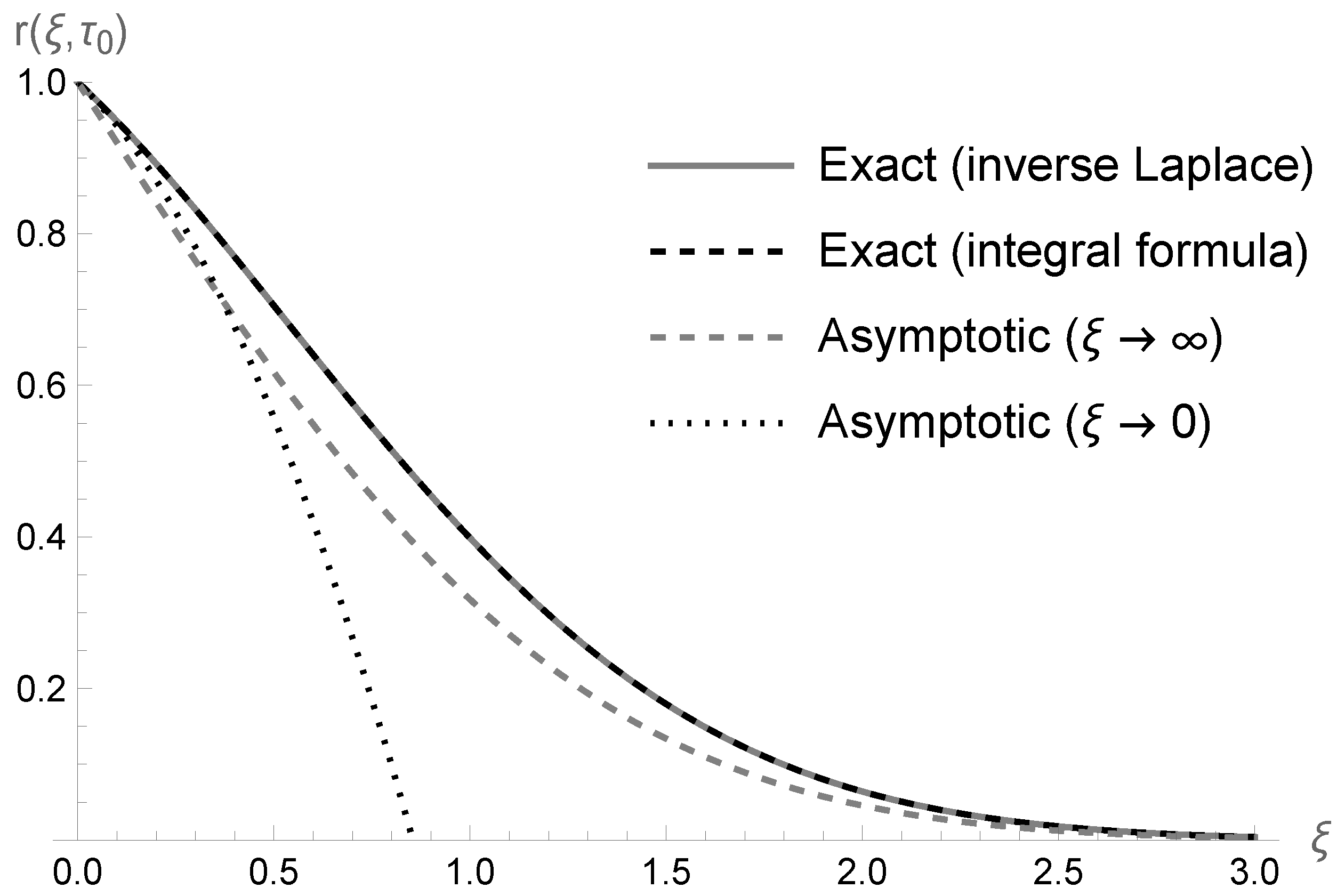
Figure 1 shows that the solution r ξ , τ given in terms of the inverse Laplace transform (31) is numerically equivalent to the integral solution (34). Indeed, the maximum discrepancy between both expressions in Figure 1 is 8.30117 × 10 10 , thus within the numerical error of (31) and (34) computed by MATHEMATICA (see the MATHEMATICA notebook available at https://shorturl.at/d0bgQ accessed on 11 January 2026). Also, the asymptotic representations for τ , i.e., (46), and τ 0 , i.e., (36) are numerically checked.

2.2.3. Asymptotic Solution for ξ 0

In order to obtain the asymptotic solution as ξ 0 , expand the integrand of f ξ , τ in powers of ξ as follows:
exp u + ξ 2 τ 2 = e u 2 exp ξ τ u + ξ 4 τ = e u 2 k = 0 1 k k ! ξ τ k u + ξ 4 τ k = e u 2 1 ξ τ u + ξ 4 τ + ξ 2 2 τ u + ξ 4 τ 2 + ,
and
F ¯ 1 0 1 ; 2 ξ τ u = k = 0 2 ξ τ u k k ! 2 = 1 + 2 ξ τ u + ξ 2 τ u 2 +
Therefore, up to the second order, the integrand of (24) is given by
exp u + ξ 2 τ 2 F ¯ 1 0 1 ; 2 ξ τ u e u 2 1 + ξ u τ 2 τ 1 + ξ 2 u 2 1 2 τ + τ 2 1 4 τ , ξ 0 .
Insert (47) into (24) and apply the integral
0 e u 2 u k d u = 1 2 Γ 1 + k 2 ,
to arrive at
f ξ , τ 1 + ξ 2 τ 1 π τ + ξ 2 2 τ 2 , ξ 0 ,
which is consistent with (32). Moreover, taking into account (48), we have
0 τ e τ f ξ , τ d τ 0 τ e τ 1 + ξ 2 τ 1 π τ + ξ 2 2 τ 2 d τ = 1 e τ 2 τ e τ π ξ + 1 τ e τ 1 2 ξ 2 , ξ 0 .
Finally, insert (48) and (49) in (33) and simplify the result to arrive at
r ξ , τ 1 e τ π τ ξ 1 + e τ 2 ξ 2 , ξ 0 .
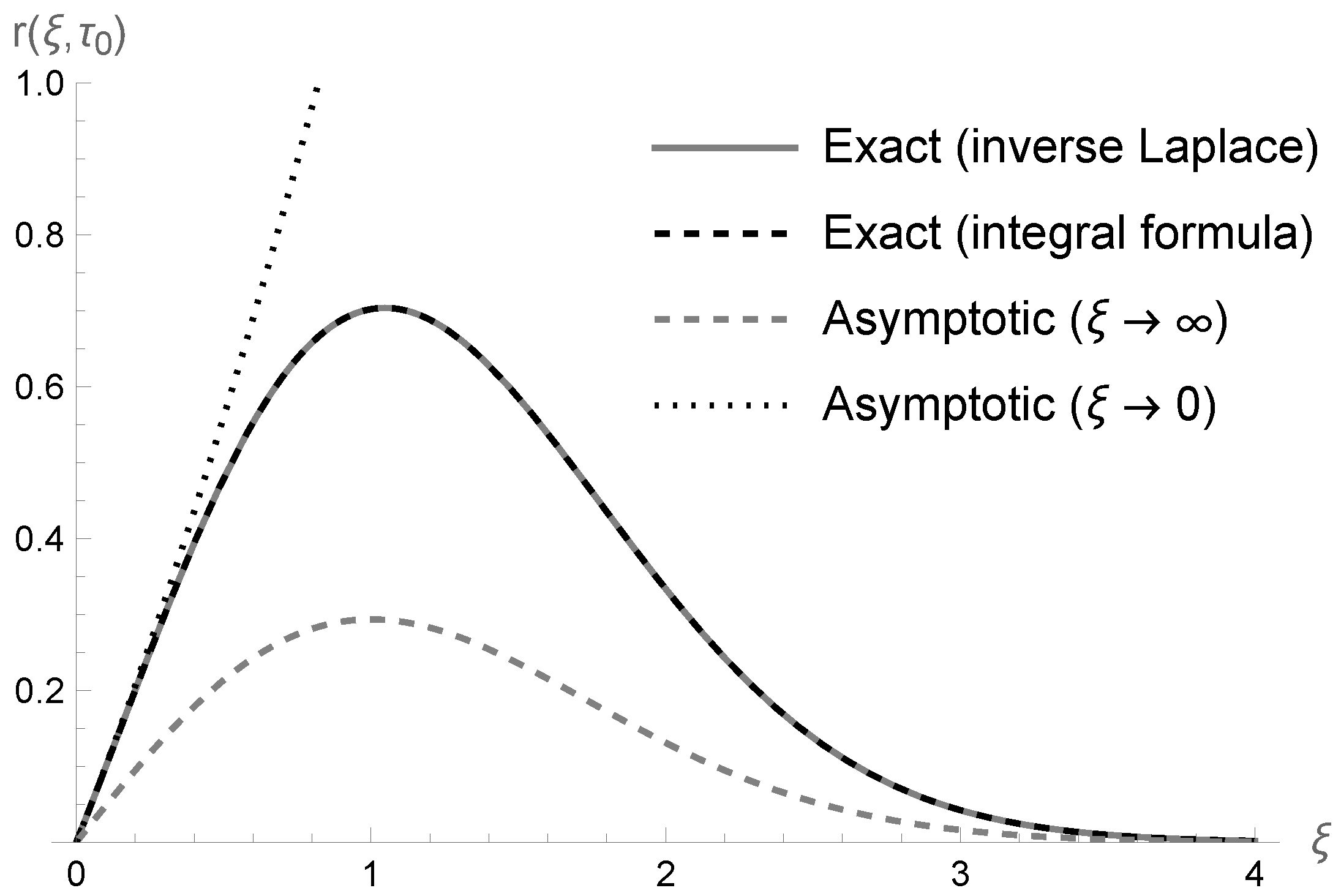
Figure 2 shows that the solution r ξ , τ given in terms of the inverse Laplace transform (31) is numerically equivalent to the integral solution (34). Indeed, the maximum discrepancy between both expressions in Figure 2 is 8.35081 × 10 11 , thus within the numerical error of (31) and (34) computed by MATHEMATICA (see the MATHEMATICA notebook available at https://shorturl.at/d0bgQ accessed on 11 January 2026). Also, the asymptotic representations for ξ , i.e., (36), and ξ 0 , i.e., (50), are numerically checked. Notice as well that, according to (32), we have
lim ξ 0 r ξ , τ = 1 = lim ξ 0 erfc ξ 2 τ ,
as we can see in Figure 2.

2.3. Delta Pulse Solution

For the case r 0 t = δ t / t ε , the solution given in (30) is reduced to
r ξ , τ = 0 τ δ τ τ e τ g ξ , τ d τ = e τ g ξ , τ ,
Therefore, according to (27), we have
r ξ , τ = e τ τ f ξ , τ
= e τ L 1 exp ξ s + ξ s ; τ ,
and according to the integral form of g ξ , τ given in (28), we have
r ξ , τ = e τ 4 π τ 5 / 2 ξ v 2 2 τ exp v 2 4 τ F 1 0 1 ; ξ v ξ d v .
Now, from (35) and (52), we arrive at the following asymptotic formula:
r ξ , τ ξ 2 π τ 3 / 2 exp ξ 2 4 τ τ , τ 0 or ξ .
Also, recasting (43) in terms of generalized hypergeometric functions, we have
f ξ , τ F 2 0 1 2 , 1 ; ξ 2 τ 4 + 2 ξ τ π F 2 0 3 2 , 3 2 ; ξ 2 τ 4 , τ ,
thus
r ξ , τ ξ e τ × 2 ξ 2 τ 9 π F 2 0 5 2 , 5 2 ; ξ 2 τ 4 + ξ 2 F 2 0 3 2 , 2 ; ξ 2 τ 4 + 1 π τ F 2 0 3 2 , 3 2 ; ξ 2 τ 4 , τ
Finally, from (48) we have
r ξ , τ ξ e τ ξ 2 + 1 π τ 1 + 1 2 τ , ξ 0 .
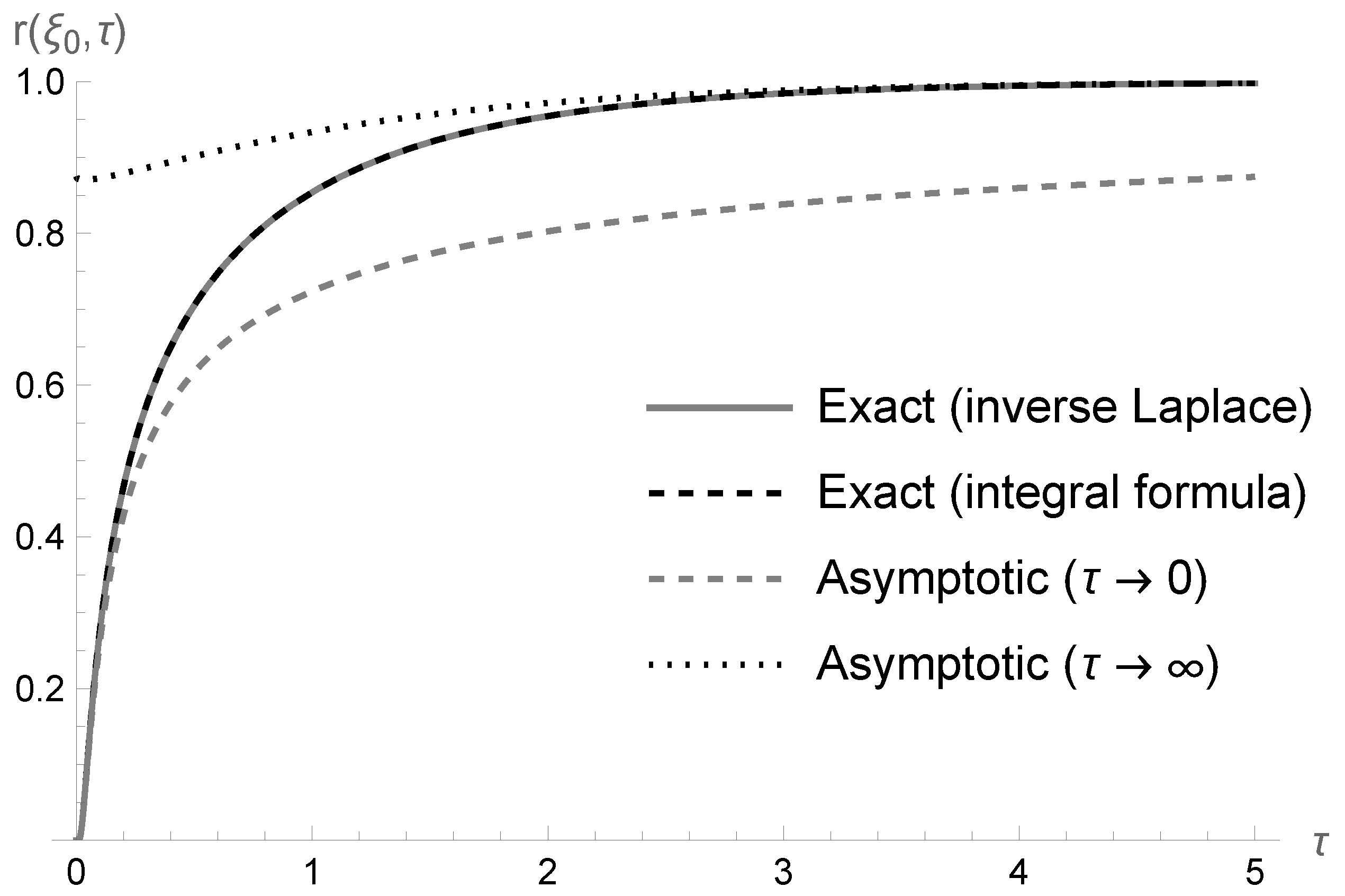
Figure 3 shows that the solution r ξ , τ given in terms of the inverse Laplace transform (53) is numerically equivalent to the integral solution (54). Indeed, the maximum discrepancy between both expressions in Figure 3 is 5.10461 × 10 9 , thus within the numerical error of (53) and (54) computed by MATHEMATICA (see the MATHEMATICA notebook available at https://shorturl.at/d0bgQ accessed on 11 January 2026). Also, the asymptotic representations for τ 0 , i.e., (55), and τ , i.e., (56) are numerically checked.
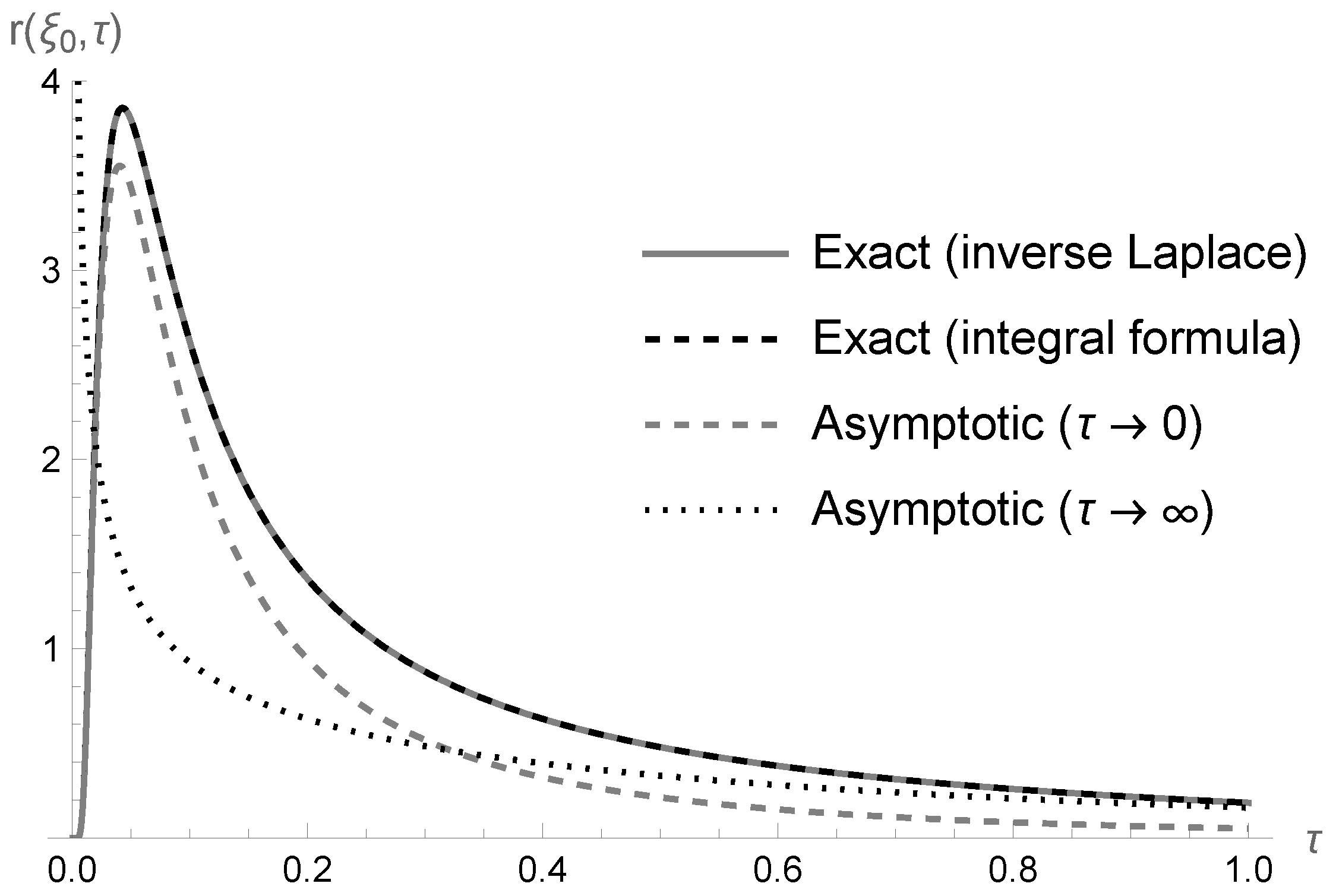
Figure 4 shows that the solution r ξ , τ given in terms of the inverse Laplace transform (53) is numerically equivalent to the integral solution (54). Indeed, the maximum discrepancy between both expressions in Figure 4 is 1.04126 × 10 11 ; thus, within the numerical error of (53) and (54) computed by MATHEMATICA (see the MATHEMATICA notebook available at https://shorturl.at/d0bgQ accessed on 11 January 2026). Also, the asymptotic representations for ξ , i.e., (55), and ξ 0 , i.e., (57), are numerically checked.

3. Conclusions

Using the dimensionless variables ξ and τ , defined in (16) and (17), we have derived an integral-form expression for the mechanical response r ξ , τ of an initially quiescent, semi-infinite homogeneous Kelvin–Voigt medium to a pulse r 0 τ applied at the origin. The general solution is given in (30),
r ξ , τ = 0 τ r 0 t ε τ τ e τ g ξ , τ d τ ,
where the kernel g ξ , τ is expressed in integral form by (28)
g ξ , τ = 1 4 π τ 5 / 2 ξ v 2 2 τ exp v 2 4 τ F ¯ 1 0 1 ; ξ v ξ d v .
For a delta-pulse excitation r 0 τ = δ τ , we obtained the explicit integral representation given in (54):
r ξ , τ = e τ 4 π τ 5 / 2 ξ v 2 2 τ exp v 2 4 τ F ¯ 1 0 1 ; ξ v ξ d v .
Numerical comparisons confirm that this formulation is computationally efficient and fully equivalent to the corresponding inverse Laplace transform solution given in (53)
r ξ , τ = e τ L 1 exp ξ s + ξ s ; τ .
In contrast, the integral solution given by Hanin [6] is less efficient from a computational point of view (see the MATHEMATICA notebook available at https://shorturl.at/d0bgQ accessed on 11 January 2026):
r ξ , τ = 2 ξ π τ 0 1 e 2 τ u 2 cos 2 u ξ τ 1 u 2 d u + e 2 τ π 0 e τ u sin 2 + u 1 + u ξ sin 2 ξ d u .
The integral solution given by Dozio [14] in dimensionless variables reads as
r ξ , τ = e τ ξ 2 2 + 2 π 0 u e τ u 2 sin ξ 1 u + u d u .
However, it seems that this solution is not correct from our numerical experiments (see the MATHEMATICA notebook available at https://shorturl.at/d0bgQ accessed on 11 January 2026). Nonetheless, the delta-pulse solution derived here allows us to obtain simple and explicit asymptotic formulas for the response as τ 0 , and ξ 0 , , summarized in (55)–(57):
r ξ , τ ξ 2 π τ 3 / 2 exp ξ 2 4 τ τ , τ 0 or ξ ,
r ξ , τ ξ e τ ξ 2 + 1 π τ 1 + 1 2 τ , ξ 0 ,
and,
r ξ , τ ξ e τ × 2 ξ 2 τ 9 π F 2 0 5 2 , 5 2 ; ξ 2 τ 4 + ξ 2 F 2 0 3 2 , 2 ; ξ 2 τ 4 + 1 π τ F 2 0 3 2 , 3 2 ; ξ 2 τ 4 τ .
Similarly, we have obtained an integral-form solution for a step-pulse excitation r 0 τ = θ τ , given in (34)
r ξ , τ = ξ F ¯ 1 0 1 ; ξ v ξ exp v 2 4 τ τ π τ + e v 2 erfc v 2 τ 2 τ e v 2 erfc v + 2 τ 2 τ d v .
This solution is numerically equivalent to the inverse Laplace transform representation in (31)
r ξ , τ = L 1 1 s exp ξ s 1 + s ; τ ,
and is more convenient for both numerical evaluation and asymptotic analysis than earlier formulations found in the literature. For instance, the integral solution given by Morrison [5],
r ξ , τ = e τ π 0 τ cos 2 u τ u u τ u exp 2 u ξ 2 4 u d u ,
seems to be simpler, but it is numerically difficult to compute for τ 1 (see the MATHEMATICA notebook available at https://shorturl.at/d0bgQ accessed on 11 January 2026). Also, it does not seem to be an easy task to obtain from Morrison’s integral solution the asymptotic behavior as ξ , τ 0 , . Nevertheless, from our step-pulse integral representation, we derived asymptotic expressions for small and large values of ξ and τ , reported in (36), (46) and (50):
r ξ , τ erfc ξ 2 τ , τ 0 or ξ ,
r ξ , τ 1 ξ 2 e τ 1 2 F 2 0 1 2 , 2 ; ξ 2 τ 4 + 2 ξ τ 3 π F 2 0 3 2 , 5 2 ; ξ 2 τ 4 , τ ,
and
r ξ , τ 1 e τ π τ ξ 1 + e τ 2 ξ 2 , ξ 0 .
Finally, we note that all numerical checks and the graphical illustrations presented in this paper were carried out using MATHEMATICA. The corresponding MATHEMATICA notebook is available at https://shorturl.at/d0bgQ accessed on 11 January 2026.

Author Contributions

Conceptualization, J.L.G.-S. and F.M.; methodology, J.L.G.-S., F.M. and A.M.; software, J.L.G.-S.; data curation, J.L.G.-S., F.M. and A.M.; writing—original draft preparation, J.L.G.-S.; writing—review and editing, J.L.G.-S., F.M. and A.M.; supervision, F.M. and A.M. All authors have read and agreed to the published version of the manuscript.

Funding

The research of F. Mainardi and A. Mentrelli was carried out in the framework of the activities of the Italian National Group of Mathematical Physics [Gruppo Nazionale per la Fisica Matematica (GNFM), Istituto Nazionale di Alta Matematica (INdAM)]. A. Mentrelli is partially funded by the European Union—NextGenerationEU under the National Recovery and Resilience Plan (PNRR)—Mission 4 Education and research, Component 2 From research to business—Investment 1.1 Notice PRIN 2022—DD N. 104 dated 2 February 2022, entitled “The Mathematics and Mechanics of Non-linear Wave Propagation in Solids” (proposal code: 2022P5R22 A; CUP: J53D23002350006), and by the Italian National Institute for Nuclear Physics (INFN), grant FLAG.

Data Availability Statement

No new data were created or analyzed in this study. Data sharing is not applicable.

Conflicts of Interest

The authors declare no conflicts of interest.

References

  1. Mainardi, F. Fractional Calculus and Waves in Linear Viscoelasticity: An Introduction to Mathematical Models, 2nd ed.; World Scientific: Singapore, 2022. [Google Scholar]
  2. Hunter, S. Viscoelastic waves. In Progress in Solid Mechanics; Sneddon, I., Hill, R., Eds.; North-Holland: Amsterdam, The Netherlands, 1960; Chapter 1; pp. 3–60. [Google Scholar]
  3. Jeffreys, H. Damping in bodily seismic waves. Mon. Not. R. Astron. Soc. Geophys. Suppl. 1931, 2, 318–323. [Google Scholar] [CrossRef][Green Version]
  4. Lee, E.H.; Morrison, J.A. A comparison of the propagation of longitudinal waves in rods of viscoelastic materials. J. Polym. Sci. 1956, 19, 93–110. [Google Scholar] [CrossRef]
  5. Morrison, J.A. Wave propagation in rods of Voigt material and visco-elastic materials with three-parameter models. Q. Appl. Math. 1956, 14, 153–169. [Google Scholar] [CrossRef]
  6. Hanin, M. Propagation of an aperiodic wave in a compressible viscous medium. J. Math. Phys. 1957, 36, 234–249. [Google Scholar] [CrossRef]
  7. Collins, F. Plane compressional Voigt waves. Geophysics 1960, 25, 483–504. [Google Scholar] [CrossRef]
  8. Clark, G.B.; Rupert, G.B. Plane and spherical waves in a Voigt medium. J. Geophys. Res. 1966, 71, 2047–2053. [Google Scholar] [CrossRef]
  9. Clark, G.B.; Rupert, G.B.; Jamison, J.E. Series transform solutions for Voigt transients. Q. Appl. Math. 1968, 25, 349–361. [Google Scholar] [CrossRef]
  10. Jaramillo, E.E.; Colvin, J.D. Transient waves in a Voigt medium. J. Geophys. Res. 1970, 75, 5767–5774. [Google Scholar] [CrossRef]
  11. Mainardi, F. On the seismic pulse in a standard linear solid. Pure Appl. Geophys. 1972, 99, 72–84. [Google Scholar] [CrossRef]
  12. Buchen, P.; Mainardi, F. Asymptotic expansions for transient viscoelastic waves. J. Mécanique 1975, 14, 597–608. [Google Scholar]
  13. Mainardi, F.; Turchetti, G. Wave front expansions for transient viscoelastic waves. Mech. Res. Commun. 1975, 2, 107–111. [Google Scholar] [CrossRef]
  14. Dozio, M. On the propagation of signals in Kelvin-Voigt viscoelastic rods. Meccanica 1990, 25, 199–203. [Google Scholar] [CrossRef]
  15. Colombaro, I.; Giusti, A.; Mainardi, F. On transient waves in linear viscoelasticity. Wave Motion 2017, 74, 191–212. [Google Scholar] [CrossRef]
  16. Schiff, J.L. The Laplace Transform: Theory and Applications; Springer Science & Business Media: Berlin/Heidelberg, Germany, 1999. [Google Scholar]
  17. Prudnikov, A.P.; Brychkov, Y.; Marichev, O.I. Integrals and Series: Inverse Laplace Transforms; CRC Press: Boca Raton, FL, USA, 1986; Volume 5. [Google Scholar]
  18. Lebedev, N.N. Special Functions and Their Applications; Prentice-Hall Inc.: Saddle River, NJ, USA, 1965. [Google Scholar]
  19. Prudnikov, A.P.; Brychkov, Y.A.; Marichev, O.I. Integrals and Series: Elementary Functions; CRC Press: Boca Raton, FL, USA, 1986; Volume 1. [Google Scholar]
  20. Olver, F.W.J.; Olde Daalhuis, A.B.; Lozier, D.W.; Schneider, B.I.; Boisvert, R.F.; Clark, C.W.; Miller, B.R.; Saunders, B.V.; Cohl, H.S.; McClain, M.A. (Eds.) NIST Digital Library of Mathematical Functions. Version 1.2.5. Available online: https://dlmf.nist.gov/ (accessed on 11 January 2026).
  21. Oldham, K.B.; Myland, J.; Spanier, J. An Atlas of Functions: With Equator, the Atlas Function Calculator; Springer: Berlin/Heidelberg, Germany, 2009. [Google Scholar]
Figure 1. Graph of r ξ 0 , τ with ξ 0 = 0.5 for the step pulse solutions and the asymptotic approximations in the Kelvin–Voigt model.
Mathematics 14 00528 g001
Figure 2. Graph of r ξ , τ 0 with τ 0 = 0.5 for the step pulse solutions and the asymptotic approximations in the Kelvin–Voigt model.
Mathematics 14 00528 g002
Figure 3. Graph of r ξ 0 , τ with ξ 0 = 0.5 for the delta pulse solutions and the asymptotic approximations in the Kelvin–Voigt model.
Mathematics 14 00528 g003
Figure 4. Graph of r ξ , τ 0 with τ 0 = 0.5 for the delta pulse solutions and the asymptotic approximations in the Kelvin–Voigt model.
Mathematics 14 00528 g004
Table 1. The four types of viscoelasticity.
Type J g J e G g G e
I>0<∞<∞>0
II>0=∞<∞=0
III=0<∞=∞>0
IV=0=∞=∞=0
Disclaimer/Publisher’s Note: The statements, opinions and data contained in all publications are solely those of the individual author(s) and contributor(s) and not of MDPI and/or the editor(s). MDPI and/or the editor(s) disclaim responsibility for any injury to people or property resulting from any ideas, methods, instructions or products referred to in the content.