


Abstract
Right groups form an important bridge between group theory and semigroup theory, combining the algebraic symmetry of groups with the one-sided structure of right zero semigroups. This paper develops a complete structural and enumerative theory of right groups. We describe all sub-right groups, Green’s equivalences, Rees’ congruences, and quotients in explicit algebraic terms. Closed formulas and asymptotic estimates are obtained for right groups, sub-right groups, subsemigroups, normal sub-right groups, Rees congruences, and quotient structures, together with a precise comparison between projection and Rees’ quotients. The results unify the structure, combinatorics, and quotient theory of right groups and provide a framework for further investigations into categorical and varietal aspects of right groups.
Keywords:
right groups; semigroups; sub-right groups; normal sub-right groups; subsemigroups; enumeration; Rees’ congruences MSC:
20M10; 20M17; 20M25; 20E07; 20F05; 68Q70; 68R15
1. Introduction
Right groups occupy a central position in semigroup theory, providing one of the clearest interfaces between group structure and one-sided semigroup behavior. Each right group , with G a group and R a right zero semigroup, blends the algebraic regularity of G with the unilateral degeneracy of R. This decomposition makes right groups simultaneously transparent and structurally rich: the group factor encodes all symmetries, while the right zero factor distributes them across fibers in a highly controlled way.
Beyond their algebraic relevance, right groups also arise naturally in computer science and information systems. The right zero component models deterministic “last-operation wins” behavior in synchronizing automata, routing protocols, and pipeline architectures, while the group component captures reversible state transformations. As a result, right groups serve as compact algebraic models for systems in which the final process overwrites intermediate computations—an effect familiar from compiler passes, control sequencing, and reversible computation.
The purpose of this paper is to develop a comprehensive structural and enumerative theory of right groups. We provide explicit descriptions of their subsemigroups, sub-right groups, normal sub-right groups, Green’s equivalences, and Rees’ congruences, showing in each case how the group part G determines the algebraic structure while the right zero factor R multiplies or indexes the resulting families. This yields closed formulas for the number of sub-right groups and uniform-layer subsemigroups, together with level-by-level refinements and containment counts. A complete classification of isomorphism types of right groups of a given order is obtained, and explicit enumeration formulas are derived.
The quotient structure of right groups admits a complete description. Each normal subgroup of the group component gives rise to two different quotients: a projection-kernel quotient, which remains a right group, and a Rees quotient, which introduces a zero and reflects the one-sided nature of multiplication. Normal sub-right groups correspond exactly to normal subgroups of the group component, and the families of projection kernels and Rees congruences have the same size. By contrast, the full congruence lattice is much larger, its growth is controlled by the Bell numbers, and the proportion of kernel or Rees congruences becomes negligible as the size of the right zero component increases. Similar asymptotic behavior appears when comparing normal sub-right groups with all sub-right groups and when contrasting uniform-layer subsemigroups with arbitrary subsemigroups.
These results provide a unified picture of the structure and combinatorics of right groups, showing that their behavior is governed entirely by the interplay between the symmetry of the group component and the combinatorial freedom of the right zero component. The framework developed here extends naturally to broader classes such as right-regular and completely simple semigroups and opens directions for further work on automorphisms, endomorphisms, and congruences.
Left groups and right groups form a dual pair within the general framework of strong semilattices of semigroups. The authors in [1,2,3] have developed a substantial body of work on the structure, endomorphisms, and automorphisms of strong semilattices of groups and left groups. More recently, Shah et al. [4] have further advanced the corresponding left-hand theory. In particular, ref. [5] analyzes structural properties of left groups, including endomorphisms and the behavior of homomorphism kernels and images, while [4] investigates group-like features such as Green’s relations and the correspondence between congruences and normal subgroups.
Despite these developments, essential structural and combinatorial aspects—most notably a comprehensive characterization and enumeration theory—have not been addressed in the existing literature. The present paper fills this gap by undertaking a systematic investigation of subgroup structure, subsemigroups, and enumeration phenomena in the setting of right groups.
Moreover, the present work develops a new and self-contained theory for right groups that goes beyond existing left-group results. We derive closed formulas for the number of non-isomorphic right groups, subsemigroups, sub-right groups, and normal sub-right groups; establish a sharp distinction between projection kernels and Rees quotients; and obtain complete congruence counts together with asymptotic bounds. These combinatorial and enumerative results are new and do not admit counterparts in the current literature on left groups and their strong semilattices. Finally, the structural and enumerative framework developed here provides a natural foundation for further investigations into endomorphisms, automorphisms, and congruence lattices of right groups and of their strong semilattices built from them. In particular, the explicit descriptions of subsemigroups and sub-right groups obtained in this paper are expected to play a central role in extending the automorphism and endomorphism theories previously developed for groups to the right-group setting.
Although the paper is formulated for right groups, all structural, combinatorial, and enumerative results admit precise dual analogues for left groups. Indeed, under the standard duality exchanging right zero and left zero components and reversing the order of multiplication, the arguments transfer verbatim: the torsion criteria, the description of subsemigroups via uniform fibers, and the resulting enumeration formulas remain valid in the left-group setting.
2. Preliminaries
A semigroup R is said to be a right zero semigroup if the multiplication on R satisfies for all , and we denote by the right zero semigroup of r elements. A right group is a semigroup S that is a direct product
where G is a group and R is a right zero semigroup, with multiplication in S given by
The basic properties of right groups are classical and can be found in standard texts on semigroups (see Clifford and Preston [6], Howie [7], Petrich [8], Lallement [9] and Howie and McFadden [10]).
Before we move further let us illustrate some of the common examples of right groups.
Example 1
(Trivial and cyclic right groups). If , then is the right zero semigroup itself. If is the cyclic group of order n, then is a right group of order .
Example 2
(Direct product of a nonabelian group with ). Let (the dihedral group of order 8) and . Then consists of two parallel copies of , and the product of any element from the first copy with one from the second lies in the second. Here two copies of are the layers and , each isomorphic to , and the product of any element from the first copy with one from the second copy lies in the second, as .
Example 3
(Permutation right group). If is the symmetric group on , then represents r “parallel layers” of the symmetric group, with right multiplication by transporting any element to layer j.
These examples illustrate the fibered structure of right groups. Every right group can thus be regarded as a bundle of groups over a right zero base. Many algebraic properties of S split as products of those of G and R, which underlies all results in the subsequent sections.
A semigroup S is said to be regular if for every element , there exists an element such that . Equivalently, S is regular if each of its elements is regular; that is, every satisfies the identity above for some . Let S be a semigroup and let denote the semigroup obtained from S by adjoining an identity element if one does not already exist. For an element , the principal left ideal generated by a is the set , the principal right ideal generated by a is the set , and the principal two-sided ideal (or simply the principal ideal) generated by a is the set .
Green’s relations describe the structure of a semigroup through its principal ideals. Elements are -related when they generate the same principal left ideal and -related when their principal right ideals coincide; their intersection captures equality of both. The relation corresponds to equality of principal two-sided ideals, while is the join of and , connecting elements through a chain of left- and right-relations. Together these relations partition the semigroup and reveal its internal ideal structure.
A semigroup is simple if it has no proper two-sided ideals and completely simple if it is simple and contains a primitive idempotent; equivalently, it has minimal left and right ideals, or every -class contains an idempotent. Completely simple semigroups are regular and include right groups as a special case. By the Rees theorem (Theorem 3.3.1 in [7]), every completely simple semigroup is isomorphic to a Rees matrix semigroup over a group G, where I and are nonempty index sets and is the sandwich matrix, with multiplication given by
In Theorem 1, we show that every right group is a particularly transparent instance of a Rees matrix semigroup, obtained by taking , , and . Hence each right group has the canonical form
with each -class a copy of G and the right zero set R indexing these classes. This representation provides a transparent framework that underpins the structural, enumerative, and asymptotic results developed in the paper.
For further background on semigroups, we refer to Clifford–Preston [6,11], Howie [7], Petrich [8], Lallement [9], and Rhodes–Steinberg [12]; for inverse semigroups [13]; for group theory to Robinson [14] and Scott [15]; and for combinatorial and lattice-theoretic notions to Stanley [16,17] and Volkov [18].
3. Canonical Structure of Right Groups
Right groups possess a canonical decomposition as a direct product of a group and a right zero semigroup. This structure, implicit in the work of Clifford and Preston [6] and Tamura and McAlister [19,20], deserves an explicit and constructive formulation. In this section we develop the canonical structural results that will underpin the combinatorial analysis of later sections.
To prepare for the proof of the canonical structure theorem, we record a few auxiliary results concerning intersections of principal right ideals and the normalization of single-row Rees matrix representations.
Lemma 1.
Let S be a regular semigroup and let K be a nonempty minimal two-sided ideal of S. Then K is completely simple.
Proof.
Since K is a nonempty minimal ideal of S, it is a simple semigroup. Moreover, in a regular semigroup, every element of a minimal ideal possesses a relative inverse (see, for example, [7]). Hence, for each , there exists such that . Setting , we obtain an idempotent belonging to K. Therefore, K contains idempotents.
In any regular semigroup, each -class containing an idempotent is a group. Consequently, for every , the -class is a subgroup of K. Furthermore, since every element of K lies in the -class of some idempotent, it follows that K is a union of groups.
By the Rees–Suschkewitsch Theorem (cf. [7], Theorem 3.3.1), a simple semigroup that is a union of groups is completely simple. Hence, K is completely simple. □
Lemma 2.
Let S be a semigroup in which every principal right ideal is generated by an idempotent. If are nonzero idempotents contained in the same minimal two-sided ideal of S, then the right ideals and intersect (i.e.,).
Proof.
Let K be the minimal two-sided ideal containing e and f. Since principal right ideals are generated by idempotents, for any there is an idempotent g with . Using minimality of K and regularity of elements in K (one may pass to an idempotent in each nonzero right ideal of K), one finds . Select with and write for some idempotent . Similarly get and idempotent h. By minimality , and so , which yields the required intersection in . □
We now show that a Rees matrix semigroup with a single row can always be reduced to the canonical form with a trivial sandwich row.
Here denotes the Rees matrix semigroup over a group G with singleton row set , column set I, and sandwich matrix ; in particular, is the completely simple semigroup with multiplication reduced to Thus each -class is naturally isomorphic to G, while the index set I acts as a right zero component.
Lemma 3.
Let be a Rees matrix semigroup with a single row and sandwich row . Then
Proof.
Each element of M has the form with multiplication
For every let and define
Then for ,
since . Thus is a homomorphism. It is bijective, with inverse , and therefore an isomorphism. Hence the sandwich row may be normalized to the all-1 row. □
Combining the auxiliary lemmas above, we obtain the canonical form of any regular semigroup whose principal right ideals are idempotent-generated. This description appears in the next theorem.
Theorem 1
(Canonical structure). For a nonempty semigroup S, the following statements are equivalent.
- (i)
- S is regular, and every principal right ideal of S is generated by an idempotent.
- (ii)
- S is completely simple, and S has exactly one -class.
- (iii)
- (single row, trivial sandwich matrix) for some group G and nonempty set I.
- (iv)
- , where R is the right zero semigroup on I.
Proof.
(i) ⇒ (ii). Assume S is regular and every principal right ideal is generated by an idempotent.
First, every nonzero two-sided ideal of S contains an idempotent. Indeed, if J is a nonzero two-sided ideal and , then for some idempotent e, and hence .
Let J be a nonzero two-sided ideal, and select . Then . We claim that . Take arbitrary . By our hypothesis, for some idempotent f. By Lemma 2 the right ideals and meet, so is chosen. Since we have , hence . Thus , and therefore . Hence S has no proper nonzero two-sided ideals; S is simple.
Now S is regular, simple, and contains idempotents, so applying Lemma 1 with shows S is completely simple.
Finally, for any two idempotents simplicity gives elements with . Hence . But by the same intersection argument above, the right ideals and meet, so is chosen. Writing we get , so . By symmetry , and therefore . For arbitrary an idempotent e with is chosen; then equals the common right ideal generated by any idempotent. Therefore all principal right ideals coincide, and S has exactly one -class.
(ii) ⇒ (iii). Assume S is completely simple and has exactly one -class. By Rees’ theorem there exist a group G, nonempty index sets , and a sandwich matrix such that
In the Rees model the -classes correspond to the row index set I. Having exactly one -class forces ; write . Then S is isomorphic to the single-column Rees matrix semigroup . By Lemma 3 this single-column model is isomorphic to the Rees matrix semigroup with the trivial sandwich column, i.e., . This proves (iii).
(iii) ⇒ (iv). Assume . Writing elements as pairs (suppressing the fixed column index), the multiplication is
Let R be the right zero semigroup on (product ). The direct product , with product , has the same multiplication table, so . This gives (iv).
(iv) ⇒ (i). Assume with R the right zero semigroup on . For the element satisfies
so every element is regular. For any the principal right ideal ; idempotents are exactly , and each such idempotent generates S on the right. Hence every principal right ideal is generated by an idempotent. This proves (i). □
As an immediate consequence of the preceding theorem, we obtain the following characterization of right groups.
Corollary 1.
A semigroup S is a right group if and only if it satisfies any (hence all) of the equivalent conditions in Theorem 1.
In view of the structural representation obtained above, we can determine the Green’s relations and principal ideal structure of right groups.
Theorem 2
(Ideals and Green’s relations, general). Let be a right group. Then
- (i)
- The -classes are the fibers for .
- (ii)
- There is a single -class, namely, S itself.
- (iii)
- Hence S has one -class.
- (iv)
- The principal left ideal of is , and every principal right ideal is S.
- (v)
- Thus S is completely simple with exactly minimal left ideals .
Proof.
(i) For and arbitrary , we have , . Conversely if then , giving the reverse inclusion. Thus any -class of S is exactly as claimed.
(ii) For any , we can write . Hence for every , so there is a single -class, namely, S itself.
(iii) Since and has one class, has one class (the whole semigroup).
(iv) Items (a) and (b) together describe the principal left and right ideals as claimed.
(v) Each fiber is a nonzero left ideal, and it is minimal (no proper nonzero left ideal sits inside a single fiber); hence, these are precisely the minimal left ideals of S. Their number equals the cardinality of R, i.e., there are minimal left ideals. Together with (b) and (c) this shows S is completely simple with the stated family of minimal left ideals. □
The canonical description of a right group immediately yields the structure of its -classes.
Corollary 2
(-classes of a right group). For a right group , the -classes are exactly the fibers for . Each is a group isomorphic to G, and these are precisely the maximal subgroups of S.
Proof.
By Theorem 2 the -classes are , and S is a single -class. Thus consists of exactly the sets , one for each . For fixed , the set is closed under multiplication, , so is a group with identity and inverses . The projection is a group isomorphism . Since the idempotents of are exactly the elements with , the maximal subgroups are the -classes of these idempotents. Thus the maximal subgroups of S are exactly the fibers . □
Remark 1.
A right group has exactly maximal subgroups, one for each , and each is canonically isomorphic to G.
We now determine the number of Green’s classes and subgroups in a finite right group.
Proposition 1
(Counting Green’s classes and subgroups in a finite right group). Let S be a finite right group, where G is a finite group of order and is the right zero semigroup on r elements. The numbers of Green’s classes and subgroups in S are as follows:
| Structure | Number in |
| -classes | r |
| -classes | 1 |
| -classes | 1 |
| -classes | r |
| Maximal subgroups | r |
| All subgroups of S |
Here denotes the number of subgroups of the group G.
Proof.
Write with the right zero semigroup. For each fixed i the left ideal generated by is , so the -classes are exactly the fibers (there are r of them). The principal right ideal of any element is , so all elements are -related and there is a single -class. Thus , giving one -class.
Since and is universal, each -class equals the corresponding -class ; hence there are r -classes, each a subgroup isomorphic to G. These are precisely the maximal subgroups of S.
Finally, every subgroup of S lies inside some maximal subgroup , and conversely each subgroup of G yields a subgroup of . Therefore the total number of subgroups of S is . □
Having identified right groups with direct products of a group and a right zero semigroup, we can now characterize all homomorphisms between them.
Proposition 2
(All homomorphisms between right groups). For right groups and , every semigroup homomorphism is uniquely of the form , where is a group homomorphism and is any function. Conversely, every such pair defines a homomorphism.
Proof.
This is straightforward and follows on similar lines to the case of left groups (see Theorem 4.1 of [5]). □
Corollary 3
(Isomorphism classification of right groups). Right groups and are isomorphic (as semigroups) if and only if (as groups) and (as right zero semigroups, equivalently as sets).
Proof.
(⇒) If is an isomorphism, then by Proposition 2 there exist and a bijection such that . Invertibility of forces to be a group isomorphism and a bijection, so and .
(⇐) Conversely, given a group isomorphism and a bijection , is an isomorphism with inverse . □
It easy to see that for every non-empty set I, there is exactly one right zero semigroup structure on I, so the above corollary can be restated as follows.
Corollary 4
(Isomorphism classification of right groups). Let and be right groups. Then
In particular, for fixed the isomorphism type of S is determined exactly by the isomorphism type of G.
4. Enumeration of Non-Isomorphic Right Groups
The classification and enumeration of right groups up to isomorphism provides the natural starting point for analyzing their structure. Since each finite right group is of the form , the enumeration problem reduces to understanding how the choices of G and the size r of the right zero factor determine distinct isomorphism types. In this section we derive explicit formulas for the number of non-isomorphic right groups of a given order. Let be the number of groups of order n, the number of prime factors of n, the divisor function, and the number of non-isomorphic right groups of size n. The next theorem provides the foundation for all subsequent enumerative results.
Theorem 3
(Master count). For every , the number of non-isomorphic right groups of size n is
Proof.
Any right group S of size n has the form with and such that . Fix . There are exactly isomorphism classes for G, and (up to isomorphism) exactly one right zero semigroup of size . Thus each divisor d contributes distinct isomorphism classes, and summing over yields the formula. □
Corollary 5
(Fixed group size or fixed index size).
- (i)
- For fixed and , the number of non-isomorphic right groups of the form with , is exactly .
- (ii)
- For fixed , the number of non-isomorphic right groups of size n with is if and 0 otherwise.
Proof.
Parts (i) and (ii) follow immediately from Theorem 3 since I contributes no nontrivial isomorphism variation beyond its cardinality. □
The following is a well known fact in group theory, and so its proof is omitted here.
Lemma 4
(Multiplicativity of f). If then .
The following result provides a fundamental enumeration formula that captures how the arithmetic structure of n governs the diversity of right groups of that size.
Theorem 4.
Let be the prime-power factorization of . The number of non-isomorphic right groups of size n is
Proof.
By Theorem 3
For the product form: if and with , then every group of order d is (up to isomorphism) a direct product of a -groups across the primes, and the choice of the -primary factors is independent across coprime components. Since f by Lemma 4 is multiplicative, we have
This completes the factorization of the divisor sum. □
We now illustrate the application of Theorem 4 by computing the number of non-isomorphic right groups for some values of n.
Example 4.
- (i)
- Let . Using the multiplicative form of Theorem 4, we obtain
- (ii)
- Let . Since n is a prime power, Theorem 4 yields
- (iii)
- Let . For the prime factors we computeHence, Alternatively, using the divisor–sum formulation,since there is exactly one group of order 18.
As immediate consequences of Theorem 4, we obtain explicit formulas for the cases when the order of the right group is a prime power.
Corollary 6
(Prime powers and squarefree n). If , then
Proof.
If then in the prime factorization we have and . Hence the product formula in the displayed factorization of previous theorem contains a single factor, so
as required. □
Corollary 7.
If is prime, then
Proof.
For a prime p, there are exactly two divisors 1 and p. Since (the trivial group) and (the cyclic group of order p), we have
Thus, there are precisely two non-isomorphic right groups of prime order, namely, the trivial right zero semigroup and the direct product . □
Example 5.
Prime cubes (uniform count for all primes). For any prime p,
Representatives are classified by the divisor and a group G of order d:
| d | Right groups | |
| 1 | 1 | |
| p | 1 | |
| 2 | ||
| 5 |
For odd primes p, it is classical that there are exactly five non-isomorphic groups of order . For , although the classification differs, there are again precisely five non-isomorphic groups of order 8, namely
Hence , and the equality remains valid for as well. Thus the enumeration formula for right groups of order holds uniformly for all primes.
For completeness, we include in an appendix explicit representatives of non-isomorphic right groups of orders 12 and 16, which serve to concretely illustrate the enumeration formula established in Theorem 4.
The classical theorem of Hölder [21], refined by Huppert [22], gives a complete classification and enumeration of groups of square-free order. Modern treatments may be found in Murty [23] and Murty-Srinivasan [24]. This result forms the foundation for our analysis.
Lemma 5
(Count of groups of square-free order). Let be square-free with . For each , let , and let denote the largest divisor of whose prime factors lie only in . Then
Using the Hölder–Huppert classification, the following theorem gives a fully explicit combinatorial formula for the number of right groups of any square-free order.
Theorem 5
(Enumeration of right groups of square-free order). Let be square-free with . For any subset and any , let
Then the number of right groups of order n is
Proof.
We have
Since is square-free, each divisor d corresponds uniquely to a subset (namely, ), so
By the lemma on groups of square-free order (Lemma 5), for a subset J the number of groups of order equals
where is the largest divisor of whose prime factors lie in . Substituting this expression into the sum over J yields the formula stated in the theorem. □
In the absence of any interaction among the prime factors of n, the enumeration simplifies dramatically, as captured by the following corollary.
Corollary 8
(Square-free, no ). Let be square-free with and assume no divides for . Then every square-free divisor admits exactly one group of order d, so .
Proof.
Let be square-free with and assume for all . For any square-free divisor , Lemma 5 gives
According to our hypothesis, no earlier prime in J divides ; hence
so each factor in the product is . Thus for every square-free divisor , and each such group is unique (indeed cyclic).
Applying Theorem 5 then gives
□
Corollary 9
(Square-free, with some ). For a square-free and each subset , let be the largest divisor of supported on earlier primes in J. Then
Whenever a relation with occurs, some , so .
Proof.
By Lemma 5, the number of isomorphism classes of groups of order is Since right groups of size n are exactly , we have , yielding the displayed formula. If some , then for any J with and we have ; hence, , so and therefore strictly increase over the baseline . □
Example 6
(Two primes). Let with .
- (i)
- If , then and .
- (ii)
- If , then so and .Representatives in the second case:
Corollary 10
(Divisor lower bound). For all , . If n is square-free, then .
Proof.
For each d there is at least one group of order d, namely, the cyclic group , so . Therefore
If n is squarefree, then , yielding the stated bound. □
The enumerative framework developed here completely determines the combinatorial structure of right groups and places their classification on firm arithmetic footing. It reveals how the multiplicative behavior of the underlying group-counting function governs the entire enumeration of right groups.
5. Subsemigroups and Sub-Right Groups of a Right Group
In this section we analyze the internal structure of a right group through its subsemigroups and sub-right groups. Although the product representation of right groups is classical, the detailed organization and enumeration of their substructures has not been systematically developed. We give a complete decomposition of all subsemigroups of S, identify precisely which ones are themselves right groups, and obtain explicit counting formulas for and . In particular, we show that every sub-right group splits canonically into a group component and a right zero component. A sub-right group of S is a subsemigroup that is itself a right group.
Theorem 6
(Structure of sub-right groups). Let be a right group. A subsemigroup is a sub-right group if and only if
where is a subgroup and .
Proof.
The proof follows a similar line to [5] [Lemma 2.6]. □
Example 7.
- (1)
- For , every sub-right group has the form with and nonempty, yielding infinitely many sub-right groups of each size.
- (2)
- For , sub-right groups are with and nonempty. Since has four subgroups and has seven nonempty subsets, S has sub-right groups.
To analyze the internal structure of a right group, it is useful to understand how its subsemigroups decompose along the right zero component. The next proposition provides a complete description of all subsemigroups of in terms of families of subsets of the group component.
Proposition 3
(Structure of subsemigroups of a right group). Let be a right group. Every subsemigroup has the form
where and each satisfies
Conversely, any nonempty family satisfying these closure conditions yields a subsemigroup of S.
Proof.
() Let be a subsemigroup and define and . Then . If and , then , and since , we obtain . Thus for all .
Conversely, suppose and nonempty sets satisfy . For , if then , , and hence . Thus , showing that T is closed under multiplication and therefore a subsemigroup. □
The next theorem characterizes subsemigroups which are sub-right groups.
Theorem 7
(Sub-right groups of a right group). Let be a right group. with multiplication , and let T, and be as in Proposition 3. Then T is a sub-right group of if and only if there exists a subgroup such that . In this case , and is a right zero subsemigroup of R.
Proof.
Assume first that T is a sub-right group of . The multiplication on T is the restriction, so the projection is a semigroup homomorphism, and its image is a group. For we have , so is chosen, i.e., . If is arbitrary, then , so . Since h ranges over H and , we see that . On the other hand, if then , so by the definition of H. Thus , and hence for all .
Conversely, suppose there is a subgroup such that for all . Then
For we have , and since H is a subgroup, while by assumption. Thus is closed under the multiplication inherited from and is clearly a right group with group component H and right zero component . Hence T is a sub-right group of . □
Example 8.
Let . Define
Here and . Since and , the closure conditions are satisfied. Thus T is a subsemigroup of S, though not a sub-right group (since ).
We now enumerate all sub-right groups of , showing they are precisely the sets with and nonempty.
The symbols and denote the set of all sub-right groups of S and subgroups of G, respectively.
Corollary 11
(Counting sub-right groups). Let be a right group.
If R is finite of size m, this specializes to
Proof.
If T is a sub-right group of S, then by Theorem 6, where is a subgroup and . Now taking into account all possible choices of the distinct H and and their possible arrangements gives the desired formulas. □
The following corollary shows that for finite group components, the notions of subsemigroups and sub-right groups in a right group coincide completely.
Corollary 12
(Finite G case: subsemigroups are sub-right groups). If G is finite, then every subsemigroup is a subgroup. Consequently, in with finite G, every subsemigroup T is a sub-right group:
Hence the total number of subsemigroups of S equals .
Proof.
Let H be a nonempty subsemigroup of the finite group G. Since G is finite, there exists such that some positive power of h is idempotent. As the identity e is the unique idempotent of G, we have . For any , finiteness of G implies that h has finite order, say . Since H is closed under multiplication, , and hence . Therefore, H is closed under inverses and contains the identity, and thus H is a subgroup of G.
The remaining assertions follow immediately from Proposition 3 and Corollary 11. □
Remark 2.
Thus the “new” phenomenon of subsemigroups that are not right groups can occur only when G is infinite.
Example 9
(Infinite group, non-right-group subsemigroup). Let and R any right zero semigroup. For , set . Let and define
Then and are subsemigroups of , and so is a subsemigroup of . Hence T is a subsemigroup of . However, is not a group (no inverses), so T cannot be a right group.
The next corollary refines the total count by stratifying sub-right groups according to the size of their right zero component.
Corollary 13
(Level-by-level count when R is finite). For with , the number of sub-right groups whose right zero component has size k is
Thus
Proof.
By Theorem 6, every sub-right group of is with and , and . Thus exactly when has size k.
For fixed k, a sub-right group with is obtained by choosing a subgroup (giving choices) and a k-subset (giving choices). The representation is unique, so
Summing over yields
□
The following corollary determines how many sub-right groups of a right group contain a given sub-right group as a subset.
Proposition 4
(Containment counts). For and nonempty , the number of sub-right groups containing is
In particular, if and , this equals .
Proof.
By Theorem 6, every sub-right group of is with and . We have
Indeed, inclusion of products forces by projection to R, and for any , the inclusion gives . Conversely, if and , then is immediate.
Thus sub-right groups containing correspond to all H with and all subsets with . There are choices for H, and choices for . Multiplying yields the stated count. □
Example 10.
For , the group has 4 subgroups, and has 7 nonempty subsets, giving ; moreover, exactly of these have right zero size k.
For , since is countable and has nonempty subsets, one obtains .
Thus there are countably many sub-right groups with a finite right zero component and continuum many with an infinite component.
When the group component is infinite, precise enumeration is harder; the next proposition gives general structural bounds for the number of subsemigroups in this setting.
Proposition 5
(Counting bounds for infinite G). Let with G infinite and R arbitrary, and write for the set of subsemigroups of G. Then
- 1.
- (Lower bound) At least subsemigroups arise, namely, the constant-layer sets with and .
- 2.
- (Crude upper bound) If , then
- 3.
- (Uniform layers) For each there are exactly subsemigroups with all layers equal to K.
Proof.
(1) (Lower bound). For any and any nonempty , the layers satisfy , so by Proposition 3 the set is a subsemigroup of S. Different choices of give distinct subsemigroups, yielding in total.
(2) (Crude upper bound). Assume . For any nonempty , a subsemigroup with this right zero support is determined by nonempty sets satisfying . Ignoring this condition gives at most possibilities, so
(3) (Uniform layers). Fix and take . Then , so each nonempty yields a valid subsemigroup . Hence there are exactly such subsemigroups for each K. □
The next theorem gives the exact quantitative relationship between subsemigroups and sub-right groups of a right group, including sharp bounds, precise counts, and the conditions under which they coincide.
Theorem 8
(Bounds between subsemigroups and sub-right groups). Let be a right group. Then
- 1.
- Bounds
- 2.
- Sub-right groups.and if , then
- 3.
- Lower bound.via the constant-layer subsemigroups .
- 4.
- Equality criterion. The following are equivalent:
- (a)
- .
- (b)
- Every subsemigroup of G is a subgroup.
- (c)
- G is torsion.
Hence if G is finite, then .
Proof.
(1) (Universal sandwich bounds). The inequality is immediate. By Proposition 3, any subsemigroup has the form
with and nonempty satisfying . Ignoring this condition, for fixed there are at most ways to choose the , so
This gives the full chain of bounds.
(2) (Explicit count of sub-right groups). By Theorem 6, sub-right groups of S are exactly
and the map is bijective. Hence
If , then for each k there are choices of with , and choices for H, giving
(3) (Lower bound via constant layers). For any and nonempty , setting for all yields , so is a subsemigroup. Distinct pairs give distinct T, so
(4) (Equality criterion).
(a) ⇒ (b). If every subsemigroup of S is a sub-right group, then for any and the set , being a subsemigroup, must be of the form with , so is a subgroup. Thus .
(b) ⇒ (c). If every subsemigroup of G is a subgroup and G contained an element of infinite order g, then would be a proper subsemigroup that is not a subgroup, a contradiction. Hence G is torsion.
(c) ⇒ (a). Assume G is torsion and let be a subsemigroup. For each put . Each is a subsemigroup of the torsion group G, hence a subgroup (since implies ). The layer condition then forces all to be equal: and , so . Thus with , showing that every subsemigroup is a sub-right group. For finite G this holds automatically since finite groups are torsion. □
The equivalence in part (4) of Theorem 8 is not restricted to the finite case. It also applies to infinite torsion groups. Indeed, if G is torsion, then every subsemigroup of G is automatically a subgroup: for any g in a subsemigroup , there exists such that , implying . In particular, this includes classical infinite torsion groups such as the Prüfer p-groups , in which every element has finite order although the group itself is infinite (see, for example, [14]). Consequently, for right groups with G an infinite torsion group, every subsemigroup of S is still a sub-right group, and the equality continues to hold. This shows that the equality criterion depends on the torsion property of G rather than on finiteness. The example constructed below justifies it.
Example 11
(Right groups over Prüfer groups with infinite right zero component). Let p be a prime and let be the Prüfer p-group,
Let R be an arbitrary (possibly infinite) right zero semigroup, that is, for all .
Define
with multiplication
Then S is a right group.
Let be a subsemigroup. Set , which is nonempty, and for each define
For , we have
so is a subsemigroup of . Since is a torsion group, every subsemigroup of is a subgroup; hence .
Moreover, for any and ,
which forces . Consequently,
where is a subgroup.
Thus, even when R is infinite, every subsemigroup of is a sub-right group, and
The preceding example yields the following general consequence for torsion right groups. The next corollary and remark clarify the role of the torsion condition in Theorem 8 by covering both the infinite torsion case and the necessity of this assumption.
Corollary 14.
Let be a right group, where G is a (possibly infinite) torsion group and R is a right zero semigroup. Then every subsemigroup of S is a sub-right group. In particular,
Proof.
Since G is torsion, every subsemigroup of G is a subgroup. Let be a subsemigroup. As shown in Example 11, each fiber is a subgroup of G, and all fibers coincide. Hence for some subgroup and nonempty , so T is a sub-right group. □
Remark 3
(Necessity of the torsion assumption). The torsion hypothesis in Theorem 8 is essential. Indeed, let and let be a right zero semigroup. For the right group with multiplication , the subset
is a subsemigroup of S. However, the fiber is not a subgroup of , so T is not a sub-right group. Thus, if G is not torsion, a right group may admit subsemigroups that are not sub-right groups, and consequently
The following corollary records the exponential growth of sub-right groups in the finite case and the jump to continuum once the right zero component becomes infinite.
Here means that A and B are of the same order of growth, i.e., each is bounded above and below by a constant multiple of the other. Also denotes a quantity that remains bounded independently of m.
Corollary 15
(Exponential growth and continuum threshold). For :
- 1.
- If G is finite and , then ; in fact
- 2.
- If and , then
Proof.
(1) From the formula
we get, for ,
since as . Thus grows like , and
(2) For , the general bounds give
With we have . If , then
so both lower and upper bounds are . Hence
showing the jump to continuum size once R is countably infinite. □
Example 12
(Infinite G with strict inequality). Let . Since , we have
However, has additive subsemigroups, and choosing independent layers with and yields
Thus
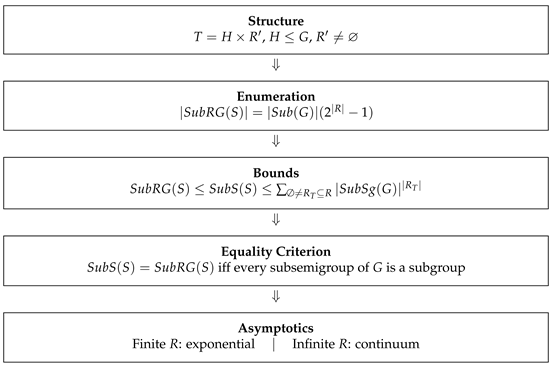
The results of this section provide a complete quantitative and structural description of the sub-right groups and subsemigroups of a right group . We established that every sub-right group decomposes canonically as with and , yielding exact enumeration formulas and universal bounds. For finite components, the number of sub-right groups grows exponentially with the size of the right zero part, while in the infinite setting this growth reaches the continuum threshold, producing families of uncountable cardinality. These findings illustrate a clear transition from combinatorial to set-theoretic behavior, linking algebraic structure with asymptotic and cardinal phenomena within the framework of right groups.
The overall logical flow and quantitative interdependence of the results established in this section are summarized schematically in the diagram below. It highlights the progression from structural characterization to enumeration, bounding, and asymptotic-cardinal growth behavior of sub-right groups.
6. Rees Congruences and Normal Sub-Right Groups in Right Groups
In this section we establish the precise correspondence between normal sub-right groups and Rees congruences in a right group . Every Rees congruence arises uniquely from a normal subgroup of G, so the normal and quotient structure of S is completely controlled by the normal subgroup lattice of G.
Definition 1
(Normal sub-right group). Let be a right group. A sub-right group is normal in S if
We now analyze normal sub-right groups and show that, in , normality is completely determined by the normal subgroup structure of G.
Theorem 9
(Characterization of normal sub-right groups). Let be a right group. A sub-right group N of S is normal in S if and only if
Proof.
It follows a similar line to Proposition 4 of [4]. □
The next proposition shows that taking quotients by normal sub-right groups preserves the right-group structure.
Proposition 6
(Quotients are right groups). If then is normal in , and
as right groups.
Proof.
Consider the map
where and . We first show that is a homomorphism of semigroups (indeed of right groups). For any , we have
On the other hand,
We next identify the kernel of . By definition,
Finally, since is surjective (every element has a preimage ), the First Isomorphism Theorem for semigroups gives
Hence the quotient of a right group by a normal sub-right group is again a right group, as claimed. □
Remark 4.
In semigroup theory, the kernel of a homomorphism is the congruence
For the map , we have
so the congruence classes of are precisely the sets . The class containing the identity layer corresponds to
which is therefore the kernel subset underlying the congruence . Thus N represents the kernel of the semigroup morphism φ in the usual sense, and the quotient coincides with .
Normal sub-right groups of correspond exactly to normal subgroups of G, and the product with R preserves all lattice operations.
Corollary 16
(Lattice correspondence). The assignment is an isomorphism of lattices between
with inclusion, meets, and joins preserved:
Proof.
Let , and consider the correspondence
By Theorem 9, every normal sub-right group of S is of the form for a unique normal subgroup . Hence is a bijection.
To verify that is a lattice isomorphism, we check the preservation of order, meets, and joins.
(Order preservation). If in G, then clearly in S, since inclusion holds coordinatewise. Conversely, if , then projecting onto the first coordinate gives . Thus preserves and reflects inclusion.
(Meet preservation). The meet (intersection) in both lattices is a set-theoretic intersection. Hence
because the second component is identical in both factors.
(Join preservation). The join in the lattice of normal subgroups is the subgroup generated by the union: . Since products distribute over unions in the direct product,
Thus the join is preserved.
Therefore is an isomorphism of lattices between the normal subgroup lattice of G and the normal sub-right-group lattice of S, with order, meets, and joins corresponding exactly as claimed. □
We denote by the set of normal sub-right groups of S and by the set of normal subgroups of G. The next corollary shows that these two sets have the same size.
Corollary 17
(Exact count). Let be a right group. Then
Proof.
By Theorem 9, normality forces with , and conversely any such H yields a normal sub-right group. Counting these is the same as counting normal subgroups of G. □
The following corollary contrasts the stability of the normal sub-right group count with the exponential growth of all sub-right groups, highlighting the consequence of Corollary 17.
Corollary 18
(Comparison with sub-right groups). For fixed G and variable m, we have
whereas
The next proposition shows that intervals of normal sub-right groups and corresponding quotients are completely governed by the normal subgroup lattice of G.
Proposition 7
(Intervals and quotients). For any , the normal sub-right groups above are in bijective correspondence with the normal subgroups containing . Consequently,
Proof.
By Theorem 9, every normal sub-right group of is of the form with . Thus
so the normal sub-right groups of S containing correspond bijectively to the normal subgroups of G. Taking cardinalities gives the first equality.
For the quotient , the canonical projection induces a bijection
because each normal sub-right group has preimage with and . Hence
□
Recall that for any ideal , the Rees congruence collapses all elements of I to one class and leaves all others singleton. For a right group , the next proposition shows that every Rees congruence arises uniquely from an ideal of the form with , giving a bijective correspondence between Rees congruences on S and normal subgroups of G.
Theorem 10
(Rees congruences on a right group). For a right group , every Rees congruence arises uniquely from an ideal of the form with ; conversely, each normal subgroup yields the Rees congruence . Thus Rees congruences on S are in bijection with .
Proof.
Let be a Rees congruence determined by an ideal . If , then for any we have , so membership in I depends only on the first coordinate. Define
If and , then , so . If , then
which implies and hence . Thus H is a subgroup of G.
To see that H is normal, take any and any with . For arbitrary we have
since I is an ideal. Hence , so .
Since every element of I has first coordinate in H, we have , and the argument above showing layer independence gives the reverse inclusion. Thus , proving that every Rees congruence is of the form for a unique . The converse direction is immediate: if , then is easily seen to be an ideal of S, so its associated Rees relation is a semigroup congruence. □
Corollary 19
(Bijection: normal subgroups ↔ Rees congruences). For a right group , the assignments
are mutually inverse bijections between the normal subgroups of G, the normal sub-right groups of S, and the Rees congruences on S.
Proof.
By Theorem 10, every Rees congruence on S is uniquely of the form with , and distinct normal subgroups give distinct ideals and hence distinct congruences. Thus the stated assignments define bijections between the three sets. □
The correspondence established in the above corollary can be represented by the following diagram.
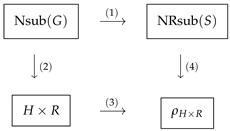
- (1)
- (2)
- (3)
- (4)
We write for the set of Rees congruences on S.
Corollary 20
(Count of Rees congruences). Let be a right group. Then, as an immediate consequence of Theorem 10,
In particular the number of Rees congruences depends only on the normal subgroup lattice of G and is independent of R.
Proof.
The proof is immediate from Theorem 10, which identifies every Rees congruence with a unique ideal coming from some , and vice versa. □
Corollary 21
(Global counting bounds). Let . Then
Moreover if then
Proof.
The left inequality holds because every Rees congruence comes from a normal sub-right group . The right inequality holds because every sub-right group is, in particular, a subsemigroup. The stated equalities follow from the Rees-normal correspondence and the sub-right group counting theorem. □
Example 13
(Comparison of Rees, sub-right, and all subsemigroups). Let .
(1) If and , then but , so .
(2) If and , then , while a continuum of independent layer choices gives , so .
(3) If G is finite abelian and , then every subsemigroup is a subgroup and every subgroup is normal; hence
We now complement the projection quotient (Proposition 6) by constructing the corresponding Rees quotient , laying the groundwork for comparing and enumerating these two quotient structures.
Theorem 11
(Rees quotient collapsing an ideal). Let and , and put . Then the Rees quotient is exactly the right group with a zero adjoined:
where the class of N becomes the zero.
Proof.
Define
where 0 is the adjoined zero. If then both and are 0; if then and
so is a homomorphism. It is surjective since every nonzero has preimage with , and 0 has preimages all of .
Because collapses N to 0, all elements of N lie in one kernel class; if , then and have the same R-coordinate and the same coset , exactly the pairs identified by . Thus .
Hence . □
Remark 5.
The projection identifies elements only within each H-coset and yields the right group . In contrast, the Rees congruence collapses the whole ideal to a single zero class, giving the Rees quotient ; the two constructions coincide only in trivial cases.
Corollary 22.
Let and . Then
- 1.
- is a group iff R is a singleton, in which case the quotient is .
- 2.
- is a group iff , i.e., and R is a singleton; then the quotient is the one-element group.
Proof.
(1) The product is a group only when the right zero factor is trivial; thus , giving .
(2) The Rees quotient contains a zero unless the entire semigroup collapses to one class, which occurs exactly when , equivalently and . In that case the quotient is the one-point group; otherwise it contains a zero and is not a group. □
Corollary 23.
Let and . Then
- 1.
- is simple iff and is a simple group.
- 2.
- is 0-simple iff and is a simple group.
Proof.
(1) In , any proper nonempty subset of R or any proper normal subgroup of produces a nontrivial ideal. Hence simplicity forces , and then the quotient reduces to the group , whose simplicity is exactly the remaining condition.
(2) The nonzero ideals of correspond to ideals of ; thus 0-simplicity requires to have no proper nonzero ideals, which by (1) happens precisely when and is simple. In that case the only proper ideal is . □
Quotienting by the projection kernel yields the right group , while collapsing via the Rees congruence produces with an adjoined zero. Thus the projection quotient is zero-free, whereas the Rees quotient is its zero-augmentation.
| Case | ||
| General | ||
| 1 (singleton) | 1 (singleton) | |
Having separated kernel congruences from Rees congruences, we now establish several useful counting formulas and bounds that highlight their distinct roles.
Proposition 8.
For the right group , the projection kernels (with ) and the Rees congruences are both in bijection with the normal subgroups of G. Hence
independent of the right zero factor R.
Proof.
By definition is indexed by normal subgroups . Distinct H produce distinct projection kernels , so .
The identification of Rees congruences with ideals of the form (Theorem 10) shows every Rees congruence is determined by a unique normal subgroup H, and every H produces the Rees congruence . Hence as well.
Combining the two equalities gives the displayed identity. The right zero factor R does not enter these counting arguments except as a passive factor, so the counts depend only on . □
In the next corollary denotes Bell number.
Corollary 24.
For the finite right group with ,
Hence the proportion of congruences that are projection kernels or Rees congruences is
which tends to 0 rapidly as .
Proof.
The equalities in the first line are Proposition 8. The factorization is the usual product decomposition of congruences discussed earlier. The displayed ratio follows immediately, and the asymptotic claim uses the known superpolynomial growth of the Bell numbers . □
7. Appendix: Explicit Right Groups of Small Orders
In this appendix we list explicit representatives of non-isomorphic right groups of small orders, illustrating the enumeration formula established in Theorem 4. Recall that every finite right group is of the form , where G is a finite group and is the right zero semigroup of size k.
Example 14.
Let . By Theorem 4,
Hence, there are exactly eight non-isomorphic right groups of order 12. They arise as direct products , where . Explicit representatives are listed below.
| 1 | 1 | |
| 2 | 1 | |
| 3 | 1 | |
| 4 | 2 | |
| 6 | 2 | |
| 12 | 1 |
This explicit list confirms that .
Example 15.
Let . Again by Theorem 4,
Thus, there are 23 non-isomorphic right groups of order 16. Each such right group is of the form , where . The contributions according to the group order are summarized below.
| 1 | 1 | |
| 2 | 1 | |
| 4 | 2 | |
| 8 | 5 | |
| 16 | 14 |
This example illustrates how the rapid growth of influences the total number of non-isomorphic right groups.
7.1. Future Directions and Applications
The structural and enumerative theory developed in this paper naturally suggests several directions for further research and potential applications.
7.1.1. Applications to Graph Theory
Finite right groups arise naturally in algebraic graph theory through Cayley digraphs and semigroup action digraphs. Let be a right group and let be a generating set. The (right) Cayley digraph has vertex set S and a directed edge for each and . Due to the multiplication rule
the digraph decomposes into parallel layers, each layer being a copy of the Cayley digraph of G with respect to the projection of A onto G. Edges between layers are entirely controlled by the right zero component and exhibit a uniform directional behavior.
Example 16.
Let be the dihedral group of order 8 and let . Then the Cayley digraph of consists of two parallel copies of the Cayley digraph of . Moreover, any edge corresponding to multiplication by an element with second coordinate maps vertices from either copy into the second layer. Congruences and sub-right groups of S correspond to quotient digraphs obtained by collapsing entire layers or factoring by normal subgroups of , making the enumeration results of this paper directly applicable to counting invariant subgraphs and quotient digraphs.
These observations indicate that right groups provide a tractable algebraic framework for studying layered digraphs, graph quotients, and symmetry-preserving decompositions.
7.1.2. Extensions to Non-Associative Structures
The methods developed in this paper also point toward extensions beyond the associative setting. Several key ideas—layer decompositions, projection kernels, and the interaction between a group-like component and a one-sided zero component—do not depend essentially on associativity but rather on directional absorption properties.
Example 17.
Let Q be a loop (or quasigroup) and let R be a right zero groupoid. One may define a non-associative structure on by
where · denotes the loop operation in Q. Although associativity may fail, the right zero component still forces a rigid layer behavior analogous to that of right groups. Substructures of such objects are expected to reflect a mixture of loop substructures and layer selection, suggesting a possible extension of the enumeration and congruence ideas developed here.
While a full theory in the non-associative setting lies beyond the scope of the present work, the results of this paper provide a foundational template for investigating right-sided constructions in quasigroups, loops, and groupoids with absorbing components.
These directions indicate that the theory of right groups developed here has relevance not only within semigroup theory but also in algebraic graph theory and in the emerging study of structured non-associative algebraic systems.
7.2. Conclusions
This paper provides a unified structural, enumerative, and congruential description of right groups . We showed that all algebraic properties of S are determined by the interaction between the group factor G and the right zero factor R: sub-right groups, ideals, and congruences correspond directly to substructures of G, while the Bell-number growth of partitions of R governs the size and complexity of the full lattice of subsemigroups and congruences. The quotient theory is completely resolved through the dichotomy between projection quotients and Rees quotients , which reflect the one-sided nature of right groups. These results establish a complete toolkit for analyzing right groups and suggest natural directions for further work, including the study of automorphisms and endomorphisms, refined congruence classifications, and deeper connections with varieties and computational complexity.
Author Contributions
Conceptualization, A.H.S., D.J.M. and B.A.S.; methodology, A.H.S., D.J.M. and B.A.S.; software, A.H.S., D.J.M. and B.A.S.; validation, A.H.S., D.J.M. and B.A.S.; formal analysis, A.H.S., D.J.M. and B.A.S.; investigation, A.H.S., D.J.M. and B.A.S.; resources, A.H.S., D.J.M. and B.A.S.; data curation, A.H.S., D.J.M. and B.A.S.; writing—original draft preparation, B.A.S. and D.J.M.; writing—review and editing, A.H.S., D.J.M. and B.A.S.; visualization, A.H.S., D.J.M. and B.A.S.; supervision, A.H.S., D.J.M. and B.A.S.; project administration, A.H.S., D.J.M. and B.A.S.; funding acquisition, A.H.S., D.J.M. and B.A.S. All authors have read and agreed to the published version of the manuscript.
Funding
This work was supported by the Deanship of Scientific Research, Vice Presidency for Graduate Studies and Scientific Research, King Faisal University, Saudi Arabia Grant No. KFU260221.
Institutional Review Board Statement
This study does not involve any human participants or animals. Hence, ethical approval is not applicable.
Data Availability Statement
The original contributions presented in this study are included in the article material. Further inquiries can be directed to the corresponding author.
Conflicts of Interest
The authors declare that there are no conflicts of interest regarding the publication of this manuscript.
References
- Shah, A.H.; Mir, D.J.; Khan, N.M. On Automorphisms of a Strong Semilattice Groups. Math. Open 2022, 1, 2250002. [Google Scholar] [CrossRef] [Scilit]
- Shah, A.H.; Mir, D.J. On Automorphisms of a Strong Semilattice of π-groups. Int. J. Nonlinear Anal. Appl. 2022, 13, 3031–3036. [Google Scholar] [CrossRef] [Scilit]
- Shah, A.H.; Attari, S.A. Structure and endomorphisms of a strong semilattice of left groups. Ric. Mat. 2025. [Google Scholar] [CrossRef] [Scilit]
- Shah, A.H.; Subaiei, B.A.; Attari, S.A.; Mir, D.J. On Group-like Properties of Left Groups. Mathematics 2025, 13, 3109. [Google Scholar] [CrossRef] [Scilit]
- Shah, A.H.; Attari, S.A.; Khan, N.M. Left Groups and Their Endomorphisms. Asian-Eur. J. Math. 2024, 17, 2450021. [Google Scholar] [CrossRef] [Scilit]
- Clifford, A.H.; Preston, G.B. The Algebraic Theory of Semigroups, Vol. I; American Mathematical Society: Providence, RI, USA, 1961. [Google Scholar]
- Howie, J.M. Fundamentals of Semigroup Theory; Oxford University Press: Oxford, UK, 1995. [Google Scholar]
- Petrich, M. Introduction to Semigroups; Merrill Publishing Company: Columbus, OH, USA, 1973. [Google Scholar]
- Lallement, G. Semigroups and Combinatorial Applications; Wiley: New York, NY, USA, 1979. [Google Scholar]
- Howie, J.M.; McFadden, R. Some Properties of One-sided Groups. Proc. Edinb. Math. Soc. 1978, 21, 81–90. [Google Scholar]
- Clifford, A.H.; Preston, G.B. The Algebraic Theory of Semigroups, Vol. II; American Mathematical Society: Providence, RI, USA, 1967. [Google Scholar]
- Rhodes, J.; Steinberg, B. The q-Theory of Finite Semigroups; Springer: Berlin/Heidelberg, Germany, 2009. [Google Scholar]
- Petrich, M. Inverse Semigroups; John Wiley & Sons: Hoboken, NJ, USA, 1984. [Google Scholar]
- Robinson, D.J.S. A Course in the Theory of Groups, 2nd ed.; Springer: Berlin/Heidelberg, Germany, 1996. [Google Scholar]
- Scott, W.R. Group Theory; Dover Publications: New York, NY, USA, 1987. [Google Scholar]
- Stanley, R.P. Enumerative Combinatorics, Vol. 2; Cambridge University Press: Cambridge, UK, 1999. [Google Scholar]
- Stanley, R.P. Enumerative Combinatorics, Vol. 1; Cambridge University Press: Cambridge, UK, 1987. [Google Scholar]
- Volkov, M.V. Combinatorial and lattice properties of semigroups. In Handbook of Algebra; Elsevier: Amsterdam, The Netherlands, 2003; Volume 3, pp. 711–764. [Google Scholar]
- Tamura, T. The theory of regular semigroups. J. Fac. Sci. Hokkaido Univ. Ser. I 1954, 13, 1–40. [Google Scholar]
- McAlister, D.B. Rees matrix covers for regular semigroups. Quart. J. Math. Oxf. 1977, 28, 213–226. [Google Scholar] [CrossRef] [Scilit]
- Hölder, O. Die Gruppen mit quadratfreier Ordnungszahl. Math. Z. 1895, 1, 261–290. [Google Scholar]
- Huppert, B. Endliche Gruppen I; Springer: Berlin, Germany, 1967. [Google Scholar]
- Murty, M.R. On groups of squarefree order. Math. Ann. 1984, 267, 415–419. [Google Scholar] [CrossRef] [Scilit]
- Murty, M.R.; Srinivasan, S. On the number of groups of squarefree order. Can. Math. Bull. 1987, 30, 438–445. [Google Scholar] [CrossRef] [Scilit]
Disclaimer/Publisher’s Note: The statements, opinions and data contained in all publications are solely those of the individual author(s) and contributor(s) and not of MDPI and/or the editor(s). MDPI and/or the editor(s) disclaim responsibility for any injury to people or property resulting from any ideas, methods, instructions or products referred to in the content. |
© 2026 by the authors. Licensee MDPI, Basel, Switzerland. This article is an open access article distributed under the terms and conditions of the Creative Commons Attribution (CC BY) license.