Optimal Surface for Elliptical Isolated Footings with Partially Compressed Contact Area

 , , ,
, , , 
 , and
, and
Abstract
1. Introduction
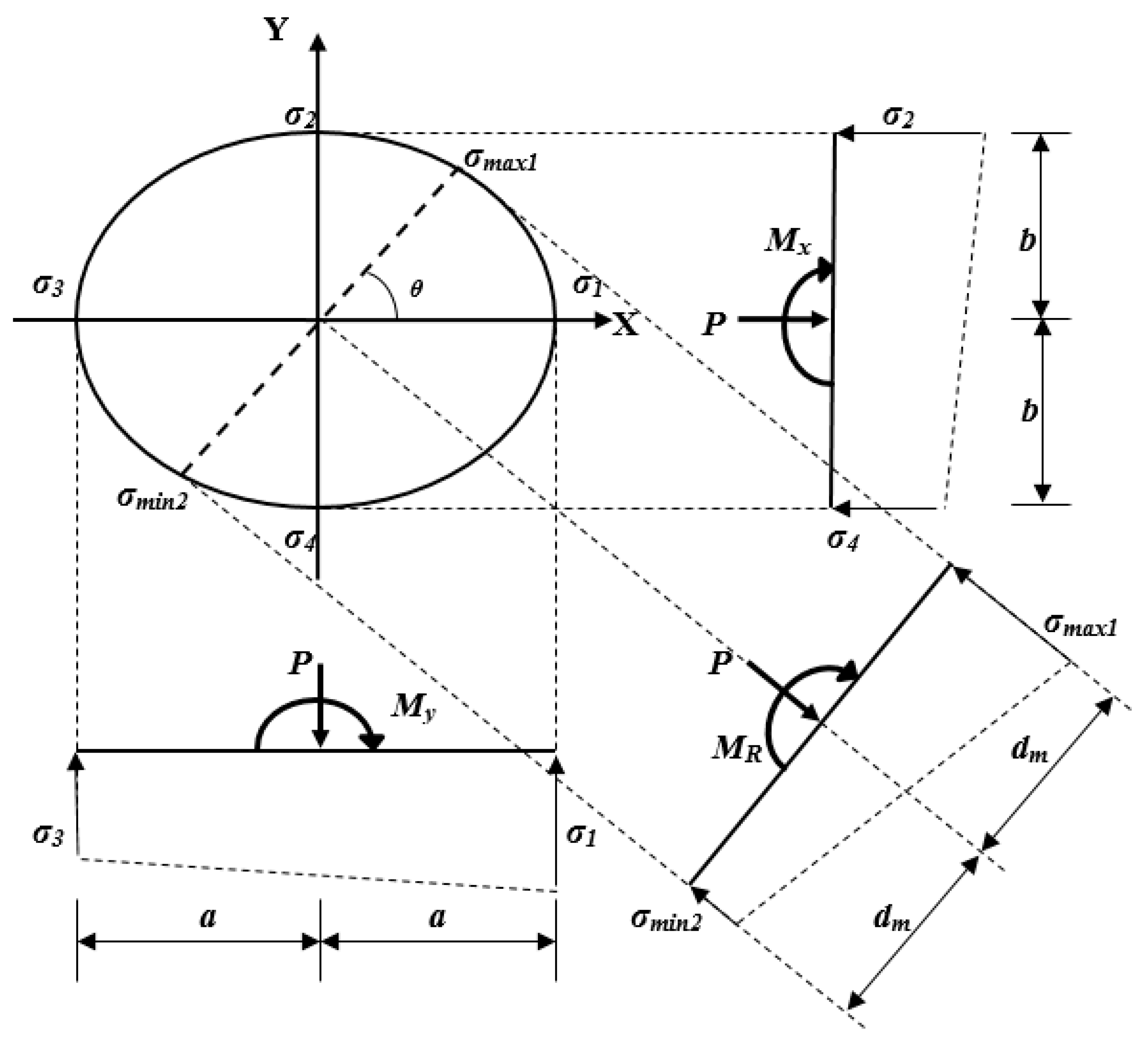
2. Formulation of the Model
2.1. Case I: Fully Compressed Area
2.2. Case II: Partially Compressed Area
2.3. Minimum Surface for EIFs
3. Numerical Examples
4. Results
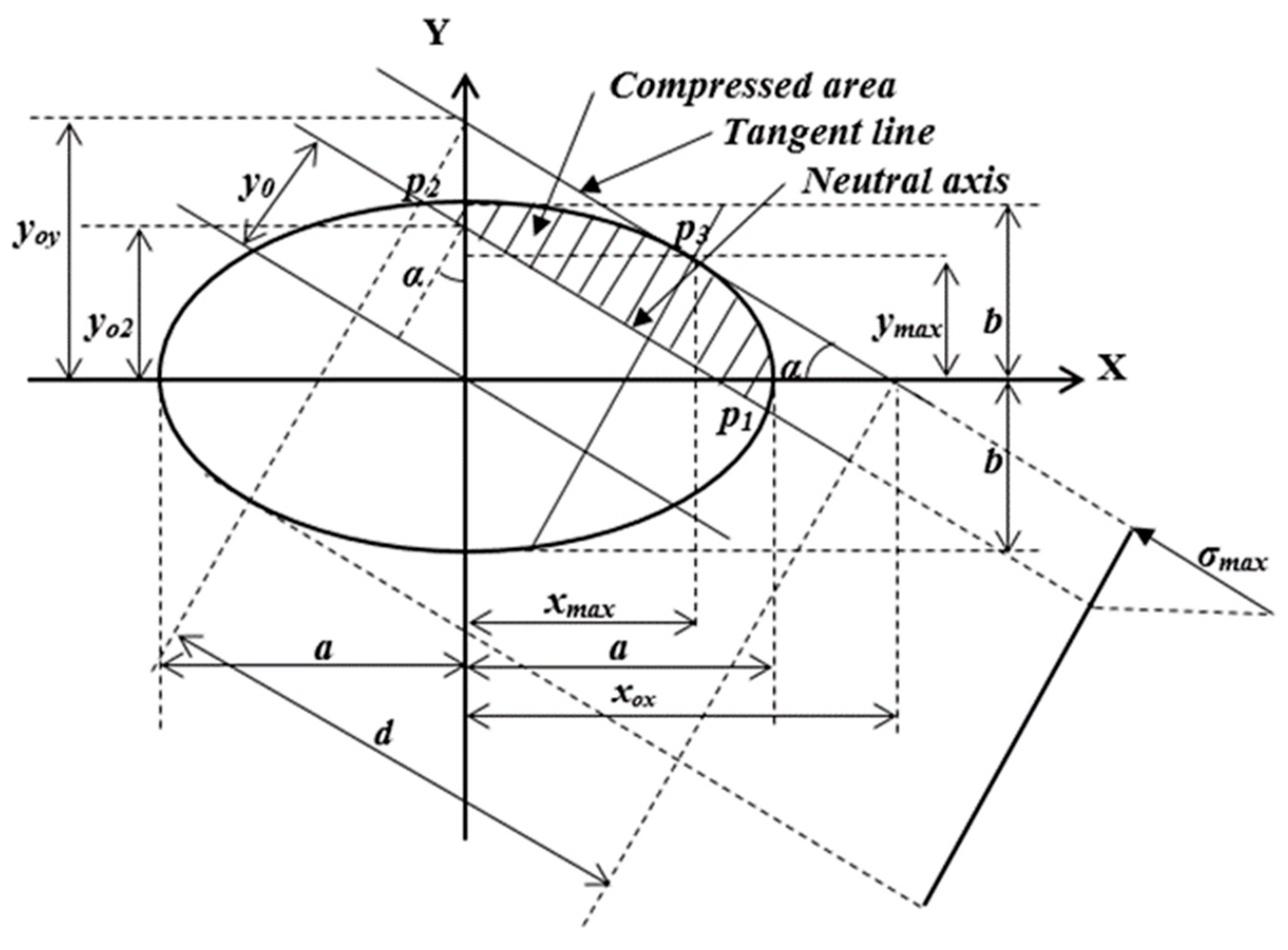
- Substituting x = xmax and y = ymax into Equation (24) gives σz = σmax.
- Substituting x = x1 and y = y1 into Equation (24) gives σz = 0.
- Substituting x = x2 and y = y2 into Equation (24) gives σz = 0.
- When P in Case I increases: a, b, and AminCI decrease; σ1 increases; σ2 is zero except in P = 2200 kN.
- When P in Case II increases: a, b, y0 (absolute value) and AminCII are the same up to P = 1200 kN, then they increase; σ1 reaches the maximum value of 200 kN/m2; σ2 is zero.
- In Case II, the values for P = 600, 800, 1000, 1200 kN present the same values in a, b, y0, σ1, σ2, and AminCII because P reaches a maximum value of P = 1367.83 kN.
- In all cases, the minimum area appears in Case II, except in example 9, where σ1 reaches the maximum value of 200 kN/m2 and the minimum area appears in Case I.
- In all cases, the values of a and b are equal, because the moments are equal.
- When P in Case I increases: a, b, and AminCI decrease up to P = 1800 kN, then they increase; σ1 increases up to P = 1800 kN, then it is equal; σ2 is zero up to P = 1600 kN, then it increases.
- When P in Case II increases: a, b, y0 (absolute value) and AminCII are equal up to P = 1000 kN, and then they increase; σ1 reaches the maximum value of 200 kN/m2; σ2 is zero.
- In Case II, the values for P = 600, 800, 1000 kN present the same values in a, b, y0, σ1, σ2, and AminCII because P reaches a maximum value of P = 1090.76 kN.
- In all cases, the minimum area appears in Case II, except in examples 7, 8, and 9, where σ1 reaches the maximum value of 200 kN/m2, and the minimum area appears in Case I.
- When My, in MPDG (Case I), decreases: a and AminCI decrease; b remains constant; σ1 tends to increase; σ2 practically is zero except in My = 150 kN-m.
- When My, in NMPA (Case II), decreases: a decreases; AminCII decreases up to My = 300 kN-m and then increases; b increases; y0 (absolute value) increases up to My = 500 kN-m, then decreases up to My = 300 kN-m, and then increases; σ1 reaches the maximum value of 200 kN/m2; σ2 is zero.
- In all cases, the minimum area appears in Case II, except in example 5, where the minimum area appears in Case I because σ1 reaches the maximum value of 200 kN/m2.
- When My decreases: AminCI/AminCII decreases.
- The highest AminCI/AminCII ratio appears at My = 900 kN-m of 2.46 times; this means that MPDG (Case I) is greater than NMPA (Case II).
- The smallest AminCI/AminCII ratio appears at My = 150 kN-m of 0.84 times; this means that NMPA (Case II) is greater than MPDG (Case I).
- When P in Case I decreases: a, b, and AminCI decrease up to P = 1300 kN, then they increase; σ1 practically reaches the maximum value of 200 kN/m2 up to P = 1300 kN, then it decreases; σ2 decreases up to P = 1100 kN, then it is constant and equal to zero.
- When P in Case II decreases: a decreases up to P = 1300 kN, and then it is constant; b and y0 (absolute value) decrease; AminCII decreases; σ1 reaches the maximum value of 200 kN/m2; σ2 is zero.
- In all cases, the minimum area appears in Case II, except in examples 1 and 2, where the minimum area appears in Case I because σ1 reaches the maximum value of 200 kN/m2.
- When P decreases: AminCI/AminCII increases.
- The highest AminCI/AminCII ratio appears at P = 700 kN of 2.91 times, which means that MPDG (Case I) is greater than NMPA (Case II).
- The smallest AminCI/AminCII ratio appears at P = 1500 kN of 0.84 times, which means that NMPA (Case II) is greater than MPDG (Case I).
- When Mx for RIFs increases: hx and hx1 decrease; hy, hy1, and AminVM increase, and this is present in all four studies.
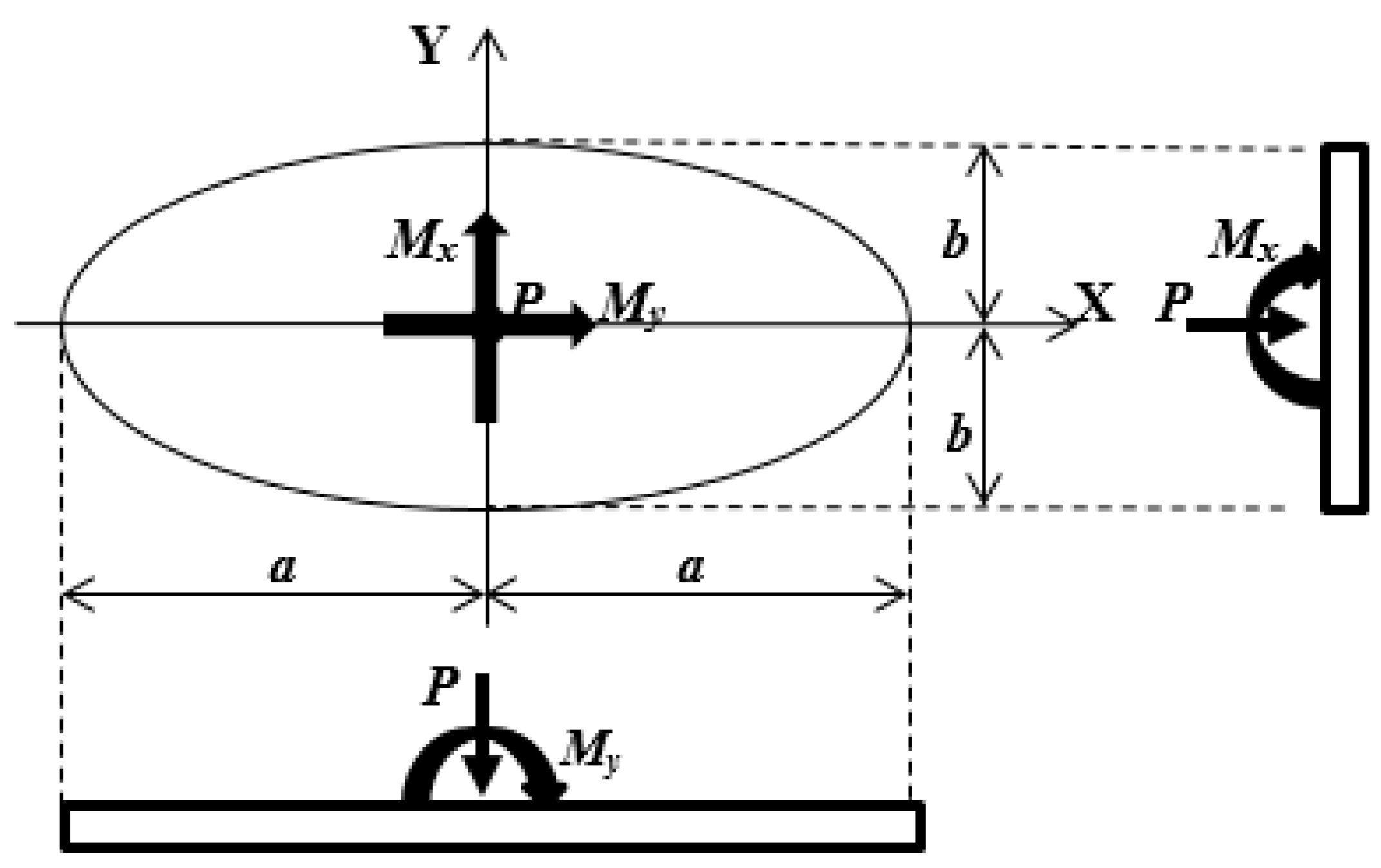
- When Mx for EIFs increases: a decreases; b, and AminMP increase, this is present in all four studies; y0 (absolute value) tends to increase in all studies except Study 2 (Mx = 1500 kN-m and My = 500 kN-m).
- When Mx equals My, square footings are generated for RIFs, and circular footings are generated for EIFs.
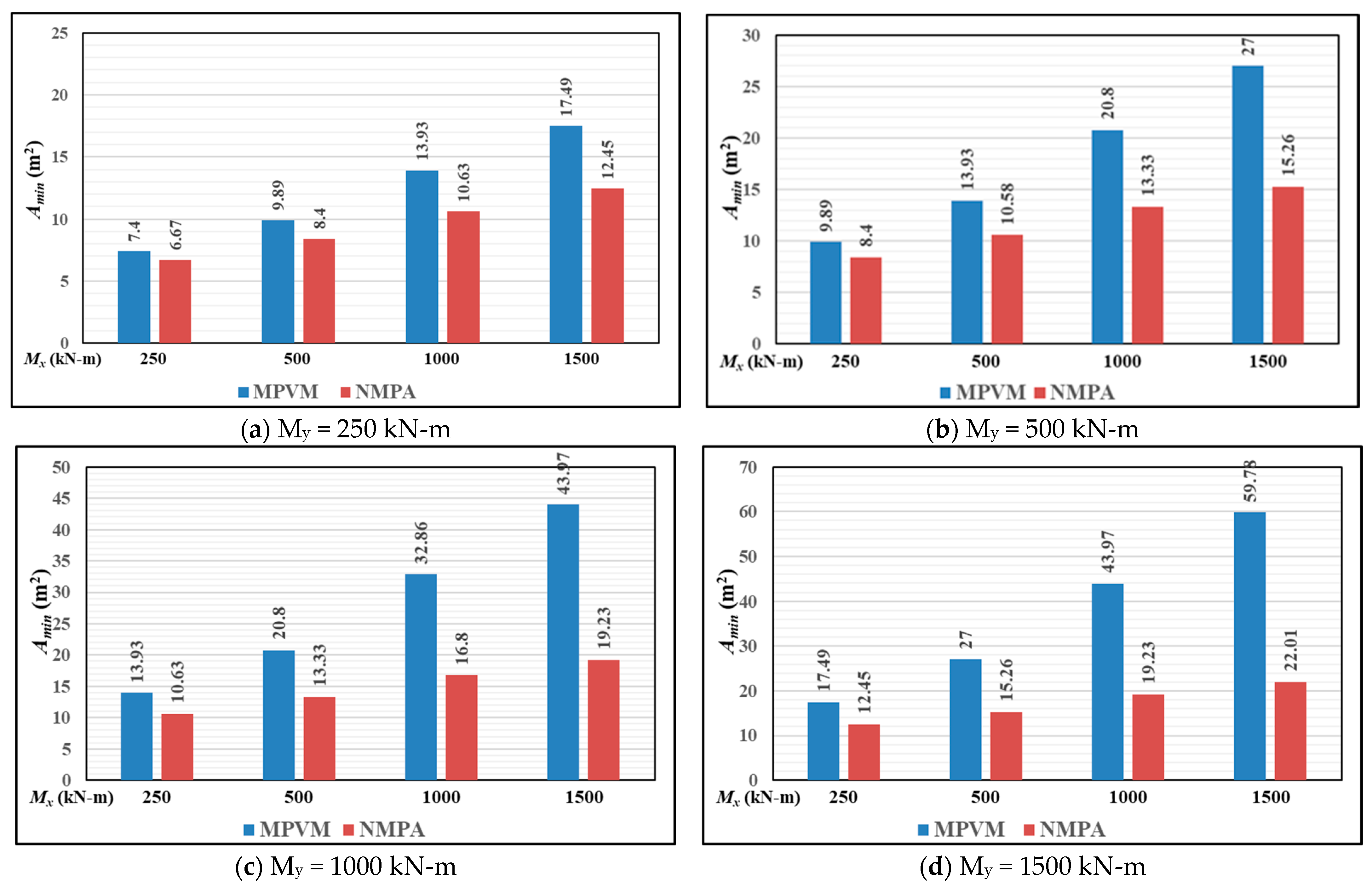
- The highest AminVM/AminMP ratio appears at Mx and My = 1500 kN-m, 2.72 times.
- The smallest AminVM/AminMP ratio appears at Mx and My = 250 kN-m, 1.11 times.
5. Conclusions
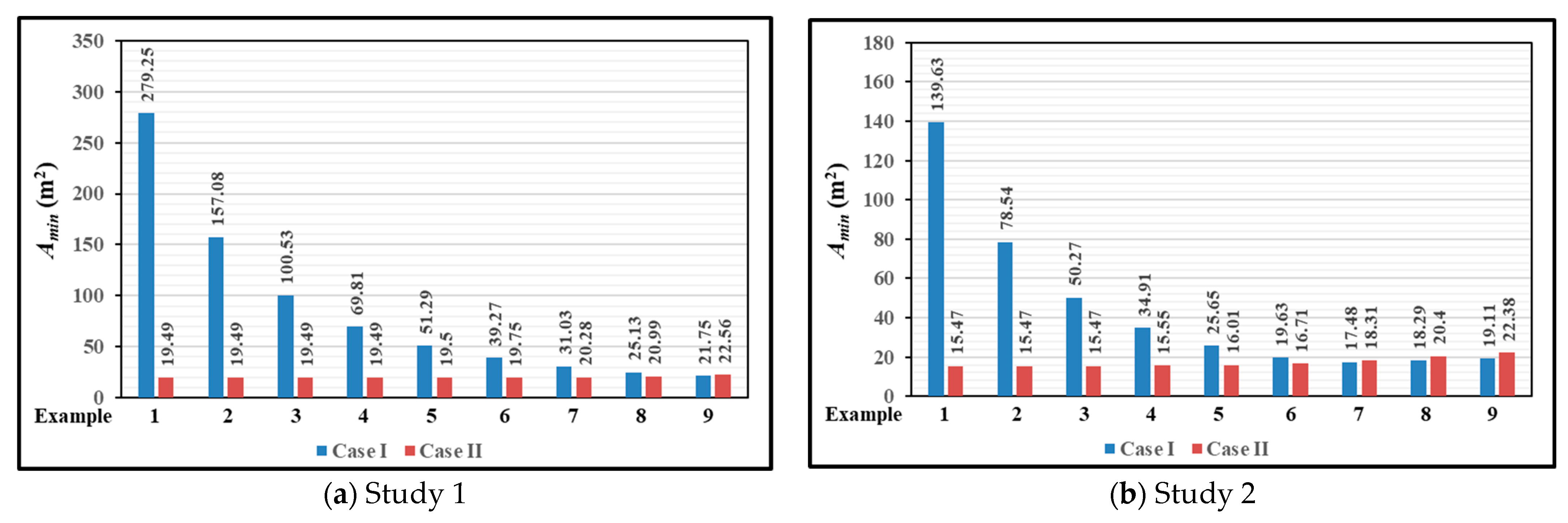
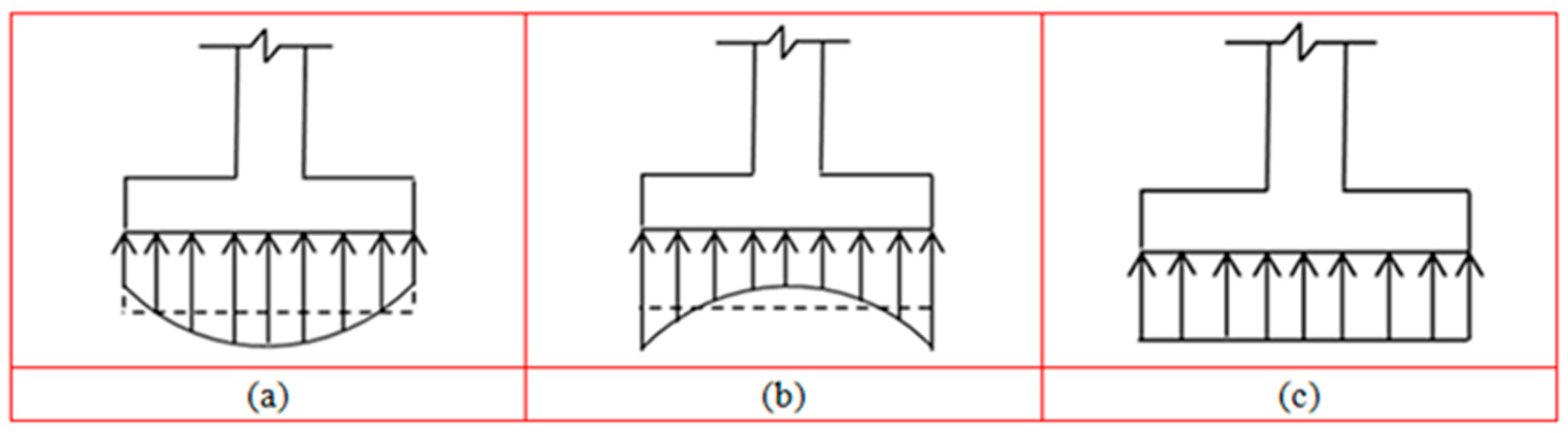
- Some authors present equations to find the dimensions and minimum area of the footing, but the entire surface of the footing is fully compressed (see Case I of the two studies in Figure 7).
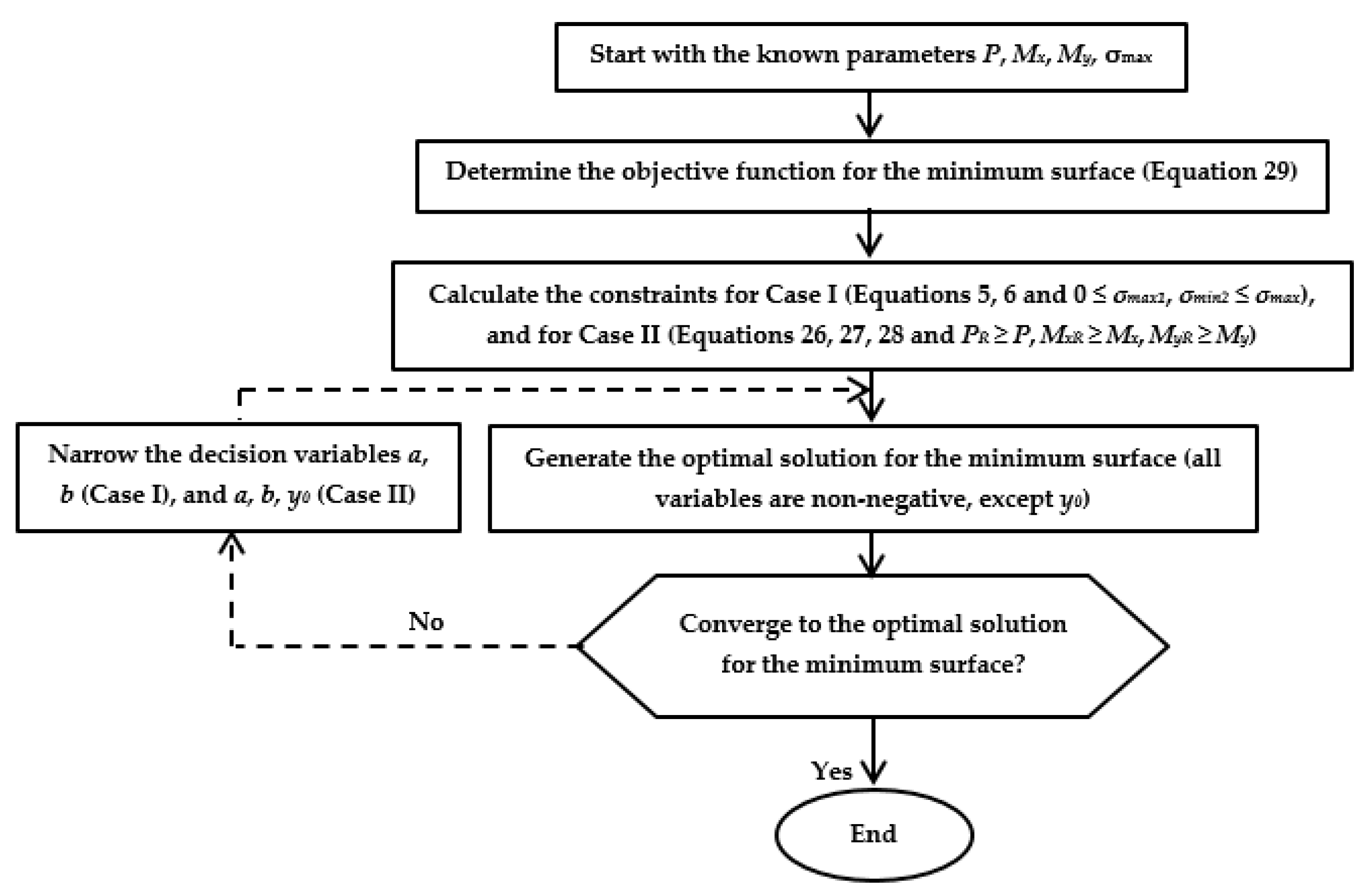
- The proposed model presents the minimum surface and the constraint functions for the two possible cases.
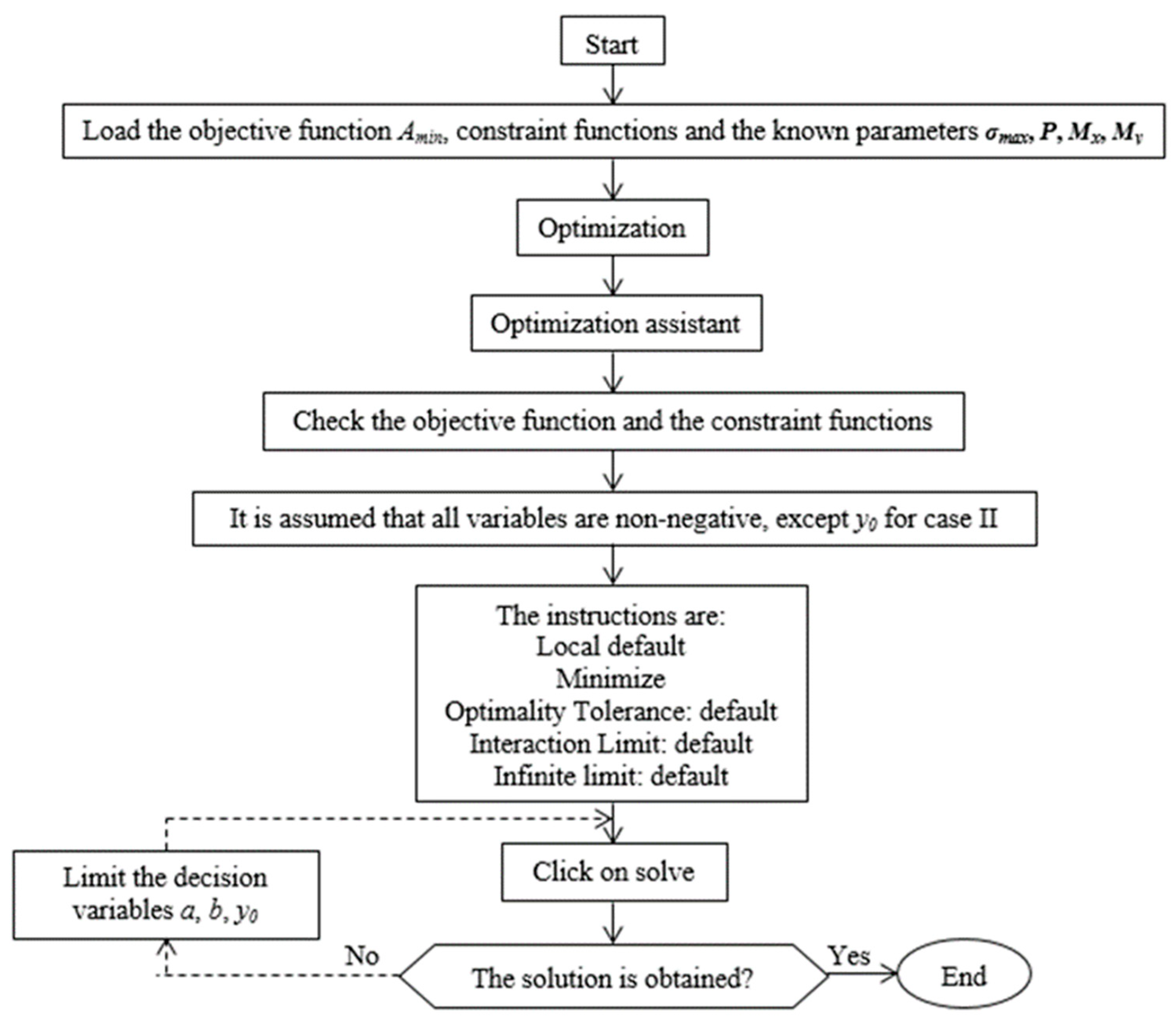
- The model can be used as a review of the allowable load capacity of the soil, taking into account the objective function σmax and the same constraint functions presented in this article (see Figure 6).
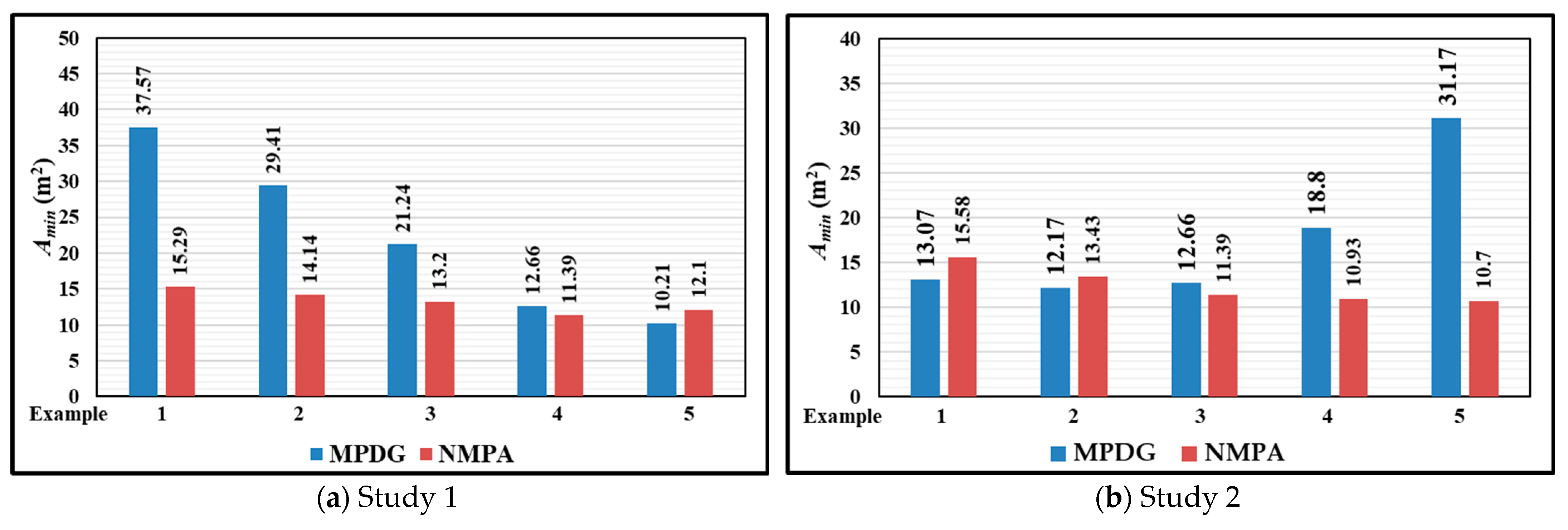
- The two studies show significant savings using Case II compared to Case I. For Study 1 of example 1, there is a saving of 93.02%, and for Study 2 of example 1, there is a saving of 88.92% (see Figure 7). All these studies were performed under the same loads and moments for both models.
- The minimum area tends to decrease when P increases; this is because σ2 is equal to zero and σ1 does not reach σmax (Case I).
- The minimum area tends to increase when P increases, and in some cases it remains constant because the load P acting is less than the load PR that it resists (Case II).
- The two studies show significant savings using the NMPA compared to MPDG. For Study 1 of example 1, there is a saving of 59.30%, and for Study 2 of example 5, there is a saving of 65.67% (see Figure 8). All these studies were performed under the same loads and moments for both models.
- The four studies show significant savings using the NMPA for EIFs compared to MPVM for RIFs, with savings that can reach up to 63.18% (see Figure 9d). All these studies were performed under the same loads and moments for both models.
- In all cases, the minimum area appears in Case II, when σ1 does not reach the maximum value of σmax in Case I.
- The main advantage of this research is that it directly impacts the cost of foundation construction, since by presenting a smaller contact area with the soil, it generates a smaller volume of fill for the foundation.
- When the moments are equal, the values of “a” and “b” are equal in two cases; this means that it is a circular footing (see Table 2).
Author Contributions
Funding
Data Availability Statement
Acknowledgments
Conflicts of Interest
Appendix A


References
- Bowles, J.E. Foundation Analysis and Design; McGraw-Hill: New York, NY, USA, 2001. [Google Scholar]
- Shahin, M.A.; Cheung, E.M. Stochastic design charts for bearing capacity of strip footings. Geomech. Eng. 2011, 3, 153–167. [Google Scholar] [CrossRef]
- Dixit, M.S.; Patil, K.A. Experimental estimate of Nγ values and corresponding settlements for square footings on finite layer of sand. Geomech. Eng. 2013, 5, 363–377. [Google Scholar] [CrossRef]
- ErzÍn, Y.; Gul, T.O. The use of neural networks for the prediction of the settlement of pad footings on cohesionless soils based on standard penetration test. Geomech. Eng. 2013, 5, 541–564. [Google Scholar] [CrossRef]
- Colmenares, J.E.; Kang, S.-R.; Shin, Y.-J.; Shin, J.-H. Ultimate bearing capacity of conical shell foundations. Struct. Eng. Mech. 2014, 52, 507–523. [Google Scholar] [CrossRef]
- Cure, E.; Sadoglu, E.; Turker, E.; Uzuner, B.A. Decrease trends of ultimate loads of eccentrically loaded model strip footings close to a slope. Geomech. Eng. 2014, 6, 469–485. [Google Scholar] [CrossRef]
- Fattah, M.Y.; Yousif, M.A.; Al-Tameemi, S.M.K. Effect of pile group geometry on bearing capacity of piled raft foundations. Struct. Eng. Mech. 2015, 54, 829–853. [Google Scholar] [CrossRef]
- Uncuoğlu, E. The bearing capacity of square footings on a sand layer overlying clay. Geomech. Eng. 2015, 9, 287–311. [Google Scholar] [CrossRef]
- Anil, Ö.; Akbaş, S.O.; BabagĪray, S.; Gel, A.C.; Durucan, C. Experimental and finite element analyses of footings of varying shapes on sand. Geomech. Eng. 2017, 12, 223–238. [Google Scholar] [CrossRef]
- Khatri, V.N.; Debbarma, S.P.; Dutta, R.K.; Mohanty, B. Pressure-settlement behavior of square and rectangular skirted footings resting on sand. Geomech. Eng. 2017, 12, 689–705. [Google Scholar] [CrossRef]
- Mohebkhah, A. Bearing capacity of strip footings on a stone masonry trench in clay. Geomech. Eng. 2017, 13, 255–267. [Google Scholar] [CrossRef]
- Zhang, W.-X.; Wu, H.; Hwang, H.-J.; Zhang, J.-Y.; Chen, B.; Yi, W.-J. Bearing behavior of reinforced concrete column-isolated footing substructures. Eng. Struct. 2019, 200, 109744. [Google Scholar] [CrossRef]
- Turedi, Y.; Emirler, B.; Ornek, M.; Yildiz, A. Determination of the bearing capacity of model ring footings: Experimental and numerical investigations. Geomech. Eng. 2019, 18, 29–39. [Google Scholar] [CrossRef]
- Gnananandarao, T.; Khatri, V.N.; Dutta, R.K. Bearing capacity and settlement prediction of multi-edge skirted footings resting on sand. Ing. Investig. 2020, 40, 9–21. [Google Scholar] [CrossRef]
- Gör, M. Analyzing the bearing capacity of shallow foundations on two-layered soil using two novel cosmology-based optimization techniques. Smart Struct. Syst. 2022, 29, 513–522. [Google Scholar] [CrossRef]
- Hu, D.; Hu, Y.; Hu, R.; Tan, Z.; Ni, P.; Chen, Y.; Xiang, X.; Li, Y.; Liu, J. Machine Learning–Finite Element Mesh Optimization-Based Modeling and Prediction of Excavation-Induced Shield Tunnel Ground Settlement. Int. J. Comput. Methods 2025, 22, 2450066. [Google Scholar] [CrossRef]
- Yin, Q.; Xin, T.; Zhenggang, H.; Minghua, H. Measurement and Analysis of Deformation of Underlying Tunnel Induced by Foundation Pit Excavation. Adv. Civil Eng. 2023, 1, 8897139. [Google Scholar] [CrossRef]
- Li, Z.-Q.; Nie, L.; Yiguo Xue, Y.; Li, W.; Fan, K. Model Testing on the Processes, Characteristics, and Mechanismof Water Inrush Induced by Karst Caves Ahead and Alongside a Tunnel. Rock Mech. Rock Eng. 2025, 58, 5363–5380. [Google Scholar] [CrossRef]
- Zhang, J.; Li, Y.; Zhang, C. Pounding induced overturning resistance of FPB-isolated structures considering soil-structure-interactions. Soil Dyn. Earthq. Eng. 2024, 177, 108416. [Google Scholar] [CrossRef]
- Ren, S.-P.; Chen, X.; Ren, Z.-L.; Cheng, P.; Liu, Y. Large-deformation modelling of earthquake-triggered landslides considering non-uniform soils with a stratigraphic dip. Comput. Geotech. 2023, 159, 105492. [Google Scholar] [CrossRef]
- Liu, Y.; Chen, X.; Hu, M. Three-dimensional large deformation modeling of landslides in spatially variable and strain-softening soils subjected to seismic loads. Can. Geotech. J. 2022, 60, 426–437. [Google Scholar] [CrossRef]
- Özmen, G. Determination of base stresses in rectangular footings under biaxial bending. Teknik Dergi Digest. 2011, 22, 1519–1535. [Google Scholar]
- Rodriguez-Gutierrez, J.A.; Aristizabal-Ochoa, J.D. Rigid spread footings resting on soil subjected to axial load and biaxial bending. I: Simplified analytical method. Int. J. Geomech. 2013, 13, 109–119. [Google Scholar] [CrossRef]
- Rodriguez-Gutierrez, J.A.; Aristizabal-Ochoa, J.D. Rigid spread footings resting on soil subjected to axial load and biaxial bending. II: Design aids. Int. J. Geomech. 2013, 13, 120–131. [Google Scholar] [CrossRef]
- Aydogdu, I. New Iterative method to Calculate Base Stress of Footings under Biaxial Bending. Int. J. Eng. Appl. Sci. 2016, 8, 40–48. [Google Scholar] [CrossRef][Green Version]
- Girgin, K. Simplified formulations for the determination of rotational spring constants in rigid spread footings resting on tensionless soil. J. Civil Eng. Manag. 2017, 23, 464–474. [Google Scholar] [CrossRef]
- Rawat, S.; Mittal, R.K.; Muthukumar, G. Isolated Rectangular Footings under Biaxial Bending: A Critical Appraisal and Simplified Analysis Methodology. Pract. Period. Struct. Des. Const. 2020, 25, 04020011. [Google Scholar] [CrossRef]
- Lezgy-Nazargah, M.; Mamazizi, A.; Khosravi, H. Analysis of shallow footings rested on tensionless foundations using a mixed finite element model. Struct. Eng. Mech. 2022, 81, 379–394. [Google Scholar] [CrossRef]
- Himeur, N.; Mamen, B.; Benguediab, S.; Bouhadra, A.; Menasria, A.; Bouchouicha, B.; Bourada, F.; Benguediab, M.; Tounsi, A. Coupled effect of variable Winkler–Pasternak foundations on bending behavior of FG plates exposed to several types of loading. Steel Compos. Struct. 2022, 44, 339–355. [Google Scholar] [CrossRef]
- Vela-Moreno, V.B.; Luévanos-Rojas, A.; López-Chavarría, S.; Medina-Elizondo, M.; Sandoval-Rivas, R.; Martínez-Aguilar, C. Optimal area for rectangular isolated footings considering that contact surface works partially to compression. Struct. Eng. Mech. 2022, 84, 561–573. [Google Scholar] [CrossRef]
- Soto-Garcia, S.; Luévanos-Rojas, A.; Barquero-Cabrero, J.D.; López-Chavarría, S.; Medina-Elizondo, M.; Farias-Montemayor, O.M.; Martinez-Aguilar, C. A New Model for the Contact Surface with Soil of Circular Isolated Footings Considering that the Contact Surface Works Partially Under Compression. Int. J. Innov. Comput. Inf. Control 2022, 18, 1103–1116. [Google Scholar]
- Montes-Paramo, P.; Luévanos-Rojas, A.; López-Chavarría, S.; Medina-Elizondo, M.; Sandoval-Rivas, R. Optimal area for rectangular combined footings assuming that the contact surface with the soil works partially to compression. Ing. Inv. Tecnol. 2023, 24, 1–15. [Google Scholar] [CrossRef]
- Luévanos-Rojas, A.; Estrada-Mendoza, B.L.; Juárez-Ramírez, M. Área óptima para zapatas combinadas en forma de T asumiendo que el área en contacto con el suelo trabaja parcialmente en compresión. Bol. Cienc. Tierra 2025, 58, 51–71. [Google Scholar] [CrossRef]
- Elhanash, M.; Elsherif, A.K.; Aref, A.; Nagy, N.M. New analytical method for optimum design of circular and elliptical footings. Adv. Comput. Des. 2025, 10, 151–167. [Google Scholar] [CrossRef]
- Diaz-Gurrola, E.R.; Luévanos-Rojas, A.; Santiago-Hurtado, G.; Moreno-Landeros, V.M.; Landa-Gómez, A.E. Mathematical Calculations for the Design of Elliptical Isolated Foundations with Optimal Cost. Mathematics 2025, 13, 1777. [Google Scholar] [CrossRef]
- Santiago-Hurtado, G.; Luévanos-Rojas, A.; Moreno-Landeros, V.M.; Diaz-Gurrola, E.R.; Narayanasamy, R.; Cortés-Martínez, F.; López-León, L.D. Mathematical Development for the Minimum Cost of Elliptical Combined Footings. Buildings 2025, 15, 3633. [Google Scholar] [CrossRef]





| Case | Equations |
|---|---|
| I | Equations (5) and (6), 0 ≤ σmax1 and σmin2 ≤ σmax |
| II | Equations (26)–(28), PR ≥ P, MxR ≥ Mx, MyR ≥ My |
| Example | P (kN) | Case I | Case II | AminCI/AminCII | |||||||||
|---|---|---|---|---|---|---|---|---|---|---|---|---|---|
| a (m) | b (m) | σ1 (kN/m2) | σ2 (kN/m2) | AminCI (m2) | a (m) | b (m) | y0 (m) | σ1 (kN/m2) | σ2 (kN/m2) | AminCII (m2) | |||
| 1 | 600 | 9.43 | 9.43 | 4.30 | 0 | 279.25 | 2.49 | 2.49 | −1.17 | 200 | 0 | 19.49 | 14.33 |
| 2 | 800 | 7.07 | 7.07 | 10.19 | 0 | 157.08 | 2.49 | 2.49 | −1.17 | 200 | 0 | 19.49 | 8.06 |
| 3 | 1000 | 5.66 | 5.66 | 19.89 | 0 | 100.53 | 2.49 | 2.49 | −1.17 | 200 | 0 | 19.49 | 5.16 |
| 4 | 1200 | 4.71 | 4.71 | 34.38 | 0 | 69.81 | 2.49 | 2.49 | −1.17 | 200 | 0 | 19.49 | 3.58 |
| 5 | 1400 | 4.04 | 4.04 | 54.59 | 0 | 51.29 | 2.49 | 2.49 | −1.24 | 200 | 0 | 19.50 | 2.63 |
| 6 | 1600 | 3.54 | 3.54 | 81.49 | 0 | 39.27 | 2.51 | 2.51 | −1.64 | 200 | 0 | 19.75 | 1.99 |
| 7 | 1800 | 3.14 | 3.14 | 116.02 | 0 | 31.03 | 2.54 | 2.54 | −2.01 | 200 | 0 | 20.28 | 1.53 |
| 8 | 2000 | 2.83 | 2.83 | 159.15 | 0 | 25.13 | 2.59 | 2.59 | −2.36 | 200 | 0 | 20.99 | 1.20 |
| 9 | 2200 | 2.63 | 2.63 | 200.00 | 2.30 | 21.75 | 2.68 | 2.68 | −2.61 | 200 | 0 | 22.56 | 0.96 |
| Example | P (kN) | Case I | Case II | AminCI/AminCII | |||||||||
|---|---|---|---|---|---|---|---|---|---|---|---|---|---|
| a (m) | b (m) | σ1 (kN/m2) | σ2 (kN/m2) | AminCI (m2) | a (m) | b (m) | y0 (m) | σ1 (kN/m2) | σ2 (kN/m2) | AminCII (m2) | |||
| 1 | 600 | 4.71 | 9.43 | 8.59 | 0 | 139.63 | 1.57 | 3.14 | −0.94 | 200 | 0 | 15.47 | 9.03 |
| 2 | 800 | 3.54 | 7.07 | 20.37 | 0 | 78.54 | 1.57 | 3.14 | −0.94 | 200 | 0 | 15.47 | 5.08 |
| 3 | 1000 | 2.83 | 5.66 | 39.79 | 0 | 50.27 | 1.57 | 3.14 | −0.94 | 200 | 0 | 15.47 | 3.25 |
| 4 | 1200 | 2.36 | 4.71 | 68.75 | 0 | 34.91 | 1.57 | 3.15 | −1.17 | 200 | 0 | 15.55 | 2.24 |
| 5 | 1400 | 2.02 | 4.04 | 109.18 | 0 | 25.65 | 1.60 | 3.19 | −1.55 | 200 | 0 | 16.01 | 1.60 |
| 6 | 1600 | 1.77 | 3.54 | 162.97 | 0 | 19.63 | 1.60 | 3.33 | −1.85 | 200 | 0 | 16.71 | 1.17 |
| 7 | 1800 | 1.67 | 3.34 | 200.00 | 5.96 | 17.48 | 1.60 | 3.64 | −1.97 | 200 | 0 | 18.31 | 0.95 |
| 8 | 2000 | 1.71 | 3.41 | 200.00 | 18.71 | 18.29 | 1.73 | 3.75 | −2.14 | 200 | 0 | 20.40 | 0.90 |
| 9 | 2200 | 1.74 | 3.49 | 200.00 | 30.25 | 19.11 | 1.77 | 4.03 | −2.18 | 200 | 0 | 22.38 | 0.85 |
| Example | My (kN-m) | MPDG (Case I) | NMPA (Case II) | AminCI/AminCII | ||||||||||
|---|---|---|---|---|---|---|---|---|---|---|---|---|---|---|
| a (m) | b (m) | σ1 (kN/m2) | σ2 (kN/m2) | AminCI (m2) | a (m) | b (m) | y0 (m) | σ1 (kN/m2) | σ2 (kN/m2) | AminCII (m2) | ||||
| 1 | TR | 900 | 4.63 | 2.57 | 58.84 | 0 | 37.39 | 2.93 | 1.63 | −1.06 | 200.00 | 0 | 14.95 | 2.50 |
| PR | 4.60 | 2.60 | 58.48 | 0.07 | 37.57 | 2.95 | 1.65 | −1.46 | 200.00 | 0 | 15.29 | 2.46 | ||
| 2 | TR | 700 | 3.60 | 2.57 | 75.66 | 0 | 29.08 | 2.49 | 1.78 | −1.28 | 200.00 | 0 | 13.87 | 2.10 |
| PR | 3.60 | 2.60 | 74.61 | 0.21 | 29.41 | 2.50 | 1.80 | −1.53 | 200.00 | 0 | 14.14 | 2.08 | ||
| 3 | TR | 500 | 2.57 | 2.57 | 105.92 | 0 | 20.77 | 2.01 | 2.01 | −1.52 | 200.00 | 0 | 12.67 | 1.64 |
| PR | 2.60 | 2.60 | 103.02 | 0.57 | 21.24 | 2.05 | 2.05 | −1.86 | 200.00 | 0 | 13.20 | 1.61 | ||
| 4 | TR | 300 | 1.54 | 2.57 | 176.53 | 0 | 12.46 | 1.41 | 2.56 | −1.62 | 200.00 | 0 | 11.32 | 1.10 |
| PR | 1.55 | 2.60 | 173.09 | 0.68 | 12.66 | 1.45 | 2.50 | −1.66 | 200.00 | 0 | 11.39 | 1.11 | ||
| 5 | TR | 150 | 1.25 | 2.57 | 200.00 | 18.32 | 10.08 | 1.36 | 2.75 | −1.92 | 200.00 | 0 | 11.71 | 0.86 |
| PR | 1.25 | 2.60 | 196.54 | 18.93 | 10.21 | 1.40 | 2.75 | −2.07 | 200.00 | 0 | 12.10 | 0.84 | ||
| Example | P (kN) | MPDG (Case I) | NMPA (Case II) | AminCI/AminCII | ||||||||||
|---|---|---|---|---|---|---|---|---|---|---|---|---|---|---|
| a (m) | b (m) | σ1 (kN/m2) | σ2 (kN/m2) | AminCI (m2) | a (m) | b (m) | y0 (m) | σ1 (kN/m2) | σ2 (kN/m2) | AminCII (m2) | ||||
| 1 | TR | 1500 | 1.57 | 2.62 | 200.00 | 32.47 | 12.90 | 1.59 | 3.07 | −1.86 | 200.00 | 0 | 15.32 | 0.84 |
| PR | 1.60 | 2.60 | 196.98 | 32.57 | 13.07 | 1.60 | 3.10 | −1.88 | 200.00 | 0 | 15.58 | 0.84 | ||
| 2 | TR | 1300 | 1.52 | 2.53 | 200.00 | 15.14 | 12.09 | 1.47 | 2.89 | −1.69 | 200.00 | 0 | 13.35 | 0.91 |
| PR | 1.55 | 2.50 | 198.24 | 15.34 | 12.17 | 1.50 | 2.95 | −1.81 | 200.00 | 0 | 13.43 | 0.91 | ||
| 3 | TR | 1100 | 1.54 | 2.57 | 176.53 | 0 | 12.46 | 1.41 | 2.56 | −1.62 | 200.00 | 0 | 11.32 | 1.10 |
| PR | 1.55 | 2.60 | 173.09 | 0.68 | 12.66 | 1.45 | 2.50 | −1.66 | 200.00 | 0 | 11.39 | 1.11 | ||
| 4 | TR | 900 | 1.89 | 3.14 | 96.69 | 0 | 18.62 | 1.42 | 2.37 | −1.24 | 200.00 | 0 | 10.61 | 1.75 |
| PR | 1.90 | 3.15 | 95.50 | 0.24 | 18.80 | 1.45 | 2.40 | −1.19 | 200.00 | 0 | 10.93 | 1.72 | ||
| 5 | TR | 700 | 2.42 | 4.04 | 45.49 | 0 | 30.77 | 1.41 | 2.34 | −0.80 | 200.00 | 0 | 10.36 | 2.97 |
| PR | 2.45 | 4.05 | 44.77 | 0.14 | 31.17 | 1.45 | 2.35 | −0.69 | 200.00 | 0 | 10.70 | 2.91 | ||
| Study | My (kN-m) | Mx (kN-m) | MPVM (RIFs) | NMPA (EIFs) | AminVM/AminMP | |||||||||||
|---|---|---|---|---|---|---|---|---|---|---|---|---|---|---|---|---|
| Case | hx (m) | hy (m) | hx1 (m) | hy1 (m) | AminVM (m2) | Case | a (m) | b (m) | y0 (m) | σ1 (kN/m2) | σ2 (kN/m2) | AminMP (m2) | ||||
| 1 | 250 | 250 | V | 2.72 | 2.72 | 3.50 | 3.50 | 7.40 | II | 1.46 | 1.46 | −0.69 | 250 | 0 | 6.67 | 1.11 |
| 500 | V | 2.22 | 4.45 | 2.45 | 4.90 | 9.89 | II | 1.16 | 2.31 | −0.69 | 250 | 0 | 8.40 | 1.18 | ||
| 1000 | II | 1.87 | 7.46 | 1.73 | 6.93 | 13.93 | II | 1.00 | 3.38 | −0.69 | 250 | 0 | 10.63 | 1.31 | ||
| 1500 | II | 1.71 | 10.24 | 1.41 | 8.49 | 17.49 | II | 1.00 | 3.96 | −0.80 | 250 | 0 | 12.45 | 1.40 | ||
| 2 | 500 | 250 | V | 4.45 | 2.22 | 4.90 | 2.45 | 9.89 | II | 2.31 | 1.16 | −0.69 | 250 | 0 | 8.40 | 1.18 |
| 500 | II | 3.73 | 3.73 | 3.46 | 3.46 | 13.93 | II | 1.84 | 1.84 | −0.86 | 250 | 0 | 10.58 | 1.32 | ||
| 1000 | II | 3.22 | 6.45 | 2.45 | 4.90 | 20.80 | II | 1.46 | 2.91 | −0.87 | 250 | 0 | 13.33 | 1.56 | ||
| 1500 | II | 3.00 | 9.00 | 2.00 | 6.00 | 27.00 | II | 1.27 | 3.82 | −0.80 | 250 | 0 | 15.26 | 1.77 | ||
| 3 | 1000 | 250 | II | 7.46 | 1.87 | 6.93 | 1.73 | 13.93 | II | 3.38 | 1.00 | −0.69 | 250 | 0 | 10.63 | 1.31 |
| 500 | II | 6.45 | 3.22 | 4.90 | 2.45 | 20.80 | II | 2.91 | 1.46 | −0.87 | 250 | 0 | 13.33 | 1.56 | ||
| 1000 | II | 5.73 | 5.73 | 3.46 | 3.46 | 32.86 | II | 2.31 | 2.31 | −1.09 | 250 | 0 | 16.80 | 1.96 | ||
| 1500 | II | 5.41 | 8.12 | 2.83 | 4.24 | 43.97 | II | 2.02 | 3.03 | −1.12 | 250 | 0 | 19.23 | 2.29 | ||
| 4 | 1500 | 250 | II | 10.24 | 1.71 | 8.49 | 1.41 | 17.49 | II | 3.96 | 1.00 | −0.80 | 250 | 0 | 12.45 | 1.40 |
| 500 | II | 9.00 | 3.00 | 6.00 | 2.00 | 27.00 | II | 3.82 | 1.27 | −0.80 | 250 | 0 | 15.26 | 1.77 | ||
| 1000 | II | 8.12 | 5.41 | 4.24 | 2.83 | 43.97 | II | 3.03 | 2.02 | −1.12 | 250 | 0 | 19.23 | 2.29 | ||
| 1500 | II | 7.73 | 7.73 | 3.46 | 3.46 | 59.78 | II | 2.65 | 2.65 | −1.25 | 250 | 0 | 22.01 | 2.72 | ||
Disclaimer/Publisher’s Note: The statements, opinions and data contained in all publications are solely those of the individual author(s) and contributor(s) and not of MDPI and/or the editor(s). MDPI and/or the editor(s) disclaim responsibility for any injury to people or property resulting from any ideas, methods, instructions or products referred to in the content. |
© 2026 by the authors. Licensee MDPI, Basel, Switzerland. This article is an open access article distributed under the terms and conditions of the Creative Commons Attribution (CC BY) license.
Share and Cite
Luévanos-Rojas, A.; Santiago-Hurtado, G.; Moreno-Landeros, V.M.; Díaz-Gurrola, E.R.; Narayanasamy, R.; López-León, L.D.; Olguin-Coca, F.J.; Landa-Gómez, A.E. Optimal Surface for Elliptical Isolated Footings with Partially Compressed Contact Area. Mathematics 2026, 14, 407. https://doi.org/10.3390/math14030407
Luévanos-Rojas A, Santiago-Hurtado G, Moreno-Landeros VM, Díaz-Gurrola ER, Narayanasamy R, López-León LD, Olguin-Coca FJ, Landa-Gómez AE. Optimal Surface for Elliptical Isolated Footings with Partially Compressed Contact Area. Mathematics. 2026; 14(3):407. https://doi.org/10.3390/math14030407
Chicago/Turabian StyleLuévanos-Rojas, Arnulfo, Griselda Santiago-Hurtado, Víctor Manuel Moreno-Landeros, Eyran Roberto Díaz-Gurrola, Rajeswari Narayanasamy, Luis Daimir López-León, Francisco Javier Olguin-Coca, and Aldo Emelio Landa-Gómez. 2026. "Optimal Surface for Elliptical Isolated Footings with Partially Compressed Contact Area" Mathematics 14, no. 3: 407. https://doi.org/10.3390/math14030407
APA StyleLuévanos-Rojas, A., Santiago-Hurtado, G., Moreno-Landeros, V. M., Díaz-Gurrola, E. R., Narayanasamy, R., López-León, L. D., Olguin-Coca, F. J., & Landa-Gómez, A. E. (2026). Optimal Surface for Elliptical Isolated Footings with Partially Compressed Contact Area. Mathematics, 14(3), 407. https://doi.org/10.3390/math14030407