
Next Article in Journal
PLB-GPT: Potato Late Blight Prediction with Generative Pretrained Transformer and Optimizing
Previous Article in Journal
Direct Transformation of Laplace Equation’s Solution from Spherical to Cartesian Representation
error_outline You can access the new MDPI.com website here. Explore and share your feedback with us.
 
 
Article

When Does Platform Private-Label Advertising Work? The Role of Quality and Supply Chain Structure


School of Management, Lanzhou University, Lanzhou 730000, China
*
Author to whom correspondence should be addressed.
Mathematics 2026, 14(2), 227; https://doi.org/10.3390/math14020227
Submission received: 25 November 2025 / Revised: 23 December 2025 / Accepted: 5 January 2026 / Published: 7 January 2026

Abstract

Advertising is often viewed as an effective strategy for platforms to boost the sales of their private-label (PL) products. Nevertheless, not all platforms adopt PL advertising strategies, and the drivers of these heterogeneous advertising practices across platforms, which differ in PL product quality and supply chain structures (agency (A) vs. reselling (R) modes), remain unclear. Our analysis shows that, without advertising, an increase in PL quality does not necessarily deter the manufacturer from competition under mode A. When advertising is introduced, however, increasing PL quality may sometimes amplify the negative effect of advertising on the manufacturer-branded products’ price under mode A. Moreover, contrary to common belief that advertising always benefits the platform, we identify conditions under which PL advertising leads to a lose–lose outcome for both the manufacturer and the platform, regardless of PL quality. Finally, we find that an appropriately designed advertising effort allows the platform to align the manufacturer’s channel preference with its own—toward either Mode A or Mode R structure. Overall, our findings uncover the strategic interplay between PL advertising, product quality, and supply chain structure, thereby explaining the diversity of platform advertising behaviors in practice, such as JD.com and Taobao.

1. Introduction

With the rapid expansion of e-commerce and growing competition between online retail platforms, many e-commerce platforms have launched their own private-label products. Examples include JD.com’s Jingzao, Amazon Basics, Taobao’s Miaomanfen, and Walmart’s George. The introduction of PL brands is expected to generate considerable revenue to e-commerce platforms. However, refs. [1,2] suggested that despite access to a large consumer base, the market penetration of PL products remains limited. According to data released by Momentum Commerce, in the first quarter of 2024, Amazon’s private label accounted for only 0.9% of its retail revenue in the US market (https://www.momentumcommerce.com/amazons-private-label-market-share-shrinks-by-6-year-over-year-in-q1-2024/ (accessed on 20 December 2025)). This paradox between the expected profitability and the lower awareness of PL products underscores the need for e-commerce platforms to better understand how they can improve the profitability of their PL products.
Advertising is one of the most effective marketing strategies, supporting the platform in enhancing consumers’ awareness and perceived value of the PL products [3,4,5]. For instance, Amazon makes additional advertising efforts to place its private labels in sponsored ads [5] and promotes its private labels at the bottom of competitors’ product listings. Similarly, JD.com tags “JD Private Label” and “JingDongJingZao” in the product image pages to mark its private-label products and recommends them within the top few results of the search. Additionally, unlike Amazon and JD.com, Taobao does not specifically promote its private-label products. In search experiments, we found that Taobao’s private-label products often appear in natural search results and do not prominently display the “Tmall Private Label” mark in product images. Consumers only see this mark after clicking on the product detail page. It can be seen that different e-commerce platforms have made different advertising decisions. These heterogeneous advertising practices raise a fundamental research question: why do different e-commerce platforms adopt markedly different advertising strategies for their PL products, and under what conditions is PL advertising effective? On the one hand, although advertising can enhance the perceived value and recognition of PL products, consumers who are aware of both types of products may exhibit heterogeneous preferences across products with different quality levels [6,7]. However, most existing research assumes that the manufacturer, as the primary supplier of the product, usually produces high-quality products and regards the PL products as low-quality substitutes to manufacturer-branded (MB) products [2,6]. This assumption no longer perfectly characterizes the practices. Specifically, with the direct access to real demand from consumers, E-commerce platforms such as JD.com find market opportunities to meet consumers’ desire for a “better lifestyle” through providing high-quality private-label “JingZao” products (https://jdcorporateblog.com/jing-zao-partners-with-ziroom-to-launch-commercial-campaign/ (accessed on 20 December 2025)). When the quality of PL products is sufficiently high, consumers perceive a high valuation of the PL product, enabling the platforms to effectively pass part of the advertising costs on to consumers by increasing the price of PL products. Nevertheless, excessive price increases may erode the competitiveness of PL products relative to the MB products, thereby undermining the original objective of PL advertising. This trade-off highlights the necessity for platforms to make informed pricing decisions that adequately balance the risks and benefits of advertising under different quality levels. Since the existing models largely restrict attention to low-quality PL products, they are insufficient to provide decision support for the platform to evaluate the efficiency of PL advertising. To address this limitation, we formulate a game-theoretical model to investigate how the quality level shapes the profitability of the PL advertising.
On the other hand, e-commerce platforms establish cooperative relationships with manufacturers through two supply chain structures: reselling (mode R) and agency (mode A). In mode R, manufacturers wholesale products to the platforms; then, the platforms sell and manage the products. In the agency mode, manufacturers directly sell products and pay a certain commission to the platforms as a service fee. When the e-commerce platforms choose to advertise PL products, such activities intensify the competition with the manufacturer and may consequently alter their cooperation and the supply chain structure preferences. Existing studies examine how the introduction of PL products affects the sales model choices of the manufacturers [8,9,10]. However, the role of PL advertising in shaping the channel preferences of platforms has received little attention. Motivated by this identified gap, we further extend the model to investigate the conditions under which PL advertising can align or coordinate the channel preferences of both the platform and the manufacturer.
Given the aforementioned practical developments and research gaps, the goal of this study is to explore the following research questions:
(1)
How does the quality influence the competitive dynamics between MB and PL products?
(2)
What are the optimal pricing decisions with PL advertising across varying quality levels and supply chain structures?
(3)
How do advertising and the quality of PL products shape the channel preferences of both parties?
To address these questions, we construct a game-theoretical model to analyze advertising and pricing decisions in an e-commerce channel comprising a platform and a manufacturer. Two types of PL product, i.e., high-quality and low-quality PL products, are considered in this paper. Intuitively, a higher-quality PL product would be expected to discourage the MB product from competing. However, our findings reveal that this intuition does not necessarily hold under mode A, particularly when the PL quality surpasses that of the MB product. In contrast, when the PL product is of inferior quality, improvements in its quality do not deter the manufacturer from competition under either mode A or mode R. Moreover, we investigate the pricing decisions of both the platform and the manufacturer in the presence of PL advertising. The results indicate that while advertising enables the platforms to raise the price of PL products and pressures the manufacturer to reduce the price of MB products, the magnitude of these effects varies depending on the supply chain structure and PL quality. Specifically, an increase in PL quality amplifies the impact of advertising on both the price of high-quality PL products and on the price of MB products in the face of low-quality PL under mode A. Otherwise, the influence of advertising is weakly mitigated by the quality level of the PL product. Furthermore, our paper identifies the efficiency condition for PL advertising and demonstrates that such advertising may lead to a lose–lose outcome for both the platform and the manufacturer. This finding helps explain why platforms such as Taobao do not adopt advertising for their PL products. Finally, we examine the channel preferences of both the platform and the manufacturer in the presence of PL advertising. The results reveal threshold conditions that enable the platform to achieve a win–win outcome by strategically determining the advertising level and aligning it with an appropriate supply chain structure, given varying levels of PL product quality.
The remainder of this paper is organized as follows: Section 2 conducts a detailed literature review to highlight the contributions of this paper. Section 3 formulates the consumer purchasing decisions and decision model of the manufacturer and platform in the face of PL products with different quality levels. Section 4 considers the price and competition decision without PL advertising. Section 5 establishes the impacts of advertising on the pricing decisions and evaluates the efficiency of PL advertising. Section 6 demonstrates the role of PL product quality in coordinating the channel preferences of the manufacturer and platform with advertising. Section 7 extends the model to examine the robustness of our paper. Section 8 summarizes the key findings of this study and offers corresponding managerial implications, allowing platforms and manufacturers to develop a comprehensive understanding of the advertising strategy of PL products.

2. Literature Review

2.1. Operations Management with Private-Label Products

The sale of private-label (PL) products for e-commerce platforms has received increased attention in the existing research [11,12,13,14]. For instance, Liu and Li [15] investigated the information sharing strategies of platforms that offer PL products and illustrated that sharing consumer information with the manufacturer can significantly improve consumers’ perceived valuation of MB products, thereby intensifying price competition and making the PL product less profitable. They assumed that the quality of PL products would not be different from that of MB products. However, the quality of PL products may be different from that of MB products [16,17,18], thereby playing a key role in shaping the consumers’ purchasing decisions and the competition dynamics between the PL and MB products. Zhang et al. [11] and Zha et al. [12] considered the consumers’ heterogeneous valuations for both the MB and PL products and suggested that the platform should introduce PL products even when consumers perceive them as being of lower quality than MB products, to effectively capture the low-end market without facing intense competition. Chu et al. [13] considered the price strategy of the manufacturer, including both differential and uniform pricing strategies, in the face of competition from PL products. They suggested that the platform always introduces PL under a uniform pricing strategy, but that it only introduces PL under a differential pricing strategy if the substitutability between MB and PL products is low. Although their studies provide insights on the competition between PL and MB products, the PL product is assumed to be a low-quality substitute for the MB product [19,20]. The competition dynamics between high-quality PL and MB products has been largely overlooked in the existing research. In contrast, we investigate the advertising strategies of platforms that provide either high-quality or low-quality products and demonstrate the critical role of PL quality levels in the effectiveness of PL advertising strategies.
This study also contributes to the extensive literature on channel selection in co-opetitive supply chains of e-commerce platforms. Two types of supply chain structure—the reselling (R) and agency (A) modes [21,22,23,24]—are widely adopted in practice. The supply chain structure determines the price power of the MB product, thereby influencing the effectiveness of PL advertising on the competitive dynamics. However, most of the existing research is limited to investigating the effects of PL products on the channel choice of the manufacturer [8,11]. For instance, Zhang and Hou [8] examined how PL introduction affects manufacturers’ channel choice and the resulting economic and environmental outcomes. They showed that, compared with mode R, opting for mode A allows the manufacturer’s platform to gain more profit and results in superior environmental performance. Zhang et al. [11] also focused on the interaction between platform PL introduction strategies and manufacturers’ sales mode choices. While existing research has noted that PL quality improvement intensifies competition between MB and PL, we further demonstrate that this may encourage the manufacturer to participate in market competition under certain market conditions, which is largely overlooked in the existing studies.
Zhao et al. [9] investigated manufacturers’ innovation strategies under different supply chain structures, showing that under mode A, manufacturers can effectively counter competition of PL products through product upgrading, whereas this conclusion does not always hold under mode R. Li et al. [25] analyzed how platform investment in PL products affects manufacturers’ channel choices, revealing that manufacturers prefer mode A with the introduction of PL products, yet when platform investment efficiency is high, sticking to mode R becomes more advantageous. Li et al. [26] empirically studied the channel selection strategies of multinational enterprises (MNEs) and found that mode A may lead to direct competition with MNEs and PL products, along with a decrease in MNEs’ sales compared with mode R.
It is important to note that, in practice, the platform that has greater power in the e-commerce market also makes channel choice decisions to maximize its profit. Motivated by this practical phenomenon, we further investigate how the quality of PL products and advertising jointly influence the channel choice of both the platform and channel, which is largely ignored in the existing research. The results of our paper clarify the advertising effort levels under which the platform can achieve a win–win outcome under either mode A or mode R in the face of different quality levels of PL products.

2.2. Advertising Strategies of Private-Label Products

In the study of advertising strategies for PL products, some research has examined the advertising strategies adopted by brick-and-mortar retailers [27,28,29,30]. Karray and Martín-Herrán [28] and Karray and Martín-Herrán [29] investigated the effects of store brand advertising with consideration of competition intensity between national brands (NBs) and store brands (SBs). Their studies indicate that the decision sequence of the pricing and advertising does not play a dominant role in the competition between the NB and SB. Furthermore, Chen and Dimitrov [27] and Zhu et al. [30] demonstrated that the advertising of NB products can either mitigate or intensify the competition between the NB and SB products. Chen and Dimitrov [27] discussed both the positive and negative advertising effects from SBs to NBs and found that the manufacturer may consistently exert no advertising effort and simply free-ride on the retailer. In contrast, Zhu et al. [30] assumed that NB products were of higher quality than SB products, finding that the platform participates in the manufacturer’s advertising activity only if the advertising spillover is not too high, and that a more significant difference between the NB and SB can enhance the profit of the former. The effects of advertising strategies vary between online and offline retailers [5]. However, only a few studies have considered the PL advertising strategy for the platform [4,5,31,32,33,34,35], which are summarized in Table 1.
Specifically, Zennyo [31] investigated the platform’s choice between biased and fair search engines for its private-label product under mode A, finding that biased encroachment creates a win–win-win outcome for the platform, consumers, and third-party sellers only when the platform’s encroachment cost is low enough and consumers’ search cost is high enough, outperforming fair encroachment. Lee and Slutsky [32] examined how a platform’s PL advertising-through ranking its own products above third-party sellers (referred to as the self-preferencing strategy)-affects pricing strategies of both the platform and third-party sellers. They found that because self-preferencing may trigger price wars between third-party sellers, the platform does not always engage in the advertising. Kim and Kim [33] investigated the underlying reasons for platforms’ biased self-preferencing decisions and found that the commission regulations under mode A may instead incentivize platforms to adopt more concealed forms of self-preferencing. Teng [34] conducted empirical analysis to investigate the impact of self-preferencing on sales of different product categories under mode A. Long and Amaldoss [5] also focused on platforms under mode A and investigated whether the platform should either self-preference in sponsored advertising slots or concede the slots to third-party sellers to gain advertising revenue. They found that due to cooperation between the third-party sellers and the platform, conceding the advertising slot to third parties is more profitable if advertising is efficient in boosting the demand for the advertised product, allowing the platform to gain more benefits from the commission fee. However, both of the abovementioned papers assumed that the MB and PL products were homogeneous in quality and restricted their analysis of PL advertising strategies to mode A. In contrast to their research, we emphasize the critical role of PL product quality and supply chain structure in shaping PL advertising strategies. We further identify the market conditions under which PL advertising becomes inefficient, thereby offering an explanation for the heterogeneous attitudes of different platforms towards PL advertising. Furthermore, only a few studies have focused on the impact of PL advertising on sales mode selection strategies. For instance, Xu and Wei [35] investigated the impact of PL advertising on the manufacturers’ sales modes decisions without consideration of the critical role of PL product quality in shaping the efficiency of PL advertising. Hemmati et al. [4] explored how the introduction of PL products influences the quality and advertising decisions of both the platform and the manufacturer under different supply chain structures, which is most closely related to our work. However, while they assumed that both the platform and the manufacturer engage in advertising activities, platforms—acting as the owner of PL products—typically retain the exclusive control over targeted PL advertising. To bridge this practical and theoretical gap, we focus specifically on the PL advertising of the platform. In addition, although Hemmati et al. [4] found that the optimal quality of PL products may exceed that of MB products, they did not examine how PL quality shapes the effectiveness of platform’s PL advertising strategy. To bridge this gap, we evaluate the effectiveness of platforms’ advertising strategies across different PL quality levels and supply chain structures. A further contribution of this paper is to uncover how PL product quality influences the impact of the advertising on the pricing decisions of MB and PL products. We demonstrate that a higher quality level does not always strengthen the positive effect of advertising on the price of PL products—a factor that was not considered in their work.

2.3. Summary of Literature

In summary, the prior literature has primarily focused on advertising strategies for PL products for either brick-and-mortar retailers or online platforms under mode A. However, the quality of PL products plays a key role in shaping consumers’ purchasing behavior and the effectiveness of PL advertising. Despite the growing significance of these issues, they have received little attention in the existing literature. Our study addresses this gap and provides actionable managerial insights for platforms and manufacturers from the following perspectives:
(1)
We highlight the critical roles of PL quality and channel modes in shaping competitive dynamics between MB and PL products, demonstrating that quality improvement does not necessarily discourage the manufacturer from participating in competition, which is largely overlooked in the existing research.
(2)
We further identify the market conditions under which advertising leads to a lose–lose outcome for both manufacturer and platform, highlighting the need for platforms to comprehensively evaluate the cost and benefits of advertising strategies. These results also help to explain the underlying reasons for the heterogeneous attitudes of platforms toward PL advertising.
(3)
We also investigate how PL advertising coordinates the channel preferences between the manufacturer and the platform. Prior research has been limited to considering the channel preferences of the manufacturer. The impact of PL advertising on channel preferences has been ignored in the existing research. To bridge this gap, we extend our investigation to the channel preferences of both the platform and the manufacturer with regard to PL advertising.

3. Research Methodology

3.1. Problem Description

We consider an electronic commerce supply chain that encompasses a manufacturer, labeled m, and a platform, labeled f. The platform not only sells the manufacturer’s branded products (MBs) but also offers its own PL products to consumers. The platforms offer either high-quality or low-quality PL products in the market [6,7,16,20,36,37,38]. In this case, manufacturer and platform optimize the prices to maximize their profit in the face of different quality levels of PL products under different sales modes. Let superscript i = { h , l } denote the scenarios where platform offers high-quality and low-quality PL products, respectively, while subscript j = { A , R } denotes agency mode and reselling mode, respectively. With mode A, both entities—the manufacturer and the platform—engage directly with consumers by offering products for sale, where a predetermined commission rate θ is paid by manufacturer to platform as a service charge [21,37]. To facilitate the understanding of the impact of PL advertising strategies, we introduce a benchmark model in which the platform solely offers PL product without implementing advertising activities. Let the superscript Z = { N , B } denote the cases without and with PL advertising, respectively. The platform, offering type i PL product under mode A, optimizes its price p i , f Z , A to maximize its profit. Following the platform’s decisions, the manufacturer is responsible for setting the retail price p i , m Z , A for its products (MB) [21,37]. While, under mode R, the manufacturer sells its products to the platform (i type offering PL product) at a wholesale price, w i Z . The platform then simultaneously sets the retail prices for the MB and PL products [39,40].

3.2. Assumptions and Notations

In this subsection, we summarize the notations and assumptions with respect to the consumers’ purchasing decisions in the face of PL products with different quality levels and supply chain structures. The notations are listed in Table 2.
To derive the clear understanding of the efficiency of PL advertising, we make the following assumptions:
  • Consumers’ utility: In the face of different products, consumers make purchasing decisions by comparing the perceived utilities of the products. Specifically, when the platform does not implement advertising strategies, consumer utility is composed of the basic functional valuation v and retail price of the products. Consumers hold heterogeneous functional valuations of the product; therefore, we assume that v is uniformly distributed over the interval [ 0 , 1 ] [20,38]. Notably, the perceived functional utility of a PL product, α i v , varies across different quality levels. When the platform provides a high-quality PL product, consumers perceive the PL product as a high-end substitute for the MB product, and we assume that α h > 1 [41]. Conversely, α l < 1 is used to capture the discounted functional valuation of low-quality PL products [4,9]. Accordingly, when the platform offers PL product type i, the utility obtained from the MB and PL products under mode j can be defined as U i , m N , j = v p i , m N , j and U i , f N , j = α i v p i , f N , j , respectively, with i = { h , l } and j = { A , R } . Consumers make their purchasing decisions on the basis of the utility.
  • Production cost: The production cost of final products differs between the manufacturer and the platform. Specifically, when the platform offers high-quality PL products, higher unit production costs arise from the enhanced materials and stricter quality control, implying that c f > c m . Conversely, when the quality of PL products is lower than that of the MB products, the platform incurs lower production costs, and we assume that c f < c m .

3.3. Demand Function Without Advertising

Consumers make their purchasing decisions on the basis of the utility. Accordingly, when the platform offers PL product type i, the demand function for the MB and PL products under mode j without advertising can then be calculated as follows:
D i , f N , j = Pr { U i , f N , j U i , m N , j , U i , f N , j 0 } and D i , m N , j = Pr { U i , m N , j U i , f N , j , U i , m N , j 0 } .
  • Demand Function with High-Quality PL Product
    When the platform offers high-quality PL products, consumers choose between the MB and PL products only if the price of the latter is not sufficiently low. It should be noted that if the manufacturer exits the market, the platform has no incentive to engage in PL advertising. Accordingly, to clearly illustrate the impact of PL advertising, we assume that p h , f N , j > α h p h , m N , j should always be satisfied to ensure the coexistence of PL and MB products. Normalizing the market size to 1 [1,7,42], the demand function for both the PL and MB products under mode j is as follows:
    D h , f N , j = 1 p h , f N , j p h , m N , j α h 1 and D h , m N , j = p h , f N , j p h , m N , j α h 1 p h , m N , j .
  • Demand Function with Low-Quality PL Product
    In contrast, when the platform offers low-quality PL products, consumers secure limited functional valuation thereof; therefore, consumers purchase the PL product only if its retail price is not too high. In this case, the price of the PL product should satisfy the condition p l , f N , j < α l p l , m N , j to ensure competition between the MB and PL products. In this case, the demand function for the PL and MB products under mode j is as follows:
    D l , f N , j = p l , m N , j p l , f N , j 1 α l p l , f N , j α l ; D l , m N , j = 1 p l , m N , j p l , f N , j 1 α l .

3.4. Profits of Manufacturer and Platform

  • Profits under Mode A
    Under mode A, the manufacturer pays a service commission to the platform based on its sales revenue. Accordingly, when the platform offers PL product type i without advertising, the manufacturer’s profit under mode A is composed of the remaining profit of product sales and the production cost.
    π i , m N , A = ( ( 1 θ ) p i , m N , A c m ) D i , m N , A P r o f i t f r o m M B s a l e s
    Meanwhile, the platform’s profit consists of the commission revenue from the manufacturer and the direct profit from selling the PL product. Accordingly, the profit of the manufacturer and profit can be defined as follows:
    π i , f N , A = θ p i , m N , A D i , m N , A C o m m i t m e n t f e e + ( p i , f N , A c f ) D i , f N , A P r o f i t f r o m P L s a l e s .
  • Profits under Mode R
    Under mode R, the manufacturer first determines the wholesale price of the MB product and sells the product to the platform. Let w i N denote the wholesale price of the MB product in the face of type-i PL products; the profit of the manufacturer can then be defined as follows:
    π i , m N , R = D i , m N , R ( w i N c m ) P r o f i t f r o m M B w h o l e s a l e .
    In this case, the platform’s profit under mode R, primarily stemming from the direct sales of both the PL and MB products, can then be defined as follows:
    π i , f R = D i , m N , R p i , m N , R w i N P r o f i t f r o m M B s a l e s + D i , f N , R ( p i , f R c f ) P r o f i t f r o m P L s a l e s .

3.5. Decision Models for Platforms and Manufacturers

The decision models of the platform and the manufacturer are formulated in the following subsections.

3.5.1. Decision Model Under Mode A

Under mode A, the manufacturer and the platform simultaneously determine the retail prices of the MB and PL products to independently maximize their respective profits. The decision models of the manufacturer and the platform can then be formulated as A–M and A–F, respectively, as follows:
Model A M M a x p i , m Z , A π i , m Z , A p i , m Z , A ,
s . t . , D i , m Z , A 0 ,
π i , m Z , A 0
Model A F M a x p i , f Z , A π i , f Z , A p i , f Z , A ,
s . t . , D i , f Z , A 0 ,
π i , f Z , A 0 .
The associated constraints ((9), (10), (12) and (13)) ensure that the optimal prices p i , m Z , A and p i , f Z , A yield non-negative demand and profit for both the manufacturer and the platform, regardless of the quality of the PL products.

3.5.2. Decision Model Under Mode R

Under mode R, the manufacturer optimizes its wholesale price for MB products. We thus formulate the decision model of the manufacturer as shown in Model R–M, as defined below:
Model R M M a x w i Z π i , m Z , R ( w i Z ) ,
s . t . , D i , m Z , R 0 ,
π i , m Z , R 0 ,
In response to the wholesale price set by the manufacturer, the platform simultaneously optimizes the retail prices for both the PL and MB products— p i , m Z , R and p i , f Z , R , respectively—to maximize the profit. Accordingly, the decision model of the platform, denoted as Model R–F, is formulated as follows:
Model R F M a x p i , m Z , R , p i , f Z , R π i , f Z , R p i , m Z , R , p i , f Z , R | w i Z ,
s . t . , D i , m Z , R 0 , D i , f Z , R 0 ,
π i , f Z , R 0 .
The constraints under mode R are similar to those under mode A, so we omit a detailed explanation of the insights in this subsection.

4. Pricing and Competition Without Advertising

In this section, we investigate the impact of PL product quality on the price and competition decisions of both the manufacturer and platform. The proofs of the optimal pricing decisions of the platform and manufacturer are listed in Appendix A.1. To streamline the presentation, we list the closed-form optimal pricing strategy for different sale modes and quality levels in Table 3 and Table 4.
Proposition 1. 
Under mode A, improvements in PL quality do not necessarily dampen the impact of PL production cost on equilibrium prices. While higher values of α h weaken the impact of PL production costs on equilibrium prices, increases in α l strengthen this impact when the PL products are of low quality.
The results in Table 3 show that under mode A, as the quality of the PL products increases, the prices of both the manufacturer and the platform become less sensitive to the cost of the PL products, provided that the platform offers high-quality PL products; however, such results do not hold for the low-quality products. The main reason for this is that, in the face of high-quality products, consumers exhibit higher willingness to pay for the PL products, which makes the cost of such products play a weaker role in shaping the prices of both the MB and PL products. However, when the platform offers low-quality products, the increase in the quality mitigates the difference between the MB and PL products, thereby making the cost emerge as the main factor in determining the competitiveness of the MB and PL products. As a result, the prices of both MB and PL products become more sensitive to the change in the cost of the latter.
Proposition 2. 
Under mode R, a higher α h weakens the impact of PL production costs on the wholesale and retail prices of MB products only when the PL products are of high quality. Otherwise, the impact of PL production costs on equilibrium prices is independent of improvements in PL quality.
Unlike mode A, the results in Table 4 indicate that under mode R, an increase in the quality of private-label (PL) products reduces the sensitivity of both the wholesale and retail prices of manufacturer-branded (MB) products to the production cost of PL products—particularly when the platform offers high-quality PL offerings. Otherwise, the impact of PL quality on the pricing decisions for both PL and MB products becomes independent of the impact of production cost. This is because when the platform offers high-quality PL products, the introduction of PL products significantly erodes the market share of MB products. In this scenario, the quality of PL products becomes the main driver of competition, weakening the influence of production cost on the pricing of MB products. As a result, when the quality of PL products increases, both the wholesale and retail prices of MB products become less sensitive to the change in the production cost of the PL products. Conversely, when the platform offers low-quality PL products, quality plays a limited role in shaping the competitiveness of the MB products. As a result, the manufacturer adjusts its pricing strategy independently in response to changes in both the quality and production cost of PL products. Moreover, unlike mode A, mode R grants the platform full pricing authority over both MB and PL products, thereby enabling it to better balance the competition between the two by setting prices based on marginal costs and market dynamics. As a result, the impact of PL production cost on its pricing remains independent of quality, regardless of the quality level. These results highlight that the improvement in the quality does not necessarily dampen the impact of the PL production cost on the competitive dynamics between the MB and PL products. Instead, both the relative quality performance of the PL products and the supply chain structure play important roles in shaping the competition dynamics.
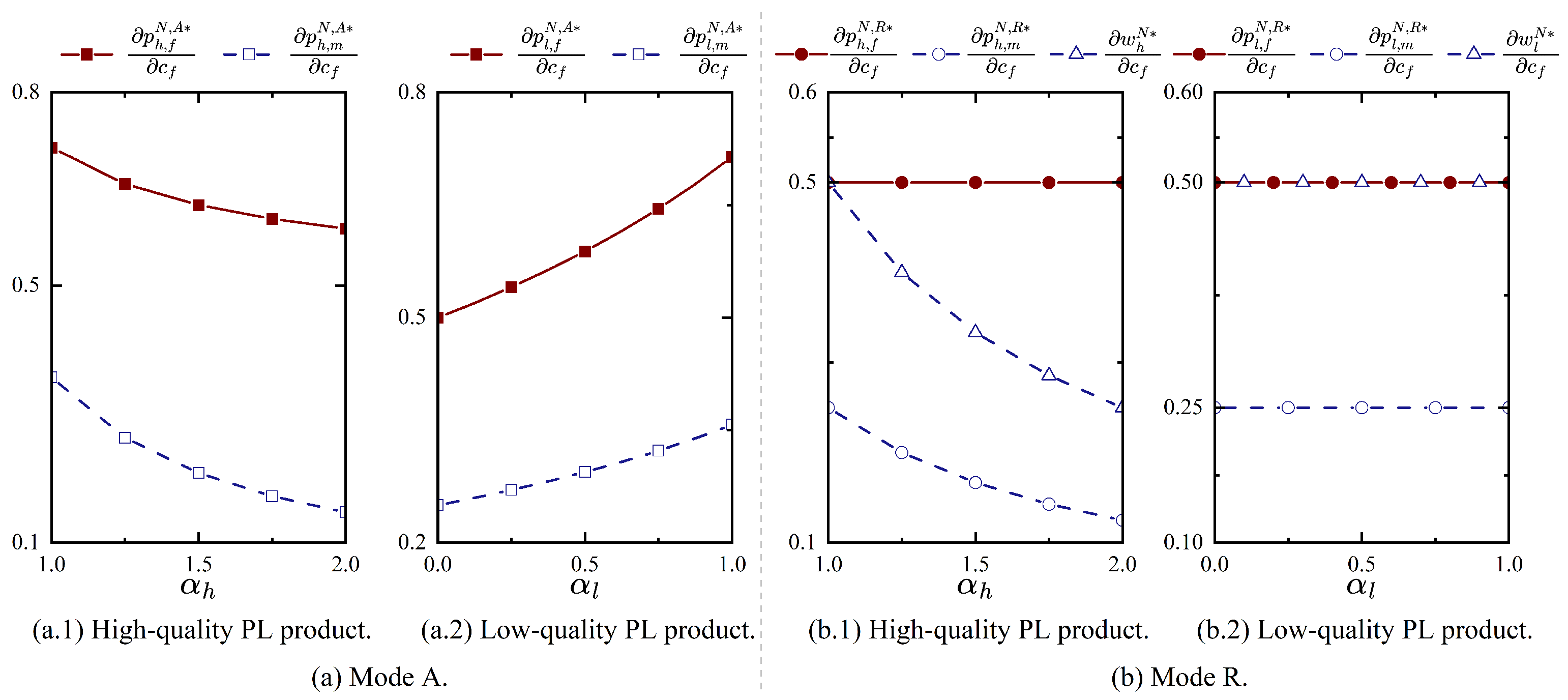
Figure 1 illustrates the results of Propositions 1 and 2. Since the joint impact of the quality and PL production cost under mode A depends on the commission rate θ , we present the numerical results of these corollaries with θ = 0.2 . Specifically, the results of Figure 1(a.1,a.2) show that under mode A, an increase in PL quality consistently shapes how the platform’s production cost influences the pricing decisions (as indicated in Proposition 1). In contrast, Figure 1(b.1,b.2) demonstrate that under mode R, the improvement in the quality only influences the wholesale and retail prices of MB products, consistent with the results of Proposition 2.

4.1. Competition Strategy with High-Quality PL Products

Define c ¯ h , m A = ( θ 1 ) c f + α h 1 2 α h + θ + 1 and c ¯ h , m R = c f α h ; we then have the following results:
Proposition 3. 
Faced with high-quality PL products, the manufacturer participates in the e-commerce competition if its production cost is not sufficiently high. Specifically, the following occurs.
1. 
Under mode A, participation occurs if c m ( 0 , c ¯ h , m A ) ;
2. 
Under mode R, both MB and PL products coexist in the market if c m ( 0 , c ¯ h , m R ) , where c ¯ h , m A c ¯ h , m R .
When the platform offers high-quality PL products, consumers exhibit stronger willingness to pay for PL products, making it difficult for the manufacturer to transfer the cost to consumers, thereby limiting the probability of MB products. As a result, the manufacturer offers MB products on the platform only when c m ( 0 , c ¯ h , m j ) . However, it is worth mentioning that in the face of high-quality PL products, the manufacturer is less likely to participate in the market competition under mode R than under mode A. This distinction arises from the pricing power of the platform under different sales modes. Specifically, under mode R, the platform sets retail prices for both the PL and MB products, pushing the manufacturer to offer a lower wholesale price to ensure sufficient demand for the MB, thereby reducing its profit margin and limiting the feasibility of participation when production costs are high. However, under mode A, the manufacturer sets price of the MB products, providing them with direct access to consumers without the double marginalization effect, leaving them with larger profit margins to offset the production cost. As a result, the manufacturer can participate in the platform even when the production costs are relatively high. This result implies that high quality of PL products does not necessarily erode the competitiveness of the MB products, underscoring the importance of the manufacturer making informed competition strategy choices under different supply chain structures.
Proposition 4. 
A higher quality of PL products does not always discourage the manufacturer from market competition; instead, it encourages the manufacturer’s participation under mode A if the commission rate is sufficiently low (i.e., θ ( 0 , θ ^ f 0 ) ).
Proposition 4 examines how the quality of private-label (PL) products influences the manufacturer’s willingness to participate in the platform. When the platform offers high-quality PL products, further increases in quality are expected to reduce the attractiveness of manufacturer-branded (MB) products, potentially discouraging manufacturer participation. This intuition consistently holds under mode R, where the platform has full pricing authority. In this case, improved PL quality directly erodes MB products’ market share and forces the manufacturer to lower its wholesale price. As a result, only manufacturers with a sufficiently low production cost can gain profit from competition with PL products. This indicates that mode R will amplify the competitive pressure from high-quality PL products on the manufacturer. In contrast, under mode A, the impact of quality improvement depends critically on the commission rate. Specifically, when the commission rate is sufficiently low (i.e., θ ( 0 , max [ θ ^ f 0 , 0 ] ) ), the revenue of the platform relies more heavily on sales of PL products than on commissions from MB products. In this case, an improvement in the PL quality allows the platform to fully monetize higher consumer valuations through increasing the price of PL products. This, in turn, reduces the competitiveness of PL products and unintentionally boosts demand for MB products. Moreover, a lower commitment rate leaves the manufacturer with a higher profit margin, thereby allowing them to benefit from the market competition with a higher production cost. Consequently, the manufacturer’s willingness to participate in the competition increases with the PL quality. However, when the commission rate is sufficiently high (i.e., θ ( max [ θ ^ f 0 , 0 ] , 1 ) ), the manufacturer bears a heavier commitment burden. An improvement in PL quality further erodes the competitiveness of MB products, thereby making the market competition profitable to the manufacturer only with very low production costs. These findings underscore the critical role of channel choice in shaping competitive dynamics and maintaining manufacturer engagement in the presence of PL products.
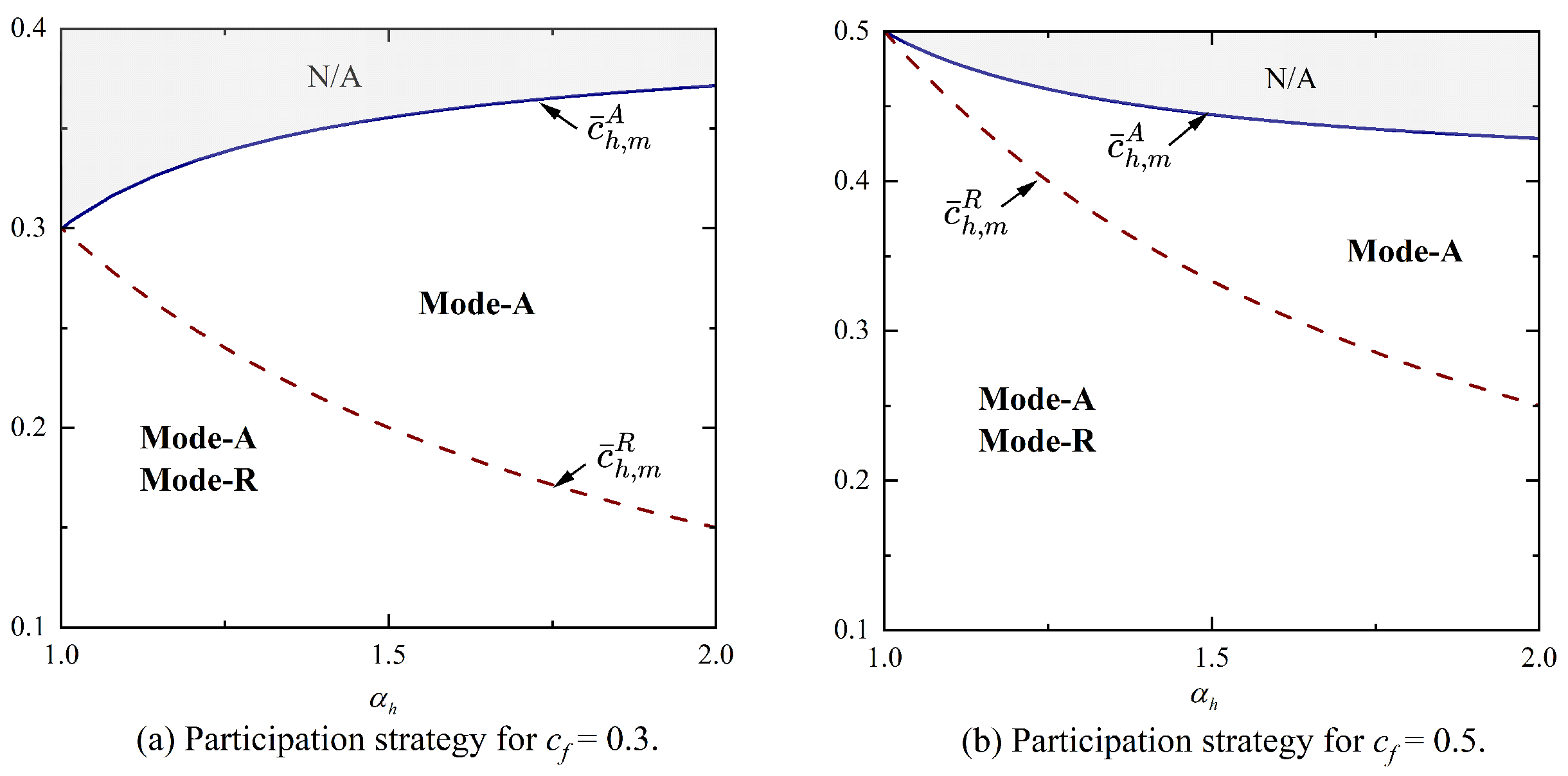
Figure 2 also presents how the quality improvement shapes the competitiveness of MB products (as shown in Proposition 4) with θ = 0.2 . Notably, the threshold θ ^ f 0 = 1 2 c f in Proposition 2 depends on the PL production cost c f . Accordingly, we consider the following two cases: (a) When c f = 0.3 , θ is located in ( 0 , θ ^ f 0 ) . As illustrated in panel (a), the region in which the manufacturer gains positive profit under mode A expands as α h increases, which implies that a quality improvement can encourage the manufacturer to participate in the competition under mode A by relaxing the cost constraint for profitable market competition. In contrast, when c f = 0.5 , θ is located in ( θ ^ f 0 , 1 ) . As shown in panel (b), higher PL quality reduces the region in which the manufacturer can profitably participate in the market. A similar pattern is observed under mode R, even when c f = 0.3 (as shown in panel (a)). In these cases, PL quality improvements intensify competition and weaken MB competitiveness, thereby discouraging manufacturer participation. These observations are fully consistent with the results of Proposition 4.

4.2. Competition Strategy with Low-Quality PL Products

In the face of low-quality PL products, consumers have a discounted valuation of the PL products. In this case, the platform can profitably offer PL products only when the manufacturer’s production cost is not excessively low (i.e., c m ( c ̲ m j , c ¯ m j ) with j = { A , R } ). In this subsection, we further investigate how the quality performance shapes the platform’s competition decision. Define c ^ f A = ( 1 θ ) α l 2 2 and c ^ f R = α l 2 2 ; we then have the following proposition:
Proposition 5. 
Under both mode A and mode R, quality improvement does not necessarily encourage the platform to offer PL products. Specifically, an increase α l leads to the following:
1. 
It discourages the platform from offering PL products if α l ( 2 2 , 1 ) and c f ( 0 , c ^ f j ) ;
2. 
It encourages the platform to offer PL products if either (a) α l ( 0 , 2 2 ) or (b) α l ( 2 2 , 1 ) and c f ( c ^ f j , c ¯ l , f j ) .
Unlike high-quality PL products, when the platform offers low-quality PL products, an increase in quality does not necessarily encourage the platform to participate in the market competition under either mode A or mode R. This is because the discounted valuation of PL products weakens the advantages of the platform’s pricing authority under mode R, rendering the choice of sales modes less influential in the engagement decision. In this case, the competitive dynamics between MB and PL products is jointly determined by PL quality and the production costs of the final products. Notably, when the manufacturer faces a higher production cost, it raises the price of MB products, which weakens its competitiveness and increases the likelihood of the platform gaining profit from offering PL products. Consequently, the platform is willing to introduce a low-quality PL product only when the manufacturer’s production cost is sufficiently high (i.e., c m > c ̲ m j ). Importantly, improvement in the PL quality does not necessarily enhance the competitiveness of the PL product. Specifically, when the production cost of PL products is sufficiently low (i.e., c f ( 0 , c ^ f j ) ) and the quality gap between PL and MB products is limited (i.e., α l ( 2 2 , 1 ) ), the PL product enjoys a strong cost advantage. In this case, a further increase in the PL quality enables the platform to raise the price of PL products, which erodes the cost advantage and intensifies the competition with the MB product. As a result, higher α l may unexpectedly discourage the platform from offering PL products. In contrast, when the production cost of the MB products is relatively high (i.e., α l ( 2 2 , 1 ) and c f ( c ^ f j , , c ¯ l , f j ) ), improvements in PL quality have a limited effect on reshaping the competitive dynamics between PL and MB products. Nevertheless, quality improvement allows the platform to extract higher profits from PL sales. Consequently, an increase in α l encourages the platform to compete with the manufacturer with a lower production cost. Moreover, when the quality gap between the PL and MB products is sufficiently high (i.e., α l ( 0 , 2 2 )), quality improvement also encourages the platform to offer PL products for the same reasons.
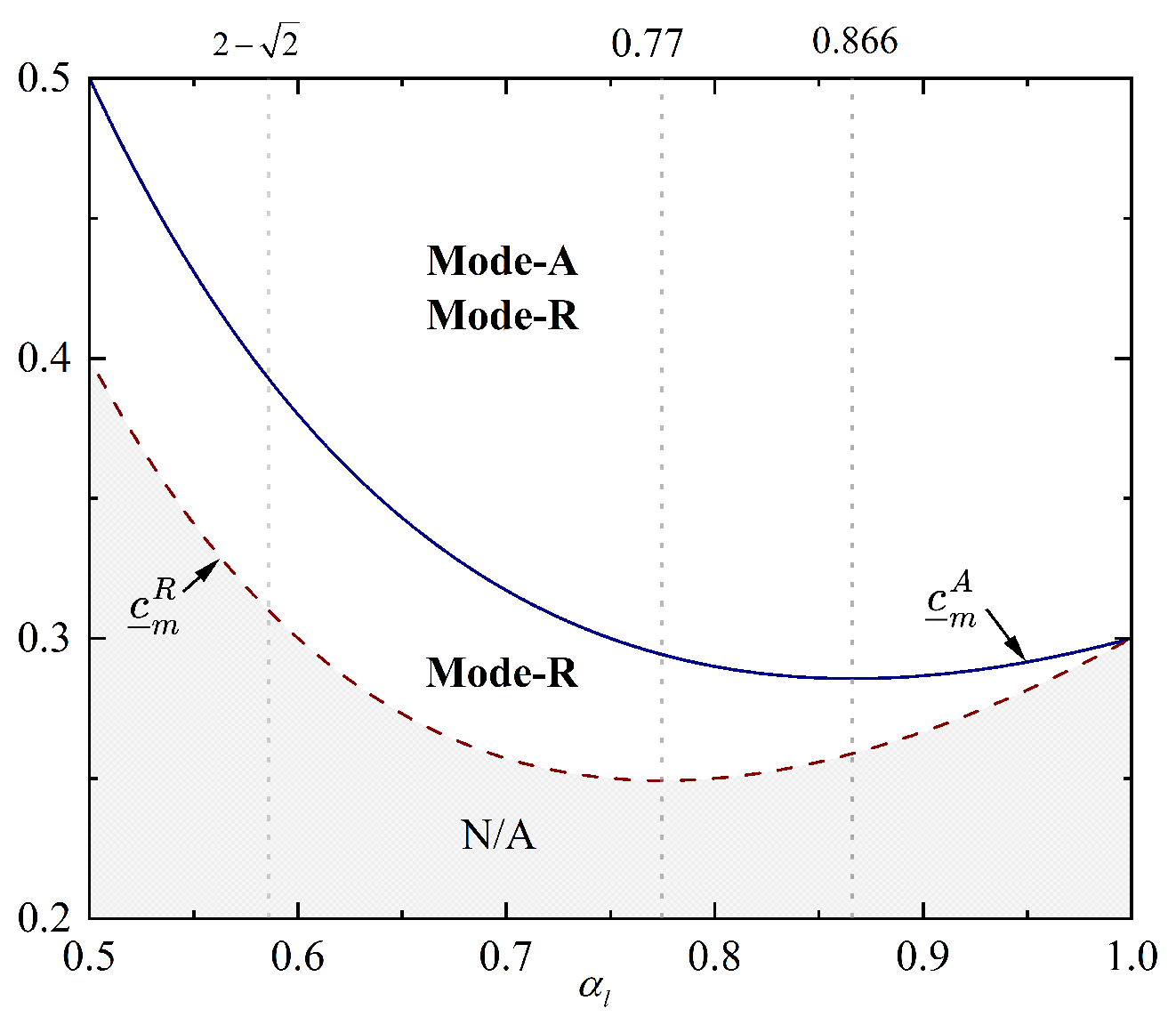
Figure 3 captures the results of Proposition 5 with parameters θ = 0.2 and c f = 0.3 . Since the threshold c ̲ m j increases in α l , the impact of quality improvements on the platform’s willingness to offer PL products depends critically on the value of α l . Specifically, when α l ( 2 2 , 1 ) , (a) under mode A, the condition c f ( 0 , c ^ f A ) holds if and only if α l ( 0.866 , 1 ) . In this region, an increase in α l discourages the platform from offering PL products due to the stricter constraint of the production cost of the manufacturer; otherwise, when α l ( 2 2 , 0.866 ) , we have c f > c ^ f A , and an increase α l relaxes the participation condition of the platform, thereby encouraging the platform to offer PL products. (b) A similar pattern arises under mode R. When α l ( 0.77 , 1 ) , quality improvement discourages PL entry, whereas for α l ( 2 2 , 0.77 ) , an increase in α l encourages the platform to offer PL products. Moreover, when α l ( 0 , 2 2 ) , an increase in α l consistently relaxes the participation constraint of the platform, thereby enhancing the platform’s willingness to compete by offering PL products.

5. Equilibrium Analysis with PL Advertising

In practice, platforms such as Amazon and JD.com utilize advertising to promote the sales of PL products [3,43,44]. In this section, we further examine how advertising activities affect the interplay of cooperation and competition between the manufacturer and the platform under different sales modes and consumer perceptions. The proof is listed in Appendix B.

5.1. Demand and Profits with PL Advertising

When a platform employs advertising strategies for its PL product, the resulting brand equity enhances the consumers’ willingness to pay of PL product [5]. For instance, Amazon strategically places PL products at the top of search results or alongside competitors’ product pages to strengthen consumer perception [8]. Let e denote the advertising effort of the platform. The effectiveness of the advertising efforts varies across PL quality levels. For instance, when the platform offers high-quality PL products, advertising has a greater impact on consumers’ willingness to pay compared to scenarios involving low-end products [45]. Let γ ( 0 , 1 ) represent the consumer’s discounted valuation of advertising of the low-quality PL product. Consistent with prior studies in the operations management field [4,28,29,35,46], we assume that the consumers’ utility is a linear function of advertising effort, which captures advertising-induced increase in the willingness to pay. This formulation enables us to derive closed-form equilibrium solutions and generate clear managerial insights that support manufacturers’ and platforms’ pricing and supply chain decisions in the presence of PL advertising, which constitute the primary contributions of this paper. Accordingly, the utility of high-quality PL product and low-quality PL product under sale mode j can be defined as: U h , f B , j = α h v + e p h , f B , j and U l , f B , j = α l v + γ e p l , f B , j , respectively. The consumers’ utility of the MB product is unaffected by the advertising effort and is defined as U i , m B , j = v p i , m B , j . Consumers make purchase decision on the basis of the utility, which is identical to that in Equation (1), and we thus omitted in this section.
Notably, while technological advancements have enabled platforms to better connect with consumers, the complexity of computational algorithms surges correspondingly with increased advertising efforts, which results in an increased marginal advertising cost [47,48]. Therefore, we then assume that the advertising cost of the platform is convex in its effort, which is defined as c a e 2 2 , as suggested in the existing research [4,35,46,47,48,49,50]. Accordingly, the profits of the platform with type i PL product under mode j with advertising can be defined as:
π i , f B , A = θ p i , m B , A D i , m B , A + ( p i , f B , A c f ) D i , f B , A c a e 2 2
π i , f B , R = p i , m B , R w i B D i , m B , R + ( p i , f B , R c f ) D i , f B , R c a e 2 2 .
It is worth mentioning that the advertising strategy has no impact on the components of the manufacturer’s profit and decision models, so we omit these expressions in this section. To facilitate the comparison of the impact of PL advertising on the competition dynamics under different sales modes, we assume that the platform adopts a homogeneous advertising effort under both mode A and mode R. This assumption allows us to isolate the impact of advertising from the role of channel structure. Under this assumption, advertising effort is exogenous, and both the platform and the manufacturer optimize the pricing decision accordingly. Because the resulting decision model is identical to that in Section 3, we omit the model formulation in this section. In Section 7, we relax this assumption and examine the heterogeneous advertising efforts to assess the robustness of our results.

5.2. Pricing Strategy with PL Advertising

Proposition 6. 
The PL advertising allows the platform to increase the PL price but lowers the retail price or wholesale price of MB products. The optimal pricing decisions are as follows:
  • For high-quality PL products, w h B * = w h N * e 2 α h ,
    p h , m B , j * = p h , m N , A * e 4 α h θ 1 , i f j = A ; p h , m N , R * e 4 α h , i f j = R . p h , f B , j * = p h , f N , A * + e 2 α h θ 1 4 α h θ 1 , i f j = A ; p h , f N , R * + e 2 , i f j = R .
  • For low-quality PL products, w l B * = w l N * e 2 ,
    p l , m B , j * = p l , m N , A * γ e 4 ( θ + 1 ) α l , i f j = A ; p l , m N , R * γ e 4 , i f j = R . ; p l , f B , j * = p l , f N , A * + γ e 2 ( θ + 1 ) α l 4 + 1 , i f j = A ; p l , f N , R * + γ e 2 , i f j = R .
Proposition 6 reveals that regardless of consumer preferences or the chosen sales modes, advertising can substantially enhance consumers’ perceived valuation of the PL product. This increased perceived value enables the platform to raise the PL product’s price, thereby reducing the relative attractiveness of the MB product to consumers. Consequently, under mode R, the manufacturer is compelled to lower the wholesale price of the MB products, making it economically viable for the platform to continue sourcing the product and offering it at a competitive retail price. Similarly, under mode A, the manufacturer must reduce the retail price of the MB products to counteract the intensified competition from the more appealing PL products, thereby mitigating the adverse impact of elevated consumer perception driven by advertising. Define Δ p i , m j = p i , m B , j * p i , m N , j * and Δ p i , f j = p i , f B , j * p i , f N , j * ; we then have the following propositions:
Proposition 7. 
Advertising effort and quality improvement do not always have aligned effects on product prices. Specifically, the following may occur:
1. 
Advertising effort may offset the effect of quality improvements on the following:
(a) 
The retail prices of MB products, when the platform offers high-quality PL products under either mode A or mode R.
(b) 
The retail prices of PL products, when the platform offers low-quality PL products under mode A.
2. 
Otherwise, advertising effort weakly reinforces the impact of quality improvement on product prices.
To facilitate understanding, we summarize the results of Proposition 5 in Table 5.
Proposition 7 and Table 5 indicate how the quality level shapes the effects of advertising on the pricing decisions of stakeholders under different sale modes. While quality improvement, which enhances the consumers’ perceived valuation of PL products, is expected to reinforce the impact of advertising effort on the equilibrium prices, it may in some cases offset that impact.
On the one hand, the PL advertising consistently decreases the retail price of MB products; however, when the platform offers high-quality PL products, a quality improvement pushes the platform to further increase the price of PL products, thereby offsetting the negative effect of PL advertising on the retail price of MB products under either mode A or mode R. In contrast, when the platform offers low-quality PL products, the impact varies across different sales modes. In this case, consumers perceive PL products as inferior substitutes; therefore, an increase in either the advertising effort or the quality of PL products will intensify the competition between PL and MB products, thereby allowing the quality improvement to reinforce the impact of advertising effort on the price of MB products under mode A. However, under mode R, the platform, which jointly determines the prices of both PL and MB products, is able to isolate the impact of quality from the role of advertising effort. Consequently, the impact of advertising effect on the retail price of MB products is independent of the quality improvement.
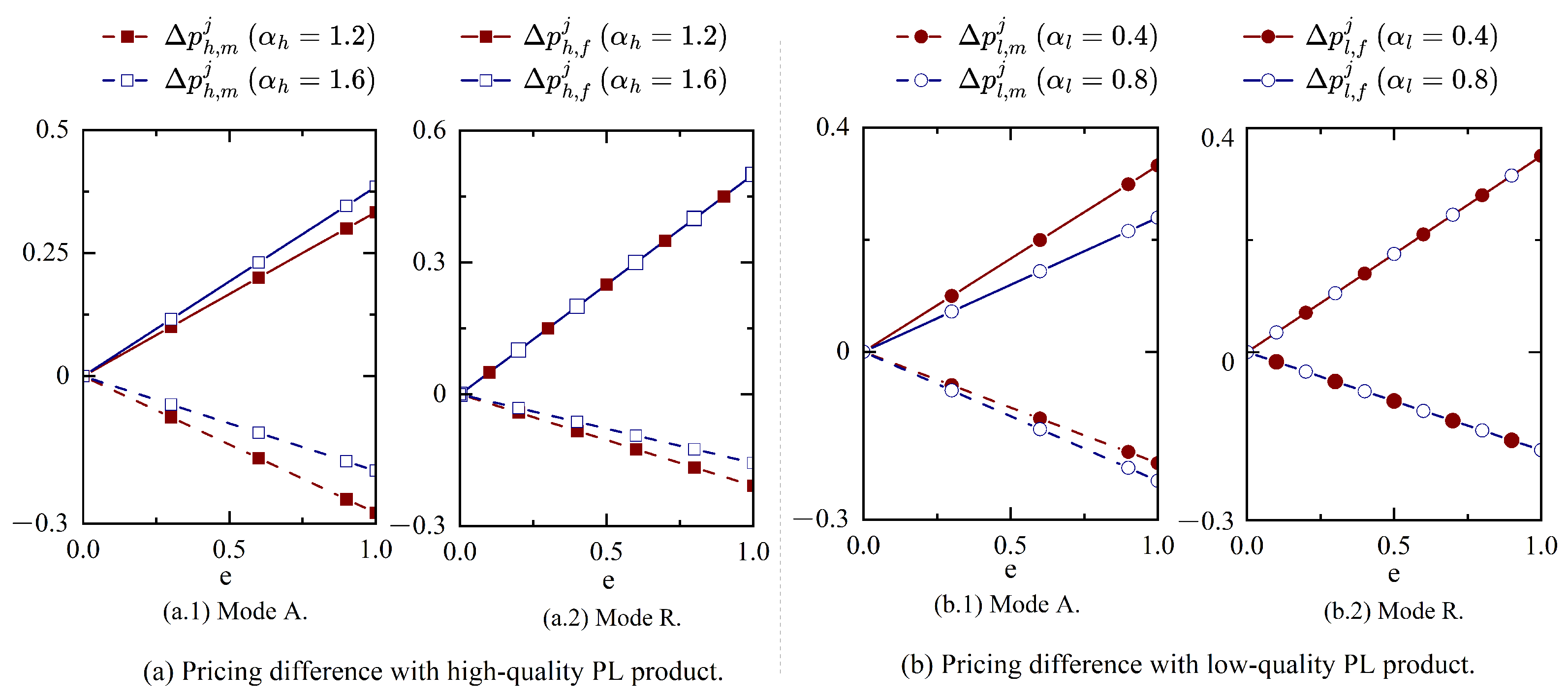
On the other hand, quality improvement offsets the impact of advertising effort on the price of PL products only when the platform offers low-quality PL products under mode A. Notably, increased advertising effort enables the platform to charge higher prices across different modes and quality levels. When the platform offers high-quality PL products under mode A, quality improvements and advertising efforts enhance the perceived valuation of the PL products, leading to an aligned effect on their price. In contrast, when the platform offers low-quality PL products, consumers’ purchasing decisions are driven primarily by functional quality rather than advertising. As a result, improvements in quality make PL prices less responsive to advertising effort. However, under mode R, the impact of advertising effort on the retail price of PL products is also independent of the quality improvement. Figure 4 presents the outcomes of Proposition 5 with θ = 0.2 and γ = 0.7 .

5.3. Efficiency Performance of PL Advertising

In this subsection, we clarify the conditions regarding the efficiency of advertising strategy for both the platform and the manufacturer in the following proposition:
Proposition 8. 
PL advertising does not necessarily increase the profit of the platform but always result in a decrease in the manufacturer’s profit. Specifically
1. 
PL advertising is a lose-lose solution for both the manufacturer and the platform if either (a)  c f ( c ^ f 0 j i , c ^ f 1 j i ) and (a.1) c a ( 0 , c ^ a j i ) and e ( 0 , e ^ j i ) , (a.2) c a ( c ^ a j i , c ¯ a ) and e ( e ^ j i , 1 ) , or (b) c f ( c ^ f 1 j i , c ¯ f j i ) .
2. 
Otherwise, a win-lose scenario exists, in which the platform gains at the expense of the manufacturer.
Recalling the result of Proposition 7, we observe that the advertising strategy—whether in markets with high-quality or low-quality PL products—consistently exerts downward pressure on the retail price of MB products across both sales modes. This effect stems from enhanced consumer perception of the PL offering, which strengthens its competitiveness and, consequently, reduces the demand for MB products. As a result, advertising systematically erodes the manufacturer’s profitability, irrespective of the sales mode (reselling or agency) or the type of consumer valuation. Moreover, although advertising enables the platform to raise the PL product’s price by enhancing its perceived value, this does not always translate into higher profit. It is then the trade-off between the production cost of PL products and the advertising-associated costs jointly influencing the profitability of the advertising activities. For instance, when the production cost of PL products is sufficiently high c f ( c ^ f 1 j i , c ¯ f j i ) , their price is at a relatively high level. In this case, a further increase in the price of PL products, driven by advertising, significantly reduces the demand for them, ultimately reducing the platform’s profit. Conversely, when the production cost of PL products is sufficiently low c f ( 0 , c ^ f 0 j i ) , advertising becomes more effective in stimulating PL demand and improving platform profit.
However, when the production cost is moderate (i.e., c f ( c ^ f 0 j i , c ^ f 1 j i ) ), the PL product neither clearly dominates nor lags behind in market competition. In this context, the profitability of advertising is primarily driven by advertising-related parameters. Specifically, when the unit advertising cost is high, i.e., c a ( c ^ a j i , c ¯ a ) , the platform’s profit decreases with the advertising effort level, leading to a lose–lose outcome for both platform and manufacturer if the advertising effort is also high (i.e., e ( e ^ j i , 1 ) ). However, if the advertising cost is lower than c ^ a j i , a lose–lose result may occur when the advertising effort is insufficient (i.e., e ( 0 , e ^ j i ) ). In this case, the profitability of advertising is not limited by cost but is instead driven by the competitive dynamics between PL and MB products. Since the platform’s total profit derives from both PL and MB sales, a marginal increase in PL competitiveness due to advertising may come at the expense of MB market share. This leads to a reduction in the marginal profit from MB sales; therefore, advertising becomes beneficial for the platform only when the effort level exceeds the threshold e ^ j i . Otherwise, with low advertising effort, the marginal gain from PL products is insufficient to compensate for the MB profit decline, ultimately resulting in a net loss for both parties. These results show that PL advertising does not always increase platform profitability, highlighting the need for platforms to carefully weigh its costs and benefits. Platforms with strong brand equity, such as JD.com and Amazon, can build PL brand equity with lower advertising costs; therefore, they usually exert greater PL advertising efforts, such as by listing their PL products at the top of search results to gain higher profits. However, platforms with weaker brand equity, such as Taobao, need to afford a higher marginal advertising costs and should adopt more conservative advertising strategies to maintain profitability.
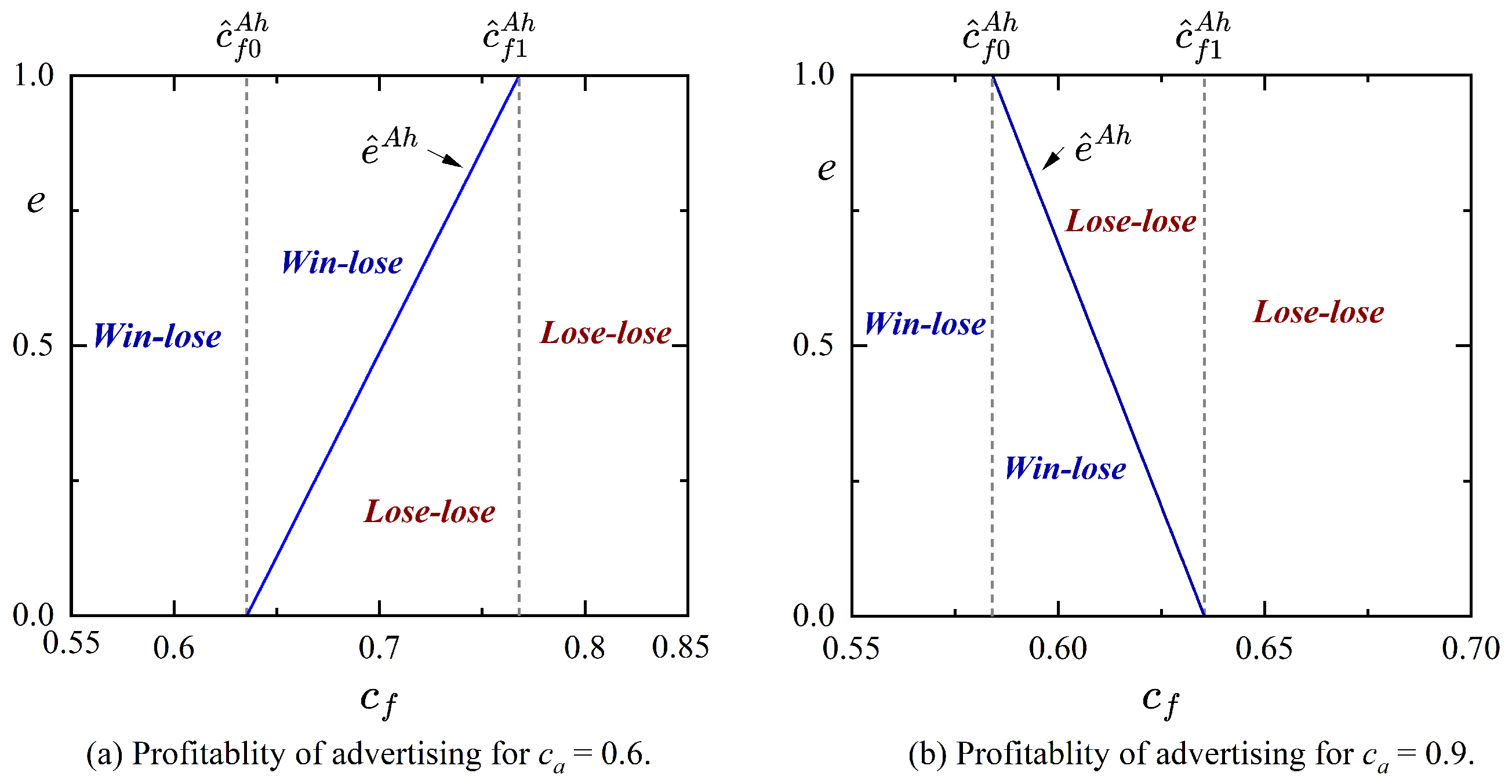
Figure 5 illustrates the profitability of advertising under mode A for a high-quality PL product with parameters θ = 0.2 , α h = 1.4 , and c m = 0.1 . With these parameters, we know that when c f ( c ^ f 0 A h , c ^ f 1 A h ) , a threshold c ^ a A h = 0.816 exists such that the profitability of the advertising varies when the advertising cost is located in different ranges. For instance, (a) when c a = 0.6 ( 0 , c ^ a A h ) , a lose–lose case exists provided that the advertising effort is lower than e ^ A h ; otherwise, (b) when c a = 0.9 ( c ^ a A h , c ¯ a ) , a lose–lose case exists if e > e ^ A h . These findings highlight the complex interaction between advertising and market competition between PL and MB products, emphasizing how this dynamic shapes the overall profitability of advertising. Notably, the impact of advertising under mode R is similar to that under mode A. We thus omit the detailed discussion for this reason.

6. Channel Preferences with PL Advertising

In this section, we further investigate the channel preferences of the manufacturer and the platform under PL advertising strategies. Notably, both the platform and the manufacturer select between mode A and mode R, and four cases may exist under different conditions. Note that the production cost of both PL and MB products remains identical under different channel structures; therefore, the preference for different channel structures is unaffected by the production cost of the manufacturer. If the platform offers high-quality PL products, the unit production cost of those products is higher than that of MB products; we thus assume c f > c m = 0 to characterize the relationship between the costs of the platform and the manufacturer, without causing calculation complexity. For the same reason, we also assume that c m > c f = 0 provided that the platform offers low-quality PL products. The proof is listed in Appendix C.
Proposition 9. 
When the platform offers high-quality, the PL advertising may coordinate the channel preferences under certain conditions. Specifically,
1. 
Manufacturer and platform hold Inconsistent channel preferences
(a) 
The platform (resp. manufacturer) prefers mode A (resp., mode R) if the advertising effort e ( 0 , e ^ n 0 h ) ( e ^ f 2 h , 1 ) ;
(b) 
The platform (resp. manufacturer) prefers mode R (resp., mode A) if the advertising effort e ( e ^ n 1 h , e ^ m 2 h ) ;
2. 
Manufacturer and platform hold Consistent channel preferences, specifically,
(a) 
both prefer mode A, if e ( e ^ n 0 h , e ^ n 1 h ) , α h ( α ^ h , 1 , α ¯ h ) and θ ( 0 , θ ^ 1 ) .
(b) 
Otherwise, both the manufacturer and platform prefer mode R.
Proposition 9 illustrates that when the platform offers high-quality PL product, the manufacturer faces fierce competition, making the advertising intensity and the commission structure play key role in shaping the channel preference of both parties. Specifically, when advertising is sufficiently low (i.e., e ( 0 , e ^ n 0 h ) ), the impact of advertising is too limited to erode the sales of MB, allowing the platform to secure higher profit under mode A. However, the manufacturer prefers mode R to protect itself from direct competition with the platform’s high-quality PL products. As the advertising effort becomes moderate (i.e., e ( e ^ n 0 h , e ^ n 1 h ) ), the platform under mode R holds full pricing authority, allowing it to well balance the competition between MB and PL products. By contrast, under mode A, when the PL products has sufficiently high quality (i.e., α h ( α ^ h , 1 , α ¯ h ) ), the consumers’ purchasing decision of different products is less affected by the PL advertising. In this case, the manufacturer lowers the price of MB as the commission rate increases. As a result, when the commission rate is low (i.e., θ ( 0 , θ ^ h , 1 ) ), both the platform and manufacturer prefer mode A for the significant revenue resulting from the MB sales. However, when either the PL quality has slight quality advantage ( α h ( 1 , α ^ h , 1 ) ) or the commitment rate is sufficiently high ( α h ( α ^ h , 1 , α ¯ h ) and θ ( θ ^ h , 1 , 1 ) ), the PL advertising pushes the manufacturer to reduce the MB price to mitigate competition or manage commitment costs—eroding profits and making mode A less appealing. In this case, both the platform and the manufacturer prefer mode R.
Moreover, when the platform exerts a higher advertising effort (i.e., e > e ^ n 1 h ), advertising costs account for a substantial portion of the platform’s expenses. In this case, when the advertising effort is moderately high (i.e., e ( e ^ n 1 h , e ^ f 2 h ) ), the platform prefers mode R for its flexibility in allocating advertising costs between both PL and MB products. However, when advertising intensity becomes excessive (i.e., e ( e ^ f 2 h , 1 ) ), PL advertising significantly weakens the competitiveness due to the significant increase in the retail prices. In response, the platform shifts to mode A to secure commitment fees from MB sales. Moreover, given that the excessive advertising effort cause more severe pressure to manufacturer under mode A, manufacturer shifts from mode A to mode R when advertising effort exceeds e ^ m 2 h . As a result, the mode R allows both the platform and manufacturer to gain more profits when e ( e ^ m 2 h , e ^ f 2 h ) . Otherwise, the manufacturer and platform become misaligned.
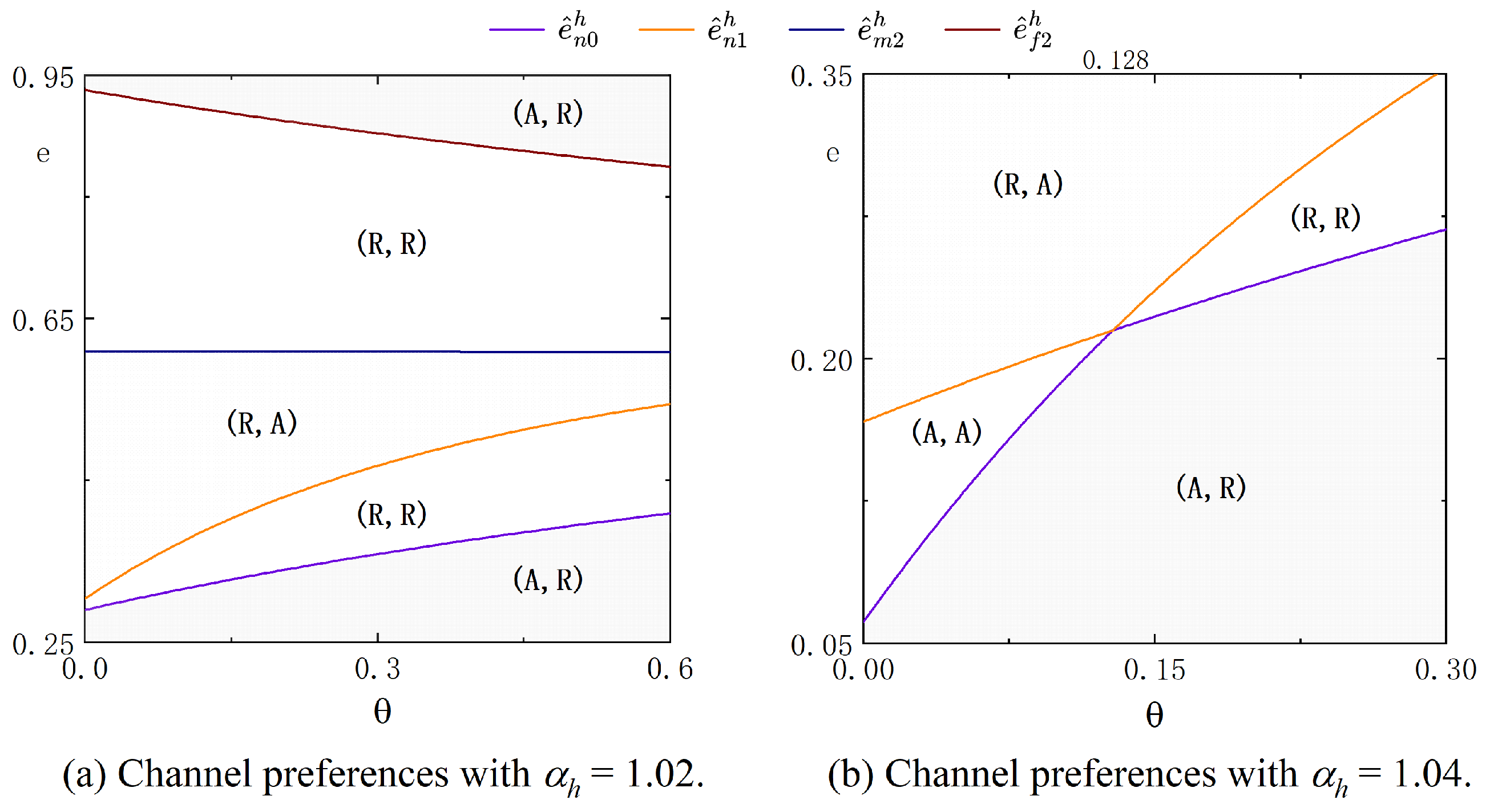
Let ( X , Y ) denote the platform and manufacturer’s channel preferences, respectively, with respect to PL advertising, where X { A , R } and Y { A , R } . Figure 6 illustrates the channel preferences of the manufacturer and platform for high-quality PL products with c f = 0.6 . In this case, we obtain a threshold α ^ h , 1 = 1 14 ( 3 + 8 2 ) . Accordingly, (a) when α h = 1.02 ( 0 , α ^ h , 1 ) , the advertising level plays a dominant role in the choice preferences of the platform and the manufacturer, regardless of the commitment fees (as shown in panel (a)). However, when (b) α h = 1.04 ( α ^ h , 1 , α ¯ h ) , the commitment fees emerge as a key determinant in the preference between mode A and mode R if the two parties hold consistent preferences (i.e., e ( e ^ n 0 h , e ^ n 1 h ) ).
Proposition 10. 
When the platform offers low-quality PL,
1. 
Manufacturer and platform also hold Inconsistent channel preferences
(a) 
The platform (resp. manufacturer) prefers mode A (resp., mode R) if the advertising effort e ( 0 , e ^ n 0 l ) ( e ^ n 3 l , 1 ) ;
(b) 
The platform (resp. manufacturer) prefers mode R (resp., mode A) if the advertising effort e ( e ^ n 1 l , e ^ n 2 l ) ;
2. 
While the quality level of PL product significantly shapes the Consistent channel preferences of the manufacturer and platform, specifically,
(a) 
both prefer mode A, if α l ( 0 , α ^ l , 1 ) , and either (a) e ( e ^ n 0 l , e ^ n 1 l ) and θ ( 0 , m i n [ θ ^ l 1 , θ ^ l 2 ] ) or (b) e ( e ^ n 2 l , e ^ n 3 l ) and θ ( θ ^ l 1 , θ ^ l 2 ) .
(b) 
Otherwise, both the manufacturer and platform prefer mode R.
Proposition 10 investigates the channel preferences of the platform and the manufacturer in the face of low-quality PL products. Similar to the case of high-quality PL products, the results show that platform and the manufacturer exhibit misaligned channel preferences when either e ( 0 , e ^ n 0 l ) ( e ^ n 3 l , 1 ) or e ( e ^ n 1 l , e ^ n 2 l ) . As the underlying reasons are consistent with those in the case of high-quality PL products, we omit the detailed explanation here for brevity. However, unlike the high-quality PL setting, the platform and the manufacturer simultaneously prefer mode A only when the quality of the PL products is sufficiently low (i.e., α l ( 0 , α ^ l , 1 ) ). The main reason for this is that in such cases, the PL products pose limited competitive pressure on the MB products, increasing the potential attractiveness of mode A to both the manufacturer and the platform. However, the benefits of mode A are sensitive to both the platform’s commitment rate and the advertising level. Specifically, when the commitment rate is low (i.e., θ ( 0 , min [ θ ^ l 1 , θ ^ l 2 ] ) ), the manufacturer retains a higher portion of the MB sales, limiting the platform’s ability to afford the advertising costs. As a result, both the manufacturer and the platform prefer mode A only when the advertising level is moderately low (i.e., e ( e ^ n 0 l , e ^ n 1 l ) ). Otherwise, if the advertising level becomes moderately high e ( e ^ n 2 l , e ^ n 3 l ) , the insufficient commitment fees and intensive competitiveness of PL products make mode R more attractive to both parties. In contrast, when the commitment rate is high (i.e., θ ( θ ^ l 1 , θ ^ l 2 ) ), the higher commission fees allow the platform to effectively compensate for the advertising cost, but this leaves a lower profit margin for the manufacturer. In this setting, when the platform applies a moderately high effort level (i.e., e ( e ^ n 2 l , e ^ n 3 l ) ), the over advertising cost enhances the competitiveness of MB products, thereby making mode A become attractive to both parties. Conversely, when the advertising level is relatively low (i.e., e ( e ^ n 0 l , e ^ n 1 l ) ), the manufacturer and the platform prefer mode R.
In contrast, if the PL product becomes competitive with high perceived quality (i.e., α l ( α ^ l , 1 , 1 ) ), the advertising level, rather then the commitment rate, becomes the dominant factor influencing the channel preferences of both parties. In this setting, when the advertising level falls within e ( e ^ n 0 l , e ^ n 1 l ) ( e ^ n 2 l , e ^ n 3 l ) , the PL product becomes highly competitive-either due to a limited price increase (when advertising is moderately low) or due to enhanced consumer perception (when advertising is moderately high). Consequently, the manufacturer prefers mode R to avoid direct competition with the platform. Otherwise, the PL advertising fails to coordinate the channel preferences between the manufacturer and platform. These results suggest that when the PL product is only slightly inferior in quality to the MB product, the platform can achieve a win–win outcome by strategically selecting the advertising level and aligning it with an appropriate supply chain structure to adequately balance competitive pressure.
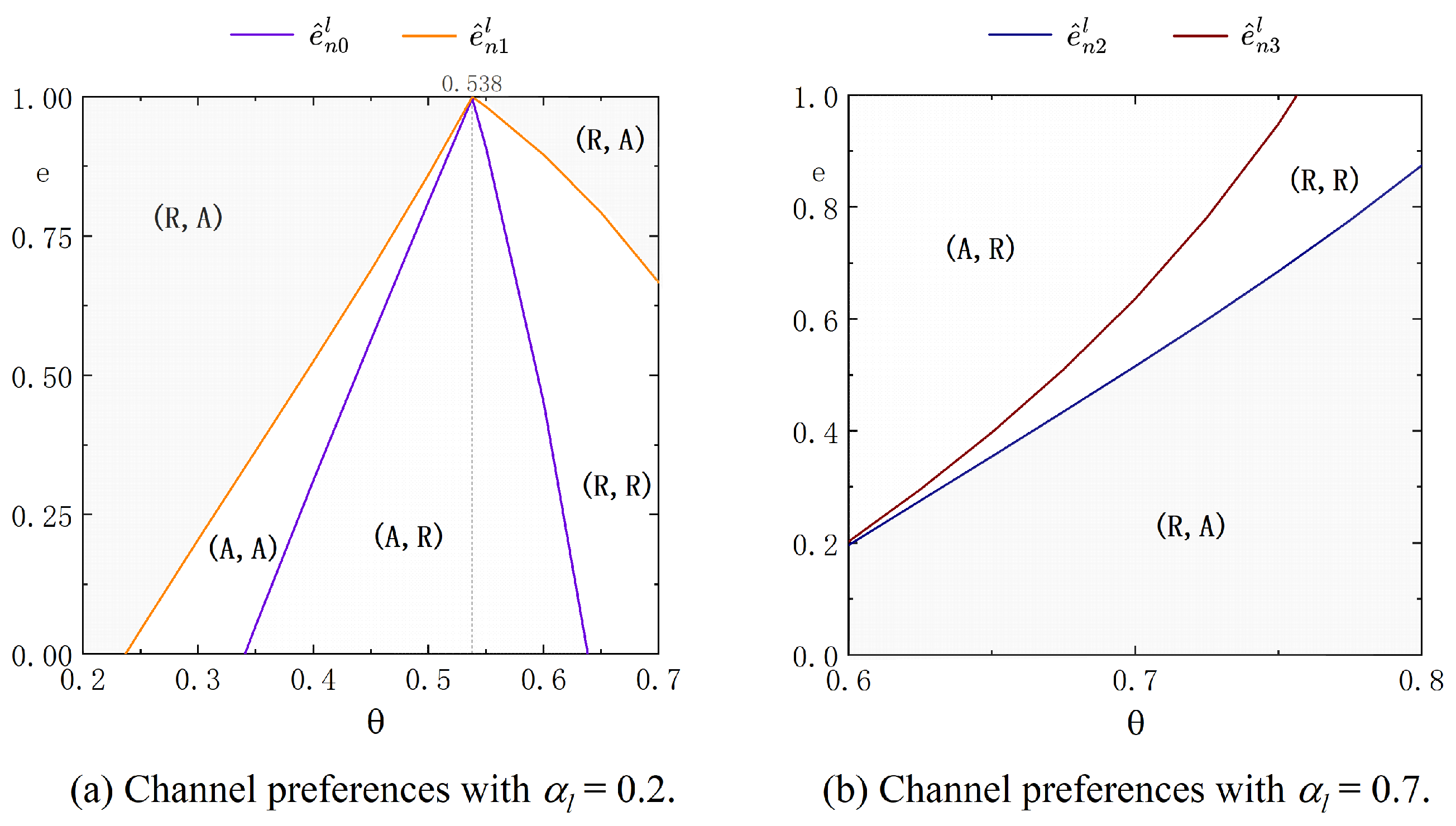
Figure 7 illustrates the channel preferences of the manufacturer and the platform for a low-quality PL product with parameters c m = 0.3 and γ = 0.5 . With these parameters, we obtain a threshold of θ ^ l 1 = 0.538 . Notably, the value of the threshold α ^ l , 1 varies with θ . We consider the following two cases: Case (a), when α l = 0.2 , α l ( 0 , α ^ l , 1 ) holds for all θ ( 0.2 , 0.7 ) . In this case, thresholds e ^ n 2 l = e ^ n 3 l = 1 . Accordingly, both mode A and mode R allow both parties to secure higher profits under a moderate advertising level (i.e., e ( e ^ n 0 l , e ^ n 1 l ) ), provided that the commitment rate is located in different ranges. Case (b), when α l = 0.7 , α l ( α ^ l , 1 , 1 ) holds for all θ ( 0.6 , 0.8 ) and e ^ n 0 l = e ^ n 1 l = 0 . In this setting, the platform and the manufacturer exhibit aligned preferences for mode R only, regardless of the commitment rate.

7. Extension: Endogenous PL Advertising and Numerical Analysis

In this section, we further extend the model to examine the robustness of our results when the platform optimizes the PL advertising effort under different sale modes. Accordingly, based on research in this field [4,5] we assume that the platform first optimizes its advertising effort. After observing consumers’ purchasing behavior, the manufacturer and the platform determine the retail price of PL and MB products. This decision sequence does not alter the profit functions of either the manufacturer or the platform, which remain identical to those with the exogenous advertising presented in Equations (20) and (21); we thus omit them here for brevity. The proof is listed in Appendix D.

7.1. Endogenous PL Advertising Decision

The primary goal of our paper is to investigate the impact of PL advertising effort on the competition dynamics between MB and PL products. Since the platform’s effort decreases with the marginal advertising cost, a sufficiently low advertising cost would intuitively lead to maximal advertising effort regardless its impact on the competition. Therefore, we restrict c a ( c ^ a j i , c ¯ a ) to focus on the case where the platform needs to apply a strategic advertising decision to maximize its profit. The threshold c ^ a j i is defined in Proposition 6; we thus omit it here. In this case, the optimal advertising effort is as follows:
  • When the platform offers high-quality PL products,
    e h j * = α h 1 2 α h θ 1 4 α h θ 2 c f ( θ + 4 ) α h + 4 α h 2 + θ + 1 c a α h 1 4 α h + θ + 1 2 + 2 α h 4 α h + θ + 4 2 ( θ + 1 ) , i f j = A ; c f 3 4 α h + 4 α h 1 α h 8 c a α h 1 α h 4 α h + 3 , i f j = R .
  • When the platform offers low-quality PL products,
    e l j * = α l γ ( θ 1 ) α l 1 4 θ + θ 2 θ 2 α l + 4 2 γ c m θ α l + α l 2 ( θ 1 ) c a α l 1 α l θ α l + α l 4 2 + 2 γ 2 ( θ + 1 ) α l 2 ( θ + 4 ) α l + 4 , i f j = A ; γ α l c m + 3 α l 3 8 c a α l 1 α l + γ 2 4 3 α l , i f j = R .

7.2. Efficiency of Endogenous PL Advertising

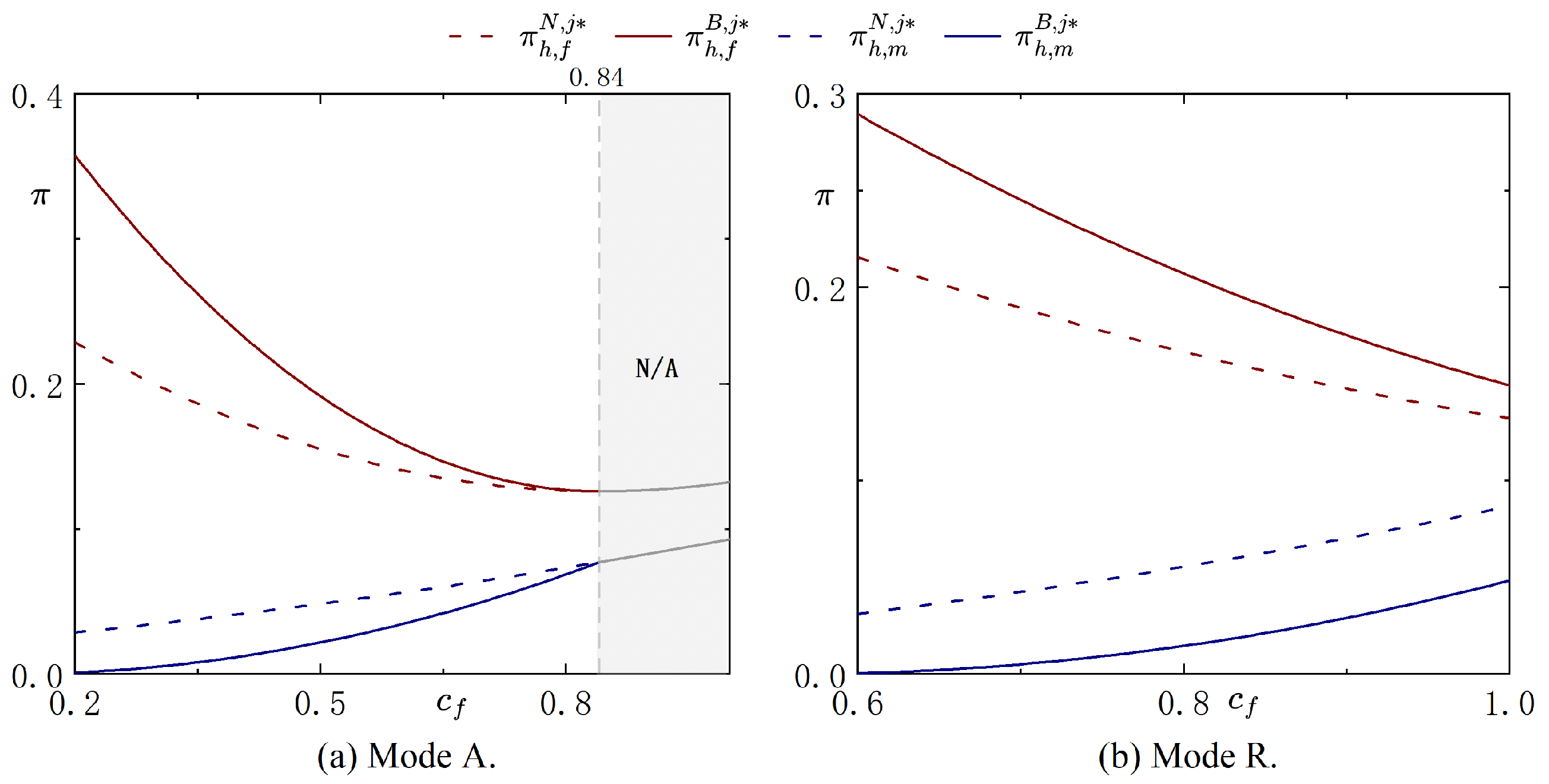
Figure 8 examines the efficiency of endogenous PL advertising with parameters α h = 1.8 and θ = 0.6 . Accordingly, the threshold c ^ a A h = 0.5 , and we then assume that c a = 0.9 . As shown in panel (a), when c f < 0.84 , the optimal advertising effort e h A * is smaller than the threshold e ^ A h listed in Proposition 8. In this region, the profit of the platform with endogenous PL advertising is higher than that without advertising, leading to a win-lose solution for the platform and the manufacturer. Otherwise, when c f > 0.84 , the optimal advertising effort should be zero. This result implies that PL advertising is no longer an economically efficient option for the platform; therefore, the PL advertising is a lose–lose solution for the platform and the manufacturer. It should be noted that, under mode R, the optimal advertising effort e h R * is always lower than the threshold e ^ R h for all c f ( 0 , 1 ) , indicating that a win-lose case always exists under mode R (as shown in panel (b)). These results demonstrate the robustness of our results with respect to the economic efficiency of PL advertising.

8. Conclusions

Advertising plays an important role in shaping consumers’ purchasing behavior and is often regarded as an effective way to promote PL products. In practice, however, platforms adopt heterogeneous PL advertising strategies. This paradox promotes us to investigate the underlying reasons of the heterogeneous attitudes toward PL advertising. Note that the operation of platforms differs in their PL quality levels and supply chain structure, we thus formulate a game theoretical model to answer the following questions: (a) When should platform adopt the PL advertising? (b) How do the PL quality and supply chain structure shape the efficiency of PL advertising in improving profit of the platforms and coordinating channel preferences? The results offer platforms and manufacturers a comprehensive understanding of when and how PL advertising works from the following perspectives:
(1)
In the absence of advertising, quality improvement of PL products, which is expected to weaken the competitiveness of manufacturer, may increase the manufacturer’s incentive to compete under certain conditions. These results underscore the importance of platform and manufacturer to adjust its competition strategies aligning with the PL quality level and structure channel to secure higher profit from the competition.
(2)
PL advertising does not necessarily enhance the profit of the platform and may lead to a lose–lose outcome for both manufacturer and platform under specific conditions. These findings highlighting the importance of jointing considering PL quality and supply chain structure in effectively designing its advertising level to well balance the competition dynamics between the MB and PL products. In particular, when advertising costs are high, adopting an aggressive advertising strategy can significantly harm platform profitability. This insight greatly explain the heterogeneous attitudes toward PL advertising observed across platforms, such as JD.com and Taobao.
(3)
Finally, we delineate the market conditions under which the PL advertising effort can coordinate the channel preference of both the platform and manufacturer. The results provide actionable guidance for platforms to select the appropriate advertising level and supply chain structure to achieve a win–win outcome. In particular, when the quality of the PL product is close to that of the product, the platform can achieve such coordination under mode R with suitable PL advertising level. In contrast, coordination through PL advertising under Mode A is more complex and requires careful evaluation of product quality and commission rates.
In summary, this research contributes to provide actionable support for both platforms and manufacturer by highlighting the important role of quality and supply chain structure not only the efficiency of private-label (PL) advertising for profit improvement but also its effectiveness in coordinating channel preferences.
This study also has several limitations that offer avenues for future research. First, while we analyze the impact of private-label (PL) advertising on competitive dynamics, the effects of fully endogenous PL advertising on both competition and sales-mode choice decisions warrant further investigation. Second, our analysis focuses on settings in which the platform offers either a high-quality or a low-quality PL product. In practice, platforms often adopt multi-tier PL strategies with multiple quality levels; examining PL advertising strategies in such settings may also yield richer insights.

Author Contributions

Conceptualization, Y.Z.; methodology, S.P.; formal analysis, S.P. and M.L.; investigation, Y.Z.; resources, M.L.; writing—original draft preparation, S.P.; writing—review and editing, Y.Z.; visualization, Y.Z. and S.P.; supervision, Y.Z.; project administration, Y.Z.; funding acquisition, Y.Z. All authors have read and agreed to the published version of the manuscript.

Funding

This research was funded by National Natural Science Foundation of China grant number 72201118.

Data Availability Statement

The original contributions presented in this study are included in the article. Further inquiries can be directed to the corresponding author.

Conflicts of Interest

The authors declare no conflicts of interest.

Abbreviations

The following abbreviations are used in this manuscript:
PLPrivate label
MBManufacturer-branded
Mode AAgency mode
Mode RReselling mode

Appendix A. Proof of Section 4

Appendix A.1. Proof of Optimal Pricing Decision Without Advertising

When the platform offers high-quality PL products, the equilibrium solutions without advertising under different sales modes are as follows:
(1)
Under mode A, from 2 π h , m N , A p h , m N , A 2 = 2 θ 1 α h α h 1 < 0 and 2 π h , f N , A p h , f N , A 2 = 2 α h 1 < 0 , we know that π h , m N , A is concave in p h , m N , A and π h , f N , A is concave in p h , f N , A . By jointly solving π h , m N , A p h , m N , A = 0 and π h , f N , A p h , f N , A = 0 , we obtain the optimal pricing decisions: p h , m N , A * = α h 2 c m θ + 1 + ( 1 θ ) c f 1 ( 1 θ ) 4 α h θ 1 and p h , f N , A * = α h 2 1 θ c f + α h 1 + θ + 1 c m 1 θ 4 α h θ 1 , respectively.
(2)
Under mode R, from 2 π h , f N , R p h , m N , R 2 = 2 α h α h 1 < 0 and the Hessian matrix ( H ) of π h , f N , R ( | H ( π h , f N , R ) | = 4 α h 1 > 0 ), we know that π h , f N , R is jointly concave in p h , m N , R and p h , f N , R . By solving π h , f N , R p h , m N , R = 0 and π h , f N , R p h , f N , R = 0 , we obtain the expression of optimal retail prices: p h , m N , R w h N = w h N + 1 2 and p h , f N , R * = c f + α h 2 , respectively. Integrating the optimal solution into π h , m R , from 2 π h , m N , R w h N 2 = α h 1 α h < 0 , we know that π h , m N , R is concave in w h N . By solving π h , m N , R w h N = 0 , we obtain the optimal MB wholesale price: w h N * = 1 2 c f α h + c m . Accordingly, we know that p h , m N , R * = 1 4 c f α h + c m + 2 .
Notably, the proof process of the case with low-quality PL products and exogenous advertising is similar to that of the case with high-quality PL products, so we omit it in this section. Moreover, we list the closed-form solutions in Table 3 and Table 4 for clarity.

Appendix A.2. Proof of Propositions 1 and 2

We check the joint impact of c f and α h on the optimal solutions:
(1)
Under mode A, (a) for the high-quality PL product, p h , f N , A * c f = 2 α h 4 α h θ 1 > 0 and 2 p h , f N , A * c f α h = 2 ( θ + 1 ) 4 α h θ 1 2 < 0 , and p h , m N , A * c f = 1 4 α h θ 1 > 0 and 2 p h , m N , A * c f α h = 4 4 α h + θ + 1 2 < 0 . (b) For the low-quality PL product, p l , f N , A * c f = 2 4 ( θ + 1 ) α l > 0 and 2 p l , f N , A * c f α l = 2 ( θ + 1 ) ( θ + 1 ) α l 4 2 > 0 , and p l , m N , A * c f = 1 4 ( θ + 1 ) α l > 0 and 2 p l , m N , A * c f α l = θ + 1 ( θ + 1 ) α l 4 2 > 0 .
(2)
Likewise, under mode R, (a) for the high-quality PL product, p h , f N , R * c f = 1 2 > 0 and 2 p h , f N , R * c f α h = 0 , p h , m N , R * c f = 1 4 α h > 0 and 2 p h , m N , R * c f α h = 1 4 α h 2 < 0 , and w h N * c f = 1 2 α h > 0 and 2 w h N * c f α h = 1 2 α h 2 < 0 . (b) For the low-quality PL product, p l , f N , R * c f = 1 2 > 0 and 2 p l , f N , R * c f α l = 0 , p l , m N , R * c f = 1 4 > 0 and 2 p l , m N , R * c f α l = 0 , and w l * c f = 1 2 > 0 and 2 w l * c f α l = 0 .

Appendix A.3. Proof of Propositions 3 and 4

Notably, for either mode A or mode R, the conditions of competition between PL and MB products are satisfied if p h , f N , j > α h p h , m N , j . Integrating the optimal solution into the condition, we know that p h , f N , j * > α h p h , m N , j * can be satisfied with c m < c ¯ h , m j , where c ¯ h , m A = ( θ 1 ) c f + α h 1 2 α h + θ + 1 under mode A, and c ¯ h , m R = c f α h under mode R. Accordingly, we know that (a) a threshold θ ^ f 0 = max [ 1 2 c f , 0 ] exists for c ¯ h , m A α h = 0 such that c ¯ h , m A α h > 0 (resp., c ¯ h , m A α h < 0 ) if 0 < θ < θ ^ f 0 (resp., θ ^ f 0 < θ < 1 ). (b) Conversely, c ¯ h , m R α h = c f α h 2 < 0 consistently holds for all θ ( 0 , 1 ) .

Appendix A.4. Proof of Proposition 5

Similar to Appendix A.3, we know that p l , f N , j * < α l p l , m N , j * —which holds if c m > c ̲ m j —should be satisfied to ensure the positive demand for both PL and MB products, where c ̲ m A = max [ 0 , c f ( 2 α l 1 ) ( θ 1 ) α l 1 ] under mode A and c ̲ m R = max [ 0 , c f ( 2 α l 1 ) + α l 1 ] under mode R. Two thresholds c f 0 A = ( θ 1 ) α l 1 α l α l 2 and c f 0 R = 1 α l α l 2 α l exist for c ̲ m A = 0 such that (a) if c f < c f 0 j , the threshold c ̲ m j = 0 , which is independent of α l . Conversely, (b) if c f > c f 0 j , the threshold c ̲ m j > 0 and relies on α l . In this case, another threshold c ^ f j exists for c ̲ m j α l = 0 , where c ^ f A = ( 1 θ ) α l 2 2 and c ^ f R = α l 2 2 . Notably, the threshold c ^ f j makes sense only if it is greater than c f 0 j , and we obtain another threshold α l = 2 2 for c ^ f j = c f 0 j such that (b.1) if α l < 2 2 , then c ^ f j < c f 0 j , implying that c ̲ m j α h < 0 for all c f ( 0 , c ¯ l , f j ) . Conversely, (b) if α l > 2 2 , the threshold c ^ f j > c f 0 j , such that c ̲ m j α h > 0 for all c f ( c f 0 j , c ^ f j ) ; otherwise, if c f ( c ^ f j , c ¯ l , f j ) , then c ̲ m j α h < 0 .

Appendix B. Proof of Section 5

It is worth mentioning that in the face of exogenous advertising, the decision model of both the manufacturer and the platform is similar to that without advertising. We thus omit the detailed proof process of the optimal solution, instead focusing on the analysis of the impact of the advertising level on the optimal solutions.

Appendix B.1. Proof of Proposition 7

In this subsection, we investigate the effect of the advertising level on the pricing decisions. Specifically, (1) under mode A, (a) for a high-quality PL product, Δ p h , m A e = 1 4 α h + θ + 1 < 0 and 2 Δ p h , m A e α h = 4 4 α h + θ + 1 2 > 0 , and Δ p h , f A e = 2 α h + θ + 1 4 α h + θ + 1 > 0 and 2 Δ p h , f A e α h = 2 ( θ + 1 ) 4 α h + θ + 1 2 > 0 . (b) For a low-quality PL product, Δ p l , m A e = γ ( θ + 1 ) α l 4 < 0 and 2 Δ p l , m A e α l = γ ( θ + 1 ) ( θ + 1 ) α l 4 2 < 0 , and Δ p l , f A e = γ 2 ( θ + 1 ) α l 4 + 1 > 0 and 2 Δ p l , f A e α l = 2 γ ( θ + 1 ) ( θ + 1 ) α l 4 2 < 0 . (2) Under mode R, (a) for a high-quality PL product, Δ p h , m R e = 1 4 α h < 0 and 2 Δ p h , m R e α h = 1 4 α h 2 > 0 . (b) For a low-quality PL product, Δ p h , f R e = 1 2 > 0 , 2 Δ p h , f R e α h = 0 , Δ p l , m R e = γ 4 < 0 and 2 Δ p l , m R e α l = 0 , Δ p l , f R e = γ 2 > 0 , and 2 Δ p l , f R e α l = 0 .

Appendix B.2. Proof of Proposition 8

In this section, we investigate the impact of the advertising level on the pricing decisions under mode A with high-quality PL products. Define Δ π h , m A = π h , m B , A * π h , m N , A * and Δ π h , f A = π h , f B , A * π h , f N , A * ; we know the following:
(1)
For the manufacturer, from Δ π h , m A c m = 2 e α h 2 α h + θ + 1 α h 1 4 α h + θ + 1 2 > 0 , we know that Δ π h , m A is an increase in c m . By solving Δ π h , m A = 0 , we obtain a threshold c ¯ h , m A such that Δ π h , m A < 0 holds for all c m ( 0 , c ¯ h , m A ) .
(2)
For the platform, from 2 Δ π h , f A e 2 = c a + A 1 , we know there exists a threshold c ^ a A h = A 1 = 1 + θ = 4 α h 2 ( 4 + θ α h ) ( α h 1 ) ( 1 + θ 4 α h ) 2 > 0 such that Δ π h , f A is convex (resp., concave) in e if c a ( 0 , c ^ a A h ) (resp., c a ( c ^ a A h , 1 ) ). By solving Δ π h , f A = 0 , we obtain two real roots: 0 and e ^ A h , where e ^ A h = c f M A h N A h ( c a + A 1 ) L A h with L A h = α h 1 4 α h + θ + 1 2 ( 1 θ ) > 0 , M A h = 4 ( θ 1 ) ( α h 4 α h + θ + 4 ) θ 1 > 0 , and N A h = 2 ( 2 α h θ 1 ) ( 2 c m α h + ( θ 1 ) ( α h ( 4 α h + θ + 4 ) θ ) ) > 0 . This implies that there exists another threshold c f 1 A h = N A h M A h > 0 for e ^ A h = 0 and c f 2 A h for e ^ A h = 1 such that (a) if c a ( 0 , c ^ a A h ) , then c f 1 A h < c f 2 A h . Accordingly, we know that (a.1) when c f ( 0 , c f 1 A h ) , e ^ A h < 0 , indicating that Δ π h , f A > 0 consistently holds for all e ( 0 , 1 ) . (a.2) When c f ( c f 1 A h , c f 2 A h ) , 0 < e ^ A h < 1 , indicating that Δ π h , f A < 0 (resp., Δ π h , f A > 0 ) holds if e ( 0 , e ^ A h ) (resp., e ( e ^ A h , 1 ) ). (a.3) When c f ( c f 2 A h , c ¯ f A h ) , then 1 < e ^ A h , indicating that Δ π h , f A < 0 holds for all e ( 0 , 1 ) . Likewise, we know that (b) if c a ( c ^ a A h , c ¯ a A h ) , then c f 1 A h > c f 2 A h . In this case, we know that (b.1) when c f ( 0 , c f 2 A h ) , e ^ A h > 1 , indicating that Δ π h , f A > 0 consistently holds for all e ( 0 , 1 ) . (b.2) When c f ( c f 2 A h , c f 1 A h ) , 0 < e ^ A h < 1 , indicating that Δ π h , f A > 0 (resp., Δ π h , f A < 0 ) holds if e ( 0 , e ^ A h ) (resp., e ( e ^ A h , 1 ) ). (b.3) When c f ( c f 1 A h , c ¯ f A h ) , then e ^ A h < 0 , indicating that Δ π h , f A < 0 holds for all e ( 0 , 1 ) .
It is worth mentioning that these results hold regardless of the quality level and supply chain structure of the platform; thus, we define c ^ f 0 j i = min [ c f 1 j i , c f 2 j i ] and c ^ f 1 j i = max [ c f 1 j i , c f 2 j i ] to simplify the expression.

Appendix C. Proof of Section 6

Appendix C.1. Proof of Proposition 9

(1) For the platform, from 2 Δ π h , f e 2 > 0 , we derive two roots e f 1 h and e f 2 h for Δ π h , f = 0 . If we define e ˜ f 1 h = m i n [ m a x [ 0 , e f 1 h ] , 1 ] and e ^ f 2 h = m i n [ m a x [ 0 , e f 2 h ] , 1 ] , then Δ π h , f < 0 if and only if e e ˜ f 1 h , e ^ f 2 h . (2) Likewise, from 2 Δ π h , m e 2 < 0 , we derive two thresholds e m 1 h and e m 2 h for Δ π i , m = 0 . Define e ˜ m 1 h = m i n [ m a x [ 0 , e m 1 h ] , 1 ] and e ^ m 2 h = m i n [ m a x [ 0 , e m 2 h ] , 1 ] , such that Δ π h , m > 0 if and only if e e ˜ m 1 h , e ^ m 2 h . (3) Comparing the thresholds, it is intuitive that e ˜ m 1 h < e ^ m 2 h < e ^ f 2 h and e ˜ f 1 h < e ^ m 2 h < e ^ f 2 h . We then compare e ˜ m 1 h to e ˜ f 1 h and find that two thresholds α ^ h , 1 = 8 2 + 3 14 and θ ^ 1 exist such that e ˜ m 1 h < e ˜ f 1 h if α h > 8 2 + 3 14 and θ < θ ^ 1 ; otherwise, e ˜ m 1 h > e ˜ f 1 h . To simplify the expression, define e ^ n 0 h = min [ e ˜ m 1 h , e ˜ f 1 h ] and e ^ n 1 h = m a x [ e ˜ m 1 h , e ˜ f 1 h ] . We then know that (a) if e ( 0 , e ^ n 0 h ) ( e ^ f 2 h , 1 ) , then Δ π h , f > 0 and Δ π h , m < 0 . (b) If e ( e ^ n 0 h , e ^ n 1 h ) , then (b.1) Δ π h , f > 0 and Δ π h , m > 0 hold for α h ( α ^ h , 1 , α ¯ h ) and θ ( 0 , θ ^ 1 ) ; (b.2) otherwise, Δ π h , f < 0 and Δ π h , m < 0 if either α h ( 1 , α ^ h , 1 ) or α h ( α ^ h , 1 , α ¯ h ) and θ ( θ ^ 1 , 1 ) . (c) If e ( e ^ n 1 h , e ^ m 2 h ) , then Δ π h , f < 0 and Δ π h , m > 0 . (d) If e ( e ^ m 2 h , e ^ f 2 h ) , then Δ π h , f > 0 and Δ π h , m > 0 .

Appendix C.2. Proof of Proposition 10

(1) For the platform, from 2 Δ π l , f e 2 > 0 , we derive two roots e f 1 l and e f 2 l for Δ π l , f = 0 . Comparing e f 1 l with e f 2 l , there is a threshold θ ^ l 1 = 1 c m c m + 1 such that e f 1 l < e f 2 l (resp., e f 1 l > e f 2 l ) if θ < θ ^ l 1 (resp., θ > θ ^ l 1 ). Define e ˜ f 1 l = m i n [ m a x [ 0 , e f 1 l ] , 1 ] and e ˜ f 2 l = m i n [ m a x [ 0 , e f 2 l ] , 1 ] . Then, Δ π l , f < 0 if and only if e ( e ^ f 1 l , e ^ f 2 l ) , where e ^ f 1 l = m i n [ e ˜ f 1 l , e ˜ f 2 l ] and e ^ f 2 l = m a x [ e ˜ f 1 l , e ˜ f 2 l ] . (2) Similarly, for the manufacturer, from 2 Δ π l , m e 2 < 0 , we derive two roots e m 1 l and e m 2 l for Δ π l , m = 0 , and e m 1 l < e m 2 l (resp., e m 1 l > e m 2 l ) if θ < θ ^ l 1 (resp., θ > θ ^ l 1 ). Define e ˜ m 1 l = m i n [ m a x [ 0 , e m 1 l ] , 1 ] and e ˜ m 2 l = m i n [ m a x [ 0 , e m 2 l ] , 1 ] ; then, Δ π l , m > 0 if and only if e ( e ^ m 1 l , e ^ m 2 l ) , where e ^ m 1 l = m i n [ e ˜ m 1 l , e ˜ m 2 l ] and e ^ m 2 l = m a x [ e ˜ m 1 l , e ˜ m 2 l ] (3) Comparing the roots, we find that (a) e ^ p 1 l < e ^ m 2 l < e ^ p 2 l and e ^ m 1 l < e ^ m 2 l < e ^ p 2 l if θ < θ ^ l 1 , while (b) e ^ p 1 l < e ^ m 1 l < e ^ p 2 l and e ^ p 1 l < e ^ m 1 l < e ^ m 2 l if θ > θ ^ l 1 . Comparing (a) e ^ m 1 l to e ^ p 1 l with θ < θ ^ l 1 and (b) e ^ m 2 l to e ^ p 2 l with θ > θ ^ l 1 , we find that two thresholds α ^ l , 1 and θ ^ l 2 = 7 9 exist such that (a) e ^ m 1 l < e ^ p 1 l holds if and only if α l < α ^ l , 1 and θ < m i n [ θ ^ l 1 , θ ^ l 2 ] , while (b) e ^ m 2 l < e ^ p 2 l holds if θ > m a x [ θ ^ l 1 , θ ^ l 2 ] , or α l > α ^ l , 1 and θ ^ l 1 < θ < θ ^ l 2 . To simplify the expression, define e ^ n 0 l = m i n [ e ^ m 1 l , e ^ p 1 l ] , e ^ n 1 l = m a x [ e ^ m 1 l , e ^ p 1 l ] , e ^ n 2 l = m i n [ e ^ m 2 l , e ^ p 2 l ] and e ^ n 3 l = m a x [ e ^ m 2 l , e ^ p 2 l ] . We then know that (a) if e ( 0 , e ^ n 0 l ) ( e ^ n 3 l , 1 ) , Δ π l , p > 0 and Δ π l , m < 0 . (b) If e ( e ^ n 0 l , e ^ n 1 l ) , then (b.1) Δ π l , p > 0 and Δ π l , m > 0 hold for α l ( 0 , α ^ l , 1 ) and θ ( 0 , m i n [ θ ^ l 1 , θ ^ l 2 ] ) ; otherwise, Δ π l , p < 0 and Δ π l , m < 0 for θ ( m i n [ θ ^ l 1 , θ ^ l 2 ] , 1 ) , or α l ( α ^ l , 1 , 1 ) and θ ( 0 , m i n [ θ ^ l 1 , θ ^ l 2 ] ) . (c) If e ( e ^ n 1 l , e ^ n 2 l ) , Δ π l , p < 0 and Δ π l , m > 0 . (d) If e ( e ^ n 2 l , e ^ n 3 l ) , then (d.1) Δ π l , p > 0 and Δ π l , m > 0 hold for α l ( 0 , α ^ l , 1 ) and θ ( θ ^ l 1 , θ ^ l 2 ) ; otherwise, Δ π l , p < 0 and Δ π l , m < 0 for θ ( 0 , θ ^ l 1 ) , or θ ( m a x [ θ ^ l 1 , θ ^ l 2 ] , 1 ) , or α l ( α ^ l , 1 , 1 ) and θ ( θ ^ l 1 , θ ^ l 2 ) .

Appendix D. Proof of Section 7

Appendix D.1. Proof of Optimal Advertising Decision with PL Advertising

When platform offers high-quality PL, the optimal advertising decision under different sales modes are:
(1)
Under mode A, from 2 π h , m B , A p h , m B , A 2 = 2 θ 1 α h α h 1 < 0 and 2 π h , f B , A p h , f B , A 2 = 2 α h 1 < 0 , we know that π h , m B , A is concave in p h , m B , A and π h , f B , A is concave in p h , f B , A , respectively. By jointly solving π h , m B , A p h , m B , A = 0 and π h , f B , A p h , f B , A = 0 , we obtain the expression of optimal price: p h , m B , A ( e h A ) = c f + e h A α h + 1 4 α h + θ + 1 and p h , f B , A ( e h A ) = e h A ( θ + 1 ) 2 α h c f + e + α h 1 4 α h + θ + 1 . Integrating the optimal solution into π h , f B , A and by solving 2 π h , f B , A e h A 2 = 0 , we obtain the threshold c ^ a A h such that 2 π h , f B , A e h A 2 < 0 holds for all c a ( c ^ a A h , c ¯ a ) . By solving π h , f B , A e h A = 0 , we obtain the optimal advertising effort e h A * = 2 c f α h 4 α h + θ + 4 θ 1 + α h 1 2 α h + θ + 1 θ 4 α h c a α h 1 4 α h + θ + 1 2 + 2 α h 4 α h + θ + 4 2 ( θ + 1 ) .
(2)
Under mode R, from 2 π h , f B , R p h , m B , R 2 = 2 α h α h 1 < 0 and the Hessian matrix ( H ) of π h , f B , R ( | H ( π h , f B , R ) | = 4 α h 1 > 0 ), we know that π h , f B , R is jointly concave in p h , m B , R and p h , f B , R . By solving π h , f B , R p h , m B , R = 0 and π h , f B , R p h , f B , R = 0 , we obtain the expression of optimal retail prices: p h , m B , R w h B = w h B + 1 2 and p h , f B , R ( e h R ) = c f + α h + e h R 2 . Integrating the optimal retail prices into π h , m B , R , from 2 π h , m B , R w h B 2 = α h 1 α h < 0 , we know that π h , m B , R is concave in w h B . By solving π h , m B , R w h B = 0 , we obtain the expression of optimal MB wholesale price: w h B ( e h R ) = c f e h R 2 α h . Integrating the optimal solution into π h , f B , R , by solving 2 π h , f B , R e h R 2 = 0 , we obtain the threshold c ^ a R h = 4 α h 3 8 α h 2 8 α h such that 2 π h , f B , A e h A 2 < 0 holds for all c a ( c a R h , c ¯ a ) . Then, by solving π h , f B , R e h R = 0 , we obtain the optimal advertising effort e h R * = c f 3 4 α h + 4 α h 1 α h 4 α h 2 c a α h 1 1 + 3 with c a ( c ^ a R h , c ¯ a ) .
Notably, the proof process of the case with low-quality PL is similar to case with high-quality PL product, so we omit it in this section.

References

  1. Song, W.; Chen, J.; Li, W. Spillover effect of consumer awareness on third parties’ selling strategies and retailers’ platform openness. Inf. Syst. Res. 2020, 32, 172–193. [Google Scholar] [CrossRef]
  2. Chen, C.; Zhuo, X.; Li, Y. Online channel introduction under contract negotiation: Reselling versus agency selling. Manag. Decis. Econ. 2022, 43, 146–158. [Google Scholar] [CrossRef]
  3. Farshbaf-Geranmayeh, A.; Zaccour, G. Pricing and advertising in a supply chain in the presence of strategic consumers. Omega 2021, 101, 102239. [Google Scholar] [CrossRef]
  4. Hemmati, M.; Ghomi, S.F.; Sajadieh, M.S. The impact of advertising and product quality on sales mode choice in the presence of private label. Int. J. Prod. Econ. 2024, 269, 109164. [Google Scholar] [CrossRef]
  5. Long, F.; Amaldoss, W. Self-preferencing in e-commerce marketplaces: The role of sponsored advertising and private labels. Mark. Sci. 2024, 43, 925–952. [Google Scholar]
  6. Huang, L.; Huang, Z.; Liu, B. Interacting with strategic waiting for store brand: Online selling format selection. J. Retail. Consum. Serv. 2022, 67, 102987. [Google Scholar] [CrossRef]
  7. Bi, G.; Wang, X.; Xu, Y. Platform’s recommendation strategy considering limited consumer awareness and market encroachment. IEEE Trans. Eng. Manag. 2022, 71, 2255–2269. [Google Scholar] [CrossRef]
  8. Zhang, X.; Hou, W. The impacts of e-tailer’s private label on the sales mode selection: From the perspectives of economic and environmental sustainability. Eur. J. Oper. Res. 2022, 296, 601–614. [Google Scholar] [CrossRef]
  9. Zhao, J.; Wang, Y.Y.; Tu, L.; Wang, J.C.; Luo, X.R. The interactions between online platform’s store brand introduction and manufacturer’s innovation strategies: Reselling vs. agency modes. Electron. Commer. Res. Appl. 2023, 62, 101320. [Google Scholar] [CrossRef]
  10. Zhang, Z.; Liu, Z.; Tang, J.; Tang, T. Private Label Introduction and Sales Format Selection with Regard to e-Commerce Platform Supply Chain. Mathematics 2025, 13, 865. [Google Scholar] [CrossRef]
  11. Zhang, C.; Zhu, Y.; Zhang, Y.; Ma, Y. Private brand encroachment and channel structure in a hybrid platform. Eur. J. Oper. Res. 2025. [Google Scholar] [CrossRef]
  12. Zha, Y.; Ren, L.; Li, Q. Cooperation or coopetition? Online platforms’ private label products encroachment and brand manufacturers’ pricing model selection. J. Model. Manag. 2025, 20, 1081–1101. [Google Scholar] [CrossRef]
  13. Chu, Q.; Zhang, Z.; Wu, T.J.; Zhang, Z. Interaction between online retail platforms’ private label brand introduction and manufacturers’ channel selection. J. Retail. Consum. Serv. 2025, 84, 104208. [Google Scholar] [CrossRef]
  14. Qi, L.; Song, H.; Xiao, W. Coopetition in platform-based retailing: On the platform’s entry. Manag. Sci. 2025, 71, 4013–4027. [Google Scholar]
  15. Liu, X.; Li, W. Platform’s preference information sharing in the presence of private label. Int. Trans. Oper. Res. 2026, 33, 1269–1295. [Google Scholar]
  16. Liu, P.; Zhang, R.; Wang, Y.; Yang, H.; Liu, B. Manufacturer’s sales format selection and information sharing strategy of platform with a private brand. J. Bus. Ind. Mark. 2024, 39, 244–255. [Google Scholar]
  17. Wang, F.; Chen, J.; Yang, H.; Sun, F. Information and selling mode strategies in a supply chain with an outsourced private label product. Int. Trans. Oper. Res. 2024, 31, 3280–3317. [Google Scholar] [CrossRef]
  18. Liao, C.; Lu, Q.; Chen, X.; Xie, S. The impact of consumer data sharing on an e-tailer’s private label strategy. Transp. Res. Part E Logist. Transp. Rev. 2025, 200, 104178. [Google Scholar] [CrossRef]
  19. Zhou, C.; Leng, M.; Liu, Z.; Cui, X.; Yu, J. The impact of recommender systems and pricing strategies on brand competition and consumer search. Electron. Commer. Res. Appl. 2022, 53, 101144. [Google Scholar] [CrossRef]
  20. Li, Y.; Chu, M.; Bai, X. To fight or not? product introduction and channel selection in the presence of a platform’s private label. Transp. Res. Part E Logist. Transp. Rev. 2024, 181, 103373. [Google Scholar] [CrossRef]
  21. Abhishek, V.; Jerath, K.; Zhang, Z.J. Agency selling or reselling? Channel structures in electronic retailing. Manag. Sci. 2016, 62, 2259–2280. [Google Scholar] [CrossRef]
  22. Luo, H.; Zhong, L.; Nie, J. Quality and distribution channel selection on a hybrid platform. Transp. Res. Part Logist. Transp. Rev. 2022, 163, 102750. [Google Scholar]
  23. Pu, X.; Sun, S.; Shao, J. Direct selling, reselling, or agency selling? Manufacturer’s online distribution strategies and their impact. Int. J. Electron. Commer. 2020, 24, 232–254. [Google Scholar] [CrossRef]
  24. Zhen, X.; Xu, S.; Li, Y.; Shi, D. When and how should a retailer use third-party platform channels? The Impact of spillover effects. Eur. J. Oper. Res. 2022, 301, 624–637. [Google Scholar] [CrossRef]
  25. Li, D.; Liu, Y.; Hu, J.; Chen, X. Private-brand introduction and investment effect on online platform-based supply chains. Transp. Res. Part E Logist. Transp. Rev. 2021, 155, 102494. [Google Scholar]
  26. Li, J.; Chen, Z.; Kwon, O.; Wang, J. Modes of control in international digital commerce: Evidence from Amazon. com. J. Int. Bus. Stud. 2025, 56, 440–450. [Google Scholar]
  27. Chen, J.; Dimitrov, S. National and store brand advertising strategies. J. Oper. Res. Soc. 2015, 66, 1237–1249. [Google Scholar] [CrossRef]
  28. Karray, S.; Martín-Herrán, G. Fighting store brands through the strategic timing of pricing and advertising decisions. Eur. J. Oper. Res. 2019, 275, 635–647. [Google Scholar] [CrossRef]
  29. Karray, S.; Martín-Herrán, G. The impact of a store brand introduction in a supply chain with competing manufacturers: The strategic role of pricing and advertising decision timing. Int. J. Prod. Econ. 2022, 244, 108378. [Google Scholar] [CrossRef]
  30. Zhu, G.; Chou, M.C.; Jia, T. National brand’s promotional pricing and advertising policies: Spillover effect and quality difference. Eng. Optim. 2022, 54, 2087–2103. [Google Scholar]
  31. Zennyo, Y. Platform encroachment and own-content bias. J. Ind. Econ. 2022, 70, 684–710. [Google Scholar] [CrossRef]
  32. Lee, J.; Slutsky, S. Price Distortion Created by Self-Preferencing and Its Impact on Welfare. 2025. Available online: https://papers.ssrn.com/sol3/papers.cfm?abstract_id=5780962 (accessed on 20 December 2025).
  33. Kim, D.J.; Kim, J.Y. A Simple Economics of Platform Self-Preferencing. Rev. Netw. Econ. 2025, 24, 37–60. [Google Scholar] [CrossRef]
  34. Teng, X. Self-Preferencing, Quality Competition, and Welfare in Mobile Application Markets. 2025. Available online: https://www.researchgate.net/publication/360803188 (accessed on 20 December 2025).
  35. Xu, Z.; Wei, J. Underlying mechanisms of strategy interaction between brand promotion and sales channel strategies. RAIRO-Oper. Res. 2025, 59, 3563–3599. [Google Scholar] [CrossRef]
  36. Wang, J.J.; Torelli, C.J.; Lalwani, A.K. The interactive effect of power distance belief and consumers’ status on preference for national (vs. private-label) brands. J. Bus. Res. 2020, 107, 1–12. [Google Scholar] [CrossRef]
  37. Cheng, F.; Chen, T.; Shen, Y.; Jing, X. Impact of green technology improvement and store brand introduction on the sales mode selection. Int. J. Prod. Econ. 2022, 253, 108587. [Google Scholar] [CrossRef]
  38. Wu, H.; Li, G.; Zheng, H.; Zhang, X. Contingent channel strategies for combating brand spillover in a co-opetitive supply chain. Transp. Res. Part E Logist. Transp. Rev. 2022, 164, 102830. [Google Scholar]
  39. Han, F.; Wang, H.; Lv, H.; Li, B. Research on Manufacturers’ Referral Strategy Considering Store Brand Retailers and Traditional Retailers. Mathematics 2022, 10, 3326. [Google Scholar] [CrossRef]
  40. Xiao, Y.; Liang, Y.; Shen, N. Channel Power Structures and Environmental Efforts: Insights from Store and National Brand Interactions. Mathematics 2025, 13, 3141. [Google Scholar] [CrossRef]
  41. Cheng, H.K.; Jung, K.S.; Kwark, Y.; Pu, J. Impact of own brand product introduction on optimal pricing models for platform and incumbent sellers. Inf. Syst. Res. 2023, 34, 1131–1147. [Google Scholar] [CrossRef]
  42. Sun, C.; Ji, Y. For better or for worse: Impacts of IoT technology in e-commerce channel. Prod. Oper. Manag. 2022, 31, 1353–1371. [Google Scholar] [CrossRef]
  43. Erdem, T.; Keane, M.P.; Sun, B. The impact of advertising on consumer price sensitivity in experience goods markets. Quant. Mark. Econ. 2008, 6, 139–176. [Google Scholar] [CrossRef]
  44. Tsui, H.C. Advertising, quality, and willingness-to-pay: Experimental examination of signaling theory. J. Econ. Psychol. 2012, 33, 1193–1203. [Google Scholar] [CrossRef]
  45. Bronnenberg, B.J.; Dubé, J.P. The formation of consumer brand preferences. Annu. Rev. Econ. 2017, 9, 353–382. [Google Scholar] [CrossRef]
  46. He, Y.; Zhang, Y.; Shen, H. Behind the scenes or front? Branding strategy of technology provider in a technology-intensive supply chain. Transp. Res. Part E Logist. Transp. Rev. 2025, 195, 103961. [Google Scholar]
  47. Liu, W.; Yan, X.; Li, X.; Wei, W. The impacts of market size and data-driven marketing on the sales mode selection in an Internet platform based supply chain. Transp. Res. Part E Logist. Transp. Rev. 2020, 136, 101914. [Google Scholar] [CrossRef]
  48. He, Y.; Wu, J.; Xiao, X. Strategic pricing and advertising decisions under competition with long-term advertising effects. Omega 2026, 138, 103360. [Google Scholar] [CrossRef]
  49. Li, H.; Chen, H.; Chai, J.; Shi, V. Private label sourcing for an e-tailer with agency selling and service provision. Eur. J. Oper. Res. 2023, 305, 114–127. [Google Scholar]
  50. Shen, Q.; He, B.; Qing, Q. Interplays between manufacturer advertising and retailer store brand introduction: Agency vs. wholesale contracts. J. Retail. Consum. Serv. 2022, 64, 102801. [Google Scholar] [CrossRef]
Figure 1. Joint impact of c f and α h on pricing decisions without PL advertising.
Mathematics 14 00227 g001
Figure 2. Manufacturer’s participation strategy with high-quality PL products.
Mathematics 14 00227 g002
Figure 3. Platform’s participation strategy with low-quality products.
Mathematics 14 00227 g003
Figure 4. Impact of e on prices with different α i under modes A and R.
Mathematics 14 00227 g004
Figure 5. Profitability of advertising for high-quality PL products under mode A.
Mathematics 14 00227 g005
Figure 6. Channel preferences of both parties with high-quality PL products.
Mathematics 14 00227 g006
Figure 7. Channel preferences of both parties with low-quality PL products.
Mathematics 14 00227 g007
Figure 8. Profitability of advertising for high-quality PL products with endogenous advertising.
Mathematics 14 00227 g008
Table 1. Summary of related literature.
ReferencesE-CommercePL Product QualitySales ModeMode Preference
LowHighMode AMode RPlatformManufacturer
Chen and Dimitrov [27]------
Karray and Martín-Herrán [28]------
Karray and Martín-Herrán [29]------
Zhu et al. [30]-----
Zennyo [31]-----
Lee and Slutsky [32]-----
Kim and Kim [33]-----
Long and Amaldoss [5]-----
Teng [34]-----
Xu and Wei [35]---
Hemmati et al. [4]--
This study
Table 2. Notation.
Table 2. Notation.
SymbolDescription
Indexes
Z { N , B } N and B denote the platform without and with PL advertising.
i { R , A } R (resp.,A) denote the reselling mode (resp., agency mode).
j { h , l } h (resp.,l) denotes the high-quality (resp., low-quality PL products).
System Parameters
vConsumers’ basic functional valuations of the product
α i Perceived utility of the type i PL product, with  α h > 1 and α l < 1 .
ePlatform’s advertising effort for PL product.
γ ( 0 , 1 ) Discounted valuation of advertising effort for low-quality PL product.
θ ( 0 , 1 ) Commission rate charged by the platform under mode A with θ ( 0 , 1 ) .
c m Unit production cost of the MB product.
c f Unit production cost of the PL product.
c a Marginal advertising cost incurred by the platform.
D i , m Z , j Demand for MB product.
D i , f Z , j Demand for PL product.
π i , m Z , j Profit of the manufacturer.
π i , f Z , j Profit of the platform.
Decision variables
p i , m Z , j Retail price of MB product
p i , f Z , j Retail price of PL product
w i Z Wholesale price of the manufacturer under mode R
Table 3. Optimal pricing under mode A.
OptimalMode A ( j = A )
DecisionsHigh-Quality PL ( i = h ) Low-Quality PL ( i = l )
p i , f N , A * α h 2 ( 1 θ ) c f + α h 1 + ( θ + 1 ) c m ( 1 θ ) 4 α h θ 1   ( θ + 1 ) α l c m + ( 1 θ ) 1 α l + 2 ( 1 θ ) c f ( 1 θ ) 4 ( θ + 1 ) α l
p i , m N , A * α h 2 c m θ + 1 + ( 1 θ ) c f 1 ( 1 θ ) 4 α h θ 1   2 c m + ( 1 θ ) c f 2 α l + 2 ( 1 θ ) 4 ( θ + 1 ) α l
Table 4. Optimal pricing under mode R.
OptimalMode R ( j = R )
DecisionsHigh-Quality PL ( i = h ) Low-Quality PL ( i = l )
p i , f N , R * 1 2 c f + α h 1 2 c f + α l
p i , m N , R * 1 4 c f α h + c m + 2 1 4 c m + c f α l + 3
w i N * 1 2 c f α h + c m 1 2 c m + c f α l + 1
Table 5. Joint impact of α i and e on the pricing decisions.
PL QualityMode AMode R
Δ p i , m A e / 2 Δ p i , m A e α i Δ p i , f A e / 2 Δ p i , f A e α i Δ p i , m R e / 2 Δ p i , m R e α i Δ p i , f R e / 2 Δ p i , f R e α i
High quality / + + / + / + + / n
Low quality / + / / n + / n
Disclaimer/Publisher’s Note: The statements, opinions and data contained in all publications are solely those of the individual author(s) and contributor(s) and not of MDPI and/or the editor(s). MDPI and/or the editor(s) disclaim responsibility for any injury to people or property resulting from any ideas, methods, instructions or products referred to in the content.