1. Introduction
Outdoor image degradation under hazy conditions is largely attributed to light attenuation and airlight scattering, which jointly reduce scene visibility and alter color appearance. As haze becomes denser, contrast diminishes and colors shift to a veiled look.
A large body of prior work attempts to reverse this degradation by estimating scene radiance through physical-model inversion, often guided by handcrafted priors [
1,
2], statistical cues [
3,
4,
5], or deep networks [
6,
7,
8]. Although these methods can produce strong results, their dependence on explicit physical modeling reduces robustness under complex or spatially varying haze conditions. Moreover, they implicitly assume that haze is present; when this assumption fails, over-enhancement, color distortion, and halo artifacts often arise. These limitations underscore the need for dehazing strategies that autonomously assess haze conditions and adjust their behavior without relying on model inversion.
Achieving such adaptability in real time remains difficult. High-quality restoration methods are computationally expensive, while lighter designs may lack robustness across diverse scenes. A practical solution must therefore balance accuracy, adaptiveness, and efficiency to support deployment in embedded or low-latency systems.
To address these challenges, we propose a fast, model-free dehazing framework driven by haze-density-aware image fusion. Instead of estimating transmission or atmospheric light, the method constructs a dehazed estimate by fusing the input image with multiple under-exposed variants, whose complementary visibility characteristics enhance structural clarity. Locally adaptive fusion weights, derived from a referenceless haze-density map, regulate the restoration strength across the scene. This formulation avoids artifacts associated with model inversion and exhibits strong robustness to varying haze levels. Furthermore, the algorithm’s localized and lightweight operations make it highly suitable for hardware acceleration, enabling real-time processing at high resolutions.
The main contributions of this work are as follows:
A model-free, haze-density-driven fusion framework that performs autonomous, region-adaptive dehazing without relying on physical-model inversion.
A complete hardware accelerator that implements the entire pipeline for real-time embedded deployment.
The remainder of this paper is organized as follows.
Section 2 reviews related work.
Section 3 details the proposed method and hardware design.
Section 4 presents quantitative, qualitative, and hardware evaluation results.
Section 5 concludes the paper and discusses future directions.
3. Proposed Method
This section presents the proposed haze-density-driven fusion framework and its corresponding hardware accelerator for real-time deployment. We first describe the model-free dehazing algorithm, followed by the hardware architecture that executes this pipeline efficiently at high resolutions.
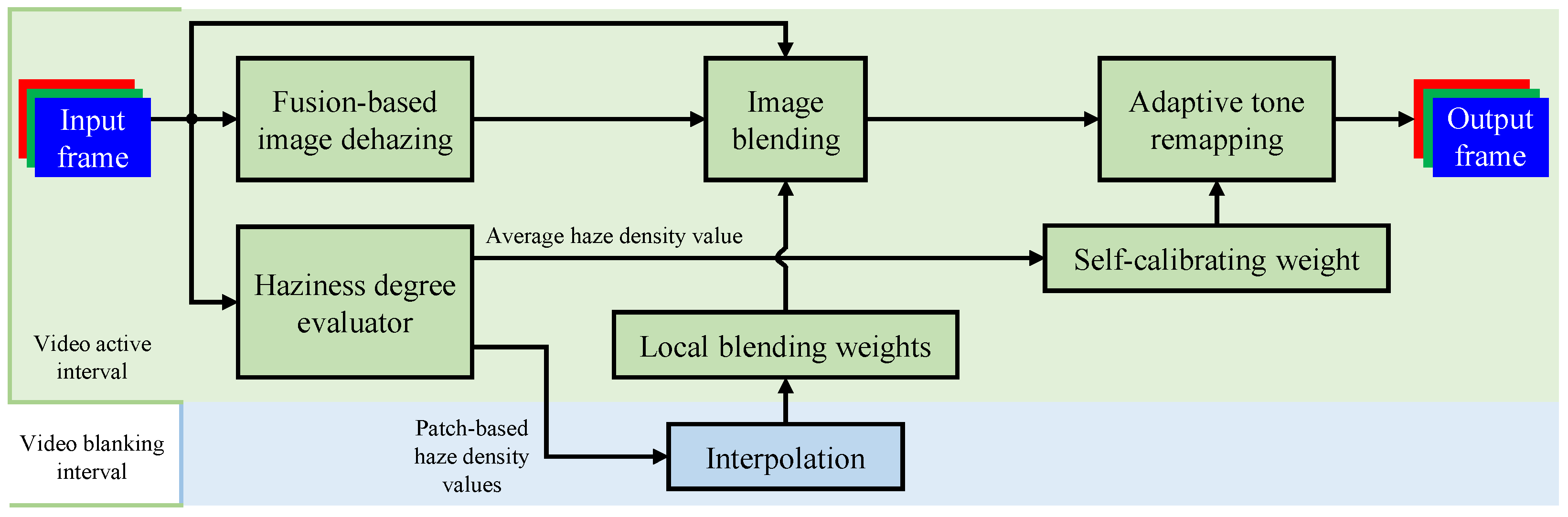
As illustrated in
Figure 1, the method comprises seven modules. The fusion-based dehazing module generates an initial dehazed estimate of the input image. The haziness-degree evaluator computes pixel-wise haze density and derives both patch-based and average haze values. The interpolation module low-pass filters and upsamples the patch-based densities to produce a smooth spatial haze field. This field is then used by the local-blending-weight module to compute fusion weights. The image-blending module fuses the input with its dehazed estimate using these weights. In parallel, the average haze density feeds the self-calibrating-weight module, which controls the adaptive tone-remapping module. This final module enhances the fused image while preventing artifacts such as undershoot, over-enhancement, and color distortion.
To support real-time operation, the modules are scheduled across video timing intervals: the active-period modules (pale green in
Figure 1) process streaming pixels continuously, while the interpolation module (pale blue) operates during blanking periods, leveraging temporal reuse to maintain throughput. This organization matches the model-free design of the proposed framework and facilitates efficient hardware realization.
3.1. Fusion-Based Image Dehazing
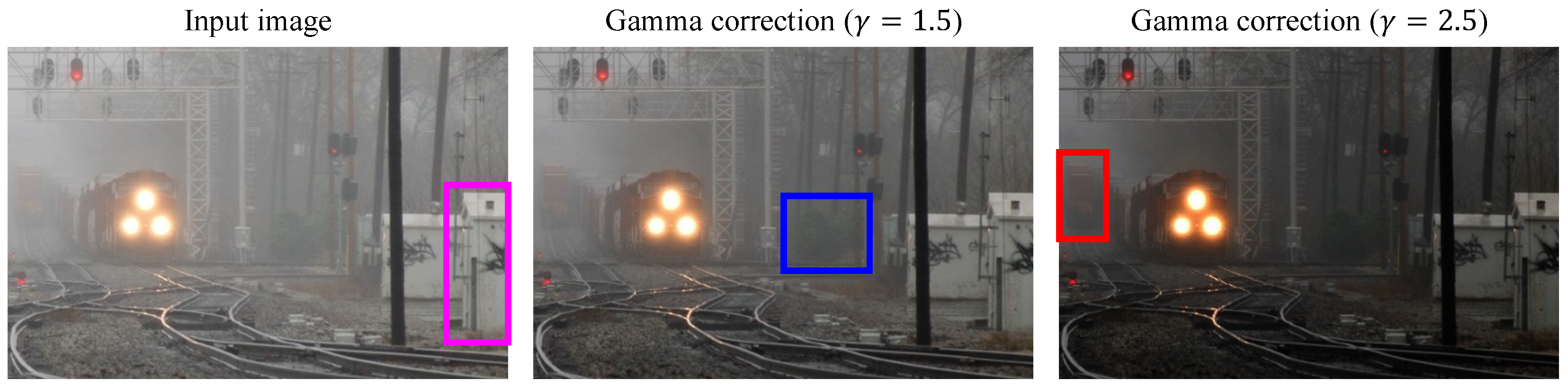
The first stage produces a dehazed estimate using a multi-variant fusion strategy. As shown in
Figure 2, which illustrates a hazy image from the IVC dataset [
31], applying different under-exposure levels to a hazy image (for example, gamma values of
and
) reveals scene structures otherwise obscured by veiling light; objects become increasingly discernible in these darker variants (highlighted in pink, blue, and red rectangles). This observation motivates the generation of multiple under-exposed versions of the input and their fusion to enhance scene visibility.
As haze suppresses fine details, a detail-enhancement step is applied prior to gamma correction and fusion (
Figure 3). The resulting variants are then combined using dark-channel-based weights, whose strong correlation with haze density makes them both simple and effective. This model-free formulation yields a dehazed estimate that enhances structural details, reduces veiling, and maintains natural color appearance.
3.1.1. Detail Enhancement
Given an input image (I), the luminance component is first extracted via its conversion from the RGB color space to the YCbCr domain. Detail enhancement is then performed on the luminance channel (Y), where high-frequency information representing local texture and edge content is obtained via convolution with a Laplacian kernel (). The resulting detail layer (e) is combined with the original luminance through an enhancement weight () that controls the degree of sharpening. This weight is formulated as a piecewise linear function of local variance (v), allowing spatially adaptive amplification of fine details in textured regions while preventing noise over-enhancement in smooth or flat areas. The enhanced luminance () is subsequently merged with its Cb and Cr components to reconstruct a refined RGB image ().
This step is mathematically expressed as follows:
where
U denotes the averaging kernel, ⊛ represents the convolution operation, and user-defined parameters
are empirically determined as
.
3.1.2. Gamma Correction
Gamma correction is applied to the detail-enhanced image () to simulate multiple under-exposure levels. In principle, increasing the number of gamma-adjusted variants can further improve dehazing quality by providing richer visibility cues. However, each additional variant requires an extra look-up table (LUT), dark-channel computation, and fusion branch, causing hardware resource usage to grow exponentially. Considering that dehazing serves as a pre-processing stage in a larger vision system, a balance between algorithmic performance and hardware efficiency is essential.
To this end, three gamma values of , , and 2 were empirically selected to yield perceptually distinct under-exposed variants that effectively attenuate haze while keeping resource usage manageable. Together with the uncorrected image, these variants form the set used in the subsequent fusion stage.
3.1.3. Weight Calculation and Image Fusion
For each variant and the original image, the complement of the dark channel with respect to one is computed and then L1-normalized, serving as fusion weights that quantify the relative haze concentration at each pixel location. Pixels with lower dark channel intensity—indicative of thinner haze—receive greater weights, indicating that clearer regions contribute more dominantly to the fusion output.
The image fusion step sums over these weighted inputs to generate the final dehazed image (
J), combining the enhanced local contrast of the under-exposed variants with the original color fidelity. This process avoids explicit transmission estimation, enabling a lightweight and fully model-free solution well-suited for parallel processing.
3.2. Haze Density Estimation and Interpolation
This section describes the haze-density estimation and interpolation process, corresponding to the haziness-degree-evaluator and interpolation modules in
Figure 1. The goal is to derive a spatially coherent haze-density field that subsequently guides the image blending and tone-remapping stages.
Section 3.2.1 introduces the referenceless haze-density estimator, and
Section 3.2.2 details the smoothing and interpolation procedure used to generate the final haze-density map.
3.2.1. Referenceless Haze-Density Estimation
To achieve autonomous and spatially adaptive dehazing, the system estimates haze density directly from the input image without relying on physical haze parameters or reference data. The resulting density map governs both local blending and global tone remapping. A referenceless evaluator [
32] computes the haze-density map
as
where
is obtained by minimizing a cost function
, which is formulated as
where
,
, and
represent the saturation, brightness, and sharpness of the image as functions of the transmission map
t, while
denotes the dark channel. The parameter
provides regularization to prevent overestimation of
t. Minimizing
identifies
such that the recovered scene exhibits maximum colorfulness, brightness, and detail clarity, while the dark channel is simultaneously suppressed.
To maintain conciseness, detailed derivations are omitted here; interested readers are referred to [
32] (Section 3.4 and Appendix A) for the complete mathematical formulation. The final expression for computing the haze-density map is given by
where
is the minimum intensity within a local patch
, and
is the color difference between the maximum and minimum channel intensities. The term
v denotes the local luminance variance, defined earlier in Equation (
4).
3.2.2. Haze Density Map Interpolation
The estimated haze-density map often exhibits spatial discontinuities caused by abrupt variations in haze levels between neighboring regions. To accommodate spatial heterogeneity while ensuring smooth visual transitions, the input frame is first divided into non-overlapping
patches. The local haze density
for the
i-th patch
is then computed as
where
denotes the number of pixels in
and
is the average haze density of the input frame.
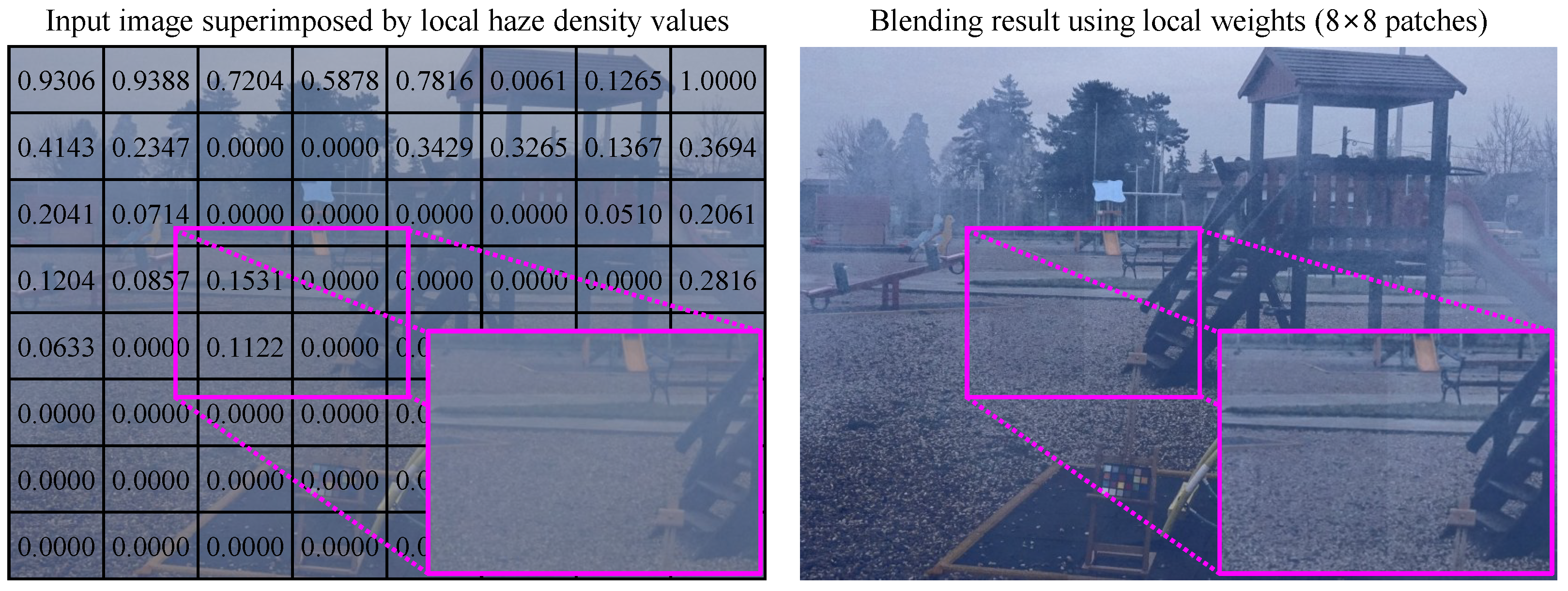
Figure 4 illustrates that using raw
local weights can lead to blocky artifacts in the blended output, especially at patch boundaries where haze densities vary sharply. The left image in
Figure 4 visualizes the patch-based haze densities, where the highlighted region shows abrupt transitions from
to zero. When these coarse values are directly applied for blending (right image), visible discontinuities appear as the pink-outlined blocks.
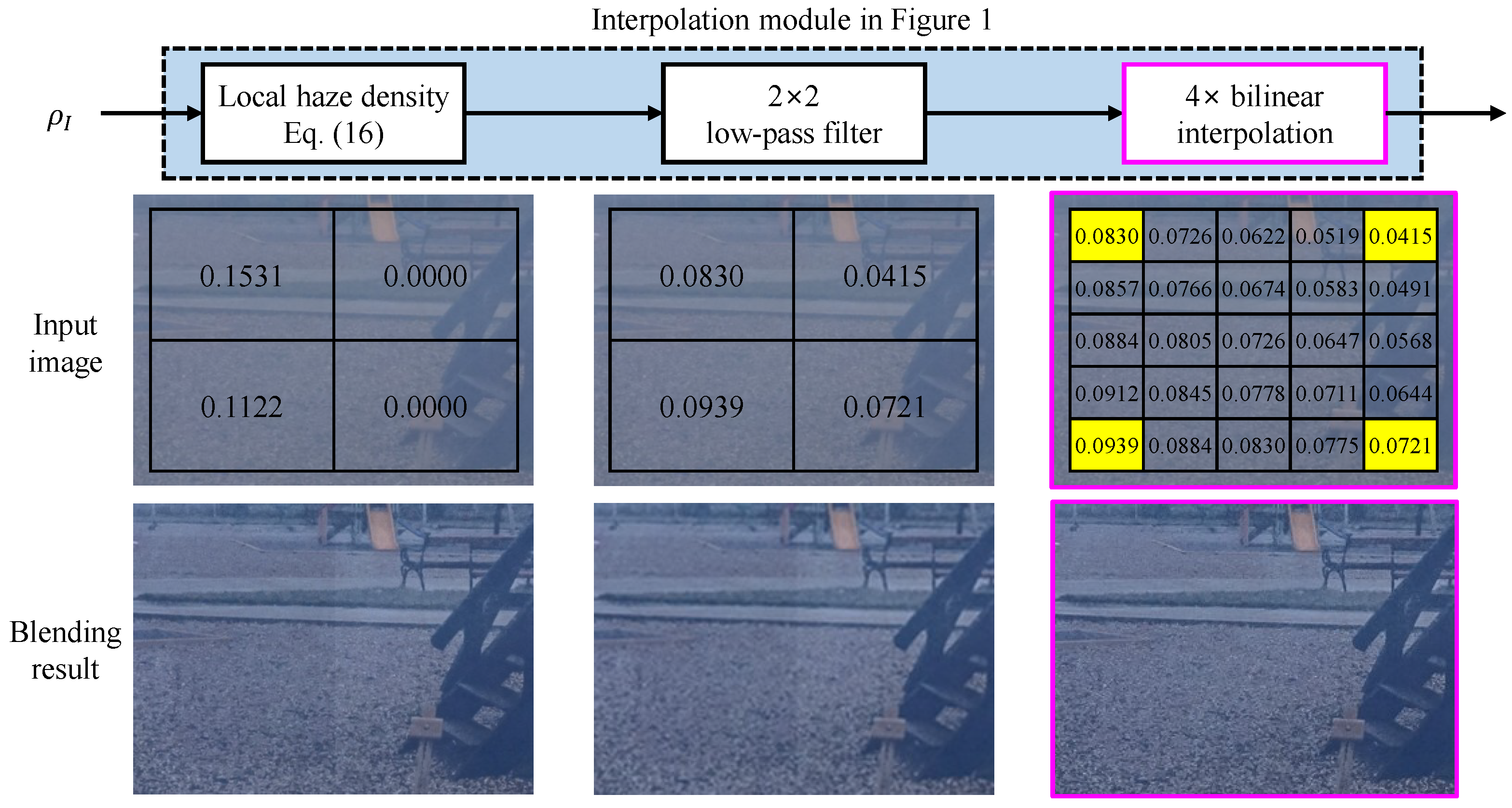
To mitigate these artifacts, a low-pass filter is first applied to attenuate abrupt transitions, followed by bilinear interpolation to upscale the local haze densities from patches to an effective resolution of . This interpolation process preserves regional haze characteristics while generating a spatially continuous density field suitable for image blending.
As shown in
Figure 5, the proposed interpolation strategy significantly reduces blocky artifacts by producing more gradual transitions across adjacent patches. In the same region highlighted in
Figure 4, the coarse
haze densities are smoothed into finer
variations, yielding a perceptually natural blending behavior in both horizontal and vertical directions.
Figure 4 and
Figure 5 are adopted from our previous work in [
33].
3.3. Haze-Aware Image Blending
This section describes the haze-aware image blending process, which corresponds to the local-blending-weight and image-blending modules in
Figure 1. Using the interpolated haze-density map, the system computes blending weights and applies them to fuse the input image with its dehazed estimate.
Section 3.3.1 details the local blending weight calculation, and
Section 3.3.2 presents the image-blending procedure used to attain autonomous dehazing.
3.3.1. Local Blending Weight Calculation
The local blending weight
is derived from the interpolated haze-density map
obtained in
Section 3.2.2. Based on perceptual analysis, pixels with higher haze density should rely more heavily on the dehazed result, while clearer regions should retain more of the original content. To reflect this principle,
is formulated as follows:
where
and
represent lower and upper haze-density thresholds for classifying haze levels, and
denotes the average global haze density computed from the entire frame. These threshold values are adopted from our previous work on hazy versus haze-free image classification [
32].
This design yields a smooth transition of blending ratios across different haze conditions. Specifically, when , the patch is heavily hazy, and the dehazed result fully dominates (). Intermediate haze levels are handled through linear interpolation to ensure continuity between neighboring patches. The adaptive weighting mechanism enables the system to autonomously balance enhancement strength according to haze densities, without manual control or external inputs.
3.3.2. Image Blending for Autonomous Dehazing
The input image
I and its dehazed estimate
J are fused using local blending weights
derived in the previous section. This process produces the blended result
B according to
The rationale for this blending formulation is threefold.
Haze-free regions: When the input region is haze-free, applying dehazing unnecessarily can amplify noise or introduce color distortion. In such cases, ensures that the output remains identical to the original image, thereby preserving natural appearance.
Mild to moderate haze: For regions with partial haze, excessive dehazing may lead to over-enhancement or halo artifacts. To mitigate this problem, varies smoothly between 0 and 1, proportionally to the local haze density, allowing gradual adjustment of dehazing strength.
Densely hazy regions: When the haze density is high, full dehazing is necessary to restore structural visibility and contrast. Here, fully prioritizes the dehazed image and suppresses the original content.
This autonomous blending strategy allows continuous adaptation across the entire image without manual intervention or scene-specific tuning.
3.4. Adaptive Tone Remapping
This section presents the adaptive tone remapping (ATR) process, corresponding to the adaptive-tone-remapping and self-calibrating-weight modules in
Figure 1. Using the fused image
B and the estimated global haze density
, the system adjusts luminance and chrominance while regulating the enhancement strength to prevent over-correction.
Section 3.4.1 details the luminance and chrominance adjustment procedure, and
Section 3.4.2 introduces the self-calibrating weight that controls the enhancement strength.
3.4.1. Luminance and Chrominance Adjustment
ATR operates in two sequential phases: (i) luminance enhancement, which compensates for brightness loss caused by haze removal, and (ii) chrominance expansion, which restores the natural color gamut narrowed by luminance correction. The enhancement strength is automatically adjusted using the self-calibrating weight (
, introduced in
Section 3.4.2), which scales the tone enhancement proportionally to the detected haze level. Therefore, haze-free regions remain unaltered, while regions with heavier haze undergo progressively stronger enhancement.
Denoting the luminance and chrominance components of the image before and after ATR as
and
, respectively, ATR can be described as
where
,
, and
denote the nonlinear luminance gain, linear weighting, and chrominance expansion functions, respectively.
The luminance enhancement module combines a nonlinear gain and a linear weight to emphasize structure while preventing over-amplification in bright regions. The nonlinear gain
constrains enhanced luminance using the Adaptive Luminance Point (
), which is expressed as
where the user-defined exponent
tunes enhancement aggressiveness,
represents the average luminance, and
denotes the luminance value where the cumulative distribution function
. The linear weighting function
modulates enhancement depending on input brightness as
with slope
m and intercept
b empirically determined for perceptual balance between dark and bright tones.
While luminance stretching improves brightness, it can inadvertently reduce colorfulness due to the Helmholtz–Kohlrausch effect. To counter this effect, chrominance signals are expanded according to local luminance. The ratio
in Equation (15) provides self-calibration, while
follows a piecewise linear mapping:
where
and
are predefined luminance thresholds. This mapping enhances saturation in dark areas and suppresses excessive color shifts in bright regions, maintaining a visually natural tone distribution.
3.4.2. Self-Calibrating Weight
ATR relies on a self-calibrating weight
that modulates enhancement strength according to the overall haze level present in the input image. This weight is formulated as a piecewise function of
:
where
and
are user-defined haze-density thresholds,
n controls the exponential response, and
denotes the maximum enhancement factor. As mentioned in
Section 3.3.1,
and
are adopted from our previous work [
32].
When the average haze density is lower than , the image is considered haze-free, and disables luminance enhancement, preserving the original appearance. For mild haze levels (), increases smoothly following an exponential profile governed by exponent n (empirically set to ), thereby enabling gradual strengthening of luminance enhancement. When haze density exceeds , transitions to a linear region that caps the enhancement magnitude at to prevent excessive luminance boosts.
3.5. Hardware Accelerator
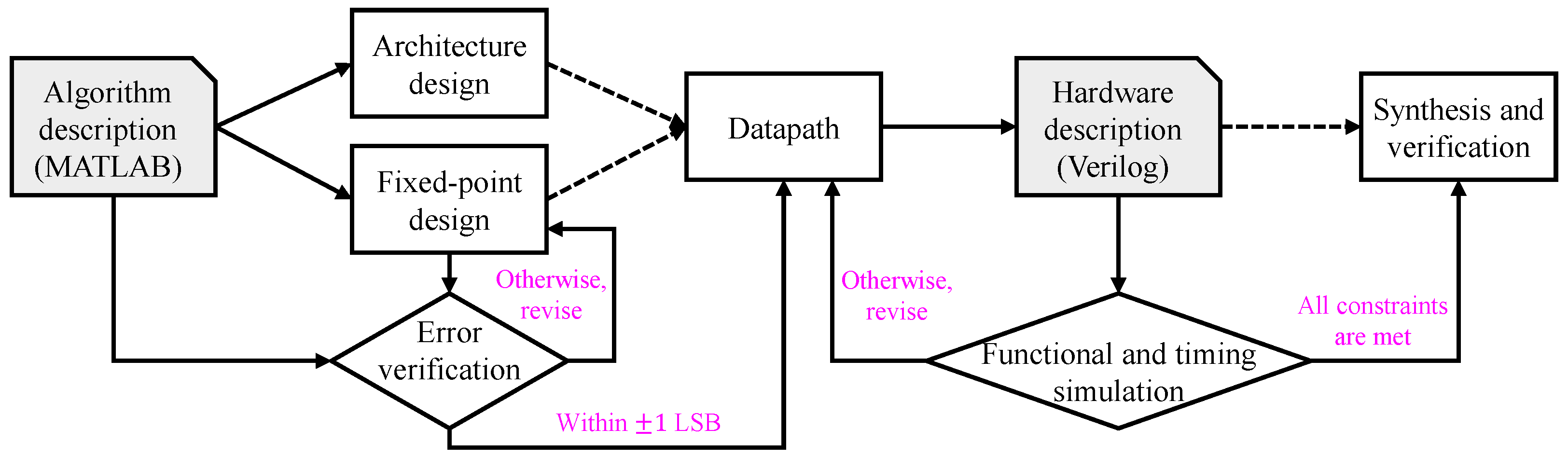
This section presents the hardware accelerator that implements the proposed dehazing pipeline. All modules are designed using a fully pipelined methodology to sustain high-throughput, pixel-stream processing. Resource usage is minimized through fixed-point arithmetic, where the word length of each signal is carefully selected to ensure that the final output error remains within
least significant bit (LSB).
Figure 6 illustrates the overall hardware design flow, from the algorithm specification to hardware description and verification on the target FPGA.
Special consideration is given to the interpolation module: As the haze-density map of the current frame becomes available only after two frames, the module is scheduled to operate during the video blanking interval, effectively reducing the latency to a single frame. The high temporal similarity between consecutive frames allows this design choice without affecting output quality.
Due to the complexity of the full system, only simplified datapaths are shown for each module. These diagrams illustrate the intra-module dataflow consistent with RTL (Register Transfer Level)-oriented hardware description and provide a clear view of how each component is realized in hardware.
Section 3.5.1 through
Section 3.5.4 detail the implementation of all major modules in the accelerator.
3.5.1. Fusion-Based Image Dehazing Module
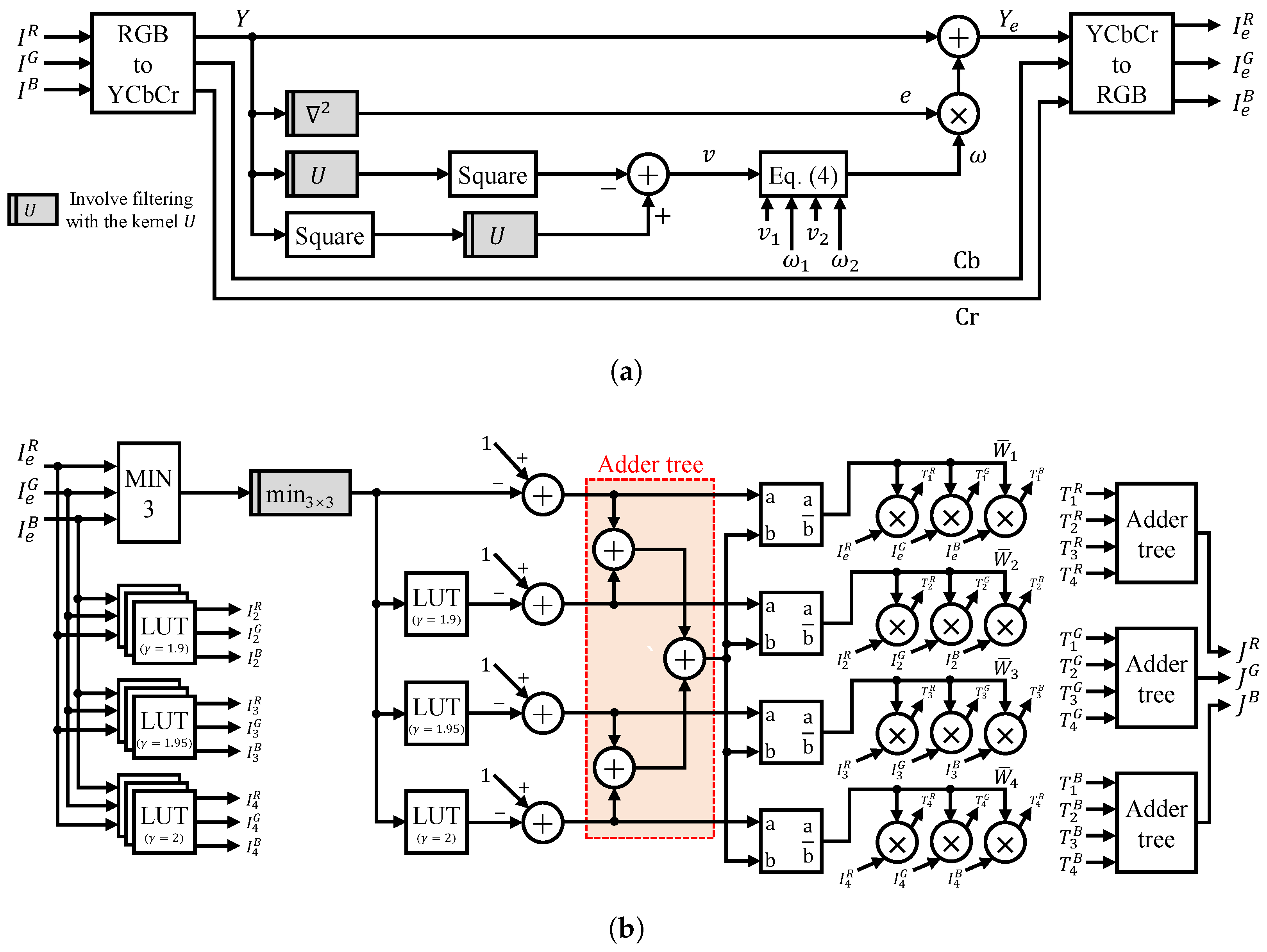
Figure 7 presents the simplified architecture of the fusion-based dehazing module, consisting of two submodules: (a) detail enhancement and (b) gamma correction, weight calculation, and fusion.
The detail-enhancement submodule (
Figure 7a) converts the input RGB stream to the YCbCr domain and enhances only the luminance channel. The enhanced Y component is then recombined with the original Cb and Cr channels to produce the locally enhanced color image. This stage requires two-dimensional filtering, with implementation details provided in
Appendix A.
The gamma-correction and fusion submodule (
Figure 7b) generates three under-exposed variants of the enhanced image using LUTs corresponding to
. A minimum filter computes the dark-channel response, which is processed through an adder-tree structure to obtain normalized fusion weights
. Each variant is then multiplied by its corresponding weight, and the weighted results are accumulated through adder trees to produce the final dehazed RGB output
.
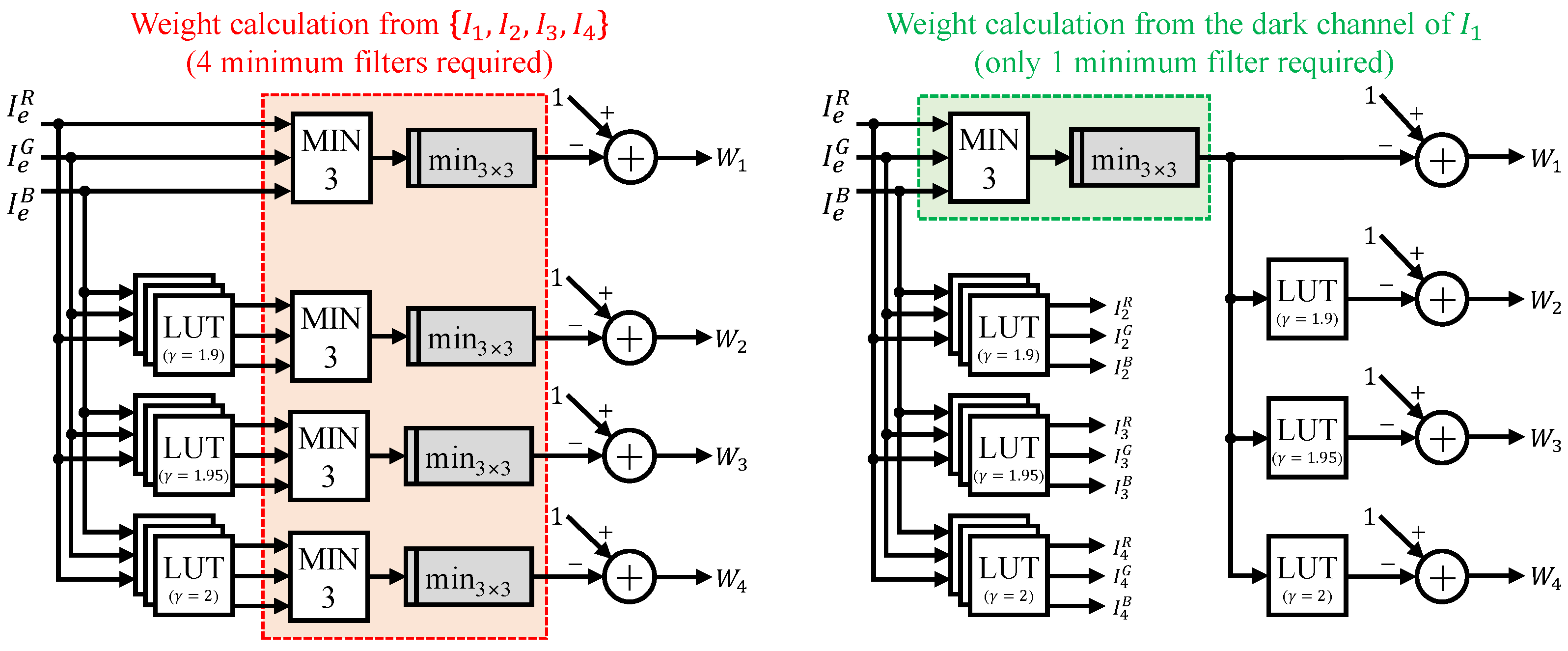
An important optimization is applied to reduce hardware cost during weight calculation. As gamma correction is a monotonically increasing operation, it preserves the relative ordering of pixel intensities. As illustrated in
Figure 8, the straightforward design—which applies gamma correction first and computes dark-channel responses afterward—requires four minimum filters. By instead applying gamma correction directly to the dark channel of the input, only one minimum filter is needed. As spatial minimum filters are resource-intensive, this design choice yields a substantial reduction in memory and logic utilization while maintaining the correctness of the weight computation.
3.5.2. Haziness-Degree-Evaluator and Interpolation Modules
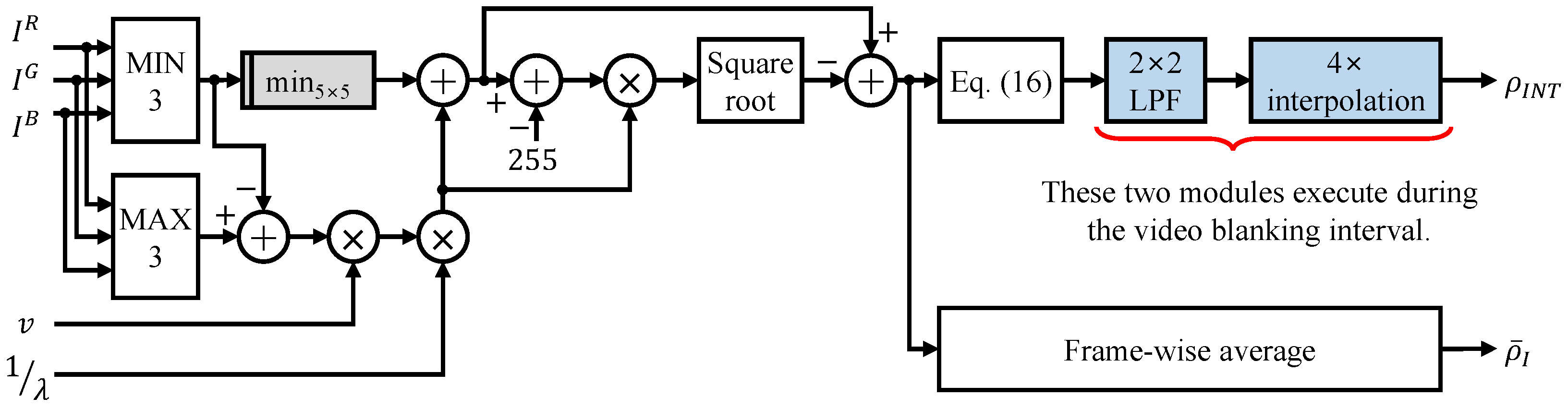
The haziness-degree-evaluator and interpolation modules are implemented as a unified, streamlined datapath. As shown in
Figure 9, the architecture realizes the operations described in
Section 3.2.1 and
Section 3.2.2.
The first stage computes the local minimum and maximum RGB values to measure color range. These values, together with the local variance
v and the inverse regularization factor
, are used to evaluate the referenceless haze-density model in Equation (
11). A square-root unit then produces the pixel-wise haze density
, which is accumulated and averaged over the frame to obtain the global haze indicator
. This global value acts as a scene-level prior for subsequent tone-remapping and blending stages.
To ensure spatial smoothness and avoid block artifacts, the pixel-wise haze map is processed by a low-pass filter followed by a bilinear interpolator. Both operations are scheduled during the video blanking interval, enabling efficient temporal reuse without reducing throughput in the active video region. The resulting interpolated haze-density map provides the continuous spatial guidance required for haze-aware blending in the fusion stage.
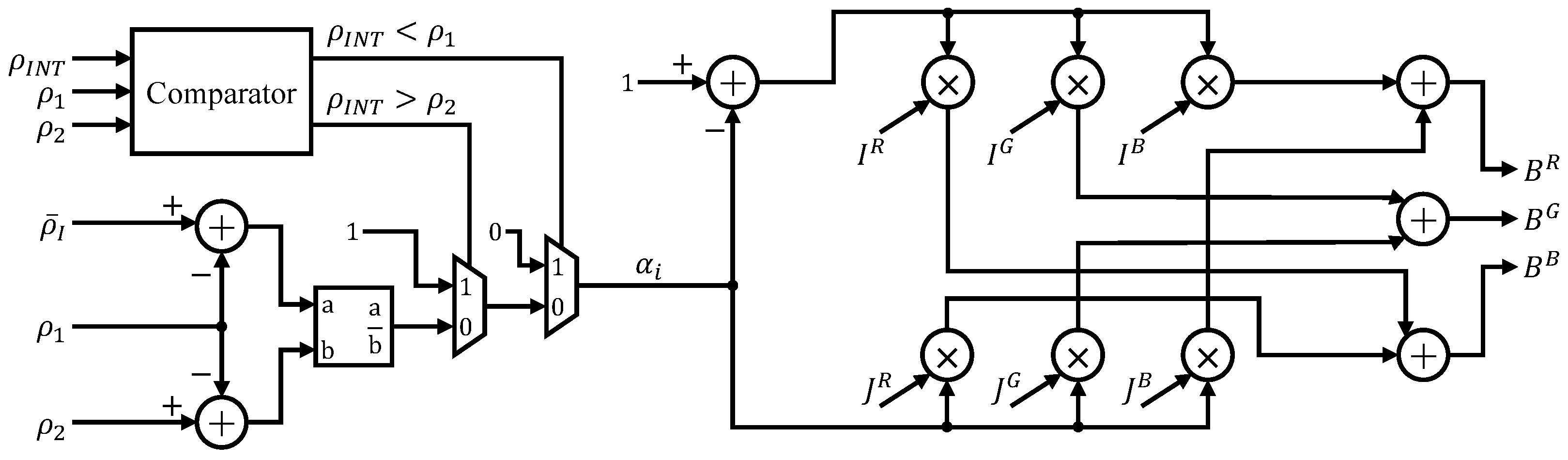
3.5.3. Local-Blending-Weight and Image-Blending Modules
The local-weight calculation and image-blending operations are implemented using a fully pipelined datapath, as shown in
Figure 10. In the first stage, the local blending weight
is computed according to Equation (
12). The interpolated haze-density value
is compared with thresholds
and
using a comparator block, and the control logic selects the appropriate branch of the piecewise linear function.
The second stage performs the blending operation defined in Equation (
13), where
and
denote the original and dehazed RGB channels. Each channel is processed independently through parallel multipliers applying
and
, followed by adders that combine the weighted results to produce the final blended output
.
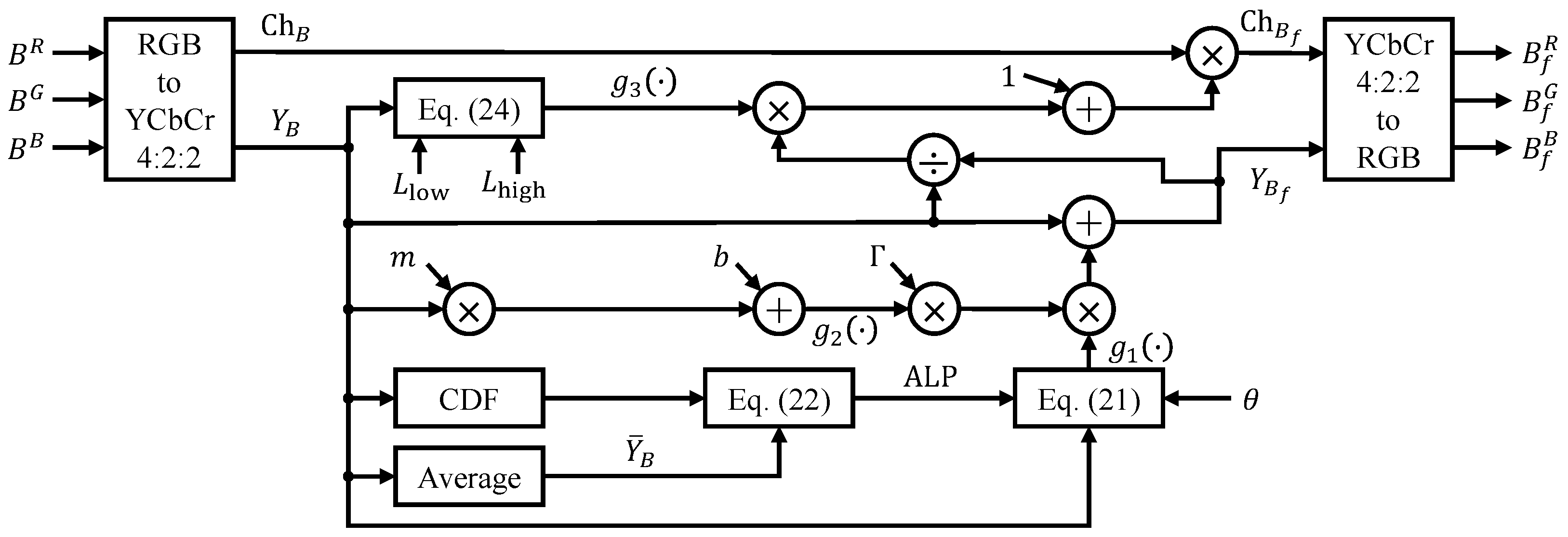
3.5.4. Adaptive-Tone-Remapping and Self-Calibrating-Weight Modules
The hardware implementation of the self-calibrating-weight and ATR modules is shown in
Figure 11, where both components are integrated into a unified, fully pipelined datapath.
The pipeline begins by converting the blended RGB input into the YCbCr domain using a format. The resulting luminance () and chrominance () signals are then processed in two parallel branches:
Self-Calibrating Weight Generation: The global average luminance
is obtained through an averaging block, while a CDF-based estimator computes the percentile luminance levels
and
for ALP (Equation (
17)). The average haze density
is processed through Equation (
19) to generate the self-calibrating weight
, which adaptively modulates the overall tone-remapping strength according to scene haze conditions.
Adaptive Tone Remapping Pipeline: The luminance channel
passes through the nonlinear and linear gain units
and
(Equations (
16) and (
18)). Their outputs are scaled by
and combined to produce the enhanced luminance
. In parallel, the chrominance components are adjusted using the chrominance-scaling function
and the luminance ratio
(Equation (15)), implementing chrominance expansion.
Finally, the enhanced YCbCr signals are converted back to RGB to yield the adaptively tone-mapped output .
4. Evaluation
This section presents a comprehensive evaluation of the proposed dehazing framework and hardware accelerator.
Section 4.1 reports the quantitative results on standard benchmarks.
Section 4.2 and
Section 4.3 provide qualitative comparisons on natural and aerial images, demonstrating the method’s visual effectiveness across diverse haze conditions.
Section 4.4 summarizes the hardware implementation results, highlighting throughput, resource usage, and real-time performance.
4.1. Quantitative Evaluation
To objectively assess the performance of the proposed system, quantitative evaluations were performed on five widely used public datasets: FRIDA2 [
34], D-HAZY [
35], O-HAZE [
36], I-HAZE [
37], and Dense-Haze [
38].
Table 2 summarizes the characteristics of these datasets, including the numbers of haze-free and hazy image pairs and whether the image scenes are synthetic or real. The evaluation compares the proposed method with five representative algorithms: DCP [
1], CAP [
2], DehazeNet [
18], YOLY [
39], and MB-TaylorFormer [
20]. For a fair comparison, FCDM [
6] was excluded owing to its behavior of resizing input images into square dimensions, whereas other methods process variable-sized images.
Two complementary image quality measures were adopted:
The TMQI (Tone-Mapped image Quality Index) quantifies the structural fidelity and naturalness of tone-mapped or dehazed images with respect to their reference haze-free ground truths. A higher TMQI value indicates better perceptual restoration and tone consistency.
The FSIMc (Feature Similarity Index for Color Images) evaluates the structural and chrominance correspondence between restored images and their references. This metric is particularly sensitive to preservation of edge details and color relationships, making it suitable for assessing dehazed image quality.
Table 3 reports the average TMQI and FSIMc values computed over all datasets. The best and second-best results for each dataset are marked in bold and italic, respectively.
For the TMQI, the proposed method achieves competitive or superior performance across most datasets, with a particularly strong improvement on O-HAZE (), surpassing both prior-based and deep-learning methods. The method also maintains stable performance on challenging D-HAZY and I-HAZE datasets, where the integration of referenceless haze estimation and adaptive tone remapping contributes to preserving structural integrity and visual naturalness. Averaged across all datasets, the proposed system attains an overall TMQI of , which is ranked second after the deep transformer-based MB-TaylorFormer ().
For the FSIMc, the proposed system demonstrates consistent color and structural fidelity, yielding an average FSIMc of , the highest among all compared methods. Notably, on FRIDA2, O-HAZE, and I-HAZE, the proposed method exhibits top-ranked scores, reaffirming its strength in maintaining global contrast and fine-grained color texture. The improved FSIMc over the DCP and CAP confirms that the proposed haze-aware blending and chrominance expansion effectively enhance perceptual color quality without introducing artifacts.
Overall, the quantitative analysis indicates that the proposed system achieves a favorable trade-off between visual fidelity (high TMQI) and structural/color preservation (high FSIMc) while maintaining real-time processing capability (discussed in
Section 4.4). The relatively consistent performance across synthetic and real datasets demonstrates that the system generalizes well to diverse imaging conditions.
4.2. Qualitative Evaluation on Natural Images
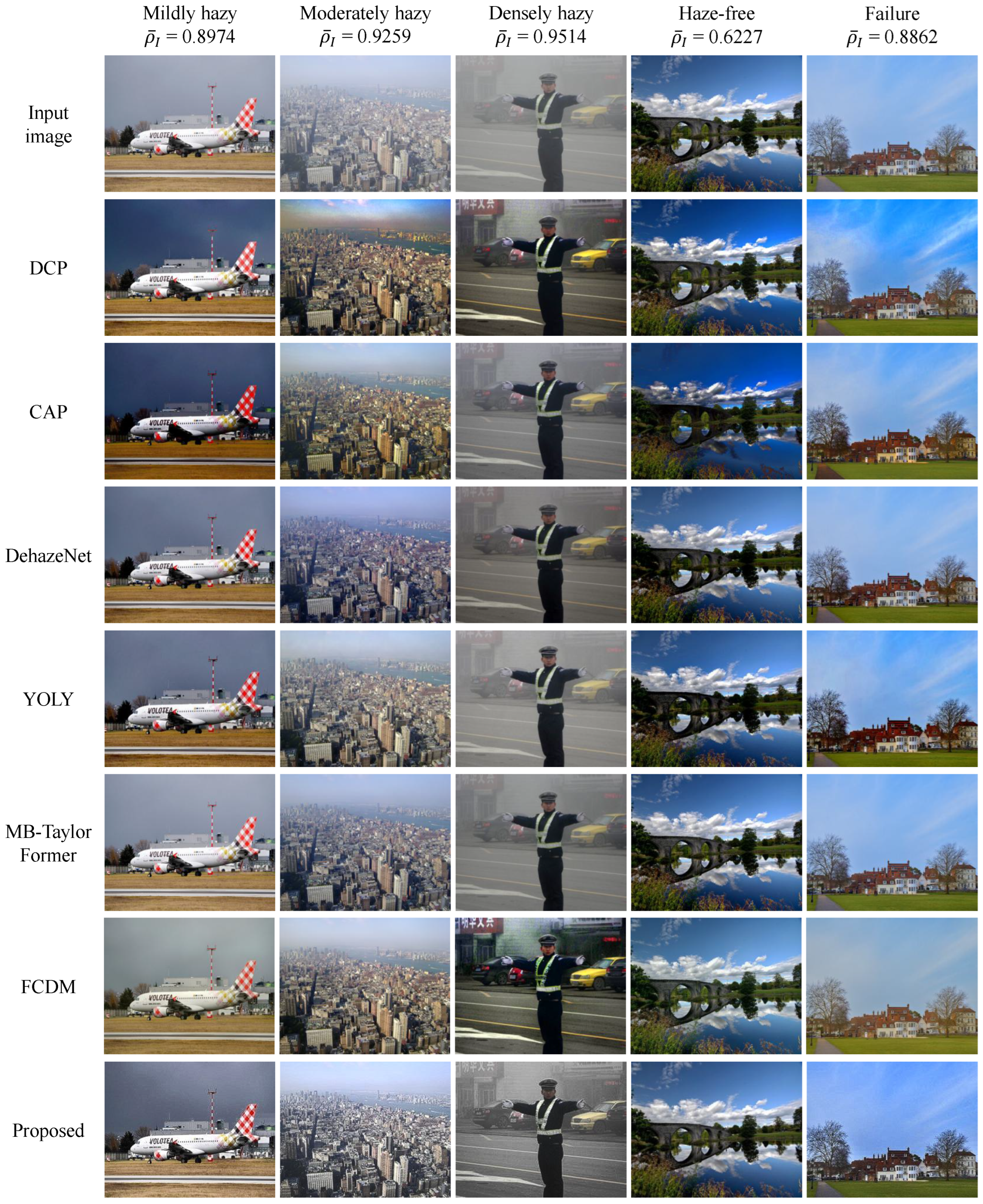
The visual performance of the proposed dehazing framework was compared against six representative algorithms: the DCP, CAP, DehazeNet, YOLY, MB-TaylorFormer, and FCDM.
Figure 12 shows the restoration results across diverse haze conditions, including mild, moderate, and dense haze, haze-free scenes, and challenging failure cases.
The proposed system adapts its enhancement strength using the self-calibrating weight , derived from the average haze density . In this evaluation, thresholds were set to and .
In mildly and moderately hazy scenes, the method improves visibility and color contrast while avoiding over-enhancement, halo artifacts, and aggressive tone shifts. Prior-based methods such as the DCP and CAP tend to introduce darkened shadows or overestimated contrast, while deep models may over-brighten distant regions or alter global color balance.
Under dense haze conditions, the proposed approach recovers structural detail and maintains consistent color appearance. The combination of haze-aware blending and adaptive tone remapping enables effective suppression of veiling without color drifting or loss of contrast. Competing approaches often struggle with clipped highlights, oversuppression, and inconsistent chromaticity.
For haze-free inputs, the proposed system correctly disables dehazing operations (), preserving the original brightness and color fidelity. This behavior is in contrast to other approaches, which frequently alter clear scenes due to fixed assumptions about haze presence.
In failure cases involving extreme lighting or reflective surfaces, the method produces stable, visually coherent results without introducing strong artifacts or color distortions. This robustness reflects the advantages of the haze-density-driven, model-free fusion design.
Overall, the qualitative results show that the proposed system achieves a strong balance of haze removal, color naturalness, and stable tone reproduction across a wide range of natural images.
4.3. Qualitative Evaluation on Aerial Images
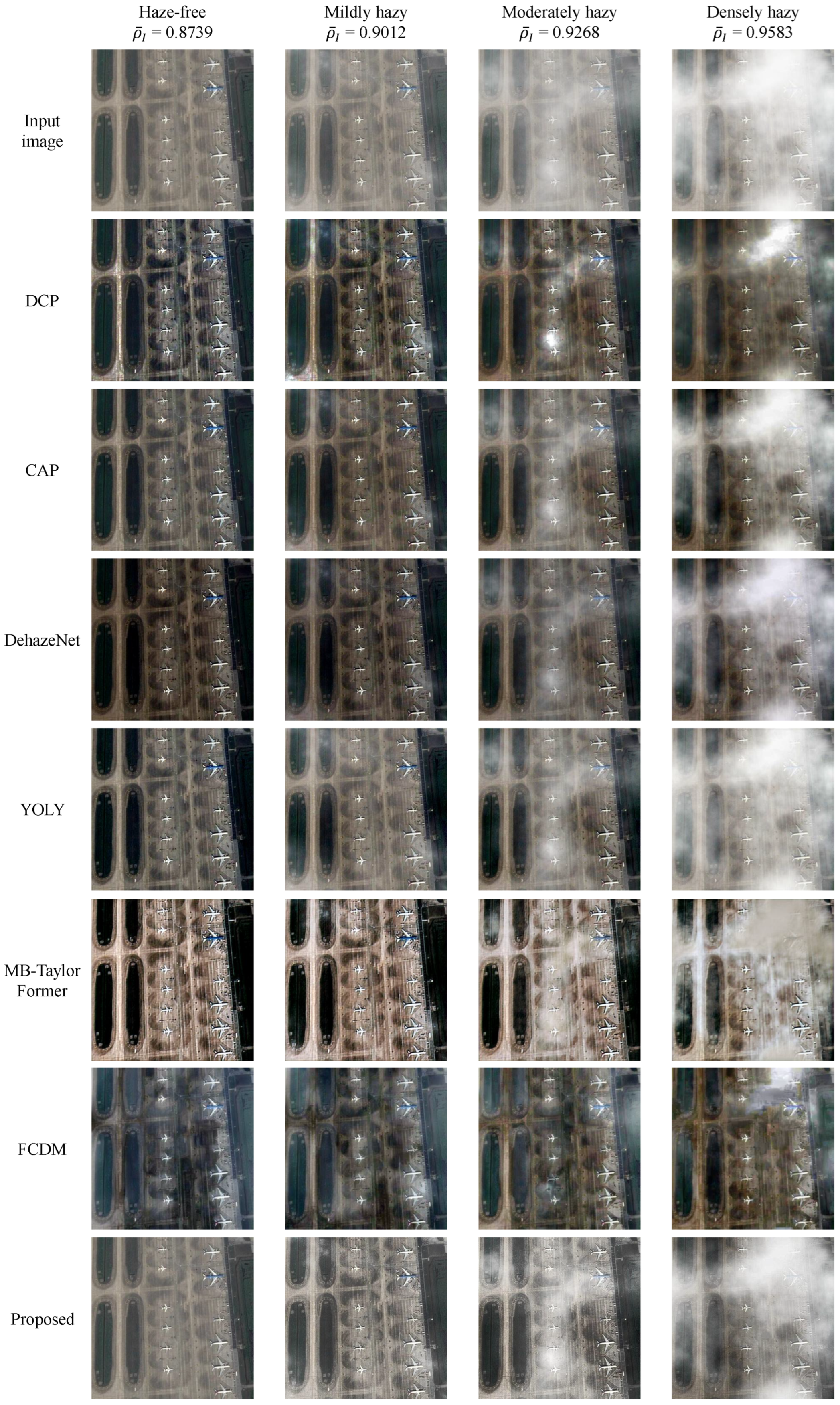
To further assess generalization across large-scale environments, the method was evaluated using aerial images exhibiting spatially extensive haze.
Figure 13 compares the proposed framework with the same set of benchmarks under haze-free, mildly hazy, moderately hazy, and densely hazy conditions, using
and thresholds
and
for classification.
In haze-free scenes, traditional prior-based and learning-based algorithms frequently modify colors or brightness unnecessarily. The proposed framework preserves the original image by suppressing dehazing when haze density is negligible.
For mild haze, the method restores clarity while maintaining natural tone reproduction. Edge structures such as runway markings and aircraft contours remain consistent without haloing or color oversaturation. Deep learning methods improve detail but occasionally introduce exaggerated saturation.
Under moderate haze conditions, the proposed system provides a balanced enhancement of structure and color. Prior-based methods often produce darkened outputs, while some learned models fade global color or produce unnatural tints.
In dense haze, the DCP and FCDM deliver strong dehazing performance but noticeably alter color appearance. In contrast, the proposed framework removes haze while preserving overall brightness and color fidelity.
These results demonstrate that the proposed approach generalizes well to aerial environments, benefiting from both the referenceless haze estimator and the adaptive blending mechanism.
4.4. Hardware Implementation Results
The proposed autonomous dehazing system was implemented using Verilog HDL following the IEEE Std 1364-2005 specification [
40]. The hardware resource utilization on a Xilinx XC7Z-045FFG900-2 MPSoC, designed by AMD (Santa Clara, CA, USA) and manufactured by TSMC (Taichung, Taiwan), device was obtained using Vivado v2023.1. The design occupies
of slice registers,
of slice LUTs, and a modest portion of on-chip memory resources (
of 36 Kb RAMs and
of 18 Kb RAMs). The minimum clock period achieved is
ns, corresponding to a maximum operating frequency of
MHz. These utilization rates demonstrate that the system can be seamlessly integrated as a pre- or post-processing module within larger heterogeneous vision pipelines without exceeding typical mid-range FPGA resource budgets.
The maximum processing throughput, expressed in frames per second (fps), can be estimated as
where
is the maximum frequency and
are the frame height and width;
represent vertical and horizontal blanking intervals, respectively. The proposed system is designed to operate with the minimum blanking intervals,
; thus, substituting the measured
into Equation (
21) yields the performance for different video resolutions, as summarized in
Table 4.
The proposed system achieves fps for Full HD () input and fps for Quad HD (). Even at ultra-high definitions such as UW4K and DCI 4K, real-time performance is maintained with fps and fps, respectively. These frame rates far exceed the standard 30 fps real-time threshold, confirming the capability of the system to handle high-resolution and low-latency imaging tasks efficiently.
The hardware comparison results in
Table 5 show clear advantages of the proposed system over three representative real-time FPGA implementations: DCP with Fast Airlight Estimation (DCP-FAE [
26]), Fusion-Based Dehazing (FBD [
17]), and Saturation-Based Dehazing (SBD [
29]). The maximum video resolution reported in the table refers to the highest input resolution each accelerator can sustain at more than 30 fps.
SBD achieves the smallest resource usage but only because its algorithmic design is extremely simple. It estimates airlight from a downsampled version of the input—where the downsampling itself is performed externally—and does not include any meaningful dehazing beyond this operation. Thus, SBD prioritizes speed and minimal resource consumption at the cost of restoration quality.
FBD, on the other hand, illustrates a suboptimal hardware design. It implements image filters using shift registers instead of line memories, leading to excessive logic utilization and a fixed-resolution architecture restricted to . Because every resolution change requires re-synthesis, FBD is impractical for real-world deployment.
DCP-FAE is more capable than SBD and FBD, but it remains tied to the DCP, which degrades severely in scenes with large sky regions or bright objects. It also requires more on-chip memory than the proposed system, despite offering lower resolution support.
In contrast, the proposed system delivers the highest throughput with balanced resource usage and is the only design capable of real-time autonomous dehazing at full DCI-4K () resolution. Unlike previous FPGA accelerators—primarily fixed-heuristic, prior-based systems operating at SVGA or FHD resolutions—the proposed architecture uniquely integrates haze-density estimation, adaptive fusion, and self-calibrating tone control into a fully hardware-friendly pipeline. This combination enables true self-adaptation to varying haze levels without manual tuning or physical-model assumptions.
Collectively, these results demonstrate that the proposed design establishes a new performance and capability benchmark among FPGA-based dehazing systems, combining algorithmic autonomy, high-resolution scalability, and efficient hardware utilization.
5. Conclusions
This paper introduced a fast, model-free dehazing framework that departs from traditional transmission estimation and physical-model inversion. The core novelty lies in its haze-density-driven design: a referenceless haze-density estimator provides both local and global guidance for fusion and tone remapping, enabling autonomous adaptation across haze-free, mildly hazy, and densely hazy scenes. Unlike prior fusion-based methods that rely on fixed heuristics, the proposed pipeline incorporates spatially continuous haze-density maps, multi-variant exposure synthesis, and self-calibrated tone control, forming a principled and fully data-independent strategy for robust restoration.
On the hardware side, the paper presented a deeply pipelined, resource-efficient accelerator tailored to the structure of the proposed algorithm. Key architectural innovations include the monotonicity-based optimization that reduces minimum-filter usage, temporally scheduled interpolation to eliminate bottlenecks, and fixed-point datapaths tuned for LSB accuracy. Implemented on a Xilinx XC7Z-045FFG900-2 device, the system achieves one-pixel-per-clock processing, a maximum operating frequency of 271.74 MHz, and real-time 30.69 fps throughput at DCI-4K resolution, demonstrating that the algorithm–hardware co-design successfully combines adaptability with high-resolution performance.
Overall, the proposed system delivers a novel and practical dehazing solution by unifying referenceless haze assessment, lightweight model-free fusion, and scalable hardware realization. These characteristics make it well suited for embedded vision, autonomous platforms, and aerial imaging. Future work will explore temporal consistency modeling and extended color-restoration modules to further enhance stability in continuous video operation.