Essential Conflict Measurement in Dempster–Shafer Theory for Intelligent Information Fusion


Abstract
1. Introduction
- i.
- This study introduces an innovative type of conflict, the essential conflict, in the combination process that is related to the counterintuitive results obtained using Dempster’s combination rule;
- ii.
- The essential conflict is formally defined, and the corresponding measurement method is developed;
- iii.
- It is demonstrated that the essential conflict reveals the essence of counterintuitive results of the D–S combination process, and the properties of the degree of essential conflict are analyzed;
- iv.
- It is demonstrated that the proposed conflict measurement can handle cases that the existing methods cannot address.
2. Preliminaries
3. Related Work
3.1. First Category
3.2. Second Category
3.3. Third Category
4. Epistemic Discussions
- (i)
- Possible states remain possible after combination;
- (ii)
- The combination result remains correctable.
- (i)
- For every state , if , then
- (ii)
- For every state , there exists an additional mass function with such thatwhere denotes the combination of , , and .
5. Formal Definition and Measurement
5.1. Essential Conflict
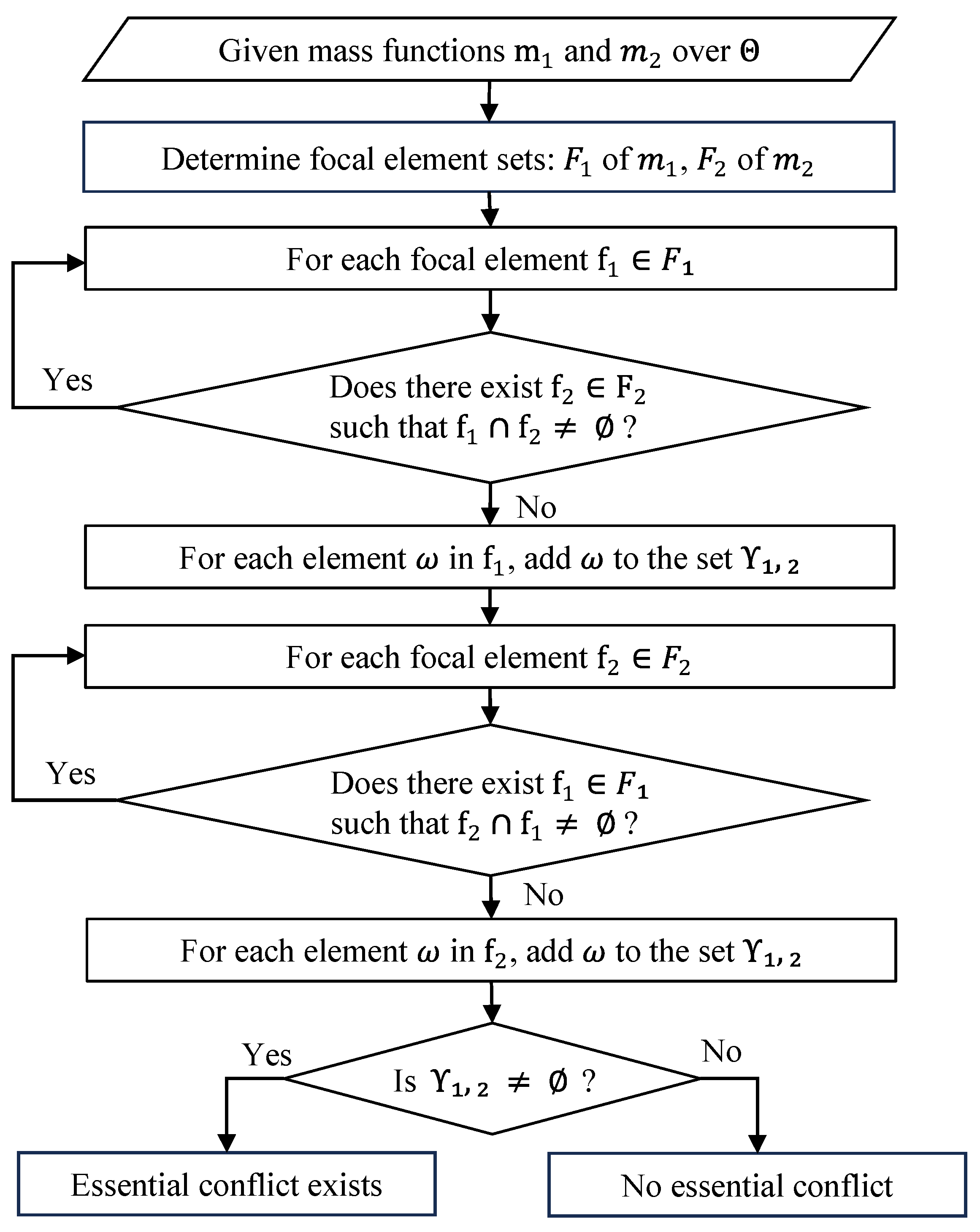
| Algorithm 1 Determining the set of essential conflict elements |
|
| Algorithm 2 checkingFocalElement |
|
- is in , and the intersection of and all the focal elements in is an empty set;
- is in , and the intersection of and all the focal elements in is an empty set.
5.2. A Quantity Measurement of Essential Conflict
6. Evaluation
6.1. Properties of Essential Conflict
6.2. Applicability Analysis
6.3. Desirable Properties
- (i)
- Symmetry: ;
- (ii)
- Boundedness: ;
- (iii)
- Extreme consistency: if mass functions and are identical, and if the two mass functions are in total conflict;
- (iv)
- Ignorance: If , then ;
- (v)
- Insensitivity to refinement: If mass functions and are refined from Θ into , then .
- (i)
- According to Definition 9,Thus, item (i) holds;
- (ii)
- According to Definition 2, for any , it holds that , , , and . Then, it can be written that:Thus, it holds that:Therefore, according to the proof process of Theorem 2,Since , thenThus, item (ii) holds;
- (iii)
- If mass functions and are identical, then there is no focal element whose intersection with all focal elements of another mass function is an empty set. Therefore, based on Definition 5, mass functions and are not in essential conflict, and . Thus, according to Definition 6, . If mass functions and are in total conflict, that is, for any and , then according to Definition 5, . Based on the proof process of Theorem 3, it can be concluded thatSince for any and according to Definition 5, and . Then, it can be written that:and . Thus, item (iii) holds;
- (iv)
- If , then according to Definition 5, . In addition, according to Definition 6, ; thus, item (iv) holds;
- (v)
- If mass functions and are refined from into , but the mass value of the focal element of each mass function remains unchanged, then according to Definition 5, . Similarly, according to Definition 6, . Thus, item (v) holds.
- Property (i): SymmetryThe conflict measurement should be symmetric; namely, the value of conflict measurement should not depend on the order of the two mass functions;
- Property (ii): BoundednessThe degree of conflict between two mass functions should be bounded; namely, the conflict measurement should have a maximum and minimum value;
- Property (iii): Extreme consistencyThe value of conflict measurement of two mass functions should be maximal if the two mass functions are in total conflict but minimal if they are identical;
- Property (iv): IgnoranceThe value of conflict measurement of the combination of the vacuous mass function and any other mass function should be minimal;
- Property (v): Insensitivity to refinementIf two mass functions are refined only from one frame to another and the mass value of the focal element of each mass function remains unchanged, then the conflict measurement value should not be affected.
7. Conclusions and Future Work
Author Contributions
Funding
Data Availability Statement
Conflicts of Interest
References
- Xiao, F.; Wen, J.; Pedrycz, W. Generalized divergence-based decision making method with an application to pattern classification. IEEE Trans. Knowl. Data Eng. 2023, 35, 6941–6956. [Google Scholar] [CrossRef] [Scilit]
- Zhang, Q.; Zhang, P.; Li, T. Information fusion for large-scale multi-source data based on the Dempster–Shafer evidence theory. Inf. Fusion 2025, 115, 102754. [Google Scholar] [CrossRef] [Scilit]
- Wang, N.; Yuen, K.F.; Yuan, J.; Li, D. Ship collision risk assessment: A multi-criteria decision-making framework based on Dempster–Shafer evidence theory. Appl. Soft Comput. 2024, 162, 111823. [Google Scholar] [CrossRef] [Scilit]
- Ma, W.; Liu, W.; Luo, X.; McAreavey, K.; Jiang, Y.; Ma, J. A Dempster–Shafer theory and uninorm-based framework of reasoning and multiattribute decision-making for surveillance system. Int. J. Intell. Syst. 2019, 34, 3077–3104. [Google Scholar] [CrossRef] [Scilit]
- Xiao, F. GEJS: A generalized evidential divergence measure for multisource information fusion. IEEE Trans. Syst. Man Cybern. Syst. 2023, 53, 2246–2258. [Google Scholar] [CrossRef] [Scilit]
- Zhu, X.; Xiong, J.; Chen, Y.-C.; Cai, Y. Safety monitoring of machinery equipment and fault diagnosis method based on support vector machine and improved evidence theory. Int. J. Inf. Comput. Secur. 2022, 19, 274–287. [Google Scholar] [CrossRef] [Scilit]
- Zhang, Y.; Xiong, A.; Xiao, Y.; Chen, Z. A new combination method based on Pearson coefficient and information entropy for multi-sensor data fusion. Inf. Softw. Technol. 2023, 161, 107248. [Google Scholar] [CrossRef] [Scilit]
- Pan, L.; Gao, X.; Deng, Y.; Cheong, K.H. Enhanced mass Jensen–Shannon divergence for information fusion. Expert Syst. Appl. 2022, 209, 118065. [Google Scholar] [CrossRef] [Scilit]
- Liu, Z.; Liu, Y.; Dezert, J.; Cuzzolin, F. Evidence combination based on credal belief redistribution for pattern classification. IEEE Trans. Fuzzy Syst. 2020, 28, 618–631. [Google Scholar] [CrossRef] [Scilit]
- Tang, Y.; Wu, D.; Liu, Z. A new approach for generation of generalized basic probability assignment in the evidence theory. Pattern Anal. Appl. 2021, 24, 1007–1023. [Google Scholar] [CrossRef] [Scilit]
- Jing, M.; Tang, Y. A new base basic probability assignment approach for conflict data fusion in the evidence theory. Appl. Intell. 2021, 51, 1056–1068. [Google Scholar] [CrossRef] [Scilit]
- Liu, W. Analyzing the degree of conflict among belief functions. Artif. Intell. 2006, 170, 909–924. [Google Scholar] [CrossRef] [Scilit]
- Jiang, W.; Huang, C.; Deng, X. A new probability transformation method based on a correlation coefficient of belief functions. Int. J. Intell. Syst. 2019, 34, 1337–1347. [Google Scholar] [CrossRef] [Scilit]
- Jiroušek, R.; Shenoy, P. On properties of a new decomposable entropy of Dempster–Shafer belief functions. Int. J. Approx. Reason. 2020, 119, 260–279. [Google Scholar] [CrossRef] [Scilit]
- Deng, X.; Jiang, W. On the negation of a Dempster–Shafer belief structure based on maximum uncertainty allocation. Inf. Sci. 2020, 516, 346–352. [Google Scholar] [CrossRef] [Scilit]
- Huang, F.; Zhang, Y.; Wang, Z.; Deng, X. A novel conflict management method based on uncertainty of evidence and reinforcement learning for multi-sensor information fusion. Entropy 2021, 23, 1222. [Google Scholar] [CrossRef] [Scilit] [PubMed]
- Xiao, F. CED: A distance for complex mass functions. IEEE Trans. Neural Netw. Learn. Syst. 2021, 32, 1525–1535. [Google Scholar] [CrossRef] [Scilit]
- Jiang, W. A correlation coefficient for belief functions. Int. J. Approx. Reason. 2018, 103, 94–106. [Google Scholar] [CrossRef] [Scilit]
- Jousselme, A.-L.; Grenier, D.; Bossé, É. A new distance between two bodies of evidence. Inf. Fusion 2001, 2, 91–101. [Google Scholar] [CrossRef] [Scilit]
- Zhao, Y.; Jia, R.; Shi, P. A novel combination method for conflicting evidence based on inconsistent measurements. Inf. Sci. 2016, 367–368, 125–142. [Google Scholar] [CrossRef] [Scilit]
- Fei, L.; Feng, Y.; Liu, L. Evidence combination using OWA-based soft likelihood functions. Int. J. Intell. Syst. 2019, 34, 2269–2290. [Google Scholar] [CrossRef] [Scilit]
- Liu, Z.; Zhang, X.; Niu, J.; Dezert, J. Combination of classifiers with different frames of discernment based on belief functions. IEEE Trans. Fuzzy Syst. 2021, 29, 1764–1774. [Google Scholar] [CrossRef] [Scilit]
- Mao, S.; Han, Y.; Deng, Y.; Pelusi, D. A hybrid DEMATEL-FRACTAL method of handling dependent evidences. Eng. Appl. Artif. Intell. 2020, 91, 103543. [Google Scholar] [CrossRef] [Scilit]
- Song, Y.; Deng, Y. A new method to measure the divergence in evidential sensor data fusion. Int. J. Distrib. Sens. Netw. 2019, 15, 1550137719841234. [Google Scholar] [CrossRef] [Scilit]
- Zadeh, L. A simple view of the Dempster–Shafer theory of evidence and its implication for the rule of combination. AI Mag. 1986, 7, 85–90. [Google Scholar]
- Xu, H.; Deng, Y. Dependent evidence combination based on decision-making trial and evaluation laboratory method. Int. J. Intell. Syst. 2019, 34, 1555–1571. [Google Scholar] [CrossRef] [Scilit]
- Dempster, A. Upper and lower probabilities induced by a multivalued mapping. In Classic Works of the Dempster–Shafer Theory of Belief Functions; Yager, R., Liu, L., Eds.; Springer: Berlin, Germany, 2008; Volume 219, pp. 57–72. [Google Scholar]
- Shafer, G. A Mathematical Theory of Evidence; Princeton University Press: Princeton, NJ, USA, 1976; Volume 1. [Google Scholar]
- Smets, P. Decision making in the TBM: The necessity of the pignistic transformation. Int. J. Approx. Reason. 2005, 38, 133–147. [Google Scholar] [CrossRef] [Scilit]
- Yager, R. On the Dempster–Shafer framework and new combination rules. Inf. Sci. 1987, 41, 93–137. [Google Scholar] [CrossRef] [Scilit]
- Dubois, D.; Prade, H. Representation and combination of uncertainty with belief functions and possibility measures. Comput. Intell. 1988, 4, 244–264. [Google Scholar] [CrossRef] [Scilit]
- Deng, X.; Deng, Y.; Chan, F. An improved operator of combination with adapted conflict. Ann. Oper. Res. 2014, 223, 451–459. [Google Scholar] [CrossRef] [Scilit]
- Smets, P. Analyzing the combination of conflicting belief functions. Inf. Fusion 2007, 8, 387–412. [Google Scholar] [CrossRef] [Scilit]
- Murphy, C. Combining belief functions when evidence conflicts. Decis. Support Syst. 2000, 29, 1–9. [Google Scholar] [CrossRef] [Scilit]
- Deng, Y. Generalized evidence theory. Appl. Intell. 2015, 43, 530–543. [Google Scholar] [CrossRef] [Scilit]
- Ma, W.; Jiang, Y.; Luo, X. A flexible rule for evidential combination in Dempster–Shafer theory of evidence. Appl. Soft Comput. 2019, 85, 105790. [Google Scholar] [CrossRef] [Scilit]
- Huang, L.; Ruan, S.; Decazes, P.; Denœux, T. Deep evidential fusion with uncertainty quantification and reliability learning for multimodal medical image segmentation. Inf. Fusion 2025, 113, 102648. [Google Scholar] [CrossRef] [Scilit]
- Qiang, C.; Li, Z.; Deng, Y. Multifractal analysis of mass function. Soft Comput. 2023, 27, 11205–11218. [Google Scholar] [CrossRef] [Scilit]
- Liu, X.; Liu, S.; Xiang, J.; Sun, R. A conflict evidence fusion method based on the composite discount factor and the game theory. Inf. Fusion 2023, 94, 1–16. [Google Scholar] [CrossRef] [Scilit]
- Smets, P. Data fusion in the transferable belief model. In Proceedings of the 3rd International Conference on Information Fusion, Paris, France, 10–13 July 2000; pp. 21–33. [Google Scholar]
- Smets, P.; Kennes, R. The transferable belief model. Artif. Intell. 1994, 66, 191–234. [Google Scholar] [CrossRef] [Scilit]
- Zhou, M.; Zhou, Y.; Yang, J.-B.; Wu, J. A generalized belief dissimilarity measure based on weighted conflict belief and distance metric and its application in multi-source data fusion. Fuzzy Sets Syst. 2024, 475, 108719. [Google Scholar] [CrossRef] [Scilit]
- Daniel, M. Conflicts within and between belief functions. In Proceedings of the International Conference on Computational Intelligence for Knowledge-Based Systems Design, Dortmund, Germany, 28–30 June 2010; pp. 696–705. [Google Scholar]
- Song, Y.; Wang, X.; Lei; Xue, A. Evidence combination based on credibility and separability. In Proceedings of the 2014 12th International Conference on Signal Processing, Hangzhou, China, 19–23 October 2014; pp. 1392–1396. [Google Scholar]
- Pan, L.; Deng, Y. An association coefficient of a belief function and its application in a target recognition system. Int. J. Intell. Syst. 2020, 35, 85–104. [Google Scholar] [CrossRef] [Scilit]
- Xiao, F.; Cao, Z.; Jolfaei, A. A novel conflict measurement in decision-making and its application in fault diagnosis. IEEE Trans. Fuzzy Syst. 2020, 29, 186–197. [Google Scholar] [CrossRef] [Scilit]
- Liu, Z. An effective conflict management method based on belief similarity measure and entropy for multi-sensor data fusion. Artif. Intell. Rev. 2023, 56, 15495–15522. [Google Scholar] [CrossRef] [Scilit]
- Xiao, F. A new divergence measure for belief functions in D–S evidence theory for multisensor data fusion. Inf. Sci. 2020, 514, 462–483. [Google Scholar] [CrossRef] [Scilit]
- Zhen, H.; Xiaochuan, J. An improved belief Hellinger divergence for Dempster–Shafer theory and its application in multi-source information fusion. Appl. Intell. 2023, 53, 17965–17984. [Google Scholar]
- Hong, X.; Huang, Y.; Ma, W.; Varadarajan, S.; Miller, P.; Liu, W.; Romero, M.J.S.; del Rincón, J.M.; Zhou, H. Evidential event inference in transport video surveillance. Comput. Vis. Image Underst. 2016, 144, 276–297. [Google Scholar] [CrossRef] [Scilit]
- Destercke, S.; Burger, T. Toward an axiomatic definition of conflict between belief functions. IEEE Trans. Cybern. 2013, 43, 585–596. [Google Scholar] [CrossRef] [Scilit] [PubMed]


| Conflict Measurement | Example 1 (It Violates the Intuition) | Example 2 (It Violates the Intuition) | Example 3 (It Satisfies the Intuition) |
|---|---|---|---|
| [28] | 0.99 | 0.36 | 0.82 |
| [19] | 0.90 | 0.20 | 0.80 |
| [12] | 0.90 | 0.20 | 0.80 |
| [43] | 0.90 | 0 | 0.80 |
| [44] | 0.73 | 0.04 | 0.60 |
| [18] | 0.99 | 0.06 | 0.78 |
| [48] | 0.95 | 0.45 | 0.73 |
| [45] | 0.99 | 0.06 | 0.78 |
| [46] | 0.99 | 0.11 | 0.95 |
| [42] | 0.98 | 0.23 | 0.82 |
| [47] | 0.99 | 0.11 | 0.95 |
| m | ||||
|---|---|---|---|---|
| 0.4 | 0.6 | 0 | 0 | |
| 0 | 0.7 | 0.3 | 0 | |
| 0.85 | 0 | 0 | 0.15 | |
| 0.4 | 0.6 | 0 | 0 | |
| 0.75 | 0 | 0 | 0.25 |
| Property (i) | Property (ii) | Property (iii) | Property (iv) | Property (v) | Time Complexity | |
|---|---|---|---|---|---|---|
| [28] | Yes | Yes | No | Yes | Yes | |
| [19] | Yes | Yes | No | No | Yes | |
| [12] | Yes | Yes | No | No | Yes | |
| [43] | Yes | Yes | No | Yes | Yes | |
| [44] | Yes | Yes | No | No | No | |
| [18] | Yes | Yes | Yes | No | Yes | |
| [48] | Yes | Yes | Yes | No | Yes | |
| [45] | Yes | Yes | Yes | No | Yes | |
| [46] | Yes | Yes | Yes | No | Yes | |
| [42] | Yes | Yes | Yes | No | Yes | |
| [47] | Yes | Yes | Yes | No | Yes | |
| Proposed measurement | Yes | Yes | Yes | Yes | Yes |
| Mass Functions | Conflict Value | Violated Property | Our Measurement | |
|---|---|---|---|---|
| [28] | Case 1 | Violate property (iii): the value should be minimal. | ||
| [19] | Case 2 | Violate property (iii): the value should be maximal. | ||
| Case 3 | Violate property (iv): the value should be minimal. | |||
| [12] | Case 4 | Violate property (iii): the value should be maximal. | ||
| Case 3 | Violate property (iv): the value should be minimal. | |||
| [43] | Case 2 | Violate property (iii): the value should be maximal. | ||
| [44] | Case 2 | Violate property (iii): the value should be maximal. | ||
| Case 3 | Violate property (iv): the value should be minimal. | |||
| Case 5 | Violate property (v): the value should not be affected. | |||
| Case 6 | ||||
| [18] | Case 3 | Violate property (iv): the value should be minimal. | ||
| [48] | Case 3 | Violate property (iv): the value should be minimal. | ||
| [45] | Case 3 | Violate property (iv): the value should be minimal. | ||
| [46] | Case 3 | Violate property (iv): the value should be minimal. | ||
| [42] | Case 3 | Violate property (iv): the value should be minimal. | ||
| [47] | Case 3 | Violate property (iv): the value should be minimal. |
Disclaimer/Publisher’s Note: The statements, opinions and data contained in all publications are solely those of the individual author(s) and contributor(s) and not of MDPI and/or the editor(s). MDPI and/or the editor(s) disclaim responsibility for any injury to people or property resulting from any ideas, methods, instructions or products referred to in the content. |
© 2025 by the authors. Licensee MDPI, Basel, Switzerland. This article is an open access article distributed under the terms and conditions of the Creative Commons Attribution (CC BY) license.
Share and Cite
Ma, W.; He, M.; Wang, S.; Zhan, J. Essential Conflict Measurement in Dempster–Shafer Theory for Intelligent Information Fusion. Mathematics 2026, 14, 97. https://doi.org/10.3390/math14010097
Ma W, He M, Wang S, Zhan J. Essential Conflict Measurement in Dempster–Shafer Theory for Intelligent Information Fusion. Mathematics. 2026; 14(1):97. https://doi.org/10.3390/math14010097
Chicago/Turabian StyleMa, Wenjun, Meishen He, Siyuan Wang, and Jieyu Zhan. 2026. "Essential Conflict Measurement in Dempster–Shafer Theory for Intelligent Information Fusion" Mathematics 14, no. 1: 97. https://doi.org/10.3390/math14010097
APA StyleMa, W., He, M., Wang, S., & Zhan, J. (2026). Essential Conflict Measurement in Dempster–Shafer Theory for Intelligent Information Fusion. Mathematics, 14(1), 97. https://doi.org/10.3390/math14010097