Conservation Laws, Soliton Dynamics, and Stability in a Nonlinear Schrödinger Equation with Second-Order Spatiotemporal Dispersion


Abstract
1. Introduction
2. Methodology Overview
- Step 1:
- The traveling wave transformation takes the following form:
- Step 2:
- Assuming the solution of Equation (3) has the following form:
- Step 3:
3. Mathematical Model
4. Formation of Soliton Solutions
- Family 1:
- Taking and in Equation (5), we get
- Case 1:
- Case 2:
- Case 3:
- Family 2:
- Taking and in Equation (5), we get
- Case 1:
- Case 2:
- Family 3:
- Taking and in Equation (5), we get
- Case 1:
- Case 1:
- Case 2:
- Case 1:
5. Conservation Laws
5.1. First Conservation Law
5.2. Second Conservation Law
5.3. Third Conservation Law Derivation
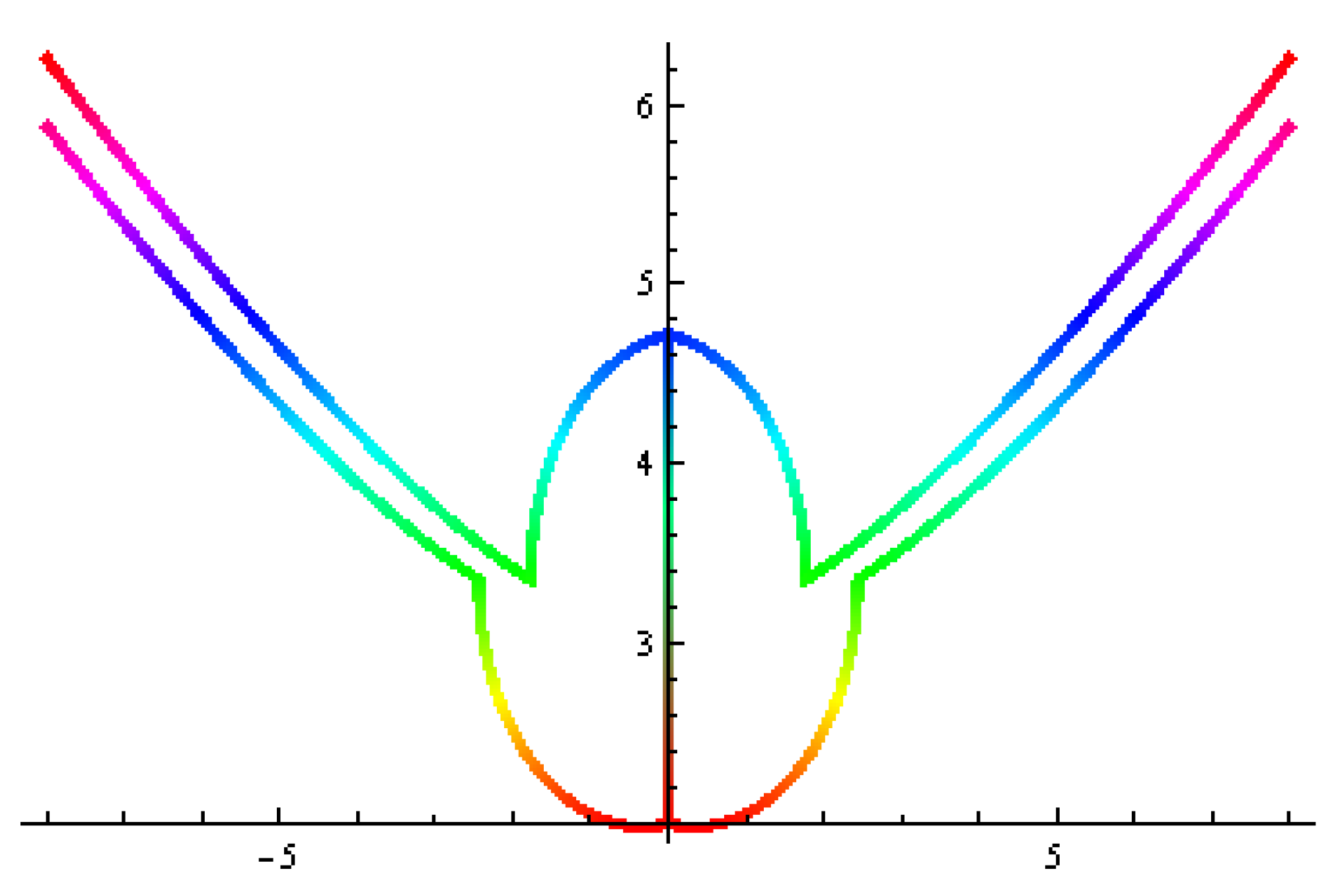
6. Stability Analysis
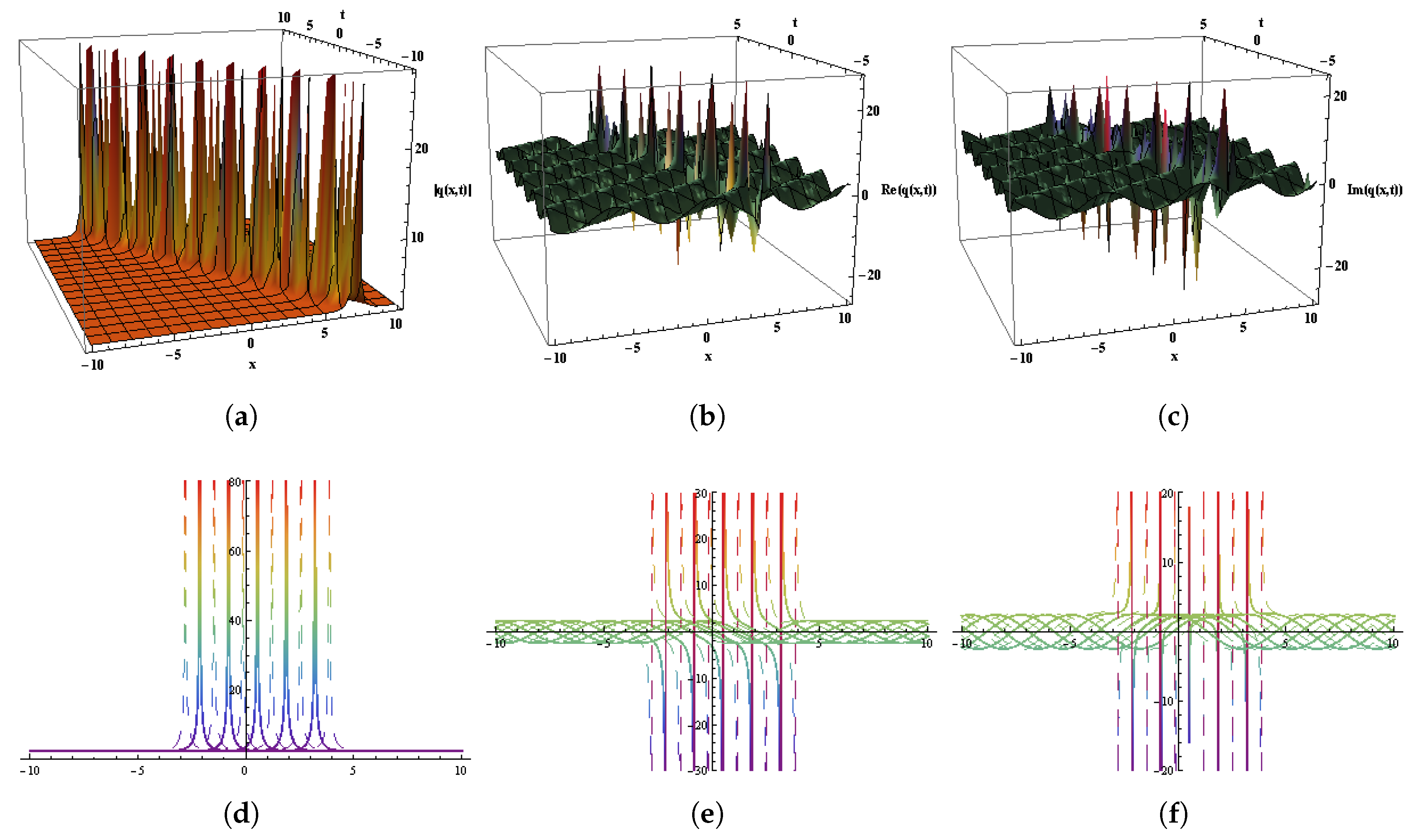
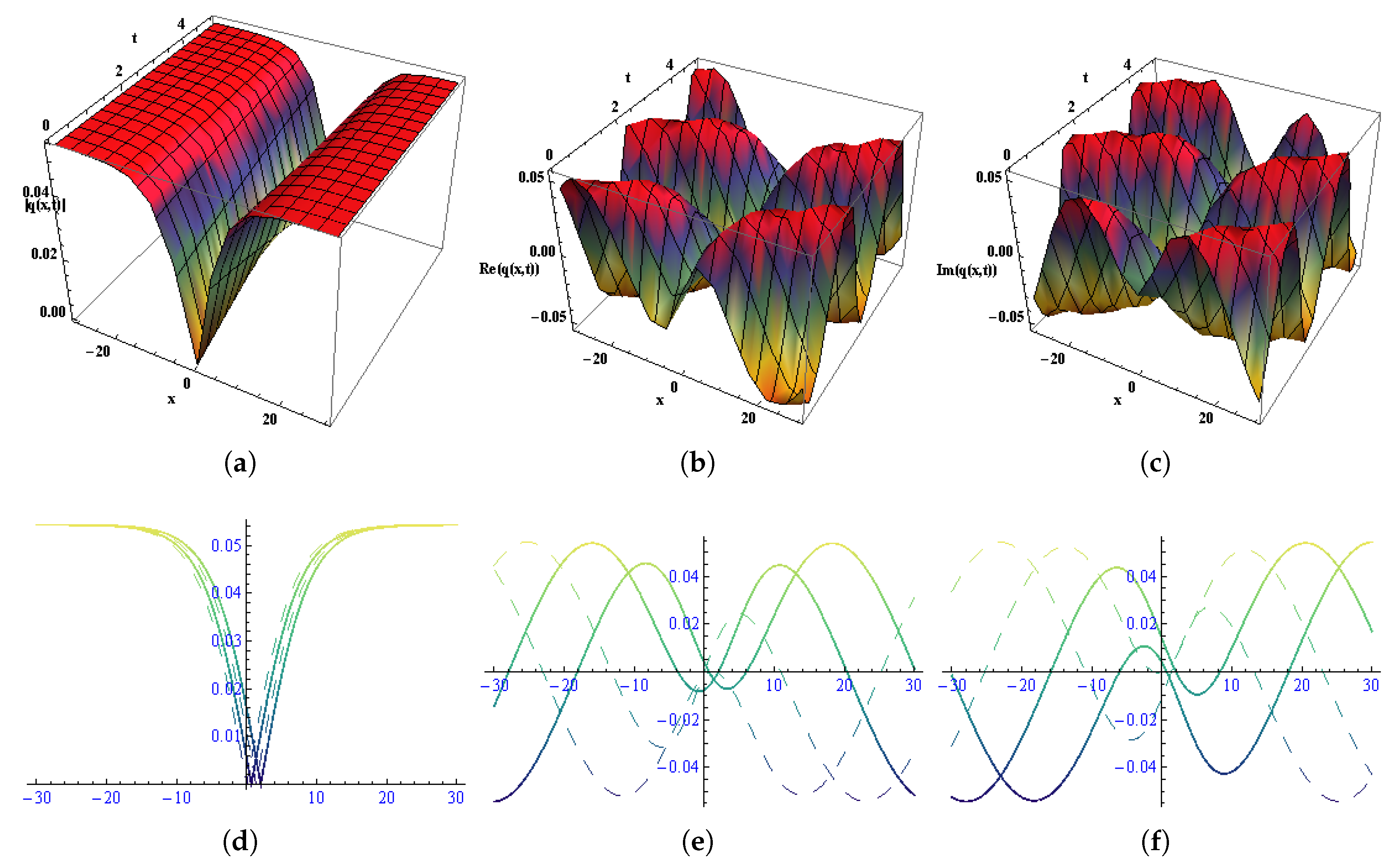
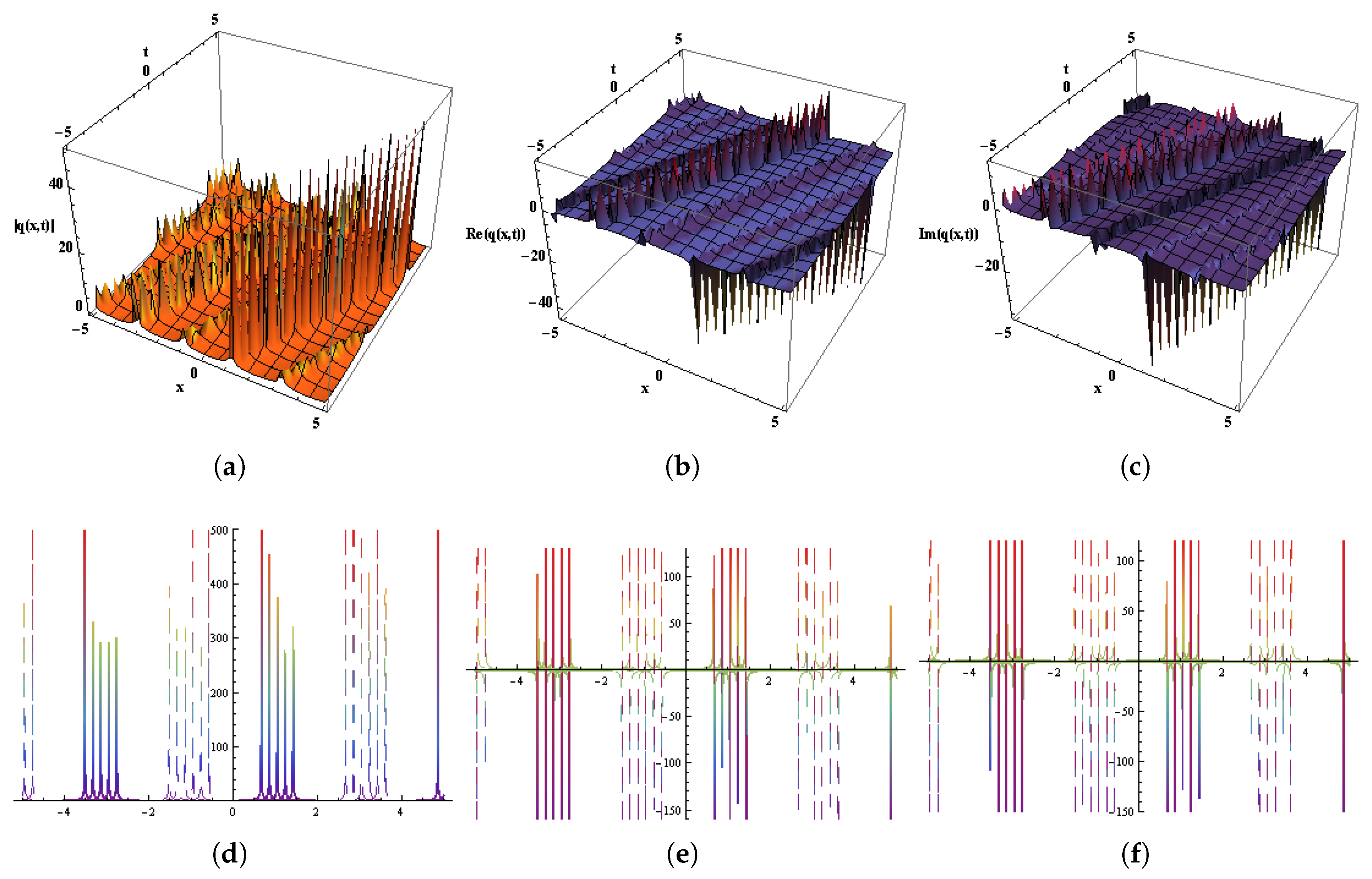
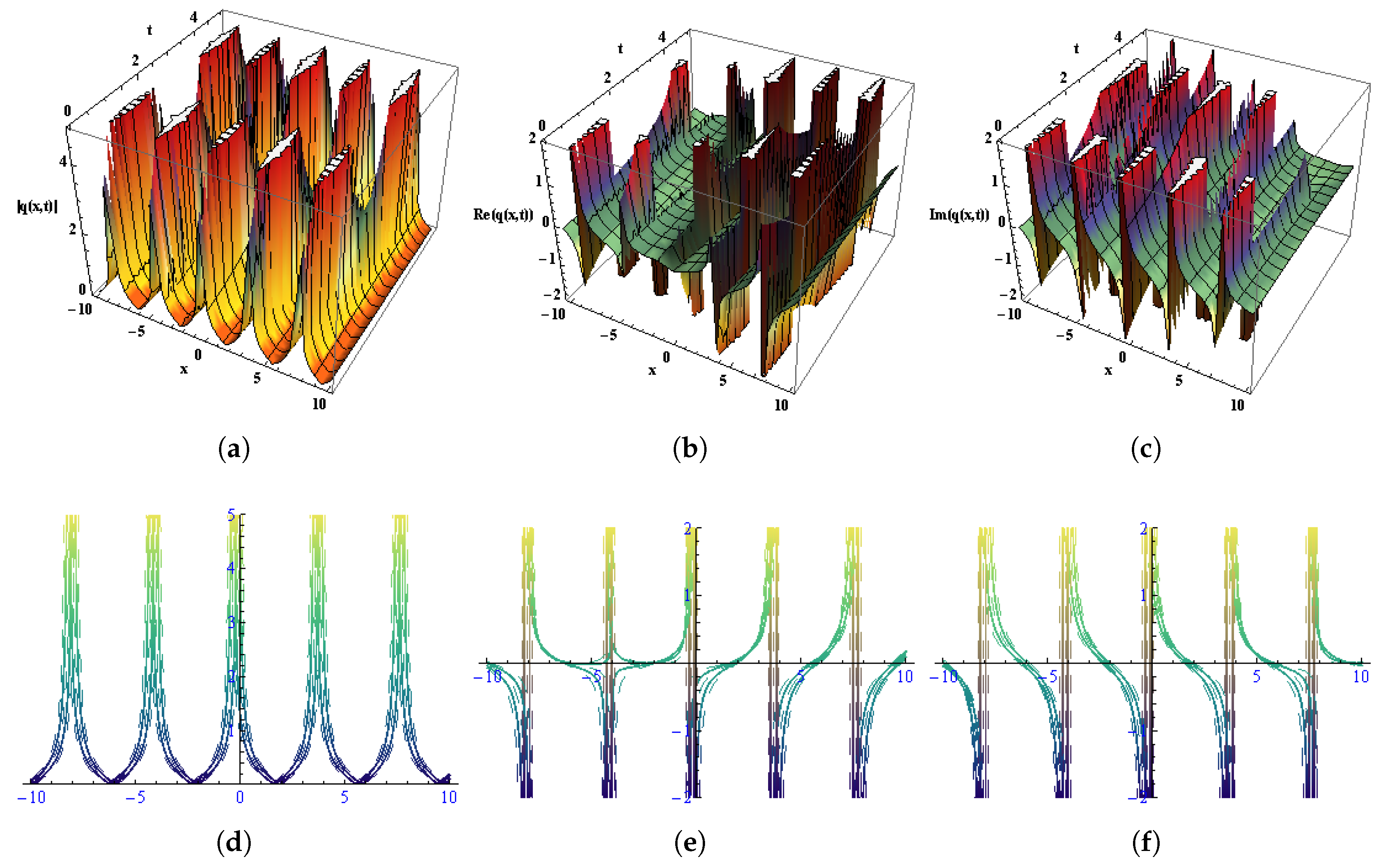
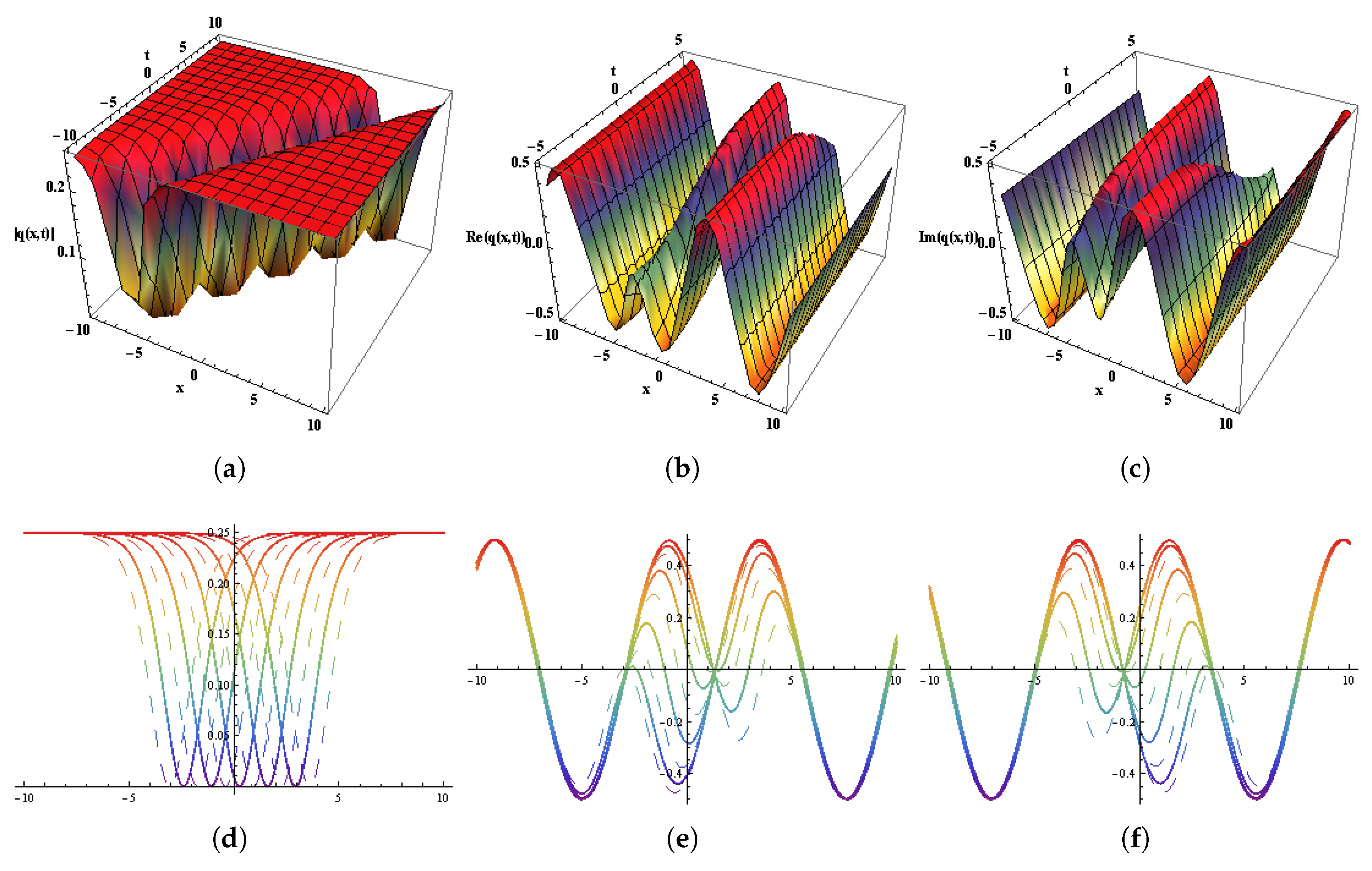
7. Results Analysis and Interpretation from a Physical Perspective
8. Concluding Remarks
Author Contributions
Funding
Data Availability Statement
Conflicts of Interest
References
- Akhmediev, N.; Soto-Crespo, J.M.; Grapinet, M.; Grelu, P. Dissipative soliton interactions inside a fiber laser cavity. Opt. Fiber Technol. 2005, 11, 209–228. [Google Scholar] [CrossRef][Green Version]
- Yasin, F.; Shahbaz, N.; Almutairi, B.; Sesay, M.; Macías-Díaz, J.E. Exploring soliton solutions of Zakharov–Kuznetsov dynamical model with applications. AIP Adv. 2025, 15, 045212. [Google Scholar] [CrossRef]
- Ahmad, J.; Mustafa, Z.; Habib, J. Analyzing dispersive optical solitons in nonlinear models using an analytical technique and its applications. Opt. Quantum Electron. 2024, 56, 77. [Google Scholar] [CrossRef]
- Altun Durmus, S. Optical soliton solutions of stochastic the third-order nonlinear Schrödinger equation with multiplicative white noise via Itô calculus. Opt. Quantum Electron. 2024, 56, 779. [Google Scholar] [CrossRef]
- Dong, S.; Huang, Q.; Luo, H.; Xiang, S.; Zhao, L.; Yang, H.; Yu, L.; Yao, C. A Design and Analysis of RCD Oscillation Suppression Circuit for Marx Pulse Generator. IEEE Trans. Plasma Sci. 2025, 53, 1277–1284. [Google Scholar] [CrossRef]
- Ahmed, I.; Seadawy, A.R.; Lu, D. Mixed lump-solitons, periodic lump and breather soliton solutions for (2+ 1)-dimensional extended Kadomtsev–Petviashvili dynamical equation. Int. J. Mod. Phys. B 2019, 33, 1950019. [Google Scholar] [CrossRef]
- Bo, Y.; Tian, D.; Liu, X.; Jin, Y. Discrete Maximum Principle and Energy Stability of the Compact Difference Scheme for Two-Dimensional Allen-Cahn Equation. J. Funct. Spaces 2022, 2022, 8522231. [Google Scholar] [CrossRef]
- Rogers, C.; Schief, W.K. Bäcklund and Darboux Transformations: Geometry and Modern Applications in Soliton Theory; Cambridge University Press: Cambridge, UK, 2002; Volume 30. [Google Scholar]
- Lu, Y.; Wang, S.; Chen, R.; Zhang, C.; Zhang, Y.; Gao, J.; Du, S. Reliability estimation method based on nonlinear Tweedie exponential dispersion process and evidential reasoning rule. Comput. Ind. Eng. 2025, 206, 111205. [Google Scholar] [CrossRef]
- Wang, Y.; Yu, A.; Cheng, Y.; Dong, Y.; Qi, J.; Alù, A. High numerical aperture achromatic meta-devices through dispersion compensation. Adv. Funct. Mater. 2025, 35, e15507. [Google Scholar] [CrossRef]
- Zhao, L.; Dong, S.; Xiang, S.; Mao, S.; Lei, Y.; Zhang, P.; Yu, L.; Yao, C. A fast-edge square-wave adjustable pulse current generator based on coupling inductor. IEEE Trans. Ind. Electron. 2024, 71, 12086–12099. [Google Scholar] [CrossRef]
- Guan, J.; Ren, Z.; Guo, Q. Stable solution of induced modulation instability. Sci. Rep. 2020, 10, 10081. [Google Scholar] [CrossRef]
- Shirpay, A.; Zarezadeh, E. Enhancing optical modulator and link performance through modulation instability: Design, simulation and implementation. Discov. Appl. Sci. 2024, 6, 358. [Google Scholar] [CrossRef]
- Azami, S. Relativistic spacetimes admitting h-almost conformal ω-Ricci-Bourguignon solitons. Int. J. Geom. Methods Mod. Phys. 2025, 22, 2550067. [Google Scholar] [CrossRef]
- Ahmed, I.; Seadawy, A.R.; Lu, D. Kinky breathers, W-shaped and multi-peak solitons interaction in (2+ 1)-dimensional nonlinear Schrödinger equation with Kerr law of nonlinearity. Eur. Phys. J. Plus 2019, 134, 120. [Google Scholar] [CrossRef]
- Kumar, S.; Mohan, B. A novel and efficient method for obtaining Hirota’s bilinear form for the nonlinear evolution equation in (n+ 1) dimensions. Partial Differ. Equ. Appl. Math. 2022, 5, 100274. [Google Scholar] [CrossRef]
- Ghanbari, B.; Kuo, C.K. New exact wave solutions of the variable-coefficient (1+ 1)-dimensional Benjamin-Bona-Mahony and (2+ 1)-dimensional asymmetric Nizhnik-Novikov-Veselov equations via the generalized exponential rational function method. Eur. Phys. J. Plus 2019, 134, 334. [Google Scholar] [CrossRef]
- Osman, M.S. Multi-soliton rational solutions for quantum Zakharov-Kuznetsov equation in quantum magnetoplasmas. Waves Random Complex Media 2016, 26, 434–443. [Google Scholar] [CrossRef]
- Bakodah, H.O.; Al Qarni, A.A.; Banaja, M.A.; Zhou, Q.; Moshokoa, S.P.; Biswas, A. Bright and dark Thirring optical solitons with improved adomian decomposition method. Optik 2017, 130, 1115–1123. [Google Scholar] [CrossRef]
- Hussain, A.; Chahlaoui, Y.; Zaman, F.D.; Parveen, T.; Hassan, A.M. The Jacobi elliptic function method and its application for the stochastic NNV system. Alex. Eng. J. 2023, 81, 347–359. [Google Scholar] [CrossRef]
- Alshammari, F.S. Exploring chaotic behavior, conservation laws, Lie symmetry, and soliton dynamics in the generalized A∓ equation. AIMS Math. 2025, 10, 22150–22179. [Google Scholar]
- Kadkhoda, N.; Jafari, H. Analytical solutions of the Gerdjikov–Ivanov equation by using exp (-ϕ (ξ))-expansion method. Optik 2017, 139, 72–76. [Google Scholar] [CrossRef]
- Kudryashov, N.A. Highly dispersive solitary wave solutions of perturbed nonlinear Schrödinger equations. Appl. Math. Comput. 2020, 371, 124972. [Google Scholar] [CrossRef]
- Guo, X.; Zhang, J.; Meng, X.; Li, Z.; Wen, X.; Girard, P.; Liang, P.; Yan, A. HALTRAV: Design of A High-performance and Area-efficient Latch with Triple-node-upset Recovery and Algorithm-based Verifications. IEEE Trans. Comput.-Aided Des. Integr. Circuits Syst. 2024, 44, 2367–2377. [Google Scholar] [CrossRef]
- Kudryashov, N.A. Traveling wave reduction of the modified KdV hierarchy: The Lax pair and the first integrals. Commun. Nonlinear Sci. Numer. Simul. 2019, 73, 472–480. [Google Scholar] [CrossRef]
- Haroon, S.; Abuzar, M.; Khan, M.F. Analyzing sensitivity and solitonic behavior using the Dullin–Gottwald–Holm model in shallow water waves. Acadlore Trans. Appl. Math. Stat. 2023, 1, 96–110. [Google Scholar] [CrossRef]
- Samir, I.; Ahmed, H.M. Optical solitons and other wave solutions to fractional-order nonlinear Sasa–Satsuma equation in mono-mode optical fibers using IM extended tanh function method. J. Opt. 2025, 54, 604–613. [Google Scholar] [CrossRef]
- Chabchoub, A.; Kibler, B.; Finot, C.; Millot, G.; Onorato, M.; Dudley, J.M.; Babanin, A.V. The nonlinear Schrödinger equation and the propagation of weakly nonlinear waves in optical fibers and on the water surface. Ann. Phys. 2015, 361, 490–500. [Google Scholar] [CrossRef]
- Zhu, S.D. Exact solutions for the high-order dispersive cubic-quintic nonlinear Schrödinger equation by the extended hyperbolic auxiliary equation method. Chaos Solitons Fractals 2007, 34, 1608–1612. [Google Scholar] [CrossRef]
- Nasreen, N.; Lu, D.; Arshad, M. Optical soliton solutions of nonlinear Schrödinger equation with second order spatiotemporal dispersion and its modulation instability. Optik 2018, 161, 221–229. [Google Scholar] [CrossRef]
- Christian, J.M.; McDonald, G.S.; Hodgkinson, T.F.; Chamorro-Posada, P. Wave envelopes with second-order spatiotemporal dispersion. I. Bright Kerr solitons and cnoidal waves. Phys. Rev. A—At. Mol. Opt. Phys. 2012, 86, 023838. [Google Scholar] [CrossRef]
- Jafari, M.; Darvazebanzade, R. Analyzing of approximate symmetry and new conservation laws of perturbed generalized Benjamin-Bona-Mahony equation. AUT J. Math. Comput. 2024, 5, 61–69. [Google Scholar]
- Iqbal, M.S.; Seadawy, A.R.; Baber, M.Z.; Qasim, M. Application of modified exponential rational function method to Jaulent–Miodek system leading to exact classical solutions. Chaos Solitons Fractals 2022, 164, 112600. [Google Scholar] [CrossRef]
- Tariq, K.U.; Younis, M. Bright, dark and other optical solitons with second order spatiotemporal dispersion. Optik 2017, 142, 446–450. [Google Scholar] [CrossRef]
- Naz, R.; Mahomed, F.M.; Mason, D.P. Comparison of different approaches to conservation laws for some partial differential equations in fluid mechanics. Appl. Math. Comput. 2008, 205, 212–230. [Google Scholar] [CrossRef]
- Yu, J.; Feng, Y. On the generalized time fractional reaction–diffusion equation: Lie symmetries, exact solutions and conservation laws. Chaos Solitons Fractals 2024, 182, 114855. [Google Scholar] [CrossRef]


Disclaimer/Publisher’s Note: The statements, opinions and data contained in all publications are solely those of the individual author(s) and contributor(s) and not of MDPI and/or the editor(s). MDPI and/or the editor(s) disclaim responsibility for any injury to people or property resulting from any ideas, methods, instructions or products referred to in the content. |
© 2025 by the authors. Licensee MDPI, Basel, Switzerland. This article is an open access article distributed under the terms and conditions of the Creative Commons Attribution (CC BY) license.
Share and Cite
Nasreen, N.; Latif, I.; Basheer, K.; Arshad, M.; Jiang, Z. Conservation Laws, Soliton Dynamics, and Stability in a Nonlinear Schrödinger Equation with Second-Order Spatiotemporal Dispersion. Mathematics 2026, 14, 54. https://doi.org/10.3390/math14010054
Nasreen N, Latif I, Basheer K, Arshad M, Jiang Z. Conservation Laws, Soliton Dynamics, and Stability in a Nonlinear Schrödinger Equation with Second-Order Spatiotemporal Dispersion. Mathematics. 2026; 14(1):54. https://doi.org/10.3390/math14010054
Chicago/Turabian StyleNasreen, Naila, Ismat Latif, Kashifa Basheer, Muhammad Arshad, and Zhaoliang Jiang. 2026. "Conservation Laws, Soliton Dynamics, and Stability in a Nonlinear Schrödinger Equation with Second-Order Spatiotemporal Dispersion" Mathematics 14, no. 1: 54. https://doi.org/10.3390/math14010054
APA StyleNasreen, N., Latif, I., Basheer, K., Arshad, M., & Jiang, Z. (2026). Conservation Laws, Soliton Dynamics, and Stability in a Nonlinear Schrödinger Equation with Second-Order Spatiotemporal Dispersion. Mathematics, 14(1), 54. https://doi.org/10.3390/math14010054