1. Introduction
The differential equation
may be designated generalized Airy differential equation since the particular case
with a + sign is the original Airy differential equation [
1]. Its solutions are the Airy functions
and
, about which there is an extensive literature [
2] covering many properties [
3]. This overlaps with the literature on the Bessel functions [
4], of which the Airy functions are a particular case [
5]. The Airy functions appear in a variety of physical phenomena [
6], including acoustic [
7] and electromagnetic [
8] waves near a caustic. The latter represents the transition from light to shadow, with the Airy function decaying in the shadow zone and oscillating towards a non-zero value in the light zone. The solution of the generalized Airy Equation (
1) with a + (−) sign may be designated generalized circular (hyperbolic) cosine and sine, since in the particular case
, the solutions are the original elementary circular (hyperbolic) cosine and sine functions [
9]. The purpose of the paper is to solve the generalized Airy differential equation for both signs ± and all complex values of the parameter
m.
There are three cases of solutions of the generalized Airy differential Equation (
1), depending on whether the parameter
m is: (I) a non-negative integer; (II) a non-integer complex number; (III) a negative integer. In case I of parameter
m being a non-negative integer, the coefficient
is an analytic function in the finite complex plane
, and the solutions are [
10] analytic functions in the finite disk, specified by ascending power series, multiplied by an integral power of
x with positive integer exponent
a if the origin is a zero of degree
a:
In case II, when
m is a complex number other than an integer, the coefficient
has a branch point [
11] at the origin; the solution may also have a branch point at the origin, with the factor
with a possibly different complex exponent
multiplying an analytic series (
Section 2), leading again to (
1) with a complex instead of a non-negative integer index
a. Thus, in both cases I and II, that is, for all complex values of the parameter
m excluding negative integers, the solution is of the form (
2), with index
a determined by an indicial equation and coefficients
specified by a two-term recurrence relation (
Section 3).
Cases I and II were discussed in detail in an earlier paper [
12] and are reviewed here briefly as a preliminary discussion. Case III is when
m is a negative integer, which is the main focus of this follow-on paper. The Airy differential Equation (
1) has a singularity at the origin that is a regular singularity [
13] for
and
and an irregular singularity [
14] of degree
for
Thus the case III, when the generalized Airy differential equation is singular, has four sub-cases corresponding to the coefficient
having (III-A) a simple pole for
; (III-B) a double pole for
; (III-C) a triple pole for
; (III-D) a higher-order pole for
In the sub-case (III-A) of
, when the coefficient
has a single pole, the generalized Airy differential Equation (
1) has a regular singularity at the origin, and the Frobenius–Fuchs method leads to a function of the first kind, specified by an ascending power series solution like (
2); since the exponent difference is an integer, the second linearly independent solution is a function of the second kind [
15], consisting of a logarithm multiplying the function of the first kind (
1), plus a complementary function specified by an ascending power series possibly starting at a higher order
:
and the solution is valid in the complex
x-plane with a branch-cut from the origin to infinity.
In the case (III-B) of
, when the coefficient has a double pole
, the generalized Airy’s differential equation has a regular singularity, but the power series solution simplifies to a single power with a complex exponent and can be expressed in elementary terms as the product of a power by circular (hyperbolic) cosines and sines for the + (−) sign, with an argument involving logarithms. In the remaining sub-cases (III-C,D) of
, when the coefficient
has a pole of order higher than 2, the generalized Airy differential Equation (
1) has an irregular singularity at the origin with degree
. The inversion of the independent variable
leads to descending power series solutions: (III-C) for
, corresponding to a triple pole
in the coefficients, the solutions are Frobenius–Fuchs series of the first (
2) and second (
3) kinds and variable
, thus valid respectively outside the origin
and outside the branch-cut
; (III-D) for
, corresponding to poles of order higher than 3 in the coefficient
, the solutions are generalized circular (hyperbolic) functions for the + (−) sign, with variable
and parameter
In the sub-case (III-D), the solutions of the generalized Airy differential Equation (
1) for
simplify (
Section 4) to circular (hyperbolic) cosines and sines for sign + (−) with variable
. In the sub-case (III-D) with
, the solutions of the generalized Airy differential equation are (
Section 5) generalized circular (hyperbolic) functions for sign + (−), with variable
and parameter
In all cases the ascending and descending power series have a general
n-th term decaying like
and converge rapidly, as demonstrated in Table 1 for the first
terms of 20 functions, namely the generalized circular and hyperbolic cosines and sines of variable unity
with five values of the parameter
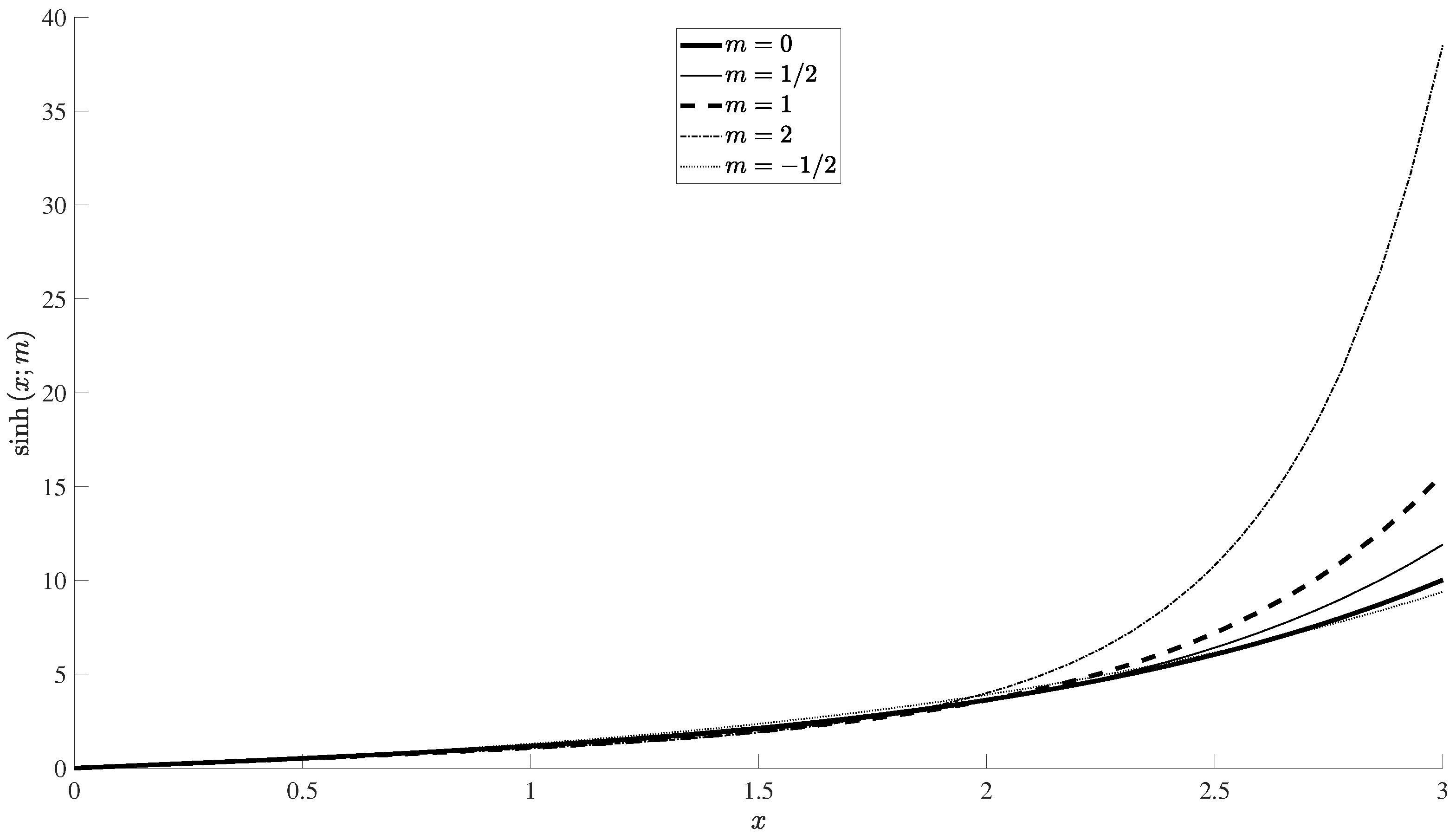
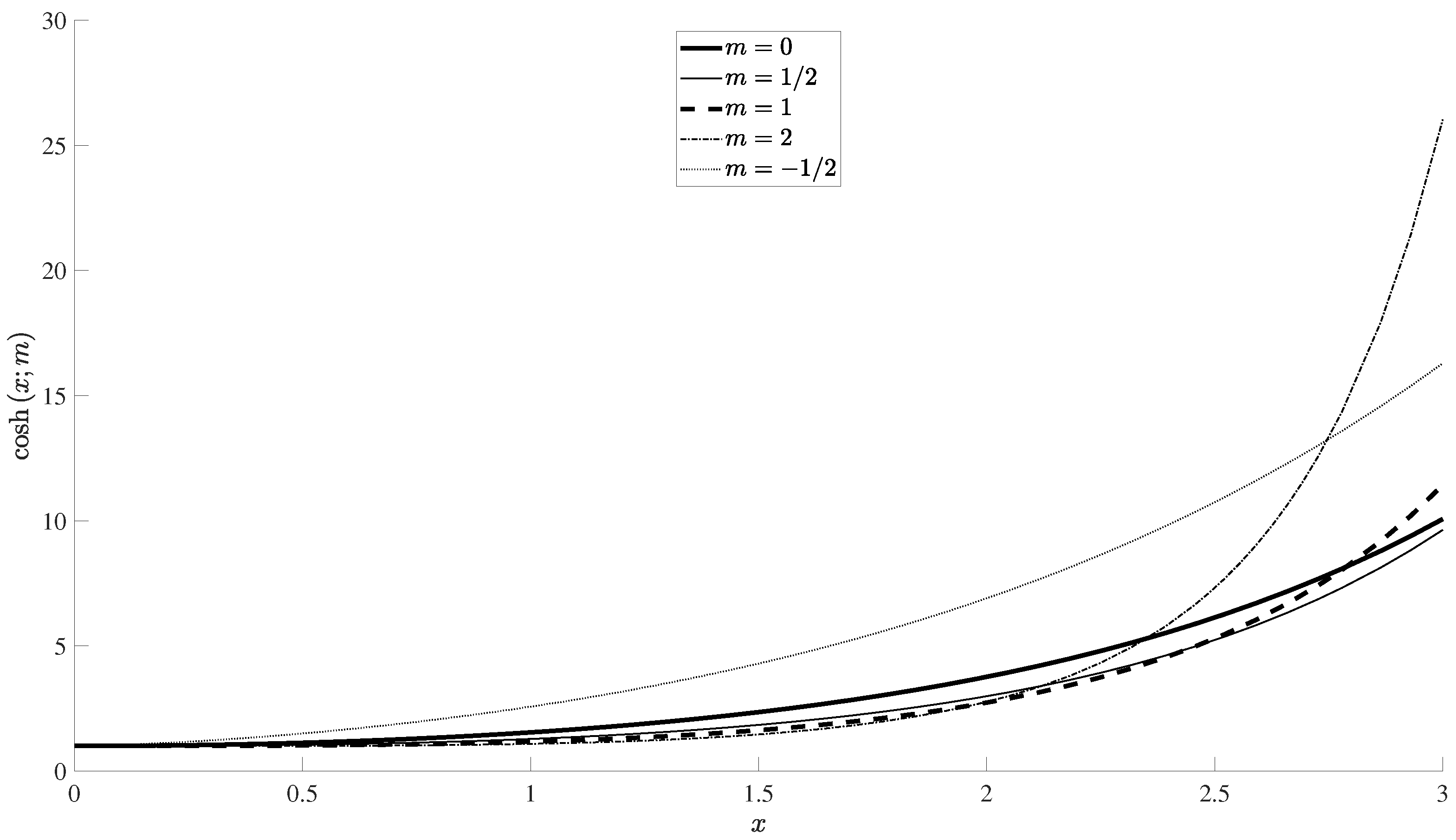
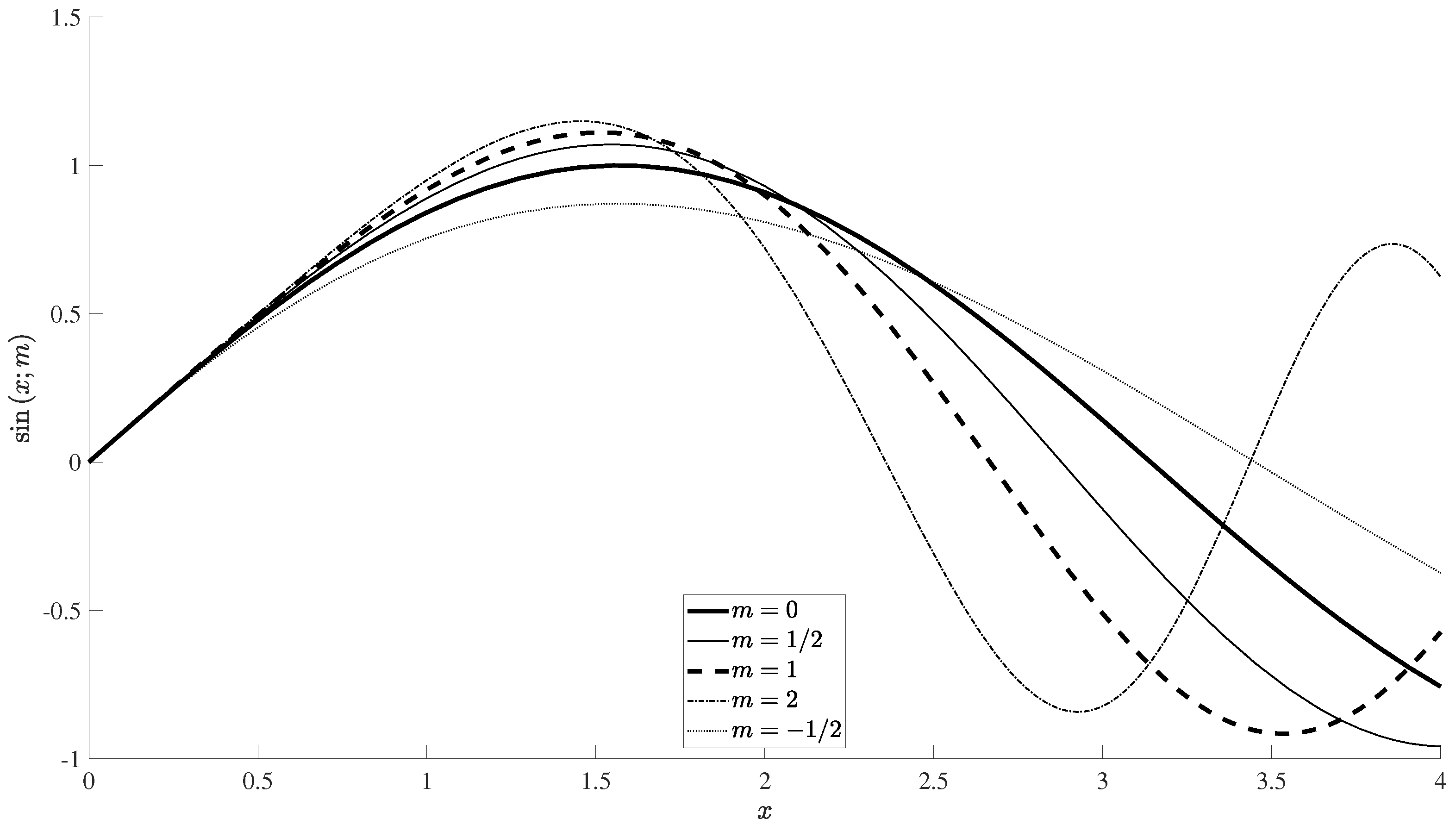
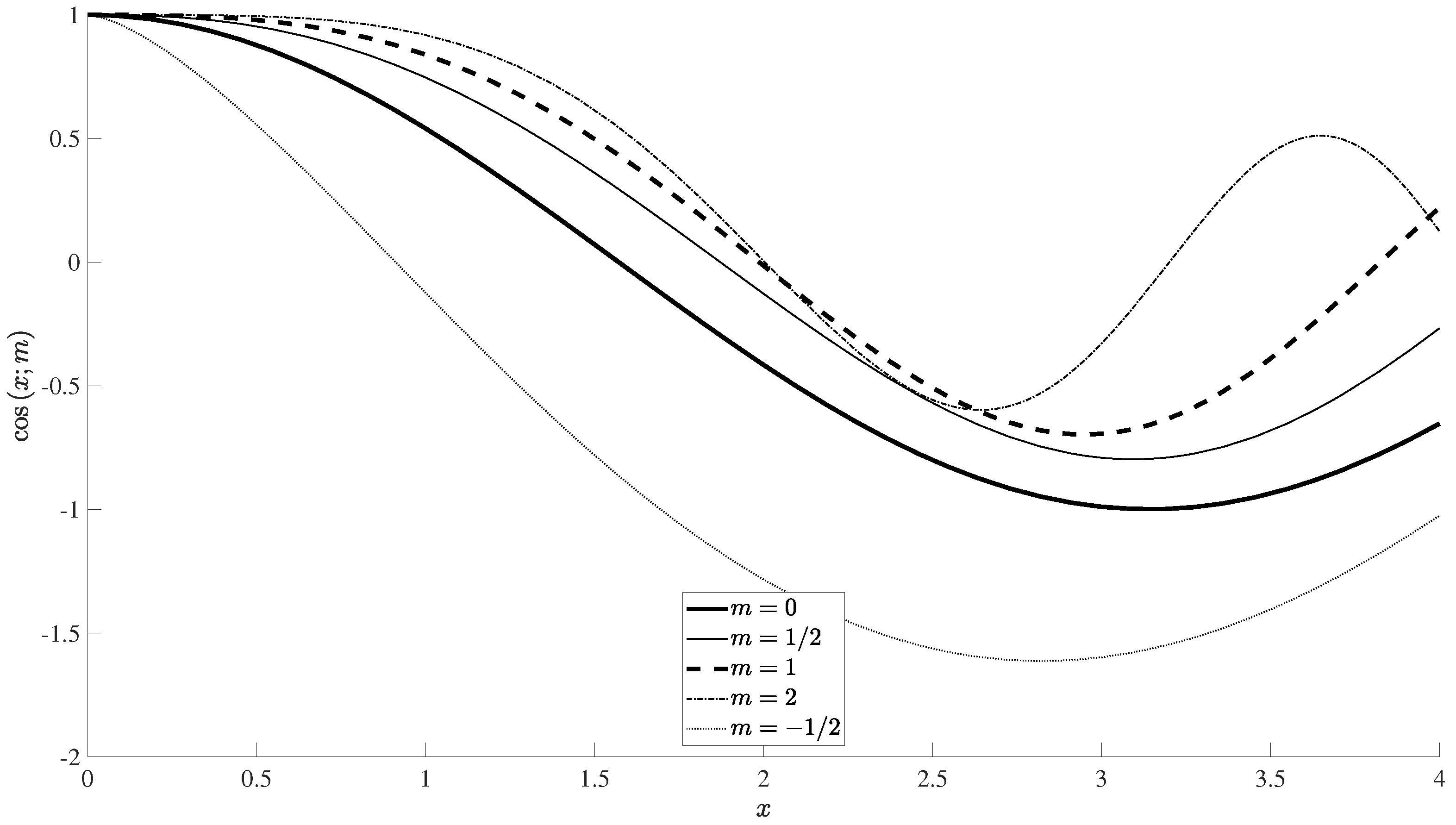
. These 20 functions are plotted in Figures 1–4 over the range
. The eight functions with
, namely generalized circular and hyperbolic cosines and sines, also appear in Table 2 for 16 values of
x in the range
. These functions describe the motion of a linear oscillator with a natural frequency varying as a power of time, with the generalized circular (hyperbolic) functions for the oscillatory (monotonic) case when the origin is an attractor (repeller). The conclusion summarizes the solutions of the generalized Airy differential Equation (
1) for all values of the variable
x and parameter
m in their complex planes (Table 3).
3. Singular Cases of the Generalized Airy Differential Equation
The singular case III of the generalized Airy differential equation corresponds to negative integer values of the parameter
m, implying a pole of order
in the coefficient and leading to four sub-cases: (III-A) a simple pole
in the coefficient corresponds to a regular singularity of the differential equation, with integer difference of the indices in the Frobenius–Fuchs method leading to functions of two kinds (
Section 3.1); (III-B) the double pole
in the coefficient also corresponds to a regular singularity of the differential equation, and in this case the Frobenius–Fuchs series reduces to just one term, that is a single power with complex exponent, leading to elementary solutions consisting of a power with real exponent multiplied by a circular or hyperbolic cosine and sine with logarithmic argument (
Section 3.2); (III-C) a triple pole
in the coefficient corresponds to an irregular singularity of the differential equation, and the inversion of the variable
leads to a regular singularity at infinity, hence Frobenius–Fuchs series of
that is descending powers, again of two kinds since the exponent difference is an integer (
Section 3.3); (III-D) the poles of order higher than three
in the coefficient correspond to irregular singularities of the differential Equation (
11) and the inversion of the independent variable
leads to another generalized Airy differential equation, with parameter
that is a non-negative integer, hence reducing the solution to case I of generalized circular and hyperbolic cosines and sines, now of variable
instead of
x, and descending instead of ascending power series (
Section 4.1).
3.1. Simple Pole and Regular Integral of Two Kinds
The case of a simple pole
in (
1) leads to a regular singularity and general integral specified by a linear combination of regular integrals of the first and second kinds.
Theorem 5. The linear second-order ordinary differential Equation (1) with a simple pole, , has a regular singularityand its general integralis specified by a linear combination with arbitrary constants and of: (i) a function of the first kind(ii) a function of the second kindinvolving a logarithmic factor multiplied by the functions of the first kind that vanishes at the origin, as , plus a complementary functionwhere the digamma function appears [17]. The integral of the first kind (40) is valid in the finite disk with center at the origin, and the function of the second kind (41) and (42) in the complex x-plane with a branch-cut from the origin to infinity. Proof. The differential Equation (
38) has regular integrals
with exponent
a and a recurrence formula for the coefficients
to be determined. Substitution of (
43) in (
38) leads to
with the change of index of summation
leading to
From (
44b) follows the recurrence formula for the coefficients
and
specifies the indices
. The higher index,
, leads to the coefficients
Setting
, one particular integral of the differential Equation (
38) is
which is a regular integral of the first kind (
40).
Since the indices
differ by an integer, the second particular integral linearly independent from (
47) is a regular integral of the second kind, second type specified [
11] by
with the coefficients determined (
45) by recurrence
Substituting (
49) in (
48), the vanishing factor
cancels in the numerator and denominator, and setting
leads to
The evaluation of (
50) is split for clarity into four steps: (i) the differentiation with regard to
a(ii) taking the limit
simplifies (
51) to
(iii) introducing [
18] the Euler digamma function
where
is the Euler–Mascheroni constant, leads to
(iv) introducing in (
54) the function of the first kind (
47) leads to the function of the second kind
consisting of the sum of three terms: (iv-1) a constant preliminary function equal to unity; (iv-2) a logarithmic factor multiplying the function of the first kind (
47); (iv-3) a complementary function involving digamma functions. The constant factor
in the square brackets is a constant multiple of (
47) and can be incorporated in the arbitrary constant
in the general integral (
39) of (
38); omitting
from (
55) leads to (
41) and (
42) as the particular integral of the second kind that is linearly independent from the particular integral of the first kind (
40) in the general integral (
39) of (
38). □
The case
of (
1) is simpler because it leads to exact integrals in finite terms (
Section 3.2).
3.2. Double Pole and Elementary Integrals
The case of a double pole
in (
1) also leads to a regular singularity, but in this case, the Frobenius–Fuchs series reduces to one term, leading to an elementary complex power solution.
Theorem 6. The generalized hyperbolic (19) differential equation with a double pole, , in the coefficients ofwith a − sign has a general integralas a linear combination with arbitrary constants and of a power multiplied by hyperbolic cosines and sines of logarithms. The generalized circular (34) differential equation with a double pole, , in the coefficients of (56) with a + sign, has the general integralas a linear combination with arbitrary constants and of a power multiplied by circular cosines and sines of logarithms. Proof. The differential Equation (
56) has power solutions
with exponents satisfying
whose roots are
The choice of upper signs in the radical in (
59b) leads to
to the powers with real exponents
that are replaced by hyperbolic cosines and sines of logarithms (
60c) in (
57). The lower signs in (
59b) leads to
to the powers with complex conjugate exponents,
corresponding to circular cosines and sines of logarithms (
61c) in (
58). □
The remaining cases of (
1) are poles of order higher than the second, leading to an irregular singularity at the origin and irregular integrals starting at
with a triple pole (
Section 3.3).
3.3. Triple Pole and Asymptotic Integrals
The case
of a triple pole leads to an irregular singularity at the origin for the differential Equation (
1), and inversion of the variable
leads to a regular singularity at infinity and hence to integrals specified by regular asymptotic Frobenius-Fuchs series of descending powers.
Theorem 7. The generalized hyperbolic (19) and circular (34) differential equations with a triple pole, ,have the general integralspecified by a linear combination, with arbitrary constants and , of: (i) an asymptotic regular integral of the first kind specified by a series of descending powers(ii) an asymptotic regular integral of the second kindconsisting of the sum of (ii-1) a preliminary function x, (ii-2) the integral of the first kind (64) multiplied by a logarithm and (ii-3) a complementary function given by Proof. The generalized circular (
19) and hyperbolic (
34) differential equations,
with a pole of order higher than two,
, in which
, in the coefficient, have an irregular singularity of degree
at the origin, and hence the solution is an irregular integral, that is, involving unending descending powers
. This suggests a change of variable, the inversion relative to the origin,
, leading, with
, to the differential equation
In the case of a triple pole,
and
, the differential Equation (
68) has a regular singularity at infinity
and the solution is specified by regular or irregular integrals in the inverse
or direct
x variables, respectively,
with index
a and coefficients
to be determined.
Substitution of (
70) in (
69) leads to
which is equivalent to
with the change of summation variable,
. The vanishing of the coefficients of all powers in (
71b) leads to the recurrence formula for the coefficients
setting
leads to the indices
. The recurrence Formula (
72) may be applied iteratively,
up to the zero-order coefficient, to which may be given the value unity,
. The higher index,
, together with
and (
73), substituted in (
70), leads to
which is a regular asymptotic integral of the first kind, specified by a converging series of descending powers in agreement with (
64).
Since the indices
differ by an integer, a linearly independent solution is [
19] a regular integral of the second kind type that can be evaluated as in (
50)–(
56),
consisting of a preliminary function, plus the function of the first kind (
74) multiplied by a logarithm, plus a complementary function. The constant factor
in the complementary function (
75) multiplies the integral of the first kind (
74) and may be incorporated in the arbitrary constant
in the general integral (
63) of (
62). Omitting the term
in (
75) leads to the asymptotic regular integral of the second kind (
65) and (
66), which is linearly independent from the asymptotic regular integral of the first kind (
64) and specifies the general integral (
63) of (
62). □
The only remaining case of the solution of the generalized circular (
34) and hyperbolic (
19) differential equations is the case of a pole of order more than three that is solvable in terms of generalized circular and hyperbolic functions, respectively, of the inverse variable (
Section 4).
6. Conclusions
The general integral of the generalized Airy differential equation has been obtained for all values of the parameter
m, with the + (−) sign in the generalized circular (
34) [hyperbolic (
19)] differential equation leading to a linear combination of generalized circular (hyperbolic) cosines and sines as indicated in
Table 3: (i) for all values of the parameter
m excluding negative integers the two linearly independent integrals in the general integral (
35) [(
20)] are generalized circular (hyperbolic) cosines (
36a) [(
21a)] and sines (
36b) [(
21b)]; (ii) the case
reduces to the original circular (hyperbolic) cosines (
37a) [(
22a)] and sines (
37b) [(
22b)]; (iii) the case
leads to Airy functions (
25a) and (
25b) for the + sign, with the − sign corresponding to the same series in alternating form; (iv) in the case
corresponding to a simple pole in the coefficient and a regular singularity of the generalized Airy differential Equation (
38), the general integral (
39) is a linear combination of Frobenius–Fuchs solutions of the first (
40) and second (
41) and (
42) kinds; (v) in the case
of double pole in the coefficient, the generalized Airy differential Equation (
56) also has a regular singularity, but the Frobenius–Fuchs series reduces to a single power with a complex exponent, corresponding to a real power multiplying circular (
58) [hyperbolic (
57)] cosines and sines with logarithmic variable; (vi) in the case
of a triple pole in the coefficient the generalized Airy differential Equation (
62) has an irregular singularity at the origin
, that becomes by inversion
a regular singularity at infinity, leading to a linear combination (
63) of descending Frobenius–Fuchs solutions of first (
64) and second (
65) and (
66) kinds; (viii) the case of a pole of order higher than three
in the generalized Airy differential equation also corresponds to an irregular singularity at the origin, and the inversion
leads to solutions in descending power series specified by generalized circular (
77) [hyperbolic (
76)] functions with variable
and parameter
; (ix) the simplest particular case of (viii) is a pole of fourth order
in the coefficient of generalized circular (
83b) [hyperbolic (
82b)] sines and cosines of variable
; (x) the next case of a pole of fifth order
in the coefficient of the generalized hyperbolic differential Equation (
84a) leads to solution (
84b) in terms of Airy functions of variable
x.
Concerning the validity of solutions in the complex
x-plane, there are three cases: (i) for integer parameter
m and ascending power series, including the Frobenius–Fuchs series of the first kind, validity in the finite disk with center at the origin
; (ii) for integer parameter
m and descending power series, including Frobenius–Fuchs series of the first kind, validity in the complex
x-plane excluding the origin
; (iii) in all other cases of complex parameter, or Frobenius–Fuchs series of the second kind with logarithmic terms, the branch point at the origin implies validity in the whole complex
x-plane excluding a branch-cut from origin to infinity
. All series solutions, ascending or descending, have coefficients decaying like
, and hence are absolutely and uniformly convergent, can be differentiated and integrated term-by-term, and the derangement of terms does not change the sum. The convergence is rapid, as shown in
Table 1, and enables calculation for a wide range of variables in
Table 2 and the plotting of the generalized circular and hyperbolic functions in
Figure 1,
Figure 2,
Figure 3 and
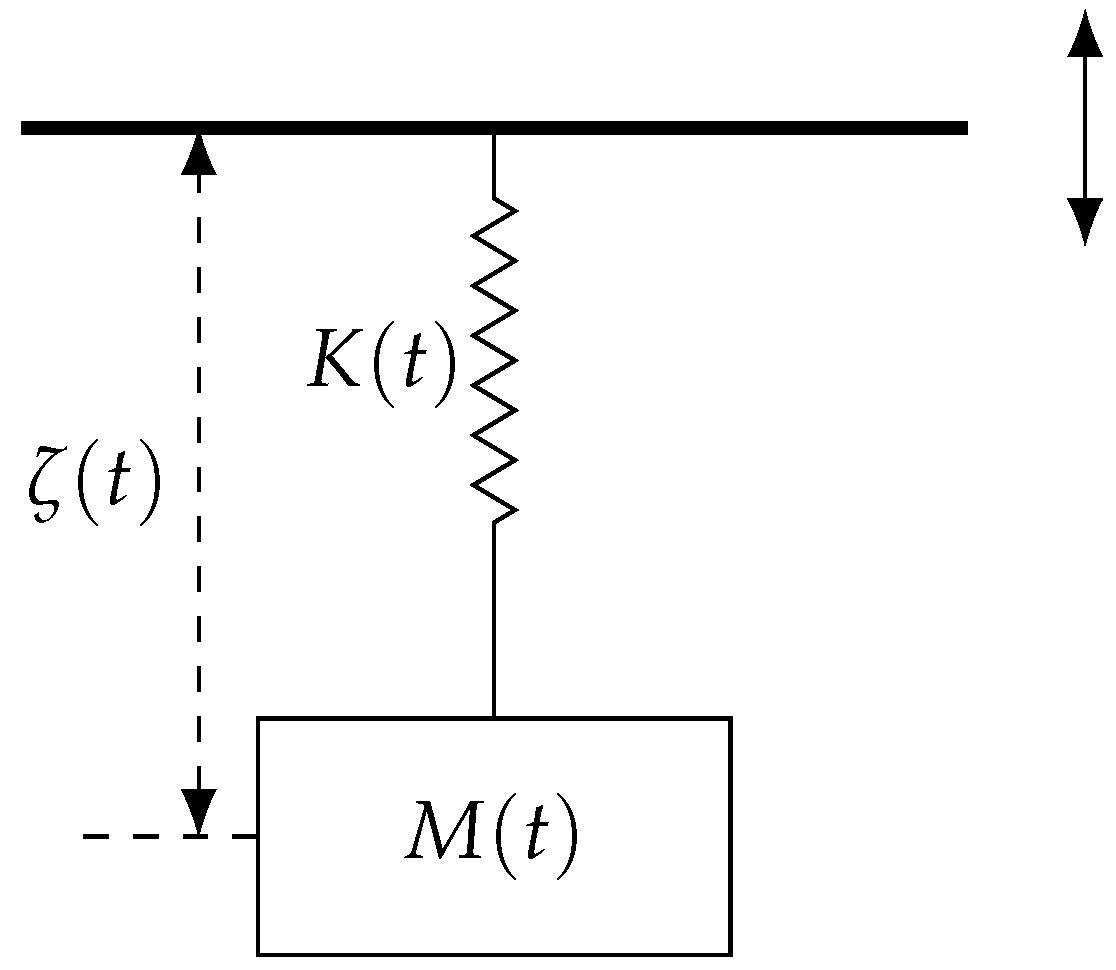
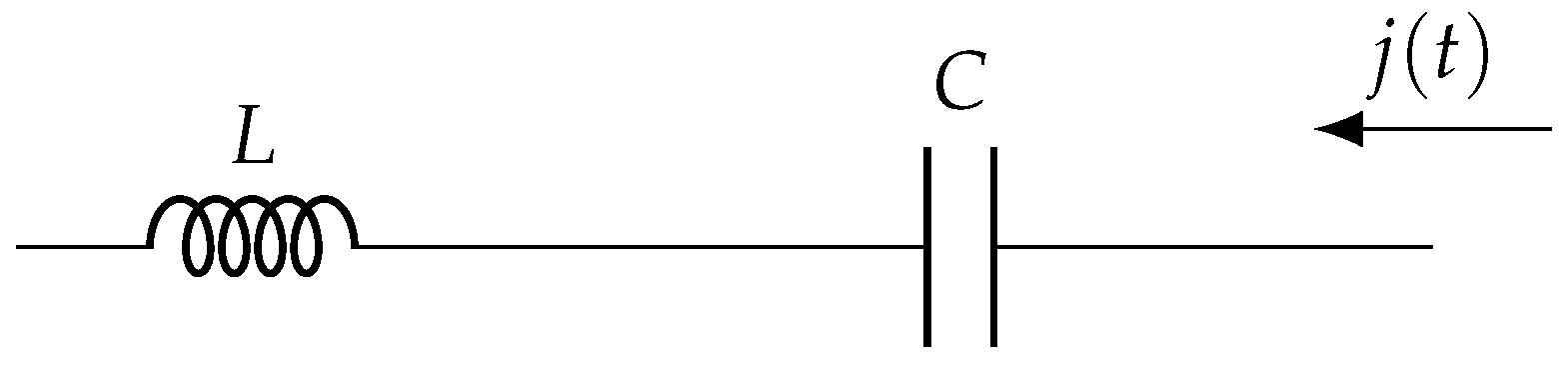
Figure 4 for five values of the parameter. The oscillatory (monotonic) behavior of generalized circular (hyperbolic) cosines and sines applies to mechanical mass-spring systems (
Figure 5) and analog electrical self-capacitor circuits (
Figure 6), generalizing the case of constant natural frequency to a natural frequency varying like a power of time. This physical application of generalized circular and hyperbolic sines and cosines is distinct from the use of the original Airy functions in connection with diffraction of light in optics [
22], tracing of sound rays near caustics [
23], transition from light to shadow in electromagnetic waves [
24] and from sound to silent zones in refraction of acoustic waves [
25], quantum mechanics of a particle in a one-dimensional force field [
26], the Chernoff’s distribution in statistics [
27], and the Jeffreys [
28], Wentzel [
29], Kramers [
30], Brillouin [
31], or JWKB approximation in wave theory [
32].