Estimate Laplacian Spectral Properties of Large-Scale Networks by Random Walks and Graph Transformation

Abstract
1. Introduction
1.1. Previous Work
1.2. Contributions and Paper Organizations
- We propose a graph transformation method that converts solving spectral moments of the combinatorial Laplacian matrix into solving spectral moments of the adjacency matrix, addressing the issue that the combinatorial Laplacian matrix lacks practical physical significance.
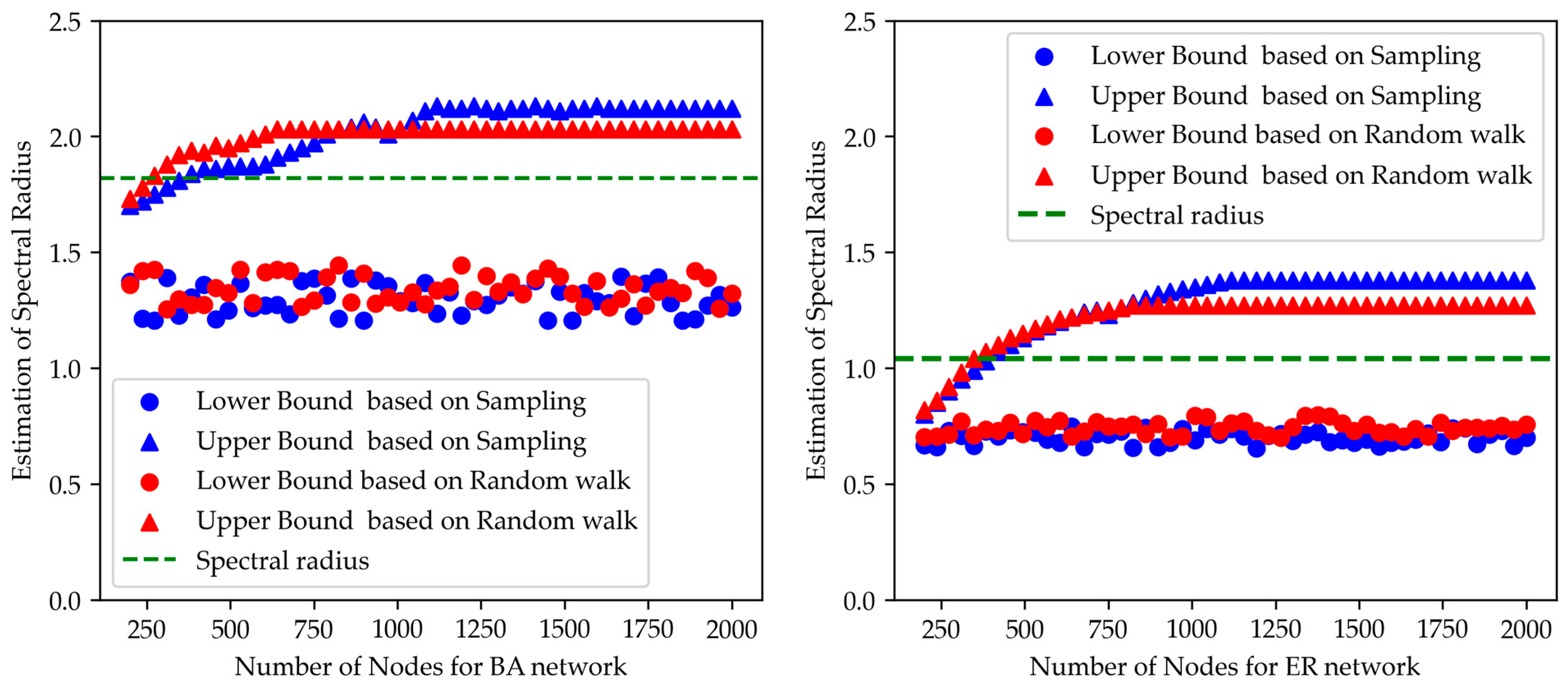
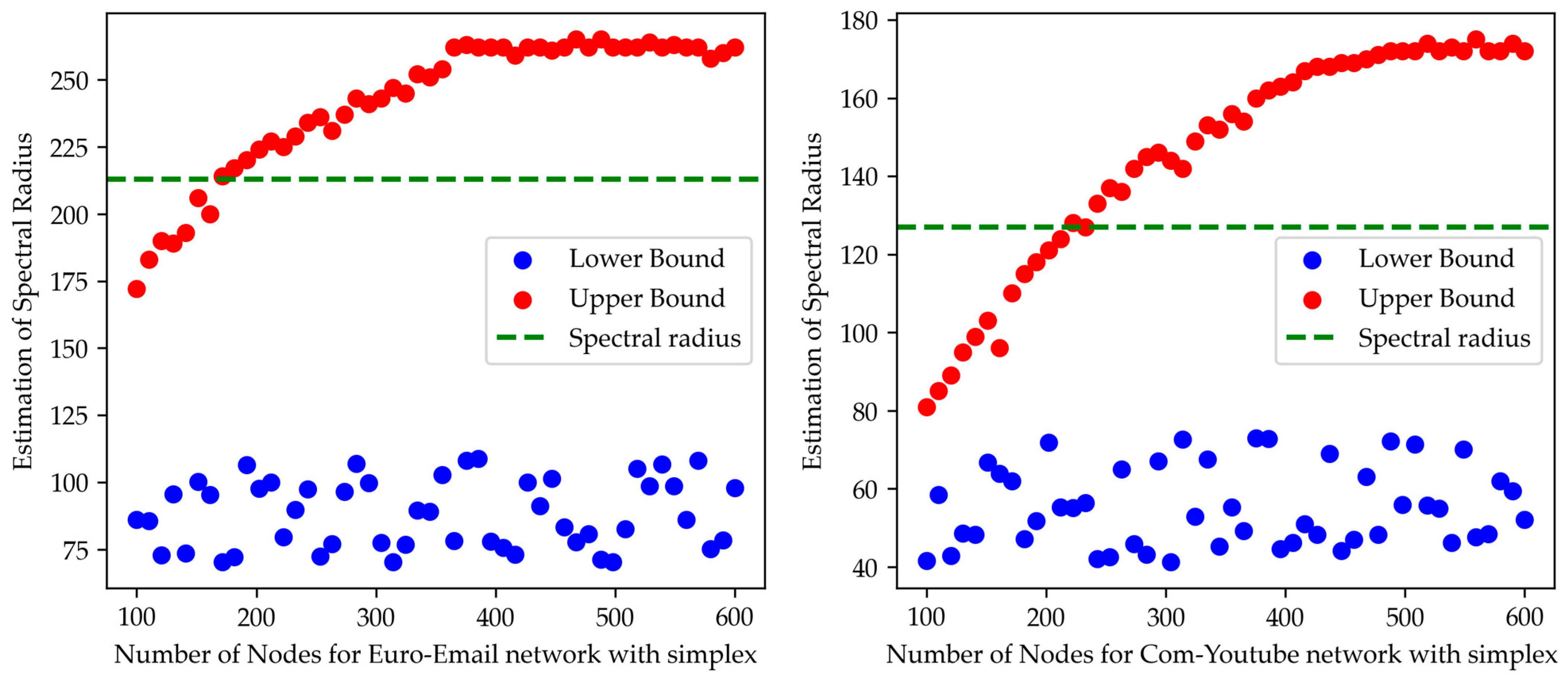
- A random walk algorithm is proposed to estimate bounds of the greatest eigenvalues of the Laplacian matrix in large-scale networks. The correctness and superiority of the algorithm are proved by experimental simulation on real and synthetic networks.
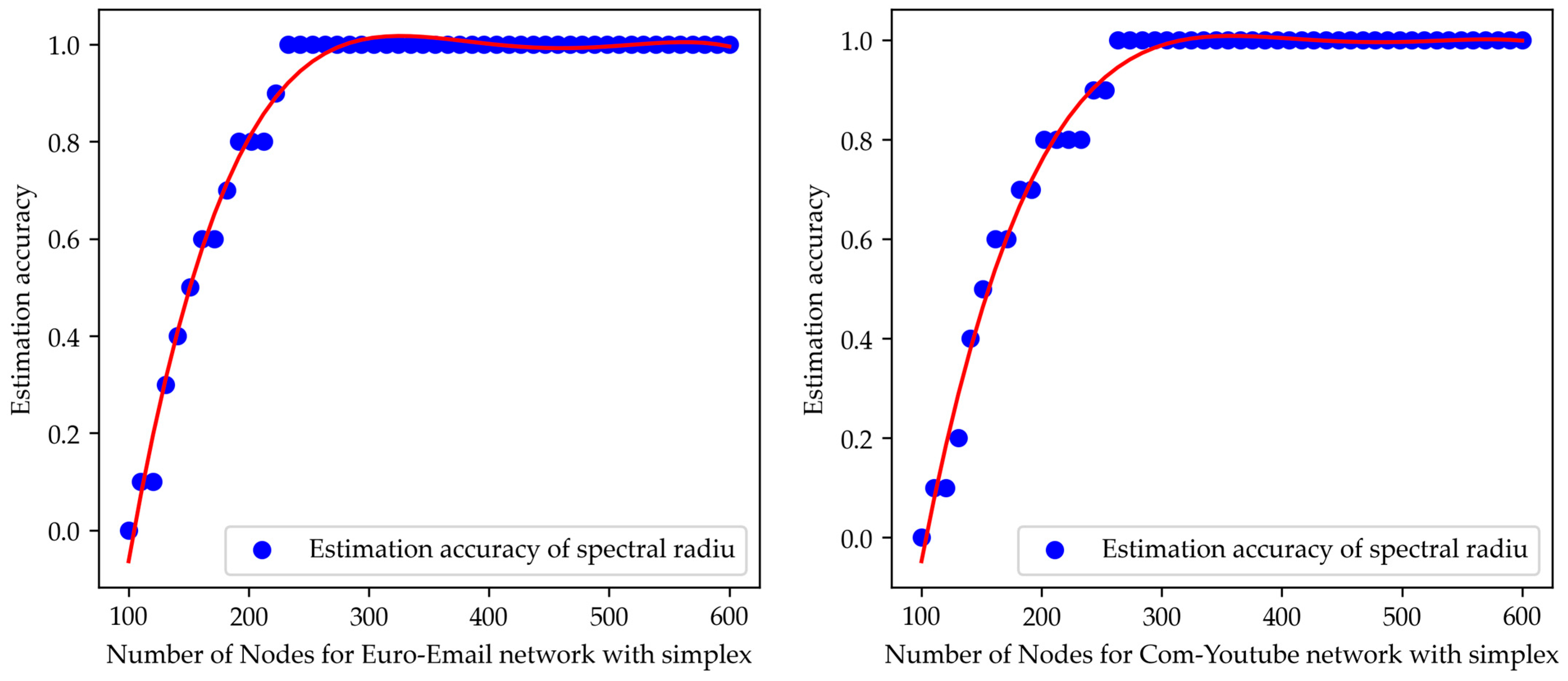
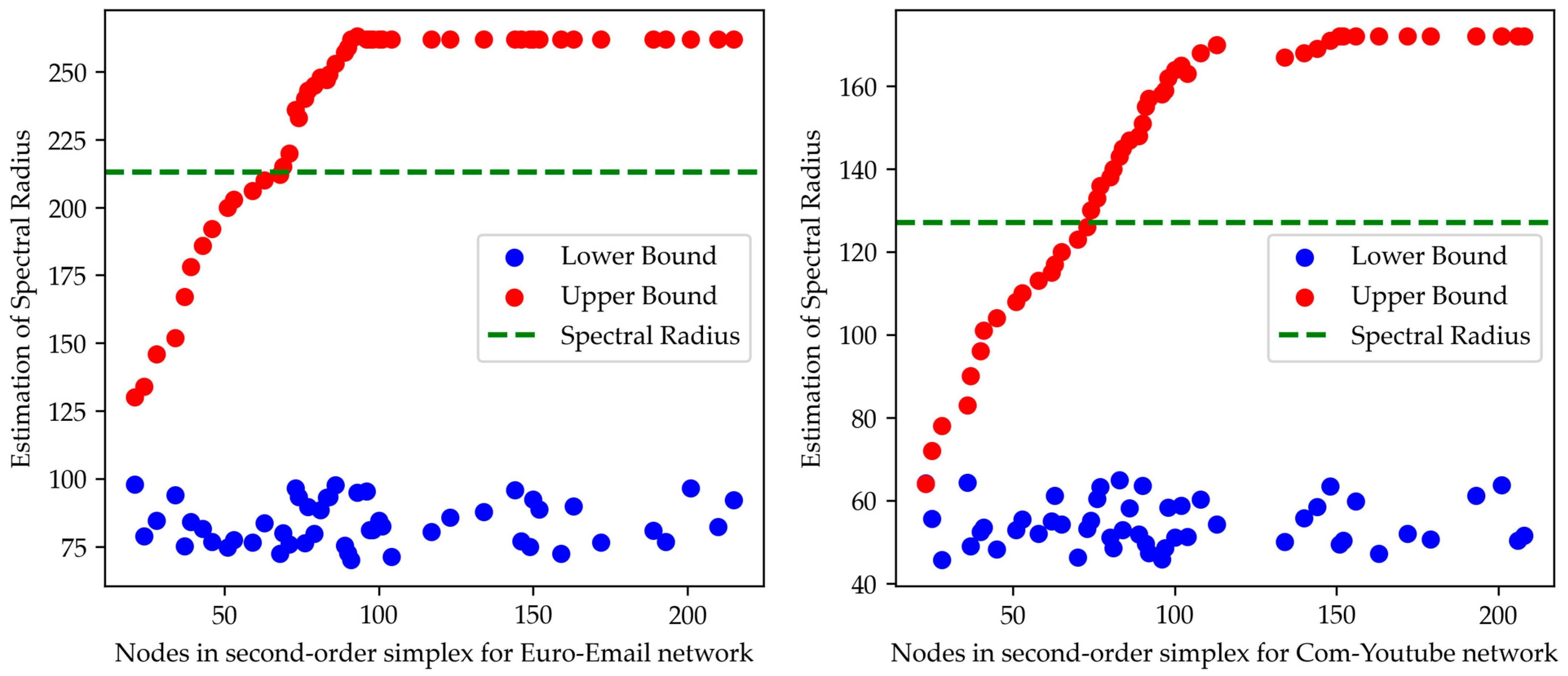
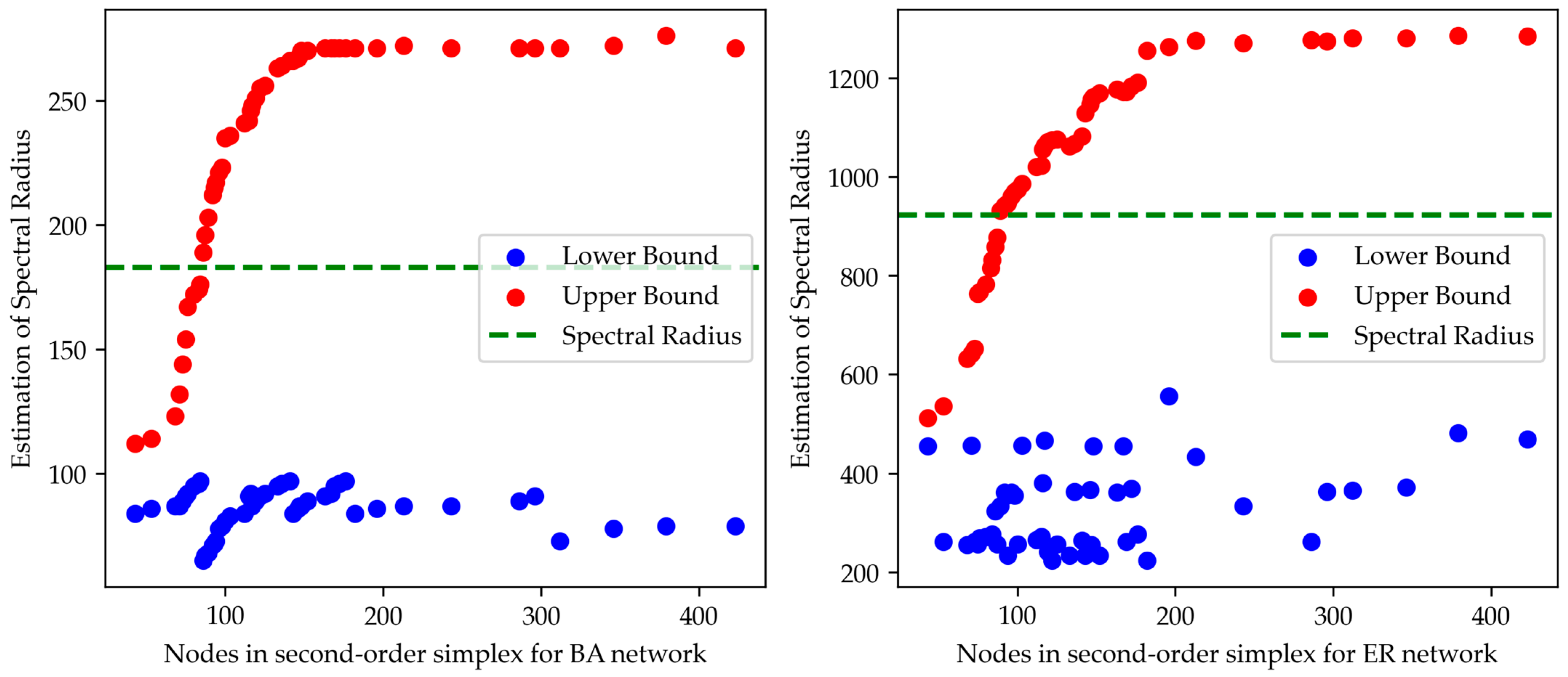
- A method combining graph transformation and random walks is proposed to estimate the bounds of the greatest eigenvalues of the second-order combinatorial Laplacian matrix in big networks with higher-order structures. Simulation investigation on real and synthetic networks confirms the algorithm’s efficacy.
2. Problem Formulation
2.1. Notation and Preliminaries
2.2. Random Walk
2.3. Problem Statement and Assumptions
2.4. The Symbol Table
| Symbol Table | Meaning Explanation |
| Undirected simple graph, where V is the node set and E is the edge set | |
| v | Any node in Figure G |
| the sum of degrees of all nodes | |
| the i-th eigenvalue of the adjacency matrix A | |
| simple complex network | |
| combinatorial Laplacian operators of order k | |
| 1 order | |
| k-simplex | |
| +1 is a face. | |
| steps | |
| in the graph. | |
| in the random walk | |
| Path judgment function (take 1 when the path is a closed path, otherwise take 0) | |
| a weighted adjacency matrix | |
| Trace of matrix M (sum of main diagonal elements) | |
| the Hankel matrix of M | |
| Z | Second-order simplex (a triangular structure consisting of three nodes) |
| indicates the neighbor of | |
| Edge weights between nodes u and v in a weighted graph | |
| Var[⋅] | Variance of Random Variables |
| E[⋅] | Mathematical Expectations of Random Variables |
3. Algorithm Description
3.1. Spectral Moment Based on Random Walks
3.2. Spectral Moment Based on Second-Order Graph Transformation and Random Walks
- (1)
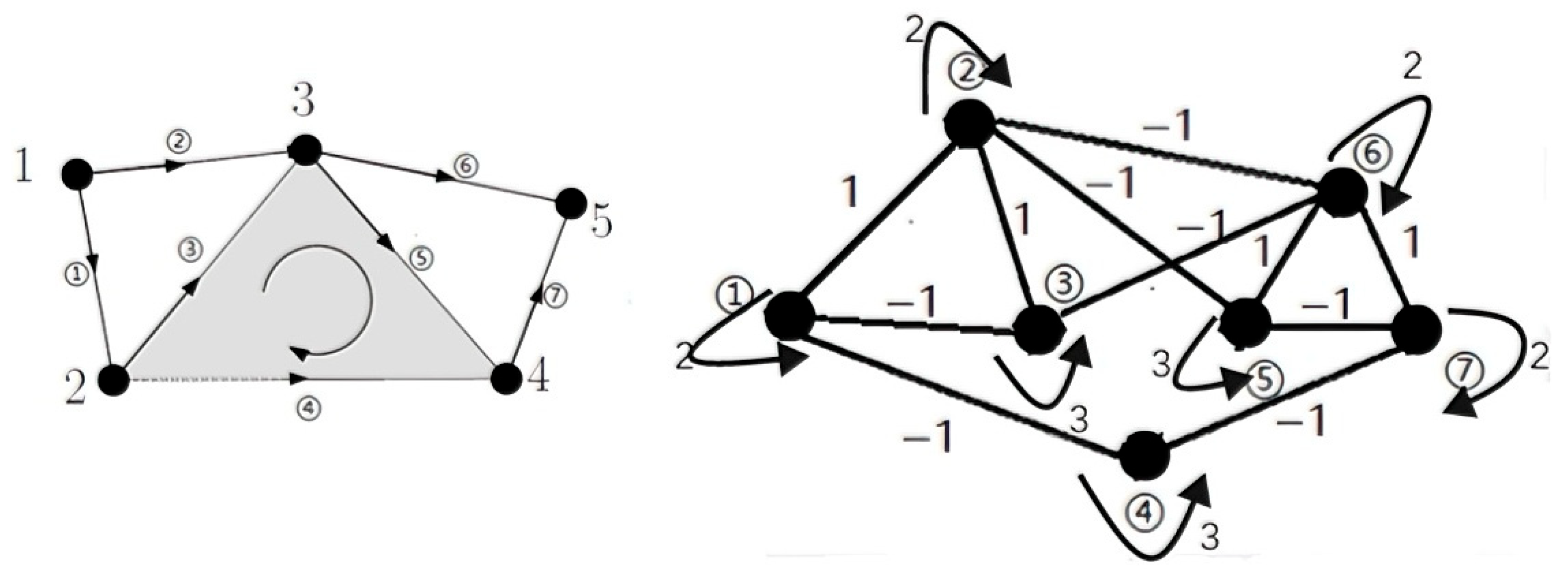
- Now there are two graphs. One is the network with simplicial complexes before transformation, and the other is the weighted network after transformation. First, each connected edge in the network with simplicial complexes is transformed into a node of the weighted network.
- (2)
- Add a self-ring to nodes of the weighted network. The weight of the self-ring is equal to , where k represents the order of in a simple complex. represents the number of simplex belonging to a higher order simplex. If the simplex in the simplex complex does not belong to any of the simplex structures of order , then is 0.
- (3)
- Observe the relationship between the different simplex in the simple complex. When studying the second-order combinatorial Laplacian matrix, observe the adjacent connected edges in the simple complex network. There are no linked connections between the respective nodes in the weighted network if the two connected edges are in the same second-order simplex. If the adjacent connected edges are not in the same second-order simplex, it is judged whether there are common nodes in the two connected edges. If there are common nodes, we continue to judge whether the direction of the connected edges is the same for the common nodes. If so, the connected edge weight between the nodes corresponding to the weighted network is 1. The edge weight between the nodes that correspond to the weighted network is −1 if they differ.
- (1)
- Treat each edge as a node, as indicated in Figure 1.
- (2)
- Add a self-loop to each converted node, with a weight of . is determined by whether the edge before conversion is in a second-order simplex. For example, if the edge is in a second-order simplex, then the weight of the self-loop of the converted node is 1 + 1 + 1, which is 3. If the edge before conversion does not belong to any second-order simplex, then the weight of the self-loop of the converted node is 0 + 1 + 1, which is 2.
- (3)
- Check to see if the edge and its neighboring edge in the left image share a node. If there is a common node, then determine whether the edge directions are the same for the common point. If they are the same, then the weight between the nodes corresponding to the edges in the right image is 1. If they are not the same, then the weight between the nodes that correspond to the edges in the right image is −1.
- (4)
- Determine whether the edge and its adjacent edge in the left image belong to the same second-order simplex. If they belong to the same second-order simplex, then there will be no edge between the corresponding nodes after conversion.
| Algorithm 1 Graph Transformation |
| Require: , second-order simplex , indicates the neighbor of |
| in in graph |
| 2: |
| 3: Step 1: edges in simplex are converted to nodes |
| 4: for do |
| then |
| corresponding to the edge is added, and the weight of the self-loop is 3 |
| 7: else |
| corresponding to the edge is added, and the weight is 2. |
| 9: end if |
| 10: Step 2: add weights to edges |
| do |
| if and then |
| and e then |
| and e then |
| 18: end if |
| 19: end for |
| 20: end for |
| s |
3.3. Error Analysis
3.4. Estimate the Upper and Lower Bounds Based on Spectral Moments
4. Results
4.1. Experimental Setup
4.2. Synthetic Network
4.3. Real Network
4.4. Synthetic Network for the Higher-Order Network
4.5. Real Network for the Higher-Order Network
5. Conclusions and Future Directions
Author Contributions
Funding
Data Availability Statement
Conflicts of Interest
References
- Brin, S.; Page, L. The anatomy of a large-scale hypertextual web search engine. Comput. Netw. ISDN Syst. 1998, 30, 107–117. [Google Scholar] [CrossRef]
- Chung, F.; Chung, F.K.; Graham, F.C. Complex Graphs and Networks; American Mathematical Society: Providence, RI, USA, 2006. [Google Scholar]
- Cohn, M. On the channel capacity of read/write isolated memory. Discret. Appl. Math. 1995, 56, 1–8. [Google Scholar] [CrossRef]
- Hong, Y. Bounds of eigenvalues of graphs. Discret. Math. 1993, 123, 65–74. [Google Scholar] [CrossRef]
- Benson, A.R.; Gleich, D.F.; Leskovec, J. Higher-order organization of complex networks. Science 2016, 353, 163–166. [Google Scholar] [CrossRef] [PubMed]
- Petri, G.; Expert, P.; Turkheimer, F. Homological scaffolds of brain functional networks. J. R. Soc. Interface 2014, 11, 20140873. [Google Scholar] [CrossRef] [PubMed]
- Sizemore, A.E.; Giusti, C.; Kahn, A. Cliques and cavities in the human connectome. J. Comput. Neurosci. 2018, 44, 115–145. [Google Scholar] [CrossRef] [PubMed]
- Grilli, J.; Barabás, G.; Michalska-smith, M.J. Higher-order interactions stabilize dynamics in competitive network models. Nature 2017, 548, 210–213. [Google Scholar] [CrossRef] [PubMed]
- Sanchez-Gorostiaga, A.; Bajić, D.; Osborne, M.L.; Poyatos, J.F.; Sanchez, A. High-order interactions dominate the functional landscape of microbial consortia. bioRxiv 2018, 333534. [Google Scholar] [CrossRef]
- Berge, C. Graphs and Hypergraphs; North-Holland Publishing Company: Amsterdam, The Netherlands, 1973. [Google Scholar]
- Hatcher, A. Algebraic Topology; Tsinghua University: Beijing, China, 2005. [Google Scholar]
- Battiston, F.; Cencetti, G.; Iacopini, I. Networks beyond pairwise interactions: Structure and dynamics. Phys. Rep. 2020, 874, 1–92. [Google Scholar] [CrossRef]
- Lee, H.; Chung, M.K.; Choi, H. Harmonic holes as the submodules of brain network and network dissimilarity. In Computational Topology in Image Context, Proceedings of the 7th International Workshop, CTIC 2019, Málaga, Spain, 24–25 January 2019; Springer: Cham, Switzerland, 2019; pp. 110–122. [Google Scholar]
- Candogan, O.; Menache, I.; Ozdaglar, A. Flows and Decompositions of Games: Harmonic and Potential Games. Math. Oper. Res. 2010, 36, 474–503. [Google Scholar] [CrossRef]
- Chui, C.K.; Mhaskar, H.N.; Zhuang, X. Representation of functions on big data associated with directed graphs. Appl. Comput. Harmon. Anal. 2018, 44, 165–188. [Google Scholar] [CrossRef]
- Bronstein, M.M.; Bruna, J.; Lecun, Y. Geometric deep learning: Going beyond Euclidean data. IEEE Signal Process. Mag. 2017, 34, 18–42. [Google Scholar] [CrossRef]
- Olver, P.J.; Shakiban, C.; Shakiban, C. Applied Linear Algebra; Prentice Hall: Upper Saddle River, NJ, USA, 2006. [Google Scholar]
- Ipsen, I.F. Computing an eigenvector with inverse iteration. Soc. Ind. Appl. Math. Rev. 1997, 39, 254–291. [Google Scholar] [CrossRef]
- Parlett, B.N. The Rayleigh quotient iteration and some generalizations for nonnormal matrices. Math. Comput. 1974, 28, 679–693. [Google Scholar] [CrossRef]
- Wilkinson, J.H. The Algebraic Eigenvalue Problem; Oxford University Press: New York, NY, USA, 1971. [Google Scholar]
- Preciado, V.M.; Jadbabaie, A.; Verghese, G.C. Structural analysis of Laplacian spectral properties of large-scale networks. IEEE Trans. Autom. Control 2013, 58, 2338–2343. [Google Scholar] [CrossRef]
- Wu, Z.; Preciado, V.M. Laplacian spectral properties of graphs from random local samples. In Proceedings of the 2014 SIAM International Conference on Data Mining, Philadelphia, PA, USA, 24–26 April 2014; Society for Industrial and Applied Mathematics: Philadelphia, PA, USA, 2014; pp. 343–351. [Google Scholar]
- Chu, X.; Sethu, H. On estimating the spectral radius of large graphs through subgraph sampling. In Proceedings of the 2015 IEEE Conference on Computer Communications Workshops (INFOCOM WKSHPS), Hong Kong, China, 26 April–1 May 2015; IEEE: Piscataway, NJ, USA, 2015; pp. 432–437. [Google Scholar]
- Abbas, S.; Tariq, J.; Zaman, A. Sampling based efficient algorithm to estimate the spectral radius of large graphs. In Proceedings of the 2017 IEEE 37th International Conference on Distributed Computing Systems Workshops (ICDCSW), Atlanta, GA, USA, 5–8 June 2017; IEEE: Piscataway, NJ, USA, 2017; pp. 175–180. [Google Scholar]
- Han, G.; Sethu, H. Closed Walk Sampler: An Efficient Method for Estimating Eigenvalues of Large Graphs. IEEE Trans. Big Data 2018, 6, 29–42. [Google Scholar] [CrossRef]
- Cvetković, D.M.; Rowlinson, P.; Simic, S. Eigenspaces of Graphs; Cambridge University Press: Cambridge, UK, 1997. [Google Scholar]
- Lasserre, J. Bounding the support of a measure from its marginal moments. Proc. Am. Math. Soc. 2011, 139, 3375–3382. [Google Scholar] [CrossRef][Green Version]
- Erdos, P.; Renyi, A. On random graphs. Publ. Math. 1959, 6, 290–297. [Google Scholar] [CrossRef]
- Barabási, A.L.; Albert, R. Emergence of scaling in random networks. Science 1999, 286, 509–512. [Google Scholar] [CrossRef] [PubMed]
- Jure, L. Stanford Large Network Dataset Collection. Available online: https://snap.stanford.edu/data/ (accessed on 18 December 2025).





Disclaimer/Publisher’s Note: The statements, opinions and data contained in all publications are solely those of the individual author(s) and contributor(s) and not of MDPI and/or the editor(s). MDPI and/or the editor(s) disclaim responsibility for any injury to people or property resulting from any ideas, methods, instructions or products referred to in the content. |
© 2025 by the authors. Licensee MDPI, Basel, Switzerland. This article is an open access article distributed under the terms and conditions of the Creative Commons Attribution (CC BY) license.
Share and Cite
Zhan, C.; Li, X.; Chen, J. Estimate Laplacian Spectral Properties of Large-Scale Networks by Random Walks and Graph Transformation. Mathematics 2026, 14, 26. https://doi.org/10.3390/math14010026
Zhan C, Li X, Chen J. Estimate Laplacian Spectral Properties of Large-Scale Networks by Random Walks and Graph Transformation. Mathematics. 2026; 14(1):26. https://doi.org/10.3390/math14010026
Chicago/Turabian StyleZhan, Changlei, Xiangyu Li, and Jie Chen. 2026. "Estimate Laplacian Spectral Properties of Large-Scale Networks by Random Walks and Graph Transformation" Mathematics 14, no. 1: 26. https://doi.org/10.3390/math14010026
APA StyleZhan, C., Li, X., & Chen, J. (2026). Estimate Laplacian Spectral Properties of Large-Scale Networks by Random Walks and Graph Transformation. Mathematics, 14(1), 26. https://doi.org/10.3390/math14010026