1. Introduction
Population dynamics, ecology, mathematical epidemiology (ME), virology, the theory of chemical reaction networks (CRNs), to name just some biological interaction networks (BIN) subfields, study all positive dynamical systems, and have similar preoccupations: the existence and multiplicity of equilibria, their local and global stability, the occurrence of bifurcations, persistence, permanence, extinction, etc.
CRN offers a versatile mathematical framework for modeling positive systems in a variety of disciplines; examples include biochemical, pharmacokinetic, epidemiological, ecological, social, neural, and multi-agent networks [
1]. Of special relevance to us is that CRN theory (CRNT) investigates mass-action systems, which include ME models, and revealed the roles of Petri graphs and siphons in determining boundary behavior. For some recent papers combining both new CRNT results (including for the SIR mathematical epidemiology (ME) model) and interesting historical references, see [
2,
3,
4,
5,
6]. Also, let us mention that CRNT is unavoidable in the study of ODEs with many variables (tens, hundreds). Note, however, that a considerable part of CRNT focuses on systems which enjoy various degrees of “reversibility”, which is absent in ME.
Ecology studies often Lotka–Volterra–Kolmogorov/generalized Lotka–Volterra (LVK/GLV) systems, whose behavior might seem simpler than those in ME, due to the linear complementarity principle (LCP); however, as shown by Smale, generalized Lotka–Volterra systems may have already very complicated dynamical behaviors, and display chaos [
7]. For some recent developments, including some which tie Smale’s work to CRNs and to ecology, see [
2,
8,
9,
10,
11,
12,
13,
14].
One subfield in which CRNT and ecology come together is that of chemical organization theory [
15,
16,
17,
18,
19]. These authors study both ODE and PDE models, and, also, touched briefly on the topic of ME models [
20].
Epidemiology is especially relevant to our unification quest due to the intricate boundary behaviors encountered in the study of its multi-strain models, whose stability and persistence may sometimes be expressed via remarkably simple threshold conditions involving basic and reproduction numbers and invasion numbers (these are essentially the particular case of the invasion rates used in ecology, obtained when the resident invariant set of boundary faces reduce to single fixed points).
Ecology, ME and CRNT also share common open problems, like the notorious persistence and permanence conjectures, which they formulate however differently. Thus, CRNT considers only the case of weakly reversible systems (see
Section 7 for a short review and further references). In ecology, the accent is on general, non-polynomial rates, but possibly generating strongly monotone semi-flows [
21,
22,
23,
24,
25,
26]. Finally, in ME, which is the focus of this paper, the accent is on using the often simpler reproduction and invasion numbers obtained via regular splitting (see
Appendix A.2) and on restricting to ME models, which still need to be defined (note that both ME and ecology models lack a precise definition, in the literature preceding our papers).
The fact that the persistence and permanence conjectures are only studied by each of the three fields for restricted structural classes suggests the interest of integrating their different perspectives; let us also note that CRNs have started to be applied in ecology and related fields in a few recent papers [
27,
28,
29,
30,
31].
Our paper focuses on several key concepts from different fields:
- 1.
Siphons and reaction networks from CRNT.
- 2.
The next generation matrix (NGM) method from ME, which is also related to the regular splitting method in numerical analysis.
- 3.
The use of the ME reproduction functions—see Definition 16—for expressing stability in terms or reproduction and invasion numbers/rates, where the second concept originated in ecology (see [
23,
32,
33,
34] for some references), but is different from the one used in ME, due to the application here of regular splitting, for models where resident invariant sets (see Definition 21) of boundary faces reduce to single fixed points.
To argue our thesis that an insufficient effort has been invested in cross-pollination (interdisciplinary integration) of CRNT, ecology, and ME, we add now some more information on the three points enumerated above.
- 1.
The reaction network (RN) representation of ODEs, and the concept of siphons are essential in CRNT, and absent in ME, even though they seem intuitively important. In support of this, our main result below started from the observation that there is a correspondence between minimal siphons and strains in multi-strain epidemic models. This led to the notion of interaction graph on the minimal siphons (IGMS), and to Theorem 1: if IGMS is acyclic, and the minimal siphons do not intersect, then the NGM can be block-triangularized (recovering well-known results obtained previously only in examples).
- 2.
The “next generation matrix” (NGM) method (which expresses the stability of the “disease-free equilibrium” (DFE) in terms of one inequality
, where
is the spectral radius of a certain matrix, obtained by “regular splitting” of the Jacobian of the “invading variables”), is omnipresent in ME, and almost absent outside the field. But, we have shown in [
35,
36] that it is equally efficient for CRN models.
- 3.
Our final piece of evidence is multi-strain ME models. Note that while
and NGM are typically presented as closed chapters in ME, for the analog stability problem of non-DFE boundary fixed points of multi-strain ME models, a general theory is definitely lacking. Our first observation here is that in simple multi-strain models, boundary fixed points are in a one-to-one correspondence with the minimal siphon facets
on which they are situated, and we incorporate this observation in our definition of multi-strain models 15. Furthermore, it was observed in various multi-strain ME models that certain “invasion numbers”
, with definitions similar to
, play a central role in stability criteria, and we provide a definition for them in 16. Now, minimal siphons are a well-known concept in chemical reaction networks (CRN), but never used in ME and ecology (note also that invasion numbers are compared to 1 in ME, and to 0 in ecology). We believe that for a general theory of multi-strain models, in particular for progressing on problems like whether k-strain models satisfy linear complementarity problem/competitive exclusion principle (Open Problem 1), a better integration of CRN, ME, and ecology might be useful. As a first step in this direction, we offer a general purpose Mathematica package Epid-CRN, available at
https://github.com/florinav/EpidCRNmodels (accessed on 15 November 2025), and illustrate its use throughout this paper.
Contributions.
We prove block triangularity of the NGM when minimal siphons form an acyclic partition (Theorem 1).
We implement detection of cycles of IGMS in Epid-CRN, and illustrate the theory on multi-strain examples.
Our paper may be viewed also as a users manual for EpidCRN, and also as an essay around several not well-known themes:
- 1.
We outline first an “x-y framework” extending the NGM method, and connect it to the older theory of regular splitting of matrices.
- 2.
We suggest one possible rigorous definition of ME models, see Definition 12, by imposing the existence of a DFE, and the existence of a regular splitting of the Jacobian matrix of the invasion vector field with respect to the invasion variables at the DFE.
- 3.
We review the role played by reproduction functions [
30,
37] for the stability analysis of multi-strain ME models (these are basically the reproduction numbers, in which the resident variables
are left free).
Organization.
We start with some mathematical underpinnings in
Section 2, which include the regular splitting of Metzler matrices, a fundamental result in ME.
Section 4 introduces a new type of interaction graphs on minimal siphons (IGMS) and provides a structural result for the NGM (Theorem 1), which assumes the acyclicity of IGMS.
The first ME example in
Section 3 revisits an ME model of [
38], which illustrates both the important complementarity principle of Lotka–Volterra–Kolmogorov models, and revisits the reproduction functions introduced in [
30,
37].
Section 4 introduces the directed interaction graphs on minimal siphons (IGMS), and establishes in Theorem 1 that next-generation matrix
inherits a block–triangular structure from
V whenever the minimal siphons form a partition of the DFE support–see Theorem 1.
Section 5, following [
39,
40,
41,
42], revisits a quite complex multi-strain example, with temporary cross-immunity, with ADE and immunity waning, but without co-infection. Some stability results are easy, due to the block-diagonal structure of the NGM, but the domain of Hopf bifurcations remains an open problem.
Section 6 presents a co-infection ME model where the minimal siphons intersect; nevertheless, the NGM has a triangular structure. Furthermore, there are more reproduction functions than minimal siphons. This poses challenges from the point of view of interpreting the stability/invasion results via reproduction functions, which we leave for further work.
Section 7 offers a brief review of persistence theory. We argue here that its open problems might be easier under the restriction to ME models (in particular when the resident invariant sets of all proper siphon faces reduce to single fixed points). Also, we include a sketch of the theory of invasion graphs [
32], which we believe might throw light on the open problems of persistence and permanence of the model in the preceding section.
Appendix A offers further comments on the NGM method.
Finally,
Appendix B.1,
Appendix B.2 and
Appendix B.3 review further topics from CRNT which we conjecture might become relevant for ME in the future. These might look at a first reading like vague similarities between disparate fields. But, as it happened to two of the authors [
29], we discovered that certain CRN results throw a whole new light on mathematical epidemiology. For example, it turns out that the presence of certain submatrices in the stoichiometric matrix (which is independent of the choice of admissible rates) render automatic the presence of various types of instabilities [
6,
43,
44], under “parameter-rich kinetics” (which do not include mass-action, but do include “Michaelis Menten saturated” kinetics).
2. Mathematical Underpinnings
2.1. Positive Dynamical Systems
Definition 1 (Positive/non-negative dynamical system)
. A dynamical system is called positive
[45] or non-negative
[46] if the non-negative orthantis forward invariant under the flow. The BIN disciplines are all concerned with positive dynamical systems, but sometimes neglect important results in their “sister sciences”.
In this essay, we are making the case that more sharing of information between the positive dynamical systems fields could be beneficial.
Remark 1. As a first argument, we ask the reader to compare the ODE description of our first example (
10)
to its “reaction networks" (RNs) representation (
9).
The superiority of the latter, encapsulated in lines with biological meaning like , seems clear to us: - 1.
Firstly, reactions represent a clear phenomenological description: in the case above, “one susceptible meets one infected, and two infected depart", is a precise description of the infection process.
- 2.
Note that after inputting the corresponding rates (rts), numerous packages will produce the ODE description (simply by “adding up" the reactions), as well as various graphs illustrating the interactions in this network, numerical simulations, and, possibly in the future, also symbolic/numeric information on the fixed points and their stability (EpidCRN does that for simple examples).
- 3.
Using the RN representation, exploring the model by changing the rates, or by adding/removing reactions can be achieved with minimal effort.
For a second argument, we recall the well-known CRNT result that assuming all free parameters are non-negative, a positive polynomial ODE system may be recognized by the absence of “syntactically negative cross-terms" [47]. This result seems practically unknown outside CRNT, and has been reproved numerous times. It seemed to us that one step towards advancing unification of the BIN sciences could be via creating a common general purpose package (symbolic, numeric, simulation and estimation of parameters). Below, we present the Mathematica package Epid-CRN, available at
https://github.com/florinav/EpidCRNmodels, (accessed on 15 November 2025), which is used in solving all the examples of this paper.
2.2. Notations
We denote by , and the set of order n column vectors of reals, positive reals and non-negative reals, respectively. The usual Euclidean norm is denoted by . The family denotes the canonical basis of the vector space . If , we denote by the ith component of z. The notation means that .
The set of matrices with real entries is denoted by . For a matrix we denote by the entry at the row i, column j. denotes the transpose of A, and will denote the transpose of the inverse of A. For matrices we write if for all i and j, if and , and if for all i and j. Let , then denotes its closure with respect to the standard Euclidean topology. Let be a matrix, then is its kernel or null space, while is its image space. Let be a function, then . Let , then . Let , then . Let , then , , and .
Let S be a set, then denotes its cardinality.
Definition 2 (spectral radius, spectral abscissa, and Hurwitz matrix [
48])
. (A) The spectral radius of a matrix A is defined bywhere denotes the spectrum of A. (B) The spectral abscissa, i.e., the largest real part among the eigenvalues of A, is denoted by (C) A matrix A is said to be Hurwitz if .
Definition 3 (Metzler matrix [
49,
50])
. A Metzler matrix A is a matrix such that . These matrices are also called quasi-positive matrices. Lemma 1. The “half eigenvector” inequalities
Let A be an irreducible Metzler matrix. Then, is a simple eigenvalue of A and there exists a unique (up to scalar multiple) vector such that . Let be a given non-zero vector.
- 1.
If for some scalar λ, then , with equality if and only if .
- 2.
If and , for some scalar λ, then .
The first half of the lemma is a direct consequence of the Perron–Frobenius Theorem for nonnegative matrices [
49]. The second part can be obtained from a straightforward application of [
49] (Theorem 2.1.11).
Scalar functions like the logariTheorem and quotients will be applied to vectors componentwise:
2.3. Invasion Criteria for Extinct Coordinates via Sub–Jacobians
Let
on
and let
be a boundary face (the variables with indices
W are “extinct" on
). If
is a boundary equilibrium, write the Jacobian in block form
. Define the
invasion spectral abscissa
Then,
For
LVK/GLV systems (see Definition 11)
one has, on
,
hence,
Persistence criterion in a GLV. Because has the factor , each singleton is a minimal semilocking set. Persistence holds if every siphon face either has no boundary equilibrium or, when it does, satisfies (i.e., at least one extinct coordinate has positive per capita growth at E).
2.4. How to Represent CRN and ME ODE Models in a Symbolic Package?
For parameterizing ME and CRN ODE models, there are three natural choices:
- 1.
The parametrization used traditionally for ODE models is . A model is thus a pair where X is the vector of the variables whose evolution we study and (right hand side) denotes the function that gives the derivatives. This parametrization is sufficient for studying small size symbolic bifurcation problems, but becomes awkward beyond that.
- 2.
In chemical reaction networks theory,
is decomposed as
where
is the “stoichiometric matrix” (SM), whose columns represent directions in which several species/compartments change simultaneously, it is viewed as an embodiment of the “structure" of the model.
is the vector of rates of change associated with each direction (assumed all to be non-negative), also known as kinetics. They are separated from the structure , since they are less certain; this fact, well accepted in CRNT, is equally true in ME.
Hence, the model is defined as a triple
.
Example 1 (SIRS ODE without inflows and outflows (that is, without demography))
.
This is defined by the triple :
Note that this representation is also a natural first step towards defining an associated CTMC model (continuous time Markov chain) on the integers.
This parametrization has had remarkable successes, including recently for studying
robust questions like the existence of
robust Lyapunov functions which depend only on the reaction rates
[
51,
52,
53,
54,
55]. All these papers assume admissibility conditions for the rates
(see [
56,
57]), which make them behave essentially like polynomial mass-action systems.
- 3.
The reaction network (RN) representation. The third parametrization, via reactions, the traditional one used in CRNT, replaces each column of
by a
reaction/interaction. For SIR, the reactions and rates are, respectively, as follows:
Note that the first column in (
2) is replaced by
(not by
), which constitutes a precise phenomenological representation of infections at the individual level: the meeting of a susceptible and an infectious results in two infectious. This is called mass-action representation.
Definition 4 (mass-action reaction [
58])
. A reaction is said to be mass-action if the coefficients multiplying the reactant species () in this case appear also as exponents in the rate of the reaction. The other columns in (
2), represented like
, etc., which correspond to transfers which do not occur after meeting individuals from other compartments, do not require explanation.
Remark 2. Essentially, the RN representation replaces Γ
by the difference of two non-negative matrices (found on the LHS and RHS of each reaction), such that (which are called input/reactants and output/products matrices, respectively).
In fact, the RN representation may be viewed as an elegant way of visualizing corresponding columns of α and β, in parallel.
Note that the RN representation (
3)
is the first step towards defining an associated discrete time Markov chain (DTMC) model on the integers, where we distinguish between inflows and outflows in a state, which is only possible in discrete time. It is surprising that even though the ODE only depends on Γ, useful information about the ODE, like; for example, the siphons (see below) requires α and β.
This becomes even more surprising once we note that to one stoichiometric matrix Γ one may associate an infinite family of pairs which satisfy , with different mass-action rates, but the same ODE.
The computation of siphons—see Definition 6—may be achieved either algorithmically, using the matrices , or, for small examples, by eye inspection.
The RN representation is the one that best avoids human errors, when entering large systems with tens of reactions.
In the RN representation, each column of , i.e., each reaction is associated with a directed pair consisting of a source complex, and a product complex, which we proceed now to define.
Definition 5 (CRN [
59])
. A CRN is defined by a triple , where are the set of species, complexes and reactions, respectively.where Roman letters () and Greek letters () are used to denote species and complex indices, respectively. A complex is a multi-set of species, and is described by a column vector representing the stoichiometry/direction of the multi-set. The actual state of the system is described by the vector (that is, a species and its quantity is denoted the same way). The term is defined as Example 2 (reactions representation of SIRS without demography)
. 2.5. Locking Sets and Semilocking Sets/Siphons
Recall first that the zero coordinate set
of any fixed boundary point in a mass action reaction network is a siphon/semilocking set [
56] [Prop. 4.5], [
60], [
61] [Lem. 63], a concept introduced in the CRN literature by Anderson [
62] and Angeli et al. [
56], where the last authors made also the connection with the parallel concept of siphons in the Petri networks literature (see also [
63] for a survey of the Petri net approach in systems biology). Siphons provide essential information for non-negative ODEs about whether trajectories can escape from or remain trapped on boundaries.
Definition 6 (siphon/semilocking set, locking set [
56,
64])
.A siphon/semilocking set is a nonempty subset of species such that whenever a species in W appears in a product complex, at least one species in W must appear in the corresponding reactant complex.
A
locking set is a nonempty subset where every reaction has at least one species from W in its reactant complex.
A siphon/semilocking set is minimal when it contains no other siphon included within.
Remark 3. Note that the RN representation is not unique, and that the search for “good representations" is a very active field—see, for example, [65,66] (whether the “good representations" in chemistry, which enjoy weak reversibility and low deficiency; for example, will also be useful in ME is a topic for further research). However, the only theoretical CRN concept used in this paper, the set of minimal siphons, depends only on the ODE and not on the RN representation—see Remark 4. Remark 4. Angeli, De Lenheer, Sontag [56] [Prop 2] (see also Shiu and Sturmfels [60] [Prop 2.1]) proved that a nonempty set I is semilocking/siphon if the boundary face is forward-invariant for the dynamics. This implies that siphons are determined by the ODE, and are the same for any RN representation (while the proof of [56] [Prop 2] does use a specific representation, any other representation would have lead to the same result). The semi-locking property is fundamental for understanding persistence.
Definition 7 (persistence)
. For a mass-action system on , persistence
means trajectories starting in the positive orthant remain bounded away from the boundary: if for all i, then for all i [56]. Ref. [
56] shows that if the
-limit set does not intersect semi-locking boundaries except at equilibria, and if all trajectories starting on non-semilocking boundaries eventually leave those boundaries, then the system exhibits persistence.
2.6. Constructing Minimal Siphons for ME Models, by Eye Inspection
ME models are characterized by the presence of infection-type reactions, like S+I→ 2 I, which are called in CRN “autocatalytic”.
Definition 8 (autocatalytic reactions [
58])
. A reaction is called autocatalytic if there exists a species which appears both as a reactant and as a product, with net production (coefficient as product exceeds that as reactant). Remark 5. An input species (which has external arrivals) cannot be included in any siphon.
A species which is a product of an autocatalytic reaction is always included in a (minimal) siphon.
The total set of species, excluding the input species, is always a locking set (and siphon).
The example below introduces the reader to the CRNT idea that crucial algebraic information like siphons may be obtained directly by examining the RN (first) column of the reaction description.
Example 3 (detecting the siphons of an example with two “infections”, one “combination” and two “ mutations”). The model defined by the reactions and rates representation below has two intersecting minimal siphons.
RN = {0 -> “S”, rts = {Lambda, (* birth *)
“S” -> 0, muS*S, (* S death *)
“I1” -> 0, mu*I1, (* I1 death *)
“I2” -> 0, mu*I2, (* I2 death *)
“I3” -> 0, mu*I3, (* I3 death *)
“S” + “I1” -> 2*“I1”, ba1*S*I1, (* infection I1 *)
“S” + “I2” -> 2*“I2”, be2*S*I2, (* infection I2 *)
“I1” + “I2” -> “I3” de*I1*I2} (* combination *)
“I3” -> “I1”, m1*I3, (* mutation I3→I1*)
“I3” -> “I2”, m2*I3, (* mutation I3→I2*)
}; ;
Remark 6. “Combination" reactions like are absent from classical epidemic models, but may occur in viral models (for example, a healthy cell and a virus combine into one unhealthy cell).
Here, after excluding S, which may not be involved in any siphon due to its external arrivals, we find that the species
and
which intervene in autocatalytic reactions may be completed to the minimal siphons
, and
. It may be checked that the NGMs have the following triangular structure:
We note here the usual upper triangular structure, which implies that , in a model which does not have a straightforward ME interpretation.
2.7. From Critical Minimal Siphons to the Disease Free Equilibrium (DFE), and Locally Monotone x-y Models
The only minimal siphons encountered in actual ME models have the property that their supporting boundary faces can be either attracting or repelling (depending on the parameters, or on reproduction and invasion numbers/rates). Ref. [
56], such siphons must be “critical” in the sense of satisfying the following:
Definition 9 (critical siphon [
56])
. A siphon T in a CRN with stoichiometric matrix Γ
is critical
if it contains no support of a positive conservation relation, i.e., if there exists no nonzero vector with and . Remark 7. - (A)
The concept of critical siphon is also dependent only on the ODE, and not on a particular RN representation.
- (B)
Boundary faces associated with uncritical siphons may not be reached by the ODE, when starting in their exterior [56].
Since minimal siphons are considerably easier to compute than fixed boundary points (and the chemical reaction networks literature provides several algorithms for that), they are the first thing we compute for any autocatalytic model. For small models, this may be achieved by eye inspection, as in the example below.
Example 4 (Example with both critical and non-critical minimal siphons).
RN = {
0 -> “S”,
“S” -> 0,
“S” + “I1” -> 2*“I1”,
“S” + “I2” -> 2*“I2”,
“D” -> “E”,
“E” -> “D”
};
There are three minimal siphons: and , induced by the autocatalytic reactions, include no positive conservation; hence, they are critical. The siphon with reversible complex graph supports the positive linear conservation ; hence, it is non-critical.
The minimal critical siphons (whose associated invariant faces may be reached by the ODE, and have maximal dimension), provide a rigorous definition of the disease-free equilibrium (DFE).
Definition 10 (DFE). The union of the indices of all minimal critical siphons E will be called the total siphon, and the face will be called the DFE face.
If a boundary fixed point exists, it will be called DFE.
Remark 8. The total siphon is itself an invariant face, by Remark 4.
Definition 11 (x-y models, Lotka–Volterra–Kolmogorov/generalized Lotka–Volterra models).
Here, at each boundary fixed point, the “invading variables" are those that take the value 0, and the “resident variables" are their complement.
(A) A positive ODE which admits a DFE , will be called an x-y model. In this case, after removing eventual conservations, the ODE may be written as follows:where denote the zero and positive coordinates of the DFE. (B) x-y models with equations of the formi.e., with M diagonal, will be called below Lotka–Volterra–Kolmogorov-type (LVK) x-y models. When further varies in a compact space, these were studied by [32,75]. (C) An model with will be called model.
(D) An model with Kolmogorov-type equations for each variablewill be called generalized Lotka–Volterra model (GLV) following Goh and subsequent literature, or Lotka–Volterra–Kolmogorov (LVK). Remark 10. The matrix satisfies, by (5), that the non-zero steady states must all satisfybut is not uniquely defined. For typical ME models, it is possible to choose a matrix appearing in the equations for at the DFE which is Metzler, for any which is equivalent to saying that the flow of the variables, when the other variables are fixed, is monotone.
One foundational result of ME, the NGM method [
76,
77,
78] reviewed in
Appendix A.3, consists of expressing the stability domain of the disease-free equilibrium in the form
. This result is related to the regular splitting theorem reviewed in next section.
2.8. Defining ME Models by Assuming the Existence of a Regular Splitting for the Jacobian and Stability of the Jacobian at the DFE
Currently, there is no accepted definition of ME models. It is accepted that ME models are a subset of mass-action representable non-negative models, but this is a very general class. We believe that “relevant” ME models are a subset of CRN models, a class which in itself rules out certain “physically unrealistic behaviors like hidden inflow reactions (HIR)/cornucopias [
79] like
(which result into a non-negative stoichiometric vector, but are not pure inflow reactions)”.
Furthermore, we conjecture that the existence of a regular splitting for the partition induced by the DFE could be taken as the definition of ME models, and we offer two possible definitions in this direction.
Definition 12 (ME model, classic and algorithmic).
We will call classic ME model a CRN with no hidden inflow reactions, and such that
- 1.
The DFE index set (the union all minimal critical siphons) is nonvoid, and contains a compact invariant set, which is composed of precisely one point; furthermore, this point may be, depending on the parameters, either stable or unstable.
- 2.
The Jacobian at the DFE, where are the non-DFE (resident) variables, is stable.
- 3.
The Jacobian at the DFE is Metzler (equivalently, the ODE is locally increasing in at the DFE)
- 4.
admits some regular splitting (and as a consequence, the instability domain of the DFE may be expressed as ).
We will call the algorithmic ME model an x-y model satisfying 1–3 above, and such that 4 is satisfied with F obtained from the totality of reactions involving x and y reactants, by removal of all terms preceded by a minus, as proposed in [80]. We will call algorithmic ME model an x-y model satisfying 1–3 above, and such that 4 is satisfied with
3. A Two Strain SI2V Lotka–Volterra–Kolmogorov Model with Permanent Cross-Immunity and Vaccination, Where the Persistence Conjecture Holds [38]; SI2V.nb
This section presents an example, which satisfies both the persistence conjecture and the competitive exclusion principle.
Definition 13 (Competitive Exclusion/Linear Complementarity Principle). We will say that a k-strain ODE satisfies the competitive exclusion principle (CEP) or Linear Complementarity Principle if its parameter space may be partitioned the into stability regions, each of which contains precisely one LAS equilibrium.
The SI
2V two-strain model of [
38] is defined by the following reactions + rates representation:
(this is the simplified version, where the recovered class, which does not affect the others, is omitted).
For a discussion of the advantages of using this representation for ME models, see [
29,
30,
37].
The two minimal siphons are
,
. The induced ODE is as follows:
with
Assumption 1. From now on, we will assume that .
Remark 11. The fact that in (
10)
the is diagonal makes the infection problem (with fixed s) a Lotka–Volterra–Kolmogorov ODE (see Definition 11), with Therefore, we expect to find four possible fixed points (see also [30,81] for a similar problem); furthermore, the diagonal structure of M suggests combining the local stability problems for all the fixed points into the single linear complementarity problem type optimization problem defined in (
11).
Definition 14 (The linear complementarity problem associated with a Lotka–Volterra–Kolmogorov ODE)
. The linear complementarity problem associated with a Lotka–Volterra–Kolmogorov ODE is as follows: Clearly, (
11) obtains the maximum value 0, and the solutions are into a one to one correspondence with cases of the type
, (where S runs over all subsets of the infection set), which may be seen to correspond exactly to the stability conditions for individual fixed points.
We conjecture that a unified proof for CEP/LCP, which has only been established in particular cases, may be provided by rigorously defining k-strain models, and using their reproduction functions, defined below:
Definition 15 (simple k-strain model). A simple k-strain model is an ME model for which the NGM has, after permutation, a triangular block structure with precisely k blocks, each of which has a unique unconditionally positive eigenvalue, and for which in all siphon faces which contain a compact invariant set in their interior, this is composed of precisely one point.
Corollary 1. For a simple k-strain model , where k is the number of blocks in the decomposition of the NGM.
Definition 16 (reproduction functions, invasion numbers, and reproduction numbers for simple k-strain models).
For a simple k-strain model:
- 1.
the unique strictly positive eigenvalues of the NGM blocks, , with the variables left free, will be called R-reproduction functions (associated with the strain i).
- 2.
will be called the
basic reproduction number of strain
i.
- 3.
Finally, in the case with two strains which correspond to two minimal siphons with resident values ,will be called the
invasion number of invading strain i on resident strain j
(see Definition 23 for the general case).
Remark 12. Note that here we have given a precise mathematical definition for the ME concept of invasion number, as the reproduction function of one (invading) strain, evaluated at the resident boundary fixed point of the other strain (this is formalized to more than two strains below). Note also that in ecology, the invasion rates turn out to be proportional to , in the simple case when resident invariant sets are singletons.
Example 5 (reproduction functions and invasion numbers of SI2V)
. For the [38] model, the NGMreveals that the reproduction functions—see Definition 16—areThe partition or the parameter space in terms of turns out to be:
- 1.
DFE stable: .
- 2.
stable: , i.e., strain 2 cannot invade.
- 3.
stable: , i.e., strain 1 cannot invade.
- 4.
stable: , i.e., both strains 1, 2 can exist and can invade.
Remark 13. DFE is stable if it is the only boundary equilibrium. The coexistence equilibrium is stable if both single-strain equilibria exist and are unstable.
The Fixed Points, and the Solution of the Linear Complementarity Problem
The DFE, E1, and the coexistence point EE turn out to be explicit, and the solution of E2 reduces to resolving a quadratic. Finally, the LCP is equivalent to the following four cases, obtained by letting S run over the two minimal siphons, their union, and the empty set:
(1)
(with
for stability) yields the
Disease-Free Equilibrium (DFE) :
and direct or NGM analysis confirm the expected result that stability holds if
, where
are the reproduction numbers of each strain—see item 3) in Definition 16
(2)
yield the
strain 1 only equilibrium:
with existence condition:
where we recall that the R-reproduction function
is defined in item 1) in Definition 16, as the unique strictly positive eigenvalue of the NGM, with the y variables left free, associated with the block corresponding to strain 1.
The analysis of the Jacobian at
(see Mathematica file) confirms the predicted stability condition
(3)
, the
strain 2 only equilibrium has
satisfying a quadratic equation
, with coefficients:
As proved in [
38], A positive free coefficient
C occurs if
and in this case the quadratic has precisely one positive root. Furthermore,
are also positive if
is positive.
The direct LAS approach involves analyzing the stability of a third order polynomial, and reveals that the result is as expected, stability holds if .
(4)
yields the
endemic equilibrium , which, surprisingly, is rational
It turns out that the (positivity) existence conditions may be written in the form
the first three are obvious, and the last two may be checked easily to be the positivity conditions for
(or, see file SI2V.nb).
Ref. [
17] are precisely the expected LAS conditions. That this is indeed the case, namely that existence implies LAS could be proved by the direct LAS approach, but this is rather challenging, since it requires solving the fourth-order Routh–Hurwitz conditions. Fortunately, LAS has been already established in [
38], by offering a Lyapunov function which shows that GAS holds whenever EE exists.
We conclude this section with an open problem.
Open Problem 1 (LCP/CEP for k-strain models). Which k-strain models satisfy LCP/CEP, and under what conditions the stability regions for the fixed points may be expressed in terms of the reproduction functions , where S runs over the k minimal siphons?
5. A Two Strain Model with Temporary Cross-Immunity, with ADE and Immunity Waning, That May Exhibit Hopf Bifurcations: [39,40,41,42,82,83,84,85]; GavScan.nb
5.1. Background
The two strain model may be traced back to [
82,
83], and is appropriate for modeling simultaneous epidemics with different pathogens, like; for example, Dengue and Zika. Subsequently, two-strain models which add further compartments allowing for temporary cross-immunity have been developed in the works of Aguiar, Stollenwerk and Kooi [
39,
86,
87,
88,
89,
90,
91] examined the effects of single-strain vaccination on the dynamics of an epidemic multi-strain Dengue model (see also [
80] for a first public notebook). This model has also been used for several strains of pathogens (without immunity-effectors compartments), and in ecology [
92,
93].
5.2. The Reaction Network Representation
The goal of this section is both to present an interesting variant model, and also to provide some comments on its analysis using EpidCRN.
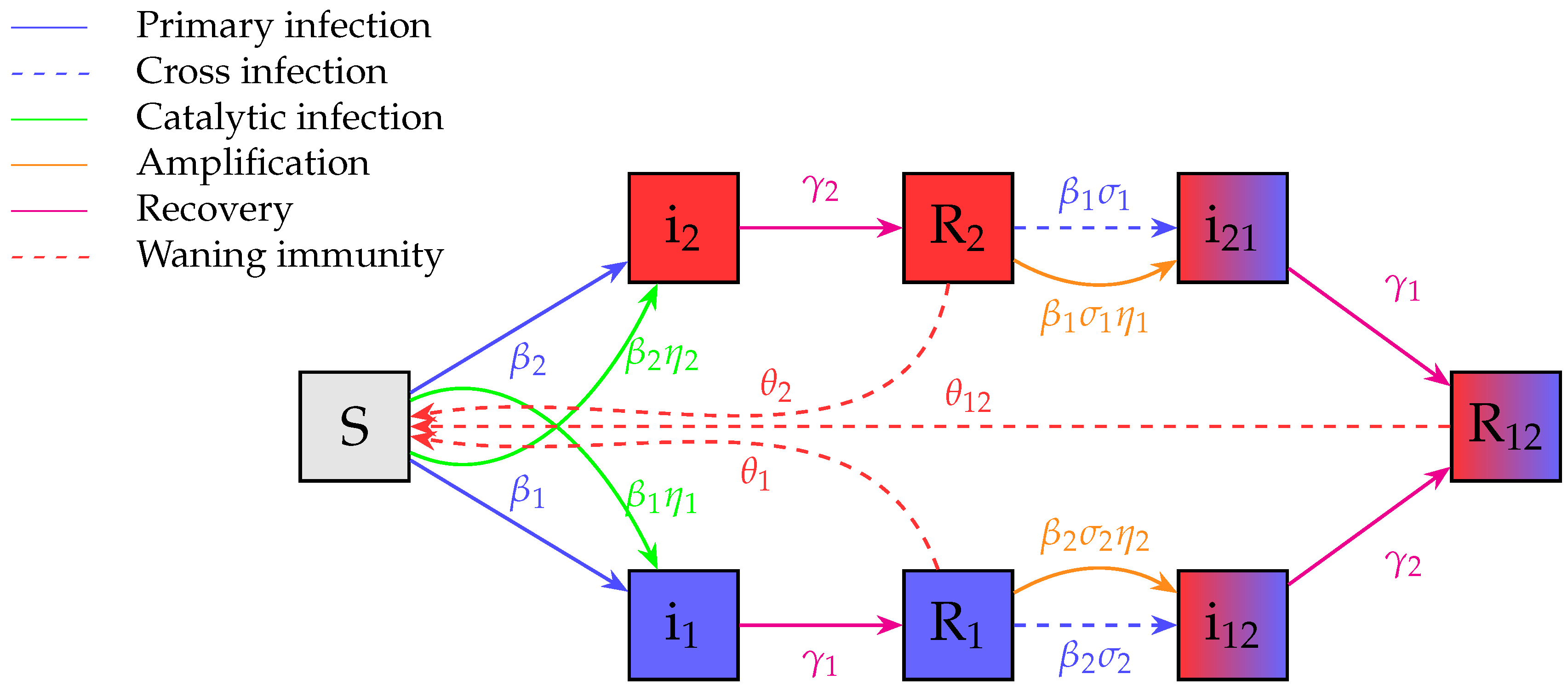
Figure 2 shows a model with eight compartments: susceptibles (s), those infected first by strain
j (
, primary infection), those recovered from strain
j (
, as a result of primary infection), those infected with strain
j after they had recovered from strain
i (
) and those recovered from both strains (
). There is one inflow into
S, 8 outflows out of all compartments, and 15 inner reactions for the “closed model”, with RN:
| Reactions | Type | Parameters |
| RNc={ “S”+“i1”->2“i1”, “S”+“i2”->2“i2”, | | “R2”+“i1”->“i1”+“i21”,“R1”+“i2”->“i2”+“i12”, | | “S”+“i21”->“i21”+“i1”,“S”+“i12”->“i12”+“i2” | | “R2”+“i21”->2“i21”, “R1”+“i12”->2“i12” | | “i1”->“R1”,“i2”->“R2”,“i21”->“R12”,“i12”->“R12”, | | “R1”->“S”, “R2”->“S”, “R12”->“S” } |
| | primary infection | | cross infection | | catalytic infection | | amplification | | recovery | | waning immunity |
| | | | | | |
|
Figure 2.
Schematic diagram of disease dynamics for two co-circulating strains. The diagram includes all reactions: primary infections (), cross-infections (), catalytic secondary infections (), amplification reactions (), recoveries (), and waning immunity (). Green arrows represent catalytic infections where secondary cases catalyze new primary infections. Orange arrows represent amplification where recovered individuals become secondary cases through contact with existing secondary cases.
Figure 2.
Schematic diagram of disease dynamics for two co-circulating strains. The diagram includes all reactions: primary infections (), cross-infections (), catalytic secondary infections (), amplification reactions (), recoveries (), and waning immunity (). Green arrows represent catalytic infections where secondary cases catalyze new primary infections. Orange arrows represent amplification where recovered individuals become secondary cases through contact with existing secondary cases.
5.3. The ODE Formulation of the Model
We present first an extension of the mass-action model allowing for saturation, which we plan to study in the future. Putting
and
, the model with saturation is given by
were
is the rate at which individuals are born,
is the mortality rate,
denotes the transmission coefficient for strain
i,
denotes the recovery rate from strain
i,
is the rate at which immunity to re-infection by strain
i wanes and
is the rate at which immunity to re-infection by both strains wanes. Finally,
is the relative susceptibility to strain
i for an individual previously infected with and recovered from strain
j (
), so that
corresponds to total cross-immunity,
corresponds to reduced susceptibility (partial cross-immunity) and
corresponds to enhanced susceptibility, called ADE.
Definition 18 (ADE [
82,
83,
94])
. For a multi-strain model, we say a secondary infection parameter has Antibody-Dependent Enhancement (ADE) if it is bigger than 1.
Assumption 2. In this paper, we consider only the mass action model obtained when .
Then,
- 1.
The two forces of infection acting on
s are as follows:
- 2.
and the forces of infection acting on
, are as follows:
where
denote decrease or increase factors of the susceptibility to secondary infections.
Assumptions on model parameters: The feasible range of the problem parameters is
Assume that the susceptible group is replenished by demographic turnover (
) and/or by waning of the immune response generated following infections (
),
(this enables the system to converge to an endemic equilibrium, rather than gradually exhausting the susceptible pool and converging to a disease-free state).
Remark 15. Some interesting features of the model, already revealed in [84,85], are as follows: - 1.
of the interior of the local stability domain of the boundary fixed point (with an analog statement for ), may be proved by factoring the full Jacobian at .
- 2.
An interior fixed point is believed to exist, and may be proved under additional conditions—see [41] [Theorem 2.2]. The general case is a hard problem, even in the particular case of Chung & Lui. - 3.
It appears from simulations that when both fixed boundary points exist and are unstable, either a unique endemic point, or an attracting periodic cycle may exist. The separation between the two is not fully understood (note that the Jacobian at the endemic point does not factor, and thus the respective Hopf bifurcation occurs in dimension 7).
- 4.
Existence of the endemic point implies LAS—see [85] [Theorems 1.1 and 1.2].
Open Problem 2 (factoring the full Jacobian at boundary fixed points). Is factoring the full Jacobian at boundary fixed points always possible for some class of multi-strain models?
5.4. Obtaining the Minimal Siphons, the DFE, the Ngm, and the Reproduction Functions with bdAn
After inputting the model as a pair (RN,rts) we initiate the analysis by calling the simplest bdAn (boundary analysis) module:
{RHS, var, par, cp, mSi, Jx, Jy, E0, K, R0A, ngm, infV} =
bdAn[RN, rts];
Print[“RHS=”, RHS // FullSimplify // MatrixForm, “mSi=”, mSi, “ K= ”,
K // MatrixForm, infV];
The outputs of bdAn are as follows:
- 1.
RHS: Right-hand side vector of the ODE system;
- 2.
var: List of all variables;
- 3.
par: List of all parameters;
- 4.
cp: List of positivity constraints for all parameters;
- 5.
mSi: Minimal siphons as variables (obtained by minSiph);
- 6.
Jx: Jacobian of infection/invasion variables (obtained by NGM);
- 7.
Jy: Jacobian of non-infection variables (obtained by NGM);
- 8.
E0: DFE condition;
- 9.
K: next generation matrix (obtained by NGM);
- 10.
R0A: List of non-zero eigenvalues of K;
- 11.
ngm: complete output of NGM, including , and the alternative next generation matrix
- 12.
infV: the order of inf variables used in NGM.
This reveals that the minimal siphons correspond precisely to the two infectious strains: and . The total siphon is the union of the two minimal siphons, , .
At the DFE , we find all species are 0, except .
The NGM K is outputted in the order , and after permutation to , has a block structure .
Remark 16. Note the diagonal structure of the NGM, which could be takes as definition of multi-strain models, and explains the typical “max" formulas that appear in multi-strain GLV or multi-strain SIR.
The two diagonal blocks are the NGMs of the boundary fixed points defined by the two minimal siphons. They have one 0 eigenvalue, and the reproduction functions (the unique positive eigenvalues, in this case), are precisely the traces of the two blocks, given by
It may be checked, both by direct stability analysis, and by the NGM method, that
Lemma 2. The DFE, with , and all other coordinates zero, is unstable if Remark 17. The reproduction functions are increasing, and the DFE instability inequalities stated in Open Problem 5 hold. Hence, the invasion stability conditions divide the parameter space in 4 pieces.
Remark 18. There is a version of bdAn, bdCo, which assumes that the all boundary points are rational, and furnishes them, and we could have used it here. However, we have preferred to give the more gradual analysis, where the non-DFE points are analyzed in a second stage.
5.5. Obtaining the Single-Strain Endemic Equilibrium Points with bdFp and inv2
Assume from now on w.l.o.g. that is the more virulent strain, (excluding the non-generic equality case), i.e., .
The single-strain endemic equilibrium points of (
19) are found by solving the fixed point system under the siphon conditions, using
bdFp. For each boundary system, the output consists of a pair consisting of all rational solutions, and of a polynomial satisfied by the non-rational solutions. Here, the output of
bdFpbdfp = bdFp[RHS, var, mSi];
Print[“rat sols on first siphon facet are”]
bd1 = bdfp[[1, 1]] // FullSimplify
bdfp[[1, 2]]
reveals that all solutions are rational, and that on each of the two siphon facets we have three fixed points, one of which is the DFE, and one of which is not non-negative. The indexes of the correct solution (2,2) are then passed on to invN2, which computes the invasion numbers and a numerical example under which the system is conjectured to be persistent:
{E1, E2, R12, R21, coP} =
invN2[bdfp[[1, 1]], bdfp[[2, 1]], R0A, E0, par, cp, 2, 2];
Print[“invasion numbers R12, R21 are ”, R12 // Apart, R21 // Apart]
We may conclude that
Theorem 2 (stability of the boundary fixed points for the Gavish model). Assume the parameters μ, , , , and satisfy (22). Then:
(1) If , then, the system (
19)
has a unique single-strain endemic equilibrium with and . Puttingthis solution satisfiesand an analog statement holds for a unique single-strain endemic equilibrium with and . (2) The invasion number is as follows:see [41] (Equation (5)). (3) is LAS if and unstable if .
Proof. For the last point, we exploit the key observation made by [
84,
85] (for the simpler particular case of permanent immunity) that the full Jacobian at
factors into one quadratic with negative roots when
, and linear terms, only one of which may have positive roots. The condition that this root [
85] [Theorem (2.2)] is positive may be finally expressed as
.
□
Remark 19. The proof offered in [41] [Theorem 2.1] is incomplete, since the conditions of [77] are not checked, and this is not at all trivial at the non-DFE boundary fixed points; however, as implemented in our .nb file, the characteristic polynomial factorization proof of [85] is easily checked to extend to this case. 5.6. The Endemic Point, in the Particular Case of [85]
The existence of the endemic point is a hard problem, still unresolved even in the particular case of Chung & Lui [
85], when
.
For this model studied already in [
85], the fixed point system may be reduced to the scalar equation
, where
which confirms [
42] (Equation (6b)). A generalization including the immunity parameters may be found in the .nb file.
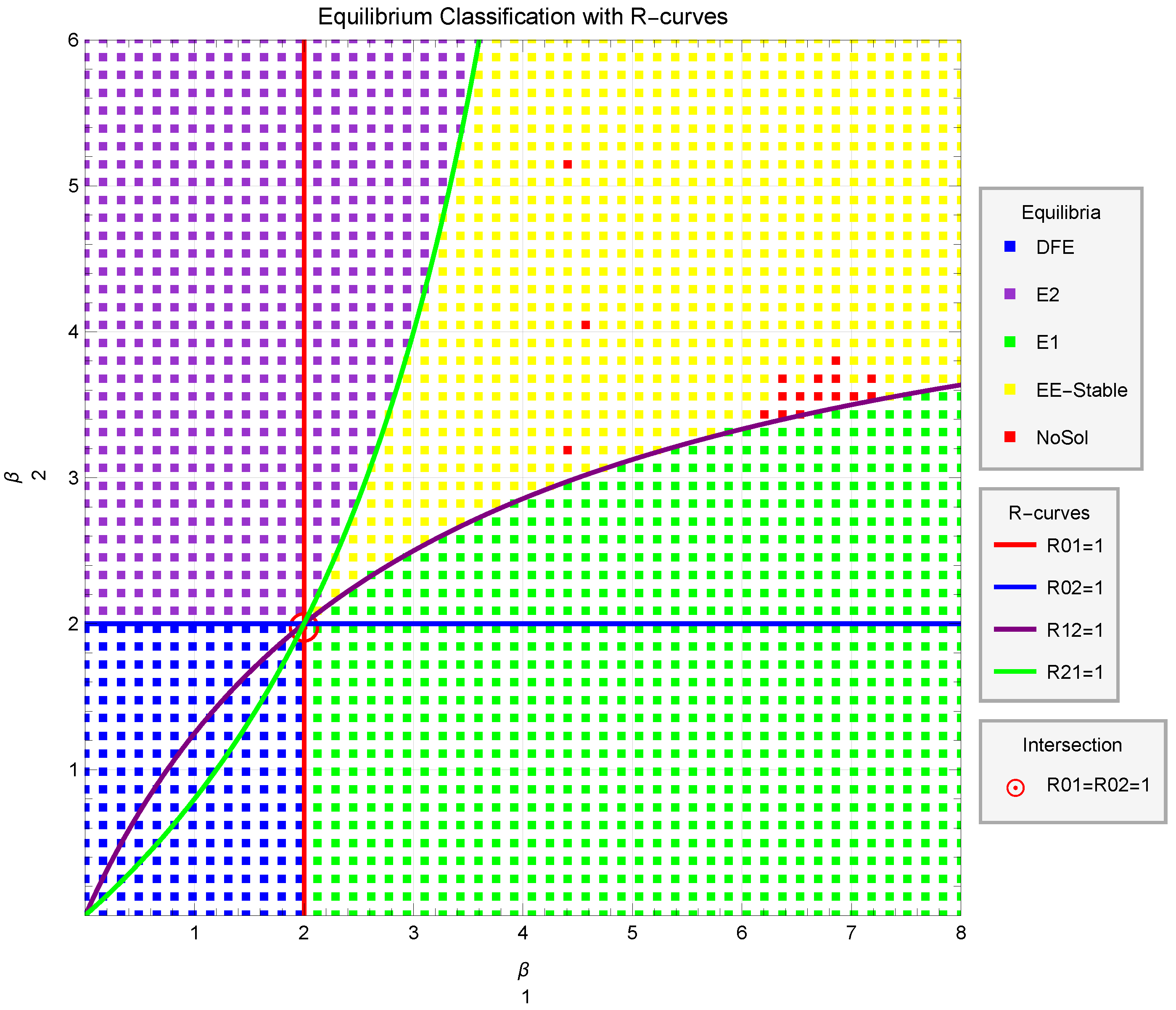
Here, the
Figure 3 is the plot of an instance of the partition. Further experiments are necessary to determine if Hopf bifurcations are possible (in this instance there is none).
Open Problem 3 (Coexistence of several locally stable fixed points). For general two-strain models, is it possible that both strains coexist and are locally stable? (Recall this is impossible for LVK models).
We end this section with a fundamental open problem.
Open Problem 4 (The persistence conjecture). The examples studied here and others suggest that for a positive ODE, the instability of all fixed boundary points (or maybe even only the instability of the disease-free equilibrium and the boundary equilibria whose zero set is a maximal non-DFE siphon) ensures the persistence.
For some positive results in particular cases, see [
95,
96,
97,
98,
99].
For another particular case where the persistence conjecture holds, we recall the following:
Proposition 1 ([
91] [Theorem 4.19])
. Two-strain models which live on a compact non-negative invariant subset and have , and , so that both strains exist, but are unstable, and are uniformly persistent. 5.7. Can the Persistence and Global Stability of This Two Strain Model Be Resolved by Removing Intermediates?
This question is inspired by the CRN papers [
61,
100], which provide conditions under which the removal of intermediates does not affect persistence. This suggests that there might be a relation between the persistence or GAS property of this model when
, and those of the model where the intermediate states
are removed.
However, the [
61,
100] theory does not apply: the cross-immunity assumption
implies that
are essential species, which do not satisfy the FFW reducibility assumption that intermediates may not appear in mixed complexes which mix “intermediates” and “non-intermediates” (r1 + i2, r1 + i12, r2 + i1, r2 + i21). Cross-immunity creates a “biological memory” that prevents mathematical reduction; the two-strain model with cross-immunity is “FFW-irreducible”.
6. A SI2R Model with Co-Infections of [101], Which Has More Reproduction Functions than Minimal Siphons; SI2Coinf.nb
Co-infection models [
102,
103,
104,
105,
106,
107,
108,
109,
110] pose a mathematical dilemma in our construction. Consider, for example, the logistic growth SI
2R model of [
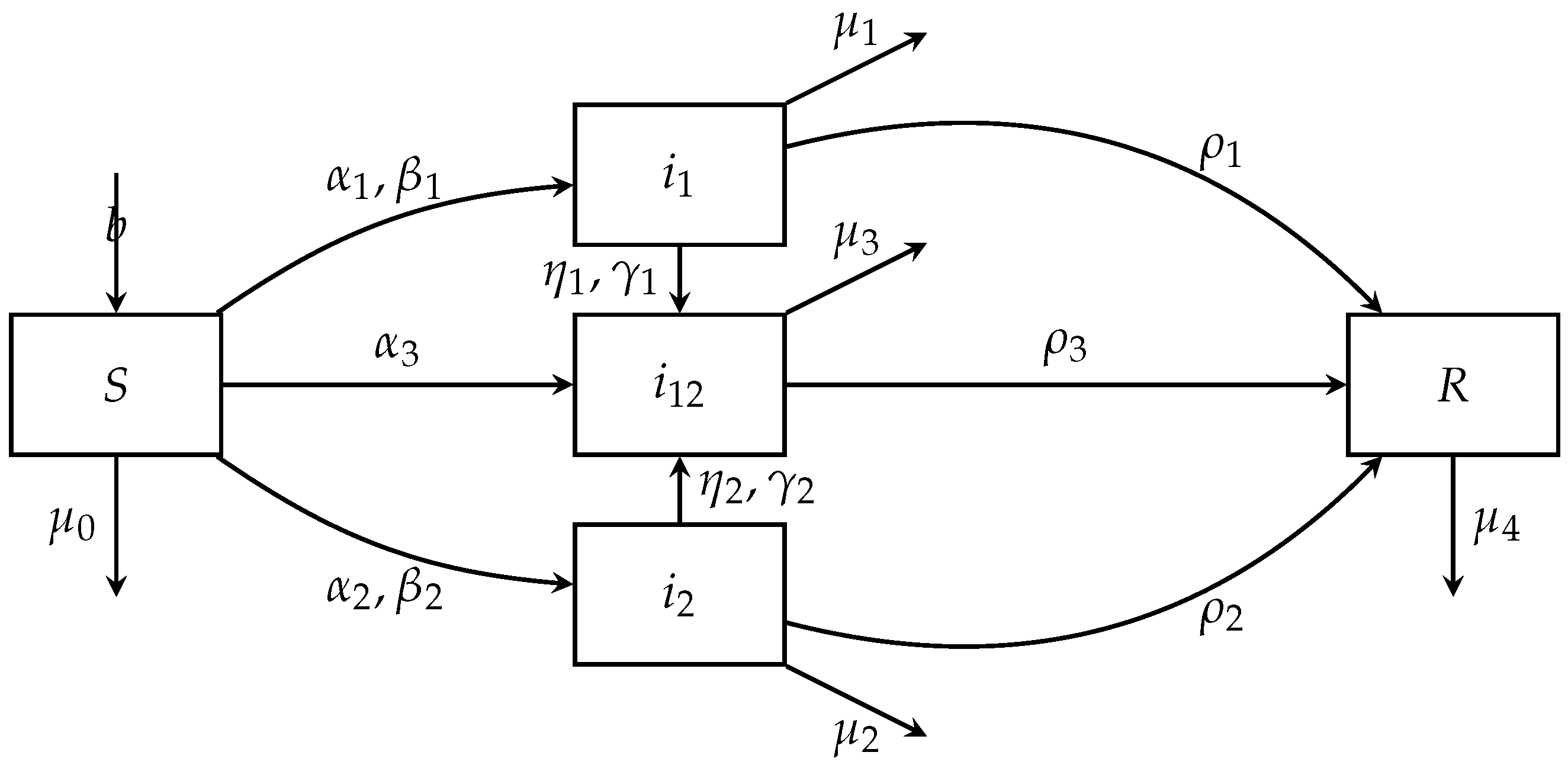
101], shown in
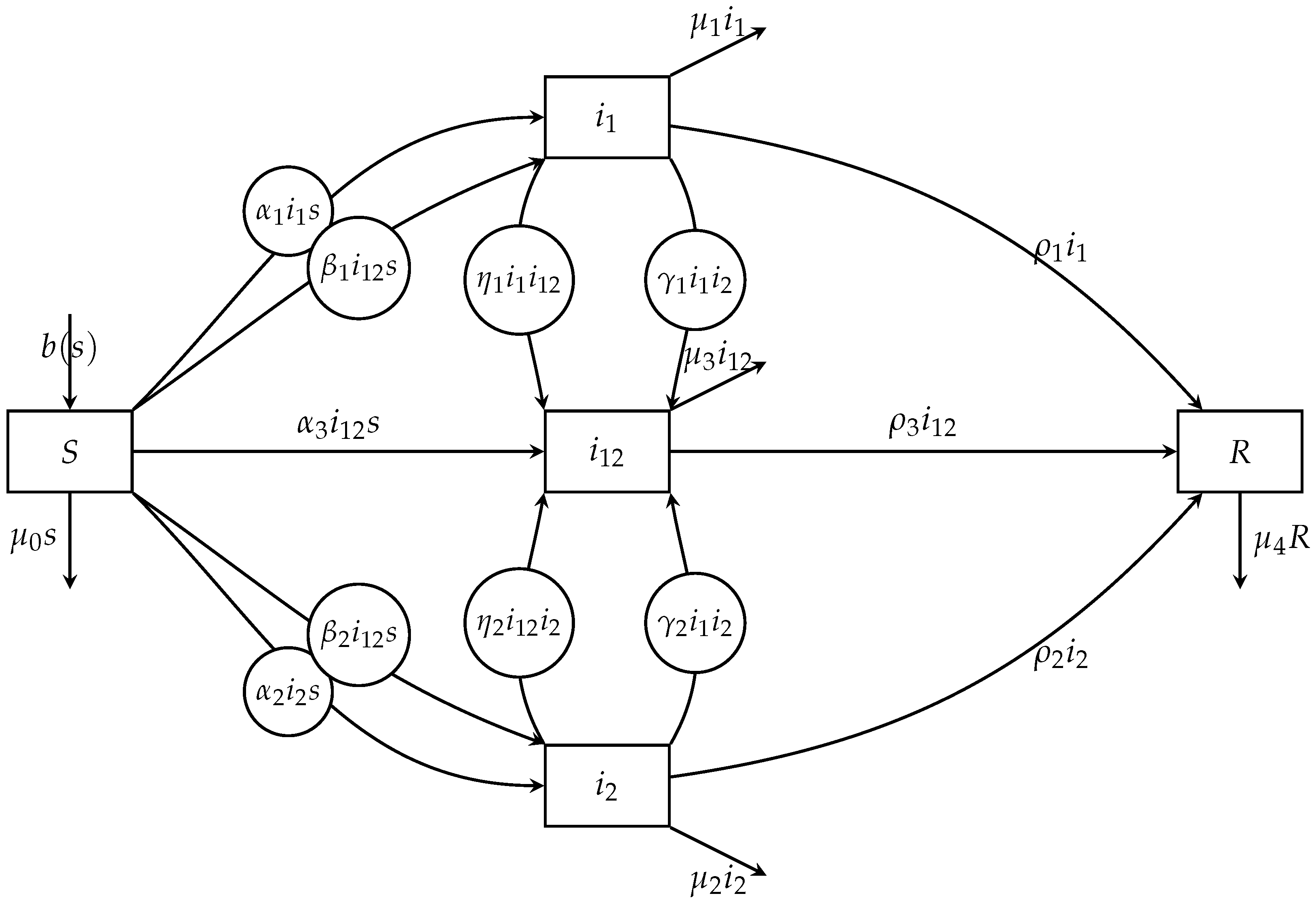
Figure 4 below, should it be viewed as two-strain, or three strain?
where the following notation was used as follows:
and are infected classes from strain 1 and strain 2, respectively.
is the compartment consisting of individuals infected by both diseases.
R represents the recovered class.
Due to the permanent immunity assumed, we may remove R from the analysis; the total removal rates of the infected will be denoted by .
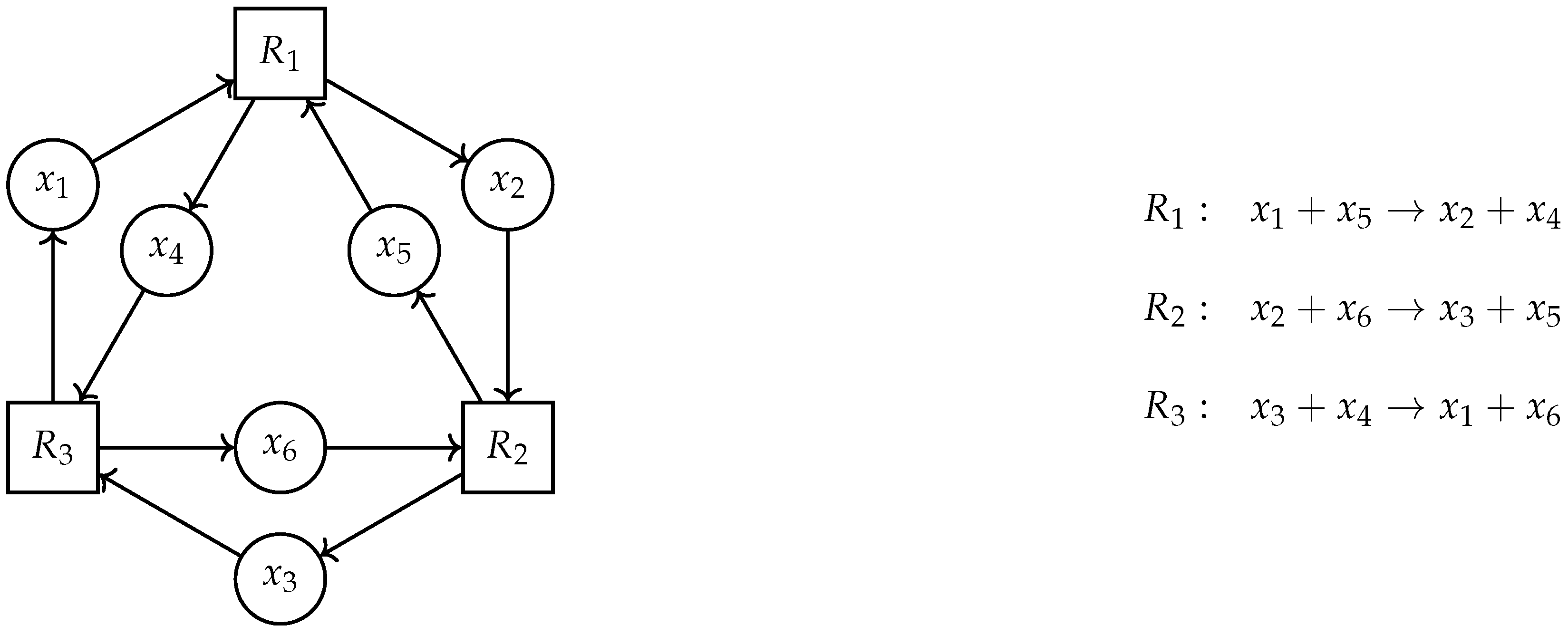
We now open a parenthesis about the similar Volpert/Petri/directed species reaction graph (DSR) bipartite graph, which plays a big role in CRNT. The graph below, for pairs of species connected by more than one reaction in
Figure 4, includes an edge for each reaction, and it indicates the complete rate inside a circle, which represents the reaction. However, for pairs of species connected by one reaction only, it keeps the structure of
Figure 4, except that is indicates the complete rate, not just its constant. The DSR graph is obtained by transforming all edges in an edge with a circle in the middle. Clearly, the DSR representation illustrated in
Figure 5 is more complete than the flow diagram in
Figure 4.
For a historical note on these Volpert/Petri/DSR graphs, see
Table 1.
The reaction network representation of the [
101] model is as follows:
The EpidCRN script bdAn, furnishes many preliminary results for an epidemiologic analysis:
{RHS, var, par, cp, mSi, Jx, Jy, E0, K, R0A, infVars, gam, ng} =
bdAn[RN, rts];
{edg, cyc, graph} = IGMS[RN, mSi];
Print[“siphons are”, mSi, “ edges are”,
edg, “ DFE is”, E0, ” repr. functions= ”, R0A]; F =
ng[[2]]; V = ng[[3]];
Print[“K=”, K // MatrixForm, “F=”, F // MatrixForm,
“V=”,V // MatrixForm];
bdAn provides the following:
- 1.
The RHS of the ODE.
- 2.
The minimal siphons mSi, which, assuming , are {i1,i12},{i2,i12}; the total DFE siphon is therefore {i1,i2,i12}.
- 3.
The subsequent command
IGMS[RN,mSi] reveals that the IGMS is a cycle as illustrated in
Figure 6 below.
- 4.
The stability of the jacobian is one of the necessary conditions we ask from an ME model.
- 5.
Another one is the existence of a regular splitting of
, or of a matrix
M appearing in the factorization of the fixed point equations may be written as follows:
Denoting by
M the matrix multiplied by
in the first representation in (
28) above, and splitting
as the difference in a non-negative matrix and of a matrix with a positive inverse
we may conclude that our model satisfies our definition of ME models.
- 6.
The second representation in (
28) reveals that when
, this is a Lotka–Volterra–Kolmogorov model.
- 7.
The next generation matrix may be made triangular
by ordering the variables as
. This suggests that the most convenient ordering of the DFE support must start with elements which appear only in one siphon.
Finally, triangularity reveals that
, where
and where
in the linear growth case (and equal to the carrying capacity in the logistic case). This concludes the stability analysis of the DFE.
- 8.
ngm is the list of all the outputs of NGM, which includes the matrices F,V.
- 9.
Using the notation (
29), we may express some of the boundary fixed points which have precisely one positive infection variable in a revealing form:
with similar formulas for
. These points exist if
called reproduction functions and applied at the s-value of the other fixed points (besides (
30)), will be seen to intervene in the stability analysis in
Section 6.1.
6.1. Further Analytical Results
Recall the reaction network from
Section 6:
with ODE
The parameters of the system are as follows:
b is the intrinsic growth of
s [
101] study the logistic case with
, containing two further parameters, the per capita birth rate
r, and the carrying capacity
K, but we study the case when
b is constant.
is the rate at which individuals infected with one strain become infected with the other strain after a meeting with single infected individuals, and move to the coinfected class ().
(not shown in figure) are the death rates of the infected compartments.
, , are the rates of transmission of strain 1, strain 2, and both strains (i.e., coinfection),
is the rate at which susceptibles contract disease but not the other disease, from a coinfected individuals.
is the rate at which individuals infected by one strain becomes coinfected, after a meeting with a coinfected individual.
The following vector notations will be used as follows:
The parameters are split into three groups:
It is reasonable to assume that the coinfection constants from , involved in terms describing double infection, are small with respect to basic constants.
Assume that are positive, and are non-negative.
Remark 20. One interesting aspect of this model is the sensitivity of the IGMS structure to the parameters. When , the minimal siphons are {i1,i12}, {i2,i12}. When , the unique minimal siphons is {i12}.
And when , there are three minimal siphons {{i1}, {i2}, {i12}}, and the IGMS is a union of two cycles; see Figure 7. Furthermore, as noted already, when , the infection part is a Lotka–Volterra–Kolmogorov model with an antisymmetric interaction matrix, to be studied in the next section.
6.2. The Antisymmetric Lotka–Volterra–Kolmogorov Case of the [101] Model, with 0 Coinfection Paramters
With 0 coinfection parameters,
, the [
101] ODE has its infection part of Lotka–Volterra–Kolmogorov type:
The infection equations may be written as follows:
with
A antisymmetric. The persistence-extinction dichotomy can thus be tackled via the theory of Lotka–Volterra–Kolmogorov ODEs with an anti-symmetric
A [
111].
This model has six fixed points, all rational, given, respectively, by
This reveals that the minimal siphon i12 = 0 does not have any fixed point in its interior (however, it contains the two fixed points on the boundary).
Finally, the endemic point
has coordinates:
Until a point, the stability analysis is easy. DFE is stable if .
Remark 21. The formulas also suggest introducingwhere we recall that represent the boundary value of s on and , respectively. 6.2.1. Stability Analysis for E1, E2
Direct analysis implies that E1 is stable if
with analog conditions holding for the stability of E2.
Remark 22. Recall that E13 exists if , and , thus stability of E1 does not preclude the existence of E13.
To check (
35), note that the jacobian at
is
, and the numerator of the characteristic polynomial at
is as follows:
The linear terms are stable if
and the quadratic term is stable if
.
Remark 23. Besides the first stability conditions for E1 in (
35),
we have obtained a second one, which we are tempted to describe as “E1 can invade E3", with the caveat that the invasions in situations with at least three siphons do not seem to be rigorously defined—see though [109,112,113,114] for some works in this direction. 6.2.2. Stability Analysis for E3
At E3, the numerator of characteristic polynomial is
Thus, stability holds if
holds, whose invasion interpretation is that besides
being the dominant strain, it must also be able to invade strains
.
6.2.3. Stability Analysis for E23
At E13,E23 the direct Routh–Hurwitz analysis becomes more cumbersome, because one of the factors of the characteristic polynomial has degree 3, but the “stability via LCP” is not that hard. Recall . To the positivity conditions of the above, we must add the negative flow condition near , which is . A common reduce of these equations yields.
Existence and Stability Conditions for E23
The first three conditions ensure the existence. The fourth condition, ensuring stability, does not seem to be expressable in terms of reproduction functions. It is, however, elegantly expressed in terms of the s values at E23 and EE.
The formulas above suggest the following:
Open Problem 5 (partition via resident variable inequalities). The parameter space may be divided via inequalities of the form
where
run over certain pairs of siphons (it may be possible to make this more precise using the theory of invasion graphs [
32,
115,
116].
Finally, we show that this model does not satisfy the CEP, i.e., the existence conditions of EE are not that all the other fixed points exist and are unstable. To simplify the existence conditions, assume first w.l.o.g. that
The existence conditions are still too long to reproduce here, so we further assume that all death rates equal
. Then, we find a conjunction of four conditions
which leave several regions not covered by any of the previous cases.
7. A Review of Persistence Theory for Positive Dynamical Systems
Let be a positive ODE defined on a compact, forward-invariant set , with semiflow .
Definition 19 (Persistence [
26,
97])
. The system is persistent if for every component i and every trajectory starting in , Definition 20 (Uniform Persistence [
26,
97])
. The system is uniformly persistent if there exists such thatuniformly for all trajectories starting in . The fundamental problems of persistence, permanence, and extinction have been studied extensively, in particular in the context of generalized Lotka–Volterra systems [
117,
118,
119,
120,
121], for mathematical ecology models [
26,
122,
123] and also for CRNs [
56,
96,
97,
98,
124,
125].
7.1. General Persistence Theory
Theorem 3 (Butler–Waltman [
118]; Fonda [
126]; Hutson–Schmitt [
120]; Smith–Thieme [
26])
. For a dissipative semiflow on a compact invariant set E, the system is uniformly persistent if and only if the boundary is a uniform repeller, i.e., there exists such thatfor all t sufficiently large and all . Remark 24 (On the insufficiency of linear instability for boundary fixed points)
. The criterion above is not constructive. The simplest constructive condition—that all boundary equilibria are unstable—does not
imply persistence—see the May–Leonard example, Section 7.3. This observation motivated the repeller Theorem 3 of Hutson–Schmitt [120] and Smith–Thieme [26], which assumes that the boundary repelling property must hold for the entire boundary set,
not just for fixed points. 7.2. Mass-Action CRNT Persistence Results
In CRNT, the driving force behind persistence theory has been the global attractor conjecture for weakly reversible systems, still unresolved; however, several partial results are available [
56,
62,
96,
97,
98,
127].
Theorem 4 (Angeli–De Leenheer–Sontag [
56], 2007)
. A mass-action chemical reaction network such that every siphon Z of the network contains the support of at least one conservation law is persistent. Theorem 5 (Anderson [
62], 2011)
. A weakly reversible, deficiency zero reaction network with mass-action kinetics satisfies:- 1.
Within each positive stoichiometric compatibility class, there exists a unique equilibrium;
- 2.
This equilibrium is globally asymptotically stable;
- 3.
The system is persistent on .
Theorem 6 (Pantea [
96], 2012)
. Every weakly reversible mass-action system of dimension (where is the dimension of the stoichiometric subspace) is persistent and permanent. Remark 25. Pantea’s proof uses the following:
- 1.
Brouwer degree theory for
- 2.
Poincaré–Bendixson theory ruling out boundary attractors
- 3.
For : Analysis of possible boundary limit sets using ω-limit set structure
The result does not extend to where more complex boundary attractors can exist.
Remark 26 (Why standard CRN persistence results fail for epidemics). Typical compartmental epidemic models satisfy:
- 1.
No weak reversibility: Infection reactions lack reverse .
- 2.
Infection strains do not contain positive conservation laws, due to possible deaths.
- 3.
Deficiency .
7.3. Failure of Persistence Due to Boundary Heteroclinic Cycles: May–Leonard System; MayLeonard.py, MayLeonard.nb
Persistence may fail even when all boundary equilibria are unstable. One mechanism illustrating this is an attracting boundary heteroclinic cycle: a sequence of boundary saddle equilibria connected cyclically, each unstable toward the next, collectively forming a closed boundary orbit that attracts all interior trajectories.
Example 7 (Symmetric May–Leonard system)
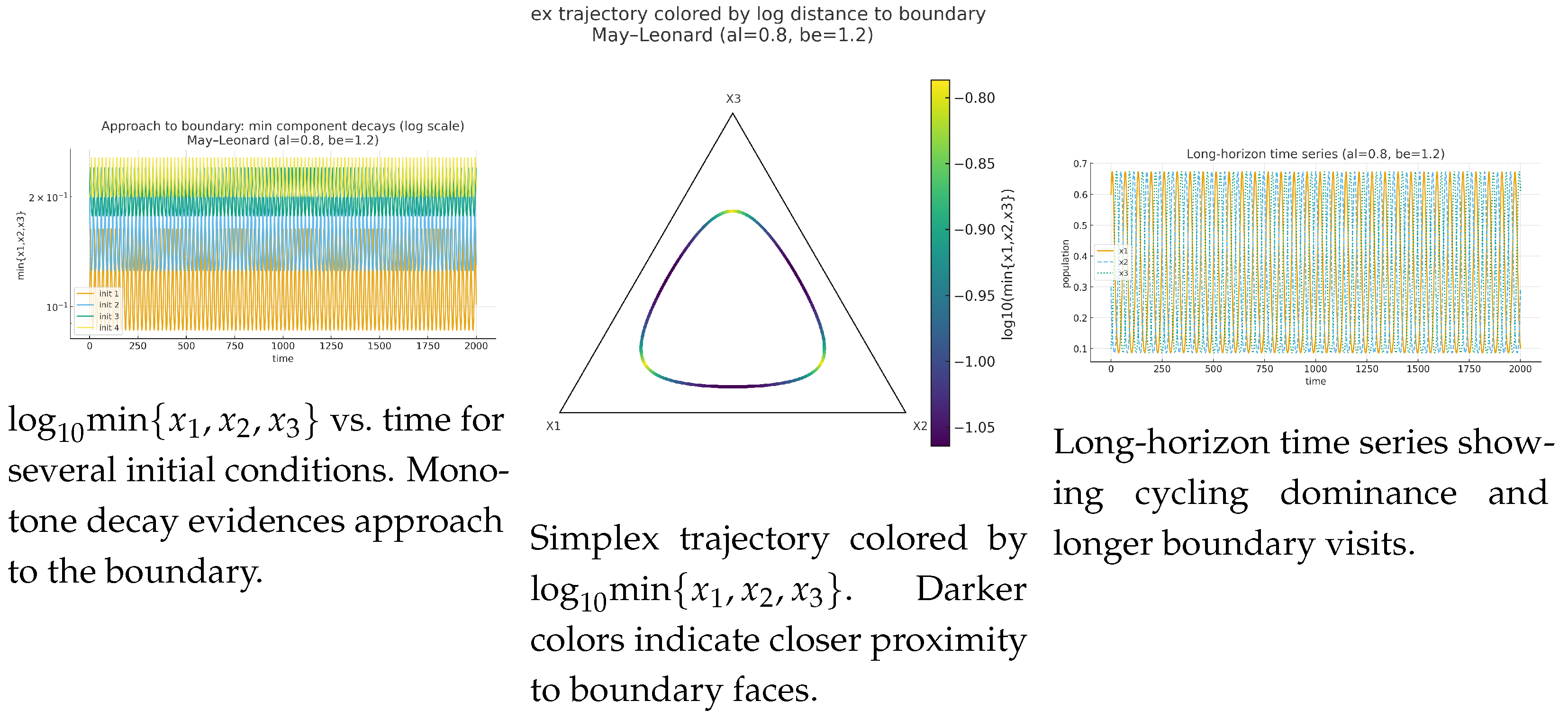
. A classical three-species competitive Lotka–Volterra equations ([128,129])satisfies that for , the boundary equilibria , , and are saddles connected in a heteroclinic cycle that attracts all interior trajectories, causing persistence failure. Figure 8 below visualizes the May–Leonard heteroclinic cycle regime with parameters
and
, demonstrating nonpersistence through three complementary perspectives:
- 1.
The left panel plot tracks over time essentially monitoring the smallest population abundance. The y-axis uses a logarithmic scale to capture orders of magnitude declines. Starting from multiple initial conditions (shown as different colored trajectories), all paths exhibit monotone decay toward on the log scale. This means the minimum population size continually decreases, approaching zero asymptotically. The smooth downward trend confirms that no trajectory stabilizes at a positive interior equilibrium; instead, populations drift inexorably toward boundary faces where at least one species becomes vanishingly rare.
- 2.
For the middle plot, it shows a single representative trajectory projected onto the 2-simplex (the triangular constraint ), color-coded by distance to the nearest boundary face.
- (a)
Yellow bright regions: trajectory far from boundaries (interior of simplex),
- (b)
Blue dark regions: trajectory near boundaries (edges or vertices).
Darker shading near the vertices indicates prolonged visits to states where one species dominates temporarily while the other two remain suppressed. The trajectory never settles but instead circulates endlessly around the boundary loop, never stabilizing in the interior.
- 3.
For the right pannel, it plots the time evolution of all three species over the interval time units, capturing long-term oscillatory behavior. The vertical axis shows population densities , and horizontal lines separate successive epochs where different species dominate.
Figure 8.
May–Leonard heteroclinic-cycle regime with al, be. Left: clearly , hence nonpersistence. Middle: simplex projection with distance-to-boundary coloring. Right: time series on showing the characteristic increase in dwell times near the boundary saddles. These are obtained in MayLeonard.nb.
Figure 8.
May–Leonard heteroclinic-cycle regime with al, be. Left: clearly , hence nonpersistence. Middle: simplex projection with distance-to-boundary coloring. Right: time series on showing the characteristic increase in dwell times near the boundary saddles. These are obtained in MayLeonard.nb.
This multi-faceted visualization in
Figure 8 clarifies why classical stability theory focused on interior equilibria and local linearizations fails to predict dynamics in systems with boundary attractors. The May–Leonard example remains a canonical warning that ecological coexistence requires more than merely unstable single species states; the connectivity and geometry of boundary equilibria matter profoundly.
For checking this with EpidCRN, we use the mass-action representation:
RN = {
“X1” -> 2*“X1”,
“X1” + “X1” -> “X1”,
“X1” + “X2” -> “X2”,
“X1” + “X3” -> “X3”,
“X2” -> 2*“X2”,
“X2” + “X2” -> “X2”,
“X2” + “X3” -> “X3”,
“X2” + “X1” -> “X1”,
“X3” -> 2*“X3”,
“X3” + “X3” -> “X3”,
“X3” + “X1” -> “X1”,
“X3” + “X2” -> “X2”
};
rts = {
x1, x1*x1, al*x1*x2, be*x1*x3,
x2, x2*x2, al*x2*x3, be*x2*x1,
x3, x3*x3, al*x3*x1, be*x3*x2
};
7.4. Invasion Graphs
In this subsection we revisit the invasion graphs theory which arose from the works of [
23,
32,
75,
109,
112,
116,
130,
131] using the notions of siphons and reproduction functions.
Throughout, is the phase space of an ME system with infection set .
Definition 21 (Proper siphons and communities)
. Let be a siphon and letdenote the associated positively invariant face.A siphon S is called proper if the restriction of the flow to admits a compact invariant set and contains a point with all coordinates in strictly positive.
The complement is called the community.
Definition 22 (Invasion rates)
. Let S be a proper siphon and its compact invariant set. For the j–equation linearizes along , , toThe (upper) Lyapunov exponentis the invasion rate
of coordinate j into the community . We say j invades
whenever . Remark 27 (Reduction for ME models with resident equilibria)
. In all ME models considered here, is a single equilibrium with susceptible level . Then, , andso invasion rate reduces to a single Jacobian evaluation.Moreover, using the splitting of infection terms,where is the reproduction function of the j–th NGM block. Definition 23 (Invasion numbers for ME models). Let be an NGM block, with reproduction function . For a proper siphon S, let be the resident equilibrium on , and let denote its susceptible coordinate.
The invasion number
of block into the community isThe reproduction number
of is Remark 28. If the minimal siphons partition and determine the NGM blocks, the preceding definition reduces to the previous Definition 16.
Example 8 (Invasion graph of the GK coinfection model)
. We consider the GK model with blocksand reproduction functionsFor and the minimal siphons areand the proper siphons are Each S determines a unique resident equilibrium with susceptible value . Table 2 lists all these values. Invasion inequalities are of the form Note that the indices correspond to .
To handle mixed equilibria on or we also introducegiven explicitly in the main text. All invasion inequalities are listed in Table 3. The invasion graph
is the directed graph whose vertices are the proper siphonsand whose edges are exactly those pairs for which the block removed in passing from S to satisfies . 8. Conclusions
In this work, we aimed to address the fragmented landscape of three traditionally separate disciplines: mathematical epidemiology, chemical reaction network theory, and ecological modeling by proposing a unifying theoretical framework.
This work demonstrates that epidemic strains are fundamentally analogous to minimal siphons, that govern boundary behavior in positive dynamical systems. This correspondence, encoded in the stoichiometric matrices that define how species interact, influences the block structure of next-generation matrices.
What emerges from this synthesis is a rigorous pathway for analyzing multi-strain epidemic systems through the lens of reproduction functions. These functions, evaluated at various boundary equilibria, capture the invasion potential of competing strains and naturally extend the classical threshold theorem of [
77] to settings where multiple pathogens coexist or compete. The integration of reaction network formalism into epidemiology also brings algorithmic advantages, illustrated in the accompanying software package via symbolic and numerical tools.
In conclusion, this work suggests that the tools of CRNT are not incidental conveniences, but fundamental structures governing multi-strain epidemic behavior. By making these tools accessible to epidemiologists and ecologists, and by demonstrating their equivalence to reproduction number based reasoning, the framework presented here contributes to a unified mathematical theory of biological interaction networks.
Looking forward, several directions promise to extend this framework’s scope. Extending beyond mass-action kinetics to frequency-dependent transmission, saturating incidence, or resource-mediated interactions will broaden applicability to contexts where density-dependent assumptions fail.