1. Introduction
Partial differential equations, particularly hyperbolic conservation laws, are fundamental to modeling practical problems in aviation, oceanography, and water conservancy [
1,
2]. If lower-order numerical approaches are employed to handle hyperbolic conservation laws, the numerical solution tends to exhibit considerable dissipation around the areas containing the discontinuities. Therefore, it is essential to construct a high-order essentially non-oscillatory (ENO) scheme for addressing hyperbolic conservation laws, since the numerical solution has high precision in smooth areas while maintaining an ENO behavior near strong discontinuities. In recent years, researchers have developed numerous advanced methods, such as the weighted ENO (WENO) scheme [
3,
4,
5,
6,
7], discontinuous Galerkin (DG) finite element method [
4,
8], and weighted compact nonlinear scheme (WCNS) [
9], etc. This article focuses on developing a novel fifth-order unequal-sized trigonometric WENO (US-TWENO) scheme and a novel hybrid US-TWENO (HUS-TWENO) scheme featuring an innovative troubled cell indicator within a finite difference structure for dealing with hyperbolic conservation laws on structured grids.
The initial finite volume WENO scheme was introduced by Liu et al. [
10]. Subsequently, it was improved and extended to the finite difference system by Jiang and Shu [
3] in 1996. Henrick et al. [
11] discovered that the classical WENO-JS scheme [
3] was unable to attain the optimal fifth-order accuracy at the critical points and created the WENO-M scheme by designing a mapping function to deal with this drawback. Borges et al. [
12] designed the WENO-Z scheme, which not only maintained the intended level of accuracy near critical points but also decreased additional computational cost. Later, Zhu and Qiu further improved the WENO scheme by developing some unequal-sized WENO (US-WENO) schemes [
13,
14] in the algebraic polynomial space and adapted it on unstructured grids. The superior linear weights could be any positive values, as long as their total sum adds up to one. This made the application of current WENO schemes [
3,
11,
12] much simpler, especially on two-dimensional and three-dimensional unstructured grids.
However, although the abovementioned high-order WENO schemes were effective in numerically addressing hyperbolic conservation laws, these advanced numerical approaches were mainly constructed by using the algebraic polynomials that could not be adapted to the characteristics of given data with significant fluctuations. For interpolating data with significant oscillations, the numerical scheme utilizing the trigonometric polynomials was more appropriate for solving such issues than the numerical scheme based on algebraic polynomials. In 1996, Christofi [
15] constructed a class of local trigonometric polynomial interpolation methods and associated trigonometric ENO schemes. Then, Zhu and Qiu [
16] developed trigonometric WENO (TWENO) schemes for simulating hyperbolic conservation laws and highly oscillatory problems. On this basis, Wang et al. constructed a novel fifth-order TWENO scheme [
17] that incorporated the multi-resolution TWENO scheme [
18] combined with multi-resolution techniques to achieve any desired level of precision in smooth areas. Although the WENO scheme had been widely used as a significant shock-capturing scheme in practical engineering problems, the local characteristic decomposition, smooth indicators, flux splitting, and complex nonlinear weight calculations all resulted in substantially additional computation costs.
The high-order WENO schemes mentioned earlier required sophisticated spatial reconstruction techniques of numerical flux splitting, local characteristic projection, and the complex and time-consuming computations of the optimal linear weights, smoothness indicators, and nonlinear weights to sustain the stability for the system. One effective option was the hybrid WENO scheme, which combined the expensive WENO reconstruction nearby discontinuous regions and used the high-order linear upwind interpolation in smooth zones, thereby optimizing the benefits of each approach [
19]. A crucial element of the hybrid WENO scheme was the discontinuity indicator. At present, the existing discontinuity indicators mainly relied on the troubled cell indicators employed in the DG techniques [
20]. Based on the research, Li and Qiu [
21] systematically studied and evaluated the effectiveness of different troubled cell indicators for the development of hybrid WENO schemes. Furthermore, the troubled cells containing the discontinuities could also be detected by determining the locations of the polynomials’ extreme points [
22]. However, among these troubled cell indicators, some of them containing artificially adjustable parameters were not easily applied in large-scale engineering applications, while the others were not easily generalized to higher-order numerical schemes. An excessively wide identification interval might result in misidentifying the troubled cells, leading to higher computation expenses. As a result, numerous researchers had focused on studying the hybrid WENO schemes, for instance, the hybrid compact-WENO scheme introduced by Pirozzoli [
23], the characteristic-wise hybrid scheme introduced by Ren et al. [
24] based on the conservative compact scheme [
23], and the hybrid central-WENO finite difference scheme proposed by Costa and Don [
25]. For further investigations into the hybrid WENO schemes, the readers can consult [
26,
27,
28,
29,
30,
31,
32,
33,
34,
35,
36] and their references.
Within this study, we proceed with the novel fifth-order finite difference US-TWENO scheme and subsequently propose the novel troubled cell indicator to design the novel hybrid US-TWENO scheme, which combines related linear upwind reconstruction and the US-TWENO spatial reconstruction on structured grids. Following the ideas proposed in [
14,
16,
17,
18], this work introduces a novel fifth-order finite difference trigonometric WENO scheme featuring a convex combination of one quartic trigonometric polynomial and two linear trigonometric polynomials in the novel trigonometric polynomial space. The new fifth-order US-TWENO scheme could obtain smaller
and
errors in smooth areas and diminish to the second-order approximation in nonsmooth areas. In a general sense, the novelties of this TWENO scheme are found in some areas: an innovative TWENO-styled exchange among three different-degree trigonometric polynomials for high-precision approximations in smooth zones, the non-oscillatory behavior near shocks or contact discontinuities, and the superior treatment of the wave-like and highly oscillatory issues. After that, we propose the novel fifth-order HUS-TWENO scheme. We detect the existence of extreme points of reconstruction trigonometric polynomials within the smallest interval (the target cell)
determined by whether the estimated minimum and maximum values of their derivative trigonometric polynomials have opposite signs or not. When the signs are opposite,
is established as a troubled cell and the complex US-TWENO reconstruction is used. If not, the efficient linear upwind scheme is utilized directly. The HUS-TWENO scheme has many advantages. Firstly, the troubled cell indicator is formulated from two simple trigonometric polynomials, requiring no manual parameters related to the problems. Secondly, during the identification of troubled cells, the troubled cell indicator determines if the reconstruction trigonometric polynomials contain extreme points by analyzing the varying signs in the estimated minima and maxima of their corresponding derivative trigonometric polynomials. Thus, this method is simpler and more efficient than the one in [
37,
38], requiring an intricate procedure to find the zero points of one-dimensional derivative algebraic polynomials across a wider interval
, which could not be directly applied to higher dimensions. Furthermore, this troubled cell indicator acts only in the most reduced interval
, smaller than the one in [
37,
38,
39] in the algebraic polynomial space. As a result, it enables more precise identification of the troubled cells. Finally, the fifth-order finite difference HUS-TWENO scheme can accurately distinguish smooth regions from discontinuous ones, seamlessly transitioning between the simple linear upwind reconstruction and complex US-TWENO reconstruction, thus substantially improving the efficiency.
The structure of the remaining parts is outlined below. In
Section 2, the novel fifth-order finite difference US-TWENO and HUS-TWENO schemes with the novel troubled cell indicator are introduced to address hyperbolic conservation laws, especially for some highly oscillatory problems.
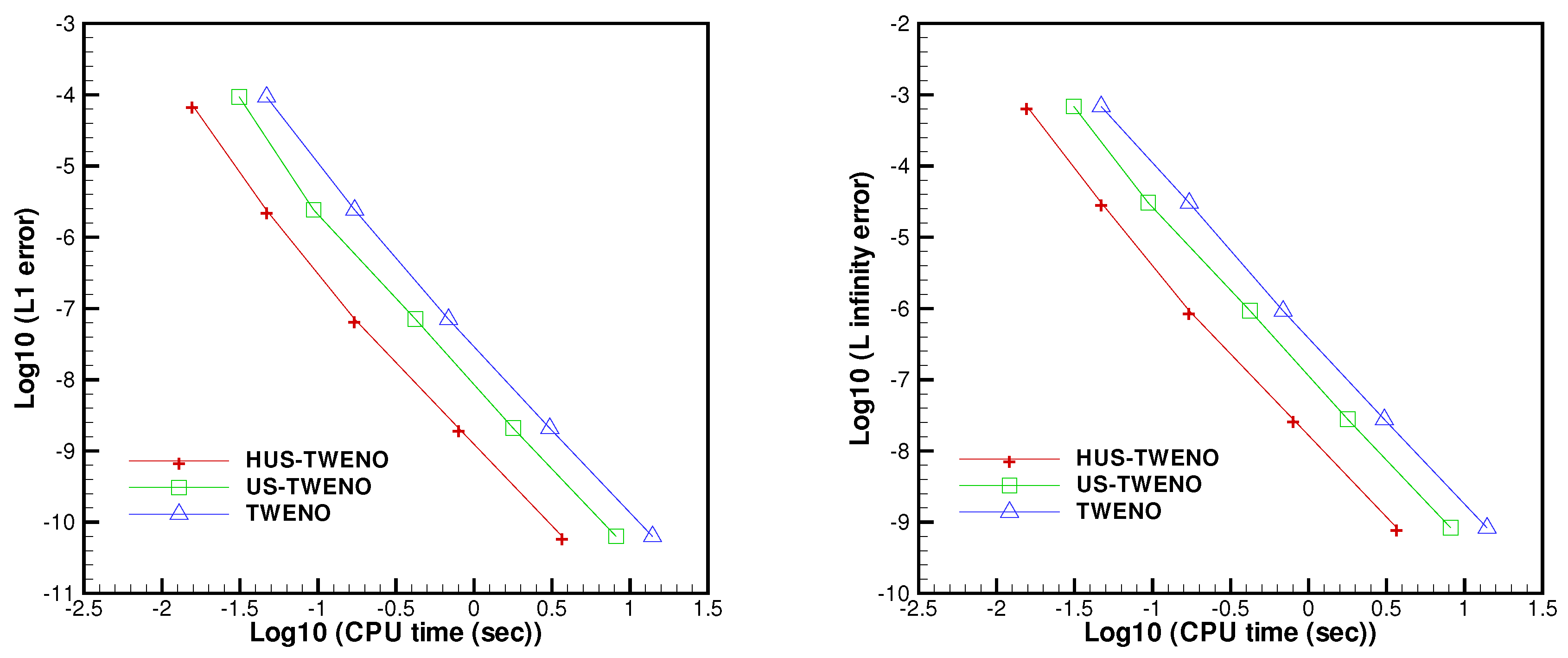
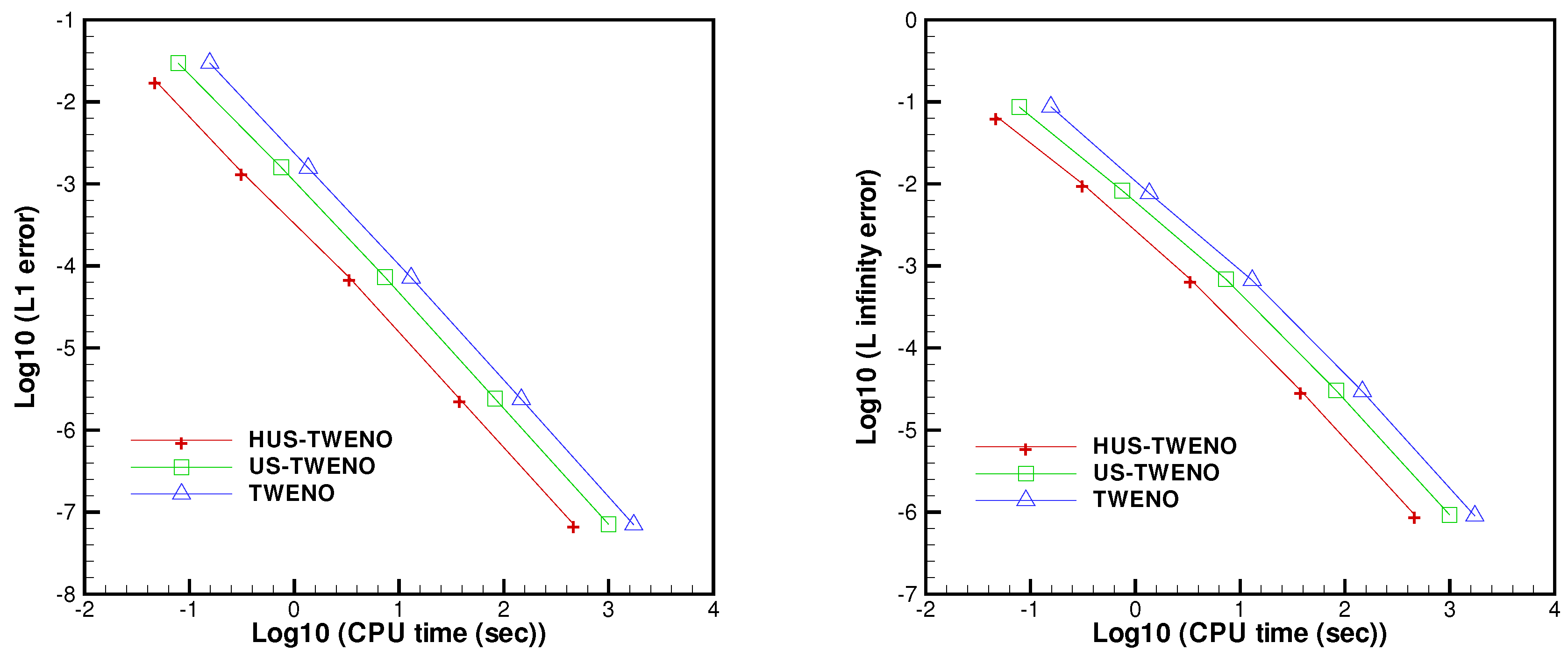
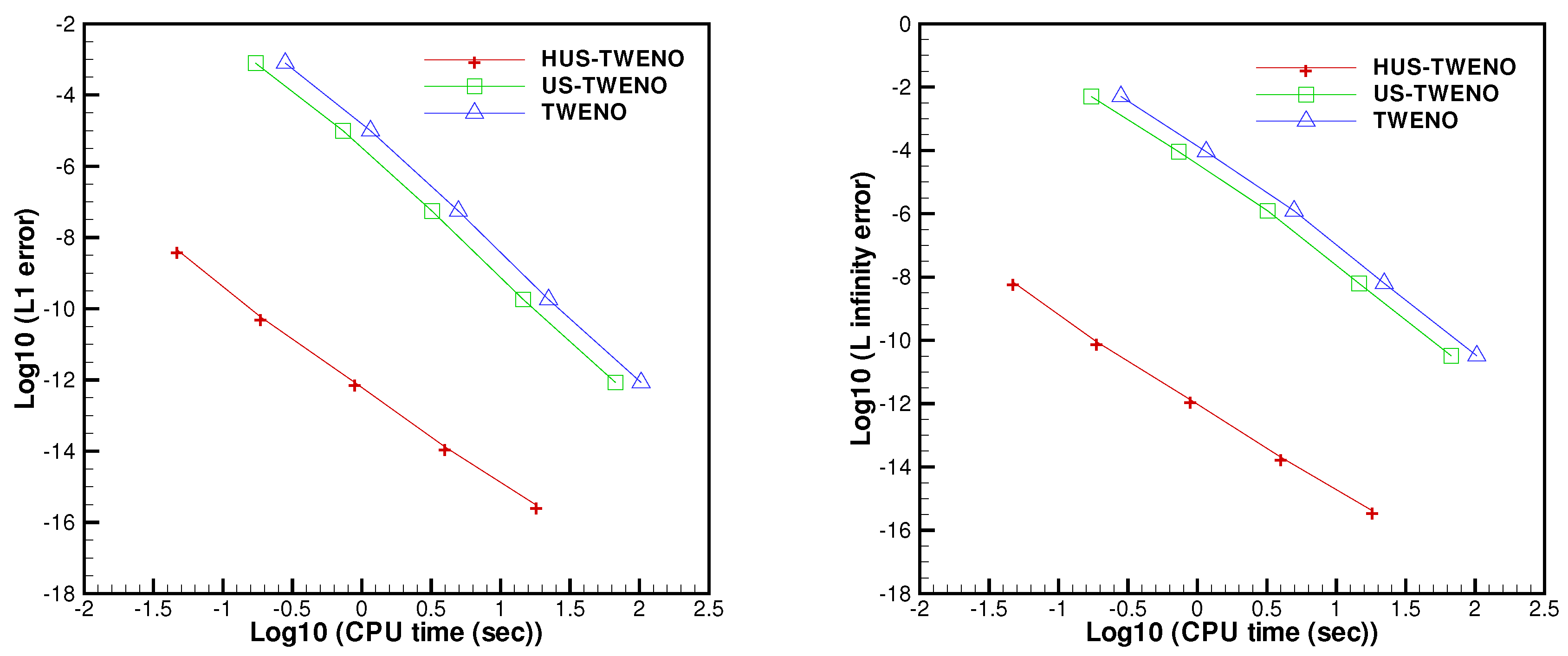
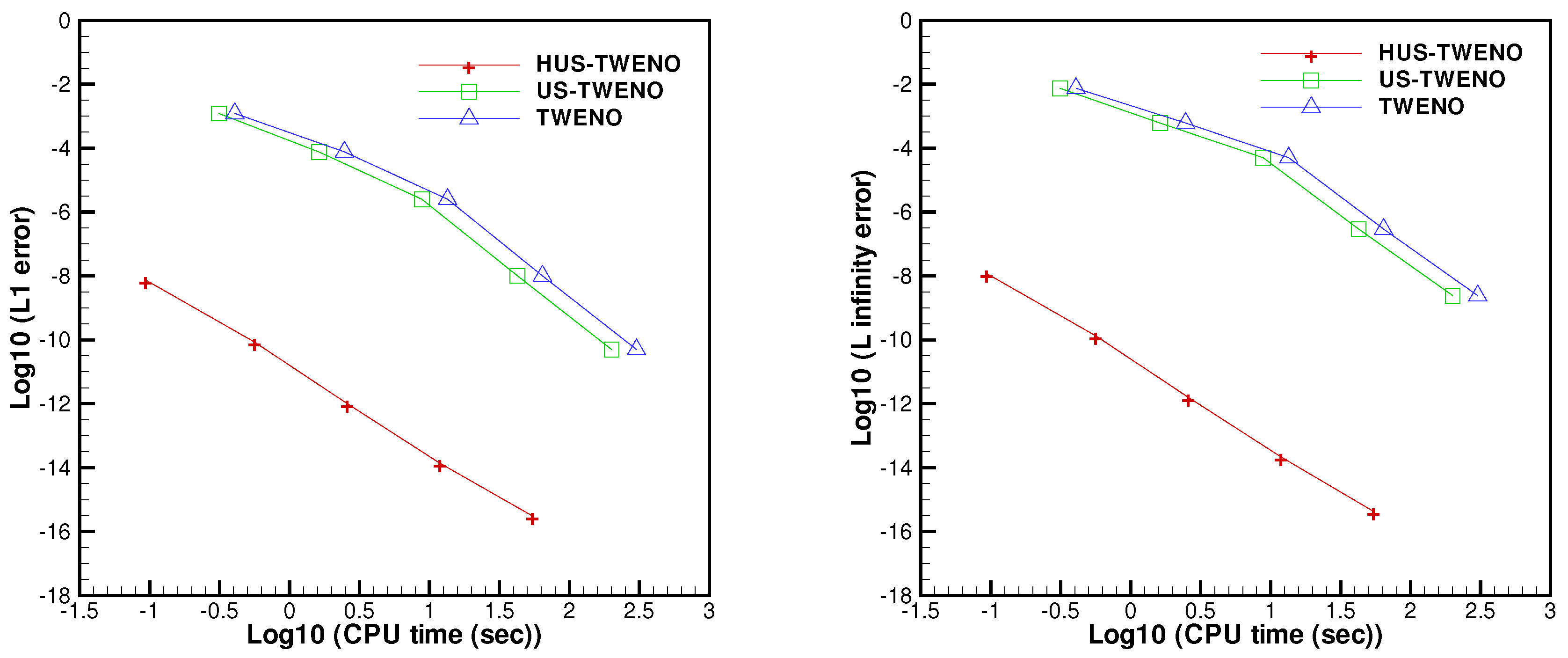
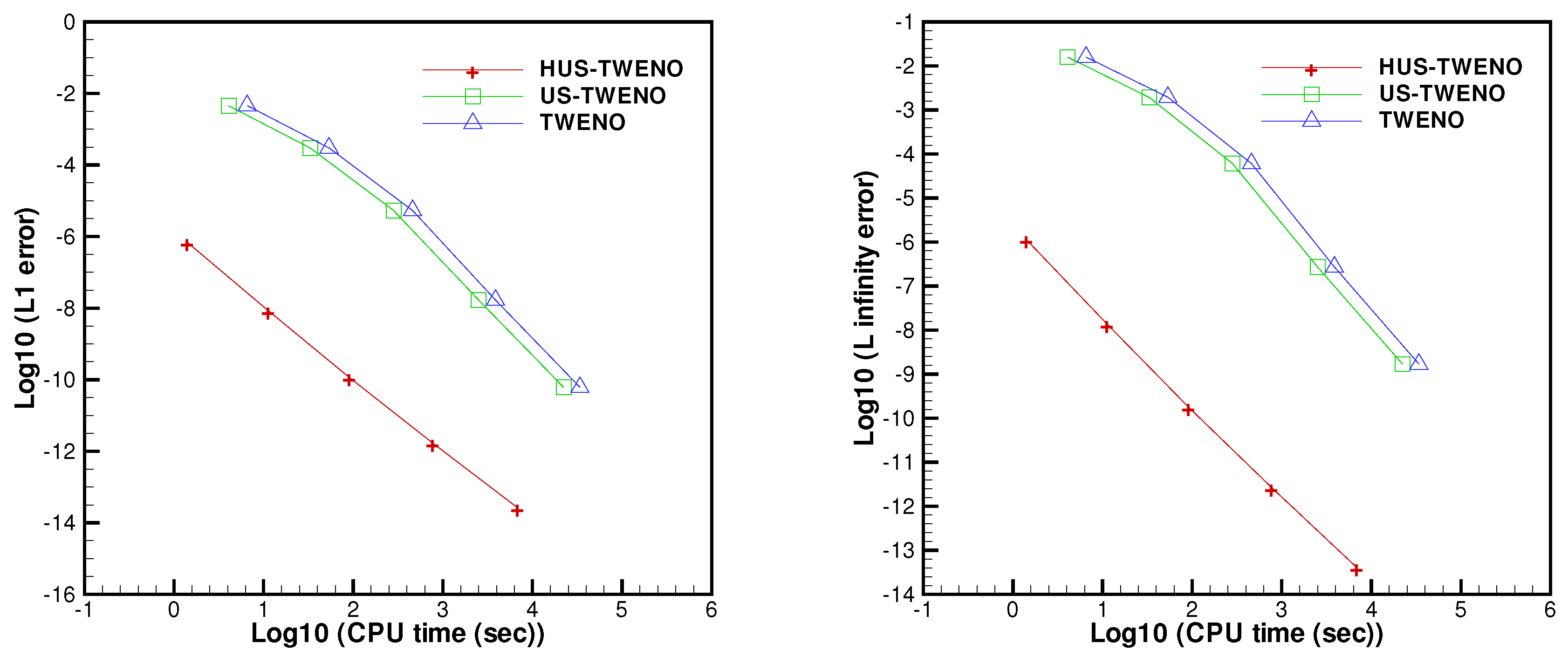
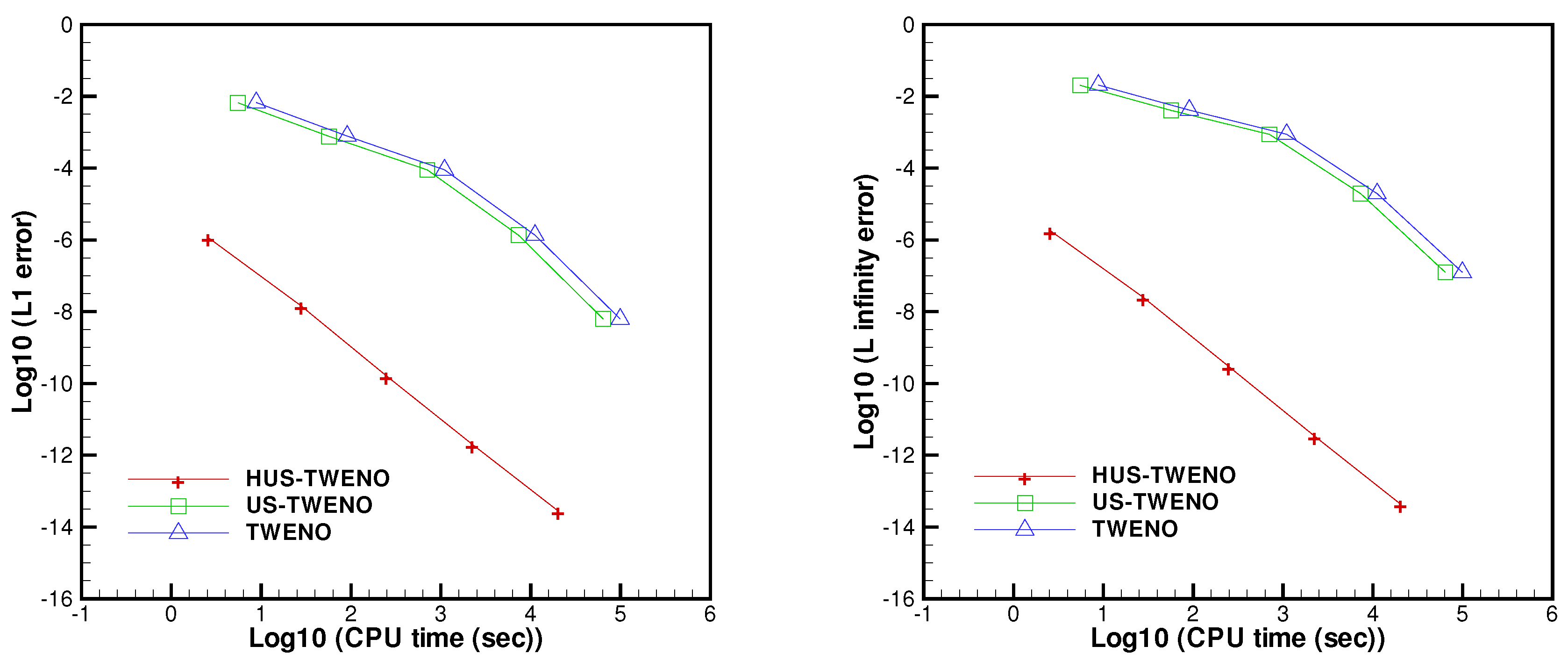
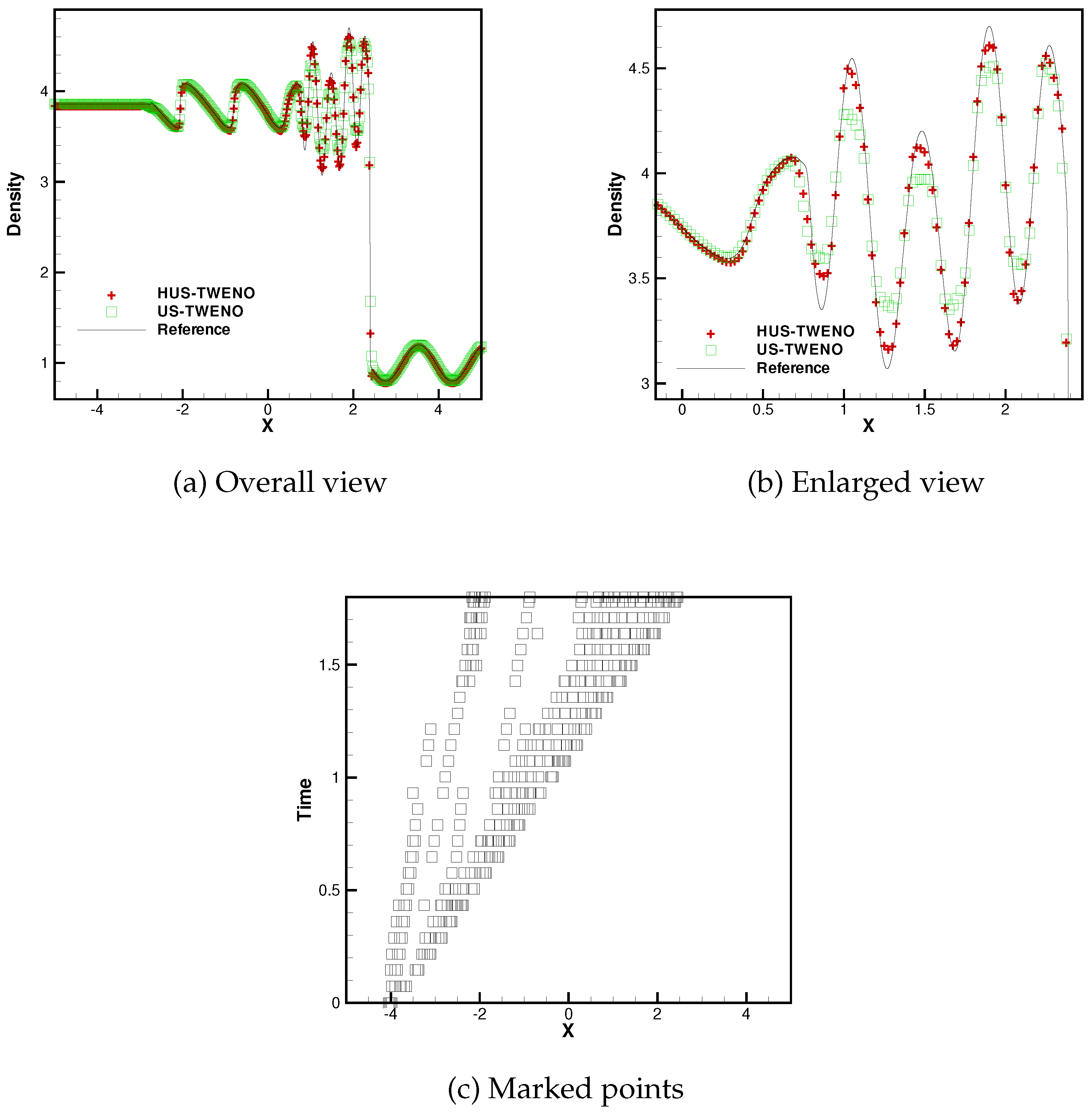
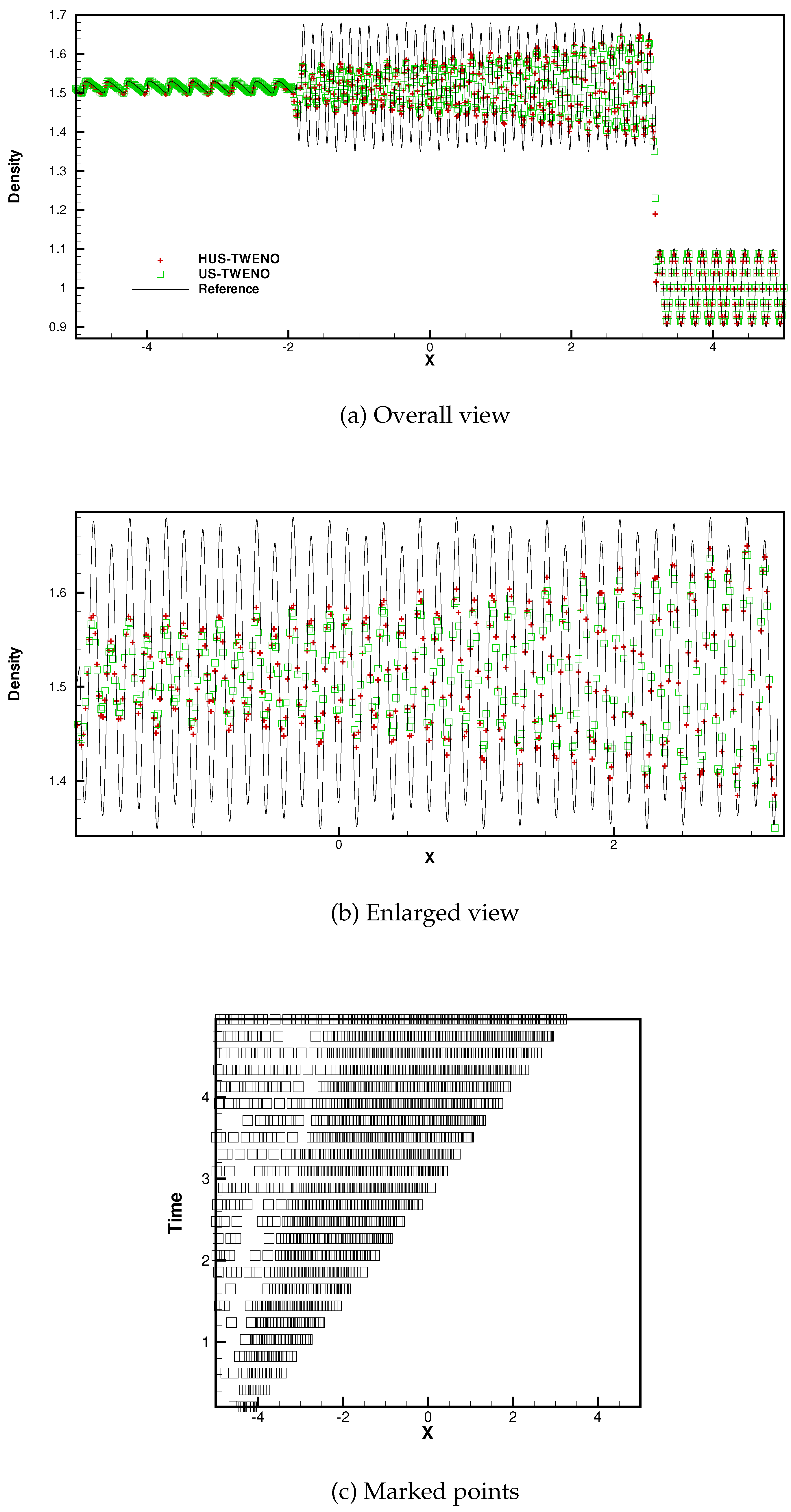
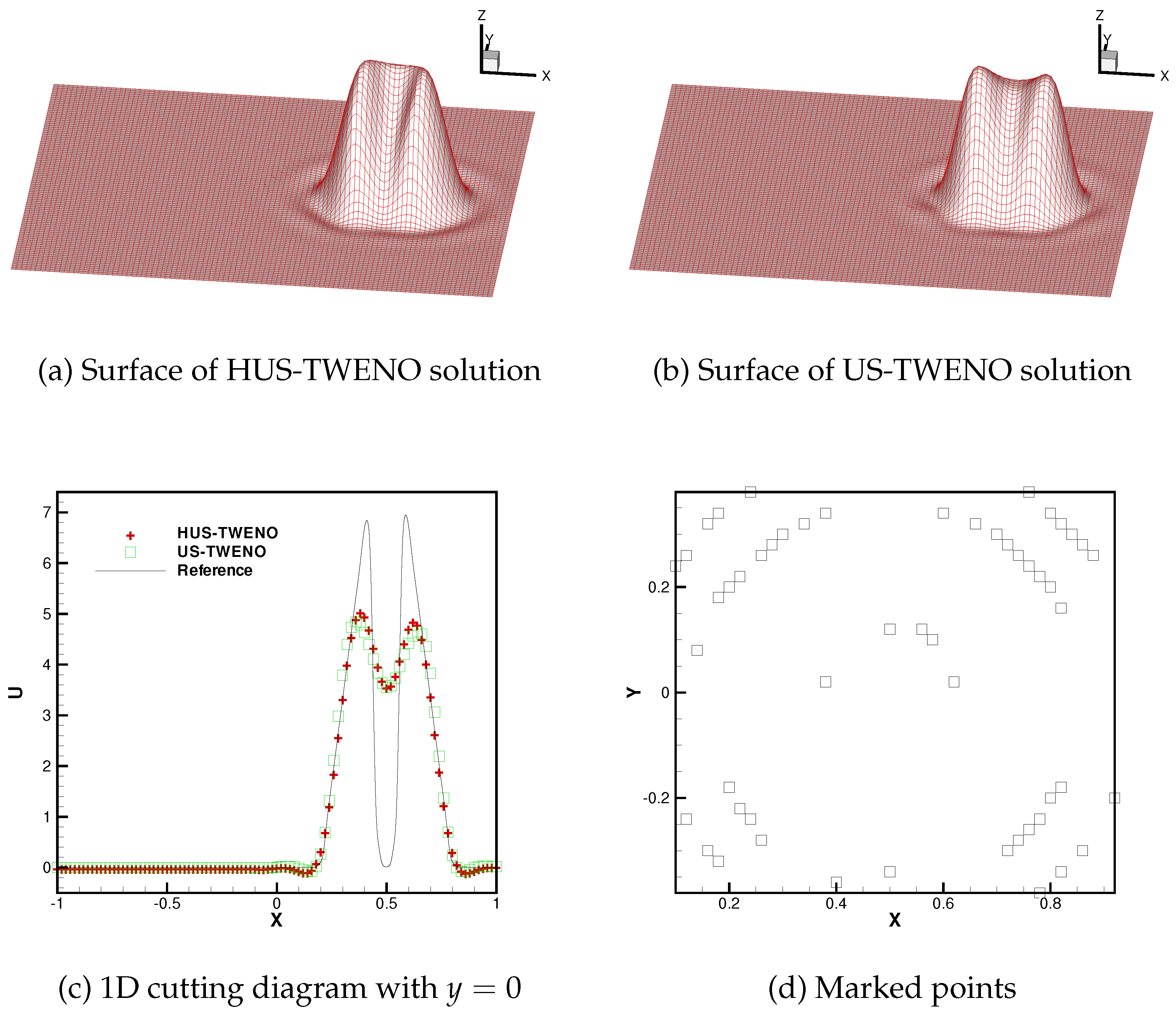
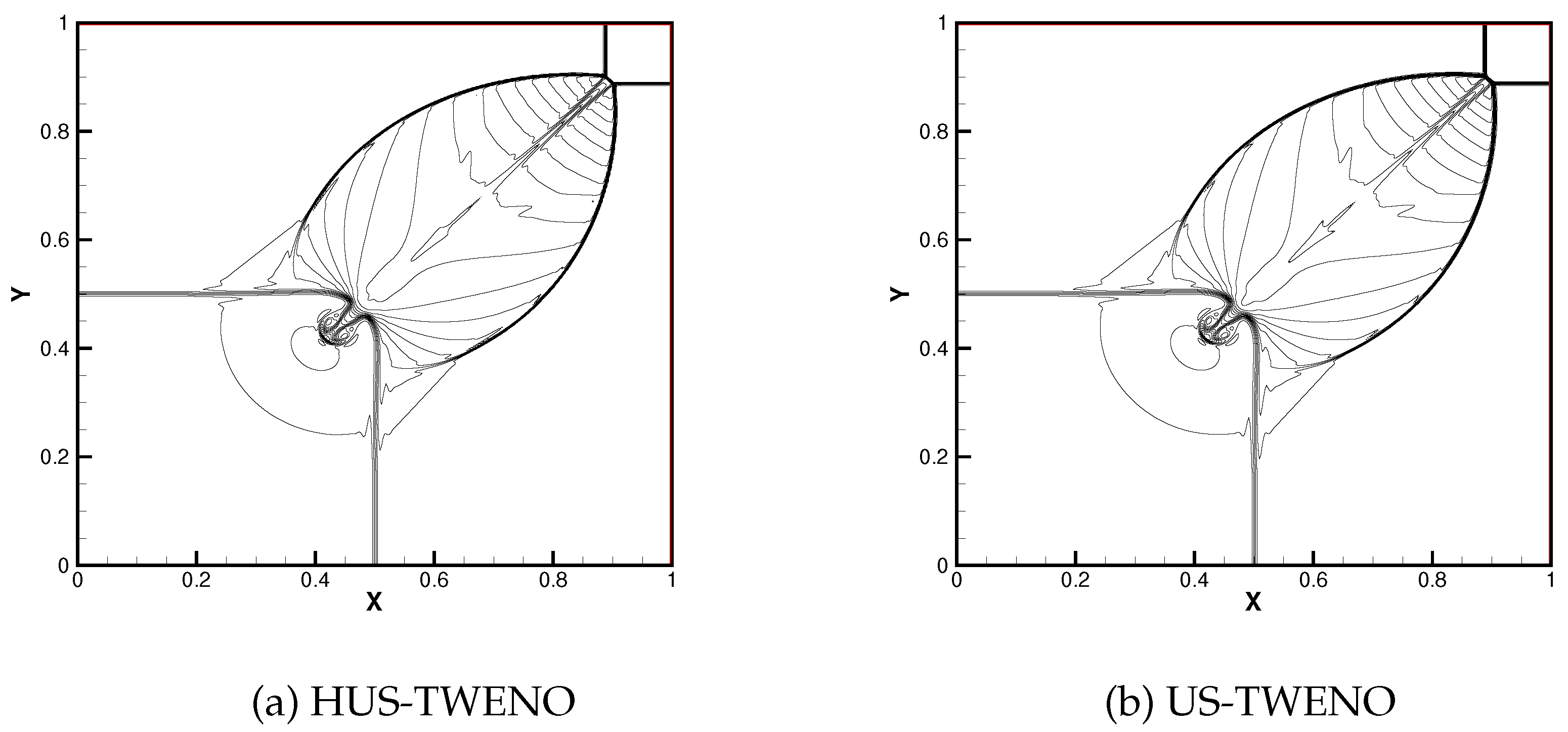
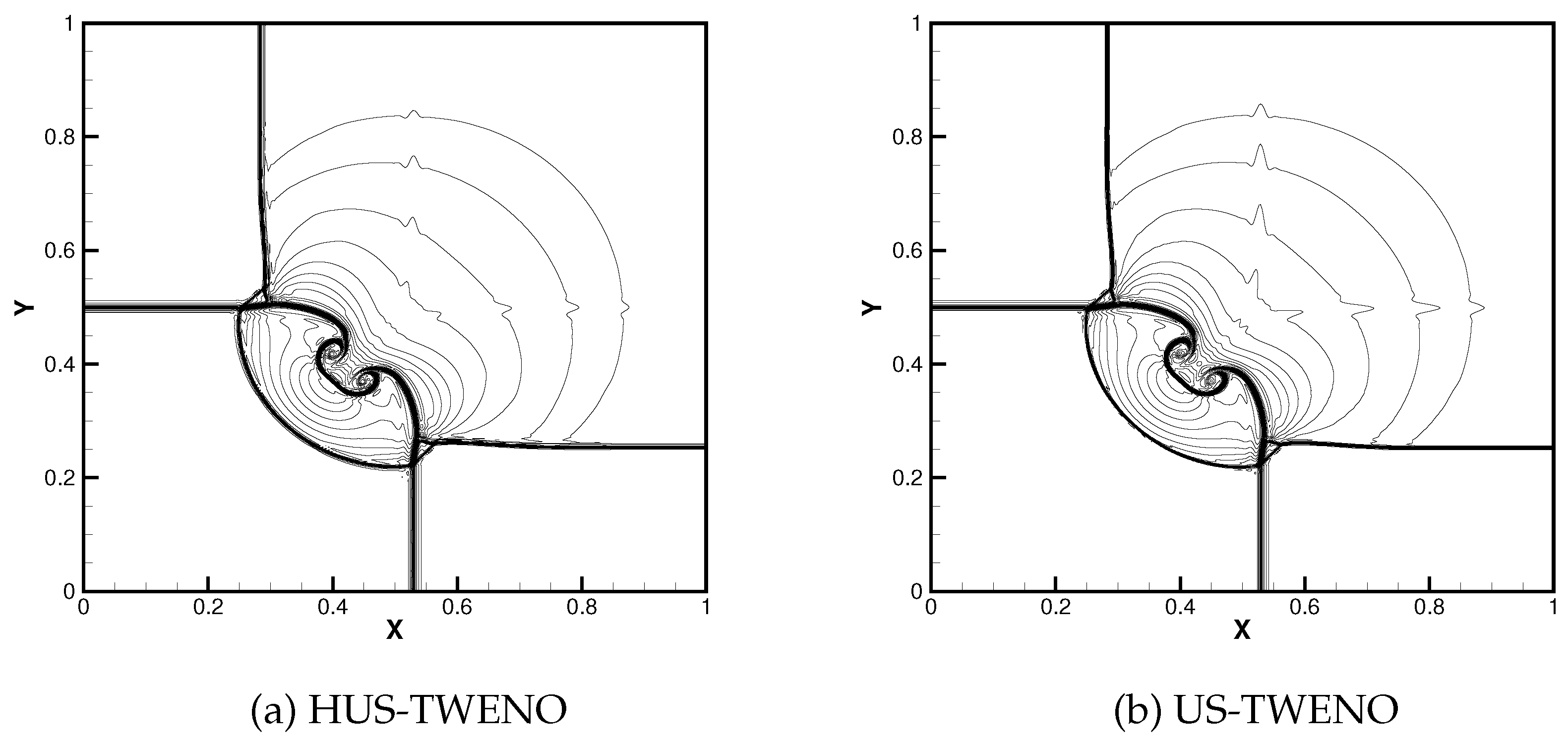
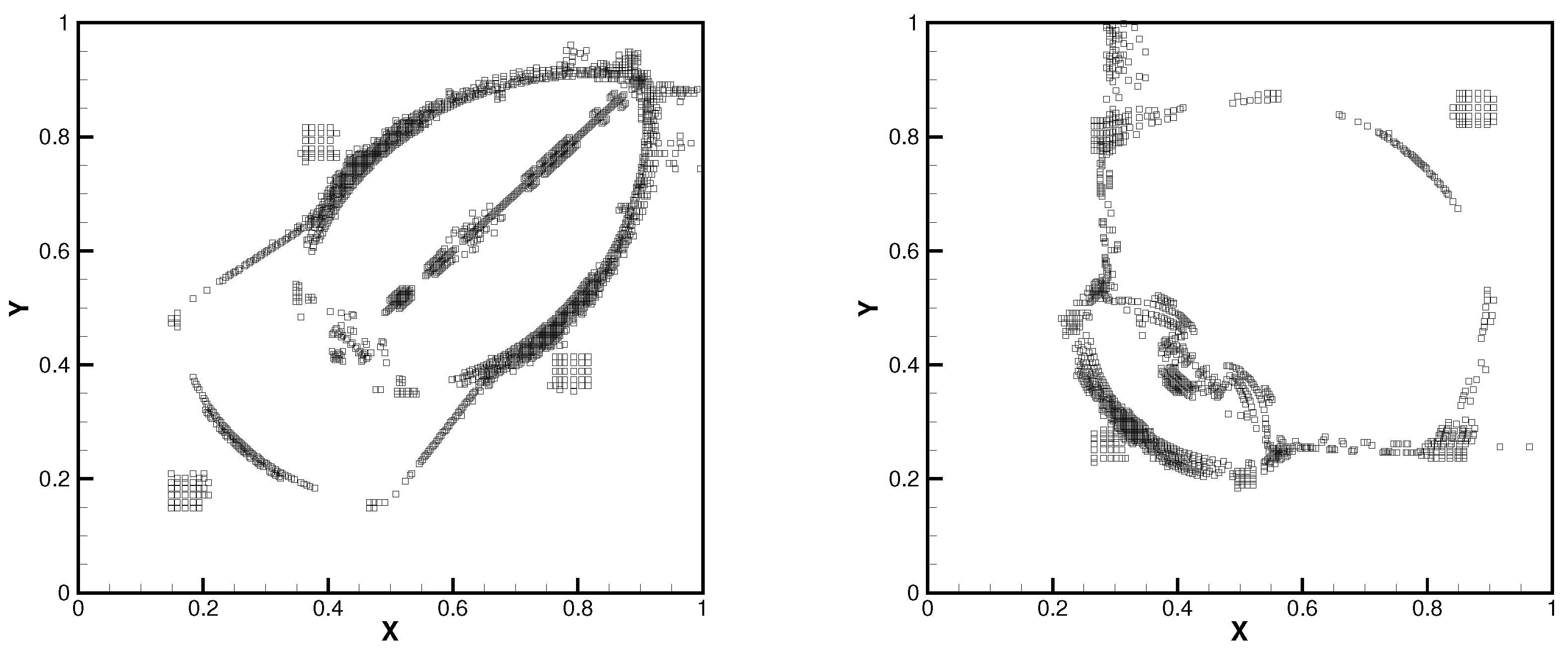
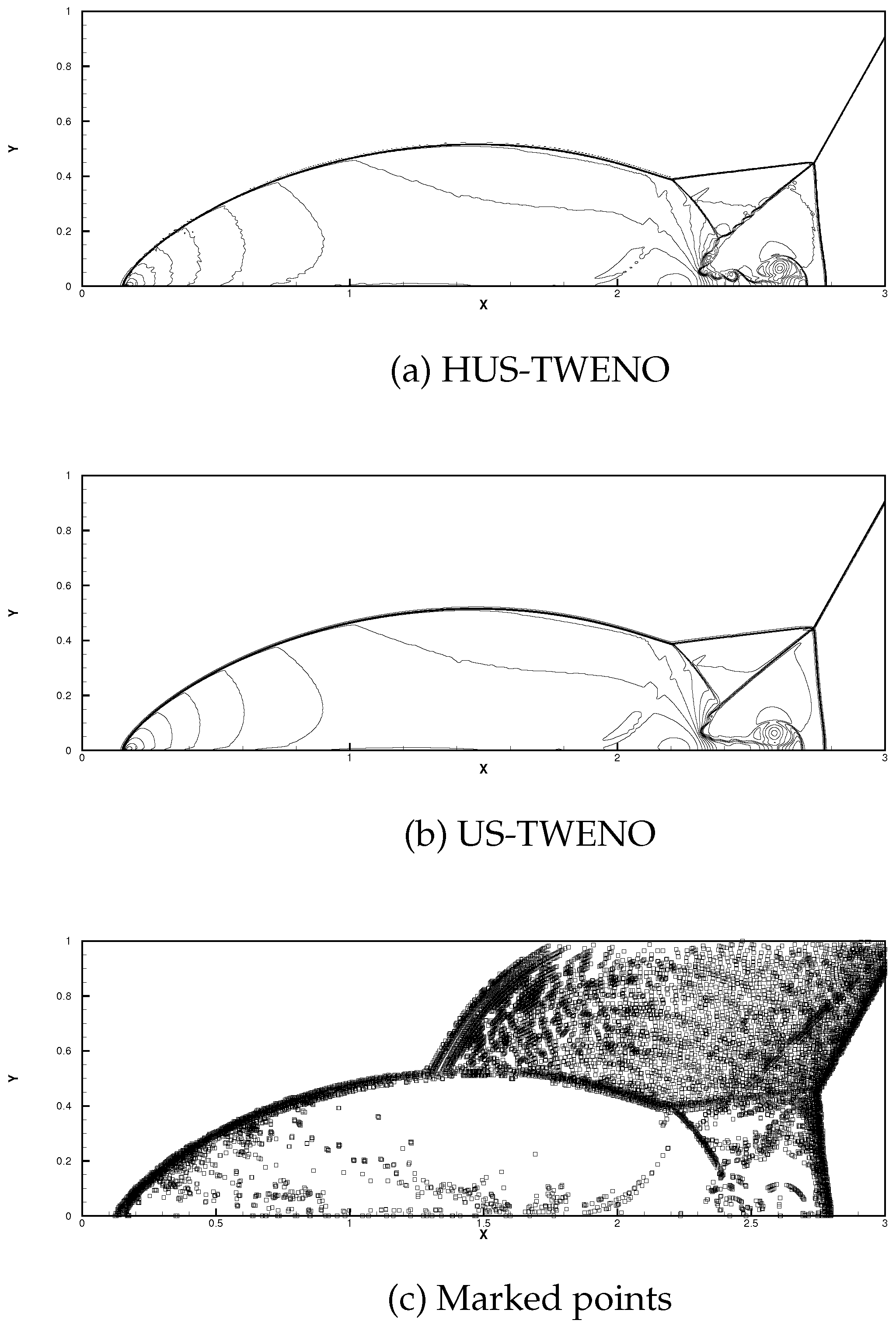
Section 3 presents several numerical evaluations to verify the high-order precision, high efficiency, and good performance of the novel US-TWENO and HUS-TWENO schemes, respectively.
Section 4 provides some concluding remarks in the end.
2. US-TWENO and HUS-TWENO Schemes
One-dimensional hyperbolic conservation laws are
and associated semi-discrete expression for (
1) is
wherein
represents the high-order finite difference spatial discretization of
. For clarity, the computational domain
is split into uniform intervals
using a constant grid spacing
(
N denotes the count of grid points).
is the cell center associated with the interval
.
stands for the numerical solution.
is the nodal point value. Following this, the right-hand side of Equation (
2) is
in which
denote the numerical fluxes at the interfaces
of the target cell
. The scheme achieves a fifth-order accuracy provided that
For maintaining the scheme’s stability,
can be divided into two components
, where
and
. Both exhibit smoothness as functions of
u. And we call for
As a popular approach, the Lax–Friedrichs flux splitting is selected by
in this context,
represents the upper limit of
within the range of
u. Based on this, the numerical flux
can be defined as
2.1. US-TWENO Scheme
On the premise that the cell averages
for every
j that is recognized, we intend to achieve a related degree trigonometric WENO polynomial approximation
limited to the target cell
, which relies on the stencils comprising
for
. The steps can be summarized in the following. The numerical fluxes in (
3) can be computed with the finite difference TWENO schemes. These characteristics provide numerous benefits to the TWENO schemes, including simplicity, efficiency, and robustness. This subsection uses the trigonometric polynomials instead of the algebraic polynomials to design the unequal-sized WENO spatial approximations for solving the highly oscillatory problems or wave-like phenomena. This US-TWENO scheme is reconstructed by using the data specified on a single five-point stencil and two two-point stencils in the new trigonometric polynomial space rather than relying on three equal-sized three-point stencils [
3] in algebraic polynomial space. This approach is intended to provide high-order precision in smooth areas while maintaining its ENO characteristics close to strong discontinuities. This method allows the optimal linear weights of the US-TWENO scheme to be any positive parameters as long as their sum equals one. Additionally, it can be readily adapted for use in multi-dimensional cases. The following part provides a detailed explanation of the new high-order spatial process.
Step 1. Select one five-point stencil
and two two-point stencils
,
to obtain a quartic trigonometric polynomial
and two linear trigonometric polynomials
, respectively, which satisfy
In which
,
,
,
,
. They are different to the trigonometric polynomial space that specified in [
16,
17,
18]. Therefore, we possess
where
Step 2. The linear weights are selected arbitrarily as some positive values, which are denoted by
,
, with their summation being one [
17,
36]. Because the arbitrary selection of linear weights does not affect the optimal precision, as an example, the linear weights are predetermined to be
,
, and
, which are similar to that specified in [
36].
Step 3. Calculate the smoothness indicators
of the trigonometric polynomials
over the interval
by applying the standard method in [
3,
5,
6,
14],
wherein
for
and
for
and
, respectively. Therefore, their specific expressions are
Their expansions in Taylor series about
are
It is assumed that they can be rewritten as
with non-zero constant
and
.
Step 4. Determine the nonlinear weights
as
by using
with
,
is a tiny positive constant to avoid having a zero denominator. Therefore, the nonlinear weights
satisfy the accuracy condition
[
12], which enables the WENO scheme to achieve formal fifth-order accuracy [
3,
5].
Step 5. The ultimate reconstruction polynomial
at
is formulated as
by setting
. The numerical flux
is reconstructed with mirror symmetry relative to
. As the final step, the semi-discrete scheme (
2) uses a fourth-order TVB Runge–Kutta approach [
40]
to obtain the full time discretization.
Remark 1. We solely present the formulation of the fifth-order US-TWENO scheme in one dimension. Finally, it is easy to adapt the US-TWENO spatial reconstruction techniques for two dimensions in a dimension-by-dimension approach.
2.2. HUS-TWENO Scheme
Following the numerical simulation experiments described in the subsequent part, it is proven that the developed US-TWENO scheme exhibits excellent precision in the zones with smooth variations and outstanding shock-capturing ability near strong discontinuities. Nonetheless, this enhanced performance comes at the cost of increasing the computational time. Therefore, a novel hybrid TWENO scheme is constructed to decrease the processing time based on the US-TWENO scheme mentioned above. The hybrid US-TWENO scheme strategically employs the high-order linear upwind scheme in smooth zones, which are the majority of the calculation area and the US-TWENO scheme close to strong discontinuities. Therefore, under the same conditions, the hybrid US-TWENO scheme has lower errors than the US-TWENO scheme. For the purpose of accurately, automatically, and efficiently identifying the troubled cells containing strong discontinuities, a novel troubled cell indicator is introduced through an application of the trigonometric polynomials. Therefore, the novel hybrid US-TWENO scheme for dealing with hyperbolic conservation laws is introduced in this subsection. The details are provided in the following.
Step 1. Obtain the first derivative of the quartic trigonometric polynomial
as
where
.
Step 2. Identify the extreme points of the reconstruction polynomial
. Determine whether the interval
is a troubled cell containing strong discontinuities or not, which is based on whether the cubic trigonometric polynomial
has at least one extreme point within it (that is, based on whether
has at least one zero point). This is because if polynomial
has extremum points in the interval
, there may be discontinuities in this interval. Although [
38] firstly determined the troubled cells by exactly solving the specific expressions of the zero points for the cubic algebraic polynomials in the range
in [
36,
38], it is hard to solve the zero points for the cubic trigonometric polynomials within
, which is more narrow than that specified in [
18,
36,
37,
38]. Therefore, this article only judges whether the minimum and maximum values of the cubic trigonometric polynomial
within
have different signs to determine whether the cubic trigonometric polynomial
has the zero points within
or not.
Step 3. Determine the minimum and maximum values of the cubic trigonometric polynomial
within
. This technology is still quite difficult for the high-degree trigonometric polynomials. However, through observation, it can be observed that each term
of the cubic trigonometric polynomial
shows a strictly monotonic behavior within very small intervals
and
based on
and (
15)–(
18). This implies that the maximum and minimum values of each term occur at the endpoints of both smaller intervals. As a result, it is not necessary to obtain a specific expression for the extreme point to roughly determine its position based on this property. On this basis, we calculate the maximum value
and minimum value
within
, and the maximum value
and minimum value
within
, respectively.
Step 4. According to (
36)–(
39), if
or
, the interval (the target cell)
is determined to be a troubled cell and the nonlinear US-TWENO scheme is used for obtaining the fifth-order spatial approximation. Otherwise, it is not recognized as a troubled cell and the fifth-order linear upwind scheme is employed for obtaining the same order spatial approximation. Here,
h represents the spatial grid step size, used to filter out grid points where the maximum and minimum values are nearly identical.
Finally, for the convenience of the readers, the proposed algorithm for the one-dimensional case can be summarized as Algorithms 1 and 2 below.
| Algorithm 1 The proposed troubled cell indicator |
Input: Density Output:
Compute the coefficients of polynomial ; for to N do Compute , , and by Equations ( 36)–( 39) if or then else end end return
|
| Algorithm 2 HUS-TWENO scheme |
Input: and Output:
if
then obtained by the linear method; else obtained by the US-TWENO scheme described in Section 2.1; end return
|
Remark 2. In this article, the fluxes in (11) are substituted by the density ρ for detecting the troubled cells. Alternatively, the fluxes can be directly used and result in a different count of the troubled cells without impacting other algorithm properties. It is also worth noting that the identification algorithm for designing the troubled cells is manual parameter-free related to the problems, which makes it convenient for simulating some large-scale engineering problems. Remark 3. In order to reduce spurious oscillations when simulating multi-dimensional Euler equations, the US-TWENO scheme is applied along the local characteristic directions [3,5]. The identification of the troubled cells and the high-order linear upwind schemes are still executed in the physical space to save time, since their implementation by using the characteristic variables, computing the optimal linear weights, computing the complicated smoothness indicators, and computing the nonlinear weights are lengthy. Obviously, the HUS-TWENO scheme achieves formal fifth-order accuracy, since the analysis above has shown that the US-TWENO scheme achieves formal fifth-order accuracy, and the linear upwind scheme is of fifth-order accuracy. 4. Concluding Remarks
This study develops a novel fifth-order finite difference US-TWENO scheme and a novel hybrid US-TWENO (HUS-TWENO) scheme with a novel troubled cell indicator. Firstly, a new finite difference US-TWENO scheme has been crafted within the new trigonometric polynomial space to address hyperbolic conservation laws and highly oscillatory issues in comparison to that specified in [
16,
17,
18]. We could randomly set the linear weights, compute the smoothness indicators, and compute the novel nonlinear weights. The main advantages of this US-TWENO scheme lie in its robustness in solving problems containing strong shocks or high oscillations, its ability to gain the optimal fifth-order precision, and its ease of coding in programs compared to before. After that, the fifth-order finite difference HUS-TWENO scheme is developed. Among which, the novel troubled cell indicator, which requires no manual parameters related to the problems, is based on two quartic trigonometric polynomials. It detects the discontinuities by detecting the extreme points of the related reconstruction trigonometric polynomials within the narrowest interval
, which is more constricted than
and
in [
37,
38] on structured grids and the two-dimensional interval in [
39] on triangular grids, respectively, in the algebraic polynomial space. Moreover, we use the signs of the estimated minimum and maximum values to identify the zero points of the corresponding derivative trigonometric polynomials, avoiding complicated and time-consuming root-solving procedures. Therefore, the HUS-TWENO scheme, built using this novel troubled cell indicator, not only retains the excellent properties of the US-WENO scheme [
14], whose reconstruction polynomials are in the algebraic polynomial space, but also features several distinct advantages, including the narrowest interval for detecting troubled cells, the seamless switching between the complex US-TWENO scheme and the linear upwind scheme, efficient computation, and the sharp shock transitions around strong discontinuities. Lastly, several numerical tests are conducted to demonstrate the effectiveness of the fifth-order HUS-TWENO scheme, since it can approximately reduce 37–73% CPU time relative to the novel fifth-order US-TWENO scheme on structured grids.