Next Article in Journal
Pair of Associated η-Ricci–Bourguignon Almost Solitons with Vertical Torse-Forming Potential on Almost Contact Complex Riemannian Manifolds
Previous Article in Journal
Analysis of Discretization Errors in the Signal Model of the Integrate-And-Dump Filter in Satellite Navigation Receivers
error_outline You can access the new MDPI.com website here. Explore and share your feedback with us.
 
 
Article

Spatiotemporal Pattern Selection in a Modified Leslie–Gower Predator–Prey System with Fear Effect and Self-Diffusion


1
Basic Courses Department, Institute of Disaster Prevention, Langfang 065201, China
2
School of Mathematical Sciences, Beihang University, Beijing 100191, China
*
Author to whom correspondence should be addressed.
Mathematics 2026, 14(1), 190; https://doi.org/10.3390/math14010190
Submission received: 20 November 2025 / Revised: 19 December 2025 / Accepted: 22 December 2025 / Published: 4 January 2026

Abstract

Indirect fear effects profoundly influence predator–prey dynamics by reducing prey reproduction. Whereas previous studies have investigated fear effects or self-diffusion separately in Leslie–Gower models, the novelty of this work lies in their simultaneous incorporation into a modified Leslie–Gower predator–prey system with Allee effect, leading to previously unreported bifurcations and spatiotemporal pattern selection. The temporal system exhibits up to six equilibria and undergoes a codimension-2 Bogdanov–Takens bifurcation. In the spatial extension, Turing instability is triggered when the predator diffusion coefficient exceeds a critical threshold. Using weak nonlinear multiple-scale analysis, amplitude equations are derived, and their stability analysis classifies stationary patterns into spots, stripes, and spot–stripe mixtures depending on the distance from the Turing onset. Numerical simulations confirm that low, moderate, and high predator diffusivity, respectively, favour spotted, mixed, and striped prey distributions. These results emphasise the critical role of fear-mediated indirect interactions and diffusion in driving spatial heterogeneity and ecosystem stability.

1. Introduction

Predator–prey interactions lie at the heart of theoretical ecology. The pioneering works of Lotka [1] and Volterra [2] introduced ordinary differential equations to describe population cycles, inspiring a century of mathematical developments ranging from limit cycles and homoclinic orbits to Hopf, homoclinic, and higher-codimension bifurcations [3,4,5,6]. Among various formulations, the modified Leslie–Gower model, in which predator carrying capacity depends on prey abundance, has proven particularly successful for systems with alternative prey or environmental protection [7,8,9,10,11,12,13,14].
In recent years, two biologically crucial mechanisms have attracted increasing attention. First, empirical evidence has repeatedly shown that the perceived risk of predation (“fear effect”) can dramatically reduce prey reproduction and alter population dynamics even in the absence of direct killing [15,16,17,18]. Theoretical studies confirm that fear can stabilise or destabilise coexistence, induce Hopf bifurcations, and even drive prey to extinction while predators survive on alternative resources [18,19,20,21,22,23,24,25,26]. Second, spatial self-diffusion is now recognised as a primary driver of Turing pattern formation in predator–prey systems [27,28,29].
Despite substantial independent progress on both fronts, their simultaneous incorporation into a Leslie–Gower framework remains largely unexplored. Existing studies either include fear without diffusion [22,24,25,26], or incorporate diffusion without fear [27,28,30], or combine them with alternative functional responses (e.g., Holling type-II or Beddington–DeAngelis) but omit the Allee effect or lack in-depth codimension-2 bifurcations and pattern-selection analysis [31]. For instance, the model presented in [32] incorporates fear, Allee, and cross-diffusion, revealing codimension-1 bifurcations (saddle-node and Hopf) and general Turing patterns, but does not explore self-diffusion-driven transitions or weakly nonlinear classifications of specific pattern sequences.
Based on the previous discussion, we seek to explore the combined impact of incorporating both fear effect and self-diffusion into a modified Leslie–Gower predator–prey model. To our knowledge, this aspect has not been previously examined. Our focus is on understanding how these factors influence the system’s dynamic behavior, which is expressed in the following form:
d x d t = r x 1 + e y 1 x k ( x M ) α x y x + m + D 1 Δ x , d y d t = s y 1 β y x + m + D 2 Δ y ,
where e represents the fear level, while r and s denote the birth rates of the prey and predator populations, respectively. M is the Allee threshold, and D 1 and D 2 are the diffusion coefficients for the prey and predator populations, respectively. The term Δ refers to the two-dimensional Laplace operator on Ω R 2 . In this context, we will describe the pattern formation mechanism for the system (1) with the initial conditions x ( u , v , 0 ) > 0 and y ( u , v , 0 ) > 0 and zero-flow boundary conditions (i.e., individuals cannot enter or exit through the boundary).
x n ( u , v ) = y n ( u , v ) = 0 , ( u , v ) Ω .
Our system assumes homogeneous environmental parameters (e.g., resource availability, and habitat quality) across the spatial domain, excluding spatial heterogeneity (e.g., resource gradients, and refuges) that could alter pattern formation and species coexistence.
The present work closes this gap by introducing a fear term 1 / ( 1 + e y ) and self-diffusion into a modified Leslie–Gower predator–prey model with Allee effect in the prey. To the best of our knowledge, this specific combination has not been previously investigated. Our analysis reveals three qualitatively new phenomena that arise only from the interplay between fear and diffusion:
(i)
Fear shifts the location of the codimension-2 Bogdanov–Takens cusp in the temporal system, generating enhanced multistability with up to six equilibria (Section 3).
(ii)
Fear raises the critical predator diffusion coefficient required for Turing instability and modulates the wavelength of emergent patterns (Section 4).
(iii)
The coupled system exhibits a clear predator-diffusivity-driven pattern sequence: spots to spot–stripe mixtures to pure stripes—a transition not observed in fear-free counterparts (Section 5 and Section 6).
These results demonstrate that indirect non-consumptive effects can profoundly reshape both temporal bifurcation structure and spatial self-organization, with direct implications for understanding patchy distributions observed in savannas, grasslands, and marine ecosystems.
We find that the diffusion coefficient significantly influences pattern emergence and transition: in the absence of diffusion, the model is spatially homogeneous; small diffusion induces spot patterns, while large diffusion leads to stripe patterns—likely associated with prey avoiding predators and predators chasing prey.
In order to simplify the system (1), we transform
x = k x ¯ , y = r k 2 y ¯ α , t = t ¯ r k .
We still use x , y to denote x ¯ , y ¯ , and system (1) becomes
d x d t = x ( 1 x ) ( x a ) 1 + f y x y x + b + d 1 Δ x , d y d t = c y 1 d y x + b + d 2 Δ y ,
where a = M k , b = m k , f = e r k 2 α , c = s r k , d = r β k α , d 1 = D 1 r k , d 2 = D 2 r k are positive constants, and their biology interpretation is given in Table 1.
The remainder of the paper is organised as follows. Section 2 presents the model and basic properties of the non-spatial (temporal) system. Section 3 analyses equilibria, local stability, and the Bogdanov–Takens bifurcation of codimension-2 (lengthy algebraic expressions are moved to Appendix A). Building on these temporal insights, Section 4 transitions to the spatial domain by deriving conditions for Turing instability in the reaction–diffusion system. Section 5 performs weakly nonlinear analysis to obtain amplitude equations and determines pattern selection and stability regions. We provide extensive numerical simulations confirming the analytical predictions. We conclude in Section 6 with ecological implications and directions for future research.

2. Equilibria and Their Properties of the Temporal System

The temporal model corresponds to the spatial model (4) and is
x ˙ = x ( 1 x ) ( x a ) 1 + f y x y x + b , y ˙ = c y 1 d y x + b .
The existence of equilibrium points is easily obtained by considering the prey nullcline and predator nullcline of system (5), which are given by
x ( 1 x ) ( x a ) 1 + f y x y x + b = 0 , c y 1 d y x + b = 0 .
After a simple calculation, the following conclusions can be reached.
Theorem 1. 
(1) 
System (5) has four boundary equilibria, E 1 0 , 0 , E 2 1 , 0 , E 3 a , 0 , and E 4 0 , b d ;   E 1 and E 2 are always saddles, E 4 is always a stable node, and E 3 is always an unstable node.
(2) 
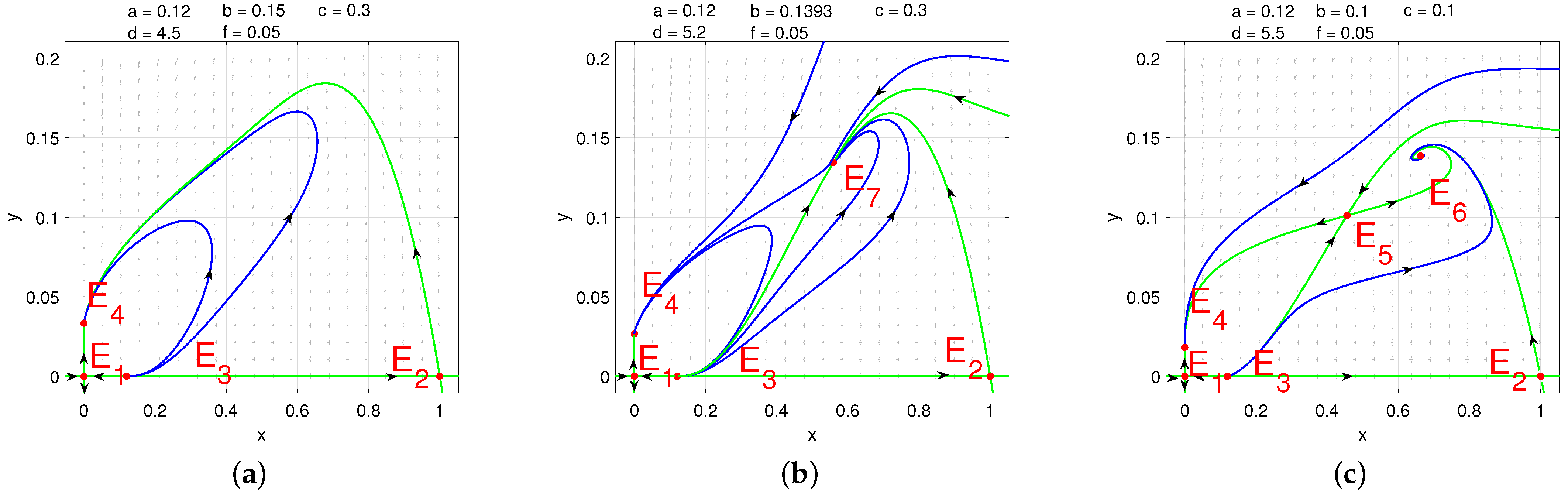
When D > 0 , system (5) has two positive equilibria E 5 x 5 , 1 d x 5 + b , E 6 x 6 , 1 d x 6 + b , where x 5 = d + a d f d D 2 d , x 6 = d + a d f d + D 2 d , D = f d a d d 2 4 d b f d + a d + 1 . E 5 is always a saddle, E 6 can be a source, a sink, or a center relying on the parametric values (see Figure 1).
In the phase space of system (5), there are always four boundary equilibria: the origin E 1 ( 0 , 0 ) (saddle, extinction attractor), E 2 ( 1 , 0 ) (saddle, prey-only attractor), E 3 ( a , 0 ) (unstable node, Allee-induced prey extinction), and E 4 ( 0 , b / d ) (stable node, predator-only attractor). When D > 0 , two interior equilibria E 5 (saddle) and E 6 (possible stable node, focus, or center) emerge, leading to up to two attractors. No limit cycles or homoclinic loops are present; transitions occur via saddle-node bifurcations. Biologically, the fear and Allee effects create multistability, allowing the ecosystem to converge to extinction or coexistence depending on initial conditions and fear level f, emphasizing vulnerability to perturbations like increased perceived risk causing regime shifts in prey–predator dynamics.
The Jacobian of system (5) is shown by
J = 1 1 + f y 3 x 2 + 2 ( a + 1 ) x a b y ( x + b ) 2 x ( x 1 ) ( x a ) f ( 1 + f y ) 2 x x + b c d y 2 ( x + b ) 2 c ,
and we obtain
t r J = 1 1 + f y [ ( 1 x ) ( x a ) x ( x a ) + x ( 1 x ) ] b y ( x + b ) 2 c , d e t J = c 1 + f y [ ( 1 x ) ( x a ) x ( x a ) + x ( 1 x ) ] + b c y ( x + b ) 2 c x ( x 1 ) ( x a ) d ( 1 + f y ) 2 + c x d ( x + b ) .
So, we can obtain the stability of each equilibrium, which is stated in Theorem 2.
Theorem 2. 
If D = 0 , system (5) has a unique positive equilibrium E 7 ( x 7 , y 7 ) = ( 1 + a f d 2 2 , 1 + a + 2 b f d 2 2 d ) , then
(1) 
if a 10 + b 01 0 , E 7 is a saddle-node;
(2) 
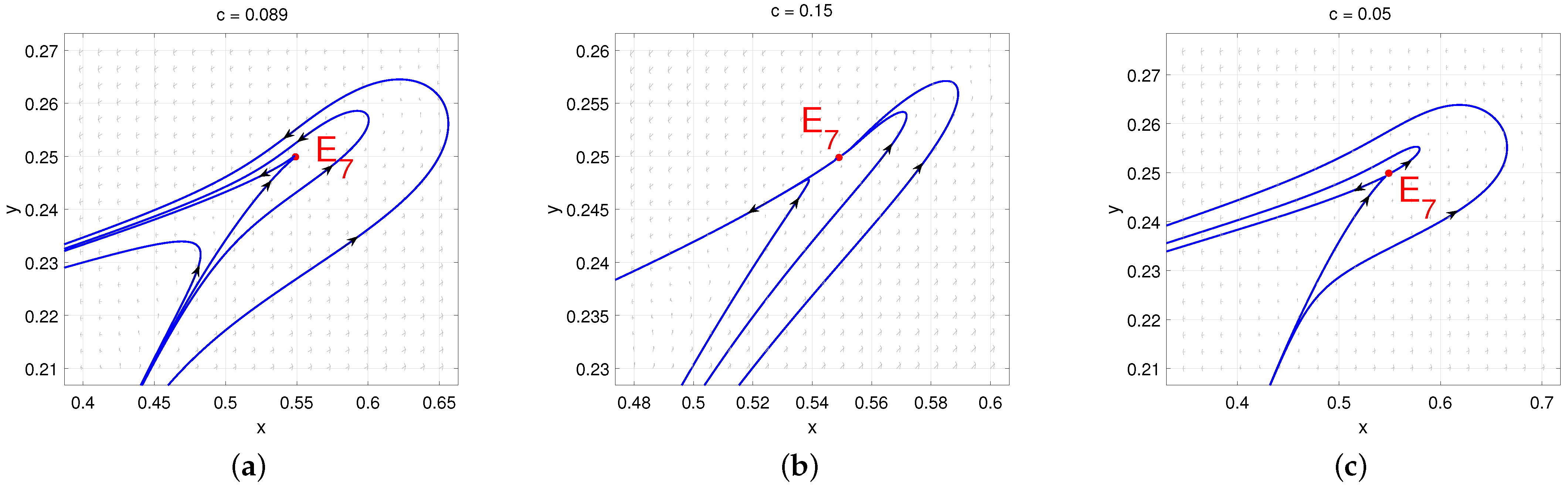
if a 10 + b 01 = 0 and e 2 0 , E 7 is a cusp of codimension-2 (see Figure 2).
Proof. 
Let x x 7 x and y y 7 y to change the equilibrium point E 7 to ( 0 , 0 ) . Then the Taylor expansion of system (5) near ( 0 , 0 ) can be reformulated as
x ˙ = a 10 x + a 01 y + a 20 x 2 + a 11 x y + a 02 y 2 + o | x , y | 2 , y ˙ = b 10 x + b 01 y + b 20 x 2 + b 11 x y + b 02 y 2 + o | x , y | 2 ,
where
a 10 = a + 2 ( a + 1 ) x 7 3 x 7 2 1 + f y 7 b y 7 ( x 7 + b ) 2 , a 01 = x 7 x 7 + b f x 7 ( 1 x 7 ) ( x 7 a ) ( 1 + f y 7 ) 2 , a 20 = 1 + a 3 x 7 1 + f y 7 + b y 7 ( x 7 + b ) 3 , a 11 = b ( x 7 + b ) 2 f a + 2 ( a + 1 ) x 7 3 x 7 2 ( 1 + f y 7 ) 2 , a 02 = f 2 x 7 ( 1 x 7 ) ( x 7 a ) ( 1 + f y 7 ) 3 , b 10 = c d , b 01 = c , b 20 = c d y 7 2 ( x 7 + b ) 3 , b 11 = 2 c d y 7 ( x 7 + b ) 2 , b 02 = c d x 7 + b .
Case 1: a 10 + b 01 0 . Let
x y = d d a 10 c 1 1 u v ,
and system (7) becomes
u ˙ = c 20 u 2 + c 11 u v + c 02 v 2 + o ( | u , v | 2 ) , v ˙ = ( c + a 10 ) v + d 20 u 2 + d 11 u v + d 02 v 2 + o ( | u , v | 2 ) ,
where c 20 = x 7 c d ( 1 x 7 ) ( x 7 a ) , since c 20 0 , E 7 ( x 7 , y 7 ) is saddle-node.
Case 2: a 10 + b 01 = 0 . Let
u v = 0 1 1 d x y ,
and system (7) becomes
u ˙ = v + b 20 v 2 + o ( | u , v | 2 ) , v ˙ = e 1 u 2 + e 2 u v + e 3 v 2 + o ( | u , v | 2 ) ,
where
e 1 = d x 7 ( 1 x 7 ) ( x 7 a ) , e 2 = b a + b 2 + a b + b + 4 d a ( x 7 a ) 2 1 ( x 7 1 ) 2 < 0 .
If e 2 0 , E 7 ( x 7 , y 7 ) is a cusp of codimension-2.   □
When D = 0 , the unique interior equilibrium E 7 is a saddle-node if a 10 + b 01 0 (bistable with extinction attractor) or a codimension-2 cusp if a 10 + b 01 = 0 and e 2 0 (tipping point for multiple attractors). No homoclinic loops; supercritical Hopf bifurcation may introduce a stable limit cycle as a periodic attractor near the cusp. Biologically, moderate fear stabilizes coexistence by damping cycles, but high fear triggers Hopf bifurcation, eliminating oscillations and leading to prey extinction while predators persist, mirroring “silent” prey declines in ecosystems with intense perceived predation.

3. Bogdanov–Takens Bifurcation Analysis of the Temporal System

In this section, we perform a Bogdanov–Takens (BT) bifurcation analysis of the temporal system. This codimension-2 bifurcation occurs when an equilibrium has a double zero eigenvalue (i.e., both the determinant and the trace of the Jacobian vanish) and corresponds to the interaction of saddle-node, Hopf, and homoclinic bifurcations in the parameter plane.
Theorem 3. 
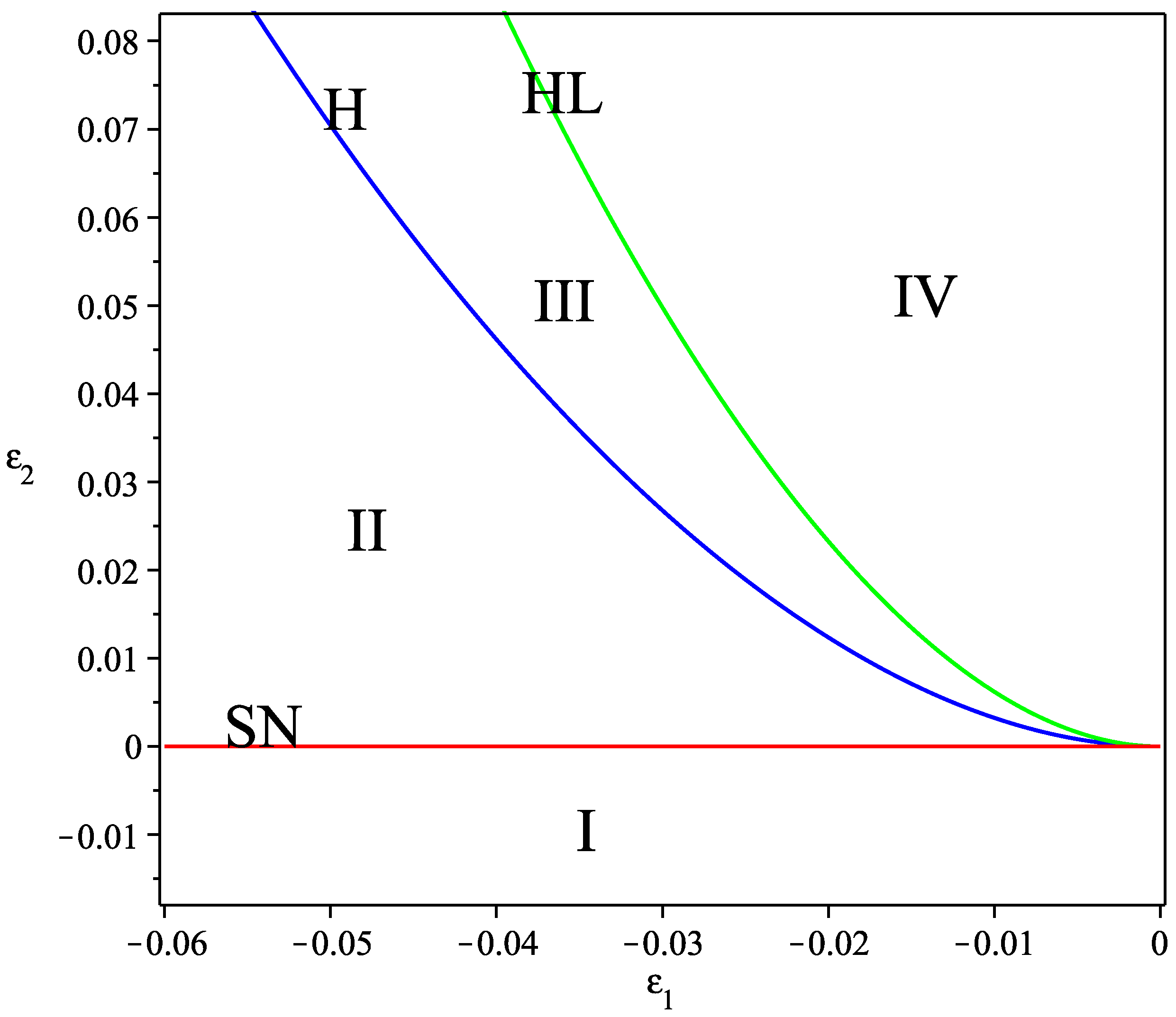
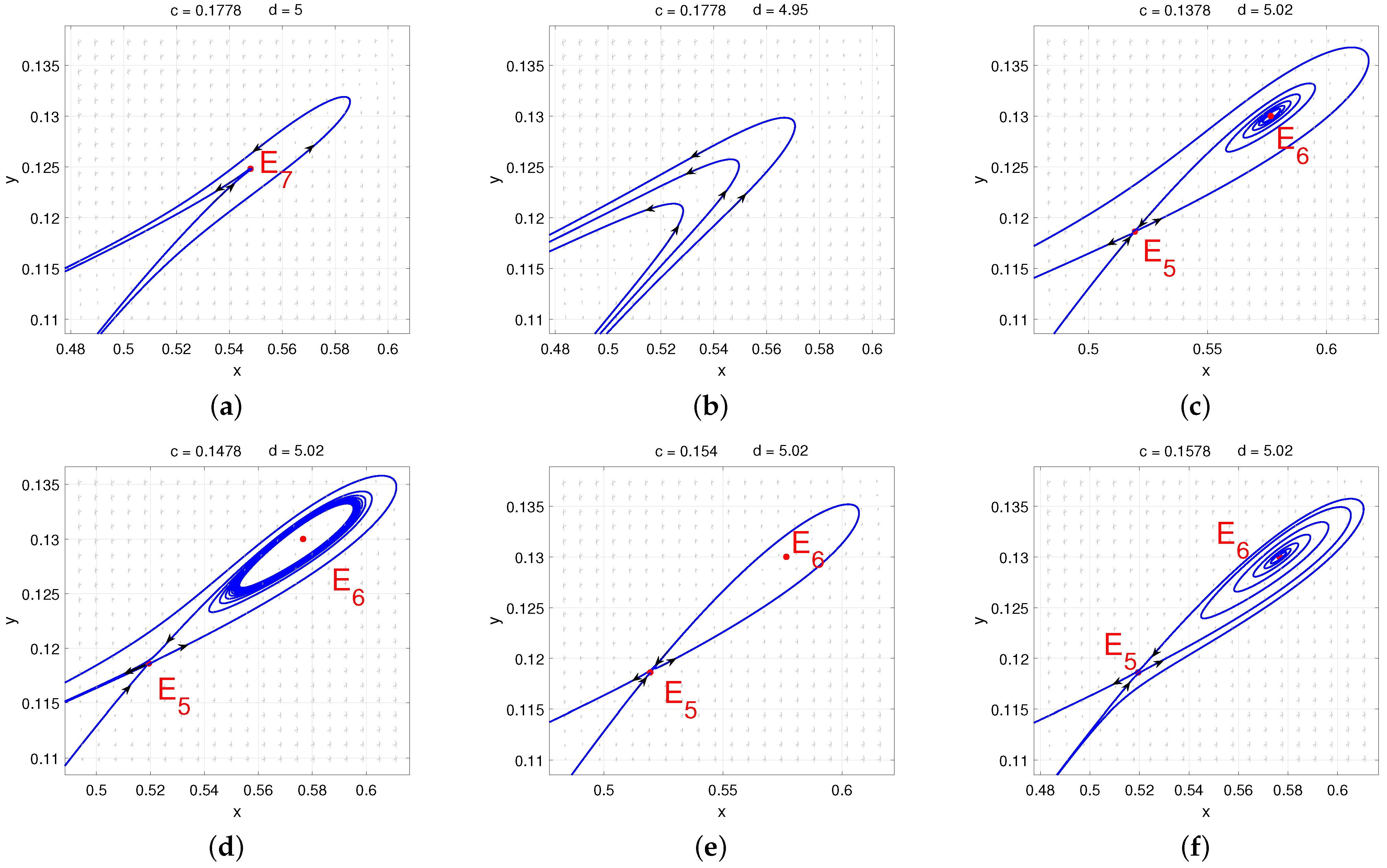
When c and d are selected as two bifurcation parameters, system (5) undergoes a Bogdanov–Takens bifurcation of codimension-2 in a small neighborhood of E 7 as ( c , d ) changes nearby ( c B T , d B T ) , where d e t J E 7 | ( c , d ) = ( c B T , d B T ) = 0 and t r J E 7 | ( c , d ) = ( c B T , d B T ) = 0 (see Figure 3 and Figure 4).
Proof. 
Disturbing the parameters c and d by c = c B T + ε 1 and d = d B T + ε 2 , where ( ε 1 , ε 2 ) is small enough [33], and system (5) takes the form as follows:
d x d t = x 1 x ( x a ) 1 + f y x y x + b , d y d t = ( c B T + ε 1 ) y 1 ( d B T + ε 2 ) y x + b .
The Taylor expansion of the system (12) at E 7 ( x 7 , y 7 ) is
d x d t = p 10 x + p 01 y + p 20 x 2 + p 11 x y + O x , y , ε 1 , ε 2 3 , d y d t = q 00 + q 10 x + q 01 y + q 11 x y + q 02 y 2 + O x , y , ε 1 , ε 2 3 ,
where
p 10 = a + 2 ( a + 1 ) x 7 3 x 7 2 1 + f y 7 b y 7 ( x 7 + b ) 2 , p 01 = x 7 x 7 + b f x 7 ( 1 x 7 ) ( x 7 a ) ( 1 + f y 7 ) 2 , p 20 = 1 + a 3 x 7 1 + f y 7 + b y 7 ( x 7 + b ) 3 , p 11 = b ( x 7 + b ) 2 f a + 2 ( a + 1 ) x 7 3 x 7 2 ( 1 + f y 7 ) 2 , p 02 = f 2 x 7 ( 1 x 7 ) ( x 7 a ) ( 1 + f y 7 ) 3 , q 00 = ε 2 y 7 ( c B T + ε 1 ) d B T , q 10 = ( c B T + ε 1 ) ( d B T + ε 2 ) d B T 2 , q 01 = ( c B T + ε 1 ) ( 1 2 ( d B T + ε 2 ) d B T ) , q 11 = 2 ( c B T + ε 1 ) ( d B T + ε 2 ) d B T ( x 7 + b ) , q 02 = ( c B T + ε 1 ) ( d B T + ε 2 ) x 7 + b .
After a series of C transformations (see Appendix A), system (13) becomes
u 5 ˙ = v 5 , v 5 ˙ = μ 1 + μ 2 v 5 + u 5 2 + u 5 v 5 + O u 5 , v 5 , ε 1 , ε 2 3 .
When the matrix ( μ 1 , μ 2 ) ( ε 1 , ε 2 ) ε 1 = ε 2 = 0 is nonsingular, the parameter transformations are homeomorphisms in a small neighborhood of ( 0 , 0 ) , and μ 1 , μ 2 are independent parameters.
Through Perko [34], we learn systems (5) and (12) undergo Bogdanov–Takens bifurcation when ε = ( ε 1 , ε 2 ) is in a small neighborhood of the origin. The local representations of the unfolding bifurcation curves are given below (“+” for θ 20 > 0 , “−” for θ 20 < 0 ):
(1)
The saddle-node bifurcation curve SN = ε 1 , ε 2 : μ 1 ε 1 , ε 2 = 0 , μ 2 ε 1 , ε 2 0 ;
(2)
The Hopf bifurcation curve H = { ε 1 , ε 2 : μ 2 ε 1 , ε 2 = ± μ 1 ε 1 , ε 2 , μ 1 ε 1 , ε 2 < 0 } ;
(3)
The homoclinic bifurcation curve
HL = ε 1 , ε 2 : μ 2 ε 1 , ε 2 = ± 5 7 μ 1 ε 1 , ε 2 , μ 1 ε 1 , ε 2 < 0 .
Near the codimension-2 Bogdanov–Takens point with parameters ( c , d ) close to ( c B T , d B T ) , the phase space features saddle-node, Hopf, and homoclinic bifurcations: up to two attractors (stable node and limit cycle) or a large homoclinic loop as a single attractor enclosing an unstable saddle. Bifurcation curves divide the plane into regions with distinct attractor counts and types. Biologically, the system is at a “tipping edge” where slight fear-induced changes in reproduction or mortality can destroy stable states and cycles, causing abrupt shifts from persistence to large oscillations or extinction, akin to sudden collapses in fearful wildlife populations.

4. Dynamics of the Spatiotemporal System

Building upon the temporal equilibrium E 6 , we first derive the conditions under which diffusion destabilizes this uniform state, leading to Turing instability. After a simple calculation, we can obtain
J E 6 = J 11 J 12 J 21 J 22 ,
where
J 11 = 1 1 + f y 6 [ ( 1 x 6 ) ( x 6 a ) x 6 ( x 6 a ) + x 6 ( 1 x 6 ) ] b y 6 ( x 6 + b ) 2 ,
J 12 = x 6 x 6 + b f x 6 ( 1 x 6 ) ( x 6 a ) ( 1 + f y 6 ) 2 , J 21 = c d , J 22 = c .
So, we obtain det J E 6 > 0 . Letting
t r   J E 6 = 0 ,
we obtain
c = c H = 1 1 + f y 6 [ ( 1 x 6 ) ( x 6 a ) x 6 ( x 6 a ) + x 6 ( 1 x 6 ) ] b y 6 ( x 6 + b ) 2 .
When D > 0 , system (5) undergoes a Hopf bifurcation at c = c H . For c > c H (slightly), the equilibrium E 6 is stable in the absence of spatial diffusion (see Figure 5) but becomes unstable once self-diffusion (or cross-diffusion) is introduced. In this subsection, we show that this loss of stability is triggered by diffusion-driven (Turing) instability in the reaction–diffusion system (4).
Theorem 4. 
If c > c H , J 11 d 2 + J 22 d 1 > 0 and Det [ J ( k ) ] < 0 , Turing instability occurs when d 2 = d 2 + or d 2 = d 2 . The critical wave count for Turing instability is provided by k 2 = d e t J E 6 d 1 d 2 .
Proof. 
We will carry out the linearization of system (4) at E 6 to obtain the following linear system as follows:
w ˙ = J E 6 w + D Δ w ,
where
J E 6 = J 11 J 12 J 21 J 22 , w = u u 6 v v 6 , D = d 1 0 0 d 2 .
Following the standard approach, we assume that (19) has a solution of the form
w = A B e λ t + i k · r ,
where λ is the growth rate of the perturbation in time t; i is the imaginary unit, i 2 = 1 ; r = ( x , y ) T is a spatial vector in two dimensions, and k is a wave vector in the plane. Replacing (21) by (19), we obtain the following relation
λ A B = J 11 d 1 k 2 J 12 J 21 J 22 d 2 k 2 A B .
We can obtain the characteristic equation at the wave number k = | k | :
λ 2 Tr [ J ( k ) ] λ + Det [ J ( k ) ] = 0 ,
where
J ( k ) = J E 6 k 2 d 1 0 0 d 2 , Tr [ J ( k ) ] = t r J E 6 k 2 d 1 + d 2 , Det [ J ( k ) ] = d 1 d 2 k 4 k 2 J 11 d 2 + J 22 d 1 + det J E 6 .
Let J 11 d 2 + J 22 d 1 > 0 , and we find that Det [ J ( k ) ] is a quadratic polynomial in k 2 . It has the minimum value at some k m i n 2 in which
k m i n 2 = J 11 d 2 + J 22 d 1 2 d 1 d 2 .
Substituting k 2 = k m i n 2 for Det [ J ( k ) ] , we can obtain
Det [ J ( k ) ] = det J E 6 J 11 d 2 + J 22 d 1 2 4 d 1 d 2 .
If det J E 6 < J 11 d 2 + J 22 d 1 2 4 d 1 d 2 , Det [ J ( k ) ] < 0 .
The conditions for the criticality of a Turing instability (Turing bifurcation) are R e ( λ ( k ) ) = 0 and I m ( λ ( k ) ) = 0 , which requires the satisfaction of the transversality condition and Det [ J ( k m i n ) ] = 0 , i.e., Det [ J ( k ) ] = det J E 6 J 11 d 2 + J 22 d 1 2 4 d 1 d 2 = 0 . The number of critical waves k 2 = k m i n 2 is then given (with Equation (25)) by
k m i n 2 = J 11 d 2 + J 22 d 1 2 d 1 d 2 = d e t J E 6 d 1 d 2 .
Considering the following marginal stability condition Det [ J ( k m i n ) ] = 0 , we can obtain
J 11 2 d 2 2 + 2 d 1 J 11 J 22 2 det J E 6 d 2 + J 22 2 d 1 2 = 0 .
A short calculation shows that
d 2 + = d 1 2 det J E 6 J 11 J 22 + 2 d 1 det J E 6 det J E 6 J 11 J 22 J 11 2 > 0 , d 2 = d 1 2 det J E 6 J 11 J 22 2 d 1 det J E 6 det J E 6 J 11 J 22 J 11 2 > 0 .
So, Det [ J ( k m i n ) ] < 0 if d 2 > d 2 + or d 2 < d 2 , and k m i n 2 = d e t J E 6 d 1 d 2 + or k m i n 2 = d e t J E 6 d 1 d 2 is the threshold number of waves of Turing instability.   □
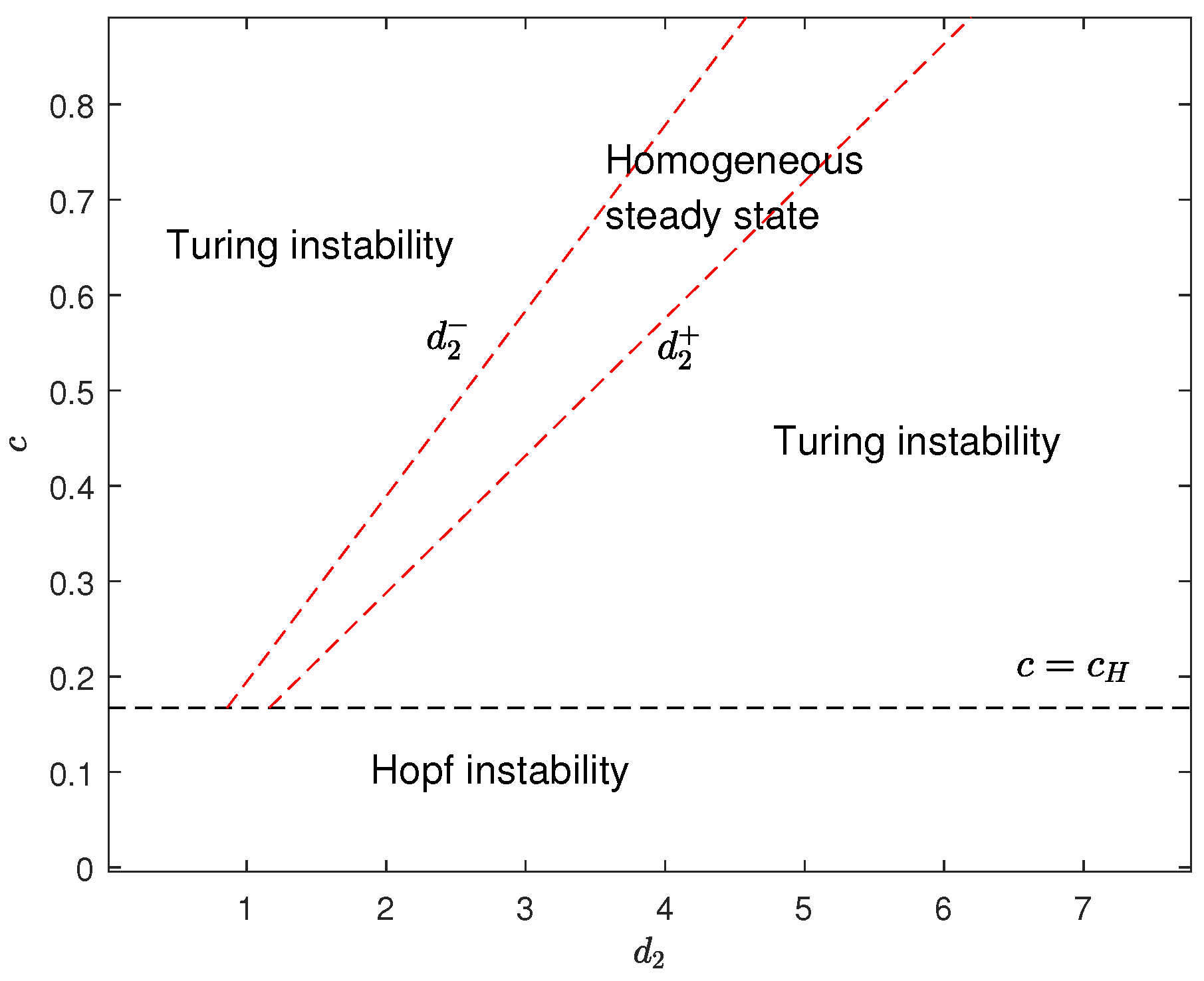
For c > c H , J 11 d 2 + J 22 d 1 > 0 , and det [ J ( k ) ] < 0 at critical d 2 = d 2 ± , the homogeneous equilibrium E 6 (stable node without diffusion) becomes an unstable focus in spatial modes k, shifting the phase space to infinite heterogeneous attractors (stationary patterns). The Turing bifurcation diagram is given by Figure 6. No explicit cycles or homoclinic loops at onset; potential for quasi-periodic or chaotic spatiotemporal attractors. Biologically, predator diffusivity exceeding prey’s destabilizes uniform distributions, fostering spatial heterogeneity as predators exploit local prey clusters, explaining patchy patterns in ecosystems like savannas where fear amplifies diffusion-driven instability.

5. Amplitude Equations

To determine the type and stability of stationary Turing patterns near the onset, we perform a standard multiple-scale weak nonlinear analysis around the critical Turing threshold d 2 = d 2 c . Three pairs of active modes with critical wavenumber k c and 120° phase relationship are excited simultaneously. After lengthy but standard calculations (details are given in Appendix B), the dynamics on the finite-dimensional center manifold are governed by the following three coupled real-amplitude equations:
τ 0 ρ 1 t = μ ρ 1 + | h | ρ 2 ρ 3 g 1 ρ 1 3 g 2 ρ 2 2 + ρ 3 2 ρ 1 , τ 0 ρ 2 t = μ ρ 2 + | h | ρ 1 ρ 3 g 1 ρ 2 3 g 2 ρ 1 2 + ρ 3 2 ρ 2 , τ 0 ρ 3 t = μ ρ 3 + | h | ρ 2 ρ 1 g 1 ρ 3 3 g 2 ρ 1 2 + ρ 2 2 ρ 3 .
where μ ( d 2 d 2 c ) > 0 is the normalized distance from the Turing bifurcation point, and the coefficients τ 0 > 0 , h, g 1 , g 2 are functions of the original biological parameters (explicit expressions in Appendix B). Stability and bifurcation analysis of Equation (29) on the equilateral triangular lattice yields the following pattern selection result:
Theorem 5. 
In a sufficiently small supercritical neighborhood of the Turing onset, the following statements hold, as follows:
(i) 
Steady state: ρ 1 = ρ 2 = ρ 3 = 0 ; it is stable as μ < μ 2 = 0 and is unstable when μ > μ 2 = 0 .
(ii) 
Stripe pattern: ρ 1 = μ g 1 0 , ρ 2 = ρ 3 = 0 ; it is stable when μ > μ 3 and is unstable when μ < μ 3 .
(iii) 
Spot pattern:
ρ 1 = ρ 2 = ρ 3 = | h | ± h 2 + 4 g 1 + 2 g 2 μ 2 g 1 + 2 g 2 .
Its existence condition is μ > μ 1 . The solution ρ + is stable as μ < μ 4 , while ρ is always unstable, where
ρ + = | h | + h 2 + 4 g 1 + 2 g 2 μ 2 g 1 + 2 g 2 , ρ = | h | h 2 + 4 g 1 + 2 g 2 μ 2 g 1 + 2 g 2 .
(iv) 
Mixed structural state: ρ 1 = | h | g 2 g 1 , ρ 2 = ρ 3 = μ g 1 ρ 1 2 g 1 + g 2 . It exists when μ > μ 3 and is always unstable as g 2 > g 1 . The explicit thresholds are
μ 1 = h 2 4 ( g 1 + 2 g 2 ) , μ 2 = 0 , μ 3 = h 2 g 1 ( g 2 g 1 ) 2 , μ 4 = ( 2 g 1 + g 2 ) h 2 ( g 2 g 1 ) 2 .
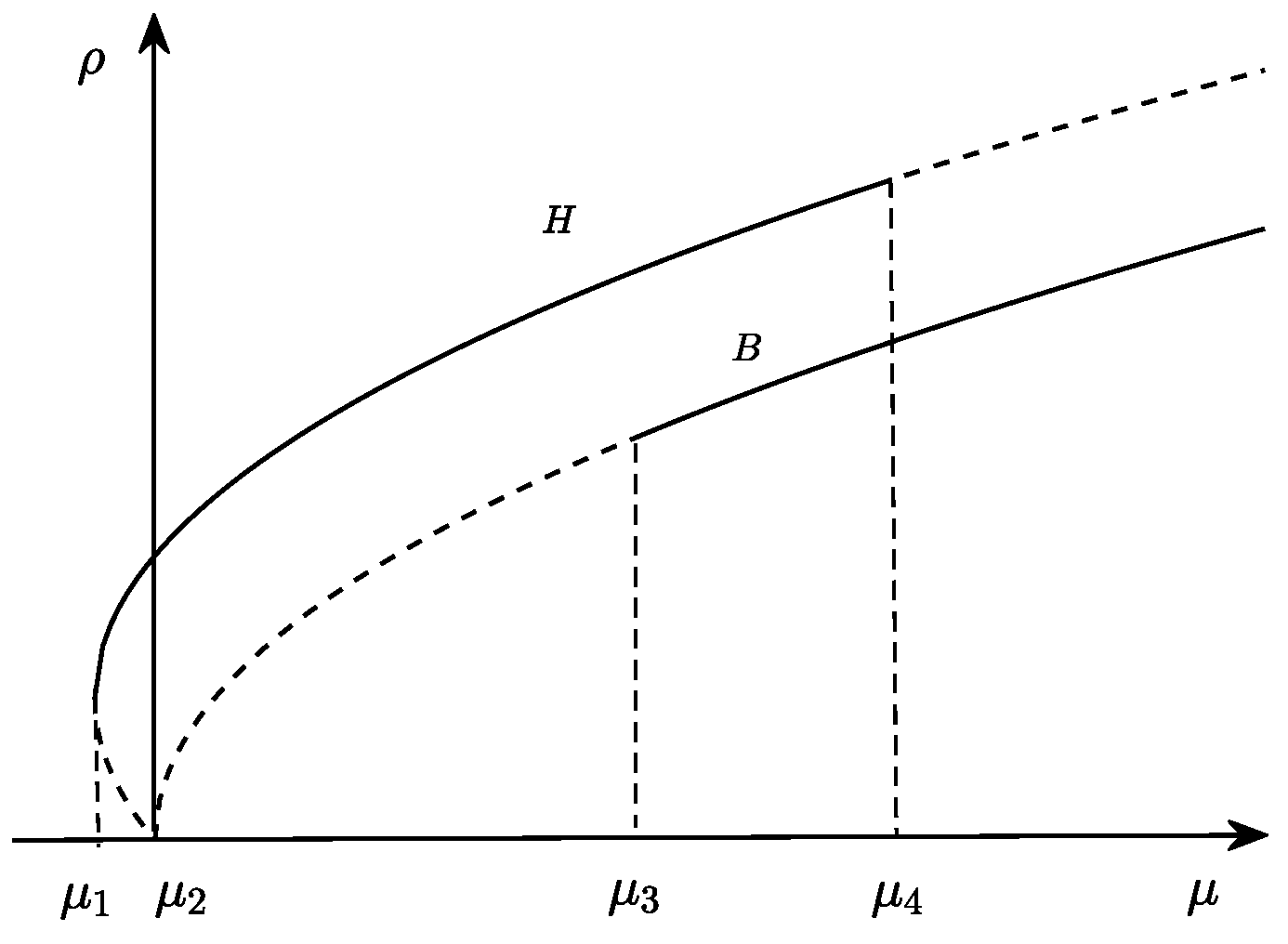
The bifurcation diagram of Turing patterns is given in Figure 7. These analytical predictions are fully confirmed by direct numerical simulations of the original system (4) in Figure 8, Figure 9 and Figure 10.
We perform two-dimensional simulations of the system (2) using MATLAB R2020b. To study the dynamic behavior of the system, we study the system on a 200 × 200 discrete grid with Neumann boundary conditions, a spatial step of 1, and a time step of 0.01.
We set a = 0.1 , b = 0.112 , c = 0.32 , d = 4.9449 , and f = 0.01 , d 1 = 1 , and select the diffusion rate d 2 as the bifurcation parameter. The patterns with corresponding d 2 are given in Table 2.
We denote the number of the prey and the predator at the point ( i , j ) at time t as x ( i , j , t ) and y ( i , j , t ) , i = 1 , 2 , , 200 , j = 1 , 2 , , 200 , respectively. Then, we have
x ( i , j , t + d t ) = x ( i , j , t ) + { f ( x ( i , j , t ) , y ( i , j , t ) ) + d 1 x ( i + 1 , j , t ) + x ( i 1 , j , t ) + x ( i , j + 1 , t ) + x ( i , j 1 , t ) 4 x ( i , j , t ) } d t , y ( i , j , t + d t ) = y ( i , j , t ) + { g ( x ( i , j , t ) , y ( i , j , t ) ) + d 2 y ( i + 1 , j , t ) + y ( i 1 , j , t ) + y ( i , j + 1 , t ) + y ( i , j 1 , t ) 4 y ( i , j , t ) } d t ,
where d t = 0.01 .
The physical domain size is Ω = [ 0 , L ] × [ 0 , L ] , where L = 200 .
The initial distributions are
x ( i , j , 0 ) = x 6 + 2 χ ( i , j ) 1 10 , y ( i , j , 0 ) = y 6 + 2 χ ( i , j ) 1 10 ,
where χ ( i , j ) is a random variable uniformly distributed over the interval ( 0 , 1 ) .
The Neumann boundary conditions are satisfied by setting
x ( L + 1 , j , t ) = x ( 1 , j , t ) , x ( i , L + 1 , t ) = x ( i , 1 , t ) ,
y ( L + 1 , j , t ) = y ( 1 , j , t ) , y ( i , L + 1 , t ) = y ( i , 1 , t ) .
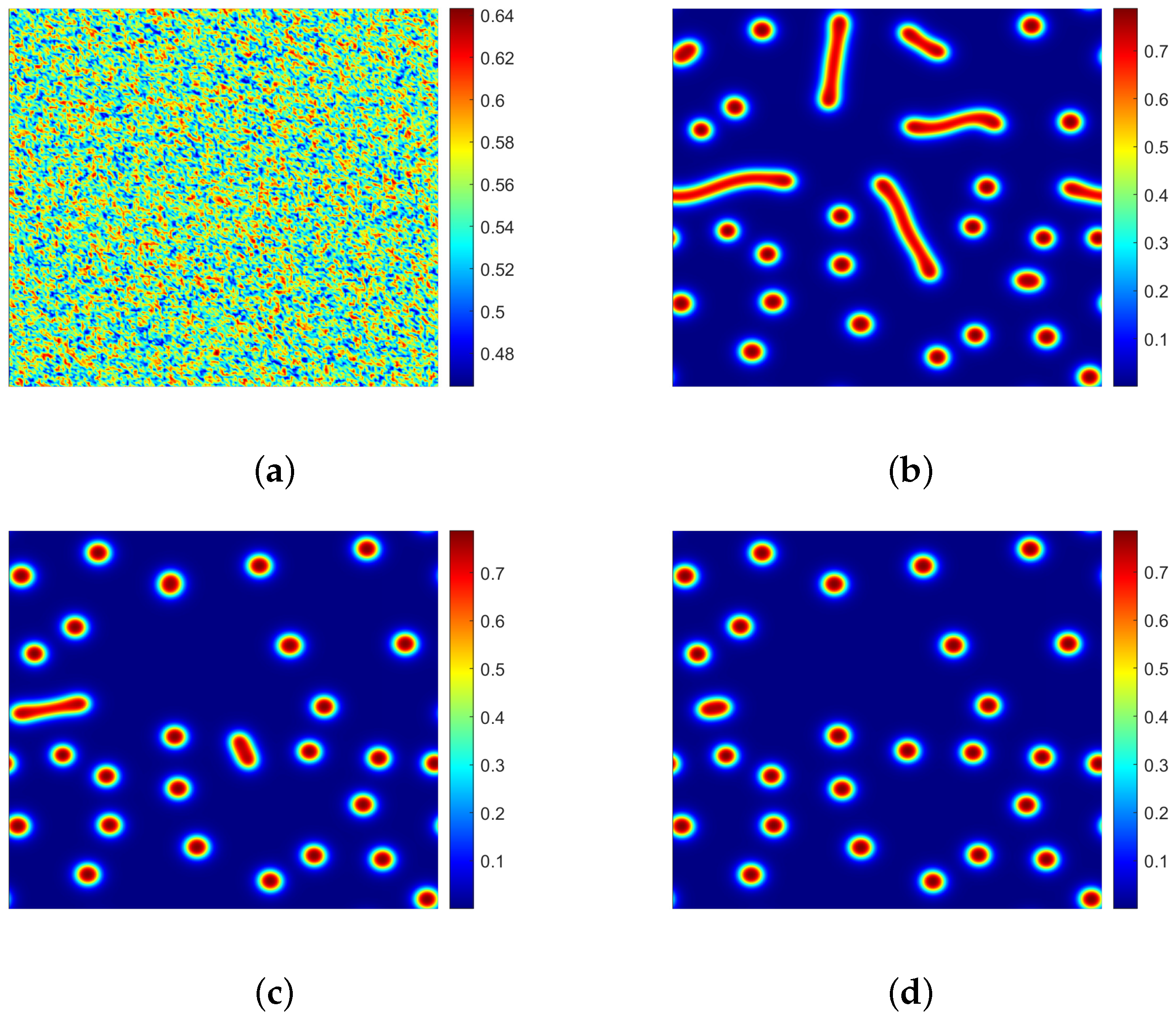
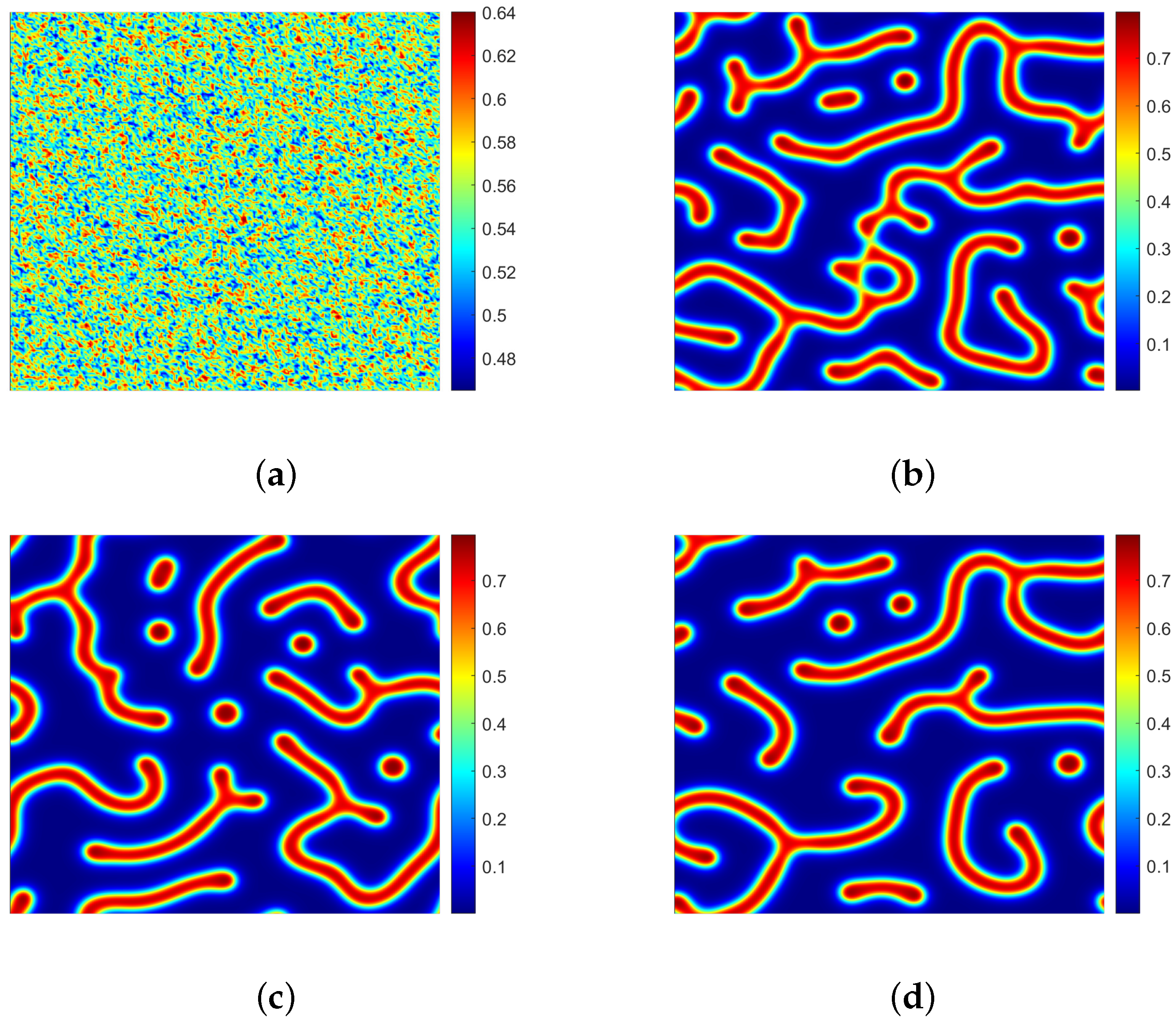
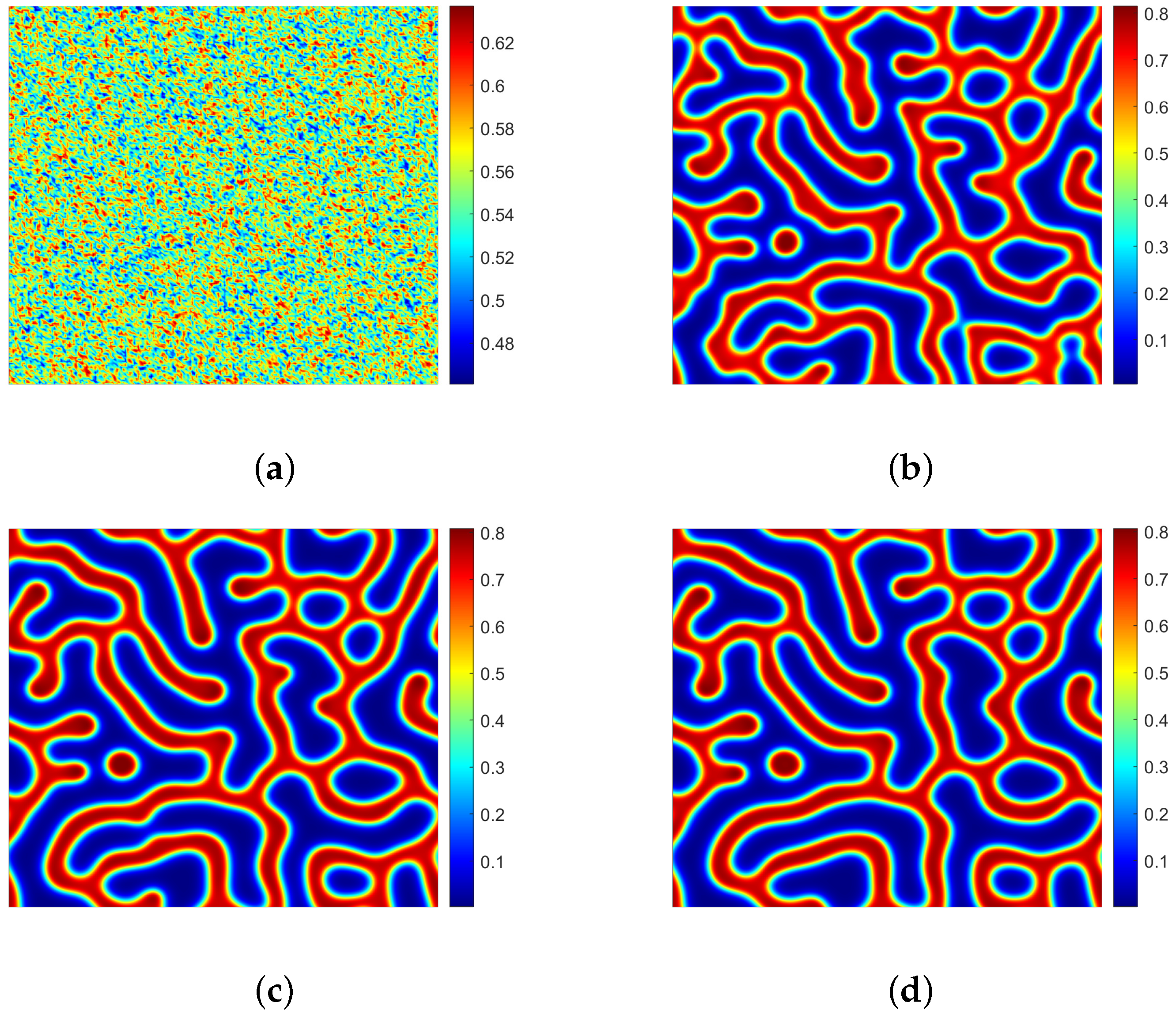
If the diffusion rate d 2 = 5.5 , system (4) exhibits spot pattern (Figure 8). The total simulation time is 2400, which means we iterate Equation (33) 240,000 times, and we take samples and depict the snapshots every 800 time units.
If the diffusion rate d 2 = 7 , system (4) exhibits mixed pattern (Figure 9). The total simulation time is 1200, and we depict the snapshots every 400 time units.
If the diffusion rate d 2 = 16 , system (4) exhibits stripe pattern (Figure 10). The total simulation time is 600, and we depict the snapshots every 200 time units.
The numerical results indicate that a small diffusion rate of the predator leads to spot pattern, which means that the prey will gather in some separate regions. A relatively big diffusion rate will make the strip pattern, which means the prey will distribute averagely in the space. This phenomenon can be explained as the prey tend to hide from the predator in different ways according to the diffusion rate of the predator. If the predators move slowly, the prey will gather at the place where there are fewer predators. If the predators move fast, the prey will distribute averagely because no place is safer.
Near the Turing threshold (small supercritical μ > 0 ), stationary attractors include hexagonal spots ( ρ 1 = ρ 2 = ρ 3 > 0 stable for μ 1 < μ < μ 4 ), stripes ( ρ 1 > 0 , ρ 2 = ρ 3 = 0 stable for μ > μ 3 ), and mixed states (metastable). These are spatial fixed points without temporal cycles or homoclinic loops; selection depends on μ thresholds. Biologically, varying predator mobility elicits prey anti-predator strategies: spots (isolated refugia, e.g., savanna herds) at low diffusivity and stripes (linear corridors, e.g., marine systems) at high diffusivity; fear modulates pattern scale, highlighting indirect effects in structuring natural communities.

6. Conclusions

In this study, we have investigated the temporal and spatiotemporal dynamics of a modified Leslie–Gower predator–prey model that simultaneously incorporates fear effects and self-diffusion—a combination not previously explored in the literature. Our analysis revealed that the temporal system exhibits a codimension-2 Bogdanov–Takens bifurcation, leading to multistability with up to six equilibria and transitions among stable nodes, limit cycles, homoclinic loops, and extinction states. Extending the model to the spatiotemporal domain, we derived explicit Turing instability conditions and, using weakly nonlinear multiple-scale analysis, obtained amplitude equations that classify stationary patterns into spots, stripes, and mixed states across different parameter regimes, with predator diffusivity emerging as the key driver of pattern selection. Extensive numerical simulations confirmed these analytical predictions, demonstrating clear sequential transitions from spots to mixed states to stripes as predator diffusivity increases.
The novelty of this work lies in integrating fear-induced reproductive suppression with self-diffusion within the Leslie–Gower framework, thereby uncovering qualitative behaviours absent in prior studies. Unlike fear-only models [25,26], where excessive fear typically drives uniform prey extinction, or diffusion-only models [3,27,28,29,30,35,36,37,38] that produce standard Turing patterns, our coupled model shows that fear significantly shifts the cusp position, alters bifurcation curves, modulates the Turing threshold, and changes pattern wavelength and selection regions. These interactions generate enhanced multistability and previously undocumented pattern-selection mechanisms compared with earlier bifurcation and pattern-formation studies in similar systems [7,9,10].
Biologically, our findings highlight the critical and often overlooked role of indirect fear effects in ecosystem resilience and spatial organization. Moderate fear stabilizes coexistence by damping population oscillations, whereas strong fear combined with high predator mobility spontaneously generates persistent spatial heterogeneity. The resulting spot and stripe patterns correspond to distinct anti-predator spatial strategies: clustered refugia under low-to-moderate predator mobility (common in African savannas) versus linear escape corridors under high mobility (typical of marine and open grassland systems). Ignoring fear therefore substantially underestimates ecosystem vulnerability to regime shifts and extinction risk.
Future research could incorporate stochastic environmental noise, seasonally varying fear intensity, or multiple prey refuges to further bridge theoretical predictions with empirical ecological data and inform conservation strategies.

Author Contributions

Conceptualization, X.J. and K.H.; methodology, X.J. and K.H.; software, X.J.; validation, L.Z. (Lijuan Zhang) and K.H.; formal analysis, X.J. and K.H.; formal analysis, X.J.; investigation, X.J.; resources, X.J.; data curation, K.H.; writing—original draft, X.J.; writing—review & editing, L.Z. (Lingling Zhao); visualization, K.H.; supervision, X.J.; project administration, X.J.; funding acquisition, X.J. All authors have read and agreed to the published version of the manuscript.

Funding

This paper was supported by the Fundamental Research Funds for the Central Universities (Grant No. ZY20250212) and the project from the Self-Financing Project of Scientific Research and Development Plan of the Langfang Science and Technology Bureau (Grant No. 2025013121).

Data Availability Statement

Data sharing is not applicable to this article as no new data were created or analyzed in this study.

Acknowledgments

We acknowledge the support of high-performance computing resources provided by the Basic Courses Department, Institute of Disaster Prevention.

Conflicts of Interest

The authors declare that they have no known competing financial interests or personal relationships that could have appeared to influence the work reported in this paper.

Appendix A

The transformation process of system (13),
u 1 = x , v 1 = x ˙ ,
and system (13) is replaced with the following form
u 1 ˙ = v 1 , v 1 ˙ = n 00 + n 10 u 1 + n 01 v 1 + n 20 u 1 2 + n 11 u 1 v 1 + n 02 v 1 2 + O u 1 , v 1 , ε 1 , ε 2 3 ,
where
n 00 = p 01 q 00 , n 10 = p 01 q 10 p 10 q 01 + p 11 q 00 , n 01 = p 10 + q 01 , n 20 = q 20 p 01 q 11 p 10 + p 11 q 10 q 01 p 20 + p 10 2 q 02 p 01 , n 11 = 2 p 20 + q 11 p 11 p 10 + 2 q 02 p 10 p 01 , n 02 = p 11 + q 02 p 01 .
After rescaling the time by ( 1 n 02 u 1 ) t t , system (A1) is rewritten as
u ˙ 1 = v 1 ( 1 n 02 u 1 ) , v ˙ 1 = ( 1 n 02 u 1 ) n 00 + n 10 u 1 + n 01 v 1 + n 20 u 1 2 + n 11 u 1 v 1 + n 02 v 1 2 + O u 1 , v 1 , ε 1 , ε 2 3 .
Letting u 2 = u 1 and v 2 = v 1 ( 1 n 02 u 1 ) , we obtain system (A2) as follows
u ˙ 2 = v 2 , v ˙ 2 = θ 00 + θ 10 u 2 + θ 01 v 2 + θ 20 u 2 2 + θ 11 u 2 v 2 + O u 2 , v 2 , ε 1 , ε 2 3 ,
where
θ 00 = n 00 , θ 10 = n 10 2 n 00 n 02 , θ 01 = n 01 , θ 20 = n 20 2 n 10 n 02 + n 00 n 02 2 , θ 11 = n 11 n 01 n 02 .
Case 1: With the smaller ε i ( i = 1 , 2 ) , if θ 20 > 0 , by the variable variation below
u 3 = u 2 , v 3 = v 2 θ 20 , t θ 20 t ,
system (A3) becomes
u ˙ 3 = v 3 , v ˙ 3 = s 00 + s 10 u 3 + s 01 v 3 + u 3 2 + s 11 u 3 v 3 + O u 3 , v 3 , ε 1 , ε 2 3 ,
where
s 00 = θ 00 θ 20 , s 10 = θ 10 θ 20 , s 01 = θ 01 θ 20 , s 11 = θ 11 θ 20 .
To eliminate the u 3 term, letting u 4 = u 3 + s 10 2 and v 4 = v 3 , we obtain system (A4) as follows
u ˙ 4 = v 4 , v ˙ 4 = r 00 + r 01 v 4 + u 4 2 + r 11 u 4 v 4 + O u 4 , v 4 , ε 1 , ε 2 3 ,
where
r 00 = s 00 s 10 2 4 , r 01 = s 01 s 10 s 11 2 , r 11 = s 11 .
Evidently, r 11 = s 11 = θ 11 θ 20 0 , if θ 11 0 .
Setting u 5 = r 11 2 u 4 , v 5 = r 11 3 v 4 and τ = 1 r 11 t , we obtain a universal unfolding of system (A5)
u 5 ˙ = v 5 , v 5 ˙ = μ 1 + μ 2 v 5 + u 5 2 + u 5 v 5 + O u 5 , v 5 , ε 1 , ε 2 3 ,
where
μ 1 = r 00 r 11 4 , μ 2 = r 01 r 11 .
Case 2: With the smaller ε i ( i = 1 , 2 ) , if θ 20 < 0 , by the variable variation below
u 3 = u 2 , v 3 = v 2 θ 20 , t θ 20 t ,
system (A3) becomes
u ˙ 3 = v 3 , v ˙ 3 = s 00 + s 10 u 3 + s 01 v 3 u 3 2 + s 11 u 3 v 3 + O u 3 , v 3 , ε 1 , ε 2 3 ,
where
s 00 = θ 00 θ 20 , s 10 = θ 10 θ 20 , s 01 = θ 01 θ 20 , s 11 = θ 11 θ 20 .
To remove the u 3 term, making u 4 = u 3 s 10 2 and v 4 = v 3 , we obtain system (A9) as follows
u ˙ 4 = v 4 , v ˙ 4 = r 00 + r 01 v 4 u 4 2 + r 11 u 4 v 4 + O u 4 , v 4 , ε 1 , ε 2 3 ,
where
r 00 = s 00 + s 10 2 4 , r 01 = s 01 + s 10 s 11 2 , r 11 = s 11 .
Clearly, r 11 = s 11 = θ 11 θ 20 0 , if θ 11 0 .
Setting u 5 = r 11 2 u 4 , v 5 = r 11 3 v 4 and τ = 1 r 11 t , we obtain the universal unfolding of system (A10)
u 5 ˙ = v 5 , v 5 ˙ = μ 1 + μ 2 v 5 + u 5 2 + u 5 v 5 + O u 5 , v 5 , ε 1 , ε 2 3 ,
where
μ 1 = r 00 r 11 4 , μ 2 = r 01 r 11 .
Retain μ 1 and μ 2 to denote μ 1 and μ 2 in (A12).

Appendix B

If we let U = ( u , v ) T , then model (4) converts to the shape of
U t = L U + N ( U , U ) ,
where L = a 11 + d 1 Δ a 12 a 21 a 22 + d 2 Δ .
The nonlinear term in (A13) is
N = 1 2 f u u u 2 + f u v u v + 1 2 f v v v 2 + 1 3 ! f u u u u 3 + 1 2 f u u v u 2 v + 1 2 f u v v u v 2 + 1 3 ! f v v v v 3 1 2 g u u u 2 + g u v u v + 1 2 g v v v 2 + 1 3 ! g u u u u 3 + 1 2 g u u v u 2 v + 1 2 g u v v u v 2 + 1 3 ! g v v v v 3 + O ( 4 ) ,
with
f u = ( 1 u ) ( u a ) u ( u a ) + u ( 1 u ) 1 + f v b v ( u + b ) 2 , f v = f u ( 1 u ) ( u a ) ( 1 + f v ) 2 u u + b , f u u = 6 u + 2 a + 2 1 + f v + 2 b v ( u + b ) 3 , f u v = f ( ( 1 u ) ( u a ) u ( u a ) + u ( 1 u ) ) ( 1 + f v ) 2 b ( u + b ) 2 , f v v = 2 f 2 u ( u a ) ( 1 u ) ( 1 + f v ) 3 , f u u u = 6 1 + f v 6 b v ( u + b ) 4 , f u u v = f ( 6 u 2 a 2 ) ( 1 + f v ) 2 + 2 b ( u + b ) 3 , f u v v = 2 f 2 ( ( 1 u ) ( u a ) u ( u a ) + u ( 1 u ) ) ( 1 + f v ) 3 , f v v v = 6 f 3 u ( u a ) ( 1 u ) ( 1 + f v ) 4 , g u = c d v 2 ( u + b ) 2 , g v = c 2 c d v u + b , g u u = 2 c d v 2 ( u + b ) 3 , g u v = 2 c d v ( u + b ) 2 , g v v = 2 c d u + b , g u u u = 6 c d v 2 ( u + b ) 4 , g u u v = 4 c d v ( u + b ) 3 , g u v v = 2 c d ( u + b ) 2 , g v v v = 0 .
Around d 2 c = d 2 + , we introduce a small parameter ε that makes the
d 2 d 2 c = ε d 21 + ε 2 d 22 + ε 3 d 23 + O ( 4 ) .
In the meantime, we set T 0 = t , T 1 = ε t , T 2 = ε 2 t and T 3 = ε 3 t , then
t = T 0 + ε T 1 + ε 2 T 2 + ε 3 T 3 + O ( 4 ) .
Expand U as below
U = u v = ε u 1 v 1 + ε 2 u 2 v 2 + ε 3 u 3 v 3 + O ( 4 ) .
Simultaneously, N takes the form
N = ε 2 N 2 + ε 3 N 3 + O ε 4 ,
with
N 2 = 1 2 f u u u 1 2 + f u v u 1 v 1 + 1 2 f v v v 1 2 1 2 g u u u 1 2 + g u v u 1 v 1 + 1 2 g v v v 1 2 , N 3 = f u u u 1 u 2 + f u v u 1 v 2 + u 2 v 1 + f v v v 1 v 2 + f uuu 3 ! u 1 3 + f uuv 2 ! u 1 2 v 1 + f u v w 2 ! u 1 v 1 2 + f v v v 3 ! v 1 3 g u u u 1 u 2 + g u v u 1 v 2 + u 2 v 1 + g v v v 1 v 2 + g uuu 3 ! u 1 3 + g uuv 2 ! u 1 2 v 1 + g u v v 2 ! u 1 v 1 2 + g v v v 3 ! v 1 3 . The linearity operator L can be decoded as
L = L c + d 2 d 2 c M ,
with
L c = a 11 + d 1 Δ a 12 a 21 a 22 + d 2 c Δ , M = 0 0 0 Δ .
As a consequence, substituting (A15)–(A19) into (A13), we have
O ( ε ) : L c u 1 v 1 = 0 .
O ε 2 : L c u 2 v 2 = T 1 u 1 v 1 d 21 M u 1 v 1 N 2 .
O ε 3 : L c u 3 v 3 = T 1 u 2 v 2 + T 2 u 1 v 1 d 22 M u 2 v 2 d 23 M u 1 v 1 N 3 .
For Equation (A13), the general solution of Equation (A13) near the critical value d 2 = d 2 c can be given as
u 1 v 1 = ϕ 1 j = 1 3 K j exp i k j · r + j = 1 3 K ¯ j exp i k j · r ,
where ϕ = J 12 d 1 k c 2 J 11 , k j = k c , r = ( x , y ) is is a vector of space, and K j is the amplitude with respect to the pattern exp i k j · r . Immediately, by Fredholm solubility condition, the right hand of (A20) must be normalized with the zero eigenvectors of the neighborhood operator of L c . This is
1 φ exp i k j · r + c . c . , j = 1 , 2 , 3 ,
with φ = d 1 k c 2 J 11 J 21 . Define
H u H v T 1 u 1 v 1 d 21 M u 1 v 1 N 2 .
Making use of the orthogonality condition, it follows
( 1 , φ ) exp i k j · r H u j H v j = 0 , j = 1 , 2 , 3 ,
where H u j and H v j are, respectively, the coefficients about exp i k j · r in H u and H v . So, we deduce
( ϕ + φ ) K 1 T 1 = d 21 k c 2 φ K 1 + 2 h 1 + φ h 2 K ¯ 2 K ¯ 3 , ( ϕ + φ ) K 2 T 1 = d 21 k c 2 φ K 2 + 2 h 1 + φ h 2 K ¯ 1 K ¯ 3 , ( ϕ + φ ) K 3 T 1 = d 21 k c 2 φ K 3 + 2 h 1 + φ h 2 K ¯ 1 K ¯ 2 ,
with h 1 = f uu 2 ϕ 2 + f u v ϕ + f v v 2 , h 2 = g u u 2 ϕ 2 + g u v ϕ + g v v 2 . Now substituting (A23) into (A21), we yield
u 2 v 2 = U 0 V 0 + j = 1 3 U j V j e i k j · r + j = 1 3 U j j V j j e 2 i k j · r + U 12 V 12 e i k 1 k 2 · r + U 23 V 23 e i k 2 k 3 · r + U 31 V 31 e i k 3 k 1 · r + c . c .
where
U j = ϕ V j , U 0 V 0 = u 00 v 00 K 1 2 + K 2 2 + K 3 2 , U j j V j j = u 11 v 11 K j 2 , U 12 V 12 = u 22 v 22 K 1 K ¯ 2 , U 23 V 23 = u 22 v 22 K 2 K ¯ 3 , U 31 V 31 = u 22 v 22 K 3 K ¯ 1 ,
with
u 00 v 00 = 2 J 12 h 2 J 22 h 1 J 11 J 22 J 12 J 21 2 J 21 h 1 J 11 h 2 J 11 J 22 J 12 J 21 , u 11 v 11 = J 12 h 2 J 22 4 d 2 c k c 2 h 1 J 11 4 d 1 k c 2 J 22 4 d 2 c k c 2 J 12 J 21 J 21 h 1 J 11 4 d 1 k c 2 h 2 J 11 4 d 1 k c 2 J 22 4 d 2 c k c 2 J 12 J 21 , u 22 v 22 = 2 J 12 h 2 J 22 3 d 2 c k c 2 h 1 J 11 3 d 1 k c 2 J 22 3 d 2 c k c 2 J 12 J 21 2 J 21 h 1 J 11 3 d 1 k c 2 h 2 J 11 3 d 1 k c 2 J 22 3 d 2 c k c 2 J 12 J 21 .
Assume that the explanation of model (A13) developed as follows
u v = j = 1 3 Z j exp i k j · r + j = 1 3 Z ¯ j exp i k j · r ,
where Z j = Z j u , Z j v T and Z ¯ j = Z ¯ j u , Z ¯ j v T are with respect to the amplitudes of the modes of k j and k j . It is possible to set
Z j = ε K j + ε 2 V j + O ( 3 ) .
As a result, we deduce
τ 0 Z 1 t = μ Z 1 + h Z ¯ 2 Z ¯ 3 g 1 Z 1 2 + g 2 Z 2 2 + Z 3 2 Z 1 , τ 0 Z 2 t = μ Z 2 + h Z ¯ 1 Z ¯ 3 g 1 Z 2 2 + g 2 Z 1 2 + Z 3 2 Z 2 , τ 0 Z 3 t = μ Z 3 + h Z ¯ 1 Z ¯ 2 g 1 Z 3 2 + g 2 Z 1 2 + Z 2 2 Z 3 ,
where
μ = d 2 d 2 c d 2 c , τ 0 = ϕ + φ d 2 c k c 2 φ , h = 2 h 1 + φ h 2 d 2 c k c 2 φ , g 1 = Q 1 + φ Q 3 d 2 c k c 2 φ , g 2 = Q 2 + φ Q 4 d 2 c k c 2 φ .
It is assumed that every amplitude solution in (A13) is of the form
Z j = ρ j exp i θ j , j = 1 , 2 , 3 ,
where ρ j and θ j are the mode and phase angle, respectively, and where ρ j and θ j are, respectively, mode and phase angle. Then, we obtain
τ 0 θ t = h ρ 1 2 ρ 2 2 + ρ 1 2 ρ 3 2 + ρ 2 2 ρ 3 2 ρ 1 ρ 2 ρ 3 sin θ , τ 0 ρ 1 t = μ ρ 1 + h ρ 2 ρ 3 cos θ g 1 ρ 1 3 g 2 ρ 2 2 + ρ 3 2 ρ 1 , τ 0 ρ 2 t = μ ρ 2 + h ρ 1 ρ 3 cos θ g 1 ρ 2 3 g 2 ρ 1 2 + ρ 3 2 ρ 2 , τ 0 ρ 3 t = μ ρ 3 + h ρ 2 ρ 1 cos θ g 1 ρ 3 3 g 2 ρ 1 2 + ρ 2 2 ρ 3 ,
with θ = θ 1 + θ 2 + θ 3 . A solution to (A13) is stable if θ = 0 and h > 0 or θ = π and h < 0 holds. Hence, we can derive the equation for the amplitude as (29).
Define
μ 1 = h 2 4 g 1 + 2 g 2 , μ 2 = 0 , μ 3 = h 2 g 1 g 2 g 1 2 , μ 4 = 2 g 1 + g 2 h 2 g 2 g 1 2 .

References

  1. Lotka, A.J. Analytical note on certain rhythmic relations in organic systems. Biol. Sci. 1921, 6, 410–415. [Google Scholar] [CrossRef] [PubMed]
  2. Volterra, V. Variazionie fluttuazioni del numero d’individui in specie animali conviventi. Mem. R. Accad. Naz. Lincei 1923, 6, 31–113. [Google Scholar] [CrossRef]
  3. Zhang, L.; Liu, J.; Banerjee, M. Hopf and steady state bifurcation analysis in a ratio-dependent predator-prey model. Commun. Nonlinear Sci. Numer. Simul. 2017, 44, 52–73. [Google Scholar] [CrossRef]
  4. Dai, Y.X.; Yang, P.; Luo, Z.L.; Lin, Y.P. Bogdanov-Takens bifurcation in a delayed Michaelis-Menten type ratio-dependent predator-prey system with prey harvesting. J. Appl. Anal. Comput. 2019, 9, 1333–1346. [Google Scholar] [CrossRef]
  5. Hu, D.P.; Cao, H.J. Stability and bifurcation analysis in a predator-prey system with Michaelis-Menten type predator harvesting. Nonlinear Anal. Real World Appl. 2017, 33, 58–82. [Google Scholar] [CrossRef]
  6. Huang, J.C.; Ruan, S.G.; Xiao, D.M. Bifurcations analysis of a mosquito population model with a saturated release rate of sterile mosquitoes. SIAM J. Appl. Dyn. Syst. 2019, 18, 939–972. [Google Scholar] [CrossRef]
  7. Jia, X.T.; Zhao, M.; Huang, K.L. Bifurcation analysis and simulations of a modified leslie-gower predator-prey model with constant-type prey harvesting. Math. Methods Appl. Sci. 2023, 46, 18789–18814. [Google Scholar] [CrossRef]
  8. Aziz-Alaoui, M.A.; Daher Okiye, M. Boundedness and global stability for a predator-prey model with modified Leslie-Gower and Holling-type II schemes. Appl. Math. Lett. 2003, 16, 1069–1075. [Google Scholar] [CrossRef]
  9. Jia, X.T.; Huang, K.L.; Li, C.P. Bifurcation analysis of a modified Leslie-Gower predator-prey system. Int. J. Bifurc. Chaos 2023, 33, 2350024. [Google Scholar] [CrossRef]
  10. Huang, K.L.; Jia, X.T.; Li, C.P. Analysis of modified Holling-Tanner model with strong allee effect. Math. Biosci. Eng. 2023, 20, 15524–15543. [Google Scholar] [CrossRef]
  11. Du, Y.; Peng, Y.; Wang, M. Effect of a protection zone in the diffusive Leslie predator-prey model. J. Differ. Equ. 2009, 246, 3932–3956. [Google Scholar] [CrossRef]
  12. Zhu, Y.; Wang, K. Existence and global attractivity of positive periodic solutions for a predator-prey model with modified Leslie-Gower Holling-type II schemes. J. Math. Anal. Appl. 2011, 384, 400–408. [Google Scholar] [CrossRef]
  13. Gupta, R.P.; Chandra, P. Bifurcation analysis of modified Leslie-Gower predator-prey model with Michaelis-Menten type prey harvesting. J. Math. Anal. Appl. 2013, 398, 278–295. [Google Scholar] [CrossRef]
  14. Xie, J.; Liu, H.; Luo, D. The effects of harvesting on the dynamics of a Leslie-Gower model. Discret. Dyn. Nat. Soc. 2021, 2021, 5520758. [Google Scholar] [CrossRef]
  15. Zanette, L.Y.; White, A.F.; Allen, M.C.; Clinchy, M. Perceived predation risk reduces the number of offspring songbirds produce per year. Science 2011, 334, 1398–1401. [Google Scholar] [CrossRef]
  16. Al-Salti, N.; Al-Musalhi, F.; Gandhi, V.; Al-Moqbali, M.; Elmojtaba, I. Dynamical analysis of a prey-predator model incorporating a prey refuge with variable carrying capacity. Ecol. Complex. 2021, 45, 100888. [Google Scholar] [CrossRef]
  17. Cresswell, W. Predation in bird populations. J. Ornithol. 2011, 152, 251–263. [Google Scholar] [CrossRef]
  18. Wang, X.; Zanette, L.; Zou, X. Modelling the fear effect in predator-prey interactions. J. Math. Biol. 2016, 73, 1179–1204. [Google Scholar] [CrossRef]
  19. Cong, P.P.; Fan, M.; Zou, X.F. Dynamics of a three-species food chain model with fear effect. Commun. Nonlinear Sci. Numer. Simul. 2021, 99, 105809. [Google Scholar] [CrossRef]
  20. Sasmal, S.K. Population dynamics with multiple Allee effects induced by fear factors-A mathematical study on prey-predator interactions. Appl. Math. Model. 2018, 64, 1–14. [Google Scholar] [CrossRef]
  21. Wang, X.Q.; Tan, Y.P.; Cai, Y.L.; Wang, W.M. Impact of the fear effect on the stability and bifurcation of a Leslie-Gower predator-prey model. Int. J. Bifurc. Chaos 2020, 30, 2050210. [Google Scholar] [CrossRef]
  22. Ramasamy, S.; Banjerdpongchai, D.; Park, P. Stability and Hopf-bifurcation analysis of diffusive Leslie-Gower prey-predator model with the Allee effect and carry-over effects. Math. Comput. Simul. 2025, 227, 19–40. [Google Scholar] [CrossRef]
  23. Vinoth, S.; Vadivel, R.; Hu, N.T.; Chen, C.S.; Gunasekaran, N. Bifurcation Analysis in a Harvested Modified Leslie-Gower Model Incorporated with the Fear Factor and Prey Refuge. Mathematics 2023, 11, 3118. [Google Scholar] [CrossRef]
  24. Vinoth, S.; Sivasamy, R.; Sathiyanathan, K.; Unyong, B.; Rajchakit, G.; Vadivel, R.; Gunasekaran, N. The dynamics of a Leslie type predator-prey model with fear and Allee effect. Adv. Differ. Equ. 2021, 2021, 338. [Google Scholar] [CrossRef]
  25. Chen, M.; Takeuchi, Y.; Zhang, J.F. Dynamic complexity of a modified Leslie-Gower predator-prey system with fear effect. Commun. Nonlinear Sci. Numer. Simul. 2023, 119, 107109. [Google Scholar] [CrossRef]
  26. Al-Momen, S.; Naji, R.K. The dynamics of modified Leslie-Gower predator-prey model under the influence of nonlinear harvesting and fear effect. Iraqi J. Sci. 2022, 63, 259–282. [Google Scholar] [CrossRef]
  27. Turing, A.M. The chemical basis of morphogenesis. Philos. Trans. R. Soc. 1952, 237, 37–72. [Google Scholar] [CrossRef]
  28. Klausmeier, C.A. Regular and irregular patterns in semiarid vegetation. Science 1999, 284, 1826–1828. [Google Scholar] [CrossRef]
  29. Cross, M.C.; Hohenberg, P.C. Pattern formation outside of equilibrium. Rev. Mod. Phys. 1993, 65, 851. [Google Scholar] [CrossRef]
  30. Banerjee, M.; Petrovskii, S. Self-organised spatial patterns and chaos in a ratio-dependent predator-prey system. Theor. Ecol. 2011, 4, 37–53. [Google Scholar] [CrossRef]
  31. Anshu; Dubey, B.; Kumar Sasmal, S.; Sudarshan, A. Consequences of fear effect and prey refuge on the Turing patterns in a delayed predator-prey system. Chaos 2022, 32, 123132. [Google Scholar] [CrossRef]
  32. Pal, D.; Kesh, D.; Mukherjee, D. Qualitative study of cross-diffusion and pattern formation in Leslie–Gower predator–prey model with fear and Allee effects. Chaos Solitons Fractals 2023, 167, 113033. [Google Scholar] [CrossRef]
  33. Chow, S.N.; Li, C.Z.; Wang, D. Normal Forms and Bifurcation of Planar Vector Fields; Cambridge University Press: New York, NY, USA, 1994. [Google Scholar] [CrossRef]
  34. Perko, L. Differential equations and dynamical systems. In Texts in Applied Mathematics, 3rd ed.; Springer: New York, NY, USA, 2013; Volume 7. [Google Scholar] [CrossRef]
  35. Kondo, S.; Asai, R. A reaction-diffusion wave on the skin of the marine angelfish pomacanthus. Nature 1995, 376, 765–768. [Google Scholar] [CrossRef]
  36. Cangelosi, R.A.; Wollkind, D.J.; Kealy-Dichone, B.J.; Chaiya, I. Nonlinear stability analyses of Turing patterns for a mussel-algae model. J. Math. Biol. 2015, 70, 1249–1294. [Google Scholar] [CrossRef] [PubMed]
  37. Ducrots, A.; Langlais, M. A singular reaction-diffusion system modelling prey-predator interactions: Invasion and co-extinction waves. J. Differ. Equ. 2012, 253, 502–532. [Google Scholar] [CrossRef]
  38. Sherratt, J.A.; Eagan, B.T.; Lewis, M.A. Oscillations and chaos behind predator-prey invasion: Mathematical artifact or ecological reality. Philos. Trans. R. Soc. Biol. Sci. 1997, 352, 21–38. [Google Scholar] [CrossRef]
Figure 1. Number of equilibria: (a) four equilibria; (b) five equilibria; (c) six equilibria. The blue lines are orbits of system (5), and the green lines are stable and unstable manifolds of saddles E 1 , E 2 , E 5 , and saddle-node E 7 .
Mathematics 14 00190 g001
Figure 2. Type of E 7 : (a) cusp; (b) attracting saddle-node; (c) repelling saddle-node.
Mathematics 14 00190 g002
Figure 3. Bifurcation diagram of the parameters c and d. The red, blue and green lines are saddle-node, Hopf and homoclinic bifurcation curve, respectively. The numbers I, II, III and IV correspond with (b), (c), (d), and (f) in Figure 4.
Mathematics 14 00190 g003
Figure 4. The phase diagrams of Bogdanov–Takens bifurcation: (a) cusp; (b) no positive equilibrium; (c) saddle and unstable focus; (d) unstable limit cycle and stable focus; (e) unstable homoclinic orbit; (f) saddle and stable focus.
Mathematics 14 00190 g004
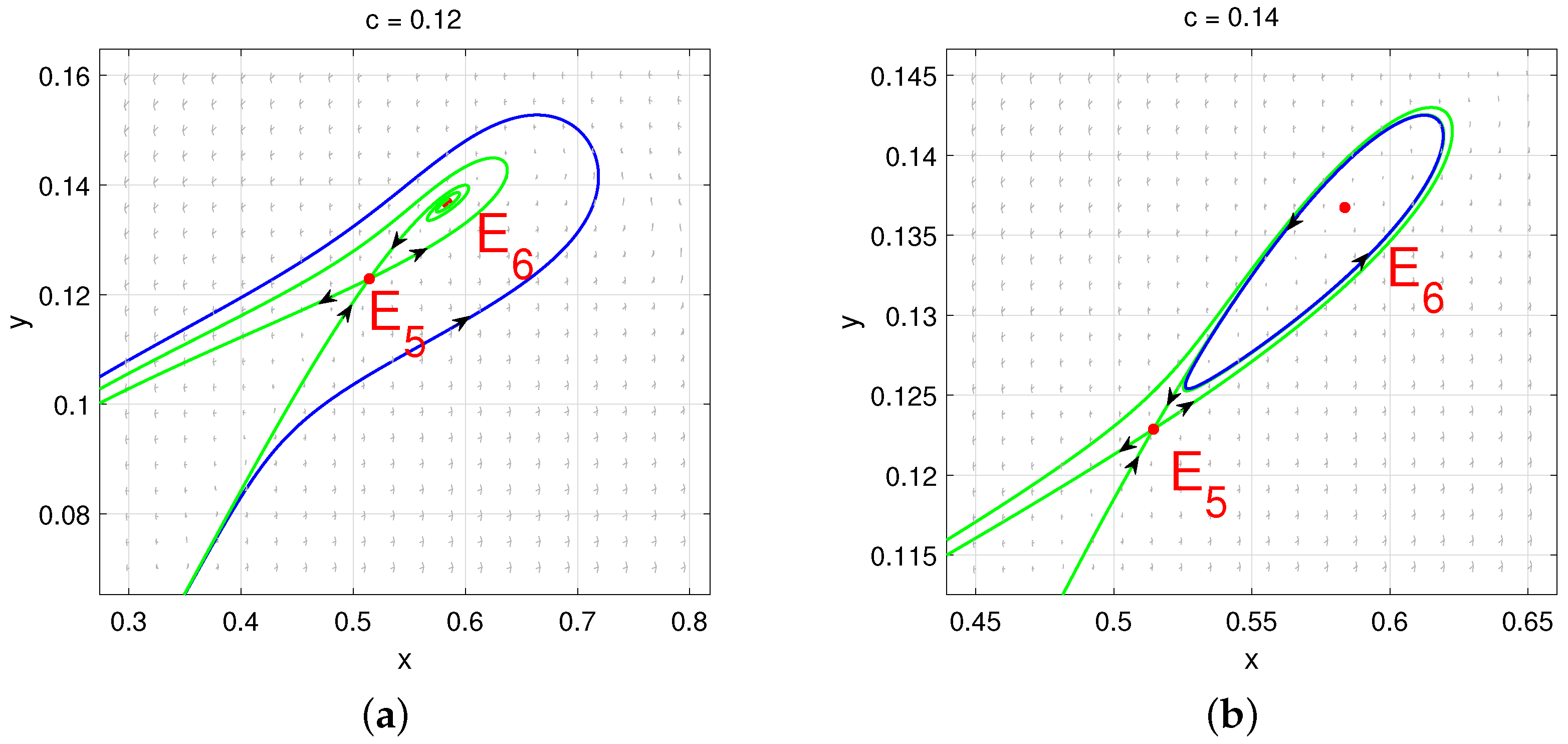
Figure 5. Phase diagrams of E 6 : (a) c < c H , unstable focus; (b) c > c H , stable focus, with existence of an unstable limit cycle. The blue lines are orbits of system (5), and the green lines are stable and unstable manifolds of the saddle E 5 .
Mathematics 14 00190 g005
Figure 6. d 2 -c graph showing the regions for spatial pattern formation. The red dashed lines are Turing bifurcation curves d 2 and d 2 + . The black dashed line is the Hopf bifurcation curve c = c H .
Mathematics 14 00190 g006
Figure 7. Bifurcation diagram of Turing patterns in system (4), H is the hexagonal (spot) pattern and B the stripe pattern. The dashed lines stand for unstable patterns, and the solid lines are stable patterns.
Mathematics 14 00190 g007
Figure 8. (a) t = 0; (b) t = 800; (c) t = 1600; (d) t = 2400.
Mathematics 14 00190 g008
Figure 9. (a) t = 0; (b) t = 400; (c) t = 800; (d) t = 1200.
Mathematics 14 00190 g009
Figure 10. (a) t = 0; (b) t = 200; (c) t = 400; (d) t = 600.
Mathematics 14 00190 g010
Table 1. The biology interpretation of the parameters in system (1).
ParametersBiology Interpretation
rBirth rates of the prey
sBirth rates of the predator
kEnvironment carrying capacity of the prey
MStrength of Allee effect on the prey
mEnvironmental protection on both species
α The consumption rate of the prey
β Competition coefficient
D 1 Diffusion rate of the prey
D 2 Diffusion rate of the predator
Table 2. Patterns for different parameters d 2 .
d 2 μ Pattern
5.5 μ < μ 3 Spot
7 μ 3 < μ < μ 4 Mixed (Spot and Stripe)
16 μ > μ 4 Stripe
Disclaimer/Publisher’s Note: The statements, opinions and data contained in all publications are solely those of the individual author(s) and contributor(s) and not of MDPI and/or the editor(s). MDPI and/or the editor(s) disclaim responsibility for any injury to people or property resulting from any ideas, methods, instructions or products referred to in the content.