Research on the Improvement of Intuitionistic Fuzzy Entropy Measurement Based on TOPSIS Method and Its Application

Abstract
1. Introduction
2. Fuzzy Entropy
- (1)
- if and only if is a crisp set;
- (2)
- if and only if , for each ;
- (3)
- Let and be two fuzzy sets. For each , if or , then we have ;
- (4)
- .
3. Intuitionistic Fuzzy Entropy Measurement and Comparative Study
- (1)
- For each , if and only if , ;
- (2)
- if and only if and are established at the same time;
- (3)
- For each , if and only if , ;
- (4)
- ;
- (5)
- ;
- (6)
- .
3.1. The Intuitionistic Fuzzy Set Entropy Measure Only Considers Intuition
- (1)
- when and only if is a fuzzy set;
- (2)
- For any , if and only if ;
- (3)
- If , then ;
- (4)
- .
3.2. The Intuitionistic Fuzzy Set Entropy Measure Only Considers Fuzziness
3.3. The Intuitionistic Fuzzy Set Entropy Measures Consider Fuzziness and Intuition
- (1)
- if and only if is a crisp set;
- (2)
- if and only if , for each ;
- (3)
- For each , when , and , or when , and , is always established;
- (4)
- .
4. Research on Improvement of Intuitionistic Fuzzy Entropy Measure
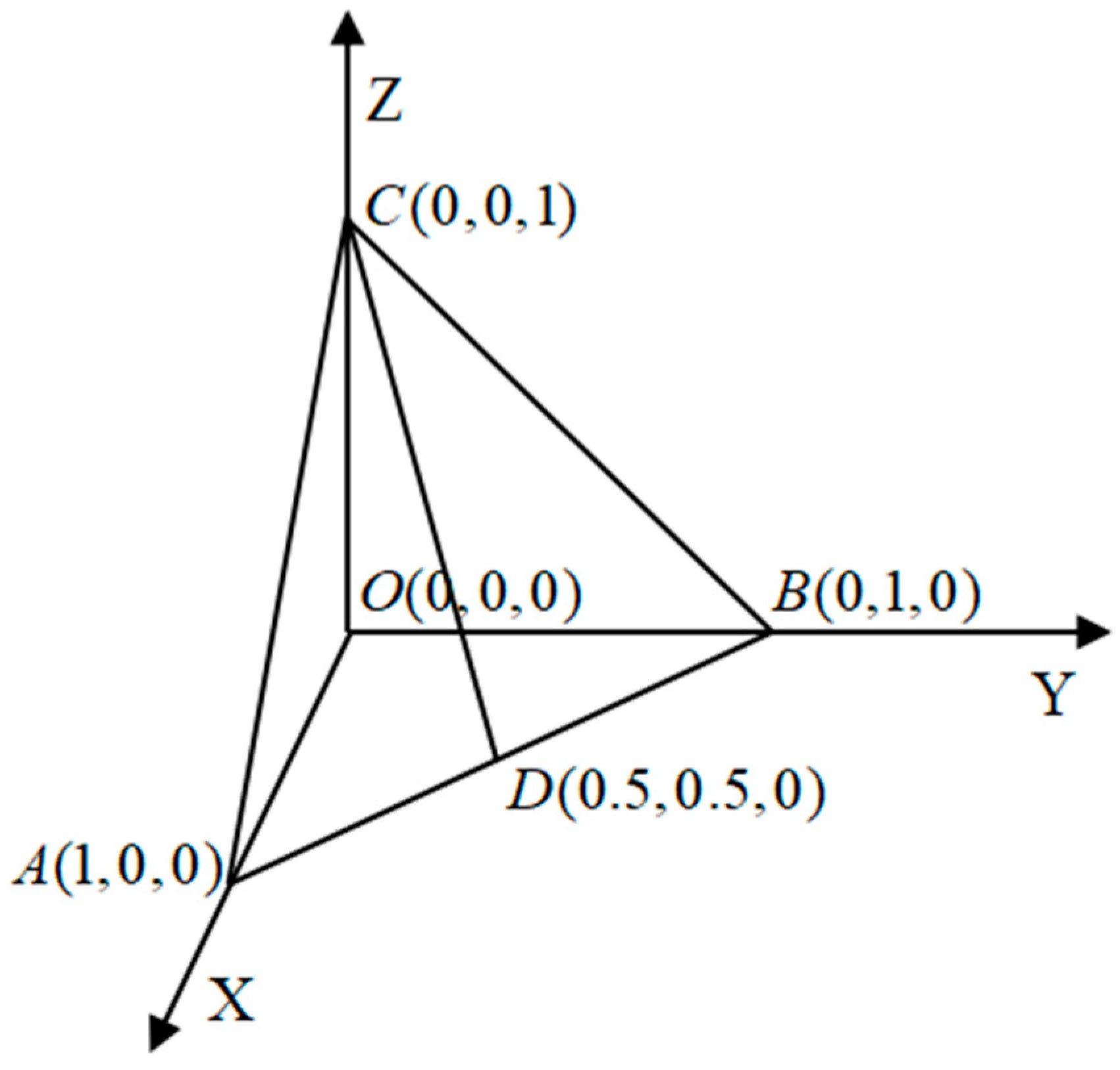
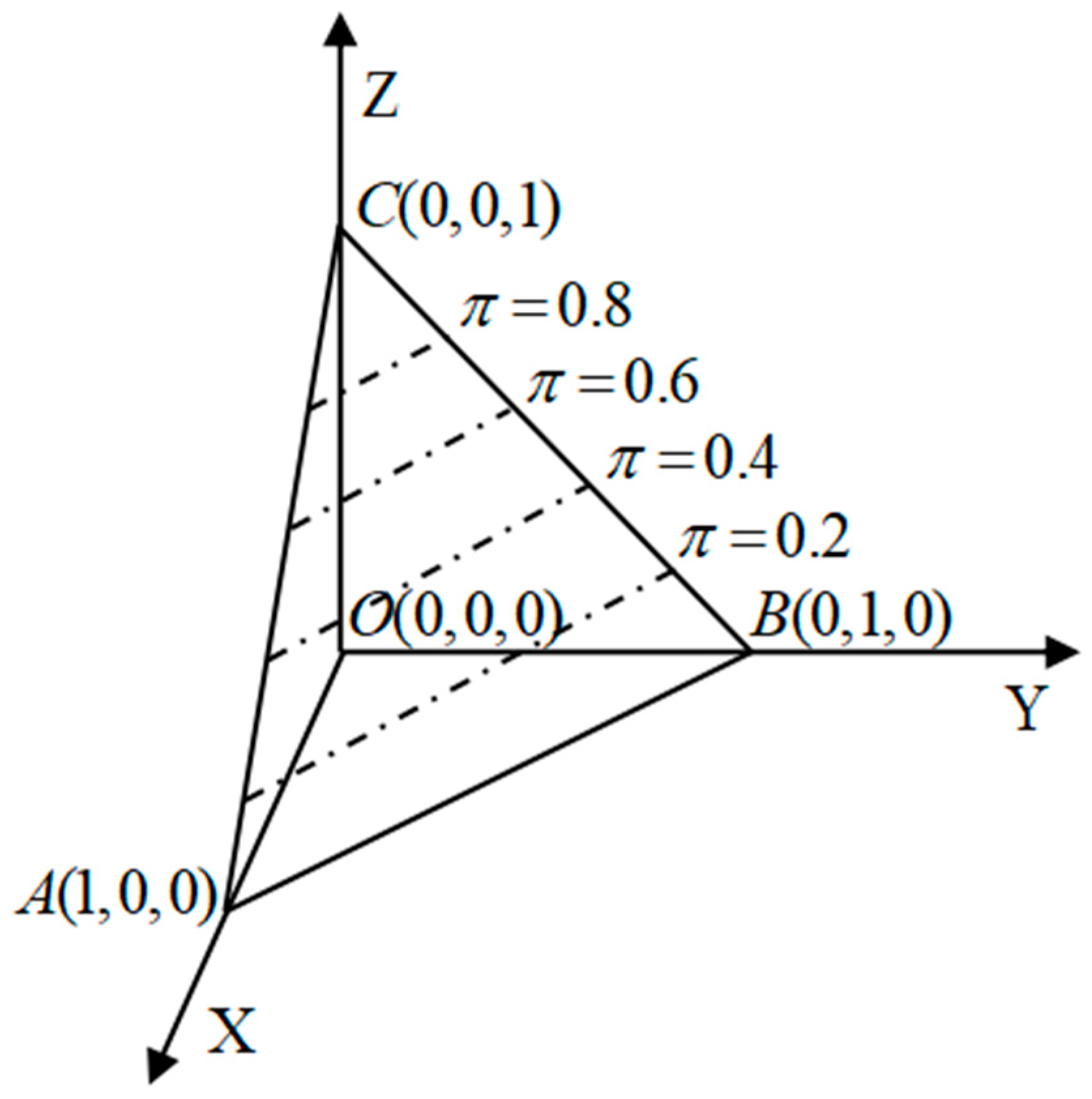
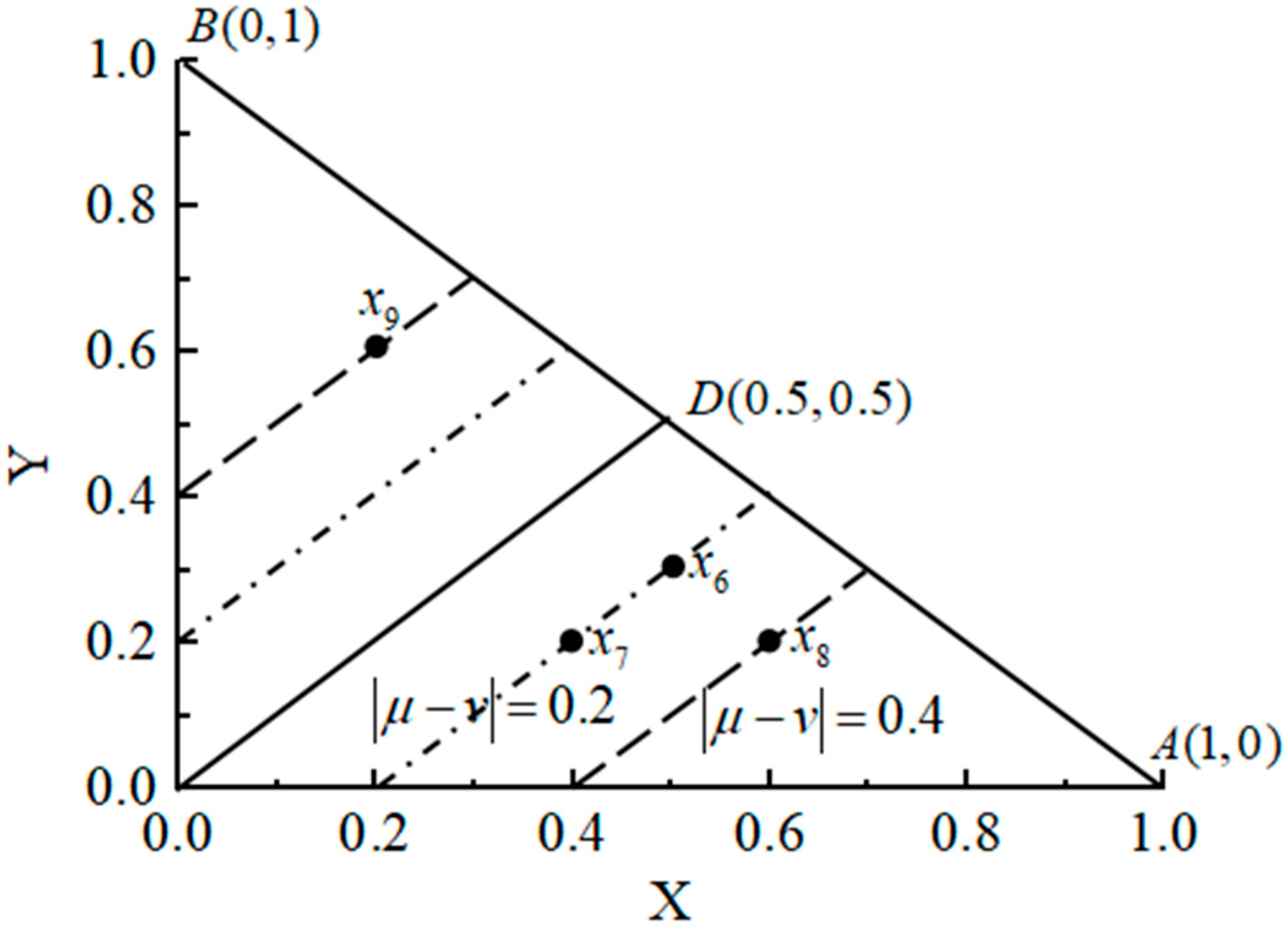
4.1. New Axiomatic Definition and Geometric Interpretation
- (1)
- if and only if is crisp set;
- (2)
- if and only if for every ;
- (3)
- If and , for each , then ;
- (4)
- If and , for each , then ;
- (5)
- ;
- (6)
- With the change in intuitionistic fuzzy sets, the value of intuitionistic fuzzy entropy is in interval [0,1].
4.2. Construct New Intuitionistic Fuzzy Entropy Measures
- (1)
- if and only if , that is , i.e., for , we have , and , or , , . So is crisp set;
- (2)
- if and only if , after finishing , i.e., for , we have , , ;
- (3)
- When and , we haveSince andThus, .
- (4)
- When and , we haveSinceand .Thus, .
- (5)
- Since ,Thus, .
- (6)
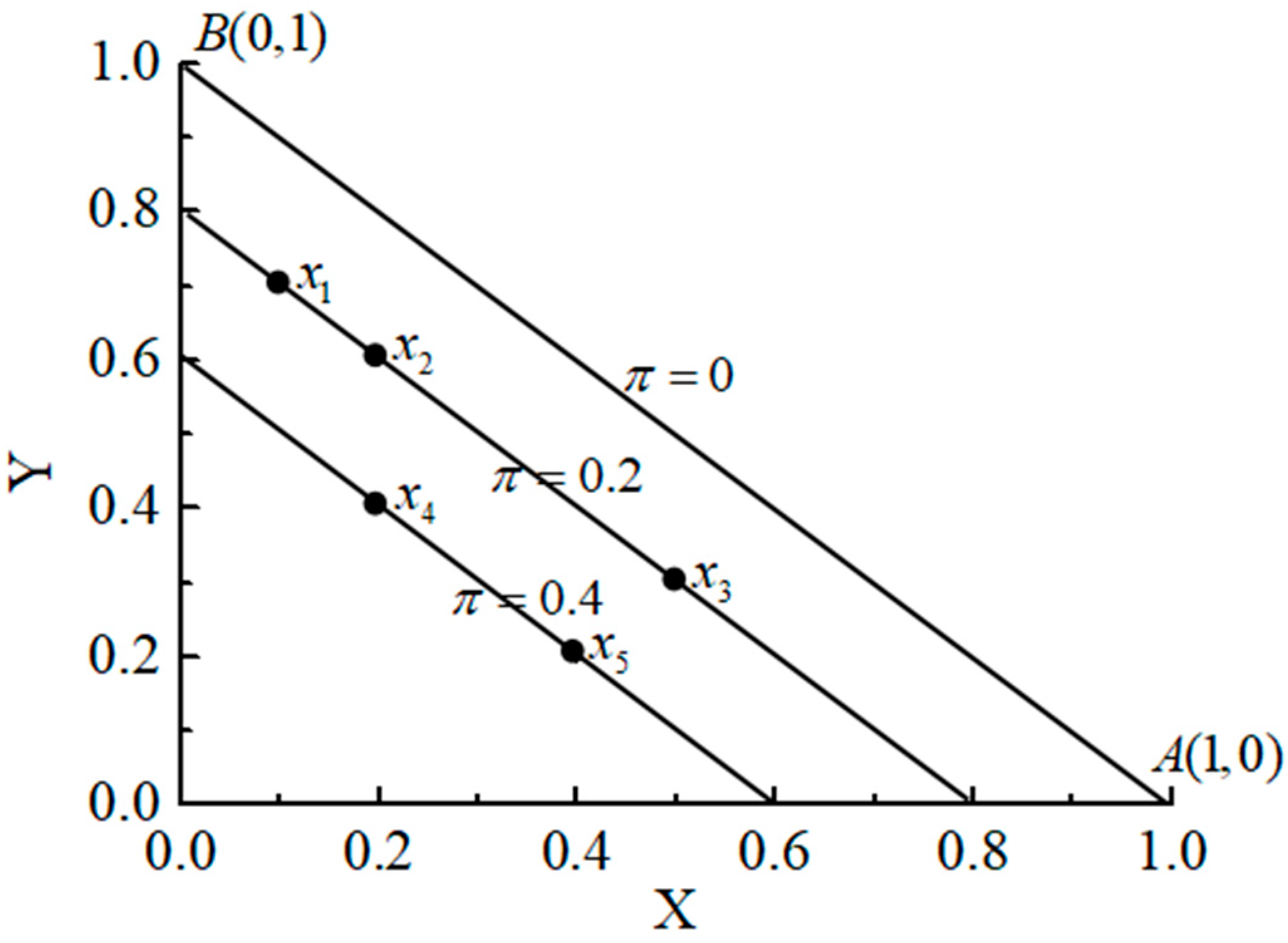
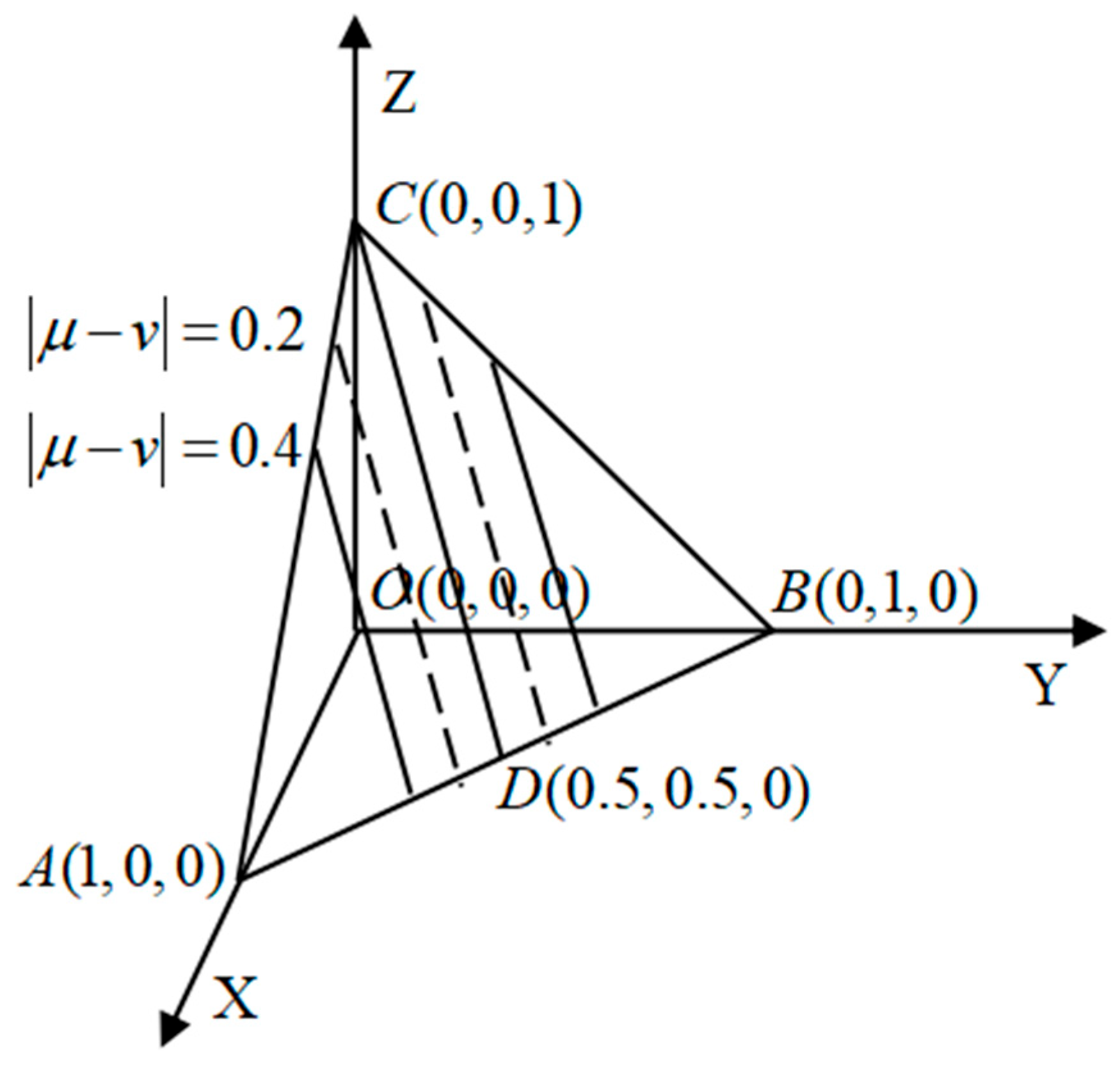
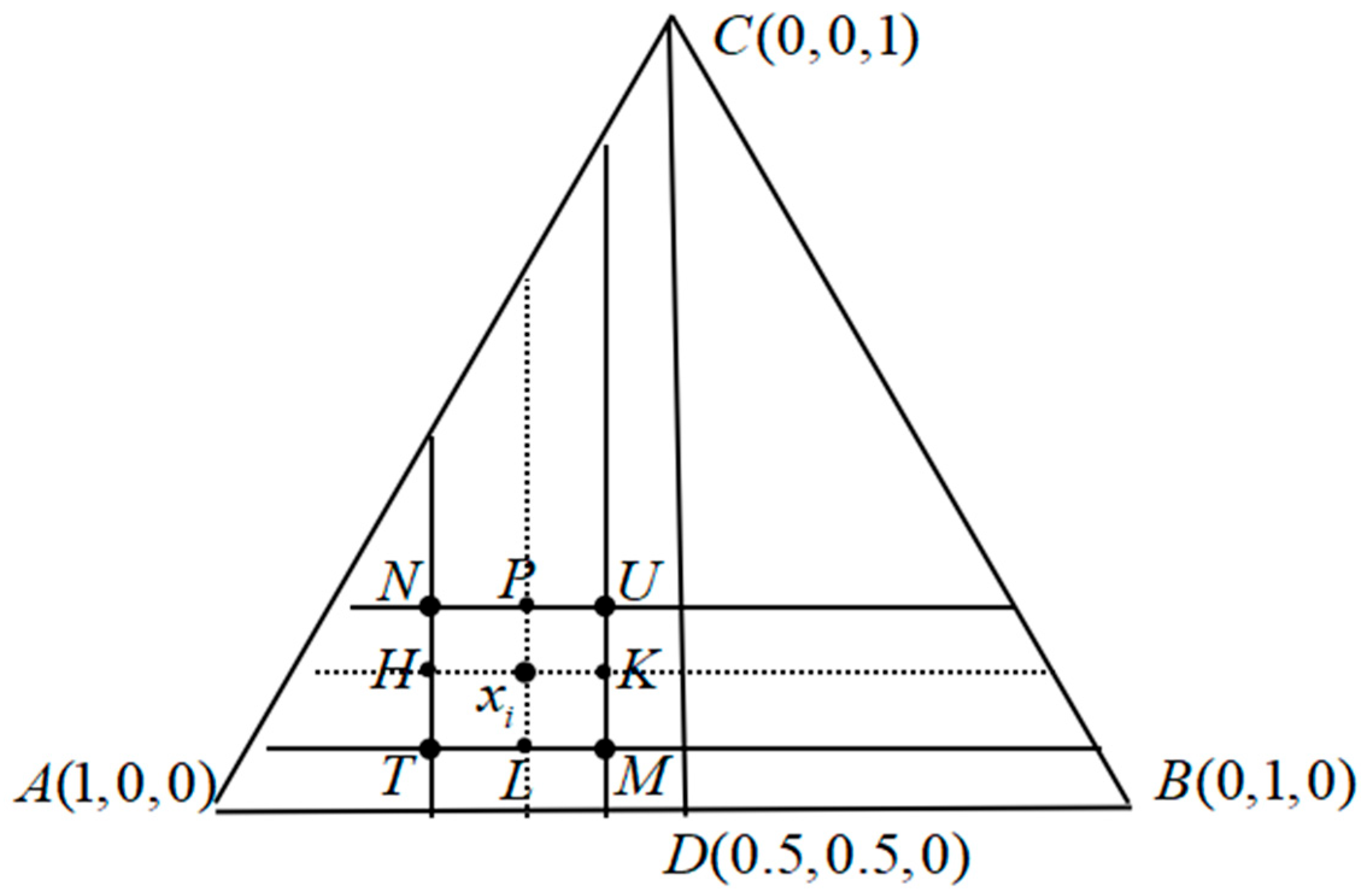
- Obviously, intuitionistic fuzzy entropy changes continuously with different in interval [0,1]. Find any point in , then draw some lines paralleled to and , as it shows in Figure 6.

- (1)
- if and only if , after simplifying and finishing . That is, for each , , , , or , , . Thus, is a crisp set;
- (2)
- if and only if , after simplifying and finishing is obtained. That is, for each , , , are established;
- (3)
- Let , , then , , or , . NoteWhen , then . Thus, ;
- (4)
- Let and , then , or , .NoteWhen , then . Thus, ;
- (5)
- Since , thus ;
- (6)
- Obviously, with different intuitionistic fuzzy sets, intuitionistic fuzzy entropy changes continuously in interval [0,1]. □
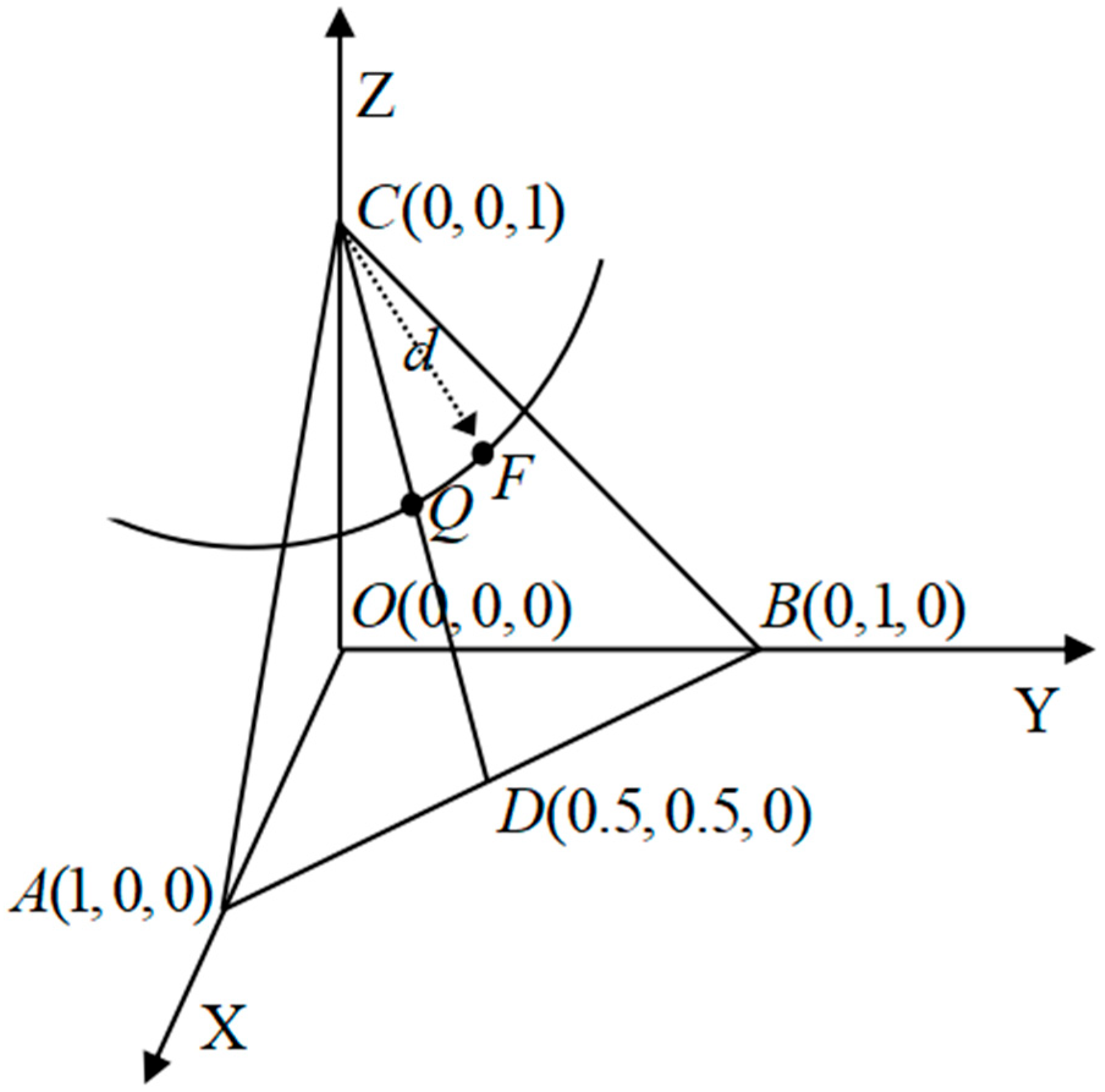
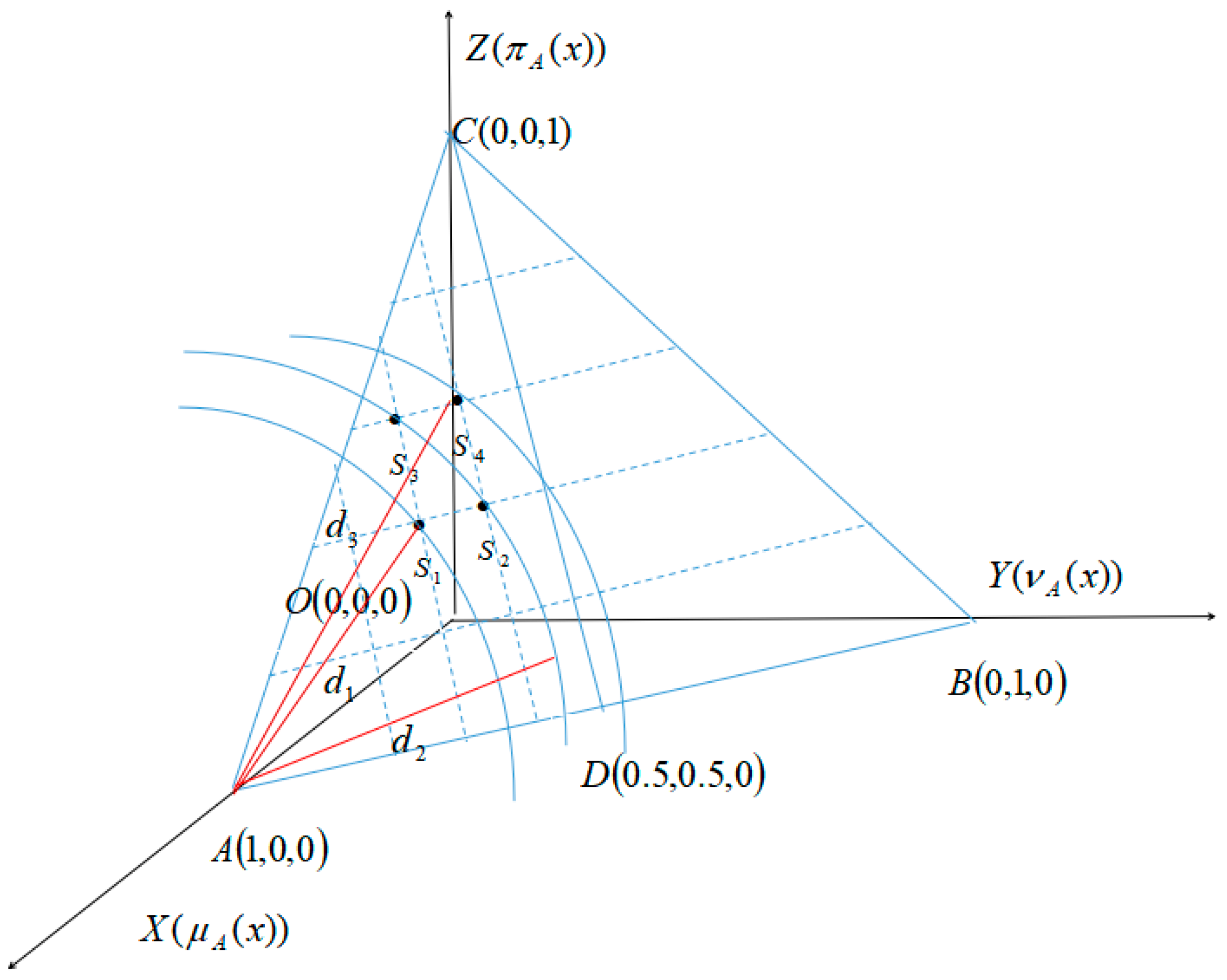
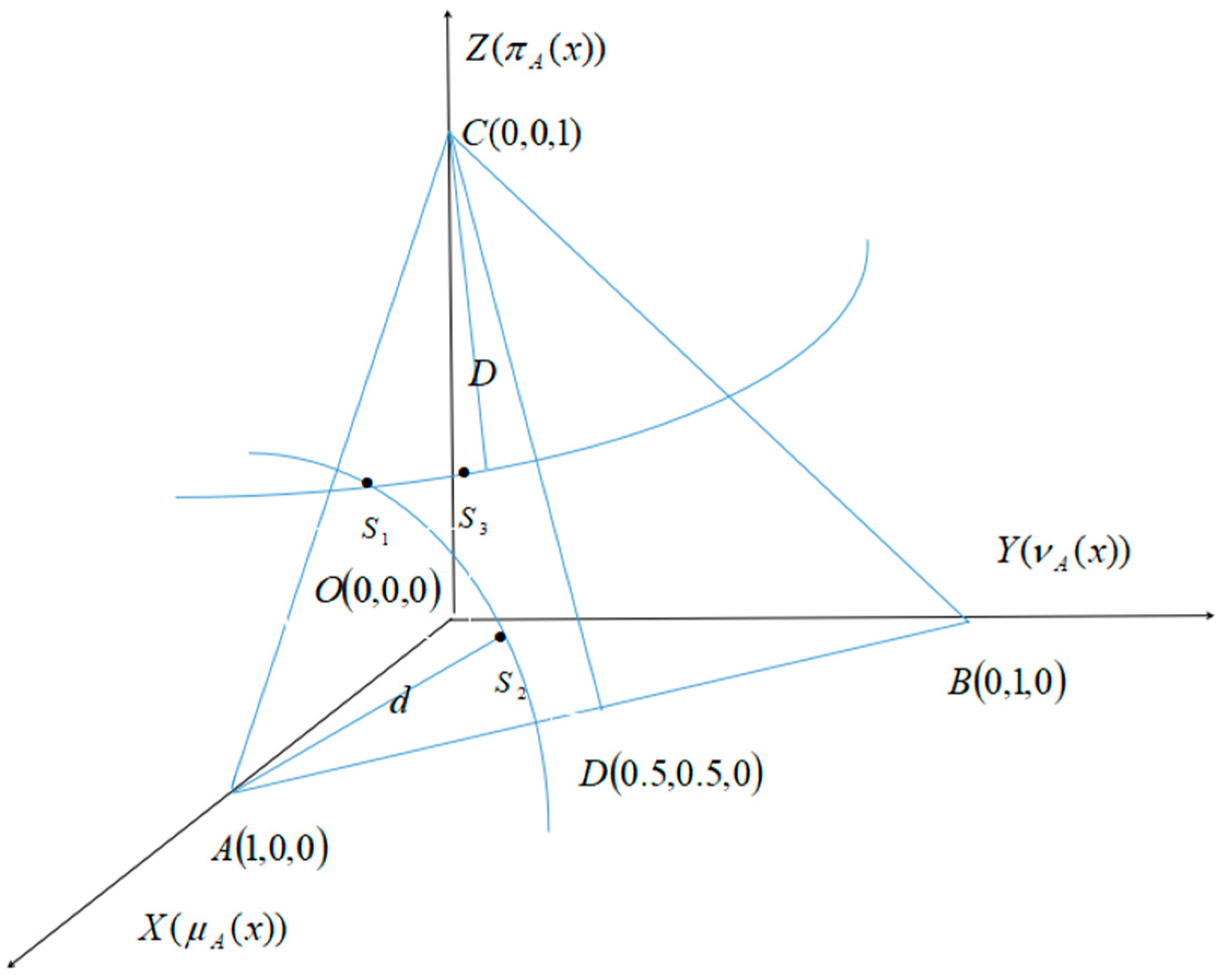
4.3. The Geometric Construction Method of Intuitionistic Fuzzy Entropy Based on TOPSIS Method
- (1)
- if and only if, orThat is, for each , we have , , , or , , . Thus, is crisp set.
- (2)
- if and only if, alsoThat is, for each , and are established.
- (3)
- Let , , for each are established.When , ;When , ;When , ;When , .The following proves that when, , , entropy , the other three situations can be proved by similar methods.Because, , , , , for each are established.So , That is , .And becauseBecause ,So .Therefore , that is, is established.
- (4)
- When , , and for each ,The following proves that when ,, , entropy , the other three situations can be proved by similar methods.Because, , ,, , so.And becauseBecause , , soTherefore , that is, is established.
- (5)
- Let , then . When,.When , ,. So .
- (6)
- It is obvious that the intuitionistic fuzzy entropy changes continuously in interval [0,1] as different intuitionistic fuzzy sets are taken. So
- (1)
- Theoretical Adaptability: The core of intuitionistic fuzzy entropy is to measure uncertainty. The essence of the TOPSIS method is to evaluate merits and demerits through distance ranking. The two are highly consistent in the logic of “quantifying target attributes based on relative positions”. An intuitionistic fuzzy point with stronger uncertainty should be closer to the maximum entropy point (complete uncertainty). It should also be farther from the zero entropy point (complete certainty). The dual-reference distance comparison mechanism of TOPSIS can accurately depict this relative relationship. However, single-reference distance measurement cannot simultaneously meet the dual requirements of “approaching the optimal” and “staying away from the worst”.
- (2)
- Comparative Advantages over Other Distance Methods: Take Minkowski distance as an example. Its essence is a single-dimensional distance measurement. It can only describe the absolute distance from an intuitionistic fuzzy point to a certain reference point. It cannot reflect the relative merits between the two points. If Minkowski distance is used to replace the TOPSIS method, it is necessary to calculate the distances to the maximum entropy point and the zero entropy point separately, and then perform manual weighting. This approach not only lacks a unified weight determination standard, but also loses the core advantage of TOPSIS—“relative closeness”.
- (3)
- Engineering Practicality: In complex engineering decision-making, decision objectives often need to consider both “optimal reference” and “worst reference” (e.g., a scheme’s optimal performance and worst-case risk). The dual-reference design of TOPSIS naturally matches the actual needs of engineering decision-making. The entropy constructed based on this method can be directly integrated into the decision model. This realizes the integration of uncertainty quantification and scheme ranking. In contrast, other distance methods require the additional construction of decision frameworks, which increases model complexity and the risk of error transmission.
- (1)
- if and only if , that is, or .That is, for each , we have , , , or , , . Thus, is crisp set.
- (2)
- if and only if , that isThat is, for each , and are established.
- (3)
- Let , , for each is always established.From Theorem 2 and Theorem 3, we know that, , thusso , that is .
- (4)
- When , , for each ,From Theorem 2 and Theorem 3, we know that, , thusso , that is .
- (5)
- Let , then ,, . Thus,
- (6)
- Obviously, changes continuously in interval [0,1].So meet the conditions. □
5. Group Decision-Making Model and Application
5.1. Group Decision Method
5.1.1. Basic Concepts of Intuitionistic Fuzzy Sets
5.1.2. Determination of Weights of Index Factors
5.1.3. Score Function with Parameters
5.2. Evaluation Procedure
5.3. Application
5.3.1. Refinement of Evaluation Objects and Decision-Making Scenarios
5.3.2. Data Structure of Evaluation and Construction of Matrices
5.3.3. Implementation Steps of the Evaluation
5.3.4. Evaluation Results and Multi-Dimensional Validation
- (1)
- Basic Evaluation Results
- (2)
- Sensitivity Analysis
- (3)
- Robustness Analysis
- (4)
- Systematic Comparison with Multiple Methods
6. Conclusions
- (1)
- Limited application scenarios of the entropy measure: The geometric construction logic of the intuitionistic fuzzy entropy measure formula based on TOPSIS proposed in this paper relies on the triangular region representation of intuitionistic fuzzy sets in three-dimensional space. When dealing with high-dimensional intuitionistic fuzzy decision-making problems, projection dimensionality reduction is required for calculation, and this process may lead to the loss of some uncertain information, thus affecting the accuracy of evaluation results.
- (2)
- Room for improvement in the quantitative accuracy of the offsetting characteristic: The study only qualitatively reveals the offsetting effect between intuition and fuzziness, without providing a quantitative calculation model for this effect. When both types of factors change significantly at the same time, the calculation accuracy of the entropy value may be affected.
- (3)
- Need for in-depth empirical verification: Numerical examples only verify the rationality of the entropy measure. They neither perform multi-scenario comparisons with mainstream methods like the Analytic Hierarchy Process (AHP) nor use long-term tracking data to validate the practical application effect of dynamic decision-making.
- (1)
- Optimize the high-dimensional adaptability of the entropy measure model: Explore high-dimensional intuitionistic fuzzy entropy construction methods that do not require dimensionality reduction. Introduce theories such as tensor analysis and manifold learning to accurately characterize the uncertainty of intuitionistic fuzzy sets in high-dimensional space, and expand the model’s application scope in complex multi-attribute decision-making problems.
- (2)
- Quantify the offset effect between intuition and fuzziness: Establish a quantitative function for the offset effect of intuition and fuzziness, clarify their offset coefficients under different variation ranges, and further improve the calculation accuracy and logical rigor of the entropy measure formula.
- (3)
- Strengthen empirical research and cross-field expansion: Conduct long-term tracking on different types of coal mining enterprises, and verify the superiority of the evaluation system and decision-making model through multi-method comparison. Extend the entropy measure method to emergency rescue fields such as chemical industry and fire protection to test its cross-scenario applicability.
Author Contributions
Funding
Data Availability Statement
Acknowledgments
Conflicts of Interest
Abbreviations
| TOPSIS | Technique for Order Preference by Similarity to an Ideal Solution |
References
- Zadeh, L.A. Fuzzy sets. Inf. Control. 1965, 8, 338–353. [Google Scholar] [CrossRef]
- Atanassov, K. Intuitionistic fuzzy sets. Fuzzy Sets Syst. 1986, 20, 87–96. [Google Scholar] [CrossRef]
- Boffa, S.; Ciucci, D.; Marsala, C. Extending intuitionistic operations, orderings, and entropy measures on generalized fuzzy orthopartitions. Fuzzy Sets Syst. 2025, 513, 109381. [Google Scholar] [CrossRef]
- Guan, Z.; Zihao, F.; Yingxin, H.; Jintao, C.; Jinyu, R. An adaptive strategy quantum particle swarm optimization method based on intuitionistic fuzzy entropy and evolutionary game theory. Appl. Soft Comput. 2025, 183, 113654. [Google Scholar]
- Xu, Z. A deviation-based approach to intuitionistic fuzzy multiple attribute group decision making. Group Decis. Negot. 2010, 19, 57–76. [Google Scholar] [CrossRef]
- Yu, G.F.; Fei, W.; Li, D.F. A compromise-typed variable weight decision method for hybrid multi-attribute decision making. IEEE Trans. Fuzzy Systems 2019, 27, 861–872. [Google Scholar] [CrossRef]
- Khan, M.J.; Jiang, S.; Ding, W.; Akram, M. Construction methods for entropy measures of circular intuitionistic fuzzy sets and their application. Eng. Appl. Artif. Intell. 2025, 160, 111809. [Google Scholar] [CrossRef]
- Xu, Z. Approaches to multiple attribute group decision making based on intuitionistic fuzzy power aggregation operators. Knowl. Based Syst. 2011, 24, 749–760. [Google Scholar] [CrossRef]
- Zhang, Y.; Huang, H.L. The distance and entropy measures-based intuitionistic fuzzy c-means and similarity matrix clustering algorithms and their applications. Appl. Soft Comput. 2025, 169, 112581. [Google Scholar] [CrossRef]
- Zolfani, S.H.; Kumar, M.Y.A.; Zavadskas, E.K. An integrated intuitionistic fuzzy AHP and TOPSIS method with a novel weighting approach based on regret theory for healthcare supplier selection. Econ. Res. 2024, 37, 1–25. [Google Scholar]
- Suo, C.; Li, X.; Li, Y. Distance-Based Knowledge Measure and Entropy for Interval-Valued Intuitionistic Fuzzy Sets. Mathematics 2023, 11, 3468. [Google Scholar] [CrossRef]
- Chen, J.; Zhao, Y.; Liu, Z.; Yang, S.; Zhou, Z. Prediction of Rockburst Propensity Based on Intuitionistic Fuzzy Set—Multisource Combined Weights—Improved Attribute Measurement Model. Mathematics 2023, 11, 3508. [Google Scholar] [CrossRef]
- Joshi, R.; Kumar, S. An intuitionistic fuzzy (δ, γ)-norm entropy with its application in supplier selection problem. Comput. Appl. Math. 2018, 37, 5624–5649. [Google Scholar] [CrossRef]
- Alreshidi, N.A.; Shah, Z.; Khan, M.J. Similarity and entropy measures for circular intuitionistic fuzzy sets. Eng. Appl. Artif. Intell. 2024, 131, 107786. [Google Scholar] [CrossRef]
- Xu, Z.S. On similarity measures of interval-valued intuitionistic fuzzy sets and their application to pattern recognitions. J. Southeast Univ. 2007, 23, 139–143. [Google Scholar]
- Yuan, J.; Luo, X. Approach for multi-attribute decision making based on novel intuitionistic fuzzy entropy and evidential reasoning. Comput. Ind. Eng. 2019, 135, 643–654. [Google Scholar] [CrossRef]
- Wei, G.; Wang, J.; Lu, M.; Wu, J. A novel multi-attribute decision-making method based on intuitionistic fuzzy sets and its application in selecting sustainable supplier. Inf. Sci. 2023, 648, 119528. [Google Scholar]
- Krishankumar, R.; Ravichandran, K.S.; Aggarwal, M.; Pamucar, D. An improved entropy function for the intuitionistic fuzzy sets with application to cloud vendor selection. Decis. Anal. J. 2023, 7, 100262. [Google Scholar] [CrossRef]
- Zadeh, L.A. The concept of a linguistic variable and its application to approximate reasoning. Inf. Sci. 1975, 8, 199–249. [Google Scholar] [CrossRef]
- Gau, W.L.; Buehrer, D.J. Vague sets. IEEE Trans. Syst. Man Cybern. 1993, 23, 610–614. [Google Scholar] [CrossRef]
- Bustince, H.; Burillo, P. Vague sets are intuitionistic fuzzy sets. Fuzzy Sets Syst. 1996, 79, 403–405. [Google Scholar] [CrossRef]
- Jin, J.L.; Garg, H. Intuitionistic fuzzy three-way ranking-based TOPSIS approach with a novel entropy measure and its application to medical treatment selection. Adv. Eng. Softw. 2023, 180, 103459. [Google Scholar] [CrossRef]
- Wang, T.; Wu, X.; Garg, H.; Liu, Q. Novel strict intuitionistic fuzzy similarity measures-based on fuzzy negation and their applications. Expert Syst. Appl. 2024, 252, 124192. [Google Scholar] [CrossRef]
- De Luca, A.; Termini, S. A definition of non probabilistic entropy in the setting of fuzzy theory. Inf. Control. 1972, 20, 301–312. [Google Scholar] [CrossRef]
- Burillo, P.; Bustince, H. Entropy on intuitionistic fuzzy sets and on interval-valued fuzzy sets. Fuzzy Sets Syst. 1996, 78, 305–316. [Google Scholar] [CrossRef]
- Szmidt, E.; Kacprzyk, J. Entropy for intuitionistic fuzzy sets. Fuzzy Sets Syst. 2001, 118, 467–477. [Google Scholar] [CrossRef]
- Szmidt, E.; Baldwin, J. Entropy for intuitionistic fuzzy set theory and mass assignment theory. Notes IFSs 2004, 10, 15–28. [Google Scholar]
- Szmidt, E.; Baldwin, J. New similarity measure for intuitionistic fuzzy set theory and mass assignment theory. Notes IFSs 2003, 9, 60–76. [Google Scholar]
- Jiang, Q.; Wang, H. Hybrid Intuitionistic Fuzzy Entropy-BWM-WASPAS Approach for Supplier Selection in Shipbuilding Enterprises. Sustainability 2025, 17, 1701. [Google Scholar] [CrossRef]
- Szmidt, E.; Kacprzyk, J. A new similarity measure for intuitionistic fuzzy sets: Straightforward approaches may not work. In Proceedings of the 2007 IEEE International Fuzzy Systems Conference, London, UK, 23–26 July 2007; Institute of Electrical and Electronics Engineers: Piscataway, NJ, USA, 2007; pp. 1–6. [Google Scholar]
- Szmidt, E.; Kacprzyk, J. Entropy and similarity of intuitionistic fuzzy sets. In Proceedings of the 11th International Conference on IPMU, Paris, France, 2–7 July 2006; Éditions EDK: Paris, France, 2006; pp. 2375–2382. [Google Scholar]
- Rani, S.; Dhanasekar, S. Type-2 Trapezoidal Pythagorean fuzzy number with novel entropy measure and aggregation operators extended to MCDM. Complex Intell. Syst. 2025, 11, 451. [Google Scholar] [CrossRef]
- Fei, F. A Neutrosophic Entropy-Based Statistical Model for Uncertainty Quantification in Mixed-Type Linguistic Data: Application to University Korean Language Teaching Management Innovation Evaluation. Neutrosophic Sets Syst. 2025, 91, 262–275. [Google Scholar]
- Senbagam, K.; Ramesh, R. A Pythagorean Fuzzy Entropy with Multi-Distributive Weighted Function-Based Decision-Making for Transportation Problem. Cogn. Comput. 2025, 17, 169. [Google Scholar] [CrossRef]
- Bozyiğit, M.C.; Olgun, M.; Ünver, M.; Söylemez, D. Parametric picture fuzzy cross-entropy measures based on d-Choquet integral for building material recognition. Appl. Soft Comput. 2024, 166, 112167. [Google Scholar] [CrossRef]
- Chen, T.Y.; Li, C.H. Determining objective weights with intuitionistic fuzzy entropy measures: A comparative analysis. Inf. Sci. 2010, 180, 4207–4222. [Google Scholar] [CrossRef]
- Zeng, W.; Li, H. Relationship between similarity measure and entropy of interval valued fuzzy sets. Fuzzy Sets Syst. 2006, 157, 1477–1484. [Google Scholar] [CrossRef]
- Vlachos, I.K.; Sergiadis, G.D. Subsethood, entropy, and cardinality for interval-valued fuzzy sets–An algebraic derivation. Fuzzy Sets Syst. 2007, 158, 1384–1396. [Google Scholar] [CrossRef]
- Zhang, Q.S.; Jiang, S.Y. A note on information entropy measures for vague sets and its application. Inf. Sci. 2008, 178, 4184–4191. [Google Scholar] [CrossRef]
- Szmidt, E.; Kacprzyk, J. New measures of entropy for intuitionistic fuzzy sets. In Proceedings of the International Conference of IFSs, Sofia, Bulgaria, 7–8 May 2005; Notes on Intuitionistic Fuzzy Sets: Sofia, Bulgaria, 2005; pp. 12–20. [Google Scholar]
- Xia, M.M.; Xu, Z.S. Entropy/cross entropy-based group decision making under intuitionistic fuzzy environment. Inf. Fusion 2012, 13, 31–47. [Google Scholar] [CrossRef]
- Ye, J. Two effective measures of intuitionistic fuzzy entropy. Computing 2010, 87, 55–62. [Google Scholar] [CrossRef]
- Wei, C.P.; Gao, Z.H.; Guo, T.T. An intuitionistic fuzzy entropy measure based on the trigonometric function. Control Decis. 2012, 27, 571–574. [Google Scholar]
- Wang, Y.; Lei, Y.J. A technique for constructing intuitionistic fuzzy entropy. Control. Decis. 2007, 22, 1390–1394. [Google Scholar]
- Huang, G.S.; Liu, Y.S. The fuzzy entropy of vague sets based on non-fuzzy sets. Comput. Appl. Softw. 2005, 22, 16–17. [Google Scholar]
- Vlachos, I.K.; Sergiadis, G.D. Inner product based entropy in the intuitionistic fuzzy setting. Int. J. Uncertain. Fuzziness Knowl. Based Syst. 2006, 14, 351–366. [Google Scholar] [CrossRef]
- Liu, P.; Teng, F. A new multi-attribute decision-making method using intuitionistic fuzzy entropy and similarity measure for project selection in strategic management. Expert Syst. Appl. 2022, 199, 117155. [Google Scholar]
- Wei, A.P.; Li, D.F.; Jiang, B.Q.; Lin, P.P. The Novel Generalized Exponential Entropy for Intuitionistic Fuzzy Sets and Interval Valued Intuitionistic Fuzzy Sets. Int. J. Fuzzy Syst. 2019, 21, 2327–2339. [Google Scholar] [CrossRef]
- Wei, C.P.; Wang, P.; Zhang, Y.Z. Entropy, similarity measure of interval-valued intuitionistic fuzzy sets and their applications. Inf. Sci. 2011, 181, 4273–4286. [Google Scholar] [CrossRef]
- Singh, A.; Kumar, S. Intuitionistic fuzzy entropy-based knowledge and accuracy measure with its applications in extended VIKOR approach for solving multi-criteria decision-making. Granul. Comput. 2023, 8, 1609–1643. [Google Scholar] [CrossRef]
- Bisht, D.; Singhz, Y.; Goyal, G.; Kumar, R. Intuitionistic fuzzy set entropy: A novel measure for uncertainty management in complex group decision-making. Math. Eng. Sci. Aerosp. (MESA) 2024, 15, 2041–3165. [Google Scholar]
- Kashyap, S.; Paradowski, B.; Gandotra, N.; Saini, N.; Sałabun, W. A Novel Trigonometric Entropy Measure Based on the Complex Proportional Assessment Technique for Pythagorean Fuzzy Sets. Energies 2024, 17, 431. [Google Scholar] [CrossRef]
- Patel, A.; Jana, S.; Mahanta, J. Intuitionistic fuzzy EM-SWARA-TOPSIS approach based on new distance measure to assess the medical waste treatment techniques. Appl. Soft Comput. 2023, 144, 110521. [Google Scholar] [CrossRef]
- Xu, C.; Lan, Y. A Multi-criteria Decision-Making Method Based on Intuitionistic Fuzzy Entropy and Three-Way Ranking TOPSIS with Applications. Int. J. Fuzzy Syst. 2025, 27, 1–24. [Google Scholar] [CrossRef]
- Kumar, N.; Mandal, R.K.; Sarkar, A.; Mahanta, J. An Intuitionistic Fuzzy Metric and its Application in Varied Decision Making Approaches. Int. J. Uncertain. Fuzziness Knowl. Based Syst. 2025, 33, 1029–1055. [Google Scholar] [CrossRef]



| 0.8182 | 0.9 | 0.9 | 0.9928 | 0.8 | 0.95 | 0.99 | 0.9895 | |
| 0.8182 | 0.9 | 0.9 | 0.9928 | 0.75 | 0.95 | 0.99 | 0.9895 | |
| 0.8182 | 0.9 | 0.9 | 0.9928 | 0.5 | 0.95 | 0.99 | 0.9895 |
| 0 | 0 | 0 | 0 | 0 | 0 | 0 | 0 | 0 | 0 | 0 | 0 | |
| 0 | 0.2 | 0.1111 | 0.3479 | 0.25 | 0.309 | 0.469 | 0.2195 | 0.2647 | 0.0461 | 0.1 | 0.095 | |
| 0.2 | 0.2 | 0 | 0.3479 | 0.2 | 0.5 | 0.2 | 0.0588 | 0.3143 | 0.2 | 0.2 | 0.2 | |
| 0.2 | 0.4 | 0.1429 | 0.6279 | 0.3333 | 0.707 | 0.6349 | 0.3333 | 0.4286 | 0.245 | 0.265 | 0.26 | |
| 0.4 | 1 | 1 | 1 | 1 | 1 | 1 | 1 | 0.7174 | 0.4804 | 0.608 | 0.539 | |
| 1 | 1 | 1 | 1 | 1 | 1 | 1 | 1 | 1 | 1 | 1 | 1 |
| Coal Mine Number | Mine Type | Production Scale (10,000 Tons/Year) | Core Rescue Risks | Current Rescue Configuration Level |
|---|---|---|---|---|
| High gas outburst mine | Gas explosion, suffocation | Equipped with full-time gas rescue team; monitoring equipment is complete | ||
| Mine with complex hydrogeological conditions | Water inrush, mine flooding | Sufficient emergency drainage equipment; lacks professional hydrogeological rescue experts | ||
| Rock burst mine | Rock collapse, personnel burial | Rescue support equipment is complete; emergency drill frequency is low | ||
| Ordinary fully mechanized mine | Electrical accidents, fire | Rescue supplies are sufficient; the command and coordination system needs improvement |
| The Target Layer | Level Indicators | The Secondary Indicators |
|---|---|---|
| Evaluation index system of mine emergency rescue capability | Hazard detection and prevention | Hazard monitoring equipment |
| Safety hazard inspection | ||
| On duty system and risk reporting system | ||
| Hazard control system | ||
| Emergency rescue preparation | Rescue teams | |
| Relief supplies | ||
| Rescue equipment | ||
| Emergency rescue system | ||
| Rescue personnel training | ||
| Publicity and education | ||
| Emergency protective equipment | ||
| Alarm system | ||
| Emergency shelter | ||
| Emergency mechanism setting | ||
| Emergency rescue and mitigation capacity | The identification and analysis of the disaster | |
| Implementation of contingency plan | ||
| Responders’ response | ||
| Command and coordination in the rescue process | ||
| Expert and information system support | ||
| Social relief | ||
| Reduction in casualties | ||
| Loss of property | ||
| Post-recovery capability | Production recovery | |
| Analysis and summary of accidents | ||
| Revision of contingency plans | ||
| Control of the impact of disasters | ||
| After the good work |
Disclaimer/Publisher’s Note: The statements, opinions and data contained in all publications are solely those of the individual author(s) and contributor(s) and not of MDPI and/or the editor(s). MDPI and/or the editor(s) disclaim responsibility for any injury to people or property resulting from any ideas, methods, instructions or products referred to in the content. |
© 2025 by the authors. Licensee MDPI, Basel, Switzerland. This article is an open access article distributed under the terms and conditions of the Creative Commons Attribution (CC BY) license.
Share and Cite
Chen, X.-G.; Xiao, W.-Y.; Chen, N.; Zhang, Y.-Z.; Yang, Y. Research on the Improvement of Intuitionistic Fuzzy Entropy Measurement Based on TOPSIS Method and Its Application. Mathematics 2026, 14, 150. https://doi.org/10.3390/math14010150
Chen X-G, Xiao W-Y, Chen N, Zhang Y-Z, Yang Y. Research on the Improvement of Intuitionistic Fuzzy Entropy Measurement Based on TOPSIS Method and Its Application. Mathematics. 2026; 14(1):150. https://doi.org/10.3390/math14010150
Chicago/Turabian StyleChen, Xiao-Guo, Wen-Yue Xiao, Ning Chen, Yu-Ze Zhang, and Yue Yang. 2026. "Research on the Improvement of Intuitionistic Fuzzy Entropy Measurement Based on TOPSIS Method and Its Application" Mathematics 14, no. 1: 150. https://doi.org/10.3390/math14010150
APA StyleChen, X.-G., Xiao, W.-Y., Chen, N., Zhang, Y.-Z., & Yang, Y. (2026). Research on the Improvement of Intuitionistic Fuzzy Entropy Measurement Based on TOPSIS Method and Its Application. Mathematics, 14(1), 150. https://doi.org/10.3390/math14010150