A Unified General Theory of Conic Sections via the Conic Radical


Abstract
1. Introduction
- Vertices;
- Foci;
- Latera Recta;
- Directrices;
- Asymptotes;
- Straight lines associated to rotated conics.
2. Preliminaries
2.1. Some Well-Known Mathematical Tools
- (i)
- ,
- (ii)
- .
- Property 1: .
- Property 2: .
- Property 3: .
2.2. The Definition of the Conic Radical
2.3. The General Theorem of Conic Sections and Its Implications
- (i)
- if and only if the locus in question is a single straight line or a circumference (degenerate or not).
- (ii)
- if and only if the locus in question is an ellipse (degenerate or not), a parabola (degenerate or not), or a hyperbola (degenerate or not) rotated by an angle , whose value is irrelevant to obtain the general equation of this locus without rotations, which is given as follows:where and are the rotated Cartesian axes generated by angle θ.
- (i)
- ,
- (ii)
- ,
- (iii)
- ,
- (iv)
- .
- (i)
- if and only if the locus in question is a circumference, an ellipse or a single point.
- (ii)
- if and only if the locus in question is a parabola, a single straight line, or a couple of straight lines with the same slope.
- (iii)
- if and only if the locus in question is a hyperbola or a couple of straight lines with different slopes.
- (i)
- if and only if ,
- (ii)
- ,
- (iii)
- implies .
- (i)
- ,
- (ii)
- ,
- (iii)
- .
- (i)
- If , then the equation of the locus in question without rotations and translations is given as follows:where Δ is as in (5).
- (ii)
- If and the locus in question corresponds to a non-degenerate parabola, then whenever the equation of this parabola without rotations and translations is given byso, whenever the equation of this parabola without rotations and translations is given bywhere and correspond to the Cartesian axes generated by a rotation and a translation at the same time, for some angle and some translated origin .
- (i)
- If this locus is a circumference, a parabola, an ellipse, or an equilateral hyperbola, then its eccentricity is .
- (ii)
- If this locus is a non-equilateral hyperbola, then its eccentricity is
3. Some Generalities
3.1. More on the Rotation Angle
3.2. A New Alternative to the Discriminant Criterion
- (i)
- if and only if the locus in question is a circumference, an ellipse, or a single point.
- (ii)
- if and only if the locus in question is a parabola, a single straight line, or a couple of straight lines with the same slope.
- (iii)
- if and only if the locus in question is a hyperbola or a couple of straight lines with different slopes.
3.3. The Equations of the Rotated and Translated Cartesian Axes
- (i)
- , for the -axis,
- (ii)
- , for the -axis.
- (i)
- If the equation corresponds to the -axis, then it is clear that the rotation angle of (3) is also the inclination angle of the straight line that corresponds to this axis; thus, Theorem 2 implies . On the other hand, if the coordinates of satisfy the equation in question, then . Therefore,
- (ii)
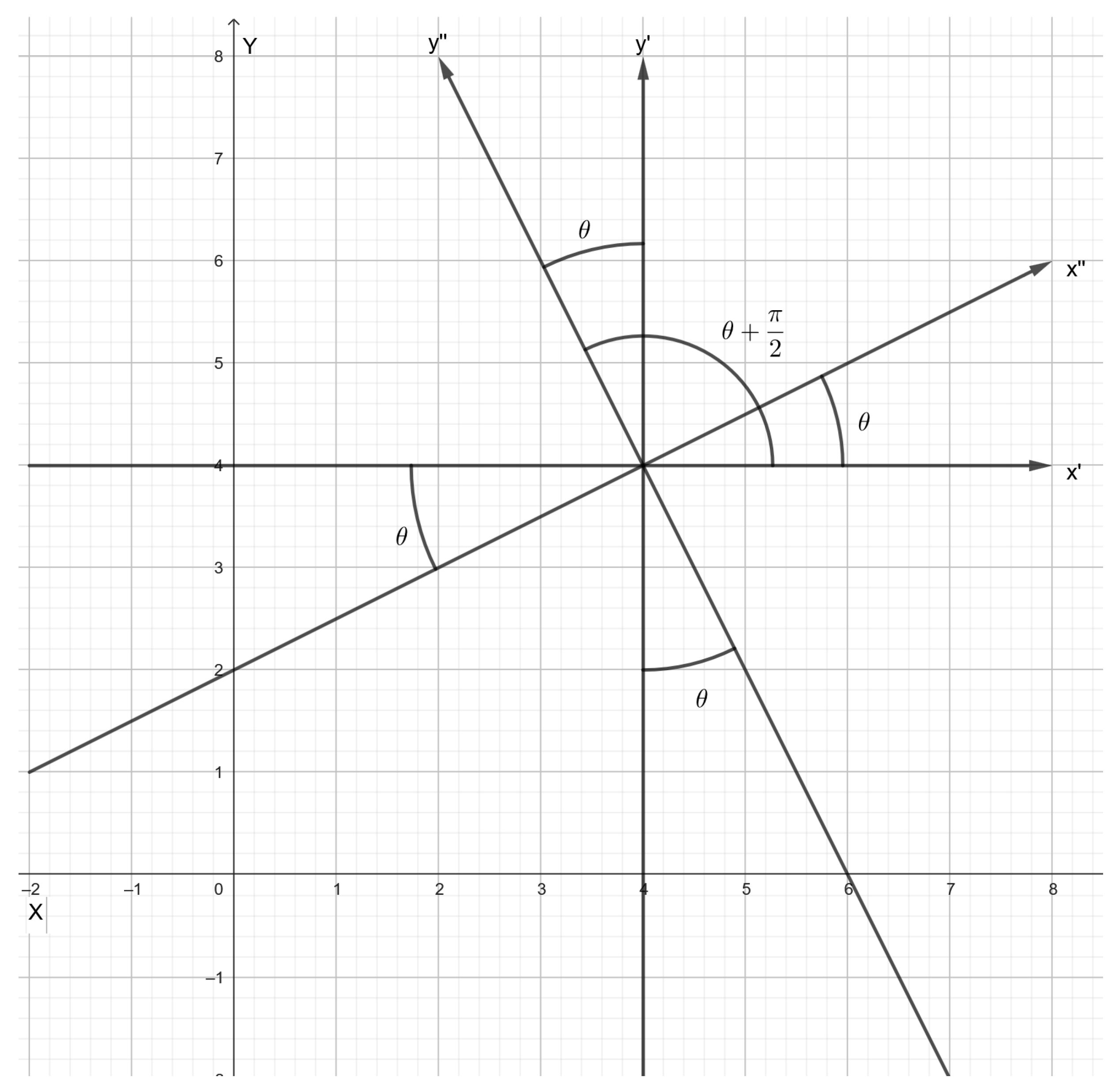
- If the equation corresponds to the -axis, then Theorem 2 implies , thus the inclination angle of the straight line that corresponds to this axis is (as in Figure 1). On the other hand, if the coordinates of also satisfy this other equation, then . Therefore,
- (i)
- for the -axis,
- (ii)
- for the -axis whenever , otherwise ,
- (i)
- for the -axis,
- (ii)
- for the -axis whenever , otherwise .
- (i)
- for the -axis,
- (ii)
- , for the -axis.
3.4. Some Important Facts on Parallel Straight Lines
- (i)
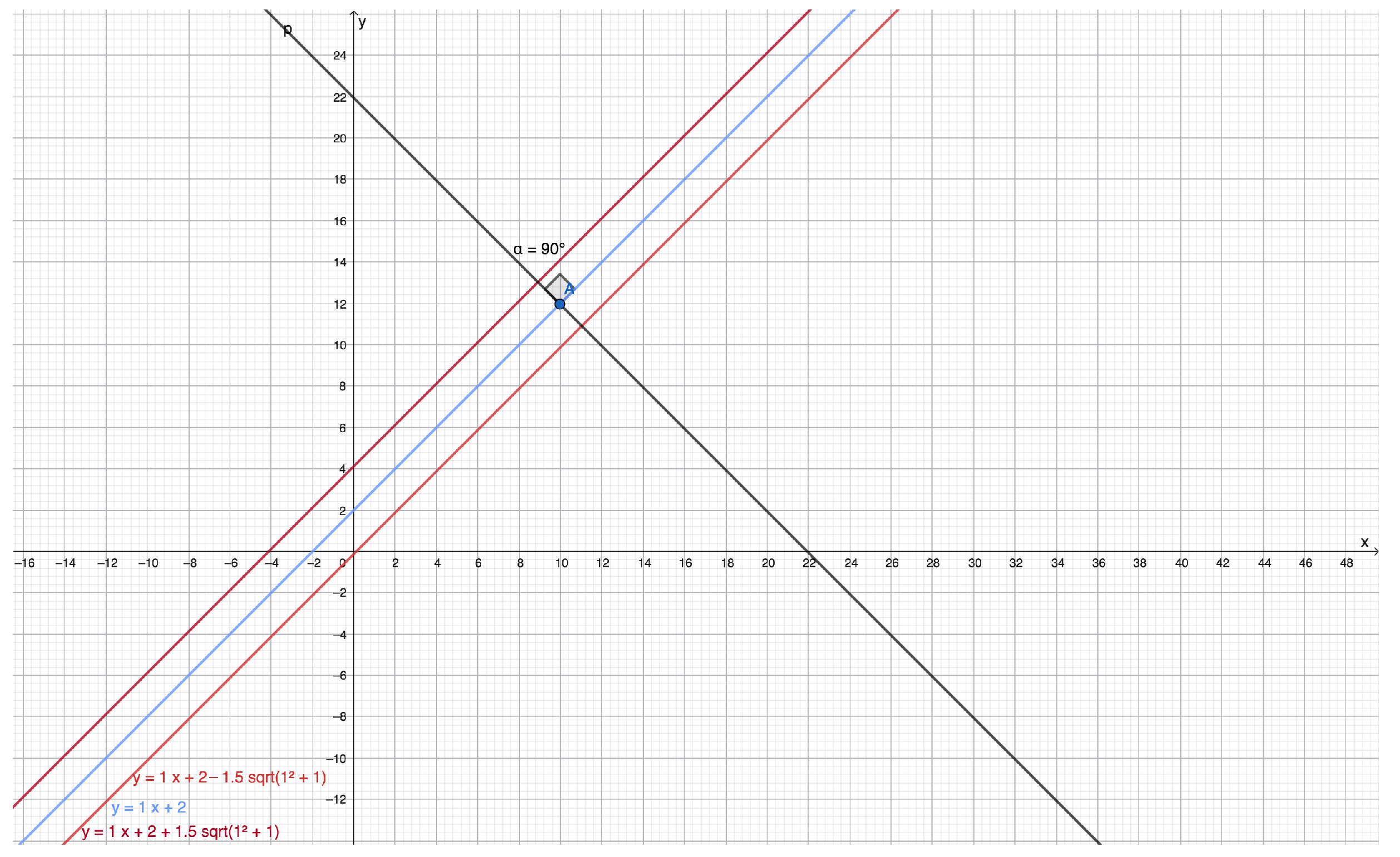
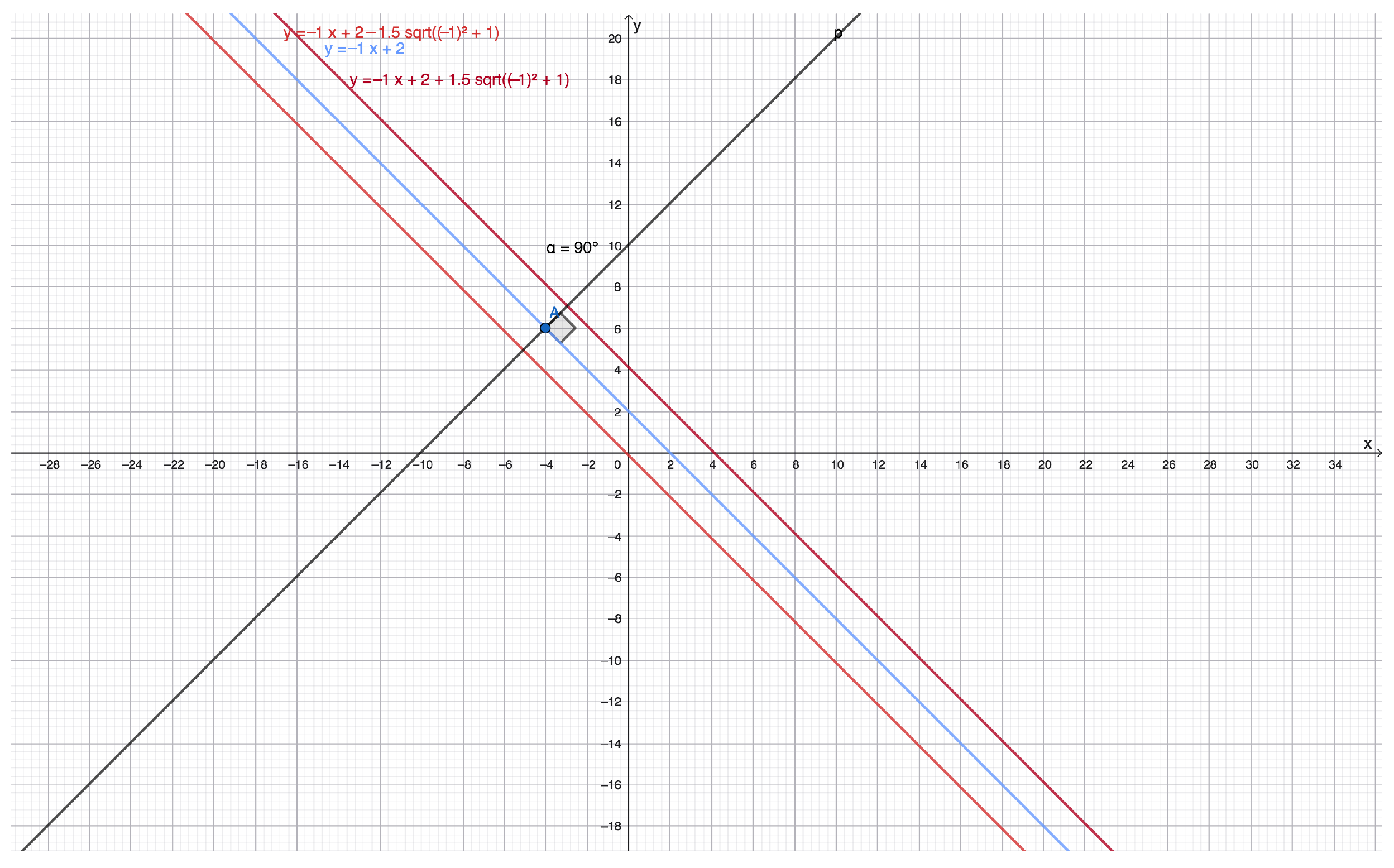
- whether , for any .
- (ii)
- whether , for any .
4. The Non-Degenerate Parabolas
4.1. On the Length of the Latus Rectum of the Parabola
- (i)
- ,
- (ii)
- .
4.2. The Vertex and the Focal Axis of the Parabola
- (i)
- If , then
- (ii)
- If , then
- (i)
- If , then (17), Remark 1, Corollary 1(i), Theorem 4(ii), and Lemma 3(ii) guarantee that (4) is of the form with , and . Thus, the canonical form of (4) is . Hence, the coordinates of the vertex of the parabola in question on the rotated Cartesian plane areNow consider that (15) and (16) respectively yield and Thus, these relations, Property 1 and Lemma 1(iii) imply that the coordinates of the vertex of the parabola in question on the non-rotated Cartesian plane are given as follows:
- (ii)
- If , then (17), Remark 1, Corollary 1(i), Theorem 4(ii), and Lemma 3(ii) guarantee that (4) has the form , with , and Thus, the canonical form of (4) is Hence, the coordinates of the vertex of the parabola in question on the rotated Cartesian plane areNow consider that (15) and (16) respectively imply and Thus, these relations and Property 1 imply that the coordinates of the vertex of the parabola in question on the non-rotated Cartesian plane are given as follows:
- (i)
- If with , then , whereas the canonical form of this equation is So, the coordinates of the vertex of the parabola in question are and . Now observe that Property 1 implies
- (ii)
- If with , then , whereas the canonical form of this equation is . So, the coordinates of the vertex of the parabola in question are and . Now observe that Property 1 implies
- (i)
- If , then the equation is , whenever ; otherwise, . Whereas h and k are determined by Theorem 10(i) in general.
- (ii)
- If , then the equation is , where h and k are determined by Theorem 10(ii).
- (i)
- If , then the equation is , where h and k are determined by Theorem 10(i).
- (ii)
- If , then the equation is , where h and k are determined by Theorem 10(ii).
4.3. On the Opening Direction of a Rotated Parabola
- (i)
- It opens right-up if .
- (ii)
- It opens left-up if .
- (iii)
- It opens left-down if .
- (iv)
- It opens right-down if .
4.4. The Focal Point of the Parabola
- (i)
- If , then
- (ii)
- If , then
- (iii)
- If , then
- (iv)
- If , then
4.5. The Equations of the Directrix and the Latus Rectum of a Rotated Parabola
- (i)
- If it opens right-up, then the equations of the directrix and the latus rectum are respectively given by
- (ii)
- If it opens left-up, then the equations of the directrix and the latus rectum are respectively given by
- (iii)
- If it opens left-down, then the equations of the directrix and the latus rectum are respectively given by
- (iv)
- If it opens right-down, then the equations of the directrix and the latus rectum are respectively given by
- (i)
- If the parabola opens right-up, then the tangent line coincides with the -axis (see Figure 1). Hence, Lemma 6(i), Corollary 9(ii) and Theorem 6(ii) imply and In addition, Proposition 2(ii) guarantees that . Therefore, the opening direction, Corollary 6, and Remark 7 guarantee that corresponds to the latus rectum, whereas corresponds to the directrix.
- (ii)
- If the parabola opens left-up, then the tangent line coincides with the -axis (see Figure 1). Hence, Lemma 6(ii), Corollary 9(i), and Theorem 6(i) imply and . In this case, Proposition 2(i) guarantees Therefore, the opening direction, Corollary 6 and Remark 7 guarantee that corresponds to the latus rectum, whereas corresponds to the directrix.
- (iii)
- This is similar to the proof of item (i); the only difference is that the equations of the directrix and the latus rectum are interchanged due to the opening direction.
- (iv)
- This is similar to the proof of item (ii); the only difference is that the equations of the directrix and the latus rectum are interchanged, as well, due to the opening direction.
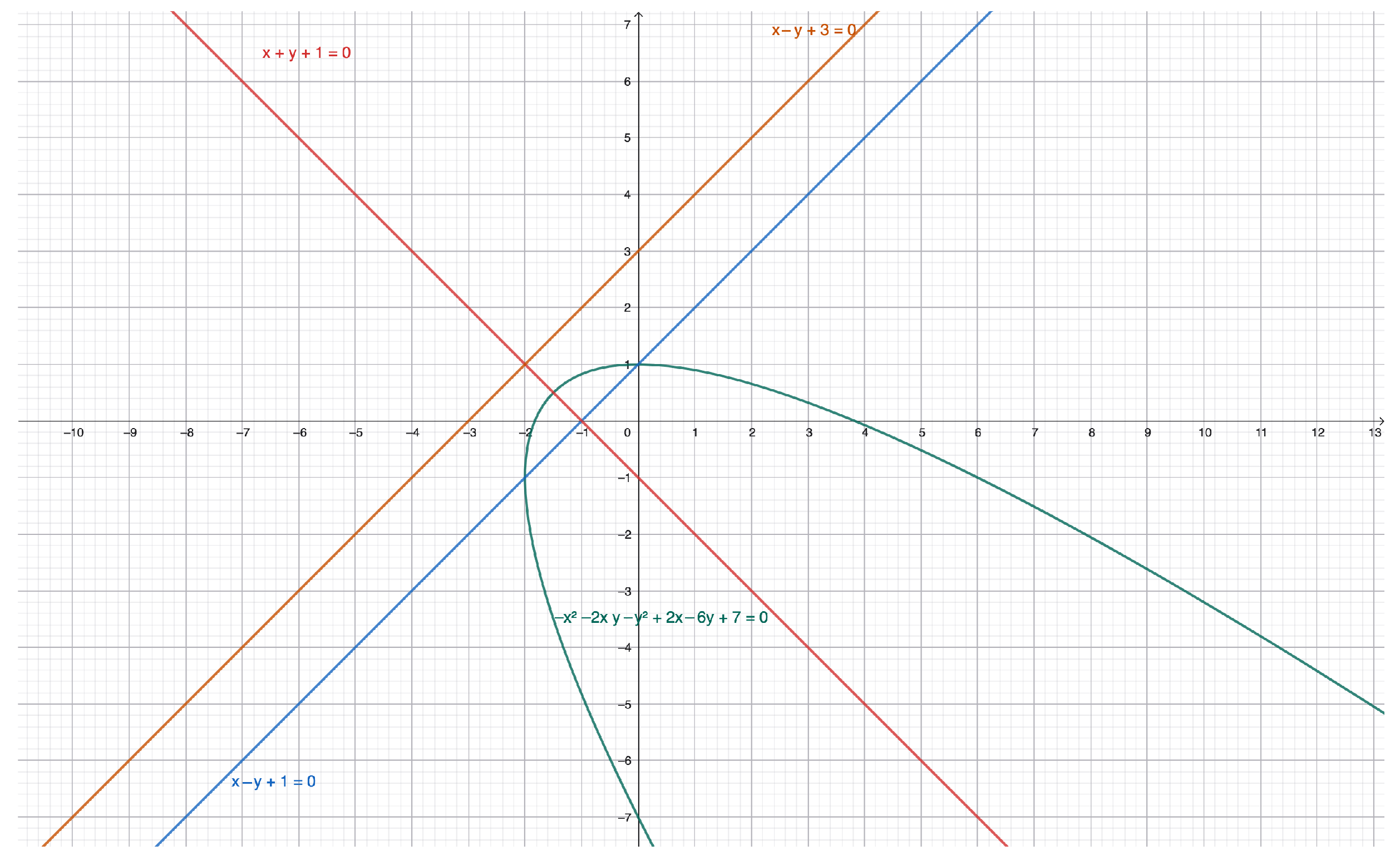
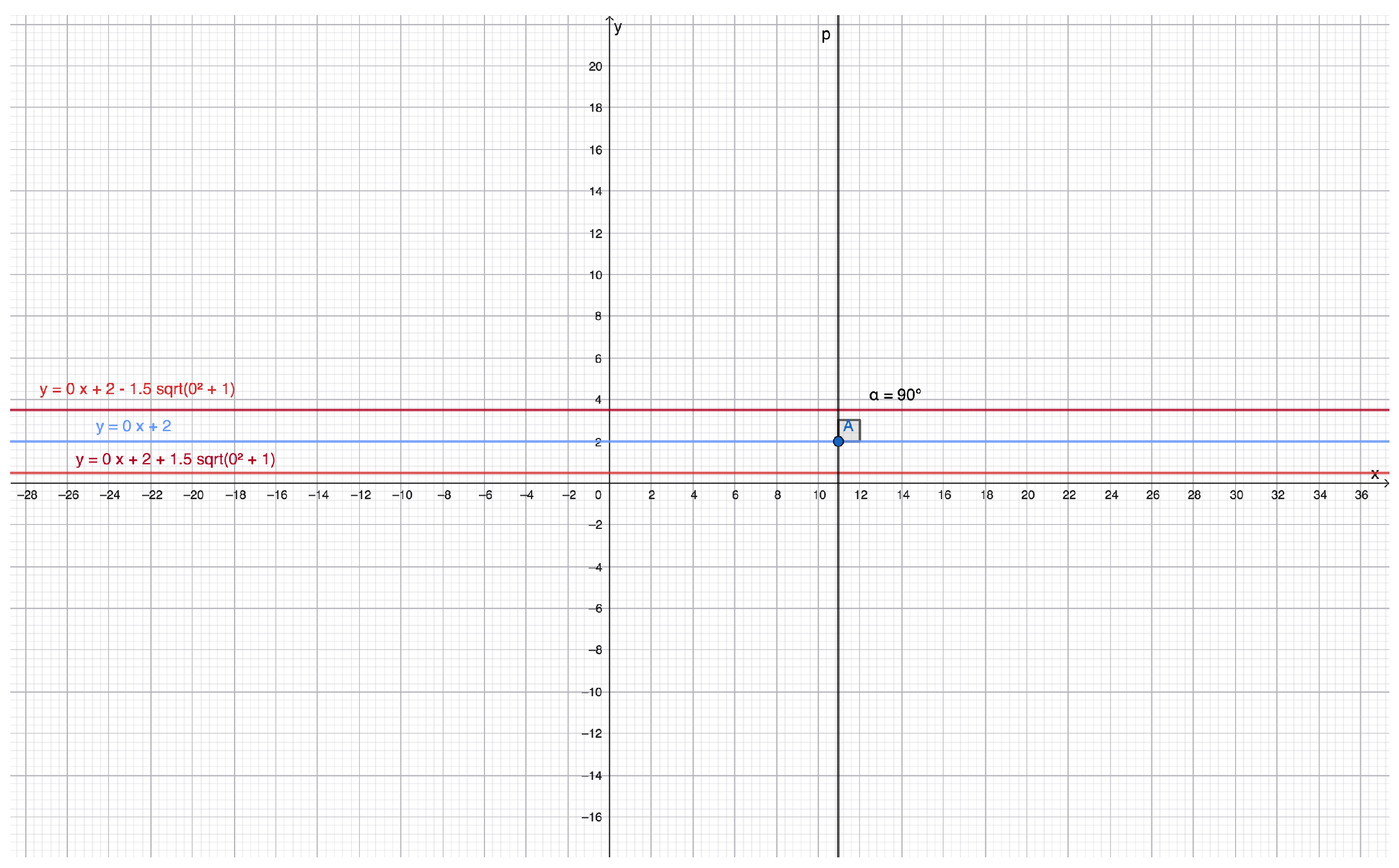
4.6. Examples of Rotated Parabolas
5. The Non-Degenerate Ellipses
5.1. On the Lengths of the Semiaxes and the Latera Recta of the Ellipse
- (i)
- If , then and .
- (ii)
- If , then and .
- (i)
- If , then Lemma 2(i) implies . Hence, consider the following complementary cases:
- Case 1. If , then . In addition, Lemma 3(i) guarantees , so this and Remark 1 imply Thus , hence
- Case 2. If . Then In addition, Lemma 3(i) guarantees , so this and Remark 1 imply . Thus , hence
- (ii)
- If , then Lemma 2(i) implies . Hence, consider the following complementary cases:
- Case 1. If , then . In addition, Lemma 3(i) guarantees . So this fact, along with Remark 1 implies . Thus , hence .
- Case 2. If , then . In addition, Lemma 3(i) guarantees , so this and Remark 1 imply . Thus , hence
- (i)
- whether .
- (ii)
- whether .
- (i)
- If , then Lemma 2(i) implies . Thus, Property 1 implies
- (ii)
- If , then Lemma 2(i) implies . Thus, Property 1 implies
5.2. The Equation of the Focal Axis of the Ellipse
- (i)
- If , then the equation is , whenever , otherwise the equation is .
- (ii)
- If , then the equation is .
- (i)
- If , then the equation is
- (ii)
- If , then the equation is
5.3. On the Extreme and Focal Points of the Ellipse
- (i)
- If , then
- (ii)
- If , then
- (i)
- (ii)
- (i)
- If , then
- (ii)
- If , then
- (i)
- Suppose that , so if and are the coordinates of the central point of the ellipse on the rotated Cartesian plane, then Corollary 12(i) and Theorem 7(ii) guarantee that the focal axis of the ellipse is vertical with respect to the rotated Cartesian plane, thus . Hence, (6)–(8), (15), (16), (18), and Lemma 7(i) imply
- (ii)
- Suppose that , so if and are the coordinates of the central point of the ellipse on the rotated Cartesian plane, then Corollary 12(i) and Theorem 7(ii) guarantee that the focal axis of the ellipse is horizontal with respect to the rotated Cartesian plane, thus . Hence, (6)–(8), (15), (16), (18), and Lemma 7(ii) imply
- (i)
- If , then
- (ii)
- If , then
5.4. The Equations of the Directrices and the Latera Recta of the Ellipse
- (i)
- , whenever ,
- (ii)
- , whenever .
- (i)
- If , then the equations are
- (ii)
- If , then the equations areotherwise, they are given by
- (i)
- If , then the equations are
- (ii)
- If , then the equations are
- (i)
- If , then the equations are
- (ii)
- If , then the equations areotherwise, they are given by .
- (i)
- If , then the equations are
- (ii)
- If , then the equations are
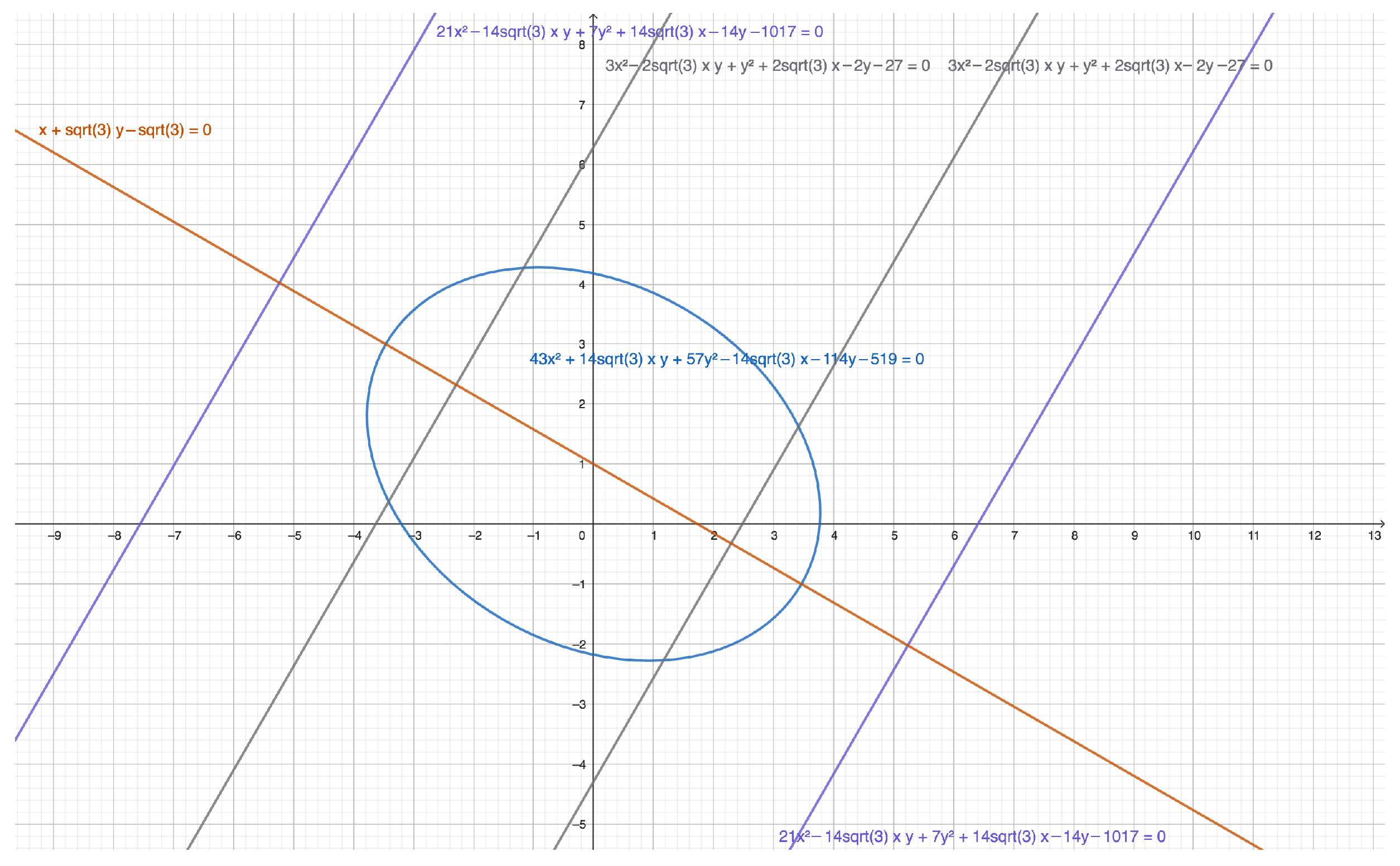
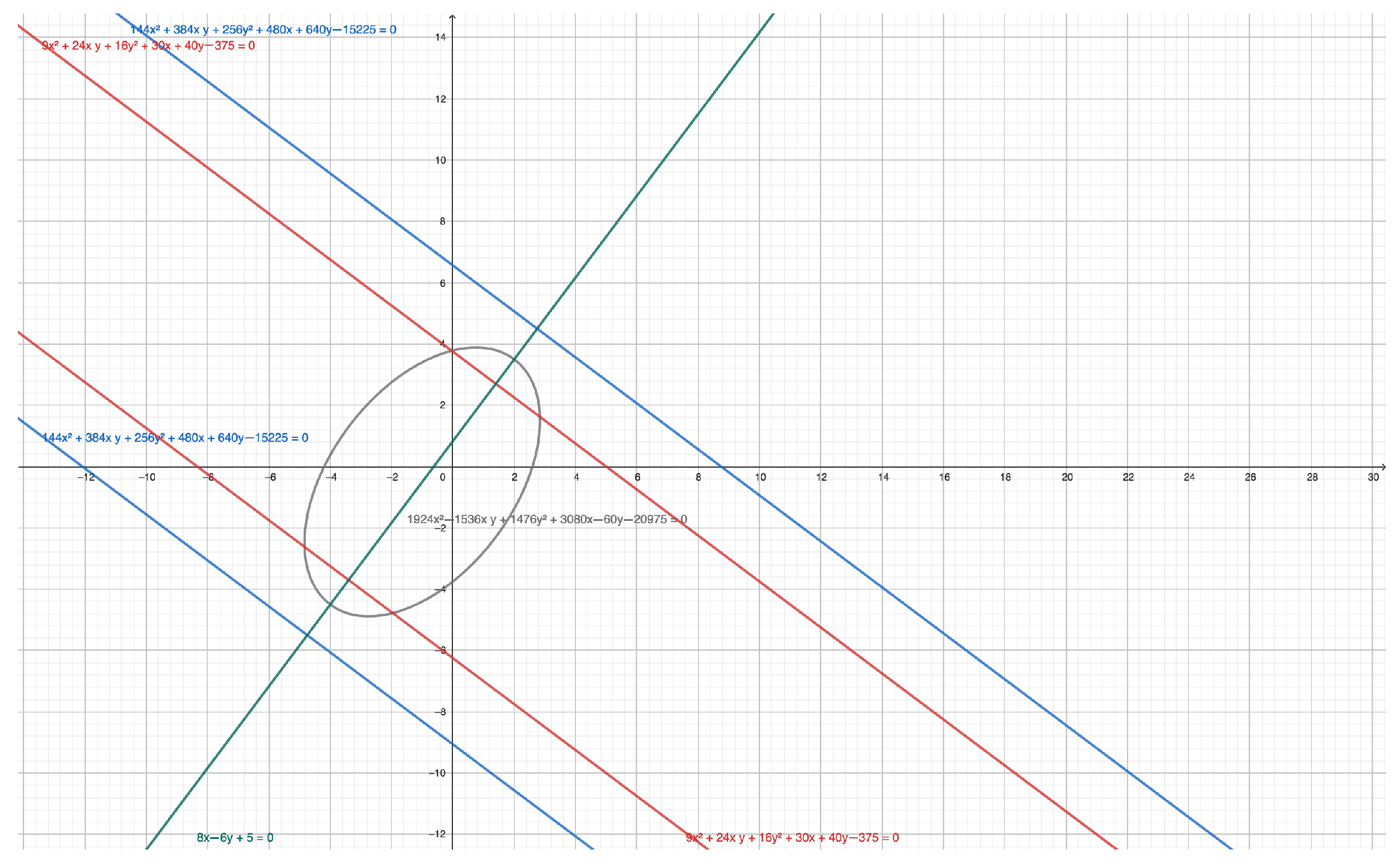
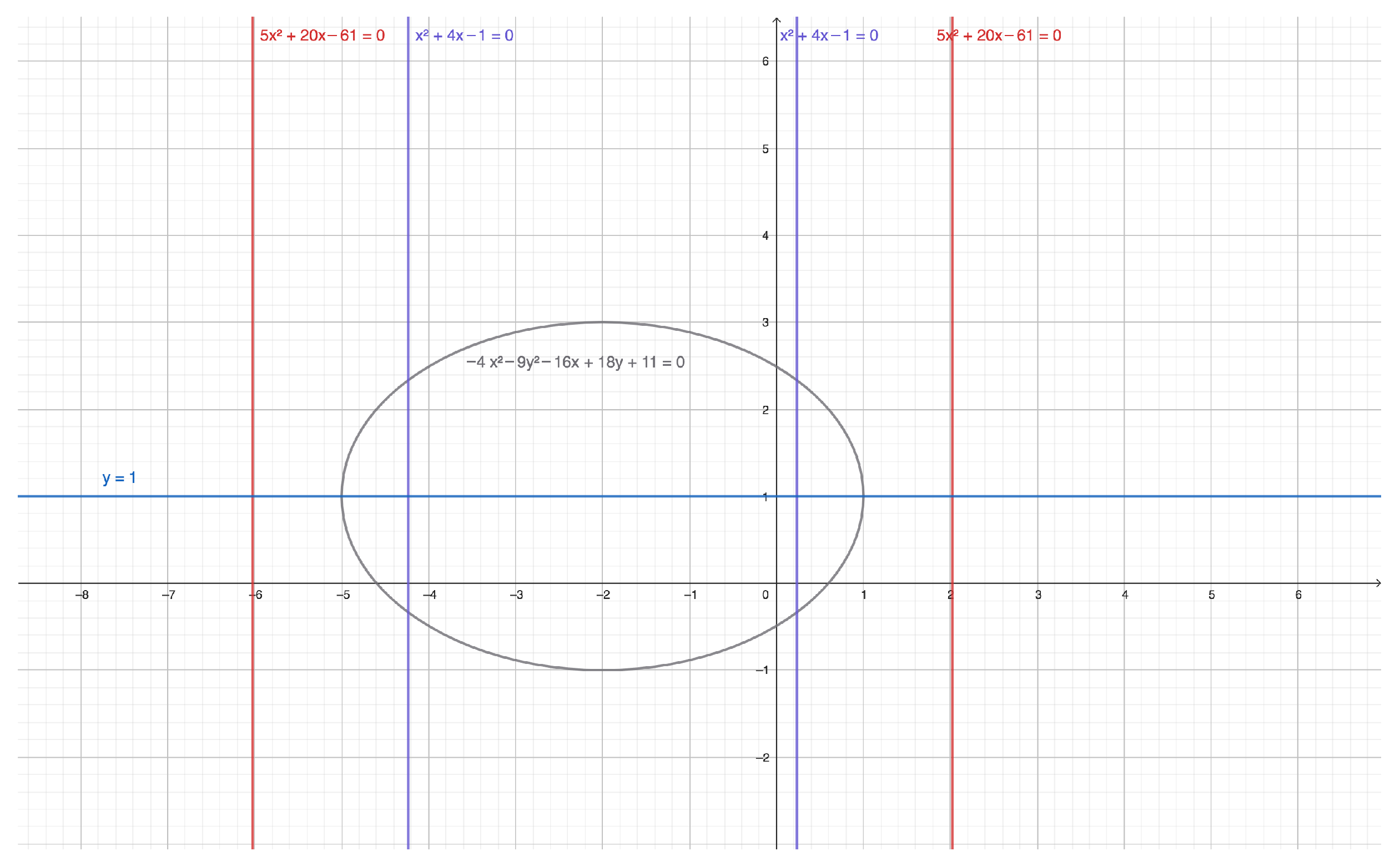
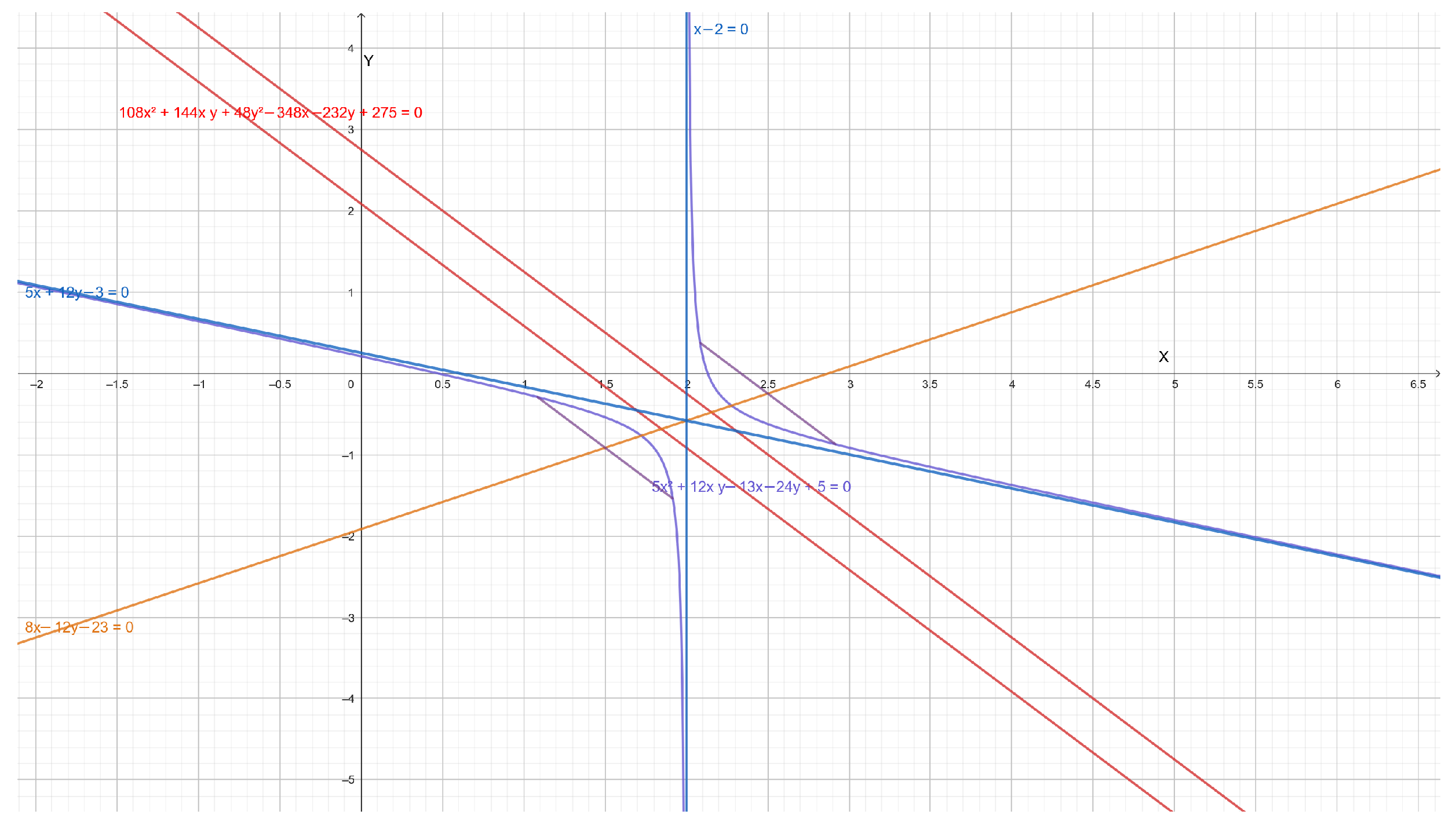
5.5. Examples of Non-Degenerate Ellipses
6. The Non-Degenerate Hyperbolas
6.1. On the Lengths of the Semiaxes and the Latera Recta of the Hyperbola
- (i)
- , and whenever .
- (ii)
- , and whenever .
- (i)
- Suppose that , thenHence, Remark 1 and Corollary 1(iii) implyFinally, note that this holds whenever .
- (ii)
- Suppose that , thenHence, item (i) impliesFinally, note that this holds if .
6.2. Some Particularities of Equilateral Hyperbolas
6.3. The Equation of the Focal Axis of the Hyperbola
- (i)
- If , then the equation is
- (ii)
- If , then the equation isotherwise, the equation is .
- (i)
- If , then the equation is
- (ii)
- If , then the equation is
6.4. On the Extreme and Focal Points of the Hyperbola
- (i)
- If , then
- (ii)
- If , then
- (i)
- If , then
- (ii)
- If , then
- (i)
- If , then
- (ii)
- If , then
6.5. The Equations of the Directrices and the Latera Recta of the Hyperbola
- (i)
- If , then the equations areotherwise, the equations are .
- (ii)
- If , then the equations are
- (i)
- If , then the equations are
- (ii)
- If , then the equations are
- (i)
- If , then the equations areotherwise, the equations are .
- (ii)
- If , then the equations are
- (i)
- If , then the equations are
- (ii)
- If , then equations are
6.6. The Equations of the Asymptotes of the Hyperbola
- (i)
- , whether ;
- (ii)
- and with , whether .
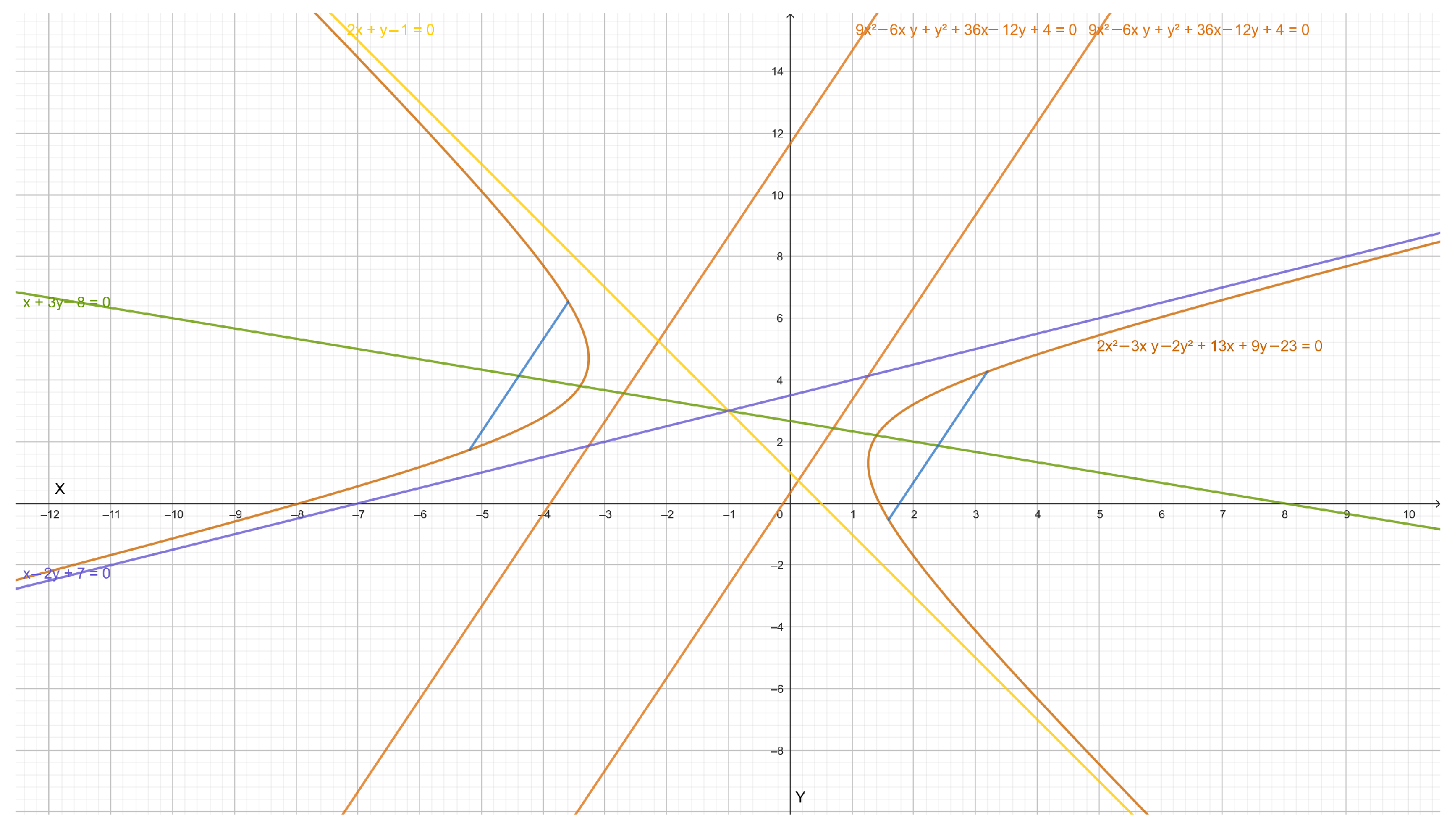
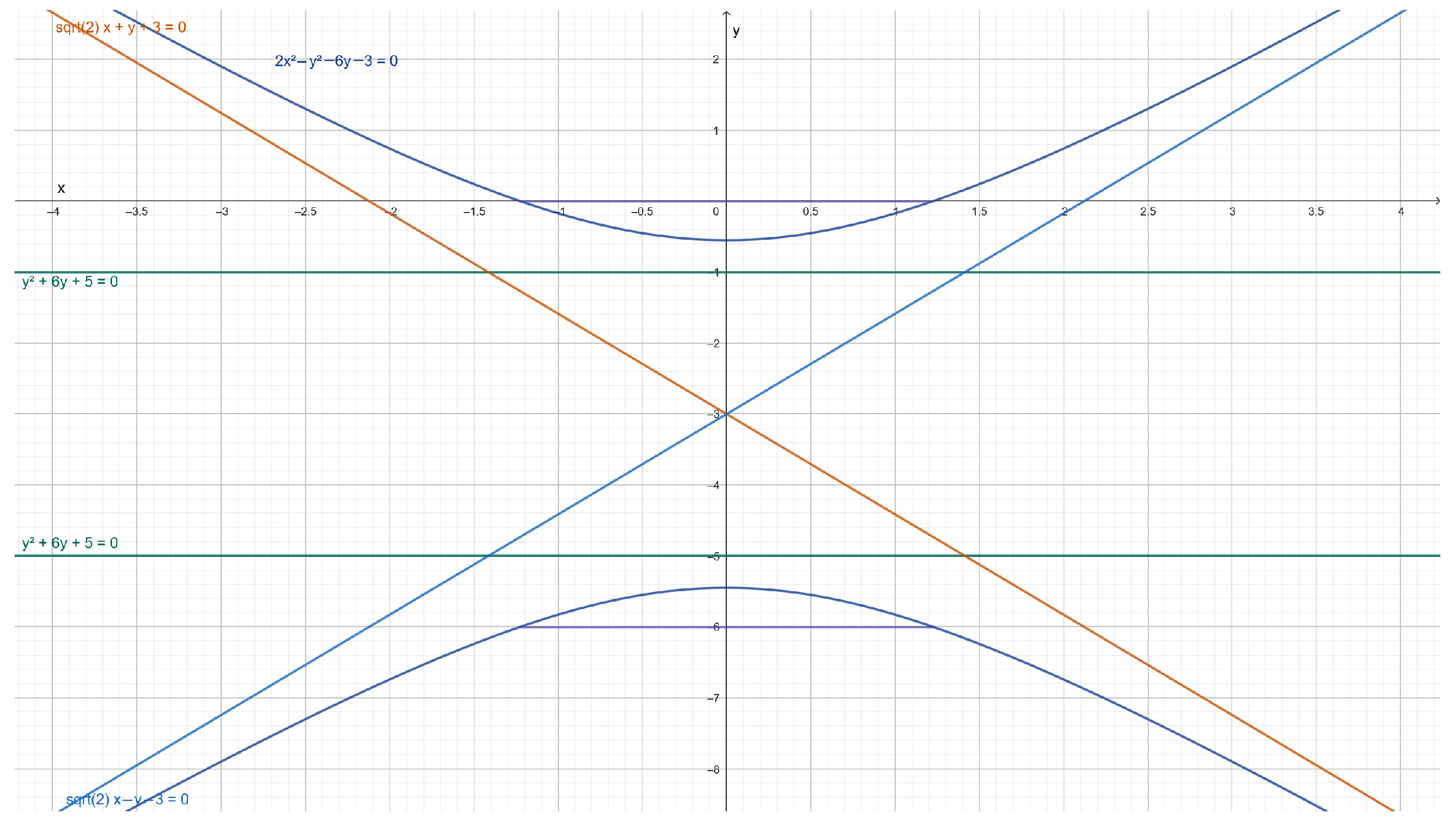
6.7. Examples of Non-Degenerate Hyperbolas
7. Concluding Remarks
7.1. Discussion on Rotated Conics
7.2. Conclusions
Author Contributions
Funding
Data Availability Statement
Acknowledgments
Conflicts of Interest
References
- Murdoch, D.C. Analytic Geometry with an Introduction to Vectors and Matrices; John Wiley and Sons: New York, NY, USA, 1967. [Google Scholar]
- Chávez-Pichardo, M.; López-Barrientos, J.D.; Perea-Flores, S. Scrutinizing the General Conic Equation. Mathematics 2025, 13, 1428. [Google Scholar] [CrossRef]
- Brannan, D.A.; Esplen, M.F.; Gray, J.J. Geometry; Cambridge University Press: Cambridge, UK, 1999. [Google Scholar]
- Hoffman, K.; Kunze, R. Linear Algebra; Pearson: Harlow, UK, 1971. [Google Scholar]
- Kindle, J.H. Theory and Problems of Plane and Solid Analytic Geometry; Schaum’s Publishing: New York, NY, USA, 1950. [Google Scholar]
- Oakley, C.O. An Outline of Analytic Geometry; Barnes and Noble: New York, NY, USA, 1963. [Google Scholar]
- Riddle, D.F. Analytic Geometry; PWS Publishing Company: Kent, UK, 1996. [Google Scholar]
- Ramírez Galarza, A.I.; Seade, J. Introduction to Classical Geometries; Birkhäuser: Basel, Switzerland, 2007. [Google Scholar]
- Earl, R.; Nicholson, J. The Concise Oxford Dictionary of Mathematics; Oxford University Press: Oxford, UK, 2021. [Google Scholar]
- Lehmann, C.H. Analytic Geometry; John Wiley and Sons, Incorporated: New York, NY, USA, 1942. [Google Scholar]




Disclaimer/Publisher’s Note: The statements, opinions and data contained in all publications are solely those of the individual author(s) and contributor(s) and not of MDPI and/or the editor(s). MDPI and/or the editor(s) disclaim responsibility for any injury to people or property resulting from any ideas, methods, instructions or products referred to in the content. |
© 2025 by the authors. Licensee MDPI, Basel, Switzerland. This article is an open access article distributed under the terms and conditions of the Creative Commons Attribution (CC BY) license.
Share and Cite
Chávez-Pichardo, M.; López-Barrientos, J.D.; Perea-Flores, S. A Unified General Theory of Conic Sections via the Conic Radical. Mathematics 2026, 14, 138. https://doi.org/10.3390/math14010138
Chávez-Pichardo M, López-Barrientos JD, Perea-Flores S. A Unified General Theory of Conic Sections via the Conic Radical. Mathematics. 2026; 14(1):138. https://doi.org/10.3390/math14010138
Chicago/Turabian StyleChávez-Pichardo, Mauricio, José Daniel López-Barrientos, and Saúl Perea-Flores. 2026. "A Unified General Theory of Conic Sections via the Conic Radical" Mathematics 14, no. 1: 138. https://doi.org/10.3390/math14010138
APA StyleChávez-Pichardo, M., López-Barrientos, J. D., & Perea-Flores, S. (2026). A Unified General Theory of Conic Sections via the Conic Radical. Mathematics, 14(1), 138. https://doi.org/10.3390/math14010138