1. Introduction
Space target recognition (STR) is a critical technology that involves extracting target characteristics by analyzing radar echo signals and using classifiers to determine the category attributes of space targets. As strategic space positions gain prominence, STR has become increasingly vital for advancing space monitoring systems, optimizing space resource utilization, and safeguarding space security. In the information age, space has emerged as a critical domain in modern warfare, driving intense competition among nations to develop advanced space weaponry. Simultaneously, the escalating issue of space debris poses significant threats to spacecraft safety. Thus, all-weather, continuous space target detection, particularly radar technology, is crucial for ensuring spacecraft safety, preserving space order, and maintaining a competitive edge in future space endeavors.
Radar technology is pivotal in modern information warfare, yielding significant advancements in both military and civilian domains. In space detection, STR represents a critical step toward achieving precise and effective target identification. By analyzing radar echo signals, parameters such as a target’s location, velocity, spin period, and size can be extracted [
1], enabling classification through the application of specialized algorithms. The radar cross-section (RCS) sequence [
2,
3], a form of narrowband information obtained from radar, holds considerable value in STR despite its limited data volume due to its low measurement cost and straightforward implementation [
4]. The RCS sequence encapsulates the motion dynamics and structural features of space targets [
5,
6,
7], serving as a fundamental radar signature that underpins classification, recognition, and attribute analysis.
Despite advancements in radar signal processing and hardware sensitivity, accurately estimating the periodic and dimensional characteristics of space targets from RCS sequences remains a considerable challenge. Traditional methods for periodic and dimensional estimation often suffer from limitations, such as algorithmic sensitivity to noise, reduced robustness in dynamic environments, and significant estimation errors, particularly under challenging space conditions. These shortcomings impede the reliable recognition of space targets, a critical requirement for maintaining situational awareness and ensuring operational security in space.
In response to these challenges, we propose a deep learning-based method for space target recognition, aimed at enhancing the robustness and accuracy of RCS sequence analysis. This approach addresses the aforementioned challenges and makes the following key contributions:
Period Estimation of Space Targets: We introduce a novel period estimation method based on combination functions and analysis of variance. This method enhances robust period estimation by suppressing noise and accurately capturing the periodic characteristics of RCS sequences
Size Estimation of Space Targets: Building on the period estimation method, we propose a Transformer-based approach for size estimation from RCS sequences, enhancing the overall characterization of space targets. This approach utilizes Transformers’ advanced sequence modeling to reduce estimation errors common in traditional methods. By capturing size variations in RCS data, this method further improves the precision of space target characterization.
Feature Fusion and Target Recognition: After extracting period and size features, we integrate them into a unified feature set for space target characterization. We introduce a cross-attention-based multi-feature interaction module to fuse these physical features with statistical features derived from RCS sequences. This module learns the dependencies between different feature types, leading to a more comprehensive understanding of space target characteristics.
In summary, the proposed method presents an innovative solution for space target recognition through the integration of deep learning with advanced statistical methods. Experimental results show that this approach enhances the performance and robustness of space target recognition while establishing a solid foundation for future advancements in space surveillance. The remainder of this paper is organized as follows.
Section 2 briefly reviews the related work. In
Section 3, we elaborate on the proposed method.
Section 4 introduces the details of the dataset construction and provides detailed experimental results and ablation experiment analysis to demonstrate the superiority of our method. In
Section 5, we summarize the work with some concluding remarks.
2. Related Work
2.1. Space Target Feature Extraction
Spatial targets, such as spheres, cylinders, and rectangular plates, typically possess simple and symmetric structures. The radar cross-section (RCS) of these targets varies with the aspect angle and can be calculated using analytical expressions. RCS data offer the advantages of real-time processing and a small data footprint, making it feasible to extract target feature parameters from RCS sequences using feature extraction techniques, thereby enabling accurate target classification and recognition.
In previous studies [
2,
3,
8,
9], target classification was based on target motion characteristics rather than radar data such as RCS. Other types of radar data include high-resolution range profile (HRRP) [
3,
4,
10,
11] and inverse synthetic aperture radar (ISAR) images [
5,
6,
12,
13]. They can represent target shape information to improve classification performance and are also based on RCS data. HRRP represents the power variation of target scattering points with distance in a 2D plot, and ISAR images represent the scattering points of the target in the cross-range and range directions in a 2D plot. Unlike RCS, HRRP and ISAR images contain target size information and can therefore improve classification performance. However, since they require separate signal processing activities, they are not suitable for real-time AI data. Chen et al. [
1] proposed RCSnet, which directly uses static RCS time series data and 1D CNN for the classification of warheads and personnel targets. Yao et al. [
14] proposed CV-CNN, which applies the CNN structure. The authors conducted human activity classification based on CV-CNN using RCS data, achieving a high classification accuracy of 99.81%. Additionally, Mansukhani et al. [
15] performed target classification based on LSTM using static RCS measurements extracted from simulations of various targets. Fu et al. [
16] achieved a high detection accuracy of 99.88% for drone classification based on LSTM using mmWave radar. Our approach distinguishes itself by enabling rapid feature extraction from RCS sequences through real-time processing and data optimization, in contrast to the aforementioned methods which rely on static data and separate signal processing, rendering them unsuitable for real-time applications.
We acknowledge the necessity for a comparative table to evaluate the radar cross-section (RCS) determination technology. Below is a proposed comparative table that outlines the existing technologies alongside the emerging deep learning methods for RCS determination. This table is designed to provide a clear comparison of the capabilities, advantages, and limitations of each technology.
2.2. Space Target Recognition
With the rapid development of computer performance, deep learning networks suitable for solving complex problems have been applied and their classification performance has been continuously improved through comparison and analysis [
17,
18]. Researchers in the defense field are working to apply various AI technologies to improve target classification performance based on RCS and achieve fast and accurate target classification.
In previous studies, to improve the performance of time series data classification, a combination of CNN, which automatically extracts data features, and LSTM or GRU, which extracts temporal features, has been used. Zeng et al. [
19] used generated flight trajectory data and performed hypersonic vehicle trajectory classification based on 1D CNN-LSTM. Liu et al. [
20] conducted a rolling bearing fault diagnosis based on 1D CNN-GRU. As mentioned earlier, 1D CNN-LSTM and 1D CNN-GRU are mainly used in fields such as fault diagnosis and biomedical signals and are rarely employed for target classification based on RCS. RCS sequence recognition for spatial targets provides a more efficient and accurate solution and shows great research potential and application prospects in the field of spatial target recognition. Deep learning methods, such as CNN-LSTM and CNN-GRU, can effectively handle time-series data. By capturing dynamic changes and long-range dependencies, they significantly enhance the accuracy and robustness of spatial target recognition.
To clearly evaluate the performance of existing techniques in RCS determination, we provide a comparison table as shown in
Table 1.
3. Method
The radar cross-section (RCS) is a physical quantity that characterizes the electromagnetic scattering capability of a target in response to incident radar signals. It is one of the key features for radar target identification. To effectively support the analysis of space target characteristics and precise identification in complex environments, this section proposes a space target identification method for RCS sequences based on the Transformer architecture. Firstly, by analyzing the RCS sequence data in the radar return signals of space targets, a statistical feature model of the RCS sequence is established. Secondly, the RCS sequence features of space targets are analyzed using composite functions and variance analysis to obtain a periodic estimation model for space targets. Thirdly, the Transformer model is introduced, specifically the Angle-wise Transformer, to enhance the capture of contextual information in the RCS sequence. This approach is used to derive a size estimation model for space targets based on the RCS sequence. Finally, the periodic and size features are integrated into the physical features of space targets. A multi-feature interaction module based on cross-attention is employed to effectively fuse the physical and statistical features of space targets, enabling the learning of dependencies between different types of features. This significantly improves the accuracy of space target identification.
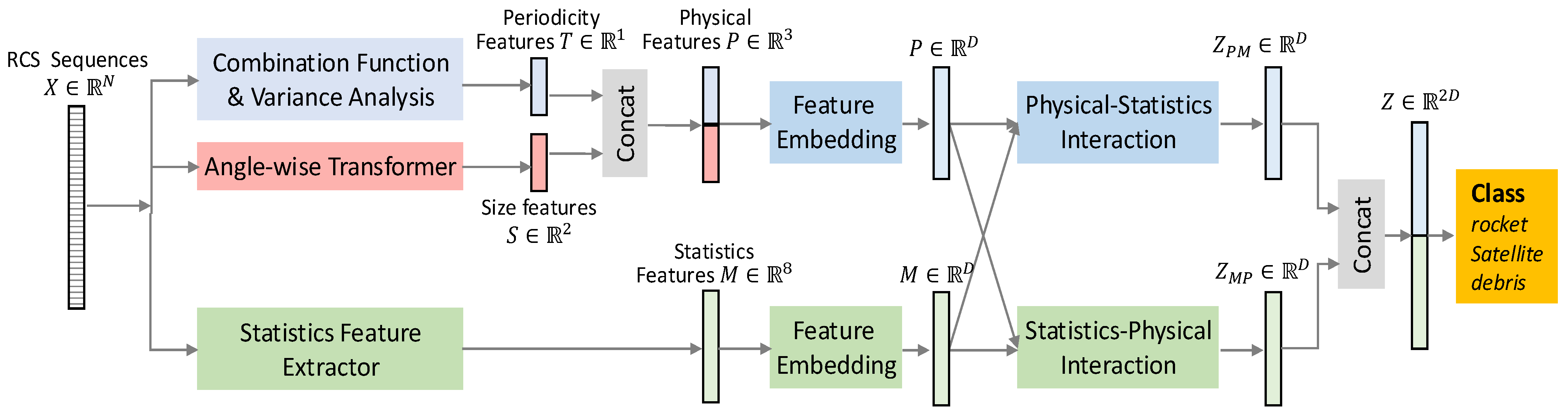
The overview of our method is illustrated in
Figure 1. Given a space target RCS sequence
, we first extract periodicity features using a Combination Function and Variance Analysis approach and size features using the Angle-Transformer. These features are then combined into a unified set of physical features. Additionally, we use a Statistical Feature Extractor module to obtain statistical features such as mean, variance, covariance, maximum value, minimum value, etc., of spatial targets. To capture the dependencies between different feature types, we employ both Physical–Statistics Interaction and Statistics–Physical Interaction modules. Finally, a classification header is used to predict the class of the space target.
3.1. Extraction of Space Target Periodic Features
Traditional methods like Fourier Transform (FT) [
7], Wavelet Transform (WT) [
21], Average Magnitude Difference Function (AMDF) [
22], and Autocorrelation Function (ACF) [
23] are commonly used to extract the periodicity of sequences. These methods have been widely used for analyzing periodicity in time-series data. However, these approaches are often limited when applied to more complex signals, leading to significant errors. To address these challenges, we propose a method based on a Combination Function and Variance Analysis, aimed at enhancing the accuracy and stability of periodicity estimation, particularly in the presence of noise, ensuring reliable feature extraction from RCS sequences even in challenging environments.
3.1.1. Composite Function
Inspired by the Autocorrelation Function and the Average Magnitude Difference Function, we introduce an improved approach that involves shifting only the first half of the sequence, ensuring that the overlapping section always covers half of the sequence length. This modification helps prevent peak amplitude attenuation and addresses the issue of uneven peak intervals. Specifically, given an RCS sequence
, the improved versions of the Autocorrelation Function and Average Magnitude Difference Function can be defined as follows:
where
is the delay time,
and
.
Although improved Autocorrelation Function and Average Magnitude Difference Functions can achieve accurate periodicity estimation in ideal noise conditions or simple signals, they remain prone to subharmonic and harmonic misidentification, which can lead to inaccurate period detection and unreliable results in complex signal scenarios. To improve robustness and mitigate these limitations, we integrate the strengths of both methods into a novel Combination Function:
3.1.2. Variance Analysis
After preprocessing the RCS sequence data using the Combination Function, we apply Variance Analysis to automatically identify the target’s periodicity in the transformed RCS sequence. The specific method is described as follows:
(1) The RCS sequence of the space target is divided into
k groups, where
k satisfies
, indicating that the possible periods of the current sequence are
. The original RCS sequence is grouped such that
represents the group index, and
represents the index of elements within each group. Therefore, each element in the grouped sequence can be represented as
(2) The within-group sum of squares
and the between-group sum of squares
are calculated. In Equation (
4),
represents the largest integer not exceeding
:
where
and
.
(3) We calculate the mean square error
and
and conduct the F-test.
The F-test helps us determine whether there is a statistically significant difference between the variances of the groups, which is essential for identifying the periodicity of the RCS sequence. This ensures that the identified periods are not influenced by random noise. We assume is the significance level; if , it indicates that there is a significant difference at this confidence level, meaning the original sequence has a period of ; otherwise, it suggests that the sequence does not exhibit periodicity at this confidence level. If multiple values of k satisfy the criterion, the largest k is selected as the period of the sequence, .
3.2. Extraction of Space Target Size Features
Accurate extraction of target dimensions is a critical task in space target recognition. Traditional deep learning methods, such as feed-forward and deep belief networks, perform well in certain scenarios but struggle to capture long-range dependencies and contextual information in RCS sequences. To overcome these limitations, this paper introduces the Transformer model, focusing on the Angle-wise Transformer, which excels at capturing contextual and long-range dependencies in RCS sequences.
The Angle-wise Transformer model divides the RCS sequence into multiple patch blocks according to the angle dimension, which are then transformed into a format that the model can process through an embedding layer. The self-attention mechanism enables the model to capture the global context information of the sequence at each angle. The specific steps are as follows:
(1) We let the RCS sequence of the spinning spatial target be denoted as
, where
and
N is the sequence length. The RCS sequence is divided into
N patches according to angles, and after passing through the embedding layer
E, we obtain
. D = 128 refers to the dimensionality of the Transformer network.
is the positional encoding that provides position-specific information, helping the model capture the order of elements in the sequence.
(2) The sliced patch blocks are embedded into the high-dimensional space to prepare the input for the Transformer. The sequence of image patches with positional information is then fed to the standard Transformer encoder. The Transformer encoder consists of multiple layers, each containing a multi-head self-attention mechanism and a feed-forward neural network. Each layer of the self-attention mechanism can be represented as
where
Q,
K, and
V are the query, key, and value matrices, respectively, and
is the scaling factor.
(3) A linear regression head is applied to the output of the Transformer layer for predicting the short-axis and long-axis dimensions of the target. The output layer for size estimation is designed as a linear regression head with the formula defined as follows:
where
is the predicted size vector and MLP has two GELU nonlinear layers. MSA is the Multi-Head Self-Attention, a mechanism in the Transformer network that allows the model to focus on different parts of the input sequence simultaneously, capturing complex dependencies. MLP is Multi-Layer Perceptron, a feedforward neural network used for transforming the outputs of the self-attention mechanism to higher-level representations. LN is the LayerNorm layer.
In the space target recognition network, the Angle-wise Transformer model is used as a sub-module for size extraction, with its parameters frozen after pre-training and excluded from subsequent training. The Angle-wise Transformer model significantly improves the accuracy of space target size estimation by effectively capturing the contextual information of the RCS sequence. The pre-training and parameter freezing strategies of the model ensure a stable feature representation for the space target recognition network.
3.3. Recognition of Space Targets Based on Composite Features
Space target recognition is a critical component of space situational awareness. Traditional recognition methods rely on a single type of feature, which limits both recognition accuracy and generalization capability. We propose a comprehensive feature-based recognition method that learns the dependencies between physical and statistical features through a multi-feature interaction module to improve recognition performance.
The multi-feature interaction module leverages the cross-attention mechanism to facilitate the exchange of information between physical features (periodic and dimensional features) and statistical features (8 basic statistical features) to enhance feature expression. The physical features
and statistical features
are represented as
where
represent 8 basic statistical features.
concatenates two tensors,
T and
S, along a specified dimension to form a new tensor
P.
The features after interacting through the cross-attention mechanism are fused to form a composite feature vector for spatial target recognition:
where
denotes the cross-attention function, which fuses the two features by capturing the complex dependencies between physical and statistical features through the cross-modal attention mechanism.
and
represent the results of the interaction between physical and statistical features.
W represents the weights. Finally, the combined statistical and physical features are fed into the classification network to identify the spatial target classes (rocket, satellite, and debris), implemented using multi-layer perception (MLP) with a hidden layer.
4. Experiment
4.1. Data Construction
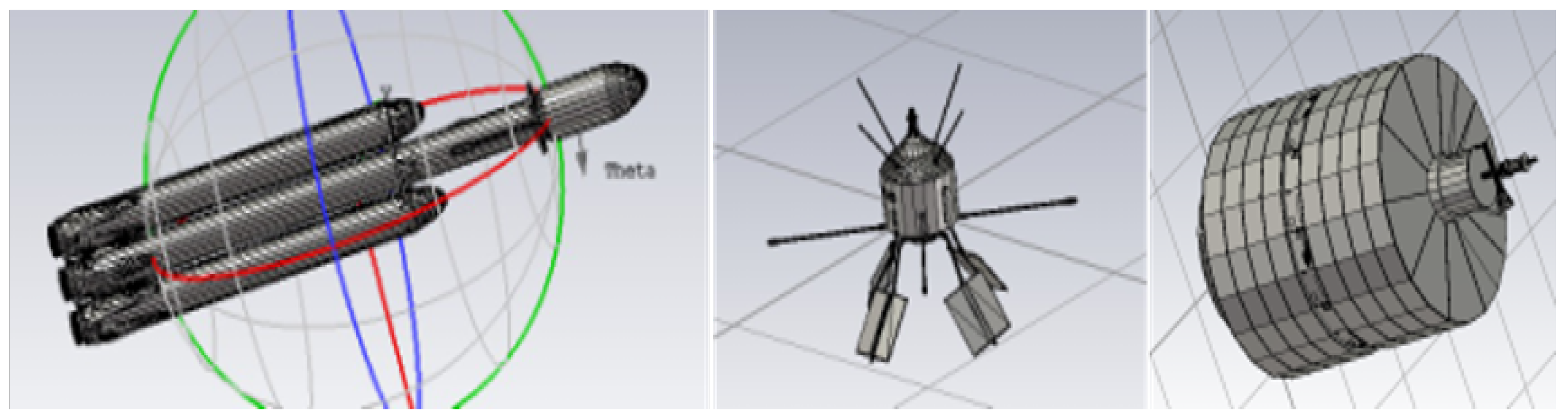
This study investigates the radar cross-section (RCS) characteristics of space targets, targeting three types of targets: rocket, satellite, and debris, as shown in
Figure 2.
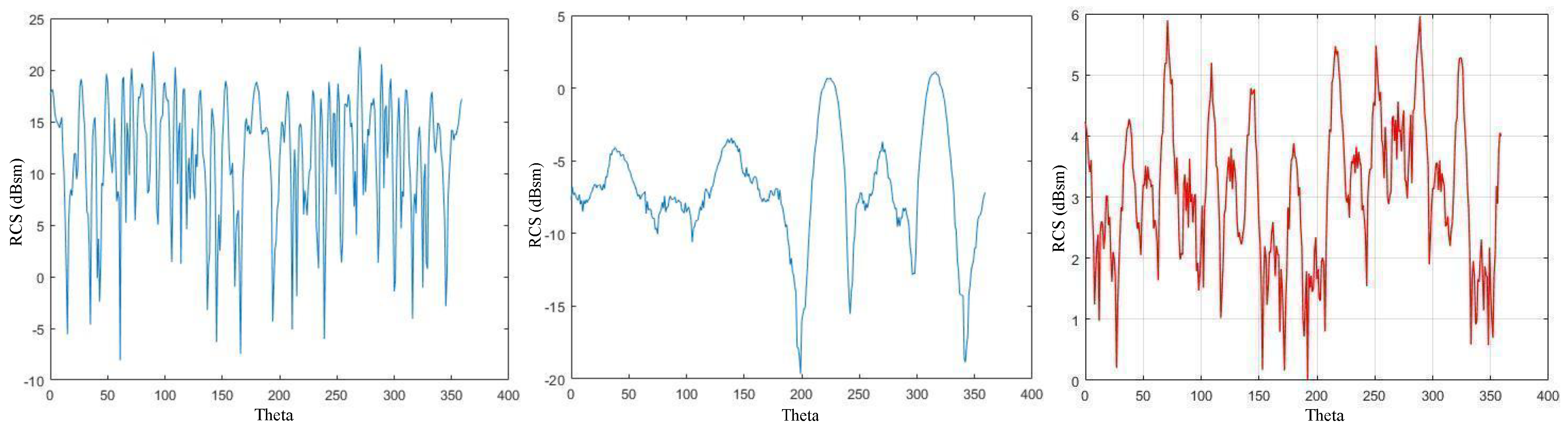
The data stored in .mat format record the RCS values of targets across a 360° horizontal phi angle range at a fixed vertical theta angle, converted to decibels to facilitate more effective analysis. The RCS data for three types of targets—rocket debris, satellite fragments, and satellites—were generated using simulated scattering center models, which approximate the electromagnetic scattering properties of complex objects, as shown in
Figure 3. The input parameters include the radar carrier frequency (500 MHz), depression angle (40–50°), azimuth angle (0–360°), and target geometry (rocket debris, satellite fragments, and satellites). Additionally, additive white Gaussian noise is introduced to simulate realistic noise conditions. The output parameters are the radar cross-section (RCS) values over the specified azimuth angles, recorded as sequences in .mat format. The depression angle range of 40–50° is selected based on the typical observation geometry for radar systems in space target recognition. This range balances the trade-off between sufficient target visibility and minimizing potential occlusion effects or signal attenuation. It aligns with the physical characteristics of space surveillance scenarios where targets are observed from inclined vantage points.
The experimental data, after randomization, are evenly divided into training and testing sets, each accounting for 50%. Due to the limited dataset size (180 samples per category), this split helps to preserve the statistical significance of the test results. To ensure the stability of the results, the space target recognition experiment is repeated 10 times, and the average recognition rate is taken as the final evaluation criterion. The network parameters designed in this paper are as follows: the input layer dimension is 360, the output layer dimension is 3, the learning rate is 0.003, and the number of iterations is 2000. The “3” refers to 3-class space target: rocket body, satellite fragment, and satellite. The “360” represents the azimuth angle range (0–360°) with RCS values at each degree. Three types of space targets—rocket debris, satellite fragments, and satellites—are selected, with 180 sets of data samples for each category. The small sample size is attributed to the computational complexity and time needed to simulate realistic scattering center models for space targets. To maintain data quality, we prioritize generating high-fidelity samples over increasing quantity.
4.2. Space Target Recognition Experimental Performance Comparison
According to the data in
Table 2, when using comprehensive features and statistical features for space target recognition, the average recognition rate of the k-NN method is now 98.27%, which shows a slight improvement compared to the previous average. The comprehensive statistical features mentioned, including the mean, median, standard deviation, coefficient of variation, sample variance, corrected sample variance, skewness, and maximum value. This suggests that comprehensive features can indeed enhance the recognition capability of the k-NN method, highlighting the importance of physical features such as period and size. The average recognition rate of the SVM remains at 96.35%, which is consistent with the rate when using only statistical features. This may be because the SVM algorithm has higher requirements for feature distribution and separability, where the additional effect of comprehensive features is not as pronounced. The average recognition rate of the Decision Tree increased to 97.79%, which is a slight decrease from the previous average of 98.27%, but still indicates an improvement compared to when only statistical features were used. This suggests that comprehensive features enhanced the Decision Tree’s ability to discriminate features, allowing it to more effectively learn classification patterns from the samples. The average recognition rate of our proposed method reached 98.91%, which is superior to the performance of the Decision Tree, further confirming the significant effect of comprehensive features. By comprehensively utilizing physical features such as period and size, the overall recognition performance of space targets can be notably improved. This result shows that our method outperforms existing techniques, particularly in terms of accuracy and robustness, and provides a novel solution for handling RCS sequence data.
The Decision Tree’s (DT) average recognition rate increased to 97.79%, slightly lower than the previous 98.27% but higher than when only statistical features were used. This indicates that comprehensive features improve the Decision Tree’s feature discrimination, enabling more effective learning of classification patterns. Our proposed method achieved an average recognition rate of 98.91%, outperforming the Decision Tree and demonstrating the substantial impact of comprehensive features. The integration of physical features, such as period and size, significantly enhances the overall recognition performance of space targets.
4.3. Detailed Performance Analysis on Modules
4.3.1. Impact of Different Period Estimation Method
The period estimation results in
Table 3 show that the FFT method achieved a result of 97.99% in period estimation. The normalized AMDF and normalized ACF, due to their inability to resolve the uneven intervals of peak values at the tail of the signal waveform, achieved results of 96.42% and 97.20%, respectively. The length of the RCS sequence significantly affects the period estimation accuracy of the CAMDF, CACF, and CACF-CAMDF methods, which are prone to harmonic misjudgment, with results of 97.71%, 97.85%, and 98.06%, respectively. The method proposed in this paper constructs a composite function to enhance signal periodicity and applies variance analysis, avoiding direct dependence on peak or valley period estimation, with a result of 98.91%, and the experimental results show that this method performs excellently in the stability of period estimation.
4.3.2. Impact of Different Size Estimation Method
The size estimation experimental results in
Table 4 show that the traditional method based on the ellipsoid model achieved an average accuracy of 95.61% in size estimation. This geometric model-based method, though intuitive, is significantly affected by the selection of the threshold, leading to a larger relative error in size estimation. For instance, the ellipsoid model may not accurately capture the complex shape and surface characteristics of space targets, especially when the target has an irregular shape or surface roughness. In contrast, deep learning-based methods for size estimation of space target RCS sequences, such as stacked autoencoders, deep feedforward neural networks, and deep belief networks, generally exhibit lower estimation errors. These methods’ average accuracies are 96.61%, 97.39%, and 98.06%, respectively, demonstrating the advantages of deep learning methods in dealing with complex data patterns and noise. Deep learning models, by learning the intrinsic representations of data, can better generalize and adapt to different space target characteristics, thereby improving the accuracy of size estimation. However, signal noise still has some impact on the size estimation results based on deep learning. Nevertheless, deep learning models, through their powerful feature extraction and noise suppression capabilities, can still maintain the size estimation results within a controllable range. This indicates that, despite noise interference, deep learning methods can still provide relatively accurate size estimation. Ultimately, our proposed method significantly outperforms all other methods with an average accuracy of 98.91%. This result highlights the superior performance of our method in size estimation extraction.
4.3.3. Impact of Different Features
The statistical features of the space target RCS sequence include eight statistical features selected as the feature vector: mean, median, standard deviation, coefficient of variation, sample variance, corrected sample variance, skewness, and maximum value.
Table 5 presents the results of our method for space target recognition based on different feature combinations. When using a combination of period and size features, our method demonstrated high recognition accuracy in all test cases, with an average accuracy of 96.35%. Furthermore, when the period feature was combined with statistical features, the recognition accuracy improved, reaching an average of 97.91%. The combination of size and statistical features also yielded good results, with an average accuracy of 97.75%. However, when our method considered the three features—period, size, and statistical—simultaneously, the recognition accuracy significantly increased, with an average accuracy of 98.91% across all test cases. This demonstrates the superior performance of our method in utilizing multi-feature information comprehensively. This multi-feature fusion approach not only enhances the accuracy of target recognition but also strengthens the robustness of the recognition system by considering the interrelationships between different features. The experimental results show that our method maintains high recognition accuracy under different feature combinations, especially when using a combination of period, size, and statistical features, achieving near-perfect target recognition results.
5. Conclusions
This paper proposes a deep learning-based method for space target recognition that significantly improves the accuracy of size estimation and recognition by effectively extracting period and size features from RCS sequences and fusing them with statistical features. The experimental results validate the significant advantages of this method in enhancing the correctness and stability of space target recognition, providing a new technical solution for space monitoring systems, resource utilization, and security assurance. While this study demonstrates notable strengths, such as improved accuracy, real-time processing capabilities, and effective feature extraction, we also recognize several limitations. These include the computational costs associated with the proposed methodology and the reliance on simulated data for training and validation. Addressing these limitations will be a key focus of our future work, which will focus on algorithm optimization to reduce computational costs while maintaining high accuracy. Additionally, we plan to explore multi-source data fusion to further enhance the robustness and accuracy of the recognition system. Real-scene testing will be conducted to validate the method’s performance in practical applications, and efforts will be made to enhance real-time processing capabilities. These improvements aim to further elevate the performance and application range of space target recognition technology.
Author Contributions
Conceptualization, M.X. and W.W.; methodology, M.X.; software, M.X.; validation, M.X. and C.F.; formal analysis, M.X.; writing—original draft preparation, M.X.; writing—review and editing, S.S.; supervision, W.W. All authors have read and agreed to the published version of the manuscript.
Funding
This research received no external funding.
Data Availability Statement
The datasets presented in this article are not readily available because time limitations. Requests to access the datasets should be directed to M.X.
Conflicts of Interest
The authors declare no conflicts of interest.
References
- Chen, J.; Xu, S.; Chen, Z. Convolutional neural network for classifying space target of the same shape by using RCS time series. IET Radar Sonar Navig. 2018, 11, 1268–1275. [Google Scholar] [CrossRef]
- Zhu, Y.; Wu, Z.; Wang, Y.; Wang, F. Space Target Recognition Based on RCS Feature Extraction Using Relative Position Matrix. In Proceedings of the IEEE International Geoscience and Remote Sensing Symposium, Athens, Greece, 7–12 July 2024; pp. 9596–9599. [Google Scholar]
- Yang, Q.; Jiang, L.; Zheng, S.; Zhao, Y.; Wang, Z. Joint Power and Bandwidth Allocation with RCS Fluctuation Characteristic for Space Target Tracking. Remote Sens. 2023, 15, 3971. [Google Scholar] [CrossRef]
- Chen, L.; Chen, R. A new radar target recognition method based on complex high resolution range profiles. In Proceedings of the 2012 International Conference on Microwave and Millimeter Wave Technology (ICMMT), Shenzhen, China, 5–8 May 2012; Volume 2, pp. 1–4. [Google Scholar]
- Jiang, S. Target identity recognition method based on RCS distribution and spatial location. Procedia Comput. Sci. 2019, 147, 632–637. [Google Scholar] [CrossRef]
- Xu, X.; Feng, C.; Han, L. Classification of Radar Targets with Micro-Motion Based on RCS Sequences Encoding and Convolutional Neural Network. Remote. Sens. 2022, 14, 5863. [Google Scholar] [CrossRef]
- Catedra, F.; Gago, E.; Nuno, L. A numerical scheme to obtain the RCS of three-dimensional bodies of resonant size using the conjugate gradient method and the fast Fourier transform. IEEE Trans. Antennas Propag. 1989, 37, 528–537. [Google Scholar] [CrossRef]
- Liu, L.; Wang, Z.; Hu, W. Precession period extraction of ballistic missile based on radar measurement. In Proceedings of the 2006 CIE International Conference on Radar, Shanghai, China, 16–19 October 2006; pp. 1–4. [Google Scholar]
- Pisane, J. Automatic Target Recognition Using Passive Bistatic Radar Signals; Supélec: Gif-sur-Yvette, France; Université de Lièg: Liège, Belgium, 2013. [Google Scholar]
- Parvatha, R.S.; Ramya, T.; Aparanii, G.S.; Mamtha, M.V.; Gupta, A.; Tom, R.J. Signature Based Radar Target Classification. In Proceedings of the 2021 International Conference on Recent Trends on Electronics, Information, Communication and Technology (RTEICT), Bangalore, India, 27–28 August 2021; pp. 873–879. [Google Scholar]
- Perissin, D.; Ferretti, A. Urban-target recognition by means of repeated spaceborne SAR images. IEEE Trans. Geosci. Remote Sens. 2007, 45, 4043–4058. [Google Scholar] [CrossRef]
- Wei, S.; Liang, J.; Wang, M.; Zeng, X.; Shi, J.; Zhang, X. CIST: An improved ISAR imaging method using convolution neural network. Remote Sens. 2020, 16, 2641. [Google Scholar] [CrossRef]
- Yuan, Y.; Luo, Y.; Ni, J.; Zhang, Q. Inverse synthetic aperture radar imaging using an attention generative adversarial network. Remote Sens. 2022, 15, 3509. [Google Scholar] [CrossRef]
- Yao, X.; Shi, X.; Zhou, F. Human activities classification based on complex-value convolutional neural network. IEEE Sensors J. 2020, 13, 7169–7180. [Google Scholar] [CrossRef]
- Mansukhani, J.; Penchalaiah, D.; Bhattacharyya, A. Rcs based target classification using deep learning methods. In Proceedings of the 2021 2nd International Conference on Range Technology (ICORT), Chandipur, Balasore, India, 5–6 August 2021; pp. 1–5. [Google Scholar]
- Fu, R.; Absi, M.A.; Kim, K.H.; Lee, Y.S.; Absi, A.A.; Lee, H.J. Deep learning-based drone classification using radar cross-section signatures at mmwave frequencies. IEEE Access 2021, 9, 161431–161444. [Google Scholar] [CrossRef]
- Feng, B.; Chen, B.; Liu, H. Radar HRRP target recognition with deep networks. Pattern Recognit. 2017, 61, 379–393. [Google Scholar] [CrossRef]
- Sehgal, B.; Shekhawat, H.S.; Jana, S.K. Automatic Radar Target Identification Using Radar cross-section Fluctuations and Recurrent Neural Networks. In Proceedings of the TENCON 2019–2019 IEEE Region 10 Conference (TENCON), Kochi, India, 17–20 October 2019; pp. 2490–2495. [Google Scholar]
- Zeng, K.; Zhuang, X.; Xie, Y.; Xi, Z. Hypersonic vehicle trajectory classification using improved CNN-LSTM model. In Proceedings of the 2021 IEEE International Conference on Unmanned Systems (ICUS), Beijing, China, 15–17 October 2021; pp. 691–696. [Google Scholar]
- Liu, H.; Ma, R.; Li, D.; Yan, L.; Ma, Z. Machinery fault diagnosis based on deep learning for time series analysis and knowledge graphs. J. Signal Process. Syst. 2021, 93, 1433–1455. [Google Scholar] [CrossRef]
- Miner, E. An Introduction to Wavelet Theory and Analysis; Sandia National Laboratories (SNL): Albuquerque, NM, USA, 1998. [Google Scholar]
- Kim, H.Y.; Lee, J.S.; Sung, M.; Kim, K.H.; Park, K.S. Pitch detection with average magnitude difference function using adaptive threshold algorithm for estimating shimmer and jitter. In Proceedings of the 20th Annual International Conference of the IEEE Engineering in Medicine and Biology Society, Hong Kong, China, 1 November 1998; Volume 20, pp. 3162–3164. [Google Scholar]
- Kunieda, N.; Shimamura, T.; Suzuki, J. Pitch extraction by using autocorrelation function on the log spectrum. Electron. Commun. Jpn. (Part III Fundam. Electron. Sci.) 2000, 83, 90–98. [Google Scholar] [CrossRef]
| Disclaimer/Publisher’s Note: The statements, opinions and data contained in all publications are solely those of the individual author(s) and contributor(s) and not of MDPI and/or the editor(s). MDPI and/or the editor(s) disclaim responsibility for any injury to people or property resulting from any ideas, methods, instructions or products referred to in the content. |
© 2025 by the authors. Licensee MDPI, Basel, Switzerland. This article is an open access article distributed under the terms and conditions of the Creative Commons Attribution (CC BY) license (https://creativecommons.org/licenses/by/4.0/).