1. Introduction and Terminologies
For an edge coloring (proper or not) of a graph G and a vertex x of G, denote by the set of colors used to color the edges incident with x.
A proper edge coloring of a graph
G is said to be vertex-distinguishing if for
, we have
. In other words,
whenever
. A graph
G has a vertex-distinguishing proper edge coloring if and only if it has no more than one isolated vertex and no isolated edges. Such a graph will be referred to as a
-graph. The minimum number of colors required for a vertex-distinguishing proper edge coloring of a
-graph
G is denoted by
. Vertex-distinguishing proper edge coloring has been considered in several papers [
1,
2,
3,
4,
5,
6,
7].
A general edge coloring (not necessarily proper) of a graph
G is said to be point-distinguishing if
is required for any two distinct vertices
. The point-distinguishing chromatic index of a
-graph
G, denoted by
, refers to the minimum number of colors required for a point-distinguishing general edge coloring of
G. This parameter was introduced by Harary and Plantholt in [
8]. Although the structure of complete bipartite graphs is simple, it seems that the problem of determining
is not easy, especially in the case
, as documented by papers of M. Horňák and R. Soták [
9,
10], N. Zagaglia Salvi [
11,
12] and M. Horňák and N. Zagaglia Salvi [
13].
A proper total coloring of a graph G is an assignment of several colors to the vertices and edges of G such that the following three conditions are satisfied:
Condition (V): No two adjacent vertices receive the same color;
Condition (E): No two adjacent edges receive the same color;
Condition (I): No edge receives the same color as any one of its incident vertices.
A general total coloring of a graph G is an assignment of several colors to the vertices and edges of G. Note that three conditions (V), (E) and (I) are not required; i.e., under a general total coloring of a graph G, two adjacent or incident elements of G may receive the same color.
For a total coloring (proper or general) f of G and a vertex x of G, denote by (or simply if no confusions arise) the set of colors used to color the vertex x or the edges incident with x. Note that is not a multiple set. And is called the color set of vertex x under f. Let be the complementary set of in the set of all available colors. Obviously , and the equality holds if the total coloring is proper.
For a proper total coloring, if
for any two distinct vertices
u and
v, then the coloring is called vertex-distinguishing proper total coloring, and the minimum number of colors required for a vertex-distinguishing proper total coloring is denoted by
. This concept was considered in [
14,
15]. In [
15], the following conjecture was given.
Conjecture 1 ([
15])
. Suppose G is a simple graph and is the number of vertices of degree d,
. Let k be the minimum positive integer such that for all d such that ;
then or .
From [
15] we know that the above conjecture is valid for complete graphs, complete bipartite graphs, wheels, fans, regular double stars, paths, cycles,
,
,
, and 2-order
n-separate trees. An upper bound
for
is also given in [
15].
General vertex-distinguishing total coloring of a graph is introduced in [
16]. The relationship between this coloring and vertex-distinguishing proper total coloring is similar to the relationship between vertex-distinguishing general edge coloring and vertex-distinguishing proper edge coloring.
After vertex-distinguishing proper edge coloring was investigated by Burris and Schelp et al. in [
4], Zhongfu Zhang et al. in [
15] began by studying vertex-distinguishing proper total coloring, obtained several results and proposed the Vizing-like conjecture (Conjecture 1) of this coloring. Similarly, Chanjuan Liu and Enqiang Zhu in [
16] researched general vertex-distinguishing total coloring and obtained many results, after vertex-distinguishing general edge coloring was studied by Harary et al. in [
8]. General vertex-distinguishing total coloring (in [
16]) is nothing but vertex-distinguishing general total coloring. In this paper we introduce an index
of a graph
G and propose a Vizing-like conjecture of the coloring. For reasons such as these, general vertex-distinguishing total coloring turns out to be rather important.
A general total coloring of graph G in which k colors are available is also called a k-general total coloring of graph G. If f is a general total coloring of graph G and for any two different vertices in , then f is called a vertex-distinguishing general total coloring of G or a general vertex-distinguishing total coloring of G and denoted by GVDTC in brief. A general vertex-distinguishing total coloring of G in which k colors are available is also called a k-general vertex-distinguishing total coloring of G and denoted by k-GVDTC in brief.
The positive integer is called the general vertex-distinguishing total chromatic number of graph G (or GVDT chromatic number of G) and is denoted by .
The following proposition is obviously true (since a vertex-distinguishing proper total coloring of a graph G is also a vertex-distinguishing general total coloring of G).
Proposition 1. .
For a graph
G, let
denote the number of vertices of degree
i,
. Let
Obviously, we have the following proposition.
Proposition 2. .
The GVDTCs of a path, cycle, star, double star, tristar, fan, wheel and complete graph are investigated and the GVDT chromatic numbers of these graphs are obtained in [
16]. The conclusions on the GVDT chromatic numbers of star
and complete graph
are listed in the following. A conjecture (the following Conjecture 2) is proposed in [
16].
Proposition 3 ([
16])
. Suppose is a star of order ; i.e., . We have Proposition 4 ([
16])
. If is a complete graph of order n, then we have Conjecture 2 ([
16])
. If G is a graph, then In this paper we will consider the GVDTC of complete bipartite graphs.
For a set S, let denote the collection of all subsets of S. Of course is also a set and has members.
An i-subset of S is a subset of S that has i elements.
For complete bipartite graph (), we suppose that the vertex set of is , where , and the edge set of is .
For a GVDTC of complete bipartite graph (), we use to denote the collection of the color sets of all vertices in X under given GVDTC; i.e., . We use to denote the collection of the color sets of all vertices in Y under given GVDTC and to denote the collection of the color sets of all vertices in under given GVDTC; i.e., =.
Generally, if we mention a k-GVDTC, then the available colors in this coloring are . If A is a subset of , then we denote by .
2. Preliminaries
For complete bipartite graphs
,
is the minimum positive integer
l such that
The following Lemma 1 is obviously true.
Lemma 1. (i) If a is a positive real number, then function is decreasing when and is increasing when .
(ii) If are positive integers, , , then when a is an even number and when a is an odd number.
Proof. By simple calculation we have . So when and when . Thus (i) is true. But (ii) is the direct consequence of (i). □
Lemma 2. Let , , where m is a positive integer. Then or .
Proof. Suppose q is a non-negative integer such that . Then . If , then , . Thus we may assume that .
(i) When , we have . Thus and .
(ii) When , we have . Thus and . □
Lemma 3. Let s be the minimum positive integer such that . If (i) , or (ii) , , then has an -GVDTC.
Proof. We will give an -GVDTC of in which the available colors are in the following. There are four cases to be considered.
In this case, only condition (i) is satisfied. Let , , and . Let , ; ; ; ; ; ; and . Let , , …, be different subsets (of ) containing at least 2 and at most colors except for all (). This is well established since .
Construct a general total coloring as follows. Let receive color , . Let and receive color and receive color j (), . Let () and receive color j, . For each , let , , then . Note that depend on j. Let receive color ; let edge receive color (); and let edge () receive the color .
Obviously we have since . From the colors of the vertices in X and the edges incident with , , we know that , . From the coloring process we know that . Thus the resulting coloring is an -GVDTC of .
If , then condition (i) is satisfied and . If , then condition (ii) is satisfied and .
Let , , and . Let , ; ; ; ; and . Let , , …, be different subsets (of ) containing at least 2 and at most colors except for all (). This is well established since .
Note that ; we can give an -GVDTC of similar to the case such that , , .
Case 3.
and when condition (ii) is satisfied we suppose .
In this case if condition (i) is satisfied then ; if condition (ii) is satisfied then and .
Fact 1. .
Proof of Fact 1. If condit ion (i) is satisfied, we have If condition (ii) is satisfied, we will prove that by induction on s.
When , , we have . Since when , when and when , we have for . Let and be the maximum positive integer such that . Then the maximum positive integer is such that does not exceed (otherwise . So . This is a contradiction to the choice of ). Suppose (induction assumption) and . Then . The proof of Fact 1 is completed. □
Let , , and . Let , , …, be different subsets (of ) containing color such that (). Let , ; ; and . Let , , …, be different subsets (of ) containing at least 2 and at most colors except for all , () and (). This is well established since (obtained by Fact 1) and .
Construct a general total coloring as follows. Let receive color , . Let and receive color and receive color j (), . Let () and receive color . For each , let , then . Let receive color ; let edge receive the color (); and let edge () receive the color .
Obviously we have . From the color of and colors of the edges incident with , , we know that , . From the coloring process we know that . Thus the resulting coloring is an -GVDTC of .
Case 4.
, and condition (ii) is satisfied.
In this case we have that
or
. The coloring given in
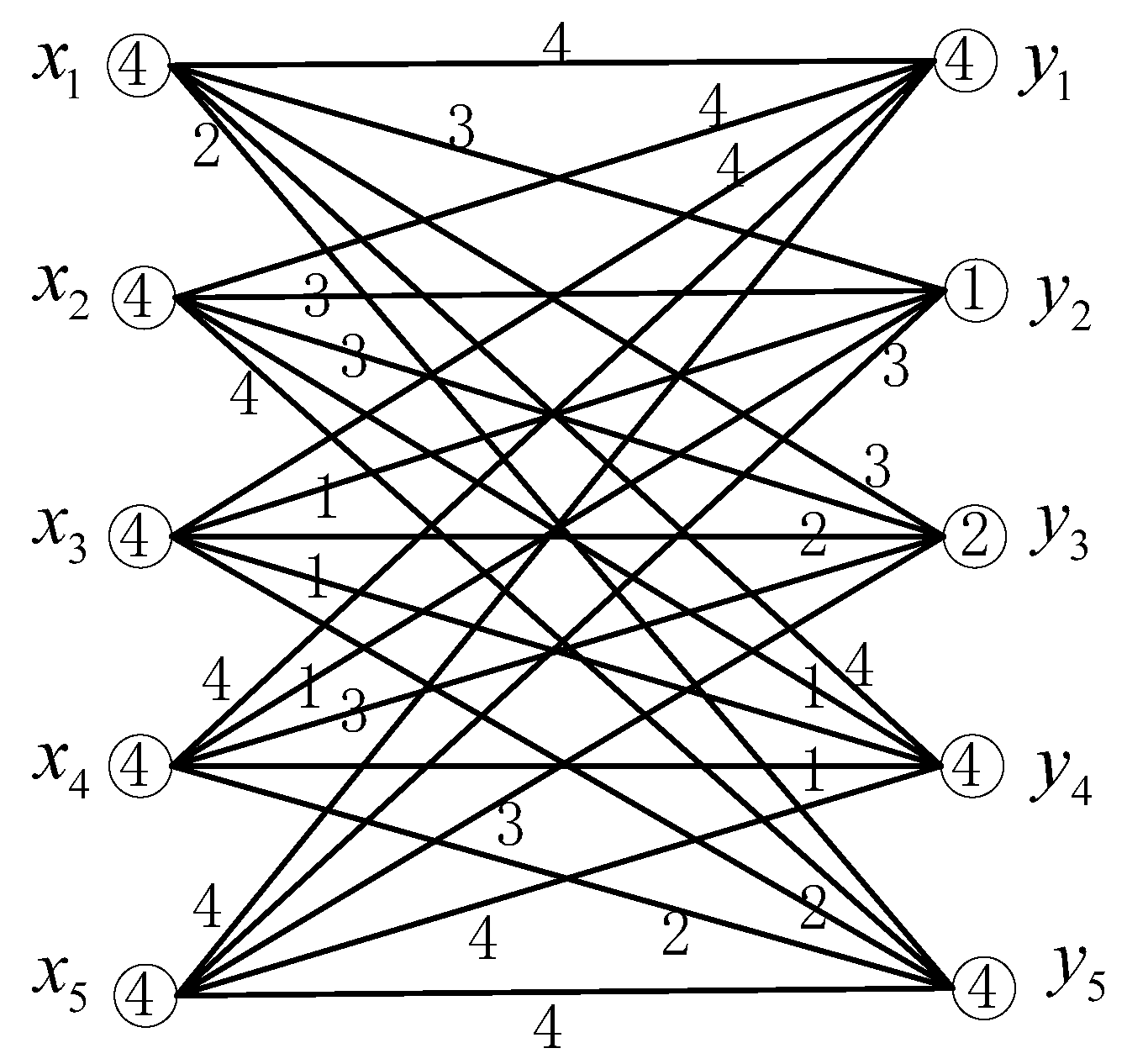
Table 1 is a 4-GVDTC of
. The restriction of this 4-GVDTC of
on the subgraph induced by
is a 4-GVDTC of
(see
Figure 1).
3. Main Results
Theorem 1. Let , and . If , then .
Proof. Firstly, we show that does not have a -GVDTC.
Otherwise, we assume that g is a -GVDTC of in which the available colors are .
When , from we know that ; i.e., . This is a contradiction. So we let . Suppose that is the collection of all 1-subsets, 2-subsets, …, -subsets of .
If , say , then , , …, are not in and , , …, . Thus . This is a contradiction.
If , then and , . Thus , , …, and . This is a contradiction.
Secondly, we will give a k-GVDTC of in which the available colors are .
Put
Now distribute other subsets of with cardinality between 2 and to vertices such that different vertices correspond different subsets. The subset that corresponds to is denoted by . This is well established since .
Construct a general total coloring as follows. Let receive color k, ; let and receive color k and receive color j (), ; and let () and receive color j, .
Let .
If contains at least two different colors, then let , where . Let receive color . Let edge receive color (). The number of colors in is not larger than the number of the uncolored edges incident with , so we can assign the colors in to the edges in such that each color in is used to color at least one edge incident with .
If contains just one color , then let receive color . The number of colors in is not larger than the number of the all (uncolored) edges incident with , so we can assign the colors in to the edges incident with such that each color in is used to color at least one edge incident with .
If is empty, then the number of colors in is not larger than , so we can assign the colors in to the vertex and the edges incident with such that each color in is used to color the vertex or one edge incident with .
By simple calculation we see that . From the color of each and the coloring of the incident edges of vertices , , we know that , . From the coloring process we know that . Thus the resulting coloring is a k-GVDTC of . □
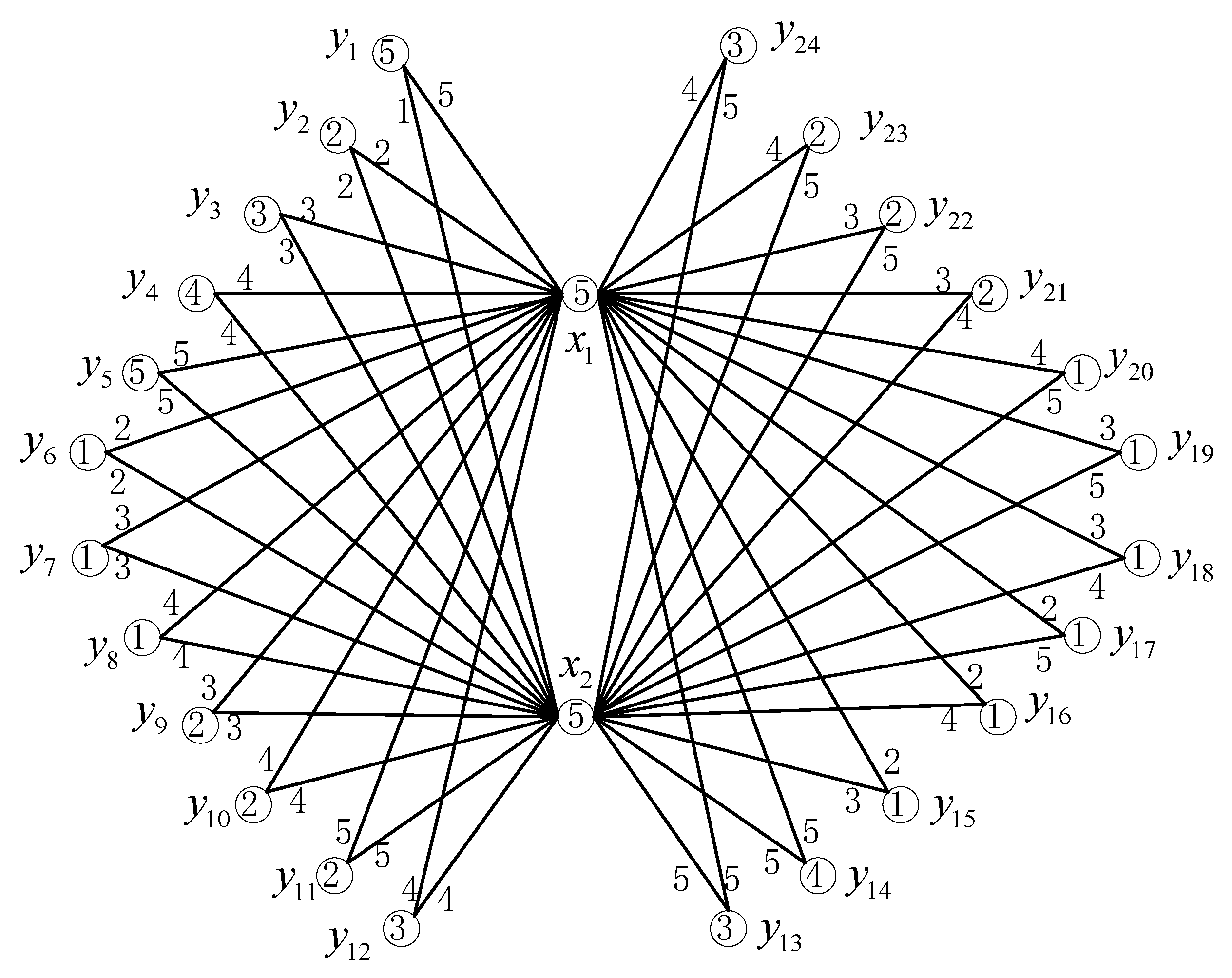
Example 1. According to the proof of Theorem 1, a 5-GVDTC of is shown in Figure 2. Remark 1. Note that when , . It is easy to see that . Let . So the restriction of the -GVDTC of obtained in the proof of Theorem 1 (take ) on the subgraph induced by is an -GVDTC of when .
Theorem 2. Let ; i.e., . Then .
Proof. By Remark 1, we have . So we need only to prove that does not have an GVDTC. Otherwise, suppose g is an GVDTC of in which the available colors are .
If there are two members and in such that (i.e., the two members are complementary), then each nonempty subset in is not in . Since , there exist at most nonempty subsets of , which are not the color set of any vertices in . Therefore at least members in are contained in . We have . By Lemma 1, we have ; i.e., . This is a contradiction.
If any subset in is not the complement of any subset in , then each is not the color set of any vertices. Thus and . This is a contradiction. □
Theorem 3. Let and . If , then .
Proof. By Lemma 3, we know that since . So we need only to prove that does not have an r-GVDTC under the given conditions.
Otherwise, let g be an r-GVDTC of in which the available colors are . We will give six claims as follows.
- Claim 1.
, .
This is obvious because the color of edge is in both and .
- Claim 2.
.
Otherwise, say . Then, by Claim 1, each is not the color set of any vertex and we have that . This is a contradiction.
- Claim 3.
.
From Claim 2, we can deduce Claim 3 easily.
- Claim 4.
.
Otherwise, say . Then, by Claim 1, each is not the color set of any vertex and we have that . This is a contradiction.
- Claim 5.
.
This is deduced from Claim 4 directly.
- Claim 6.
If D is a subset of with , then either D or is not the color set of any vertex in X, where .
Otherwise, D and are the color sets of vertices in X; then each nonempty subset in is not in . Since , there exist at most nonempty subsets of , which are not the color set of any vertices in . Therefore at least members in are contained in , where . We have .
If r is even, by Lemma 1, we have ; i.e., . In addition, by Lemma 2 from we know that . Thus ; i.e., and we have . This is a contradiction.
If r is odd, by Lemma 1, we have ; i.e., . In addition, by Lemma 2 from we know that . Thus ; i.e., . This is a contradiction, too.
We consider the following two cases.
- Case 1.
, , …, , are in .
Of course . If , then is not the color set of any vertex in by Claim 1 and Claim 6. Thus, by Claim 3 and Claim 5, we have that , where is the collection of all 2-subsets, 3-subsets, …, -subsets, except for all and with . Therefore ; i.e., . This is a contradiction.
- Case 2.
At least one subset among all -subsets and r-subsets is not the color set of any vertex in X.
If , then the complementary sets of the color sets of at least vertices in X (whose color set is not -subset or r-subset) are not the color set of any vertex in . Thus . This is a contradiction.
If , then , where is the collection of all 2-subsets, 3-subsets, …, r-subsets. Thus . This is a contradiction, too.
Thus does not have an r-GVDTC under the given conditions. The proof is completed. □
Theorem 4. Let and s be the minimum positive integer such that . Suppose
If (i) , , or (ii) , or (iii) , , , then . Proof. By Lemma 3, we know that has an -GVDTC when one of three conditions (i), (ii) or (iii) holds. When conditions (i) and (ii) are valid, we have that , and the results are right since all the nonempty subsets of the set composed by r colors cannot distinguish n vertices. So we suppose that condition (iii) holds in the following. By use of Lemma 2 and the definitions of a and , we can deduce that from . By Lemma 3, we need only to prove that does not have an r-GVDTC.
Assume that has an r-GVDTC g in which the available colors are . Firstly, we will give six claims.
- Claim 1.
, .
This is obvious because the color of edge is in both and .
- Claim 2.
.
Otherwise, say . Then each is not the color set of any vertex and we have that . This is a contradiction.
- Claim 3.
.
From Claim 2, we can deduce Claim 3 easily.
- Claim 4.
.
Otherwise, say . Then each is not the color set of any vertex and we have that . This is a contradiction.
- Claim 5.
.
This is deduced from Claim 4 directly.
- Claim 6.
If D is a subset of with , then either D or is not the color set of vertex in X, where .
Otherwise, D and are the color sets of vertices in X; then each nonempty subset in is not in . Since , there exist at most nonempty subsets of , which are not the color set of any vertex in . Therefore at least members in are contained in , where . We have .
If r is even, by Lemma 1, we have ; i.e., . This is a contradiction.
If r is odd, by Lemma 1, we have ; i.e., . This is a contradiction, too.
The proof of Claim 6 is completed.
Finally we consider the following two cases.
- Case 1.
, , …, , are in .
If
, then
is not the color set of any vertex in
by Claim 6. Let
,
, …,
,
. Then, by Claim 3 and Claim 5, we have
Thus
; i.e.,
. This is a contradiction.
- Case 2.
At least one subset among all -subsets and r-subsets is not the color set of vertices in X.
Let
,
, …,
,
with
. Then we have
Thus
; i.e.,
. This is a contradiction.
Thus does not have an r-GVDTC under the given conditions. The proof is completed. □
4. An Application to the Case
By Theorems 1–4, we can determine the when , , and , , respectively. From Theorem 4 (when condition (iii) holds) we can know that when and 12. We will discuss other cases in the following.
Theorem 5. .
Proof. Obviously, we have
. So we need only to give a 5-GVDTC of
in which the available colors are
. Let
We can give a 5-GVDTC of
easily such that
,
,
(see
Table 2). □
Theorem 6. If , then .
Proof. By Lemma 3, we know that has 6-GVDTC when . So we need only to show that does not have any 5-GVDTC when .
Assume that has a 5-GVDTC g when .
- Claim 1.
, .
Otherwise, without loss of generality, we suppose that . Then each is not the color set of any vertex and . This is a contradiction.
- Claim 2.
, .
Otherwise, without loss of generality, we suppose that . Then each is not the color set of any vertex and . This is a contradiction.
From Claim 1 and Claim 2, we have the following claim.
- Claim 3.
and , where is the collection of all subsets (of ) that contains at least 2 elements.
All 2-subsets of except for at most two 2-subsets are in .
We consider two cases.
- Case 1.
. We may suppose . Since the color set of each vertex in X is not disjoint with the color set of any vertex in Y, we have that , , , , , , , are the color sets of vertices in one part. Thus the color set of each vertex in another part is one of the following sets:
- Case 2.
. We may suppose . Since the color set of each vertex in X is not disjoint with the color set of any vertex in Y, we have that , , , , , , , are the color sets of vertices in one part. Thus the color set of each vertex in another part is one of the following sets:
This is a contradiction. □
Theorem 7. If , then .
Proof. By Lemma 3, we know that has a 7-GVDTC when . So we need only to show that does not have any 6-GVDTC when .
Assume that has a 6-GVDTC g when .
- Claim 1.
, .
Otherwise, without loss of generality, we suppose that . Then each contains color 1. But has at most 31 subsets that contain 1 and have at least two elements. This is a contradiction.
- Claim 2.
, .
Otherwise, without loss of generality, we suppose that . Then each is not the color set of any vertex and . This is a contradiction.
From Claim 1 and Claim 2, we have the following claim.
- Claim 3.
and , where is the collection of all subsets ( of ) that contains at least two elements.
All 2-subsets of except for at most two 2-subsets are in .
We consider two cases.
- Case 1.
. We may suppose . We can deduce that other 2-subsets are the color sets of vertices in one part. Thus the color set of each vertex in another part is one of the following sets:
- Case 2.
. We may suppose . We can deduce that other 2-subsets are the color sets of vertices in one part. Thus the color set of each vertex in another part is one of the following sets:
This is a contradiction. □