Article

Fuzzy and Gradual Prime Ideals

1
Department of Algebra, IMAG—Instituto de Matemáticas, Universidad de Granada, 18071 Granada, Spain
2
Department of Algebra, Universidad de Granada, 18071 Granada, Spain
*
Author to whom correspondence should be addressed.
Mathematics 2025, 13(24), 3998; https://doi.org/10.3390/math13243998
Submission received: 27 July 2025 / Revised: 23 September 2025 / Accepted: 3 December 2025 / Published: 15 December 2025
(This article belongs to the Section E1: Mathematics and Computer Science)

Abstract

There is a correspondence between equivalence classes of fuzzy ideals, on a commutative ring, and decreasing gradual ideals. In this paper, we explore how to construct a fuzzy ideal starting from any decreasing gradual ideal σ . To achieve this, we consider an interior operator, σ d , and a closure operator, σ e , and show that the pair ( σ d , σ e ) is always an F-pair, which defines a fuzzy ideal. Furthermore, this correspondence, and its inverse, preserves sums, intersections and products. This therefore provides an algebraic framework for studying fuzzy ideals. In particular, prime fuzzy ideals and weakly prime fuzzy ideals have their counterparts in the theory of decreasing gradual ideals, offering us a new perspective on these particular objects. One of the main objectives is to characterize fuzzy prime ideals using single fuzzy elements and gradual ideals.

1. Introduction

The theory of fuzzy sets, introduced by L. A. Zadeh in [1], provides a framework for studying of sets and, therefore, algebra, geometry, logic, and other branches of mathematics. It introduces a subset as a membership function, with values in the real interval [ 0 , 1 ] such that if the image of an element x i is α i , for i = 1 , 2 , and α 1 > α 2 , then, between x 1 and x 2 , the membership degree of x 1 is greater than that of x 2 .
The study of fuzzy algebraic structures is an area of work in modern fuzzy theory research. Sometimes, the relevant algebraic properties are obscured by the fuzzy theory. For this reason, a parallel theory that highlights the peculiarities of certain fuzzy structures is developed in [2]. For example, if A is a commutative ring, the category of fuzzy A-modules is far from being an abelian category. In general, there is no referent within abelian categories to study it; see [3].
We can modify this paradigm by studying functions from L = [ 0 , 1 ] , or a subset of [ 0 , 1 ] , to a set X; thus, each of these functions then defines a gradual element as defined in [4], following the theory of gradual elements developed in [5] and the theory of gradual numbers developed in [6]. As an exercise in algebraicity, we could consider gradual subgroups, submodules, or ideals; see [2,4]. In these papers the authors studied gradual right ideals and gradual right submodules, showing that there is a correspondence between fuzzy ideals in a commutative ring A and certain decreasing gradual right ideals. They also showed that the same result holds for fuzzy submodules. This correspondence explores the well-known α -levels and strong α -levels in the classical fuzzy theory.
Our preference for working with gradual elements, modules and ideals rather than fuzzy elements stems from the fact that the former can be studied within a categorical framework derived directly from an abelian category. As mentioned above, the category theory of fuzzy modules is a disadvantage of the fuzzy theory, see [3], influencing algebraic constructions such as sum, intersections, etc. The new approach that we are following allows us to relate fuzzy algebraic constructions with other categorical constructions. Consequently, we can determine which constructions are correct for fuzzy ideals and modules, and deduce their main properties.
In [2] the authors initiated the construction of an abelian category by starting from a functor category, the category of additive contravariant functors from a preadditive category to the category of abelian groups, or to the category of modules over a commutative ring. Next, they took the full subcategory of all torsion-free modules, for a particular hereditary torsion theory, the objects of which would be the decreasing gradual right modules. The objective was to identify the analogue of a strong α -level, which, within this novel framework, is designated as strictly decreasing gradual right modules. This was achieved through the utilization of an interior operator whose open objects are precisely the strictly decreasing gradual right modules. Here, we apply this theory to the preadditive category defined by the poset L = [ 0 , 1 ] .
The classical approach involves establishing a map from the set of fuzzy ideals (or submodules) to the set of decreasing gradual right modules via the α -levels. The only restriction that needed to be taken into account was considering the equivalence classes of fuzzy ideals (or submodules) with respect to the equivalence relation of fuzzy ideals (or submodules) defined by μ 1 μ 2 if μ 1 ( x ) = μ 2 ( x ) for any x A { 0 } (or x M { 0 } in the case of modules). For the sake of simplicity, the ensuing discussion will focus on fuzzy ideals, under the assumption that this can be extended to the theoretical framework of fuzzy submodules.
Finally, we will conclude with a few words about the advantages of this construction. As stated in [2] and referenced above, the correspondence from fuzzy ideals to strictly decreasing gradual right ideals, via strong α -cuts, preserves sums, intersections and products. This is primarily because we consider equivalence classes of fuzzy ideals rather than the fuzzy ideals themselves. This correspondence is beneficial because it allows us to study fuzzy ideals as strictly decreasing gradual right ideals. It is possible to reverse this correspondence starting from any decreasing gradual right ideal and associating a pair of decreasing gradual right ideals, ( σ d , σ e ) , where σ d is strictly decreasing, and σ e is a new type of decreasing gradual right ideal satisfying σ d σ σ e .
For simplicity’s sake, in this paper we prefer to use “gradual ideal” rather than “decreasing gradual right ideal”.
This paper is organized in sections. This is Section 1. Given a commutative ring A, a fuzzy subset μ : A L is a fuzzy ideal of A if it satisfies the following properties:
  • μ ( x y ) μ ( x ) μ ( y ) , for any x , y A ,
  • μ ( x y ) μ ( x ) μ ( y ) , for any x , y A , and
  • μ ( 0 ) 0 .
For any fuzzy ideal μ of A, we define another one, μ ¯ , as follows:
μ ¯ ( x ) = 1 , if   μ ( x ) = μ ( 0 ) , μ ( x ) , otherwise .
For any commutative ring A, a decreasing gradual right ideal (gradual ideal for short) of A is a map from ( 0 , 1 ] to the lattice of all ideals of A, σ : [ 0 , 1 ] L ( A ) , satisfying the following properties:
  • σ ( 0 ) = A , and
  • σ ( β ) σ ( α ) , for any α , β ( 0 , 1 ] such that α β .
Since the image of 0 is always equal to A, we can also assume that a decreasing gradual right ideal is precisely a monotone mapping from ( 0 , 1 ] to L ( A ) .
In Section 2 we review the main properties of the prime fuzzy ideals and weakly prime fuzzy ideals we shall use. We are interested in how to describe them and what properties characterize them, for which we introduce a new type of fuzzy element: the single fuzzy elements. In the context of a prime fuzzy ideal μ on the poset L, it is well established that the image of μ has only two elements, one of which is 1. In the case of a weakly prime fuzzy ideal μ , the characterization is more difficult because each μ α and each μ ˜ α = μ ˜ α (the associated strictly decreasing gradual ideal or strong α -level of μ ) are either equal to A or are a prime ideal of A. However, we show that they are intersections of particular families of prime fuzzy ideals as outlined in Proposition 2. Other useful results on fuzzy ideals are established.
In Section 3 we examine the theory from the perspective of gradual ideals. Firstly, we characterize prime gradual ideals and prove that they have one or two jumps. In this instance, the number of jumps is a key factor. Furthermore, it is important to note that most of the non-constant prime gradual ideals have a twin; if one, σ 1 , is defined by σ 1 ( δ ) = p , if δ > α , A , if δ α , then the other, σ 2 , is defined by σ 2 ( δ ) = p , if δ α , A , if δ < α , .
Therefore, the following equations holds: σ 2 = σ 1 d and σ 1 = σ 2 e . It is evident that both define the same fuzzy ideal, one as μ ( σ 1 ) , and the second one, which is strictly decreasing, as μ ˜ ( σ 2 ) . According to the established rule, there are two distinct types of gradual ideals: the first type is denoted by π ( 0 , p ) and the second type by π ˜ ( 1 , p ) . The use of jumps appears to be useful for our purposes as does the incorporation of gradual elements.
In this section, we introduce the analogue of the weakly fuzzy ideal, which we call here component prime gradual ideals. We are examining the various types of jumps, and studying their behavior in relation to the interior and closure operators.
These operators are studied in Section 4 with the aim of standardizing the method for constructing gradual ideals and fuzzy ideals, and we know how to move from gradual to fuzzy and vice versa.
This paper is concluded with Section 5, in which we present examples that illustrate the value of the gradual ideals in the study of fuzzy ideals.
We refer to [2] for notations and notions or definitions not explicitly defined in this work.

2. Prime Fuzzy Ideals of a Commutative Ring

In this section, we focus on a specific category of fuzzy ideals: the prime fuzzy ideals. Prime fuzzy ideals were introduced in the classical literature of Fuzzy Commutative Algebra; see [7,8]. Our objective is to characterize them using appropriate elements and to introduce the necessary background to develop a theory of prime gradual ideals in the next section. The study of prime fuzzy ideals is notable for the simplicity of their structure and the manner in which their combination gives rise to more complex objects.
A fuzzy ideal μ of a commutative ring A is a prime fuzzy ideal if it satisfies the following:
  • μ is non-constant.
  • If μ 1 μ 2 μ , then either μ 1 μ or μ 2 μ , for any fuzzy ideals μ 1 , μ 2 .
The following is a useful characterization of prime fuzzy ideals.
Theorem 1
([8], Theorem 3.5.5). Let μ be a fuzzy ideal. The following statements are equivalent:
(a)
μ is prime.
(b)
 
(1)
μ * = { x A μ ( x ) = μ ( 0 ) } is a prime ideal of A,
(2)
Im ( μ ) = { 1 , α } , with α 1 .
In light of this result, the study of prime fuzzy ideals can be restricted to consider fuzzy ideals μ such that μ = μ ¯ .
In particular, if μ is a prime fuzzy ideal, since it is non-constant there exists 1 α L and a prime ideal p A such that μ ( z ) = 1 , if z p , α , if z p .
In this case μ * = p . We shall represent this fuzzy ideal by π ( p , α ) , i.e.,
π ( p , α ) ( x ) = 1 , if x p , α , if x A p .
For any β L we define π ( p , α ) β = A , if β α , p , if β > α , which can be represented as Mathematics 13 03998 i001

2.1. Fuzzy Elements

A single fuzzy element of A is defined, for any x A and any α [ 0 , 1 ] , by
ε ( x , α ) ( z ) = α , if z = x , 0 , if z x .
Mathematics 13 03998 i002
Let ε ( x , α ) be a single fuzzy element of A, if x 0 , the ideal generated by ε ( x , α ) is ε ( x , α ) , defined by
ε ( x , α ) ( z ) = 1 , if z = 0 , α , if z A x { 0 } , 0 , if z A x .
Mathematics 13 03998 i003
Lemma 1.
For any fuzzy ideal μ = μ ¯ we have that ε ( x , α ) μ whenever ε ( x , α ) μ , or equivalently, x μ α .
Proof. 
Given z A , if z = 0 , then ε ( x , α ) ( 0 ) = 1 = μ ( 0 ) ; if z x A { 0 } there exists a A such that z = x a , hence μ ( z ) = μ ( x a ) μ ( x ) μ ( a ) μ ( x ) ε ( x , α ) ( x ) = α = ε ( x , α ) ( z ) ; if z x A , then μ ( z ) 0 = ε ( x , α ) ( z ) . □
If ε ( x , α ) and ε ( y , β ) are single fuzzy elements, such that x , y , x y 0 , we define the product of two single fuzzy elements as
ε ( x , α ) ε ( y , β ) = ε ( x y , α β ) ,
so we have
ε ( x , α ) ε ( y , β ) = ε ( x y , α β ) .
For x = 0 , we define ε ( x , 1 ) in the obvious way.
This product allows the following characterization of prime fuzzy ideals.
Theorem 2
([8], Theorem 3.5.6). Let μ be a non-constant fuzzy ideal, and the following statements are equivalent:
(a)
μ is prime.
(b)
If ε ( x , α ) ε ( y , β ) μ , then either ε ( x , α ) μ or ε ( y , β ) μ .
Proof. 
(b) ⇒ (a). If μ does not satisfy (a), there exist fuzzy ideals μ 1 , μ 2 such that μ 1 μ 2 μ and μ 1 , μ 2 μ . Therefore, there exist x 1 , x 2 A such that μ i ( x i ) μ ( x i ) . On the other hand, ε ( x 1 , μ 1 ( x 1 ) ) ε ( x 2 , μ 2 ( x 2 ) ) μ 1 μ 2 μ , whence there exists an index i such that ε ( x i , μ i ( x i ) ) μ , i.e., μ i ( x i ) = ε ( x i , μ i ( x i ) ) ( x i ) μ ( x i ) , which is a contradiction.
(a) ⇒ (b) is straightforward. □
Theorem 3
([8], Theorem 3.5.8). Let μ be a prime fuzzy ideal, for any x , y A , either μ ( x y ) = μ ( x ) or μ ( x y ) = μ ( y ) . In this case, each α-cut is a prime ideal.
Proof. 
Since μ is prime then μ ( A ) = { 1 , α } . If μ ( x y ) = 1 , then either μ ( x ) = 1 or μ ( y ) = 1 . If μ ( x y ) = α , then x y μ * , so x , y μ * , and μ ( x ) = μ ( y ) = α . □
The converse is also true provided that μ ( 0 ) = 1 , μ ( A ) = { 1 , α } for some α L { 1 } , and μ 1 A is prime; see Theorem 1. This means that any fuzzy ideal μ satisfying the conditions
  • μ ( 0 ) = 1 ,
  • μ ( A ) = { 1 , α }
  • μ α A is prime and
is a prime fuzzy ideal.

2.2. Maximal Fuzzy Ideals of a Commutative Ring

The natural definition of the maximal fuzzy ideal is as follows: a non-constant fuzzy ideal μ is maximal provided that for any fuzzy ideal ν such that μ ν 1 A , it holds that μ = ν , where 1 A denotes the fuzzy ideal, defined by 1 A ( x ) = 1 , for any x A .
Theorem 4
([8], Theorem 3.4.3). Let μ be a non-constant fuzzy ideal. The following statements are equivalent:
(a)
μ is maximal.
(b)
There exist a maximal ideal m A and a maximal element α L { 1 } such that μ = π ( m , α ) .
In particular, π ( m , α ) ( A ) = { 1 , α } .
Consequently, maximal fuzzy ideals are prime fuzzy ideals. The issue arises from the fact that, for L = [ 0 , 1 ] , there are no maximal fuzzy ideals. This is due to the fact that the set [ 0 , 1 ) has no maximal elements.
A weaker notion of the maximal fuzzy ideal is as follows. A fuzzy ideal μ is generalized maximal if for any fuzzy ideal ν such that μ ν , either ν * = μ * or ν * = A .
Theorem 5
([8], Theorem 3.4.5). Let μ be a non-constant fuzzy ideal. The following statements are equivalent:
(a)
μ is generalized maximal.
(b)
There exist a maximal ideal m A and an element α [ 0 , 1 ) such that μ = π ( m , α ) .
In particular, Im ( π ( m , α ) ) = { 1 , α } .

2.3. Weakly Prime Fuzzy Ideals of a Commutative Ring

Following Theorem 3, we define a fuzzy ideal μ to be a weakly prime fuzzy ideal if it satisfies the following conditions:
  • μ is non-constant.
  • μ ( x y ) = μ ( x ) or μ ( x y ) = μ ( y ) , (or equivalently, μ ( x y ) = μ ( x ) μ ( y ) ), for any x , y A .
This is a weaker notion of the prime fuzzy ideal. A weakly prime fuzzy ideal may have more than two values; that is, | μ ( A ) | may be greater than 2. It is not even necessary for the relationship μ ( 0 ) = 1 to be fulfilled for weakly prime fuzzy ideals. For further information, see [9,10,11], where weakly prime fuzzy ideals were called strongly prime fuzzy ideals or [12], who referred to them as weakly completely prime ideals.
Proposition 1
([9]). Let μ be a non-constant fuzzy ideal. The following statements are equivalent:
(a)
μ is a weakly prime fuzzy ideal.
(b)
For any α μ ( A ) , either μ α = A or μ α A is prime
Proof. 
(a) ⇒ (b). Let μ α A and let x , y A such that x y μ α , then μ ( x y ) α . Then μ ( x ) = μ ( x y ) or μ ( y ) = μ ( x y ) . In the first case, we have μ ( x ) = μ ( x y ) α , therefore x μ α . In the second case, we have μ ( y ) = μ ( x y ) α , and y μ α .
(b) ⇒ (a). Let μ ( x y ) = α . If μ α = A , then x μ α , and μ ( x ) α ; therefore, α = μ ( x y ) μ ( x ) α , then μ ( x ) = μ ( x y ) . The same result holds for y. Otherwise, if μ α A is prime, then x μ α or y μ α . If x μ α , then α = μ ( x y ) > μ ( x ) α , and μ ( x y ) = μ ( x ) . Similarly for y. □
The following example shows that not every weakly prime fuzzy ideal is a prime ideal.
Example 1.
Let p A be a prime ideal of a domain A, and for elements 0 , α , β , 1 L , with 0 < α < β < 1 we define a fuzzy subset
μ ( x ) = 1 , i f x = 0 , α , i f x p { 0 } , 0 , i f x A p .
μ is weakly prime because every λ-level is prime. But μ is not prime because μ ( 0 ) 1 . On the other hand, given that Im ( μ ) = { 0 , α , 1 } has three elements, then μ has only three stages: A, p and { 0 } .
As we pointed out before, unlike prime fuzzy ideals, for any weakly prime fuzzy ideal μ we do not have μ ( 0 ) = 1 as shown in the previous example.
Let us consider the following example.
Example 2.
If p 1 p 2 are prime ideals in the domain A, and α 2 α 1 , then we can also consider the fuzzy ideal η, defined by
η ( x ) = 1 , i f x = 0 , α 1 , i f x p 1 { 0 } , α 2 , i f x p 2 p 1 , 0 , i f x A p 2 .
It is clear that η is weakly prime; also we have η = η 1 η 2 , for η i , for i = 1 , 2 , defined by
η i ( x ) = 1 , i f x p i , α i , i f x A p i ,
This example illustrates that every weakly fuzzy prime ideal is an intersection of a family of prime fuzzy ideals, provided that μ ( 0 ) = 1 . Indeed, if μ is a weakly prime fuzzy ideal and μ ( 0 ) = 1 , it is possible to establish a description of μ in terms of the structure of I. This can be achieved by defining I = μ ( A ) L . First, we propose to extend the notation of π ( p , α ) by defining π ( A , α ) by defining π ( A , α ) ( z ) = 1 for any z A .
A subset K L is called inf-continuous if for any non-empty subset H K we have H K . In particular, for each β K we have β = { γ K γ > β } . Note that any finite subset of L is inf-continuous.
Theorem 6.
If μ ( A ) is inf-continuous, μ ( 0 ) = 1 , and μ is weakly prime fuzzy ideal, then μ is the intersection of a family of prime fuzzy ideals.
Proof. 
Let μ be a weakly prime fuzzy ideal. For any α μ ( A ) consider π ( μ α , α ) . Now we compare μ with α π ( μ α , α ) . For any z A and γ μ ( A ) , if μ ( z ) = γ then z μ γ , for any γ β , and z μ γ , for any γ > β ; hence
π ( μ γ , γ ) ( z ) = 1 , if γ β , γ , if γ > β ,
In consequence, ( γ π ( μ γ , γ ) ) ( z ) = γ π ( μ γ , γ ) ( z ) = γ { γ γ > β } = β . Therefore, γ π ( μ γ , γ ) = μ . □
Corollary 1.
Every weakly prime fuzzy ideal μ, such that μ ( A ) is finite and μ ( 0 ) = 1 , is the intersection of a finite family of prime fuzzy ideals.
Proof. 
Let μ be a weakly prime fuzzy ideal such that Im ( μ ) = { α 1 , , α n } satisfying α 1 < < α n = 1 . In this case we consider the family π ( μ α i , α i 1 ) , for i = 2 , , n . We claim that μ = i = 2 n π ( μ α i , α i 1 ) . Indeed, for any z A let μ ( z ) = β = α j ; hence, z μ α j , and we have
( i π ( μ α i , α i 1 ) ) ( z ) = i π ( μ α i , α i 1 ) ( z ) = 1 1 α j α n = α j .
Our aim is to study the structure of weakly prime fuzzy ideals, and we shall relate them to families of prime fuzzy ideals of the type π ( p , α ) .
Lemma 2.
Let p 1 , p 2 A prime ideals, and α 1 , α 2 L . The following statements are equivalent:
(a)
π ( p 1 , α 1 ) π ( p 2 , α 2 ) .
(b)
p 1 p 2 and α 1 α 2 .
Proof. 
(a) ⇒ (b). Since we have A = π ( p 1 , α 1 ) α 1 π ( p 2 , α 2 ) α 1 , then π ( p 2 , α 2 ) α 1 = A , hence α 1 α 2 . On the other hand, if β > α 2 , given that p 2 = π ( p 2 , α 2 ) β π ( p 1 , α 1 ) β = p 1 , the second condition is satisfied.
(b) ⇒ (a). For any β α 1 we have π ( p 1 , α 1 ) β = A = π ( p 2 , α 2 ) β . For any α 1 < β α 2 we have π ( p 1 , α 1 ) β = p 1 = A = π ( p 2 , α 2 ) β . The third case occurs when α 2 < β , and we have π ( p 1 , α 1 ) β = p 1 p 2 = π ( p 2 , α 2 ) β . □
Lemma 3.
For any chain of prime fuzzy ideals { π ( p i , α i ) i I } , the intersection i π ( p i , α i ) is a prime fuzzy ideal.
Proof. 
Let { π ( p i , α i ) i I } be a chain of prime fuzzy ideals, p = i p i , and α = i α 1 , and therefore π ( p , α ) i π ( p i , α i ) . For any x A , if x p , then π ( p i , α i ) ( x ) = 1 for any i I ; therefore, π ( p , α ) ( x ) = 1 = ( i π ( p i , α i ) ) ( x ) . On the other hand, if x p , there exists an index i such that x p i ; hence, x p j for any p j p i , and π ( p j , α j ) ( x ) = α j , so ( j π ( p j , α j ) ) ( x ) = j α j = α = π ( p , α ) ( x ) . In conclusion, π ( p , α ) = i π ( p i , α i ) . □
Following [2], see also [13], let us introduce a novel construction in fuzzy ideal theory. In the set of all fuzzy ideals on a ring A we consider the relation ∼, defined as follows:
μ 1 μ 2 whenever μ 1 ( x ) = μ 2 ( x ) for all x A { 0 } .
It is an equivalence relation in the set of all fuzzy ideals of a ring A. Therefore, every equivalence class, [ μ ] , contains a unique fuzzy ideal that maps 0 A to 1 L ; if we denote this fuzzy ideal by μ 0 , it is defined by
μ 0 ( z ) = 1 , if z = 0 , μ ( z ) , if z 0 .
This construction is interesting because it allows us to work on the quotient set of all fuzzy ideals, modulo this equivalence relation. This is possible after proving that if a specific property is true for μ , it is also true for μ 0 . In this regard, we have the following.
Lemma 4.
Let μ be a fuzzy ideal, and A be an integral domain. Then μ is weakly prime if, and only if, μ 0 is weakly prime.
Proof. 
Necessary condition. If μ = μ 0 , it holds. If μ μ 0 , then σ ( μ 0 ) ( 1 ) = { x A μ 0 ( x ) = 1 } = { 0 } , and it is prime if, and only if, A is an integral domain. For every other different λ -level, σ ( μ 0 ) ( λ ) = σ ( μ ) ( λ ) , which is prime by the hypothesis.
Sufficient condition. If μ = μ 0 , it holds. If μ μ 0 and μ 0 is weakly prime, then σ ( μ ) ( λ ) = σ ( μ 0 ) ( λ ) is prime for all λ 1 , so μ is weakly prime. □
In general, the problem is that for a weakly prime fuzzy ideal μ such that μ μ 0 , the construction of μ 0 produces a weakly prime fuzzy ideal only for integral domains. We can solve this problem by taking not only μ ( 0 ) = 1 but also μ ( x ) = 1 for all x μ * ; that is, by taking μ ¯ instead of μ 0 ; thus, we obtain that μ * = μ ¯ * is a prime ideal, and μ ¯ will be weakly prime.
Lemma 5.
If μ is a weakly prime fuzzy ideal, then μ ¯ is weakly prime. The converse is also true.
Proof. 
We have μ ¯ ( x y ) = μ ¯ ( x ) or μ ¯ ( y ) whenever x y , x , y μ * . If one of them belongs to μ * , then so does the other, so we obtain the result. □
Let μ be a fuzzy ideal, and let i ( μ ) denote the cardinal of μ ( A ) L . Moving to μ 0 or μ ¯ , as appropriate, we can assume that μ ( 0 ) = 1 ; hence, we always have 1 μ ( A ) . Therefore, i ( μ ) > 1 whenever μ is non-constant. Furthermore, since for any λ Im ( μ ) we have an ideal μ λ , the number of different λ -levels is exactly the cardinal number i ( μ ) , so we call each element in μ ( A ) a stage of μ . The fuzzy ideals μ with i ( μ ) = 1 are the constant ones, and every prime fuzzy ideal π satisfies i ( π ) = 2 .
We know that there are weakly prime fuzzy ideals μ such that i ( μ ) > 2 . The next step is to determine the standard form of any weakly prime fuzzy ideal. We begin by establishing a subset  I L , such that 1 I , and a set of prime ideals C = { p α α I } , which satisfy the following:
  • C is a strictly descending totally ordered set of prime ideals; that is, p α p β , whenever α < β , and
  • for any z A if β = { α I z p α } , then z p β ,
then we define a fuzzy set μ C as follows:
μ C ( z ) = α i , if z p α i { p α j α j > α i } , 0 , if z { p α i i I } .
With this definition we have the following result.
Lemma 6.
The fuzzy set μ C satisfies the following properties:
(1)
a fuzzy ideal;
(2)
a prime fuzzy ideal if, and only if, | C | = 1 ; in this case, if C = { α } , α 0 , then μ C = π ( p α , α ) .
(3)
a weakly prime fuzzy ideal whenever | C | 1
Proof. 
(1). For any x , y A if x , y α p α , then μ C ( x y ) μ C ( x ) μ C ( y ) . If { x , y } α p α , then μ C ( x ) = 0 or μ C ( y ) = 0 , and we have μ C ( x y ) μ C ( x ) μ C ( y ) .
For any x , y A if x , y α p α , then x y α p α , and μ C ( x y ) = μ C ( x ) μ C ( y ) . If x , y α p α , then x y α p α and μ C ( x y ) = μ C ( x ) μ C ( y ) . If x α p α and y α p α , then μ c ( x y ) = μ C ( y ) = μ C ( x ) μ C ( y ) .
(2) is obvious.
(3) is a consequence of the identity μ C ( x y ) = μ C ( x ) μ C ( y ) . □
A set of prime ideals C that satisfies the above properties is named a weakly prime set.
From the above construction and this lemma, the proof of the following proposition is straightforward.
Proposition 2.
If μ is a weakly prime fuzzy ideal and we consider I = μ ( A ) L , then it defines a strictly descending totally ordered set of prime ideals C = { p α = μ α α I } , (i.e., p β p α whenever β < α ) and a weakly prime fuzzy ideal μ C that satisfies μ = μ C .
Proof. 
We prove that if μ is a weakly prime fuzzy ideal and define I = μ ( A ) L , then the set C = { p α α I } is a strictly descending totally ordered set of prime ideals. Indeed, if α < β in I, then there exists z A such that μ ( z ) = α , and z p α p β . Furthermore, for any z A we have μ ( z ) = { α I z p α } = β , and z p β . Therefore, μ C is a weakly prime fuzzy ideal and μ = μ C . □
In conclusion, we obtain a characterization of weakly prime fuzzy ideals in terms of weakly prime sets.
Theorem 7.
For any non-constant fuzzy ideal μ, the following statements are equivalent:
(a)
μ is weakly prime fuzzy ideal;
(b)
μ ¯ is weakly prime fuzzy ideals;
(c)
There is a weakly prime set of prime ideals C such that μ ¯ = μ C .
To conclude this section, we show some examples that demonstrate the application of the theory.
Example 3.
Let K be a field, { X n n N } be a set of indeterminates over K, and A = K [ X n n N ] be the polynomial ring. Since there is an ascending chain of prime ideals,
0 ( X 0 ) ( X 0 , X 1 ) ( X 0 , X 1 , X 2 )
we define a fuzzy ideal η : A [ 0 , 1 ] as follows:
η ( z ) = 1 , i f z = 0 , 1 2 t + 1 , i f t = min { s z ( X 0 , , X s ) } , 0 , i f z A ( X n n N ) .
It is clear that η is a weakly prime fuzzy ideal.
Example 4.
Let K be a field, I = N { ω } , with the order induced by the ordering of N and the condition n < ω for any n N , { X i i I } be a set of indeterminates over K, and A = K [ X i i I ] be the polynomial ring. Given that there is an ascending chain of prime ideals,
0 ( X 0 ) ( X 0 , X 1 ) ( X 0 , X 1 , X 2 ) ( X i i I ) A
we define a fuzzy ideal η : A [ 0 , 1 ] as follows:
η ( z ) = 1 , i f z = 0 , 1 2 + 1 2 t + 2 , i f t = min { s z ( X 0 , , X s ) } , b e i n g   z ( X n n N ) , 1 4 , i f z A ( X n n N ) .
It is clear that η is a weakly prime fuzzy ideal.
Example 5.
Let K be a field, I = ( ν , 1 ] [ 0 , 1 ] , for some ν [ 0 , 1 ) , { X i i I } be a set of indeterminates over K, and A = K [ X i i I ] the polynomial ring. Since there is an ascending chain of prime ideals
{ p i = ( X j j i ) i I } ,
we define a fuzzy ideal η : A [ 0 , 1 ] as follows:
η ( z ) = sup { β I z p β } , w h e n e v e r   z ( X i i I ) , 0 , w h e n e v e r   z A ( X i i I ) .
Since z contains finitely many indeterminates, it is sufficient to take the maximum of them. Alternatively, we can define η ( z ) = inf I in the second case.
Example 6.
Let K be a field, I = [ ν , 1 ] [ 0 , 1 ] , for some ν [ 0 , 1 ) , { X i i I } be a set of indeterminates over K, and A = K [ X i i I ] the polynomial ring. Since there is an ascending chain of prime ideals
{ p i = ( X j j i ) i I } ,
then we define a fuzzy ideal η : A [ 0 , 1 ] as follows:
η ( z ) = sup { β I z p β } , w h e n e v e r   z ( X i i I ) , ν , w h e n e v e r   z A ( X i i I ) .

3. Gradual Ideals of a Commutative Ring

The theory of gradual ideals is similar to the theory of fuzzy ideals in that it clarifies it. In this section, we introduce prime gradual ideals, provide a classification of these, and show that there is a correspondence between certain equivalence classes of prime gradual ideals and prime fuzzy ideals.
The initial objective is to define and study prime gradual ideals on A.
Before proceeding, it would be useful to introduce some examples of gradual ideals.
Example 7.
For any ideal a A , we define a gradual ideal, denoted by σ a , by σ a ( δ ) = a , for all δ L { 0 } . We also represent it as a ; in this case we write σ a a . In particular, we can consider the cases where a is either 0 or A.
Example 8.
For any ideal a A and any α L { 0 } , we define two gradual ideals:
σ ( α , a ) ( δ ) = { 0 } , i f   δ > α , a , i f   0 < δ α , A , i f   δ = 0 , σ ¯ ( α , a ) ( δ ) = { 0 } , i f   δ α , a , i f   0 < δ < α , A , i f   δ = 0 ,
Mathematics 13 03998 i004
  • for each δ L . Note that σ ( 1 , a ) = σ a a .
Example 9.
For any gradual ideal σ and any gradual module η, the product η σ , defined ( η σ ) ( α ) = η ( α ) σ ( α ) , for any α L { 0 } , is a gradual module. See [2].

3.1. Prime Gradual Ideals

Let A be a commutative ring, and a gradual ideal σ is prime whenever it satisfies
(1)
σ A , and
(2)
for any gradual ideals σ 1 , σ 2 , if σ 1 σ 2 σ then either σ 1 σ or σ 2 σ .
Lemma 7.
Let σ be a prime gradual ideal. For any α L { 0 } , the following statements holds:
(1)
σ ( α ) = A or
(2)
σ ( α ) A is a prime ideal,
Proof. 
Let a , b A ideals be such that a b σ ( α ) A . We have
( σ ( α , a ) σ ( α , b ) ) ( δ ) = { 0 } , if δ > α , a b , if δ α ,
then σ ( α , a ) σ ( α , b ) σ . Therefore, either σ ( α , a ) σ or σ ( α , b ) σ ; that is, either a σ ( α ) or b σ ( α ) . □
As shown by the following theorems, there is a standard form for prime gradual ideals. Before introducing some definitions let us consider an example.
Example 10.
Given an ideal a A , and α L , we define the gradual ideals
π ( α , a ) ( δ ) = a , i f δ > α , A , i f δ α , π ˜ ( α , a ) ( δ ) = a , i f δ α , A , i f δ < α , f o r   a n y   δ L .
Mathematics 13 03998 i005
If p A is a prime ideal, we obtain that π ( α , p ) and π ˜ ( α , p ) provide examples of prime gradual ideals.
We can follow another approach to study prime gradual ideals. In fact, we define a gradual ideal σ to be an component prime gradual ideal if
(1)
σ is not equal to A, and
(2)
each component σ ( α ) is either A or a prime ideal p A .
As we have seen before, every prime gradual ideal is component prime, and each component prime gradual ideal is an intersection of prime gradual ideals.
If σ is a gradual ideal and α L , we define the ideals
σ ( α ) = { σ ( β ) β > α } and σ ( α ) + = { σ ( β ) β < α } .
whence we have the inclusions σ ( α ) σ ( α ) σ ( α ) + , for any α L . By extension we put σ ( 1 ) = { 0 } , and σ ( 0 ) + = A .
The gradual ideal σ  has a jump at α L if one of the following statements holds:
  • σ ( α ) σ ( α ) + ; we call it a right discrete jump.
  • σ ( α ) σ ( α ) ; we call it a left discrete jump.
  • σ ( α ) = σ ( α ) + and σ ( α ) σ ( γ ) for any γ < α ; we call it a right continuous jump.
  • σ ( α ) = σ ( α ) and σ ( γ ) σ ( α ) for any γ > α ; we call it a left continuous jump.
A right or left discrete jump is called simply a discrete jump, and similarly, a right or left continuous jump is called a continuous jump.
Let J ( σ ) be the set of all jumps of σ and let j ( σ ) denote its cardinality. There are two situations in which J ( σ ) determines completely σ :
  • If J ( σ ) = { 1 } , then σ (= π ˜ ( 1 , { 0 } ) ) is defined as σ ( δ ) = A , if δ < 1 , { 0 } , if δ = 1 .
  • If J ( σ ) = { 0 } , then σ (= π ( 0 , { 0 } ) ) is defined as σ ( δ ) = A , if δ = 0 , { 0 } , if δ > 0 .
We can therefore affirm that J ( σ ) is always non-empty.
Proposition 3.
For any gradual ideal σ we have J ( σ ) .
Proof. 
If J ( σ ) = then 1 J ( σ ) . Since { 0 } = σ ( 1 ) = σ ( 1 ) , then σ ( 1 ) = { 0 } . Let β = Inf { γ L σ ( γ ) = { 0 } } . Since β J ( σ ) , then σ ( β ) + = σ ( β ) , and there exists γ < β such that σ ( γ ) = σ ( β ) = { 0 } , which is a contradiction. □
The behavior of J ( σ ) is also well understood in the case of a prime gradual ideal σ .
Theorem 8.
If σ is a prime gradual ideal, then the following statements hold:
(1)
j ( σ ) 2 ;
(2)
J ( σ ) has no continuous jumps.
Proof. 
(1). Assume that j ( σ ) > 2 , and let α , β , γ L such that 0 γ < β < α 1 .
Case 1. If σ ( β ) σ ( α ) we take ε L such that γ < ε < β , and define the following gradual ideals:
σ 1 ( δ ) = A , if δ ε , { 0 } , if ε < δ 1 , and σ 2 = A , if δ = 0 , σ ( γ ) , if 0 < δ γ , σ ( β ) , if γ < δ 1 .
Then we have
( σ 1 σ 2 ) ( δ ) = A , if δ = 0 , σ ( γ ) , if 0 < δ γ , { 0 } , if γ < δ 1 .
Therefore, σ 1 σ 2 σ . If σ 1 σ , then A σ ( ε σ ( γ , and σ ( ε ) = A , for every ε < β ; that is, σ ( β ) + = A , which is impossible because γ J ( σ ) . If σ 2 σ , then σ ( β ) σ ( α ) , which is a contradiction.
Case 2. If σ ( β ) = σ ( α ) we have σ ( β ) = σ ( β ) + = σ ( α ) = σ ( α ) , whence for any β L such that β < β is close enough to β , and for any α + L such that α + > α is close enough to α we have σ ( β ) σ ( β ) = σ ( α ) σ ( α + ) . Therefore, if we substitute these values into the above construction, we have a contradiction. Consequently, j ( σ ) 2 .
(2). Let α J ( σ ) be a continuous jump.
Case 1. Assume that, for every γ < α , we have σ ( α ) = σ ( α ) + and σ ( α ) σ ( γ ) . In this case, there is an element ε L such that ε < α and is close enough to α . If we define the following gradual ideals
σ 1 ( δ ) = A , if δ ε , 0 , if ε < δ , and σ 2 ( δ ) = σ ( ε ) for any δ 0 .
then we have
( σ 1 σ 2 ) ( δ ) = A , if δ ε , σ ( ε ) if 0 < δ ε , 0 if ε < δ
Therefore, σ 1 σ 2 σ . If σ 1 σ , then A σ ( ε ) , which is a contradiction. If σ 2 σ , then σ ( ε ) σ ( α ) , which is a contradiction. Consequently, σ is not prime.
Case 2. Assume that, for every γ > α , we have σ ( α ) = σ ( α ) and σ ( α ) σ ( γ ) . In this case there is an element ε L such that ε > α and is close enough to α . If we define the following gradual ideals
σ 1 ( δ ) = A , if δ ε , 0 , if ε < δ , and σ 2 ( δ ) = σ ( α ) for any δ 0 .
then we have
( σ 1 σ 2 ) ( δ ) = A , if δ ε , σ ( α ) if 0 < δ ε , 0 if ε < δ 0
Therefore, σ 1 σ 2 σ . If σ 1 σ , then A σ ( α ) , which is a contradiction. If σ 2 σ , then σ ( α ) σ ( ε ) , which is a contradiction. Consequently, σ is not prime. □
Theorem 9.
Let σ A be a gradual ideal, then the following statements hold:
(1)
If j ( σ ) = 1 , then either σ = π ˜ ( α , { 0 } ) , σ = π ( α , { 0 } ) , for α L , or else a third case occurs, which is described below.
(2)
If j ( σ ) = 1 , then σ is prime if, and only if, A is an integral domain.
(3)
If j ( σ ) = 2 and σ is prime, then there is a prime ideal p A , and σ has one of the following descriptions, being J ( σ ) = { α , β } with α < β 1 :
σ ( δ ) = A , if δ α , p , if α δ 1 .
Proof. 
(1). If 1 J ( σ ) , then σ = π ˜ ( 1 , { 0 } ) . Otherwise, if 1 α J ( σ ) , then either σ = π ˜ ( α , { 0 } ) , σ = π ( α , { 0 } ) or, if σ ( α ) σ ( α ) σ ( α ) + then there exists an ideal { 0 } a A such that σ is defined as σ ( δ ) = A , if δ < α , a , if δ = α , { 0 } , if δ > α .
(2). If j ( σ ) = 1 and σ is a prime gradual ideal, then { 0 } = σ ( 1 ) A is a prime ideal, whence A is an integral domain. One possibility is that σ ( α ) σ ( α ) = σ ( α ) + , and in this case σ has the form σ ( δ ) = A , if δ α , { 0 } , if δ > α , ; that is σ = π ( α , { 0 } ) , which is a prime gradual ideal. Similarly we obtain σ = π ˜ ( α , { 0 } ) , with α 0 , whenever σ ( α ) = σ ( α ) σ ( α ) + . Another possibility is that σ ( α ) σ ( α ) σ ( α ) + ; in this case, there exists a prime ideal p A , and σ has the following form:
σ ( δ ) = A , if δ < α , p , if δ = α , { 0 } , if δ > α .
In this case σ 1 = π ( α , { 0 } ) and σ 2 = π ˜ ( α , p ) satisfy σ 1 σ 2 σ , which is a contradiction because σ 1 ( α ) = A σ ( α ) , and σ 2 ( 1 ) = p σ ( 1 ) .
(3). If j ( σ ) = 2 and σ is prime, let J ( σ ) = { α , β } , with 0 α < β 1 . If α = 0 and β = 1 , then there exists a prime ideal p A such that σ ( γ ) = p for every γ L { α , β } , whence σ = π ( 0 , p ) . Otherwise, we have the relationship
σ ( β ) σ ( β ) σ ( β ) + = σ ( α ) σ ( α ) σ ( α ) + = A .
It is easy to prove, from the above construction, that the situations σ ( β ) σ ( β ) σ ( β ) + or σ ( α ) σ ( α ) σ ( α ) + never occur. If β 1 , then σ ( β ) = { 0 } ; in this case, we consider
σ 1 ( δ ) = A , if δ α . σ ( α ) , if α < δ 1 , and σ 2 ( δ ) = A , if δ β , 0 , if β < δ 1 .
Since ( σ 1 σ 2 ) ( δ ) = A , if δ α , σ ( α ) , if α < δ β , 0 , if β < δ 1 , satisfies σ 1 σ 2 σ , then either σ 1 σ , which implies σ ( α ) σ ( β ) , or σ 2 σ , which implies A σ ( α ) ; whence σ is not prime, which is a contradiction. Let us assume that β = 1 . If σ ( 1 ) = { 0 } , then 0 σ ( 1 ) + = σ ( α ) A is a prime ideal, say p . In this case, we define two gradual ideals
σ 1 ( δ ) = A , if δ α , p , if α < δ 1 , and σ 2 ( δ ) = A , if δ < 1 , 0 , if δ = 1 ,
Since ( σ 1 σ 2 ) ( δ ) = A , if δ α , p , if α < δ < 1 , 0 , if δ = 1 , satisfies that σ 1 σ 2 σ , then either σ 1 σ , which means that p = 0 , or σ 2 σ , which means that A p , which is a contradiction. Consequently, σ ( 1 ) { 0 } and σ ( 1 ) = p .
In conclusion, we have that either σ = π ( α , p ) or σ = π ˜ ( α , p ) , for a prime ideal p A and an element α L { 0 } . □
This result gives an easy characterization of prime gradual ideals.
Theorem 10.
If σ is a gradual ideal, then σ is prime if, and only if, σ has one of the following forms for some α L :
  • With j ( σ ) = 1 :
    -
    π ( α , { 0 } ) , for any α L , and A an integral domain.
    -
    π ˜ ( α , { 0 } ) , for any α L { 0 } , and A an integral domain.
  • With j ( σ ) = 2 :
    • π ( α , p ) , for any α L and { 0 } p A a prime ideal.
    • π ˜ ( α , p ) , for any α L { 0 } and { 0 } p A a prime ideal.
It is important to note that a particular class of prime gradual ideals includes the maximal and the generalized maximal gradual ideals which are introduced below.
A gradual ideal σ is a
(1)
Generalized maximal gradual ideal if it is prime and σ ( 1 ) A is a maximal ideal, say m , that is, σ = π ( α , m ) , for some α L , or σ = π ˜ ( 1 , m ) . Since π ( 0 , m ) , π ˜ ( α , m ) π ( α , m ) , for all α L { 0 } , we exclude them to be generalized maximal gradual ideals.
(2)
Maximal gradual ideal if, σ τ A implies σ = τ , for any gradual ideal τ , that is, σ is maximal whenever there exists a maximal ideal m A such that σ = π ˜ ( 1 , m ) .

3.2. Gradual Elements

We show that there is an elementary characterization of prime gradual ideals. Let ε ( α , x ) denote the map from L to the power set of A defined as follows:
ε ( α , x ) ( δ ) = { 0 } , if δ > α , { x } , if δ α ,
then we have the equality ε ( α , x ) ε ( β , y ) = ε ( α β , x y ) . Note that the gradual ideal generated by ε ( α , x ) is ε ( α , x ) = σ ( α , x A ) . We can call an element of A a gradual element if it is of the form ε ( α , x ) .
For any gradual ideal σ and any gradual element ε ( α , x ) we write ε ( α , x ) σ whenever x σ ( α ) .
In the context of gradual theory, a novel element is introduced: the single gradual element. For any element α L and any element x A , the simple gradual element they define is ε ( α , x ) ( δ ) = { 0 } , if δ α , { x } , if δ = α ,
It is very simple to verify that ε ( α , x ) is also equal to σ ( α , x A ) . However, the multiplication of single gradual elements is not useful at all.
In a similar manner, for any element α L and any element x A , the strictly decreasing gradual ideal σ ˜ ( α , x A ) can be generated by the gradual element ε ˜ ( α , x ) , belonging to a new kind of gradual elements which we call phantom gradual elements. These are defined as follows:
ε ˜ ( α , x ) ( δ ) = 0 , if δ α , x A , if δ < α .
As the next proposition shows, prime gradual ideals can be characterized by single and phantom single gradual elements.
Theorem 11.
Let σ be a gradual ideal. The following statements are equivalent:
(a)
σ is prime.
(b)
For any α , β L and any x , y A , if σ ( α , x ) σ ( β , y ) σ , then either σ ( α , x ) σ or σ ( β , y ) σ .
Proof. 
(b) ⇒ (a). Let σ 1 σ 2 σ ; if σ i σ there exists α i L and σ ( α i , x i ) σ i ( α i ) σ ( α i ) for i = 1 , 2 . Thus we have σ ( α 1 , x 1 ) σ ( α 2 , x 2 ) σ 1 σ 2 σ . Therefore, either σ ( α 1 , x 1 ) σ or σ ( α 2 , x 2 ) σ , which is a contradiction. □
Example 11
(A prime gradual ideal). The first example of prime gradual ideal is provided by the α-levels of a prime fuzzy ideal.
It is noteworthy that if μ is a prime fuzzy ideal, since μ ( 0 ) = 1 then μ = μ ¯ . This means that we can work directly with fuzzy ideals classes as noted in the paper [2]. It is important to remark that, in general, this correspondence does not preserve the product of fuzzy ideals; see also [2]. On the other hand, if μ is a prime fuzzy ideal, then there exist α L and a prime ideal p A such that μ = π ( p , α ) . The associated gradual ideal is π ( α , p ) , which is a prime gradual ideal.
Example 12.
For any element α L { 0 } , there is another prime gradual ideal: π ˜ ( α , p ) . These prime gradual ideals correspond to strong α-levels of the prime fuzzy ideal π ( p , α ) for any α L { 0 } .
Example 13.
Another example of a prime gradual ideal is σ ˜ ( 1 , p ) , defined for any prime ideal p A . It is important to note that this example does not correspond to any prime fuzzy prime ideal. Furthermore, σ ˜ ( 1 , m ) is a maximal gradual ideal for every maximal ideal m A .
In this sense, we have the following result.
Theorem 12.
In the correspondence of Lemma (5.14) in [2], we have that μ is a prime fuzzy ideal if, and only if, σ ( μ ) is a prime gradual ideal.
Proof. 
It is a direct consequence of Theorem 2 and Theorem 11 in which prime fuzzy ideals and prime gradual ideals, respectively, are characterized. □
Theorem 13.
In the correspondence of Proposition (5.20) in [2], we have that for any non-constant fuzzy ideal, μ is a prime fuzzy ideal if, and only if, σ ˜ ( μ ) , over L, is a prime gradual ideal.
Proof. 
This is a direct consequence of Theorem 2 and Theorem 11, which characterize prime fuzzy ideals and prime gradual ideals, respectively. □
To clarify this situation and justify the involvement of L in the aforementioned propositions, let us examine two elementary examples.
Example 14.
This is an example of a prime fuzzy ideal and a prime and strictly decreasing prime gradual ideal. When we consider strictly decreasing gradual ideals, see [2], we encounter the following situation. Let μ be the fuzzy ideal of Z defined as follows:
μ ( x ) = 1 , i f x 3 Z , 1 2 , i f x 3 Z .
The associated gradual ideal is
σ ( μ ) ( α ) = 3 Z , i f α > 1 2 , Z , i f α 1 2 .
And the strictly decreasing gradual ideal defined by μ is
σ ˜ ( μ ) ( α ) = 3 Z , i f 1 2 α 1 , Z , i f α < 1 2 ,
which it is also a prime gradual ideal.
Example 15.
Let us consider a modification of the fuzzy ideal μ in Example (1). We define
μ ( x ) = 1 , i f x = 0 , 0.5 , i f x p { 0 } , 0 , i f x p .
The gradual ideal is
σ ( μ ) ( δ ) = { 0 } , i f δ = 1 , p , i f 1 2 < δ < 1 , A , i f δ 1 2 ,
μ is not prime (it has three jumps), nor is σ ( μ ) (it only has two jumps, that is, j ( σ ( μ ) ) = { 1 , 1 2 } but three prime ideals that are different in their components).
Example 16.
Let A be a domain, p A be a non-zero prime ideal, and the fuzzy ideal μ be defined as
μ ( x ) = 1 , i f x = 0 , α , i f x p { 0 } , β , i f x p ,
where β < α . The gradual ideal σ ( μ ) is
σ ( μ ) ( δ ) = { 0 } , i f δ > α , p , i f β < δ α , A , i f δ β ,
and it is not prime since it has three jumps, { 1 , α , β } ; indeed, if we define
σ 1 ( δ ) = 0 , i f δ > α 2 , A , i f δ α 2 , a n d σ 2 ( δ ) = p , f o r   a n y   δ .
Then
( σ 1 σ 2 ) ( δ ) = { 0 } , i f δ > α 2 , p , i f δ α 2 ,
and σ 1 σ 2 σ , but σ 1 , σ 2 σ ( μ ) .
On the other hand, we can also consider σ ˜ ( μ ) , which is not a prime gradual ideal. Indeed,
σ ˜ ( μ ) ( δ ) = { 0 } , i f δ α , p , i f β δ < α , A , i f δ < β .
If β = 0 , then μ is not prime, nor are σ ( μ ) or σ ˜ ( μ ) .

4. A New Operator

We know that for any gradual ideal σ , there is a strictly decreasing gradual ideal σ d , defined as
σ d ( α ) = { σ ( β ) β > α } , if α ( 0 , 1 ) , σ ( 1 ) , if α = 1 ,
such that σ σ d is an interior operator; see [2]. We had also shown the behavior of jumps with respect to this operator. Note that for each α L , we have σ d ( α ) = σ ( α ) .
In [2], the authors used certain pairs ( σ d , σ ) in order to determine the fuzzy ideals of A. In this section we explore the construction of d and how it can help to understand the relationship between gradual ideals and fuzzy ideals.
First, we are interested in dualizing the construction of σ d to obtain a new gradual ideal σ e such that the operator σ σ e is a closure operator, see [14], in the set of all gradual ideals; this operator will allow us to reduce jumps to jumps of type α + , which allow us to construct fuzzy ideals. To do this we begin by defining σ e .

4.1. A New Closure Operator

Let σ be a gradual ideal, and we define σ e as follows:
σ e ( α ) = { σ ( β ) β < α } , for any α ( 0 , 1 ) , σ ( 1 ) , if α = 1 .
The choice of σ e ( 1 ) = σ ( 1 ) is to ensure that the operator e satisfies σ e d = σ d ; see the following lemma.
A gradual ideal σ such that σ = σ e is called a widely strictly decreasing gradual ideal. The elementary properties of the operator ( ) e are collected in the following lemma.
Lemma 8.
Given a gradual ideal σ, the following statements hold:
(1)
σ σ e .
(2)
For any gradual ideal σ we have σ d σ σ e .
(3)
For any gradual ideals σ τ we have σ e τ e .
(4)
σ e e = σ e .
(5)
σ e = ( σ d ) e and σ d = ( σ e ) d .
Proof. 
(1). For any α ( 0 , 1 ) we have
σ ( α ) { σ ( β ) β < α } = σ e ( α ) = σ ( α ) + .
(2). It is obvious.
(3). For any α ( 0 , 1 ) we have
σ e ( α ) = { σ ( β ) β < α } { τ ( β ) β < α } = τ e ( α ) .
(4). Indeed, we have
σ e e ( α ) = { σ e ( β ) β < α } = { { σ ( δ ) δ < β } β < α } = { σ e ( β ) β < α } = σ e ( α ) .
(5). Always we have σ d e σ e e = σ e . On the other hand, for any α ( 0 , 1 ) we have
σ d e ( α ) = { σ d ( β ) β < α } = { { σ ( δ ) δ > β } β < α } { σ ( β ) β < α } = σ e ( α ) .
Otherwise, always we have σ e d σ d , and for any α ( 0 , 1 ) we have
σ e d ( α ) = { σ e ( β ) β > α } = { { σ ( δ ) δ < β } β > α } { σ ( β ) β > α } = σ d ( α ) .
Now we deal with the properties of σ e .
Proposition 4.
Let σ be a gradual ideal and α L , and the following statements hold:
(1)
If α J ( σ ) satisfies σ ( α ) σ ( α ) , then σ e ( α ) σ e ( α ) , that is, α J ( σ e ) is a left discrete jump.
(2)
If α J ( σ ) satisfies σ ( α ) σ ( α ) + , then σ e ( α ) + = σ e ( α ) , and σ e ( α ) σ e ( α ) ; that is, α J ( σ e ) is a left discrete jump.
(3)
If α J ( σ ) satisfies σ ( α ) = σ ( α ) , and for each γ > α we have σ ( γ ) σ ( α ) , then α J ( σ e ) ; it is either a left discrete jump or a left continuous jump.
(4)
If α J ( σ ) satisfies σ ( α ) + = σ ( α ) , and for each γ < α we have σ ( α ) σ ( γ ) , then α J ( σ e ) is a right continuous jump.
Consequently, if α J ( σ ) , then α J ( σ e ) .
Proof. 
(1). Given β > α we take ε L such that α < ε < β , then we have σ ( β ) σ ( ε ) σ ( α ) σ ( α ) , whence σ e ( β ) = { σ ( ε ) ε < β } σ ( α ) . Therefore, σ e ( α ) = { σ e ( β ) β > α } σ ( α ) σ ( α ) σ e ( α ) .
(2). We have the following chain of equalities: σ e ( α ) + = σ e e ( α ) = σ e ( α ) . On the other hand, for each γ > α we have σ e ( γ ) = { σ ( β ) β < γ } σ ( α ) , whence σ e ( α ) = { σ e ( γ γ > α } σ ( α ) σ ( α ) + = σ e ( α ) .
(3). According to the hypothesis the following equalities hold: σ e ( α ) = σ e d ( α ) = σ d ( α ) = σ ( α ) = σ ( α ) . On the other hand, if there exists γ > α such that σ e ( γ ) = σ e ( α ) , then σ ( α ) σ e ( α ) = σ e ( γ ) = { σ ( β ) β < γ } σ ( α ) , whence the equalities y σ ( α ) = σ e ( α ) = σ e ( γ ) hold. For any ε L such that α < ε < γ we have σ ( α ) = σ e ( γ ) = { σ ( ε ) ε < γ } σ ( ε ) σ ( α ) , whence σ ( α ) = σ ( ε ) , which is a contradiction. Therefore, for each γ > α we have σ e ( γ ) σ e ( α ) . We can therefore conclude that if σ e ( α ) = σ e ( α ) we have α J ( σ ) , and if σ e ( α ) σ e ( α ) , also α J ( σ ) .
(4). We always have the equalities σ e ( α ) = σ e e ( α ) = σ e ( α ) + . On the other hand, for each γ < α we can take ε L such that γ < ε < α by hypothesis σ ( α ) σ ( ε ) σ ( γ ) . Since { σ ( β ) β < α } = σ ( α ) , whence there exists ε such that σ ( α ) σ ( ε ) σ ( γ ) . Therefore, we have that σ e ( α ) σ e ( γ ) , and α J ( σ e ) . □
In the same way, we have the analogous result for σ d .
Proposition 5.
Let σ be a gradual ideal and α L ; if α J ( σ ) , then α J ( σ d ) .
A first consequence of this result is as follows.
Corollary 2.
For any gradual ideal σ we have J ( σ ) = J ( σ e ) = J ( σ d ) . In particular, σ is a prime gradual ideal (respectively, component prime gradual ideal), if, and only if, σ e is also prime if, and only if, σ d is prime.
In consequence, since ( σ d , σ ) is an E-pair, then ( σ d , σ e ) is an E-pair; see [2] for the definition.
Lemma 9.
For any gradual ideal σ, we have that ( σ d , σ e ) is an E-pair.
Proof. 
We only need to check that { σ e ( α ) σ d ( α ) α [ 0 , 1 ) } { σ e ( 1 ) } are mutually disjoint. Let β > α and x ( σ e ( α ) σ d ( α ) ) ( σ e ( β ) σ d ( β ) ) , and γ = α + β 2 . We have x σ e ( β ) = Inf { σ ( δ ) δ < β } σ ( γ ) . Otherwise, x σ d ( α ) = Sup { σ ( δ ) δ > α } σ ( γ ) , hence x σ ( γ ) , which is a contradiction. Otherwise, if α < 1 , then ( σ e ( α ) σ d ( α ) ) σ e ( 1 ) = as σ e ( 1 ) = σ ( 1 ) σ d ( α ) . In consequence, the elements of the family are mutually disjoint. □
The interesting thing about σ e is to determine what kind of jumps it has. If α L is not a jump for σ , then α is not a jump for σ e : this means that σ e has no right discrete jumps. This is connected to the (max-F) property. A gradual ideal σ has the (max-F) property whenever for each x A there exists Max { β L x σ ( β ) } ; see [2].
Theorem 14.
Every widely strictly decreasing gradual ideal σ, i.e., σ = σ e , satisfies the (max-F) property.
Proof. 
Let x A , and γ = Sup { α x σ ( α ) } . If x σ ( γ ) , then γ = Max { α x σ ( α ) } . Otherwise, if x σ ( γ ) , then { σ ( β ) β < γ } σ ( γ ) , and σ ( α ) σ ( α ) + , hence α is a right discrete jump, which is a contradiction. □
Corollary 3.
For any gradual ideal σ, there is an F-pair, ( σ d , σ e ) , and therefore a fuzzy ideal μ defined from it. Furthermore, σ is prime (respectively, component prime) if, and only if, μ is prime (respectively, strongly prime).

4.2. Equivalence Classes of Gradual Ideals

We consider two operators in the set of all gradual ideals of a ring A:
τ τ e and τ τ d
We have that the operators ( ) e and ( ) d are closure and interior operators, respectively, and that they satisfy the properties indicated in Lemma 8.
An equivalence relation appears within the set of all gradual ideals: τ 1 is related to τ 2 whenever τ 1 e = τ 2 e and τ 1 d = τ 2 d . The behavior of prime gradual ideals with respect to this equivalence relation is well understood. Using the result presented in Theorem 10, the following situation arises:
  • For any α L { 0 } , and any prime ideal p A we have
    π ˜ ( α , p ) d = π ˜ ( α , p ) π ˜ ( α , p ) e = π ( α , p ) , π ˜ ( α , p ) = π ( α , p ) d π ( α , p ) = π ( α , p ) e .
  • For α = 0 , and any prime ideal p A we have
    π ( 0 , p ) d = π ( 0 , p ) = π ( 0 , p ) e .
Using this scheme we can answer the following questions for any gradual ideals τ , τ 1 and τ 2 .
(1)
If τ 1 and τ 2 are equivalent gradual ideals, then τ 1 is prime if, and only if, τ 2 is.
(2)
τ is a prime gradual ideal if, and only if, either τ e or τ d is.

5. Examples

Commutative valuation rings are a good example of component prime gradual ideals. Below we show two examples of these rings that are built in a natural way.
Example 17.
Let V be a valuation domain with values group G = ( n Z ) 1 × ( n Z ) 2 , with the lexicographical order, where ( n Z ) 1 has the lexicographical order and ( n Z ) 2 has the reverse lexicographical order. This means that the non-zero prime ideals of V constitute a chain:
0 p 1 p 2 n p n = p = n q n q 2 q 1 .
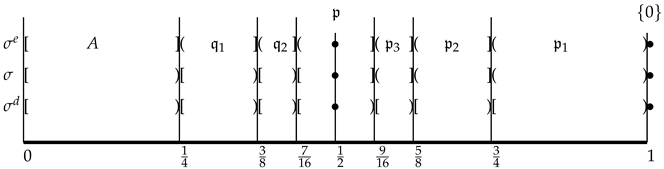
Using the filtration given by the prime ideal p n and q n , we can define a gradual ideal called σ, defined as follows, which is component prime:
σ ( δ ) = 0 , i f δ = 1 , p 1 , i f 1 2 1 + 1 2 < δ < 1 , p n , i f 1 2 1 + 1 2 n < δ 1 2 1 + 1 2 n + 1 , p , i f δ = 1 2 q n , i f 1 2 1 1 2 n δ < 1 2 1 1 2 n + 1 , A , i f δ < 1 2 1 1 2 n + 1 .
It is not widely strictly decreasing as σ e is
σ e ( δ ) = 0 , i f δ = 1 , p 1 , i f 1 2 1 + 1 2 < δ < 1 , p n , i f 1 2 1 + 1 2 n < δ 1 2 1 + 1 2 n + 1 , p , i f δ = 1 2 q n , i f 1 2 1 1 2 n + 1 < δ 1 2 1 1 2 n + 1 , A , i f δ 1 2 1 1 2 n + 1 ,
which defines a strongly fuzzy ideal. Neither it is strongly decreasing as σ d is
σ d ( δ ) = 0 , i f δ = 1 , p 1 , i f 1 2 1 + 1 2 δ < 1 , p n , i f 1 2 1 + 1 2 n δ < 1 2 1 + 1 2 n + 1 , p , i f δ = 1 2 q n , i f 1 2 1 1 2 n δ < 1 2 1 1 2 n + 1 , A , i f δ < 1 2 1 1 2 n + 1 ,
A graphical representation is the following:
Mathematics 13 03998 i006
Example 18.
Let V be a valuation ring with values that group the Hahn product of copies of Z indexes in Q with the reverse order. Hence the prime ideals of V constitute a totally ordered set: { p q q Q } { 0 , m } , where m is the maximal ideal of V, and p α p β whenever α β . We have a map from ( 0 , 1 ] to the lattice of all ideals of V defined as
σ ( α ) = { p β β > α , β ( 0 , 1 ] } , i f α 1 2 , { p β 1 β > α , β ( 0 , 1 ] } , i f α < 1 2 .
This is an example of a component prime gradual ideal of V. This is strictly decreasing but not always widely strictly decreasing as σ e σ .
It is very easy to create examples where we have proper inclusion σ ( μ 1 ) σ ( μ 2 ) σ ( μ 1 μ 2 ) . In the following, an example is presented.
Example 19.
Let K be a field, { X , Y } { X n n N } be a family of indeterminates over K, and a the ideal of the polynomial ring K [ X , Y , X 0 , ] generated by the set { X Y n X n n N } . The ring A is defined as the quotient ring of K [ X , Y , X 0 , ] a = K [ x , y , x 0 , ] , satisfying the relations x y n x n = 0 , for every n N .
In A we have a strictly descending chain of ideals:
A ( y , x 0 , x 1 , ) ( y 2 , x 0 , x 1 , , ) ( y n , x 0 , x 1 , ) ( x 0 , x 1 , ) .
Therefore, there is a fuzzy ideal μ, defined by
μ ( ( y n , x 0 , x 1 , ) ( y n + 1 , x 0 , x 1 , ) ) = 1 2 1 2 n , f o r   e v e r y   n N ,   a n d μ ( x 0 , x 1 , ) = 1 .
Note that μ ( x 0 ) = μ ( x ) = 1 , but ( μ μ ) ( x ) = Sup { μ ( y ) μ ( z ) y z = x } 1 2 . Therefore x σ ( μ ) ( 1 ) σ ( μ ) ( 1 ) = μ 1 μ 1 ( μ μ ) 1 = σ ( μ μ ) ( 1 ) .
It should be noted that we are considering the gradual ideal σ ( μ ) , defined σ ( μ ) ( α ) = μ ( α ) , for every α ( 0 , 1 ] . On the other hand, if we consider σ ˜ ( μ ) = σ ( μ ) d , we obtain a gradual ideal that satisfies σ ˜ ( μ μ ) = σ ˜ ( μ ) σ ˜ ( μ ) , as we showed that σ ˜ preserves the product. The same holds when we consider the sum.
In a similar manner, an example is presented in which the following is demonstrated: σ ( μ 1 ) + σ ( μ 2 ) σ ( μ 1 + μ 2 ) .
Example 20.
It is evident that for any fuzzy ideals μ 1 , μ 2 there always have exists an inclusion σ ( μ 1 ) + σ ( μ 2 ) σ ( μ 1 + μ 2 ) ; let us show that this inclusion may be proper. The fuzzy ideals, denoted by μ 1 and μ 2 , are hereby defined as follows:
μ 1 ( x ) = 0 , i f x Z 2 Z , 1 2 t 3 t , i f x 2 t Z 2 t + 1 Z , 1 , i f x = 0 . μ 2 ( x ) = 0 , i f x Z 3 Z , 1 2 1 3 t , i f x 3 t Z 3 t + 1 Z , 1 , i f x = 0 .
We claim ( μ 1 + μ 2 ) ( 2 ) = Sup { μ 1 ( y ) μ 2 ( 2 y ) y Z } = 1 2 . Indeed, we have two possibilities:
(1)
μ 1 ( y ) > 1 2 , then y 4 Z , i.e., there exists k Z such that y = 4 k . Hence, μ 2 ( 2 y ) = μ 2 ( 2 4 k ) = μ 2 ( 2 ( 1 2 k ) ) < 1 2 as 2 y 0 .
(2)
μ 1 ( y ) < 1 2 , in case y Z 4 Z .
In both cases we have μ 1 ( y ) μ 2 ( 2 y ) < 1 2 , so ( μ 1 + μ 2 ) ( 2 ) 1 2 . In addition, we shall show that we can choose y such that μ 1 ( y ) μ 2 ( 2 y ) is as close to 1 2 as we desire. For a sufficiently large natural number t N , define z = 2 × 3 t 3 t Z 3 t 1 Z . By the hypothesis, we have μ 2 ( z ) = 1 2 1 3 t < 1 2 . Since 2 = ( 2 z ) + z , we have ( μ 1 + μ 2 ) ( 2 ) μ 1 ( 2 z ) μ 2 ( z ) . The only case in which μ 1 ( 2 z ) μ 2 ( z ) occurs is μ 1 ( 2 z ) < 1 2 ; hence, 2 z Z 4 Z , that is 1 3 t 2 Z , which is a contradiction. Consequently, ( μ 1 + μ 2 ) ( 2 ) Sup { 1 2 1 3 t t N } = 1 2 , and 2 ( μ 1 + μ 2 ) 1 2 . On the other hand we have 2 4 Z + { 0 } ( μ 1 ) 1 2 + ( μ 2 ) 1 2 .
Let us consider the following examples of gradual prime ideals.
Example 21.
Let K be a field and A = K [ X α α ( 0 , 1 ) ] be the polynomial ring over the family of indeterminates { X α α ( 0 , 1 ) } . If for any α ( 0 , 1 ) we define
p α = ( X β β α ) ,
then π : I L ( A ) , defined
π ( α ) = A , i f α = 0 , p α , i f α ( 0 , 1 ) , ( 0 ) , i f α = 1 .
is a prime gradual ideal. In the same way, if for any α ( 0 , 1 ) we define
q α = ( X β β > α ) ,
then ρ : I L ( A ) , defined
ρ ( α ) = A , i f α = 0 , q α , i f α ( 0 , 1 ) , ( 0 ) , i f α = 1 .
is a prime gradual ideal that satisfies ρ π . Therefore, for any α ( 0 , 1 ) we have
π e ( α ) = { π ( γ ) γ < α } = { ( X β β γ ) γ < α } = π ( α ) ,
and
π d ( α ) = { π ( γ ) α < γ } = { ( X β β γ ) α < γ } = ( X β β > α ) = ρ ( α ) .

6. Conclusions

This study is based on the need to establish an association between a commutative ring and an abelian category as a means of investigating the behavior of fuzzy ideals. In this regard, the main focus has been on prime ideals, and it has been proven that their study is feasible through graded ideals, which exhibit more favorable arithmetic behavior.
After studying prime and strongly prime fuzzy ideals in Section 2, following the constructions in [2], we study gradual ideals. First, we consider prime gradual ideals, showing they are grouped in pairs and that both members of the pair define the same prime fuzzy ideal, each one by its own construction. In a second step, we consider a natural generalization of prime gradual ideals, in allowing several jumps, then we introduce the component prime gradual ideals: the analogous notion of the weakly prime fuzzy ideal. Finally, we show that the construction of pairs of gradual ideals is useful to define a fuzzy ideal starting from any gradual ideal. To standardize this construction, we have considered two operators (an interior, d, and a closure operator, e) such that σ d σ σ e and ( σ d , σ e ) is an F-pair, obtaining in this way an algebraic framework for working with fuzzy ideals. The paper concludes with a section devoted to showing examples of the theory; numerous examples throughout the paper also highlight the results contained in the text.

Author Contributions

Conceptualization, P.J.; Methodology, P.J.; Validation, P.J. and S.M.; Formal analysis, S.M.; Investigation, P.J. and S.M.; Resources, P.J.; Writing—original draft, P.J.; Writing—review & editing, S.M.; Visualization, S.M.; Supervision, P.J.; Project administration, S.M.; Funding acquisition, P.J. All authors have read and agreed to the published version of the manuscript.

Funding

This work was partially supported by the Research Group “FQM-266-Anillos y Módulos” and the framework of IMAG-María de Maeztu grant CEX2020-001105-M funded by MCIN/AEI/10.13039/50110001103.

Data Availability Statement

No new data were created or analyzed in this study.

Acknowledgments

The authors would like to thank the anonymous referees for their helpful comments, which improved the quality of the manuscript.

Conflicts of Interest

The authors declare that they have no conflicts of interest.

References

  1. Zadeh, L.A. Fuzzy sets. Inform. Control 1965, 8, 338–353. [Google Scholar] [CrossRef]
  2. Garcia, J.M.; Jara, P. Gradual and fuzzy modules: Functor categories. Mathematics 2022, 10, 4272. [Google Scholar] [CrossRef]
  3. Lopez-Permouth, S.; Malik, D. On categories of fuzzy modules. Inf. Sci. 1990, 52, 211–220. [Google Scholar] [CrossRef]
  4. Garcia, J.M.; Jara, P. Gradual sets: An approach to fuzzy sets. Adv. Fuzzy Syst. 2023, 6163672. [Google Scholar] [CrossRef]
  5. Dubois, D.; Prade, H. Gradual elements in a fuzzy set. Soft Comput. 2008, 12, 165–175. [Google Scholar] [CrossRef]
  6. Fortin, J.; Dubois, D.; Fargier, H. Gradual numbers and their application to fuzzy interval analysis. IEEE Trans. Fuzzy Syst. 2008, 16, 388–402. [Google Scholar] [CrossRef]
  7. Dixit, N.; Kumar, R.; Ajmal, N. Fuzzy ideals and fuzzy prime ideal of a ring. Fuzzy Sets Syst. 1991, 44, 127–138. [Google Scholar] [CrossRef]
  8. Mordeson, J.; Malik, D. Fuzzy Commutative Algebra; World Scientific: Singapore, 1998. [Google Scholar]
  9. Kumbhojkar, H.V.; Bapat, M.S. Not–so–fuzzy fuzzy ideals. Fuzzy Sets Syst. 1990, 37, 237–243. [Google Scholar] [CrossRef]
  10. Kumbhojkar, H.V.; Bapat, M.S. On prime and primary fuzzy ideals and their radicals. Fuzzy Sets Syst. 1993, 53, 203–216. [Google Scholar] [CrossRef]
  11. Kumar, R. Fuzzy cosets and some fuzzy radicals. Fuzzy Sets Syst. 1992, 46, 261–265. [Google Scholar] [CrossRef]
  12. Mukherjee, T.K.; Sen, M.K. Prime fuzzy ideals in rings. Fuzzy Sets Syst. 1989, 32, 337–341. [Google Scholar] [CrossRef]
  13. Jahan, I. The lattice of L—Ideals of a ring is modular. Fuzzy Sets Syst. 2012, 199, 121–129. [Google Scholar] [CrossRef]
  14. Jara, P. Honest submodules. Czech. Math. J. 2007, 57, 225–241. [Google Scholar] [CrossRef]
Disclaimer/Publisher’s Note: The statements, opinions and data contained in all publications are solely those of the individual author(s) and contributor(s) and not of MDPI and/or the editor(s). MDPI and/or the editor(s) disclaim responsibility for any injury to people or property resulting from any ideas, methods, instructions or products referred to in the content.