
Article

Nonlinear and Spatial Effects of Housing Prices on Urban–Rural Income Inequality: Evidence from Dynamic Spatial Threshold Models in Mainland China

1
Faculty of Economics, Chiang Mai University, Chiang Mai 50200, Thailand
2
Center of Excellence in Econometrics, Chiang Mai University, Chiang Mai 50200, Thailand
*
Author to whom correspondence should be addressed.
Mathematics 2025, 13(24), 3960; https://doi.org/10.3390/math13243960
Submission received: 30 October 2025 / Revised: 20 November 2025 / Accepted: 8 December 2025 / Published: 12 December 2025

Abstract

This study investigates how housing prices influence urban–rural income inequality (URG) in mainland China by explicitly incorporating spatial interdependence and nonlinear adjustment mechanisms, features often neglected in previous research. Using a balanced panel of 31 provinces from 2005 to 2023, we develop a dynamic spatial panel threshold model that jointly accounts for temporal persistence, spatial spillovers, and regime-dependent estimation. This framework enables a full decomposition of housing price effects into direct, indirect (spillover), and total impacts across distinct market regimes. The results reveal three major insights. First, URG in mainland China displays strong temporal persistence, suggesting that income disparities evolve gradually over time. Second, rising housing prices significantly widen the urban–rural income gap, both within provinces and through interprovincial transmission, underscoring the amplifying role of spatial spillovers. Third, threshold estimation identifies a critical housing price level of ln(HP) = 8.4843 (approximately 4838.21 RMB/m2), revealing that the inequality-enhancing effect of housing prices is stronger in low-price regions but diminishes as markets mature and affordability constraints intensify. These findings provide new empirical evidence that the housing market functions as a nonlinear and asymmetric driver of regional inequality in mainland China, with implications for housing policy and inclusive growth.

1. Introduction

Urban–rural income inequality (URG) has remained one of the most persistent challenges in China’s development. Despite more than four decades of rapid economic growth, income levels in rural areas continue to lag significantly behind those in cities. This enduring divide reflects not only differences in productivity and industrial structure but also deep-rooted institutional and spatial barriers that restrict equal access to opportunities and public resources. Previous studies have attributed the persistence of URG to structural and policy factors such as dual labor markets, migration frictions, and urban-biased fiscal and welfare systems [1,2,3,4,5]. More recent contributions further highlight the roles of industrial structure, external trade, and multidimensional resource gaps in shaping the urban–rural divide [6,7,8]. However, despite extensive research on these institutional mechanisms, the role of housing markets, particularly housing prices, as a transmission channel of inequality has received limited empirical attention. Understanding this relationship is critical because housing has become the largest household asset, the main source of local fiscal revenue, and a key determinant of intergenerational wealth in China’s economy.
China’s housing market has undergone a profound transformation since the late 1990s, when the transition from welfare-based allocation to market-oriented housing reform fundamentally changed property ownership and urban development patterns. Reforms such as the introduction of land-use rights, the privatization of urban housing, and the gradual relaxation of the hukou system reshaped incentives for local governments, developers, and households [9,10,11,12]. These institutional shifts unleashed a sustained housing boom that stimulated investment, expanded fiscal revenues through land sales, and generated widespread wealth effects. However, these benefits were spatially uneven. Rapid price appreciation in coastal and metropolitan regions enriched property owners and local governments, while rural and inland areas faced rising affordability constraints, limited credit access, and slower income convergence [13,14,15].
Moreover, migration and urbanization intensified the links between housing markets and regional inequality. Rising housing demand in urban centers drew labor and capital away from less developed provinces, reinforcing regional divergence [16,17]. At the same time, high housing costs in major cities restricted rural migrants’ ability to settle permanently and accumulate wealth, limiting their upward mobility [18,19]. This dual process, where housing markets both attract growth and constrain inclusion, has deepened spatial and income disparities across regions.
As illustrated in the housing-price panels of Figure 1, prices surged nationwide between 2005 and 2023, with the coastal corridor intensifying most sharply. The resulting regional divergence created both spatial spillovers and distributional tensions: coastal provinces benefited from capital inflows and property wealth accumulation, while inland areas experienced affordability pressures and slower convergence in household welfare. These intertwined processes raise a fundamental question: how do changes in housing prices shape the evolution of urban–rural income inequality across mainland China’s regions, and through what spatial and economic mechanisms?
Economic theory provides several channels through which housing prices can influence income inequality. Rising property values increase the wealth of homeowners while excluding renters and new entrants from asset accumulation, thereby amplifying inequality through capital gains and wealth concentration [19,20]. High housing costs also reduce disposable income and constrain human capital investment among lower-income households, limiting their long-term earning potential [18]. Moreover, housing serves as collateral in credit markets, linking price appreciation to entrepreneurship, education, and intergenerational mobility [21]. Conversely, rising housing prices may also signal stronger labor demand and economic vitality: higher property values often reflect urban productivity growth, agglomeration effects, and improved amenities that attract migrants and potentially narrow regional income gaps [22]. Empirical studies on China have confirmed that house price and URG are closely connected [23], and micro-level evidence shows that household asset portfolios, including housing wealth, are central to explaining income inequality within urban China [24]. However, the direction, magnitude, and spatial transmission mechanisms of the housing price–URG nexus across provinces remain far from settled.
Two main empirical challenges explain this ambiguity. First, housing markets are inherently spatial: price shocks in one province often diffuse to neighboring regions through migration, commuting, credit flows, and investment linkages [10,25]. Conventional econometric models that ignore such spatial spillovers risk biased and incomplete effect of housing prices on inequality. Second, the relationship between housing prices and inequality is likely to be nonlinear and regime dependent. Housing affordability constraints, financial depth, and institutional heterogeneity can cause the marginal effect of housing prices on URG to vary across stages of market development. Prior research has documented nonlinear housing–macro linkages [26] and threshold effects in household consumption and financial inclusion [27,28], but very few studies have integrated these nonlinearities within a spatial and dynamic econometric framework. Consequently, our understanding of how housing prices shapes inequality—across both space and regimes remains limited.
To bridge these gaps, this study develops a dynamic spatial panel threshold framework that integrates three methodological dimensions rarely combined in previous research. First, it incorporates dynamic adjustment to capture the persistence of income inequality over time, recognizing that disparities evolve gradually rather than instantaneously. Second, it embeds spatial econometric techniques to explicitly account for interprovincial spillovers and feedback effects, ensuring that inequality in one province is modeled as potentially influenced by housing-price dynamics in neighboring regions. Third, it employs threshold estimation to uncover regime-dependent nonlinearities in the housing price–inequality nexus, allowing the marginal impact of housing prices on income disparities to vary across distinct market conditions. Our approach advances existing studies that have typically examined these features in isolation, either treating inequality as static, ignoring spatial dependence, or assuming linear responses. In doing so, we complement recent structural, trade, and multidimensional perspectives on China’s urban–rural inequality [6,7,8] and the household-asset evidence of [24] by placing housing prices at the center of a dynamic spatial threshold analysis of the urban–rural income gap. This integrated approach enables the decomposition of direct, indirect, and total effects of housing prices on urban–rural inequality across different market regimes, providing a more comprehensive understanding of how housing markets shape regional disparities in mainland China.
The remainder of the paper proceeds as follows. Section 2 reviews the related literature and presents the theoretical framework linking housing, urbanization, and inequality. Section 3 describes the data, variables, and empirical specifications. Section 4 reports the estimation results, including threshold effects, spatial decompositions, and heterogeneity analyses. Section 5 concludes with policy implications and directions for future research.

2. Literature

2.1. Theoretical Review

Classical urban-economic theory explains spatial disparities through differences in wages, land rents, and amenities. The foundational models of [29,30] showed how equilibrium wages and housing costs jointly determine the spatial allocation of labor and capital. Later, ref. [22] emphasized agglomeration economies and the self-reinforcing concentration of wealth in high-productivity urban areas. In China, the coexistence of rapid urbanization with institutional frictions, particularly the hukou system and segmented land markets, has intensified this process [1,3]. These frameworks collectively suggest that the interaction between housing markets and spatial labor allocation plays a central role in shaping URG.
Within this context, housing prices influence income inequality through several interrelated mechanisms. The asset-premium channel implies that rising house prices primarily benefits property owners, while renters and new entrants face deteriorating relative welfare [20,23]. A second pathway is spatial segregation, whereby high house prices restrict access to neighborhoods with superior public services, employment opportunities, and amenities, thereby perpetuating stratification [12,31]. The resource-allocation mechanism links housing prices booms to credit misallocation, as financial resources shift toward real estate at the expense of productive sectors [32,33]. In addition, fiscal and policy channels shape the extent to which housing wealth translates into inequality: property taxation, subsidies, and fiscal transfers can either amplify or offset house prices-driven disparities [34,35]. Hence, these mechanisms highlight that house prices not only affect private wealth accumulation but also the spatial distribution of opportunity and welfare.
The effect of house prices on URG does not occur in isolation; it interacts with a range of structural covariates that influence both inequality and housing dynamics. Economic growth and financial development alter income dispersion depending on sectoral composition and credit access [2,32]. Industrialization and urbanization reallocate labor across sectors, generating heterogeneous wage effects [36]. Trade openness shapes regional inequality through export-oriented urban hubs and rural labor migration [13,37]. Demographic aging affects savings behavior and intergenerational transfers, altering both housing demand and inequality dynamics [38,39]. Finally, environmental and green-investment variables modify local amenities and land values, generating uneven spatial benefits [4,40]. Recent empirical work for China therefore confirms that structural upgrading, external integration, and multidimensional resource access can reinforce urban–rural disparities, providing empirical support for the mechanisms emphasized in this framework [6,7,8]. These factors jointly determine the strength and direction of the housing–inequality linkage through local as well as interprovincial spillovers.
A further theoretical foundation comes from recognizing threshold effects in the housing–inequality relationship. From this perspective, housing markets operate under nonlinear mechanisms in which the impact of price changes depends on affordability and institutional constraints. When housing prices rise moderately, they can stimulate economic activity through higher consumption, improved credit access, and greater labor mobility, thereby supporting inclusive growth [26,28]. However, once prices exceed certain affordability thresholds, these positive effects reverse credit constraints tighten, new entrants are priced out of urban markets, and wealth becomes increasingly concentrated among property owners, exacerbating inequality.
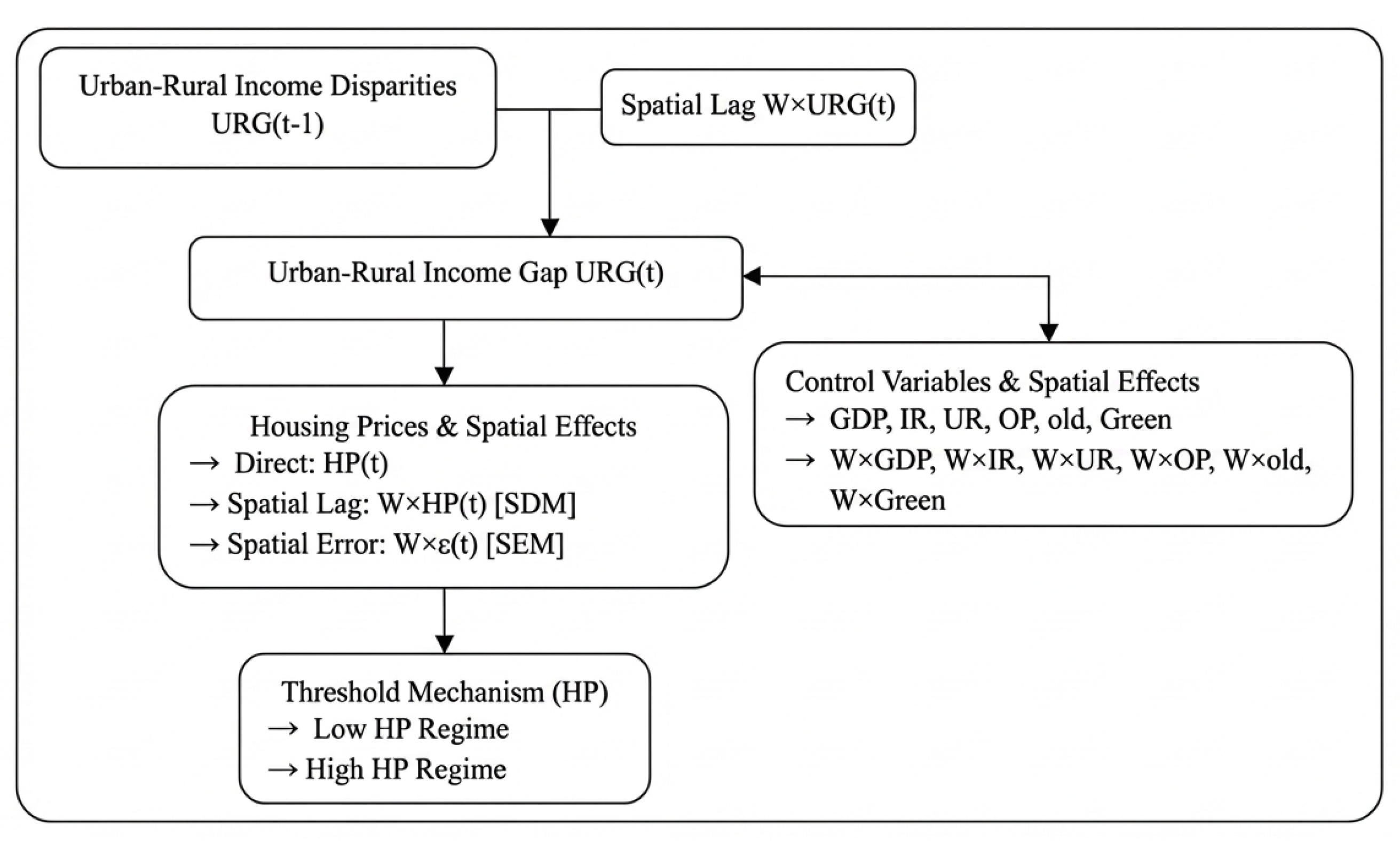
These strands of theory motivate an empirical framework that combines persistence, spatial spillovers, and regime dependence. As depicted in Figure 2, housing prices affect URG through both direct local effects and indirect spatial spillovers, while macroeconomic, financial, demographic, and environmental variables act through parallel or mediating channels. In the diagram, HP denotes the conceptual level of housing prices; in the empirical specification in Section 3, this variable enters the model in logarithmic form (lnHP) to stabilize variance and facilitate interpretation. The diagram summarises these linkages as a set of paths from HP to URG and from the control variables to both HP and URG. Solid arrows represent within-province effects, whereas dashed arrows capture cross-provincial spillovers operating through the spatial weight matrix. The threshold component indicates that the strength of these mechanisms may differ across low- and high-price regimes, providing the conceptual basis for the dynamic spatial panel threshold model estimated in Section 3.

2.2. Linkages Between Housing and Urban and Rural Income Inequality

Empirical evidence on the relationship between housing prices and URG has long been mixed across countries, time periods, and methodological frameworks. Early non-spatial and time-series studies frequently reported negative or ambiguous associations, often reflecting short-run adjustments in disposable income rather than long-term wealth effects. For instance, ref. [19] showed that higher housing expenditures reduced disposable income among non-owners, temporarily compressing measured income gaps even as underlying inequality deepened. Ref. [18] found that rising housing costs disproportionately burdened low-income households, narrowing short-term income differentials but eroding welfare over time. Ref. [41] observed that the direction of house price’s influence depended on the stage of urban development, whereas ref. [42] identified nonlinearities in which moderate price growth alleviated inequality through labor and construction effects, but excessive inflation reinforced exclusion and wealth polarization.
By contrast, a substantial body of research documented positive and inequality-enhancing effects of housing prices. Ref. [43] found that asset price appreciation, including housing, widened income disparities unless mitigated by redistributive policies. Ref. [44] emphasized the wealth channel, demonstrating that housing prices appreciation magnified inequality through accelerated asset accumulation among property owners. Ref. [21] showed that rising collateral values stimulated entrepreneurship and self-employment, but primarily among wealthier households, thereby intensifying inequality. Ref. [25] also provided evidence that house price shocks during the U.S. housing boom generated spatial spillovers that disproportionately rewarded homeowners while limiting gains for renters and rural populations.
A growing number of spatially oriented studies examine interregional dependencies in China’s housing markets. Ref. [45] showed that rising housing prices increase inequality both locally and through cross-provincial diffusion, while ref. [17] documented positive spatial spillovers from housing price growth to the urban–rural gap (URG). Ref. [16] identified migration and capital flows as key transmission channels, and ref. [46] highlighted labor-market segmentation in metropolitan areas as a reinforcing mechanism. Ref. [47] further showed that housing-related urban expansion can narrow the urban–rural income gap through employment and income spillovers, particularly in less urbanized regions, indicating that spatial development processes do not always operate in an inequality-enhancing direction. However, ref. [24] showed that household asset portfolios intensify wealth inequality within urban China, providing complementary evidence on asset-driven channels without addressing interprovincial dynamics.
Despite these advances, existing studies rely primarily on linear spatial autoregressive frameworks, which implicitly assume that the impact of housing prices on inequality is homogeneous across regions and price levels. None of these contributions incorporate threshold nonlinearity or allow the effect of housing prices to vary across distinct housing-market regimes, nor do they provide a dynamic spatial decomposition of direct and spillover effects. Our study extends this literature by developing a dynamic spatial panel threshold model that simultaneously captures (i) nonlinear regime switching, (ii) endogenous spatial interactions, and (iii) spillover decomposition. This enables us to uncover heterogeneous inequality effects across low- and high-price regimes—an aspect unexplored in prior spatial studies.

2.3. Modelling Issues

Spatial econometrics provided the methodological foundation for analyzing the linkages between housing prices and URG. The spatial autoregressive (SAR) model captured endogenous interactions among outcomes, the spatial error model (SEM) accounted for spatially correlated disturbances, and the spatial Durbin model (SDM) incorporated spatially lagged covariates, allowing for the decomposition of direct, indirect, and total effects [48]. In dynamic settings, the inclusion of lagged URG terms enabled persistence to be modeled explicitly, while the integration of SAR, SEM, or SDM structures made it possible to disentangle temporal dependence from spatial spillovers.
Applications across related domains demonstrated the broad relevance of these approaches. Ref. [49] analyzed spatial interactions between growth and renewable energy; Ref. [50] examined investment and carbon-emission linkages; and ref. [51] investigated R&D and renewable-energy determinants, all revealing significant spatial dependence and substantial spillover effects. Within housing and inequality research, ref. [45] documented spatial inequality spillovers in China, ref. [17] identified cross-regional propagation of housing prices shocks, and ref. [16] highlighted migration-driven spatial heterogeneity. Ref. [46] illustrated how metropolitan housing pressures amplified inequality through labor-market segmentation, while ref. [52] revealed environmental interactions with housing markets. Ref. [53] showed that spatial wage inequality reflected the joint functioning of labor and housing markets, and ref. [27] demonstrated threshold effects in housing finance and shared prosperity, providing methodological insights for regime-switching spatial designs.
Despite these advances, several critical gaps persist. First, most existing studies rely on non-spatial or static specifications, which risk conflating local impacts with omitted spatial spillovers and therefore misrepresent the true distributional effects of housing prices. Second, even in spatial studies, nonlinear regime behavior has rarely been combined with spatial effect decomposition. Existing frameworks, such as [48] linear SAR/SDM decomposition and the factor-robust threshold estimator of [54], do not allow spatial multipliers or long-run effects to vary across regimes, nor do they permit regime-specific direct, indirect, and total effects. As a result, the role of affordability thresholds, institutional turning points, and structural market transitions remains largely unexplored in the literature. Addressing this gap motivates our development of a dynamic spatial threshold framework with regime-dependent spatial multipliers and long-run effects, which provides a more flexible and behaviorally grounded approach to understanding how the inequality consequences of housing-price dynamics evolve across different market regimes.

3. Research Methodology

This section outlines the methodology employed to examine the impact of urban housing prices on urban–rural income disparities in mainland China, using a balanced panel for 31 provinces over 2005–2023. The dependent variable URG denotes the urban–rural income gap, measured by the Theil index. By contrast, UR refers to the urbanization rate, defined as the share of the urban population in total provincial population. We maintain this notation consistently throughout the empirical analysis.

3.1. Data Collection and Variable Selection

Data are sourced from the National Bureau of Statistics of China. Focusing on this period captures China’s rapid real estate development and significant policy changes while ensuring data quality and consistency. Urban and rural incomes are converted to real values using province-specific Consumer Price Index with 2005 as the base year.
We employ the Theil index to measure urban–rural income disparities. This entropy-based measure accounts for both population distribution and income allocation between urban and rural areas:
U R G = U P R U I ( U P R U I + R P R R I ) l n U P R U I ( U P R U I + R P R R I ) U P ( R P + U P ) + R P R R I ( U P R U I + R P R R I ) l n R P R R I ( U P R U I + R P R R I ) R P ( R P + U P ) ,
where RUI and RRI represent real per capita incomes in urban and rural areas, respectively, while UP and RP denote urban and rural resident populations.
Table 1 summarizes the construction, units, and data sources for all variables used in the empirical analysis. The dependent variable URG is measured by the Theil index based on real urban and rural per capita incomes and populations, capturing both income and population shares. Housing prices (HP) are measured as average nominal RMB prices per square meter at the provincial level and enter the model in logarithmic form (lnHP). The inclusion of year fixed effects and macroeconomic controls absorbs much of the common time trend and inflation dynamics, so that the estimated threshold reflects relative housing conditions rather than a pure nominal drift. The control variables proxy key structural channels: GDP growth reflects macroeconomic performance, trade openness (OP) captures external integration, the industrialization rate (IR) measures structural upgrading, and the urbanization rate (UR) represents demographic and spatial transformation. Green investment and the old-age dependency ratio (OLD) account for environmental and demographic conditions that may jointly shape housing markets and the urban–rural income gap. To ensure consistency and improve statistical properties, the urban–rural income gap is calculated using the Theil index, housing prices are converted to natural logarithms, and all other variables are expressed as percentages.
Under the nonlinear spatial analysis, we expect housing prices to increase URG in both regimes because higher prices raise urban entry barriers and amplify wealth effects; however, the marginal effect should be smaller in the high-price regime where affordability and saturation effects moderate additional inequality. The spatial autoregressive coefficient ρ is expected to be positive because income disparities tend to diffuse across provinces through labor mobility, investment flows, and regional market linkages. Spatially lagged housing prices (W*lnHP) should also have a positive effect, reflecting spillovers in housing demand and migration that propagate inequality. For the controls, urbanization is expected to widen URG by attracting skilled labor disproportionately; aging is expected to raise URG due to higher rural dependency burdens; interest rates may widen URG by tightening credit for rural households; and green investment is expected to reduce URG by promoting inclusive and sustainable development.
Table 2 presents descriptive statistics for each variable. It shows that the URG is relatively stable and less dispersed across provinces. Its average level is modest, with only mild right-skewness, indicating that most regions cluster near lower inequality levels and extreme disparities are limited. This pattern suggests persistence inequality without major volatility. In contrast, housing prices (HP) display substantial heterogeneity. The distribution is strongly right skewed, with a long tail caused by a few provinces at exceptionally high levels. The wide dispersion and excess kurtosis confirm that housing markets are exposed to sharp regional differences, making them more volatile than URG. These features are consistent with recent evidence that Chinese housing markets exhibit much stronger regional volatility than income inequality measures, as migration and investment flows concentrate housing booms in a subset of coastal and metropolitan provinces [14,45].
The control variables follow expected dynamics but with more moderate variation. Urbanization and aging increase gradually, reflecting demographic shifts. Economic openness and green development show greater dispersion, pointing to uneven regional progress. Growth rates remain balanced, while industrialization rate fluctuate within a narrow band. This pattern echoes findings that regional differences in openness, industrial structure, and environmental investment contribute to persistent spatial heterogeneity in development outcomes across China [4,36]. These patterns provide useful context, but the dominant feature of the data is the contrast between the stability of URG and the volatility of HP.

3.2. Methodology

Our empirical strategy follows a progressive design to investigate the nonlinear spatial relationship between housing prices and the urban–rural income gap. We begin by testing spatial dependence to determine the need for spatial econometric modeling. Once dependence is confirmed, we identify the most suitable specification through established model selection procedures. Threshold estimation is then introduced to capture regime heterogeneity across different levels of housing prices. This sequential framework allows us to address spatial spillovers, unobserved heterogeneity, and potential endogeneity in a systematic manner.
Several regressors may also raise endogeneity concerns. The urbanization rate (UR) can be jointly determined with URG, as large income gaps may slow further urbanization in disadvantaged regions. Industrialization (IR) is likewise intertwined with income distribution through sectoral employment and wage premium. Our dynamic specification, rich set of controls, and factor-robust two-step IV estimator mitigate these concerns to some extent, but we acknowledge that residual endogeneity cannot be fully ruled out. We therefore interpret the coefficients on UR and IR as capturing conditional associations that are informative but not necessarily fully causal.

3.2.1. Spatial Dependence Testing

We first assess spatial dependence in the urban–rural income gap using the Global Moran’s I statistic:
I t = n S 0 i = 1 n j = 1 n w i j ( x i t     x t ¯ ) ( x j t     x t ¯ ) i = 1 n ( x i t     x t ¯ ) 2 ,
where x i t is the variable of interest, w i j is an element of the spatial weight matrix, n is the number of provinces, and S 0 = i = 1 n j = 1 n w i j . Positive values indicate clustering of similar levels, negative values indicate spatial dissimilarity, and values near zero suggest spatial randomness. We complement Moran’s I with Geary’s C,
C t = ( n 1 ) 2 S 0 i = 1 n j = 1 n w i j ( x i t   x j t ) 2 i = 1 n ( x i t x t ¯ ) 2 ,
for which C t < 1 signals positive spatial autocorrelation and C t > 1 signals negative spatial autocorrelation, and C t = 1 corresponds to spatial randomness.
To guide model specification, we also conduct standard and robust Lagrange Multiplier (LM) tests ([55]) to distinguish between spatial lag and spatial error dependence, ensuring that the econometric specification is correctly identified.

3.2.2. Spatial Weight Matrix Construction

The spatial weight matrix defines the connectivity across provinces and is central to identifying spillover effects. We first construct a K-nearest neighbors’ matrix (W1) based on great-circle distances between provincial centroids. Each province is connected to its three nearest neighbors (k = 3), with weights defined as the inverse of interprovincial distances:
w i j = 1 d i j ,     i f   p r o v i n c e   j   i s   a m o n g   3   n e a r e s t   n e i g h b o r s   o f   i 0 ,     o t h e r w i s e ,
where d i j denotes the great-circle distance between provinces i and j. The matrix is row-standardized so that j 1 n w i j = 1 . This specification ensures equal connectivity across provinces, accommodates island provinces such as Hainan, and reflects realistic spatial interactions beyond administrative contiguity.
The choice of k = 3 balances model stability and realistic spatial representation. A smaller neighborhood size avoids oversmoothing and preserves localized economic interactions, which is particularly important given mainland China’s pronounced regional heterogeneity. At the same time, connecting each province to at least three neighbors ensures a minimum degree of spatial connectivity, including for island regions such as Hainan, thereby preventing isolated nodes in the network. This specification reflects moderate spatial dependence while maintaining parsimony, consistent with recommendations in [48,56], who note that three to five nearest neighbors typically provide stable and interpretable spillover estimates in provincial-level spatial econometric models.
For robustness, we also construct an alternative distance-decay contiguity matrix (W2). In this case, provinces are considered neighbors only if they share a common border, with weights defined as the inverse of the distance between their capitals:
w i j = 1 d i j ,     i f   p r o v i n c e s   i   a n d   j   s h a r e   a   b o r d e r 0 ,     o t h e r w i s e ,
where d i j again denotes the great-circle distance between capitals, measured in kilometers. This design introduces a distance-decay effect while maintaining contiguity constraints, implying that even among adjacent provinces, closer administrative centers exert stronger spatial linkages.

3.2.3. Spatial Panel Threshold Model Specification

We estimate three alternative dynamic spatial threshold specifications based on diagnostic outcomes. The dependent variable is U R G , while l n H P serves both as the core explanatory variable and as the threshold variable. The threshold parameter γ partitions provinces into low- and high-price regimes, thereby allowing heterogeneous effects of housing prices across market conditions. Province fixed effects μ i capture unobserved heterogeneity, and time fixed effects λ t control for common shocks.
When spatial dependence arises in both the dependent and explanatory variables, the Dynamic spatial threshold Durbin model (DSDTM) is specified as:
U R G i , t = α 0 + α 1 U R G i , t 1 + β 1 l n H P i , t I l n H P i , t γ + β 2 l n H P i , t I γ < l n H P i , t + ρ W U R G i , t + θ 1 W l n H P i , t I l n H P i , t γ + θ 2 W l n H P i , t I γ < l n H P i , t + β 3 G r o w t h i , t + β 4 l n O P i , t + β 5 l n I R i , t + β 6 l n O L D i , t + β 7 l n G r e e n i , t + β 8 l n U R i , t + θ 3 W G r o w t h i , t + θ 4 W l n O P i , t + θ 5 W l n I R i , t + θ 6 W l n O L D i , t + θ 7 W l n G r e e n i , t + θ 8 W l n U R i , t + μ i + λ t + ε i , t
where I ( ) denotes an indicator function that takes the value 1 when the stated condition is satisfied (e.g., l n   H P i t γ ) and 0 otherwise, thereby dividing observations into low- and high-price regimes. This function divides all observations into two mutually exclusive regimes, a low-price regime ( l n   H P i t γ ) and a high-price regime ( l n   H P i t > γ ), allowing the effects of housing prices and their spatial spillovers to differ between these market conditions. Accordingly, this specification captures regime-dependent local effects of housing prices, spatial spillovers of both prices and control variables, and spatial feedback in the dependent variable through ρ W U R G i t .
When spatial dependence is confined to the dependent variable, the Dynamic spatial threshold autoregressive model (DSTARM) is expressed as
U R G i , t = α 0 + α 1 U R G i , t 1 + β 1 l n H P i , t I l n H P i , t γ + β 2 l n H P i , t I γ < l n H P i , t + ρ W U R G i , t + β 3 G r o w t h i , t + β 4 l n O P i , t + β 5 l n I R i , t + β 6 l n O L D i , t + β 7 l n G r e e n i , t + β 8 l n U R i , t + μ i + λ t + ε i , t .
This model restricts spatial dependence to the dependent variable and excludes spatial lags of regressors.
Finally, when spatial correlation operates exclusively through the error process, the Dynamic spatial threshold error model (DSTEM) is specified as:
U R G i , t = α 0 + α 1 U R G i , t 1 + β 1 l n H P i , t I l n H P i , t γ + β 2 l n H P i , t I γ < l n H P i , t + β 3 G r o w t h i , t + β 4 l n O P i , t + β 5 l n I R i , t + β 6 l n O L D i , t + β 7 l n G r e e n i , t + β 8 l n U R i , t + μ i + λ t + u i , t
where u i , t = ν W u i , t + ε i , t denotes the spatially correlated error structure.
The DSDTM is taken as the baseline specification because it nests the DSTARM and DSTEM as special cases. This nesting property allows us to decompose the effects of housing prices into direct and spillover components while also accommodating both endogenous interactions and correlated errors. The DSAR and DSEM estimates are therefore interpreted as restricted versions of the more general DSDM and serve as robustness checks rather than competing benchmarks.

3.2.4. Direct and Indirect Effects Decomposition

Following the framework of [48], the spatial effects of housing prices are decomposed into direct (local), indirect (spillover), and total components to clarify the long-run feedback mechanisms embedded in the dynamic spatial threshold model. This section derives the long-run effects of housing prices under different spatial specifications, DSTDM, DSTARM, and DSTEM, and explains how spatial dependence alters equilibrium responses to housing-price changes. For regime k { L , H } , the long-run equilibrium effect of housing prices on the urban–rural income gap is expressed as:
E [ URG ] ln HP k = ( I n α 1 I n ) ρ W 1 ( β k I n + θ k W )
where I n is the n   ×   n identity matrix, W is the row-normalized spatial weight matrix, α 1 represents the temporal autoregressive coefficient, and ρ measures spatial dependence. The coefficients β k and θ k capture the local and spatial lag effects of housing prices in regime k , respectively. The matrix term [ ( I n α 1 I n ) ρ W ] 1 summarizes both spatial diffusion and dynamic propagation, thus characterizing the steady-state responses to changes in housing prices.
The average direct effect (ADE) measures the within-province or internal response of the urban–rural income gap to a 1% change in local housing prices, after accounting for feedback transmitted through the spatial network. It is computed as the mean of the diagonal elements of the long-run impact matrix:
D i r e c t ¯ k = n 1 tr ( I n α 1 I n ) ρ W 1 ( β k I n + θ k W )
where t r ( ) denotes the trace operator.
The average total effect (ATE) represents the overall long-run influence of housing prices across all provinces, incorporating both local effects and cross-provincial feedback:
T o t a l ¯ k = n 1 1 n T ( I n α 1 I n ) ρ W 1 ( β k I n + θ k W ) 1 n
where 1 n is an n -dimensional unit vector.
The average indirect effect (AIE), which captures the spatial spillover transmitted from one province to its neighbors, is obtained as the difference between the total and direct effects:
I n d i r e c t ¯ k = T o t a l ¯ k D i r e c t ¯ k
For DSTARM, it restricts spatial dependence to the dependent variable, leading the long-run direct and total effects to be computed as follows:
D i r e c t ¯ k = E [ URG ] ln HP k = ( I n α 1 I n ) ρ W 1 β k I n
T o t a l ¯ = n 1 1 n T ( I n α 1 I n ) ρ W 1 1 n β
By contrast, the DSTEM introduces spatial correlation solely through the error term, such that the expected value E [ y t ] = X t β is unaffected by spatial weighting. Hence, direct and indirect effects are not decomposed in the DSTEM, spatial dependence manifests only in the disturbance process rather than in the mean structure.

3.2.5. Estimation via Two-Step IV (2SIV)

To address potential endogeneity, dynamic bias, and latent cross-sectional dependence, this study estimates the dynamic spatial threshold model using the two-step instrumental variables estimator proposed by [54] and extended by [57]. After determining the optimal threshold parameter γ ^ through the grid-search procedure described earlier, the regime-specific coefficients of the dynamic spatial threshold model are estimated using the 2SIV framework. Specifically, for each identified regime, lagged levels of the dependent variable and its spatial lags are employed as primary instruments for the endogenous terms U R G i , t 1 and ( W U R G t ) i . Specifically, second-order and higher lags are used as valid instruments under the moment conditions, E [ u i t URG i , t s ] = 0 , s 2 , which assumes the absence of serial correlation in idiosyncratic errors.
  • Step 1 (Defactorization and instrument construction).
    We first remove latent common shocks from the instrument set using principal components. Let F x denote the matrix of latent common factors extracted from the regressors X , and define the projection operator M F x = I T F x ( F x F x ) 1 F x . The defactored regressors are then obtained as X ~ i = M F x X i and W X ~ i = M F x ( W X i ) . Based on these, the instrument matrix for each cross-sectional unit is constructed as
    Z i = L 2 U R G ˜ i W L U R G ˜ i L X ˜ i W L X ˜ i X ˜ i W X ˜ i
    where L is the lag operator, and U R G ~ i and X ~ i denote the defactored series. This structure ensures both instrument relevance, by capturing temporal and spatial persistence—and instrument validity, by eliminating cross-sectional dependence through defactorization. These instruments are then employed in the 2SIV estimation to obtain consistent and asymptotically efficient estimates of the regime-specific parameters in the dynamic spatial threshold framework.
  • Step 2 (IV on the defactored system).
    In the first stage, a preliminary instrumental variables (IV) estimation is conducted using the defactored model, in which latent common factors have been removed from the regressors and instruments. In the second stage, the residuals from this preliminary estimation are used to extract additional latent factors embedded in the disturbance term. The model is then re-estimated after purging these factors, thereby addressing both observed and unobserved sources of cross-sectional dependence.
    Θ ˜ = ( A ˜ B ˜ 1 A ˜ ) 1 A ˜ B ˜ 1 y ˜ ,
    where A ~ = 1 N T i Z i M F y C i , B ~ = 1 N T i Z i Z i , M F y is the projection operator removing common factors from the residual space, and C i is the regressor matrix. The robust variance–covariance matrix of the estimator is computed as
    Var ^ ( θ ˜ ) = ( A ˜ B ˜ 1 A ˜ ) 1 A ˜ B ˜ 1 Ω ˜ B ˜ 1 A ˜ ( A ˜ B ˜ 1 A ˜ ) 1 ,   with   Ω ˜ = 1 N T i Z i M F y u ^ i u ^ i M F y Z i
    and u ^ i denotes the residual vector from the defactored system.
This two-step estimation procedure efficiently eliminates latent common factors, corrects for simultaneity and dynamic endogeneity, and ensures consistent inference under general forms of spatial and temporal dependence. The final parameter estimates are regime-specific, reflecting heterogeneity across low- and high-housing-price regimes identified by the estimated threshold parameter γ ^ . After estimation, we compute heteroskedasticity- and spatial-correlation-robust standard errors clustered at the provincial level. All reported t-statistics and significance levels in the empirical results are based on this cluster-robust variance–covariance matrix.

3.2.6. Threshold Estimation and Grid-Search Procedure

The threshold parameter γ that partitions provinces into low- and high-price regimes is unknown a priori and must be estimated jointly with the slope coefficients. Following [58] and adapting the procedure to the two-step IV framework, we employ a grid-search algorithm combined with bootstrap inference to identify the optimal threshold value. Specifically, a set of candidate values Γ = { γ 1 , γ 2 , , γ G } is generated from the empirical distribution of the threshold variable l n   H P i t , excluding a small percentage of extreme observations (typically the lowest and highest 5%) to ensure sufficient data within each regime. For each candidate γ g Γ , the sample is split into two regimes according to the indicator functions
At each step of the grid search, the 2SIV estimator is applied to the resulting threshold-specific sample, yielding the parameter vector θ ~ ( γ g ) and the corresponding sum of squared residuals (SSR). The estimated threshold value is obtained by minimizing the SSR across all grid points:
S S R ( γ g ) = i , t u ^ i t 2 ( γ g ) .
After the threshold value γ ^ is identified, the 2SIV model is re-estimated using this optimal split to obtain the final regime-specific coefficients β ^ L , β ^ H , θ ^ L , θ ^ H .
To assess the statistical significance of the regime shift, a bootstrap likelihood-ratio (LR) test is performed under the null hypothesis of no threshold effect ( H 0 : β L = β H , θ L = θ H ). Because the distribution of the LR statistics is non-standard, the bootstrap critical values are obtained by resampling the residuals from the estimated 2SIV model under H 0 . The null hypothesis is rejected when the observed LR statistic exceeds the bootstrap critical value at the chosen significance level.
γ ^ = arg min γ g Γ S S R ( γ g ) .
This iterative grid-search procedure ensures that the estimated threshold γ ^ is determined endogenously from the data, consistent with the IV-based estimation structure, and that the resulting parameter estimates reflect the heterogeneous spatial dynamics of housing prices and inequality across distinct market regimes.
Our estimator builds on the two-step IV procedure of [54], which addresses interactive fixed effects and spatial dynamics in large panels. We extend their framework in two directions. First, we integrate a Hansen-type grid search for an endogenous housing-price threshold into the 2SIV estimator, so that regime splits and spatial parameters are jointly determined from the data. Second, we derive long-run spatial effects for each regime and decompose them into direct and spillover components under dynamic persistence. Note that although the asymptotic properties of the two-step IV estimator are derived under large-N and large-T asymptotics, our panel with N = 31 and T = 19 falls within the range considered in the simulation evidence reported by [54], where the estimator exhibits satisfactory finite-sample performance. To mitigate potential small-sample concerns, we adopt a parsimonious dynamic specification and a compact instrument set that avoids instrument proliferation. In particular, we limit the depth of temporal lags and do not include higher-order spatial lags of the regressors as additional instruments. A more extensive sensitivity analysis over lag length and instrument definitions is left for future work.

4. Empirical Results

This section reports our empirical findings in a structured sequence. We first provide diagnostic analyses of the panel dataset, including cross-sectional dependence tests, panel unit root assessments, and correlation patterns. These diagnostics establish the econometric foundation for subsequent model estimation and confirm the presence of spatial and temporal interdependencies that conventional approaches may overlook. Building on these results, the following subsections examine spatial dependence and present baseline spatial model estimations before extending the analysis to threshold-based specifications.

4.1. Preliminary Tests

Table 3 summarizes cross-sectional dependence tests conducted across four alternative methodologies: CD, LM, Scaled LM, and Bias-corrected Scaled LM statistics. The results uniformly reject the null hypothesis of independence at the 1% significance level for all variables. URG and lnUR display the strongest dependence, followed closely by Growth and housing prices, confirming the spatial and economic interconnections among Chinese provinces. These findings confirm that standard panel estimators assuming independence would be inappropriate and motivate the application of spatial econometric techniques.
Table 4 reports the results of panel unit root tests under cross-sectional dependence. Across the CIPS, LLC, and IPS procedures, the null hypothesis of a unit root is consistently rejected for all variables. These findings confirm the stationarity of the series in levels, providing a reliable basis for subsequent spatial and threshold model estimation.
Table 5 presents the correlation matrix among the main variables together with their variance inflation factors (VIFs). Although the correlation between lnHP and lnUR is relatively high (ρ ≈ 0.81), the corresponding VIFs remain below the conventional threshold of 10, with most values close to 1–5. Thus, this VIF test suggests that multicollinearity is not a serious concern in our specification. Therefore, the estimated coefficients in the subsequent models are unlikely to be distorted by collinearity among the regressors.
Given the strong cross-sectional dependence and stationarity documented in Table 3 and Table 4, alternative approaches such as spatial differencing or common correlated effects (CCE) estimators could, in principle, be considered. However, spatial differencing is not suitable for our purposes because it mechanically eliminates the spatial interactions—such as the spatial autoregressive effect and the spillover channels—that our analysis seeks to estimate. As a result, the direct and indirect effects of housing prices would no longer be interpretable. CCE estimators are powerful tools for addressing unobserved common shocks, but they are designed primarily for large-N panels and do not naturally accommodate the nonlinear threshold structure employed in this study. Moreover, by absorbing cross-sectional dependence through cross-sectional averages, CCE tends to wash out spatial variation and makes it difficult to identify the spatial spillovers that are central to our research question. In contrast, the dynamic spatial panel threshold model allows us to explicitly capture both spatial dependence and regime switching while preserving meaningful decompositions of direct, indirect, and total effects. For these reasons, we adopt this framework as our main empirical strategy.

4.2. Spatial Dependence Diagnostics

To ensure the appropriateness of spatial econometric specifications, we first examine whether the variables exhibit global spatial dependence and then identify the specific form of dependence relevant to model selection. The Global Moran’s I test provides evidence of overall spatial clustering, while the Lagrange Multiplier diagnostics distinguish between spatial lag and error dependence.
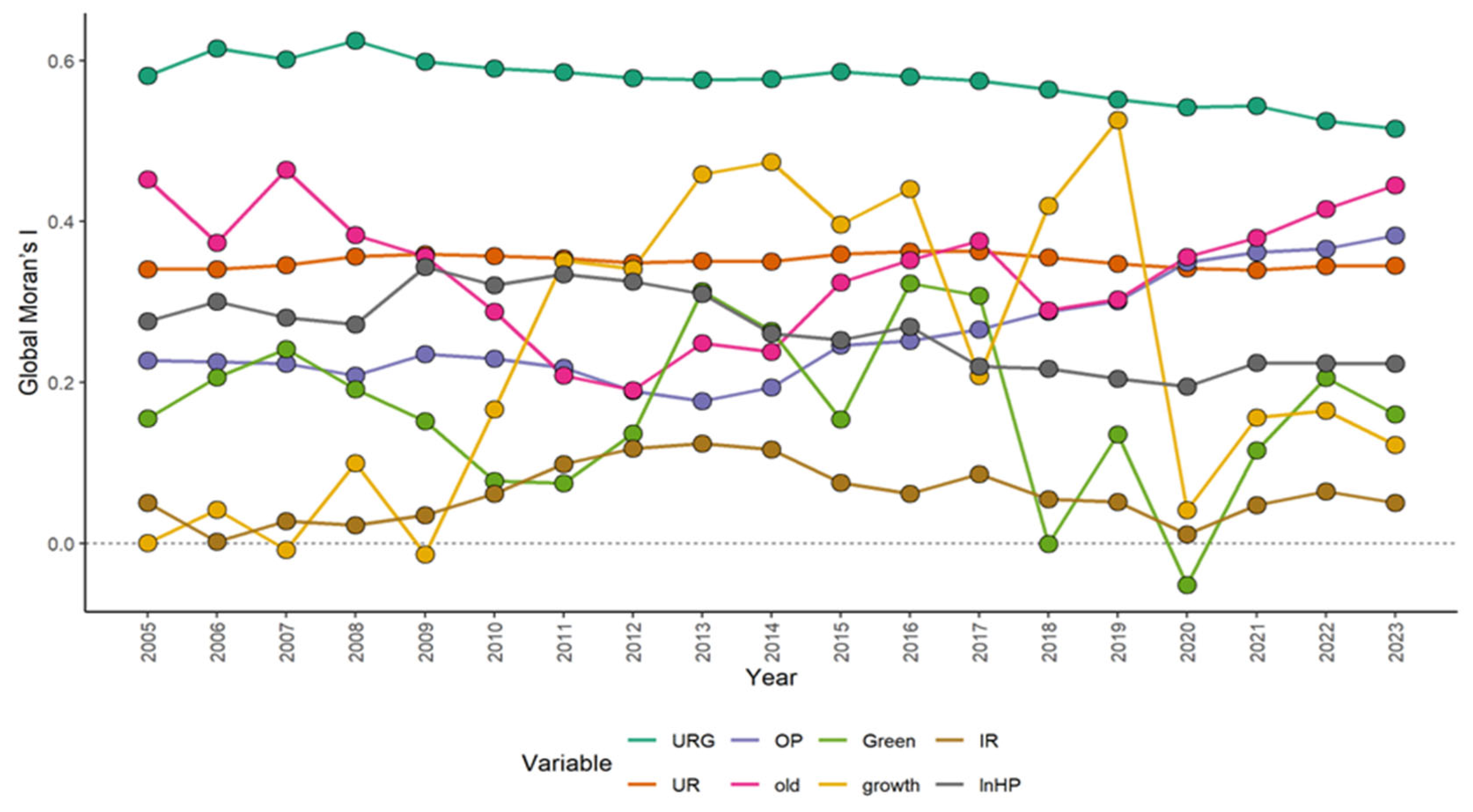
Spatial autocorrelation diagnostics: Table 6 reports Global Moran’s I and Geary’s C for URG. We find strong and persistent positive spatial autocorrelation. The average I over 2005–2023 is about 0.57, with a mild decline over time (roughly 0.62 in 2006–2008 vs. 0.52 in 2023). In Appendix A, Table A1 extends the tests to the each variable. Most show positive and often significant spatial clustering (e.g., lnUR, lnOP, lnOLD, lnHP), while lnIR is near zero and generally insignificant. Figure 3 plots year-by-year Moran’s I for all eight variables and visually confirms these patterns: URG remains highest, lnIR stays flat around zero, and the others lie in between. These diagnostics justify using spatial econometric models in the main analysis.
Table 7 reports LM and robust LM tests for cross-section means and two-way fixed-effects panel residuals. In the cross-section, evidence for a spatial lag is marginal and the error component is not robust. For the panel residuals, all statistics are significant at the 1% level. Spatial dependence is therefore pervasive once province and year effects are controlled. These diagnostics support models that allow both endogenous interaction and correlated errors. We accordingly adopt a dynamic spatial Durbin model with threshold effects.
Table 8 presents the coefficient sets used in the LM diagnostics under two specifications, cross-section OLS and panel fixed effects (FE). Although these coefficients are not the focus of the analysis, they provide useful intuition about how key variables behave depending on whether variation is measured across provinces or within provinces over time. Several patterns are consistent across the two designs. Urbanization (UR) is negatively related to the urban–rural gap (URG) in both cross-section and FE estimates, suggesting that higher urbanization is generally associated with a narrower gap. Population aging (old) becomes positive and precisely estimated once fixed effects are included, indicating that within-province increases in aging tend to widen the gap.
Other variables exhibit design-sensitive behavior. Economic growth is positive in the cross-section, reflecting that richer or faster-growing provinces tend to have larger URG, but turns negative under FE, implying that growth helps reduce inequality within a province over time. Openness (OP), green innovation (Green), and the interest rate (IR) are insignificant between provinces yet become negative and significant within provinces, suggesting that time-varying improvements rather than cross-sectional differences matter for reducing URG. Housing prices (lnHP) remain small and insignificant in both designs, indicating that a linear specification cannot capture their distributional effect.

4.3. Spatial Model Estimates: Linear Benchmarks and Threshold Models

We first estimate the linear versions of the three dynamic spatial specifications corresponding to Equations (6)–(8), where the threshold mechanism is removed and all observations share a single set of coefficients. Under this restriction, Equation (6) produces the linear DSDM, Equation (7) becomes the linear DSAR, and Equation (8) yields the linear DSEM. These linear spatial benchmarks, together with a non-spatial dynamic OLS specification, are reported in Table 9 and serve as preliminary model selection and comparison.
Table 10 then reports the full dynamic spatial threshold models (DSDTM, DSTARM, DSTEM) that correspond directly to Equations (6)–(8). These are the main empirical specifications of the paper and incorporate regime-specific coefficients for lnHP (and, in the DSDTM case, the spatially lagged covariates). Because the linear and diagnostic regressions are not the methodological focus of the study, only the threshold spatial models are fully developed and discussed in the main text.
To further investigate the impact of housing prices on urban–rural income inequality, we estimate a series of linear and nonlinear spatial models. The linear specifications serve as benchmark estimates, while the threshold framework captures potential nonlinear adjustments and regime-dependent dynamics within the housing market channel.
Table 9 reports the results of the DSDM, DSAR, DSEM, and OLS specifications. The lagged dependent variable (URG_lag) is positive and highly significant in all cases, confirming strong temporal persistence in URG. The coefficient magnitudes are slightly smaller in the spatial models than in OLS, suggesting that ignoring spatial dependence may exaggerate persistence effects.
The key variable lnHP is positive and significant across all models. This finding is particularly important because much of the prior empirical literature, based on non-spatial or purely time-series frameworks, has reported a negative or ambiguous relationship between housing prices and urban–rural inequality (e.g., [18,19,23]). By contrast, the spatial results demonstrate that rising housing prices reinforce inequality once spatial spillovers are explicitly modelled. Among the controls, lnOP exerts a consistently negative influence, while GDP growth shows weaker and less stable effects. Other covariates, including lnIR, lnOLD, and lnGreen, are generally insignificant.
The standard errors indicate precise estimation of the core spatial parameters and the housing-price effect. In DSAR/DSDM, the spatial lag parameter ρ is sharply identified (SE ≈ 0.024). In DSEM, the spatial error parameter λ is likewise precise (SE ≈ 0.049). The coefficient on l n   H P is stable across models (≈0.004–0.006) with SE ≈ 0.002, supporting a robust positive effect. By contrast, several Durbin terms ( W   ×   X ) in the DSDM exhibit larger standard errors and are not statistically significant, providing limited evidence, within the linear benchmark, of indirect covariate spillovers. These narrow uncertainty bounds for the key parameters strengthen confidence in the spatial estimates.
Finally, the J-test for overidentifying restrictions fails to reject the null hypothesis of instrument validity in all spatial models, confirming that the GMM instruments used in the estimation are appropriate and uncorrelated with the error term.
Table 10 turns to nonlinear spatial threshold models, with the estimated threshold value for lnHP at 8.4843, confirming the presence of nonlinear spatial dynamics. The lagged dependent variable (URG_lag) remains positive and highly significant across all specifications, reinforcing the persistence of disparities over time. Both the low-regime (lnHP.L) and high-regime (lnHP.H) coefficients are positive and significant across the DSTDM, DSTARM, and DSTEM, indicating that rising housing prices consistently exacerbate inequality. However, the magnitude of the effect is stronger below the threshold and weaker above it, implying a diminishing marginal influence of housing prices on URG once markets become more mature or saturated. In other words, while housing price increases continue to widen disparities, the rate of amplification slows beyond the critical price level. This pattern is consistent with the notion that affordability constraints, policy interventions, and market stabilization may attenuate the inequality-enhancing impact of housing appreciation at higher price regimes.
Among the three specifications, the DSTDM and DSTARM yield nearly identical estimates, whereas the DSTEM produces smaller coefficients due to the absorption of spatial error dependence through the ν term. The spatial autoregressive parameter ρ remains positive and highly significant in the DSTDM and DSTARM, confirming that inequality in one province is influenced by neighboring regions through spatial spillovers.
Compared with the linear results in Table 9, the nonlinear estimates refine, rather than overturn, the main result of the linear models. The positive relationship between housing prices and URG persists in both frameworks; however, the threshold models reveal that the magnitude of this effect is state-dependent. Housing price increases have a stronger inequality-enhancing effect in low-price regimes but weaker effects in high-price regimes, reflecting diminishing returns in the transmission of housing market dynamics to inequality.
Table 11 decomposes the spatial effects of the nonlinear DSTDM model into direct, indirect (spillover), and total components. In both regimes, lnHP exhibits positive direct and total effects on URG, indicating that housing price increases within a province directly exacerbate local income disparities and also transmit inequality to neighboring regions through spatial spillovers. The direct effect dominates the indirect effect, suggesting that the inequality-enhancing mechanism operates primarily through within-province channels, such as wealth accumulation among urban homeowners and rising housing costs that constrain rural and low-income groups. The positive spillover component further implies that inequality in one province can propagate to others via interregional capital flows, migration, and investment linkages.
To clarify magnitudes, consider the low-price regime where the total effect of lnHP is 0.0107. A 1% increase in housing prices then raises URG by approximately 0.01 × 0.0107 = 0.000107. At the sample mean URG of about 0.099, a 10% increase in housing prices in the low-price regime implies an increase of roughly 0.00107, or about 10.7 basis points. In the high-price regime, the corresponding total effect is smaller (0.0083), confirming that the marginal impact of housing prices on inequality diminishes as markets become more expensive and constrained.
Comparing across regimes, the magnitude of effect of lnHP is stronger below the threshold (low-price regime) and weaker above it, consistent with the threshold model results in Table 10. This pattern aligns with threshold and affordability theories ([26,58]), suggesting that moderate housing price growth initially amplifies inequality through asset appreciation and cost-of-living effects, while excessively high prices induce affordability pressures, dampening the marginal inequality impact. The findings are broadly consistent with [19,23], who observed that real estate booms tend to widen inequality, yet the intensity of this relationship diminishes as markets mature or when policy constraints tighten. The spatially decomposed evidence presented here extends these insights by demonstrating that housing-induced inequality in mainland China is not purely local but diffuses across regions through economic and demographic interconnections.
Among the control variables, the results remain consistent with theoretical expectations but less central to the nonlinear mechanism. Economic growth and trade openness continue to exert negative effects on URG, implying that development and integration promote convergence between urban and rural incomes. Urbanization also retains a significant negative impact, reflecting the equalizing role of labor mobility and structural transformation. Meanwhile, industrialization rate, aging, and green investment are statistically weak or unstable, though the latter shows a notable positive spillover, suggesting regionally uneven diffusion of environmental investments.
Overall, the dynamic spatial threshold results complement and extend existing evidence on housing prices and inequality. The finding that rising housing prices widen the urban–rural income gap, with diminishing marginal effects at high price levels, is consistent with nonlinear patterns documented in housing and inequality studies for other contexts [19,41,42]. At the same time, the spatial decomposition shows that a sizeable share of the inequality effect operates through cross-provincial spillovers, in line with [17,45], who emphasise the role of housing-market linkages in propagating disparities across regions. Our contribution is to integrate these insights into a unified dynamic spatial threshold framework, which simultaneously accounts for persistence, spatial diffusion, and regime-dependent responses of inequality to housing prices.

4.4. Robustness Check

To evaluate the stability of our findings, we conduct two sets of robustness checks addressing (i) sensitivity to alternative spatial connectivity structures and (ii) concerns about the finite-sample performance of the two-step IV estimator with interactive effects. In addition to the baseline K-nearest-neighbor matrix with k = 3, we re-estimate the model using k = 4 to assess the sensitivity of the results to neighborhood size

4.4.1. Robustness to Alternative Spatial Weight Matrix

Our baseline analysis relies on a K-nearest-neighbors spatial weight matrix (W1, k = 3). To examine whether the estimated nonlinear spatial threshold effects depend on the specific choice of spatial connectivity, we re-estimate all three nonlinear spatial threshold models using an alternative distance-based contiguity matrix (W2). Table 12 reports the results.
Table 12 presents the estimates of the nonlinear spatial threshold models based on the alternative spatial weight matrix (W2). The estimated threshold value for lnHP remains 8.4024, which confirms the robustness of the nonlinear specification. The lagged dependent variable (URG_lag) is again positive and highly significant in all three models, reinforcing the persistence of income disparities over time. Both the low-regime (lnHP.L) and high-regime (lnHP.H) coefficients retain positive and significant signs, although their magnitudes are slightly smaller than those obtained under W1 (Table 10). This indicates that housing prices continue to widen URG in both regimes, but the marginal intensity of this effect is moderated under the W2 specification.

4.4.2. Robustness to Alternative IV Estimator

A second concern relates to the finite-sample properties of the two-step IV estimator with interactive effects, given that our panel contains 31 provinces observed over 19 years. To address this, we estimate a simpler dynamic spatial panel model that does not include interactive common factors. This alternative specification retains the key sources of endogeneity, dynamic persistence and spatial dependence, while adopting a more parsimonious moment structure. Our endogenous variables are instrumented using their own second lags to avoid instrument proliferation, while the spatial weight matrix W1 is retained for comparability. This GMM estimator corresponds to a widely used approach in dynamic spatial econometrics and allows us to check whether the key results persist under a simpler IV framework.
The GMM results (Table 13) confirm the robustness of our main conclusions. Both lnHP and the spatial autoregressive coefficient ρ remain positive and statistically significant, with magnitudes close to those obtained under the full dynamic spatial threshold model. The persistence of these results under a simpler IV design indicates that the positive and inequality-enhancing impact of housing prices is not an artifact of the two-step IV estimator with interactive effects.

4.4.3. Robustness to K-Nearest-Neighbor Spatial Weight (k = 4)

Table 14 reports the results obtained when the K-nearest-neighbor spatial weight matrix is expanded from k = 3 (baseline) to k = 4. The results demonstrate that the model is highly robust to this variation in spatial connectivity.

5. Conclusions

This study set out to address a central question in mainland China’s development process: how do housing prices shape urban–rural income inequality (URG) once spatial interactions and nonlinear dynamics are taken into account? While existing research has focused mainly on institutional or labor market factors, the role of housing markets, especially their spatial spillovers and regime-dependent effects, has remained largely unexplored. To fill this gap, we employed a nonlinear dynamic spatial model including the Dynamic Spatial Durbin Threshold Model, Dynamic Spatial Threshold Autoregressive Model, and Dynamic Spatial Threshold Error Model. This integrated approach allowed us to capture the persistence of inequality, spatial dependence across provinces, and nonlinear threshold effects driven by housing market regimes.
The results reveal several key findings. First, urban–rural inequality exhibits strong temporal persistence, confirming that disparities evolve gradually over time. Second, housing prices consistently exert a positive and significant impact on URG, overturning earlier evidence of neutral or negative effects. The inclusion of spatial dependence refines the persistence estimates and reveals that housing markets reinforce inequality not only locally but also through interregional spillovers. Third, the nonlinear threshold analysis identifies a critical housing price level (lnHP = 8.4843 or 4838.21 RMB per m2) that divides the sample into low- and high-price regimes. In both regimes, housing prices widen URG, but the marginal effect diminishes above the threshold, consistent with theories of affordability constraints and market maturity. These results demonstrate that URG in mainland China is jointly shaped by persistence, spatial diffusion, and threshold effects operating through the housing market channel.
From a policy perspective, the regime-specific results point to differentiated strategies across regions. The stronger inequality-enhancing effect of housing prices in the low-price regime—where many inland and central provinces are located—implies that these areas are most vulnerable when house prices begin to accelerate. Policies in these markets should prioritize early-stage macroprudential tools, stricter supervision of land auctions, and safeguards against speculative booms, combined with targeted support for rural households’ access to credit and housing services in small and medium-sized cities. By contrast, in mature coastal markets, where prices are already high and the marginal inequality effect is weaker, the priority shifts towards improving affordability through expanded rental and social housing, inclusionary zoning, and targeted subsidies for low-income groups rather than further stimulating housing demand.
The strong spatial spillovers documented in the dynamic spatial threshold model also highlight the need for explicitly regional coordination. Because increases in housing prices in coastal and core provinces transmit to neighboring inland areas, isolated provincial interventions risk displacing pressures rather than reducing them. More effective options include inter-provincial fiscal transfers linked to housing and infrastructure needs, coordinated regulation of land supply and purchase restrictions within major urban corridors, and joint investment in transport and digital infrastructure that reshapes spatial connectivity instead of reinforcing existing core–periphery patterns. Such spatially coordinated policies would better align housing-market management with the cross-provincial nature of inequality dynamics.
Finally, the finding that the marginal effect of housing prices on URG diminishes in high-price regimes can be related to existing policy levers. In large cities where purchase restrictions, loan-to-value caps, and other macroprudential measures are already in place, our results are consistent with the view that these interventions have attenuated, though not reversed, the inequality-enhancing impact of housing appreciation. Extending appropriately calibrated versions of these tools to fast-growing secondary cities while expanding social housing and rural development programs could prevent new centers of inequality from emerging as housing markets deepen. Overall, the evidence points to a policy mix that combines region-specific housing instruments, spatially coordinated interventions, and broader income-support policies to curb the contribution of housing markets to China’s urban–rural divide.
Future research could extend the present analysis in several directions. Incorporating additional dimensions of spatial heterogeneity, such as Technology and Information and Communication Technology, financial integration or migration flows, may provide deeper insights into the mechanisms linking housing markets and inequality. Cross-country comparisons would also be valuable in assessing whether the positive housing price–inequality nexus observed in mainland China is context-specific or reflects broader structural regularities in developing and emerging economies. In addition, using fully deflated housing prices is an important extension that we leave for future work.

Author Contributions

Conceptualization, W.Y. and P.M.; methodology, W.Y.; software, M.L.; validation, P.M., W.Y. and M.L.; formal analysis, M.L.; investigation, M.L.; data curation, M.L.; writing—original draft preparation, M.L.; writing—review and editing, P.M. All authors have read and agreed to the published version of the manuscript.

Funding

This research was funded by Center of Excellence in Econometrics, Faculty of Economics, Chiang Mai University.

Data Availability Statement

The raw data supporting the conclusions of this article will be made available by the authors on request.

Conflicts of Interest

The authors declare no conflicts of interest.

Appendix A

Table A1. Moran’s I by Year and Variable (2005–2023).
YearUROPOldGreen
ModelMoran’s IGeary’s CMoran’s IGeary’s CMoran’s IGeary’s CMoran’s IGeary’s C
20050.3410 ***0.6790 **0.2270 **0.7690 *0.4520 ***0.5230 ***0.1550 *0.7830 **
20060.3400 ***0.6800 **0.2260 **0.7710 **0.3740 ***0.5890 ***0.2060 **0.6490 ***
20070.3460 **0.6760 **0.2240 **0.7720 **0.4640 ***0.4990 ***0.2410 ***0.6280 ***
20080.3560 ***0.6610 ***0.2080 **0.7840 *0.3840 ***0.5740 ***0.1920 **0.7540 **
20090.3590 ***0.6590 ***0.2350 **0.7570 **0.3560 ***0.6010 ***0.1520 *0.7880 *
20100.3570 ***0.6520 ***0.2300 **0.7610 **0.2880 ***0.6550 ***0.07770.8510
20110.3540 ***0.6540 ***0.2180 **0.7740 **0.2090 *0.7300 **0.07460.8240 *
20120.3490 ***0.6570 ***0.1890 *0.8040 *0.19000.7370 **0.1370 *0.7480 **
20130.3510 ***0.6530 ***0.17700.8160 *0.2490 **0.6820 **0.3140 ***0.5690 ***
20140.3510 ***0.6520 ***0.1940 **0.8020 *0.2380 **0.6900 **0.2640 **0.5700 ***
20150.3590 ***0.6430 ***0.2460 **0.7500 **0.3240 ***0.6140 ***0.1540 *0.6750 ***
20160.3630 ***0.6390 ***0.2520 **0.7470 **0.3520 ***0.5860 ***0.3230 ***0.6190 ***
20170.3630 ***0.6370 ***0.2660 **0.7360 **0.3760 ***0.5690 ***0.3080 ***0.5660 ***
20180.3550 ***0.6410 ***0.2880 ***0.7190 **0.2900 ***0.6550 ***−0.00090.9690
20190.3470 ***0.6470 ***0.3010 **0.7060 **0.3040 ***0.6420 ***0.1350 *0.8670
20200.3420 ***0.6500 ***0.3490 ***0.6610 **0.3560 ***0.5740 ***−0.05151.0400
20210.3400 **0.6500 ***0.3620 ***0.6460 ***0.3800 ***0.5450 ***0.11500.8760
20220.3440 ***0.6450 ***0.3660 ***0.6420 ***0.4160 ***0.5110 ***0.2060 **0.8410
20230.3450 ***0.6440 **0.3830 ***0.6290 ***0.4450 ***0.4830 ***0.1610 *0.8970
YearGrowthIRlnHP
ModelMoran’s IGeary’s CMoran’s IGeary’s CMoran’s IGeary’s C
20050.00020.93600.05050.90300.2760 **0.7240 **
20060.04200.95800.00210.95100.3000 ***0.6960 **
2007−0.00820.94400.02790.93100.2800 **0.7120 **
20080.09980.88300.02230.93200.2720 **0.7270 **
2009−0.01360.97300.03520.91200.3440 ***0.6560 **
20100.1670 *0.7630 **0.06170.89200.3210 ***0.6710 ***
20110.3510 ***0.6200 ***0.09840.86200.3350 ***0.6570 ***
20120.3410 ***0.7040 **0.11800.84000.3260 ***0.6600 ***
20130.4590 ***0.5970 ***0.12400.8270 *0.3100 ***0.6790 **
20140.4740 ***0.5520 ***0.11700.8300 *0.2610 **0.7200 **
20150.3960 ***0.6180 ***0.07520.85900.2530 **0.7300 **
20160.4400 ***0.5480 ***0.06180.87100.2690 ***0.7180 **
20170.2080 *0.7860 *0.08580.85400.2200 *0.7640 *
20180.4200 ***0.5350 ***0.05460.87900.2170 **0.7680 **
20190.5260 ***0.4240 ***0.05130.88400.2050 *0.7820 *
20200.04100.88800.01120.92100.19500.7930 *
20210.1560 *0.80600.04730.89000.2240 *0.7660 **
20220.1650 *0.7640 **0.06470.88400.2240 *0.7700 **
20230.12200.8180 *0.05020.89600.2230 **0.7730 *
Note: ***, **, and * denote statistical significance at the 1%, 5%, and 10% levels, respectively.

References

  1. Knight, J.; Deng, Q.; Li, S. The puzzle of migrant labour shortage and rural labour surplus in China. China Econ. Rev. 2011, 22, 585–600. [Google Scholar] [CrossRef]
  2. Lin, H.; Brueckner, M. Inequality and growth in China. Empir. Econ. 2024, 66, 539–585. [Google Scholar] [CrossRef]
  3. Sicular, T.; Ximing, Y.; Gustafsson, B.; Shi, L. The urban–rural income gap and inequality in China. Rev. Income Wealth 2007, 53, 93–126. [Google Scholar] [CrossRef]
  4. Wu, M.; Ma, Y.; Gao, Y.; Ji, Z. The impact of digital economy on income inequality from the perspective of technological progress-biased transformation: Evidence from China. Empir. Econ. 2024, 67, 567–607. [Google Scholar] [CrossRef]
  5. Zhang, K.H.; Song, S. Rural–urban migration and urbanization in China: Evidence from time-series and cross-section analyses. China Econ. Rev. 2003, 14, 386–400. [Google Scholar] [CrossRef]
  6. Chen, D.; Ma, Y. Effect of industrial structure on urban–rural income inequality in China. China Agric. Econ. Rev. 2022, 14, 547–566. [Google Scholar] [CrossRef]
  7. Liang, S. International trade and urban-rural income inequality in China. Appl. Econ. Lett. 2024, 31, 1243–1246. [Google Scholar] [CrossRef]
  8. Yang, Y.; Xue, J.; Qian, J.; Qian, X. Mapping energy inequality between urban and rural China. Appl. Geogr. 2024, 165, 103220. [Google Scholar] [CrossRef]
  9. Glaeser, E.L.; Gyourko, J. The economic implications of housing supply. J. Econ. Perspect. 2018, 32, 3–30. [Google Scholar] [CrossRef]
  10. Hilber, C.A.; Robert-Nicoud, F. On the origins of land use regulations: Theory and evidence from US metro areas. J. Urban Econ. 2013, 75, 29–43. [Google Scholar] [CrossRef]
  11. Lin, G.C.; Ho, S.P. The state, land system, and land development processes in contemporary China. Ann. Assoc. Am. Geogr. 2005, 95, 411–436. [Google Scholar] [CrossRef]
  12. Wang, Y.P.; Murie, A. Social and spatial implications of housing reform in China. Int. J. Urban Reg. Res. 2000, 24, 397–417. [Google Scholar] [CrossRef]
  13. Chen, A.; Coulson, N.E. Determinants of urban migration: Evidence from Chinese cities. Urban Stud. 2002, 39, 2189–2197. [Google Scholar] [CrossRef]
  14. Garriga, C.; Hedlund, A.; Tang, Y.; Wang, P. Rural–urban migration and house prices in China. Reg. Sci. Urban Econ. 2021, 91, 103613. [Google Scholar] [CrossRef]
  15. Wang, X.R.; Hui, E.C.M.; Sun, J.X. Population migration, urbanization and housing prices: Evidence from the cities in China. Habitat Int. 2017, 66, 49–56. [Google Scholar] [CrossRef]
  16. Liu, J.; Xiang, H.; Zhu, S.; Chen, S. Spatial heterogeneity analysis of biased land resource supply policies on housing prices and innovation efficiency. Humanit. Soc. Sci. Commun. 2024, 11, 1180. [Google Scholar] [CrossRef]
  17. Zhao, S.; Zhao, K.; Zhang, P. Spatial inequality in China’s housing market and the driving mechanism. Land 2021, 10, 841. [Google Scholar] [CrossRef]
  18. Dustmann, C.; Fitzenberger, B.; Zimmermann, M. Housing expenditure and income inequality. Econ. J. 2022, 132, 1709–1736. [Google Scholar] [CrossRef]
  19. Hailemariam, A.; Awaworyi Churchill, S.; Smyth, R.; Baako, K.T. Income inequality and housing prices in the very long run. South. Econ. J. 2021, 88, 295–321. [Google Scholar] [CrossRef]
  20. Piketty, T.; Saez, E. Inequality in the long run. Science 2014, 344, 838–843. [Google Scholar] [CrossRef] [PubMed]
  21. Adelino, M.; Schoar, A.; Severino, F. House prices, collateral, and self-employment. J. Financ. Econ. 2015, 117, 288–306. [Google Scholar] [CrossRef]
  22. Glaeser, E.L.; Gottlieb, J.D. The wealth of cities: Agglomeration economies and spatial equilibrium in the United States. J. Econ. Lit. 2009, 47, 983–1028. [Google Scholar] [CrossRef]
  23. Yin, X.C.; Su, C.W. Have housing prices contributed to regional imbalances in urban–rural income gap in China? J. Hous. Built Environ. 2022, 37, 2139–2156. [Google Scholar] [CrossRef]
  24. Liu, J.; He, X.; Dong, Y. The causes of income inequality in urban China: A household assets perspective. Chin. J. Sociol. 2024, 10, 218–242. [Google Scholar] [CrossRef]
  25. DeFusco, A.; Ding, W.; Ferreira, F.; Gyourko, J. The role of price spillovers in the American housing boom. J. Urban Econ. 2018, 108, 72–84. [Google Scholar] [CrossRef]
  26. Quigley, J.M.; Raphael, S. Is housing unaffordable? Why isn’t it more affordable? J. Econ. Perspect. 2004, 18, 191–214. [Google Scholar] [CrossRef]
  27. Nguena, C.L.; Tchana Tchana, F.; Zeufack, A. On threshold effect of housing finance on shared prosperity: Evidence from sub-Saharan Africa. Bull. Econ. Res. 2024, 76, 5–40. [Google Scholar] [CrossRef]
  28. Zheng, H.; Qian, J.; Liu, G.; Wu, Y.; Delang, C.O.; He, H. Housing prices and household consumption: A threshold effect model analysis in central and western China. Humanit. Soc. Sci. Commun. 2023, 10, 764. [Google Scholar] [CrossRef]
  29. Henderson, J.V. The sizes and types of cities. Am. Econ. Rev. 1974, 64, 640–656. [Google Scholar]
  30. Roback, J. Wages, rents, and the quality of life. J. Political Econ. 1982, 90, 1257–1278. [Google Scholar] [CrossRef]
  31. Zhang, C.; Jia, S.; Yang, R. Housing affordability and housing vacancy in China: The role of income inequality. J. Hous. Econ. 2016, 33, 4–14. [Google Scholar] [CrossRef]
  32. Beck, T.; Levine, R.; Loayza, N. Finance and the sources of growth. J. Financ. Econ. 2000, 58, 261–300. [Google Scholar] [CrossRef]
  33. Mian, A.; Sufi, A. House of Debt: How They (And You) Caused the Great Recession, and How We Can Prevent It from Happening Again; University of Chicago Press: Chicago, IL, USA, 2015. [Google Scholar]
  34. Favilukis, J.; Ludvigson, S.C.; Van Nieuwerburgh, S. The macroeconomic effects of housing wealth, housing finance, and limited risk sharing in general equilibrium. J. Political Econ. 2017, 125, 140–223. [Google Scholar] [CrossRef]
  35. Sommer, K.; Sullivan, P. Implications of US tax policy for house prices, rents, and homeownership. Am. Econ. Rev. 2018, 108, 241–274. [Google Scholar] [CrossRef]
  36. Kanbur, R.; Zhang, X. Fifty years of regional inequality in China: A journey through central planning, reform, and openness. Rev. Dev. Econ. 2005, 9, 87–106. [Google Scholar] [CrossRef]
  37. Feenstra, R.C.; Hanson, G.H. Global production sharing and rising inequality: A survey of trade and wages. Handb. Int. Trade 2003, 1, 146–185. [Google Scholar]
  38. Bloom, D.E.; Canning, D.; Fink, G. Implications of population aging for economic growth. Oxf. Rev. Econ. Policy 2010, 26, 583–612. [Google Scholar] [CrossRef]
  39. Malyovanyi, M.; Nepochatenko, Z.; Osipova, A.; Novak, I.; Prokopchuk, O. The impact of population ageing on economic growth: The role of social policy models in OECD countries. Financ. Credit. Act. Probl. Theory Pract. 2025, 4, 538–557. [Google Scholar]
  40. Umair, M.; Aizhan, A.; Teymurova, V.; Chang, L. Does the disparity between rural and urban incomes affect rural energy poverty? Energy Strategy Rev. 2024, 56, 101584. [Google Scholar]
  41. Ünalan, G.; Çamalan, Ö.; Yılmaz, H.H. The impact of increases in housing prices on income inequality: A perspective on sustainable urban development. Sustainability 2025, 17, 4024. [Google Scholar] [CrossRef]
  42. Chien, M.S.; Setyowati, N.; Cheng, C.Y.; Cheng, Y.S. The nonlinear relationship between housing prices and income inequality. J. Hous. Built Environ. 2025, 40, 1089–1112. [Google Scholar] [CrossRef]
  43. Kim, H.; Rhee, D.E. The effects of asset prices on income inequality: Redistribution policy does matter. Econ. Model. 2022, 113, 105899. [Google Scholar] [CrossRef]
  44. Ioannides, Y.M.; Ngai, L.R. Housing and inequality. J. Econ. Lit. 2025, 63, 916–963. [Google Scholar] [CrossRef]
  45. Fischer, T. Spatial inequality and housing in China. J. Urban Econ. 2023, 134, 103532. [Google Scholar] [CrossRef]
  46. Mu, X.; Cui, C.; Cui, J. Housing differentiation from the spatial opportunity structure perspective: An empirical study on new-generation migrants in China. J. Chin. Sociol. 2024, 11, 3. [Google Scholar] [CrossRef]
  47. Zhong, S.; Wang, M.; Zhu, Y.; Chen, Z.; Huang, X. Urban expansion and the urban–rural income gap: Empirical evidence from China. Cities 2022, 129, 103831. [Google Scholar] [CrossRef]
  48. LeSage, J.P.; Pace, R.K. Introduction to Spatial Econometrics; CRC Press: Boca Raton, FL, USA, 2009. [Google Scholar]
  49. Chica-Olmo, J.; Sari-Hassoun, S.; Moya-Fernández, P. Spatial relationship between economic growth and renewable energy consumption in 26 European countries. Energy Econ. 2020, 92, 104962. [Google Scholar] [CrossRef]
  50. Li, J.; Li, S. Energy investment, economic growth and carbon emissions in China—Empirical analysis based on spatial Durbin model. Energy Policy 2020, 140, 111425. [Google Scholar] [CrossRef]
  51. Khezri, M.; Heshmati, A.; Khodaei, M. The role of R&D in the effectiveness of renewable energy determinants: A spatial econometric analysis. Energy Econ. 2021, 99, 105287. [Google Scholar] [CrossRef]
  52. Xue, W.; Li, X.; Yang, Z.; Wei, J. Are house prices affected by PM2.5 pollution? Evidence from Beijing, China. Int. J. Environ. Res. Public Health 2022, 19, 8461. [Google Scholar] [CrossRef] [PubMed]
  53. Moretti, E. Real wage inequality. Am. Econ. J. Appl. Econ. 2013, 5, 65–103. [Google Scholar] [CrossRef]
  54. Cui, G.; Sarafidis, V.; Yamagata, T. IV estimation of spatial dynamic panels with interactive effects: Large sample theory and an application on bank attitude towards risk. Econom. J. 2023, 26, 124–146. [Google Scholar] [CrossRef]
  55. Anselin, L.; Bera, A.K.; Florax, R.; Yoon, M.J. Simple diagnostic tests for spatial dependence. Reg. Sci. Urban Econ. 1996, 26, 77–104. [Google Scholar] [CrossRef]
  56. Yu, J.; De Jong, R.; Lee, L.F. Quasi-maximum likelihood estimators for spatial dynamic panel data with fixed effects when both n and T are large. J. Econom. 2008, 146, 118–134. [Google Scholar] [CrossRef]
  57. Kripfganz, S.; Sarafidis, V. Estimating Spatial Dynamic Panel Data Models with Unobserved Common Factors in Stata. J. Stat. Softw. 2025, 113, 1–27. [Google Scholar] [CrossRef]
  58. Hansen, B.E. Threshold effects in non-dynamic panels: Estimation, testing, and inference. J. Econom. 1999, 93, 345–368. [Google Scholar] [CrossRef]
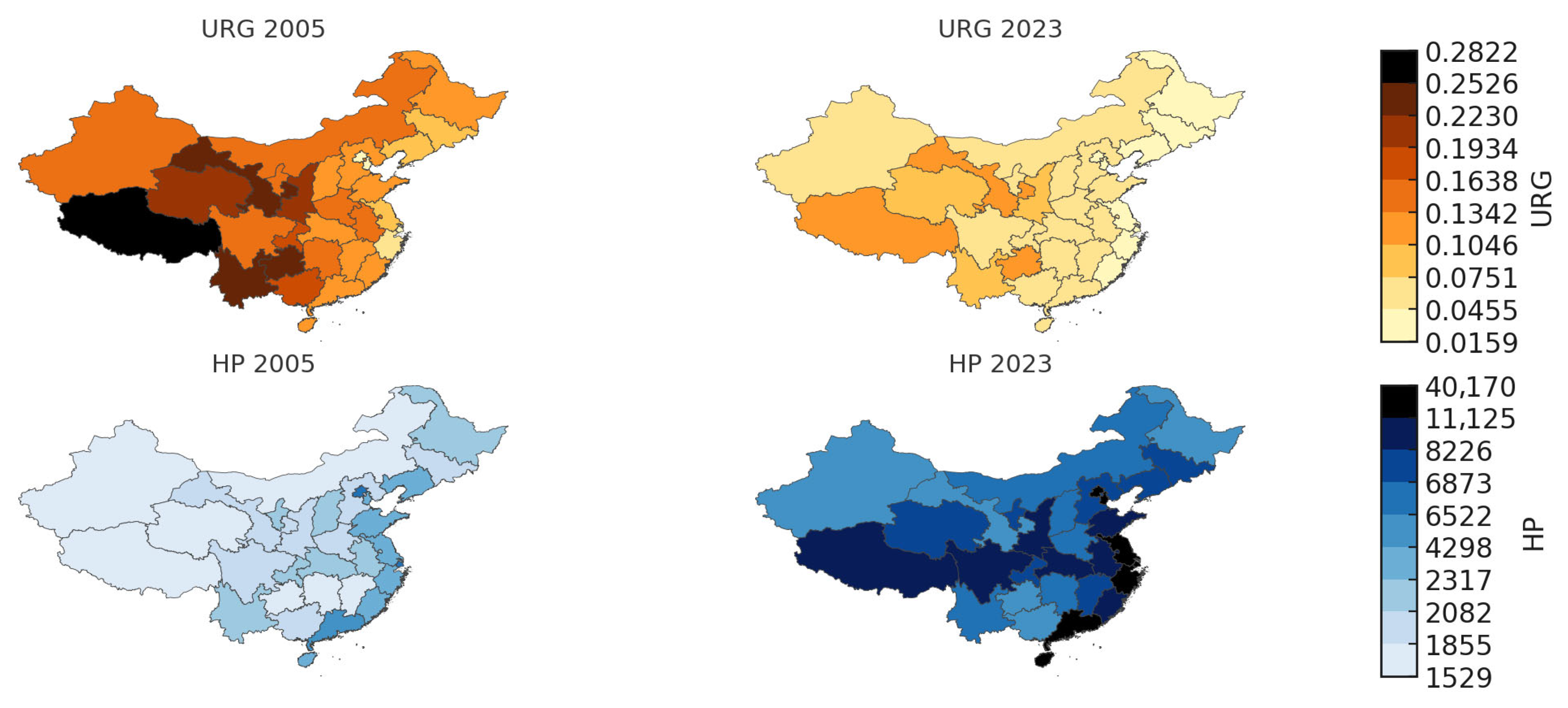
Figure 1. Heat maps of URG and housing prices in 2005 and 2023.
Mathematics 13 03960 g001
Figure 2. Theoretical Framework.
Mathematics 13 03960 g002
Figure 3. Annual global Moran’s I (2005–2023).
Mathematics 13 03960 g003
Table 1. Variable Definitions and Sources.
VariableDefinitionCalculationSource
Dependent Variable
URGUrban–rural income gapSee Equation (1)NBS China
Measurement
RUIReal urban incomeNominal urban income/CPI × 100NBS China
RRIReal rural incomeNominal rural income/CPI × 100NBS China
UPUrban populationPermanent urban residentsNBS China
RPRural populationPermanent rural residentsNBS China
Independent Variables
HPHousing pricesAverage commercial housing price per m2NBS China
Control Variables
GrowthGDP growth rateln( G D P t )     ln( G D P t 1 )NBS China
OPTrade opennessProvincial annual increment of import and export trade volume/Provincial GDP × 100%NBS China
IRIndustrialization rateProvincial annual increment of industrial added value/Provincial GDP × 100%NBS China
URUrbanization rateUrban population/Total population × 100%NBS China
GreenGreen investment ratioGreen investment/Provincial GDP × 100%NBS China
OLDOld-age Dependency RatioPopulation aged 60+/Population aged 15–59 × 100%CEIC
Note: NBS China = National Bureau of Statistics of China.
Table 2. Descriptive Statistics of variables (2005–2023).
VariableMinMaxMeanSDSkewnessKurtosis
URG0.01590.28220.09930.05000.7820.5674
UR0.22610.89600.55960.14600.3414−0.0680
OP0.00761.79990.29060.34612.26125.0003
OLD0.06700.30600.14750.04560.91610.3454
Green0.00050.04630.01180.00781.67293.6044
Growth−0.05480.26090.10920.05740.2001−0.4963
IR0.14910.61960.41630.0846−0.68540.7044
HP1528.680040,526.00006987.13005816.09003.184912.8456
Table 3. Tests for Cross-Sectional dependence.
VariableCD TestLM TestScaled LM TestBias-Corrected Scaled LM Test
URG90.9910 ***8287.64 ***256.5143 ***255.6532 ***
lnUR88.9428 ***8044.72 ***248.5487 ***247.6875 ***
lnOP21.5912 ***3100.98 ***86.4372 ***85.5761 ***
lnOLD82.3528 ***7125.74 ***218.4143 ***217.5532 ***
lnGreen45.6605 ***2859.45 ***78.5172 ***77.6561 ***
Growth89.2936 ***7975.0220 ***246.2633 ***245.3516 ***
lnIR51.3862 ***4849.80 ***143.7834 ***142.9223 ***
lnHP90.9635 ***8277.98 ***256.1978 ***255.3367 ***
Note: *** denotes statistical significance at the 1% level.
Table 4. Panel unit root tests.
VariableCIPS (T-bar)LLCIPS
URG−3.0735 ***−2.6321 ***−2.9097 ***
lnUR−2.9203 ***−3.3606 ***−7.1316 ***
lnOP−1.8609 *−2.0914 ***−2.9397 ***
lnOLD−1.7980 *−11.4288 ***−7.6870 ***
lnGreen−2.1883 **−4.2367 ***−2.4634 **
Growth−2.4719 **−12.0474 ***−7.8405 ***
lnIR−1.7948 *−4.5180 ***−2.5872 ***
lnHP−1.6623 *−8.0505 ***−5.7838 ***
Note: ***, **, and * denote statistical significance at the 1%, 5%, and 10% levels, respectively.
Table 5. Correlation structure.
VariablelnHPlnURGrowthlnOPlnIRlnOLDlnGreen
lnHP1.00000.8141−0.47480.4835−0.46910.4383−0.2876
lnUR0.81411.0000−0.40300.6440−0.25530.4406−0.1562
Growth−0.4748−0.40301.00000.04370.2977−0.42470.1584
lnOP0.48350.64400.04371.0000−0.11580.0131−0.0931
lnIR−0.4691−0.25530.2977−0.11581.0000−0.18420.1847
lnOLD0.43830.4406−0.42470.0131−0.18421.0000−0.4312
lnGreen−0.2876−0.15620.1584−0.09310.1847−0.43121.0000
VIF4.16515.18651.62502.40491.38351.85161.3592
Table 6. Global Moran’s I and Geary’s C for URG by year (2005–2023).
YearMoran’s IGeary’s CYearMoran’s IGeary’s C
20050.5814 ***0.4433 ***20150.5865 ***0.4693 ***
20060.6152 ***0.4385 ***20160.5799 ***0.4746 ***
20070.6017 ***0.4518 ***20170.5751 ***0.4803 ***
20080.6248 ***0.4200 ***20180.5642 ***0.4893 ***
20090.5989 ***0.4508 ***20190.5515 ***0.5033 ***
20100.5903 ***0.4611 ***20200.5421 ***0.5135 ***
20110.5858 ***0.4763 ***20210.5437 ***0.5094 ***
20120.5782 ***0.4877 ***20220.5249 ***0.5309 ***
20130.5758 ***0.4900 ***20230.5153 ***0.5425 ***
20140.5773 ***0.4875 ***Average0.5743 ***0.4800 ***
Note: *** denotes statistical significance at the 1% level.
Table 7. Lagrange multiplier tests for spatial structure.
LM TestCross-SectionPanel Residuals
Statisticp-ValueStatisticp-Value
LM-lag3.26830.0706152.65980.0000
Robust LM-lag3.36410.0666102.93290.0000
LM-error0.28270.594962.79250.0000
Robust LM-error0.37860.538413.06560.0003
Table 8. Auxiliary Regressions Under Cross-Section and Fixed-Effects Specifications.
VariableCross-SectionPanel FE
lnHP−0.0477 *
(0.0280)
0.0071 *
(0.0041)
lnUR−0.2038 **
(0.0841)
−0.1596 ***
(0.0192)
lnOP0.0444
(0.0340)
−0.0361 ***
(0.0040)
lnOLD−0.1075
(0.1601)
0.1523 ***
(0.0262)
lnGreen0.2610
(1.1676)
−0.1713 **
(0.0761)
Growth0.7093 **
(0.3401)
−0.0450 ***
(0.0150)
lnIR−0.1017
(0.0654)
−0.0643 ***
(0.0130)
Note: ***, **, and * denote significance at the 1%, 5%, and 10% levels, respectively. Standard errors in parentheses. Fixed effects dummies are omitted from display. Robust standard errors (in parentheses) are clustered by province.
Table 9. Estimates from linear spatial models.
ParameterDSDMDSARDSEMOLS
URG_lag0.6869 ***
(0.0228)
0.6834 ***
(0.0226)
0.7169 ***
(0.0216)
0.7482 ***
(0.0222)
lnHP0.0057 ***
(0.0021)
0.0057 ***
(0.0021)
0.0037 *
(0.0022)
0.0043 *
(0.0023)
Growth−0.0134 *
(0.0070)
−0.0140 **
(0.0070)
−0.0120 *
(0.0072)
−0.0156 **
(0.0077)
lnOP−0.0059 ***
(0.0021)
−0.0058 ***
(0.0021)
−0.0055 ***
(0.0021)
−0.0053 **
(0.0023)
lnIR−0.0043
(0.0063)
−0.0038
(0.0063)
−0.0033
(0.0062)
−0.0034
(0.0069)
lnOLD−0.0015
(0.0131)
−0.0030
(0.0129)
0.0182
(0.0132)
0.0194
(0.0135)
lnGreen−0.0047
(0.0350)
−0.0123
(0.0348)
−0.0393
(0.0355)
−0.0218
(0.0379)
lnUR−0.0640 ***
(0.0100)
−0.0665 ***
(0.0100)
−0.0732 ***
(0.0103)
−0.0707 ***
(0.0109)
W×nHP0.0020
(0.0012)
---
W×Growth0.0054
(0.0072)
---
W×lnOP−0.0020
(0.0016)
---
W×lnIR0.0002
(0.0044)
---
W×lnOLD0.0034
(0.0095)
---
W×lnGreen0.0492
(0.0472)
- -
ρ (W×URG)0.1441 ***
(0.0240)
0.1435 ***
(0.0241)
--
υ--0.2407 ***
(0.0493)
-
F Statistic222.2006 ***416.3802 ***380.7359 ***384.0957 ***
Log-likelihood2291.00802287.47601304.3860-
Adj-R20.87050.86880.85830.8593
J test18.136
[0.409]
24.119
[0.191]
10.813
[0.290]
Note: ***, **, and * denote statistical significance at the 1%, 5%, and 10% levels, respectively. [ ] denotes p-value. Robust standard errors (in parentheses) are clustered by province.
Table 10. Estimates from nonlinear spatial threshold models.
ParameterDSTDMDSTARMDSTEM
Threshold value γ8.4843 ***8.5211 ***8.5092 ***
URG_lag0.6901 ***0.6876 ***0.7206 ***
lnHP.L0.0085 **0.0076 ***0.0057 ***
lnHP.H0.0060 ***0.0064 ***0.0045 **
lnGreen−0.0047−0.0103−0.0344
Growth−0.0136 **−0.0140 **−0.0127 *
lnIR−0.0049−0.0041−0.0040
lnOLD0.0010−0.00110.0189
lnOP−0.0057 ***−0.0056 ***−0.0055 ***
lnUR−0.0616 ***−0.0640 ***−0.0704 ***
W×nHP.L0.0022--
W×lnHP.H0.0017--
W×lnGreen0.0295--
W×Growth0.0034--
W×lnIR0.0007--
W×lnOLD0.0015
W×lnOP−0.0200--
W×lnUR−0.0050--
ρ (W×URG)0.1336 ***0.1498 ***-
ν--0.2073 ***
F Statistic199.9382 ***378.8045 ***350.5127 ***
Log-likelihood2296.9612293.7911310.465
R20.87310.87170.8627
J test7.204
[0.391]
4.801
[0.698]
10.092
[0.302]
Note: ***, **, and * denote statistical significance at the 1%, 5%, and 10% levels, respectively. Robust standard errors (in parentheses) are clustered by province.
Table 11. Decomposition of Spatial Effects in Nonlinear Models.
Direct EffectIndirect EffectTotal Effect
lnHP.L0.00810.00260.0107
lnHP.H0.00540.00290.0083
Growth−0.01350.0018−0.0117
lnIR−0.00490.0001−0.0048
lnOLD0.00100.00190.0029
lnUR−0.0621−0.0149−0.0769
lnOP−0.0058−0.0031−0.0089
lnGreen−0.00380.03240.0286
Table 12. Estimates from Nonlinear Spatial Threshold Models (W2).
ParameterDSDMDSARDSEM
Threshold value γ8.4024 ***8.4223 ***8.4010 ***
URG_lag0.6828 ***0.6851 ***0.7329 ***
lnHP.L0.0063 **0.0066 ***0.0061 ***
lnHP.H0.0049 ***0.0052 ***0.0048 **
W×lnHP.L0.0018--
W×lnHP.H0.0017--
ρ (W×URG)0.1708 ***0.1716 ***-
ν--0.1433 ***
F Statistic201.553 ***383.894 ***352.047 ***
Log-likelihood2297.7192295.8121307.795
R20.87400.87310.8632
J test10.134
[0.290]
5.019
[0.145]
18.224
[0.415]
Note: *** and ** denote statistical significance at the 1% and 5% levels, respectively. Robust standard errors (in parentheses) are clustered by province.
Table 13. Estimates from Nonlinear Spatial Threshold Models with GMM.
ParameterDSDMDSARDSEM
Threshold value γ8.4843 ***8.5211 ***8.5092 ***
URG_lag0.5003 ***0.7294 ***0.2034 ***
lnHP.L0.0102 *0.0089 **0.0093 **
lnHP.H0.0052 **0.0037 **0.0052 **
W×nHP.L0.0020--
W×lnHP.H0.0003--
ρ (W×URG)0.1003 ***0.1210 ***-
ν--0.1433 ***
F Statistic197.192 ***312.909 ***323.103 ***
Log-likelihood2102.5962156.3901173.302
R20.88340.82210.8340
J test15.245
[0.427]
3.235
[0.101]
8.113
[0.208]
Note: ***, **, and * denote statistical significance at the 1%, 5%, and 10% levels, respectively. Robust standard errors (in parentheses) are clustered by province.
Table 14. Estimates from Nonlinear Spatial Threshold Models (k = 4).
ParameterDSDMDSARDSEM
Threshold value γ8.4843 ***8.5211 ***8.5092 ***
URG_lag0.6911 ***0.6872 ***0.7210 ***
lnHP.L0.0083 **0.0076 ***0.0059 ***
lnHP.H0.0061 ***0.0063 ***0.0043 **
W×lnHP.L0.0021--
W×lnHP.H0.0018--
ρ (W×URG)0.1333 ***0.1493 ***-
ν--0.2071 ***
F Statistic201.220 ***379.102 ***351.023 ***
Log-likelihood2299.2032297.2031315.210
R20.87320.87170.8627
J test7.199
[0.387]
4.796
[0.699]
10.100
[0.300]
Note: *** and ** denote statistical significance at the 1% and 5% levels, respectively.
Disclaimer/Publisher’s Note: The statements, opinions and data contained in all publications are solely those of the individual author(s) and contributor(s) and not of MDPI and/or the editor(s). MDPI and/or the editor(s) disclaim responsibility for any injury to people or property resulting from any ideas, methods, instructions or products referred to in the content.