Similarity Self/Ideal Index (SSI): A Feature-Based Approach to Modeling Psychological Well-Being




Abstract
1. Introduction
1.1. Psychological Well-Being
1.2. Personal Construct Psychology
1.3. Feature-Based Approach to Modeling Psychological Well-Being
- (i)
- Proposal of the Similarity Self/Ideal Index: We introduce a set-theoretic measure of psychological well-being that operationalizes self–ideal alignment. Unlike traditional correlational methods in PCP, this feature-based approach accounts for the asymmetric and non-linear nature of similarity judgments, directly addressing the limitations of geometric models.
- (ii)
- Mathematical Formalization within a Fuzzy Similarity Space: We establish a rigorous mathematical framework where the alignment between self and ideal is defined as a graded relation of inclusion. We prove that the local congruence function serves as a normalized fuzzy membership function, ensuring the index is bounded, internally coherent, and consistent with constructivist principles of gradual validation.
- (iii)
- Structural Analysis of Psychological Resilience: Beyond providing a static measure of well-being, the proposed framework enables the analysis of the underlying stability of the self-system. By examining the structural configuration of self–ideal discrepancies, the model allows for the differentiation between resilient and fragile systems, offering a new perspective for clinical case formulation and the modeling of psychological change.
2. Mathematical Foundations
2.1. Formalization of the Similarity Self/Ideal Index
- (i)
- The sign of the score, , which represents the qualitative nature of the attribute. It indicates the specific pole of the construct with which the individual identifies.
- (ii)
- The absolute value of the score, , which quantifies the intensity or salience of the attribute. It measures how strongly the individual endorses that particular pole.
- (i)
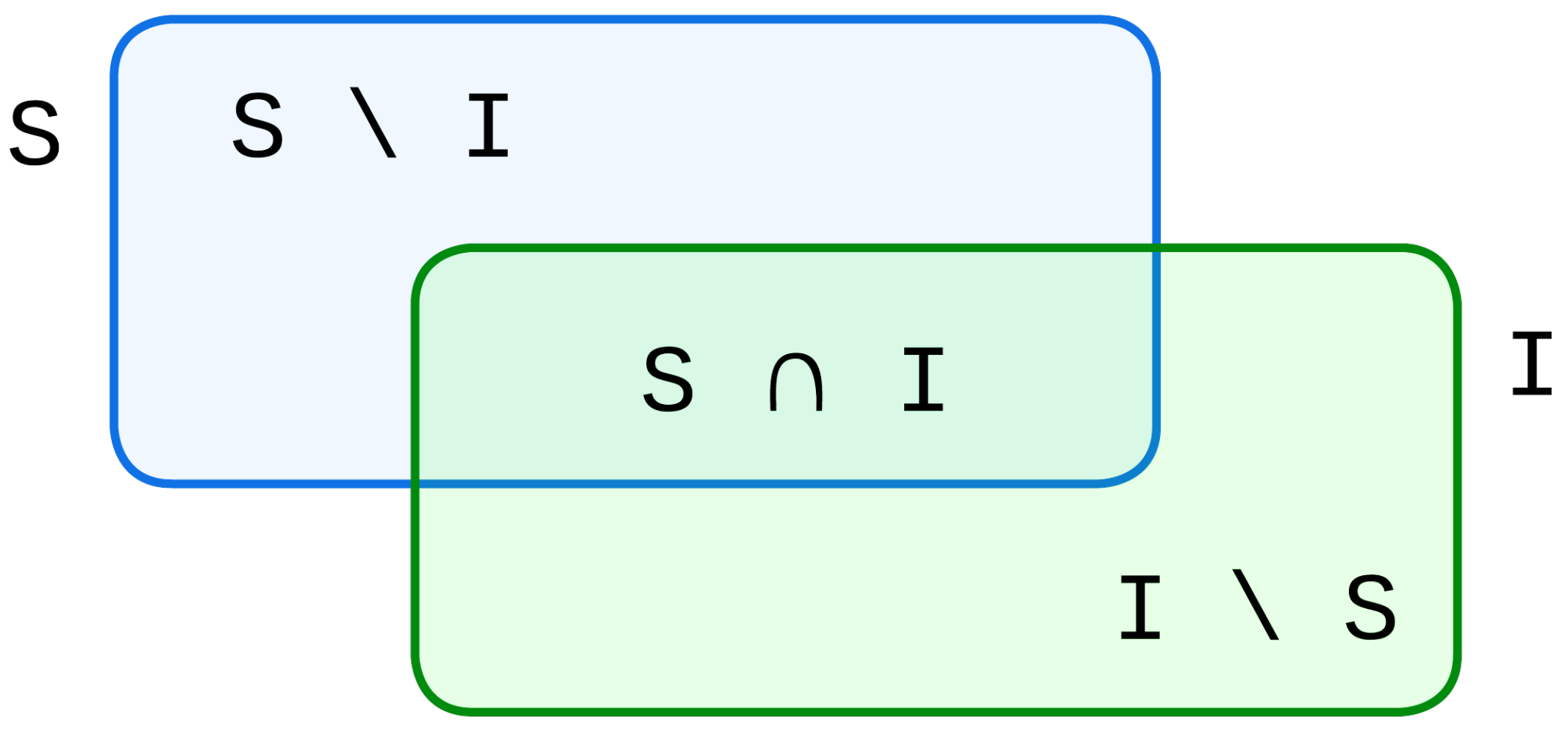
- The set of shared attributes, where both self and ideal align on the same pole:
- (ii)
- The set of attributes distinctive to the Self-Now (discrepancies):
- (iii)
- The set of attributes distinctive to the Ideal-Self (aspirations):
2.2. Properties of the SSI Index
- (i)
- Lower Bound (): Since the numerator, , is non-negative and the denominator is a sum of non-negative terms (assuming ), the entire fraction must be non-negative.
- (ii)
- Upper Bound (): To prove the upper bound, we must show that the numerator is less than or equal to the denominator:
- (i)
- Maximum Similarity: The index attains its maximum value of 1 if and only if the Self-Now and Ideal-Self vectors are congruent on all constructs, meaning for every construct i, .
- (ii)
- Complete Mismatch: The index attains its minimum value of 0 if and only if the set of shared attributes is empty ().
- (i)
- Maximum Similarity: (⇒) Assume . This implies that the numerator and denominator of the SSI formula are equal, which requires that . Since and the magnitude functions are non-negative, this holds if and only if and . The condition for an attribute to be included in the disjoint sets is . For the magnitudes of these sets to be zero, it must be that for every i where , both and . This is equivalent to stating that there is no construct for which and have opposite signs. Thus, for all i, .(⇐) Assume that for every construct i, . This implies that for all i, the product . According to the definitions, the disjoint sets and only contain attributes where . Therefore, the only attributes that could possibly belong to these sets are those where (i.e., where and/or ). In such cases, the magnitudes and contributed to the sums and are zero. Consequently, and . The SSI formula simplifies to:(assuming , the non-trivial case). This establishes the biconditional relationship between and pole congruence.
- (ii)
- Complete Mismatch: (⇒) Assume . Given that the denominator is non-negative, this equality requires the numerator to be zero: . The magnitude function is a sum of non-negative terms . The sum can only be zero if the set over which the sum is taken, , is empty.(⇐) Assume . From Definition 5, if the set of shared attributes is empty, its magnitude must be 0. Substituting this into the SSI formula yields:Provided that at least one attribute exists in either or (the non-trivial case), the denominator will be positive, and thus .This establishes the biconditional relationship between and .
- (i)
- The Discrepancy Ratio (), which quantifies the magnitude of self-discrepancies relative to the magnitude of congruence:
- (ii)
- The Aspiration Ratio (), which quantifies the magnitude of unfulfilled aspirations relative to the magnitude of congruence:
- (i)
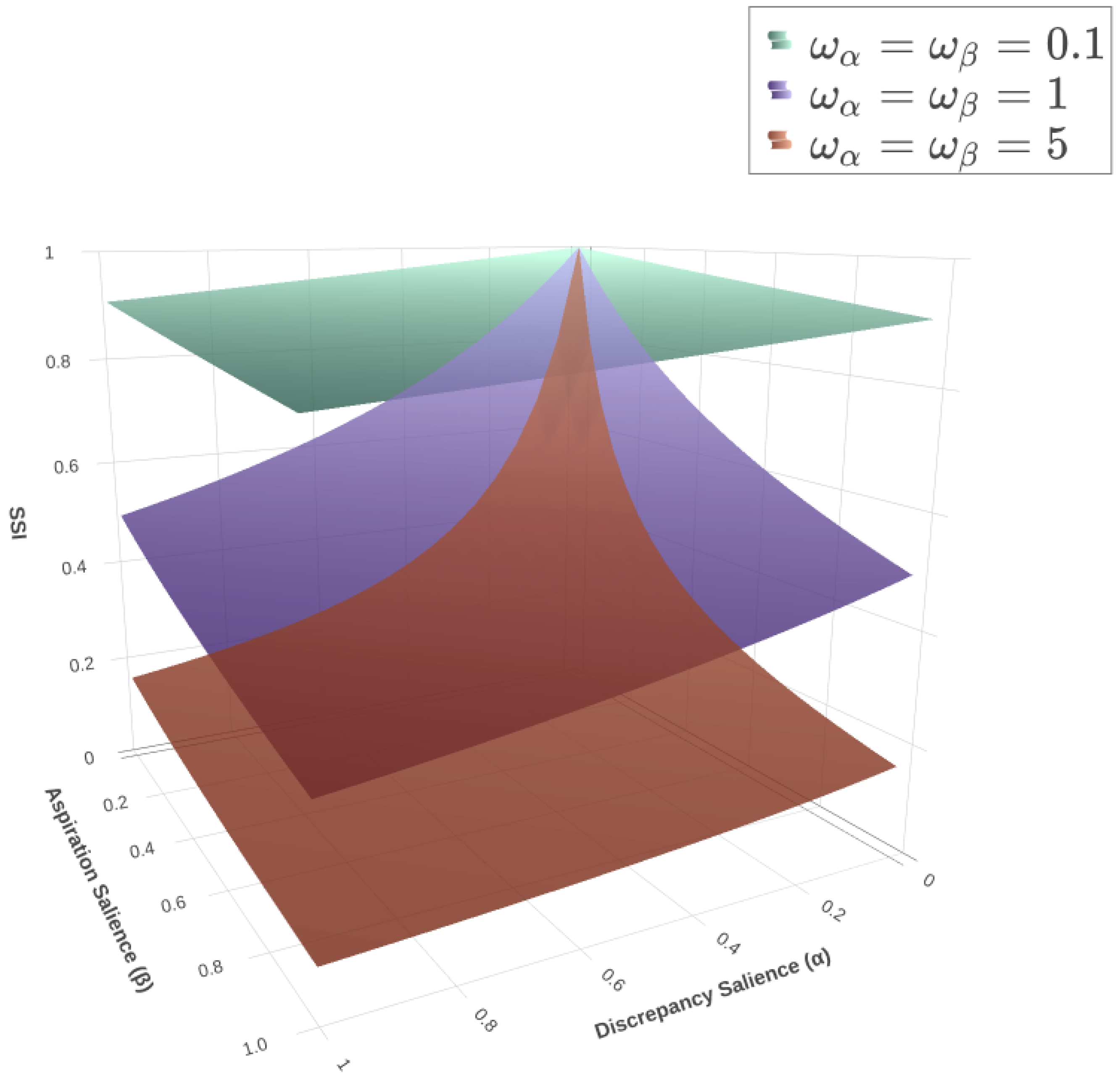
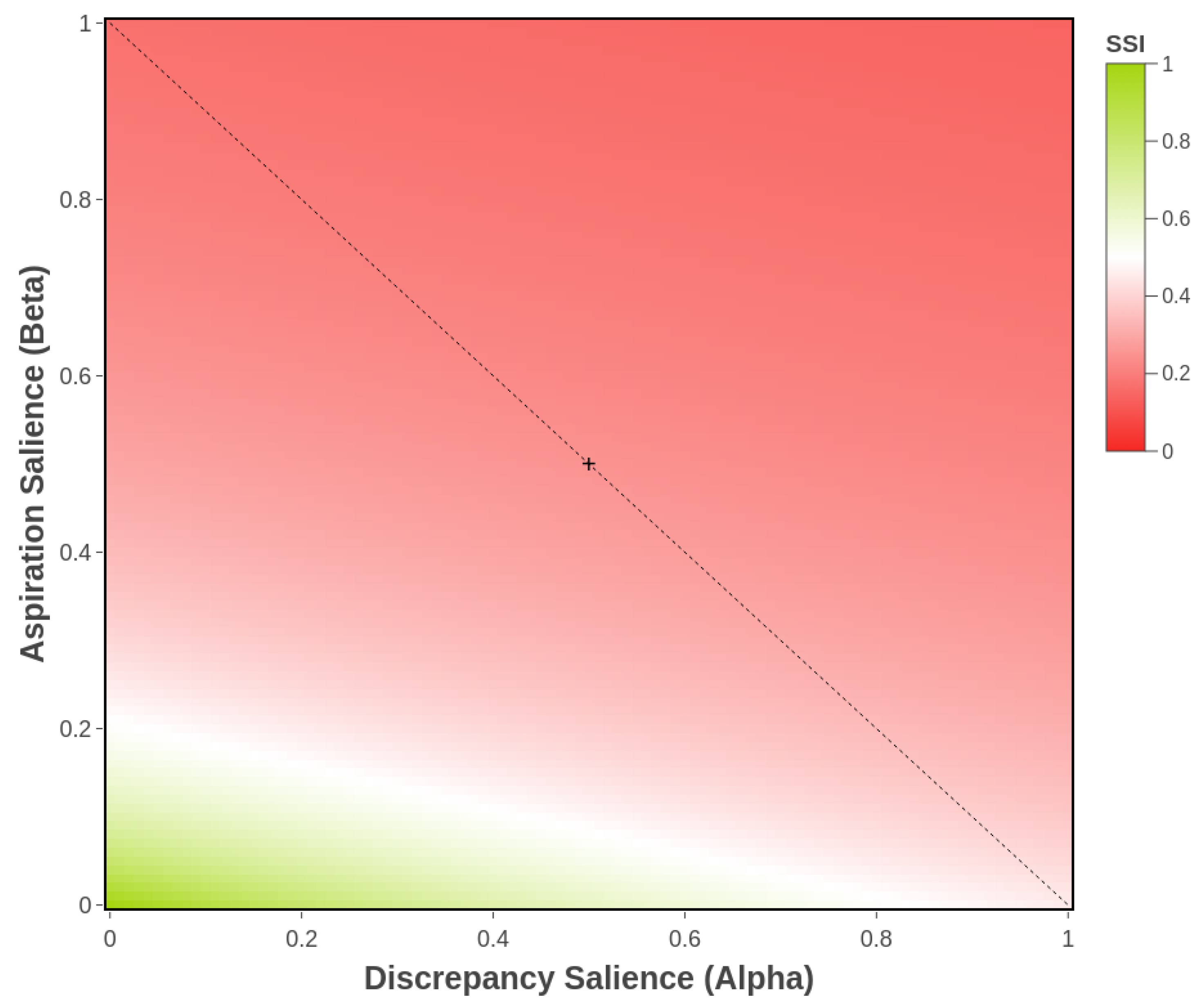
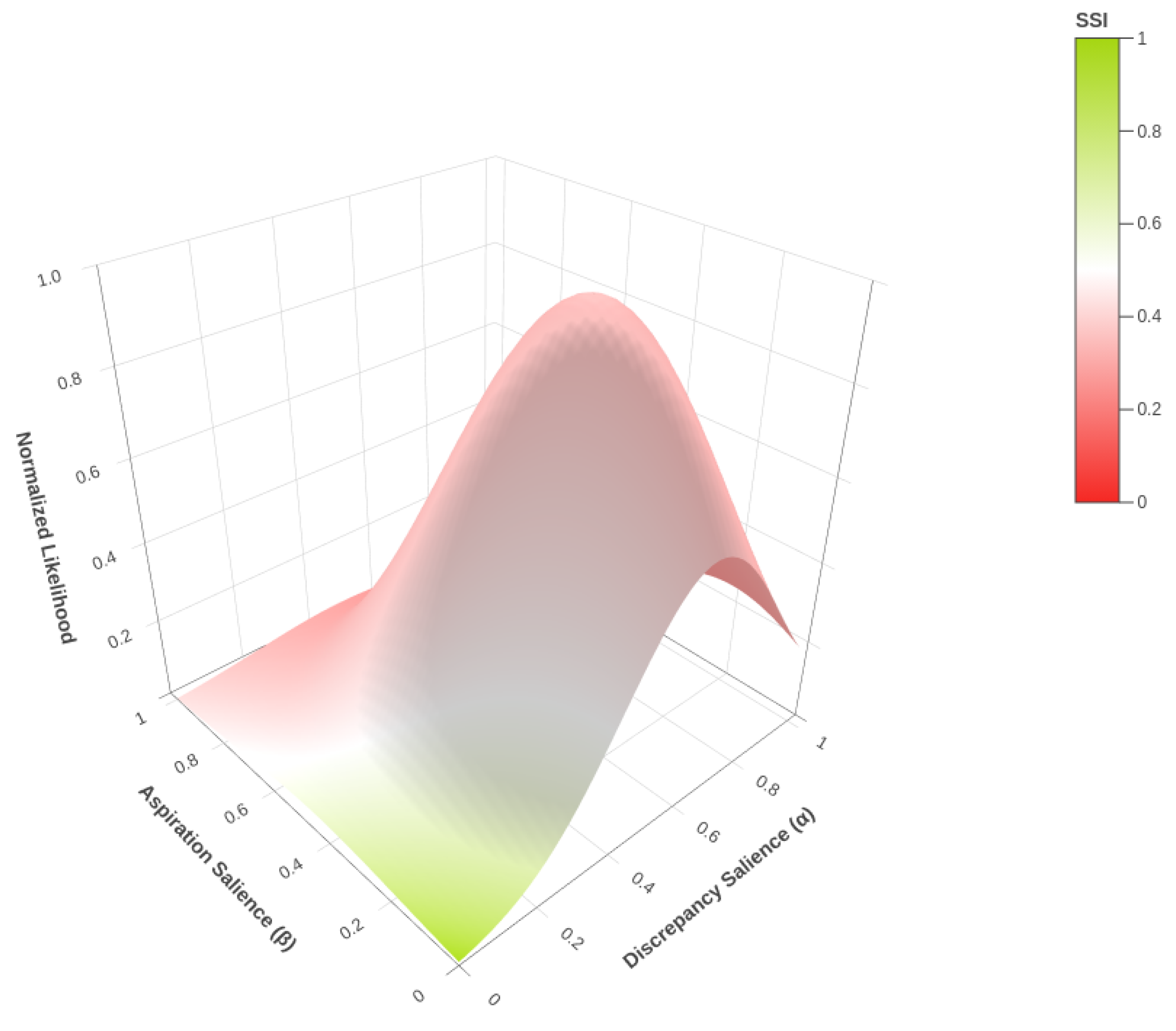
- Non-linearity and Monotonic Decrease: The function is non-linear and strictly decreasing with respect to both α and β. The first partial derivatives are non-zero and negative for all in the domain:
- (ii)
- Convexity: The function is convex over its domain. The second partial derivatives are non-negative, indicating that the rate of decrease is itself decreasing:
- (iii)
- Asymptotic Behavior: The function has a horizontal asymptote at . The limit of the function as either salience parameter tends to infinity is zero:
- (iv)
- Parametrized Sensitivity: The local sensitivity of the index is determined by the gradient vector, , whose magnitude depends directly on the structural coefficients and :where . The magnitude of the gradient, , is thus a direct function of the structural coefficients, confirming their role as shape parameters governing the steepness of the decay.
- (i)
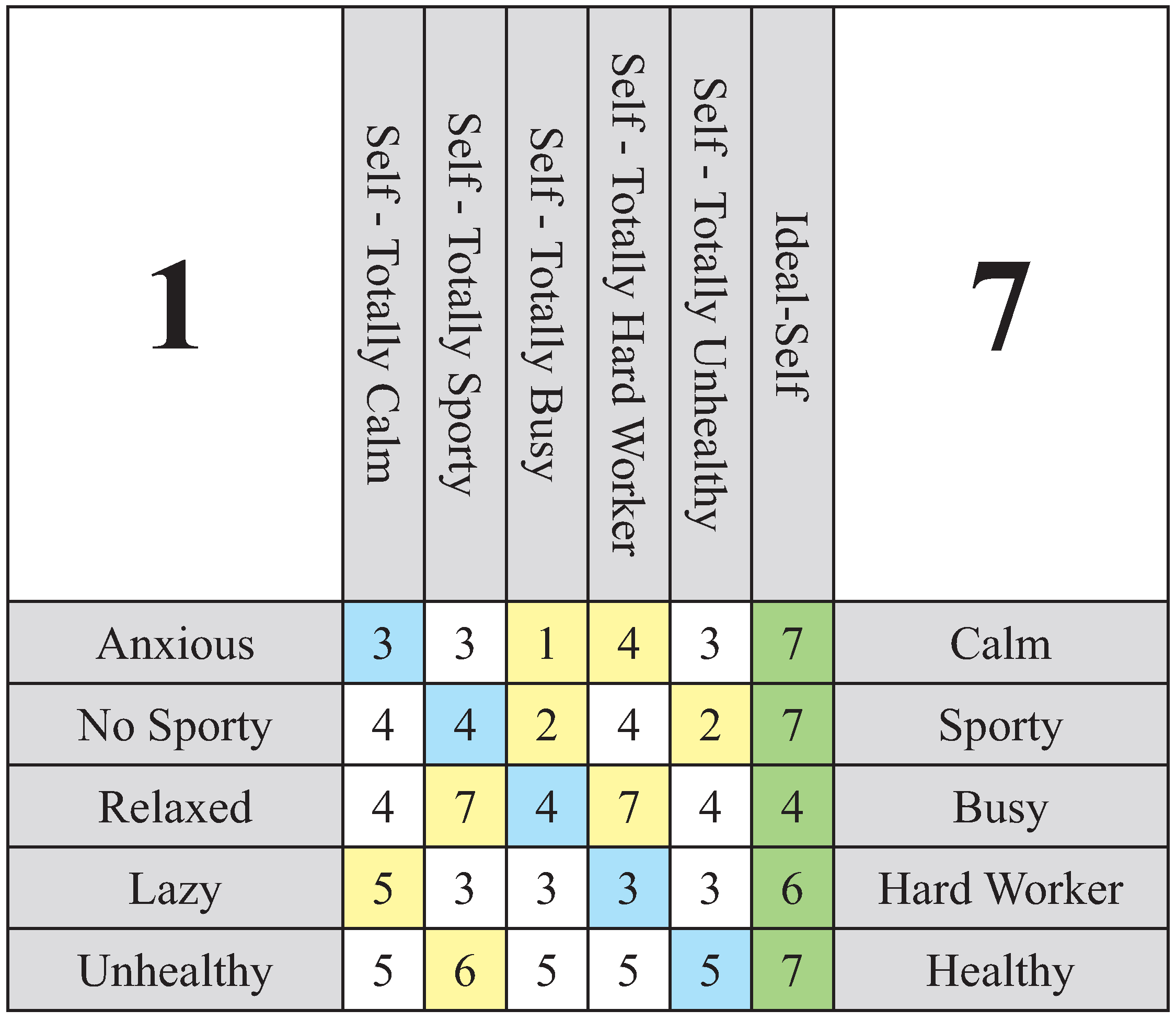
- The magnitude of shared attributes, , for the construct ‘Healthy’ () is:
- (ii)
- The magnitude of self-discrepancies, , for the poles ‘Anxious’ and ‘Lazy’ is:
- (iii)
- The magnitude of unfulfilled aspirations, , for the poles ‘Calm’, ‘Sporty’, and ‘Hard Worker’ is:
2.3. Fuzzy Similarity Interpretation of the SSI Function
- (i)
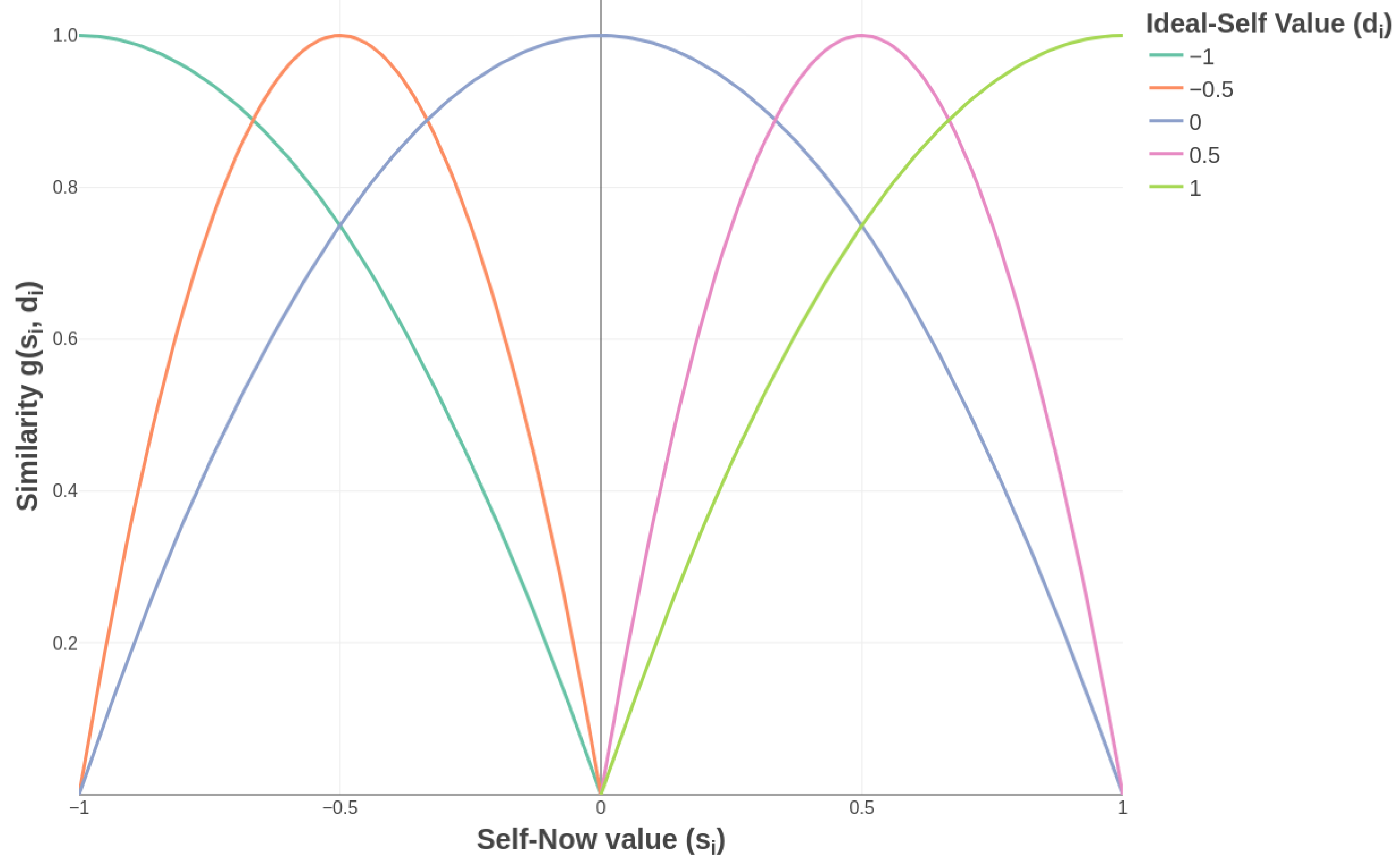
- Normalization: .
- (ii)
- Boundedness: for all .
- (iii)
- Reflexive maximum: if and only if .
- (iv)
- Monotonic decay: decreases strictly as increases.
- (v)
- Continuity: is a continuous and differentiable function.
3. Discussion
3.1. Conceptual Framework of the Fuzzy Similarity Space
3.2. Applications
3.3. Limitations and Future Research Directions
4. Conclusions
Author Contributions
Funding
Data Availability Statement
Conflicts of Interest
Abbreviations
| PCP | Personal Construct Psychology |
| RepGrid | Repertory Grid |
| SSI | Similarity Self/Ideal |
| WimpGrid | Weighted Implication Grid |
References
- Tversky, A. Features of similarity. Psychol. Rev. 1977, 84, 327–352. [Google Scholar] [CrossRef]
- Ryff, C.D. Happiness is everything, or is it? Explorations on the meaning of psychological well-being. J. Personal. Soc. Psychol. 1989, 57, 1069–1081. [Google Scholar] [CrossRef]
- Kahneman, D.; Diener, E.; Schwarz, N. (Eds.) Well-Being: The Foundations of Hedonic Psychology; Russell Sage Foundation: New York, NY, USA, 1999. [Google Scholar]
- Waterman, A.S. Two conceptions of happiness: Contrasts of personal expressiveness (eudaimonia) and hedonic enjoyment. J. Personal. Soc. Psychol. 1993, 64, 678–691. [Google Scholar] [CrossRef]
- Diener, E.; Emmons, R.A.; Larsen, R.J.; Griffin, S. The Satisfaction with Life Scale. J. Personal. Assess. 1985, 49, 71–75. [Google Scholar] [CrossRef]
- Ryff, C.D.; Keyes, C.L.M. The structure of psychological well-being revisited. J. Personal. Soc. Psychol. 1995, 69, 719–727. [Google Scholar] [CrossRef]
- Rosenberg, M. Society and the Adolescent Self-Image; Princeton University Press: Princeton, NJ, USA, 1965. [Google Scholar]
- Watson, D.; Clark, L.A.; Tellegen, A. Development and validation of brief measures of positive and negative affect: The PANAS scales. J. Personal. Soc. Psychol. 1988, 54, 1063–1070. [Google Scholar] [CrossRef]
- Crowne, D.P.; Marlowe, D. A new scale of social desirability independent of psychopathology. J. Consult. Psychol. 1960, 24, 349–354. [Google Scholar] [CrossRef]
- Borsboom, D.; Cramer, A.O.J. Network analysis: An integrative approach to the structure of psychopathology. Annu. Rev. Clin. Psychol. 2013, 9, 91–121. [Google Scholar] [CrossRef]
- Allport, G.W. Personality: A Psychological Interpretation; Henry Holt and Company: New York, NY, USA, 1937. [Google Scholar]
- Wang, M.; Xu, S.; Jiang, J.; Xiang, D.; Hsieh, S. Global reliable diagnosis of networks based on self-comparative diagnosis model and g-good-neighbor property. J. Comput. Syst. Sci. 2026, 155, 103698. [Google Scholar] [CrossRef]
- Kelly, G.A. The Psychology of Personal Constructs; W. W. Norton: New York, NY, USA, 1955. [Google Scholar]
- Fransella, F.; Bell, R.; Bannister, D. A Manual for Repertory Grid Technique; John Wiley & Sons: Chichester, UK, 2004. [Google Scholar]
- Botella, L.; Feixas, G. Teoría de los Constructos Personales: Aplicaciones a la Práctica Psicológica; Laertes: Barcelona, Spain, 1998. [Google Scholar]
- Jones, R.E. Identification in terms of personal constructs: Reconciling a paradox in theory. J. Consult. Psychol. 1961, 25, 276. [Google Scholar] [CrossRef]
- Higgins, E.T. Self-discrepancy: A theory relating self and affect. Psychol. Rev. 1987, 94, 319–340. [Google Scholar] [CrossRef]
- Mackay, N. Identification, reflection, and correlation: Problems in the bases of repertory grid measures. Int. J. Pers. Constr. Psychol. 1992, 5, 57–75. [Google Scholar] [CrossRef]
- Bell, R.C. A note on the correlation of elements in repertory grids: How to and why. J. Constr. Psychol. 2006, 19, 273–279. [Google Scholar] [CrossRef]
- Rosch, E. Cognitive representations of semantic categories. J. Exp. Psychol. Gen. 1975, 104, 192–233. [Google Scholar] [CrossRef]
- Ashby, F.G.; Maddox, W.T. Human category learning. Annu. Rev. Psychol. 2005, 56, 149–178. [Google Scholar] [CrossRef]
- Barsalou, L.W. Grounded Cognition. Annu. Rev. Psychol. 2008, 59, 617–645. [Google Scholar] [CrossRef]
- Sanfeliciano, A.; Saúl, L.A.; Botella, L. Weighted Implication Grid: A graph-theoretical approach to modeling psychological change. Front. Psychol. 2025, 16, 1630920. [Google Scholar] [CrossRef]
- Zadeh, L.A. Fuzzy sets. Inf. Control 1965, 8, 338–353. [Google Scholar] [CrossRef]
- Zimmermann, H.J. Fuzzy Set Theory—Furthermore, Its Applications, 4th ed.; Springer: Boston, MA, USA, 2001. [Google Scholar] [CrossRef]
- Ruspini, E.H. Numerical methods for fuzzy clustering. Inf. Sci. 1970, 2, 319–350. [Google Scholar] [CrossRef]
- Sørensen, T. A method of establishing groups of equal amplitude in plant sociology based on similarity of species content and its application to analyses of the vegetation on Danish commons. In Biologiske Skrifter; Det Kongelige Danske Videnskabernes Selskab: Copenhagen, Denmark, 1948; Volume 5, pp. 1–34. [Google Scholar]
- Dice, L.R. Measures of the Amount of Ecologic Association Between Species. Ecology 1945, 26, 297–302. [Google Scholar] [CrossRef]
- Sanfeliciano, A.; Saúl, L.A. Exploring the Personal Construction of Psychological Change via Graph Theory: Validation of the Weighted Implication Grid. J. Math. Psychol. 2025; submitted. [Google Scholar] [CrossRef]
- Hinkle, D.N. The Change of Personal Constructs from the Viewpoint of a Theory of Construct Implications. Ph.D. Thesis, The Ohio State University, Columbus, OH, USA, 1965. [Google Scholar]
- Sanfeliciano, A.; Saúl, L.A.; Hurtado-Martínez, C.; Botella, L. PB Space: A Mathematical Framework for Modeling Presence and Implication Balance in Psychological Change Through Fuzzy Cognitive Maps. Axioms 2025, 14, 650. [Google Scholar] [CrossRef]



| Traditional RepGrid Metrics | General Fuzzy Similarity Metrics | SSI Index | |
| Conceptual Model | Geometric (Distance-based in Euclidean space) | Set-Theoretic (Graded membership) | Set-Theoretic (Feature-matching within fuzzy space) |
| Mathematical Basis | Linear Algebra / Statistics | Fuzzy Logic Axioms | Tversky’s Contrast Model & Fuzzy Sets |
| Symmetry Assumption | Symmetric | Generally Symmetric | Asymmetric |
| Pole Reversal Sensitivity | High (Correlation sign flips arbitrarily) | N/A (Depends on membership definition) | Robust (Treats poles as distinct signed features) |
| Magnitude Integration | Indirect (via Euclidean distance) | Direct (via membership grade) | Direct (via attribute intensity and weights) |
| Output Range | |||
| Main Limitations | Assumes linearity and symmetry; sensitive to arbitrary pole assignment. | Requires abstract definition of membership functions; computationally complex. | Requires estimation of salience parameters (). |
Disclaimer/Publisher’s Note: The statements, opinions and data contained in all publications are solely those of the individual author(s) and contributor(s) and not of MDPI and/or the editor(s). MDPI and/or the editor(s) disclaim responsibility for any injury to people or property resulting from any ideas, methods, instructions or products referred to in the content. |
© 2025 by the authors. Licensee MDPI, Basel, Switzerland. This article is an open access article distributed under the terms and conditions of the Creative Commons Attribution (CC BY) license (https://creativecommons.org/licenses/by/4.0/).
Share and Cite
Sanfeliciano, A.; Hurtado-Martínez, C.; Botella, L.; Saúl, L.A. Similarity Self/Ideal Index (SSI): A Feature-Based Approach to Modeling Psychological Well-Being. Mathematics 2025, 13, 3954. https://doi.org/10.3390/math13243954
Sanfeliciano A, Hurtado-Martínez C, Botella L, Saúl LA. Similarity Self/Ideal Index (SSI): A Feature-Based Approach to Modeling Psychological Well-Being. Mathematics. 2025; 13(24):3954. https://doi.org/10.3390/math13243954
Chicago/Turabian StyleSanfeliciano, Alejandro, Carlos Hurtado-Martínez, Luis Botella, and Luis Angel Saúl. 2025. "Similarity Self/Ideal Index (SSI): A Feature-Based Approach to Modeling Psychological Well-Being" Mathematics 13, no. 24: 3954. https://doi.org/10.3390/math13243954
APA StyleSanfeliciano, A., Hurtado-Martínez, C., Botella, L., & Saúl, L. A. (2025). Similarity Self/Ideal Index (SSI): A Feature-Based Approach to Modeling Psychological Well-Being. Mathematics, 13(24), 3954. https://doi.org/10.3390/math13243954