1. Introduction
Much work has recently been carried out on the role of electric and magnetic fields for technological applications in the confinement of relativistic massive charged particles, especially in two-dimensional systems governed by the Dirac–Weyl equation, although it is known that this is not suitable for massless two-dimensional particles due to the existence of a strong Klein tunneling effect [
1,
2]. To be more precise, in reference [
3], the scattering and resonances in the Dirac equation are analyzed for the case of spherical potential and, in [
4], graphene is studied as a Dirac material, studying the bound states and considering various topology and potential configurations. In [
5], the confinement of fermions in graphene by means of magnetic fields is considered, and, in [
6], something similar is studied for electrons with mass. Reference [
7] considers electrons confined in the plane in the presence of both magnetic fields perpendicular to the plane and electric fields in the plane. Various works study the properties of quantum dots. For example, reference [
8] addresses the resonances in an electric quantum dot; in [
9], the confining properties of a quantum dot under an electrostatic potential with different symmetries (circular, Cartesian) are considered; and, in [
10], quantum dots subjected to potentials with rotational symmetry are investigated in bilayer graphene. Furthermore, it is worthy to mention the studies of the bound states of the Dirac equation for massless fermions under hyperbolic [
11], Pöschl–Teller-type potential in one dimension [
12], Coulomb-type electric fields [
13], graphene strips [
14], and the zero energy states for various electrostatic potentials in quantum dots and graphene [
15,
16,
17].
Another situation where electric fields are able to confine particles is when we deal with a quantum dot with some kind of symmetry, typically radial, that allows for a well-defined angular momentum quantum number. The confinement of massive particles in two dimensions has also been studied to better understand new topological materials, such as graphene, silicene, germanene, stanene, and phosphorene [
18,
19,
20], where charges acquire effective mass from spin–orbit interaction and perpendicular electric fields [
21,
22]. An important consequence of massive particle confinement is that it allows to observe the phenomenon of atomic collapse, which is very difficult to detect in relativistic quantum mechanics but is accessible with Dirac materials [
23,
24,
25,
26] due to the existence of the Fermi velocity
[
27]. The search for resonances is also an interesting topic, and in fact confinement in Dirac materials must necessarily include bound and resonance states [
28].
Although it is clear that the aforementioned technological applications are extremely interesting, in this work, our focus is on the theoretical analysis of certain two-dimensional systems that are governed by the (2 + 1) massive Dirac equation subjected to a type of toy potential, the singular contact interactions in two dimensions. It is well-known that contact or point interactions in one-dimensional relativistic quantum mechanics have been used to model short-range potentials. They are singular interactions whose appropriate treatment needs the use of special mathematical methods in order to avoid ambiguities (see [
29] and references quoted therein). The main goal of the present work is to adapt a recent distributional approach, originally developed for the one-dimensional case [
30], to study, in a mathematically rigorous manner, radially symmetric two-dimensional contact interactions supported on a circumference of radius
R. From the radial symmetry, it is possible to reduce the problem to one dimension (the radial one), and apply in an almost straightforward way the distributional approach of [
30] to a contact potential at
. In the actual one-dimensional case, the usual four parameters of the point interactions can be rewritten in terms of four physical potentials strengths, corresponding to a scalar, a pseudoscalar, and the two components of a (1 + 1) Lorentz electromagnetic point potential [
30]. As is seen here, in the two-dimensional case with radial symmetry and a singular potential concentrated on a circumference, those four parameters will correspond to the physical strengths of a scalar and the three components of a (2 + 1) electromagnetic Lorentz singular potential. After obtaining the general solutions for the Dirac equation with the most general contact interaction concentrated on the circumference, we consider some special cases, namely, a purely scalar potential, a purely electrostatic potential, a purely magnetic potential, and two mixtures of a scalar and an electrostatic potential. In each of these cases, we systematically investigate the confining properties of the contact potential, understood broadly as the structure of the bound states and resonances, and the conditions under which the circular barrier becomes impenetrable.
The structure of the paper is as follows. In
Section 2, we review the covariant form of the Dirac equation in (2 + 1) dimensions with the most general external regular potential with radial symmetry. In
Section 3, we consider the (2 + 1) Dirac equation with the most general, time-independent, contact potential supported on a circumference of radius
R. In
Section 4, we determine the equations for the energy eigenstates of the previously derived Dirac radial equation, including bound states, scattering states, and resonances. These quantities are subsequently investigated for some special cases of physical interest in
Section 5. The paper ends with a discussion and conclusions in
Section 6.
2. Planar Dirac Equation with a Radial Regular Potential
In this section, we briefly review the covariant form of the Dirac equation in (2 + 1) dimensions for a particle of mass
m interacting with the most general external regular potential. By a regular potential we mean a potential that is described, in the laboratory frame, by a function
that is locally integrable with respect to the space coordinates, i.e.,
for every closed finite
. The Dirac equation for a potential formed by a scalar
and a vector potential
, with
and
(we are using natural units,
):
Above,
is the Dirac 2-component spinor,
is the
identity matrix, and
are
Dirac matrices satisfying
, with the metric tensor being
. For convenience, we use the following representation for the Dirac matrices, in terms of the Pauli matrices:
We are interested in the case where, in a particular reference frame (e.g., the laboratory frame), the potentials are independent of time, and the time-independent Dirac equation reads as follows:
where
is the position vector of the Dirac particle in the cartesian coordinates of the laboratory frame,
is the corresponding time independent Dirac spinor and
Even if the potential in the Dirac Equation (
2) is
, we sometimes abuse the language and refer to
as the potential.
Since we are only interested in the case where the potentials have radial symmetry (in the laboratory reference frame), it is natural to use polar coordinates from now on. The space cartesian components
(
) of the Lorentz vector potential transform to the polar components
and
, with
and
the polar angle, as
where
,
, and, with a slight abuse of notation,
,
. By defining
we can write (
3) in polar coordinates as
The whole potential will have radial symmetry if all the above four potentials
,
,
, and
depend only on
r, and in this case we will denote them simply as
, and
. We observe that in (2 + 1) dimensions, the magnetic field
is a scalar quantity (under rotations), given by the
of the curl of a space vector lying in the
-plane,
With radial symmetry,
, and we have
Thus, in polar coordinates, the Dirac Equation (
2), with a radial potential (
5), reads
To obtain the above equation, we used (
4) as follows, as well as the transformations of the derivatives:
Taking advantage of the radial symmetry, we seek for solutions of the time-independent Dirac equation that are also eigensolutions of the total angular momentum operator:
By writing the time-independent Dirac spinor in the separated form,
where
and
, the eigenvalue equation for
is
, which implies
and, thus,
It is direct to see that
is a unitary matrix,
.
Now, turning (
7), with (
8), into the Dirac equation (
6), and multiplying from the left by
, we obtain
From (
8), (
4), and (
1), we have
Substituting the above results into Equation (
9), we obtain the radial Dirac equation
which can be written in terms of an effective potential:
where
Conservation of the Dirac Current
The Dirac current in (2 + 1) dimensions, in cartesian components, is given by
The current conservation states that
, which, in the cartesian coordinates of the laboratory frame, reads as
Integrating the above on a arbitrary circle
of radius
, and using the divergence theorem, we obtain (below,
is the unit vector in the radial direction)
where
is the total probability to find the Dirac particle enclosed inside the circumference
of radius
. Above, we identified the radial component of the Dirac current,
, and used the fact that the radial symmetry implies that it does not depend on
(see below).
Now, we restrict ourselves to the stationary case. From the radial symmetry, we have
The explicit form of the component
is
and, for the cartesian space components, we have
where, from (
4) and (
14), we have identified the
r and
-components of the stationary Dirac current as
From (
15) and (16), it is clear that both the current’s polar components
and
do not depend on the angular coordinate
, as mentioned earlier. Thus, we write
and
. From the above, we have that along the angular direction both the stationary currents
and
are constant and, from (
13), in the stationary case, we have that the quantity
vanishes, which implies that
,
. In particular, for any radius
,
Summarizing the results obtained so far, we have that, for an external, regular, and radial symmetric potential,
, the radial spinor
must solve the one-dimensional stationary Dirac Equation (
11) with the effective one-dimensional potential (
12). The conservation of the Dirac current in the original two-dimensional problem implies that the one-dimensional (radial) stationary current
, given by (
15), is continuous (and vanishes) at any
r, and therefore satisfies condition (
17).
Equation (
11) is mathematically analogous to the Dirac equation in (1 + 1) dimensions, with an external potential
(see Equation (
3) on p. 4 in [
30]). However, (
11) holds only for
. In the next section, we show how to extend it as a distributional equation on the interval
, and which condition the Dirac spinor
must satisfy at
. The analogous roles of the potentials
and
of the regular, true one-dimensional case (see Equation (
2) in [
30]) will be played in (
11) by the following combinations:
It is worthy to observe that in (
11) the effective one-dimensional potential in the radial direction,
, is not Hermitian, due to the presence of the imaginary quantity
added to the potential
in (
18). However, this is immaterial, since, for the distributional method of [
30] to be applicable in the present case, it suffices that the current be continuous at
. Finally, it is worthy to note that the original potential
is in fact Hermitian, and the Lorentz vector
is conserved.
3. Dirac Equation with Radial Contact Potentials at
Now, we consider the Dirac equation with the most general, time-independent, contact potential supported on a circumference of radius
R in the laboratory frame. Since now the potential is singular, the products between the potentials and the spinors
appearing in (
11) are not well-defined. Guided by the analogy to the one-dimensional case, we follow closely the steps in reference [
30] and write the time-independent Dirac equation as
where
is the regular part of the effective potential. Since this term defines a regular distribution on
, which includes the origin, Equation (
19), understood as a distributional equation, can be extended to include the origin, which is assumed from now on. We note that in polar coordinates, a radial function
is said to define a regular distribution if it is locally integrable on
, i.e., if
for any closed finite interval
, in which case we denote
; due to the presence of the Jacobian factor
r in the integral, the potential (
20) is locally integrable also on
. The first term in the right-hand side of (
19) is the contact term, and is a
matrix, yet unknown, whose elements are singular (not regular) distributions, related to the singular potentials concentrated at
. The distribution space we consider here is the Schwartz space
, which consists of continuous linear functionals acting on the Schwartz space
of infinitely differentiable strongly decreasing test functions. For details, we refer the reader to reference [
30]. The distribution
is determined from the following three basic requirements (adapted from [
30]):
- (R1)
must be a distribution concentrated at , i.e., it must be equal to the zero distribution on .
- (R2)
The two components of the radial Dirac spinor must correspond to regular distributions on , i.e., they must be slow growth functions and locally integrable (in the Lebesgue sense) on . This is equivalent to saying that must have order on any closed interval .
- (R3)
The Dirac current must be conserved across . In the stationary case, this implies that .
The definition we are using above for the
order of a distribution on a closed, finite interval
, is the same as [
30], adapted to the semi-infinite axis
. Briefly, with
, the order of the Dirac delta distribution
on
K is
. Taking the derivative of any distribution increases its order on
K by
, whereas taking an indefinite integral (a primitive) decreases its order by
. The order of a sum of distributions on
K is the largest order of its terms. A distribution has order
on
K if it is infinitely differentiable on
K. A distribution has order
on
K if on this interval it coincides with a continuous but not differentiable (in the ordinary sense) function. A distribution of order
corresponds to a discontinuous function, and may or may not be regular. A distribution having order
on
K is always singular. For more details, we refer the reader to [
30].
From requirement (R2), and balancing the orders on both sides of (
19), the order of the interaction distribution
on any interval
must be
. This same requirement also sets a maximum for the order of the spinor
on a closed finite interval
containing the origin, but not containing
R, i.e.,
,
. Since on
the contact distribution
equals the zero distribution, and the term (
20) has order
(since it is regular on
, see the text after equation (
20)), by balancing the orders on both sides of (
19), we conclude that
on
and, consequently,
on
. This means that the spinor
must be continuous on
and, therefore, it must be bounded at the origin. By a continuous distribution on a closed, finite interval
, we are referring to a regular distribution which coincides with a continuous ordinary function almost everywhere on
K. This is another way to justify, in a mathematically rigorous way, the usual assumption of boundedness of the Dirac spinor at
.
Theorem 3.5-2 in [
31] states that a distribution that is concentrated at a single point
, and that has singular order
s on a closed finite interval
, must in this interval coincide with a finite linear combination of Dirac deltas and its derivatives, up to order
s. Since on
K the order of
is zero, we must have
. We have that, on
K,
(from (R2)) and, consequently,
. Now, by balancing the orders on both sides of (
19), we have that
, and therefore
on
K. Requirements (R1) and (R2) thus imply that
where the
matrix
does not depend on the coordinate
r, and will have a functional (linear) dependence of the spinor
. The form of
will completely specify the contact term, and below it is found from requirement (R3). As is shown, the obtained form of
will imply matching conditions that
must satisfy at
, similar to the true one-dimensional case. Also, it will provide the contact term
explicitly as a well-defined distribution defined on the semi-axis
.
To determine
, we proceed exactly in the same way as in [
30]. By taking a distributional indefinite integral of Equation (
19) on
,
, we obtain
where
is any primitive of
,
is a primitive of the product
, and
c is a constant and arbitrary column matrix. Similarly to the reasoning in [
30], we conclude that both functions,
and
, are continuous on
K. That
is regular on
is clear from the fact that
is regular (from (R2)) and
is continuous at
; thus, this product is a regular distribution and, therefore, any of its primitives is a continuous function—by the way,
is also regular on
, since on this interval,
is regular and
is continuous. By isolating the term
in the above equation, we find that
must have well-defined lateral limits at
. By considering the limits
in (
22) and taking the difference, we obtain
Now, the functional coefficient
is determined from requirement (R3):
The problem of determining
from (
23), by using the current condition (
24), is mathematically analogous to the one-dimensional problem treated in [
30]. Therefore, we just collect the results from [
30], replacing the analogous quantities in the present problem:
where the real constants
, and
are identified with the strengths of the singular potentials associated to the contact term supported on
, namely, from (
21),
The radial Dirac Equation (
19), with the contact and the regular interaction terms given explicitly, is
A
permeable contact interaction is characterized by the condition (see Equation (
55) in [
30])
which means that the solutions at
and
are connected by the following matching conditions:
where the
matrix is written in terms of the physical strengths as (observe that, when collecting the results from Equation (57) in [
30], we should replace
):
Yet, to have a unique set of
-parameters
, given a set of parameters
and
and
satisfying the permeability conditions (
26), we can write the relationships
where in the above expressions the plus (minus) sign must be taken if
(
); if
, we must take the same sign as
(see [
30]).
When the strength potentials are such that the permeability condition (
26) is not met, the circular wall at
is impenetrable, and some (or all) of the
matrix parameters become infinite. In this case, the inner and outer solutions are independent, the (anti)particle is completely confined in the inner (outer) region of the circumference of radius
R, and it cannot be transmitted to the outer (inner) region. The set of allowed energies for the (anti)particle confined in the inner region will depend on the boundary conditions at
, which in turn depend on the values of the strength potentials. In the outer region, all energies
are allowed; the
cases may or may not be allowed in the outer region, as we see later. In the following sections, we use the matching conditions (
27), together with the form (
28) of the
matrix in terms of the physical strengths, to study bound, scattering, and resonant states for various choices of the contact potentials. Cases that give rise to an impermeable wall can be obtained by considering the corresponding limits on the
parameters.
6. Discussion and Conclusions
In this work, we investigate the massive Dirac equation in the plane, with a singular interaction supported on a circumference of radius
R. Using the radial symmetry of the interaction, we show that this problem can be reduced to a one-dimensional point interaction problem in the radial coordinate. To study this problem, we adapt the distributional approach in [
30], in which a physical interpretation of the parameters of point interactions in one dimension was given in terms of the strengths of four Lorentz singular point potentials. In this way, we were able to interpret the four parameters of the singular interaction supported on the circumference as the strengths of a scalar (
B) and the three polar components (
, and
) of a Lorentz vector. It is worth noting that the usual requirement of boundedness of the Dirac spinor at the origin (sometimes stated without justification) arises from the basic assumptions of the distributional approach.
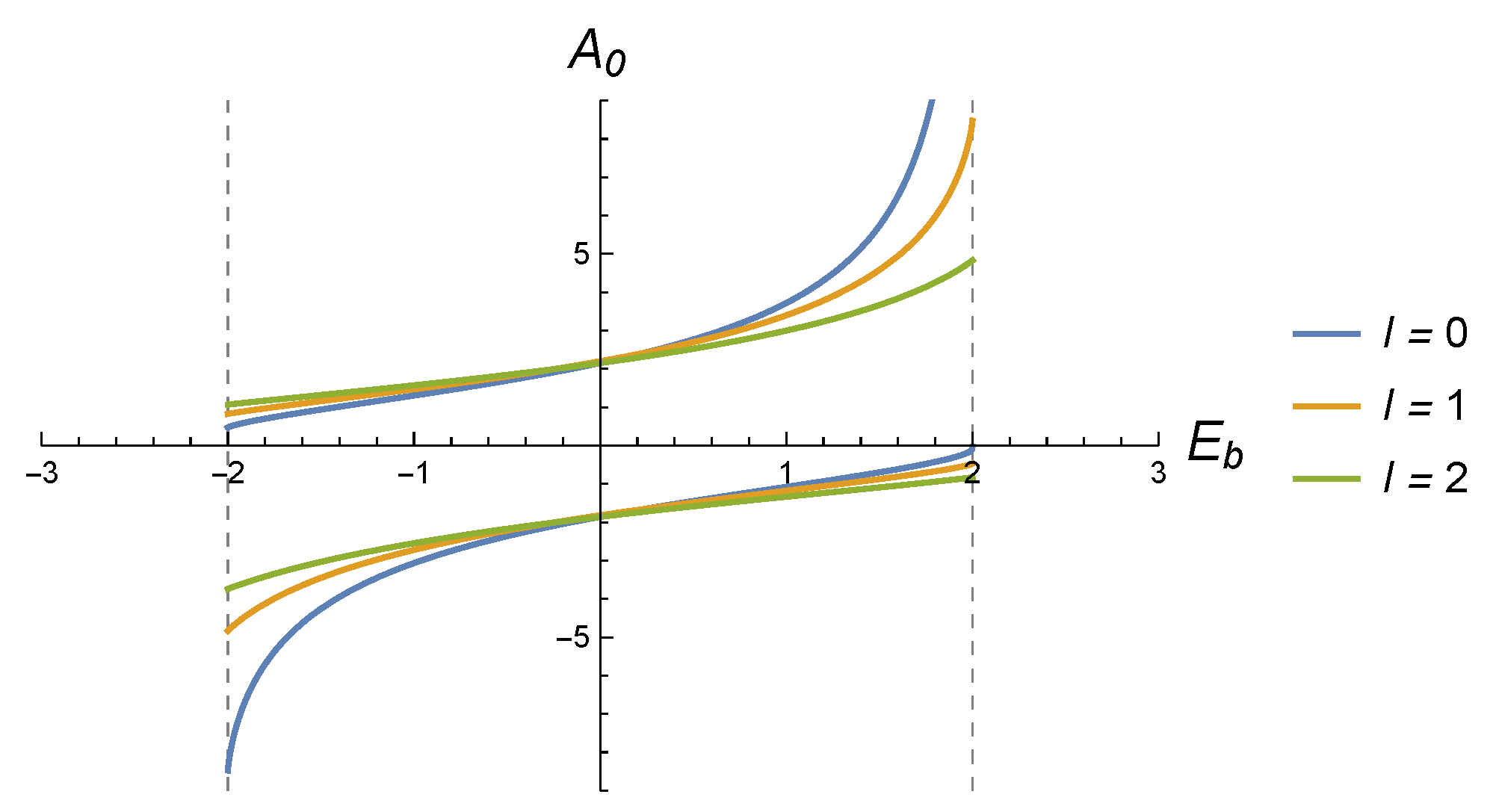
After obtaining time-independent solutions for critical, supercritical, bound, and scattering states for the most general contact potential concentrated on
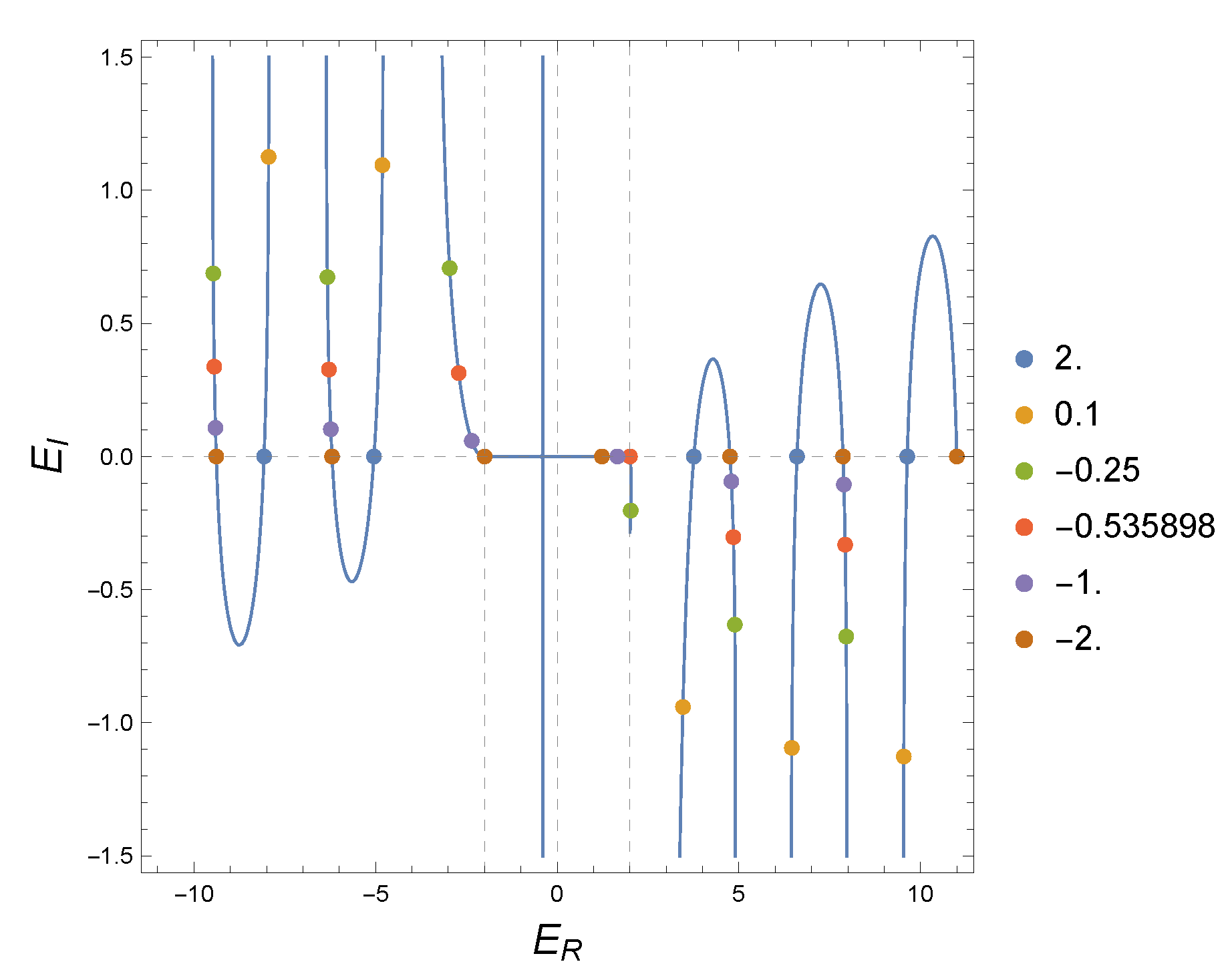
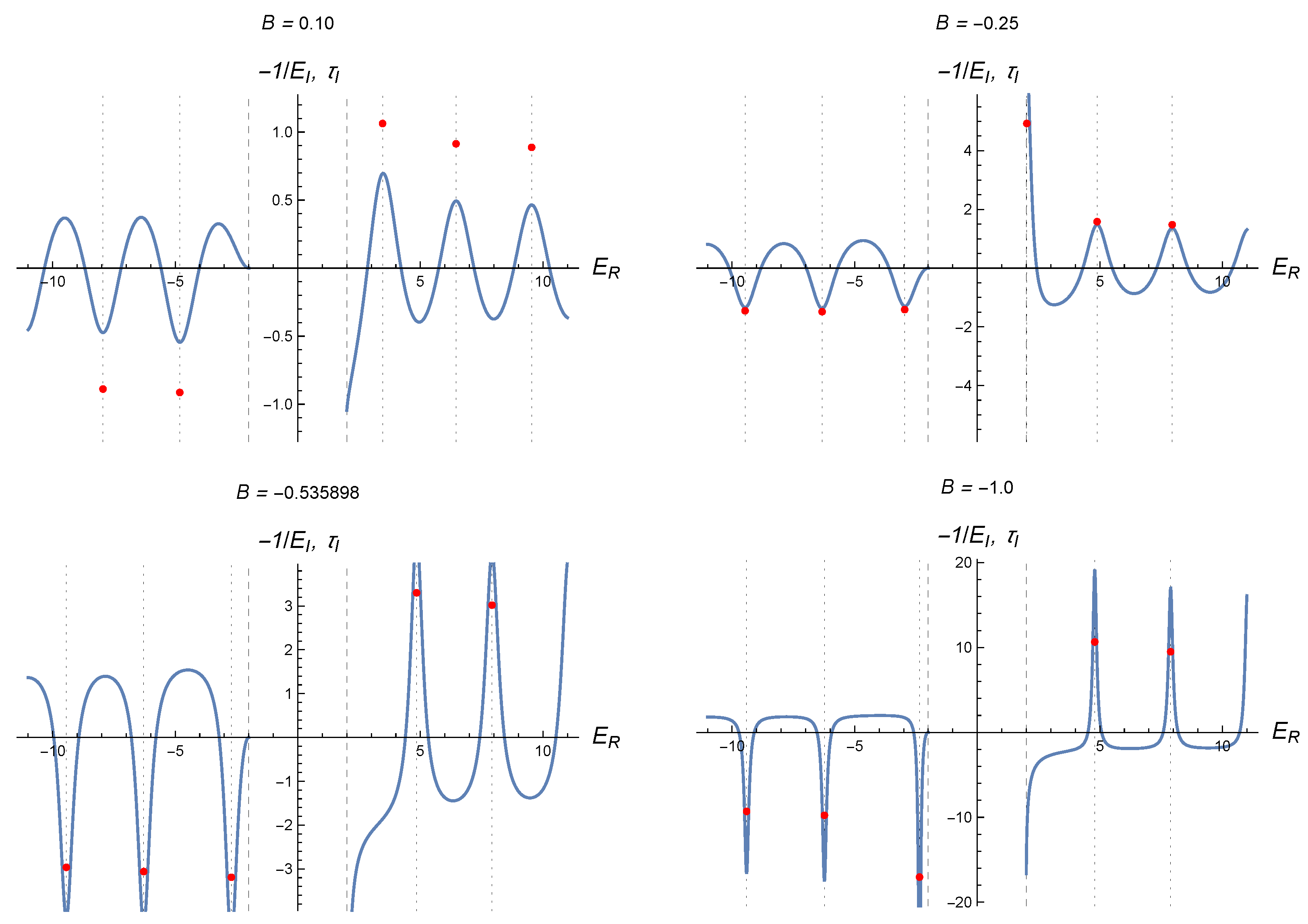
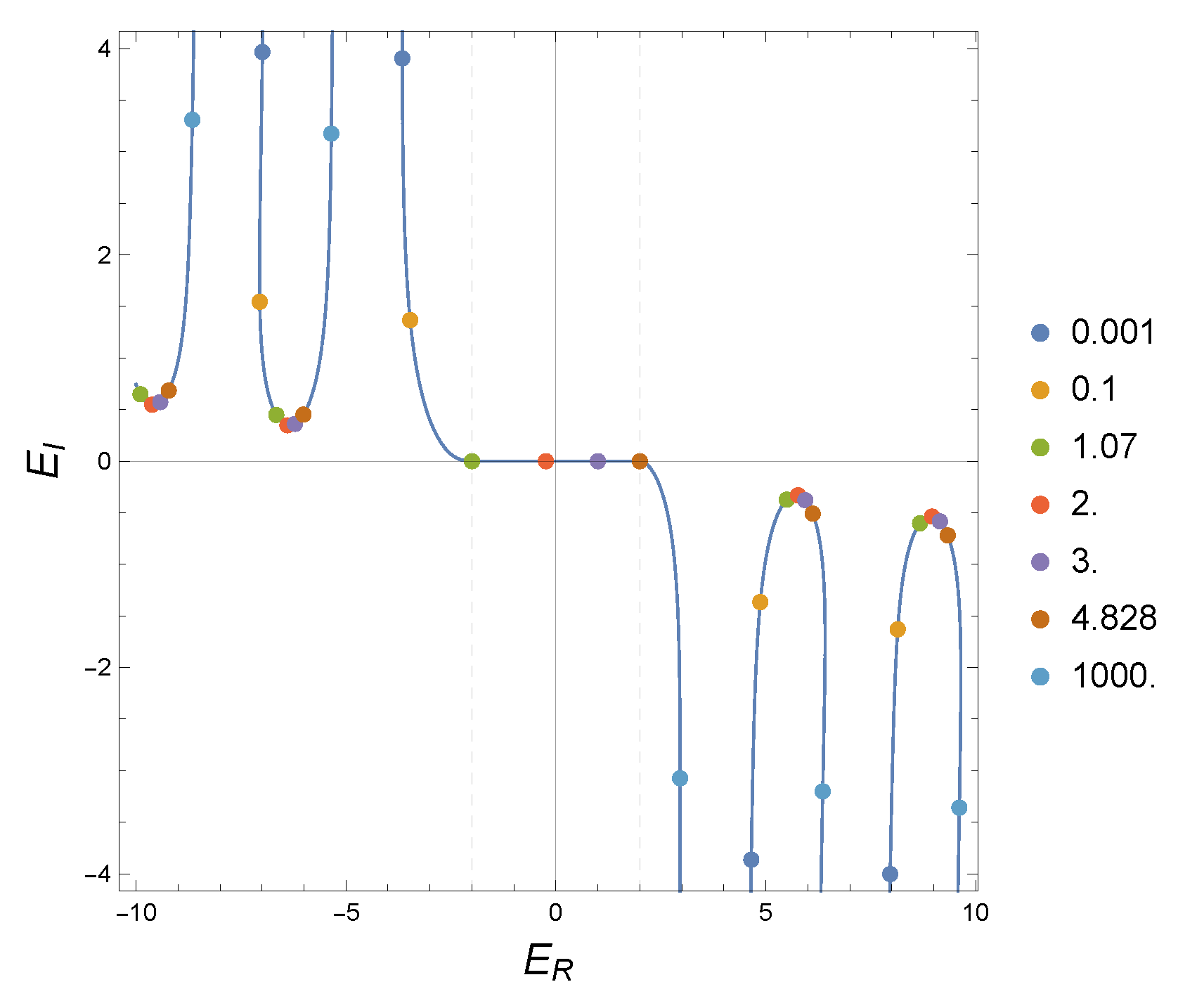
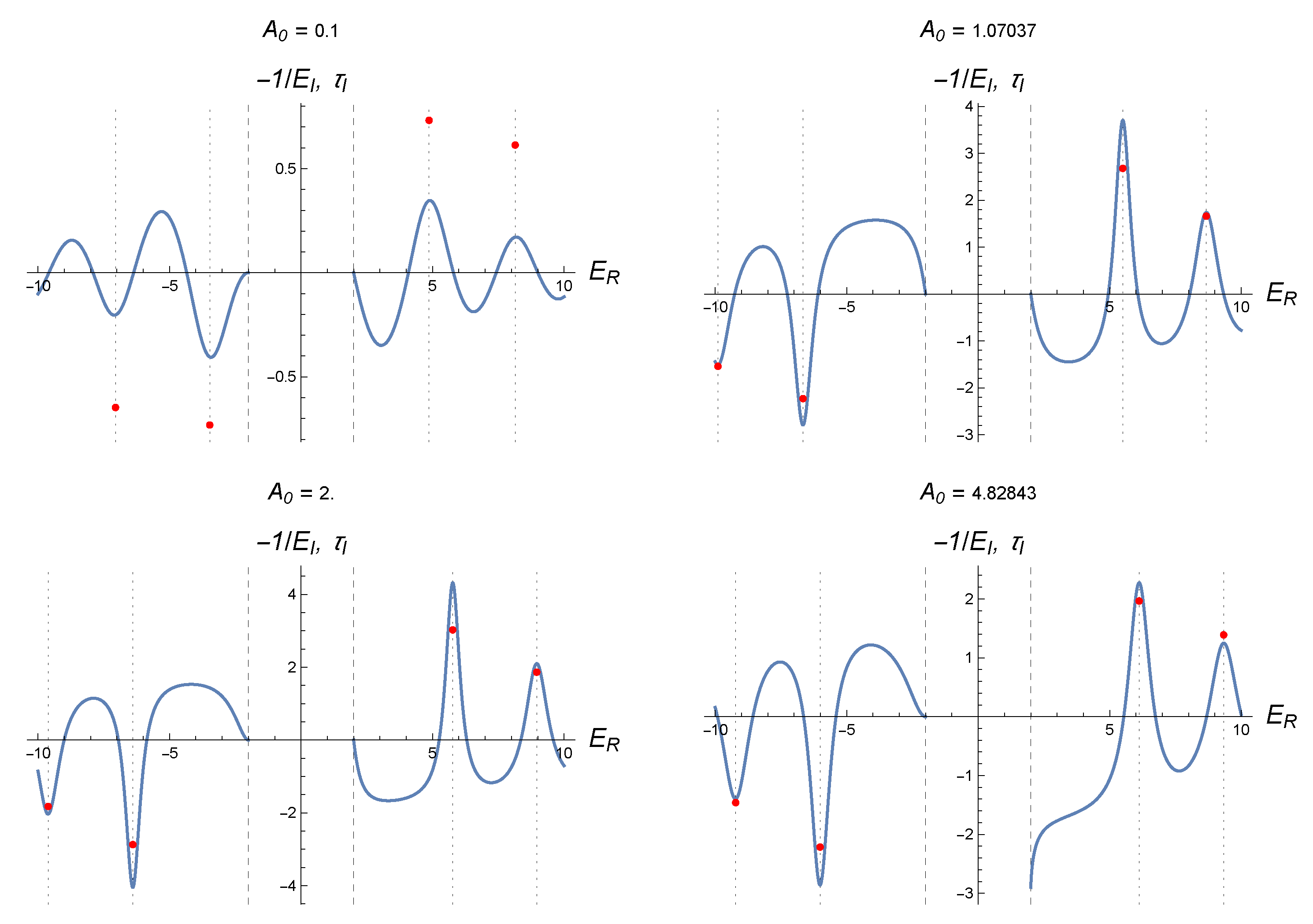
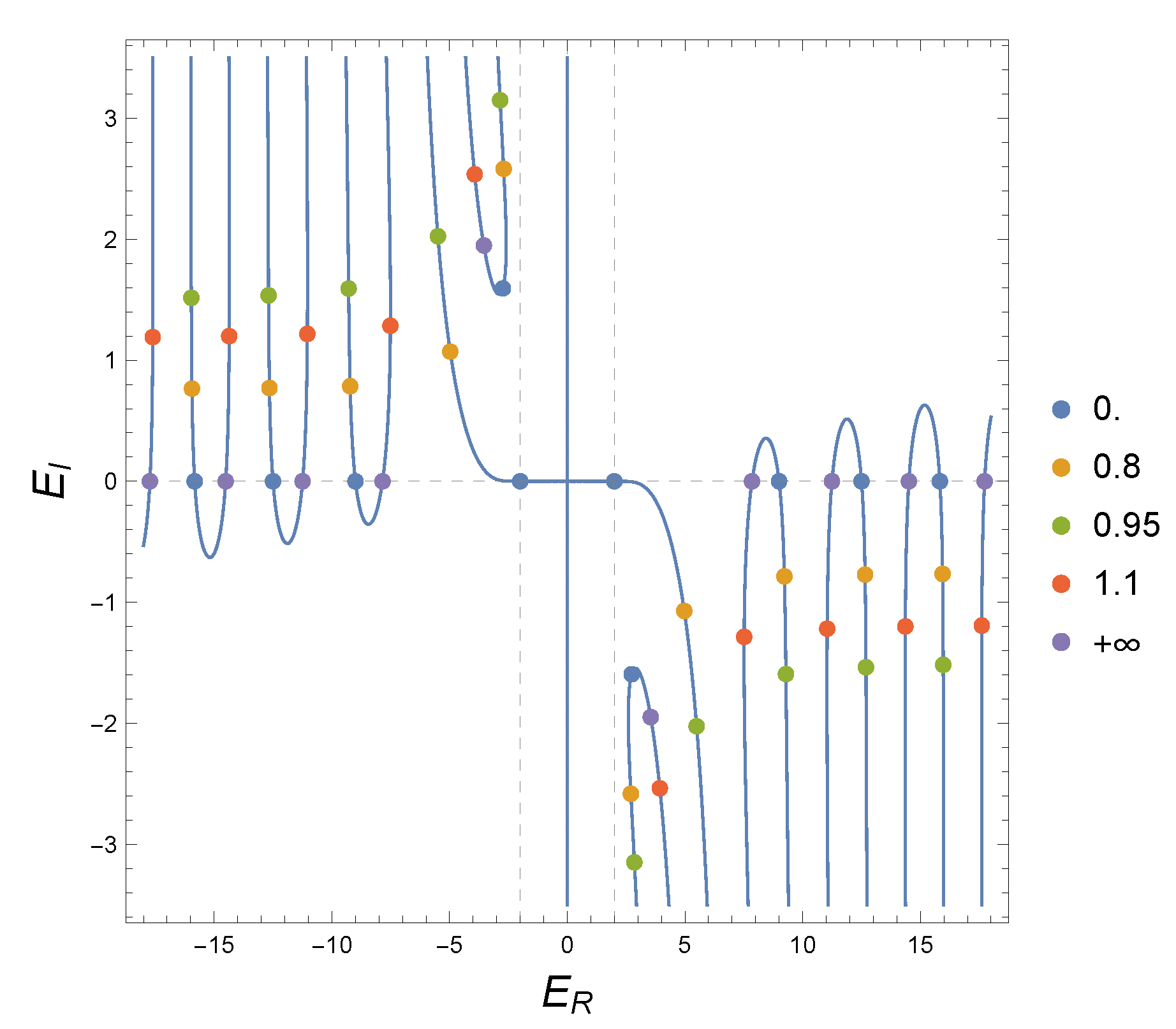
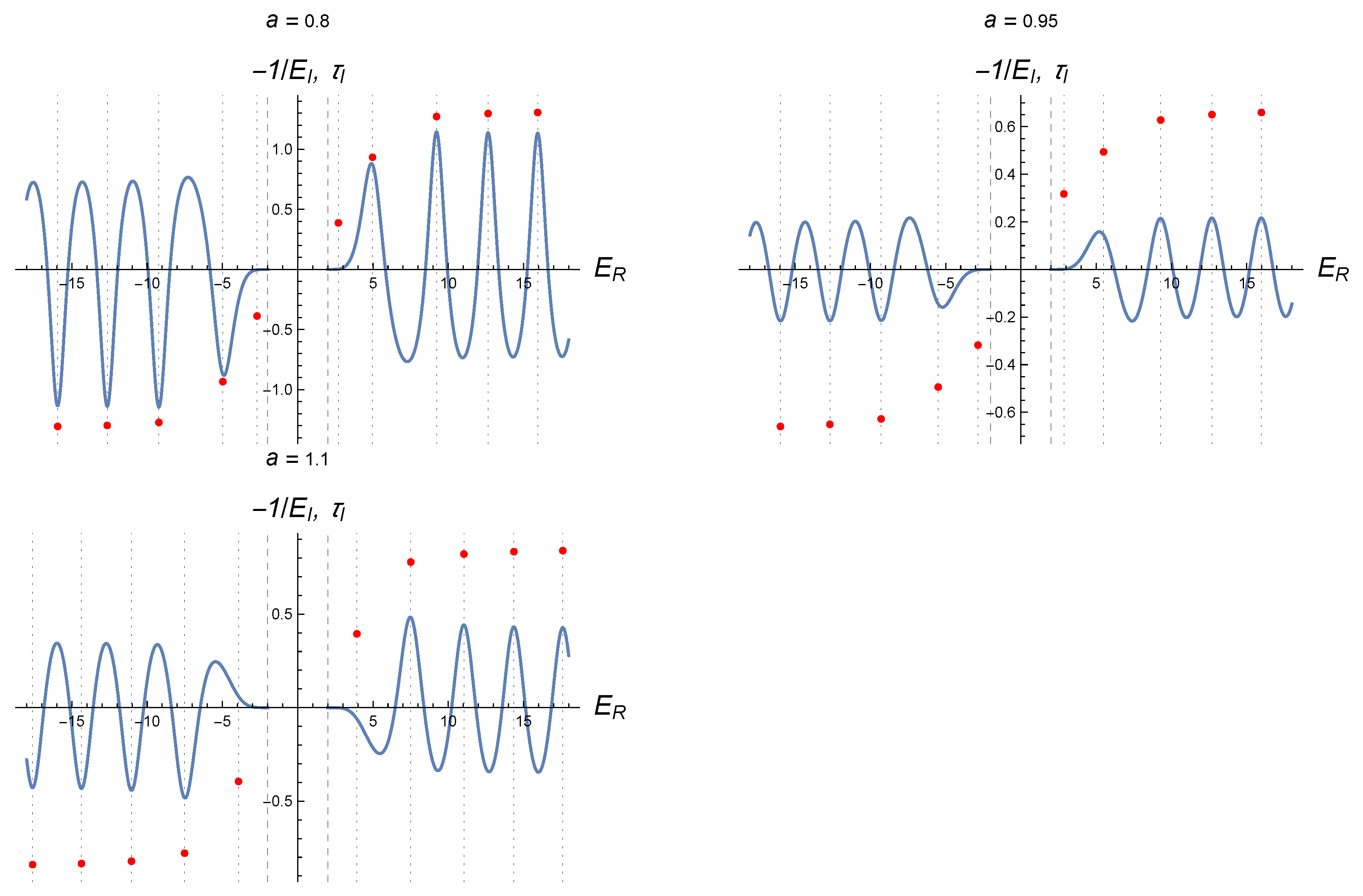
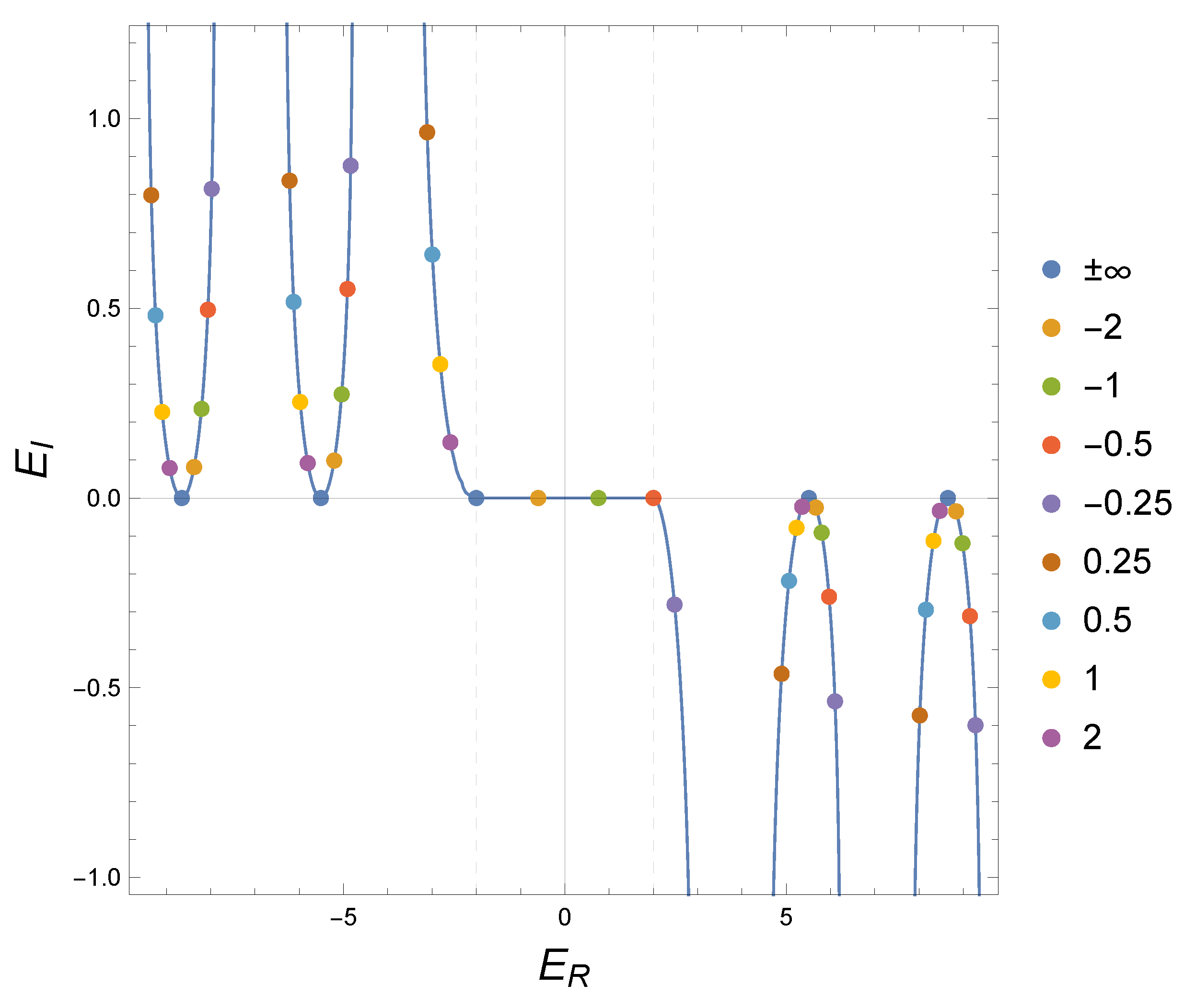
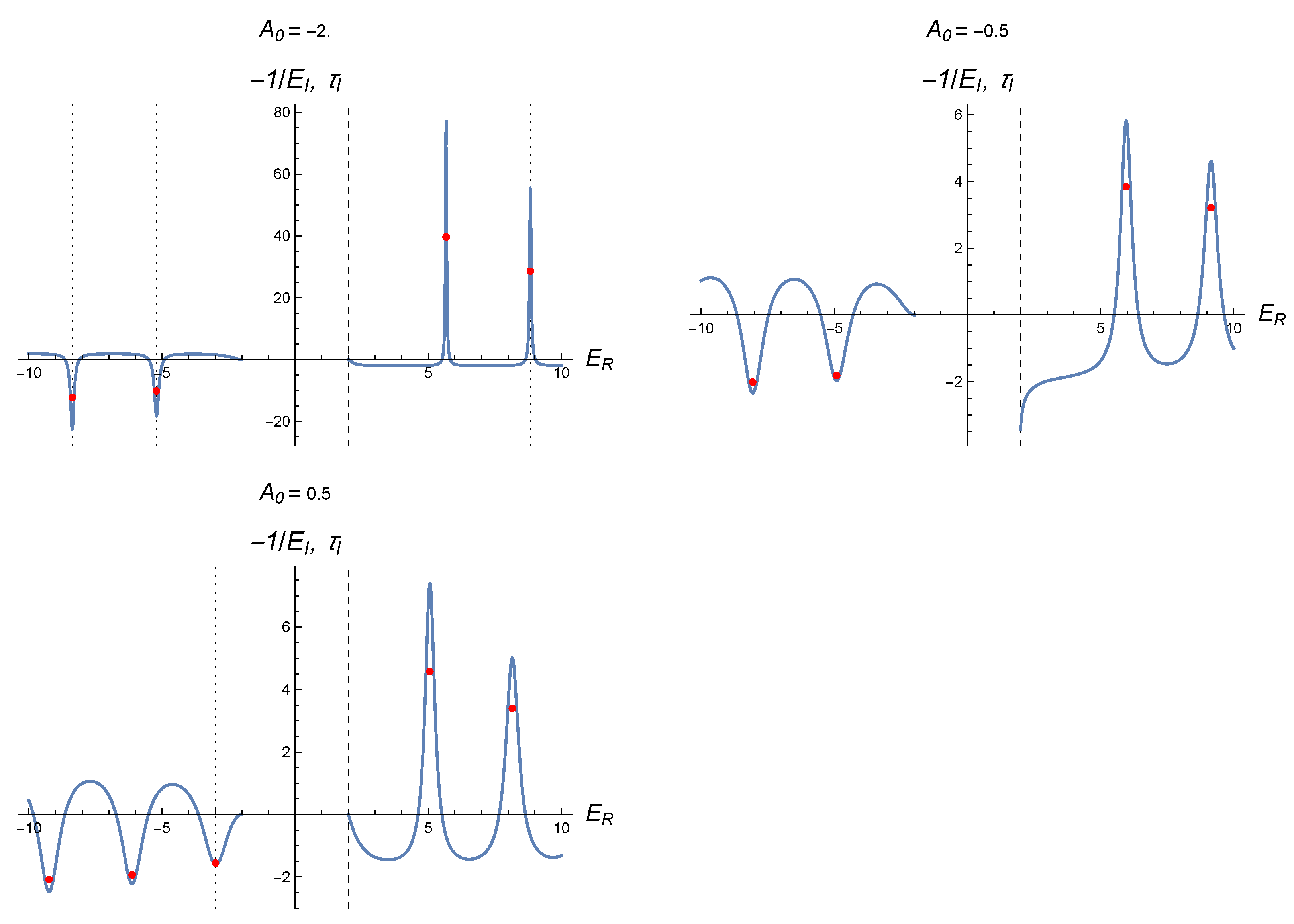
, we systematically addressed five special cases of contact interactions and their confining properties. In all these cases, we investigated how varying the potential strengths modify the structure of the critical, supercritical, bound, and resonant states. We also investigated the values (or corresponding limits) of the strengths for which the circular barrier is impenetrable. The resonant energies were identified using the real parts of the complex energy solutions for purely outgoing scattering conditions, and subsequently compared to the location of the Wigner time delay peaks, with excellent overall agreement. Our results also showed that, when the real parts of the complex energies coincide with the location of the Wigner time peaks, the negative inverse of the imaginary parts provides a scale for the intensities of these peaks. From the permeability condition (
26), we observed that only potentials with strengths
and a non-zero
B or
can produce an impenetrable barrier on the circumference. For example, we saw that a purely electrostatic contact barrier cannot completely confine an (anti)particle either in the inner or outer circle. This result is consistent with that of reference [
33] for the one-dimensional case, and recalls Klein’s paradox for point potentials. In the following, we briefly summarize the main results for the five special cases considered in this article.
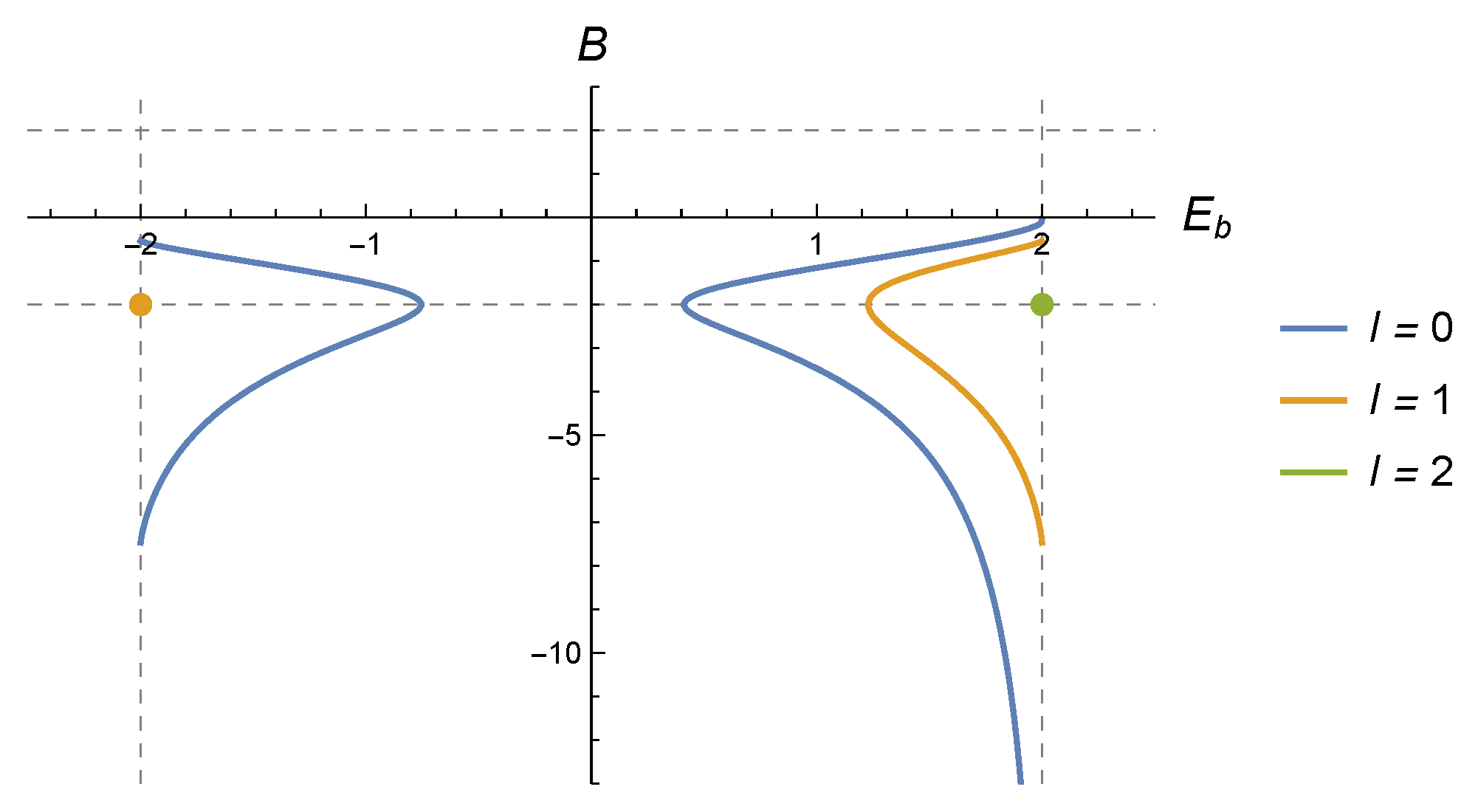
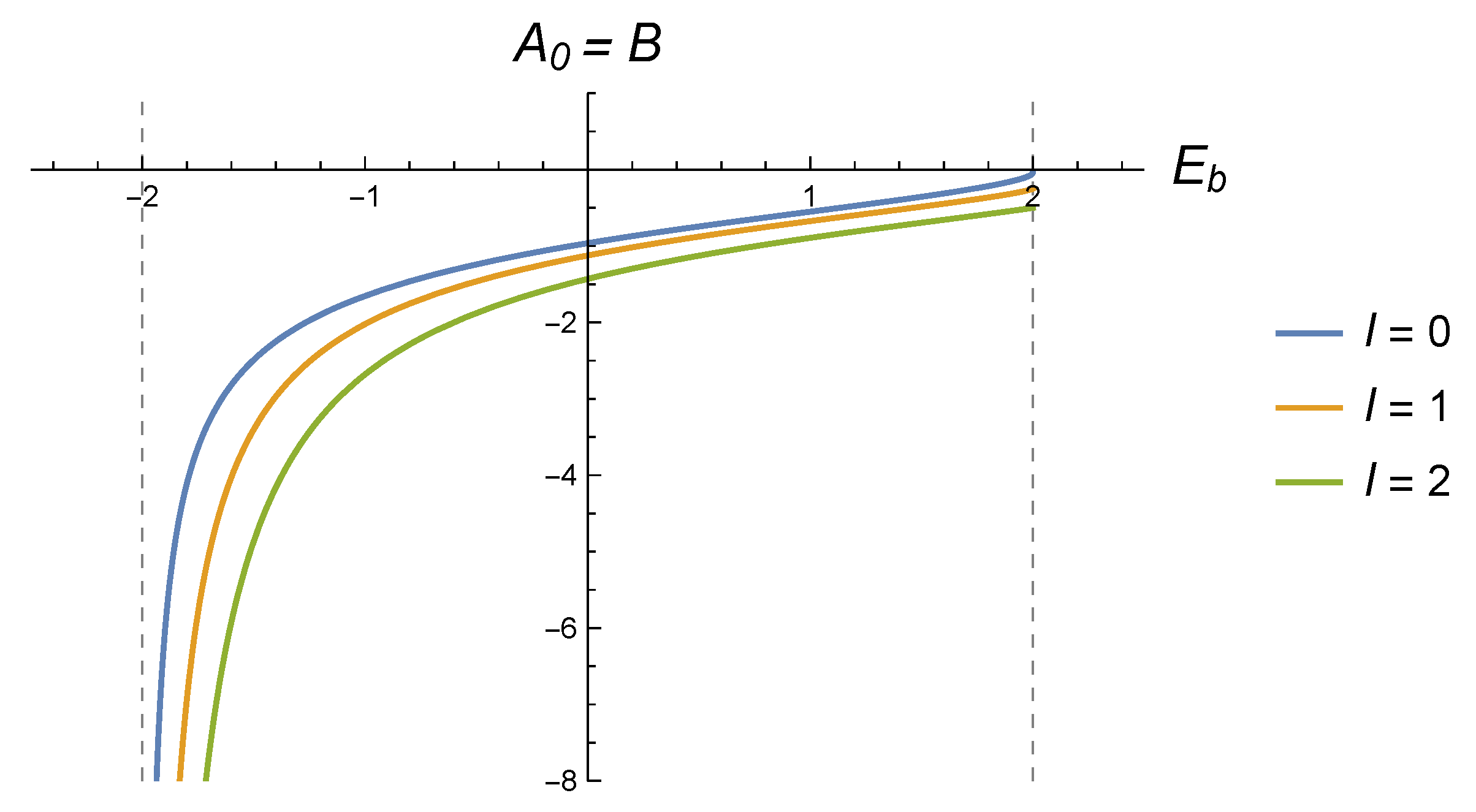
A purely scalar shell (arbitrary B, ), modeling an infinite “kick” in the (anti)particle mass at , displays a rich structure. The ensemble of bound states and resonances has the symmetry , implying that an infinite strength B will be similar to the free case. This potential can produce an impermeable wall at if the scalar strength is and can admit none, one, or two bound states (for and , respectively), for suitable negative values of the scalar strength B. The larger the mass, the more values of angular momentum will admit bound states, which may be absorbed/emitted at both the critical and supercritical energies, depending on the angular momentum l. For any value of B, there exits a discrete set of resonances close to the discrete energies admitted for (anti)particles completely confined by an impenetrable circular wall. The energy location of the Wigner time delay peaks agrees very well with the real part of the complex resonances.
A purely electrostatic shell (arbitrary , ) is never impermeable, for any finite or infinite value of strength . For positive or negative and in suitable ranges, it admits a single bound state that can be absorbed/emitted at both critical and supercritical energies . The potential also exhibits a discrete set of resonances for any value of strength . The real part of the complex resonances also shows a very good agreement with the Wigner time delay peaks.
A purely magnetic shell (arbitrary and and ) does not admit bound states , but it can be impenetrable for suitable combinations of finite values of the electromagnetic strengths, namely, and . This singular potential can therefore completely confine an (anti)particle in the inner region of the circular wall at , with a discrete set of admissible energies depending on the value of (). This potential also allows a discrete set of resonances for arbitrary choices of the electromagnetic strengths, with energies very close to the discrete energies of the impenetrable cases. It is an interesting result that for large values of the angular momentum there are still complex resonances in the limit of impenetrable walls, which do not correspond to the location of any peaks in the Wigner time delay. This mismatch may be due to the fact that these resonances do not converge to a confined state within this limit. For high values of the resonant energies, there is a good agreement between the real part of the complex energies and the locations of the Wigner time delay peaks.
Finally, we considered a situation with two “mixed” potentials, a “ shell” potential (arbitrary , ) and a “ shell” (arbitrary , ). These two cases are related to each other by a “spin flip” transformation, and we detail only the “delta shell” case. The impermeability condition is met only in the limits , and for both cases the system admits the same discrete set of energies for a particle confined in the inner region of the impenetrable circular wall. For finite values of the strength , this potential admits a single bound state for sufficiently large and negative values of this parameter. It also admits a discrete set of resonances for any value of the strength , with energies close to those corresponding to the impenetrable case. The single bound state is captured/emitted only at the critical energy . The results obtained for Wigner time delay are similar to those analyzed in the previous cases.
Future applications of the contact models presented here could include the analysis of the Aharonov–Bohm effect with a singular magnetic field concentrated on a circumference. This investigation may be interesting due to the nontrivial characteristics of singular electromagnetic interactions, both in one and two dimensions. It also seems necessary and interesting to consider the natural generalization of these models to three dimensions, with singular potentials concentrated on a spherical surface. Finally, we believe it is worth emphasizing that our two-dimensional models presented here can describe phenomena in Dirac materials, as mentioned in the Introduction, where the Fermi velocity at the surface acts like the speed of light, and may therefore be accessible, at least in principle, to perform experiments involving ordinary velocities and short-range potentials approximately localized on a circle.